

- Industry Size (2025)
- USD 2.2 Bn
- Forecast (2035)
- USD 11.9 Bn
- CAGR (2025 to 2035)
- 18.5%
Digital-Watermark Enabled Sorting for Flexible Food Packaging Market Forecast and Outlook 2026 to 2036
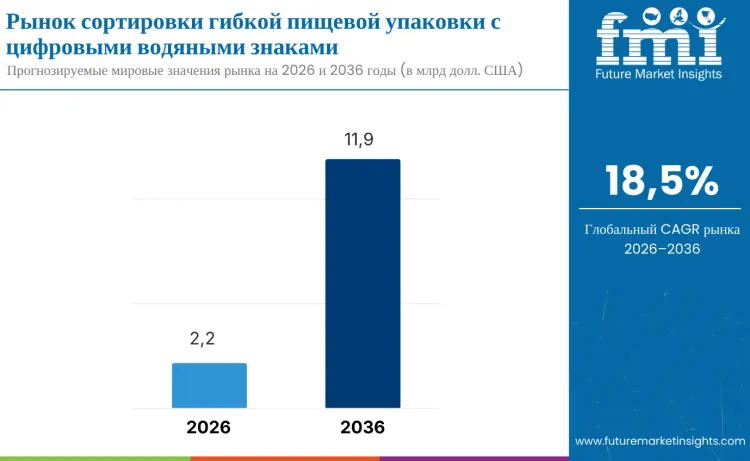
The digital-watermark enabled sorting for flexible food packaging market is valued at USD 2.2 billion in 2026 and is projected to reach USD 11.9 billion by 2036, reflecting a CAGR of 18.5%. Demand rises as recycling systems address the challenge of identifying visually similar flexible packs and improving recovery rates required under emerging circular packaging regulations. Brand owners embed imperceptible digital watermarks to enable precise pack identification at high throughput.
Machine-vision digital watermark detection systems lead technology adoption because they deliver high-speed scanning, accurate classification of multi-layer and mono-material films, and improved separation of food-grade from non-food packaging streams. Integration with AI-enabled sorting algorithms enhances detection reliability across varied lighting conditions, print designs, and film distortions. Systems support recyclers aiming to raise purity levels of PE and PP streams for downstream reprocessing.
Quick Stats for Digital-Watermark Enabled Sorting for Flexible Food Packaging Market
- Market Value (2026): USD 2.2 billion
- Market Forecast Value (2036): USD 11.9 billion
- Forecast CAGR (2026 to 2036): 18.5%
- Leading Technology Type in Global Demand: Machine-vision digital watermark detection systems
- Key Growth Regions in Global Demand: China, India, USA, Japan
- Top Players in Global Demand: Digimarc Corporation, Tomra, Pellenc ST, Suez, Amcor
China, India, USA, and Japan emerge as principal growth regions driven by regulatory momentum, expansion of flexible packaging markets, and modernization of waste-sorting infrastructure. Digimarc Corporation, Tomra, Pellenc ST, Suez, and Amcor anchor competitive development through watermark standards, advanced sensor platforms, and recycling partnerships that accelerate adoption of digitally identifiable flexible food packaging across global value chains.
Digital-Watermark Enabled Sorting for Flexible Food Packaging Market Key Takeaways
| Metric | Value |
|---|---|
| Market Value (2026) | USD 2.2 billion |
| Market Forecast Value (2036) | USD 11.9 billion |
| Forecast CAGR (2026 to 2036) | 18.5% |
How Are the Segments Classified in the Digital-Watermark Enabled Sorting for Flexible Food Packaging Market?
Demand for digital-watermark sorting solutions is shaped by PPWR-aligned recyclability goals, increased mono-material packaging adoption, and requirements for accurate high-speed identification across flexible food formats. Buyers evaluate detection accuracy, integration with existing sorting lines, and data-management capability supporting traceability. Adoption patterns reflect investment in AI-enabled recognition, hybrid NIR systems, and watermark-based coding that improves sorting precision for flexible packaging streams.
Which Technology Type Accounts for the Largest Share of Global Demand?
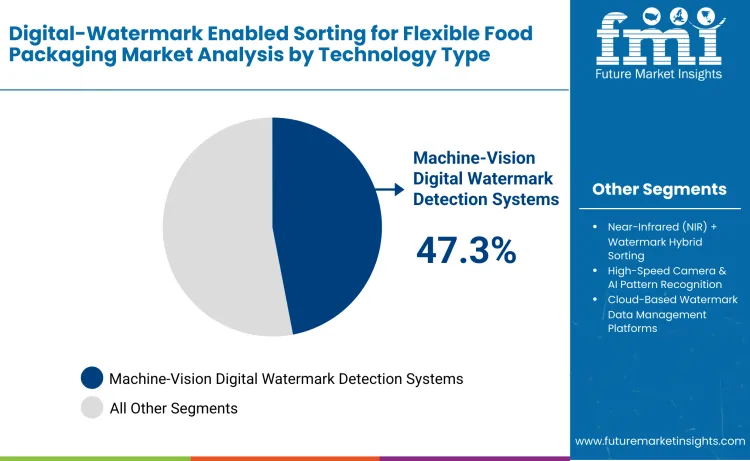
Machine-vision digital watermark detection systems hold 47.3%, making them the leading technology-type segment globally. These systems support high-resolution scanning, micro-pattern recognition, and automated identification of marked flexible packaging at industrial throughput speeds. NIR + watermark hybrid sorting enhances material discrimination by combining spectral signatures with embedded digital codes. High-speed camera and AI pattern-recognition systems support real-time classification when watermark visibility varies. Cloud-based watermark data-management platforms store product codes, support traceability, and integrate remote updates. Technology distribution reflects reliance on machine-vision precision for accurate flexible-pack sorting.
Key Points:
- Machine-vision systems deliver high-speed, high-accuracy watermark detection.
- NIR-watermark hybrids improve material-level discrimination.
- AI pattern-recognition strengthens variable-condition sorting.
- Cloud platforms support scalable watermark data integration.
Which Packaging Format Represents the Largest Share of Global Demand?
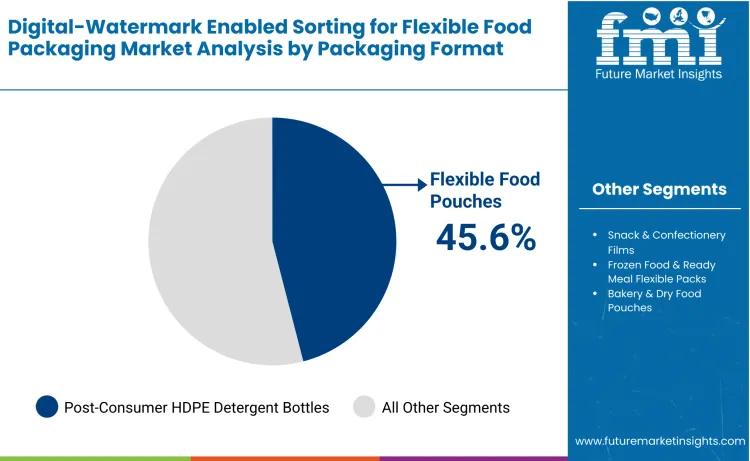
Flexible food pouches hold 45.6%, making them the largest packaging-format segment globally. Pouches represent high-volume consumption across meal kits, snacks, sauces, and ready foods, creating strong demand for accurate watermark-based sorting to improve recyclability. Snack and confectionery films support lightweight packaging streams requiring rapid classification. Frozen food and ready-meal flexible packs involve variable printing, moisture exposure, and temperature-related distortions addressed through watermark-enabled detection. Bakery and dry-food pouches support shelf-stable product formats requiring mono-material compatibility. Format distribution reflects pouch dominance in flexible-food packaging volumes and recyclability priorities.
Key Points:
- Flexible pouches lead due to high consumption volume.
- Snack films require fast, lightweight-stream sorting.
- Frozen and ready-meal packs benefit from robust watermark readability.
- Bakery pouches align with mono-material recyclability goals.
Which Material Type Accounts for the Largest Share of Global Demand?
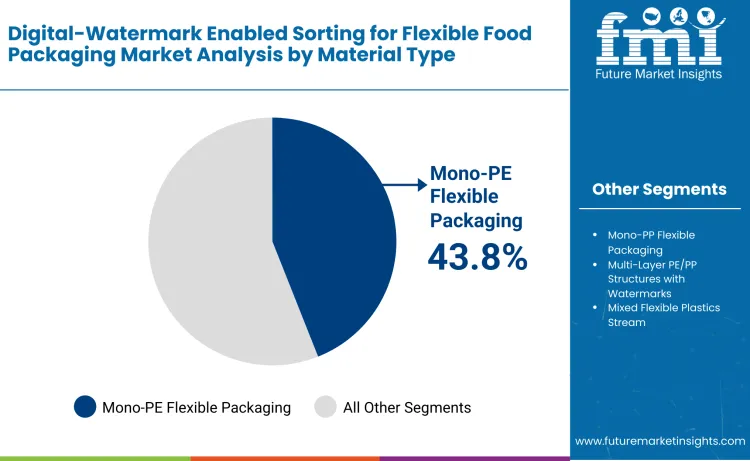
Mono-PE flexible packaging holds 43.8%, making it the largest material-type segment globally. Strong PPWR-driven demand for mono-material PE structures supports large-scale adoption of digital-watermark technology to improve sorting precision and recycling yield. Mono-PP flexible packaging supports applications needing higher heat resistance and stiffness, with improved compatibility in watermark-enabled recovery. Multi-layer PE/PP structures with digital watermarks support transitional packaging formats where enhanced sorting allows partial recovery. Mixed flexible plastics streams rely on digital-enhanced classification to separate compatible feedstock. Material distribution reflects regulatory direction favoring mono-material packaging and the role of watermarks in improving downstream sorting accuracy.
Key Points:
- Mono-PE dominates due to broad adoption and strong recyclability pathways.
- Mono-PP supports higher-heat applications with watermark-enabled sorting.
- Multi-layer structures use watermarks to improve recoverability.
- Mixed streams rely on digital coding to enhance feedstock separation.
What are the Key Dynamics in the Digital-Watermark Enabled Sorting for Flexible Food Packaging Market?
Global demand rises as packaging producers, recyclers, and brand owners adopt digital watermark technology to improve identification, separation, and recovery of flexible food packaging. Watermark systems embed imperceptible codes into packaging surfaces, enabling high speed optical detection in sorting facilities. Stakeholders evaluate technology to enhance circularity, meet recyclability targets, and reduce contamination across mixed flexible waste streams. Interest strengthens as regulatory expectations move toward higher traceability and improved material purity.
How are traceability requirements and advanced identification needs shaping adoption of digital watermark sorting?
Recycling facilities use digital watermark detection to distinguish packaging by polymer type, food contact status, and functional attributes without relying on manual inspection. Optical systems identify small and lightweight flexible items that conventional NIR sensors often miss. Brand owners integrate watermarks to support accurate separation of PE, PP, and specialty flexible films. Sorting lines achieve improved purity levels when watermarks guide targeted material flow into dedicated streams. Packaging producers incorporate watermark patterns during printing or moulding without altering package appearance. Technology trials indicate gains in identification accuracy across mixed feedstocks. Data linked to watermarks supports verification of recyclability claims and material provenance.
How do implementation costs, workflow adaptation, and material diversity influence scalability?
Sorting facilities require investment in camera arrays, processing units, and software designed to detect watermark signatures at high speed. Printers and converters must adapt artwork workflows to embed codes consistently across varying film formats. Variability in packaging thickness, ink systems, and print quality affects recognition rates, requiring calibration across materials. Waste streams with high contamination or degraded film surfaces reduce detection reliability. Collaboration between packaging producers and recyclers is necessary to align code standards and processing efficiency. Regional differences in recycling infrastructure shape adoption pace, influencing long term economics for watermark enabled sorting systems.
How is Demand for Digital-Watermark Enabled Sorting for Flexible Food Packaging Market Evolving Across Key Countries?
Demand for the digital-watermark enabled sorting for flexible food packaging market is rising due to increased focus on high-accuracy material separation, expansion of mono-material packaging, and alignment with circular-economy standards. China records a CAGR of 19.6% supported by rapid deployment of advanced sorting technologies. India shows an 18.9% CAGR driven by flexible-packaging growth and regulatory interest in recyclability. USA posts a 17.5% CAGR supported by modernization of MRF systems. Japan holds a 16.3% CAGR linked with precision recycling frameworks. UK records a 15.7% CAGR supported by policy alignment with digital-watermark initiatives and national recycling targets.
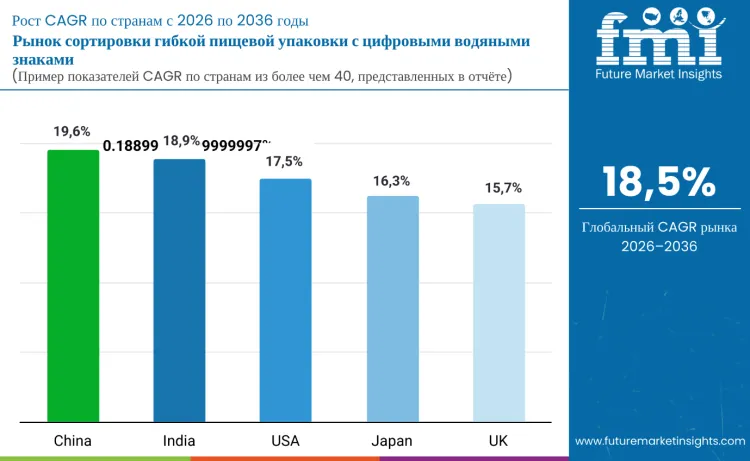
| Country | CAGR (%) |
|---|---|
| China | 19.6% |
| India | 18.9% |
| USA | 17.5% |
| Japan | 16.3% |
| UK | 15.7% |
How is China driving demand for Digital-Watermark Enabled Sorting for Flexible Food Packaging?
China drives demand due to high output of flexible packaging, rapid investment in automated recycling, and strong adoption of digital identification technologies. The country’s CAGR of 19.6% reflects active deployment of digital-watermark recognition systems enabling accurate PE, PP, and multilayer separation. Sorting centers integrate high-resolution scanners and AI-supported decision engines to improve material recovery rates. Packaging converters adopt watermark-compatible designs to support large-scale recyclability initiatives. Regional recycling hubs expand washing, reprocessing, and compounding lines to handle consistent digitally tagged feedstock. National circular-economy programs reinforce adoption across industrial clusters.
- High flexible-packaging output requiring advanced sorting
- AI-supported identification improving separation accuracy
- Converter adoption of watermark-ready designs
- Strong alignment with circular-economy development plans
How is India driving demand for Digital-Watermark Enabled Sorting for Flexible Food Packaging?
India supports rising demand due to strong growth in packaged food consumption, regulatory focus on recyclable formats, and emerging investment in digital-sorting infrastructure. The country’s CAGR of 18.9% reflects increasing adoption of watermark-enabled scanning technology used to identify flexible-pack types at higher accuracy. Packaging producers shift toward watermark-compatible mono-material structures to meet future recyclability requirements. Regional recyclers integrate upgraded recognition and sorting modules into existing lines to improve recovery consistency. Government initiatives supporting standardized marking frameworks strengthen long-term deployment.
- Growth in flexible packaged food consumption
- Regulatory emphasis on recyclability and traceability
- Upgraded sorting lines adopting watermark recognition
- Producer transition toward watermark-compatible packaging
How is the USA driving demand for Digital-Watermark Enabled Sorting for Flexible Food Packaging?
The USA drives demand through modernization of materials-recovery facilities, strong alignment with design-for-recycling principles, and broader deployment of advanced recognition technologies. The country’s CAGR of 17.5% reflects integration of watermark-enabled scanners in MRFs to differentiate flexible food packaging with improved precision. Packaging firms incorporate digital identifiers to meet recyclability guidelines. Advanced optical and AI-assisted sorting systems enable higher purity levels in PE and PP output streams. Industry partnerships test watermark frameworks at commercial scale to validate throughput and yield performance.
- AI-assisted scanning improving flexible-pack identification
- Packaging-design shifts supporting watermark inclusion
- MRF upgrades strengthening flexible-material recovery
- Industry pilots validating large-scale watermark sorting
How is Japan driving demand for Digital-Watermark Enabled Sorting for Flexible Food Packaging?
Japan drives demand due to structured waste-management systems, strong quality expectations for recycled materials, and expansion of mono-material flexible packaging. The country’s CAGR of 16.3% reflects adoption of watermark-enabled identification tools supporting precise sorting of flexible food packaging streams. Municipal collection frameworks supply consistent feedstock suitable for rigorous digital sorting. Packaging manufacturers collaborate with technology providers to refine watermark placement for high-accuracy recognition. Precision-oriented processing facilities integrate controlled washing and reprocessing steps to maintain consistent recycled-material quality.
- Structured collection systems supporting reliable feedstock
- High-accuracy digital sorting requirements
- Collaboration between manufacturers and technology providers
- Precision reprocessing supporting quality-driven recycling
How is the UK driving demand for Digital-Watermark Enabled Sorting for Flexible Food Packaging?
The UK supports demand through policy alignment with digital-watermark initiatives, national recycling-rate targets, and strong interest in traceable packaging systems. The country’s CAGR of 15.7% reflects adoption of watermark-enabled sorting pilots within regional MRFs and flexible-pack recovery centers. Extended producer-responsibility frameworks encourage use of digitally identifiable packaging. Retailers collaborate with brand owners to shift toward watermark-compatible flexible formats. National circular-economy strategies reinforce investment in automated sorting infrastructure supporting high-purity output streams.
- EPR and policy frameworks encouraging watermark adoption
- Regional deployment of watermark-enabled sorting pilots
- Retail and brand collaboration on compatible packaging
- Circular-economy strategies driving automated-sorting investment
What is the competitive landscape of demand for digital-watermark enabled sorting for flexible food packaging globally?
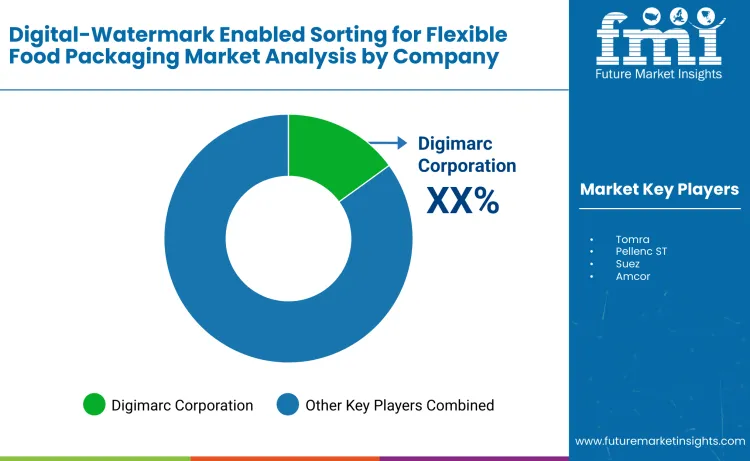
Demand for digital-watermark enabled sorting for flexible food packaging grows as recycling systems adapt to higher purity requirements, material traceability needs, and extended producer responsibility frameworks. Digimarc Corporation holds a significant share. Position strengthens through proprietary digital-watermark technology integrated into sorting trials and commercial deployments across Europe and North America. Tomra participates with sorting platforms updated to read digital watermarks alongside traditional optical signatures. Pellenc ST maintains visibility with advanced detection modules capable of integrating digital-watermark datasets into flexible packaging sorting workflows. Requirements center on high-resolution detection, pattern recognition accuracy, and reliable identification of flexible packs carrying imperceptible digital watermarks. Buyers evaluate scanner speed, lighting stability, data processing capability, and compatibility with industrial sorting lines operating at elevated throughput.
Procurement teams prioritize interoperability with existing NIR equipment, software update support, and alignment with design-for-recycling protocols. Trend in the global market reflects broader adoption of smart packaging technologies, closed-loop objectives, and digital tagging methods improving identification of PE and PP mono-material structures. Suez contributes through implementation of watermark-enabled sorting within managed recycling facilities and pilot programs. Amcor supports demand through packaging design incorporating digital watermarks that improve downstream material identification. Competitive positioning globally reflects detection fidelity, systems integration, watermark robustness, and operational scalability supporting enhanced flexible packaging recovery.
Key Players in the Digital-Watermark Enabled Sorting for Flexible Food Packaging Market
- Digimarc Corporation
- Tomra
- Pellenc ST
- Suez
- Amcor
Scope of the Report
| Items | Values |
|---|---|
| Quantitative Units | USD billion |
| Technology Type | Machine-Vision Digital Watermark Detection Systems, NIR + Watermark Hybrid Sorting, High-Speed Camera & AI Pattern Recognition, Cloud-Based Watermark Data Management Platforms |
| Packaging Format | Flexible Food Pouches, Snack & Confectionery Films, Frozen Food & Ready Meal Flexible Packs, Bakery & Dry Food Pouches |
| Material Type | Mono-PE Flexible Packaging, Mono-PP Flexible Packaging, Multi-Layer PE/PP Structures with Watermarks, Mixed Flexible Plastics Stream |
| End-User | Sorting & MRF Operators, Brand Owners & FMCG Companies, Packaging Converters, Extended Producer Responsibility (EPR) Schemes |
| Regions Covered | Asia Pacific, Europe, North America, Latin America, Middle East & Africa |
| Countries Covered | India, China, USA, Germany, South Korea, Japan, Italy, and 40+ countries |
| Key Companies Profiled | Digimarc Corporation, Tomra, Pellenc ST, Suez, Amcor |
| Additional Attributes | Dollar sales by technology type, packaging format, and material categories; adoption trends linked to digital watermark-enabled sorting initiatives (e.g., HolyGrail 2.0); efficiency gains from high-speed AI vision systems integrated with NIR; penetration of watermark-ready mono-material PE/PP packs; implementation drivers from EPR mandates and FMCG circularity targets; advances in cloud-based watermark databases supporting real-time line authentication; competitive landscape of digital watermark creators, sensor developers, and packaging converters; infrastructure readiness among MRFs for watermark-enabled automated flexible packaging recovery. |
Digital-Watermark Enabled Sorting for Flexible Food Packaging Market by Segment
By Technology Type:
- Machine-Vision Digital Watermark Detection Systems
- Near-Infrared (NIR) + Watermark Hybrid Sorting
- High-Speed Camera & AI Pattern Recognition
- Cloud-Based Watermark Data Management Platforms
By Packaging Format:
- Flexible Food Pouches
- Snack & Confectionery Films
- Frozen Food & Ready Meal Flexible Packs
- Bakery & Dry Food Pouches
By Material Type:
- Mono-PE Flexible Packaging
- Mono-PP Flexible Packaging
- Multi-Layer PE/PP Structures with Watermarks
- Mixed Flexible Plastics Stream
By End-User:
- Sorting & MRF Operators
- Brand Owners & FMCG Companies
- Packaging Converters
- Extended Producer Responsibility (EPR) Schemes
Region:
- Asia Pacific
- China
- Japan
- South Korea
- India
- Australia & New Zealand
- ASEAN
- Rest of Asia Pacific
- Europe
- Germany
- United Kingdom
- France
- Italy
- Spain
- Nordic
- BENELUX
- Rest of Europe
- North America
- United States
- Canada
- Mexico
- Latin America
- Brazil
- Chile
- Rest of Latin America
- Middle East & Africa
- Kingdom of Saudi Arabia
- Other GCC Countries
- Turkey
- South Africa
- Other African Union
- Rest of Middle East & Africa
Preview the report firsthand - request a free sample
Get SampleGet the brochure for pricing and purchase details.
Get PDFTable of Content
- Executive Summary
- Market Overview
- Global Market Value, 2020-2026
- Global Market Forecast, 2026-2036
- Market Dynamics
- Drivers
- Restraints
- Opportunities
- Regulatory & Standards Landscape
- Technology & Material Innovation Outlook
- Market Segmentation Analysis
- By Technology Type
- Machine-Vision Digital Watermark Detection Systems
- NIR + Watermark Hybrid Sorting
- High-Speed Camera & AI Pattern Recognition
- Cloud-Based Watermark Data Management Platforms
- By Packaging Format
- Flexible Food Pouches
- Snack & Confectionery Films
- Frozen Food & Ready Meal Flexible Packs
- Bakery & Dry Food Pouches
- By Material Type
- Mono-PE Flexible Packaging
- Mono-PP Flexible Packaging
- Multi-Layer PE/PP Structures with Watermarks
- Mixed Flexible Plastics Stream
- By End-User
- Sorting & MRF Operators
- Brand Owners & FMCG Companies
- Packaging Converters
- Extended Producer Responsibility (EPR) Schemes
- By Technology Type
- Regional Outlook
- Asia Pacific
- Europe
- North America
- Latin America
- Middle East & Africa
- Country-Level Outlook
- China
- India
- USA
- Japan
- United Kingdom
- Germany
- South Korea
- Italy
- Australia & New Zealand
- ASEAN
- Brazil
- Chile
- Turkey
- South Africa
- Other GCC Countries
- Rest of Europe
- Rest of Latin America
- Rest of Middle East & Africa
- Competitive Landscape
- Market Structure Overview
- Company Positioning
- Strategic Initiatives
- Key Player Profiles
- Scope of the Report
- Research Methodology
- Assumptions & Acronyms


