

- Industry Size (2026)
- USD 1.6 Bn
- Forecast (2036)
- USD 2.9 Bn
- CAGR (2026 to 2036)
- 6.1%
Industrial Odor Management Market Size, Market Forecast and Outlook By FMI
The industrial odor control market is valued at USD 1.5 billion in 2025, with revenue expected to reach USD 1.6 billion in 2026 at a projected CAGR of 6.1% across the forecast horizon. Market expansion to USD 2.9 billion by 2036 reflects increasing enforcement of fence‑line emission rules as urban development pushes residential areas closer to industrial operations, tightening compliance expectations for facilities.
Report Summary of Industrial Odor Management Market
- Market Snapshot
- The Industrial Odor Management Market stands at USD 1.5 billion in 2025 and is projected to reach USD 2.9 billion by 2036, reflecting sustained regulatory and operational demand.
- The industry is set to grow at a 6.0% CAGR from 2026 to 2036, generating an incremental USD 1.27 billion as odor control shifts from discretionary compliance to essential risk‑mitigation infrastructure.
- The category remains compliance-led, with competitiveness anchored in odor-removal efficiency, media longevity, maintenance intensity, retrofit compatibility, and service responsiveness.
- Odor management has evolved beyond nuisance mitigation as H₂S and related gases accelerate corrosion, elevate workforce exposure risks, and heighten community sensitivity, broadening the mandate for treatment solutions.
- Demand and Growth Drivers
- Demand is increasing as industrial and wastewater facilities are required to prevent off‑site odor dispersion, directly driving capital investment in treatment systems and expanding operating programs.
- Biological and hybrid solutions are gaining traction as suppliers validate >99.9% H₂S removal performance, strengthening customer confidence in non‑chemical alternatives.
- Growth is reinforced by wastewater and sanitation expansion in emerging markets, where odor mitigation is now treated as a core design criterion rather than a secondary add‑on.
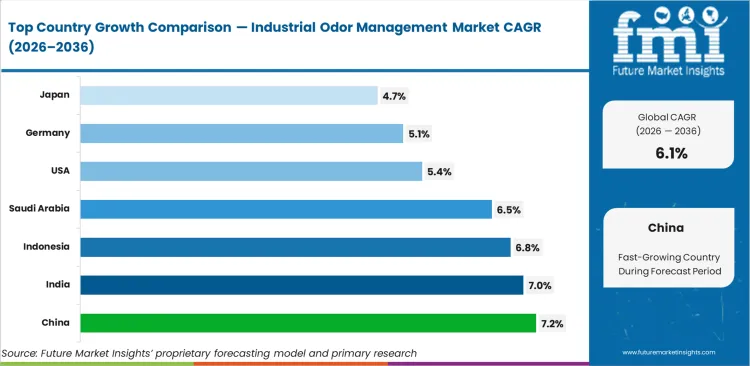
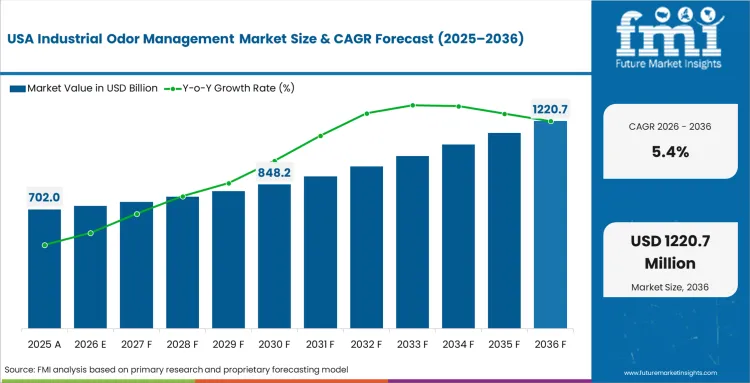
- Among key markets, China leads at 7.2% CAGR, followed by India (7.0%), Indonesia (6.8%), Saudi Arabia (6.5%), United States (5.4%), Germany (5.1%), and Japan (4.7%).
- Growth remains moderated by long asset lifecycles, engineering‑intensive project configurations, and operators who defer upgrades until regulatory tightening, corrosion losses, or community complaints lead to action.
- Product and Segment View
- The market comprises odor treatment systems, media, chemicals, monitoring, and services centered on scrubbers, biofilters, adsorbents, and control chemistry for industrial and wastewater air streams.
- Solutions are deployed across wastewater plants, sewer networks, food processing, rendering, chemicals, pulp and paper, biogas, and waste‑handling facilities.
- Chemical scrubbers (31%) lead due to their suitability for sulfur‑rich and mixed‑gas environments in municipal and industrial settings.
- Wastewater applications (34%) dominate as H₂S control underpins both nuisance reduction and asset‑corrosion protection.
- Systems (46%) represent the largest offering segment, as value remains concentrated in vessels, blowers, ducting, controls, and integrated treatment equipment.
- Retrofits (58%) dominate installations, reflecting that most projects are initiated by complaints, regulatory actions, or performance‑driven upgrades.
- Sulfur compounds (37%) remain the primary odor source as H₂S and mercaptans continue to define design parameters in wastewater and waste‑related applications.
- The scope includes on‑site odor capture, treatment, chemistry, media replacement, and monitoring, but excludes HVAC deodorization, consumer odor products, and VOC destruction solutions not intended for odor management.
- Geography and Competitive Outlook
- China, India, and Indonesia are the fastest‑growing markets, while the United States remains a stable, high‑value base with strong replacement, retrofit, and service‑oriented spending.
- Competition is increasingly shaped by bundled treatment‑plus‑service models, adoption of biological and hybrid upgrades, and deeper integration of monitoring with treatment programs.
- Key participants include Xylem, CECO Environmental, Dürr, PureAir Filtration, Anguil Environmental Systems, Bionomic Industries, and Ecolab Nalco Water.
- Market remains moderately fragmented, with the largest supplier holding roughly 14% share, reflecting end‑users’ reliance on regional integrators, application specialists, and service‑centric odor‑chemistry providers.
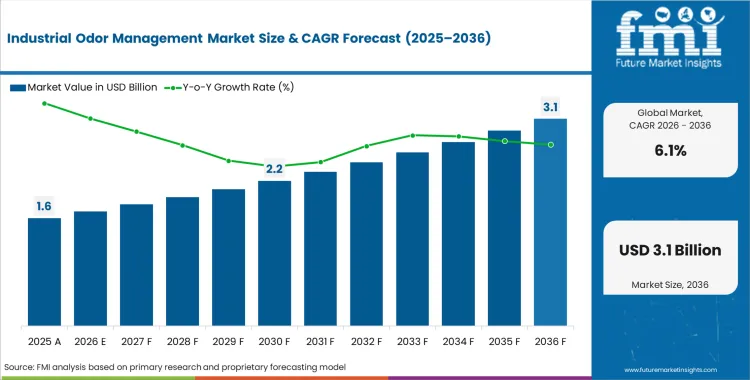
| Metric | Details |
|---|---|
| Industry Size (2026) | USD 1.6 billion |
| Industry Value (2036) | USD 2.9 billion |
| CAGR (2026 to 2036) | 6.1% |
Source: Future Market Insights (FMI) analysis, based on proprietary forecasting model and primary research
Facility leaders now face direct pressure from peri‑urban expansion that places communities in proximity to previously isolated industrial zones. Postponing mitigation upgrades accelerates complaint volumes, which regulators increasingly translate into strict operating‑permit conditions. Planning teams recognize that waiting for mandatory directives heightens shutdown risk, making early deployment of footprint‑efficient odor control systems a baseline business‑continuity measure rather than optional environmental expenditure. FMI’s analysis indicates that reliable odor control infrastructure mitigates community‑driven constraints.
As environmental authorities roll out real‑time fence‑line monitoring frameworks, continuous baseline tracking becomes a required compliance element. Objective data records replace subjective complaint assessments, compelling operators to install permanent engineered systems from industrial odor control providers instead of relying on seasonal masking solutions. Plant managers view continuous electronic monitoring as a definitive cause for committed capital investment.
China leads at 7.2% CAGR as peri-urban industrial clusters expand near dense residential zones. India tracks at 7.0% CAGR through aggressive municipal wastewater modernization mandates. Indonesia advances at an annual compound growth rate of 6.8% while Saudi Arabia registers 6.5% annual rate, both driven by first-time sanitation infrastructure rather than replacement cycles. United States demand grows at 5.4% CAGR, followed by Germany at 5.1%, reflecting mature installed bases moving toward high-efficiency media upgrades. Japan rounds out this group at a CAGR of 4.7% with compact footprint requirements defining procurement criteria. Divergence across regions stems from whether facilities are establishing initial compliance baselines or optimizing existing footprint constraints.
Segmental Analysis
Industrial Odor Management Market Analysis by Technology
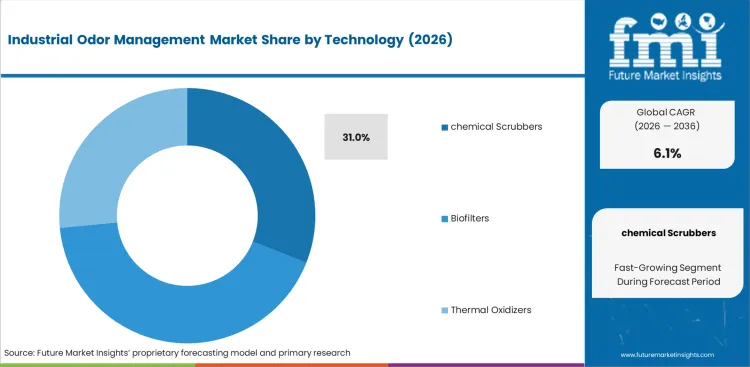
High destruction-efficiency requirements continue to create pressure for older facilities, where limited site space restricts the installation of large biological treatment systems. In this context, chemical scrubbers are often preferred over biofilters because they deliver more consistent results under variable loading conditions, especially during high-intensity sulfur events. Their ability to remain stable during process disturbances makes them a practical option for EHS teams focused on predictable compliance performance. This advantage is expected to help chemical scrubbers capture a 31.0% share of the technology segment in 2026. At the same time, scrubber use creates a secondary challenge that is often underplayed in environmental compliance discussions. Scrubber blowdown produces a liquid waste stream that requires separate treatment and can shift part of the pollution burden from air management to water handling. Facilities that fail to plan for this downstream requirement may face municipal discharge penalties despite meeting air compliance targets. The value of an optimized gas scrubber system therefore depends on balancing primary removal performance with secondary waste treatment needs.
- Concentration spike handling: Wet scrubbing systems chemically neutralize sudden bursts of hydrogen sulfide. Plant operators avoid immediate permit violations during process upsets.
- Secondary waste generation: Spent chemical solutions require dedicated treatment before discharge. Utilities managers face increased liquid waste handling costs.
- Footprint optimization: Vertical scrubber designs minimize ground-level space requirements. Engineering directors can fit high-capacity abatement into crowded existing facilities.
Industrial Odor Management Market Analysis by End Use
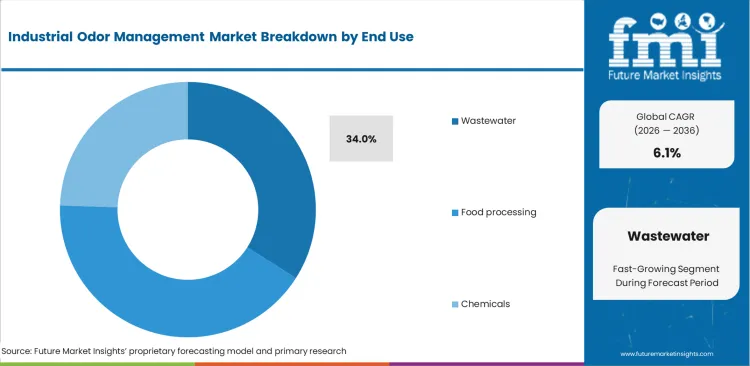
Municipal authorities face strong public pressure when collection networks release nuisance gases near residential areas. This is expected to help wastewater capture a 34.0% share of the end-use segment in 2026 within the wastewater odor control market. Sewer odor and corrosion control remain a priority because hydrogen sulfide affects both surrounding communities and underground infrastructure. Plant superintendents often specify heavy-duty odor control systems for this reason. Equipment designed for aggressive sewer conditions can help reduce long-term infrastructure damage. Many project teams still view odor control as a response to public complaints alone. That approach overlooks the effect of sulfide corrosion on concrete assets over time. Effective odor control in wastewater plants also supports lift station protection and reduces future repair burdens. The segment is expected to retain strong demand as operators link odor control more closely with asset preservation.
- Corrosion prevention: Effective sulfide removal stops sulfuric acid formation on concrete surfaces. Asset managers extend infrastructure lifespan significantly.
- Community relations: Neutralizing lift station emissions prevents residential nuisance reports. Operations directors maintain public goodwill during urban expansion.
- Regulatory compliance: Continuous treatment meets strict municipal air quality standards. Compliance officers avoid costly fines and mandated pauses.
Industrial Odor Management Market Analysis by Offering
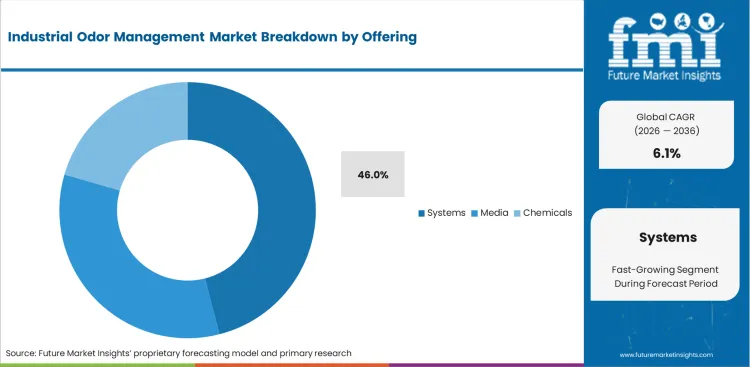
Procurement teams increasingly evaluate the trade‑off between piecemeal component sourcing and fully integrated turnkey platforms. Buyers are gravitating toward unified solutions as they seek stronger accountability and reduced integration risk across project lifecycles. In this context, integrated industrial odor control systems are projected to capture a 46.0% share in 2026, reflecting growing preference for single‑vendor performance assurance. Project engineers further reinforce this change by demanding complete skids, as internally matching fans, media, and monitoring sensors introduces unacceptable variability in system output. FMI’s analysis indicates that unified air‑pollution‑control architectures also streamline permitting, given their ability to deliver certified outlet concentrations. Capital expenditure reviews often overlook that proprietary system designs can lock facilities into long‑term captive media‑replacement contracts. Buyers who prioritize the lowest upfront investment frequently relinquish leverage over long‑term operating expenses, ultimately facing inflated chemical and media budgets.
- Performance guarantees: Turnkey platforms provide certified outlet emission levels. Environmental directors secure operating permits faster with vendor-backed data.
- Integration risk: Pre-engineered skids eliminate mismatched component sizing. Project engineers avoid costly on-site modification delays.
- Lifecycle pricing: Proprietary media chambers restrict third-party replacement options. Procurement managers must negotiate long-term consumable contracts upfront.
Industrial Odor Management Market Analysis by Installation
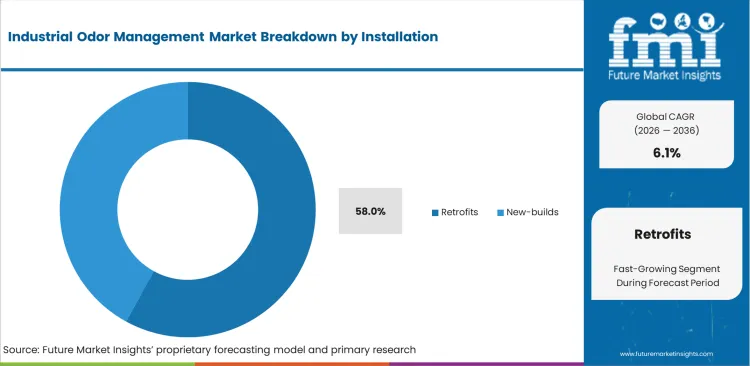
Legacy facilities continue to face tightening emission standards as expanding residential zones encroach on long‑established industrial boundaries. Operations managers increasingly rely on engineered odor‑control retrofits, as relocating entire plants remains economically unfeasible. These retrofits are often installed within severely constrained footprints, requiring abatement of hardware to fit into narrow spaces between existing structures. FMI’s analysis highlights that custom‑engineered air‑pollution‑control equipment designed for modular assembly has become a decisive factor in vendor selection under such conditions. Standard market share figures frequently obscure the extent to which retrofit budgets are consumed by modifications rather than treatment equipment itself. Engineered odor‑control retrofits for factories are projected to command a 58.0% share in 2026, underscoring their dominance in space‑restricted environments. Facilities that postpone proactive upgrades ultimately encounter emergency installation mandates, forcing dependence on premium‑priced modular systems to satisfy increasingly aggressive compliance deadlines.
- Space constraints: Modular hardware fits within existing boundaries. Plant managers avoid costly demolition while upgrading compliance capabilities.
- Integration complexity: Tying new scrubbers into active exhaust ductwork requires precise scheduling. Engineering teams face significant downtime risks during connection.
- Capital allocation: Hidden reinforcement costs often exceed equipment purchase prices. Financial directors must budget for extensive site preparation.
Industrial Odor Management Market Analysis by Odor Source
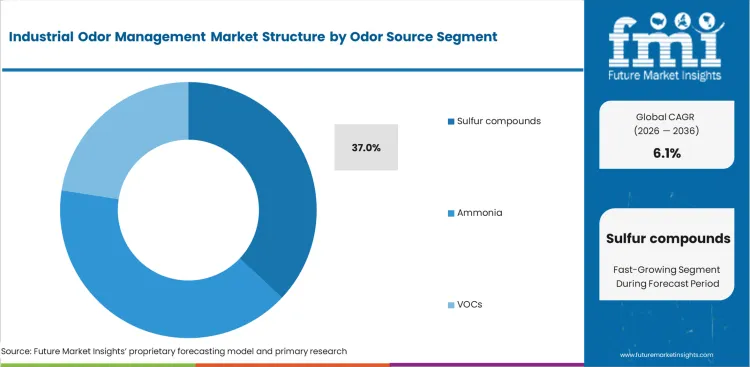
Extreme human olfactory sensitivity to mercaptans and hydrogen sulfide forces immediate mitigation action. Targeted H2S odor control systems hold an estimated 37.0% share in 2026 because even fractional parts-per-billion concentrations result in neighborhood complaints. Compliance officers target these specific molecules using dedicated media and scrubbers. FMI observes that neutralizing sulfur requires different chemistry than general air filters designed for particulates. Most regulatory frameworks focus on toxicity, yet non-toxic nuisance odors routinely cause more facility shutdowns due to sheer volume of public outcry. Operators focusing strictly on toxic threshold limits often find themselves unprepared for community-led legal actions over harmless but highly pungent sulfur emissions.
- Threshold sensitivity: Humans detect hydrogen sulfide at extremely low concentrations. EHS managers must target near-zero outlet emissions to prevent complaints.
- Chemical specificity: Dedicated caustic scrubbing removes sulfur efficiently. Utilities directors must balance chemical consumption against destruction requirements.
- Public perception: Pungent emissions signal danger regardless of actual toxicity. Plant managers face scrutiny until specific sulfur abatement is verified.
Industrial Odor Management Market Drivers, Restraints, and Opportunities
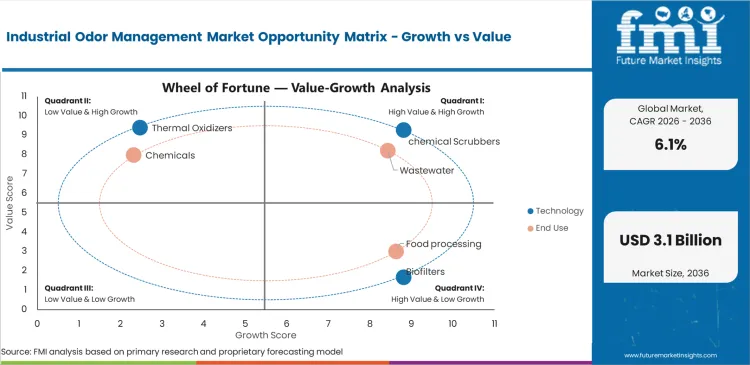
Peri-urban residential development forces industrial facilities into immediate compliance upgrades. Plant managers face existential threats when new housing tracts border legacy manufacturing sites, elevating minor nuisance odors into major political issues. Delaying abatement installation leads to organized community opposition, making industrial emissions odor compliance an existential requirement. Facilities must deploy advanced odor detection equipment alongside industrial odor monitoring systems to maintain their operating licenses. Compliance officers track public complaint logs closely, knowing each report increases likelihood of mandatory facility inspections.
Physical footprint limitations prevent widespread deployment of low-cost biological filters at established facilities. Plant engineers struggle to find adequate ground space for large media beds, forcing reliance on compact but chemically intensive scrubber systems. This spatial reality locks operators into higher long-term consumable costs, as inexpensive biological options simply cannot fit within existing property lines. High-efficiency vertical systems partially address this friction but carry significant capital premiums. Operations directors must evaluate odor control system maintenance cost alongside expensive engineering workarounds to site abatement hardware.
Opportunities in the Industrial Odor Management Market
- Transient-load handling: Vendors developing sensors that preemptively adjust chemical dosing during process upsets capture premium contracts. Operations directors need dynamic response capabilities.
- Waterless abatement: Deploying dry scrubbing systems with activated carbon odor control industrial media eliminates secondary liquid waste streams. EHS managers avoid transferring pollution from air to water.
- Predictive maintenance: Integrating volatile organic compound gas sensor networks allows proactive evaluation of media replacement frequency odor control. Maintenance supervisors prevent breakthrough emissions before they occur.
Regional Analysis
Based on regional analysis, industrial odor management market is segmented into East Asia, South Asia, North America, Western Europe, and Middle East across 40 plus countries.
.webp "Top Country Growth Comparison Industrial Odor Management Market Cagr (2026 2036)")
| Country | CAGR (2026 to 2036) |
|---|---|
| China | 7.2% |
| India | 7.0% |
| Indonesia | 6.8% |
| Saudi Arabia | 6.5% |
| United States | 5.4% |
| Germany | 5.1% |
| Japan | 4.7% |
Source: Future Market Insights (FMI) analysis, based on proprietary forecasting model and primary research
East Asia Industrial Odor Management Market Analysis
Aggressive relocation of heavy industry into monitored eco-parks defines regional expansion. Local environmental bureaus mandate continuous emission tracking before granting operating permits. FMI's analysis indicates that centralized wastewater treatment within these parks creates massive point-source odor challenges requiring industrial-scale abatement. Facilities cannot begin operations until advanced neutralization systems pass rigorous baseline testing. Equipment suppliers aligning with provincial park developers secure large-scale fleet installation contracts.
- China: The industrial odor management market in China experiences mandatory continuous monitoring, forcing immediate hardware upgrades across industrial parks. EHS directors secure comprehensive air scrubbing chemicals for industrial emissions to meet strict local limits. Revenue for industrial odor management in China is anticipated to record a 7.2% CAGR through 2036. Vendors offering integrated data logging alongside robust neutralization capabilities ultimately win dominant market share.
- Japan: Sales of abatement technologies in Japan are poised to garner a 4.7% CAGR during the assessment period, largely because stringent urban zoning laws compel plants to implement ultra-compact solutions. Facilities engineers specify high-efficiency media systems that require a minimal physical footprint. By adopting these targeted designs, operations directors successfully achieve strict emission compliance without sacrificing highly valuable production floor space across established legacy facilities.
FMI's report includes South Korea and Taiwan. Regional momentum favors suppliers capable of integrating emission data directly into municipal smart-city monitoring grids.
South Asia and Middle East Industrial Odor Management Market Analysis
Municipal wastewater modernization drives rapid infrastructure development across urban centers. Funding from central sanitation programs requires engineered odor control at new lift stations. According to FMI's estimates, decentralized treatment plants embedded in residential areas demand high-efficiency compact systems. Contractors building these networks must include certified abatement skids within primary project bids. Planners prioritizing stringent odor control for food processing plants and civic infrastructure reduce long-term maintenance burdens for operators.
- India: The industrial odor control market in India experiences rapid development as government-funded sanitation projects require built-in abatement systems from day one. Municipal engineers aggressively deploy high-capacity biofilters to ensure low-maintenance daily operation. Driven by this infrastructure push, demand across the Indian industrial sector is set to rise at a 7.0% CAGR by 2036. This early specification inevitably locks facilities into long-term media replacement contracts.
- Indonesia: Green-field industrial parks require integrated emission controls just to secure essential international financing. Driven by these foundational investments, the industrial odor management segment in Indonesia is anticipated to capture a 6.8% CAGR during the forecast period. Project managers specifically prioritize simple, easily maintained scrubbing technologies. This pragmatic approach allows newly built facilities to achieve baseline environmental compliance while simultaneously minimizing complex operator training requirements.
- Saudi Arabia: Petrochemical hubs are implementing strict fence-line monitoring protocols to govern emissions. To eliminate highly complex vapor streams, site directors consistently install advanced thermal oxidizers. Capitalizing on this heavy industrial focus, odor abatement demand in Saudi Arabia is expected to record a 6.5% CAGR through 2036. Procurement teams leverage these high-capacity units to aggressively protect adjacent residential zones from hazardous chemical off-gassing.
FMI's report includes UAE and Malaysia. Expanding heavy industrial corridors rely heavily on modular systems capable of fast-track deployment.
North America and Europe Industrial Odor Management Market Analysis
Mature installed bases move procurement focus toward high-efficiency media upgrades. Regulators aggressively tighten allowable emission thresholds around established industrial zones. Based on FMI's assessment, plants face pressure to retrofit existing hardware with superior capture technologies. Buyers target specific water treatment market solutions integrating advanced analytical sensors. Organizations delay wholesale system replacement by extending hardware lifespan through strategic component modernization.
- United States: Revenue within the United States odor management sector is projected to rise at a 5.4% CAGR during the assessment period as strict enforcement of localized air quality permits forces plants to upgrade legacy scrubbers. Compliance officers increasingly integrate advanced monitoring components to verify ongoing performance. Facilities utilizing these continuous logging capabilities successfully preempt costly municipal fines while avoiding full-scale equipment replacement.
- Germany: Deep integration of stringent sustainability metrics heavily pushes facility operators toward low-energy biological systems. Process engineers actively eliminate chemically intensive scrubbers wherever technically feasible. Driven by this green transition, the German industrial odor control segment is anticipated to record a 5.1% CAGR by 2036. Plants fully transitioning to these dry media solutions successfully reduce their overall operational carbon footprints while maintaining regulatory compliance.
FMI's report includes Canada and France. Stricter dispersion modeling requirements compel facilities to redesign exhaust stacks for improved atmospheric mixing.
Competitive Aligners for Market Players
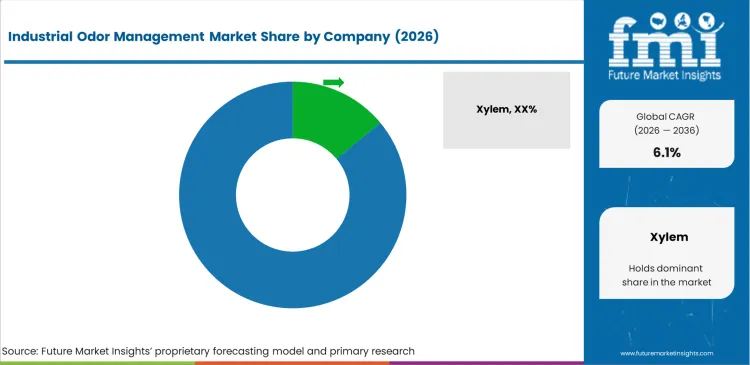
Incumbents leverage massive installed bases and proprietary media formulations to lock in recurring revenue. Identifying the best industrial odor control companies requires procurement directors to factor in these captive consumable ecosystems. Challengers attempt to break this hold by offering open-architecture systems compatible with generic replacement media. Evaluators looking for reliable industrial odor control suppliers carefully assess whether lower initial capital costs offset higher long-term chemical consumption. Organizations utilizing water and wastewater treatment chemicals optimize dosing strategies to reduce total operating expenses.
Tracking industrial odor management key players reveals that true competitive advantage involves proven reliability under transient peak loading, not just steady-state efficiency. Leading industrial odor control manufacturers demonstrate this capability through extensive field data across diverse industrial applications. Engineering managers prioritize vendors with validated performance curves during process upsets. Facilities requiring high-performance industrial water treatment solutions seek suppliers offering guaranteed destruction rates under worst-case scenarios.
Large municipalities resist single-vendor lock-in by mandating standardized dimensions for media vessels. This forces suppliers to compete on chemical efficiency and voc capture and scrubbing chemicals performance rather than proprietary hardware shapes. FMI observes that successful players adapt by switching profit centers from hardware margins to predictive maintenance contracts. Suppliers providing continuous remote monitoring systems generate stable service revenue while ensuring clients maintain uninterrupted compliance.
Key Players in Industrial Odor Management Market
- Xylem
- CECO Environmental
- Dürr
- PureAir Filtration
- Anguil Environmental Systems
- Bionomic Industries
- Ecolab Nalco Water
Scope of the Report
| Metric | Value |
|---|---|
| Quantitative Units | USD 1.6 billion to USD 2.9 billion, at a CAGR of 6.1% |
| Market Definition | Industrial odor management encompasses hardware and chemical interventions designed to neutralize volatile emission streams before atmospheric release. Core mechanisms include biological degradation, chemical scrubbing, and thermal oxidation of nuisance compounds. |
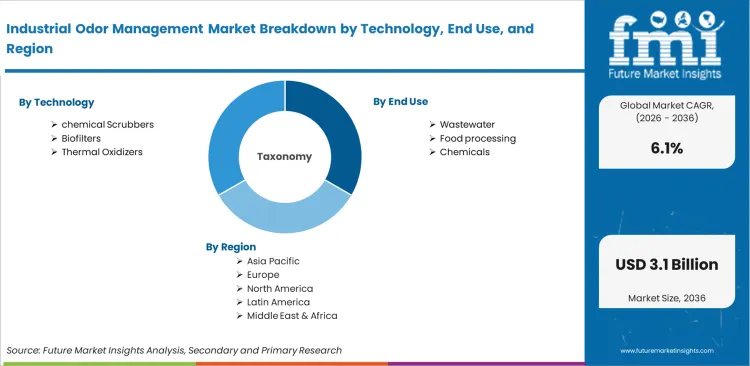
| Segmentation | By technology, By end use, By offering, By installation, By odor source, and Region |
| Regions Covered | North America, Latin America, Europe, Asia Pacific, Middle East and Africa |
| Countries Covered | China, India, Indonesia, Saudi Arabia, United States, Germany, Japan |
| Key Companies Profiled | Xylem, CECO Environmental, Dürr, PureAir Filtration, Anguil Environmental Systems, Bionomic Industries, Ecolab Nalco Water |
| Forecast Period | 2026 to 2036 |
| Approach | Municipal infrastructure capital expenditure budgets and heavy industrial facility construction permits anchor quantitative modeling. |
Source: Future Market Insights (FMI) analysis, based on proprietary forecasting model and primary research
Industrial Odor Management Market Analysis by Segments
By technology:
- Chemical scrubbers
- Biofilters
- Carbon adsorbers
- Thermal oxidizers
- Mist systems
By end use:
- Wastewater
- Food processing
- Chemicals
- Waste handling
- Pulp & paper
By offering:
- Systems
- Media
- Chemicals
- Monitoring
- Services
By installation:
- Retrofits
- New-builds
By odor source:
- Sulfur compounds
- Ammonia
- VOCs
- Organic vapors
- Mixed streams
Region:
- North America
- United States
- Canada
- Europe
- Germany
- United Kingdom
- France
- Italy
- Spain
- Asia Pacific
- China
- Japan
- South Korea
- Taiwan
- Singapore
- Latin America
- Brazil
- Mexico
- Argentina
- Middle East & Africa
- GCC Countries
- South Africa
Bibliography
- United States Environmental Protection Agency. (2024). Enforcement and Compliance Assurance annual results for fiscal year 2024. EPA.
- United States Environmental Protection Agency. (2025, March 3). Air Permit No. 10247T09. EPA.
- de Falco, G., et al. (2025). Biofiltration for odor mitigation in water resource recovery facilities: Current understanding and future directions. Science of the Total Environment.
- Szyłak-Szydłowski, M., & Kulig, A. (2024). Deodorisation of ventilated air from a fat-processing plant using different types of biofilter fillings and membranes. Sustainability, 16(5), 1939.
- Han, D., Sun, Q., Yan, X., Zhang, X., Wang, X., & Wang, K. (2024). Review on photocatalytic applications for deodorization in livestock and poultry farms. Agriculture, 14(12), 2216.
This bibliography is provided for reader reference. The full FMI report contains the complete reference list with primary source documentation.
This Report Addresses
- What constraints prevent widespread biological filter deployment across legacy manufacturing sites.
- Why chemical scrubbers maintain dominance despite generating secondary liquid waste streams requiring separate treatment.
- How continuous fence-line monitoring protocols switch capital allocation from temporary masking agents to permanent hardware.
- Which specific compliance metrics correlate most strongly with community nuisance complaints during process upsets.
- Where modular retrofit designs provide cost advantages over wholesale system replacement in space-constrained facilities.
- When municipal authorities enforce aggressive abatement mandates on decentralized wastewater lift stations.
- Who holds leverage over long-term operating budgets regarding proprietary media replacement contracts.
- What engineering strategies successfully manage transient peak loading of hydrogen sulfide emissions.
Frequently Asked Questions
Explain the industrial odor management market outlook through 2036?
Revenue is expected to reach USD 2.9 billion by 2036. Urban encroachment forces facility directors to implement permanent abatement infrastructure, driving sustained capital expenditure across heavy manufacturing sectors.
What is the industrial odor control market size in 2025 and 2036?
FMI notes a valuation of USD 1.5 billion in 2025. The sector advances to USD 2.9 billion by 2036, supported by tightening municipal permits and strict fence-line monitoring requirements.
What is the industrial odor management CAGR?
Analysis indicates a 6.1% compound annual growth rate through 2036. Decentralized wastewater lift stations and expanding industrial parks require continuous emission tracking and high-efficiency neutralization hardware.
What is the best technology for H2S odor control?
Dedicated caustic scrubbers provide the highest destruction efficiency for concentrated hydrogen sulfide spikes. Plant operators rely on chemical neutralization to prevent community complaints during unexpected process upsets.
Compare scrubbers biofilters and carbon systems for industrial odor control?
Scrubbers handle transient peak loading but generate secondary liquid waste. Biofilters offer low operating expenses but require massive physical footprints. Carbon adsorbers provide excellent polishing for low-concentration streams but demand frequent media replacement.
How much does an industrial odor control system cost?
Capital expenditure varies significantly based on volumetric capacity and destruction requirements. Procurement teams must evaluate total lifecycle expenses, as proprietary media replacement and secondary waste treatment often exceed initial hardware investments.
How do industrial odor control systems work?
These platforms neutralize volatile emission streams before atmospheric release. Core mechanisms include biological degradation by microbial cultures, chemical scrubbing via caustic solutions, and thermal oxidation of nuisance compounds inside reaction chambers.
Who are the best industrial odor control companies?
Leading suppliers include Xylem, CECO Environmental, Dürr, PureAir Filtration, and Anguil Environmental Systems. Engineering managers prioritize vendors demonstrating proven reliability under worst-case transient peak loading scenarios.
Why do systems command a leading offering share?
Turnkey platforms provide certified outlet emission levels, claiming 46.0% share. Engineering directors avoid integration risks associated with mismatched components.
What drives retrofit installations?
Space-constrained legacy facilities must upgrade emission controls without expanding footprints. Modular hardware allows plant managers to meet new regulations without costly demolition.
Why are sulfur compounds the primary target?
Extreme human olfactory sensitivity to mercaptans forces immediate mitigation. Compliance officers deploy dedicated caustic scrubbing to neutralize low-threshold nuisance gases.
How does China maintain its growth trajectory?
Mandatory continuous monitoring across modern industrial parks is the driver for a 7.2% CAGR. Centralized wastewater treatment creates massive point-source challenges requiring high-capacity abatement.
What differences exist between Indian and German demand?
India expands rapidly at 7.0% through initial municipal sanitation deployments. Germany tracks at 5.1% by retrofitting mature installations with high-efficiency biological media.
How do transient loads impact system design?
Abatement architecture must handle sudden peak concentrations during process upsets. Facilities utilizing predictive sensors avoid permit violations during unexpected emission spikes.
Why do masking agents face declining adoption?
Regulators increasingly demand permanent destruction rather than temporary masking. EHS officers abandon perfumed sprays to meet strict molecular neutralization requirements.
What hidden costs impact total lifecycle expenses?
Proprietary media chambers lock facilities into captive replacement pricing. Procurement teams must evaluate consumable contracts upfront to prevent inflated operating budgets.
How does secondary waste affect abatement choices?
Wet scrubbing generates liquid waste requiring dedicated treatment before discharge. Utilities managers must balance efficient air compliance against increased water handling costs.
Why is footprint optimization critical for retrofits?
Cramped industrial alleys restrict large-scale equipment deployment. Vertical designs allow engineering teams to install high-capacity systems without expanding property lines.
What role does continuous monitoring play in procurement?
Electronic data streams eliminate subjective complaint thresholds. Plant managers use integrated sensors to verify performance and proactively schedule media replacement.
How do turnkey skids simplify permitting?
Vendor-backed performance guarantees streamline municipal approval processes. Environmental directors secure operating permits faster when using unified integrated platforms.
Why do low-toxicity emissions cause facility shutdowns?
Pungent nuisance odors generate overwhelming public outcry regardless of toxicity. Operators prioritizing toxic limits often fail to address harmless but highly volatile sulfur compounds.
How do expanding industrial parks secure international financing?
Green-field projects require integrated emission controls to meet global standards. Project managers specify reliable scrubbing technologies to satisfy strict environmental performance covenants.
What competitive advantage do open-architecture systems offer?
Standardized dimensions prevent single-vendor lock-in for replacement media. Procurement directors gain leverage by purchasing generic chemicals instead of proprietary formulations.
How does corrosion prevention influence municipal budgets?
Sulfide removal helps extend the service life of concrete infrastructure. Asset managers are expected to gain greater long-term savings from preventive abatement than from post-failure repair work.
Preview the report firsthand - request a free sample
Get SampleGet the brochure for pricing and purchase details.
Get PDFTable of Content
- Executive Summary
- Global Market Outlook
- Demand-side Trends
- Supply-side Trends
- Technology Roadmap Analysis
- Analysis and Recommendations
- Market Overview
- Market Coverage / Taxonomy
- Market Definition / Scope / Limitations
- Research Methodology
- Chapter Orientation
- Analytical Lens and Working Hypotheses
- Market Structure, Signals, and Trend Drivers
- Benchmarking and Cross-market Comparability
- Market Sizing, Forecasting, and Opportunity Mapping
- Research Design and Evidence Framework
- Desk Research Programme (Secondary Evidence)
- Company Annual and Sustainability Reports
- Peer-reviewed Journals and Academic Literature
- Corporate Websites, Product Literature, and Technical Notes
- Earnings Decks and Investor Briefings
- Statutory Filings and Regulatory Disclosures
- Technical White Papers and Standards Notes
- Trade Journals, Industry Magazines, and Analyst Briefs
- Conference Proceedings, Webinars, and Seminar Materials
- Government Statistics Portals and Public Data Releases
- Press Releases and Reputable Media Coverage
- Specialist Newsletters and Curated Briefings
- Sector Databases and Reference Repositories
- FMI Internal Proprietary Databases and Historical Market Datasets
- Subscription Datasets and Paid Sources
- Social Channels, Communities, and Digital Listening Inputs
- Additional Desk Sources
- Expert Input and Fieldwork (Primary Evidence)
- Primary Modes
- Qualitative Interviews and Expert Elicitation
- Quantitative Surveys and Structured Data Capture
- Blended Approach
- Why Primary Evidence is Used
- Field Techniques
- Interviews
- Surveys
- Focus Groups
- Observational and In-context Research
- Social and Community Interactions
- Stakeholder Universe Engaged
- C-suite Leaders
- Board Members
- Presidents and Vice Presidents
- R&D and Innovation Heads
- Technical Specialists
- Domain Subject-matter Experts
- Scientists
- Physicians and Other Healthcare Professionals
- Governance, Ethics, and Data Stewardship
- Research Ethics
- Data Integrity and Handling
- Primary Modes
- Tooling, Models, and Reference Databases
- Desk Research Programme (Secondary Evidence)
- Data Engineering and Model Build
- Data Acquisition and Ingestion
- Cleaning, Normalisation, and Verification
- Synthesis, Triangulation, and Analysis
- Quality Assurance and Audit Trail
- Market Background
- Market Dynamics
- Drivers
- Restraints
- Opportunity
- Trends
- Scenario Forecast
- Demand in Optimistic Scenario
- Demand in Likely Scenario
- Demand in Conservative Scenario
- Opportunity Map Analysis
- Product Life Cycle Analysis
- Supply Chain Analysis
- Investment Feasibility Matrix
- Value Chain Analysis
- PESTLE and Porter’s Analysis
- Regulatory Landscape
- Regional Parent Market Outlook
- Production and Consumption Statistics
- Import and Export Statistics
- Market Dynamics
- Global Market Analysis 2021 to 2025 and Forecast, 2026 to 2036
- Historical Market Size Value (USD Million) Analysis, 2021 to 2025
- Current and Future Market Size Value (USD Million) Projections, 2026 to 2036
- Y-o-Y Growth Trend Analysis
- Absolute $ Opportunity Analysis
- Global Market Pricing Analysis 2021 to 2025 and Forecast 2026 to 2036
- Global Market Analysis 2021 to 2025 and Forecast 2026 to 2036, By Technology
- Introduction / Key Findings
- Historical Market Size Value (USD Million) Analysis By Technology , 2021 to 2025
- Current and Future Market Size Value (USD Million) Analysis and Forecast By Technology , 2026 to 2036
- chemical Scrubbers
- Biofilters
- Thermal Oxidizers
- chemical Scrubbers
- Y-o-Y Growth Trend Analysis By Technology , 2021 to 2025
- Absolute $ Opportunity Analysis By Technology , 2026 to 2036
- Global Market Analysis 2021 to 2025 and Forecast 2026 to 2036, By End Use
- Introduction / Key Findings
- Historical Market Size Value (USD Million) Analysis By End Use, 2021 to 2025
- Current and Future Market Size Value (USD Million) Analysis and Forecast By End Use, 2026 to 2036
- Wastewater
- Food processing
- Chemicals
- Wastewater
- Y-o-Y Growth Trend Analysis By End Use, 2021 to 2025
- Absolute $ Opportunity Analysis By End Use, 2026 to 2036
- Global Market Analysis 2021 to 2025 and Forecast 2026 to 2036, By Offering
- Introduction / Key Findings
- Historical Market Size Value (USD Million) Analysis By Offering, 2021 to 2025
- Current and Future Market Size Value (USD Million) Analysis and Forecast By Offering, 2026 to 2036
- Systems
- Media
- Chemicals
- Systems
- Y-o-Y Growth Trend Analysis By Offering, 2021 to 2025
- Absolute $ Opportunity Analysis By Offering, 2026 to 2036
- Global Market Analysis 2021 to 2025 and Forecast 2026 to 2036, By Installation
- Introduction / Key Findings
- Historical Market Size Value (USD Million) Analysis By Installation, 2021 to 2025
- Current and Future Market Size Value (USD Million) Analysis and Forecast By Installation, 2026 to 2036
- Retrofits
- New-builds
- Retrofits
- Y-o-Y Growth Trend Analysis By Installation, 2021 to 2025
- Absolute $ Opportunity Analysis By Installation, 2026 to 2036
- Global Market Analysis 2021 to 2025 and Forecast 2026 to 2036, By Odor Source
- Introduction / Key Findings
- Historical Market Size Value (USD Million) Analysis By Odor Source, 2021 to 2025
- Current and Future Market Size Value (USD Million) Analysis and Forecast By Odor Source, 2026 to 2036
- Sulfur compounds
- Ammonia
- VOCs
- Sulfur compounds
- Y-o-Y Growth Trend Analysis By Odor Source, 2021 to 2025
- Absolute $ Opportunity Analysis By Odor Source, 2026 to 2036
- Global Market Analysis 2021 to 2025 and Forecast 2026 to 2036, By Region
- Introduction
- Historical Market Size Value (USD Million) Analysis By Region, 2021 to 2025
- Current Market Size Value (USD Million) Analysis and Forecast By Region, 2026 to 2036
- North America
- Latin America
- Western Europe
- Eastern Europe
- East Asia
- South Asia and Pacific
- Middle East & Africa
- Market Attractiveness Analysis By Region
- North America Market Analysis 2021 to 2025 and Forecast 2026 to 2036, By Country
- Historical Market Size Value (USD Million) Trend Analysis By Market Taxonomy, 2021 to 2025
- Market Size Value (USD Million) Forecast By Market Taxonomy, 2026 to 2036
- By Country
- USA
- Canada
- Mexico
- By Technology
- By End Use
- By Offering
- By Installation
- By Odor Source
- By Country
- Market Attractiveness Analysis
- By Country
- By Technology
- By End Use
- By Offering
- By Installation
- By Odor Source
- Key Takeaways
- Latin America Market Analysis 2021 to 2025 and Forecast 2026 to 2036, By Country
- Historical Market Size Value (USD Million) Trend Analysis By Market Taxonomy, 2021 to 2025
- Market Size Value (USD Million) Forecast By Market Taxonomy, 2026 to 2036
- By Country
- Brazil
- Chile
- Rest of Latin America
- By Technology
- By End Use
- By Offering
- By Installation
- By Odor Source
- By Country
- Market Attractiveness Analysis
- By Country
- By Technology
- By End Use
- By Offering
- By Installation
- By Odor Source
- Key Takeaways
- Western Europe Market Analysis 2021 to 2025 and Forecast 2026 to 2036, By Country
- Historical Market Size Value (USD Million) Trend Analysis By Market Taxonomy, 2021 to 2025
- Market Size Value (USD Million) Forecast By Market Taxonomy, 2026 to 2036
- By Country
- Germany
- UK
- Italy
- Spain
- France
- Nordic
- BENELUX
- Rest of Western Europe
- By Technology
- By End Use
- By Offering
- By Installation
- By Odor Source
- By Country
- Market Attractiveness Analysis
- By Country
- By Technology
- By End Use
- By Offering
- By Installation
- By Odor Source
- Key Takeaways
- Eastern Europe Market Analysis 2021 to 2025 and Forecast 2026 to 2036, By Country
- Historical Market Size Value (USD Million) Trend Analysis By Market Taxonomy, 2021 to 2025
- Market Size Value (USD Million) Forecast By Market Taxonomy, 2026 to 2036
- By Country
- Russia
- Poland
- Hungary
- Balkan & Baltic
- Rest of Eastern Europe
- By Technology
- By End Use
- By Offering
- By Installation
- By Odor Source
- By Country
- Market Attractiveness Analysis
- By Country
- By Technology
- By End Use
- By Offering
- By Installation
- By Odor Source
- Key Takeaways
- East Asia Market Analysis 2021 to 2025 and Forecast 2026 to 2036, By Country
- Historical Market Size Value (USD Million) Trend Analysis By Market Taxonomy, 2021 to 2025
- Market Size Value (USD Million) Forecast By Market Taxonomy, 2026 to 2036
- By Country
- China
- Japan
- South Korea
- By Technology
- By End Use
- By Offering
- By Installation
- By Odor Source
- By Country
- Market Attractiveness Analysis
- By Country
- By Technology
- By End Use
- By Offering
- By Installation
- By Odor Source
- Key Takeaways
- South Asia and Pacific Market Analysis 2021 to 2025 and Forecast 2026 to 2036, By Country
- Historical Market Size Value (USD Million) Trend Analysis By Market Taxonomy, 2021 to 2025
- Market Size Value (USD Million) Forecast By Market Taxonomy, 2026 to 2036
- By Country
- India
- ASEAN
- Australia & New Zealand
- Rest of South Asia and Pacific
- By Technology
- By End Use
- By Offering
- By Installation
- By Odor Source
- By Country
- Market Attractiveness Analysis
- By Country
- By Technology
- By End Use
- By Offering
- By Installation
- By Odor Source
- Key Takeaways
- Middle East & Africa Market Analysis 2021 to 2025 and Forecast 2026 to 2036, By Country
- Historical Market Size Value (USD Million) Trend Analysis By Market Taxonomy, 2021 to 2025
- Market Size Value (USD Million) Forecast By Market Taxonomy, 2026 to 2036
- By Country
- Kingdom of Saudi Arabia
- Other GCC Countries
- Turkiye
- South Africa
- Other African Union
- Rest of Middle East & Africa
- By Technology
- By End Use
- By Offering
- By Installation
- By Odor Source
- By Country
- Market Attractiveness Analysis
- By Country
- By Technology
- By End Use
- By Offering
- By Installation
- By Odor Source
- Key Takeaways
- Key Countries Market Analysis
- USA
- Pricing Analysis
- Market Share Analysis, 2025
- By Technology
- By End Use
- By Offering
- By Installation
- By Odor Source
- Canada
- Pricing Analysis
- Market Share Analysis, 2025
- By Technology
- By End Use
- By Offering
- By Installation
- By Odor Source
- Mexico
- Pricing Analysis
- Market Share Analysis, 2025
- By Technology
- By End Use
- By Offering
- By Installation
- By Odor Source
- Brazil
- Pricing Analysis
- Market Share Analysis, 2025
- By Technology
- By End Use
- By Offering
- By Installation
- By Odor Source
- Chile
- Pricing Analysis
- Market Share Analysis, 2025
- By Technology
- By End Use
- By Offering
- By Installation
- By Odor Source
- Germany
- Pricing Analysis
- Market Share Analysis, 2025
- By Technology
- By End Use
- By Offering
- By Installation
- By Odor Source
- UK
- Pricing Analysis
- Market Share Analysis, 2025
- By Technology
- By End Use
- By Offering
- By Installation
- By Odor Source
- Italy
- Pricing Analysis
- Market Share Analysis, 2025
- By Technology
- By End Use
- By Offering
- By Installation
- By Odor Source
- Spain
- Pricing Analysis
- Market Share Analysis, 2025
- By Technology
- By End Use
- By Offering
- By Installation
- By Odor Source
- France
- Pricing Analysis
- Market Share Analysis, 2025
- By Technology
- By End Use
- By Offering
- By Installation
- By Odor Source
- India
- Pricing Analysis
- Market Share Analysis, 2025
- By Technology
- By End Use
- By Offering
- By Installation
- By Odor Source
- ASEAN
- Pricing Analysis
- Market Share Analysis, 2025
- By Technology
- By End Use
- By Offering
- By Installation
- By Odor Source
- Australia & New Zealand
- Pricing Analysis
- Market Share Analysis, 2025
- By Technology
- By End Use
- By Offering
- By Installation
- By Odor Source
- China
- Pricing Analysis
- Market Share Analysis, 2025
- By Technology
- By End Use
- By Offering
- By Installation
- By Odor Source
- Japan
- Pricing Analysis
- Market Share Analysis, 2025
- By Technology
- By End Use
- By Offering
- By Installation
- By Odor Source
- South Korea
- Pricing Analysis
- Market Share Analysis, 2025
- By Technology
- By End Use
- By Offering
- By Installation
- By Odor Source
- Russia
- Pricing Analysis
- Market Share Analysis, 2025
- By Technology
- By End Use
- By Offering
- By Installation
- By Odor Source
- Poland
- Pricing Analysis
- Market Share Analysis, 2025
- By Technology
- By End Use
- By Offering
- By Installation
- By Odor Source
- Hungary
- Pricing Analysis
- Market Share Analysis, 2025
- By Technology
- By End Use
- By Offering
- By Installation
- By Odor Source
- Kingdom of Saudi Arabia
- Pricing Analysis
- Market Share Analysis, 2025
- By Technology
- By End Use
- By Offering
- By Installation
- By Odor Source
- Turkiye
- Pricing Analysis
- Market Share Analysis, 2025
- By Technology
- By End Use
- By Offering
- By Installation
- By Odor Source
- South Africa
- Pricing Analysis
- Market Share Analysis, 2025
- By Technology
- By End Use
- By Offering
- By Installation
- By Odor Source
- USA
- Market Structure Analysis
- Competition Dashboard
- Competition Benchmarking
- Market Share Analysis of Top Players
- By Regional
- By Technology
- By End Use
- By Offering
- By Installation
- By Odor Source
- Competition Analysis
- Competition Deep Dive
- Xylem
- Overview
- Product Portfolio
- Profitability by Market Segments (Product/Age /Sales Channel/Region)
- Sales Footprint
- Strategy Overview
- Marketing Strategy
- Product Strategy
- Channel Strategy
- CECO Environmental
- Dürr
- PureAir Filtration
- Anguil Environmental Systems
- Bionomic Industries
- Xylem
- Competition Deep Dive
- Assumptions & Acronyms Used


