

- Industry Size (2026)
- Forecast (2036)
- CAGR
- (2026 to 2036)
Floating Skimmer Market Size, Forecast and Outlook By FMI
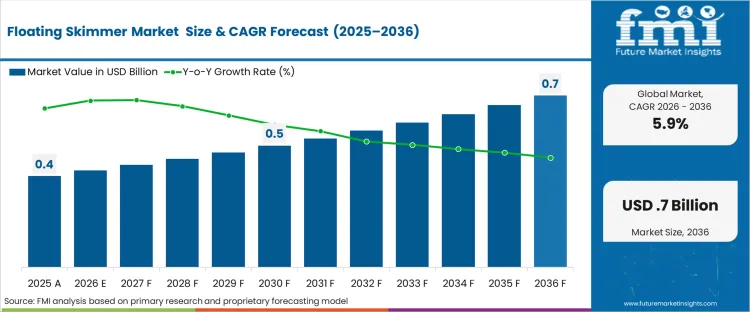
The floating skimmer market was valued at USD 0.38 billion in 2025. The market is projected to reach USD 0.40 billion in 2026 and USD 0.71 billion by 2036, expanding at a CAGR of 5.9% during the forecast period. Floating weir skimmers are expected to lead product type with a 41.2% share in 2026. Primary surface oil removal is projected to remain the leading workflow with a 46.8% share in 2026. Industrial wastewater treatment facilities are expected to lead end-user demand with a 52.6% share in 2026.
Summary of Floating Skimmer Market
- Key Drivers
- Compliance-led oil removal: Wastewater systems handling free oil need dependable surface separation before downstream treatment begins to suffer. EPA guidance notes that separated oil layers in oil-water separators are removed by skimmers, pumps, or similar equipment.
- Produced-water handling: Oil and gas operations continue to generate large volumes of water that need oil management before treatment, storage, or reuse. This keeps demand active for both mobile and fixed floating skimming systems.
- Tighter discharge standards: The EU’s revised urban wastewater framework strengthens treatment obligations under the bloc’s zero-pollution agenda. That is supporting investment in front-end contaminant removal equipment, including floating scum and oil skimming systems.
- Key Segments Analyzed in the Report
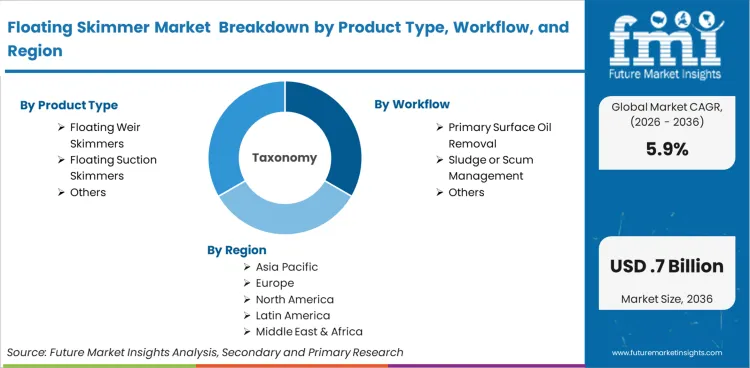
- Product type: floating weir skimmers, floating suction skimmers, brush and drum skimmers, and others
- Workflow: primary surface oil removal, pre-treatment ahead of DAF or filtration, spill recovery, and sludge or scum management
- End user: industrial wastewater treatment, municipal wastewater treatment, oil and gas, marine and ports
- Region: North America, Latin America, Europe, East Asia, South Asia and Pacific, and Middle East and Africa
- Analyst Opinion
- Nikhil Kaitwade, Principal Consultant at FMI says, "The value pool in floating skimmers does not sit in steel and floats alone. It sits in recovery efficiency under unstable field conditions, compatibility with downstream separation trains, and service responsiveness when operators cannot afford a contaminated tank, pond, or sump to remain offline."
Floating Skimmer Market Definition
The floating skimmer market includes surface-recovery systems designed to remove free-floating oil, grease, scum, foam, or other buoyant contaminants from tanks, pits, separators, ponds, lagoons, harbors, and spill zones. It covers floating weir skimmers, floating suction skimmers, brush and drum variants, hoses, pumps, decanting assemblies, and related control accessories. These systems are used in wastewater plants, industrial process facilities, ports, marine response operations, refineries, terminals, and oilfield water-management sites.
Floating Skimmer Market Inclusions
- Floating skimmer systems used for oil, grease, foam, or scum recovery from liquid surfaces
- Revenue from equipment, replacement components, hoses, pumps, control units, and related service support
- Sales across municipal, industrial, marine, and oil and gas applications in all major regions
Floating Skimmer Market Exclusions
- Subsurface separation systems that do not rely on floating or surface skimming action
- Finished wastewater-treatment plant EPC revenue, except where standalone skimmer equipment is sold
- General pumping, aeration, or mixing equipment not designed for selective surface contaminant removal
Floating Skimmer Market Research Methodology
This study evaluates the floating skimmer market across product type, workflow, end user, and region for the base year 2025 and the forecast period 2026 to 2036. Market value is presented in USD billion terms. The assessment draws on wastewater treatment guidance, produced-water management documents, urban wastewater policy updates, company product literature, financial releases, and application notes from manufacturers active in oil recovery and surface contaminant removal. Market estimates are built through triangulation of installed-use environments, replacement cycles, equipment pricing bands, service intensity, and end-use investment trends across industrial, municipal, marine, and hydrocarbon-handling operations.
Key Drivers, Restraints, and Trends in Floating Skimmer Market
Drivers
Demand for floating skimmers rises when operators need to remove free oil or scum before downstream treatment performance starts slipping. EPA guidance explains the basic operating logic clearly. Oil rises, forms a surface layer, and must then be removed by skimmers or similar equipment. Industrial users adopt skimmers because early surface removal reduces fouling pressure on filters, chemical treatment, and dissolved air flotation units. Oil and gas adds another layer of demand because produced water remains a large and persistent handling stream in major basins. Municipal demand is also improving as wastewater standards tighten and utilities move toward stricter contaminant control.
Restraints
Performance can change sharply with fluid conditions. Floating suction systems work best when the oil layer is thick enough and stable enough to be recovered cleanly. When the layer turns thin or turbulence increases, the system can pull in more water than operators want. That lowers recovery efficiency and may require extra decanting support. Smaller facilities also face budget pressure because the skimmer alone does not solve emulsified oil issues. Integration can get messy when skimmers must connect with separators, pumps, and control systems from different vendors. Marine and spill-response use cases bring weather and deployment constraints as well.
Trends
The market is moving away from standalone oil pickup hardware toward integrated surface-removal packages that fit into wider treatment trains. Oil Skimmers, Inc. presents floating weir systems as an early step ahead of ultrafiltration or chemical treatment because upstream oil removal improves process economics. Xylem’s Evoqua DAF materials make a similar point. Oils and greases removal is being positioned inside a broader wastewater workflow, not as an isolated piece of equipment. Marine-response specialists such as Lamor are also pushing high-capacity free-floating recovery systems for rough field conditions. Buyers increasingly want equipment that fits the process from the start and does not create a new operational bottleneck later.
Segmental Analysis
Floating Skimmer Market Analysis by Product Type
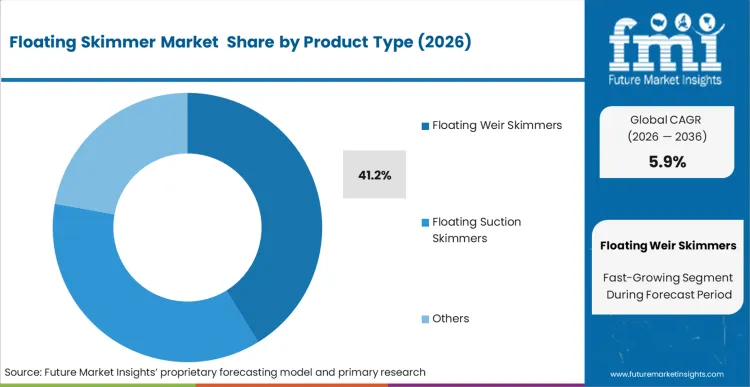
Floating weir skimmers are projected to hold the leading 41.2% share in 2026. They lead because they handle variable surface layers with relatively simple mechanics. They also fit a wide range of pits, separators, ponds, and equalization tanks. Their commercial strength comes from how often they serve as the first recovery device before more expensive treatment steps begin. Oil Skimmers, Inc. states that weir skimmers remove oil, grease, and floating solids from the water surface and that removing oil before ultrafiltration or chemical treatment improves process performance and reduces treatment cost.
Floating Skimmer Market Analysis by Workflow
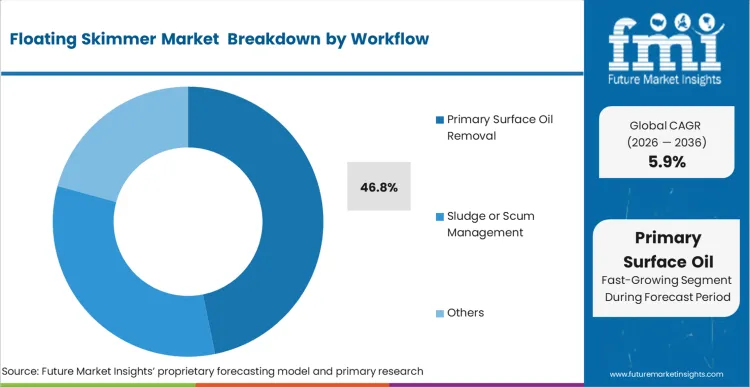
Primary surface oil removal is expected to lead workflow demand with a 46.8% share in 2026. This workflow stays ahead because operators usually need to strip free oil and floating matter before they tackle dissolved contaminants, suspended solids, or polishing stages. It is especially relevant in equalization tanks, oily sumps, interceptors, and pre-treatment zones ahead of DAF, filters, or coalescers. Xylem’s Evoqua DAF documentation supports this sequence and reinforces the importance of skimming-led pre-treatment workflows.
Competitive Aligners for Market Players
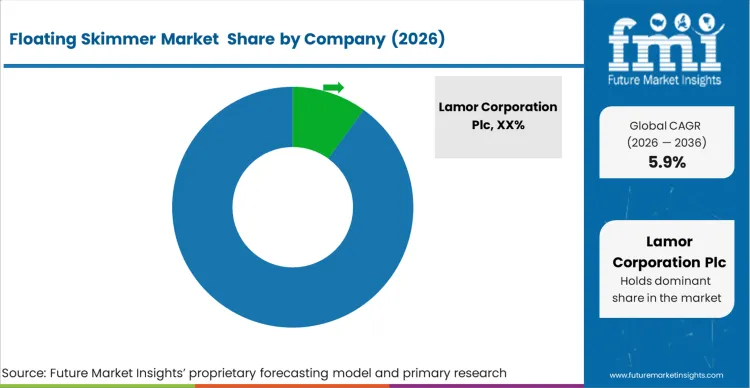
Competitive strength in floating skimmers comes from performance in the field. Buyers care about recovery stability, quick deployment, and compatibility with pumps and separators already on site. Spare-part availability matters too because downtime directly affects compliance and cleanup speed. The strongest suppliers usually pair application support with recurring aftermarket revenue. Oil Skimmers, Inc. links floating weir performance directly to lower downstream treatment cost, which makes the sale easier to justify operationally. Abanaki’s guidance also shows that floating suction systems have clear limits when oil layers become too thin. That matters because buyers remember poor recovery performance much longer than they remember brochure claims. Lamor, meanwhile, continues to anchor its position in high-capacity spill recovery and reported nearly EUR 80 million in new orders for 2025. That reinforces the value of field-proven response capability and service reach.
Key Players in Floating Skimmer Market
- Lamor Corporation Plc
- Oil Skimmers, Inc.
- Abanaki Corporation
- Xylem Inc.
- DESMI A/S
- Elastec, Inc.
- Vikoma International Ltd.
- Zebra-Tech Ltd.
- Scintex Pty Ltd
- Aqua-Guard Spill Response Inc.
Strategic Outlook by FMI on Floating Skimmer Market
The floating skimmer market is moving from simple contaminant pickup toward workflow-critical surface recovery. The next phase will be shaped by tighter wastewater compliance, continued oily-water handling in industrial and hydrocarbon settings, and stronger buyer preference for skimmers that fit smoothly into DAF, filtration, and decanting systems. Companies that combine application-specific product design with strong aftermarket support are likely to outperform. The market is still specialized, but it is becoming harder to compete with a hardware-only pitch.
Scope of the Report
| Metric | Value |
|---|---|
| Market Value | USD 0.38 billion in 2025 to USD 0.71 billion by 2036 |
| CAGR | 5.9% from 2026 to 2036 |
| Base Year | 2025 |
| Forecast Period | 2026 to 2036 |
| Product Type Segmentation | Floating Weir Skimmers, Floating Suction Skimmers, Brush and Drum Skimmers, Others |
| Workflow Segmentation | Primary Surface Oil Removal, Pre-treatment Ahead of DAF or Filtration, Spill Recovery, Sludge or Scum Management |
| End User Segmentation | Industrial Wastewater Treatment, Municipal Wastewater Treatment, Oil and Gas, Marine and Ports |
| Regions Covered | North America, Latin America, Europe, East Asia, South Asia and Pacific, Middle East and Africa |
Frequently Asked Questions
What is the current size of the floating skimmer market?
The floating skimmer market was valued at USD 0.38 billion in 2025.
What is the expected market value of the floating skimmer market in 2026?
The market is projected to reach USD 0.40 billion in 2026.
What will be the floating skimmer market value by 2036?
The market is forecast to reach USD 0.71 billion by 2036.
What is the projected CAGR of the floating skimmer market?
The floating skimmer market is projected to expand at a CAGR of 5.9% from 2026 to 2036.
Which product type leads the floating skimmer market in 2026?
Floating weir skimmers are expected to lead with a 41.2% share in 2026.
Preview the report firsthand - request a free sample
Get SampleGet the brochure for pricing and purchase details.
Get PDFTable of Content
- Executive Summary
- Global Market Outlook
- Demand-side Trends
- Supply-side Trends
- Technology Roadmap Analysis
- Analysis and Recommendations
- Market Overview
- Market Coverage / Taxonomy
- Market Definition / Scope / Limitations
- Research Methodology
- Chapter Orientation
- Analytical Lens and Working Hypotheses
- Market Structure, Signals, and Trend Drivers
- Benchmarking and Cross-market Comparability
- Market Sizing, Forecasting, and Opportunity Mapping
- Research Design and Evidence Framework
- Desk Research Programme (Secondary Evidence)
- Company Annual and Sustainability Reports
- Peer-reviewed Journals and Academic Literature
- Corporate Websites, Product Literature, and Technical Notes
- Earnings Decks and Investor Briefings
- Statutory Filings and Regulatory Disclosures
- Technical White Papers and Standards Notes
- Trade Journals, Industry Magazines, and Analyst Briefs
- Conference Proceedings, Webinars, and Seminar Materials
- Government Statistics Portals and Public Data Releases
- Press Releases and Reputable Media Coverage
- Specialist Newsletters and Curated Briefings
- Sector Databases and Reference Repositories
- FMI Internal Proprietary Databases and Historical Market Datasets
- Subscription Datasets and Paid Sources
- Social Channels, Communities, and Digital Listening Inputs
- Additional Desk Sources
- Expert Input and Fieldwork (Primary Evidence)
- Primary Modes
- Qualitative Interviews and Expert Elicitation
- Quantitative Surveys and Structured Data Capture
- Blended Approach
- Why Primary Evidence is Used
- Field Techniques
- Interviews
- Surveys
- Focus Groups
- Observational and In-context Research
- Social and Community Interactions
- Stakeholder Universe Engaged
- C-suite Leaders
- Board Members
- Presidents and Vice Presidents
- R&D and Innovation Heads
- Technical Specialists
- Domain Subject-matter Experts
- Scientists
- Physicians and Other Healthcare Professionals
- Governance, Ethics, and Data Stewardship
- Research Ethics
- Data Integrity and Handling
- Primary Modes
- Tooling, Models, and Reference Databases
- Desk Research Programme (Secondary Evidence)
- Data Engineering and Model Build
- Data Acquisition and Ingestion
- Cleaning, Normalisation, and Verification
- Synthesis, Triangulation, and Analysis
- Quality Assurance and Audit Trail
- Market Background
- Market Dynamics
- Drivers
- Restraints
- Opportunity
- Trends
- Scenario Forecast
- Demand in Optimistic Scenario
- Demand in Likely Scenario
- Demand in Conservative Scenario
- Opportunity Map Analysis
- Product Life Cycle Analysis
- Supply Chain Analysis
- Investment Feasibility Matrix
- Value Chain Analysis
- PESTLE and Porter’s Analysis
- Regulatory Landscape
- Regional Parent Market Outlook
- Production and Consumption Statistics
- Import and Export Statistics
- Market Dynamics
- Global Market Analysis 2021 to 2025 and Forecast, 2026 to 2036
- Historical Market Size Value (USD Million) Analysis, 2021 to 2025
- Current and Future Market Size Value (USD Million) Projections, 2026 to 2036
- Y-o-Y Growth Trend Analysis
- Absolute $ Opportunity Analysis
- Global Market Pricing Analysis 2021 to 2025 and Forecast 2026 to 2036
- Global Market Analysis 2021 to 2025 and Forecast 2026 to 2036, By Product Type
- Introduction / Key Findings
- Historical Market Size Value (USD Million) Analysis By Product Type , 2021 to 2025
- Current and Future Market Size Value (USD Million) Analysis and Forecast By Product Type , 2026 to 2036
- Floating Weir Skimmers
- Floating Suction Skimmers
- Others
- Floating Weir Skimmers
- Y-o-Y Growth Trend Analysis By Product Type , 2021 to 2025
- Absolute $ Opportunity Analysis By Product Type , 2026 to 2036
- Global Market Analysis 2021 to 2025 and Forecast 2026 to 2036, By Workflow
- Introduction / Key Findings
- Historical Market Size Value (USD Million) Analysis By Workflow, 2021 to 2025
- Current and Future Market Size Value (USD Million) Analysis and Forecast By Workflow, 2026 to 2036
- Primary Surface Oil Removal
- Sludge or Scum Management
- Others
- Primary Surface Oil Removal
- Y-o-Y Growth Trend Analysis By Workflow, 2021 to 2025
- Absolute $ Opportunity Analysis By Workflow, 2026 to 2036
- Global Market Analysis 2021 to 2025 and Forecast 2026 to 2036, By Region
- Introduction
- Historical Market Size Value (USD Million) Analysis By Region, 2021 to 2025
- Current Market Size Value (USD Million) Analysis and Forecast By Region, 2026 to 2036
- North America
- Latin America
- Western Europe
- Eastern Europe
- East Asia
- South Asia and Pacific
- Middle East & Africa
- Market Attractiveness Analysis By Region
- North America Market Analysis 2021 to 2025 and Forecast 2026 to 2036, By Country
- Historical Market Size Value (USD Million) Trend Analysis By Market Taxonomy, 2021 to 2025
- Market Size Value (USD Million) Forecast By Market Taxonomy, 2026 to 2036
- By Country
- USA
- Canada
- Mexico
- By Product Type
- By Workflow
- By Country
- Market Attractiveness Analysis
- By Country
- By Product Type
- By Workflow
- Key Takeaways
- Latin America Market Analysis 2021 to 2025 and Forecast 2026 to 2036, By Country
- Historical Market Size Value (USD Million) Trend Analysis By Market Taxonomy, 2021 to 2025
- Market Size Value (USD Million) Forecast By Market Taxonomy, 2026 to 2036
- By Country
- Brazil
- Chile
- Rest of Latin America
- By Product Type
- By Workflow
- By Country
- Market Attractiveness Analysis
- By Country
- By Product Type
- By Workflow
- Key Takeaways
- Western Europe Market Analysis 2021 to 2025 and Forecast 2026 to 2036, By Country
- Historical Market Size Value (USD Million) Trend Analysis By Market Taxonomy, 2021 to 2025
- Market Size Value (USD Million) Forecast By Market Taxonomy, 2026 to 2036
- By Country
- Germany
- UK
- Italy
- Spain
- France
- Nordic
- BENELUX
- Rest of Western Europe
- By Product Type
- By Workflow
- By Country
- Market Attractiveness Analysis
- By Country
- By Product Type
- By Workflow
- Key Takeaways
- Eastern Europe Market Analysis 2021 to 2025 and Forecast 2026 to 2036, By Country
- Historical Market Size Value (USD Million) Trend Analysis By Market Taxonomy, 2021 to 2025
- Market Size Value (USD Million) Forecast By Market Taxonomy, 2026 to 2036
- By Country
- Russia
- Poland
- Hungary
- Balkan & Baltic
- Rest of Eastern Europe
- By Product Type
- By Workflow
- By Country
- Market Attractiveness Analysis
- By Country
- By Product Type
- By Workflow
- Key Takeaways
- East Asia Market Analysis 2021 to 2025 and Forecast 2026 to 2036, By Country
- Historical Market Size Value (USD Million) Trend Analysis By Market Taxonomy, 2021 to 2025
- Market Size Value (USD Million) Forecast By Market Taxonomy, 2026 to 2036
- By Country
- China
- Japan
- South Korea
- By Product Type
- By Workflow
- By Country
- Market Attractiveness Analysis
- By Country
- By Product Type
- By Workflow
- Key Takeaways
- South Asia and Pacific Market Analysis 2021 to 2025 and Forecast 2026 to 2036, By Country
- Historical Market Size Value (USD Million) Trend Analysis By Market Taxonomy, 2021 to 2025
- Market Size Value (USD Million) Forecast By Market Taxonomy, 2026 to 2036
- By Country
- India
- ASEAN
- Australia & New Zealand
- Rest of South Asia and Pacific
- By Product Type
- By Workflow
- By Country
- Market Attractiveness Analysis
- By Country
- By Product Type
- By Workflow
- Key Takeaways
- Middle East & Africa Market Analysis 2021 to 2025 and Forecast 2026 to 2036, By Country
- Historical Market Size Value (USD Million) Trend Analysis By Market Taxonomy, 2021 to 2025
- Market Size Value (USD Million) Forecast By Market Taxonomy, 2026 to 2036
- By Country
- Kingdom of Saudi Arabia
- Other GCC Countries
- Turkiye
- South Africa
- Other African Union
- Rest of Middle East & Africa
- By Product Type
- By Workflow
- By Country
- Market Attractiveness Analysis
- By Country
- By Product Type
- By Workflow
- Key Takeaways
- Key Countries Market Analysis
- USA
- Pricing Analysis
- Market Share Analysis, 2025
- By Product Type
- By Workflow
- Canada
- Pricing Analysis
- Market Share Analysis, 2025
- By Product Type
- By Workflow
- Mexico
- Pricing Analysis
- Market Share Analysis, 2025
- By Product Type
- By Workflow
- Brazil
- Pricing Analysis
- Market Share Analysis, 2025
- By Product Type
- By Workflow
- Chile
- Pricing Analysis
- Market Share Analysis, 2025
- By Product Type
- By Workflow
- Germany
- Pricing Analysis
- Market Share Analysis, 2025
- By Product Type
- By Workflow
- UK
- Pricing Analysis
- Market Share Analysis, 2025
- By Product Type
- By Workflow
- Italy
- Pricing Analysis
- Market Share Analysis, 2025
- By Product Type
- By Workflow
- Spain
- Pricing Analysis
- Market Share Analysis, 2025
- By Product Type
- By Workflow
- France
- Pricing Analysis
- Market Share Analysis, 2025
- By Product Type
- By Workflow
- India
- Pricing Analysis
- Market Share Analysis, 2025
- By Product Type
- By Workflow
- ASEAN
- Pricing Analysis
- Market Share Analysis, 2025
- By Product Type
- By Workflow
- Australia & New Zealand
- Pricing Analysis
- Market Share Analysis, 2025
- By Product Type
- By Workflow
- China
- Pricing Analysis
- Market Share Analysis, 2025
- By Product Type
- By Workflow
- Japan
- Pricing Analysis
- Market Share Analysis, 2025
- By Product Type
- By Workflow
- South Korea
- Pricing Analysis
- Market Share Analysis, 2025
- By Product Type
- By Workflow
- Russia
- Pricing Analysis
- Market Share Analysis, 2025
- By Product Type
- By Workflow
- Poland
- Pricing Analysis
- Market Share Analysis, 2025
- By Product Type
- By Workflow
- Hungary
- Pricing Analysis
- Market Share Analysis, 2025
- By Product Type
- By Workflow
- Kingdom of Saudi Arabia
- Pricing Analysis
- Market Share Analysis, 2025
- By Product Type
- By Workflow
- Turkiye
- Pricing Analysis
- Market Share Analysis, 2025
- By Product Type
- By Workflow
- South Africa
- Pricing Analysis
- Market Share Analysis, 2025
- By Product Type
- By Workflow
- USA
- Market Structure Analysis
- Competition Dashboard
- Competition Benchmarking
- Market Share Analysis of Top Players
- By Regional
- By Product Type
- By Workflow
- Competition Analysis
- Competition Deep Dive
- Lamor Corporation Plc
- Overview
- Product Portfolio
- Profitability by Market Segments (Product/Age /Sales Channel/Region)
- Sales Footprint
- Strategy Overview
- Marketing Strategy
- Product Strategy
- Channel Strategy
- Oil Skimmers, Inc.
- Abanaki Corporation
- Xylem Inc.
- DESMI A/S
- Elastec, Inc.
- Lamor Corporation Plc
- Competition Deep Dive
- Assumptions & Acronyms Used


