

- Industry Size (2026)
- USD 1850.0 Mn
- Forecast (2036)
- USD 3505.4 Mn
- CAGR (2026 to 2036)
- 6.6%
Floating Floor Market Forecast and Outlook 2026 to 2036
The floating floor market is projected to be valued at USD 1,850.0 million in 2026 and reach USD 3,505.4 million by 2036, expanding at a CAGR of 6.6%. Value behavior reflects the role of floating assemblies as technical solutions for impact noise and vibration control rather than decorative flooring upgrades. These systems gain relevance where building codes specify impact insulation thresholds and where occupant expectations for acoustic separation continue to tighten.
Adoption concentrates in multifamily housing, hotels, offices, and institutional buildings where structural slabs alone fail to limit footfall noise. Specification depends on dynamic stiffness, compressive strength, and long-term creep resistance, since acoustic performance must remain stable under sustained loads and high traffic. Cost formation favors repeatable underlayment systems that integrate with standard finishes, keeping installation complexity and floor height buildup within acceptable limits.
Quick Stats for Floating Floor Market
- Floating Floor Market Value (2026): USD 1,850.0 million
- Floating Floor Market Forecast Value (2036): USD 3,505.4 million
- Floating Floor Market Forecast CAGR 2026 to 2036: 6.6%
- Leading System Type by Demand Share: Resilient Underlayment Floating Floors
- Fastest-Growing Countries: India, Vietnam, Indonesia, Saudi Arabia, UAE
- Top Players in Global Demand: Getzner Werkstoffe, Kinetics Noise Control, REGUPOL, Mason Industries, GERB Schwingungsisolierung
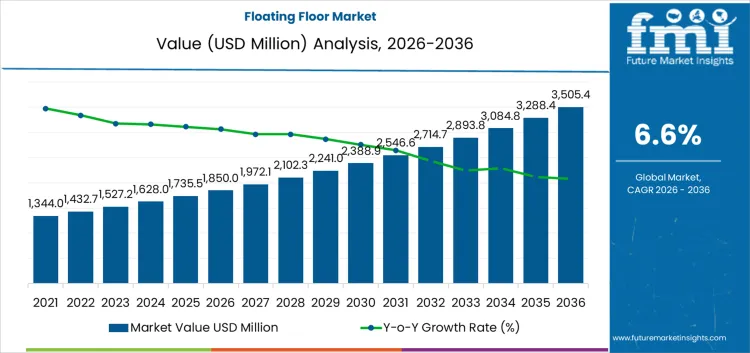
Renovation and reuse of existing building stock accounts for a growing share of demand as acoustic shortcomings become evident during occupation. Retrofit scenarios favor floating systems that can be installed over existing substrates without structural intervention, reshaping procurement priorities toward speed, predictability, and tolerance for uneven bases. Performance differentiation emerges through material behavior over time, particularly resistance to compression set and moisture-related degradation. Constraints remain around added floor height, threshold coordination, and load capacity in heavily furnished spaces, limiting blanket adoption.
Supplier advantage aligns with tested acoustic data, clear load ratings, and coordination support for designers and installers. Distribution patterns reflect close linkage with flooring contractors and acoustic consultants rather than retail flooring channels. Expansion remains anchored in compliance-driven acoustic correction and adaptive interior planning, positioning floating floors as functional infrastructure layers within buildings rather than discretionary finish selections.
Floating Floor Market Key Takeaways
| Metric | Value |
|---|---|
| Market Value (2026) | USD 1,850.0 million |
| Market Forecast Value (2036) | USD 3,505.4 million |
| Forecast CAGR 2026 to 2036 | 6.6% |
Why is the Demand for Floating Floor Growing?
Demand for floating floors is increasing as building designers, facility planners, and renovation contractors require flooring systems that improve impact sound isolation and structural decoupling in both new construction and retrofit projects. Floating floors reduce transmission of footsteps, equipment vibration, and mechanical noise between adjacent spaces by separating the finished surface from the structural subfloor with resilient underlayments or isolation mats. Engineers and acoustic consultants specify floating floor assemblies that meet defined impact insulation class (IIC) and sound transmission class (STC) targets because improved acoustic performance contributes to occupant comfort and compliance with building codes in multifamily residential, commercial office, hotel, and healthcare environments. Procurement teams evaluate material durability, compressive strength, and compatibility with finished floor coverings such as hardwood, laminate, and engineered tile to ensure predictable performance under sustained loads typical of high-traffic zones.
Growth in urban infill projects, mixed-use developments, and the trend toward activity-based interior planning reinforces uptake of floating floors that support flexible space usage without extensive structural modification. Interior retrofit schedules increasingly prioritize solutions that minimize downtime while meeting tenant expectations for quiet spaces, and floating floor systems can be installed over existing substrates without disruptive demolition work. Technical improvements in resilient underlayments, moisture control layers, and engineered panel design enhance long-term dimensional stability and resistance to compression set under variable humidity and load conditions. Coordination between architects, flooring installers, and mechanical planners ensures that floating floor assemblies align with integrated acoustic strategies for overall building comfort. These application-specific performance and integration considerations are contributing to sustained demand growth in the floating floor market.
How Are the Segments Classified in the Floating Floor Market?
Demand for floating floor systems is shaped by impact noise reduction needs, vibration isolation requirements, and building code compliance. Developers and facility owners deploy floating assemblies to limit structure-borne sound transmission between occupied spaces. Adoption aligns with higher-density residential construction, mixed-use developments, and performance-driven interior design. Product selection prioritizes acoustic attenuation, load performance, and installation compatibility. Segment classification reflects differentiation by system architecture, end-use environment, and material composition influencing isolation effectiveness, installation complexity, and long-term acoustic stability.
By System Type, Resilient Underlayment Floating Floors Hold the Largest Share
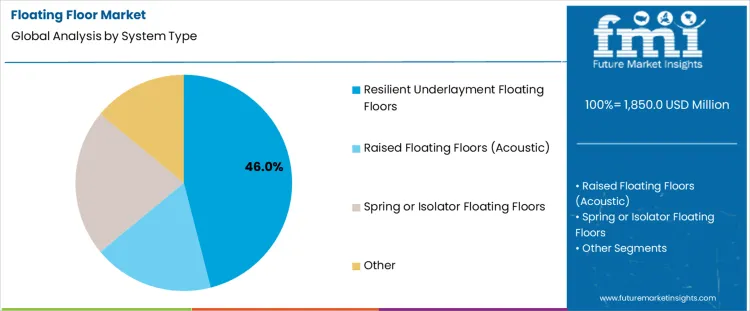
Resilient underlayment floating floors hold 46.0%, representing the largest share due to installation simplicity and broad applicability. Thin resilient layers decouple finished flooring from structural slabs, reducing impact noise transmission. Compatibility with common floor finishes supports widespread adoption across projects. Cost efficiency and minimal floor height buildup suit retrofit and new construction. Spring or isolator systems provide higher isolation for vibration-sensitive spaces with greater complexity. Raised acoustic floors address service integration needs with lower penetration. System segmentation reflects preference for solutions balancing acoustic performance, constructability, and cost control.
Key Points
- Resilient underlayments reduce impact noise effectively.
- Thin profiles suit retrofit and new construction.
- Other systems address higher isolation or service integration needs.
By End Use, Residential Multifamily Accounts for the Highest Share
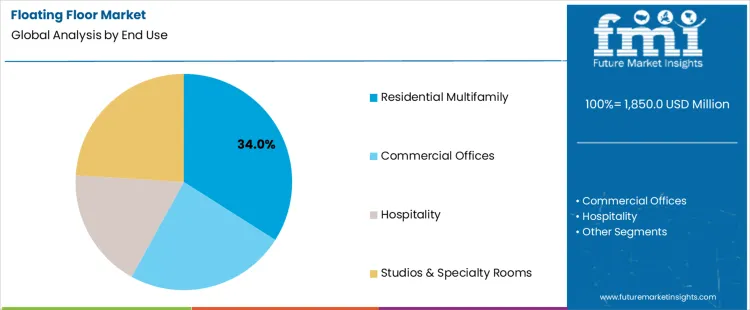
Residential multifamily holds 34.0%, representing the largest share due to inter-unit noise control requirements. Apartments and condominiums require floor systems limiting impact sound between stacked dwellings. Regulatory standards drive consistent specification of floating assemblies. High unit density increases aggregate installation volume. Commercial offices apply systems selectively for comfort zones. Hospitality settings manage guest room noise with targeted deployment. Studios and specialty rooms require advanced isolation with lower overall volume. End-use segmentation reflects concentration where resident comfort expectations and compliance requirements sustain consistent demand.
Key Points
- Multifamily housing prioritizes inter-unit noise control.
- Regulations drive consistent floating floor specification.
- Other uses apply systems selectively or for specialty needs.
By Material, Rubber and Elastomer Systems Represent the Leading Share
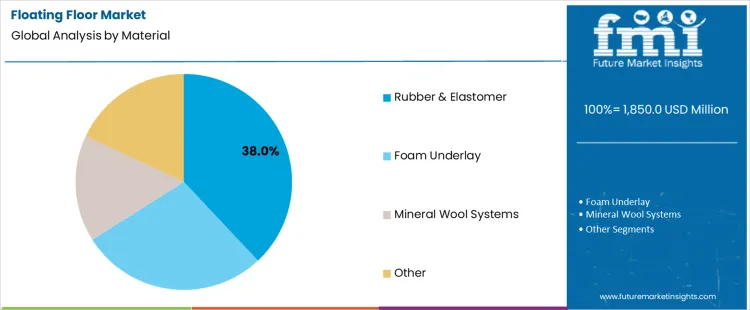
Rubber and elastomer materials hold 38.0%, representing the largest share due to resilience and durability. Elastic properties provide effective impact noise attenuation and vibration damping under sustained loads. Long-term compression resistance supports stable acoustic performance. Compatibility with varied system designs enables broad use. Foam underlays offer lightweight solutions with moderate durability. Mineral wool systems provide absorption with thickness considerations. Material segmentation reflects preference for resilient compounds delivering consistent isolation, durability, and performance predictability across floating floor installations.
Key Points
- Elastomers provide durable impact noise reduction.
- Compression resistance supports long-term performance.
- Other materials trade thickness or weight for absorption.
What are the Key Dynamics in the Floating Floor Market?
Demand for floating floors reflects structural decoupling requirements to control impact sound, vibration, and thermal movement in buildings. Adoption concentrates in residential multifamily housing, commercial offices, hospitality projects, and flooring renovation activity. Global scope aligns with building acoustics compliance and fast-install interior systems. Usage centers on floor assemblies installed over underlayment layers without mechanical fixation to subfloors, enabling controlled movement and isolation.
How do acoustic isolation need and construction efficiency shape adoption?
Impact noise transmission between floors remains a primary concern in multifamily and mixed-use buildings. Demand increases where building codes require impact insulation class compliance without increasing slab thickness. Floating floors decouple finish layers from structural slabs, reducing structure-borne sound from footfall and rolling loads. Renovation projects adopt floating systems to upgrade acoustic performance without structural modification. Compatibility with engineered wood, laminate, vinyl, and tile supports broad interior application. Underlayment selection influences performance across frequency ranges and load conditions. Rapid installation without curing time improves construction sequencing. Adoption reflects functional need to achieve acoustic isolation and dimensional tolerance within constrained build schedules.
How do height constraints, load limits, and cost pressure influence market scalability?
Floating floor assemblies increase finished floor height, creating challenges at door thresholds and transitions. Demand sensitivity rises where ceiling height limits restrict added buildup. Load-bearing capacity depends on underlayment compression resistance, affecting suitability for heavy furnishings and wheeled traffic. Moisture sensitivity of certain materials limits use over damp substrates. Acoustic performance varies with installation quality, increasing workmanship dependency. Material cost exceeds direct-bond alternatives in cost-driven projects. Long-term creep affects levelness and joint integrity. Fire and smoke compliance requirements add specification complexity, constraining standardized, large-scale deployment across diverse building types.
How Is Demand for Floating Floor Systems Evolving Globally?
Demand for floating floor systems is expanding globally due to noise isolation needs, vibration control, and performance-led building specifications. Adoption aligns with residential high-rises, commercial offices, hospitality projects, and institutional facilities requiring impact sound reduction. Retrofit activity increases where existing slabs fail updated acoustic criteria. Material selection emphasizes load distribution, moisture tolerance, and compatibility with finishes. Growth rates in India at 7.9%, Vietnam at 7.4%, Indonesia at 7.1%, Saudi Arabia at 6.6%, and UAE at 6.3% indicate sustained expansion driven by urban construction intensity, compliance expectations, and building performance optimization rather than decorative flooring upgrades.
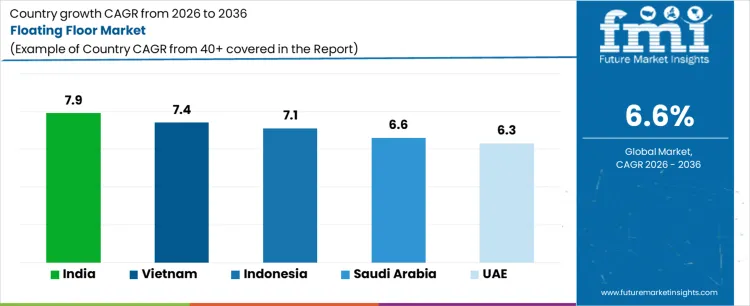
| Country | CAGR (%) |
|---|---|
| India | 7.9% |
| Vietnam | 7.4% |
| Indonesia | 7.1% |
| Saudi Arabia | 6.6% |
| UAE | 6.3% |
What Is Driving Strong Expansion of Floating Floor Demand in India?
Demand for floating floor systems in India is growing at a CAGR of 7.9%, supported by dense urban housing and institutional construction. High-rise residential projects require impact noise control between dwelling units. IT offices, hospitals, and educational buildings specify floating floors to manage vibration and footfall noise. Urban noise exposure increases enforcement of acoustic performance standards. Retrofit demand emerges during tenant fit-outs and compliance-led renovations. Domestic manufacturing improves availability across budget tiers. Growth reflects performance-driven specifications and regulatory enforcement rather than premium interior positioning.
- High-rise residential impact sound control
- Institutional building vibration management needs
- Urban noise regulation enforcement
- Retrofit activity during tenant renovations
Why Is Vietnam Experiencing Rapid Uptake of Floating Floor Systems?
Floating floor demand in Vietnam is expanding at a CAGR of 7.4%, driven by mixed-use development and hospitality construction. Hotels and serviced apartments require floor isolation to improve guest comfort. Office buildings adopt floating systems to support flexible layouts and privacy. Urban redevelopment elevates attention to building performance standards. Local suppliers expand access to modular floating floor components. Growth reflects hospitality and commercial usage intensity rather than residential luxury-driven flooring adoption.
- Hospitality guest comfort requirements
- Office layout flexibility and privacy needs
- Urban redevelopment performance standards
- Improved availability of modular systems
How Is Indonesia Supporting Growth in Floating Floor Sales?
Sales of floating floor systems in Indonesia are growing at a CAGR of 7.1%, shaped by institutional buildings and urban congestion. Airports, hospitals, and government facilities require vibration and noise isolation across occupied zones. High ambient noise levels increase reliance on impact sound mitigation. Educational facilities specify floating floors for auditoriums and laboratories. Budget discipline favors standardized systems with certified acoustic ratings. Growth reflects institutional construction demand and functional noise control rather than broad residential uptake.
- Institutional facility vibration isolation needs
- High ambient urban noise conditions
- Education and laboratory flooring specifications
- Preference for standardized certified systems
What Factors Are Supporting Floating Floor Demand in Saudi Arabia?
Floating floor demand in Saudi Arabia is expanding at a CAGR of 6.6%, supported by large-scale infrastructure and commercial projects. Government buildings and healthcare facilities specify acoustic and vibration isolation for functionality. Hospitality developments integrate floating floors to enhance room comfort. Design-stage compliance within megaprojects sustains procurement volumes. Climate-controlled interiors increase focus on floor system stability. Growth reflects institutional and hospitality requirements rather than retrofit-heavy residential activity.
- Public infrastructure acoustic compliance
- Healthcare vibration control requirements
- Hospitality comfort specifications
- Design-stage integration in megaprojects
Why Is the UAE Showing Steady Growth in Floating Floor Systems?
Demand for floating floor systems in United Arab Emirates is growing at a CAGR of 6.3%, driven by premium commercial construction and mixed-use developments. Offices and conference facilities require impact noise control across multifunctional spaces. Hospitality projects emphasize floor isolation for guest privacy. Building quality standards reinforce certified system adoption. Refurbishment projects generate replacement demand during upgrades. Growth remains steady, reflecting quality-led specifications and service-oriented construction rather than rapid expansion in building volume.
- Premium commercial building performance standards
- Hospitality privacy and comfort needs
- Certified systems aligned with quality codes
- Refurbishment-driven replacement demand
What is the competitive landscape of demand for the floating floor market globally?
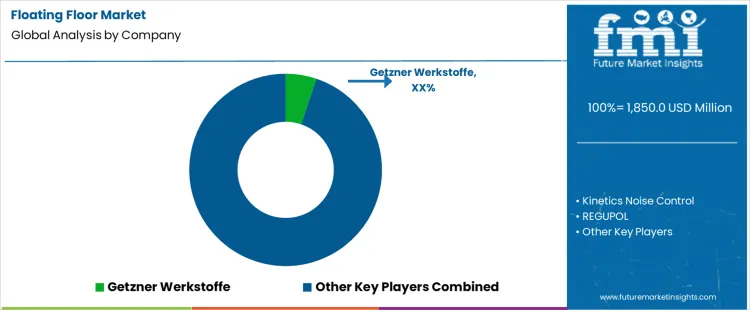
Demand for floating floor systems is driven by stringent vibration and impact noise limits in buildings and infrastructure. Applications concentrate in cinemas, recording studios, laboratories, data centers, residential towers, and transit-adjacent developments. Buyers evaluate dynamic stiffness, natural frequency control, load bearing capacity, creep behavior, installation height, and long-term performance stability. Specification teams assess laboratory-tested impact sound reduction, resonance behavior, and compatibility with concrete slabs or raised floors. Procurement behavior favors suppliers offering project-specific engineering support, verified acoustic calculations, and reliable material consistency. Trend in the floating floor market reflects higher adoption in mixed-use developments and retrofits requiring precise vibration isolation.
Getzner Werkstoffe leads competitive positioning through elastomer-based floating floor systems engineered for defined load ranges and resonance control. Kinetics Noise Control competes through spring and elastomer assemblies specified for studios, theaters, and vibration-critical facilities. REGUPOL supports demand with recycled elastomer solutions optimized for impact sound reduction and structural durability. Mason Industries maintains relevance by supplying spring isolator-based floating floors for mechanical and structural vibration control. GERB Schwingungsisolierung participates with precision-engineered floating floor systems targeting ultra-low frequency isolation requirements. Competitive differentiation centers on dynamic performance accuracy, engineering support depth, installation reliability, and compliance with acoustic design criteria.
Key Players in the Floating Floor Market
- Getzner Werkstoffe
- Kinetics Noise Control
- REGUPOL
- Mason Industries
- GERB Schwingungsisolierung
- Trelleborg
- Saint-Gobain
- Knauf
- MAPEI
Scope of the Report
| Items | Values |
|---|---|
| Quantitative Units | USD million |
| System Type | Resilient Underlayment Floating Floors; Raised Floating Floors (Acoustic); Spring or Isolator Floating Floors; Other |
| End Use | Residential Multifamily; Commercial Offices; Hospitality; Studios & Specialty Rooms |
| Material | Rubber & Elastomer; Foam Underlay; Mineral Wool Systems; Other |
| Sales Channel | Flooring Contractors; Building Distributors; Direct Manufacturer Sales; Other |
| Regions Covered | Asia Pacific, Europe, North America, Latin America, Middle East & Africa |
| Countries Covered | India, Vietnam, Indonesia, Saudi Arabia, UAE, and 40+ countries |
| Key Companies Profiled | Getzner Werkstoffe; Kinetics Noise Control; REGUPOL; Mason Industries; GERB Schwingungsisolierung; Trelleborg; Saint-Gobain; Knauf; MAPEI |
| Additional Attributes | Dollar sales by system type, end use, material, and sales channel; vibration isolation efficiency and impact sound reduction performance across resilient, raised, and spring-based floating floor systems; material damping characteristics of rubber, foam, and mineral wool layers; structural load handling and long-term performance in residential, commercial, and studio environments; procurement dynamics shaped by contractor-led installations, distributor supply, and direct manufacturer project engagements. |
Floating Floor Market by Segment
System Type:
- Resilient Underlayment Floating Floors
- Raised Floating Floors (Acoustic)
- Spring or Isolator Floating Floors
- Other
End Use:
- Residential Multifamily
- Commercial Offices
- Hospitality
- Studios & Specialty Rooms
Material:
- Rubber & Elastomer
- Foam Underlay
- Mineral Wool Systems
- Other
Sales Channel:
- Flooring Contractors
- Building Distributors
- Direct Manufacturer Sales
- Other
Region:
- Asia Pacific
- China
- Japan
- South Korea
- India
- Australia & New Zealand
- ASEAN
- Rest of Asia Pacific
- Europe
- Germany
- United Kingdom
- France
- Italy
- Spain
- Nordic
- BENELUX
- Rest of Europe
- North America
- United States
- Canada
- Mexico
- Latin America
- Brazil
- Chile
- Rest of Latin America
- Middle East & Africa
- Kingdom of Saudi Arabia
- Other GCC Countries
- Turkey
- South Africa
- Other African Union
- Rest of Middle East & Africa
Bibliography
- International Organization for Standardization. (2023). Acoustics-Measurement of sound insulation in buildings and of building elements-Part 2: Laboratory measurements of impact sound insulation (ISO 10140-3:2023). ISO.
- International Organization for Standardization. (2024). Acoustics-Rating of sound insulation in buildings and of building elements-Part 2: Impact sound insulation (ISO 717-2:2024, revised edition). ISO.
- European Committee for Standardization. (2023). Acoustics-Measurement of sound insulation in buildings and of building elements-Impact sound insulation (EN ISO 10140-3:2023). CEN.
- European Committee for Standardization. (2024). Acoustics-Sound insulation of building elements-Laboratory measurement of impact sound reduction of floor coverings on a standard floor (EN ISO 10140-4:2024). CEN.
- International Organization for Standardization. (2023). Acoustics-Determination of dynamic stiffness-Materials used under floating floors in buildings (ISO 9052-1:2023). ISO.
Frequently Asked Questions
How big is the floating floor market in 2026?
The global floating floor market is estimated to be valued at USD 1,850.0 million in 2026.
What will be the size of floating floor market in 2036?
The market size for the floating floor market is projected to reach USD 3,505.4 million by 2036.
How much will be the floating floor market growth between 2026 and 2036?
The floating floor market is expected to grow at a 6.6% CAGR between 2026 and 2036.
What are the key product types in the floating floor market?
The key product types in floating floor market are resilient underlayment floating floors, raised floating floors (acoustic), spring or isolator floating floors and other.
Which end use segment to contribute significant share in the floating floor market in 2026?
In terms of end use, residential multifamily segment to command 34.0% share in the floating floor market in 2026.
Preview the report firsthand - request a free sample
Get SampleGet the brochure for pricing and purchase details.
Get PDFTable of Content
- Executive Summary
- Global Market Outlook
- Demand-side Trends
- Supply-side Trends
- Technology Roadmap Analysis
- Analysis and Recommendations
- Market Overview
- Market Coverage / Taxonomy
- Market Definition / Scope / Limitations
- Market Background
- Market Dynamics
- Drivers
- Restraints
- Opportunity
- Trends
- Scenario Forecast
- Demand in Optimistic Scenario
- Demand in Likely Scenario
- Demand in Conservative Scenario
- Opportunity Map Analysis
- Product Life Cycle Analysis
- Supply Chain Analysis
- Investment Feasibility Matrix
- Value Chain Analysis
- PESTLE and Porter’s Analysis
- Regulatory Landscape
- Regional Parent Market Outlook
- Production and Consumption Statistics
- Import and Export Statistics
- Market Dynamics
- Global Market Analysis 2021 to 2025 and Forecast, 2026 to 2036
- Historical Market Size Value (USD Million) Analysis, 2021 to 2025
- Current and Future Market Size Value (USD Million) Projections, 2026 to 2036
- Y-o-Y Growth Trend Analysis
- Absolute $ Opportunity Analysis
- Global Market Pricing Analysis 2021 to 2025 and Forecast 2026 to 2036
- Global Market Analysis 2021 to 2025 and Forecast 2026 to 2036, By System Type
- Introduction / Key Findings
- Historical Market Size Value (USD Million) Analysis By System Type , 2021 to 2025
- Current and Future Market Size Value (USD Million) Analysis and Forecast By System Type , 2026 to 2036
- Resilient Underlayment Floating Floors
- Raised Floating Floors (Acoustic)
- Spring or Isolator Floating Floors
- Other
- Resilient Underlayment Floating Floors
- Y-o-Y Growth Trend Analysis By System Type , 2021 to 2025
- Absolute $ Opportunity Analysis By System Type , 2026 to 2036
- Global Market Analysis 2021 to 2025 and Forecast 2026 to 2036, By End Use
- Introduction / Key Findings
- Historical Market Size Value (USD Million) Analysis By End Use, 2021 to 2025
- Current and Future Market Size Value (USD Million) Analysis and Forecast By End Use, 2026 to 2036
- Residential Multifamily
- Commercial Offices
- Hospitality
- Studios & Specialty Rooms
- Residential Multifamily
- Y-o-Y Growth Trend Analysis By End Use, 2021 to 2025
- Absolute $ Opportunity Analysis By End Use, 2026 to 2036
- Global Market Analysis 2021 to 2025 and Forecast 2026 to 2036, By Material
- Introduction / Key Findings
- Historical Market Size Value (USD Million) Analysis By Material, 2021 to 2025
- Current and Future Market Size Value (USD Million) Analysis and Forecast By Material, 2026 to 2036
- Rubber & Elastomer
- Foam Underlay
- Mineral Wool Systems
- Other
- Rubber & Elastomer
- Y-o-Y Growth Trend Analysis By Material, 2021 to 2025
- Absolute $ Opportunity Analysis By Material, 2026 to 2036
- Global Market Analysis 2021 to 2025 and Forecast 2026 to 2036, By Sales Channel
- Introduction / Key Findings
- Historical Market Size Value (USD Million) Analysis By Sales Channel, 2021 to 2025
- Current and Future Market Size Value (USD Million) Analysis and Forecast By Sales Channel, 2026 to 2036
- Flooring Contractors
- Building Distributors
- Direct Manufacturer Sales
- Other
- Flooring Contractors
- Y-o-Y Growth Trend Analysis By Sales Channel, 2021 to 2025
- Absolute $ Opportunity Analysis By Sales Channel, 2026 to 2036
- Global Market Analysis 2021 to 2025 and Forecast 2026 to 2036, By Region
- Introduction
- Historical Market Size Value (USD Million) Analysis By Region, 2021 to 2025
- Current Market Size Value (USD Million) Analysis and Forecast By Region, 2026 to 2036
- North America
- Latin America
- Western Europe
- Eastern Europe
- East Asia
- South Asia and Pacific
- Middle East & Africa
- Market Attractiveness Analysis By Region
- North America Market Analysis 2021 to 2025 and Forecast 2026 to 2036, By Country
- Historical Market Size Value (USD Million) Trend Analysis By Market Taxonomy, 2021 to 2025
- Market Size Value (USD Million) Forecast By Market Taxonomy, 2026 to 2036
- By Country
- USA
- Canada
- Mexico
- By System Type
- By End Use
- By Material
- By Sales Channel
- By Country
- Market Attractiveness Analysis
- By Country
- By System Type
- By End Use
- By Material
- By Sales Channel
- Key Takeaways
- Latin America Market Analysis 2021 to 2025 and Forecast 2026 to 2036, By Country
- Historical Market Size Value (USD Million) Trend Analysis By Market Taxonomy, 2021 to 2025
- Market Size Value (USD Million) Forecast By Market Taxonomy, 2026 to 2036
- By Country
- Brazil
- Chile
- Rest of Latin America
- By System Type
- By End Use
- By Material
- By Sales Channel
- By Country
- Market Attractiveness Analysis
- By Country
- By System Type
- By End Use
- By Material
- By Sales Channel
- Key Takeaways
- Western Europe Market Analysis 2021 to 2025 and Forecast 2026 to 2036, By Country
- Historical Market Size Value (USD Million) Trend Analysis By Market Taxonomy, 2021 to 2025
- Market Size Value (USD Million) Forecast By Market Taxonomy, 2026 to 2036
- By Country
- Germany
- UK
- Italy
- Spain
- France
- Nordic
- BENELUX
- Rest of Western Europe
- By System Type
- By End Use
- By Material
- By Sales Channel
- By Country
- Market Attractiveness Analysis
- By Country
- By System Type
- By End Use
- By Material
- By Sales Channel
- Key Takeaways
- Eastern Europe Market Analysis 2021 to 2025 and Forecast 2026 to 2036, By Country
- Historical Market Size Value (USD Million) Trend Analysis By Market Taxonomy, 2021 to 2025
- Market Size Value (USD Million) Forecast By Market Taxonomy, 2026 to 2036
- By Country
- Russia
- Poland
- Hungary
- Balkan & Baltic
- Rest of Eastern Europe
- By System Type
- By End Use
- By Material
- By Sales Channel
- By Country
- Market Attractiveness Analysis
- By Country
- By System Type
- By End Use
- By Material
- By Sales Channel
- Key Takeaways
- East Asia Market Analysis 2021 to 2025 and Forecast 2026 to 2036, By Country
- Historical Market Size Value (USD Million) Trend Analysis By Market Taxonomy, 2021 to 2025
- Market Size Value (USD Million) Forecast By Market Taxonomy, 2026 to 2036
- By Country
- China
- Japan
- South Korea
- By System Type
- By End Use
- By Material
- By Sales Channel
- By Country
- Market Attractiveness Analysis
- By Country
- By System Type
- By End Use
- By Material
- By Sales Channel
- Key Takeaways
- South Asia and Pacific Market Analysis 2021 to 2025 and Forecast 2026 to 2036, By Country
- Historical Market Size Value (USD Million) Trend Analysis By Market Taxonomy, 2021 to 2025
- Market Size Value (USD Million) Forecast By Market Taxonomy, 2026 to 2036
- By Country
- India
- ASEAN
- Australia & New Zealand
- Rest of South Asia and Pacific
- By System Type
- By End Use
- By Material
- By Sales Channel
- By Country
- Market Attractiveness Analysis
- By Country
- By System Type
- By End Use
- By Material
- By Sales Channel
- Key Takeaways
- Middle East & Africa Market Analysis 2021 to 2025 and Forecast 2026 to 2036, By Country
- Historical Market Size Value (USD Million) Trend Analysis By Market Taxonomy, 2021 to 2025
- Market Size Value (USD Million) Forecast By Market Taxonomy, 2026 to 2036
- By Country
- Kingdom of Saudi Arabia
- Other GCC Countries
- Turkiye
- South Africa
- Other African Union
- Rest of Middle East & Africa
- By System Type
- By End Use
- By Material
- By Sales Channel
- By Country
- Market Attractiveness Analysis
- By Country
- By System Type
- By End Use
- By Material
- By Sales Channel
- Key Takeaways
- Key Countries Market Analysis
- USA
- Pricing Analysis
- Market Share Analysis, 2025
- By System Type
- By End Use
- By Material
- By Sales Channel
- Canada
- Pricing Analysis
- Market Share Analysis, 2025
- By System Type
- By End Use
- By Material
- By Sales Channel
- Mexico
- Pricing Analysis
- Market Share Analysis, 2025
- By System Type
- By End Use
- By Material
- By Sales Channel
- Brazil
- Pricing Analysis
- Market Share Analysis, 2025
- By System Type
- By End Use
- By Material
- By Sales Channel
- Chile
- Pricing Analysis
- Market Share Analysis, 2025
- By System Type
- By End Use
- By Material
- By Sales Channel
- Germany
- Pricing Analysis
- Market Share Analysis, 2025
- By System Type
- By End Use
- By Material
- By Sales Channel
- UK
- Pricing Analysis
- Market Share Analysis, 2025
- By System Type
- By End Use
- By Material
- By Sales Channel
- Italy
- Pricing Analysis
- Market Share Analysis, 2025
- By System Type
- By End Use
- By Material
- By Sales Channel
- Spain
- Pricing Analysis
- Market Share Analysis, 2025
- By System Type
- By End Use
- By Material
- By Sales Channel
- France
- Pricing Analysis
- Market Share Analysis, 2025
- By System Type
- By End Use
- By Material
- By Sales Channel
- India
- Pricing Analysis
- Market Share Analysis, 2025
- By System Type
- By End Use
- By Material
- By Sales Channel
- ASEAN
- Pricing Analysis
- Market Share Analysis, 2025
- By System Type
- By End Use
- By Material
- By Sales Channel
- Australia & New Zealand
- Pricing Analysis
- Market Share Analysis, 2025
- By System Type
- By End Use
- By Material
- By Sales Channel
- China
- Pricing Analysis
- Market Share Analysis, 2025
- By System Type
- By End Use
- By Material
- By Sales Channel
- Japan
- Pricing Analysis
- Market Share Analysis, 2025
- By System Type
- By End Use
- By Material
- By Sales Channel
- South Korea
- Pricing Analysis
- Market Share Analysis, 2025
- By System Type
- By End Use
- By Material
- By Sales Channel
- Russia
- Pricing Analysis
- Market Share Analysis, 2025
- By System Type
- By End Use
- By Material
- By Sales Channel
- Poland
- Pricing Analysis
- Market Share Analysis, 2025
- By System Type
- By End Use
- By Material
- By Sales Channel
- Hungary
- Pricing Analysis
- Market Share Analysis, 2025
- By System Type
- By End Use
- By Material
- By Sales Channel
- Kingdom of Saudi Arabia
- Pricing Analysis
- Market Share Analysis, 2025
- By System Type
- By End Use
- By Material
- By Sales Channel
- Turkiye
- Pricing Analysis
- Market Share Analysis, 2025
- By System Type
- By End Use
- By Material
- By Sales Channel
- South Africa
- Pricing Analysis
- Market Share Analysis, 2025
- By System Type
- By End Use
- By Material
- By Sales Channel
- USA
- Market Structure Analysis
- Competition Dashboard
- Competition Benchmarking
- Market Share Analysis of Top Players
- By Regional
- By System Type
- By End Use
- By Material
- By Sales Channel
- Competition Analysis
- Competition Deep Dive
- Getzner Werkstoffe
- Overview
- Product Portfolio
- Profitability by Market Segments (Product/Age /Sales Channel/Region)
- Sales Footprint
- Strategy Overview
- Marketing Strategy
- Product Strategy
- Channel Strategy
- Kinetics Noise Control
- REGUPOL
- Mason Industries
- GERB Schwingungsisolierung
- Trelleborg
- Saint-Gobain
- Knauf
- MAPEI
- Getzner Werkstoffe
- Competition Deep Dive
- Assumptions & Acronyms Used
- Research Methodology


