

- Industry Size (2026)
- USD 820.0 Mn
- Forecast (2036)
- USD 1482.4 Mn
- CAGR (2026 to 2036)
- 6.1%
Floor Power Grommets Market Size, Market Forecast and Outlook By FMI
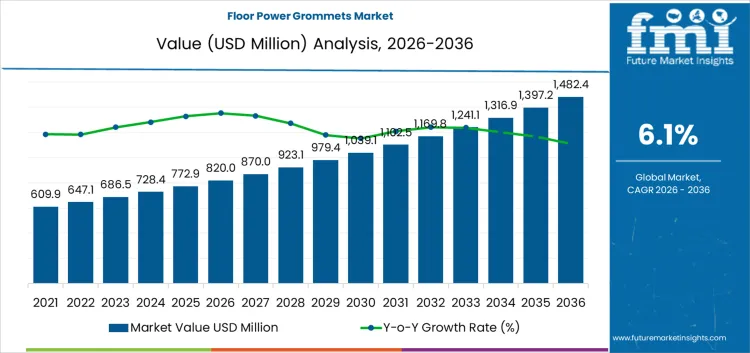
The floor power grommets market is likely to be valued at USD 820.0 million in 2026 and is projected to reach USD 1,482.4 million by 2036, registering a CAGR of 6.1%. Value creation is anchored in interior electrical infrastructure requirements rather than standalone electrical hardware demand. Floor power grommets are specified as part of coordinated floor, furniture, and cabling systems in commercial offices, data centers, education facilities, and institutional buildings.
Summary of Floor Power Grommets Market
- Market Snapshot
- The Floor Power Grommets Market is valued at USD 820.0 million in 2026.
- The Floor Power Grommets Market is projected treach USD 1,482.4 million by 2036.
- The market is expected texpand at a CAGR of 6.1% between 2026 and 2036.
- Demand and Growth Drivers
- Demand is driven by flexible workspace layouts requiring distributed floor-based power and data access points.
- Adoption increases with higher workstation density and raised floor penetration in commercial interiors.
- Interior refurbishment and technology upgrades generate recurring replacement demand cycles.
- Product and Segment View
- Standard floor box or grommet kits account for 38.0% of total demand due tmulti-cable capacity.
- Commercial offices contribute 44.0% of total application demand driven by dense workstation layouts.
- New construction holds 58.0% share as early-stage integration enables optimal placement and compliance.
- Geography and Competitive Outlook
- India leads growth with a CAGR of 8.1% supported by office expansion and coworking adoption.
- China follows with a CAGR of 7.6% driven by commercial development and refurbishment activity.
- Key companies include Legrand (Wiremold), Hubbell, Schneider Electric, Leviton, and OBBettermann.
Demand intensity correlates with workstation density, raised floor penetration, and frequency of layout reconfiguration rather than overall building size. Each installation represents a fixed interface between underfloor power distribution and occupied space, making unit demand proportional to access point planning rather than total electrical load.
Quick Stats for Floor Power Grommets Market
- Floor Power Grommets Market Value (2026): USD 820.0 million
- Floor Power Grommets Market Forecast Value (2036): USD 1,482.4 million
- Floor Power Grommets Market Forecast CAGR 2026 to 2036: 6.1%
- Leading Grommet Type by Demand Share: Standard Floor Box or Grommet Kits
- Fastest-Growing Countries: India, China, Vietnam, Indonesia, Mexico
- Top Players in Global Demand: Legrand (Wiremold), Hubbell, Schneider Electric, Leviton, OBO Bettermann, Eaton, Panduit, Electriduct, Hager, nVent
Adoption dynamics are governed by installation sequencing, fire and electrical code compliance, and long-term adaptability of interior layouts. Early-stage integration during new construction favors standardized floor box and grommet kits, while retrofit demand remains constrained by slab thickness, underfloor access, and disruption tolerance. Replacement cycles are driven primarily by interior refurbishment and technology upgrades rather than mechanical wear, as grommets experience limited electrical stress once installed.
Product selection reflects trade-offs between cable capacity, sealing performance, aesthetic finish, and load resistance under furniture movement. Market expansion tracks growth in flexible office formats, shared work environments, and structured cabling standards, with volume accumulation occurring through fit-out density increases and renovation activity rather than expansion of conventional fixed-layout offices.
Floor Power Grommets Market Key Takeaways
| Metric | Value |
|---|---|
| Market Value (2026) | USD 820.0 million |
| Market Forecast Value (2036) | USD 1,482.4 million |
| Forecast CAGR 2026 to 2036 | 6.1% |
Why is the Demand for Floor Power Grommets Growing?
Demand for floor power grommets is rising as commercial and institutional facilities require flexible and accessible electrical connectivity within open plan and modular spaces. Architects and interior planners are specifying floor power grommets to deliver power, data, and USB access points at workstations, conference areas, and public zones without relying solely on perimeter outlets. This preference reflects evolving workspace layouts that emphasize adaptability and ergonomic placement of devices such as laptops, displays, and collaboration tools. Facility managers prioritize grommet solutions that meet electrical safety standards, provide durable housing against foot traffic and furniture movement, and simplify maintenance access. Procurement teams evaluate load capacity, outlet configuration, and compatibility with raised floor and hard surface installations to ensure selected products align with building specifications and long-term facility plans.
Growth in corporate office fit-outs, co-working environments, and educational campuses reinforces the need for floor power grommets that support distributed connectivity while minimizing cable clutter and trip hazards. Technology upgrades and periodic reconfigurations of work areas encourage adoption of grommet systems that integrate power and communication ports with aesthetic finishes that complement interior design goals. Contractors and electrical engineers coordinate installation with underfloor wiring infrastructure to maintain clear pathways and code compliance. These technical and operational priorities contribute to sustained demand for floor power grommets in contemporary built environments.
How Are the Segments Classified in the Floor Power Grommets Market?
Demand for floor power grommets is shaped by workspace electrification, cable management requirements, and safety compliance within occupied interiors. Facilities require organized access to power and data while maintaining floor integrity and fire safety. Adoption aligns with flexible office layouts, densified workstations, and technology-enabled interiors. Product selection prioritizes cable capacity, sealing performance, fire resistance, and installation compatibility. Segment classification reflects differentiation by grommet configuration, functional application setting, and installation timing. Structure highlights how access method, space usage profile, and build stage influence specification priorities, deployment scale, and replacement patterns.
Which Grommet Type Represents the Largest Share of Demand?
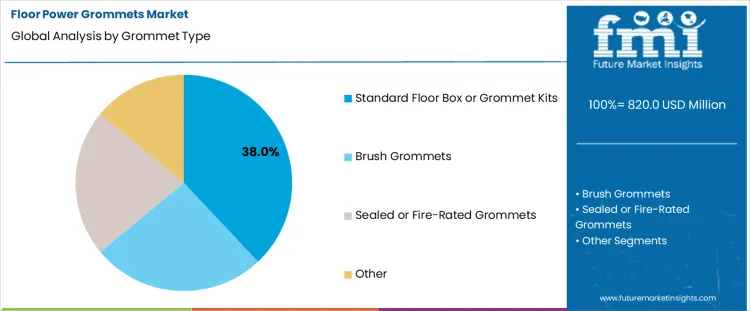
Standard floor box or grommet kits hold 38.0%, representing the largest share among grommet types due to versatility and capacity. These kits support multiple power and data cables while maintaining organized access points. Rigid housings protect cables from wear and foot traffic. Compatibility with raised and solid floors supports broad deployment. Brush grommets provide flexible cable passage with minimal sealing. Sealed or fire-rated grommets address code compliance in safety-critical zones. Grommet type segmentation reflects preference for multi-cable, durable solutions meeting everyday power distribution needs in occupied spaces.
Key Points
- Standard kits support multiple cables with physical protection.
- Broad floor compatibility enables wide deployment.
- Other types address flexibility or fire safety requirements.
Which Application Accounts for the Highest Share of Demand?
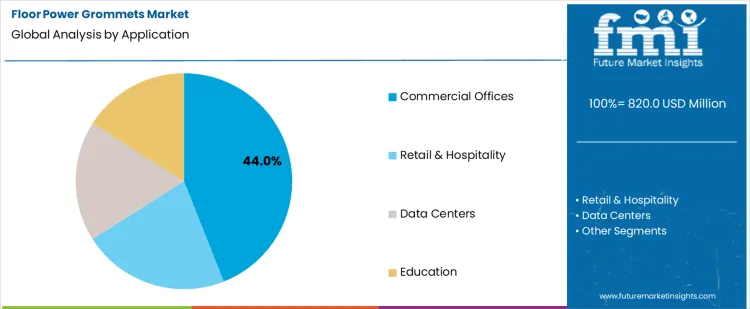
Commercial offices hold 44.0%, representing the largest share among application settings due to workstation density. Modern offices require frequent floor-based access to power and connectivity. Flexible layouts increase reliance on distributed access points. Safety and aesthetics influence placement and specification. Retail and hospitality environments apply grommets for point-of-sale and display power. Data centers require controlled access with stricter sealing needs. Education facilities support technology-enabled classrooms. Application segmentation reflects concentration of demand where occupant density and device usage drive consistent power access requirements.
Key Points
-
Offices require frequent access to floor-based power.
- Flexible layouts increase grommet deployment density.
- Other settings apply grommets for specialized power needs.
Which Installation Category Drives the Largest Share of Demand?
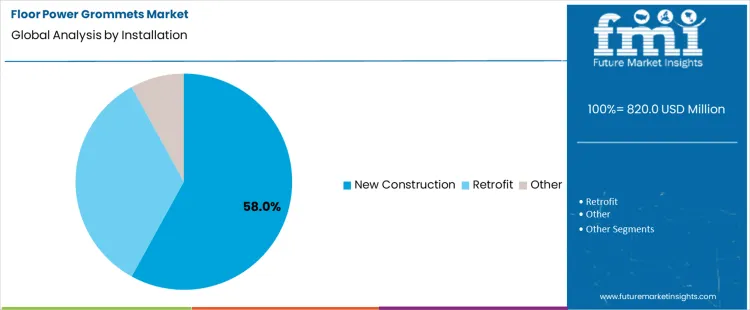
New construction holds 58.0%, representing the largest share among installation categories due to early-stage integration. Planning power access during construction enables optimal placement and compliance alignment. Structural coordination reduces retrofit complexity and cost. Integrated installation supports long-term cable management efficiency. Retrofit installations address upgrades in existing buildings with access limitations. Other installation contexts represent limited use cases. Installation segmentation reflects preference for planned deployment where coordination, compliance, and lifecycle efficiency remain priorities.
Key Points
- New builds allow optimized power access planning.
- Early integration reduces installation complexity.
- Retrofit demand supports modernization of existing spaces.
What are the Key Dynamics in the Floor Power Grommets Market?
Demand for floor power grommets reflects need for safe, organized electrical and data access through raised and solid floor systems. Adoption spans commercial offices, data centers, control rooms, retail interiors, and institutional buildings. Global scope aligns with flexible workspace layouts and structured cabling practices. Usage centers on recessed floor fittings providing power, data, and AV connectivity while maintaining floor integrity and pedestrian safety.
How do workspace reconfiguration and electrical safety requirements shape adoption?
Modern commercial interiors prioritize flexible layouts supporting frequent desk and equipment relocation. Demand increases as floor-based power access reduces reliance on wall outlets and exposed cable runs. Floor power grommets enable direct connection to underfloor raceways and raised floor voids common in offices and data centers. Safety standards require flush mounting, load-rated covers, and ingress protection to prevent trip hazards and electrical exposure. Data-heavy environments rely on integrated power and low-voltage access to support workstations and conferencing systems. Adoption strengthens where modular furniture systems depend on distributed floor connectivity. Aesthetic integration supports acceptance in client-facing and premium interior spaces.
How do installation constraints, cost pressure, and standard variation influence market scalability?
Installation requires coordination with floor construction, core drilling, and underfloor cabling layouts, increasing retrofit complexity. Demand sensitivity rises where renovation budgets limit structural modification. Load rating and fire performance requirements elevate material and certification cost. Standard variation across regions affects socket formats and compliance alignment. Improper sealing increases dust and moisture ingress risk, affecting long-term reliability. Limited access to underfloor services constrains placement flexibility. Custom finishes and configurations reduce standardization benefits. Dependence on construction project cycles limits consistent volume scalability across commercial building segments.
How Is Demand for Floor Power Grommets Evolving Globally?
Demand for floor power grommets is expanding globally due to growth in flexible workspaces, commercial interior refurbishment, and structured power distribution needs. Adoption aligns with office fit-outs, data-enabled workstations, and safety requirements for concealed cable routing. Open-plan layouts and raised flooring increase specification of modular grommet systems supporting power and data integration. Replacement demand emerges during renovation cycles and layout reconfiguration. Growth rates in India at 8.1%, China at 7.6%, Vietnam at 7.1%, Indonesia at 6.8%, and Mexico at 6.2% indicate sustained expansion driven by commercial construction intensity, workspace modernization, and lifecycle refurbishment.
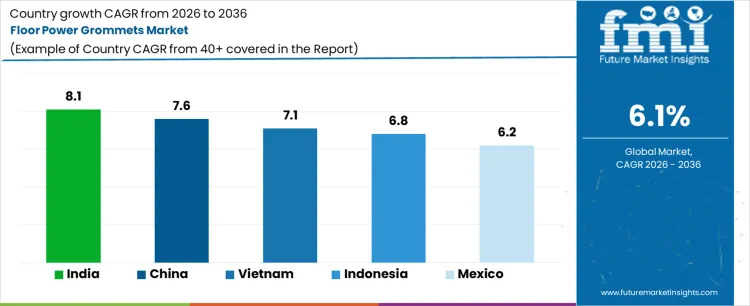
| Country | CAGR (%) |
|---|---|
| India | 8.1% |
| China | 7.6% |
| Vietnam | 7.1% |
| Indonesia | 6.8% |
| Mexico | 6.2% |
What Is Driving Strong Growth of Floor Power Grommet Demand in India?
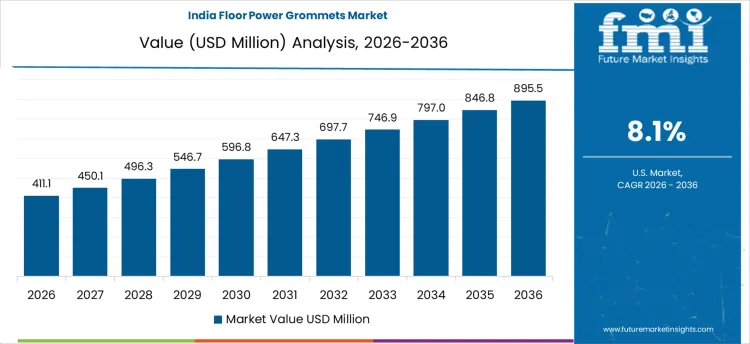
India is growing at a CAGR of 8.1%, supported by expansion of commercial offices, IT parks, and coworking facilities. Flexible seating and dense workstation layouts require accessible floor-level power and data routing. Raised flooring adoption increases grommet installation points per floor plate. Fire safety and cable management standards influence specification choices. Tier-2 city office development broadens installation base. Demand growth reflects workspace formalization and interior fit-out activity rather than speculative commercial construction.
- Expansion of IT parks and coworking spaces
- Raised flooring adoption in modern offices
- Fire safety and cable management compliance
- Growth of commercial offices in Tier-2 cities
Why Is China Sustaining Elevated Demand for Floor Power Grommets?
Floor power grommet demand in China is expanding at a CAGR of 7.6%, driven by large-scale commercial developments and interior modernization. Corporate offices and mixed-use buildings integrate modular power access for flexible layouts. High workstation density increases grommet count per floor. Automated manufacturing supports standardized designs at scale. Refurbishment of older office stock adds replacement demand. Demand growth reflects interior system integration and building utilization intensity rather than net expansion of office space.
- Large commercial and mixed-use developments
- High workstation density driving grommet volume
- Standardized modular designs at scale
- Office refurbishment supporting replacement demand
How Is Vietnam Influencing Growth of Floor Power Grommet Adoption?
Vietnam is growing at a CAGR of 7.1%, shaped by expansion of corporate offices and foreign-invested facilities. New office buildings adopt international fit-out standards emphasizing concealed power access. Flexible layouts in technology and service sectors increase grommet usage. Cost sensitivity favors standardized plastic and metal designs. Growth of business parks sustains steady installations. Demand growth reflects commercial real estate formalization and export-oriented services rather than mature replacement cycles.
- Foreign-invested office development activity
- Adoption of international interior fit-out standards
- Flexible layouts in technology and services
- Expansion of business parks
What Factors Are Supporting Floor Power Grommet Demand in Indonesia?
Floor power grommet demand in Indonesia is expanding at a CAGR of 6.8%, influenced by urban office development and interior upgrades. Central business districts add new office towers with raised floor systems. Power access requirements increase with digital workplace adoption. Climate conditions influence material selection for durability. Retrofit projects in existing offices contribute incremental demand. Growth reflects urban commercial development and digital workspace adoption rather than large-scale corporate consolidation.
- New office towers in central business districts
- Digital workplace power access requirements
- Climate-influenced material durability needs
- Retrofit activity in existing office stock
Why Is Mexico Experiencing Steady Expansion in Floor Power Grommet Demand?
Floor power grommet demand in Mexico is growing at a CAGR of 6.2%, supported by export-oriented corporate offices and shared service centers. Facilities serving multinational firms follow standardized interior infrastructure specifications. Raised floors and modular furniture systems increase grommet installation points. Stable office utilization supports predictable replacement during refurbishments. Supplier integration within regional construction supply chains supports availability. Growth remains steady, reflecting fit-out continuity and renovation cycles rather than rapid office space expansion.
- Shared service center and corporate office growth
- Standardized interior infrastructure specifications
- Modular furniture and raised floor adoption
- Renovation-driven replacement demand
What is the competitive landscape of demand for the floor power grommets market globally?
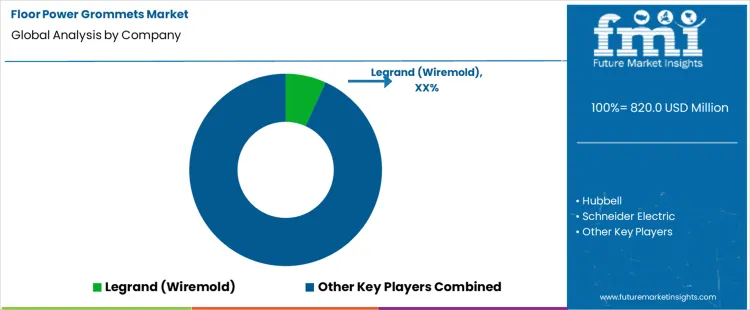
Demand for floor power grommets is driven by commercial building electrification, flexible workspace layouts, and infrastructure needs in offices, retail, education, and hospitality environments. Floor power grommets provide access to electrical, data, and communication connections while maintaining aesthetic continuity and safety in finished floor applications. Buyers evaluate device durability, cable management efficiency, ingress protection, ease of installation in raised and slab-on-grade floors, and compliance with electrical and building safety standards. Procurement teams prioritize suppliers with broad portfolios, global distribution networks, strong technical support, and products certified to relevant regional standards. Trend in the global market reflects increased demand for flexible power access solutions that support modular office design and evolving workplace technology requirements.
Legrand (Wiremold) holds leading positioning through engineered floor power grommet systems widely adopted in commercial and institutional facilities supported by extensive specification and service networks. Hubbell supports demand with modular access floor power solutions integrated with cable management and connectivity options meeting diverse installation environments. Schneider Electric participates with floor power distribution and grommet products aligned with broader electrical infrastructure portfolios. Leviton contributes floor-mounted power and connectivity solutions designed to meet evolving workplace and building automation needs. OBO Bettermann supplies floor power grommets and related cable management systems with focus on safety and installation efficiency. Competitive differentiation depends on product reliability, compliance with safety standards, ease of installation, integration with building management systems, and ability to serve global specification requirements.
Key Players in the Floor Power Grommets Market
- Legrand (Wiremold)
- Hubbell
- Leviton
- OBO Bettermann
- Electriduct
- Hager
- nVent
- Boden Group
Scope of the Report
| Items | Values |
|---|---|
| Quantitative Units | USD million |
| Grommet Type | Standard Floor Box or Grommet Kits; Brush Grommets; Sealed or Fire-Rated Grommets; Other |
| Application | Commercial Offices; Retail & Hospitality; Data Centers; Education |
| Installation | New Construction; Retrofit; Other |
| Sales Channel | Electrical Distributors; Contractors; OEM or Project Direct; E-commerce |
| Regions Covered | Asia Pacific, Europe, North America, Latin America, Middle East & Africa |
| Countries Covered | India, China, Vietnam, Indonesia, Mexico, and 40+ countries |
| Key Companies Profiled | Legrand (Wiremold); Hubbell; Schneider Electric; Leviton; OBO Bettermann; Eaton; Panduit; Electriduct; Hager; nVent |
| Additional Attributes | Dollar sales by grommet type, application, and installation mode; adoption trends for brush and sealed grommets supporting flexible workstation layouts and raised floor cabling; fire-rating, smoke-seal, and ingress protection performance benchmarks; compatibility with raised access floors, screed floors, and core-drilled installations; load resistance, lid durability, and cable exit protection metrics; retrofit complexity and installation time considerations; procurement patterns across distributor-led electrical supply and project-direct specifications; compliance with electrical safety codes, fire regulations, and data center standards influencing product selection. |
Floor Power Grommets Market by Segment
Grommet Type:
- Standard Floor Box or Grommet Kits
- Brush Grommets
- Sealed or Fire-Rated Grommets
- Other
Application:
- Commercial Offices
- Retail & Hospitality
- Data Centers
- Education
Installation:
- New Construction
- Retrofit
- Other
Sales Channel:
- Electrical Distributors
- Contractors
- OEM or Project Direct
- E-commerce
Region:
- Asia Pacific
- China
- Japan
- South Korea
- India
- Australia & New Zealand
- ASEAN
- Rest of Asia Pacific
- Europe
- Germany
- United Kingdom
- France
- Italy
- Spain
- Nordic
- BENELUX
- Rest of Europe
- North America
- United States
- Canada
- Mexico
- Latin America
- Brazil
- Chile
- Rest of Latin America
- Middle East & Africa
- Kingdom of Saudi Arabia
- Other GCC Countries
- Turkey
- South Africa
- Other African Union
- Rest of Middle East & Africa
Bibliography
- International Electrotechnical Commission. (2023). IEC 60670-23: Boxes and enclosures for electrical accessories-Particular requirements for floor boxes and recessed floor fittings, revised edition with staged implementation. International Electrotechnical Commission.
- International Organization for Standardization. (2023). ISO 9001 and ISO 45001: Application guidance for electrical floor fittings within quality and occupational safety management systems, reaffirmed applicability to building electrical components. International Organization for Standardization.
- European Committee for Standardization. (2023). EN 50085-2-2: Cable trunking systems and cable ducting systems for electrical installations-Floor and underfloor systems, amended and applied in phases. CEN.
- National Fire Protection Association. (2024). NFPA 70 (National Electrical Code): Articles on floor boxes, recessed fittings, and power access systems, updated with phased enforcement cycles. National Fire Protection Association.
- International Code Council. (2024). International Building Code: Electrical floor penetrations, fire resistance, and accessibility provisions applicable to floor power grommets, current adopted edition. International Code Council.
- Underwriters Laboratories. (2023). UL 514A and UL 514C: Metallic and nonmetallic floor fittings and poke-through assemblies, updated certification scope for floor power access devices. Underwriters Laboratories.
- British Standards Institution. (2023). BS 7671 (IET Wiring Regulations): Requirements for floor-mounted electrical accessories and recessed power access points, incorporating recent amendment updates. British Standards Institution.
Frequently Asked Questions
How big is the floor power grommets market in 2026?
The global floor power grommets market is estimated to be valued at USD 820.0 million in 2026.
What will be the size of floor power grommets market in 2036?
The market size for the floor power grommets market is projected to reach USD 1,482.4 million by 2036.
How much will be the floor power grommets market growth between 2026 and 2036?
The floor power grommets market is expected to grow at a 6.1% CAGR between 2026 and 2036.
What are the key product types in the floor power grommets market?
The key product types in floor power grommets market are standard floor box or grommet kits, brush grommets, sealed or fire-rated grommets and other.
Which application segment to contribute significant share in the floor power grommets market in 2026?
In terms of application, commercial offices segment to command 44.0% share in the floor power grommets market in 2026.
Preview the report firsthand - request a free sample
Get SampleGet the brochure for pricing and purchase details.
Get PDFTable of Content
- Executive Summary
- Global Market Outlook
- Demand-side Trends
- Supply-side Trends
- Technology Roadmap Analysis
- Analysis and Recommendations
- Market Overview
- Market Coverage / Taxonomy
- Market Definition / Scope / Limitations
- Market Background
- Market Dynamics
- Drivers
- Restraints
- Opportunity
- Trends
- Scenario Forecast
- Demand in Optimistic Scenario
- Demand in Likely Scenario
- Demand in Conservative Scenario
- Opportunity Map Analysis
- Product Life Cycle Analysis
- Supply Chain Analysis
- Investment Feasibility Matrix
- Value Chain Analysis
- PESTLE and Porter’s Analysis
- Regulatory Landscape
- Regional Parent Market Outlook
- Production and Consumption Statistics
- Import and Export Statistics
- Market Dynamics
- Global Market Analysis 2021 to 2025 and Forecast, 2026 to 2036
- Historical Market Size Value (USD Million) Analysis, 2021 to 2025
- Current and Future Market Size Value (USD Million) Projections, 2026 to 2036
- Y-o-Y Growth Trend Analysis
- Absolute $ Opportunity Analysis
- Global Market Pricing Analysis 2021 to 2025 and Forecast 2026 to 2036
- Global Market Analysis 2021 to 2025 and Forecast 2026 to 2036, By Grommet Type
- Introduction / Key Findings
- Historical Market Size Value (USD Million) Analysis By Grommet Type , 2021 to 2025
- Current and Future Market Size Value (USD Million) Analysis and Forecast By Grommet Type , 2026 to 2036
- Standard Floor Box or Grommet Kits
- Brush Grommets
- Sealed or Fire-Rated Grommets
- Other
- Standard Floor Box or Grommet Kits
- Y-o-Y Growth Trend Analysis By Grommet Type , 2021 to 2025
- Absolute $ Opportunity Analysis By Grommet Type , 2026 to 2036
- Global Market Analysis 2021 to 2025 and Forecast 2026 to 2036, By Application
- Introduction / Key Findings
- Historical Market Size Value (USD Million) Analysis By Application, 2021 to 2025
- Current and Future Market Size Value (USD Million) Analysis and Forecast By Application, 2026 to 2036
- Commercial Offices
- Retail & Hospitality
- Data Centers
- Education
- Commercial Offices
- Y-o-Y Growth Trend Analysis By Application, 2021 to 2025
- Absolute $ Opportunity Analysis By Application, 2026 to 2036
- Global Market Analysis 2021 to 2025 and Forecast 2026 to 2036, By Installation
- Introduction / Key Findings
- Historical Market Size Value (USD Million) Analysis By Installation, 2021 to 2025
- Current and Future Market Size Value (USD Million) Analysis and Forecast By Installation, 2026 to 2036
- New Construction
- Retrofit
- Other
- New Construction
- Y-o-Y Growth Trend Analysis By Installation, 2021 to 2025
- Absolute $ Opportunity Analysis By Installation, 2026 to 2036
- Global Market Analysis 2021 to 2025 and Forecast 2026 to 2036, By Sales Channel
- Introduction / Key Findings
- Historical Market Size Value (USD Million) Analysis By Sales Channel, 2021 to 2025
- Current and Future Market Size Value (USD Million) Analysis and Forecast By Sales Channel, 2026 to 2036
- Electrical Distributors
- Contractors
- OEM or Project Direct
- E-commerce
- Electrical Distributors
- Y-o-Y Growth Trend Analysis By Sales Channel, 2021 to 2025
- Absolute $ Opportunity Analysis By Sales Channel, 2026 to 2036
- Global Market Analysis 2021 to 2025 and Forecast 2026 to 2036, By Region
- Introduction
- Historical Market Size Value (USD Million) Analysis By Region, 2021 to 2025
- Current Market Size Value (USD Million) Analysis and Forecast By Region, 2026 to 2036
- North America
- Latin America
- Western Europe
- Eastern Europe
- East Asia
- South Asia and Pacific
- Middle East & Africa
- Market Attractiveness Analysis By Region
- North America Market Analysis 2021 to 2025 and Forecast 2026 to 2036, By Country
- Historical Market Size Value (USD Million) Trend Analysis By Market Taxonomy, 2021 to 2025
- Market Size Value (USD Million) Forecast By Market Taxonomy, 2026 to 2036
- By Country
- USA
- Canada
- Mexico
- By Grommet Type
- By Application
- By Installation
- By Sales Channel
- By Country
- Market Attractiveness Analysis
- By Country
- By Grommet Type
- By Application
- By Installation
- By Sales Channel
- Key Takeaways
- Latin America Market Analysis 2021 to 2025 and Forecast 2026 to 2036, By Country
- Historical Market Size Value (USD Million) Trend Analysis By Market Taxonomy, 2021 to 2025
- Market Size Value (USD Million) Forecast By Market Taxonomy, 2026 to 2036
- By Country
- Brazil
- Chile
- Rest of Latin America
- By Grommet Type
- By Application
- By Installation
- By Sales Channel
- By Country
- Market Attractiveness Analysis
- By Country
- By Grommet Type
- By Application
- By Installation
- By Sales Channel
- Key Takeaways
- Western Europe Market Analysis 2021 to 2025 and Forecast 2026 to 2036, By Country
- Historical Market Size Value (USD Million) Trend Analysis By Market Taxonomy, 2021 to 2025
- Market Size Value (USD Million) Forecast By Market Taxonomy, 2026 to 2036
- By Country
- Germany
- UK
- Italy
- Spain
- France
- Nordic
- BENELUX
- Rest of Western Europe
- By Grommet Type
- By Application
- By Installation
- By Sales Channel
- By Country
- Market Attractiveness Analysis
- By Country
- By Grommet Type
- By Application
- By Installation
- By Sales Channel
- Key Takeaways
- Eastern Europe Market Analysis 2021 to 2025 and Forecast 2026 to 2036, By Country
- Historical Market Size Value (USD Million) Trend Analysis By Market Taxonomy, 2021 to 2025
- Market Size Value (USD Million) Forecast By Market Taxonomy, 2026 to 2036
- By Country
- Russia
- Poland
- Hungary
- Balkan & Baltic
- Rest of Eastern Europe
- By Grommet Type
- By Application
- By Installation
- By Sales Channel
- By Country
- Market Attractiveness Analysis
- By Country
- By Grommet Type
- By Application
- By Installation
- By Sales Channel
- Key Takeaways
- East Asia Market Analysis 2021 to 2025 and Forecast 2026 to 2036, By Country
- Historical Market Size Value (USD Million) Trend Analysis By Market Taxonomy, 2021 to 2025
- Market Size Value (USD Million) Forecast By Market Taxonomy, 2026 to 2036
- By Country
- China
- Japan
- South Korea
- By Grommet Type
- By Application
- By Installation
- By Sales Channel
- By Country
- Market Attractiveness Analysis
- By Country
- By Grommet Type
- By Application
- By Installation
- By Sales Channel
- Key Takeaways
- South Asia and Pacific Market Analysis 2021 to 2025 and Forecast 2026 to 2036, By Country
- Historical Market Size Value (USD Million) Trend Analysis By Market Taxonomy, 2021 to 2025
- Market Size Value (USD Million) Forecast By Market Taxonomy, 2026 to 2036
- By Country
- India
- ASEAN
- Australia & New Zealand
- Rest of South Asia and Pacific
- By Grommet Type
- By Application
- By Installation
- By Sales Channel
- By Country
- Market Attractiveness Analysis
- By Country
- By Grommet Type
- By Application
- By Installation
- By Sales Channel
- Key Takeaways
- Middle East & Africa Market Analysis 2021 to 2025 and Forecast 2026 to 2036, By Country
- Historical Market Size Value (USD Million) Trend Analysis By Market Taxonomy, 2021 to 2025
- Market Size Value (USD Million) Forecast By Market Taxonomy, 2026 to 2036
- By Country
- Kingdom of Saudi Arabia
- Other GCC Countries
- Turkiye
- South Africa
- Other African Union
- Rest of Middle East & Africa
- By Grommet Type
- By Application
- By Installation
- By Sales Channel
- By Country
- Market Attractiveness Analysis
- By Country
- By Grommet Type
- By Application
- By Installation
- By Sales Channel
- Key Takeaways
- Key Countries Market Analysis
- USA
- Pricing Analysis
- Market Share Analysis, 2025
- By Grommet Type
- By Application
- By Installation
- By Sales Channel
- Canada
- Pricing Analysis
- Market Share Analysis, 2025
- By Grommet Type
- By Application
- By Installation
- By Sales Channel
- Mexico
- Pricing Analysis
- Market Share Analysis, 2025
- By Grommet Type
- By Application
- By Installation
- By Sales Channel
- Brazil
- Pricing Analysis
- Market Share Analysis, 2025
- By Grommet Type
- By Application
- By Installation
- By Sales Channel
- Chile
- Pricing Analysis
- Market Share Analysis, 2025
- By Grommet Type
- By Application
- By Installation
- By Sales Channel
- Germany
- Pricing Analysis
- Market Share Analysis, 2025
- By Grommet Type
- By Application
- By Installation
- By Sales Channel
- UK
- Pricing Analysis
- Market Share Analysis, 2025
- By Grommet Type
- By Application
- By Installation
- By Sales Channel
- Italy
- Pricing Analysis
- Market Share Analysis, 2025
- By Grommet Type
- By Application
- By Installation
- By Sales Channel
- Spain
- Pricing Analysis
- Market Share Analysis, 2025
- By Grommet Type
- By Application
- By Installation
- By Sales Channel
- France
- Pricing Analysis
- Market Share Analysis, 2025
- By Grommet Type
- By Application
- By Installation
- By Sales Channel
- India
- Pricing Analysis
- Market Share Analysis, 2025
- By Grommet Type
- By Application
- By Installation
- By Sales Channel
- ASEAN
- Pricing Analysis
- Market Share Analysis, 2025
- By Grommet Type
- By Application
- By Installation
- By Sales Channel
- Australia & New Zealand
- Pricing Analysis
- Market Share Analysis, 2025
- By Grommet Type
- By Application
- By Installation
- By Sales Channel
- China
- Pricing Analysis
- Market Share Analysis, 2025
- By Grommet Type
- By Application
- By Installation
- By Sales Channel
- Japan
- Pricing Analysis
- Market Share Analysis, 2025
- By Grommet Type
- By Application
- By Installation
- By Sales Channel
- South Korea
- Pricing Analysis
- Market Share Analysis, 2025
- By Grommet Type
- By Application
- By Installation
- By Sales Channel
- Russia
- Pricing Analysis
- Market Share Analysis, 2025
- By Grommet Type
- By Application
- By Installation
- By Sales Channel
- Poland
- Pricing Analysis
- Market Share Analysis, 2025
- By Grommet Type
- By Application
- By Installation
- By Sales Channel
- Hungary
- Pricing Analysis
- Market Share Analysis, 2025
- By Grommet Type
- By Application
- By Installation
- By Sales Channel
- Kingdom of Saudi Arabia
- Pricing Analysis
- Market Share Analysis, 2025
- By Grommet Type
- By Application
- By Installation
- By Sales Channel
- Turkiye
- Pricing Analysis
- Market Share Analysis, 2025
- By Grommet Type
- By Application
- By Installation
- By Sales Channel
- South Africa
- Pricing Analysis
- Market Share Analysis, 2025
- By Grommet Type
- By Application
- By Installation
- By Sales Channel
- USA
- Market Structure Analysis
- Competition Dashboard
- Competition Benchmarking
- Market Share Analysis of Top Players
- By Regional
- By Grommet Type
- By Application
- By Installation
- By Sales Channel
- Competition Analysis
- Competition Deep Dive
- Legrand (Wiremold)
- Overview
- Product Portfolio
- Profitability by Market Segments (Product/Age /Sales Channel/Region)
- Sales Footprint
- Strategy Overview
- Marketing Strategy
- Product Strategy
- Channel Strategy
- Hubbell
- Schneider Electric
- Leviton
- OBO Bettermann
- Eaton
- Panduit
- Electriduct
- Hager
- nVent
- Legrand (Wiremold)
- Competition Deep Dive
- Assumptions & Acronyms Used
- Research Methodology


