

- Industry Size (2026)
- USD 169 Mn
- Forecast (2036)
- USD 538 Mn
- CAGR (2026 to 2036)
- 12.3%
High-Flexibility Sealants for Floating Offshore Wind Foundations Market Forecast and Outlook 2026 to 2036
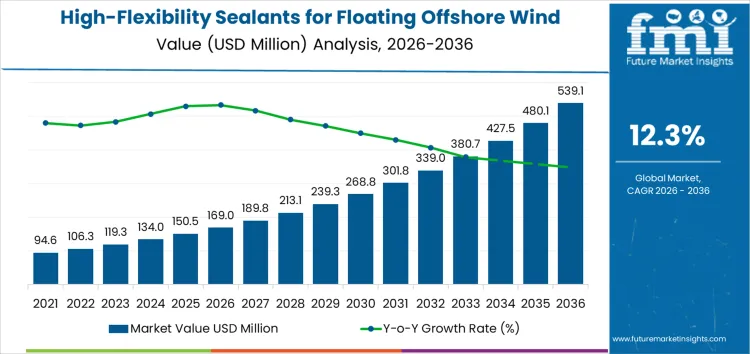
The high-flexibility sealants for floating offshore wind foundations Market is valued at USD 169 million in 2026 and is projected to reach USD 538 million by 2036, reflecting a CAGR of 12.3%. Demand growth is driven by structural motion tolerance, fatigue resistance, and long-term sealing performance under dynamic marine conditions. Cost structures reflect the complexity of material formulations, offshore qualification testing, and installation logistics. Sealants must accommodate continuous movement, saltwater exposure, and temperature variation without loss of adhesion. Suppliers with proven offshore track records maintain pricing discipline. Value creation depends on reducing maintenance intervals and protecting structural interfaces rather than material volumes supplied.
Between 2026 and 2036, value capture concentrates among suppliers embedded in foundation design and certification workflows. Project developers prioritize sealants that support predictable inspection cycles and minimize offshore intervention risk. Once specified, materials remain locked due to requalification cost and limited access for replacement. Entry barriers persist through marine testing requirements and project specific validation. Strategic tradeoffs emerge between maximizing flexibility and ensuring long term material stability. Firms aligning formulation performance with foundation engineering standards secure stronger positioning. Profit pools favor suppliers participating early in platform development, where long asset lifespans support durable margin recovery.
Quick Stats for High Flexibility Sealants for Floating Offshore Wind Foundations Market
- High-Flexibility Sealants for Floating Offshore Wind Foundations Market Value (2026): USD 169 million
- High-Flexibility Sealants for Floating Offshore Wind Foundations Market Forecast Value (2036): USD 538 million
- High-Flexibility Sealants for Floating Offshore Wind Foundations Market Forecast CAGR (2026 to 2036): 12.3%
- Leading Sealant Chemistry in High Flexibility Sealants for Floating Offshore Wind Foundations Market: Marine-grade polyurethane sealants
- Key Growth Regions in High Flexibility Sealants for Floating Offshore Wind Foundations Market: Asia Pacific, Europe, North America
- Top Players in High Flexibility Sealants for Floating Offshore Wind Foundations Market: Sika AG, Trelleborg AB, H.B. Fuller (Chemique Marine Systems), Bostik (Arkema), 3M Marine & Offshore Solutions
What Is the Growth Forecast for High-Flexibility Sealants for Floating Offshore Wind Foundations Market through 2036?
Dynamic load tolerance and joint movement accommodation define the early growth phase of the High-Flexibility Sealants for Floating Offshore Wind Foundations Market between 2026 and 2031. During this period, the market expands from USD 169 million to USD 272 million, adding USD 103 million in value. Annual progression from USD 92 million to USD 169 million reflects increasing deployment of floating platforms in deep water wind projects. Historical growth was limited by the small installed base of floating turbines and conservative material selection for marine structures. Forward expansion in this phase is supported by higher pilot project activity, wider use of semi-submersible and spar foundations, and growing recognition of sealant performance under continuous motion and saltwater exposure.
Project scale up and standardization of floating foundation designs drive growth from 2031 to 2036. Over this period, the market increases from USD 272 million to USD 538 million, adding USD 266 million and representing the stronger expansion window. Annual values rise from USD 307 million to USD 538 million, indicating accelerating year over year momentum. Earlier demand focused on demonstration scale installations, while future growth reflects commercial scale wind farms and repeat project execution. Larger foundation sizes, longer service life requirements, and higher tolerance for cyclic stress support sustained expansion as high flexibility sealants become critical materials for floating offshore wind infrastructure.
High-Flexibility Sealants for Floating Offshore Wind Foundations Market Key Takeaways
| Metric | Value |
|---|---|
| Market Value (2026) | USD 169 million |
| Forecast Value (2036) | USD 538 million |
| Forecast CAGR (2026 to 2036) | 12.3% |
What Is Driving Demand in the High-Flexibility Sealants for Floating Offshore Wind Foundations Market?
Demand for high-flexibility sealants in floating offshore wind foundations stems from structural and environmental demands unique to floating platforms rather than from general sealing needs. Floating wind foundations are subject to complex multidirectional motions caused by waves, currents, and wind, creating dynamic gaps and movements at joints, penetrations, and interface transitions. Traditional rigid sealants often crack or debond under repeated flexing, compromising water ingress prevention, corrosion protection, and overall structural resilience. Early adoption of flexible sealants occurred where prototype failures and field testing revealed leakage or adhesion loss at critical interfaces, prompting specification of materials capable of accommodating large strains while maintaining bond strength.
Future demand will be shaped by formalised engineering standards, safety and durability criteria, and integrated design approaches in offshore wind development rather than incremental material upgrades alone. Regulatory frameworks for offshore energy infrastructure increasingly define service life expectations under defined cyclic load regimes, requiring sealants that maintain performance over years of exposure to salt water, temperature variation, and mechanical fatigue. Advances in polymer chemistry are producing sealants with high elongation, elastic recovery, and compatibility with carbon steel, composites, and other foundation materials used in floating platforms. Procurement specifications are evolving to mandate validated performance under dynamic loading and long term environmental exposure rather than rely on conservative design margins.
What Factors Are Affecting the Demand for High-Flexibility Sealants for Floating Offshore Wind Foundations Market in Terms of Sealant Chemistry and Application Area?
The high flexibility sealants market for floating offshore wind foundations is driven by expansion of floating wind projects, harsher marine exposure conditions, and long service life requirements. Demand focuses on sealants that tolerate continuous movement, saltwater exposure, and cyclic loading without loss of adhesion. Adoption is influenced by foundation design, installation method, and maintenance accessibility. Market leadership reflects proven durability in marine environments and flexibility under dynamic stress rather than lowest material cost or short-term mechanical strength.
What Is Driving Leadership by Sealant Chemistry in the High Flexibility Sealants Market?

Marine-grade polyurethane sealants account for about 36% of demand because they provide a strong balance of elasticity, adhesion, and resistance to seawater exposure. Floating offshore wind structures experience constant motion from waves, wind, and current, placing high strain on sealed joints. Polyurethane sealants maintain flexibility while offering sufficient mechanical strength to withstand joint movement without cracking or delamination. Their ability to bond to steel, composites, and coated surfaces makes them suitable for complex foundation geometries. Controlled curing profiles support application during offshore assembly and maintenance operations. Longstanding use in marine construction and shipbuilding reinforces confidence in their long-term performance under aggressive environmental conditions.
Silicone, hybrid silicone, polysulfide, and other elastomeric systems support specific performance needs but remain secondary. Silicone sealants offer excellent UV and temperature resistance but lower tear strength. Polysulfide systems provide chemical resistance and flexibility but face slower curing. Hybrid elastomers balance properties but add formulation complexity. These chemistries complement polyurethane dominance rather than replace it. Sealant chemistry leadership therefore reflects balanced flexibility, adhesion, and marine durability rather than optimization for a single performance attribute.
What Is Driving Leadership by Application Area in the High Flexibility Sealants Market?
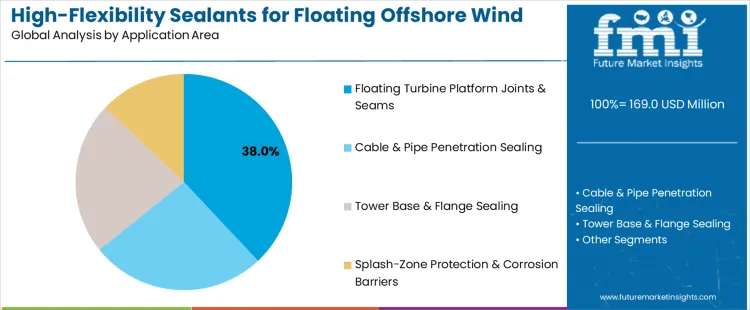
Floating turbine platform joints and seams represent about 38% of demand because they are critical load-bearing and movement-intensive interfaces. These joints connect pontoons, columns, and structural sections that move independently under wave action. Sealant failure in these areas can lead to water ingress, corrosion, and structural degradation. As a result, developers prioritize high flexibility sealants with proven fatigue resistance for platform joints. Large seam lengths and multiple interfaces drive higher material consumption in this application. Limited access after installation further reinforces the need for reliable sealing solutions at the platform level.
Cable and pipe penetrations, tower base sealing, and splash-zone protection form important secondary applications. Penetrations require localized sealing but involve smaller volumes. Tower base flanges experience movement but are fewer in number. Splash-zone barriers focus on corrosion protection rather than joint flexibility alone. These applications contribute to overall demand but do not match the scale or criticality of platform joints. Application leadership therefore reflects movement intensity, repair difficulty, and structural importance within floating offshore wind foundations rather than total number of sealed locations.
How Are High-Flexibility Sealants Being Applied Across Floating Offshore Wind Foundations?
Use appears in offshore wind farms where floating platform structures require resilient joints capable of withstanding wave motion, thermal cycling, and mechanical stress. Manufacturers adopt high-flexibility sealants to bond metal, composite, and concrete components, providing water-tightness, vibration damping, and structural integrity. Operators integrate these sealants in pontoons, mooring attachments, and hull connections to maintain foundation durability in harsh marine environments. These applications reflect operational and safety priorities rather than aesthetic objectives, with adoption driven by joint performance, environmental resilience, and structural reliability.
What Operational and Material Conditions Support Adoption of High-Flexibility Sealants for Floating Offshore Wind Foundations?
Selection aligns with substrates exposed to saltwater, UV radiation, and wide temperature variations. Formulations are optimized for elongation, adhesion, chemical resistance, and long-term durability under dynamic loads. Installation processes monitor surface preparation, sealant application, and curing conditions to ensure uniform coverage and bond strength. Quality control evaluates mechanical performance, water ingress prevention, and adhesion consistency to meet international marine and renewable energy standards. These conditions emerge from operational efficiency, structural integrity, and environmental resilience priorities in offshore manufacturing workflows.
Which Practical Considerations Limit Wider Use of High-Flexibility Sealants for Floating Offshore Wind Foundations?
High material and installation costs limit adoption to large-scale or premium offshore projects. Sealant compatibility with diverse metals, composites, and coatings must be validated. Harsh marine conditions require precise application and curing to maintain performance. Regulatory approvals and offshore engineering standards vary by region. These factors lead to selective deployment where structural reliability, environmental resistance, and operational safety justify incremental cost and specialized process management.
What is the Demand for High Flexibility Sealants for Floating Offshore Wind Foundations by Country?
| Country | CAGR (%) |
|---|---|
| China | 14.0% |
| USA | 11.5% |
| UK | 11.0% |
| Norway | 10.6% |
| South Korea | 10.2% |
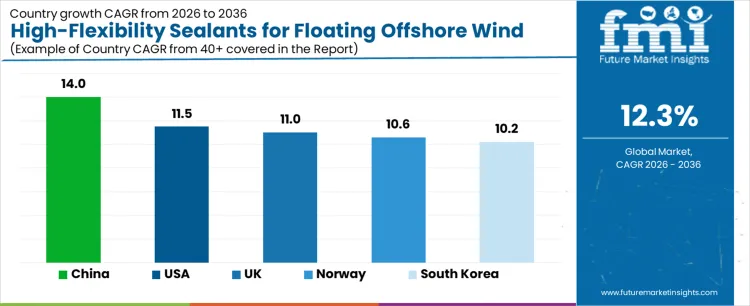
The demand for high flexibility sealants for floating offshore wind foundations varies across countries, driven by offshore wind capacity expansion, renewable energy initiatives, and structural durability requirements. China leads with a 14.0% CAGR, supported by rapid offshore wind deployment, government renewable energy targets, and adoption of advanced sealants for floating foundations. The USA follows at 11.5%, driven by expansion of offshore wind projects and stringent performance requirements for structural components. The UK records 11.0%, shaped by established offshore wind capacity and adoption of flexible sealant solutions. Norway posts 10.6%, supported by offshore wind and marine engineering projects. South Korea grows at 10.2%, reflecting renewable energy expansion and demand for durable sealants in floating wind foundations.
How Are High-Flexibility Sealants Expanding Floating Offshore Wind Foundation Projects in China?

In China, the High-Flexibility Sealants for Floating Offshore Wind Foundations Market is growing at a CAGR of 14% through 2036, driven by rapid expansion of offshore wind farms and large-scale renewable energy projects. Manufacturers are adopting high-flexibility sealants to improve structural resilience, accommodate thermal and mechanical stress, and ensure long-term durability of floating foundation assemblies. Demand is concentrated in coastal renewable energy hubs, offshore fabrication yards, and industrial adhesive suppliers. Compared to the USA, China emphasizes large-scale industrial integration and high-volume offshore projects. Domestic suppliers provide high-performance, chemically compatible sealants suitable for recurring foundation installation and maintenance cycles.
- Coastal renewable energy hubs, offshore fabrication yards, and industrial adhesive suppliers drive adoption
- Sealants improve structural resilience, flexibility, and durability
- Domestic suppliers provide high-performance, chemically compatible solutions
- Recurring foundation installation and maintenance cycles sustain adoption
How Are Offshore Wind Expansion and Regulatory Incentives Driving Growth in the United States?
In the United States, revenue is growing at a CAGR of 11.5% through 2036, supported by federal incentives for offshore wind, renewable energy mandates, and increasing investment in floating foundation projects. Contractors and renewable energy developers are adopting high-flexibility sealants to ensure foundation integrity, accommodate environmental stress, and extend service life. Demand is concentrated in coastal wind energy zones, fabrication facilities, and industrial adhesive supply chains. Compared to the UK, the U.S. market balances operational efficiency with compliance and long-term durability. Domestic suppliers provide high-performance sealants compatible with automated offshore assembly and recurring maintenance cycles.
- Coastal wind energy zones, fabrication facilities, and industrial supply chains drive adoption
- Sealants ensure structural integrity and accommodate environmental stress
- Domestic suppliers provide high-performance, production-compatible adhesives
- Recurring offshore assembly and maintenance cycles sustain adoption
How Are Renewable Energy Standards and Industrial Hubs Supporting Growth in the UK?
In the UK, the market is expanding at a CAGR of 11% through 2036, driven by offshore wind capacity expansion, government renewable energy targets, and installation of floating foundations. Developers and contractors are integrating high-flexibility sealants to enhance durability, maintain structural performance, and meet environmental and safety standards. Demand is concentrated in offshore wind zones, fabrication yards, and industrial adhesive suppliers. Compared to China, adoption focuses on precision, regulatory compliance, and project-specific durability rather than large-scale volume. Domestic suppliers provide high-performance sealants compatible with recurring offshore foundation installations and inspections.
- Offshore wind zones, fabrication yards, and industrial adhesive suppliers drive adoption
- Sealants enhance durability and maintain structural performance
- Domestic suppliers provide high-performance, compliant solutions
- Recurring foundation installations and inspections sustain adoption
How Are Industrial Standards and Offshore Wind Growth Driving Adoption in Norway?
In Norway, revenue is growing at a CAGR of 10.6% through 2036, supported by the country’s strong offshore wind development, marine engineering capabilities, and stringent environmental standards. Manufacturers are adopting high-flexibility sealants to ensure mechanical resilience, thermal stability, and long-term durability of floating foundation assemblies. Demand is concentrated in coastal wind farm hubs, fabrication yards, and industrial adhesive suppliers. Compared to South Korea, adoption emphasizes environmental compliance and project-specific quality. Domestic suppliers provide high-performance sealants suitable for recurring offshore foundation installation, maintenance, and safety inspections.
- Coastal wind farm hubs, fabrication yards, and industrial adhesive suppliers drive adoption
- Sealants ensure mechanical resilience, thermal stability, and durability
- Domestic suppliers provide high-performance, environmentally compliant solutions
- Recurring foundation installation and inspection cycles sustain adoption
How Are Renewable Energy Expansion and Industrial Scale Driving Market Growth in South Korea?

In South Korea, the market is expanding at a CAGR of 10.2% through 2036, driven by increasing offshore wind projects, industrial-scale renewable energy expansion, and government incentives. Contractors and manufacturers are integrating high-flexibility sealants for floating foundations to enhance durability, accommodate dynamic marine conditions, and ensure long-term structural performance. Demand is concentrated in coastal renewable energy hubs, fabrication yards, and industrial adhesive supply centers. Compared to Norway, adoption emphasizes large-scale production integration and recurring project cycles. Domestic suppliers provide high-performance, chemically compatible sealants suitable for repeated offshore foundation installation and maintenance.
- Coastal renewable energy hubs, fabrication yards, and industrial adhesive centers drive adoption
- Sealants enhance durability and accommodate marine conditions
- Domestic suppliers provide high-performance, chemically compatible solutions
- Recurring offshore foundation installation and maintenance cycles sustain adoption
Which Strategic Approaches Define Competition in the High-Flexibility Sealants for Floating Offshore Wind Foundations Market under Dynamic Load Conditions?
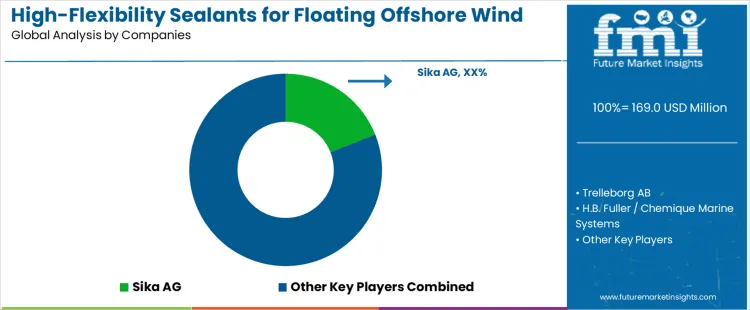
Competition in high flexibility sealants for floating offshore wind foundations is driven by the ability to accommodate continuous motion, hydrostatic pressure, and long service intervals rather than by static sealing strength. Sika AG and Bostik, part of Arkema, position their sealants around elastic recovery and fatigue resistance, targeting joints exposed to multidirectional movement from waves and mooring dynamics. Their strategies emphasize long term adhesion to steel and composite substrates, resistance to saltwater ingress, and stability across temperature gradients. Qualification centers on cyclic movement endurance, crack bridging capability, and performance after prolonged immersion, reflecting operator focus on maintenance avoidance and structural integrity over decades.
Marine and offshore specialists shape competition through application specific engineering. Trelleborg AB competes by aligning sealant performance with elastomeric systems used in offshore interfaces, prioritizing deformation tolerance and material compatibility. H.B. Fuller, through Chemique Marine Systems, emphasizes tailored formulations and installation support for complex joint geometries encountered during offshore assembly. 3M Marine and Offshore Solutions participates where sealants intersect with corrosion protection and composite bonding requirements. Across the market, competitive advantage depends on validation under simulated offshore motion, ease of application during limited weather windows, and documented durability. Success is defined by predictable behavior under dynamic loads and reduced intervention risk rather than breadth of sealant portfolios or rapid formulation changes.
Key Players in the High Flexibility Sealants for Floating Offshore Wind Foundations Market
- Sika AG
- Trelleborg AB
- H.B. Fuller or Chemique Marine Systems
- Bostik (Arkema)
- 3M Marine & Offshore Solutions
Scope of the Report
| Items | Values |
|---|---|
| Quantitative Units (2026) | USD million |
| Type | Marine-Grade Polyurethane Sealants, Silicone or Hybrid Silicone Sealants, Polysulfide-Based Flexible Sealants, Other High-Flexibility Elastomeric Systems |
| Application | Floating Turbine Platform Joints and Seams, Cable and Pipe Penetration Sealing, Tower Base and Flange Sealing, Splash-Zone Protection and Corrosion Barriers |
| End Users | Floating Offshore Wind Developers, Offshore Foundation Fabricators, Marine Engineering Contractors, Offshore Installation and Maintenance Operators |
| Regions Covered | Asia Pacific, Europe, North America, Latin America, Middle East and Africa |
| Countries Covered | China, United States, United Kingdom, Norway, South Korea, Japan, Germany, France, India, Spain, Canada, Brazil, ASEAN countries, Nordic countries, and other global regions |
| Key Companies Profiled | Sika AG, Trelleborg AB, H.B. Fuller or Chemique Marine Systems, Bostik part of Arkema, 3M Marine and Offshore Solutions |
| Additional Attributes | Dollar by sales across sealant chemistry and application area, dynamic load and cyclic movement tolerance benchmarks, offshore qualification and marine durability testing requirements, compatibility with steel composite and coated substrates, installation performance under offshore weather windows, regional adoption trends linked to floating wind project pipelines |
High-Flexibility Sealants for Floating Offshore Wind Foundations Market Segmentation
Sealant Chemistry:
- Marine-Grade Polyurethane Sealants
- Silicone or Hybrid Silicone-Sealants
- Polysulfide-Based Flexible Sealants
- Other High-Flexibility Elastomeric Systems
Application Area:
- Floating Turbine Platform Joints & Seams
- Cable & Pipe Penetration Sealing
- Tower Base & Flange Sealing
- Splash-Zone Protection & Corrosion Barriers
Foundation Type:
- Semi-Submersible Platforms
- Spar-Buoy Platforms
- Tension Leg Platforms (TLP)
- Other Floating Foundation Designs
Region
- Asia Pacific
- China
- Japan
- South Korea
- India
- Australia & New Zealand
- ASEAN
- Rest of Asia Pacific
- Europe
- Germany
- United Kingdom
- France
- Italy
- Spain
- Nordic
- BENELUX
- Rest of Europe
- North America
- United States
- Canada
- Mexico
- Latin America
- Brazil
- Chile
- Rest of Latin America
- Middle East & Africa
- Kingdom of Saudi Arabia
- Other GCC Countries
- Turkey
- South Africa
- Other African Union
- Rest of Middle East & Africa
Frequently Asked Questions
How big is the high-flexibility sealants for floating offshore wind foundations market in 2026?
The global high-flexibility sealants for floating offshore wind foundations market is estimated to be valued at USD 169.0 million in 2026.
What will be the size of high-flexibility sealants for floating offshore wind foundations market in 2036?
The market size for the high-flexibility sealants for floating offshore wind foundations market is projected to reach USD 539.1 million by 2036.
How much will be the high-flexibility sealants for floating offshore wind foundations market growth between 2026 and 2036?
The high-flexibility sealants for floating offshore wind foundations market is expected to grow at a 12.3% CAGR between 2026 and 2036.
What are the key product types in the high-flexibility sealants for floating offshore wind foundations market?
The key product types in high-flexibility sealants for floating offshore wind foundations market are marine-grade polyurethane sealants, silicone / hybrid silicone-sealants, polysulfide-based flexible sealants and other high-flexibility elastomeric systems.
Which application area segment to contribute significant share in the high-flexibility sealants for floating offshore wind foundations market in 2026?
In terms of application area, floating turbine platform joints & seams segment to command 38.0% share in the high-flexibility sealants for floating offshore wind foundations market in 2026.
Preview the report firsthand - request a free sample
Get SampleGet the brochure for pricing and purchase details.
Get PDFTable of Content
- Executive Summary
- Global Market Outlook
- Demand-side Trends
- Supply-side Trends
- Technology Roadmap Analysis
- Analysis and Recommendations
- Market Overview
- Market Coverage / Taxonomy
- Market Definition / Scope / Limitations
- Market Background
- Market Dynamics
- Drivers
- Restraints
- Opportunity
- Trends
- Scenario Forecast
- Demand in Optimistic Scenario
- Demand in Likely Scenario
- Demand in Conservative Scenario
- Opportunity Map Analysis
- Product Life Cycle Analysis
- Supply Chain Analysis
- Investment Feasibility Matrix
- Value Chain Analysis
- PESTLE and Porter’s Analysis
- Regulatory Landscape
- Regional Parent Market Outlook
- Production and Consumption Statistics
- Import and Export Statistics
- Market Dynamics
- Global Market Analysis 2021 to 2025 and Forecast, 2026 to 2036
- Historical Market Size Value (USD Million) Analysis, 2021 to 2025
- Current and Future Market Size Value (USD Million) Projections, 2026 to 2036
- Y-o-Y Growth Trend Analysis
- Absolute $ Opportunity Analysis
- Global Market Pricing Analysis 2021 to 2025 and Forecast 2026 to 2036
- Global Market Analysis 2021 to 2025 and Forecast 2026 to 2036, By Sealant Chemistry
- Introduction / Key Findings
- Historical Market Size Value (USD Million) Analysis By Sealant Chemistry , 2021 to 2025
- Current and Future Market Size Value (USD Million) Analysis and Forecast By Sealant Chemistry , 2026 to 2036
- Marine-Grade Polyurethane Sealants
- Silicone / Hybrid Silicone-Sealants
- Polysulfide-Based Flexible Sealants
- Other High-Flexibility Elastomeric Systems
- Marine-Grade Polyurethane Sealants
- Y-o-Y Growth Trend Analysis By Sealant Chemistry , 2021 to 2025
- Absolute $ Opportunity Analysis By Sealant Chemistry , 2026 to 2036
- Global Market Analysis 2021 to 2025 and Forecast 2026 to 2036, By Application Area
- Introduction / Key Findings
- Historical Market Size Value (USD Million) Analysis By Application Area, 2021 to 2025
- Current and Future Market Size Value (USD Million) Analysis and Forecast By Application Area, 2026 to 2036
- Floating Turbine Platform Joints & Seams
- Cable & Pipe Penetration Sealing
- Tower Base & Flange Sealing
- Splash-Zone Protection & Corrosion Barriers
- Floating Turbine Platform Joints & Seams
- Y-o-Y Growth Trend Analysis By Application Area, 2021 to 2025
- Absolute $ Opportunity Analysis By Application Area, 2026 to 2036
- Global Market Analysis 2021 to 2025 and Forecast 2026 to 2036, By Foundation Type
- Introduction / Key Findings
- Historical Market Size Value (USD Million) Analysis By Foundation Type, 2021 to 2025
- Current and Future Market Size Value (USD Million) Analysis and Forecast By Foundation Type, 2026 to 2036
- Semi-Submersible Platforms
- Spar-Buoy Platforms
- Tension Leg Platforms (TLP)
- Other Floating Foundation Designs
- Semi-Submersible Platforms
- Y-o-Y Growth Trend Analysis By Foundation Type, 2021 to 2025
- Absolute $ Opportunity Analysis By Foundation Type, 2026 to 2036
- Global Market Analysis 2021 to 2025 and Forecast 2026 to 2036, By Region
- Introduction
- Historical Market Size Value (USD Million) Analysis By Region, 2021 to 2025
- Current Market Size Value (USD Million) Analysis and Forecast By Region, 2026 to 2036
- North America
- Latin America
- Western Europe
- Eastern Europe
- East Asia
- South Asia and Pacific
- Middle East & Africa
- Market Attractiveness Analysis By Region
- North America Market Analysis 2021 to 2025 and Forecast 2026 to 2036, By Country
- Historical Market Size Value (USD Million) Trend Analysis By Market Taxonomy, 2021 to 2025
- Market Size Value (USD Million) Forecast By Market Taxonomy, 2026 to 2036
- By Country
- USA
- Canada
- Mexico
- By Sealant Chemistry
- By Application Area
- By Foundation Type
- By Country
- Market Attractiveness Analysis
- By Country
- By Sealant Chemistry
- By Application Area
- By Foundation Type
- Key Takeaways
- Latin America Market Analysis 2021 to 2025 and Forecast 2026 to 2036, By Country
- Historical Market Size Value (USD Million) Trend Analysis By Market Taxonomy, 2021 to 2025
- Market Size Value (USD Million) Forecast By Market Taxonomy, 2026 to 2036
- By Country
- Brazil
- Chile
- Rest of Latin America
- By Sealant Chemistry
- By Application Area
- By Foundation Type
- By Country
- Market Attractiveness Analysis
- By Country
- By Sealant Chemistry
- By Application Area
- By Foundation Type
- Key Takeaways
- Western Europe Market Analysis 2021 to 2025 and Forecast 2026 to 2036, By Country
- Historical Market Size Value (USD Million) Trend Analysis By Market Taxonomy, 2021 to 2025
- Market Size Value (USD Million) Forecast By Market Taxonomy, 2026 to 2036
- By Country
- Germany
- UK
- Italy
- Spain
- France
- Nordic
- BENELUX
- Rest of Western Europe
- By Sealant Chemistry
- By Application Area
- By Foundation Type
- By Country
- Market Attractiveness Analysis
- By Country
- By Sealant Chemistry
- By Application Area
- By Foundation Type
- Key Takeaways
- Eastern Europe Market Analysis 2021 to 2025 and Forecast 2026 to 2036, By Country
- Historical Market Size Value (USD Million) Trend Analysis By Market Taxonomy, 2021 to 2025
- Market Size Value (USD Million) Forecast By Market Taxonomy, 2026 to 2036
- By Country
- Russia
- Poland
- Hungary
- Balkan & Baltic
- Rest of Eastern Europe
- By Sealant Chemistry
- By Application Area
- By Foundation Type
- By Country
- Market Attractiveness Analysis
- By Country
- By Sealant Chemistry
- By Application Area
- By Foundation Type
- Key Takeaways
- East Asia Market Analysis 2021 to 2025 and Forecast 2026 to 2036, By Country
- Historical Market Size Value (USD Million) Trend Analysis By Market Taxonomy, 2021 to 2025
- Market Size Value (USD Million) Forecast By Market Taxonomy, 2026 to 2036
- By Country
- China
- Japan
- South Korea
- By Sealant Chemistry
- By Application Area
- By Foundation Type
- By Country
- Market Attractiveness Analysis
- By Country
- By Sealant Chemistry
- By Application Area
- By Foundation Type
- Key Takeaways
- South Asia and Pacific Market Analysis 2021 to 2025 and Forecast 2026 to 2036, By Country
- Historical Market Size Value (USD Million) Trend Analysis By Market Taxonomy, 2021 to 2025
- Market Size Value (USD Million) Forecast By Market Taxonomy, 2026 to 2036
- By Country
- India
- ASEAN
- Australia & New Zealand
- Rest of South Asia and Pacific
- By Sealant Chemistry
- By Application Area
- By Foundation Type
- By Country
- Market Attractiveness Analysis
- By Country
- By Sealant Chemistry
- By Application Area
- By Foundation Type
- Key Takeaways
- Middle East & Africa Market Analysis 2021 to 2025 and Forecast 2026 to 2036, By Country
- Historical Market Size Value (USD Million) Trend Analysis By Market Taxonomy, 2021 to 2025
- Market Size Value (USD Million) Forecast By Market Taxonomy, 2026 to 2036
- By Country
- Kingdom of Saudi Arabia
- Other GCC Countries
- Turkiye
- South Africa
- Other African Union
- Rest of Middle East & Africa
- By Sealant Chemistry
- By Application Area
- By Foundation Type
- By Country
- Market Attractiveness Analysis
- By Country
- By Sealant Chemistry
- By Application Area
- By Foundation Type
- Key Takeaways
- Key Countries Market Analysis
- USA
- Pricing Analysis
- Market Share Analysis, 2025
- By Sealant Chemistry
- By Application Area
- By Foundation Type
- Canada
- Pricing Analysis
- Market Share Analysis, 2025
- By Sealant Chemistry
- By Application Area
- By Foundation Type
- Mexico
- Pricing Analysis
- Market Share Analysis, 2025
- By Sealant Chemistry
- By Application Area
- By Foundation Type
- Brazil
- Pricing Analysis
- Market Share Analysis, 2025
- By Sealant Chemistry
- By Application Area
- By Foundation Type
- Chile
- Pricing Analysis
- Market Share Analysis, 2025
- By Sealant Chemistry
- By Application Area
- By Foundation Type
- Germany
- Pricing Analysis
- Market Share Analysis, 2025
- By Sealant Chemistry
- By Application Area
- By Foundation Type
- UK
- Pricing Analysis
- Market Share Analysis, 2025
- By Sealant Chemistry
- By Application Area
- By Foundation Type
- Italy
- Pricing Analysis
- Market Share Analysis, 2025
- By Sealant Chemistry
- By Application Area
- By Foundation Type
- Spain
- Pricing Analysis
- Market Share Analysis, 2025
- By Sealant Chemistry
- By Application Area
- By Foundation Type
- France
- Pricing Analysis
- Market Share Analysis, 2025
- By Sealant Chemistry
- By Application Area
- By Foundation Type
- India
- Pricing Analysis
- Market Share Analysis, 2025
- By Sealant Chemistry
- By Application Area
- By Foundation Type
- ASEAN
- Pricing Analysis
- Market Share Analysis, 2025
- By Sealant Chemistry
- By Application Area
- By Foundation Type
- Australia & New Zealand
- Pricing Analysis
- Market Share Analysis, 2025
- By Sealant Chemistry
- By Application Area
- By Foundation Type
- China
- Pricing Analysis
- Market Share Analysis, 2025
- By Sealant Chemistry
- By Application Area
- By Foundation Type
- Japan
- Pricing Analysis
- Market Share Analysis, 2025
- By Sealant Chemistry
- By Application Area
- By Foundation Type
- South Korea
- Pricing Analysis
- Market Share Analysis, 2025
- By Sealant Chemistry
- By Application Area
- By Foundation Type
- Russia
- Pricing Analysis
- Market Share Analysis, 2025
- By Sealant Chemistry
- By Application Area
- By Foundation Type
- Poland
- Pricing Analysis
- Market Share Analysis, 2025
- By Sealant Chemistry
- By Application Area
- By Foundation Type
- Hungary
- Pricing Analysis
- Market Share Analysis, 2025
- By Sealant Chemistry
- By Application Area
- By Foundation Type
- Kingdom of Saudi Arabia
- Pricing Analysis
- Market Share Analysis, 2025
- By Sealant Chemistry
- By Application Area
- By Foundation Type
- Turkiye
- Pricing Analysis
- Market Share Analysis, 2025
- By Sealant Chemistry
- By Application Area
- By Foundation Type
- South Africa
- Pricing Analysis
- Market Share Analysis, 2025
- By Sealant Chemistry
- By Application Area
- By Foundation Type
- USA
- Market Structure Analysis
- Competition Dashboard
- Competition Benchmarking
- Market Share Analysis of Top Players
- By Regional
- By Sealant Chemistry
- By Application Area
- By Foundation Type
- Competition Analysis
- Competition Deep Dive
- Sika AG
- Overview
- Product Portfolio
- Profitability by Market Segments (Product/Age /Sales Channel/Region)
- Sales Footprint
- Strategy Overview
- Marketing Strategy
- Product Strategy
- Channel Strategy
- Trelleborg AB
- H.B. Fuller / Chemique Marine Systems
- Bostik (Arkema)
- 3M Marine & Offshore Solutions
- Sika AG
- Competition Deep Dive
- Assumptions & Acronyms Used
- Research Methodology


