

- Industry Size (2026)
- USD 1009.3 Mn
- Forecast (2036)
- USD 1944.8 Mn
- CAGR (2026 to 2036)
- 6.8%
Offshore Repurposing Repower Wind Upgrades Market Forecast and Outlook 2026 to 2036
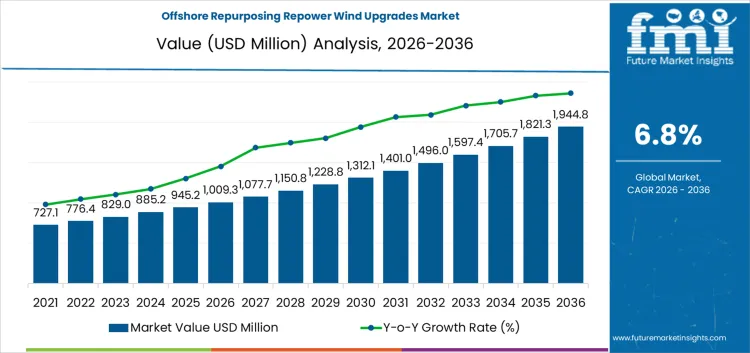
The offshore repurposing and repower wind upgrades market is set to reach USD 1,009.3 million in 2026 and is projected to reach USD 1,944.8 million by 2036, reflecting a CAGR of 6.8%. Market performance is shaped by concentration among service providers capable of executing turbine repowering, blade replacement, and structural retrofits for offshore wind farms. Regional control over port facilities, vessel availability, and specialized labor affects operational reliability. Adoption varies according to project age, regulatory approvals, and wind farm capacity expansion plans. Smaller operators face limitations in capital investment, certification, and access to large-scale offshore projects.
Margin concentration favors companies offering integrated repower solutions with validated engineering, installation, and maintenance support. Fragmentation persists among regional or niche service providers, while leading firms capture concentrated value through fleet coordination, operational reliability, and alignment with multi-farm contracts. Market outcomes are determined by technical capability, compliance with marine and turbine regulations, and project execution efficiency rather than the number of retrofitted turbines alone. Adoption timelines vary with regional energy policies, turbine age distribution, and offshore infrastructure readiness.
Quick Stats of the Offshore Repurposing Repower Wind Upgrades Market
- Offshore Repurposing Repower Wind Upgrades Market Value (2026): USD 1,009.3 million
- Offshore Repurposing Repower Wind Upgrades Forecast Value (2036): USD 1,944.8 million
- Offshore Repurposing Repower Wind Upgrades Forecast CAGR 2026 to 2036: 6.8%
- Leading Upgrade Type in Offshore Repurposing Repower Wind Upgrades Market: Nacelle replacement (42 % share)
- Leading Water Depth in Offshore Repurposing Repower Wind Upgrades Market: Shallow (<30 m, 64 % share)
- Key Growth Regions in Offshore Repurposing Repower Wind Upgrades Market: UK, Germany, Netherlands, USA
- Top Players in Offshore Repurposing Repower Wind Upgrades Market: Siemens Gamesa, Vestas, GE Vernova, Nordex, MingYang Smart Energy, Goldwind
What is the Growth Forecast for Offshore Repurposing Repower Wind Upgrades Market through 2036?
Between 2026 and 2031, the offshore repurposing repower wind upgrades market is projected to grow from USD 1,009.3 million to USD 1,313.3 million, generating an absolute increase of USD 304 million and reflecting a CAGR of 6.8%. Growth is driven by adoption of nacelle replacement, blade upgrades, and power electronics retrofits across shallow (<30 m) and mid-depth water installations. Turbines aged 15-20 years and older than 20 years are the primary candidates for upgrades. Expansion is supported by rising demand for increased energy output, efficiency improvements, and extended turbine lifespans. Suppliers focus on retrofit feasibility, performance optimization, and compliance with offshore standards.
From 2031 to 2036, the market is expected to expand from USD 1,313.3 million to USD 1,944.8 million, adding USD 631.5 million. Growth is fueled by broader adoption of mid-life turbine upgrades, increasing offshore wind capacity, and technological innovations in blade and power electronics enhancements. Market drivers include higher energy yield requirements, operational cost reduction, and sustainability initiatives. Competitive advantage favors suppliers with validated upgrade solutions, engineering expertise, and strong project execution capabilities. Leading companies include Siemens Gamesa, Vestas, GE Vernova, Nordex, MingYang Smart Energy, and Goldwind.
Offshore Repurposing Repower Wind Upgrades Market Key Takeaways
| Metric | Value |
|---|---|
| Market Value (2026) | USD 1,009.30 million |
| Forecast Value (2036) | USD 1,944.8 million |
| Forecast CAGR 2026 to 2036 | 6.80% |
What Is Driving Demand for Offshore Repurposing and Repower Wind Upgrades?
Offshore repurposing and repower wind upgrades are increasingly adopted to extend the operational life, improve performance, and increase energy output of existing offshore wind farms. Historically, aging wind turbines faced declining efficiency and rising maintenance costs, limiting long-term asset viability. Modern repowering strategies replace or retrofit key components such as rotors, nacelles, generators, and control systems to achieve higher capacity, improved reliability, and compliance with updated grid and environmental standards. Offshore wind developers, utilities, and engineering service providers prioritize turbine compatibility, downtime minimization, and regulatory approvals. Early adoption focused on pilot projects and high-value assets, while current demand spans large-scale offshore farms driven by renewable energy targets, grid integration requirements, and cost optimization. Component reliability, upgrade scope, and installation logistics influence adoption.
Increasing focus on renewable energy expansion, efficiency optimization, and asset life extension is shaping market growth. Compared with conventional maintenance, repowering and upgrade projects emphasize higher energy yield, reduced downtime, and integration with modern turbine technologies. Cost structures depend on component manufacturing, offshore installation, and engineering services, concentrating margins among suppliers capable of delivering certified, high-performance upgrades. Operators adopt these solutions to maximize energy production, extend turbine lifespan, and comply with evolving environmental and grid regulations. By 2036, offshore repurposing and repower wind upgrades are expected to become standard practice in wind farm asset management, supporting efficient, high-yield renewable energy generation and long-term operational sustainability.
What Factors Are Shaping the Demand for Offshore Repurposing Repower Wind Upgrades in Terms of Upgrade Type and Water Depth?
The demand for offshore repurposing and repower wind upgrades is segmented by upgrade type and water depth. Upgrade types include nacelle replacement, blade upgrades, and power electronics retrofits. Water depth segments include shallow (<30 m), mid-depth, and deep-water installations. Adoption is influenced by turbine performance requirements, lifecycle extension goals, and operational reliability. Uptake is driven by regulatory incentives, grid integration needs, and cost optimization. Upgrade type and water depth selection depend on structural feasibility, site conditions, and maintenance accessibility, ensuring reliable, efficient, and high-performing repowered turbines across offshore wind farms globally.
Why Is Nacelle Replacement Leading the Upgrade Type Segment in Offshore Repurposing and Repower Wind Upgrades?
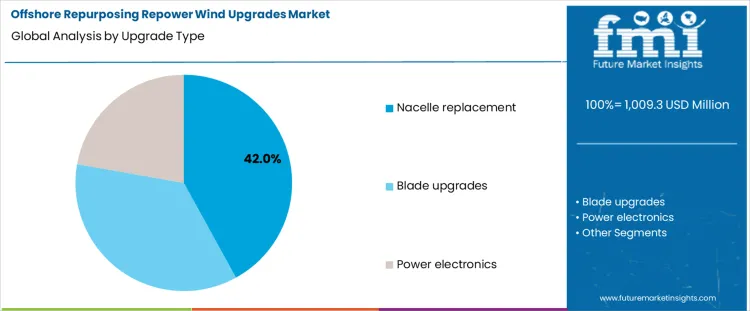
Nacelle replacement accounts for approximately 42% of total upgrade type demand, making it the leading category. This involves substituting older turbine nacelles with modern, higher-capacity units to improve energy output and operational reliability. Adoption is driven by the need to extend turbine life, increase efficiency, and integrate advanced monitoring systems. Operational procedures include structural assessment, component removal, and installation with precision alignment. Nacelle replacement reduces downtime, enhances energy capture, and allows the incorporation of upgraded control systems and safety features. The segment leads because it provides measurable gains in turbine performance, reliability, and grid compatibility across offshore installations.
Operational factors further reinforce adoption. Upgrades must consider turbine structural limits, crane availability, and weather windows. Integration with control and power electronics ensures optimized performance. Nacelle replacement leads because it delivers predictable energy output improvements, reduces maintenance frequency, and supports compliance with evolving energy regulations, making it a core strategy for repowering offshore wind assets efficiently.
Why Are Shallow-Water Installations Representing the Largest Water Depth Segment in Offshore Repurposing and Repower Wind Upgrades?
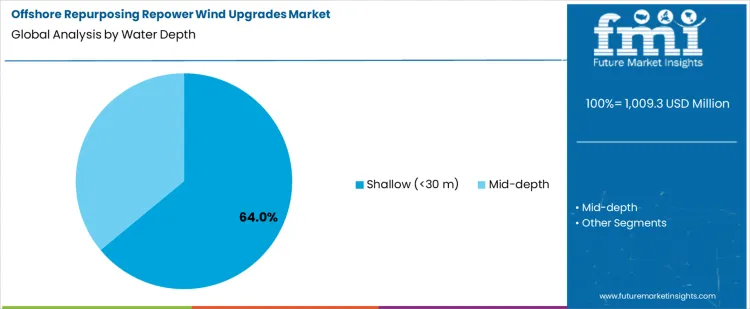
Shallow-water installations account for approximately 64% of total water depth demand, making them the largest category. Adoption is driven by ease of access, lower installation costs, and reduced logistical complexity compared with mid- and deep-water sites. These locations allow crane-assisted upgrades, simplified cabling, and straightforward structural assessments. Operational procedures include vessel scheduling, platform stabilization, and component lifting with precision. Shallow sites facilitate safer and faster retrofit operations, enabling timely turbine upgrades with minimal disruption.
Functional and operational factors further reinforce adoption. Shallow-water projects benefit from predictable sea conditions, accessibility for maintenance crews, and integration with existing infrastructure. This segment leads because it provides efficient, cost-effective, and high-reliability repowering solutions, maximizing energy yield and asset lifespan across offshore wind farms while minimizing operational risks and logistical challenges.
How Are Repowering and Upgrading Offshore Wind Turbines Extending Asset Lifecycles?
Offshore repurposing and repower wind upgrades are increasingly adopted to replace aging turbine components, enhance capacity, and extend operational life of existing offshore wind farms. Adoption is strongest in regions with mature offshore wind installations, strong renewable energy policies, and high electricity demand. Upgrades are selected for turbine compatibility, performance improvement, and grid integration capability. Growth is driven by the need to maximize return on existing assets, improve energy output, and comply with evolving environmental standards. Investment focuses on blade replacements, generator enhancements, and control system modernization. Operators prioritize solutions that improve reliability, efficiency, and sustainability without full-scale farm replacement.
Why Are Regional Renewable Energy Targets and Aging Wind Farms Driving Adoption?
Demand is influenced by local government incentives, renewable energy mandates, and the increasing age of offshore turbines. Operators adopt repowering solutions to boost capacity, reduce downtime, and maintain grid compliance. Systems offering improved aerodynamic efficiency, generator upgrades, and remote monitoring capability gain preference. Adoption is concentrated in regions with high installed offshore capacity and supportive regulatory frameworks. Operational efficiency, energy yield optimization, and compliance with evolving regulations drive procurement rather than cost. Suppliers providing validated, high-performance upgrade solutions gain competitive advantage among offshore wind operators and EPC contractors.
What Challenges Restrict Broader Deployment of Offshore Wind Upgrades?
High retrofit costs, logistical complexity, and technical compatibility issues limit adoption. Performance can be affected by sea conditions, turbine design constraints, and integration with existing grid infrastructure. Installation requires specialized vessels, lifting equipment, and offshore expertise. Smaller operators or regions with limited maintenance infrastructure adopt upgrades more slowly. These factors concentrate early deployment among large-scale offshore wind farms, experienced operators, and regions with mature offshore logistics capabilities.
How Are Technological Advancements and Collaborative Industry Efforts Shaping Market Growth?
Recent innovations include lightweight composite blades, high-efficiency generators, and digital twin-based predictive maintenance for repowered turbines. Collaboration between turbine manufacturers, operators, and engineering firms ensures upgrade feasibility, performance validation, and compliance with offshore standards. Pilot projects assess energy output, structural integrity, and environmental impact before large-scale implementation. Quality monitoring, standardization, and lifecycle modeling maintain consistent performance. Focus is on energy yield improvement, reliability, and asset longevity rather than cost or volume. Collaborative efforts enable broader adoption of offshore repowering and repower upgrades, maximizing return on existing wind assets while supporting regional renewable energy targets.
What is the Demand for Offshore Repurposing and Repower Wind Upgrades by Country?
| Country | CAGR (%) |
|---|---|
| UK | 6.5% |
| Germany | 6.2% |
| Netherlands | 6.0% |
| USA | 5.8% |
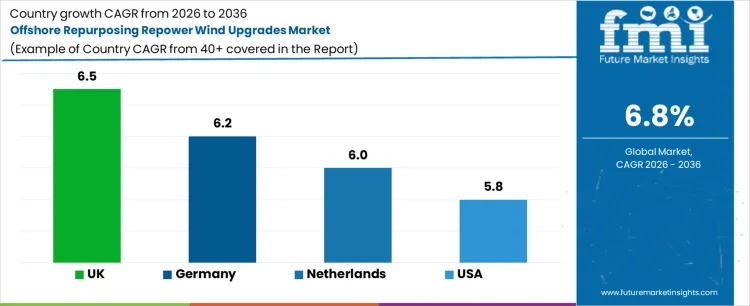
Demand for offshore repurposing and repower wind upgrades is rising as wind farm operators seek to extend asset lifespans, improve energy output, and enhance operational efficiency. The UK leads with a 6.5% CAGR, driven by mature offshore wind infrastructure, regulatory support, and initiatives to optimize existing turbine performance. Germany follows at 6.2%, supported by extensive offshore wind capacity and focus on repowering aging turbines. The Netherlands records 6.0% growth, shaped by modernizing offshore wind installations and improving energy yields. The USA shows 5.8% CAGR, reflecting gradual expansion of offshore wind capacity and adoption of repowering and optimization strategies for older turbines.
How is the United Kingdom experiencing growth in the offshore repurposing repower wind upgrades market?
United Kingdom is experiencing growth at a CAGR of 6.5%, supported by adoption of offshore repurposing repower wind upgrades market solutions to extend the operational life of offshore wind farms and improve energy generation efficiency. Wind farm operators and technology providers are deploying repowering systems optimized for turbine retrofits, blade upgrades, and integration with existing electrical infrastructure. Demand is concentrated in north sea offshore wind clusters, coastal energy hubs, and renewable energy R&D centers. Investments focus on system performance, material durability, and compliance with renewable energy regulations rather than new offshore construction. Growth reflects government incentives, industrial adoption of turbine upgrades, and increasing focus on renewable energy efficiency.
- Offshore wind repowering drives adoption.
- Systems optimize turbine retrofits and blade performance.
- Offshore clusters and energy hubs concentrate demand.
- System performance and regulatory compliance guide investment.
How is Germany witnessing growth in the offshore repurposing repower wind upgrades market?
Germany is witnessing growth at a CAGR of 6.2%, fueled by adoption of offshore repurposing repower wind upgrades market solutions to enhance efficiency and extend operational life of existing offshore wind installations. Technology providers and operators are deploying upgrades optimized for turbine performance, structural integrity, and integration with power grids. Demand is concentrated in north sea offshore farms, renewable energy hubs, and R&D centers. Investments prioritize material durability, system reliability, and compliance with energy regulations rather than large-scale new projects. Growth reflects industrial adoption of turbine repowering, government incentives, and rising focus on renewable energy sustainability.
- Turbine upgrades drive adoption.
- Systems improve structural integrity and efficiency.
- Offshore farms and energy hubs concentrate demand.
- Material durability and system reliability guide investment.
How is the Netherlands experiencing growth in the offshore repurposing repower wind upgrades market?
Netherlands is experiencing growth at a CAGR of 6%, supported by adoption of offshore repurposing repower wind upgrades market solutions to optimize performance and lifespan of offshore wind farms. Operators and technology providers are deploying repowering systems optimized for turbine blade upgrades, generator efficiency, and grid integration. Demand is concentrated in north sea offshore wind clusters, renewable energy hubs, and research centers. Investments focus on system performance, material quality, and regulatory compliance rather than large-scale construction. Growth reflects government support for offshore renewable energy, industrial adoption of turbine repowering, and focus on maximizing wind energy output.
- Offshore turbine efficiency drives adoption.
- Systems optimize blades, generators, and grid integration.
- Offshore wind clusters and energy hubs concentrate demand.
- System performance and regulatory compliance guide investment.
How is the United States witnessing growth in the offshore repurposing repower wind upgrades market?
United States is witnessing growth at a CAGR of 5.8%, fueled by adoption of offshore repurposing repower wind upgrades market solutions to improve energy output and extend service life of offshore wind installations. Operators and technology providers are deploying repowering systems optimized for turbine efficiency, blade performance, and integration with existing grid infrastructure. Demand is concentrated in east coast offshore wind hubs, renewable energy clusters, and R&D facilities. Investments prioritize system reliability, material durability, and regulatory compliance rather than fleet-scale construction. Growth reflects industrial adoption of turbine upgrades, government incentives for offshore wind, and increasing focus on sustainable energy solutions.
- Offshore wind upgrades drive adoption.
- Systems enhance turbine and blade efficiency.
- East coast wind hubs and R&D facilities concentrate demand.
- System reliability and regulatory compliance guide investment.
Who Competes in the Offshore Repurposing Repower Wind Upgrades Market and What Defines Their Capabilities?
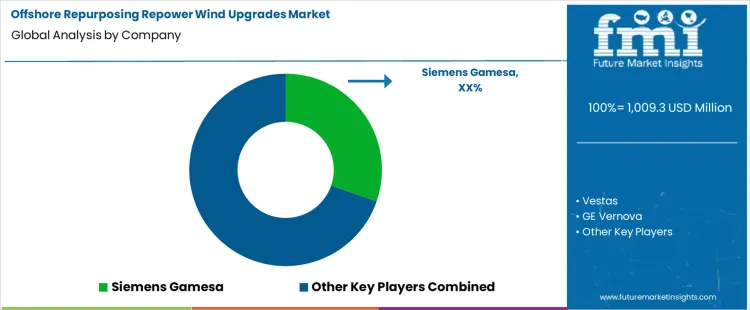
Competition in the offshore repurposing and repower wind upgrades market is defined by turbine retrofitting expertise, electrical and mechanical integration, and optimization of existing wind farm performance. Siemens Gamesa provides repowering solutions for offshore turbines, focusing on performance optimization, component replacement, and grid compliance. Vestas develops upgrade programs that extend turbine lifespan, enhance energy yield, and integrate advanced control systems for existing offshore installations. GE Vernova supplies turbine retrofits with improved generators, control electronics, and blade replacements to increase efficiency. Nordex delivers repowering services targeting structural reinforcement and operational reliability for older offshore turbines. MingYang Smart Energy focuses on turbine upgrades with improved power conversion and environmental resilience.
Goldwind provides offshore repowering solutions emphasizing electrical and mechanical integration with existing turbine platforms. Other competitors include regional wind turbine service providers and specialized engineering firms offering retrofitting, blade replacement, and control system upgrades. Differentiation arises from technical expertise in turbine integration, ability to optimize energy output, compliance with grid and safety regulations, and capacity to reduce operational downtime during upgrades. Market positioning is influenced by proven retrofit performance, experience with offshore environmental conditions, and capability to extend turbine life while improving overall efficiency and reliability in existing offshore wind farms.
Key Players in the Offshore Repurposing Repower Wind Upgrades Market
- Siemens Gamesa
- Vestas
- GE Vernova
- Nordex
- MingYang Smart Energy
- Goldwind
Scope of the Report
| Items | Values |
|---|---|
| Quantitative Units (2026) | USD million |
| Upgrade Type | Nacelle replacement, Blade upgrades, Power electronics |
| Water Depth | Shallow (<30 m), Mid-depth |
| Turbine Age | 15-20 years, 20 years |
| Region | Asia Pacific, Europe, North America, Latin America, Middle East & Africa |
| Key Countries Covered | UK, Germany, Netherlands, USA |
| Key Companies Profiled | Siemens Gamesa, Vestas, GE Vernova, Nordex, MingYang Smart Energy, Goldwind |
| Additional Attributes | Dollar sales by upgrade type, water depth, and turbine age; regional CAGR, volume and value growth projections; adoption across shallow- and mid-depth offshore installations; turbine retrofitting, blade replacement, and nacelle upgrades; integration with existing turbine platforms and grid infrastructure; focus on energy yield improvement, operational reliability, and compliance with renewable energy regulations; margins concentrated among suppliers delivering validated, high-performance repower solutions with engineering and project execution support. |
Offshore Repurposing Repower Wind Upgrades Market Segmentation
Upgrade Type:
- Nacelle replacement
- Blade upgrades
- Power electronics
Water Depth:
- Shallow (<30 m)
- Mid-depth
Turbine Age:
- 15-20 years
- 20 years
Region:
- Asia Pacific
- China
- Japan
- South Korea
- India
- Australia & New Zealand
- ASEAN
- Rest of Asia Pacific
- Europe
- Germany
- United Kingdom
- France
- Italy
- Spain
- Nordic
- BENELUX
- Rest of Europe
- North America
- United States
- Canada
- Mexico
- Latin America
- Brazil
- Chile
- Rest of Latin America
- Middle East & Africa
- Kingdom of Saudi Arabia
- Other GCC Countries
- Turkey
- South Africa
- Other African Union
- Rest of Middle East & Africa
Bibliography
- U.S. National Renewable Energy Laboratory. (2023). Offshore Wind Market Report: 2023 Edition. National Renewable Energy Laboratory.
- The Crown Estate. (2023). Offshore Wind Report 2022. The Crown Estate.
- UK Department for Energy Security and Net Zero. (2024). Clean Energy Industries Sector Plan. UK Government.
- Bundesnetzagentur. (2023). Netzentwicklungsplan Strom: Archive and plan documents. Federal Network Agency (Germany).
- European Commission. (2023). European Wind Power Action Plan. European Commission.
- European Parliament and Council of the European Union. (2023). Directive (EU) 2023/2413 (Renewable Energy Directive revision). EUR-Lex.
Frequently Asked Questions
How big is the offshore repurposing repower wind upgrades market in 2026?
The global offshore repurposing repower wind upgrades market is estimated to be valued at USD 1,009.3 million in 2026.
What will be the size of offshore repurposing repower wind upgrades market in 2036?
The market size for the offshore repurposing repower wind upgrades market is projected to reach USD 1,944.8 million by 2036.
How much will be the offshore repurposing repower wind upgrades market growth between 2026 and 2036?
The offshore repurposing repower wind upgrades market is expected to grow at a 6.8% CAGR between 2026 and 2036.
What are the key product types in the offshore repurposing repower wind upgrades market?
The key product types in offshore repurposing repower wind upgrades market are nacelle replacement, blade upgrades and power electronics.
Which water depth segment to contribute significant share in the offshore repurposing repower wind upgrades market in 2026?
In terms of water depth, shallow (<30 m) segment to command 64.0% share in the offshore repurposing repower wind upgrades market in 2026.
Preview the report firsthand - request a free sample
Get SampleGet the brochure for pricing and purchase details.
Get PDFTable of Content
- Executive Summary
- Global Market Outlook
- Demand-side Trends
- Supply-side Trends
- Technology Roadmap Analysis
- Analysis and Recommendations
- Market Overview
- Market Coverage / Taxonomy
- Market Definition / Scope / Limitations
- Market Background
- Market Dynamics
- Drivers
- Restraints
- Opportunity
- Trends
- Scenario Forecast
- Demand in Optimistic Scenario
- Demand in Likely Scenario
- Demand in Conservative Scenario
- Opportunity Map Analysis
- Product Life Cycle Analysis
- Supply Chain Analysis
- Investment Feasibility Matrix
- Value Chain Analysis
- PESTLE and Porter’s Analysis
- Regulatory Landscape
- Regional Parent Market Outlook
- Production and Consumption Statistics
- Import and Export Statistics
- Market Dynamics
- Global Market Analysis 2021 to 2025 and Forecast, 2026 to 2036
- Historical Market Size Value (USD Million) Analysis, 2021 to 2025
- Current and Future Market Size Value (USD Million) Projections, 2026 to 2036
- Y-o-Y Growth Trend Analysis
- Absolute $ Opportunity Analysis
- Global Market Pricing Analysis 2021 to 2025 and Forecast 2026 to 2036
- Global Market Analysis 2021 to 2025 and Forecast 2026 to 2036, By Upgrade Type
- Introduction / Key Findings
- Historical Market Size Value (USD Million) Analysis By Upgrade Type , 2021 to 2025
- Current and Future Market Size Value (USD Million) Analysis and Forecast By Upgrade Type , 2026 to 2036
- Nacelle replacement
- Blade upgrades
- Power electronics
- Nacelle replacement
- Y-o-Y Growth Trend Analysis By Upgrade Type , 2021 to 2025
- Absolute $ Opportunity Analysis By Upgrade Type , 2026 to 2036
- Global Market Analysis 2021 to 2025 and Forecast 2026 to 2036, By Water Depth
- Introduction / Key Findings
- Historical Market Size Value (USD Million) Analysis By Water Depth, 2021 to 2025
- Current and Future Market Size Value (USD Million) Analysis and Forecast By Water Depth, 2026 to 2036
- Shallow (<30 m)
- Mid-depth
- Shallow (<30 m)
- Y-o-Y Growth Trend Analysis By Water Depth, 2021 to 2025
- Absolute $ Opportunity Analysis By Water Depth, 2026 to 2036
- Global Market Analysis 2021 to 2025 and Forecast 2026 to 2036, By Turbine Age
- Introduction / Key Findings
- Historical Market Size Value (USD Million) Analysis By Turbine Age, 2021 to 2025
- Current and Future Market Size Value (USD Million) Analysis and Forecast By Turbine Age, 2026 to 2036
- 15-20 years
- >20 years
- 15-20 years
- Y-o-Y Growth Trend Analysis By Turbine Age, 2021 to 2025
- Absolute $ Opportunity Analysis By Turbine Age, 2026 to 2036
- Global Market Analysis 2021 to 2025 and Forecast 2026 to 2036, By Region
- Introduction
- Historical Market Size Value (USD Million) Analysis By Region, 2021 to 2025
- Current Market Size Value (USD Million) Analysis and Forecast By Region, 2026 to 2036
- North America
- Latin America
- Western Europe
- Eastern Europe
- East Asia
- South Asia and Pacific
- Middle East & Africa
- Market Attractiveness Analysis By Region
- North America Market Analysis 2021 to 2025 and Forecast 2026 to 2036, By Country
- Historical Market Size Value (USD Million) Trend Analysis By Market Taxonomy, 2021 to 2025
- Market Size Value (USD Million) Forecast By Market Taxonomy, 2026 to 2036
- By Country
- USA
- Canada
- Mexico
- By Upgrade Type
- By Water Depth
- By Turbine Age
- By Country
- Market Attractiveness Analysis
- By Country
- By Upgrade Type
- By Water Depth
- By Turbine Age
- Key Takeaways
- Latin America Market Analysis 2021 to 2025 and Forecast 2026 to 2036, By Country
- Historical Market Size Value (USD Million) Trend Analysis By Market Taxonomy, 2021 to 2025
- Market Size Value (USD Million) Forecast By Market Taxonomy, 2026 to 2036
- By Country
- Brazil
- Chile
- Rest of Latin America
- By Upgrade Type
- By Water Depth
- By Turbine Age
- By Country
- Market Attractiveness Analysis
- By Country
- By Upgrade Type
- By Water Depth
- By Turbine Age
- Key Takeaways
- Western Europe Market Analysis 2021 to 2025 and Forecast 2026 to 2036, By Country
- Historical Market Size Value (USD Million) Trend Analysis By Market Taxonomy, 2021 to 2025
- Market Size Value (USD Million) Forecast By Market Taxonomy, 2026 to 2036
- By Country
- Germany
- UK
- Italy
- Spain
- France
- Nordic
- BENELUX
- Rest of Western Europe
- By Upgrade Type
- By Water Depth
- By Turbine Age
- By Country
- Market Attractiveness Analysis
- By Country
- By Upgrade Type
- By Water Depth
- By Turbine Age
- Key Takeaways
- Eastern Europe Market Analysis 2021 to 2025 and Forecast 2026 to 2036, By Country
- Historical Market Size Value (USD Million) Trend Analysis By Market Taxonomy, 2021 to 2025
- Market Size Value (USD Million) Forecast By Market Taxonomy, 2026 to 2036
- By Country
- Russia
- Poland
- Hungary
- Balkan & Baltic
- Rest of Eastern Europe
- By Upgrade Type
- By Water Depth
- By Turbine Age
- By Country
- Market Attractiveness Analysis
- By Country
- By Upgrade Type
- By Water Depth
- By Turbine Age
- Key Takeaways
- East Asia Market Analysis 2021 to 2025 and Forecast 2026 to 2036, By Country
- Historical Market Size Value (USD Million) Trend Analysis By Market Taxonomy, 2021 to 2025
- Market Size Value (USD Million) Forecast By Market Taxonomy, 2026 to 2036
- By Country
- China
- Japan
- South Korea
- By Upgrade Type
- By Water Depth
- By Turbine Age
- By Country
- Market Attractiveness Analysis
- By Country
- By Upgrade Type
- By Water Depth
- By Turbine Age
- Key Takeaways
- South Asia and Pacific Market Analysis 2021 to 2025 and Forecast 2026 to 2036, By Country
- Historical Market Size Value (USD Million) Trend Analysis By Market Taxonomy, 2021 to 2025
- Market Size Value (USD Million) Forecast By Market Taxonomy, 2026 to 2036
- By Country
- India
- ASEAN
- Australia & New Zealand
- Rest of South Asia and Pacific
- By Upgrade Type
- By Water Depth
- By Turbine Age
- By Country
- Market Attractiveness Analysis
- By Country
- By Upgrade Type
- By Water Depth
- By Turbine Age
- Key Takeaways
- Middle East & Africa Market Analysis 2021 to 2025 and Forecast 2026 to 2036, By Country
- Historical Market Size Value (USD Million) Trend Analysis By Market Taxonomy, 2021 to 2025
- Market Size Value (USD Million) Forecast By Market Taxonomy, 2026 to 2036
- By Country
- Kingdom of Saudi Arabia
- Other GCC Countries
- Turkiye
- South Africa
- Other African Union
- Rest of Middle East & Africa
- By Upgrade Type
- By Water Depth
- By Turbine Age
- By Country
- Market Attractiveness Analysis
- By Country
- By Upgrade Type
- By Water Depth
- By Turbine Age
- Key Takeaways
- Key Countries Market Analysis
- USA
- Pricing Analysis
- Market Share Analysis, 2025
- By Upgrade Type
- By Water Depth
- By Turbine Age
- Canada
- Pricing Analysis
- Market Share Analysis, 2025
- By Upgrade Type
- By Water Depth
- By Turbine Age
- Mexico
- Pricing Analysis
- Market Share Analysis, 2025
- By Upgrade Type
- By Water Depth
- By Turbine Age
- Brazil
- Pricing Analysis
- Market Share Analysis, 2025
- By Upgrade Type
- By Water Depth
- By Turbine Age
- Chile
- Pricing Analysis
- Market Share Analysis, 2025
- By Upgrade Type
- By Water Depth
- By Turbine Age
- Germany
- Pricing Analysis
- Market Share Analysis, 2025
- By Upgrade Type
- By Water Depth
- By Turbine Age
- UK
- Pricing Analysis
- Market Share Analysis, 2025
- By Upgrade Type
- By Water Depth
- By Turbine Age
- Italy
- Pricing Analysis
- Market Share Analysis, 2025
- By Upgrade Type
- By Water Depth
- By Turbine Age
- Spain
- Pricing Analysis
- Market Share Analysis, 2025
- By Upgrade Type
- By Water Depth
- By Turbine Age
- France
- Pricing Analysis
- Market Share Analysis, 2025
- By Upgrade Type
- By Water Depth
- By Turbine Age
- India
- Pricing Analysis
- Market Share Analysis, 2025
- By Upgrade Type
- By Water Depth
- By Turbine Age
- ASEAN
- Pricing Analysis
- Market Share Analysis, 2025
- By Upgrade Type
- By Water Depth
- By Turbine Age
- Australia & New Zealand
- Pricing Analysis
- Market Share Analysis, 2025
- By Upgrade Type
- By Water Depth
- By Turbine Age
- China
- Pricing Analysis
- Market Share Analysis, 2025
- By Upgrade Type
- By Water Depth
- By Turbine Age
- Japan
- Pricing Analysis
- Market Share Analysis, 2025
- By Upgrade Type
- By Water Depth
- By Turbine Age
- South Korea
- Pricing Analysis
- Market Share Analysis, 2025
- By Upgrade Type
- By Water Depth
- By Turbine Age
- Russia
- Pricing Analysis
- Market Share Analysis, 2025
- By Upgrade Type
- By Water Depth
- By Turbine Age
- Poland
- Pricing Analysis
- Market Share Analysis, 2025
- By Upgrade Type
- By Water Depth
- By Turbine Age
- Hungary
- Pricing Analysis
- Market Share Analysis, 2025
- By Upgrade Type
- By Water Depth
- By Turbine Age
- Kingdom of Saudi Arabia
- Pricing Analysis
- Market Share Analysis, 2025
- By Upgrade Type
- By Water Depth
- By Turbine Age
- Turkiye
- Pricing Analysis
- Market Share Analysis, 2025
- By Upgrade Type
- By Water Depth
- By Turbine Age
- South Africa
- Pricing Analysis
- Market Share Analysis, 2025
- By Upgrade Type
- By Water Depth
- By Turbine Age
- USA
- Market Structure Analysis
- Competition Dashboard
- Competition Benchmarking
- Market Share Analysis of Top Players
- By Regional
- By Upgrade Type
- By Water Depth
- By Turbine Age
- Competition Analysis
- Competition Deep Dive
- Siemens Gamesa
- Overview
- Product Portfolio
- Profitability by Market Segments (Product/Age /Sales Channel/Region)
- Sales Footprint
- Strategy Overview
- Marketing Strategy
- Product Strategy
- Channel Strategy
- Vestas
- GE Vernova
- Nordex
- MingYang Smart Energy
- Goldwind
- Siemens Gamesa
- Competition Deep Dive
- Assumptions & Acronyms Used
- Research Methodology


