

- Industry Size (2026)
- USD 410.0 Mn
- Forecast (2036)
- USD 1070.0 Mn
- CAGR (2026 to 2036)
- 10.1%
Offshore Wind Turbine Blade Leading-Edge Defect Inspection Equipment Market Size, Market Forecast and Outlook By FMI
The offshore wind turbine blade leading-edge defect inspection equipment market was valued at USD 370.0 million in 2025. Sector is poised to reach USD 410.0 million in 2026, registering a CAGR of 10.1% during this forecast period. Sustained investment propels the offshore wind blade inspection market size to USD 1,070.0 million through 2036 as operators prioritize continuous defect mapping across oceanic arrays without requiring prolonged generation shutdowns.
Summary of Offshore Wind Turbine Blade Leading-Edge Defect Inspection Equipment Market
- Market Snapshot
- The offshore wind turbine blade leading-edge defect inspection equipment market is valued at USD 370.0 million in 2025 and is projected to reach USD 1,070.0 million by 2036.
- The industry is expected to grow at a 10.1% CAGR from 2026 to 2036, creating an incremental opportunity of USD 660.0 million between 2026 and 2036.
- This market remains a specification-led offshore maintenance equipment category where repeatable defect detection, safe remote access, and data quality matter more than low upfront hardware price.
- The demand base is being lifted by a rapidly expanding offshore fleet, supported by global industry associations tracking expanding installed offshore wind capacity.
- Demand and Growth Drivers
- Industry is poised to expand as leading-edge erosion directly reduces blade aerodynamic performance and increases O&M burden, which makes earlier and more repeatable defect capture valuable for offshore operators.
- Drone-based capture is gaining share as leading technology providers now market wind-specific capture and analysis workflows that cut manual access needs and improve repeatability.
- Portable composite NDT remains relevant as prominent suppliers continue to market phased-array ultrasound, conventional ultrasound, and bond-testing tools for blade spar caps, bonding, lightning damage, and disbonds.
- Among key countries, China is set to expand at 11.7% CAGR, followed by Taiwan at 10.8%, Netherlands at 10.4%, United Kingdom at 9.8%, Germany at 9.5%, United States at 8.7%, and Japan at 8.2% through 2036.
- Growth is moderated by offshore project bankability pressure, auction volatility in some mature markets, and policy disruption in the United States and Japan.
- Product and Segment View
- The market covers drone vision systems, thermal cameras, LiDAR imaging payloads, handheld ultrasonic tools, bond-testing tools, and field-grade data processors used to detect, classify, and verify leading-edge defects on offshore wind blades.
- These systems are used across routine blade health checks, shutdown diagnostics, repair confirmation, lightning-path checks, and defect escalation workflows on large offshore turbines.
- Drone vision is anticipated to lead the Inspection Technology segment with 44.0% share, reflecting the need to inspect offshore blades quickly without rope-heavy access.
- UAV systems lead the Equipment Format segment with 52.0% share, supported by better deployment speed and expanding autonomous flight workflows.
- Surface erosion leads the Blade Damage Focus segment with 48.0% share, as the leading-edge erosion is the most persistent defect theme in offshore blade life-extension work.
- In-service checks lead the Deployment Setting segment with 58.0% share, as operators push to reduce weather-related downtime and vessel mobilization overhead.
- Owners operators lead the End User segment with 46.0% share, since inspection hardware decisions increasingly sit inside asset-management and blade-health programs rather than one-off contractor purchases.
- Scope includes equipment used for defect capture, measurement, and field verification on offshore blades, while excluding blade repair materials, full inspection services revenue, and general nacelle or tower-only inspection tools.
- Geography and Competitive Outlook
- China, Taiwan, and the Netherlands are the fastest-growing national markets in this model, while the United Kingdom remains a stable high-value installed-base market for recurring offshore blade inspections.
- Competition is being shaped by tighter integration of autonomous drone capture, AI damage classification, and portable NDT confirmation, with companies such as DJI, Evident, Teledyne FLIR, Voliro, Perceptual Robotics, Sulzer Schmid, and SkySpecs active across the workflow.
- The market is fragmented as the offshore blade inspection still combines payload specialists, drone-stack providers, AI software firms, and portable NDT vendors rather than one vertically dominant vendor.
- Vendor positioning is increasingly tied to data repeatability, offshore deployment efficiency, and the ability to link image-based screening with defect-prioritization workflows.
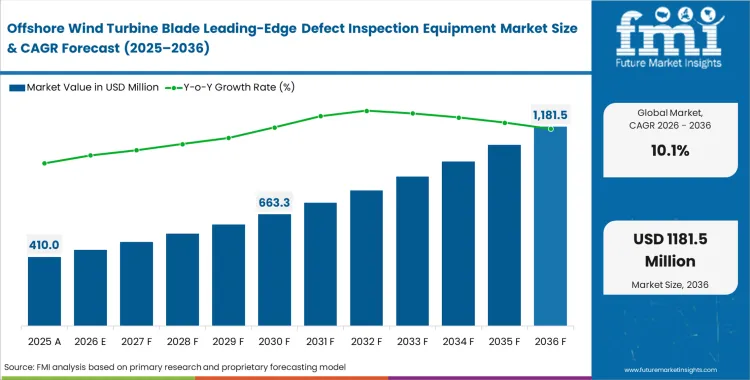
- Market size in 2025: USD 370.0 million
- Estimated market size in 2026: USD 410.0 million
- Forecast market size by 2036: USD 1,070.0 million
- CAGR (2026–2036): 10.1%
- Leading inspection technology in 2026: Drone vision (44.0% share)
- Leading equipment format in 2026: UAV systems (52.0% share)
- Fastest-growing country: China (11.7% CAGR)
Offshore operations face intense pressure to maximize aerodynamic efficiency before heavy rain erosion degrades fiberglass structures permanently. Waiting for scheduled rope access audits creates unacceptable risk blind spots across isolated marine environments. Transitioning toward automated wind blade inspection equipment forces engineering directors to evaluate optical payload capabilities rather than just raw hardware flight times. Falling behind means relying on support and manual climbing techniques that consume excessive operational budgets across large oceanic installations. Teams now demand proven sensor compatibility checklists prior to signing enterprise vendor agreements for new offshore wind turbine blade evaluation programs.
Severe offshore weather windows dictate operational maintenance scheduling. Extreme oceanic turbulence restricts manual inspection days heavily, forcing asset owners toward remote diagnostic solutions. Adopting autonomous blade inspection for offshore wind farms ensures continuous structural documentation regardless of high wind speeds, directly preventing aerodynamic failure across large scale offshore wind turbine installations.
China is projected to see offshore wind turbine blade leading‑edge defect inspection equipment demand grow at an 11.7% CAGR through 2036, supported by mandated coastal grid upgrades and stricter inspection norms tied to large offshore builds. Taiwan is expected to expand at a 10.8% CAGR as rapid capacity additions push operators toward automated systems that work within tight weather windows. The Netherlands is anticipated to grow at 10.4% CAGR, driven by North Sea digitization efforts linking blade data to lifecycle planning. The United Kingdom is forecast at 9.8% CAGR, Germany at 9.5%, the United States at 8.7%, and Japan at 8.2% through 2036, reflecting differing fleet maturity, regulatory pressure, and offshore operating conditions.
Segmental Analysis
Offshore Wind Turbine Blade Leading-Edge Defect Inspection Equipment Market Analysis by Inspection Technology
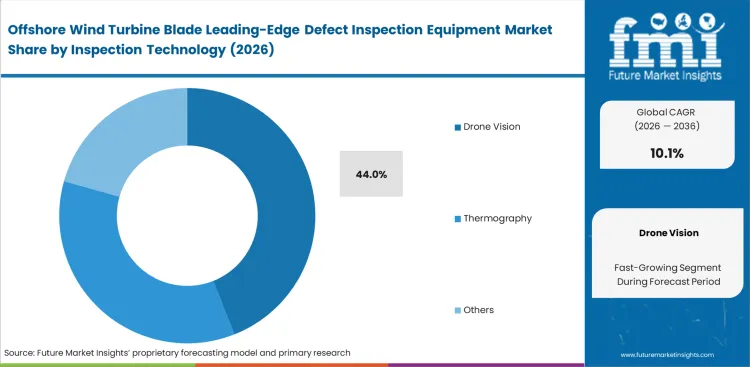
Drone vision is expected to hold 44.0% share in 2026, driven by the need for stable hover performance during precision imaging tasks. Continuous close-range inspection requires advanced optical sensing capabilities that legacy camera systems cannot deliver. Structural engineers depend on clear visual references to assess erosion before approving turbine blade repair materials. Procurement teams often overlook how basic imaging setups restrict performance in complex offshore environments despite lower upfront costs. Deploying inspection robots designed for offshore stability ensures sharper image capture, while integrating phased array ultrasound enhances defect detection beyond surface-level visuals.
- High resolution mapping requirement: Precision defect scanning demands perfectly clear visual positioning. Reliability engineers avoid generic cameras because movement blur ruins delicate structural calibrations.
- Payload modularity advantage: Multirotor frames support rapid sensor swapping between visual cameras and deep structural probes. Daily asset utilization is maximized by executing diverse testing protocols using single airframes diverse testing protocols using single airframes.
- Data processing friction: Processing raw optical data requires specialized engineering software and extensive computing power. IT directors struggle to integrate complex multi-gigabyte files into legacy maintenance databases.
Offshore Wind Turbine Blade Leading-Edge Defect Inspection Equipment Market Analysis by Equipment Format
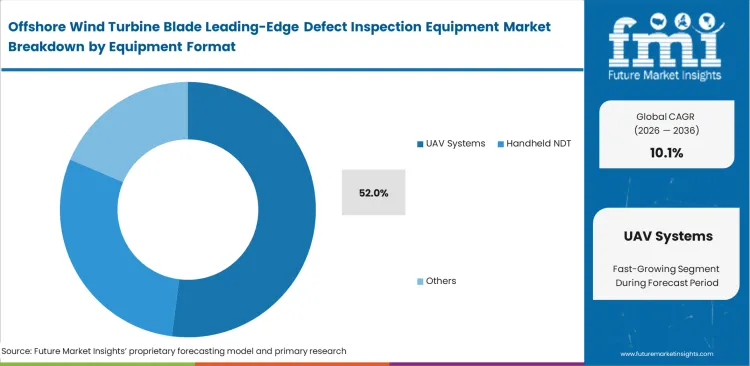
Diagnostic efficiency defines initial capital deployment decisions across vast oceanic complexes. Facility directors prioritize this mode to rapidly evaluate structures daily. UAV systems is likely to capture 52.0% share in 2026. This approach acts as an essential primary filter, identifying suspicious anomalies before dispatching costly rope access teams for localized manual quantification. Older fixed camera setups fail to provide sufficient angles required to spot tiny lightning track burns. Delaying drone adoption forces reliability engineers to perform slow manual checks, increasing probabilities of uncontained blade failures. Selecting proper non-destructive testing equipment ensures comprehensive coverage. Incorporating drone inspection and monitoring services standardizes the evaluation methodology securely.
- Primary coverage volume: Rapid aerial scanning eliminates tedious rope access maneuvers. Reliability engineers evaluate entire turbines in hours instead of days, freeing technicians for critical repair oversight.
- Contractor deployment speed: Portable drone configurations allow fast setup across difficult vessels. Service technicians maximize daily billable inspections by jumping quickly between elevated scanning locations.
- Battery degradation limits: Intense continuous flight operations destroy standard lithium batteries quickly. Plant managers deploying these units must purchase expensive specialized high capacity power cells.
Offshore Wind Turbine Blade Leading-Edge Defect Inspection Equipment Market Analysis by Blade Damage Focus
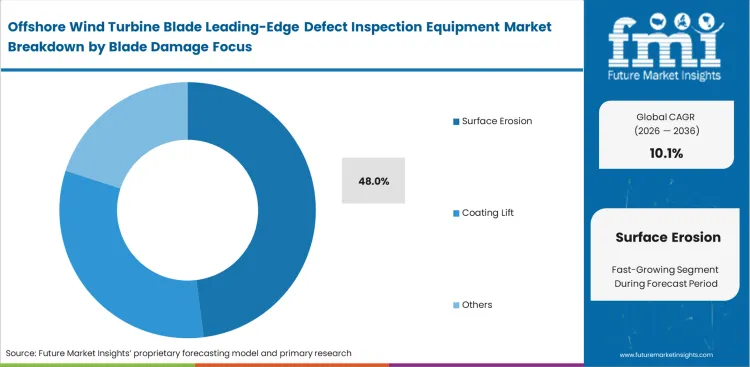
Maintenance managers utilize offshore leading edge erosion detection technologies exclusively to avoid deploying technicians just to verify outer shell integrity. Analyzing leading edges visually allows structural verification while preventing costly production stops. Surface erosion is projected to capture 48.0% share in 2026. Pure margin generation exists entirely in identifying minor wear before it requires patching operations offshore. Relying on binoculars guarantees budget overruns as unseen wear escalates quickly. Applying specific rain erosion resistant offshore blade edge coatings limits future degradation rates reliably.
- Wear prevention economics: Early visual detection occurs without halting generation. Maintenance directors avoid staggering repair costs by assessing outer shell loss from localized test images.
- Aerodynamic loss detection: Degraded edges create drag invisibly. Inspectors utilize specific image contrasting to understand wear patterns stripping efficiency away from modern turbine operations.
- Clearance access constraints: High offshore winds prevent bulky equipment deployment entirely. Contractors require ultra-stable flight algorithms to squeeze testing hardware close to active process lines safely.
Offshore Wind Turbine Blade Leading-Edge Defect Inspection Equipment Market Analysis by Deployment Setting
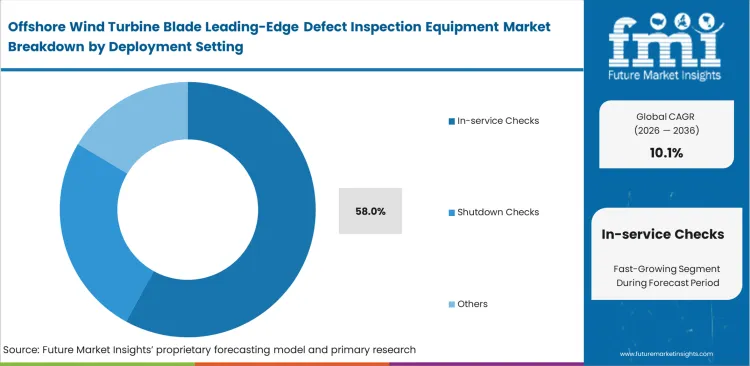
In-service checks are poised to garner 58.0% share in 2026. Industrial operators prefer shifting technical downtime risk away from their core generation schedules. Facility managers require actionable structural reports immediately, driving offshore blade inspection downtime reduction without locking turbine blades down for entire days. Purchasing fixed hardware directly forces engineering departments into becoming ad hoc aviation maintenance organizations. Utilizing predictive maintenance for offshore wind blades avoids this internal capital expenditure completely, leaning heavily on predictive maintenance architectures.
- Downtime avoidance: Aerial agreements draw funds from flexible operational budgets. Plant managers bypass rigid generation stop orders by executing inspections while turbines spin slowly.
- Liability transfer strategy: Contracting third party operators moves aviation liability off corporate balance sheets. Service providers are strictly required to carry insurance policies covering potential infrastructure collision damage.
- Hardware obsolescence protection: Rapid sensor evolution makes current hardware obsolete within three years. Operations directors utilizing service models ensure their facilities always benefit from modern diagnostic equipment.
Offshore Wind Turbine Blade Leading-Edge Defect Inspection Equipment Market Analysis by End User
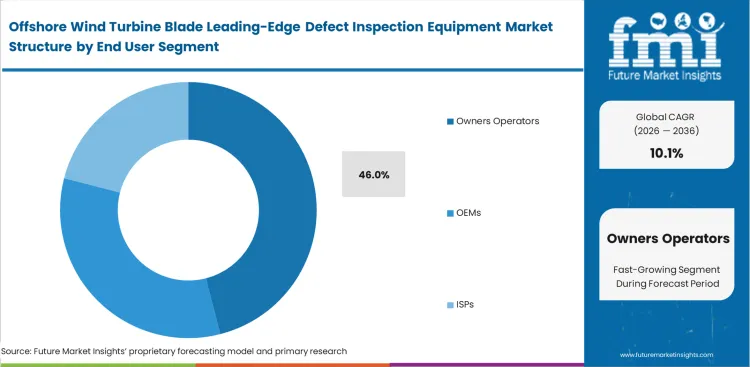
Asset accountability dictates final technology selection regardless of who actually performs field execution. Owners operators are predicted to command 46.0% share in 2026. Infrastructure owners write strict corporate engineering specifications determining exactly which aerial platforms are permissible on their networks. These parent organizations purchase very little field hardware themselves but exert absolute control over procurement decisions made by offshore blade inspection equipment suppliers. Third party firms buy physical hardware, but operators dictate data formats that force service companies into purchasing specific approved brands. Employing proven ndt inspection services prevents data fragmentation entirely.
- Corporate standard enforcement: Parent organizations draft rigid manual guidelines specifying acceptable image resolutions. Strict adherence to these documents is required to avoid immediate disqualification from lucrative service agreements.
- Data retention liability: Network owners bear ultimate legal responsibility for unpredicted structural failures. Risk managers demand highly encrypted unalterable visual records from external contractors to prove regulatory compliance.
- Fleet standardization pressure: Third party inspection firms prefer operating homogenous equipment pools. Operations directors consolidate purchasing around single manufacturers to reduce technician training burdens.
Offshore Wind Turbine Blade Leading-Edge Defect Inspection Equipment Market Analysis by Blade Size
Modern offshore energy generation relies entirely on huge sweeping surface areas to capture wind efficiently. 80 m blades are estimated to capture 54.0% share in 2026. Facility directors prioritize inspecting these gigantic structures because their sheer size amplifies any aerodynamic loss caused by minor edge defects exponentially. This dimension acts as the primary engineering hurdle, requiring drones with extended flight times to scan completely from root to tip. Waiting for traditional scopes to cover this area increases probabilities of missed structural cracking immensely.
- Extended flight requirement: Blade spans eliminate short range consumer drone usage completely. Reliability engineers evaluate surface areas requiring specialized long endurance battery configurations continuously.
- Wind shear resistance: High altitudes subject drones to intense variable winds. Service technicians maximize safety by utilizing heavy duty industrial frames capable of holding position precisely against sudden gusts.
- Focus tracking algorithms: Maintaining exact distance along a curved eighty meter blade stretches software limits. Inspection managers must implement rigorous optical tracking systems to prevent blurry image sequences.
Drivers, Restraints, and Opportunities
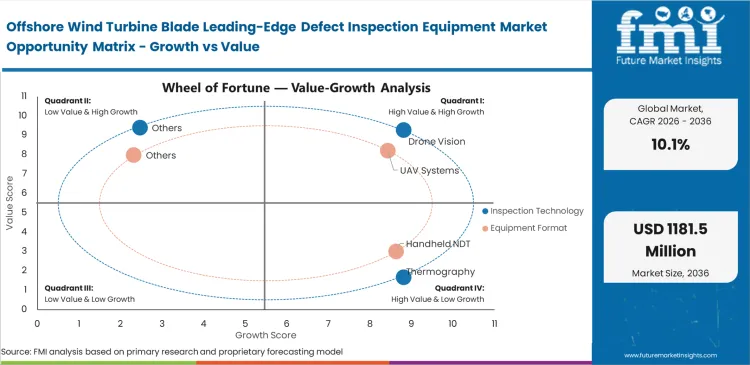
Unscheduled turbine shutdowns force offshore operators to replace slow manual checks with high speed aerial screening. Relying on crews to dangle from ropes consumes critical maintenance funds and causes large-scale power delivery disruption. Engineering directors demand technology capable of validating composite steel integrity from easily accessible service vessels below. Halting blade rotation for mandatory manual audits destroys quarterly power generation targets across deepwater segments. Acoustic and visual drone systems bypass these physical access limitations completely, capturing essential wear data without disrupting electricity transfer. Delaying this transition leaves asset owners legally exposed to rupture liabilities that slow moving manual inspection routines consistently miss.
Signal interpretation ambiguity throttles adoption momentum severely even when facility managers eagerly acquire advanced aerial hardware. Engineering teams drown in complex image data corrupted by benign ocean glare returning from standard wet fiberglass surfaces. Software platforms struggle to automatically separate actual erosion pits from these normal environmental reflections without intense human intervention. IT directors cannot simply plug visual files into legacy corporate databases designed for simple numerical wear values. Until advanced algorithms can reliably translate raw imagery into definitive repair coordinates, scaling field operations remains totally constrained by severe global shortages of certified composite analysts. Evaluating the ROI of offshore blade inspection equipment requires factoring in these heavy interpretation hours.
Opportunities
- Automated flight paths: Remote oceanic locations demand autonomous navigation. Asset managers fund vendors developing resident drones capable of executing daily wear metrics via preprogrammed cellular networks.
- AI-driven defect classification: Processing raw visual data consumes excessive human hours. Software directors eagerly adopt drone analytics tools that automatically strip benign glare reflections from returning acoustic signals.
- Multispectral integration: Identifying internal delaminations requires deeper scanning. Engineering chiefs prioritize ruggedized thermographic payloads capable of surviving continuous offshore exposure while mapping internal structural damage concurrently. Integrating ai driven predictive maintenance tools enhances operational lifespans significantly.
Regional Analysis
Based on regional analysis, Offshore Wind Turbine Blade Leading-Edge Defect Inspection Equipment is segmented into North America, Latin America, Europe, East Asia, South Asia, Oceania, and Middle East and Africa across 40 plus countries.
.webp "Top Country Growth Comparison Offshore Wind Turbine Blade Leading Edge Defect Inspection Equipment Market Cagr (2026 2036)")
| Country | CAGR (2026 to 2036) |
|---|---|
| China | 11.7% |
| Taiwan | 10.8% |
| Netherlands | 10.4% |
| United Kingdom | 9.8% |
| Germany | 9.5% |
| United States | 8.7% |
| Japan | 8.2% |
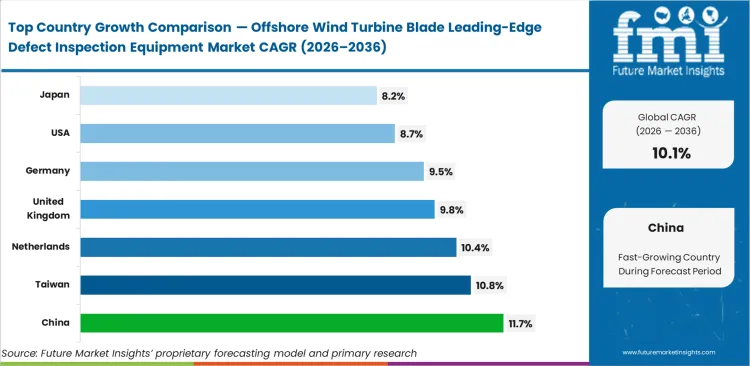
Source: Future Market Insights (FMI) analysis, based on proprietary forecasting model and primary research
East Asia Market Analysis
Deployment of state funded renewable energy networks demands automated diagnostic solutions immediately. Civil engineering ministries require transit operators to map structural baselines rapidly. National energy boards penalize unscheduled maintenance shutdowns severely, forcing grid providers to adopt continuous preventive screening routines. Maintenance directors cannot rely on slow manual thickness readings to protect critical oceanic flow lines spanning active typhoon zones. Integrating advanced automation turns raw visual telemetry into prioritized reinforcement work orders automatically. Incorporating smart aerial work robots reduces human risk.
- China: Offshore mega projects require corresponding investments in predictive oversight technologies. Engineering chiefs utilize locally customized high capacity aerial electronics to punch through thick marine fog layers securely, advancing the China offshore blade inspection equipment market at a CAGR of 11.7% through 2036. Dominating core battery technology gives regional operators a significant structural advantage in executing extended remote field operations without localized power sources.
- Taiwan: Wind farm installations mandate intense diagnostic verification protocols to combat severe saltwater corrosion. Facilities prioritize automated drones generating irrefutable digital evidence proving critical blade integrity. Taiwan is projected to witness 10.8% CAGR through 2036. Local technology startups dominate software integration contracts by offering hyper customized analytical interfaces tailored for regional typhoon stresses.
- Japan: Japan is likely to post a CAGR of 8.2% through 2036. Aging coastal infrastructure requires specialized high stability platforms capable of navigating complex aerodynamic support structures securely. Strict regulatory environments compel regional operators to engineer the most advanced vibration resistant camera gimbals available globally.
Europe Market Analysis
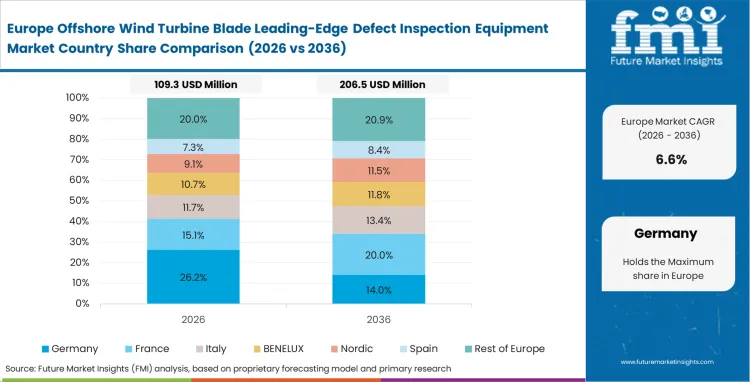
Mandates regarding historical industrial site preservation dictate intense structural monitoring requirements across aging continental infrastructure. Energy ministries deploying cross border wind networks demand specialized simulation systems capable of tracking deep structural embrittlement environments. Stringent industrial safety regulations give local engineering software developers a significant advantage in pushing predictive maintenance standards. Facility managers integrate virtual structural data directly into centralized smart grid planning hubs to optimize shutdown scheduling. Expanding power monitoring architectures relies strictly on accurate blade generation data.
- Netherlands: Transitioning deepwater wind networks to handle power demands precise structural evaluation solutions. Compliance officers utilize heavily regulated platforms to guarantee safe operational extensions for aging offshore turbines. Netherlands is expected to witness 10.4% CAGR through 2036. Dominating core precision flight processing algorithms allows regional vendors to outcompete international rivals on fundamental defect resolution specifications.
- United Kingdom: Extensive North Sea installations require continuous structural tracking under extreme weather conditions. Chief engineers rely on high fidelity spatial models to predict minute aerodynamic efficiency losses caused by leading edge erosion. United Kingdom is anticipated to see continuous adoption grow at a CAGR of 9.8% over the forecast period. Navigating complex marine access regulations provides local firms immense experience managing remote logistics.
- Germany: High volume clean energy generation forces offshore operators to champion long range screening capabilities aggressively. Facility managers prioritize dynamic thermal resistant sensors to track internal corrosion over brutal winter months. Germany capacity grows at 9.5% through 2036. Relying on remote acoustics allows authorities to plan targeted summer maintenance schedules accurately without wasting limited resources.
North America Market Analysis
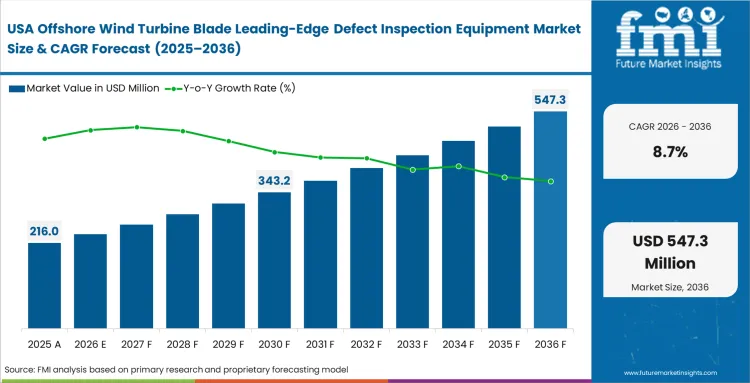
Aging coastal transmission lines are pushing operators across North America to prioritize long-range aerial screening capabilities. Increasing frequency of severe weather events is driving demand for diagnostic solutions that can quickly assess frozen offshore infrastructure. Federal safety boards continue to enforce strict verification protocols to reduce the risk of aerodynamic failures across critical energy assets. Domestic software providers face tightening cybersecurity requirements related to critical infrastructure data hosting and access control. These mandates are shaping how inspection data is stored, processed, and shared across operational networks. Compliance is becoming a key factor in technology selection alongside performance and reliability.
- United States: Strict federal materials compliance grants mandate comprehensive digital diagnostic records before releasing operating permits. Specialized domestic service providers are leveraged to build predictive databases to build predictive databases capable of managing entire coastal transmission systems safely. United States is anticipated to rise at a CAGR of 8.7% through 2036. State transit directors demand continuous diagnostic capabilities to justify extending operational limits of aging maritime networks safely.
Competitive Aligners for Market Players
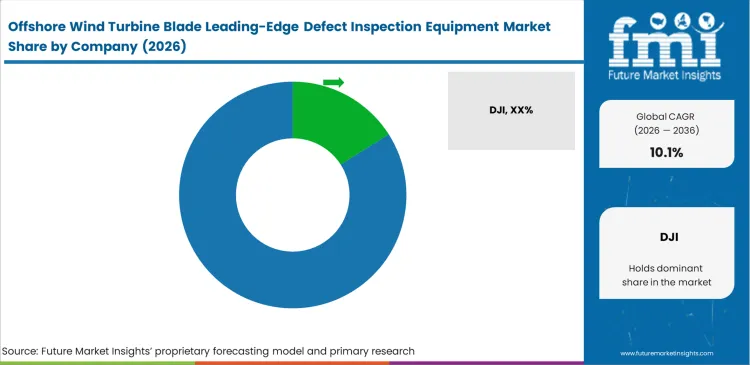
Drone hardware commoditization forces established engineering technology vendors to pivot aggressively toward open architecture software interpretation platforms. Producing highly powerful multirotor airframes offers minimal competitive differentiation when regional startups assemble comparable units utilizing identical commercial supply chains. Asset managers evaluating how to select offshore blade inspection vendors care very little about maximum flight speed; they select vendors based entirely on machine learning capabilities that filter benign wave glare without requiring expensive human intervention. Utilizing premium turbine blade material ensures maximum equipment longevity originally, but offshore blade inspection key players must still track long term degradation accurately.
Established vendors maintain their competitive moat through extensive, proprietary defect-classification libraries built on thousands of hours of empirical offshore field data. Accurately determining whether a surface anomaly is harmless salt residue or a critical leading-edge gouge requires training diagnostic models on historical datasets that new entrants simply lack. Companies like Teledyne FLIR and Evident leverage these deep visual, thermal, and acoustic data libraries to guarantee highly accurate structural assessments for wind farm operators.
Large public utility departments actively resist software ecosystem lock-in by demanding universal data export capabilities constantly. IT directors refuse to purchase platforms tied exclusively to proprietary cloud processing environments that isolate critical structural imagery from broader enterprise resource planning software. Employing high quality current sensors within drone battery management prevents mid flight power failures. Selecting proper testing equipment remains the baseline for operational success globally.
Key Players in Offshore Wind Turbine Blade Leading-Edge Defect Inspection Equipment Market
- DJI
- Evident
- Teledyne FLIR
- Voliro
- Perceptual Robotics
- Sulzer Schmid
- SkySpecs
Scope of the Report
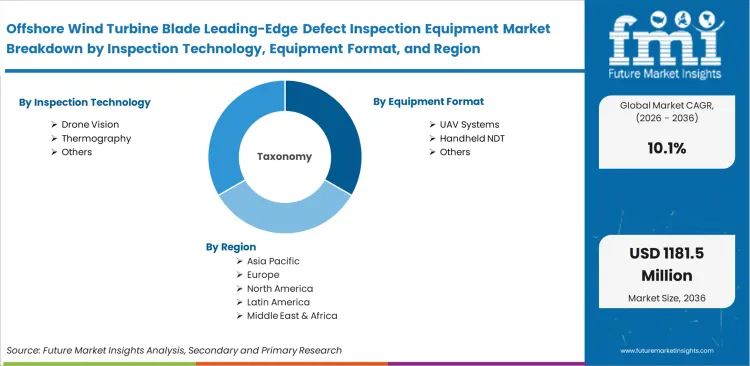
| Metric | Value |
|---|---|
| Quantitative Units | USD 370.0 million (2025) to USD 1,070.0 million (2036), at a CAGR of 10.1% |
| Market Definition | The offshore wind turbine blade leading‑edge defect inspection equipment market comprises mobile, non‑destructive inspection hardware and sensing systems used to detect, document, and verify surface and sub‑surface defects on offshore wind turbine blades. Equipment includes drone‑based visual systems, thermal and ultrasonic inspection tools, LiDAR imaging payloads, bond‑testing devices, crawler robots, and field‑grade data processors deployed across in‑service, shutdown, factory, and repair workflows. |
| Segmentation |
|
| Regions Covered | North America, Latin America, Europe, East Asia, South Asia, Oceania, Middle East and Africa |
| Countries Covered | China, Taiwan, Netherlands, United Kingdom, Germany, United States, Japan, and 30 plus countries |
| Key Companies Profiled | DJI, Evident, Teledyne FLIR, Voliro, Perceptual Robotics, Sulzer Schmid, SkySpecs, and other regional vendors |
| Forecast Period | 2026 to 2036 |
| Approach | Hybrid bottom‑up and top‑down methodology using verified offshore wind inspection equipment sales, installed offshore capacity tracking, and adoption modeling across inspection technologies, blade sizes, and deployment settings, supported by primary interviews and secondary industry data |
Offshore Wind Turbine Blade Leading-Edge Defect Inspection Equipment Market Analysis by Segments
Inspection Technology
- Drone vision
- Thermography
- Ultrasound
- LiDAR imaging
- Bond testing
Equipment Format
- UAV systems
- Handheld NDT
- Crawler robots
- Videoscopes
- Edge processors
Blade Damage Focus
- Surface erosion
- Coating lift
- Crack mapping
- Lightning paths
- Bond failure
Deployment Setting
- In-service checks
- Shutdown checks
- Factory checks
- Repair checks
End User
- Owners operators
- OEMs
- ISPs
- Repair firms
- Utilities
Blade Size
- 80 m blades
- 60-80 m
- <60 m
Region
- North America
- Latin America
- Europe
- East Asia
- South Asia
- Oceania
- Middle East and Africa
Bibliography
- Global Wind Energy Council. (2025, June 25). Offshore wind installed capacity reaches 83 GW as new report finds 2024 a record year for construction and auctions.
- International Energy Agency. (2025). Renewables 2025: Renewable electricity.
- U.S. Department of Energy. (2024). An operations and maintenance roadmap for U.S. offshore wind.
- National Renewable Energy Laboratory. (2024). Offshore wind market report: 2024 edition (NREL/TP-5000-90897).
- WindEurope. (2025, February 27). Wind energy in Europe: 2024 statistics and the outlook for 2025-2030.
This bibliography is provided for reader reference and is not exhaustive. The full report contains the complete reference list with primary source documentation.
Frequently Asked Questions
How are offshore wind blade leading-edge defects inspected?
Unmanned aerial hardware and specialized non-destructive sensors gather actionable erosion data, delamination signatures, or lightning strike damage from active marine environments without requiring technicians to climb ropes manually.
What is the market size of offshore blade leading-edge defect inspection equipment?
Sustained investment propels the offshore wind blade inspection CAGR to 10.1%, carrying the sector valuation from USD 410.0 million in 2026 to USD 1,070.0 million by 2036.
Which companies sell offshore wind blade defect inspection equipment?
Leading vendors include DJI, Evident, Teledyne FLIR, Voliro, Perceptual Robotics, Sulzer Schmid, and SkySpecs. Facility managers choose established providers because their reliable data validation protocols ensure field engineering teams interpret complex waveform visualizations accurately.
Compare drone, thermal, and ultrasonic tools for offshore blade inspection?
Drone vision systems provide rapid external erosion mapping, thermal payloads identify hidden internal delaminations based on temperature variances, and ultrasonic tools deliver precise volumetric thickness measurements requiring close surface contact via crawler robots or specialized attachments.
Why is leading-edge erosion such a major offshore blade maintenance issue?
High velocity rain impact strips aerodynamic efficiency continuously. Aerodynamic efficiency drops drastically when protective gel coats wear down prematurely, demanding offshore wind O&M equipment capable of identifying minor wear before it requires patching operations offshore.
Which equipment types dominate offshore blade defect inspection today?
UAV systems capture 52.0% share in 2026. Facility directors prioritize this mode to rapidly evaluate structures daily, acting as an essential primary filter identifying suspicious anomalies before dispatching costly localized manual quantification resources.
Why do drone vision systems lead this space?
This dominant position stems directly from hover stability required during precision imaging routines. Continuous proximity flying demands responsive optical sensors that older camera setups cannot match, preventing movement blur from ruining delicate structural calibrations entirely.
Which countries are growing fastest in offshore blade inspection demand?
China tracks at 11.7% compound growth as national power ministries mandate continuous grid modernization across coastal zones, requiring automated oversight to protect critical oceanic flow lines spanning active typhoon zones safely.
What is included and excluded from this scope?
Scope covers multirotor drone frames, crawler robots, high-resolution optical payloads, and automated image processing software. Consumer-grade recreational quadcopters and static monitoring sensors permanently attached to nacelle housings do not qualify as mobile external inspection systems.
How fragmented is the competitive landscape?
Drone hardware commoditization forces established engineering technology vendors to pivot aggressively toward open architecture software interpretation platforms, utilizing algorithmic libraries to guarantee highly accurate failure predictions for their industrial clients globally.
Preview the report firsthand - request a free sample
Get SampleGet the brochure for pricing and purchase details.
Get PDFTable of Content
- Executive Summary
- Global Market Outlook
- Demand-side Trends
- Supply-side Trends
- Technology Roadmap Analysis
- Analysis and Recommendations
- Market Overview
- Market Coverage / Taxonomy
- Market Definition / Scope / Limitations
- Research Methodology
- Chapter Orientation
- Analytical Lens and Working Hypotheses
- Market Structure, Signals, and Trend Drivers
- Benchmarking and Cross-market Comparability
- Market Sizing, Forecasting, and Opportunity Mapping
- Research Design and Evidence Framework
- Desk Research Programme (Secondary Evidence)
- Company Annual and Sustainability Reports
- Peer-reviewed Journals and Academic Literature
- Corporate Websites, Product Literature, and Technical Notes
- Earnings Decks and Investor Briefings
- Statutory Filings and Regulatory Disclosures
- Technical White Papers and Standards Notes
- Trade Journals, Industry Magazines, and Analyst Briefs
- Conference Proceedings, Webinars, and Seminar Materials
- Government Statistics Portals and Public Data Releases
- Press Releases and Reputable Media Coverage
- Specialist Newsletters and Curated Briefings
- Sector Databases and Reference Repositories
- FMI Internal Proprietary Databases and Historical Market Datasets
- Subscription Datasets and Paid Sources
- Social Channels, Communities, and Digital Listening Inputs
- Additional Desk Sources
- Expert Input and Fieldwork (Primary Evidence)
- Primary Modes
- Qualitative Interviews and Expert Elicitation
- Quantitative Surveys and Structured Data Capture
- Blended Approach
- Why Primary Evidence is Used
- Field Techniques
- Interviews
- Surveys
- Focus Groups
- Observational and In-context Research
- Social and Community Interactions
- Stakeholder Universe Engaged
- C-suite Leaders
- Board Members
- Presidents and Vice Presidents
- R&D and Innovation Heads
- Technical Specialists
- Domain Subject-matter Experts
- Scientists
- Physicians and Other Healthcare Professionals
- Governance, Ethics, and Data Stewardship
- Research Ethics
- Data Integrity and Handling
- Primary Modes
- Tooling, Models, and Reference Databases
- Desk Research Programme (Secondary Evidence)
- Data Engineering and Model Build
- Data Acquisition and Ingestion
- Cleaning, Normalisation, and Verification
- Synthesis, Triangulation, and Analysis
- Quality Assurance and Audit Trail
- Market Background
- Market Dynamics
- Drivers
- Restraints
- Opportunity
- Trends
- Scenario Forecast
- Demand in Optimistic Scenario
- Demand in Likely Scenario
- Demand in Conservative Scenario
- Opportunity Map Analysis
- Product Life Cycle Analysis
- Supply Chain Analysis
- Investment Feasibility Matrix
- Value Chain Analysis
- PESTLE and Porter’s Analysis
- Regulatory Landscape
- Regional Parent Market Outlook
- Production and Consumption Statistics
- Import and Export Statistics
- Market Dynamics
- Global Market Analysis 2021 to 2025 and Forecast, 2026 to 2036
- Historical Market Size Value (USD Million) Analysis, 2021 to 2025
- Current and Future Market Size Value (USD Million) Projections, 2026 to 2036
- Y-o-Y Growth Trend Analysis
- Absolute $ Opportunity Analysis
- Global Market Pricing Analysis 2021 to 2025 and Forecast 2026 to 2036
- Global Market Analysis 2021 to 2025 and Forecast 2026 to 2036, By Inspection Technology
- Introduction / Key Findings
- Historical Market Size Value (USD Million) Analysis By Inspection Technology , 2021 to 2025
- Current and Future Market Size Value (USD Million) Analysis and Forecast By Inspection Technology , 2026 to 2036
- Drone Vision
- Thermography
- Others
- Drone Vision
- Y-o-Y Growth Trend Analysis By Inspection Technology , 2021 to 2025
- Absolute $ Opportunity Analysis By Inspection Technology , 2026 to 2036
- Global Market Analysis 2021 to 2025 and Forecast 2026 to 2036, By Equipment Format
- Introduction / Key Findings
- Historical Market Size Value (USD Million) Analysis By Equipment Format, 2021 to 2025
- Current and Future Market Size Value (USD Million) Analysis and Forecast By Equipment Format, 2026 to 2036
- UAV Systems
- Handheld NDT
- Others
- UAV Systems
- Y-o-Y Growth Trend Analysis By Equipment Format, 2021 to 2025
- Absolute $ Opportunity Analysis By Equipment Format, 2026 to 2036
- Global Market Analysis 2021 to 2025 and Forecast 2026 to 2036, By Blade Damage Focus
- Introduction / Key Findings
- Historical Market Size Value (USD Million) Analysis By Blade Damage Focus, 2021 to 2025
- Current and Future Market Size Value (USD Million) Analysis and Forecast By Blade Damage Focus, 2026 to 2036
- Surface Erosion
- Coating Lift
- Others
- Surface Erosion
- Y-o-Y Growth Trend Analysis By Blade Damage Focus, 2021 to 2025
- Absolute $ Opportunity Analysis By Blade Damage Focus, 2026 to 2036
- Global Market Analysis 2021 to 2025 and Forecast 2026 to 2036, By Deployment Setting
- Introduction / Key Findings
- Historical Market Size Value (USD Million) Analysis By Deployment Setting, 2021 to 2025
- Current and Future Market Size Value (USD Million) Analysis and Forecast By Deployment Setting, 2026 to 2036
- In-service Checks
- Shutdown Checks
- Others
- In-service Checks
- Y-o-Y Growth Trend Analysis By Deployment Setting, 2021 to 2025
- Absolute $ Opportunity Analysis By Deployment Setting, 2026 to 2036
- Global Market Analysis 2021 to 2025 and Forecast 2026 to 2036, By End User
- Introduction / Key Findings
- Historical Market Size Value (USD Million) Analysis By End User, 2021 to 2025
- Current and Future Market Size Value (USD Million) Analysis and Forecast By End User, 2026 to 2036
- Owners Operators
- OEMs
- ISPs
- Owners Operators
- Y-o-Y Growth Trend Analysis By End User, 2021 to 2025
- Absolute $ Opportunity Analysis By End User, 2026 to 2036
- Global Market Analysis 2021 to 2025 and Forecast 2026 to 2036, By Blade Size
- Introduction / Key Findings
- Historical Market Size Value (USD Million) Analysis By Blade Size, 2021 to 2025
- Current and Future Market Size Value (USD Million) Analysis and Forecast By Blade Size, 2026 to 2036
- 80 m Blades
- 60–80 m
- <60 m
- 80 m Blades
- Y-o-Y Growth Trend Analysis By Blade Size, 2021 to 2025
- Absolute $ Opportunity Analysis By Blade Size, 2026 to 2036
- Global Market Analysis 2021 to 2025 and Forecast 2026 to 2036, By Region
- Introduction
- Historical Market Size Value (USD Million) Analysis By Region, 2021 to 2025
- Current Market Size Value (USD Million) Analysis and Forecast By Region, 2026 to 2036
- North America
- Latin America
- Western Europe
- Eastern Europe
- East Asia
- South Asia and Pacific
- Middle East & Africa
- Market Attractiveness Analysis By Region
- North America Market Analysis 2021 to 2025 and Forecast 2026 to 2036, By Country
- Historical Market Size Value (USD Million) Trend Analysis By Market Taxonomy, 2021 to 2025
- Market Size Value (USD Million) Forecast By Market Taxonomy, 2026 to 2036
- By Country
- USA
- Canada
- Mexico
- By Inspection Technology
- By Equipment Format
- By Blade Damage Focus
- By Deployment Setting
- By End User
- By Blade Size
- By Country
- Market Attractiveness Analysis
- By Country
- By Inspection Technology
- By Equipment Format
- By Blade Damage Focus
- By Deployment Setting
- By End User
- By Blade Size
- Key Takeaways
- Latin America Market Analysis 2021 to 2025 and Forecast 2026 to 2036, By Country
- Historical Market Size Value (USD Million) Trend Analysis By Market Taxonomy, 2021 to 2025
- Market Size Value (USD Million) Forecast By Market Taxonomy, 2026 to 2036
- By Country
- Brazil
- Chile
- Rest of Latin America
- By Inspection Technology
- By Equipment Format
- By Blade Damage Focus
- By Deployment Setting
- By End User
- By Blade Size
- By Country
- Market Attractiveness Analysis
- By Country
- By Inspection Technology
- By Equipment Format
- By Blade Damage Focus
- By Deployment Setting
- By End User
- By Blade Size
- Key Takeaways
- Western Europe Market Analysis 2021 to 2025 and Forecast 2026 to 2036, By Country
- Historical Market Size Value (USD Million) Trend Analysis By Market Taxonomy, 2021 to 2025
- Market Size Value (USD Million) Forecast By Market Taxonomy, 2026 to 2036
- By Country
- Germany
- UK
- Italy
- Spain
- France
- Nordic
- BENELUX
- Rest of Western Europe
- By Inspection Technology
- By Equipment Format
- By Blade Damage Focus
- By Deployment Setting
- By End User
- By Blade Size
- By Country
- Market Attractiveness Analysis
- By Country
- By Inspection Technology
- By Equipment Format
- By Blade Damage Focus
- By Deployment Setting
- By End User
- By Blade Size
- Key Takeaways
- Eastern Europe Market Analysis 2021 to 2025 and Forecast 2026 to 2036, By Country
- Historical Market Size Value (USD Million) Trend Analysis By Market Taxonomy, 2021 to 2025
- Market Size Value (USD Million) Forecast By Market Taxonomy, 2026 to 2036
- By Country
- Russia
- Poland
- Hungary
- Balkan & Baltic
- Rest of Eastern Europe
- By Inspection Technology
- By Equipment Format
- By Blade Damage Focus
- By Deployment Setting
- By End User
- By Blade Size
- By Country
- Market Attractiveness Analysis
- By Country
- By Inspection Technology
- By Equipment Format
- By Blade Damage Focus
- By Deployment Setting
- By End User
- By Blade Size
- Key Takeaways
- East Asia Market Analysis 2021 to 2025 and Forecast 2026 to 2036, By Country
- Historical Market Size Value (USD Million) Trend Analysis By Market Taxonomy, 2021 to 2025
- Market Size Value (USD Million) Forecast By Market Taxonomy, 2026 to 2036
- By Country
- China
- Japan
- South Korea
- By Inspection Technology
- By Equipment Format
- By Blade Damage Focus
- By Deployment Setting
- By End User
- By Blade Size
- By Country
- Market Attractiveness Analysis
- By Country
- By Inspection Technology
- By Equipment Format
- By Blade Damage Focus
- By Deployment Setting
- By End User
- By Blade Size
- Key Takeaways
- South Asia and Pacific Market Analysis 2021 to 2025 and Forecast 2026 to 2036, By Country
- Historical Market Size Value (USD Million) Trend Analysis By Market Taxonomy, 2021 to 2025
- Market Size Value (USD Million) Forecast By Market Taxonomy, 2026 to 2036
- By Country
- India
- ASEAN
- Australia & New Zealand
- Rest of South Asia and Pacific
- By Inspection Technology
- By Equipment Format
- By Blade Damage Focus
- By Deployment Setting
- By End User
- By Blade Size
- By Country
- Market Attractiveness Analysis
- By Country
- By Inspection Technology
- By Equipment Format
- By Blade Damage Focus
- By Deployment Setting
- By End User
- By Blade Size
- Key Takeaways
- Middle East & Africa Market Analysis 2021 to 2025 and Forecast 2026 to 2036, By Country
- Historical Market Size Value (USD Million) Trend Analysis By Market Taxonomy, 2021 to 2025
- Market Size Value (USD Million) Forecast By Market Taxonomy, 2026 to 2036
- By Country
- Kingdom of Saudi Arabia
- Other GCC Countries
- Turkiye
- South Africa
- Other African Union
- Rest of Middle East & Africa
- By Inspection Technology
- By Equipment Format
- By Blade Damage Focus
- By Deployment Setting
- By End User
- By Blade Size
- By Country
- Market Attractiveness Analysis
- By Country
- By Inspection Technology
- By Equipment Format
- By Blade Damage Focus
- By Deployment Setting
- By End User
- By Blade Size
- Key Takeaways
- Key Countries Market Analysis
- USA
- Pricing Analysis
- Market Share Analysis, 2025
- By Inspection Technology
- By Equipment Format
- By Blade Damage Focus
- By Deployment Setting
- By End User
- By Blade Size
- Canada
- Pricing Analysis
- Market Share Analysis, 2025
- By Inspection Technology
- By Equipment Format
- By Blade Damage Focus
- By Deployment Setting
- By End User
- By Blade Size
- Mexico
- Pricing Analysis
- Market Share Analysis, 2025
- By Inspection Technology
- By Equipment Format
- By Blade Damage Focus
- By Deployment Setting
- By End User
- By Blade Size
- Brazil
- Pricing Analysis
- Market Share Analysis, 2025
- By Inspection Technology
- By Equipment Format
- By Blade Damage Focus
- By Deployment Setting
- By End User
- By Blade Size
- Chile
- Pricing Analysis
- Market Share Analysis, 2025
- By Inspection Technology
- By Equipment Format
- By Blade Damage Focus
- By Deployment Setting
- By End User
- By Blade Size
- Germany
- Pricing Analysis
- Market Share Analysis, 2025
- By Inspection Technology
- By Equipment Format
- By Blade Damage Focus
- By Deployment Setting
- By End User
- By Blade Size
- UK
- Pricing Analysis
- Market Share Analysis, 2025
- By Inspection Technology
- By Equipment Format
- By Blade Damage Focus
- By Deployment Setting
- By End User
- By Blade Size
- Italy
- Pricing Analysis
- Market Share Analysis, 2025
- By Inspection Technology
- By Equipment Format
- By Blade Damage Focus
- By Deployment Setting
- By End User
- By Blade Size
- Spain
- Pricing Analysis
- Market Share Analysis, 2025
- By Inspection Technology
- By Equipment Format
- By Blade Damage Focus
- By Deployment Setting
- By End User
- By Blade Size
- France
- Pricing Analysis
- Market Share Analysis, 2025
- By Inspection Technology
- By Equipment Format
- By Blade Damage Focus
- By Deployment Setting
- By End User
- By Blade Size
- India
- Pricing Analysis
- Market Share Analysis, 2025
- By Inspection Technology
- By Equipment Format
- By Blade Damage Focus
- By Deployment Setting
- By End User
- By Blade Size
- ASEAN
- Pricing Analysis
- Market Share Analysis, 2025
- By Inspection Technology
- By Equipment Format
- By Blade Damage Focus
- By Deployment Setting
- By End User
- By Blade Size
- Australia & New Zealand
- Pricing Analysis
- Market Share Analysis, 2025
- By Inspection Technology
- By Equipment Format
- By Blade Damage Focus
- By Deployment Setting
- By End User
- By Blade Size
- China
- Pricing Analysis
- Market Share Analysis, 2025
- By Inspection Technology
- By Equipment Format
- By Blade Damage Focus
- By Deployment Setting
- By End User
- By Blade Size
- Japan
- Pricing Analysis
- Market Share Analysis, 2025
- By Inspection Technology
- By Equipment Format
- By Blade Damage Focus
- By Deployment Setting
- By End User
- By Blade Size
- South Korea
- Pricing Analysis
- Market Share Analysis, 2025
- By Inspection Technology
- By Equipment Format
- By Blade Damage Focus
- By Deployment Setting
- By End User
- By Blade Size
- Russia
- Pricing Analysis
- Market Share Analysis, 2025
- By Inspection Technology
- By Equipment Format
- By Blade Damage Focus
- By Deployment Setting
- By End User
- By Blade Size
- Poland
- Pricing Analysis
- Market Share Analysis, 2025
- By Inspection Technology
- By Equipment Format
- By Blade Damage Focus
- By Deployment Setting
- By End User
- By Blade Size
- Hungary
- Pricing Analysis
- Market Share Analysis, 2025
- By Inspection Technology
- By Equipment Format
- By Blade Damage Focus
- By Deployment Setting
- By End User
- By Blade Size
- Kingdom of Saudi Arabia
- Pricing Analysis
- Market Share Analysis, 2025
- By Inspection Technology
- By Equipment Format
- By Blade Damage Focus
- By Deployment Setting
- By End User
- By Blade Size
- Turkiye
- Pricing Analysis
- Market Share Analysis, 2025
- By Inspection Technology
- By Equipment Format
- By Blade Damage Focus
- By Deployment Setting
- By End User
- By Blade Size
- South Africa
- Pricing Analysis
- Market Share Analysis, 2025
- By Inspection Technology
- By Equipment Format
- By Blade Damage Focus
- By Deployment Setting
- By End User
- By Blade Size
- USA
- Market Structure Analysis
- Competition Dashboard
- Competition Benchmarking
- Market Share Analysis of Top Players
- By Regional
- By Inspection Technology
- By Equipment Format
- By Blade Damage Focus
- By Deployment Setting
- By End User
- By Blade Size
- Competition Analysis
- Competition Deep Dive
- DJI
- Overview
- Product Portfolio
- Profitability by Market Segments (Product/Age /Sales Channel/Region)
- Sales Footprint
- Strategy Overview
- Marketing Strategy
- Product Strategy
- Channel Strategy
- Evident
- Teledyne FLIR
- Voliro
- Perceptual Robotics
- Sulzer Schmid
- DJI
- Competition Deep Dive
- Assumptions & Acronyms Used


