

- Industry Size (2026)
- USD 1.4 Bn
- Forecast (2036)
- USD 2.0 Bn
- CAGR (2026 to 2036)
- 4.0%
Floating Fountains Market Forecast and Outlook By FMI
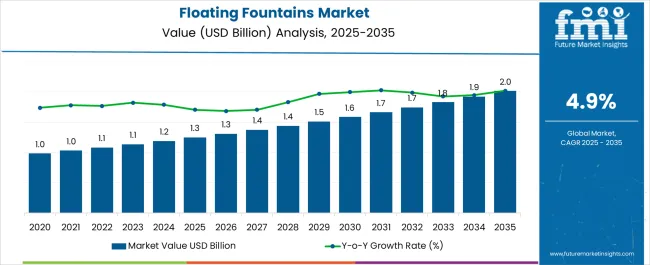
In 2025, the floating fountains market was valued at USD 1.3 billion. Based on Future Market Insights' analysis, demand for floating fountains is estimated to grow to USD 1.4 billion in 2026 and USD 2.0 billion by 2036. FMI projects a CAGR of 4.0% during the forecast period.
Absolute dollar growth of USD 0.7 billion over the decade signals steady incremental expansion driven by urban beautification projects and hospitality sector investments rather than transformational growth. Despite discretionary spending sensitivity and seasonal demand patterns, major floating fountain manufacturers sustain profitability through product differentiation with integrated LED lighting and energy-efficient motor technologies.
As De’Mon Wiggins, EVP and President, Pentair Flow and Pentair Water Solutions, stated regarding the leadership focus behind the transition, “Wiggins will lead and direct strategic initiatives for three key businesses: Commercial Water Solutions, Water Quality Management, and Flow, and this leadership transition aims to drive greater alignment and focus across businesses and foster innovation and operational excellence.” [1]
China (6.1% CAGR) and India (5.6% CAGR) drive new opportunities through rapid urbanization and government investment in public recreational spaces. Brazil (4.6% CAGR) contributes via resort development and growing middle-class investment in residential water features. Mature floating fountain markets such as Germany (5.1%), the United States (4.2%), the United Kingdom (3.7%), and Japan (3.2%) generate replacement demand through technology upgrades, with volume expansion constrained by market saturation and seasonal climate limitations.
Floating Fountains Market Definition
Floating fountains comprise self-contained water feature systems mounted on floating platforms, designed for installation in ponds, lakes, swimming pools, and decorative water bodies. These units utilize submerged electric motors to pump water through various nozzle configurations, creating decorative spray patterns while providing water circulation and aeration benefits. Integrated lighting systems enhance visual appeal during evening hours, transforming water features into dynamic landscape elements.
Floating Fountains Market Inclusions
The report includes a comprehensive analysis of market dynamics, featuring Global and Regional Market Sizes (Volume and Value) and a 10-year Forecast (2026-2036). It covers segmental breakdowns by power rating (Less Than 0.75 Hp, 0.75 Hp to 1.34 Hp, More Than 1.34 Hp), application (Swimming Pool, Ponds, Lakes, Others), type (With Lighting System, Without Lighting System), and geographic regions.
Floating Fountains Market Exclusions
The scope excludes permanently installed fountain systems requiring fixed plumbing, decorative water features without floating platforms, and industrial aeration equipment not designed for aesthetic applications. It also omits residential pond pumps without decorative spray capabilities, focusing strictly on floating fountain systems combining aeration with visual water display.
Floating Fountains Market Research Methodology
- Primary Research: Interviews were conducted with floating fountain manufacturers, landscape architects, hospitality property developers, and water feature distributors across major regions. Lighting system specialists clarified LED integration trends.
- Desk Research: Public parks project data, hospitality construction statistics, and corporate financial filings supported volume benchmarking.
- Market-Sizing and Forecasting: A hybrid top-down and bottom-up model was developed. Demand was reconstructed from municipal beautification project budgets, residential water feature installation rates, and hospitality sector investment, then validated against manufacturer shipment data.
- Data Validation and Update Cycle: Outputs undergo anomaly screening, variance checks across production and trade datasets, and structured peer review prior to release.
Summary of Floating Fountains Market
- Floating Fountains Market Definition:
- The industry covers floating platform-mounted fountain systems combining decorative water display with aeration functionality for ponds, lakes, and swimming pools.
- Demand Drivers in the Market:
- Urban beautification projects drive municipal fountain installations.
- Hospitality sector invests in experiential water features.
- LED lighting integration enables nighttime visual impact.
- Key Segments Analyzed in the FMI Report:
- Power: Less Than 0.75 Hp leads with 40.0% share.
- Application: Swimming pools dominate at 35.0% share.
- Type: With Lighting System commands 55.0% share.
- Analyst Opinion at FMI:
- Nikhil Kaitwade, Principal Consultant for Industrial Automation at Future Market Insights, opines, "In the updated version of the Floating Fountains Market Report for 2026 to 2036, landscape architects and hospitality developers will find insights into how smart control integration and energy-efficient motor technologies are reshaping fountain specification criteria. Besides this, my findings point at seasonal demand patterns directly impacting manufacturer inventory cycles and the shift toward solar-compatible systems enabling off-grid installations."
- Strategic Implications/Executive Takeaways:
- Shift focus from basic aeration to integrated lighting and control systems.
- Treat energy efficiency as market access requirement rather than differentiator.
- Prioritize modular designs enabling easy seasonal installation and removal.
- Methodology:
- Validated through municipal project records and manufacturer shipment data.
- Zero reliance on speculative third-party market research reports.
- Based on verifiable public parks budgets and hospitality construction statistics.
Segmental Analysis
Floating Fountains Market Analysis by Power
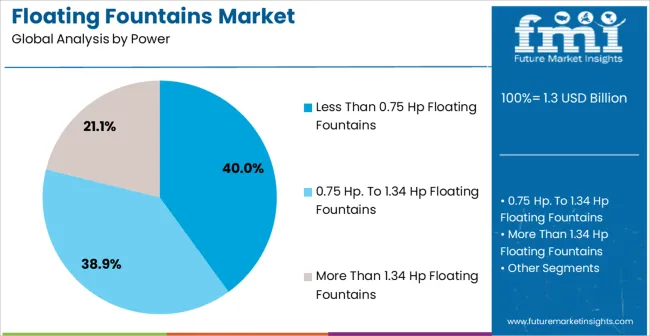
Based on FMI’s floating fountains market report, consumption of less than 0.75 Hp floating fountains is estimated to hold 40.0% share in 2026. Growth in demand for low-power units comes from cost efficiency, lower energy draw, and fit with residential ponds and small water features where high-capacity aeration is unnecessary.
- Residential Market Penetration: OASE positions PondJet Eco Premium as a low-power solution enabled by CORE 6 technology, stating the set delivers up to 25% greater energy efficiency versus the previous model. [2]
- Low Operating Cost Proof Point: OASE specifies the PondJet Eco Premium at 150W, reinforcing why sub-0.75 Hp systems lead in small-feature installs where operating cost drives purchase decisions. [3]
- DIY Installation Appeal: Scott Aerator channel listings emphasize quick setup with included float platform, ropes, and mounting hardware, aligning with the segment’s DIY-friendly adoption pathway. [4]
Floating Fountains Market Analysis by Application
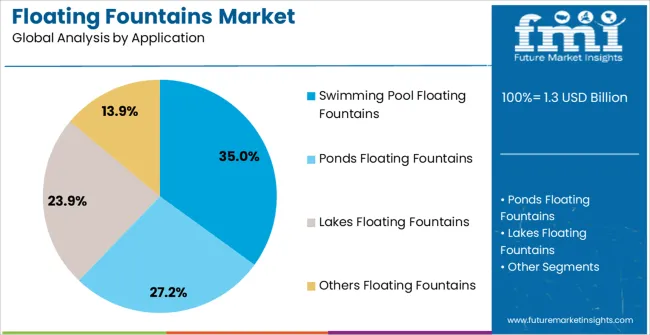
Based on FMI’s floating fountains market report, consumption in swimming pool applications is estimated to hold 35.0% share in 2026. Growth in swimming pool floating fountain demand comes from homeowners and hospitality operators seeking aesthetic upgrades while adding surface circulation that complements filtration systems.
- Residential Pool Premiumization: Kasco Marine states its JF Series comes standard with five interchangeable nozzles and can operate without a nozzle, enabling multiple fountain patterns from one unit to match changing preference and conditions. [5]
- Aeration Benefits Recognition: Vendor specifications for Kasco aerating fountain systems emphasize oxygenation and surface circulation as functional benefits alongside aesthetics, supporting broader adoption beyond decorative use cases. [6]
- Shallow-Water Fit: The same specification listing indicates operation in as little as 15 inches of water, expanding suitability for smaller engineered water bodies and shallow-depth installs. [6]
Floating Fountains Market Drivers, Restraints, and Opportunities
Future Market Insights analysis suggests the floating fountains market is shaped by a mature, replacement-driven base in commercial ponds and lakes, alongside faster growth in residential water features where buyers prioritize visual impact, low operating cost, and easy installation. Estimated valuation in 2026 reflects an “efficiency push” as municipalities, HOAs, golf courses, and hospitality operators upgrade aging fountain-aerator fleets with higher-efficiency motors, improved spray pattern control, and more durable, serviceable designs that reduce downtime and seasonal maintenance labor.
While demand for standard decorative units remains steady, value growth increasingly comes from feature upgrades such as multi-nozzle pattern sets, plug-and-play assemblies, and circulation-driven aeration benefits that support water quality outcomes and algae control. The forecast assumes a “new normal” where growth is tied to steady landscaping spend, shoreline development, and public-space revitalization, tempered by energy pricing sensitivity and permitting complexity in certain jurisdictions.
- Efficiency-Led Premiumization: Growth is shifting from basic decorative output to energy-efficient, performance-per-watt systems that deliver strong visual effect and functional circulation with lower operating cost.
- Installation and Compliance Friction: Restraints come from electrical requirements, anchoring and cabling complexity, seasonal storage needs, and site-specific permitting or safety rules that slow adoption in public-access water bodies.
- Service and Retrofit Upside: Opportunity expands through retrofit kits, modular nozzle/pump upgrades, and dealer-led maintenance programs that convert one-time equipment sales into recurring service revenue and improve lifecycle economics for buyers.
Regional Analysis
Based on the regional analysis, the floating fountains market is segmented into North America, Latin America, Europe, East Asia, South Asia, Oceania, and Middle East & Africa across 40+ countries. The full report also offers market attractiveness analysis based on regional trends.

| Country | CAGR (2026 to 2036) |
|---|---|
| China | 6.1% |
| India | 5.6% |
| Germany | 5.1% |
| Brazil | 4.6% |
| United States | 4.2% |
| United Kingdom | 3.7% |
| Japan | 3.2% |
Source: Future Market Insights (FMI) analysis, based on proprietary forecasting model and primary research.
Asia Pacific Floating Fountains Market Analysis
Asia Pacific serves as the global “growth frontier” for floating fountains, where adoption is increasingly linked to urban water management programs that favor aeration-plus-visual systems over purely decorative installations.
- China: Demand for floating fountains in China is projected to rise at a 6.1% CAGR through 2036, supported by the national Sponge City direction targeting 80% of urban built-up areas meeting Sponge City requirements by 2030. [7]
- India: Domestic demand is accelerating at a 5.6% CAGR, supported by public infrastructure modernization, with India’s Smart Cities Mission reporting 7,380 out of 8,075 projects completed in its progress update. [8]
The full report analyzes the floating fountains market across East and South Asia from 2021-2036, covering project pipelines, public-space investment patterns, and country-level growth themes across China, India, Japan, ASEAN, and other Asia Pacific markets.
Europe Floating Fountains Market Analysis
Europe is characterized by “heritage-meets-innovation” dynamics, where restoration projects and energy-efficiency priorities drive demand for illuminated, reliable floating fountain systems with lower operating cost.
- Germany: Demand for floating fountains in Germany is rising at a 5.1% CAGR through 2036, with public-sector modernization spending creating downstream opportunities for upgraded parks and therapeutic outdoor spaces. [9]
- United Kingdom: Expanding at a 3.7% CAGR, supported by heritage restoration funding, with Birmingham Botanical Gardens stating it secured a £9.075m grant from The National Lottery Heritage Fund toward its major restoration program. [10]
FMI’s Europe assessment includes country-wise analysis covering Germany, the UK, and other regional markets, highlighting local procurement trends, refurbishment cycles, and energy-cost sensitivity shaping fountain upgrades.
North America Floating Fountains Market Analysis
North America represents the most mature market, defined by established dealer networks and a stronger emphasis on water-quality outcomes where aeration fountains are used for dissolved oxygen support alongside aesthetics.
- United States: Demand for floating fountains in the United States is projected to rise at a 4.2% CAGR through 2036, supported by municipal lake management deployments, including Oakland’s Lake Merritt pilot noting an aeration fountain installation on August 15, 2023. [11]
FMI’s report includes detailed North America analysis with country-wise assessment including the USA and Canada, mapping demand by application and public-space investment cycles.
Middle East & Africa Floating Fountains Market Analysis
The Middle East represents a premium growth pocket where luxury hospitality and city beautification under national transformation plans support high-visibility water feature installations.
- Saudi Arabia: The market is expanding at a 4.8% CAGR through 2036, with water security positioned as a national priority in Saudi Water Authority’s Vision framework. [12]
- United Arab Emirates: Demand in the UAE is projected to rise at a 4.5% CAGR, supported by luxury floating hospitality projects, with Travel Tomorrow reporting the Kempinski Floating Palace targeted to open in Dubai by 2026. [13]
The full report covers MEA country dynamics across Gulf markets and Africa, detailing tourism-led capex, public realm development, and procurement preferences for large-format and illuminated fountain systems.
Competitive Aligners for Market Players

Market structure in floating fountains remains fragmented at the brand level, yet practical competition is concentrated among a limited set of suppliers capable of meeting durability, electrical safety, and service expectations for municipalities, HOAs, golf courses, resorts, and lake-management buyers. A meaningful share of demand is replacement-driven, so the primary competitive variable is lifecycle cost survivability rather than peak margin capture, with buyers evaluating energy draw, maintenance frequency, and downtime risk as part of total cost of ownership. Suppliers with strong in-house engineering around motors, pumps, seals, and nozzle systems are better positioned to deliver consistent spray patterns and reliable circulation across variable water conditions, which reduces warranty exposure and protects dealer reputation.
Service capability further narrows the competitive field. Players with established dealer networks, stocked spare parts, and fast turnaround repair programs sustain customer retention because outages are highly visible in public-facing installations and can trigger immediate complaints or contract penalties. Suppliers without service coverage often compete on price but face churn when performance issues emerge or when seasonal commissioning requires rapid support.
Customer concentration reinforces buyer leverage, large institutional buyers use competitive tenders, dual-source across brands to avoid dependency, and limit price pass-through of motors, stainless components, and freight inflation, tightening margins for underinvested suppliers.
Recent Developments
The report includes full coverage of key trends from competitive benchmarking. Some of the recent developments covered in the reports:
- In February 2026, Aqua Metals signed a term sheet to acquire Lion Energy in an all-stock deal, aiming to build an integrated battery lifecycle platform spanning energy storage, software, manufacturing, and recycling, with closing targeted for Q2 2026. [14]
- In March 2025, Himalaya Music Fountain signed a contract to build a 65-meter floating musical fountain in India, featuring stainless steel construction and dynamic DMX lighting, marking its 25th fountain project in the country. [15]
Key Players in Floating Fountains Market
- AquaMaster Fountains and Aerators
- Kasco Marine, Inc.
- Scott Aerator Company
- Fawn Lake Fountains
- Eagle Outdoor Fountains
- Midwest Ponds
- Pond Pro USA
- Fountain Mountain
- Outdoor Water Solutions
- Absolute Aeration
- Otterbine Barebo, Inc.
- The Pond Guy
- Living Water Aeration
- Airmax, Inc.
- Aqua Control
Scope of the Report
| Metric | Value |
|---|---|
| Quantitative Units | USD 1.4 billion (2026) to USD 2.0 billion (2036), at a CAGR of 4.0% |
| Market Definition | The floating fountains market comprises the global production, supply, and trade of self-contained fountain systems mounted on floating platforms for deployment in ponds, lakes, swimming pools, and other decorative water bodies, using submerged electric motors and nozzle assemblies to create spray patterns while delivering circulation and aeration benefits, with optional integrated lighting for nighttime visual impact. |
| Power Segmentation | Less Than 0.75 Hp Floating Fountains; 0.75 Hp to 1.34 Hp Floating Fountains; More Than 1.34 Hp Floating Fountains |
| Application Segmentation | Swimming Pool Floating Fountains; Ponds Floating Fountains; Lakes Floating Fountains; Others Floating Fountains |
| Type Segmentation | With Lighting System; Without Lighting System |
| Regions Covered | North America; Latin America; Europe; East Asia; South Asia; Oceania; Middle East & Africa |
| Countries Covered | United States, Canada, Mexico, Brazil, Argentina, Germany, United Kingdom, France, Italy, Spain, China, India, Japan, South Korea, Indonesia, Australia, United Arab Emirates, Saudi Arabia, and 40+ countries |
| Key Companies Profiled | Kasco Marine, Inc.; Scott Aerator Company; AquaMaster Fountains and Aerators; Otterbine Barebo, Inc.; Airmax, Inc.; Outdoor Water Solutions; The Pond Guy; Living Water Aeration; Absolute Aeration; Fawn Lake Fountains |
| Forecast Period | 2026 to 2036 |
| Approach | Hybrid top-down and bottom-up market modeling validated through primary interviews with fountain OEMs, distributors, landscape architects, and hospitality/municipal buyers, supported by benchmarking of public-space beautification budgets, hospitality capex trends, and manufacturer shipment validation with structured variance checks and peer review. |
Floating Fountains Market Analysis by Segments
Power
- Less Than 0.75 Hp Floating Fountains
- 0.75 Hp to 1.34 Hp Floating Fountains
- More Than 1.34 Hp Floating Fountains
Application
- Swimming Pool Floating Fountains
- Ponds Floating Fountains
- Lakes Floating Fountains
- Others Floating Fountains (Decorative Basins, Commercial Water Features)
Type
- With Lighting System
- Single-Color LED
- Multi-Color/Color-Changing LED
- Programmable/Smart Lighting
- Without Lighting System
Region
- North America
- United States
- Canada
- Mexico
- Latin America
- Brazil
- Argentina
- Chile
- Colombia
- Rest of Latin America
- Europe
- Germany
- United Kingdom
- France
- Italy
- Spain
- Russia
- Nordic
- Benelux
- Rest of Europe
- East Asia
- China
- Japan
- South Korea
- South Asia & Pacific
- India
- ASEAN (Indonesia, Malaysia, Thailand, Vietnam, Philippines)
- Australia & New Zealand
- Rest of South Asia & Pacific
- Middle East & Africa
- Kingdom of Saudi Arabia
- United Arab Emirates
- Turkey
- South Africa
- Rest of Middle East & Africa
Bibliography
- [1] Pentair plc. (2026, February 3). Pentair announces new executive leadership roles to accelerate growth and enhance customer focus. Pentair Press Release.
- [2] OASE GmbH. (2025). PondJet Eco Premium Core 6. OASE Product Page.
- [3] OASE GmbH. (2025). PondJet Eco Premium INT. OASE Product Page.
- [4] Pond Haven. (2025). Scott Aerator floating AquaSweep. Pond Haven Product Page.
- [5] Kasco Marine. (2025). J-Series fountains. Kasco Marine Product Page.
- [6] Kinetic Water Features. (2025). 2400VFX 1/2 HP lake and pond aerating fountain. Kinetic Water Features.
- [7] ICLEI - Local Governments for Sustainability. (2025). How sponge cities in China can manage urban water challenges. Talk of the Cities.
- [8] Press Information Bureau, Government of India. (2025). Press release. PIB.
- [9] Federal Ministry of Health (Germany). (2026). Changes in the areas of health and long-term care in 2026. Bundesgesundheitsministerium.
- [10] Birmingham Botanical Gardens. (2025). Major grant from the National Lottery Heritage Fund. Birmingham Botanical Gardens News.
- [11] City of Oakland. (2025). Lake Merritt water quality management pilot project. City of Oakland.
- [12] Saudi Water Authority (SWA). (2025). Vision. SWA.
- [13] Travel Tomorrow. (2025). Five-star floating hotel to open in Dubai by 2026. Travel Tomorrow.
- [14] AQMS Stock News. (2025). Aqua Metals to acquire Lion Energy in stock deal. AQMS News.
- [15] China Music Fountain Manufacturer. (2025). India new 65m floating fountain project: The production is about to start. Company News.
This Report Addresses
Market intelligence to enable structured strategic decision-making across mature and emerging floating fountain markets
Market size estimation and 10-year revenue forecasts from 2026 to 2036, supported by validated municipal project data and manufacturer shipment statistics
Growth opportunity mapping across power ratings, applications, and type categories with emphasis on illuminated and smart-controlled models
Segment and regional revenue forecasts covering swimming pool, pond, lake, and other water feature applications
Competition strategy assessment including product line breadth, lighting technology differentiation, and distribution channel coverage benchmarking
Technology roadmap tracking including LED integration, solar compatibility, and smart control development
Regulatory impact analysis covering electrical safety standards, energy efficiency requirements, and water feature permitting considerations
Market report delivery in PDF, Excel, PPT, and interactive dashboard formats for executive and operational use
Frequently Asked Questions
How large is the demand for floating fountains in the global market in 2026?
Demand for floating fountains in the global market is estimated to be valued at USD 1.4 billion in 2026.
What will be the market size of floating fountains in the global market by 2036?
Market size for floating fountains is projected to reach USD 2.0 billion by 2036.
What is the expected demand growth for floating fountains in the global market between 2026 and 2036?
Demand for floating fountains in the global market is expected to grow at a CAGR of 4.0% between 2026 and 2036.
Which power segment is poised to lead global sales by 2026?
Less Than 0.75 Hp floating fountains are expected to be the dominant power segment, capturing approximately 40.0% of global market share in 2026 due to cost-effectiveness, energy efficiency, and suitability for residential applications.
Which application segment is projected to contribute significant share in the floating fountains market in 2026?
In terms of application, the swimming pool floating fountains segment is projected to command 35.0% share in the floating fountains market in 2026, driven by residential pool aesthetics and hospitality sector investments.
What is driving floating fountain demand in China?
China's 6.1% CAGR is driven by government investment in urban water features as part of "Sponge City" initiatives and expanding domestic tourism infrastructure requiring visually striking public amenities.
What compliance standards are referenced for China?
China's GB electrical safety standards for outdoor equipment and municipal park permitting requirements are referenced as key compliance benchmarks.
What is the United States growth outlook in this report?
The United States is projected to grow at a CAGR of 4.2% during 2026 to 2036, supported by replacement demand for lighting-upgraded units and increasing adoption in homeowners association community ponds and lakes.
Why is Germany's growth rate significant in this report?
Germany's 5.1% CAGR reflects strong municipal investment in public park renovations and increasing adoption of energy-efficient LED-illuminated models in residential garden water features.
What type of demand dominates in mature markets?
Replacement demand through technology upgrades from unlit to LED-illuminated models dominates mature markets, with seasonal climate patterns limiting year-round operation.
What is Japan's growth outlook in this report?
Japan is projected to grow at a CAGR of 3.2% during 2026 to 2036, characterized by stable garden culture and adoption in high-end residential and hospitality applications despite limited new water feature development.
Does the report cover Australia in its regional analysis?
Australia is included within South Asia & Pacific under the regional coverage framework, recognizing its strong outdoor living culture and pool fountain adoption.
What are the sources referred to for analyzing the market in Australia?
Australian Bureau of Statistics housing data and Tourism Research Australia hospitality investment reports are cited as primary reference sources.
What is the main demand theme linked to Middle East coverage?
Middle East demand centers on luxury hospitality developments in UAE and Saudi Arabia seeking differentiated guest experiences through illuminated water features.
Which type segment is strategically important for premium positioning?
With Lighting System floating fountains are prioritized for premium positioning, capturing 55% market share through enhanced visual impact and higher price points.
What are floating fountains and what are they mainly used for?
Floating fountains are self-contained water feature systems mounted on floating platforms, primarily used to enhance aesthetic appeal of ponds, lakes, and swimming pools while providing water circulation and aeration benefits.
What does the floating fountains market mean in this report?
The floating fountains market refers to global production and supply of floating platform-mounted fountain systems combining decorative water display with aeration functionality for residential, commercial, and municipal applications.
What is included in the scope of this floating fountains market report?
Scope covers floating fountains by power rating, application (swimming pools, ponds, lakes), type (with/without lighting), and geographic regions.
What is excluded from the scope of this report?
Permanently installed fountain systems, industrial aeration equipment without decorative features, and residential pond pumps without spray capabilities are excluded.
What does market forecast mean on this page?
Market forecast represents a model-based projection built on defined assumptions for strategic planning purposes.
How does FMI build and validate the floating fountains market forecast?
Forecast is developed using hybrid top-down and bottom-up modeling validated through municipal project records, hospitality construction data, and manufacturer shipment benchmarks.
What does zero reliance on speculative third-party market research mean here?
Primary interviews and verifiable public datasets including municipal parks budgets, hospitality investment statistics, and corporate financial filings are used instead of unverified syndicated market estimates.
Preview the report firsthand - request a free sample
Get SampleGet the brochure for pricing and purchase details.
Get PDFTable of Content
- Executive Summary
- Global Market Outlook
- Demand-side Trends
- Supply-side Trends
- Technology Roadmap Analysis
- Analysis and Recommendations
- Market Overview
- Market Coverage / Taxonomy
- Market Definition / Scope / Limitations
- Research Methodology
- Chapter Orientation
- Analytical Lens and Working Hypotheses
- Market Structure, Signals, and Trend Drivers
- Benchmarking and Cross-market Comparability
- Market Sizing, Forecasting, and Opportunity Mapping
- Research Design and Evidence Framework
- Desk Research Programme (Secondary Evidence)
- Company Annual and Sustainability Reports
- Peer-reviewed Journals and Academic Literature
- Corporate Websites, Product Literature, and Technical Notes
- Earnings Decks and Investor Briefings
- Statutory Filings and Regulatory Disclosures
- Technical White Papers and Standards Notes
- Trade Journals, Industry Magazines, and Analyst Briefs
- Conference Proceedings, Webinars, and Seminar Materials
- Government Statistics Portals and Public Data Releases
- Press Releases and Reputable Media Coverage
- Specialist Newsletters and Curated Briefings
- Sector Databases and Reference Repositories
- FMI Internal Proprietary Databases and Historical Market Datasets
- Subscription Datasets and Paid Sources
- Social Channels, Communities, and Digital Listening Inputs
- Additional Desk Sources
- Expert Input and Fieldwork (Primary Evidence)
- Primary Modes
- Qualitative Interviews and Expert Elicitation
- Quantitative Surveys and Structured Data Capture
- Blended Approach
- Why Primary Evidence is Used
- Field Techniques
- Interviews
- Surveys
- Focus Groups
- Observational and In-context Research
- Social and Community Interactions
- Stakeholder Universe Engaged
- C-suite Leaders
- Board Members
- Presidents and Vice Presidents
- R&D and Innovation Heads
- Technical Specialists
- Domain Subject-matter Experts
- Scientists
- Physicians and Other Healthcare Professionals
- Governance, Ethics, and Data Stewardship
- Research Ethics
- Data Integrity and Handling
- Primary Modes
- Tooling, Models, and Reference Databases
- Desk Research Programme (Secondary Evidence)
- Data Engineering and Model Build
- Data Acquisition and Ingestion
- Cleaning, Normalisation, and Verification
- Synthesis, Triangulation, and Analysis
- Quality Assurance and Audit Trail
- Market Background
- Market Dynamics
- Drivers
- Restraints
- Opportunity
- Trends
- Scenario Forecast
- Demand in Optimistic Scenario
- Demand in Likely Scenario
- Demand in Conservative Scenario
- Opportunity Map Analysis
- Product Life Cycle Analysis
- Supply Chain Analysis
- Investment Feasibility Matrix
- Value Chain Analysis
- PESTLE and Porter’s Analysis
- Regulatory Landscape
- Regional Parent Market Outlook
- Production and Consumption Statistics
- Import and Export Statistics
- Market Dynamics
- Global Market Analysis 2021 to 2025 and Forecast, 2026 to 2036
- Historical Market Size Value (USD Million) Analysis, 2021 to 2025
- Current and Future Market Size Value (USD Million) Projections, 2026 to 2036
- Y-o-Y Growth Trend Analysis
- Absolute $ Opportunity Analysis
- Global Market Pricing Analysis 2021 to 2025 and Forecast 2026 to 2036
- Global Market Analysis 2021 to 2025 and Forecast 2026 to 2036, By Power
- Introduction / Key Findings
- Historical Market Size Value (USD Million) Analysis By Power , 2021 to 2025
- Current and Future Market Size Value (USD Million) Analysis and Forecast By Power , 2026 to 2036
- Less Than 0.75 Hp
- 0.75 Hp to 1.34 Hp
- More Than 1.34 Hp
- Less Than 0.75 Hp
- Y-o-Y Growth Trend Analysis By Power , 2021 to 2025
- Absolute $ Opportunity Analysis By Power , 2026 to 2036
- Global Market Analysis 2021 to 2025 and Forecast 2026 to 2036, By Application
- Introduction / Key Findings
- Historical Market Size Value (USD Million) Analysis By Application, 2021 to 2025
- Current and Future Market Size Value (USD Million) Analysis and Forecast By Application, 2026 to 2036
- Swimming pools
- Ponds Floating Fountains
- Lakes Floating Fountains
- Others
- Swimming pools
- Y-o-Y Growth Trend Analysis By Application, 2021 to 2025
- Absolute $ Opportunity Analysis By Application, 2026 to 2036
- Global Market Analysis 2021 to 2025 and Forecast 2026 to 2036, By Type
- Introduction / Key Findings
- Historical Market Size Value (USD Million) Analysis By Type, 2021 to 2025
- Current and Future Market Size Value (USD Million) Analysis and Forecast By Type, 2026 to 2036
- With Lighting System
- Without Lighting System
- With Lighting System
- Y-o-Y Growth Trend Analysis By Type, 2021 to 2025
- Absolute $ Opportunity Analysis By Type, 2026 to 2036
- Global Market Analysis 2021 to 2025 and Forecast 2026 to 2036, By Region
- Introduction
- Historical Market Size Value (USD Million) Analysis By Region, 2021 to 2025
- Current Market Size Value (USD Million) Analysis and Forecast By Region, 2026 to 2036
- North America
- Latin America
- Western Europe
- Eastern Europe
- East Asia
- South Asia and Pacific
- Middle East & Africa
- Market Attractiveness Analysis By Region
- North America Market Analysis 2021 to 2025 and Forecast 2026 to 2036, By Country
- Historical Market Size Value (USD Million) Trend Analysis By Market Taxonomy, 2021 to 2025
- Market Size Value (USD Million) Forecast By Market Taxonomy, 2026 to 2036
- By Country
- USA
- Canada
- Mexico
- By Power
- By Application
- By Type
- By Country
- Market Attractiveness Analysis
- By Country
- By Power
- By Application
- By Type
- Key Takeaways
- Latin America Market Analysis 2021 to 2025 and Forecast 2026 to 2036, By Country
- Historical Market Size Value (USD Million) Trend Analysis By Market Taxonomy, 2021 to 2025
- Market Size Value (USD Million) Forecast By Market Taxonomy, 2026 to 2036
- By Country
- Brazil
- Chile
- Rest of Latin America
- By Power
- By Application
- By Type
- By Country
- Market Attractiveness Analysis
- By Country
- By Power
- By Application
- By Type
- Key Takeaways
- Western Europe Market Analysis 2021 to 2025 and Forecast 2026 to 2036, By Country
- Historical Market Size Value (USD Million) Trend Analysis By Market Taxonomy, 2021 to 2025
- Market Size Value (USD Million) Forecast By Market Taxonomy, 2026 to 2036
- By Country
- Germany
- UK
- Italy
- Spain
- France
- Nordic
- BENELUX
- Rest of Western Europe
- By Power
- By Application
- By Type
- By Country
- Market Attractiveness Analysis
- By Country
- By Power
- By Application
- By Type
- Key Takeaways
- Eastern Europe Market Analysis 2021 to 2025 and Forecast 2026 to 2036, By Country
- Historical Market Size Value (USD Million) Trend Analysis By Market Taxonomy, 2021 to 2025
- Market Size Value (USD Million) Forecast By Market Taxonomy, 2026 to 2036
- By Country
- Russia
- Poland
- Hungary
- Balkan & Baltic
- Rest of Eastern Europe
- By Power
- By Application
- By Type
- By Country
- Market Attractiveness Analysis
- By Country
- By Power
- By Application
- By Type
- Key Takeaways
- East Asia Market Analysis 2021 to 2025 and Forecast 2026 to 2036, By Country
- Historical Market Size Value (USD Million) Trend Analysis By Market Taxonomy, 2021 to 2025
- Market Size Value (USD Million) Forecast By Market Taxonomy, 2026 to 2036
- By Country
- China
- Japan
- South Korea
- By Power
- By Application
- By Type
- By Country
- Market Attractiveness Analysis
- By Country
- By Power
- By Application
- By Type
- Key Takeaways
- South Asia and Pacific Market Analysis 2021 to 2025 and Forecast 2026 to 2036, By Country
- Historical Market Size Value (USD Million) Trend Analysis By Market Taxonomy, 2021 to 2025
- Market Size Value (USD Million) Forecast By Market Taxonomy, 2026 to 2036
- By Country
- India
- ASEAN
- Australia & New Zealand
- Rest of South Asia and Pacific
- By Power
- By Application
- By Type
- By Country
- Market Attractiveness Analysis
- By Country
- By Power
- By Application
- By Type
- Key Takeaways
- Middle East & Africa Market Analysis 2021 to 2025 and Forecast 2026 to 2036, By Country
- Historical Market Size Value (USD Million) Trend Analysis By Market Taxonomy, 2021 to 2025
- Market Size Value (USD Million) Forecast By Market Taxonomy, 2026 to 2036
- By Country
- Kingdom of Saudi Arabia
- Other GCC Countries
- Turkiye
- South Africa
- Other African Union
- Rest of Middle East & Africa
- By Power
- By Application
- By Type
- By Country
- Market Attractiveness Analysis
- By Country
- By Power
- By Application
- By Type
- Key Takeaways
- Key Countries Market Analysis
- USA
- Pricing Analysis
- Market Share Analysis, 2025
- By Power
- By Application
- By Type
- Canada
- Pricing Analysis
- Market Share Analysis, 2025
- By Power
- By Application
- By Type
- Mexico
- Pricing Analysis
- Market Share Analysis, 2025
- By Power
- By Application
- By Type
- Brazil
- Pricing Analysis
- Market Share Analysis, 2025
- By Power
- By Application
- By Type
- Chile
- Pricing Analysis
- Market Share Analysis, 2025
- By Power
- By Application
- By Type
- Germany
- Pricing Analysis
- Market Share Analysis, 2025
- By Power
- By Application
- By Type
- UK
- Pricing Analysis
- Market Share Analysis, 2025
- By Power
- By Application
- By Type
- Italy
- Pricing Analysis
- Market Share Analysis, 2025
- By Power
- By Application
- By Type
- Spain
- Pricing Analysis
- Market Share Analysis, 2025
- By Power
- By Application
- By Type
- France
- Pricing Analysis
- Market Share Analysis, 2025
- By Power
- By Application
- By Type
- India
- Pricing Analysis
- Market Share Analysis, 2025
- By Power
- By Application
- By Type
- ASEAN
- Pricing Analysis
- Market Share Analysis, 2025
- By Power
- By Application
- By Type
- Australia & New Zealand
- Pricing Analysis
- Market Share Analysis, 2025
- By Power
- By Application
- By Type
- China
- Pricing Analysis
- Market Share Analysis, 2025
- By Power
- By Application
- By Type
- Japan
- Pricing Analysis
- Market Share Analysis, 2025
- By Power
- By Application
- By Type
- South Korea
- Pricing Analysis
- Market Share Analysis, 2025
- By Power
- By Application
- By Type
- Russia
- Pricing Analysis
- Market Share Analysis, 2025
- By Power
- By Application
- By Type
- Poland
- Pricing Analysis
- Market Share Analysis, 2025
- By Power
- By Application
- By Type
- Hungary
- Pricing Analysis
- Market Share Analysis, 2025
- By Power
- By Application
- By Type
- Kingdom of Saudi Arabia
- Pricing Analysis
- Market Share Analysis, 2025
- By Power
- By Application
- By Type
- Turkiye
- Pricing Analysis
- Market Share Analysis, 2025
- By Power
- By Application
- By Type
- South Africa
- Pricing Analysis
- Market Share Analysis, 2025
- By Power
- By Application
- By Type
- USA
- Market Structure Analysis
- Competition Dashboard
- Competition Benchmarking
- Market Share Analysis of Top Players
- By Regional
- By Power
- By Application
- By Type
- Competition Analysis
- Competition Deep Dive
- AquaMaster Fountains and Aerators
- Overview
- Product Portfolio
- Profitability by Market Segments (Product/Age /Sales Channel/Region)
- Sales Footprint
- Strategy Overview
- Marketing Strategy
- Product Strategy
- Channel Strategy
- Kasco Marine, Inc.
- Scott Aerator Company
- Fawn Lake Fountains
- Eagle Outdoor Fountains
- Midwest Ponds
- Pond Pro USA
- AquaMaster Fountains and Aerators
- Competition Deep Dive
- Assumptions & Acronyms Used


