

- Industry Size (2025)
- USD 3.1 Bn
- Forecast (2035)
- USD 10.2 Bn
- CAGR (2025 to 2035)
- 12.6%
Remote Desktop Software Market Size and Share Forecast Outlook 2025 to 2035
The remote desktop software market is experiencing robust growth driven by digital transformation initiatives, the proliferation of hybrid work models, and rising demand for secure remote access solutions. Organizations are increasingly adopting these platforms to ensure seamless collaboration, centralized IT management, and secure data handling across distributed workforces. Current market trends indicate strong momentum in cloud-based deployments and scalability-focused solutions that support diverse enterprise environments.
Advancements in encryption, authentication, and bandwidth optimization technologies are further strengthening adoption rates. The future outlook remains positive as enterprises continue prioritizing business continuity, cost efficiency, and operational flexibility.
Increasing demand from industries such as IT, telecommunications, and BFSI is expected to fuel sustained growth Strategic product innovation, integration of AI-based monitoring tools, and enhanced cross-platform compatibility are contributing to the overall expansion of the market, ensuring long-term resilience and adaptability across global business ecosystems.
Quick Stats for Remote Desktop Software Market
- Remote Desktop Software Market Industry Value (2025): USD 3.1 billion
- Remote Desktop Software Market Forecast Value (2035): USD 10.2 billion
- Remote Desktop Software Market Forecast CAGR: 12.6%
- Leading Segment in Remote Desktop Software Market in 2025: Cloud (54.7%)
- Key Growth Region in Remote Desktop Software Market: North America, Asia-Pacific, Europe
- Top Key Players in Remote Desktop Software Market: Microsoft, ConnectWise, TeamViewer, Splashtop Inc., AnyDesk, Zoho Assist, RealVNC Limited, BeyondTrust Corporation, LogMeIn, Inc., Techinline, Goverlan, Inc., ISL Online, Others

| Metric | Value |
|---|---|
| Remote Desktop Software Market Estimated Value in (2025 E) | USD 3.1 billion |
| Remote Desktop Software Market Forecast Value in (2035 F) | USD 10.2 billion |
| Forecast CAGR (2025 to 2035) | 12.6% |
Segmental Analysis
The market is segmented by Deployment Type, Enterprise Size, and End Use and region. By Deployment Type, the market is divided into Cloud, On-Premise, and Web-Based. In terms of Enterprise Size, the market is classified into Large Enterprises and Small And Medium Enterprises. Based on End Use, the market is segmented into IT And Telecommunications, Government, BFSI, Healthcare, Retail, Education, Media And Entertainment, and Others. Regionally, the market is classified into North America, Latin America, Western Europe, Eastern Europe, Balkan & Baltic Countries, Russia & Belarus, Central Asia, East Asia, South Asia & Pacific, and the Middle East & Africa.
Insights into the Deployment Type Segment
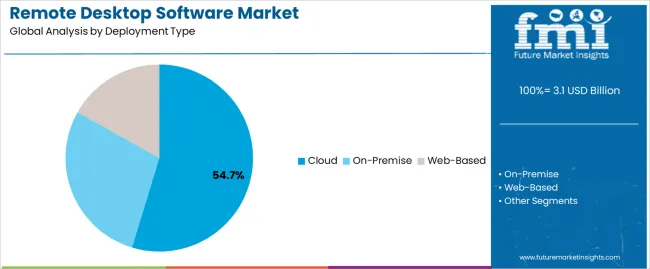
The cloud segment, accounting for 54.70% of the deployment type category, has emerged as the dominant model owing to its scalability, flexibility, and cost advantages. Adoption has accelerated as enterprises shift toward subscription-based software models that reduce on-premise maintenance costs and improve deployment agility.
Cloud-based remote desktop platforms are enabling real-time collaboration and remote access management with minimal infrastructure overhead. Enhanced security frameworks and compliance certifications are further reinforcing trust among enterprise users.
The segment’s growth is being supported by increasing demand from small and medium enterprises seeking affordable, easily deployable solutions Continuous improvements in data encryption, latency management, and multi-device integration are expected to sustain the segment’s leadership and ensure strong revenue contribution throughout the forecast period.
Insights into the Enterprise Size Segment
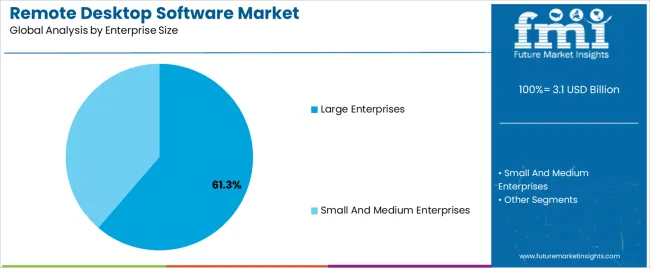
The large enterprises segment, holding 61.30% of the enterprise size category, leads the market due to extensive IT infrastructure requirements and large-scale remote workforce operations. Adoption is driven by the need for centralized control, seamless connectivity, and robust data protection across multiple business units.
Investments in enterprise-grade security and multi-factor authentication have strengthened deployment confidence. The segment benefits from advanced customization options and integration capabilities with existing enterprise systems, enabling efficient remote monitoring and maintenance.
Strategic partnerships between software providers and large corporations are enhancing product adaptability and user experience The continued shift toward flexible work environments and global collaboration models is expected to sustain demand from large enterprises and reinforce their dominant position within the market.
Insights into the End Use Segment
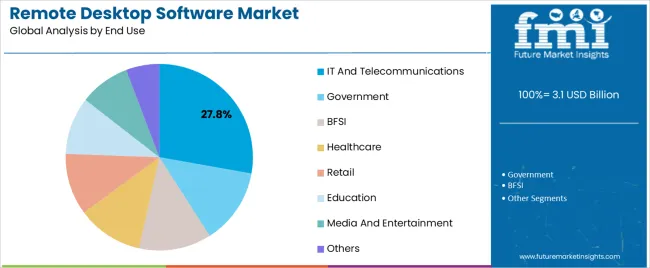
The IT and telecommunications segment, representing 27.80% of the end use category, has been a key contributor to overall market demand. This dominance is driven by the industry’s reliance on remote network management, software troubleshooting, and real-time technical support operations.
Increasing adoption of virtualized infrastructure and remote monitoring solutions has further strengthened usage across service providers and IT support companies. The segment benefits from the need for high-performance remote access platforms that ensure minimal downtime and data security.
Continuous digitalization within telecom operations and rising cloud service integration are expected to maintain growth momentum Strategic focus on enhancing operational efficiency, workforce flexibility, and cross-platform accessibility continues to position the IT and telecommunications segment as a critical driver of market expansion.
Overview of Markets Adjacent to the Global Remote Desktop Software Industry
The column below offers a comparative analysis of the remote desktop software market. For comparison, the help desk software market and document capture software market are taken. All these markets are evaluated on parameters like growth drivers, key trends, and emerging opportunities.
Out of these markets, the remote desktop software market wins at a relatively higher growth rate of 12.6% CAGR. The industry is backed by factors like increasing demand in sectors like healthcare, retail, BFSI, and education. Wider deployment of on-premise remote desktop software solutions is also contributing to the market growth.
Remote Desktop Software Market:
| Attributes | Remote Desktop Software Market |
|---|---|
| CAGR (2025 to 2035) | 12.6% |
| Growth Factor | Rising use of remote solutions to enable operations on tasks like presentations, technical support on a remote basis possible |
| Opportunity | Increasing use of remote desktop software telecommunication and Information Technology (IT) sectors |
| Key Trends | Surging use of technologies like cloud computing |
Help Desk Software Market:
| Attributes | Help Desk Software Market |
|---|---|
| CAGR (2025 to 2035) | 9.4% |
| Growth Factor | Increasing consumer preference for brands with efficient customer service |
| Opportunity | Expansion of BYOD or bring your own device concept |
| Key Trends | Rising popularity of technologies that help cut down costs and improve overall efficiency |
Document Capture Software Market:
| Attributes | Document Capture Software Market |
|---|---|
| CAGR (2025 to 2035) | 8.6% |
| Growth Factor | Growing demand for document capture software solutions to serve the requirements for routine document imaging in sectors like education, healthcare, etc. |
| Opportunity | Several organizations are observing demand for secure, integrated, and extremely collaborative cloud-based documentary systems |
| Key Trends | Surging adoption of cloud computing in organizations |
Category-wise Remote Desktop Software Market Insights
On-premise Remote Desktop Software Solutions to Capture a Sizeable Market Size
| Leading Deployment Type | On-premise Remote Desktop Software Solutions |
|---|---|
| Value Share (2025) | 39.80% |
The on-premise remote desktop software solutions are predicted to acquire a share of 39.80% in 2025. This deployment mode is expected to be driven by factors like:
- Organizations are increasingly opting for on-premise remote desktop software as they prioritize complete control over their applications and data, particularly those dealing with sensitive information. By using on-premise solutions, users can customize their security measures and execute stricter access controls.
- End use industries are increasingly utilizing on-premise solutions to remove dependence on outside cloud providers and their potential vulnerabilities. As a result, on-premise solutions find significant value in regions where internet connectivity is unreliable and among people who don’t trust their data to outside entities.
- Potential long-term cost savings associated with the use of on-premise solutions are boosting its adoption among organizations with a significant count of users. These solutions eliminate the ongoing subscription fees related to cloud-based solutions.
- On-premise remote control software solutions easily integrate with the existing IT infrastructure and legacy systems. As a result, streamlining workflows and reducing disruptions. Established organizations with complex internal systems are seen deploying on-premise solutions.
Large Enterprises Account for a Massive Market Share
| Leading Enterprise Size | Large Enterprises |
|---|---|
| Value Share (2025) | 56.20% |
Based on enterprise size, large enterprises are expected to account for a market share of 56.20% in 2025. Key factors that are determining the growth of this segment include:
- Large enterprises are increasingly adopting remote support software to enable employees to work remotely. Thus, offering flexibility and potentially improving work-life balance. By using these software solutions, large organizations can attract and retain top talent, particularly in a cut-throat job market.
- Businesses are finding remote desktop software (RDS) solutions attractive as they lower the overhead costs related to physical office space like utilities, rent, and maintenance. Moreover, RDS combines software licenses and resources, which further leads to further cost efficiencies.
Remote Desktop Software Market Analysis by Country
| Countries | Forecast CAGR (2025 to 2035) |
|---|---|
| The United States | 9.4% |
| Germany | 8.0% |
| Japan | 7.30% |
| China | 13.10% |
| Australia | 16.10% |
Versatile Use of Remote Desktop Software Across Multiple End Use Industries in the United States
The remote desktop software market in the United States is estimated to register a CAGR of 9.4% through 2035. This promising growth is anticipated to be driven by following factors:
- Rising adoption of work-from-home framework, which has been increasing rapidly since the coronavirus spread.
- Surging concentration of desktop sharing software vendors, robust IT network, and increasing cloud use in the United States are the key motivators.
- Increasing penetration of computers and the Internet in industries besides telecommunications and IT, such as healthcare, food and beverages, manufacturing plants, and automobiles.
High Costs Associated with Workspaces Fuel the Demand for Remote Desktop Software in China
The China remote desktop software market is anticipated to record a CAGR of 13.1% from 2025 to 2035. Key factors that are contributing to burgeoning demand are:
- Increasing presence of prosperous IT and telecommunication industries in the country.
- Growing count of small as well as medium scale IT companies are predicted to drive sales of remote desktop software.
- Expanding employee base and inflating costs of workspaces are increasing the utility of remote desktop software.
- Rising adoption of complex digital technologies to assist employees in carrying out various industry processes.
Surging Remote Working Practices to Motivate Growth in Remote Desktop Software in Germany
Adoption of remote desktop software in Germany is predicted to surge at a CAGR of 8% through 2035. Top motivators that are driving the market growth are:
- End use industries are consistently introducing remote working environment software products to bring efficiency to the employees’ productivity level and attain business growth.
- Increasing deployment of technologies like virtual reality, connected devices, Internet of Things, and artificial intelligence to support remote desktop solutions.
- Robust advancements in the digitization trend and availability of outsourcing prospects.
Remote Desktop Software Allows Experienced Employees in Japan to Work Efficiently and Remotely
The remote desktop software industry in Japan is expanding at a CAGR of 7.3% over the forecast period. Growth-inducing factors that are impacting the regional market are:
- The coronavirus outbreak opened the global population to be receptive to flexible work models. Use of remote desktop software management is increasing as it allows employees to access their office computers from remote locations.
- Businesses in Japan are finding remote desktop software quite attractive owing to its advanced security features like access controls and encryption. This is important for Japanese businesses as it allows them to adhere to stringent data privacy regulations.
- Companies can arm themselves with remote desktop software by permitting experienced employees with physical limitations to work remotely.
Australia to Offer Significant Opportunities to Investors and Stakeholders
Rising adoption of remote desktop software in Australia to exhibit 16.1% CAGR over the assessment period. Main contributors to market growth are:
- Surging adoption of cloud-based applications and services in Australia to necessitate remote access software in Australia. Users are increasingly using remote desktop software to securely access cloud-based resources from any device connected to the internet.
- Increasing popularity of distance and e-learning education platforms in Australia to propel the demand for remote desktop software solutions. Students and educators are raising their use of remote desktop software to access educational resources remotely.
- Growing demand for dependable remote desktop solutions that have robust security features, especially among individuals and businesses.
Competitive Landscape

Key players are consistently innovating and including new features to their software like collaboration tools, improved security, and mobile device compatibility, to meet the changing user demands. Industry participants are developing specialized solutions that easily adapt to certain industries like education and healthcare, with features customized to their distinct requirements.
Competitors are strategically collaborating with other technology companies to incorporate their software with other relevant services and platforms. Thus, offering a more comprehensive solution to customers. Market players are further collaborating with managed service providers (MSPs) to extend their market reach and provide their software as a constituent of broader IT service packages.
Players are further employing mergers and acquisitions, entering new markets, and localizing their marketing efforts and software to enhance their grasp in the global market.
Latest Developments Shaping the Remote Desktop Software Market
- In November 2025, Microsoft introduced a new “Windows App”, which allows users to deploy iPads, iPhones, and other devices to remotely connect to their PCs. This new app offers a secure way to access virtual apps or remote PCs and desktops made possible by an administrator. The app remotely connects to Windows 365 and other devices.
- In December 2024, TSplus revealed the official release of new version of Remote Access software called Remote Access Version 15. This software comes with a Lite Administrative Interface and a brand-new setup to empower first-time users to conveniently begin using the application’s valuable features.
Key Coverage in the Global Remote Desktop Software Market Research Report
- Adjacent Study of Clientless Remote Support Software Market, Remote Office Software Market, and Remote Desktop and Screen-Sharing Software Market
- Category-wise Market Study of Segments Including Cloud-based Remote Desktop Software, On-premise Remote Desktop Software Solutions, and Web-based Remote Desktop Software Solutions
Key Players in Remote Desktop Software Market
- ConnectWise
- Microsoft
- TeamViewer
- Splashtop Inc.
- AnyDesk
- Zoho Assist
- RealVNC Limited
- BeyondTrust Corporation
- LogMeIn, Inc.
- Techinline
- Goverlan, Inc.
- ISL Online
- Others
Remote Desktop Software Market Research by Categories
By Deployment Type:
- On-premise
- Cloud
- Web-based
By Enterprise Size:
- Small and Medium Enterprises
- Large Enterprises
By End Use:
- Government
- IT and Telecommunications
- BFSI
- Healthcare
- Retail
- Education
- Media and Entertainment
- Others
By Region:
- North America
- Europe
- Asia Pacific
- Middle East and Africa
- Latin America
Frequently Asked Questions
How big is the remote desktop software market in 2025?
The global remote desktop software market is estimated to be valued at USD 3.1 billion in 2025.
What will be the size of remote desktop software market in 2035?
The market size for the remote desktop software market is projected to reach USD 10.2 billion by 2035.
How much will be the remote desktop software market growth between 2025 and 2035?
The remote desktop software market is expected to grow at a 12.6% CAGR between 2025 and 2035.
What are the key product types in the remote desktop software market?
The key product types in remote desktop software market are cloud, on-premise and web-based.
Which enterprise size segment to contribute significant share in the remote desktop software market in 2025?
In terms of enterprise size, large enterprises segment to command 61.3% share in the remote desktop software market in 2025.
Preview the report firsthand - request a free sample
Get SampleGet the brochure for pricing and purchase details.
Get PDFTable of Content
- Executive Summary
- Global Market Outlook
- Demand-side Trends
- Supply-side Trends
- Technology Roadmap Analysis
- Analysis and Recommendations
- Market Overview
- Market Coverage / Taxonomy
- Market Definition / Scope / Limitations
- Market Background
- Market Dynamics
- Drivers
- Restraints
- Opportunity
- Trends
- Scenario Forecast
- Demand in Optimistic Scenario
- Demand in Likely Scenario
- Demand in Conservative Scenario
- Opportunity Map Analysis
- Product Life Cycle Analysis
- Supply Chain Analysis
- Investment Feasibility Matrix
- Value Chain Analysis
- PESTLE and Porter’s Analysis
- Regulatory Landscape
- Regional Parent Market Outlook
- Production and Consumption Statistics
- Import and Export Statistics
- Market Dynamics
- Global Market Analysis 2020 to 2024 and Forecast, 2025 to 2035
- Historical Market Size Value (USD Million) Analysis, 2020 to 2024
- Current and Future Market Size Value (USD Million) Projections, 2025 to 2035
- Y-o-Y Growth Trend Analysis
- Absolute $ Opportunity Analysis
- Global Market Pricing Analysis 2020 to 2024 and Forecast 2025 to 2035
- Global Market Analysis 2020 to 2024 and Forecast 2025 to 2035, By Deployment Type
- Introduction / Key Findings
- Historical Market Size Value (USD Million) Analysis By Deployment Type , 2020 to 2024
- Current and Future Market Size Value (USD Million) Analysis and Forecast By Deployment Type , 2025 to 2035
- Cloud
- On-Premise
- Web-Based
- Y-o-Y Growth Trend Analysis By Deployment Type , 2020 to 2024
- Absolute $ Opportunity Analysis By Deployment Type , 2025 to 2035
- Global Market Analysis 2020 to 2024 and Forecast 2025 to 2035, By Enterprise Size
- Introduction / Key Findings
- Historical Market Size Value (USD Million) Analysis By Enterprise Size, 2020 to 2024
- Current and Future Market Size Value (USD Million) Analysis and Forecast By Enterprise Size, 2025 to 2035
- Large Enterprises
- Small And Medium Enterprises
- Y-o-Y Growth Trend Analysis By Enterprise Size, 2020 to 2024
- Absolute $ Opportunity Analysis By Enterprise Size, 2025 to 2035
- Global Market Analysis 2020 to 2024 and Forecast 2025 to 2035, By End Use
- Introduction / Key Findings
- Historical Market Size Value (USD Million) Analysis By End Use, 2020 to 2024
- Current and Future Market Size Value (USD Million) Analysis and Forecast By End Use, 2025 to 2035
- IT And Telecommunications
- Government
- BFSI
- Healthcare
- Retail
- Education
- Media And Entertainment
- Others
- Y-o-Y Growth Trend Analysis By End Use, 2020 to 2024
- Absolute $ Opportunity Analysis By End Use, 2025 to 2035
- Global Market Analysis 2020 to 2024 and Forecast 2025 to 2035, By Region
- Introduction
- Historical Market Size Value (USD Million) Analysis By Region, 2020 to 2024
- Current Market Size Value (USD Million) Analysis and Forecast By Region, 2025 to 2035
- North America
- Latin America
- Western Europe
- Eastern Europe
- East Asia
- South Asia and Pacific
- Middle East & Africa
- Market Attractiveness Analysis By Region
- North America Market Analysis 2020 to 2024 and Forecast 2025 to 2035, By Country
- Historical Market Size Value (USD Million) Trend Analysis By Market Taxonomy, 2020 to 2024
- Market Size Value (USD Million) Forecast By Market Taxonomy, 2025 to 2035
- By Country
- USA
- Canada
- Mexico
- By Deployment Type
- By Enterprise Size
- By End Use
- By Country
- Market Attractiveness Analysis
- By Country
- By Deployment Type
- By Enterprise Size
- By End Use
- Key Takeaways
- Latin America Market Analysis 2020 to 2024 and Forecast 2025 to 2035, By Country
- Historical Market Size Value (USD Million) Trend Analysis By Market Taxonomy, 2020 to 2024
- Market Size Value (USD Million) Forecast By Market Taxonomy, 2025 to 2035
- By Country
- Brazil
- Chile
- Rest of Latin America
- By Deployment Type
- By Enterprise Size
- By End Use
- By Country
- Market Attractiveness Analysis
- By Country
- By Deployment Type
- By Enterprise Size
- By End Use
- Key Takeaways
- Western Europe Market Analysis 2020 to 2024 and Forecast 2025 to 2035, By Country
- Historical Market Size Value (USD Million) Trend Analysis By Market Taxonomy, 2020 to 2024
- Market Size Value (USD Million) Forecast By Market Taxonomy, 2025 to 2035
- By Country
- Germany
- UK
- Italy
- Spain
- France
- Nordic
- BENELUX
- Rest of Western Europe
- By Deployment Type
- By Enterprise Size
- By End Use
- By Country
- Market Attractiveness Analysis
- By Country
- By Deployment Type
- By Enterprise Size
- By End Use
- Key Takeaways
- Eastern Europe Market Analysis 2020 to 2024 and Forecast 2025 to 2035, By Country
- Historical Market Size Value (USD Million) Trend Analysis By Market Taxonomy, 2020 to 2024
- Market Size Value (USD Million) Forecast By Market Taxonomy, 2025 to 2035
- By Country
- Russia
- Poland
- Hungary
- Balkan & Baltic
- Rest of Eastern Europe
- By Deployment Type
- By Enterprise Size
- By End Use
- By Country
- Market Attractiveness Analysis
- By Country
- By Deployment Type
- By Enterprise Size
- By End Use
- Key Takeaways
- East Asia Market Analysis 2020 to 2024 and Forecast 2025 to 2035, By Country
- Historical Market Size Value (USD Million) Trend Analysis By Market Taxonomy, 2020 to 2024
- Market Size Value (USD Million) Forecast By Market Taxonomy, 2025 to 2035
- By Country
- China
- Japan
- South Korea
- By Deployment Type
- By Enterprise Size
- By End Use
- By Country
- Market Attractiveness Analysis
- By Country
- By Deployment Type
- By Enterprise Size
- By End Use
- Key Takeaways
- South Asia and Pacific Market Analysis 2020 to 2024 and Forecast 2025 to 2035, By Country
- Historical Market Size Value (USD Million) Trend Analysis By Market Taxonomy, 2020 to 2024
- Market Size Value (USD Million) Forecast By Market Taxonomy, 2025 to 2035
- By Country
- India
- ASEAN
- Australia & New Zealand
- Rest of South Asia and Pacific
- By Deployment Type
- By Enterprise Size
- By End Use
- By Country
- Market Attractiveness Analysis
- By Country
- By Deployment Type
- By Enterprise Size
- By End Use
- Key Takeaways
- Middle East & Africa Market Analysis 2020 to 2024 and Forecast 2025 to 2035, By Country
- Historical Market Size Value (USD Million) Trend Analysis By Market Taxonomy, 2020 to 2024
- Market Size Value (USD Million) Forecast By Market Taxonomy, 2025 to 2035
- By Country
- Kingdom of Saudi Arabia
- Other GCC Countries
- Turkiye
- South Africa
- Other African Union
- Rest of Middle East & Africa
- By Deployment Type
- By Enterprise Size
- By End Use
- By Country
- Market Attractiveness Analysis
- By Country
- By Deployment Type
- By Enterprise Size
- By End Use
- Key Takeaways
- Key Countries Market Analysis
- USA
- Pricing Analysis
- Market Share Analysis, 2024
- By Deployment Type
- By Enterprise Size
- By End Use
- Canada
- Pricing Analysis
- Market Share Analysis, 2024
- By Deployment Type
- By Enterprise Size
- By End Use
- Mexico
- Pricing Analysis
- Market Share Analysis, 2024
- By Deployment Type
- By Enterprise Size
- By End Use
- Brazil
- Pricing Analysis
- Market Share Analysis, 2024
- By Deployment Type
- By Enterprise Size
- By End Use
- Chile
- Pricing Analysis
- Market Share Analysis, 2024
- By Deployment Type
- By Enterprise Size
- By End Use
- Germany
- Pricing Analysis
- Market Share Analysis, 2024
- By Deployment Type
- By Enterprise Size
- By End Use
- UK
- Pricing Analysis
- Market Share Analysis, 2024
- By Deployment Type
- By Enterprise Size
- By End Use
- Italy
- Pricing Analysis
- Market Share Analysis, 2024
- By Deployment Type
- By Enterprise Size
- By End Use
- Spain
- Pricing Analysis
- Market Share Analysis, 2024
- By Deployment Type
- By Enterprise Size
- By End Use
- France
- Pricing Analysis
- Market Share Analysis, 2024
- By Deployment Type
- By Enterprise Size
- By End Use
- India
- Pricing Analysis
- Market Share Analysis, 2024
- By Deployment Type
- By Enterprise Size
- By End Use
- ASEAN
- Pricing Analysis
- Market Share Analysis, 2024
- By Deployment Type
- By Enterprise Size
- By End Use
- Australia & New Zealand
- Pricing Analysis
- Market Share Analysis, 2024
- By Deployment Type
- By Enterprise Size
- By End Use
- China
- Pricing Analysis
- Market Share Analysis, 2024
- By Deployment Type
- By Enterprise Size
- By End Use
- Japan
- Pricing Analysis
- Market Share Analysis, 2024
- By Deployment Type
- By Enterprise Size
- By End Use
- South Korea
- Pricing Analysis
- Market Share Analysis, 2024
- By Deployment Type
- By Enterprise Size
- By End Use
- Russia
- Pricing Analysis
- Market Share Analysis, 2024
- By Deployment Type
- By Enterprise Size
- By End Use
- Poland
- Pricing Analysis
- Market Share Analysis, 2024
- By Deployment Type
- By Enterprise Size
- By End Use
- Hungary
- Pricing Analysis
- Market Share Analysis, 2024
- By Deployment Type
- By Enterprise Size
- By End Use
- Kingdom of Saudi Arabia
- Pricing Analysis
- Market Share Analysis, 2024
- By Deployment Type
- By Enterprise Size
- By End Use
- Turkiye
- Pricing Analysis
- Market Share Analysis, 2024
- By Deployment Type
- By Enterprise Size
- By End Use
- South Africa
- Pricing Analysis
- Market Share Analysis, 2024
- By Deployment Type
- By Enterprise Size
- By End Use
- USA
- Market Structure Analysis
- Competition Dashboard
- Competition Benchmarking
- Market Share Analysis of Top Players
- By Regional
- By Deployment Type
- By Enterprise Size
- By End Use
- Competition Analysis
- Competition Deep Dive
- Microsoft
- Overview
- Product Portfolio
- Profitability by Market Segments (Product/Age /Sales Channel/Region)
- Sales Footprint
- Strategy Overview
- Marketing Strategy
- Product Strategy
- Channel Strategy
- ConnectWise
- TeamViewer
- Splashtop Inc.
- AnyDesk
- Zoho Assist
- RealVNC Limited
- BeyondTrust Corporation
- LogMeIn, Inc.
- Techinline
- Goverlan, Inc.
- ISL Online
- Others
- Microsoft
- Competition Deep Dive
- Assumptions & Acronyms Used
- Research Methodology


