

- Market Size (2026)
- USD 0.8 Bn
- Forecast (2036)
- USD 1.5 Bn
- CAGR (2026 to 2036)
- 6.6%
Industrial Site Carbon Footprint Verification and Metering Test Equipment Market Size, Market Forecast and Outlook By FMI
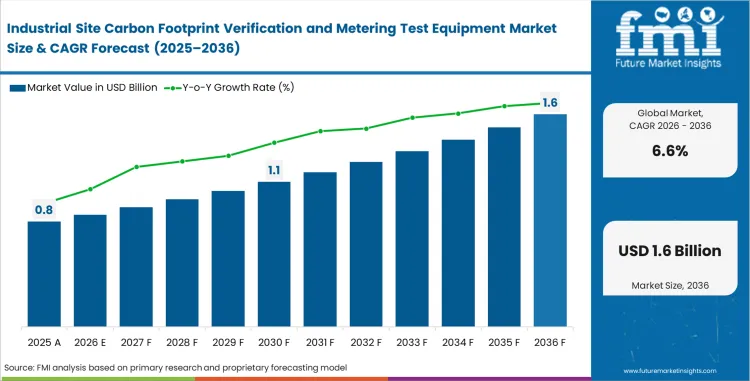
Industrial site carbon footprint verification and metering test equipment market was valued at USD 0.73 billion in 2025. Sector is expected to reach USD 0.8 billion in 2026 at a CAGR of 6.6% during the forecast period. FMI estimates place total valuation at USD 1.5 billion by 2036 as industrial facilities move from broad carbon reporting toward instrument-backed measurement, source-level verification, and audit-ready site records.
Summary of Industrial Site Carbon Footprint Verification and Metering Test Equipment Market
- Industrial Site Carbon Footprint Verification and Metering Test Equipment Market Snapshot
- Industrial Site Carbon Footprint Verification and Metering Test Equipment Market is valued at USD 0.73 billion in 2025 and is projected to reach USD 1.5 billion by 2036.
- Industry outlook points to a 6.6% CAGR from 2026 to 2036, creating an incremental opportunity of about USD 0.70 billion over the decade.
- This category stays centered on compliance-led industrial instrumentation, covering fixed emissions monitoring, stack and source-gas analyzers, optical gas imaging, flow and metering devices, and associated hardware used to support auditable greenhouse-gas reporting.
- Facility-level MRV systems in Europe, large-emitter reporting under the USA GHGRP, and wider OCEMS/CEMS enforcement across India and other industrializing economies continue to shape category direction.
- Industrial Site Carbon Footprint Verification and Metering Test Equipment Market Demand and Growth Drivers
- Large industrial emitters increasingly require instrument-backed evidence for monitoring, reporting, and verification, and that requirement is pushing facilities beyond spreadsheet-led carbon accounting.
- Methane monitoring is lifting interest in OGI, laser, and continuous monitoring equipment because oil and gas assets need practical leak-detection coverage that can stand up to operating review.
- Carbon capture and industrial decarbonization projects are widening the instrumentation base, since capture, transport, storage, and source-stream measurement call for tighter CO2 and process verification capability.
- Among key countries, India leads with 8.1% CAGR, followed by China at 7.8%, Saudi Arabia at 7.2%, Brazil at 6.9%, the United States at 5.9%, Germany at 5.7%, and Japan at 5.1% during the 2026 to 2036 forecast period.
- Calibration burden, certification requirements, site integration cost, and the replacement-led nature of mature demand bases continue to keep category expansion measured rather than abrupt.
- Industrial Site Carbon Footprint Verification and Metering Test Equipment Market Product and Segment View
- Scope covers fixed and portable emissions-monitoring hardware, gas analyzers, OGI cameras, flow and metering devices, and DAHS-linked compliance equipment used inside industrial facilities.
- Use extends across power generation, cement, chemicals, refining, metals, waste handling, and methane-exposed oil and gas sites where measured emissions records carry operating importance.
- Regulated stacks and permanent reporting obligations keep fixed CEMS in the lead, and the segment is expected to account for 41% share in 2026 because always-on measurement fits continuous verification better than episodic testing.
- Supported by multi-gas flexibility and easier fit with established compliance workflows already familiar to engineering teams, extractive systems are projected to secure 37% share in 2026.
- CO2 is anticipated to emerge with 34% market share in 2026, reflecting its central place in facility carbon-footprint accounting and in reporting frameworks built around measurable source emissions.
- Power plants are likely to represent 28% of the market in 2026 because stack-based measurement density, installed CEMS familiarity, and tighter reporting discipline keep utilities important users.
- As industry valuation is still shaped more by regulation and auditable evidence than by discretionary sustainability reporting, compliance monitoring is forecast to represent 44% share in 2026.
- Scope includes hardware used to meter, detect, quantify, and verify GHG emissions at industrial sites, while software-only carbon accounting, consulting-only verification, and general ambient air monitoring networks remain outside coverage.
- Industrial Site Carbon Footprint Verification and Metering Test Equipment Market Geography and Competitive Outlook
- India, China, and Saudi Arabia remain the faster-expanding markets in this model, while the United States and Germany continue as stable high-value demand bases with deeper installed infrastructure.
- Competitive positioning is shaped by regulatory certification, analyzer accuracy, lifecycle service depth, DAHS compatibility, and the ability to cover both stack monitoring and fugitive-emissions verification with credible operating support.
- Fragmentation stays moderate in this category. According to estimates, no single supplier appears to control a dominant global share across all site-verification equipment classes, supported more by portfolio breadth than by disclosed segment revenue.
Key Takeaways, Market Size, and Forecast
- Industrial Site Carbon Footprint Verification and Metering Test Equipment Market is forecast to rise from USD 0.8 billion in 2026 to USD 1.5 billion by 2036, at a CAGR of 6.6%.
- The industrial site carbon footprint verification and metering test equipment market was valued at USD 0.73 billion in 2025.
- By 2036, the Industrial Site Carbon Footprint Verification and Metering Test Equipment Market is expected to reach USD 1.5 billion.
- From 2026 to 2036, the market is anticipated to expand at a CAGR of 6.6%.
- The market is projected to create an incremental opportunity of about USD 0.70 billion over the decade.
- In 2026, Fixed CEMS is likely to account for 41% of the equipment type segment.
- India (8.1% CAGR) and China (7.8% CAGR) are expected to remain the fastest growing country markets.
Carbon reporting at plant level now requires more than compiled assumptions. Engineering teams, compliance managers, and plant operators increasingly need equipment-backed records that can be checked, repeated, and defended during internal review or external verification. Estimation therefore remains central to current buying logic in this market, especially where facilities are still deciding how much of their carbon record should come from measured evidence rather than calculated approximation. Broader overlap with emissions management solutions keeps category interest active, yet hardware purchases usually move ahead only when site teams decide that measured output must sit closer to routine plant practice.
Adoption becomes easier once a facility assigns clear responsibility for calibration, measurement quality, and data continuity. Plant engineering teams usually trigger this move when emissions records begin to affect operating discipline rather than remaining confined to corporate reporting. Instrument selection tends to move faster after that point.
India is expected to post 8.1% CAGR through 2036, followed by China at 7.8%, Saudi Arabia at 7.2%, Brazil at 6.9%, the United States at 5.9%, Germany at 5.7%, and Japan at 5.1%. Faster-moving countries usually combine industrial capacity additions with tighter site-level oversight, while mature demand bases lean more toward retrofit cycles, analyzer replacement, and instrumentation upgrades within installed facilities.
Industrial Site Carbon Footprint Verification and Metering Test Equipment Market Key Takeaways
| Metric | Details |
|---|---|
| Industry Size (2026) | USD 0.8 billion |
| Industry Value (2036) | USD 1.5 billion |
| CAGR (2026-2036) | 6.6% |
Source: Future Market Insights (FMI) analysis, based on proprietary forecasting model and primary research
Segmental Analysis
Industrial Site Carbon Footprint Verification and Metering Test Equipment Market Analysis by Equipment Type
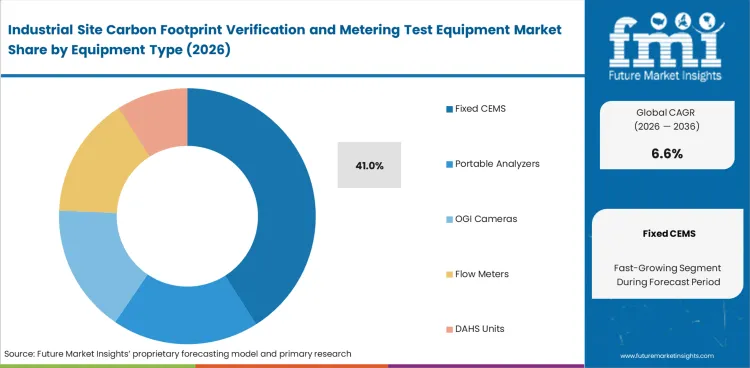
Permanent measurement still anchors a large part of category valuation. Facilities handling regulated emissions streams or audit-sensitive carbon records usually favor equipment that can remain installed, feed repeatable data into site systems, and reduce reliance on intermittent test activity. Fixed CEMS is expected to account for 41% share in 2026 because it fits operating environments where emissions verification has to sit inside routine plant practice rather than outside it.
Utilities, refining assets, and process industries continue to prefer hardware that supports continuity, routine checks, and traceable records across longer operating periods. Portable tools retain relevance for targeted work, yet they carry less weight where constant measurement and stable reporting matter more. Poor alignment at the selection stage often leaves facilities managing uneven data continuity, repeated workarounds, and added service pressure when air quality monitoring equipment is used only as a partial substitute.
- Continuity: Fixed systems keep source-level data available during routine plant operation. Engineering teams gain a steadier record for verification work.
- Service fit: Installed platforms are easier to absorb into scheduled upkeep and instrument checks. Maintenance planning becomes more predictable at site level.
- Audit readiness: Permanent measurement supports cleaner data history across reporting cycles. Compliance teams face fewer gaps when records are reviewed.
Industrial Site Carbon Footprint Verification and Metering Test Equipment Market Analysis by Measurement Method
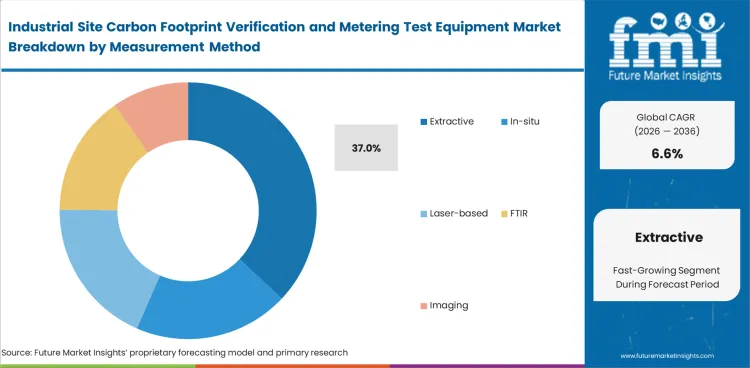
Operating familiarity carries almost as much weight as analytical capability in method selection. Extractive systems are projected to secure 37% share in 2026 because many industrial users already know how to manage sampling, conditioning, analyzer handling, and service routines around this approach. Category preference stays firm where facilities need broader gas flexibility without rebuilding site practice from the ground up. In-situ options can reduce some handling steps, yet they also place more pressure on installation conditions and field confidence in certain applications. Laser-based and imaging methods retain importance in selected use cases, especially where methane or point-source confirmation matters, but wider adoption still leans toward methods that fit established operating habits. Weak method fit usually appears later through service complexity, unstable readings under plant conditions, or longer acceptance cycles when gas sensors are being folded into a broader emissions setup.
- Workflow fit: Extractive systems align well with analyzer routines already familiar in heavy industry. Site staff can adapt faster without rewriting every service step.
- Sampling control: Managed sample conditioning helps operators maintain cleaner measurement conditions. Output quality becomes easier to interpret over repeated runs.
- Application breadth: Multi-gas use cases favor methods that can support broader coverage. Facilities avoid narrowing instrument utility too early.
Industrial Site Carbon Footprint Verification and Metering Test Equipment Market Analysis by Gas Type
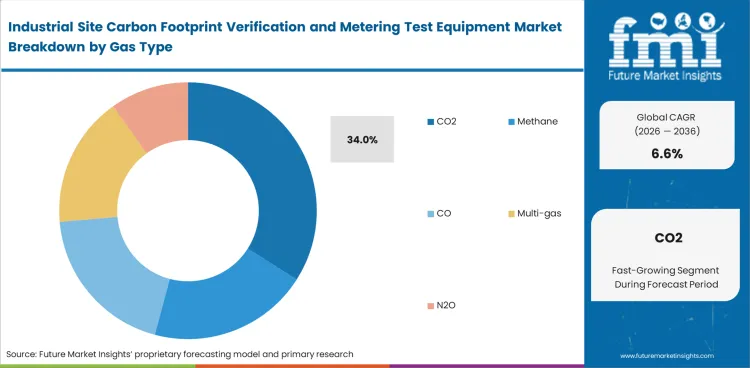
Carbon-footprint verification usually starts with the gas stream closest to carbon accounting itself. CO2 is anticipated to represent 34% of the market in 2026 because facility-level reporting, combustion-related measurement, and carbon-balance checks still begin with carbon dioxide before moving into methane or broader multi-gas coverage. Industrial users do not always enter this category looking for the broadest gas menu. Many first look for credible carbon dioxide measurement that can anchor plant records and support reporting discipline with less ambiguity. Methane-focused equipment is on a positive trend where fugitives and leak surveillance matter, while multi-gas systems are gaining room in more complex industrial environments. CO2 nevertheless stays in the lead because it sits closest to how facilities frame carbon-footprint obligations. Weak CO2 measurement at the front end can make later verification work less convincing, even when plants add more advanced total carbon analyzers or methane tools.
- Carbon anchor: CO2 remains the base measurement for many facility-level carbon records. Plants often start here before widening gas coverage.
- Reporting fit: Carbon dioxide data is easier to connect with internal emissions accounting routines. Site records become more usable across review cycles.
- Expansion path: Once CO2 measurement is stable, facilities can extend into methane and multi-gas verification with less disruption. Sequencing matters in this category.
Industrial Site Carbon Footprint Verification and Metering Test Equipment Market Analysis by End Use
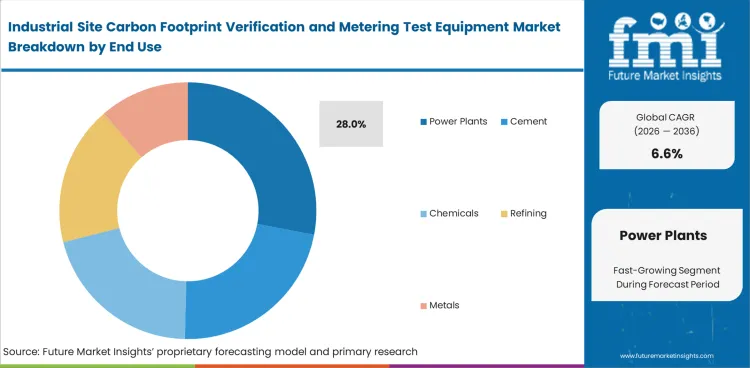
Power Plants are likely to represent 28% of the market in 2026 because stack-based verification, emissions oversight, and analyzer integration are already more embedded in utility practice than in many other industrial settings. Installed monitoring habits differ sharply by industry, and utilities enter this category with deeper measurement familiarity than most other user groups. Established discipline around source monitoring lowers the hurdle for carbon-footprint verification equipment when compared with sectors still building their internal measurement routines. Cement, refining, chemicals, and metals are also rising in relevance because each carries high emissions intensity and a stronger need for audit-ready site records. Utility assets still remain an important demand base because equipment choices there are usually tied to repeat use, stable records, and known service workflows rather than first-time experimentation. Poorly fitted instruments in this end use can disrupt operating continuity and add avoidable burden around process instrumentation equipment integration.
- Installed base: Utilities already work with source-monitoring hardware in many locations. Entry barriers for carbon verification equipment are lower here.
- Operating discipline: Power assets tend to follow tighter routines for checks, recordkeeping, and service cycles. Measurement consistency is easier to protect.
- Replacement cycle: Existing instrument populations create repeat demand through upgrades and renewals. Mature use does not remove buying activity.
Industrial Site Carbon Footprint Verification and Metering Test Equipment Market Analysis by Use Case
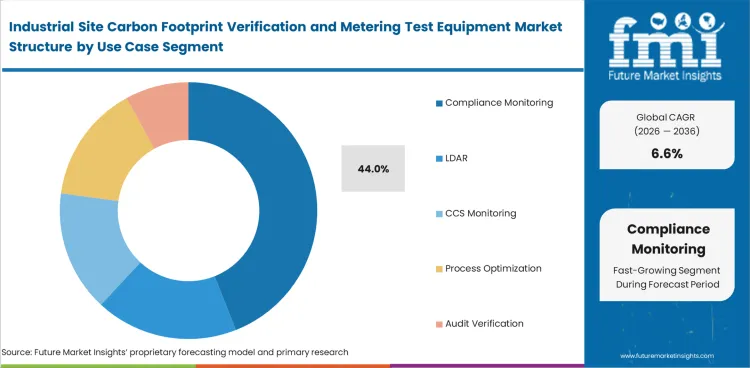
Regulated verification remains the first reason most industrial sites allocate spending to this category. Compliance Monitoring is expected to account for 44% share in 2026 because facilities still justify equipment purchases most easily when plant records must support reporting, inspection, or internal control requirements. Discretionary use cases such as process optimization or broader carbon analytics rarely carry the same urgency unless a facility already has credible measurement hardware in place. LDAR and methane-oriented work are expanding in relevance, and CCS monitoring adds another layer of category interest, yet core buying logic still begins with proof, traceability, and repeatable site evidence. Audit verification carries similar importance for the same reason. Facilities that delay equipment adoption until reporting pressure builds often enter the category under tighter timelines and narrower choices, which can make later integration with leak detection equipment or source-monitoring setups less efficient.
- Proof requirement: Compliance-led entry begins where reported emissions need measured support. Verification has to be defensible at site level.
- Timing pressure: Reporting requirements compress decision windows for plants that wait too long. Equipment selection becomes harder under deadline pressure.
- Expansion route: Once compliance use is established, sites can broaden toward LDAR, CCS, or optimization work. Early use often sets the later path.
Industrial Site Carbon Footprint Verification and Metering Test Equipment Market Drivers, Restraints, and Opportunities
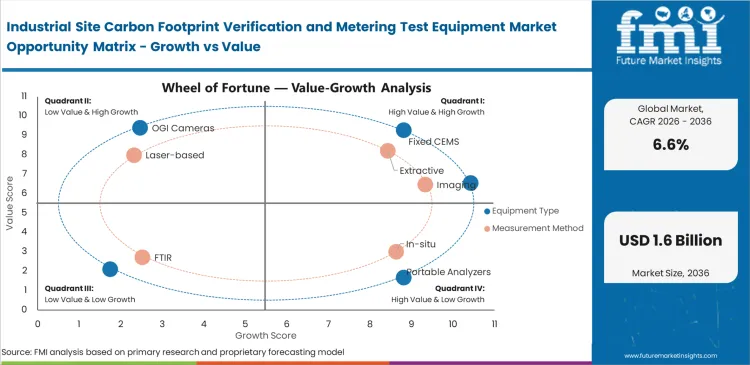
Measurement credibility is now a plant issue rather than a reporting-office issue. Plant operators need carbon data that can be traced back to instruments, maintained through routine checks, and defended during review, and that is steadily changing how facilities evaluate analyzers, meters, imaging tools, and site interfaces. Category uptake is rising where reported emissions are expected to reflect measured conditions instead of broad assumptions. Carbon capture projects, methane surveillance needs, and closer attention to source-level data are also widening the role of natural gas analyzers and verification-grade devices across industrial operations.
Internal handoff remains a real obstacle even when site teams accept the need for better measurement. Many facilities still move slowly because ownership can sit across engineering, compliance, maintenance, and operations at the same time, delaying equipment choice, installation review, and upkeep planning. Cost still matters, yet coordination inside the plant often slows adoption more than price alone. Calibration discipline, service readiness, and data-handling responsibility all have to land with the right team before instruments are used properly. Partial adoption can therefore leave facilities with hardware on site but weak measurement practice in use.
Opportunities in the Industrial Site Carbon Footprint Verification and Metering Test Equipment Market
- Methane surveillance: Oil, gas, refining, and chemical facilities create room for wider use of imaging, analyzer, and leak-verification tools where source confirmation has to become more routine. Suppliers that connect methane-focused devices with plant-friendly service support can widen their role faster.
- Retrofit integration: Existing industrial assets still carry a large installed base of older measurement arrangements, giving retrofit programs a practical route into this category. Engineering teams usually prefer equipment that fits current site layouts and data paths with less disruption.
- CCS instrumentation: Carbon capture activity opens a stronger path for source-stream monitoring, metering, and verification equipment linked to process spectroscopy needs. Vendors that support stable readings across capture-linked operations can strengthen their position as this area expands.
Regional Analysis
Based on the regional analysis, Industrial Site Carbon Footprint Verification and Metering Test Equipment Market is segmented into North America, Latin America, Europe, East Asia, South Asia & Pacific, and Middle East & Africa across 40 plus countries.
.webp "Top Country Growth Comparison Industrial Site Carbon Footprint Verification And Metering Test Equipment Market Cagr (2026 2036)")
| Country | CAGR (2026 to 2036) |
|---|---|
| India | 8.1% |
| China | 7.8% |
| Saudi Arabia | 7.2% |
| Brazil | 6.9% |
| United States | 5.9% |
| Germany | 5.7% |
| Japan | 5.1% |
Source: Future Market Insights (FMI) analysis, based on proprietary forecasting model and primary research
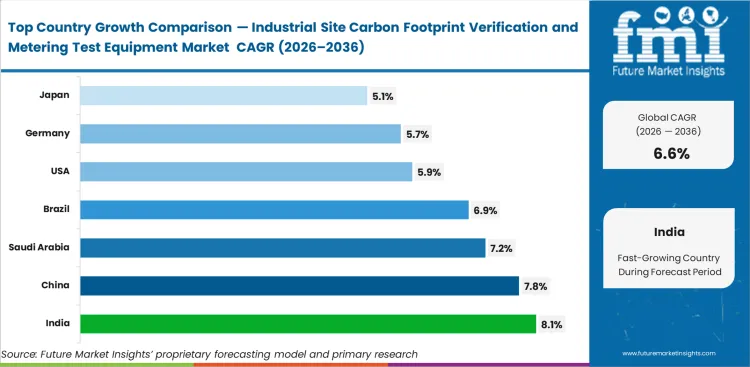
North America Industrial Site Carbon Footprint Verification and Metering Test Equipment Market Analysis
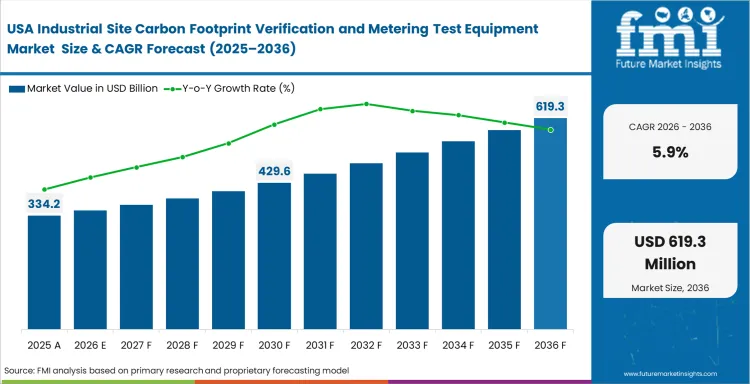
North America carries a more mature profile than faster-building demand bases because much of the category here develops inside facilities that already understand emissions instrumentation. Equipment selection therefore leans less on first-entry installation and more on upgrade logic, site compatibility, and continuity of measured records. Legacy source-monitoring arrangements still matter. Plants usually move when installed systems no longer support cleaner reporting, broader gas visibility, or stronger data quality across audit cycles. Operating teams across this region also compare service support, calibration confidence, and integration discipline more closely than broad feature lists. Category valuation is therefore rising through refinement, methane-focused add-ons, and audit-ready metering layers rather than through simple first-entry activity. Overlap with environmental test equipment categories also keeps evaluation grounded in reliability and upkeep practicality.
- United States: Industry outlook in the United States points to 5.9% CAGR through 2036, reflecting a market where plant operators are more selective and less willing to accept equipment that complicates service schedules or site data handling. Large industrial reporting exposure keeps the United States central to regional valuation. Utilities, refining assets, chemical sites, and other heavy emitters already work with emissions measurement in some form, so fresh investment usually centers on improving data quality, extending gas coverage, or replacing aging systems that no longer fit current verification needs. Mature valuation does not imply weak movement. Facilities that align instrument choice with established operating routines can move into audit-ready verification with less disruption across live sites.
FMI's report includes Canada and Mexico within North America. Industrial facilities across these countries add depth to regional valuation where emissions oversight, plant modernization, and site-level metering discipline are advancing. Stable uptake in this wider regional base supports repeat category activity beyond the United States.
Latin America and Middle East & Africa Industrial Site Carbon Footprint Verification and Metering Test Equipment Market Analysis
Latin America and Middle East & Africa move from a smaller installed base, and that condition changes how facilities approach this category. First-entry projects are more common here than in North America or parts of Europe, so equipment selection often begins with practical questions around installation fit, supplier support, and whether site teams can maintain the system without recurring service strain. Capital discipline remains important, yet facilities are rarely looking only for the lowest initial outlay. Instruments that reduce repeat intervention, stabilize readings, and suit plant conditions attract more attention. Country momentum across this grouping comes from the meeting point between export-facing industry, emissions scrutiny, and energy-sector measurement needs. Oil and gas exposure also widens the relevance of methane and leak-verification equipment, which keeps adjacent interest in leak detection tools closely tied to category development.
- Brazil: Industrial decarbonization activity and wider attention to plant-level emissions control are helping Brazil build a firmer valuation base for verification-grade instruments. Heavy industry and energy-linked assets create a practical opening for fixed and portable equipment where site records need better continuity and clearer measurement support. Facilities here usually weigh service access and installation practicality carefully because poorly matched systems can create repeat technical intervention and longer acceptance cycles. Brazil is forecast to register 6.9% CAGR over the study period, supported by a market that is still broadening beyond patchwork measurement practice. Early movers can place more credible measurement discipline inside large industrial sites before verification expectations become harder to meet with partial tools.
- Saudi Arabia: A CAGR of 7.2% is expected for Saudi Arabia through 2036, and that pace reflects a market where category uptake is tied closely to operating practicality inside large industrial assets. Energy-linked industry, refining capacity, and large-scale process operations keep Saudi Arabia important in this category. Source-level carbon measurement and methane-related verification work carry stronger weight here because facilities need equipment that can perform under demanding industrial conditions while supporting clearer records across major sites. Faster adoption depends less on experimentation and more on whether suppliers can support site use with dependable service and strong operating fit. Facilities that get this right improve internal visibility and make later verification work easier to manage across complex sites.
FMI's report includes the rest of Latin America, GCC countries outside Saudi Arabia, South Africa, and other Middle East & African markets. Industrial plants in these countries add opportunity where emissions oversight is becoming more site-facing and where energy, mining, and process industries need measurable records rather than broad estimates. Regional progress is uneven, yet practical need for verified measurement is widening.
Europe and Asia Industrial Site Carbon Footprint Verification and Metering Test Equipment Market Analysis
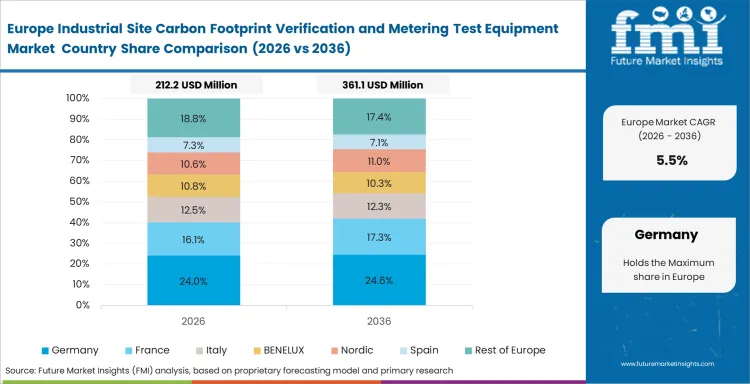
Europe and Asia present the widest contrast in this study. Europe benefits from more established emissions reporting discipline and a deeper installed base of industrial measurement practice, while large parts of Asia are expanding faster through fresh capacity, tighter oversight, and wider first-entry category activity across heavy industry. Facilities in both regions still care about serviceability and instrument credibility, yet evaluation logic differs. European plants more often compare upgrade value inside installed systems, while Asian sites more often assess how quickly verification-grade hardware can be installed and made usable under live operating conditions. This combination keeps Europe important for repeat instrument activity and makes Asia the stronger source of faster-forward expansion. Cross-category evaluation also draws on adjacent interest in ftir gas analysers and source-monitoring tools where gas coverage has to widen without losing measurement confidence.
- Germany: Industrial discipline and emissions oversight keep Germany relevant even though its pace is more measured than the highest-moving countries in this study. Utilities, chemicals, metals, and advanced manufacturing facilities already work within tighter environmental controls, so site teams often invest to improve record quality, upgrade installed equipment, and maintain measurement integrity under closer review. A slower pace than India or China does not reduce Germany’s importance. Germany is likely to post 5.7% CAGR in the sector by 2036, pointing to a mature valuation base where facilities expect clearer installation logic and stronger long-term support. Supplier credibility carries extra weight in settings where instrument choice is tested through service life rather than quick pilot activity.
- Japan: Industry outlook in Japan points to 5.1% CAGR through 2036. Precision in plant operations helps Japan stay relevant in a sector where stable readings and disciplined upkeep matter. Industrial users tend to adopt carefully, with close attention to equipment reliability, service burden, and how well instruments fit controlled operating environments. Expansion is steadier here because facilities generally favor proven fit over fast rollout, especially when measurement systems must integrate cleanly with established plant routines. The growth also reflects a market where long service life and dependable operating performance continue to matter more than speed alone.
- China: China is expected to record 7.8% CAGR during the forecast period, supported by the need to install practical measurement capability across a very large industrial base where source-level visibility can no longer rely on partial arrangements. Category depth here is expanding because measurement discipline is becoming harder to postpone across major emitting sectors. Large industrial capacity, broad emissions exposure, and rising attention to measurable site records keep China near the top of the range in this study. Plant operators across utilities, heavy industry, and process sectors are in a stronger position to add fixed and portable verification tools as emissions monitoring becomes more closely tied to plant discipline. Scale helps, yet scale alone does not explain the pace.
- India: Expanding industrial activity, wider use of continuous monitoring in polluting sectors, and rising pressure for measurable site records keep India at the front of this forecast set. Engineering teams often enter this category while building out emissions discipline more broadly, which gives first-entry valuation more room than in mature replacement-led countries. Pace here comes from plant additions as well as enforcement depth. Adoption in India is anticipated to move ahead at a CAGR of 8.1% during the assessment period, leaving the country ahead of the rest of the set on a forecast basis. Facilities that install workable verification systems early gain a cleaner route into repeat measurement practice before compliance expectations tighten further.
FMI's report includes France, Italy, the United Kingdom, Benelux, Nordic countries, South Korea, ASEAN members, and Australia & New Zealand within this wider regional cluster. Processing hubs, mature industrial bases, and expanding emissions oversight together make this the broadest regional pool in the study. Country paths differ, yet a common theme is clear, plants increasingly need site evidence that reads as operational data, not only as sustainability reporting.
Competitive Aligners for Market Players
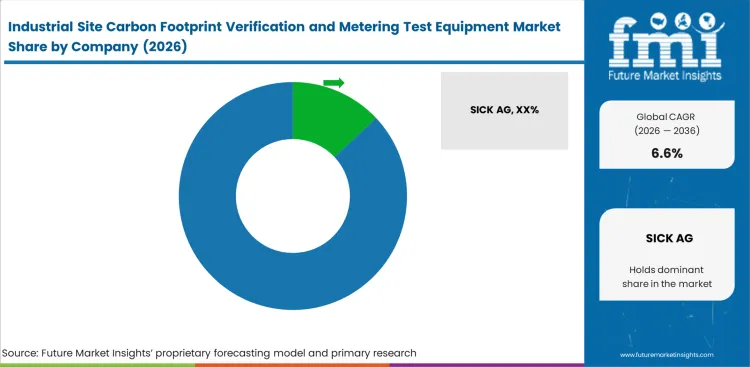
Competition in this category is defined less by simple equipment supply and more by whether a vendor can support reliable measurement under plant conditions that rarely stay perfect. Facilities compare suppliers on analyzer credibility, calibration discipline, service support, data continuity, and ease of fitting instruments into live industrial operations. SICK AG, ABB Ltd., Endress+Hauser Group, Teledyne FLIR LLC, HORIBA, Ltd., Siemens AG, and Fuji Electric Co., Ltd. remain relevant because each sits close to one or more of those requirements. Equipment selection is rarely settled by initial price alone when site teams know poor installation fit can create repeat burden later.
Incumbents carry an advantage where installed relationships, service coverage, and instrumentation familiarity help facilities move with less uncertainty. Breadth across source monitoring, gas analysis, imaging, and plant-facing interfaces also matters because sites often prefer fewer handoffs once verification programs widen. Challengers can still win, yet they usually need sharper application fit or a cleaner answer on upkeep and measurement stability before facilities reconsider established names. Adjacent interest across pollution monitoring equipment categories also helps larger vendors stay visible where customers already know their service base.
Facility leverage does exist, especially in mature plants that can compare multiple suppliers and weigh retrofit practicality carefully. Even so, vendors that reduce service interruptions and keep measurement records more dependable are likely to defend position better through 2036 than vendors relying on broad claims alone. Industry direction points toward a tighter balance between hardware capability and lifecycle usability. Plants are becoming less willing to separate one from the other.
Key Players in Industrial Site Carbon Footprint Verification and Metering Test Equipment Market
- SICK AG
- ABB Ltd.
- Endress+Hauser Group
- Teledyne FLIR LLC
- HORIBA, Ltd.
- Siemens AG
- Fuji Electric Co., Ltd.
Scope of the Report
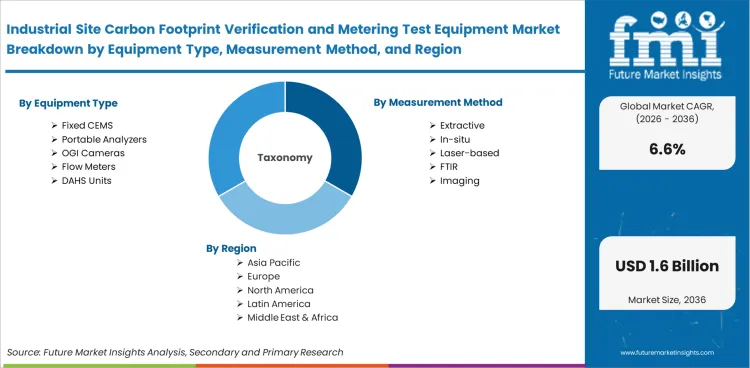
| Metric | Value |
|---|---|
| Quantitative Units | USD 0.8 billion to USD 1.5 billion, at a CAGR of 6.6% |
| Market Definition | Industrial Site Carbon Footprint Verification and Metering Test Equipment Market covers physical instruments used to measure, meter, detect, and verify greenhouse-gas emissions at industrial facilities. Scope centers on equipment-backed site evidence for reporting, audit checks, and operating control. Software-only accounting and consultancy-only verification remain outside study scope. |
| Equipment Type Segmentation | Fixed CEMS, Portable Analyzers, OGI Cameras, Flow Meters, DAHS Units |
| Measurement Method Segmentation | Extractive, In-situ, Laser-based, FTIR, Imaging |
| Gas Type Segmentation | CO2, Methane, CO, Multi-gas, N2O |
| End Use Segmentation | Power Plants, Cement, Chemicals, Refining, Metals |
| Use Case Segmentation | Compliance Monitoring, LDAR, CCS Monitoring, Process Optimization, Audit Verification |
| Regions Covered | North America, Latin America, Europe, East Asia, South Asia & Pacific, Middle East & Africa |
| Countries Covered | India, China, Saudi Arabia, Brazil, United States, Germany, Japan, and 40 plus countries |
| Key Companies Profiled | SICK AG, ABB Ltd., Endress+Hauser Group, Teledyne FLIR LLC, HORIBA, Ltd., Siemens AG, Fuji Electric Co., Ltd. |
| Forecast Period | 2026 to 2036 |
| Approach | FMI combined interviews with plant engineering, emissions compliance, instrumentation, and technical service participants. Baseline sizing was built from reportable industrial site populations, installed instrument logic, and likely equipment mix by use case. Forecast validation was carried out through supplier presence, country adoption pattern checks, and consistency against adjacent industrial monitoring categories. |
Source: Future Market Insights (FMI) analysis, based on proprietary forecasting model and primary research
Industrial Site Carbon Footprint Verification and Metering Test Equipment Market Analysis by Segments
By Equipment Type:
- Fixed CEMS
- Portable Analyzers
- OGI Cameras
- Flow Meters
- DAHS Units
By Measurement Method:
- Extractive
- In-situ
- Laser-based
- FTIR
- Imaging
By Gas Type:
- CO2
- Methane
- CO
- Multi-gas
- N2O
By End Use:
- Power Plants
- Cement
- Chemicals
- Refining
- Metals
By Use Case:
- Compliance Monitoring
- LDAR
- CCS Monitoring
- Process Optimization
- Audit Verification
By Region:
- North America
- United States
- Canada
- Mexico
- Latin America
- Brazil
- Rest of Latin America
- Europe
- Germany
- France
- Italy
- United Kingdom
- Benelux
- Nordics
- Rest of Europe
- East Asia
- China
- Japan
- South Korea
- South Asia & Pacific
- India
- ASEAN
- Australia & New Zealand
- Middle East & Africa
- Saudi Arabia
- GCC
- South Africa
- Rest of Middle East & Africa
Bibliography
- USA Environmental Protection Agency. (2026, March 30). Greenhouse Gas Reporting Program (GHGRP). USA EPA.
- USA Environmental Protection Agency. (2026, January 29). GHGRP reported data. USA EPA.
- International Energy Agency. (2025, May 07). Global Methane Tracker 2025. IEA.
- European Topic Centre on Climate Mitigation. (2025, June). Trends and projections in the EU ETS in 2025. ETC-CM Report 2025/06.;
- Sensors. (2024, June 21). Methane quantification performance of the quantitative optical gas imaging system under near-field conditions. MDPI.
This bibliography is provided for reader reference. The full FMI report contains the complete reference list with primary source documentation.
This Report Addresses
- Market intelligence to support strategic decision making across fixed CEMS, portable analyzers, OGI cameras, flow meters, and DAHS-linked verification equipment
- Market size estimation and 10-year revenue forecasts from 2026 to 2036, supported by reportable site mapping, installed instrument logic, and facility-level equipment mix analysis
- Growth opportunity mapping across Equipment Type, Measurement Method, Gas Type, End Use, and Use Case with emphasis on plant ownership of measurement quality and audit-ready site records
- Segment and regional revenue forecasts covering Fixed CEMS, Extractive systems, CO2 measurement, Power Plants, and Compliance Monitoring across industrial verification and emissions control settings
- Competition strategy assessment including service support, calibration discipline, integration fit, and continuity of measured records across live facilities
- Analyzer and verification equipment development tracking including continuous emission monitoring, gas sensing, optical gas imaging, leak detection, and process spectroscopy use in industrial operations
- Market access analysis covering plant-level verification practice, source measurement requirements, methane surveillance activity, and installation acceptance inside operating facilities
- Market report delivery in PDF, Excel, PPT, and interactive dashboard formats for executive strategy, industrial planning teams, and operational benchmarking use
Frequently Asked Questions
How large is Industrial Site Carbon Footprint Verification and Metering Test Equipment Market in 2026?
Industrial Site Carbon Footprint Verification and Metering Test Equipment Market is estimated at USD 0.8 billion in 2026. That level reflects a category that has moved past niche use yet still sits within a narrower equipment layer inside the wider emissions monitoring universe.
What will Industrial Site Carbon Footprint Verification and Metering Test Equipment Market be valued at by 2036?
FMI projects valuation to reach USD 1.5 billion by 2036. Expansion to that level suggests continued broadening of site-level verification practice rather than a short-lived buying cycle.
What CAGR is projected for the market during 2026 to 2036?
FMI projects a CAGR of 6.6% for 2026 to 2036. Pace sits in line with an established industrial equipment category where compliance pressure, retrofit demand, and measurement discipline are advancing together.
Which Equipment Type segment leads the market?
Fixed CEMS leads Equipment Type and is expected to account for 41% share in 2026. Lead position comes from steady source-level monitoring needs in facilities where periodic testing alone does not provide enough continuity for verification work.
Which Measurement Method segment leads the market?
Extractive leads Measurement Method with an expected 37% share in 2026. Facilities continue to rely on methods that fit familiar analyzer handling, sample conditioning, and service routines inside industrial plants.
Which Gas Type segment leads the market?
CO2 leads Gas Type and is anticipated to represent 34% of the market in 2026. Carbon-footprint verification still begins with carbon dioxide because it sits closest to how most industrial sites build measurable carbon records.
What is pushing category expansion in this market?
Need for audit-ready plant-level emissions records is a major force behind equipment uptake. Facilities increasingly require measured evidence that can support reporting, internal checks, and source confirmation instead of depending only on broad calculations.
What is the primary restraint in this market?
Internal coordination across engineering, maintenance, compliance, and operations remains a key restraint. Equipment decisions can be approved, delayed, or narrowed depending on who owns calibration, data integrity, and ongoing site responsibility once instruments are installed.
Which country advances fastest in the market?
India leads the country set with 8.1% CAGR, ahead of China at 7.8%. Difference comes from India’s combination of industrial additions and wider room for first-entry site monitoring, while China’s pace builds on a larger and more established industrial base.
Why does plant-level verification matter more now than broad carbon estimation?
Measured site evidence carries more weight when emissions records need to be reviewed, repeated, and defended. Once facilities treat carbon measurement like an operating variable rather than only a disclosure item, hardware uptake becomes more durable.
How is methane surveillance affecting equipment uptake?
Methane-focused work broadens need for imaging, laser, and leak-verification tools, especially in energy-linked facilities. It also pulls attention toward equipment that can work alongside installed source-monitoring arrangements without complicating upkeep.
What shapes competition among suppliers in this market?
Competition is defined by service support, calibration discipline, measurement credibility, and installation fit inside live plants. Facilities usually stay cautious with equipment that adds burden to upkeep or weakens confidence in site records.
Why do power plants remain the leading end-use segment?
Power Plants are likely to account for 28% share in 2026 because many utility assets already operate with tighter source-monitoring discipline than other industrial users. Existing familiarity lowers the hurdle for adding carbon verification equipment.
Why does Compliance Monitoring lead Use Case?
Compliance Monitoring is expected to represent 44% share in 2026 since most facilities still enter this category to satisfy reporting and verification needs first. Process optimization and broader analytics usually come later, once measured data is already reliable.
What makes the United States an important market even with a lower CAGR than India or China?
United States is projected at 5.9% CAGR through 2036, yet it remains important because its installed base is deeper and facility requirements are more exacting. Much of the activity there comes from replacement, upgrade, and measurement-quality improvement inside current plants.
How should Germany be interpreted in this forecast?
Germany is forecast at 5.7% CAGR, which points to a mature industrial setting rather than weak category relevance. Discipline in emissions oversight and plant engineering keeps valuation steady, though expansion is more selective than in faster-building countries.
What does Japan’s position say about this market?
Japan is expected to post 5.1% CAGR through 2036. Rate reflects careful adoption where reliability, service burden, and operational fit often matter more than speed of rollout.
Why is Brazil above the global average?
Brazil is projected to register 6.9% CAGR because industrial decarbonization needs and plant-level emissions control are gaining more weight across energy-linked and heavy industrial operations. Country still offers room for broader first-entry verification hardware use.
Why is Saudi Arabia one of the faster-moving markets?
Saudi Arabia is expected to record 7.2% CAGR through 2036. Large process industries and energy-linked assets support stronger need for source-level monitoring and methane-related verification equipment.
Why does China remain close to the top of the range?
China is projected at 7.8% CAGR because industrial scale, broad emissions exposure, and expanding need for measurable site records come together there. Country combines a large installed base with continued room for wider deployment of verification-grade tools.
What is included in the market scope?
Scope includes fixed CEMS, portable analyzers, OGI cameras, flow and metering devices, DAHS-linked equipment, and other site-facing test instruments used for carbon-footprint verification. Inclusion depends on direct equipment use in measuring or validating emissions at industrial facilities.
What is excluded from the market scope?
Software-only carbon accounting, consultancy-only verification, and general ambient monitoring networks are outside scope. Each is excluded because it does not provide the same equipment-led source verification function addressed in this study.
How was this market sized by FMI?
FMI used reportable site populations, likely equipment mix by industrial use case, and installed instrument logic to build the baseline. Country patterns, supplier presence, and adjacency to other industrial monitoring categories were then used to test forecast consistency.
What is the non-obvious point practitioners usually understand better than outsiders?
Interest in carbon reporting does not automatically convert into fast equipment rollout. Plants move once ownership of calibration, upkeep, and data credibility is clearly assigned inside operations, and that practical handoff often decides timing more than external discussion alone.
Preview the report firsthand - request a free sample
Get SampleGet the brochure for pricing and purchase details.
Get PDFTable of Content
- Executive Summary
- Global Market Outlook
- Demand-side Trends
- Supply-side Trends
- Technology Roadmap Analysis
- Analysis and Recommendations
- Market Overview
- Market Coverage / Taxonomy
- Market Definition / Scope / Limitations
- Research Methodology
- Chapter Orientation
- Analytical Lens and Working Hypotheses
- Market Structure, Signals, and Trend Drivers
- Benchmarking and Cross-market Comparability
- Market Sizing, Forecasting, and Opportunity Mapping
- Research Design and Evidence Framework
- Desk Research Programme (Secondary Evidence)
- Company Annual and Sustainability Reports
- Peer-reviewed Journals and Academic Literature
- Corporate Websites, Product Literature, and Technical Notes
- Earnings Decks and Investor Briefings
- Statutory Filings and Regulatory Disclosures
- Technical White Papers and Standards Notes
- Trade Journals, Industry Magazines, and Analyst Briefs
- Conference Proceedings, Webinars, and Seminar Materials
- Government Statistics Portals and Public Data Releases
- Press Releases and Reputable Media Coverage
- Specialist Newsletters and Curated Briefings
- Sector Databases and Reference Repositories
- FMI Internal Proprietary Databases and Historical Market Datasets
- Subscription Datasets and Paid Sources
- Social Channels, Communities, and Digital Listening Inputs
- Additional Desk Sources
- Expert Input and Fieldwork (Primary Evidence)
- Primary Modes
- Qualitative Interviews and Expert Elicitation
- Quantitative Surveys and Structured Data Capture
- Blended Approach
- Why Primary Evidence is Used
- Field Techniques
- Interviews
- Surveys
- Focus Groups
- Observational and In-context Research
- Social and Community Interactions
- Stakeholder Universe Engaged
- C-suite Leaders
- Board Members
- Presidents and Vice Presidents
- R&D and Innovation Heads
- Technical Specialists
- Domain Subject-matter Experts
- Scientists
- Physicians and Other Healthcare Professionals
- Governance, Ethics, and Data Stewardship
- Research Ethics
- Data Integrity and Handling
- Primary Modes
- Tooling, Models, and Reference Databases
- Desk Research Programme (Secondary Evidence)
- Data Engineering and Model Build
- Data Acquisition and Ingestion
- Cleaning, Normalisation, and Verification
- Synthesis, Triangulation, and Analysis
- Quality Assurance and Audit Trail
- Market Background
- Market Dynamics
- Drivers
- Restraints
- Opportunity
- Trends
- Scenario Forecast
- Demand in Optimistic Scenario
- Demand in Likely Scenario
- Demand in Conservative Scenario
- Opportunity Map Analysis
- Product Life Cycle Analysis
- Supply Chain Analysis
- Investment Feasibility Matrix
- Value Chain Analysis
- PESTLE and Porter’s Analysis
- Regulatory Landscape
- Regional Parent Market Outlook
- Production and Consumption Statistics
- Import and Export Statistics
- Market Dynamics
- Global Market Analysis 2021 to 2025 and Forecast, 2026 to 2036
- Historical Market Size Value (USD Million) Analysis, 2021 to 2025
- Current and Future Market Size Value (USD Million) Projections, 2026 to 2036
- Y-o-Y Growth Trend Analysis
- Absolute $ Opportunity Analysis
- Global Market Pricing Analysis 2021 to 2025 and Forecast 2026 to 2036
- Global Market Analysis 2021 to 2025 and Forecast 2026 to 2036, By Equipment Type
- Introduction / Key Findings
- Historical Market Size Value (USD Million) Analysis By Equipment Type , 2021 to 2025
- Current and Future Market Size Value (USD Million) Analysis and Forecast By Equipment Type , 2026 to 2036
- Fixed CEMS
- Portable Analyzers
- OGI Cameras
- Flow Meters
- DAHS Value (USD Million)s
- Fixed CEMS
- Y-o-Y Growth Trend Analysis By Equipment Type , 2021 to 2025
- Absolute $ Opportunity Analysis By Equipment Type , 2026 to 2036
- Global Market Analysis 2021 to 2025 and Forecast 2026 to 2036, By Measurement Method
- Introduction / Key Findings
- Historical Market Size Value (USD Million) Analysis By Measurement Method, 2021 to 2025
- Current and Future Market Size Value (USD Million) Analysis and Forecast By Measurement Method, 2026 to 2036
- Extractive
- In-situ
- Laser-based
- FTIR
- Imaging
- Extractive
- Y-o-Y Growth Trend Analysis By Measurement Method, 2021 to 2025
- Absolute $ Opportunity Analysis By Measurement Method, 2026 to 2036
- Global Market Analysis 2021 to 2025 and Forecast 2026 to 2036, By Gas Type
- Introduction / Key Findings
- Historical Market Size Value (USD Million) Analysis By Gas Type, 2021 to 2025
- Current and Future Market Size Value (USD Million) Analysis and Forecast By Gas Type, 2026 to 2036
- CO2
- Methane
- CO
- Multi-gas
- N2O
- CO2
- Y-o-Y Growth Trend Analysis By Gas Type, 2021 to 2025
- Absolute $ Opportunity Analysis By Gas Type, 2026 to 2036
- Global Market Analysis 2021 to 2025 and Forecast 2026 to 2036, By End Use
- Introduction / Key Findings
- Historical Market Size Value (USD Million) Analysis By End Use, 2021 to 2025
- Current and Future Market Size Value (USD Million) Analysis and Forecast By End Use, 2026 to 2036
- Power Plants
- Cement
- Chemicals
- Refining
- Metals
- Power Plants
- Y-o-Y Growth Trend Analysis By End Use, 2021 to 2025
- Absolute $ Opportunity Analysis By End Use, 2026 to 2036
- Global Market Analysis 2021 to 2025 and Forecast 2026 to 2036, By Use Case
- Introduction / Key Findings
- Historical Market Size Value (USD Million) Analysis By Use Case, 2021 to 2025
- Current and Future Market Size Value (USD Million) Analysis and Forecast By Use Case, 2026 to 2036
- Compliance Monitoring
- LDAR
- CCS Monitoring
- Process Optimization
- Audit Verification
- Compliance Monitoring
- Y-o-Y Growth Trend Analysis By Use Case, 2021 to 2025
- Absolute $ Opportunity Analysis By Use Case, 2026 to 2036
- Global Market Analysis 2021 to 2025 and Forecast 2026 to 2036, By Region
- Introduction
- Historical Market Size Value (USD Million) Analysis By Region, 2021 to 2025
- Current Market Size Value (USD Million) Analysis and Forecast By Region, 2026 to 2036
- North America
- Latin America
- Western Europe
- Eastern Europe
- East Asia
- South Asia and Pacific
- Middle East & Africa
- Market Attractiveness Analysis By Region
- North America Market Analysis 2021 to 2025 and Forecast 2026 to 2036, By Country
- Historical Market Size Value (USD Million) Trend Analysis By Market Taxonomy, 2021 to 2025
- Market Size Value (USD Million) Forecast By Market Taxonomy, 2026 to 2036
- By Country
- USA
- Canada
- Mexico
- By Equipment Type
- By Measurement Method
- By Gas Type
- By End Use
- By Use Case
- By Country
- Market Attractiveness Analysis
- By Country
- By Equipment Type
- By Measurement Method
- By Gas Type
- By End Use
- By Use Case
- Key Takeaways
- Latin America Market Analysis 2021 to 2025 and Forecast 2026 to 2036, By Country
- Historical Market Size Value (USD Million) Trend Analysis By Market Taxonomy, 2021 to 2025
- Market Size Value (USD Million) Forecast By Market Taxonomy, 2026 to 2036
- By Country
- Brazil
- Chile
- Rest of Latin America
- By Equipment Type
- By Measurement Method
- By Gas Type
- By End Use
- By Use Case
- By Country
- Market Attractiveness Analysis
- By Country
- By Equipment Type
- By Measurement Method
- By Gas Type
- By End Use
- By Use Case
- Key Takeaways
- Western Europe Market Analysis 2021 to 2025 and Forecast 2026 to 2036, By Country
- Historical Market Size Value (USD Million) Trend Analysis By Market Taxonomy, 2021 to 2025
- Market Size Value (USD Million) Forecast By Market Taxonomy, 2026 to 2036
- By Country
- Germany
- UK
- Italy
- Spain
- France
- Nordic
- BENELUX
- Rest of Western Europe
- By Equipment Type
- By Measurement Method
- By Gas Type
- By End Use
- By Use Case
- By Country
- Market Attractiveness Analysis
- By Country
- By Equipment Type
- By Measurement Method
- By Gas Type
- By End Use
- By Use Case
- Key Takeaways
- Eastern Europe Market Analysis 2021 to 2025 and Forecast 2026 to 2036, By Country
- Historical Market Size Value (USD Million) Trend Analysis By Market Taxonomy, 2021 to 2025
- Market Size Value (USD Million) Forecast By Market Taxonomy, 2026 to 2036
- By Country
- Russia
- Poland
- Hungary
- Balkan & Baltic
- Rest of Eastern Europe
- By Equipment Type
- By Measurement Method
- By Gas Type
- By End Use
- By Use Case
- By Country
- Market Attractiveness Analysis
- By Country
- By Equipment Type
- By Measurement Method
- By Gas Type
- By End Use
- By Use Case
- Key Takeaways
- East Asia Market Analysis 2021 to 2025 and Forecast 2026 to 2036, By Country
- Historical Market Size Value (USD Million) Trend Analysis By Market Taxonomy, 2021 to 2025
- Market Size Value (USD Million) Forecast By Market Taxonomy, 2026 to 2036
- By Country
- China
- Japan
- South Korea
- By Equipment Type
- By Measurement Method
- By Gas Type
- By End Use
- By Use Case
- By Country
- Market Attractiveness Analysis
- By Country
- By Equipment Type
- By Measurement Method
- By Gas Type
- By End Use
- By Use Case
- Key Takeaways
- South Asia and Pacific Market Analysis 2021 to 2025 and Forecast 2026 to 2036, By Country
- Historical Market Size Value (USD Million) Trend Analysis By Market Taxonomy, 2021 to 2025
- Market Size Value (USD Million) Forecast By Market Taxonomy, 2026 to 2036
- By Country
- India
- ASEAN
- Australia & New Zealand
- Rest of South Asia and Pacific
- By Equipment Type
- By Measurement Method
- By Gas Type
- By End Use
- By Use Case
- By Country
- Market Attractiveness Analysis
- By Country
- By Equipment Type
- By Measurement Method
- By Gas Type
- By End Use
- By Use Case
- Key Takeaways
- Middle East & Africa Market Analysis 2021 to 2025 and Forecast 2026 to 2036, By Country
- Historical Market Size Value (USD Million) Trend Analysis By Market Taxonomy, 2021 to 2025
- Market Size Value (USD Million) Forecast By Market Taxonomy, 2026 to 2036
- By Country
- Kingdom of Saudi Arabia
- Other GCC Countries
- Turkiye
- South Africa
- Other African Union
- Rest of Middle East & Africa
- By Equipment Type
- By Measurement Method
- By Gas Type
- By End Use
- By Use Case
- By Country
- Market Attractiveness Analysis
- By Country
- By Equipment Type
- By Measurement Method
- By Gas Type
- By End Use
- By Use Case
- Key Takeaways
- Key Countries Market Analysis
- USA
- Pricing Analysis
- Market Share Analysis, 2025
- By Equipment Type
- By Measurement Method
- By Gas Type
- By End Use
- By Use Case
- Canada
- Pricing Analysis
- Market Share Analysis, 2025
- By Equipment Type
- By Measurement Method
- By Gas Type
- By End Use
- By Use Case
- Mexico
- Pricing Analysis
- Market Share Analysis, 2025
- By Equipment Type
- By Measurement Method
- By Gas Type
- By End Use
- By Use Case
- Brazil
- Pricing Analysis
- Market Share Analysis, 2025
- By Equipment Type
- By Measurement Method
- By Gas Type
- By End Use
- By Use Case
- Chile
- Pricing Analysis
- Market Share Analysis, 2025
- By Equipment Type
- By Measurement Method
- By Gas Type
- By End Use
- By Use Case
- Germany
- Pricing Analysis
- Market Share Analysis, 2025
- By Equipment Type
- By Measurement Method
- By Gas Type
- By End Use
- By Use Case
- UK
- Pricing Analysis
- Market Share Analysis, 2025
- By Equipment Type
- By Measurement Method
- By Gas Type
- By End Use
- By Use Case
- Italy
- Pricing Analysis
- Market Share Analysis, 2025
- By Equipment Type
- By Measurement Method
- By Gas Type
- By End Use
- By Use Case
- Spain
- Pricing Analysis
- Market Share Analysis, 2025
- By Equipment Type
- By Measurement Method
- By Gas Type
- By End Use
- By Use Case
- France
- Pricing Analysis
- Market Share Analysis, 2025
- By Equipment Type
- By Measurement Method
- By Gas Type
- By End Use
- By Use Case
- India
- Pricing Analysis
- Market Share Analysis, 2025
- By Equipment Type
- By Measurement Method
- By Gas Type
- By End Use
- By Use Case
- ASEAN
- Pricing Analysis
- Market Share Analysis, 2025
- By Equipment Type
- By Measurement Method
- By Gas Type
- By End Use
- By Use Case
- Australia & New Zealand
- Pricing Analysis
- Market Share Analysis, 2025
- By Equipment Type
- By Measurement Method
- By Gas Type
- By End Use
- By Use Case
- China
- Pricing Analysis
- Market Share Analysis, 2025
- By Equipment Type
- By Measurement Method
- By Gas Type
- By End Use
- By Use Case
- Japan
- Pricing Analysis
- Market Share Analysis, 2025
- By Equipment Type
- By Measurement Method
- By Gas Type
- By End Use
- By Use Case
- South Korea
- Pricing Analysis
- Market Share Analysis, 2025
- By Equipment Type
- By Measurement Method
- By Gas Type
- By End Use
- By Use Case
- Russia
- Pricing Analysis
- Market Share Analysis, 2025
- By Equipment Type
- By Measurement Method
- By Gas Type
- By End Use
- By Use Case
- Poland
- Pricing Analysis
- Market Share Analysis, 2025
- By Equipment Type
- By Measurement Method
- By Gas Type
- By End Use
- By Use Case
- Hungary
- Pricing Analysis
- Market Share Analysis, 2025
- By Equipment Type
- By Measurement Method
- By Gas Type
- By End Use
- By Use Case
- Kingdom of Saudi Arabia
- Pricing Analysis
- Market Share Analysis, 2025
- By Equipment Type
- By Measurement Method
- By Gas Type
- By End Use
- By Use Case
- Turkiye
- Pricing Analysis
- Market Share Analysis, 2025
- By Equipment Type
- By Measurement Method
- By Gas Type
- By End Use
- By Use Case
- South Africa
- Pricing Analysis
- Market Share Analysis, 2025
- By Equipment Type
- By Measurement Method
- By Gas Type
- By End Use
- By Use Case
- USA
- Market Structure Analysis
- Competition Dashboard
- Competition Benchmarking
- Market Share Analysis of Top Players
- By Regional
- By Equipment Type
- By Measurement Method
- By Gas Type
- By End Use
- By Use Case
- Competition Analysis
- Competition Deep Dive
- SICK AG
- Overview
- Product Portfolio
- Profitability by Market Segments (Product/Age /Sales Channel/Region)
- Sales Footprint
- Strategy Overview
- Marketing Strategy
- Product Strategy
- Channel Strategy
- ABB Ltd.
- Endress+Hauser Group
- Teledyne FLIR LLC
- HORIBA, Ltd.
- Siemens AG
- Fuji Electric Co., Ltd.
- SICK AG
- Competition Deep Dive
- Assumptions & Acronyms Used


