

- Industry Size (2026)
- USD 4.0 Bn
- Forecast (2036)
- USD 11.7 Bn
- CAGR (2026 to 2036)
- 11.3%
Rack Ready Luminaires Market Forecast and Outlook 2026 to 2036
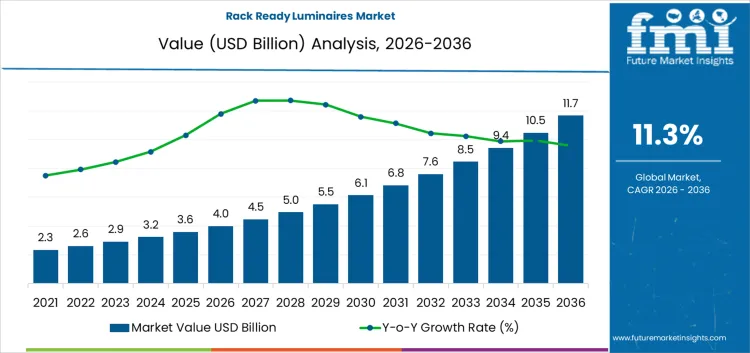
The rack ready luminaires market is likely to be valued at USD 4.0 billion in 2026 and is projected to reach USD 11.7 billion by 2036, reflecting a CAGR of 11.3%. Early demand is shaped by data center build patterns and by the shift toward pre-configured infrastructure blocks. Lighting is specified as part of rack and aisle kits rather than as a separate electrical item. Buyers favor fixtures that reduce installation time, cable routing work, and commissioning checks. Purchase decisions sit with facility designers and integrators, not with general contractors. Unit growth tracks new capacity additions, while value per rack reflects mounting standards, thermal tolerance, and compliance documentation.
Market behavior reflects operational discipline inside large server farms. Replacement cycles follow refit schedules, layout changes, and energy audit programs rather than simple fixture lifetimes. Standardized rack footprints encourage reuse of the same luminaire formats across sites and regions. Pricing remains controlled by framework agreements and long term supplier lists. Capacity planning follows data center clustering and localization rules. Growth remains strong, supported by continued expansion of high density facilities and by procurement models that favor pre validated components over custom site specific lighting solutions.
Quick Stats of the Rack Ready Luminaires Market
- Rack Ready Luminaires Market Value (2026): USD 4.0 billion
- Rack Ready Luminaires Forecast Value (2036): USD 11.7 billion
- Rack Ready Luminaires Forecast CAGR 2026 to 2036: 11.3%
- Leading Luminaire Type in Rack Ready Luminaires Market: Linear Bar Fixtures (46 % share)
- Leading Light Spectrum in Rack Ready Luminaires Market: Full-Spectrum White + Red (44 % share)
- Key Growth Regions in Rack Ready Luminaires Market: China, India, USA, South Korea, Japan
- Top Players in Rack Ready Luminaires Market: Signify, OSRAM, Fluence (Acuity Brands), Heliospectra, Valoya, Lumigrow, Gavita (Hawthorne), GE Current (Acuity), Bridgelux, Samsung LED
What is the Growth Forecast for Rack Ready Luminaires Market through 2036?
Between 2026 and 2031, the rack ready luminaires market is projected to expand from USD 4.0 billion along a growth path consistent with an 11.3% CAGR, driven by the physical scaling of vertical farming rather than by incremental lighting upgrades. New facilities are designed around multi-tier racks, which makes lighting a structural layer of the growing system instead of an add-on utility. Linear bar and intercanopy fixtures dominate because they match shelf geometry and allow predictable photon distribution. Purchasing decisions are made at project design stage, not at maintenance stage, which explains the strong role of direct-to-grower and bundled rack solutions. Spectrum selection follows crop planning models, with full-spectrum and tunable combinations becoming standard in high-density production environments.
From 2031 to 2036, the market is expected to reach USD 11.7 billion, with value creation tied to farm scale, automation, and yield optimization rather than to fixture replacement cycles. As facilities grow larger and more standardized, lighting layouts become part of repeatable infrastructure templates, raising unit volumes per project even when the number of projects grows more slowly. Far-red and UV-enhanced spectrums gain relevance in research and high-value crops, adding to average system value. Competitive advantage rests on photometric performance validation, system integration capability, and long-term reliability commitments. This environment favors suppliers such as Signify, OSRAM, Fluence (Acuity Brands), Heliospectra, Valoya, Lumigrow, Gavita (Hawthorne), GE Current (Acuity), Bridgelux, and Samsung LED.
Rack Ready Luminaires Market Key Takeaways
| Metric | Value |
|---|---|
| Market Value (2026) | USD 4.0 billion |
| Forecast Value (2036) | USD 11.7 billion |
| Forecast CAGR 2026 to 2036 | 11.3% |
How Are Rack Ready Luminaires Streamlining Industrial and Commercial Lighting?
Rack ready luminaires are increasingly adopted to simplify lighting installation in industrial, warehouse, and commercial facilities, reducing labor costs and improving operational efficiency. Historically, lighting systems required separate fixtures, wiring, and mounting components, which increased installation time and complexity. Modern rack ready luminaires integrate pre-mounted electrical connections, standardized mounting brackets, and modular designs to enable quick attachment directly to storage racks or structural supports. Facility managers, warehouse operators, and lighting solution providers prioritize installation speed, durability, and energy efficiency. Early adoption focused on large warehouses and distribution centers, while current demand spans manufacturing facilities, cold storage, and logistics hubs, driven by automation integration, energy management requirements, and operational flexibility. Fixture robustness, mounting compatibility, and electrical reliability influence supplier selection.
Increasing warehouse automation, energy efficiency standards, and demand for rapid deployment are shaping market growth. Compared with conventional lighting, rack ready luminaires emphasize plug-and-play installation, modularity, and integration with control systems for optimized illumination. Cost structures depend on luminaire materials, electrical components, and certification, concentrating margins among suppliers capable of delivering high-performance, reliable solutions. Facility operators adopt these luminaires to reduce installation time, enhance energy efficiency, and simplify maintenance. By 2036, rack ready luminaires are expected to become standard in industrial and commercial environments, supporting operational efficiency, flexible lighting deployment, and long-term facility management.
What Factors Are Shaping the Demand for Rack Ready Luminaires by Fixture Format and Spectral Configuration in 2026?
The rack ready luminaires market in 2026 is segmented by luminaire type and by light spectrum design. By fixture format, demand is divided into linear bar, intercanopy, panel or array, and other configurations, each fitting different rack geometries, crop densities, and airflow patterns. By spectrum, demand is organized around full spectrum white with red, red blue tunable, far red or UV enhanced, and other mixes that influence plant response and energy use. These segments reflect how growers and integrators balance uniformity, heat management, electrical loading, and crop specific recipes while trying to standardize installations across multi tier production environments with tight space and service constraints.
Why Do Linear Bar Fixtures Form the Core of Rack Based Lighting Systems?
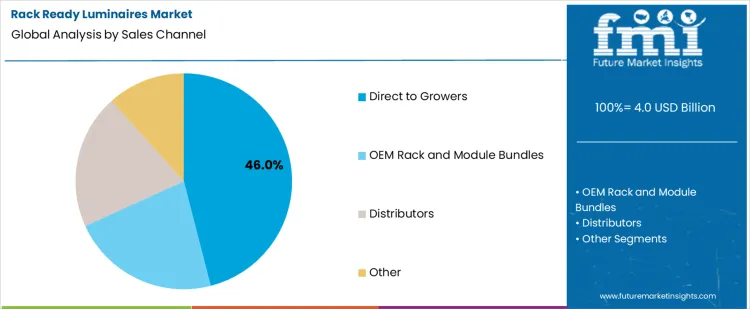
Linear bar fixtures account for about 46% of demand in 2026, reflecting their structural compatibility with multi tier rack layouts. These fixtures can be placed in continuous runs, which simplifies coverage planning and reduces shadowing between shelves. Their narrow profile supports airflow and keeps thermal buildup away from plant surfaces. From an installation standpoint, bars allow repeatable mounting patterns and straightforward cable routing, which reduces labor time in large facilities. Inventory management also benefits because a small number of lengths can serve many layouts. Reliability expectations favor simple mechanical designs with fewer large panels or joints. This combination of geometric fit, thermal behavior, and installation efficiency keeps linear bars as the reference format for most rack based cultivation systems.
Intercanopy and panel or array fixtures address more specialized cultivation strategies. Intercanopy units target light delivery into dense plant structures, which suits vine or tall crops but requires more complex mounting and service access. Panel or array fixtures provide high output over wider areas, yet their size and weight complicate tier spacing and airflow management. Both formats increase mechanical load on racks and raise alignment sensitivity. Their use depends on crop type, growth stage strategy, and facility design philosophy. Volumes remain lower because many operators prefer to standardize around one primary fixture type and limit variation that could slow expansion, training, and maintenance across multi room or multi site operations.
Why Does Full Spectrum White Plus Red Lead Spectral Selection?
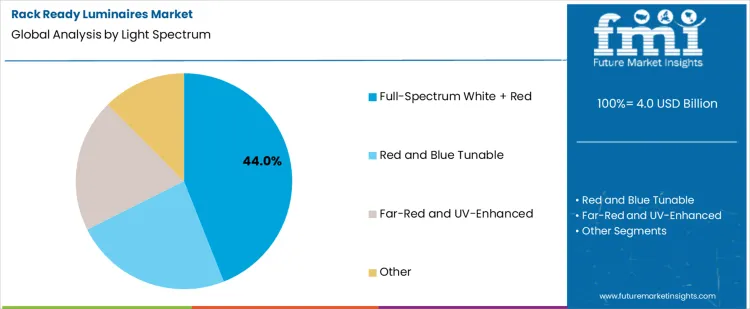
Full spectrum white plus red represents about 44% of demand in 2026 because it supports broad crop coverage with a single, stable light recipe. This spectrum allows operators to grow multiple varieties without changing hardware, which simplifies planning and reduces the risk of mismatched lighting during crop transitions. White light also improves visual inspection and work conditions inside growing areas, which matters in dense rack environments. From a control standpoint, fixed spectra reduce tuning errors and commissioning time. Energy performance remains predictable across growth cycles, which helps with power budgeting. This operational simplicity and flexibility make full spectrum with red a practical default choice for facilities focused on repeatability and scale rather than constant recipe experimentation.
Red blue tunable and far red or UV enhanced spectra serve targeted growth objectives rather than general production. Tunable systems require more control infrastructure and operator discipline to avoid inconsistent results across tiers. Far red and UV additions address specific morphological or quality goals, yet they introduce extra variables in scheduling and exposure management. These approaches often appear in research, seedling stages, or premium crop programs rather than in bulk production. Their hardware costs and commissioning effort also remain higher. As a result, these spectra grow alongside specialized applications, while full spectrum white plus red continues to anchor the majority of installations aimed at predictable, repeatable output across large rack based farms.
Why Are Data Center Power Density and Deployment Speed Reshaping Demand for Rack Ready Luminaires through 2036?
Demand is driven by how facilities are built and operated rather than by general lighting cycles. High density data halls prioritize fast commissioning, predictable illumination, and zero interference with cable routing and airflow. Operators prefer luminaires that mount directly to racks because they remove ceiling work, shorten build schedules, and keep light where technicians work. Colocation sites also value uniformity across halls to simplify maintenance and spares. As halls become taller and more modular, overhead lighting loses effectiveness. Rack level lighting becomes part of the infrastructure kit specified early in design, making volume follow data hall expansion and retrofit activity instead of real estate construction cycles.
What Cost Control, Standardization, and Procurement Practices Are Limiting Rapid Upscaling of This Category?
Constraints are commercial and procedural. Lighting budgets remain a small line item compared with power and cooling, so purchasing teams resist premium pricing even when operational benefits are clear. Many operators still treat rack lighting as optional fit out rather than core infrastructure. Electrical and safety approvals vary by region and operator, slowing standard product adoption. Integrators also prefer to minimize the number of vendors inside racks to reduce coordination risk. In retrofit projects, access limitations and live environment rules restrict installation windows. These factors keep decision cycles long, fragment specifications, and prevent rapid, uniform rollouts across multi-site data center portfolios.
How Are Operations Models and Facility Standardization Changing the Role of Rack Level Lighting?
Change is coming from how data centers are run. Remote hands, shift based maintenance, and audit driven operations increase the value of consistent, shadow free lighting inside racks. Standard hall designs encourage pre specified accessory kits, and lighting is increasingly bundled with containment and cable management. Some operators integrate lighting control into monitoring systems to reduce unnecessary usage during idle periods. As facilities move toward repeatable templates across regions, rack level lighting becomes a defined element rather than an afterthought. The category is moving away from ad hoc installations toward standardized, facility wide deployment tied to operational protocols and documentation requirements.
What is the Demand for Rack Ready Luminaires by Country?

| Country | CAGR (%) |
|---|---|
| China | 12.2% |
| India | 11.4% |
| USA | 8.6% |
| South Korea | 8.1% |
| Japan | 6.8% |
Demand for rack ready luminaires is rising as warehouses, distribution centers, and industrial facilities adopt efficient, pre-configured lighting solutions to improve energy efficiency, installation speed, and operational productivity. China leads with a 12.2% CAGR, driven by rapid expansion of e-commerce, industrial facilities, and adoption of advanced lighting technologies. India follows at 11.4%, supported by growth in warehousing infrastructure and modernization of industrial lighting. The USA grows at 8.6%, shaped by retrofitting and energy-efficient lighting upgrades in logistics and commercial facilities. South Korea records 8.1% growth, influenced by industrial automation and facility modernization. Japan shows 6.8% CAGR, reflecting moderate adoption in existing warehouses and gradual deployment of rack-ready luminaires.
How is China experiencing growth in the rack ready luminaires market?
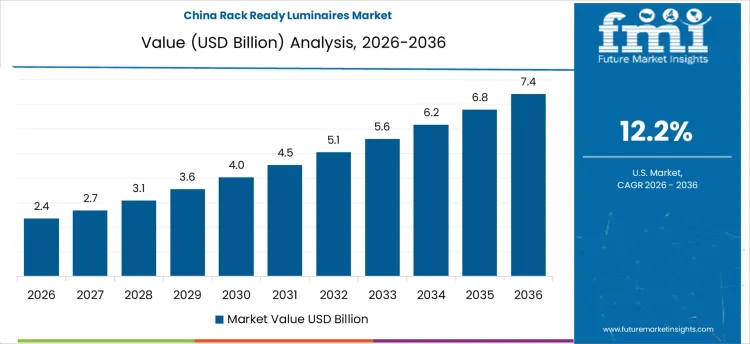
China is experiencing growth at a CAGR of 12.2%, supported by adoption of rack ready luminaires market solutions to improve warehouse lighting efficiency, operational visibility, and energy management. Manufacturers and suppliers are producing luminaires optimized for high luminous output, durability, and seamless integration with racking systems. Demand is concentrated in large-scale warehouses, distribution centers, and e-commerce fulfillment facilities. Investments focus on material quality, energy efficiency, and compliance with industrial lighting standards rather than large-scale deployment. Growth reflects rising industrial warehousing, adoption of modern lighting solutions, and focus on operational productivity and energy savings.
- Warehouse efficiency drives adoption.
- Luminaires optimize luminous output and durability.
- Distribution centers and warehouses concentrate demand.
- Material quality and energy standards guide investment.
How is India witnessing growth in the rack ready luminaires market?
India is witnessing growth at a CAGR of 11.4%, fueled by adoption of rack ready luminaires market solutions to enhance warehouse lighting, operational visibility, and energy efficiency. Manufacturers and suppliers are deploying luminaires optimized for durability, high luminous output, and integration with storage racking systems. Demand is concentrated in logistics hubs, e-commerce fulfillment centers, and large-scale warehouses. Investments prioritize material performance, energy efficiency, and adherence to industrial lighting standards rather than fleet-scale deployment. Growth reflects increasing industrial warehousing, adoption of modern lighting technologies, and focus on productivity and energy cost reduction.
- Warehouse lighting drives adoption.
- Luminaires enhance durability and luminous output.
- Logistics hubs and fulfillment centers concentrate demand.
- Material performance and energy compliance guide investment.
How is the United States experiencing growth in the rack ready luminaires market?
United States is experiencing growth at a CAGR of 8.6%, supported by adoption of rack ready luminaires market solutions to improve operational visibility, warehouse efficiency, and energy management. Manufacturers and suppliers are producing luminaires optimized for high luminous output, durability, and compatibility with racking systems. Demand is concentrated in distribution centers, industrial warehouses, and fulfillment facilities. Investments focus on material quality, energy efficiency, and compliance with industrial lighting standards rather than large-scale deployment. Growth reflects moderate expansion of warehouse infrastructure, industrial adoption of modern lighting, and focus on operational productivity.
- Operational visibility drives adoption.
- Luminaires optimize luminous output and durability.
- Distribution centers and warehouses concentrate demand.
- Material quality and energy standards guide investment.
How is South Korea witnessing growth in the rack ready luminaires market?
South Korea is witnessing growth at a CAGR of 8.1%, fueled by adoption of rack ready luminaires market solutions to enhance warehouse lighting efficiency, energy management, and operational productivity. Manufacturers and suppliers are deploying luminaires optimized for luminous output, durability, and seamless integration with storage racking systems. Demand is concentrated in industrial warehouses, e-commerce fulfillment centers, and logistics hubs. Investments prioritize material performance, energy efficiency, and adherence to industrial lighting standards rather than fleet-scale deployment. Growth reflects industrial adoption of advanced lighting solutions, warehouse modernization, and focus on operational visibility.
- Warehouse efficiency drives adoption.
- Luminaires enhance luminous output and durability.
- Industrial warehouses and fulfillment centers concentrate demand.
- Material performance and energy compliance guide investment.
How is Japan experiencing growth in the rack ready luminaires market?
Japan is experiencing growth at a CAGR of 6.8%, supported by adoption of rack ready luminaires market solutions to improve warehouse operational visibility, energy efficiency, and productivity. Manufacturers and suppliers are producing luminaires optimized for high luminous output, durability, and compatibility with racking systems. Demand is concentrated in distribution centers, industrial warehouses, and logistics facilities. Investments focus on material quality, system reliability, and compliance with industrial lighting standards rather than large-scale deployment. Growth reflects moderate expansion of warehouse infrastructure, industrial adoption of modern lighting, and focus on energy-efficient and durable luminaires.
- Operational visibility drives adoption.
- Luminaires optimize luminous output and durability.
- Distribution centers and warehouses concentrate demand.
- Material quality and compliance guide investment.
Who Competes in the Rack Ready Luminaires Market and What Defines Their Capabilities?
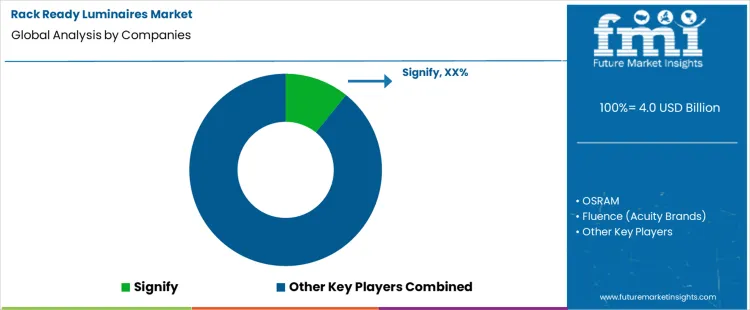
Competition in the rack ready luminaires market is defined by light output efficiency, spectrum control, and integration with vertical farming or controlled-environment agriculture systems. Signify supplies luminaires engineered for uniform light distribution, spectrum optimization, and energy-efficient operation in multi-tier growing systems. OSRAM develops high-performance LED luminaires suitable for controlled-environment agriculture, with adjustable spectral output for different plant growth stages. Fluence (Acuity Brands) provides rack-ready solutions combining high photon efficacy with modular deployment in vertical farms. Heliospectra delivers luminaires with programmable spectrum and intensity control for horticultural optimization. Valoya offers LED systems designed for plant-specific growth performance and energy efficiency.
Lumigrow provides modular rack luminaires with tunable light spectra and advanced control interfaces. Gavita (Hawthorne) supplies high-intensity LED luminaires engineered for vertical and greenhouse applications. GE Current (Acuity) delivers energy-efficient luminaires with spectrum tuning and modular integration capabilities. Bridgelux provides high-output, reliable luminaires for controlled-environment agriculture. Samsung LED develops energy-efficient LED modules suitable for integration in rack-ready horticultural lighting systems. Other regional and specialty suppliers focus on energy efficiency, spectrum customization, and ease of integration with automated farm controls. Competitive differentiation arises from light efficacy, spectral tunability, modularity, thermal management, and compatibility with vertical farming infrastructure.
Key Players in the Rack Ready Luminaires Market
- Signify
- OSRAM
- Fluence (Acuity Brands)
- Heliospectra
- Valoya
- Lumigrow
- Gavita (Hawthorne)
- GE Current (Acuity)
- Bridgelux
- Samsung LED
Scope of the Report
| Items | Values |
|---|---|
| Quantitative Units (2026) | USD billion |
| Luminaire Type | Linear Bar Fixtures, Intercanopy Fixtures, Panel/Array Fixtures, Other |
| Light Spectrum | Full-Spectrum White + Red, Red/Blue Tunable, Far-Red/UV-Enhanced, Other |
| Application | Vertical Farms, Greenhouse Supplemental, Plant Research, Other |
| Sales Channel | Direct to Growers, OEM Rack/Module Bundles, Distributors, Other |
| Regions Covered | Asia Pacific, Europe, North America, Latin America, Middle East & Africa |
| Countries Covered | China, Japan, South Korea, India, Australia & New Zealand, ASEAN, Germany, United Kingdom, France, Italy, Spain, Nordic, BENELUX, United States, Canada, Mexico, Brazil, Chile, Saudi Arabia, Turkey, South Africa, and other regional markets |
| Key Companies Profiled | Signify, OSRAM, Fluence (Acuity Brands), Heliospectra, Valoya, Lumigrow, Gavita (Hawthorne), GE Current (Acuity), Bridgelux, Samsung LED |
| Additional Attributes | Dollar sales by luminaire type, light spectrum, application, and sales channel, demand driven by rack based facility buildouts rather than fixture replacement cycles, specification of lighting as part of rack and aisle infrastructure kits, preference for pre validated and standardized formats across multi-site deployments, integration with vertical farming and controlled environment agriculture systems, and value growth linked to facility scale, automation, and yield optimization rather than standalone lighting upgrades. |
Rack Ready Luminaires Market Segmentation
Luminaire Type:
- Linear Bar Fixtures
- Intercanopy Fixtures
- Panel/Array Fixtures
- Other
Light Spectrum:
- Full-Spectrum White + Red
- Red/Blue Tunable
- Far-Red/UV-Enhanced
- Other
Application:
- Vertical Farms
- Greenhouse Supplemental
- Plant Research
- Other
Sales Channel:
- Direct to Growers
- OEM Rack/Module Bundles
- Distributors
- Other
Region
- Asia Pacific
- China
- Japan
- South Korea
- India
- Australia & New Zealand
- ASEAN
- Rest of Asia Pacific
- Europe
- Germany
- United Kingdom
- France
- Italy
- Spain
- Nordic
- BENELUX
- Rest of Europe
- North America
- United States
- Canada
- Mexico
- Latin America
- Brazil
- Chile
- Rest of Latin America
- Middle East & Africa
- Kingdom of Saudi Arabia
- Other GCC Countries
- Turkey
- South Africa
- Other African Union
- Rest of Middle East & Africa
Bibliography
- International Energy Agency. (2024). Energy efficiency policy for lighting and lighting systems. International Energy Agency.
- European Commission. (2024). Ecodesign and energy labelling requirements for light sources and control gear (EU 2019/2020 and EU 2019/2015). European Union.
- USA Department of Energy. (2024). Energy conservation standards for general service lamps and luminaires. USA Department of Energy.
- Occupational Safety and Health Administration. (2023). Occupational safety and health standards for industrial and warehouse facilities (29 CFR Part 1910). USA Department of Labor.
- United Nations Economic Commission for Europe. (2024). UN Sustainable Development Goals and energy efficient infrastructure in industrial facilities. United Nations.
Frequently Asked Questions
How big is the rack ready luminaires market in 2026?
The global rack ready luminaires market is estimated to be valued at USD 4.0 billion in 2026.
What will be the size of rack ready luminaires market in 2036?
The market size for the rack ready luminaires market is projected to reach USD 11.7 billion by 2036.
How much will be the rack ready luminaires market growth between 2026 and 2036?
The rack ready luminaires market is expected to grow at a 11.3% CAGR between 2026 and 2036.
What are the key product types in the rack ready luminaires market?
The key product types in rack ready luminaires market are linear bar fixtures, intercanopy fixtures, panel and array fixtures and other.
Which light spectrum segment to contribute significant share in the rack ready luminaires market in 2026?
In terms of light spectrum, full-spectrum white + red segment to command 44.0% share in the rack ready luminaires market in 2026.
Preview the report firsthand - request a free sample
Get SampleGet the brochure for pricing and purchase details.
Get PDFTable of Content
- Executive Summary
- Global Market Outlook
- Demand-side Trends
- Supply-side Trends
- Technology Roadmap Analysis
- Analysis and Recommendations
- Market Overview
- Market Coverage / Taxonomy
- Market Definition / Scope / Limitations
- Market Background
- Market Dynamics
- Drivers
- Restraints
- Opportunity
- Trends
- Scenario Forecast
- Demand in Optimistic Scenario
- Demand in Likely Scenario
- Demand in Conservative Scenario
- Opportunity Map Analysis
- Product Life Cycle Analysis
- Supply Chain Analysis
- Investment Feasibility Matrix
- Value Chain Analysis
- PESTLE and Porter’s Analysis
- Regulatory Landscape
- Regional Parent Market Outlook
- Production and Consumption Statistics
- Import and Export Statistics
- Market Dynamics
- Global Market Analysis 2021 to 2025 and Forecast, 2026 to 2036
- Historical Market Size Value (USD Million) Analysis, 2021 to 2025
- Current and Future Market Size Value (USD Million) Projections, 2026 to 2036
- Y-o-Y Growth Trend Analysis
- Absolute $ Opportunity Analysis
- Global Market Pricing Analysis 2021 to 2025 and Forecast 2026 to 2036
- Global Market Analysis 2021 to 2025 and Forecast 2026 to 2036, By Luminaire Type
- Introduction / Key Findings
- Historical Market Size Value (USD Million) Analysis By Luminaire Type , 2021 to 2025
- Current and Future Market Size Value (USD Million) Analysis and Forecast By Luminaire Type , 2026 to 2036
- Linear Bar Fixtures
- Intercanopy Fixtures
- Panel and Array Fixtures
- Other
- Linear Bar Fixtures
- Y-o-Y Growth Trend Analysis By Luminaire Type , 2021 to 2025
- Absolute $ Opportunity Analysis By Luminaire Type , 2026 to 2036
- Global Market Analysis 2021 to 2025 and Forecast 2026 to 2036, By Light Spectrum
- Introduction / Key Findings
- Historical Market Size Value (USD Million) Analysis By Light Spectrum, 2021 to 2025
- Current and Future Market Size Value (USD Million) Analysis and Forecast By Light Spectrum, 2026 to 2036
- Full-Spectrum White + Red
- Red and Blue Tunable
- Far-Red and UV-Enhanced
- Other
- Full-Spectrum White + Red
- Y-o-Y Growth Trend Analysis By Light Spectrum, 2021 to 2025
- Absolute $ Opportunity Analysis By Light Spectrum, 2026 to 2036
- Global Market Analysis 2021 to 2025 and Forecast 2026 to 2036, By Application
- Introduction / Key Findings
- Historical Market Size Value (USD Million) Analysis By Application, 2021 to 2025
- Current and Future Market Size Value (USD Million) Analysis and Forecast By Application, 2026 to 2036
- Vertical Farms
- Greenhouse Supplemental
- Plant Research
- Other
- Vertical Farms
- Y-o-Y Growth Trend Analysis By Application, 2021 to 2025
- Absolute $ Opportunity Analysis By Application, 2026 to 2036
- Global Market Analysis 2021 to 2025 and Forecast 2026 to 2036, By Sales Channel
- Introduction / Key Findings
- Historical Market Size Value (USD Million) Analysis By Sales Channel, 2021 to 2025
- Current and Future Market Size Value (USD Million) Analysis and Forecast By Sales Channel, 2026 to 2036
- Direct to Growers
- OEM Rack and Module Bundles
- Distributors
- Other
- Direct to Growers
- Y-o-Y Growth Trend Analysis By Sales Channel, 2021 to 2025
- Absolute $ Opportunity Analysis By Sales Channel, 2026 to 2036
- Global Market Analysis 2021 to 2025 and Forecast 2026 to 2036, By Region
- Introduction
- Historical Market Size Value (USD Million) Analysis By Region, 2021 to 2025
- Current Market Size Value (USD Million) Analysis and Forecast By Region, 2026 to 2036
- North America
- Latin America
- Western Europe
- Eastern Europe
- East Asia
- South Asia and Pacific
- Middle East & Africa
- Market Attractiveness Analysis By Region
- North America Market Analysis 2021 to 2025 and Forecast 2026 to 2036, By Country
- Historical Market Size Value (USD Million) Trend Analysis By Market Taxonomy, 2021 to 2025
- Market Size Value (USD Million) Forecast By Market Taxonomy, 2026 to 2036
- By Country
- USA
- Canada
- Mexico
- By Luminaire Type
- By Light Spectrum
- By Application
- By Sales Channel
- By Country
- Market Attractiveness Analysis
- By Country
- By Luminaire Type
- By Light Spectrum
- By Application
- By Sales Channel
- Key Takeaways
- Latin America Market Analysis 2021 to 2025 and Forecast 2026 to 2036, By Country
- Historical Market Size Value (USD Million) Trend Analysis By Market Taxonomy, 2021 to 2025
- Market Size Value (USD Million) Forecast By Market Taxonomy, 2026 to 2036
- By Country
- Brazil
- Chile
- Rest of Latin America
- By Luminaire Type
- By Light Spectrum
- By Application
- By Sales Channel
- By Country
- Market Attractiveness Analysis
- By Country
- By Luminaire Type
- By Light Spectrum
- By Application
- By Sales Channel
- Key Takeaways
- Western Europe Market Analysis 2021 to 2025 and Forecast 2026 to 2036, By Country
- Historical Market Size Value (USD Million) Trend Analysis By Market Taxonomy, 2021 to 2025
- Market Size Value (USD Million) Forecast By Market Taxonomy, 2026 to 2036
- By Country
- Germany
- UK
- Italy
- Spain
- France
- Nordic
- BENELUX
- Rest of Western Europe
- By Luminaire Type
- By Light Spectrum
- By Application
- By Sales Channel
- By Country
- Market Attractiveness Analysis
- By Country
- By Luminaire Type
- By Light Spectrum
- By Application
- By Sales Channel
- Key Takeaways
- Eastern Europe Market Analysis 2021 to 2025 and Forecast 2026 to 2036, By Country
- Historical Market Size Value (USD Million) Trend Analysis By Market Taxonomy, 2021 to 2025
- Market Size Value (USD Million) Forecast By Market Taxonomy, 2026 to 2036
- By Country
- Russia
- Poland
- Hungary
- Balkan & Baltic
- Rest of Eastern Europe
- By Luminaire Type
- By Light Spectrum
- By Application
- By Sales Channel
- By Country
- Market Attractiveness Analysis
- By Country
- By Luminaire Type
- By Light Spectrum
- By Application
- By Sales Channel
- Key Takeaways
- East Asia Market Analysis 2021 to 2025 and Forecast 2026 to 2036, By Country
- Historical Market Size Value (USD Million) Trend Analysis By Market Taxonomy, 2021 to 2025
- Market Size Value (USD Million) Forecast By Market Taxonomy, 2026 to 2036
- By Country
- China
- Japan
- South Korea
- By Luminaire Type
- By Light Spectrum
- By Application
- By Sales Channel
- By Country
- Market Attractiveness Analysis
- By Country
- By Luminaire Type
- By Light Spectrum
- By Application
- By Sales Channel
- Key Takeaways
- South Asia and Pacific Market Analysis 2021 to 2025 and Forecast 2026 to 2036, By Country
- Historical Market Size Value (USD Million) Trend Analysis By Market Taxonomy, 2021 to 2025
- Market Size Value (USD Million) Forecast By Market Taxonomy, 2026 to 2036
- By Country
- India
- ASEAN
- Australia & New Zealand
- Rest of South Asia and Pacific
- By Luminaire Type
- By Light Spectrum
- By Application
- By Sales Channel
- By Country
- Market Attractiveness Analysis
- By Country
- By Luminaire Type
- By Light Spectrum
- By Application
- By Sales Channel
- Key Takeaways
- Middle East & Africa Market Analysis 2021 to 2025 and Forecast 2026 to 2036, By Country
- Historical Market Size Value (USD Million) Trend Analysis By Market Taxonomy, 2021 to 2025
- Market Size Value (USD Million) Forecast By Market Taxonomy, 2026 to 2036
- By Country
- Kingdom of Saudi Arabia
- Other GCC Countries
- Turkiye
- South Africa
- Other African Union
- Rest of Middle East & Africa
- By Luminaire Type
- By Light Spectrum
- By Application
- By Sales Channel
- By Country
- Market Attractiveness Analysis
- By Country
- By Luminaire Type
- By Light Spectrum
- By Application
- By Sales Channel
- Key Takeaways
- Key Countries Market Analysis
- USA
- Pricing Analysis
- Market Share Analysis, 2025
- By Luminaire Type
- By Light Spectrum
- By Application
- By Sales Channel
- Canada
- Pricing Analysis
- Market Share Analysis, 2025
- By Luminaire Type
- By Light Spectrum
- By Application
- By Sales Channel
- Mexico
- Pricing Analysis
- Market Share Analysis, 2025
- By Luminaire Type
- By Light Spectrum
- By Application
- By Sales Channel
- Brazil
- Pricing Analysis
- Market Share Analysis, 2025
- By Luminaire Type
- By Light Spectrum
- By Application
- By Sales Channel
- Chile
- Pricing Analysis
- Market Share Analysis, 2025
- By Luminaire Type
- By Light Spectrum
- By Application
- By Sales Channel
- Germany
- Pricing Analysis
- Market Share Analysis, 2025
- By Luminaire Type
- By Light Spectrum
- By Application
- By Sales Channel
- UK
- Pricing Analysis
- Market Share Analysis, 2025
- By Luminaire Type
- By Light Spectrum
- By Application
- By Sales Channel
- Italy
- Pricing Analysis
- Market Share Analysis, 2025
- By Luminaire Type
- By Light Spectrum
- By Application
- By Sales Channel
- Spain
- Pricing Analysis
- Market Share Analysis, 2025
- By Luminaire Type
- By Light Spectrum
- By Application
- By Sales Channel
- France
- Pricing Analysis
- Market Share Analysis, 2025
- By Luminaire Type
- By Light Spectrum
- By Application
- By Sales Channel
- India
- Pricing Analysis
- Market Share Analysis, 2025
- By Luminaire Type
- By Light Spectrum
- By Application
- By Sales Channel
- ASEAN
- Pricing Analysis
- Market Share Analysis, 2025
- By Luminaire Type
- By Light Spectrum
- By Application
- By Sales Channel
- Australia & New Zealand
- Pricing Analysis
- Market Share Analysis, 2025
- By Luminaire Type
- By Light Spectrum
- By Application
- By Sales Channel
- China
- Pricing Analysis
- Market Share Analysis, 2025
- By Luminaire Type
- By Light Spectrum
- By Application
- By Sales Channel
- Japan
- Pricing Analysis
- Market Share Analysis, 2025
- By Luminaire Type
- By Light Spectrum
- By Application
- By Sales Channel
- South Korea
- Pricing Analysis
- Market Share Analysis, 2025
- By Luminaire Type
- By Light Spectrum
- By Application
- By Sales Channel
- Russia
- Pricing Analysis
- Market Share Analysis, 2025
- By Luminaire Type
- By Light Spectrum
- By Application
- By Sales Channel
- Poland
- Pricing Analysis
- Market Share Analysis, 2025
- By Luminaire Type
- By Light Spectrum
- By Application
- By Sales Channel
- Hungary
- Pricing Analysis
- Market Share Analysis, 2025
- By Luminaire Type
- By Light Spectrum
- By Application
- By Sales Channel
- Kingdom of Saudi Arabia
- Pricing Analysis
- Market Share Analysis, 2025
- By Luminaire Type
- By Light Spectrum
- By Application
- By Sales Channel
- Turkiye
- Pricing Analysis
- Market Share Analysis, 2025
- By Luminaire Type
- By Light Spectrum
- By Application
- By Sales Channel
- South Africa
- Pricing Analysis
- Market Share Analysis, 2025
- By Luminaire Type
- By Light Spectrum
- By Application
- By Sales Channel
- USA
- Market Structure Analysis
- Competition Dashboard
- Competition Benchmarking
- Market Share Analysis of Top Players
- By Regional
- By Luminaire Type
- By Light Spectrum
- By Application
- By Sales Channel
- Competition Analysis
- Competition Deep Dive
- Signify
- Overview
- Product Portfolio
- Profitability by Market Segments (Product/Age /Sales Channel/Region)
- Sales Footprint
- Strategy Overview
- Marketing Strategy
- Product Strategy
- Channel Strategy
- OSRAM
- Fluence (Acuity Brands)
- Heliospectra
- Valoya
- Lumigrow
- Gavita (Hawthorne)
- GE Current (Acuity)
- Bridgelux
- Samsung LED
- Signify
- Competition Deep Dive
- Assumptions & Acronyms Used
- Research Methodology


