

- Market Size (2026)
- USD 2.62 Bn
- Forecast (2036)
- USD 9.44 Bn
- CAGR (2026 to 2036)
- 13.7%
Ready To Drink Cocktails Market Size, Market Forecast and Outlook By FMI
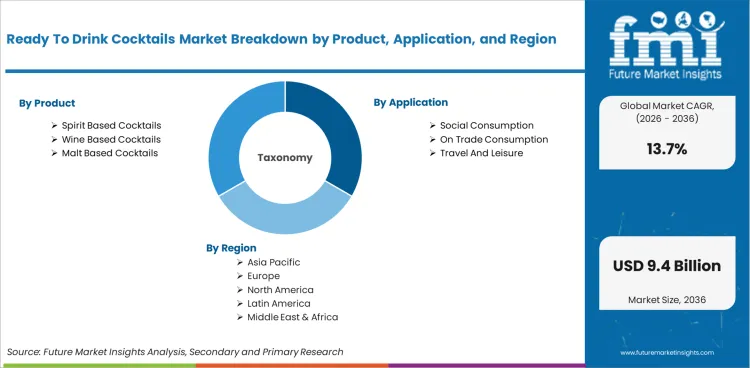
The ready to drink cocktails market was valued at USD 2.3 billion in 2025. The market is set to reach USD 2.6 billion by 2026-end and grow at a CAGR of 13.7% between 2026-2036 to reach USD 9.4 billion by 2036. Spirit Based Cocktails will dominate with a 60.0% share, while Social Consumption will lead with a 65.0% share.
Summary of the Ready To Drink Cocktails Market
- Demand and Growth Drivers
- Convenience-driven consumption shift is replacing bar-prepared cocktails with pre-mixed alternatives that deliver consistent quality, portable packaging, and competitive pricing for social drinking occasions at home, outdoors, and events.
- Premium spirit brand entry into RTD including Diageo, Bacardi, and Pernod Ricard is elevating category quality perception, expanding shelf space allocation, and attracting consumers who previously perceived RTD as low-quality alternatives.
- Social media and influencer marketing of RTD cocktail brands is accelerating product discovery and trial among younger legal-drinking-age consumers who prioritize brand identity, flavor variety, and Instagram-worthy packaging.
- Product and Segment View
- Spirit Based Cocktails is likely to remain the leading product segment at 60% share, supported by established demand and procurement patterns.
- Social Consumption is likely to account for 65% of the application segment, reflecting buyer preference and usage patterns.
- Adults is likely to lead the end use segment at 70% share during the forecast period.
- Geography and Competitive Outlook
- China is likely to remain a key market at 18.5% CAGR, supported by strong demand fundamentals and expanding adoption.
- India is likely to sustain growth at 17.13% CAGR owing to rising spending and expanding infrastructure.
- Companies with broad product portfolios and multi-channel distribution are likely to gain traction during the forecast period.
- Analyst Opinion
- The ready to drink cocktails market is evolving into a more defined commercial category with clear segment leaders and established distribution patterns.
- Adoption is increasing due to rising awareness, expanding distribution, and growing influence of premiumization on purchasing behavior.
- Demand is further supported by product format diversification, where manufacturers expand offerings to capture new consumption occasions and buyer segments.
- Companies that can secure consistent supply while delivering quality across key segments are likely to strengthen their position over the forecast period.
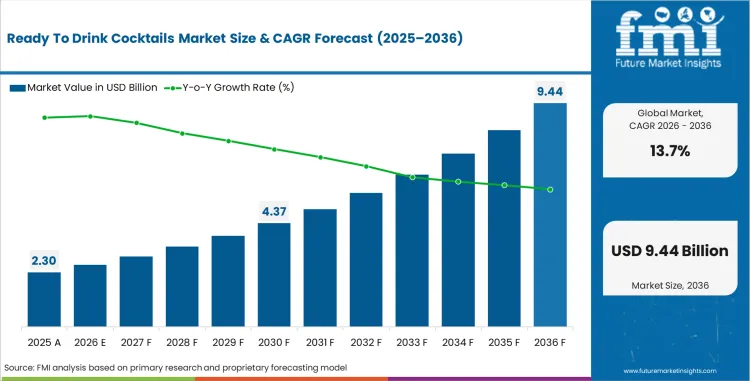
Key Takeaways, Market Size, and Forecast
- The ready to drink cocktails market was valued at USD 2.3 billion in 2025.
- By 2036, the Ready To Drink Cocktails Market is expected to be worth USD 9.44 billion.
- From 2026 to 2036, the market is projected to expand at a CAGR of 13.7%.
- The market is projected to create an incremental opportunity of USD 6.83 billion between 2026 and 2036.
- In 2026, spirit based cocktails is expected to account for 60% of the product segment, driven by demand for premium spirit-based mixed drinks in portable can formats targeting social consumption occasions as convenient alternatives to bar-prepared cocktails.
- China (18.5%) and India (17.13%) are two of the fastest growing markets in the world.
Ready To Drink Cocktails Market Definition
The ready-to-drink (RTD) cocktails market encompasses commercially traded pre-mixed alcoholic beverages combining spirits, wine, or malt bases with mixers, flavors, and other ingredients in shelf-stable retail formats. Product categories include spirit-based cocktails, wine-based cocktails, malt-based cocktails, and hard seltzers sold through off-premise retail and on-premise hospitality channels.
Ready To Drink Cocktails Market Inclusions
Market scope covers all commercially traded RTD cocktail products categorized by product (spirit-based cocktails, wine-based cocktails, malt-based cocktails, hard seltzers), application (social consumption, home entertainment, on-premise consumption), end use (adults, premium consumers), distribution channel (offline retail, online retail), packaging (cans, bottles, pouches), alcohol content (standard alcohol, low alcohol, non-alcoholic), and pricing tier (mid range, economy, premium). The revenue range spans from 2026 to 2036.
Ready To Drink Cocktails Market Exclusions
The scope does not include standard beer, wine, or neat spirits sold without pre-mixing, non-alcoholic mocktail beverages, or cocktail mixers sold without alcohol content.
Ready To Drink Cocktails Market Research Methodology
- Primary Research: FMI analysts spoke with spirits companies, RTD brand managers, liquor retail buyers, hospitality procurement specialists and e-commerce alcohol platform operators in key markets.
- Desk Research: Integrated data from alcohol industry associations, excise tax databases, retail scanner data and consumer drinking pattern surveys.
- Market Sizing and Forecasting: Bottom-up aggregation across product categories and distribution channels, adjusted for regional adoption curves for alcohol regulation, drinking age demographics and premiumization trends.
- Data validation : Quarterly reconciliation against alcohol retail scanner data and alcohol producer volume disclosures.
Why is the Ready To Drink Cocktails Market Growing?
- Convenience-driven consumption shift is replacing bar-prepared cocktails with pre-mixed alternatives, offering consistent quality, portable packaging
- Entry of premium spirit brands in RTD including Diageo, Bacardi.
- Social media and influencer marketing of RTD cocktail brands is promoting product discovery and trial among younger legal-drinking-age consumers who appreciate brand identity and flavor variety.
RTD cocktails market is projected to grow at a CAGR of 13.7% driven by the convergence of convenience, premiumization and social consumption trends. Spirit cocktails, mainly in the form of gin and tonic, margarita, whiskey sour and vodka based premix formats, account for 60.0% of the product segment. Social consumption is driven by home entertainment, outdoor gatherings and portable occasion use. These three applications account for 65.0% of demand in terms of volume.
Adults account for 70.0% of the end-user demand, with the prime consumption cohort being 21 to 40 age demographic. Off-premise retail is 65.0% of distribution and is led by liquor stores, supermarkets and convenience stores. 60.0% Cans Packaging is portable, chills quickly, recyclable, offers portion control consistent with single-serve consumption occasions.
Market Segmentation Analysis
- Spirit Based Cocktails accounts for 60% of the product segment, reflecting established demand patterns.
- Adults leads the end use segment at 70% share.
The ready to drink cocktails market is segmented by product, application, end use, distribution channel, packaging, alcohol content, pricing tier.
Insights into the Spirit Based Cocktails Product Segment
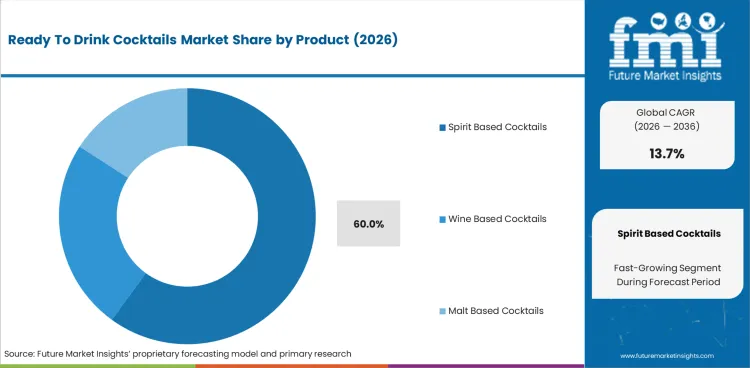
In 2026, spirit-based cocktails are expected to account for 60.0% of the product segment. Gin and tonic, margarita, Moscow mule, and whiskey sour are the most popular premix formats. Premium spirit brands including Diageo (Tanqueray, Ketel One) and Bacardi are entering the RTD category, elevating quality and consumer perception. Pricing ranges from mass-market to ultra-premium, with spirit brand equity supporting price differentiation.
Insights into the Offline Retail Distribution Channel
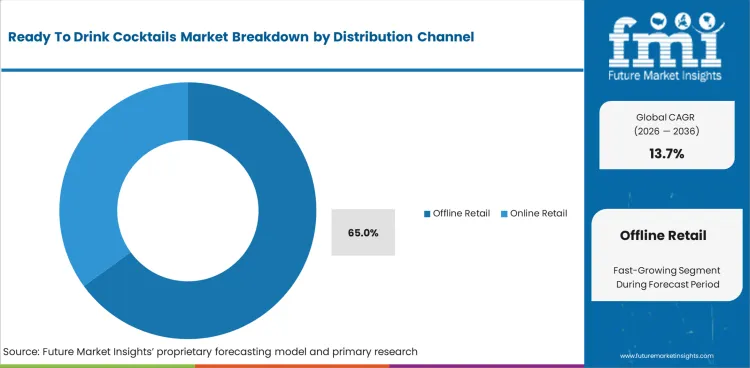
Offline retail accounts for 65.0% of distribution. Liquor stores and specialist alcohol retailers provide curated product selection with brand variety. Supermarkets are allocating expanding shelf space to RTD cocktails alongside beer and wine. Convenience stores capture impulse and portability-driven purchases. On-premise distribution in bars, restaurants, and event venues represents a growing channel.
Ready To Drink Cocktails Market Drivers, Restraints, and Opportunities
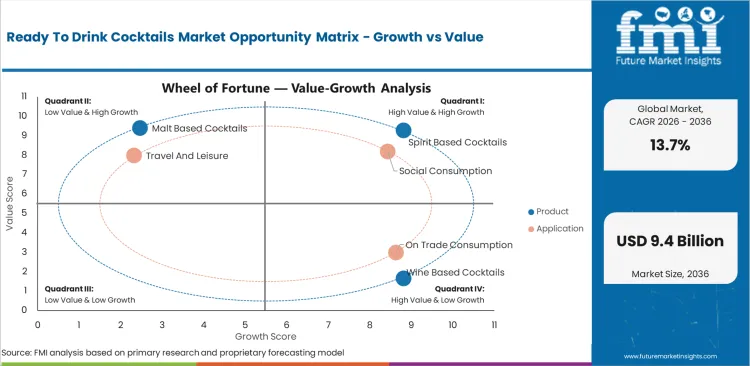
- Convenience and Portability for is creating structured demand across key segments.
- Alcohol Regulation and Distribution is limiting adoption at stable pricing in some segments.
The ready to drink cocktails market is shaped by demand-side catalysts and supply-side constraints that vary by region and price tier.
Convenience and Portability for Social Occasions
Demand is shaped by consumer preference for convenient, portable cocktail options that deliver consistent quality without bartender preparation. RTD cocktails serve home entertainment, outdoor events, picnics, and social gatherings where bar infrastructure is unavailable.
Premium Spirit Brand Category Entry
Big spirit company enters RTD with premium brand extensions to fuel growth. Diageo, Bacardi, Pernod Ricard and Brown-Forman are launching RTD products under their established spirit brands, increasing quality perception and gaining retail shelf space allocation.
Alcohol Regulation and Distribution Complexity
Adoption is constrained by variations across markets in alcohol excise tax structures, distribution regulations, and advertising restrictions. In the USA there are three-tier distribution requirements and in the EU there are strict advertising rules . This creates market access complexity for new brands .
Social Media Brand Building and Flavor Innovation
Social media marketing can support growth, allowing new RTD brands to build consumer awareness and trial without the need to invest in traditional advertising. Seasonal and limited edition flavors, as well as celebrity endorsements, keep consumers excited and coming back for more.
Analysis of Ready To Drink Cocktails Market By Key Countries
.webp "Top Country Growth Comparison Ready To Drink Cocktails Market Cagr (2026 2036)")
| Country | CAGR |
|---|---|
| China | 18.5% |
| India | 17.13% |
| Germany | 15.76% |
| Brazil | 14.39% |
| USA | 13.02% |
| UK | 11.65% |
| Japan | 10.28% |
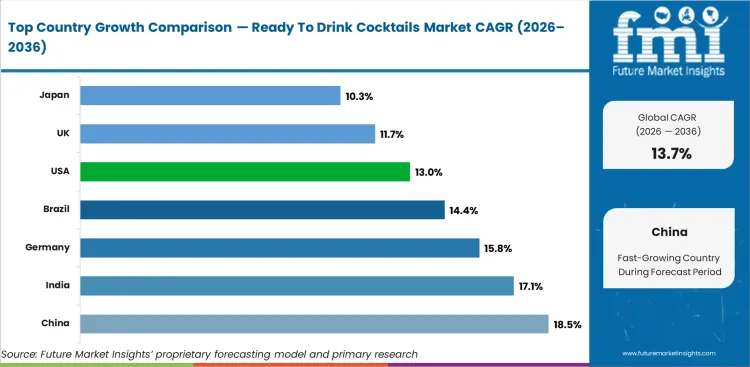
- China leads with 18.5% CAGR, owing to the largest demand base and increasing adoption.
- India 17.13% Strong demand backed by rising spend, expansion in distribution.
- Germany (15.76%) and Brazil (14.39%) are growth-oriented in expanding market development.
The global ready to drink cocktails market is projected to expand at 13.7% per year from 2026 to 2036. The study covers more than 30 countries.
Sales Analysis of Ready To Drink Cocktails Market in China
China leads at 18.5% through 2036. Rapid urbanization, growing nightlife culture among younger demographics, and e-commerce alcohol delivery are creating explosive growth. Low-alcohol and flavored RTD products align with Chinese consumer preference for lighter drinking occasions.
- Rapid urbanization and nightlife culture growth create expanding demand for convenient cocktail products.
- E-commerce alcohol delivery platforms enable rapid distribution of RTD brands to urban consumers.
- Low-alcohol and fruit-flavored RTD formats align with Chinese consumer preference for lighter beverages.
Demand Outlook for Ready To Drink Cocktails Market in India
India is expanding at 17.13% through 2036. Young demographic profile, growing urban social drinking culture, and premiumization trends create favorable conditions. Regulatory constraints on alcohol advertising and distribution vary by state, creating uneven market development.
- Young demographic profile provides a large potential consumer base for RTD cocktail products.
- Urban social drinking culture and premiumization trends support category development.
- State-level alcohol regulation creates varying market access conditions across India.
Future Outlook for Ready To Drink Cocktails Market in the United States
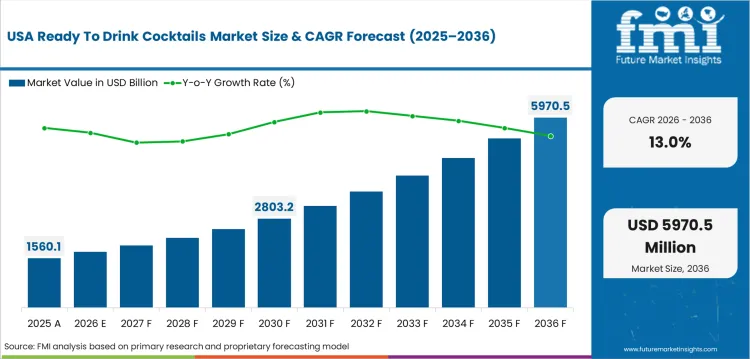
The USA is growing at 9.5% through 2036. The most developed RTD cocktails market globally, with hard seltzers having paved consumer acceptance for pre-mixed alcoholic beverages. Spirit-based RTD is the fastest-growing sub-category as premium brands enter the market.
- Most developed RTD market globally with hard seltzer category having established consumer acceptance.
- Spirit-based RTD is the fastest-growing sub-category driven by premium brand entry.
- Three-tier distribution system shapes market access and retail placement strategies.
In-depth Analysis of Ready To Drink Cocktails Market in Japan
Japan is expanding at 8.2% through 2036. Japan pioneered the RTD category with chuhai products, and the market benefits from established convenience store distribution and consumer acceptance of pre-mixed alcoholic beverages in can formats.
- Chuhai heritage provides established consumer familiarity with canned pre-mixed alcoholic beverages.
- Convenience store distribution network provides unmatched retail accessibility.
- Suntory and Asahi maintain strong positions through domestic brand portfolios and distribution scale.
In-depth Analysis of Ready To Drink Cocktails Market in Germany
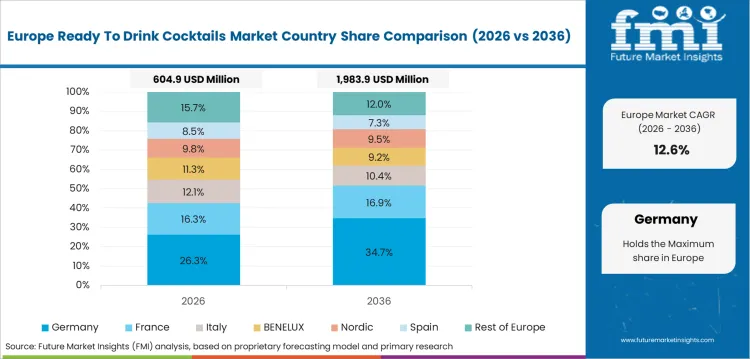
Germany is expanding at 7.5% through 2036. EU regulations on alcohol labeling and advertising shape market development. German consumers show growing interest in premium RTD products, particularly gin and tonic and cocktail can formats.
- EU alcohol labeling and advertising regulations shape product positioning and marketing approaches.
- Premium gin and tonic RTD formats are gaining consumer acceptance among German adults.
- Retail distribution through supermarkets and beverage specialty stores provides broad accessibility.
Opportunity Analysis of Ready To Drink Cocktails Market in the United Kingdom
The UK is growing at 7.2% through 2036. Strong cocktail culture and established pub and bar drinking traditions create a receptive consumer base. UK supermarket and off-license retailers allocate expanding shelf space to premium RTD cocktail brands.
- Strong cocktail culture creates a receptive consumer base for premium RTD products.
- Supermarket and off-license retailers allocate expanding shelf space to RTD cocktail categories.
- Celebrity and brand collaboration RTD products drive consumer trial and social media attention.
Demand Outlook for Ready To Drink Cocktails Market in Brazil
Brazil is growing at 8.8% through 2036. Brazilian social drinking culture, warm climate, and outdoor socializing patterns create favorable conditions for portable RTD cocktails. Cachaca-based and tropical fruit RTD products have strong local appeal.
- Social drinking culture and warm climate create favorable conditions for portable RTD consumption.
- Cachaca-based and tropical fruit RTD products leverage local flavor preferences.
- Urban bar and nightlife culture creates consumer familiarity with cocktail formats.
Competitive Landscape and Strategic Positioning
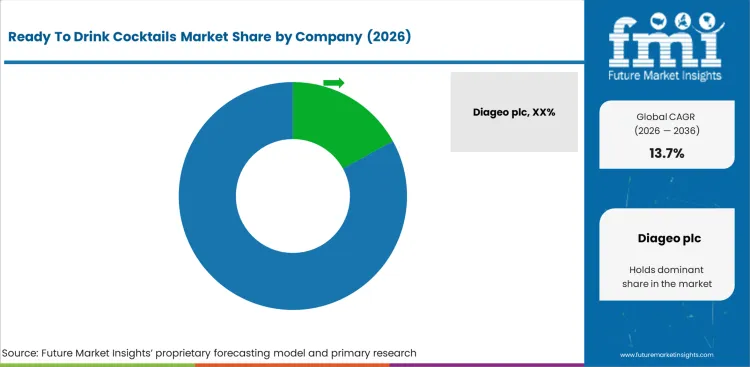
- Diageo plc leads through its portfolio of premium spirit brands including Tanqueray, Ketel One, and Captain Morgan, which provide brand equity and consumer trust for RTD cocktail line extensions across global markets.
- Bacardi Limited and Brown-Forman compete through established spirit brand portfolios (Bacardi rum, Jack Daniel's whiskey) that enable premium RTD product launches with built-in consumer recognition and retail shelf access.
- Regional players including Asahi Group, Suntory Holdings, and Shanghai Bacchus Liquor capture domestic market share through local flavor preferences, established distribution, and regulatory compliance expertise.
The competitive landscape is shaped by global leaders with integrated supply chains and regional specialists with niche capabilities.
Key Companies in the Ready To Drink Cocktails Market
Key global companies leading the ready to drink cocktails market include:
- Diageo plc (UK), Bacardi Limited (Bermuda), and Brown-Forman (USA) lead through premium spirit brand portfolios, global distribution, and marketing investment that supports RTD category expansion across established and emerging markets.
- Pernod Ricard (France), Asahi Group Holdings Ltd. (Japan), and Suntory Holdings Limited (Japan) compete through multi-category alcohol portfolios, regional market expertise, and established retail and on-premise distribution relationships.
- House of Delola LLC (USA), Ranch Rider Spirits Co. (USA), Halewood Wines and Spirits (UK), and Shanghai Bacchus Liquor Co. (China) are gaining share through premium positioning, clean-ingredient formulations, and social media brand building.
Competitive Benchmarking: Ready To Drink Cocktails Market
| Company | Spirit Portfolio | RTD Range | Distribution Scale | Brand Equity |
|---|---|---|---|---|
| Diageo | Very High | High | Global | Very Strong |
| Bacardi | Very High | High | Global | Very Strong |
| Brown-Forman | High | Medium | Global | Very Strong |
| Pernod Ricard | Very High | Medium | Global | Very Strong |
| Asahi Group | Medium | High | Asia | Strong |
| Suntory | High | Very High | Asia, Global | Very Strong |
| House of Delola | Low | Medium | N. America | Moderate |
| Ranch Rider | Low | Medium | N. America | Moderate |
| Halewood | Medium | Medium | Europe | Moderate |
| Shanghai Bacchus | Medium | Medium | China | Moderate |
Source: Future Market Insights competitive analysis, 2026.
Key Developments in Ready To Drink Cocktails Market
- In 2025, Diageo expanded its premium pre-mixed RTD footprint across North America and Europe through The Cocktail Collection, featuring ready-to-serve cocktails under flagship brands such as Tanqueray and Ketel One, including offerings like the Tanqueray Negroni and Ketel One Espresso Martini. In 2026, the company further broadened retail accessibility by introducing convenient single-serve packaging formats for selected cocktail products across grocery and convenience channels.
- In 2025, Suntory Holdings expanded its ready-to-drink portfolio with new premium chuhai and highball offerings inspired by Japanese izakaya cocktail culture, targeting younger adult consumers through convenience retail expansion, digital marketing campaigns, and contemporary packaging initiatives designed to strengthen brand appeal among Gen Z and Millennial audiences.
Key Players in the Ready To Drink Cocktails Market
Major Global Players
- Diageo plc
- House of Delola, LLC
- Ranch Rider Spirits Co.
- Brown-Forman
- Bacardi Limited
Emerging Players/Startups
- Asahi Group Holdings, Ltd.
- Pernod Ricard
- Halewood Wines & Spirits
- Shanghai Bacchus Liquor Co., Ltd.
- Suntory Holdings Limited
Report Scope and Coverage
| Parameter | Details |
|---|---|
| Quantitative Units | USD 2.62 billion to USD 9.44 billion, at a CAGR of 13.7% |
| Market Definition | The ready-to-drink (RTD) cocktails market encompasses commercially traded pre-mixed alcoholic beverages combining spirits, wine, or malt bases with mixers, flavors, and other ingredients in shelf-stable retail formats. Product categories include spirit-based cocktails, wine-based cocktails, malt-based cocktails, and hard seltzers sold through off-premise retail and on-premise hospitality channels. |
| Regions Covered | North America, Latin America, Europe, East Asia, South Asia and Pacific, Middle East and Africa |
| Countries Covered | China, India, Germany, Brazil, USA, UK, Japan, 30 plus countries |
| Key Companies Profiled | Diageo plc, House of Delola, LLC, Ranch Rider Spirits Co., Brown-Forman, Bacardi Limited, Asahi Group Holdings, Ltd., Pernod Ricard, Halewood Wines & Spirits |
| Forecast Period | 2026 to 2036 |
| Approach | Hybrid bottom-up and top-down methodology starting with verified transaction data, projecting adoption velocity across segments and regions. |
Market Segmentation Analysis
Ready To Drink Cocktails Market Segmented by Product:
- Spirit Based Cocktails
- Vodka Based
- Vodka Soda
- Vodka Fruit Mix
- Rum Based
- Rum Punch
- Mojito
- Whiskey Based
- Whiskey Cola
- Whiskey Sour
- Tequila Based
- Margarita
- Tequila Mix Drinks
- Vodka Based
- Wine Based Cocktails
- Sparkling Wine Cocktails
- Wine Spritzers
- Fruit Infused Wine Drinks
- Still Wine Cocktails
- Sangria
- Flavored Wine Mix
- Sparkling Wine Cocktails
- Malt Based Cocktails
- Hard Seltzers
- Flavored Seltzers
- Low Calorie Seltzers
- Flavored Malt Beverages
- Fruit Based Malt Drinks
- Sweetened Malt Drinks
- Hard Seltzers
Ready To Drink Cocktails Market Segmented by Application:
- Social Consumption
- House Parties
- Home Gatherings
- Celebration Events
- Outdoor Events
- Picnics
- Festivals
- House Parties
- On Trade Consumption
- Bars And Pubs
- Nightlife Venues
- Casual Bars
- Restaurants
- Casual Dining
- Fine Dining
- Bars And Pubs
- Travel And Leisure
- Airlines And Railways
- In Flight Services
- Onboard Catering
- Hospitality
- Hotels
- Resorts
- Airlines And Railways
Ready To Drink Cocktails Market Segmented by End Use:
- Adults
- Male Consumers
- Urban Consumers
- Occasional Drinkers
- Female Consumers
- Social Drinkers
- Health Conscious Drinkers
- Male Consumers
- Young Adults
- College Students
- Party Consumption
- Casual Drinking
- Working Professionals
- After Work Consumption
- Weekend Consumption
- College Students
Ready To Drink Cocktails Market Segmented by Distribution Channel:
- Offline Retail
- Liquor Stores
- Specialty Alcohol Retailers
- State Run Stores
- Supermarkets And Hypermarkets
- Large Format Stores
- Convenience Stores
- On Trade Channels
- Bars And Restaurants
- Hotels And Clubs
- Liquor Stores
- Online Retail
- E Commerce Platforms
- Alcohol Delivery Platforms
- Brand Owned Websites
- Quick Commerce
- Instant Delivery Services
- App Based Orders
- E Commerce Platforms
Ready To Drink Cocktails Market Segmented by Packaging:
- Cans
- Aluminum Cans
- Standard Cans
- Slim Cans
- Large Format Cans
- Multi Serve Cans
- Party Packs
- Aluminum Cans
- Bottles
- Glass Bottles
- Premium Packaging
- Single Serve Bottles
- Plastic Bottles
- Travel Friendly Packs
- Lightweight Bottles
- Glass Bottles
Ready To Drink Cocktails Market Segmented by Alcohol Content:
- Standard Alcohol
- Moderate Alcohol Content
- Balanced Cocktails
- Classic Recipes
- High Alcohol Content
- Strong Cocktails
- Premium Blends
- Moderate Alcohol Content
- Low Alcohol
- Light Cocktails
- Session Drinks
- Low Calorie Drinks
- Light Cocktails
- Non Alcoholic
- Zero Alcohol Cocktails
- Mocktails
- Functional Beverages
- Zero Alcohol Cocktails
Ready To Drink Cocktails Market Segmented by Pricing Tier:
- Mid Range
- Standard Branded Products
- Mass Premium Cocktails
- Standard Branded Products
- Economy
- Affordable Products
- Private Label Brands
- Affordable Products
- Premium
- Craft And Artisanal Cocktails
- Small Batch Production
- High Quality Ingredients
- Craft And Artisanal Cocktails
Ready To Drink Cocktails Market by Region:
- North America
- USA
- Canada
- Mexico
- Latin America
- Brazil
- Chile
- Rest of Latin America
- Western Europe
- Germany
- UK
- Italy
- Spain
- France
- Nordic
- BENELUX
- Rest of Western Europe
- Eastern Europe
- Russia
- Poland
- Hungary
- Balkan & Baltic
- Rest of Eastern Europe
- East Asia
- China
- Japan
- South Korea
- South Asia and Pacific
- India
- ASEAN
- Australia & New Zealand
- Rest of South Asia and Pacific
- Middle East & Africa
- Kingdom of Saudi Arabia
- Other GCC Countries
- Turkiye
- South Africa
- Other African Union
- Rest of Middle East & Africa
Research Sources and Bibliography
- 1. International Wines and Spirits Record. (2025). IWSR Global RTD Market Analysis. IWSR.
- 2. World Health Organization. (2024). WHO Global Status Report on Alcohol and Health. WHO.
- 3. Distilled Spirits Council of the United States. (2025). DISCUS Annual Economic Review: RTD Category. DISCUS.
- 4. European Spirits Organisation. (2024). spiritsEUROPE Market Report: Ready-to-Drink Trends. spiritsEUROPE.
- 5. Euromonitor International. (2025). Global Alcoholic Drinks Market Intelligence Report. Euromonitor.
This bibliography is provided for reader reference.
This Report Answers
- Estimating the market size and revenue generation from 2026 to 2036.
- Segmenting by product, application, end use, distribution channel, packaging, alcohol content, and pricing tier.
- Providing regional insights across more than 30 markets.
- Analyzing premiumization and spirit brand category entry dynamics.
- Assessing the competitive landscape across spirit, wine, and malt-based RTD segments.
- Identifying investment opportunities in premium and flavor-innovation categories.
- Tracking alcohol regulation and social media marketing trends.
- Delivering data in PDF and Excel formats.
Frequently Asked Questions
How big is the ready to drink cocktails market in 2026?
The global ready to drink cocktails market is estimated to be valued at USD 2.62 billion in 2026.
What will be the size of ready to drink cocktails market in 2036?
The market size for the ready to drink cocktails market is projected to reach USD 9.44 billion by 2036.
How much will be the ready to drink cocktails market growth between 2026 and 2036?
The ready to drink cocktails market is expected to grow at a 13.7% CAGR between 2026 and 2036.
What are the key product in the ready to drink cocktails market?
The key product in ready to drink cocktails market are spirit based cocktails, wine based cocktails and malt based cocktails.
Which application segment is expected to contribute significant share in the ready to drink cocktails market in 2026?
In terms of application, social consumption segment is expected to command 65.0% share in the ready to drink cocktails market in 2026.
Preview the report firsthand - request a free sample
Get SampleGet the brochure for pricing and purchase details.
Get PDFTable of Content
- Executive Summary
- Global Market Outlook
- Demand-side Trends
- Supply-side Trends
- Technology Roadmap Analysis
- Analysis and Recommendations
- Market Overview
- Market Coverage / Taxonomy
- Market Definition / Scope / Limitations
- Research Methodology
- Chapter Orientation
- Analytical Lens and Working Hypotheses
- Market Structure, Signals, and Trend Drivers
- Benchmarking and Cross-market Comparability
- Market Sizing, Forecasting, and Opportunity Mapping
- Research Design and Evidence Framework
- Desk Research Programme (Secondary Evidence)
- Company Annual and Sustainability Reports
- Peer-reviewed Journals and Academic Literature
- Corporate Websites, Product Literature, and Technical Notes
- Earnings Decks and Investor Briefings
- Statutory Filings and Regulatory Disclosures
- Technical White Papers and Standards Notes
- Trade Journals, Industry Magazines, and Analyst Briefs
- Conference Proceedings, Webinars, and Seminar Materials
- Government Statistics Portals and Public Data Releases
- Press Releases and Reputable Media Coverage
- Specialist Newsletters and Curated Briefings
- Sector Databases and Reference Repositories
- FMI Internal Proprietary Databases and Historical Market Datasets
- Subscription Datasets and Paid Sources
- Social Channels, Communities, and Digital Listening Inputs
- Additional Desk Sources
- Expert Input and Fieldwork (Primary Evidence)
- Primary Modes
- Qualitative Interviews and Expert Elicitation
- Quantitative Surveys and Structured Data Capture
- Blended Approach
- Why Primary Evidence is Used
- Field Techniques
- Interviews
- Surveys
- Focus Groups
- Observational and In-context Research
- Social and Community Interactions
- Stakeholder Universe Engaged
- C-suite Leaders
- Board Members
- Presidents and Vice Presidents
- R&D and Innovation Heads
- Technical Specialists
- Domain Subject-matter Experts
- Scientists
- Physicians and Other Healthcare Professionals
- Governance, Ethics, and Data Stewardship
- Research Ethics
- Data Integrity and Handling
- Primary Modes
- Tooling, Models, and Reference Databases
- Desk Research Programme (Secondary Evidence)
- Data Engineering and Model Build
- Data Acquisition and Ingestion
- Cleaning, Normalisation, and Verification
- Synthesis, Triangulation, and Analysis
- Quality Assurance and Audit Trail
- Market Background
- Market Dynamics
- Drivers
- Restraints
- Opportunity
- Trends
- Scenario Forecast
- Demand in Optimistic Scenario
- Demand in Likely Scenario
- Demand in Conservative Scenario
- Opportunity Map Analysis
- Product Life Cycle Analysis
- Supply Chain Analysis
- Investment Feasibility Matrix
- Value Chain Analysis
- PESTLE and Porter’s Analysis
- Regulatory Landscape
- Regional Parent Market Outlook
- Production and Consumption Statistics
- Import and Export Statistics
- Market Dynamics
- Global Market Analysis 2021 to 2025 and Forecast, 2026 to 2036
- Historical Market Size Value (USD Million) Analysis, 2021 to 2025
- Current and Future Market Size Value (USD Million) Projections, 2026 to 2036
- Y-o-Y Growth Trend Analysis
- Absolute $ Opportunity Analysis
- Global Market Pricing Analysis 2021 to 2025 and Forecast 2026 to 2036
- Global Market Analysis 2021 to 2025 and Forecast 2026 to 2036, By Product
- Introduction / Key Findings
- Historical Market Size Value (USD Million) Analysis By Product , 2021 to 2025
- Current and Future Market Size Value (USD Million) Analysis and Forecast By Product , 2026 to 2036
- Spirit Based Cocktails
- Vodka Based
- Vodka Soda
- Vodka Fruit Mix
- Rum Based
- Rum Punch
- Mojito
- Whiskey Based
- Whiskey Cola
- Whiskey Sour
- Tequila Based
- Wine Based Cocktails
- Sparkling Wine Cocktails
- Wine Spritzers
- Fruit Infused Wine Drinks
- Still Wine Cocktails
- Sangria
- Malt Based Cocktails
- Hard Seltzers
- Flavored Seltzers
- Low Calorie Seltzers
- Flavored Malt Beverages
- Fruit Based Malt Drinks
- Spirit Based Cocktails
- Y-o-Y Growth Trend Analysis By Product , 2021 to 2025
- Absolute $ Opportunity Analysis By Product , 2026 to 2036
- Global Market Analysis 2021 to 2025 and Forecast 2026 to 2036, By Application
- Introduction / Key Findings
- Historical Market Size Value (USD Million) Analysis By Application, 2021 to 2025
- Current and Future Market Size Value (USD Million) Analysis and Forecast By Application, 2026 to 2036
- Social Consumption
- House Parties
- Home Gatherings
- Celebration Events
- Outdoor Events
- Picnics
- Festivals
- On Trade Consumption
- Bars And Pubs
- Nightlife Venues
- Casual Bars
- Restaurants
- Casual Dining
- Travel And Leisure
- Airlines And Railways
- In Flight Services
- Onboard Catering
- Hospitality
- Hotels
- Social Consumption
- Y-o-Y Growth Trend Analysis By Application, 2021 to 2025
- Absolute $ Opportunity Analysis By Application, 2026 to 2036
- Global Market Analysis 2021 to 2025 and Forecast 2026 to 2036, By End Use
- Introduction / Key Findings
- Historical Market Size Value (USD Million) Analysis By End Use, 2021 to 2025
- Current and Future Market Size Value (USD Million) Analysis and Forecast By End Use, 2026 to 2036
- Adults
- Male Consumers
- Urban Consumers
- Occasional Drinkers
- Female Consumers
- Social Drinkers
- Health Conscious Drinkers
- Young Adults
- College Students
- Party Consumption
- Casual Drinking
- Working Professionals
- After Work Consumption
- Adults
- Y-o-Y Growth Trend Analysis By End Use, 2021 to 2025
- Absolute $ Opportunity Analysis By End Use, 2026 to 2036
- Global Market Analysis 2021 to 2025 and Forecast 2026 to 2036, By Distribution Channel
- Introduction / Key Findings
- Historical Market Size Value (USD Million) Analysis By Distribution Channel, 2021 to 2025
- Current and Future Market Size Value (USD Million) Analysis and Forecast By Distribution Channel, 2026 to 2036
- Offline Retail
- Liquor Stores
- Specialty Alcohol Retailers
- State Run Stores
- Supermarkets And Hypermarkets
- Large Format Stores
- Convenience Stores
- On Trade Channels
- Bars And Restaurants
- Hotels And Clubs
- Online Retail
- E Commerce Platforms
- Alcohol Delivery Platforms
- Brand Owned Websites
- Quick Commerce
- Instant Delivery Services
- Offline Retail
- Y-o-Y Growth Trend Analysis By Distribution Channel, 2021 to 2025
- Absolute $ Opportunity Analysis By Distribution Channel, 2026 to 2036
- Global Market Analysis 2021 to 2025 and Forecast 2026 to 2036, By Packaging
- Introduction / Key Findings
- Historical Market Size Value (USD Million) Analysis By Packaging, 2021 to 2025
- Current and Future Market Size Value (USD Million) Analysis and Forecast By Packaging, 2026 to 2036
- Cans
- Aluminum Cans
- Standard Cans
- Slim Cans
- Large Format Cans
- Multi Serve Cans
- Party Packs
- Bottles
- Glass Bottles
- Premium Packaging
- Single Serve Bottles
- Plastic Bottles
- Travel Friendly Packs
- Cans
- Y-o-Y Growth Trend Analysis By Packaging, 2021 to 2025
- Absolute $ Opportunity Analysis By Packaging, 2026 to 2036
- Global Market Analysis 2021 to 2025 and Forecast 2026 to 2036, By Alcohol Content
- Introduction / Key Findings
- Historical Market Size Value (USD Million) Analysis By Alcohol Content, 2021 to 2025
- Current and Future Market Size Value (USD Million) Analysis and Forecast By Alcohol Content, 2026 to 2036
- Standard Alcohol
- Moderate Alcohol Content
- Balanced Cocktails
- Classic Recipes
- High Alcohol Content
- Strong Cocktails
- Premium Blends
- Low Alcohol
- Light Cocktails
- Session Drinks
- Low Calorie Drinks
- Non Alcoholic
- Zero Alcohol Cocktails
- Mocktails
- Functional Beverages
- Standard Alcohol
- Y-o-Y Growth Trend Analysis By Alcohol Content, 2021 to 2025
- Absolute $ Opportunity Analysis By Alcohol Content, 2026 to 2036
- Global Market Analysis 2021 to 2025 and Forecast 2026 to 2036, By Pricing Tier
- Introduction / Key Findings
- Historical Market Size Value (USD Million) Analysis By Pricing Tier, 2021 to 2025
- Current and Future Market Size Value (USD Million) Analysis and Forecast By Pricing Tier, 2026 to 2036
- Mid Range
- Standard Branded Products
- Mass Premium Cocktails
- Economy
- Affordable Products
- Private Label Brands
- Premium
- Craft And Artisanal Cocktails
- Small Batch Production
- High Quality Ingredients
- Mid Range
- Y-o-Y Growth Trend Analysis By Pricing Tier, 2021 to 2025
- Absolute $ Opportunity Analysis By Pricing Tier, 2026 to 2036
- Global Market Analysis 2021 to 2025 and Forecast 2026 to 2036, By Region
- Introduction
- Historical Market Size Value (USD Million) Analysis By Region, 2021 to 2025
- Current Market Size Value (USD Million) Analysis and Forecast By Region, 2026 to 2036
- North America
- Latin America
- Western Europe
- Eastern Europe
- East Asia
- South Asia and Pacific
- Middle East & Africa
- Market Attractiveness Analysis By Region
- North America Market Analysis 2021 to 2025 and Forecast 2026 to 2036, By Country
- Historical Market Size Value (USD Million) Trend Analysis By Market Taxonomy, 2021 to 2025
- Market Size Value (USD Million) Forecast By Market Taxonomy, 2026 to 2036
- By Country
- USA
- Canada
- Mexico
- By Product
- By Application
- By End Use
- By Distribution Channel
- By Packaging
- By Alcohol Content
- By Pricing Tier
- By Country
- Market Attractiveness Analysis
- By Country
- By Product
- By Application
- By End Use
- By Distribution Channel
- By Packaging
- By Alcohol Content
- By Pricing Tier
- Key Takeaways
- Latin America Market Analysis 2021 to 2025 and Forecast 2026 to 2036, By Country
- Historical Market Size Value (USD Million) Trend Analysis By Market Taxonomy, 2021 to 2025
- Market Size Value (USD Million) Forecast By Market Taxonomy, 2026 to 2036
- By Country
- Brazil
- Chile
- Rest of Latin America
- By Product
- By Application
- By End Use
- By Distribution Channel
- By Packaging
- By Alcohol Content
- By Pricing Tier
- By Country
- Market Attractiveness Analysis
- By Country
- By Product
- By Application
- By End Use
- By Distribution Channel
- By Packaging
- By Alcohol Content
- By Pricing Tier
- Key Takeaways
- Western Europe Market Analysis 2021 to 2025 and Forecast 2026 to 2036, By Country
- Historical Market Size Value (USD Million) Trend Analysis By Market Taxonomy, 2021 to 2025
- Market Size Value (USD Million) Forecast By Market Taxonomy, 2026 to 2036
- By Country
- Germany
- UK
- Italy
- Spain
- France
- Nordic
- BENELUX
- Rest of Western Europe
- By Product
- By Application
- By End Use
- By Distribution Channel
- By Packaging
- By Alcohol Content
- By Pricing Tier
- By Country
- Market Attractiveness Analysis
- By Country
- By Product
- By Application
- By End Use
- By Distribution Channel
- By Packaging
- By Alcohol Content
- By Pricing Tier
- Key Takeaways
- Eastern Europe Market Analysis 2021 to 2025 and Forecast 2026 to 2036, By Country
- Historical Market Size Value (USD Million) Trend Analysis By Market Taxonomy, 2021 to 2025
- Market Size Value (USD Million) Forecast By Market Taxonomy, 2026 to 2036
- By Country
- Russia
- Poland
- Hungary
- Balkan & Baltic
- Rest of Eastern Europe
- By Product
- By Application
- By End Use
- By Distribution Channel
- By Packaging
- By Alcohol Content
- By Pricing Tier
- By Country
- Market Attractiveness Analysis
- By Country
- By Product
- By Application
- By End Use
- By Distribution Channel
- By Packaging
- By Alcohol Content
- By Pricing Tier
- Key Takeaways
- East Asia Market Analysis 2021 to 2025 and Forecast 2026 to 2036, By Country
- Historical Market Size Value (USD Million) Trend Analysis By Market Taxonomy, 2021 to 2025
- Market Size Value (USD Million) Forecast By Market Taxonomy, 2026 to 2036
- By Country
- China
- Japan
- South Korea
- By Product
- By Application
- By End Use
- By Distribution Channel
- By Packaging
- By Alcohol Content
- By Pricing Tier
- By Country
- Market Attractiveness Analysis
- By Country
- By Product
- By Application
- By End Use
- By Distribution Channel
- By Packaging
- By Alcohol Content
- By Pricing Tier
- Key Takeaways
- South Asia and Pacific Market Analysis 2021 to 2025 and Forecast 2026 to 2036, By Country
- Historical Market Size Value (USD Million) Trend Analysis By Market Taxonomy, 2021 to 2025
- Market Size Value (USD Million) Forecast By Market Taxonomy, 2026 to 2036
- By Country
- India
- ASEAN
- Australia & New Zealand
- Rest of South Asia and Pacific
- By Product
- By Application
- By End Use
- By Distribution Channel
- By Packaging
- By Alcohol Content
- By Pricing Tier
- By Country
- Market Attractiveness Analysis
- By Country
- By Product
- By Application
- By End Use
- By Distribution Channel
- By Packaging
- By Alcohol Content
- By Pricing Tier
- Key Takeaways
- Middle East & Africa Market Analysis 2021 to 2025 and Forecast 2026 to 2036, By Country
- Historical Market Size Value (USD Million) Trend Analysis By Market Taxonomy, 2021 to 2025
- Market Size Value (USD Million) Forecast By Market Taxonomy, 2026 to 2036
- By Country
- Kingdom of Saudi Arabia
- Other GCC Countries
- Turkiye
- South Africa
- Other African Union
- Rest of Middle East & Africa
- By Product
- By Application
- By End Use
- By Distribution Channel
- By Packaging
- By Alcohol Content
- By Pricing Tier
- By Country
- Market Attractiveness Analysis
- By Country
- By Product
- By Application
- By End Use
- By Distribution Channel
- By Packaging
- By Alcohol Content
- By Pricing Tier
- Key Takeaways
- Key Countries Market Analysis
- USA
- Pricing Analysis
- Market Share Analysis, 2025
- By Product
- By Application
- By End Use
- By Distribution Channel
- By Packaging
- By Alcohol Content
- By Pricing Tier
- Canada
- Pricing Analysis
- Market Share Analysis, 2025
- By Product
- By Application
- By End Use
- By Distribution Channel
- By Packaging
- By Alcohol Content
- By Pricing Tier
- Mexico
- Pricing Analysis
- Market Share Analysis, 2025
- By Product
- By Application
- By End Use
- By Distribution Channel
- By Packaging
- By Alcohol Content
- By Pricing Tier
- Brazil
- Pricing Analysis
- Market Share Analysis, 2025
- By Product
- By Application
- By End Use
- By Distribution Channel
- By Packaging
- By Alcohol Content
- By Pricing Tier
- Chile
- Pricing Analysis
- Market Share Analysis, 2025
- By Product
- By Application
- By End Use
- By Distribution Channel
- By Packaging
- By Alcohol Content
- By Pricing Tier
- Germany
- Pricing Analysis
- Market Share Analysis, 2025
- By Product
- By Application
- By End Use
- By Distribution Channel
- By Packaging
- By Alcohol Content
- By Pricing Tier
- UK
- Pricing Analysis
- Market Share Analysis, 2025
- By Product
- By Application
- By End Use
- By Distribution Channel
- By Packaging
- By Alcohol Content
- By Pricing Tier
- Italy
- Pricing Analysis
- Market Share Analysis, 2025
- By Product
- By Application
- By End Use
- By Distribution Channel
- By Packaging
- By Alcohol Content
- By Pricing Tier
- Spain
- Pricing Analysis
- Market Share Analysis, 2025
- By Product
- By Application
- By End Use
- By Distribution Channel
- By Packaging
- By Alcohol Content
- By Pricing Tier
- France
- Pricing Analysis
- Market Share Analysis, 2025
- By Product
- By Application
- By End Use
- By Distribution Channel
- By Packaging
- By Alcohol Content
- By Pricing Tier
- India
- Pricing Analysis
- Market Share Analysis, 2025
- By Product
- By Application
- By End Use
- By Distribution Channel
- By Packaging
- By Alcohol Content
- By Pricing Tier
- ASEAN
- Pricing Analysis
- Market Share Analysis, 2025
- By Product
- By Application
- By End Use
- By Distribution Channel
- By Packaging
- By Alcohol Content
- By Pricing Tier
- Australia & New Zealand
- Pricing Analysis
- Market Share Analysis, 2025
- By Product
- By Application
- By End Use
- By Distribution Channel
- By Packaging
- By Alcohol Content
- By Pricing Tier
- China
- Pricing Analysis
- Market Share Analysis, 2025
- By Product
- By Application
- By End Use
- By Distribution Channel
- By Packaging
- By Alcohol Content
- By Pricing Tier
- Japan
- Pricing Analysis
- Market Share Analysis, 2025
- By Product
- By Application
- By End Use
- By Distribution Channel
- By Packaging
- By Alcohol Content
- By Pricing Tier
- South Korea
- Pricing Analysis
- Market Share Analysis, 2025
- By Product
- By Application
- By End Use
- By Distribution Channel
- By Packaging
- By Alcohol Content
- By Pricing Tier
- Russia
- Pricing Analysis
- Market Share Analysis, 2025
- By Product
- By Application
- By End Use
- By Distribution Channel
- By Packaging
- By Alcohol Content
- By Pricing Tier
- Poland
- Pricing Analysis
- Market Share Analysis, 2025
- By Product
- By Application
- By End Use
- By Distribution Channel
- By Packaging
- By Alcohol Content
- By Pricing Tier
- Hungary
- Pricing Analysis
- Market Share Analysis, 2025
- By Product
- By Application
- By End Use
- By Distribution Channel
- By Packaging
- By Alcohol Content
- By Pricing Tier
- Kingdom of Saudi Arabia
- Pricing Analysis
- Market Share Analysis, 2025
- By Product
- By Application
- By End Use
- By Distribution Channel
- By Packaging
- By Alcohol Content
- By Pricing Tier
- Turkiye
- Pricing Analysis
- Market Share Analysis, 2025
- By Product
- By Application
- By End Use
- By Distribution Channel
- By Packaging
- By Alcohol Content
- By Pricing Tier
- South Africa
- Pricing Analysis
- Market Share Analysis, 2025
- By Product
- By Application
- By End Use
- By Distribution Channel
- By Packaging
- By Alcohol Content
- By Pricing Tier
- USA
- Market Structure Analysis
- Competition Dashboard
- Competition Benchmarking
- Market Share Analysis of Top Players
- By Regional
- By Product
- By Application
- By End Use
- By Distribution Channel
- By Packaging
- By Alcohol Content
- By Pricing Tier
- Competition Analysis
- Competition Deep Dive
- Diageo plc
- Overview
- Product Portfolio
- Profitability by Market Segments (Product/Age /Sales Channel/Region)
- Sales Footprint
- Strategy Overview
- Marketing Strategy
- Product Strategy
- Channel Strategy
- House of Delola, LLC
- Ranch Rider Spirits Co.
- Brown-Forman
- Bacardi Limited
- Asahi Group Holdings, Ltd.
- Pernod Ricard
- Halewood Wines & Spirits
- Shanghai Bacchus Liquor Co., Ltd.
- Suntory Holdings Limited
- Diageo plc
- Competition Deep Dive
- Assumptions & Acronyms Used


