

- Market Size (2026)
- USD 40.1 Bn
- Forecast (2036)
- USD 97.6 Bn
- CAGR (2026 to 2036)
- 9.3%
How big is Ready-to-Drink (RTD) Alcoholic Beverages Market in 2026?
USD 40.1 billion in 2026 and USD 97.6 billion by 2036 at a 9.3% CAGR.
Sales of ready-to-drink alcoholic beverages are projected to rise from USD 40.1 billion in 2026 to USD 97.6 billion by 2036. This reflects a 9.3% CAGR over the forecast period. Demand is expected to be driven by packaged drinks that turn bar-style serves into a clear retail purchase.
Commercial planning is expected to focus on product repeatability before national expansion. Producers require stable flavor and carbonation after transport. Retailers require cans and multipacks that are simple to display. The ready-to-drink cocktails category shows how cocktail names become easier to sell when the drink is already mixed and portioned. Ready-to-serve cocktails offer a second reference for portioned at-home drinking.
-alcoholic-beverages-market-value-analysis.webp "Ready To Drink (rtd) Alcoholic Beverages Market Value Analysis")
Key Takeaways of Ready-to-Drink (RTD) Alcoholic Beverages Market
- Demand for RTD alcoholic beverages is shaped by the need to convert familiar serves into stable packaged drinks, maintain taste and carbonation repeatability, and support lighter drinking occasions through low-ABV and single-serve formats.
- By type, Hard Seltzer holds 36.3% share in 2026, while Low ABV (<5%) accounts for 45.7% share in 2026 within ABV, reflecting portable single-serve convenience and consumer preference for lighter, portion-controlled drinking occasions.
- Australia leads country growth at 8.6% CAGR through 2036, followed by the USA at 8.2% and the UK at 7.8%, shaped by premix familiarity, manufacturing scale, retail reach, and duty-band messaging.
- Competition centers on Diageo, Bacardi, Campari Group, Anheuser-Busch InBev, Molson Coors, Mark Anthony Brands, and Suntory, spanning spirits brands, hard-seltzer reach, scale, and canned cocktail formats.
- Formula ownership, regulatory documentation, flavor stability across storage temperatures, carbonation retention, and ABV label control remain key considerations for wider retail adoption.
- Commercial expansion is expected to follow measured sell-through by flavor and pack format, with ABV mix reviewed before rollout and contracts defining formula and regulatory responsibilities before supply begins.
Analyst Perspective
"The ready-to-drink (RTD) alcoholic beverages market is increasingly shaped by consistent consumer experience at commercial scale. Beverage companies are evaluating taste, carbonation, ABV accuracy, shelf stability, and package performance across production and distribution conditions. Suppliers and brands that maintain formulation consistency, regulatory control, and reliable performance across flavors and formats will be better positioned to support sustained category expansion."
—Nandini Roy Choudhury, Principal Analyst at Future Market Insights
Source: FMI's proprietary forecasting model and primary research
How is the Ready-to-Drink (RTD) Alcoholic Beverages Market segmented?
The ready-to-drink (RTD) alcoholic beverages market is segmented by Type, ABV, Packaging, and Region.
The segmentation framework separates drink format from alcohol strength before comparing pack choice across regions. Type analysis covers Hard Seltzer and Canned Cocktails. RTD Spirits and Wine-based formats are included. ABV analysis separates Low ABV (<5%) from standard and high-ABV formats. Non-Alcoholic variants are reviewed separately. Wine-based formats connect with canned wine in pack-led trials. Packaging analysis compares Can and Bottle formats. Regional analysis shows how duty rules and retail structures affect launch timing.
What supports demand for hard seltzer within the type category?
-alcoholic-beverages-market-analysis-by-type.webp "Ready To Drink (rtd) Alcoholic Beverages Market Analysis By Type")
Hard Seltzer combines sparkling water, alcohol and light flavoring in a format designed for chilled shelves, outdoor occasions and casual social drinking. Its familiar single-serve can helps consumers understand the product without requiring detailed preparation or serving instructions. The category also supports demand from drinkers seeking lower sweetness than traditional flavored alcoholic beverages. Manufacturers can extend the format through fruit combinations and seasonal variants while maintaining a consistent sparkling base.
- Hard Seltzer is expected to hold 36.3% share in 2026, driven by its fit with flavored sparkling alcohol and portable single-serve cans. The format supports individual portion control while giving retailers a product that can move easily through chilled displays and multipack promotions.
- Beverage manufacturers test flavor stability and carbonation before widening retail listings across supermarkets, convenience stores and hospitality channels. Poor carbonation retention or flavor separation can weaken repeat purchases even when initial trial remains strong.
How does low ABV (<5%) shape demand within the ABV category?
-alcoholic-beverages-market-analysis-by-abv.webp "Ready To Drink (rtd) Alcoholic Beverages Market Analysis By Abv")
Low ABV (<5%) connects ready-to-drink convenience with lighter drinking occasions and controlled alcohol intake. The category allows consumers to choose a refreshing alcoholic beverage without the stronger profile associated with many spirits-based cocktails. It also gives producers room to balance fruit flavors, carbonation and sweetness while keeping the overall drink approachable.
- Low ABV (<5%) is projected to account for 45.7% share in 2026, supported by lighter drinking occasions and clear portion control. The format fits social events where consumers may prefer a drink that can be consumed slowly without creating an overly strong taste.
- Beverage companies balance alcohol strength with sweetness, acidity and carbonation so the drink remains stable without losing taste. A product with insufficient flavor can appear diluted, while excessive sweetness can undermine the lighter positioning associated with low-ABV beverages.
How is can positioned within the packaging category?
-alcoholic-beverages-market-analysis-by-packaging.webp "Ready To Drink (rtd) Alcoholic Beverages Market Analysis By Packaging")
Can packaging supports hard seltzer through fast chilling, low weight and convenient handling across retail and outdoor consumption occasions. Metal cans allow retailers to stack multipacks efficiently and reduce the breakage risks associated with glass bottles. Their large printable surface also supports clear brand recognition and flavor differentiation across crowded chilled shelves.
- Can packaging is forecast to capture 56.7% share in 2026, owing to single-serve RTD consumption and rapid movement through chilled retail displays. The format gives consumers a portable pack that requires no glassware or preparation before use.
- Canned formats retain a clear role where portability and immediate pack recognition influence trial purchases. Beverage brands can use colors and flavor cues to distinguish individual variants while keeping the overall product family visually connected.
What are the drivers, restraints, and opportunities in the Ready-to-Drink (RTD) Alcoholic Beverages Market?
Packaged cocktail convenience and can-based retail execution are expected to support demand. Alcohol classification and duty rules are expected to slow some launches.
- Driver: Packaged RTD formats turn cocktail demand into a retail product sold through single cans and multipacks.
- Restraint: Alcohol base and formula approval rules create different launch routes for malt-based and spirits-based RTDs. Wine-based formats often require another path.
- Opportunity: Canned alcoholic beverages give retailers more flavor options without changing the store setup for every launch.
Demand is expected to strengthen when packaged cocktails reduce preparation work for consumers and retailers. DISCUS reported in February 2026 that USA premixed cocktails including spirits RTDs reached USD 3.8 billion in 2025. The figure shows that ready-mixed spirits products already hold meaningful sales value inside beverage alcohol. Producers gain when a known cocktail moves into cans without confusing the serving size. Retailers gain when the same product fits chilled shelves and multipack displays.
Regulation is expected to remain the main operating constraint. TTB guidance updated in September 2025 says certain distilled spirits and wines require formula approval before the product is made or imported. Certain beers and malt beverages follow the same sequence. That review step is expected to slow RTD launches when flavors and alcohol bases change together. Producers require a clear approval path before they commit to cans and retail display plans.
The main opportunity is expected to come from branded cocktails that already carry consumer recognition. The Coca-Cola Company and Bacardi Limited announced in September 2024 that their BACARDÍ and Coca-Cola ready-to-drink cocktail would debut in select European markets and Mexico in 2025. The agreement shows how known drink names can enter packaged alcohol without teaching shoppers a new serve from scratch.
Which country CAGRs are profiled in the Ready-to-Drink (RTD) Alcoholic Beverages Market?
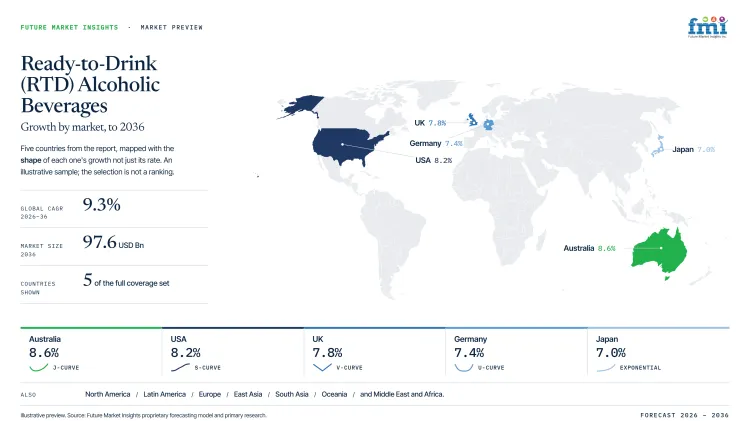
| Country | CAGR |
|---|---|
| USA | 8.2% |
| Japan | 7.0% |
| UK | 7.8% |
| Australia | 8.6% |
| Germany | 7.4% |
How do country-level CAGRs compare in the Ready-to-Drink (RTD) Alcoholic Beverages Market?
A global growth rate represents the weighted average of all markets included in the analysis. It therefore cannot exceed the growth rate of every individual market within the coverage set. The global forecast CAGR of 9.3% indicates that some countries not shown in this comparison are expected to expand above that rate. The five profiled markets are illustrative examples and their position below the global figure makes this difference visible.
- The countries are distinguished less by their CAGRs and more by their specific routes to packaged alcoholic beverage adoption. The complete range between Australia and Japan is only 1.6 percentage points. Each adjacent market is separated by 0.4 percentage points which creates a compressed comparison without a pronounced break between country groups.
- Australia benefits from an established premix culture and strong demand for portable cold cans during summer and event-led occasions. The USA remains closely aligned but follows a different commercial route through broad manufacturing capacity and national retail distribution.
- The UK reflects a measured development model shaped by alcohol duty bands and clearer positioning for low-ABV products. Germany occupies a similar middle position although local beer habits and regional beverage preferences require more gradual product testing.
- Japan stands outside the upper part of the comparison because canned alcohol is already mature and future expansion depends more on premium formats than broad volume adoption.
- Comparable CAGRs can therefore produce different market entry conditions. Deployment timing depends on duty treatment and retail structure while formulation requirements vary with local flavor preferences and established drinking habits.
The full report provides country-level CAGR analysis across North America, Latin America, Europe, East Asia, South Asia, Oceania and the Middle East and Africa.
Country-wise Analysis
- The USA combines broad beverage production with a large retail base for canned cocktails and hard seltzers. Demand in the USA is projected to advance at 8.2% CAGR from 2026 to 2036. TTB authorized 13 additional wine standards of fill and 15 distilled spirits standards of fill in January 2025. The rule gives RTD producers more room to match can sizes with single-serve drinking occasions. National retailers test multipacks before wider distribution. Producers require early formula and label checks since alcohol base affects the approval path.
- Japan has a mature canned alcohol culture through chu-hi and highball-style drinks. Adoption in Japan is estimated to expand at 7.0% CAGR through 2036. The National Tax Agency Report 2025 stated that FY2023 taxable liquor volume was about 80% of its FY1999 peak. The decline pushes companies toward value-added canned cocktails instead of pure volume expansion. Local flavor work remains necessary since citrus and tea profiles shape repeat shelf rotation. Producers keep serving size and sweetness clear for convenience-channel decisions.
- The UK retail route is shaped by alcohol duty and unit-aware drinking habits. The UK is forecast to record 7.8% CAGR through 2036. HMRC reported in April 2026 that Alcohol Duty receipts reached approximately £12.4 billion for the 2025 to 2026 financial year. The figure shows a large taxable base for packaged alcohol competition. Low-ABV RTDs use clear unit messaging to help shoppers compare cans with beer and spirits. Launch plans work best when label wording is tested before compliance review.
- Australian liquor retailers have a long premix tradition and a clear summer occasion for cold cans. RTD alcoholic beverage demand in Australia is anticipated to rise at 8.6% CAGR during the forecast period. The Australian Government published a February 2025 notice setting the excise rate for item 3.2 at $104.31 per litre of alcohol. The rate raises the price test for spirit-based RTDs. Multipacks still support summer and event-led occasions where portability affects buying. Producers separate duty planning from flavor testing before committing to national packs.
- Germany combines regional beverage production with beer and sparkling wine habits. Demand in Germany is expected to advance at 7.4% CAGR from 2026 to 2036. Destatis reported in February 2026 that German beer sales fell 6.0% to roughly 7.8 billion litres in 2025. Regional beverage culture supports local trials before national rollout. Producers avoid treating German RTD demand as a simple extension of beer consumption.
Who are the notable companies in the Ready-to-Drink (RTD) Alcoholic Beverages Market?
Campari Group; Diageo; Anheuser-Busch InBev; Molson Coors; Bacardi; Suntory; and Mark Anthony Brands are notable companies in ready-to-drink alcoholic beverages.
-alcoholic-beverages-market-analysis-by-company.webp "Ready To Drink (rtd) Alcoholic Beverages Market Analysis By Company")
The competitive outlook combines spirits groups with beer companies and canned cocktail specialists. Spirits companies compete through recognizable cocktail names and brand trust. Beer and hard-seltzer companies compete through retail reach and canning scale. Regional beverage groups use local flavor knowledge and existing RTD production systems.
- Diageo and Bacardi compete through spirits brands that translate familiar bar calls into packaged mixed drinks.
- Anheuser-Busch InBev and Molson Coors compete through hard-seltzer reach. Mark Anthony Brands adds multipack retail execution through a focused seltzer portfolio.
- Campari Group remains active in aperitif occasions. Suntory holds a clear role where highball and chu-hi habits shape local RTD choices.
Competitive Benchmarking: Ready-to-Drink (RTD) Alcoholic Beverages Market
| Company | Type | ABV | Packaging | Geographic Reach |
|---|---|---|---|---|
| Campari Group | Medium | Medium | High | Europe and selected export markets |
| Diageo | High | High | High | North America, Europe, and international markets |
| Anheuser-Busch InBev | High | Medium | High | United States and selected export markets |
| Molson Coors | Medium | Medium | High | United States and selected export markets |
| Bacardi | High | High | Medium | Europe, Mexico, and selected global markets |
| Suntory | High | Medium | High | Japan and selected international markets |
| Mark Anthony Brands | High | Medium | High | North America and selected global markets |
Key Developments in the Ready-to-Drink (RTD) Alcoholic Beverages Market
- In May 2025, Molson Coors expanded Naked Life non-alcoholic cocktails to nationwide availability in the United States, following an initial launch in select stores in March 2025, with five ready-to-drink cocktail flavors.
- In October 2025, Diageo GB launched Fancy That! to help consumers understand alcohol units in popular drinks.
- In December 2024, Suntory announced that MARU-HI would expand its USA ready-to-drink portfolio with a California launch from January 2025.
Key Players in the Ready-to-Drink (RTD) Alcoholic Beverages Market
Global spirits and cocktail companies
- Diageo
- Bacardi
- Campari Group
Beer and hard-seltzer companies
- Anheuser-Busch InBev
- Molson Coors
- Mark Anthony Brands
Regional RTD and canned cocktail companies
- Suntory
Ready-to-Drink (RTD) Alcoholic Beverages Market - Report Scope
-alcoholic-beverages-market-breakdown-by-type,-abv,-and-region.webp "Ready To Drink (rtd) Alcoholic Beverages Market Breakdown By Type, Abv, And Region")
| Coverage field | Report scope |
|---|---|
| Market breakdown | Type, ABV, packaging, and region. |
| Quantitative Units | Revenue in USD Billion, CAGR in %. |
| Market Definition | Finished packaged ready-to-drink alcoholic beverages sold in hard seltzer, canned cocktail, RTD spirits, and wine-based formats. |
| Regions Covered | North America; Latin America; Europe; East Asia; South Asia and Pacific; and Middle East and Africa. |
| Countries Covered | USA; Japan; UK; Australia; Germany; and more than twenty-five additional countries across the regions. |
| Key Companies Profiled | Campari Group; Diageo; Anheuser-Busch InBev; Molson Coors; Bacardi; Suntory; and Mark Anthony Brands. |
| Forecast Period | 2026 to 2036. |
| Approach | Hybrid bottom-up and top-down market sizing supported by primary interviews and official desk research. |
Ready-to-Drink (RTD) Alcoholic Beverages Market - Research Methodology
| Method | Approach |
|---|---|
| Primary Research | FMI analysts gathered input from manufacturers, service providers, technology developers, distributors, end users, procurement teams, and subject-matter experts. Interviews examined purchasing decisions, product or service evaluation, adoption barriers, approval requirements, pricing considerations, and expectations for technical or commercial support. Respondents were also asked what evidence is required before a trial, pilot, or initial order develops into regular purchasing. |
| Desk Research | Desk research covered government statistics, regulatory publications, trade data, industry associations, technical literature, standards, company filings, product information, and official corporate announcements. Sources were reviewed for relevance, publication date, geographic coverage, and consistency with the defined market scope. Claims relating to performance, applications, approvals, capacity, investment, and commercial activity were retained only when supported by credible public evidence. |
| Market Sizing and Forecasting | The market model combined the baseline value with historical performance, segment structure, pricing and volume indicators, adoption levels, company participation, and country-level demand conditions. Forecast assumptions considered economic activity, investment trends, regulatory developments, technology adoption, purchasing cycles, supply availability, and barriers to wider market use. Segment and regional estimates were reconciled before the final market total was calculated. |
| Data Validation | Estimates were checked against multiple independent indicators, including public data, company activity, trade patterns, industry developments, and findings from primary interviews. Validation also tested whether products, services, applications, and company revenues fell within the defined market boundaries. Adjacent categories, unsupported claims, overlapping revenues, and activities without direct market relevance were excluded to reduce double counting and maintain consistency across segments and countries. |
Ready-to-Drink (RTD) Alcoholic Beverages Market by Segments
Ready-to-Drink (RTD) Alcoholic Beverages Market segmented by Type:
- Hard Seltzer
- Canned Cocktails
- RTD Spirits
- Wine-based
Ready-to-Drink (RTD) Alcoholic Beverages Market segmented by ABV:
- Low ABV (<5%)
- Standard ABV (5-8%)
- High ABV (>8%)
- Non-Alcoholic
Ready-to-Drink (RTD) Alcoholic Beverages Market segmented by Packaging:
- Can
- Bottle
Ready-to-Drink (RTD) Alcoholic Beverages Market by Region:
- North America
- United States
- Canada
- Latin America
- Brazil
- Mexico
- Argentina
- Chile
- Western Europe
- Germany
- France
- United Kingdom
- Italy
- Spain
- Benelux
- Nordics
- Eastern Europe
- Poland
- Czech Republic
- Romania
- Hungary
- East Asia
- China
- Japan
- South Korea
- South Asia and Pacific
- India
- ASEAN
- Australia and New Zealand
- Middle East and Africa
- GCC Countries
- South Africa
- Türkiye
- Israel
Research Sources and Bibliography
- Alcohol and Tobacco Tax and Trade Bureau. (2025, January). TTB adds new standards of fill for wine and distilled spirits; eliminates distinction between standards of fill for distilled spirits in cans and other types of containers. USA Department of the Treasury.
- Alcohol and Tobacco Tax and Trade Bureau. (2025, September 11). Which alcohol beverages require formula approval? USA Department of the Treasury.
- Australian Government Federal Register of Legislation. (2025, February 3). Notice of substituted rates of excise duty: Notice No. 1 (2025). Australian Government.
- Bacardi Limited and The Coca-Cola Company. (2024, September 17). The Coca-Cola Company and Bacardi Limited announce plans to debut BACARDÍ & Coca-Cola ready-to-drink cocktail. The Coca-Cola Company.
- Destatis. (2026, February). Beer sales down in 2025. German Federal Statistical Office.
- Distilled Spirits Council of the United States. (2026, February 5). Distilled Spirits Council Annual Economic Briefing 2025. Distilled Spirits Council of the United States.
- Diageo. (2025, October 30). Diageo GB launches Fancy That! to help consumers better understand alcohol units. Diageo.
- Molson Coors Beverage Company. (2025, May 15). Ready for any occasion: Naked Life non-alcoholic cocktails launch nationwide. Molson Coors Beer & Beyond.
- Suntory Holdings Limited. (2024, December 12). Suntory expands US ready-to-drink portfolio with launch of MARU-HI. Suntory Holdings Limited.
This bibliography is provided for reader reference and is not exhaustive. The full report contains the complete reference list and detailed citations.
This Report Answers
- How large is the ready-to-drink (RTD) alcoholic beverages market in 2026 and 2036?
- Which packaged-drink and retail conditions support demand?
- Why does Hard Seltzer lead the Type category in 2026?
- How does Low ABV (<5%) influence serving and label planning?
- Why does Can packaging account for the leading share in 2026?
- How do country growth rates differ across the USA and Japan? How do the UK and Australia compare with Germany?
- Which companies compete through spirits brands and hard seltzers? Which companies add canned cocktail systems?
- What limits launch timing across alcohol base and label approval routes?
- How do retailers test RTD flavors without adding excess shelf work?
Frequently Asked Questions
How big is the Ready-to-Drink (RTD) Alcoholic Beverages Market in 2026?
The ready-to-drink alcoholic beverages market is valued at USD 40.1 billion in 2026 and is forecast to reach USD 97.6 billion by 2036, rising from USD 36.7 billion in 2025, driven by packaged formats that convert familiar bar-style serves into portable retail purchases.
What is the CAGR of the Ready-to-Drink (RTD) Alcoholic Beverages Market from 2026 to 2036?
The ready-to-drink alcoholic beverages market is projected to grow at a CAGR of 9.3% between 2026 and 2036, supported by expanding demand for single-serve canned cocktails, hard seltzers, and low-ABV formats across retail and event-led occasions.
Which type leads the Ready-to-Drink (RTD) Alcoholic Beverages Market?
Hard Seltzer accounts for 36.3% of the ready-to-drink alcoholic beverages market by type in 2026, driven by its light flavor profile, portable single-serve can format, and broad fit with chilled retail displays and multipack promotions across supermarket and convenience channels.
Which country is growing fastest in the Ready-to-Drink (RTD) Alcoholic Beverages Market?
The ready-to-drink alcoholic beverages market in Australia is projected to grow at a CAGR of 8.6% through 2036, supported by an established premix culture, active liquor retail channels, and strong consumer demand for portable cold cans during summer and event-led occasions.
Who are the leading companies in the Ready-to-Drink (RTD) Alcoholic Beverages Market?
Leading companies in the ready-to-drink alcoholic beverages market include Diageo, Bacardi, Campari Group, Anheuser-Busch InBev, Molson Coors, Mark Anthony Brands, and Suntory, spanning global spirits brands, hard-seltzer manufacturing scale, and regional canned cocktail systems.
Preview the report firsthand - request a free sample
Get SampleGet the brochure for pricing and purchase details.
Get PDFTable of Content
- Key Takeaways
- Market Size and CAGR
- Top Growth Driver
- Fastest Growing Segment
- Leading Region
- Key Companies
- Emerging Opportunities
- Executive Summary
- Global Market Outlook
- Demand-side Trends
- Supply-side Trends
- Technology Roadmap Analysis
- Analysis and Recommendations
- Analyst Perspective (What is happening? Why now? What should investors know?)
- Key Questions Answered
- How large is the market?
- What is the CAGR?
- What are key trends?
- Which region dominates?
- Who are the leaders?
- Market Overview
- Market Coverage / Taxonomy
- Market Definition / Scope / Limitations
- Research Methodology
- Chapter Orientation
- Analytical Lens and Working Hypotheses
- Market Structure, Signals, and Trend Drivers
- Benchmarking and Cross-market Comparability
- Market Sizing, Forecasting, and Opportunity Mapping
- Research Design and Evidence Framework
- Desk Research Programme (Secondary Evidence)
- Expert Input and Fieldwork (Primary Evidence)
- Tooling, Models, and Reference Databases
- Data Engineering and Model Build
- Quality Assurance and Audit Trail
- Market Background
- Market Dynamics (Drivers, Restraints, Opportunity, Trends)
- Scenario Forecast (Optimistic, Likely, Conservative)
- Impact Analysis
- AI Impact
- Sustainability Impact
- Regulatory Impact
- Technology Impact
- Consumer / Buyer Analysis
- Purchase Drivers
- Adoption Barriers
- Buyer Journey
- Opportunity Map Analysis
- Product Life Cycle Analysis
- Supply Chain Analysis
- Investment Feasibility Matrix
- Value Chain Analysis
- PESTLE and Porter's Analysis
- Regulatory Landscape
- Regional Parent Market Outlook
- Production and Consumption Statistics
- Import and Export Statistics
- Global Market Analysis and Forecast, 2021 to 2036
- Historical Market Size Value (USD Billion) Analysis, 2021 to 2025
- Current and Future Market Size Value (USD Billion) Projections, 2026 to 2036
- Y-o-Y Growth Trend Analysis
- Absolute $ Opportunity Analysis
- Global Market Pricing Analysis, 2021 to 2036
- Global Market Analysis and Forecast, By Type, 2021 to 2036
- Introduction / Key Findings
- Historical Market Size Value (USD Billion) Analysis By Type, 2021 to 2025
- Current and Future Market Size Value (USD Billion) Analysis and Forecast By Type, 2026 to 2036
- Hard Seltzer
- Canned Cocktails
- RTD Spirits
- Wine-based
- Hard Seltzer
- Y-o-Y Growth Trend Analysis By Type, 2021 to 2025
- Absolute $ Opportunity Analysis By Type, 2026 to 2036
- Global Market Analysis and Forecast, By ABV, 2021 to 2036
- Introduction / Key Findings
- Historical Market Size Value (USD Billion) Analysis By ABV, 2021 to 2025
- Current and Future Market Size Value (USD Billion) Analysis and Forecast By ABV, 2026 to 2036
- Low ABV (<5%)
- Standard ABV (5-8%)
- High ABV (>8%)
- Non-Alcoholic
- Low ABV (<5%)
- Y-o-Y Growth Trend Analysis By ABV, 2021 to 2025
- Absolute $ Opportunity Analysis By ABV, 2026 to 2036
- Global Market Analysis and Forecast, By Packaging, 2021 to 2036
- Introduction / Key Findings
- Historical Market Size Value (USD Billion) Analysis By Packaging, 2021 to 2025
- Current and Future Market Size Value (USD Billion) Analysis and Forecast By Packaging, 2026 to 2036
- Can
- Bottle
- Can
- Y-o-Y Growth Trend Analysis By Packaging, 2021 to 2025
- Absolute $ Opportunity Analysis By Packaging, 2026 to 2036
- Global Market Analysis and Forecast, By Region, 2021 to 2036
- Introduction
- Historical Market Size Value (USD Billion) Analysis By Region, 2021 to 2025
- Current Market Size Value (USD Billion) Analysis and Forecast By Region, 2026 to 2036
- North America
- Latin America
- Western Europe
- Eastern Europe
- East Asia
- South Asia and Pacific
- Middle East & Africa
- Market Attractiveness Analysis By Region
- North America Market Analysis and Forecast, By Country, 2021 to 2036
- Historical Market Size Value (USD Billion) Trend Analysis By Market Taxonomy, 2021 to 2025
- Market Size Value (USD Billion) Forecast By Market Taxonomy, 2026 to 2036
- By Country
- USA
- Canada
- By Type
- By ABV
- By Packaging
- By Country
- Market Attractiveness Analysis
- By Country
- By Type
- By ABV
- By Packaging
- Key Takeaways
- Latin America Market Analysis and Forecast, By Country
- Historical Market Size Value (USD Billion) Trend Analysis By Market Taxonomy, 2021 to 2025
- Market Size Value (USD Billion) Forecast By Market Taxonomy, 2026 to 2036
- By Country
- Brazil
- Mexico
- Chile
- Rest of Latin America
- By Type
- By ABV
- By Packaging
- By Country
- Market Attractiveness Analysis
- By Country
- By Type
- By ABV
- By Packaging
- Key Takeaways
- Western Europe Market Analysis and Forecast, By Country
- Historical Market Size Value (USD Billion) Trend Analysis By Market Taxonomy, 2021 to 2025
- Market Size Value (USD Billion) Forecast By Market Taxonomy, 2026 to 2036
- By Country
- Germany
- UK
- Italy
- Spain
- France
- Nordic
- BENELUX
- Rest of Western Europe
- By Type
- By ABV
- By Packaging
- By Country
- Market Attractiveness Analysis
- By Country
- By Type
- By ABV
- By Packaging
- Key Takeaways
- Eastern Europe Market Analysis and Forecast, By Country
- Historical Market Size Value (USD Billion) Trend Analysis By Market Taxonomy, 2021 to 2025
- Market Size Value (USD Billion) Forecast By Market Taxonomy, 2026 to 2036
- By Country
- Russia
- Poland
- Hungary
- Balkan & Baltic
- Rest of Eastern Europe
- By Type
- By ABV
- By Packaging
- By Country
- Market Attractiveness Analysis
- By Country
- By Type
- By ABV
- By Packaging
- Key Takeaways
- East Asia Market Analysis and Forecast, By Country
- Historical Market Size Value (USD Billion) Trend Analysis By Market Taxonomy, 2021 to 2025
- Market Size Value (USD Billion) Forecast By Market Taxonomy, 2026 to 2036
- By Country
- China
- Japan
- South Korea
- By Type
- By ABV
- By Packaging
- By Country
- Market Attractiveness Analysis
- By Country
- By Type
- By ABV
- By Packaging
- Key Takeaways
- South Asia and Pacific Market Analysis and Forecast, By Country
- Historical Market Size Value (USD Billion) Trend Analysis By Market Taxonomy, 2021 to 2025
- Market Size Value (USD Billion) Forecast By Market Taxonomy, 2026 to 2036
- By Country
- India
- ASEAN
- Australia & New Zealand
- Rest of South Asia and Pacific
- By Type
- By ABV
- By Packaging
- By Country
- Market Attractiveness Analysis
- By Country
- By Type
- By ABV
- By Packaging
- Key Takeaways
- Middle East & Africa Market Analysis and Forecast, By Country
- Historical Market Size Value (USD Billion) Trend Analysis By Market Taxonomy, 2021 to 2025
- Market Size Value (USD Billion) Forecast By Market Taxonomy, 2026 to 2036
- By Country
- Kingdom of Saudi Arabia
- Other GCC Countries
- Türkiye
- South Africa
- Other African Union
- Rest of Middle East & Africa
- By Type
- By ABV
- By Packaging
- By Country
- Market Attractiveness Analysis
- By Country
- By Type
- By ABV
- By Packaging
- Key Takeaways
- Key Countries Market Analysis
- USA
- Pricing Analysis
- Market Share Analysis, 2025
- By Type
- By ABV
- By Packaging
- Canada
- Pricing Analysis
- Market Share Analysis, 2025
- By Type
- By ABV
- By Packaging
- Mexico
- Pricing Analysis
- Market Share Analysis, 2025
- By Type
- By ABV
- By Packaging
- Brazil
- Pricing Analysis
- Market Share Analysis, 2025
- By Type
- By ABV
- By Packaging
- Chile
- Pricing Analysis
- Market Share Analysis, 2025
- By Type
- By ABV
- By Packaging
- Germany
- Pricing Analysis
- Market Share Analysis, 2025
- By Type
- By ABV
- By Packaging
- UK
- Pricing Analysis
- Market Share Analysis, 2025
- By Type
- By ABV
- By Packaging
- Italy
- Pricing Analysis
- Market Share Analysis, 2025
- By Type
- By ABV
- By Packaging
- Spain
- Pricing Analysis
- Market Share Analysis, 2025
- By Type
- By ABV
- By Packaging
- France
- Pricing Analysis
- Market Share Analysis, 2025
- By Type
- By ABV
- By Packaging
- India
- Pricing Analysis
- Market Share Analysis, 2025
- By Type
- By ABV
- By Packaging
- ASEAN
- Pricing Analysis
- Market Share Analysis, 2025
- By Type
- By ABV
- By Packaging
- Australia & New Zealand
- Pricing Analysis
- Market Share Analysis, 2025
- By Type
- By ABV
- By Packaging
- China
- Pricing Analysis
- Market Share Analysis, 2025
- By Type
- By ABV
- By Packaging
- Japan
- Pricing Analysis
- Market Share Analysis, 2025
- By Type
- By ABV
- By Packaging
- South Korea
- Pricing Analysis
- Market Share Analysis, 2025
- By Type
- By ABV
- By Packaging
- Russia
- Pricing Analysis
- Market Share Analysis, 2025
- By Type
- By ABV
- By Packaging
- Poland
- Pricing Analysis
- Market Share Analysis, 2025
- By Type
- By ABV
- By Packaging
- Hungary
- Pricing Analysis
- Market Share Analysis, 2025
- By Type
- By ABV
- By Packaging
- Kingdom of Saudi Arabia
- Pricing Analysis
- Market Share Analysis, 2025
- By Type
- By ABV
- By Packaging
- Türkiye
- Pricing Analysis
- Market Share Analysis, 2025
- By Type
- By ABV
- By Packaging
- South Africa
- Pricing Analysis
- Market Share Analysis, 2025
- By Type
- By ABV
- By Packaging
- USA
- Market Structure Analysis
- Competition Dashboard
- Competition Benchmarking
- Market Share Analysis of Top Players
- By Regional
- By Type
- By ABV
- By Packaging
- Emerging Startups
- Innovation Benchmarking
- Competition Analysis
- Competition Deep Dive
- Campari (Aperol)
- Overview
- Product Portfolio
- Profitability by Market Segments
- Sales Footprint
- Strategy Overview
- Marketing Strategy
- Product Strategy
- Channel Strategy
- Diageo
- Anheuser-Busch InBev
- Molson Coors
- Bacardi
- Suntory
- Mark Anthony
- Campari (Aperol)
- Case Studies
- Success Stories
- Recent Developments
- Competition Deep Dive
- Assumptions & Acronyms Used


