

- Industry Size (2026)
- USD 8.2 Bn
- Forecast (2036)
- USD 13.3 Bn
- CAGR (2026 to 2036)
- 5.0%
Ready-to-Use Disinfectant Wipes Market Forecast and Outlook 2026 to 2036
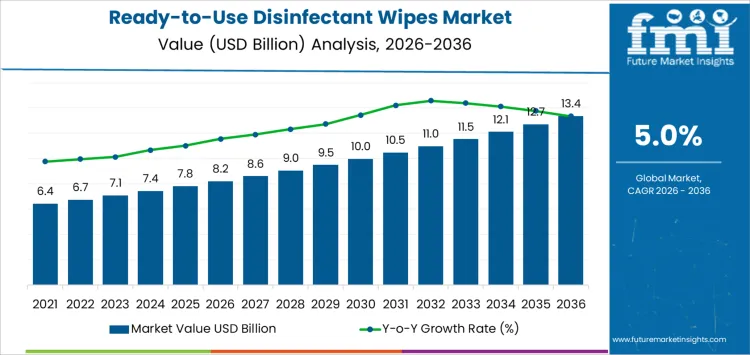
In 2026, the ready to use disinfectant wipes market stands at USD 8.2 billion and is expected to reach USD 13.3 billion by 2036, reflecting a CAGR of 5.0%. Expansion from USD 6.1 billion in 2020 is driven by sustained demand across healthcare facilities, commercial offices, schools, and household settings. Quaternary ammonium and oxidizer based wipes remain widely used due to compatibility with high touch surface protocols. Nonwoven spunlace substrates dominate as they balance strength and absorbency. Canister packaging supports frequent access and controlled dispensing in shared environments.
From 2027 through 2031, market value increases from USD 8.6 billion to USD 10.5 billion, then advances steadily toward USD 13.3 billion by 2036. Healthcare and long term care settings continue to anchor consumption due to routine surface sanitation requirements. Commercial buildings and households maintain consistent usage aligned with daily cleaning habits. Alcohol and peroxide based wipes gain share in applications requiring faster drying. Growth reflects repeat purchase behavior, packaging convenience, and standardized hygiene practices rather than increases in surface coverage or cleaning frequency.
Quick Stats of the Ready-to-Use Disinfectant Wipes Market:
- Ready-to-Use Disinfectant Wipes Market Value (2026): USD 8.2 billion
- Ready-to-Use Disinfectant Wipes Market Forecast Value (2036): USD 13.3 billion
- Ready-to-Use Disinfectant Wipes Market Forecast CAGR (2026–2036): 5.0%
- Leading Active Chemistry in the Market: Quaternary Ammonium Wipes (34%)
- Key Growth Regions: China, Brazil, USA, UK, Germany
- Top Players: Ecolab, Diversey, Zep, Spartan Chemical, Betco, Clorox, SC Johnson Professional, Reckitt, Solenis, 3M
What is the Growth Forecast for the Ready-to-Use Disinfectant Wipes Market through 2036?
Between 2026 and 2031, the ready-to-use disinfectant wipes market expands from USD 8.2 billion to around USD 10.0 billion, reflecting demand anchored in immediacy, portability, and point-of-use hygiene needs. Growth during this phase is driven by widespread reliance on wipes in offices, schools, healthcare facilities, and public transport systems where rapid surface sanitation is required without additional equipment. Consumption patterns are closely tied to daily footfall rather than episodic cleaning cycles. Product differentiation during this period centers on substrate durability, moisture retention, and compatibility with sensitive surfaces such as electronics and medical devices.
From 2031 to 2036, the market grows from approximately USD 10.0 billion to USD 13.3 billion, showing stronger value expansion as wipes become embedded in routine hygiene behavior across households and professional settings. Demand benefits from higher per-location usage, expansion of private-label offerings, and broader adoption in foodservice front-of-house and retail checkout areas. Growth in this phase reflects normalization of wipe-based disinfection as a default cleaning step rather than a supplementary option. Increased use in multi-surface applications, higher replacement frequency, and wider distribution through mass retail and institutional supply channels reinforce sustained market momentum.
Ready to Use Disinfectant Wipes Market Key Takeaways
| Metric | Value |
|---|---|
| Market Value (2026) | USD 8.2 billion |
| Forecast Value (2036) | USD 13.3 billion |
| Forecast CAGR (2026–2036) | 5.0% |
How Are Convenience and Compliance Shaping the Ready-to-Use Disinfectant Wipes Market from 2026 to 2036?
Ready-to-use disinfectant wipes gained traction as facilities required immediate surface hygiene without preparation or equipment setup. Offices, hospitals, schools, and transport operators adopted wipes for rapid cleaning of high-touch surfaces such as desks, rails, medical carts, and electronics. Historical demand reflected preference for pre-saturated formats that delivered consistent dosing and reduced cross-contamination risk. Buyers selected wipes based on substrate strength, liquid retention, and compatibility with sensitive surfaces. Usage patterns aligned with routine touchpoint cleaning, infection control audits, and decentralised cleaning responsibilities across large facilities.
From 2026 to 2036 demand is expected to expand as hygiene protocols remain embedded in daily operations across public and private spaces. Growth follows wider use in non-clinical settings including retail, logistics hubs, and shared workspaces. Manufacturers focus on faster kill times, low residue formulations, and wipes that resist tearing during use. Buyers evaluate dispenser efficiency, shelf stability, and disposal impact. Demand depends on labour efficiency, regulatory labelling clarity, and preference for portable disinfection solutions that support frequent, visible cleaning practices across distributed environments.
What Is the Demand for the Ready-to-Use Disinfectant Wipes Market by Active Chemistry and End-Use Setting for 2026 to 2036?
From 2026 to 2036, the ready-to-use disinfectant wipes market expands as surface hygiene becomes embedded in daily routines across institutional, commercial, and household settings. Quaternary ammonium wipes lead active chemistry with a 34% share due to their balance of antimicrobial coverage and material compatibility. Healthcare and long-term care settings represent the largest end-use segment at 32%, driven by high-touch surface density and structured infection control protocols. Demand growth reflects preference for disposable formats that support speed, consistency, and reduced cross-contamination risk.
Why do quaternary ammonium wipes account for 34% of demand in the ready-to-use disinfectant wipes market by active chemistry from 2026 to 2036?
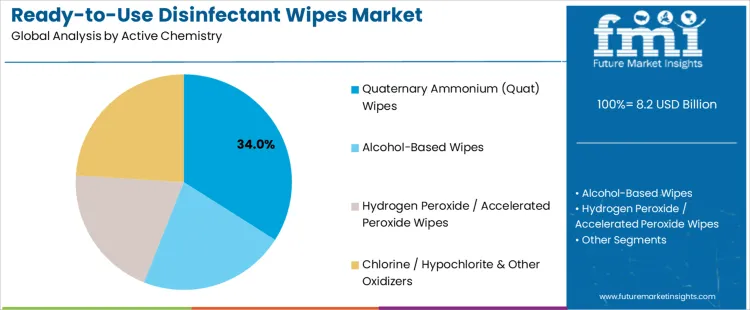
Quaternary ammonium wipes account for 34% of demand because they provide reliable antimicrobial performance while remaining suitable for frequent surface contact. Consumption intensity remains high in environments that require repeated wiping of desks, beds, rails, equipment housings, and shared fixtures. Usage stays stable as quat formulations offer residual activity that supports extended protection between cleaning cycles. Procurement decisions prioritize compatibility with plastics, coated metals, laminates, and synthetic fabrics that dominate modern interiors.
Buyers favor wipes that maintain moisture levels without dripping or premature drying during use. Price sensitivity remains moderate since quat wipes balance efficacy with lower corrosion and odor concerns. Specification control emphasizes active concentration stability, wipe material absorbency, and uniform liquid distribution across each sheet. Demand continues from 2026 to 2036 as organizations standardize disinfectant wipes for routine sanitation rather than episodic deep cleaning. Repeat purchasing patterns remain predictable because wipes are consumed continuously across shifts. Substitution pressure from alcohol or oxidizer wipes remains limited where surface safety, user comfort, and routine use frequency favor quaternary ammonium chemistry.
Why do healthcare and long-term care settings represent 32% of demand in the ready-to-use disinfectant wipes market by end-use setting from 2026 to 2036?
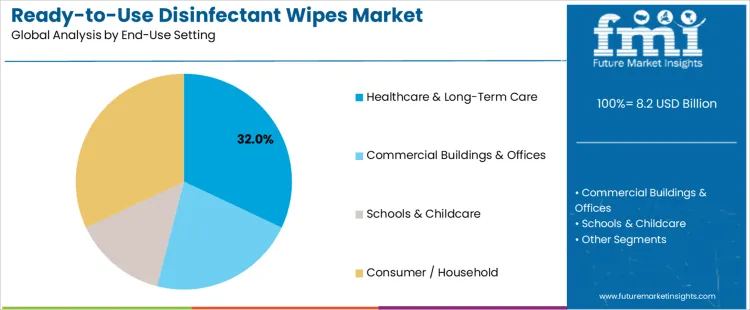
Healthcare and long-term care settings represent 32% of demand because patient proximity, vulnerable populations, and frequent surface contact require continuous disinfection. Consumption is concentrated in hospitals, nursing homes, rehabilitation centers, and outpatient facilities where wipe-based cleaning supports rapid response between patient interactions. Usage remains steady as wipes allow staff to sanitize equipment and surfaces without leaving work areas or preparing solutions. Procurement favors products validated for healthcare protocols, defined contact times, and compatibility with medical devices.
Buyers prioritize wipes that reduce cross-contamination through single-use formats and controlled moisture release. Price sensitivity stays moderate since infection control outcomes outweigh per-unit cost considerations. Specification control focuses on lint-free substrates, consistent saturation, and packaging that preserves moisture during high-frequency access. Demand persists from 2026 to 2036 as aging populations, staffing efficiency needs, and infection prevention policies sustain continuous wipe consumption. Repeat utilization remains stable due to standardized cleaning checklists and regulatory oversight tied to surface hygiene compliance.
How Is Demand for Ready to Use Disinfectant Wipes Being Shaped by Point of Use Hygiene Needs?
What Operational Conditions Are Driving Demand for Ready to Use Disinfectant Wipes?
Drivers arise from workflows that depend on rapid, targeted disinfection. Hospitals select wipes to manage high touch surfaces without interrupting care routines. Schools adopt wipes for desks and equipment cleaned between classes. Fitness centers rely on them for member use on shared machines throughout the day. Food retail back rooms keep wipes for spot sanitation where water access is limited. These conditions reflect operational pressures tied to turnover, shared equipment use, and staff availability, anchoring demand in convenience and immediate effectiveness.
What Practical Constraints Are Limiting Wider Adoption of Disinfectant Wipes?
Barriers relate to cost per use, waste generation, and surface compatibility. High volume facilities find wipes more expensive than liquid disinfectants for routine cleaning. Disposal of used wipes increases waste handling requirements. Some surfaces require specific dwell times that wipes cannot always maintain. Drying of wipes in open containers reduces effectiveness, leading to product loss. Storage space for multiple canister types also affects purchasing. These constraints limit broader adoption where cost efficiency, sustainability rules, or surface requirements take precedence.
What is the Growth Outlook for Ready to Use Disinfectant Wipes Across Key Countries?
| Country | CAGR (%) |
|---|---|
| China | 6.0% |
| Brazil | 5.8% |
| USA | 4.7% |
| UK | 4.7% |
| Germany | 4.6% |
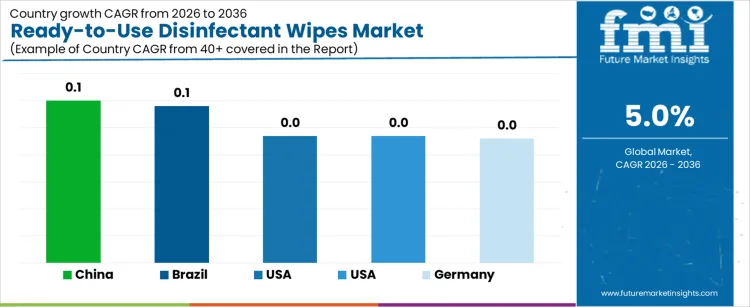
The ready to use disinfectant wipes segment is expanding steadily across global markets, driven by routine hygiene practices in healthcare, commercial, and household settings. China leads at 6.0%, supported by large scale institutional usage, public facility sanitation programs, and strong uptake in healthcare and transportation hubs. Brazil follows at 5.8%, reflecting growing adoption in hospitality, retail spaces, and outsourced cleaning services. The USA and UK each post 4.7% growth, shaped by mature consumption patterns, recurring demand from hospitals, offices, and schools, and preference for convenient, pre saturated formats. Germany at 4.6% shows stable expansion linked to industrial hygiene standards and healthcare compliance requirements. Overall growth remains consistent, supported by repeat purchase behavior, standardized cleaning protocols, and sustained focus on surface disinfection across professional and consumer environments.
How Are Convenience Focused Hygiene Practices Supporting the Ready to Use Disinfectant Wipes Market in the United States?
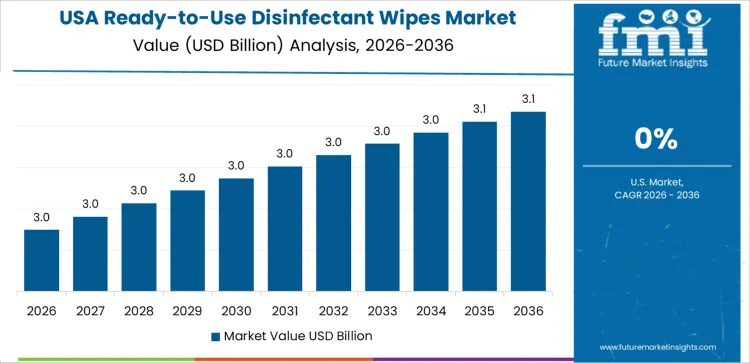
Ready to use disinfectant wipes demand in the United States is growing at a CAGR of 4.7% from 2026 to 2036 as healthcare facilities, offices, and households rely on quick sanitation solutions. Healthcare providers use wipes for surface disinfection between patient interactions to maintain hygiene efficiency. Office environments apply wipes to keep shared workspaces clean throughout the day. Households purchase ready to use wipes for routine hygiene across kitchens, bathrooms, and high touch surfaces. Growth reflects steady preference for portable and time saving cleaning formats across professional and personal settings nationwide.
- Healthcare providers use wipes for rapid surface sanitation.
- Offices apply disinfectant wipes in shared workspaces.
- Households rely on wipes for routine daily hygiene.
What Is Driving Adoption of the Ready to Use Disinfectant Wipes Market in Germany?
Ready to use disinfectant wipes demand in Germany is expanding at a CAGR of 4.6% from 2026 to 2036 as hospitals, offices, and public facilities adopt convenient cleaning formats. Hospitals rely on wipes for controlled disinfection of medical equipment and contact surfaces. Office buildings use wipes to maintain hygiene in high contact zones such as desks and meeting rooms. Public facilities integrate wipes into daily cleaning routines to support visitor safety. Growth reflects structured adoption driven by hygiene standards and ease of application across institutional environments.
- Hospitals rely on wipes for controlled surface disinfection.
- Offices use disinfectant wipes in high contact zones.
- Public facilities integrate wipes into routine cleaning schedules.
Why Is the Ready to Use Disinfectant Wipes Market Expanding Faster in China?
Ready to use disinfectant wipes demand in China is increasing at a CAGR of 6.0% from 2026 to 2036 as commercial complexes, healthcare facilities, and transport hubs expand use of portable sanitation products. Commercial complexes apply wipes to manage cleanliness in common areas with high foot traffic. Healthcare facilities rely on wipes for fast disinfection workflows during routine operations. Transport hubs use wipes to support passenger hygiene needs across terminals. Growth reflects broad scale adoption across high traffic environments nationwide.
- Commercial complexes use wipes to manage common area hygiene.
- Healthcare facilities rely on wipes for fast disinfection tasks.
- Transport hubs apply wipes to support passenger cleanliness.
How Are Service Sector Needs Shaping the Ready to Use Disinfectant Wipes Market in the United Kingdom?
Ready to use disinfectant wipes demand in the United Kingdom is growing at a CAGR of 4.7% from 2026 to 2036 as offices, hospitality venues, and healthcare sites adopt convenient sanitation solutions. Office managers rely on wipes for rapid cleaning between meetings and shared workspace use. Hospitality venues use wipes to maintain hygiene across guest rooms and public areas. Healthcare sites apply wipes to support infection control routines during daily operations. Growth reflects steady reliance on simple sanitation tools across service environments.
- Offices rely on wipes for rapid surface cleaning.
- Hospitality venues use wipes to maintain guest hygiene standards.
- Healthcare sites apply wipes for infection control support.
What Is Supporting Growth of the Ready to Use Disinfectant Wipes Market in Brazil?
Ready to use disinfectant wipes demand in Brazil is expanding at a CAGR of 5.8% from 2026 to 2036 as commercial facilities, public buildings, and households adopt portable cleaning products. Commercial facilities use wipes to manage daily surface sanitation in offices and retail spaces. Public buildings rely on wipes for quick hygiene maintenance in shared areas. Households integrate disinfectant wipes into routine cleaning practices for convenience. Growth reflects increasing preference for accessible hygiene products across urban environments.
- Commercial facilities use wipes for daily sanitation needs.
- Public buildings rely on wipes for quick hygiene maintenance.
- Households integrate disinfectant wipes into routine cleaning practices.
What Is Driving the Demand for Ready to Use Disinfectant Wipes and Which Companies Shape Institutional and Consumer Use?
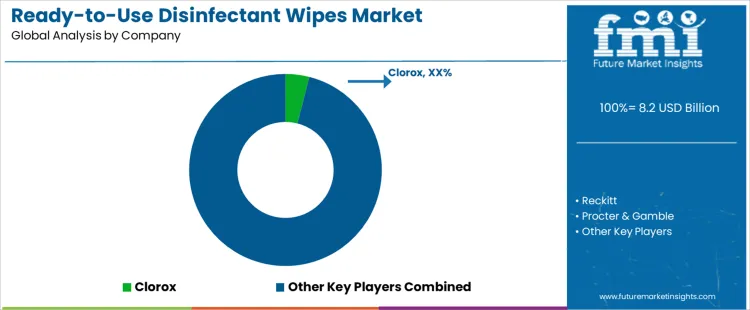
Demand for ready to use disinfectant wipes is supported by their role in fast surface sanitation across healthcare, offices, retail, transport, and household environments. Facilities value wipes for controlled dosing, portability, and reduced preparation time during routine cleaning. Ecolab and Diversey support institutional programs through surface specific wipes used in hospitals, foodservice, and hospitality settings. SC Johnson Professional and 3M supply workplaces and public buildings with wipes designed for frequent contact surfaces and shared equipment. Zep supports contract cleaners that require flexible formats across multi-site operations. Nice Pak plays a central role as a contract manufacturer supplying private label and branded wipes across retail and professional channels.
Household adoption is shaped by convenience, perceived safety, and preference for single step cleaning. Clorox, Reckitt, Procter and Gamble, and Unilever influence consumer behavior through branded wipes positioned for kitchens, bathrooms, electronics, and childcare areas. Buyers focus on kill spectrum, surface compatibility, moisture retention, and lint control. Retailers prioritize shelf stable packaging and clear usage instructions. Usage expands in gyms, schools, public transport, and elder care facilities where rapid wipe down is routine. Demand visibility tracks hygiene protocol standardization, outsourcing of cleaning services, and steady reliance on disposable wipes for high touch surface control in occupied spaces.
Key Players in the Ready to Use Disinfectant Wipes Market
- Ecolab
- Diversey
- Zep
- Spartan Chemical
- Betco
- Clorox
- SC Johnson Professional
- Reckitt
- Solenis
- 3M
Scope of the Report
| Items | Values |
|---|---|
| Quantitative Units (2026) | USD billion |
| Active Chemistry | Quaternary Ammonium Wipes; Alcohol Based Wipes; Hydrogen Peroxide and Accelerated Peroxide Wipes; Chlorine and Hypochlorite and Other Oxidizer Wipes |
| End Use Setting | Healthcare and Long Term Care; Commercial Buildings and Offices; Schools and Childcare; Consumer and Household |
| Wipe Substrate | Nonwoven Spunlace; Meltblown and Composite Nonwovens; Biodegradable and Cellulosic Substrates; Other Substrate Types |
| Pack Format | Canisters; Soft Packs; Refill Packs; Other Packaging Formats |
| Regions Covered | Asia Pacific; Europe; North America; Latin America; Middle East and Africa |
| Countries Covered | China; Japan; South Korea; India; Australia and New Zealand; ASEAN; Germany; United Kingdom; France; Italy; Spain; Nordic; BENELUX; United States; Canada; Mexico; Brazil; Chile; Kingdom of Saudi Arabia; Turkey; South Africa; plus 40+ additional countries across Asia Pacific, Europe, Latin America, and Middle East and Africa |
| Key Companies Profiled | Ecolab; Diversey; Zep; Spartan Chemical; Betco; Clorox; SC Johnson Professional; Reckitt; Solenis; 3M |
| Additional Attributes | Dollar by sales across active chemistry types, end use settings, wipe substrates, and pack formats; usage frequency variation across healthcare, commercial, and household environments; point of use versus centralized cleaning consumption patterns; dispenser access and moisture retention considerations; substrate strength and lint control requirements for sensitive surfaces; regulatory labeling and contact time compliance influence on procurement; role of private label manufacturing and contract wipe producers in supply structure |
Ready to Use Disinfectant Wipes Market Segmentation
Active Chemistry:
- Quaternary Ammonium (Quat) Wipes
- Alcohol-Based Wipes
- Hydrogen Peroxide / Accelerated Peroxide Wipes
- Chlorine / Hypochlorite & Other Oxidizers
End-Use Setting:
- Healthcare & Long-Term Care
- Commercial Buildings & Offices
- Schools & Childcare
- Consumer / Household
Wipe Substrate:
- Nonwoven Spunlace
- Meltblown / Composite Nonwovens
- Biodegradable / Cellulosic
- Other Substrates
Pack Format:
- Canisters
- Soft Packs
- Refill Packs
- Other Formats
Region
Asia Pacific
- China
- Japan
- South Korea
- India
- Australia & New Zealand
- ASEAN
- Rest of Asia Pacific
Europe
- Germany
- United Kingdom
- France
- Italy
- Spain
- Nordic
- BENELUX
- Rest of Europe
North America
- United States
- Canada
- Mexico
Latin America
- Brazil
- Chile
- Rest of Latin America
Middle East & Africa
- Kingdom of Saudi Arabia
- Other GCC Countries
- Turkey
- South Africa
- Other African Union
- Rest of Middle East & Africa
Frequently Asked Questions
How big is the ready-to-use disinfectant wipes market in 2026?
The global ready-to-use disinfectant wipes market is estimated to be valued at USD 8.2 billion in 2026.
What will be the size of ready-to-use disinfectant wipes market in 2036?
The market size for the ready-to-use disinfectant wipes market is projected to reach USD 13.4 billion by 2036.
How much will be the ready-to-use disinfectant wipes market growth between 2026 and 2036?
The ready-to-use disinfectant wipes market is expected to grow at a 5.0% CAGR between 2026 and 2036.
What are the key product types in the ready-to-use disinfectant wipes market?
The key product types in ready-to-use disinfectant wipes market are quaternary ammonium (quat) wipes, alcohol-based wipes, hydrogen peroxide / accelerated peroxide wipes and chlorine / hypochlorite & other oxidizers.
Which end-use setting segment to contribute significant share in the ready-to-use disinfectant wipes market in 2026?
In terms of end-use setting, healthcare & long-term care segment to command 32.0% share in the ready-to-use disinfectant wipes market in 2026.
Preview the report firsthand - request a free sample
Get SampleGet the brochure for pricing and purchase details.
Get PDFTable of Content
- Executive Summary
- Global Market Outlook
- Demand-side Trends
- Supply-side Trends
- Technology Roadmap Analysis
- Analysis and Recommendations
- Market Overview
- Market Coverage / Taxonomy
- Market Definition / Scope / Limitations
- Market Background
- Market Dynamics
- Drivers
- Restraints
- Opportunity
- Trends
- Scenario Forecast
- Demand in Optimistic Scenario
- Demand in Likely Scenario
- Demand in Conservative Scenario
- Opportunity Map Analysis
- Product Life Cycle Analysis
- Supply Chain Analysis
- Investment Feasibility Matrix
- Value Chain Analysis
- PESTLE and Porter’s Analysis
- Regulatory Landscape
- Regional Parent Market Outlook
- Production and Consumption Statistics
- Import and Export Statistics
- Market Dynamics
- Global Market Analysis 2021 to 2025 and Forecast, 2026 to 2036
- Historical Market Size Value (USD Million) Analysis, 2021 to 2025
- Current and Future Market Size Value (USD Million) Projections, 2026 to 2036
- Y-o-Y Growth Trend Analysis
- Absolute $ Opportunity Analysis
- Global Market Pricing Analysis 2021 to 2025 and Forecast 2026 to 2036
- Global Market Analysis 2021 to 2025 and Forecast 2026 to 2036, By Active Chemistry
- Introduction / Key Findings
- Historical Market Size Value (USD Million) Analysis By Active Chemistry , 2021 to 2025
- Current and Future Market Size Value (USD Million) Analysis and Forecast By Active Chemistry , 2026 to 2036
- Quaternary Ammonium (Quat) Wipes
- Alcohol-Based Wipes
- Hydrogen Peroxide / Accelerated Peroxide Wipes
- Chlorine / Hypochlorite & Other Oxidizers
- Y-o-Y Growth Trend Analysis By Active Chemistry , 2021 to 2025
- Absolute $ Opportunity Analysis By Active Chemistry , 2026 to 2036
- Global Market Analysis 2021 to 2025 and Forecast 2026 to 2036, By End-Use Setting
- Introduction / Key Findings
- Historical Market Size Value (USD Million) Analysis By End-Use Setting, 2021 to 2025
- Current and Future Market Size Value (USD Million) Analysis and Forecast By End-Use Setting, 2026 to 2036
- Healthcare & Long-Term Care
- Commercial Buildings & Offices
- Schools & Childcare
- Consumer / Household
- Y-o-Y Growth Trend Analysis By End-Use Setting, 2021 to 2025
- Absolute $ Opportunity Analysis By End-Use Setting, 2026 to 2036
- Global Market Analysis 2021 to 2025 and Forecast 2026 to 2036, By Wipe Substrate
- Introduction / Key Findings
- Historical Market Size Value (USD Million) Analysis By Wipe Substrate, 2021 to 2025
- Current and Future Market Size Value (USD Million) Analysis and Forecast By Wipe Substrate, 2026 to 2036
- Nonwoven Spunlace
- Meltblown / Composite Nonwovens
- Biodegradable / Cellulosic
- Other Substrates
- Y-o-Y Growth Trend Analysis By Wipe Substrate, 2021 to 2025
- Absolute $ Opportunity Analysis By Wipe Substrate, 2026 to 2036
- Global Market Analysis 2021 to 2025 and Forecast 2026 to 2036, By Pack Format
- Introduction / Key Findings
- Historical Market Size Value (USD Million) Analysis By Pack Format, 2021 to 2025
- Current and Future Market Size Value (USD Million) Analysis and Forecast By Pack Format, 2026 to 2036
- Canisters
- Soft Packs
- Refill Packs
- Other Formats
- Y-o-Y Growth Trend Analysis By Pack Format, 2021 to 2025
- Absolute $ Opportunity Analysis By Pack Format, 2026 to 2036
- Global Market Analysis 2021 to 2025 and Forecast 2026 to 2036, By Region
- Introduction
- Historical Market Size Value (USD Million) Analysis By Region, 2021 to 2025
- Current Market Size Value (USD Million) Analysis and Forecast By Region, 2026 to 2036
- North America
- Latin America
- Western Europe
- Eastern Europe
- East Asia
- South Asia and Pacific
- Middle East & Africa
- Market Attractiveness Analysis By Region
- North America Market Analysis 2021 to 2025 and Forecast 2026 to 2036, By Country
- Historical Market Size Value (USD Million) Trend Analysis By Market Taxonomy, 2021 to 2025
- Market Size Value (USD Million) Forecast By Market Taxonomy, 2026 to 2036
- By Country
- USA
- Canada
- Mexico
- By Active Chemistry
- By End-Use Setting
- By Wipe Substrate
- By Pack Format
- By Country
- Market Attractiveness Analysis
- By Country
- By Active Chemistry
- By End-Use Setting
- By Wipe Substrate
- By Pack Format
- Key Takeaways
- Latin America Market Analysis 2021 to 2025 and Forecast 2026 to 2036, By Country
- Historical Market Size Value (USD Million) Trend Analysis By Market Taxonomy, 2021 to 2025
- Market Size Value (USD Million) Forecast By Market Taxonomy, 2026 to 2036
- By Country
- Brazil
- Chile
- Rest of Latin America
- By Active Chemistry
- By End-Use Setting
- By Wipe Substrate
- By Pack Format
- By Country
- Market Attractiveness Analysis
- By Country
- By Active Chemistry
- By End-Use Setting
- By Wipe Substrate
- By Pack Format
- Key Takeaways
- Western Europe Market Analysis 2021 to 2025 and Forecast 2026 to 2036, By Country
- Historical Market Size Value (USD Million) Trend Analysis By Market Taxonomy, 2021 to 2025
- Market Size Value (USD Million) Forecast By Market Taxonomy, 2026 to 2036
- By Country
- Germany
- UK
- Italy
- Spain
- France
- Nordic
- BENELUX
- Rest of Western Europe
- By Active Chemistry
- By End-Use Setting
- By Wipe Substrate
- By Pack Format
- By Country
- Market Attractiveness Analysis
- By Country
- By Active Chemistry
- By End-Use Setting
- By Wipe Substrate
- By Pack Format
- Key Takeaways
- Eastern Europe Market Analysis 2021 to 2025 and Forecast 2026 to 2036, By Country
- Historical Market Size Value (USD Million) Trend Analysis By Market Taxonomy, 2021 to 2025
- Market Size Value (USD Million) Forecast By Market Taxonomy, 2026 to 2036
- By Country
- Russia
- Poland
- Hungary
- Balkan & Baltic
- Rest of Eastern Europe
- By Active Chemistry
- By End-Use Setting
- By Wipe Substrate
- By Pack Format
- By Country
- Market Attractiveness Analysis
- By Country
- By Active Chemistry
- By End-Use Setting
- By Wipe Substrate
- By Pack Format
- Key Takeaways
- East Asia Market Analysis 2021 to 2025 and Forecast 2026 to 2036, By Country
- Historical Market Size Value (USD Million) Trend Analysis By Market Taxonomy, 2021 to 2025
- Market Size Value (USD Million) Forecast By Market Taxonomy, 2026 to 2036
- By Country
- China
- Japan
- South Korea
- By Active Chemistry
- By End-Use Setting
- By Wipe Substrate
- By Pack Format
- By Country
- Market Attractiveness Analysis
- By Country
- By Active Chemistry
- By End-Use Setting
- By Wipe Substrate
- By Pack Format
- Key Takeaways
- South Asia and Pacific Market Analysis 2021 to 2025 and Forecast 2026 to 2036, By Country
- Historical Market Size Value (USD Million) Trend Analysis By Market Taxonomy, 2021 to 2025
- Market Size Value (USD Million) Forecast By Market Taxonomy, 2026 to 2036
- By Country
- India
- ASEAN
- Australia & New Zealand
- Rest of South Asia and Pacific
- By Active Chemistry
- By End-Use Setting
- By Wipe Substrate
- By Pack Format
- By Country
- Market Attractiveness Analysis
- By Country
- By Active Chemistry
- By End-Use Setting
- By Wipe Substrate
- By Pack Format
- Key Takeaways
- Middle East & Africa Market Analysis 2021 to 2025 and Forecast 2026 to 2036, By Country
- Historical Market Size Value (USD Million) Trend Analysis By Market Taxonomy, 2021 to 2025
- Market Size Value (USD Million) Forecast By Market Taxonomy, 2026 to 2036
- By Country
- Kingdom of Saudi Arabia
- Other GCC Countries
- Turkiye
- South Africa
- Other African Union
- Rest of Middle East & Africa
- By Active Chemistry
- By End-Use Setting
- By Wipe Substrate
- By Pack Format
- By Country
- Market Attractiveness Analysis
- By Country
- By Active Chemistry
- By End-Use Setting
- By Wipe Substrate
- By Pack Format
- Key Takeaways
- Key Countries Market Analysis
- USA
- Pricing Analysis
- Market Share Analysis, 2025
- By Active Chemistry
- By End-Use Setting
- By Wipe Substrate
- By Pack Format
- Canada
- Pricing Analysis
- Market Share Analysis, 2025
- By Active Chemistry
- By End-Use Setting
- By Wipe Substrate
- By Pack Format
- Mexico
- Pricing Analysis
- Market Share Analysis, 2025
- By Active Chemistry
- By End-Use Setting
- By Wipe Substrate
- By Pack Format
- Brazil
- Pricing Analysis
- Market Share Analysis, 2025
- By Active Chemistry
- By End-Use Setting
- By Wipe Substrate
- By Pack Format
- Chile
- Pricing Analysis
- Market Share Analysis, 2025
- By Active Chemistry
- By End-Use Setting
- By Wipe Substrate
- By Pack Format
- Germany
- Pricing Analysis
- Market Share Analysis, 2025
- By Active Chemistry
- By End-Use Setting
- By Wipe Substrate
- By Pack Format
- UK
- Pricing Analysis
- Market Share Analysis, 2025
- By Active Chemistry
- By End-Use Setting
- By Wipe Substrate
- By Pack Format
- Italy
- Pricing Analysis
- Market Share Analysis, 2025
- By Active Chemistry
- By End-Use Setting
- By Wipe Substrate
- By Pack Format
- Spain
- Pricing Analysis
- Market Share Analysis, 2025
- By Active Chemistry
- By End-Use Setting
- By Wipe Substrate
- By Pack Format
- France
- Pricing Analysis
- Market Share Analysis, 2025
- By Active Chemistry
- By End-Use Setting
- By Wipe Substrate
- By Pack Format
- India
- Pricing Analysis
- Market Share Analysis, 2025
- By Active Chemistry
- By End-Use Setting
- By Wipe Substrate
- By Pack Format
- ASEAN
- Pricing Analysis
- Market Share Analysis, 2025
- By Active Chemistry
- By End-Use Setting
- By Wipe Substrate
- By Pack Format
- Australia & New Zealand
- Pricing Analysis
- Market Share Analysis, 2025
- By Active Chemistry
- By End-Use Setting
- By Wipe Substrate
- By Pack Format
- China
- Pricing Analysis
- Market Share Analysis, 2025
- By Active Chemistry
- By End-Use Setting
- By Wipe Substrate
- By Pack Format
- Japan
- Pricing Analysis
- Market Share Analysis, 2025
- By Active Chemistry
- By End-Use Setting
- By Wipe Substrate
- By Pack Format
- South Korea
- Pricing Analysis
- Market Share Analysis, 2025
- By Active Chemistry
- By End-Use Setting
- By Wipe Substrate
- By Pack Format
- Russia
- Pricing Analysis
- Market Share Analysis, 2025
- By Active Chemistry
- By End-Use Setting
- By Wipe Substrate
- By Pack Format
- Poland
- Pricing Analysis
- Market Share Analysis, 2025
- By Active Chemistry
- By End-Use Setting
- By Wipe Substrate
- By Pack Format
- Hungary
- Pricing Analysis
- Market Share Analysis, 2025
- By Active Chemistry
- By End-Use Setting
- By Wipe Substrate
- By Pack Format
- Kingdom of Saudi Arabia
- Pricing Analysis
- Market Share Analysis, 2025
- By Active Chemistry
- By End-Use Setting
- By Wipe Substrate
- By Pack Format
- Turkiye
- Pricing Analysis
- Market Share Analysis, 2025
- By Active Chemistry
- By End-Use Setting
- By Wipe Substrate
- By Pack Format
- South Africa
- Pricing Analysis
- Market Share Analysis, 2025
- By Active Chemistry
- By End-Use Setting
- By Wipe Substrate
- By Pack Format
- USA
- Market Structure Analysis
- Competition Dashboard
- Competition Benchmarking
- Market Share Analysis of Top Players
- By Regional
- By Active Chemistry
- By End-Use Setting
- By Wipe Substrate
- By Pack Format
- Competition Analysis
- Competition Deep Dive
- Clorox
- Overview
- Product Portfolio
- Profitability by Market Segments (Product/Age /Sales Channel/Region)
- Sales Footprint
- Strategy Overview
- Marketing Strategy
- Product Strategy
- Channel Strategy
- Reckitt
- Procter & Gamble
- SC Johnson Professional
- Ecolab
- Diversey
- Unilever
- 3M
- Zep
- Nice-Pak
- Clorox
- Competition Deep Dive
- Assumptions & Acronyms Used
- Research Methodology


