

- Industry Size (2026)
- USD 1.5 Bn
- Forecast (2036)
- USD 3.1 Bn
- CAGR (2026 to 2036)
- 8.0%
Disinfectant Fogging and Misting Chemicals Market Forecast and Outlook 2026 to 2036
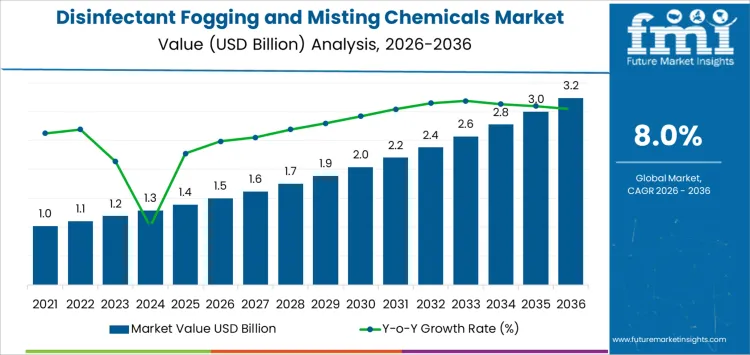
The disinfectant fogging and misting chemicals market is valued at USD 1.5 billion in 2026 and is projected to reach USD 3.1 billion by 2036, reflecting a CAGR of 8.0%. Growth from USD 1.0 billion in 2020 to USD 1.5 billion in 2026 reflects expanding use across healthcare laboratories, public transport systems, and hospitality facilities. Hydrogen peroxide and peracetic acid systems account for a large share due to compatibility with enclosed space disinfection. ULV fogging fluids dominate early demand as facilities adopt standardized airborne application protocols.
From 2027 onward, market value increases from USD 1.6 billion to USD 2.2 billion by 2031, then advances to USD 3.1 billion by 2036 through widening annual increments. Healthcare and laboratory environments remain the primary users due to recurring sanitation cycles. Industrial warehousing and public venues expand usage tied to large area coverage needs. Concentrated formulations retain a strong position as operators manage storage and dilution efficiency. Growth reflects increased deployment frequency and broader institutional adoption rather than expansion of disinfected floor space.
Quick Stats of the Disinfectant Fogging and Misting Chemicals Market
- Disinfectant Fogging and Misting Chemicals Market Value (2026): USD 1.5 billion
- Disinfectant Fogging and Misting Chemicals Market Forecast Value (2036): USD 3.1 billion
- Disinfectant Fogging and Misting Chemicals Market Forecast CAGR (2026-2036): 8.0%
- Leading Active Chemistry in the Market: Hydrogen Peroxide / Peracetic Acid Systems (34%)
- Key Growth Regions: China, Brazil, USA, UK, Germany
- Top Players: Ecolab, Diversey, SC Johnson Professional, 3M, Procter & Gamble, Reckitt, Clorox, Betco, Spartan Chemical, Zep
What is the Growth Forecast for the Disinfectant Fogging and Misting Chemicals Market through 2036?
Over the earlier part of the ten-year period, from 2026 to 2031, the market grows from USD 1.5 billion to around USD 2.0 billion, indicating a phase of consolidation rather than rapid escalation. Growth during these years reflects normalization after emergency-driven demand, with continued usage anchored in healthcare facilities, food processing plants, and public infrastructure maintenance. Adoption is sustained by routine sanitation protocols, regulatory compliance, and periodic outbreak preparedness. The market during this phase is characterized by controlled procurement cycles, contract renewals, and selective expansion into non-healthcare environments such as logistics and education facilities.
Across the latter half of the ten-year horizon, from 2031 to 2036, the market expands more decisively from about USD 2.0 billion to USD 3.1 billion. This comparison highlights a clear acceleration in value creation relative to the earlier years. Growth is supported by wider institutionalization of fogging and misting as standard disinfection methods, expansion into hospitality and transportation sectors, and higher usage frequency in large enclosed spaces. While the first half of the decade emphasized stabilization, the second half reflects scale-driven growth, broader application coverage, and stronger integration into long-term facility hygiene programs worldwide.
Disinfectant Fogging and Misting Chemicals Market Key Takeaways
| Metric | Value |
|---|---|
| Market Value (2026) | USD 1.4 billion |
| Forecast Value (2036) | USD 2.9 billion |
| Forecast CAGR (2026-2036) | 8.0% |
What Is Driving the Demand for the Disinfectant Fogging and Misting Chemicals Market from 2026 to 2036?
Use of disinfectant fogging and misting chemicals expanded as facilities adopted large area disinfection methods that limit manual surface contact. Airports, food plants, warehouses, and healthcare buildings relied on fine droplet dispersion to reach complex layouts and high surfaces. Historical demand followed infection control protocols that required rapid turnaround between shifts or occupants. Buyers selected chemicals based on droplet stability, material compatibility, and residue control. Adoption depended on alignment with fogging equipment specifications and safety thresholds for occupied or semi occupied spaces.
From 2026 to 2036 demand is expected to progress with wider deployment in transport hubs, hospitality, animal housing, and controlled industrial environments. Growth reflects need for scalable disinfection during routine operations rather than emergency response alone. Chemical suppliers focus on formulations suited for thermal fogging and cold misting systems with predictable dispersion behavior. Buyers assess efficacy across pathogens, ventilation interaction, and reentry timelines. Demand depends on regulatory guidance, facility risk management practices, and integration of automated disinfection into scheduled maintenance programs across commercial and institutional settings.
What Is the Demand for the Disinfectant Fogging and Misting Chemicals Market by Active Chemistry and Deployment for 2026 to 2036?
From 2026 to 2036, the disinfectant fogging and misting chemicals market evolves as controlled-area sanitation becomes routine across healthcare, transportation, food handling, and large public facilities. Demand centers on chemistries that deliver broad-spectrum efficacy at low concentrations while remaining compatible with automated dispersion systems. Hydrogen peroxide and peracetic acid systems hold the leading chemistry share at 34% due to their residue-free breakdown and high oxidation efficiency. ULV fogging fluids dominate deployment at 44% as facilities favor low-volume dispersion that achieves uniform coverage with minimal moisture accumulation across enclosed spaces.
Why do hydrogen peroxide and peracetic acid systems account for 34% of demand in the disinfectant fogging and misting chemicals market by active chemistry from 2026 to 2036?
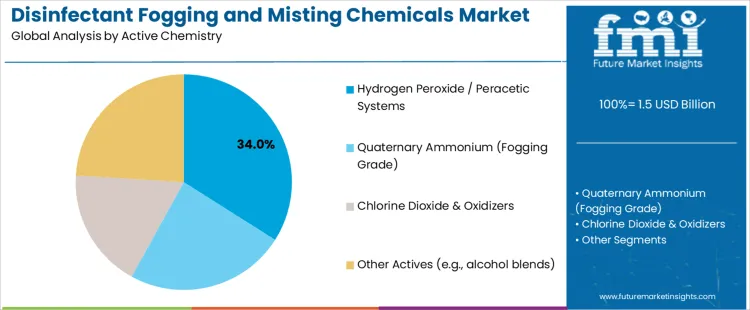
Hydrogen peroxide and peracetic acid systems account for 34% of demand because operators require fast-acting oxidizing agents that leave no persistent chemical residue after application. Consumption intensity is high in hospitals, pharmaceutical manufacturing, laboratories, and clean production zones where post-disinfection wipe-down is undesirable. Usage remains stable since these chemistries decompose into oxygen, water, and acetic acid derivatives, reducing concerns around surface accumulation and long-term material interaction. Procurement decisions prioritize efficacy against bacteria, viruses, spores, and fungi across short contact times. Buyers favor formulations with controlled vapor behavior that remain effective under varying humidity conditions. Price sensitivity stays moderate because downtime reduction and validated kill rates influence purchasing decisions more than unit cost. Specification control focuses on concentration stability, storage shelf life, and compatibility with stainless steel, polymers, and electronic surfaces. Demand remains consistent from 2026 to 2036 as healthcare expansion, pharmaceutical output, and bio-controlled environments continue to rely on oxidizing fogging chemistries for routine and terminal disinfection cycles.
Why do ULV fogging fluids represent 44% of demand in the disinfectant fogging and misting chemicals market by deployment from 2026 to 2036?
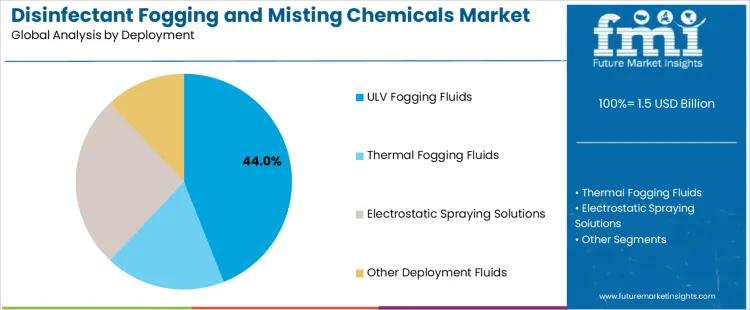
ULV fogging fluids represent 44% of demand because they enable uniform dispersal of disinfectants using minimal liquid volume while reaching complex geometries and enclosed zones. Consumption is strong in airports, transit systems, food processing plants, warehouses, and institutional buildings where rapid room turnover is required. Usage remains steady since ULV systems produce fine droplets that stay airborne long enough to contact walls, equipment surfaces, and ventilation pathways. Procurement is driven by facility managers selecting fluids optimized for particle size stability and consistent suspension during atomization. Buyers prioritize formulations that reduce surface wetting and eliminate pooling risks. Price sensitivity remains moderate as ULV deployment lowers chemical usage per cycle and reduces labor time. Specification control emphasizes droplet size distribution, evaporation rate, and machine compatibility. Demand continues from 2026 to 2036 as automated disinfection programs expand and operators standardize ULV-based sanitation protocols across high-traffic and controlled environments.
How Is Demand for Disinfectant Fogging and Misting Chemicals Taking Shape Within Controlled Sanitation Environments?
Demand develops through settings that require rapid, wide area disinfection without manual surface wiping. Food storage warehouses use fogging agents during scheduled shutdowns to reach enclosed zones. Hospitals apply misting chemicals in isolation rooms between patient occupancy cycles. Schools and childcare centers rely on fogging during off hours to reset shared spaces. Transportation depots deploy misting systems inside vehicles where contact points are difficult to access. These uses arise from operational needs for coverage efficiency and downtime control rather than general cleaning preferences, anchoring demand in specific sanitation workflows.
What Application Specific Factors Are Driving Demand for Disinfectant Fogging and Misting Chemicals?
Drivers stem from the need to disinfect large or complex spaces with minimal labor. Healthcare facilities adopt fogging chemicals to shorten room turnover while meeting internal hygiene protocols. Food processing plants use misting agents to sanitize air and surfaces during maintenance windows. Public facilities select formulations compatible with installed fogging equipment to standardize procedures across sites. Logistics centers adopt misting to treat high ceiling areas unreachable by manual methods. These drivers reflect workflow efficiency goals and equipment compatibility rather than marketing influence or consumer behavior.
What Operational and Safety Constraints Are Limiting Wider Use of Fogging and Misting Chemicals?
Barriers arise from ventilation requirements, training needs, and chemical handling rules. Some buildings lack airflow systems that support safe dispersal and clearance after application. Facilities require trained staff to manage exposure controls, which adds labor cost. Sensitive electronics in offices and data rooms limit use of certain formulations. Regulatory labeling and storage requirements increase administrative burden for smaller operators. Budget limits in schools and municipal facilities also restrict frequent application. These constraints shape selective adoption where infrastructure, staffing, or safety controls remain limited.
What is the Growth Outlook for Disinfectant Fogging and Misting Chemicals Across Key Countries?
| Country | CAGR (%) |
|---|---|
| China | 9.0% |
| Brazil | 8.8% |
| USA | 7.7% |
| UK | 7.7% |
| Germany | 7.6% |
The disinfectant fogging and misting chemicals sector is showing strong growth across major regions, driven by heightened hygiene protocols in healthcare, transportation, hospitality, and large commercial facilities. China leads at 9.0%, supported by extensive deployment in public infrastructure, manufacturing plants, and municipal sanitation programs. Brazil follows at 8.8%, reflecting rising use in commercial buildings, airports, and food processing facilities. The USA and UK each record 7.7% growth, driven by institutional adoption in hospitals, schools, offices, and event venues where rapid area disinfection is required. Germany at 7.6% shows steady expansion linked to industrial hygiene standards, healthcare compliance, and routine preventive disinfection practices. Overall growth is reinforced by recurring application cycles, regulatory focus on infection control, and continued reliance on automated fogging and misting systems.
How Are Infection Control Protocols Supporting Disinfectant Fogging and Misting Chemicals Demand in the United States?
Disinfectant fogging and misting chemicals demand in the United States is rising at a CAGR of 7.7% from 2026 to 2036 as healthcare facilities, commercial buildings, and transport operators rely on automated disinfection methods for large enclosed spaces. Hospitals use fogging chemicals to disinfect patient rooms and surgical areas efficiently. Commercial buildings adopt misting systems to maintain hygiene in shared environments. Transport operators apply fogging solutions to manage sanitation across vehicles and terminals. Growth reflects consistent use of contactless disinfection methods across sectors focused on operational hygiene.
- Hospitals use fogging chemicals for room and equipment sanitation.
- Commercial buildings adopt misting systems for shared spaces.
- Transport operators apply automated disinfection solutions regularly.
What Is Driving Disinfectant Fogging and Misting Chemicals Adoption in Germany?
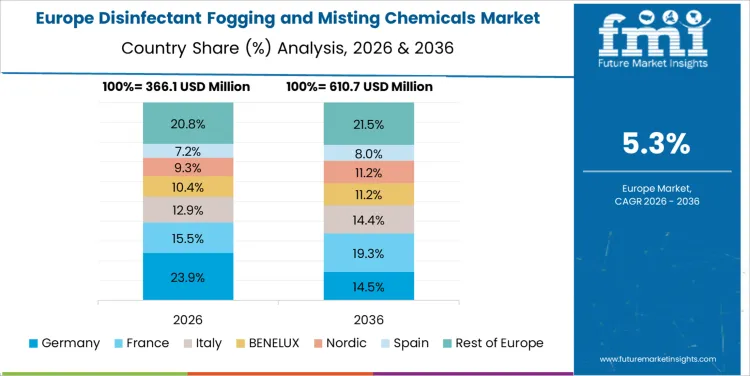
Disinfectant fogging and misting chemicals demand in Germany is expanding at a CAGR of 7.6% from 2026 to 2036 as industrial facilities, healthcare institutions, and public buildings integrate automated disinfection into maintenance routines. Industrial users apply misting chemicals to sanitize production areas with minimal downtime. Healthcare institutions rely on fogging solutions for controlled hygiene management. Public buildings integrate these chemicals into scheduled sanitation protocols. Growth reflects structured adoption aligned with safety standards and systematic facility management practices.
- Industrial facilities apply misting chemicals to sanitize work zones.
- Healthcare institutions rely on fogging for controlled hygiene routines.
- Public buildings integrate automated disinfection into maintenance plans.
Why Is China Experiencing Faster Growth in Disinfectant Fogging and Misting Chemicals Demand?
Disinfectant fogging and misting chemicals demand in China is increasing at a CAGR of 9.0% from 2026 to 2036 as commercial complexes, manufacturing zones, and public infrastructure expand automated sanitation programs. Commercial complexes use fogging chemicals to manage large indoor spaces. Manufacturing zones adopt misting solutions to maintain hygiene across high activity areas. Public infrastructure projects specify fogging chemicals for routine disinfection. Growth reflects large scale deployment across expanding facilities nationwide.
- Commercial complexes use fogging chemicals for large indoor areas.
- Manufacturing zones adopt misting solutions for hygiene management.
- Public infrastructure projects specify automated disinfection chemicals.
How Are Service Sector Practices Influencing Demand in the United Kingdom?
Disinfectant fogging and misting chemicals demand in the United Kingdom is growing at a CAGR of 7.7% from 2026 to 2036 as offices, healthcare facilities, and hospitality venues adopt automated sanitation solutions. Offices use misting chemicals to disinfect shared workspaces. Healthcare facilities rely on fogging solutions for infection control procedures. Hospitality venues apply automated disinfection to maintain guest area hygiene. Growth reflects steady adoption across service sectors focused on efficient sanitation methods.
- Offices use misting chemicals for shared workspace hygiene.
- Healthcare facilities rely on fogging for infection control.
- Hospitality venues apply automated disinfection in guest areas.
What Factors Are Supporting Strong Demand Growth in Brazil?
Disinfectant fogging and misting chemicals demand in Brazil is expanding at a CAGR of 8.8% from 2026 to 2036 as commercial facilities, transport hubs, and public institutions increase use of automated sanitation systems. Commercial facilities adopt fogging chemicals to manage large floor areas efficiently. Transport hubs apply misting solutions for passenger safety. Public institutions integrate automated disinfection into regular cleaning schedules. Growth reflects rising awareness of efficient sanitation practices across urban infrastructure.
- Commercial facilities adopt fogging for efficient area coverage.
- Transport hubs apply misting solutions for passenger safety.
- Public institutions integrate automated disinfection into cleaning routines.
What Is Driving the Demand for Disinfectant Fogging and Misting Chemicals and Which Companies Shape Institutional Deployment
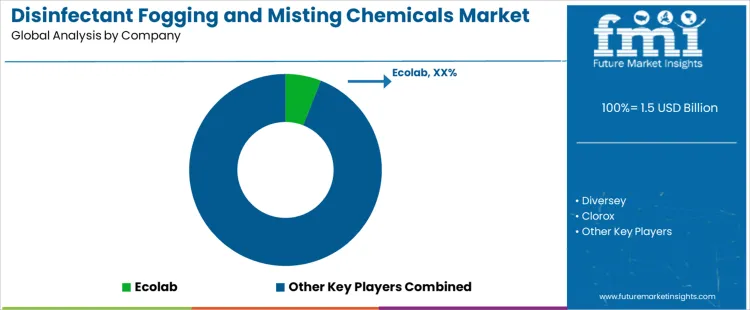
Use of disinfectant fogging and misting chemicals is expanding as facilities adopt whole room and rapid coverage disinfection methods that reduce manual labor. Hospitals, food processing plants, transport terminals, and animal care facilities rely on these systems to treat hard to reach surfaces and high volume spaces. Ecolab and Diversey supply validated formulations used with cold foggers and electrostatic sprayers in healthcare and hospitality settings. Steris supports critical care environments through vapor and mist based chemistries designed for high assurance decontamination. SC Johnson Professional and 3M participate through surface compatible disinfectants used in office buildings and public venues. Clorox and Reckitt support broader commercial use through branded concentrates adapted for fogging equipment.
Chemical choice depends on droplet behavior, contact time, material compatibility, and residue management after application. Evonik contributes through hydrogen peroxide based systems used in controlled disinfection programs where rapid breakdown is required. Lanxess supplies active biocides formulated into fogging products used in food, agriculture, and industrial sanitation. Neogen serves biosecurity focused environments including livestock facilities and laboratories. Adoption is guided by regulatory approval, operator safety, and effectiveness against airborne and surface pathogens. Demand visibility reflects preparedness planning, seasonal infection cycles, and routine sanitation protocols in high occupancy buildings.
Key Players in the Disinfectant Fogging and Misting Chemicals Market
- Ecolab
- Diversey
- SC Johnson Professional
- 3M
- Procter & Gamble
- Reckitt
- Clorox
- Betco
- Spartan Chemical
- Zep
Scope of the Report
| Items | Values |
|---|---|
| Quantitative Units (2026) | USD billion |
| Active Chemistry | Hydrogen Peroxide and Peracetic Acid Systems; Quaternary Ammonium Fogging Grade; Chlorine Dioxide and Oxidizing Agents; Other Actives including Alcohol Blends |
| Deployment Type | ULV Fogging Fluids; Thermal Fogging Fluids; Electrostatic Spraying Solutions; Other Deployment Fluids |
| End Use Setting | Healthcare and Laboratories; Transport including Aviation Rail and Transit; Hospitality and Public Venues; Industrial and Warehousing |
| Concentration | Concentrates for Dilution; Ready to Use Formulations |
| Regions Covered | Asia Pacific; Europe; North America; Latin America; Middle East and Africa |
| Countries Covered | China; Japan; South Korea; India; Australia and New Zealand; ASEAN; Germany; United Kingdom; France; Italy; Spain; Nordic; BENELUX; United States; Canada; Mexico; Brazil; Chile; Kingdom of Saudi Arabia; Turkey; South Africa; plus additional countries across Asia Pacific, Europe, Latin America, and Middle East and Africa |
| Key Companies Profiled | Ecolab; Diversey; SC Johnson Professional; 3M; Procter and Gamble; Reckitt; Clorox; Betco; Spartan Chemical; Zep |
| Additional Attributes | Dollar by sales across active chemistry types, deployment methods, concentration formats, and end use settings; frequency of fogging and misting cycles in institutional facilities; compatibility with ULV thermal and electrostatic equipment; droplet size stability and dispersion performance; residue behavior and reentry time management; material compatibility with metals polymers and electronics; regulatory approval and labeling requirements; operator safety and ventilation considerations; procurement through contract sanitation programs; integration with automated and scheduled disinfection workflows. |
Disinfectant Fogging and Misting Chemicals Market Segmentation
Active Chemistry:
- Hydrogen Peroxide / Peracetic Systems
- Quaternary Ammonium (Fogging Grade)
- Chlorine Dioxide & Oxidizers
- Other Actives (e.g., alcohol blends)
Deployment:
- ULV Fogging Fluids
- Thermal Fogging Fluids
- Electrostatic Spraying Solutions
- Other Deployment Fluids
End-Use Setting:
- Healthcare & Labs
- Transport (Aviation, Rail, Transit)
- Hospitality & Public Venues
- Industrial & Warehousing
Concentration:
- Concentrates for Dilution
- Ready-to-Use (RTU)
Region:
- Asia Pacific
- China
- Japan
- South Korea
- India
- Australia & New Zealand
- ASEAN
- Rest of Asia Pacific
- Europe
- Germany
- United Kingdom
- France
- Italy
- Spain
- Nordic
- BENELUX
- Rest of Europe
- North America
- United States
- Canada
- Mexico
- Latin America
- Brazil
- Chile
- Rest of Latin America
- Middle East & Africa
- Kingdom of Saudi Arabia
- Other GCC Countries
- Turkey
- South Africa
- Other African Union
- Rest of Middle East & Africa
Frequently Asked Questions
How big is the disinfectant fogging and misting chemicals market in 2026?
The global disinfectant fogging and misting chemicals market is estimated to be valued at USD 1.5 billion in 2026.
What will be the size of disinfectant fogging and misting chemicals market in 2036?
The market size for the disinfectant fogging and misting chemicals market is projected to reach USD 3.2 billion by 2036.
How much will be the disinfectant fogging and misting chemicals market growth between 2026 and 2036?
The disinfectant fogging and misting chemicals market is expected to grow at a 8.0% CAGR between 2026 and 2036.
What are the key product types in the disinfectant fogging and misting chemicals market?
The key product types in disinfectant fogging and misting chemicals market are hydrogen peroxide / peracetic systems, quaternary ammonium (fogging grade), chlorine dioxide & oxidizers and other actives (e.g., alcohol blends).
Which deployment segment to contribute significant share in the disinfectant fogging and misting chemicals market in 2026?
In terms of deployment, ulv fogging fluids segment to command 44.0% share in the disinfectant fogging and misting chemicals market in 2026.
Preview the report firsthand - request a free sample
Get SampleGet the brochure for pricing and purchase details.
Get PDFTable of Content
- Executive Summary
- Global Market Outlook
- Demand-side Trends
- Supply-side Trends
- Technology Roadmap Analysis
- Analysis and Recommendations
- Market Overview
- Market Coverage / Taxonomy
- Market Definition / Scope / Limitations
- Market Background
- Market Dynamics
- Drivers
- Restraints
- Opportunity
- Trends
- Scenario Forecast
- Demand in Optimistic Scenario
- Demand in Likely Scenario
- Demand in Conservative Scenario
- Opportunity Map Analysis
- Product Life Cycle Analysis
- Supply Chain Analysis
- Investment Feasibility Matrix
- Value Chain Analysis
- PESTLE and Porter’s Analysis
- Regulatory Landscape
- Regional Parent Market Outlook
- Production and Consumption Statistics
- Import and Export Statistics
- Market Dynamics
- Global Market Analysis 2021 to 2025 and Forecast, 2026 to 2036
- Historical Market Size Value (USD Million) Analysis, 2021 to 2025
- Current and Future Market Size Value (USD Million) Projections, 2026 to 2036
- Y-o-Y Growth Trend Analysis
- Absolute $ Opportunity Analysis
- Global Market Pricing Analysis 2021 to 2025 and Forecast 2026 to 2036
- Global Market Analysis 2021 to 2025 and Forecast 2026 to 2036, By Active Chemistry
- Introduction / Key Findings
- Historical Market Size Value (USD Million) Analysis By Active Chemistry , 2021 to 2025
- Current and Future Market Size Value (USD Million) Analysis and Forecast By Active Chemistry , 2026 to 2036
- Hydrogen Peroxide / Peracetic Systems
- Quaternary Ammonium (Fogging Grade)
- Chlorine Dioxide & Oxidizers
- Other Actives (e.g., alcohol blends)
- Y-o-Y Growth Trend Analysis By Active Chemistry , 2021 to 2025
- Absolute $ Opportunity Analysis By Active Chemistry , 2026 to 2036
- Global Market Analysis 2021 to 2025 and Forecast 2026 to 2036, By Deployment
- Introduction / Key Findings
- Historical Market Size Value (USD Million) Analysis By Deployment, 2021 to 2025
- Current and Future Market Size Value (USD Million) Analysis and Forecast By Deployment, 2026 to 2036
- ULV Fogging Fluids
- Thermal Fogging Fluids
- Electrostatic Spraying Solutions
- Other Deployment Fluids
- Y-o-Y Growth Trend Analysis By Deployment, 2021 to 2025
- Absolute $ Opportunity Analysis By Deployment, 2026 to 2036
- Global Market Analysis 2021 to 2025 and Forecast 2026 to 2036, By End-Use Setting
- Introduction / Key Findings
- Historical Market Size Value (USD Million) Analysis By End-Use Setting, 2021 to 2025
- Current and Future Market Size Value (USD Million) Analysis and Forecast By End-Use Setting, 2026 to 2036
- Healthcare & Labs
- Transport (Aviation, Rail, Transit)
- Hospitality & Public Venues
- Industrial & Warehousing
- Y-o-Y Growth Trend Analysis By End-Use Setting, 2021 to 2025
- Absolute $ Opportunity Analysis By End-Use Setting, 2026 to 2036
- Global Market Analysis 2021 to 2025 and Forecast 2026 to 2036, By Concentration
- Introduction / Key Findings
- Historical Market Size Value (USD Million) Analysis By Concentration, 2021 to 2025
- Current and Future Market Size Value (USD Million) Analysis and Forecast By Concentration, 2026 to 2036
- Concentrates for Dilution
- Ready-to-Use (RTU)
- Y-o-Y Growth Trend Analysis By Concentration, 2021 to 2025
- Absolute $ Opportunity Analysis By Concentration, 2026 to 2036
- Global Market Analysis 2021 to 2025 and Forecast 2026 to 2036, By Region
- Introduction
- Historical Market Size Value (USD Million) Analysis By Region, 2021 to 2025
- Current Market Size Value (USD Million) Analysis and Forecast By Region, 2026 to 2036
- North America
- Latin America
- Western Europe
- Eastern Europe
- East Asia
- South Asia and Pacific
- Middle East & Africa
- Market Attractiveness Analysis By Region
- North America Market Analysis 2021 to 2025 and Forecast 2026 to 2036, By Country
- Historical Market Size Value (USD Million) Trend Analysis By Market Taxonomy, 2021 to 2025
- Market Size Value (USD Million) Forecast By Market Taxonomy, 2026 to 2036
- By Country
- USA
- Canada
- Mexico
- By Active Chemistry
- By Deployment
- By End-Use Setting
- By Concentration
- By Country
- Market Attractiveness Analysis
- By Country
- By Active Chemistry
- By Deployment
- By End-Use Setting
- By Concentration
- Key Takeaways
- Latin America Market Analysis 2021 to 2025 and Forecast 2026 to 2036, By Country
- Historical Market Size Value (USD Million) Trend Analysis By Market Taxonomy, 2021 to 2025
- Market Size Value (USD Million) Forecast By Market Taxonomy, 2026 to 2036
- By Country
- Brazil
- Chile
- Rest of Latin America
- By Active Chemistry
- By Deployment
- By End-Use Setting
- By Concentration
- By Country
- Market Attractiveness Analysis
- By Country
- By Active Chemistry
- By Deployment
- By End-Use Setting
- By Concentration
- Key Takeaways
- Western Europe Market Analysis 2021 to 2025 and Forecast 2026 to 2036, By Country
- Historical Market Size Value (USD Million) Trend Analysis By Market Taxonomy, 2021 to 2025
- Market Size Value (USD Million) Forecast By Market Taxonomy, 2026 to 2036
- By Country
- Germany
- UK
- Italy
- Spain
- France
- Nordic
- BENELUX
- Rest of Western Europe
- By Active Chemistry
- By Deployment
- By End-Use Setting
- By Concentration
- By Country
- Market Attractiveness Analysis
- By Country
- By Active Chemistry
- By Deployment
- By End-Use Setting
- By Concentration
- Key Takeaways
- Eastern Europe Market Analysis 2021 to 2025 and Forecast 2026 to 2036, By Country
- Historical Market Size Value (USD Million) Trend Analysis By Market Taxonomy, 2021 to 2025
- Market Size Value (USD Million) Forecast By Market Taxonomy, 2026 to 2036
- By Country
- Russia
- Poland
- Hungary
- Balkan & Baltic
- Rest of Eastern Europe
- By Active Chemistry
- By Deployment
- By End-Use Setting
- By Concentration
- By Country
- Market Attractiveness Analysis
- By Country
- By Active Chemistry
- By Deployment
- By End-Use Setting
- By Concentration
- Key Takeaways
- East Asia Market Analysis 2021 to 2025 and Forecast 2026 to 2036, By Country
- Historical Market Size Value (USD Million) Trend Analysis By Market Taxonomy, 2021 to 2025
- Market Size Value (USD Million) Forecast By Market Taxonomy, 2026 to 2036
- By Country
- China
- Japan
- South Korea
- By Active Chemistry
- By Deployment
- By End-Use Setting
- By Concentration
- By Country
- Market Attractiveness Analysis
- By Country
- By Active Chemistry
- By Deployment
- By End-Use Setting
- By Concentration
- Key Takeaways
- South Asia and Pacific Market Analysis 2021 to 2025 and Forecast 2026 to 2036, By Country
- Historical Market Size Value (USD Million) Trend Analysis By Market Taxonomy, 2021 to 2025
- Market Size Value (USD Million) Forecast By Market Taxonomy, 2026 to 2036
- By Country
- India
- ASEAN
- Australia & New Zealand
- Rest of South Asia and Pacific
- By Active Chemistry
- By Deployment
- By End-Use Setting
- By Concentration
- By Country
- Market Attractiveness Analysis
- By Country
- By Active Chemistry
- By Deployment
- By End-Use Setting
- By Concentration
- Key Takeaways
- Middle East & Africa Market Analysis 2021 to 2025 and Forecast 2026 to 2036, By Country
- Historical Market Size Value (USD Million) Trend Analysis By Market Taxonomy, 2021 to 2025
- Market Size Value (USD Million) Forecast By Market Taxonomy, 2026 to 2036
- By Country
- Kingdom of Saudi Arabia
- Other GCC Countries
- Turkiye
- South Africa
- Other African Union
- Rest of Middle East & Africa
- By Active Chemistry
- By Deployment
- By End-Use Setting
- By Concentration
- By Country
- Market Attractiveness Analysis
- By Country
- By Active Chemistry
- By Deployment
- By End-Use Setting
- By Concentration
- Key Takeaways
- Key Countries Market Analysis
- USA
- Pricing Analysis
- Market Share Analysis, 2025
- By Active Chemistry
- By Deployment
- By End-Use Setting
- By Concentration
- Canada
- Pricing Analysis
- Market Share Analysis, 2025
- By Active Chemistry
- By Deployment
- By End-Use Setting
- By Concentration
- Mexico
- Pricing Analysis
- Market Share Analysis, 2025
- By Active Chemistry
- By Deployment
- By End-Use Setting
- By Concentration
- Brazil
- Pricing Analysis
- Market Share Analysis, 2025
- By Active Chemistry
- By Deployment
- By End-Use Setting
- By Concentration
- Chile
- Pricing Analysis
- Market Share Analysis, 2025
- By Active Chemistry
- By Deployment
- By End-Use Setting
- By Concentration
- Germany
- Pricing Analysis
- Market Share Analysis, 2025
- By Active Chemistry
- By Deployment
- By End-Use Setting
- By Concentration
- UK
- Pricing Analysis
- Market Share Analysis, 2025
- By Active Chemistry
- By Deployment
- By End-Use Setting
- By Concentration
- Italy
- Pricing Analysis
- Market Share Analysis, 2025
- By Active Chemistry
- By Deployment
- By End-Use Setting
- By Concentration
- Spain
- Pricing Analysis
- Market Share Analysis, 2025
- By Active Chemistry
- By Deployment
- By End-Use Setting
- By Concentration
- France
- Pricing Analysis
- Market Share Analysis, 2025
- By Active Chemistry
- By Deployment
- By End-Use Setting
- By Concentration
- India
- Pricing Analysis
- Market Share Analysis, 2025
- By Active Chemistry
- By Deployment
- By End-Use Setting
- By Concentration
- ASEAN
- Pricing Analysis
- Market Share Analysis, 2025
- By Active Chemistry
- By Deployment
- By End-Use Setting
- By Concentration
- Australia & New Zealand
- Pricing Analysis
- Market Share Analysis, 2025
- By Active Chemistry
- By Deployment
- By End-Use Setting
- By Concentration
- China
- Pricing Analysis
- Market Share Analysis, 2025
- By Active Chemistry
- By Deployment
- By End-Use Setting
- By Concentration
- Japan
- Pricing Analysis
- Market Share Analysis, 2025
- By Active Chemistry
- By Deployment
- By End-Use Setting
- By Concentration
- South Korea
- Pricing Analysis
- Market Share Analysis, 2025
- By Active Chemistry
- By Deployment
- By End-Use Setting
- By Concentration
- Russia
- Pricing Analysis
- Market Share Analysis, 2025
- By Active Chemistry
- By Deployment
- By End-Use Setting
- By Concentration
- Poland
- Pricing Analysis
- Market Share Analysis, 2025
- By Active Chemistry
- By Deployment
- By End-Use Setting
- By Concentration
- Hungary
- Pricing Analysis
- Market Share Analysis, 2025
- By Active Chemistry
- By Deployment
- By End-Use Setting
- By Concentration
- Kingdom of Saudi Arabia
- Pricing Analysis
- Market Share Analysis, 2025
- By Active Chemistry
- By Deployment
- By End-Use Setting
- By Concentration
- Turkiye
- Pricing Analysis
- Market Share Analysis, 2025
- By Active Chemistry
- By Deployment
- By End-Use Setting
- By Concentration
- South Africa
- Pricing Analysis
- Market Share Analysis, 2025
- By Active Chemistry
- By Deployment
- By End-Use Setting
- By Concentration
- USA
- Market Structure Analysis
- Competition Dashboard
- Competition Benchmarking
- Market Share Analysis of Top Players
- By Regional
- By Active Chemistry
- By Deployment
- By End-Use Setting
- By Concentration
- Competition Analysis
- Competition Deep Dive
- Ecolab
- Overview
- Product Portfolio
- Profitability by Market Segments (Product/Age /Sales Channel/Region)
- Sales Footprint
- Strategy Overview
- Marketing Strategy
- Product Strategy
- Channel Strategy
- Diversey
- Clorox
- Reckitt
- 3M
- SC Johnson Professional
- Steris
- Neogen
- Evonik (peroxide systems)
- Lanxess (biocides)
- Ecolab
- Competition Deep Dive
- Assumptions & Acronyms Used
- Research Methodology


