

- Market Size (2026)
- USD 12.5 Bn
- Forecast (2036)
- USD 23.6 Bn
- CAGR (2026 to 2036)
- 6.6%
Industrial Lighting Retrofits Market Size, Market Forecast and Outlook By FMI
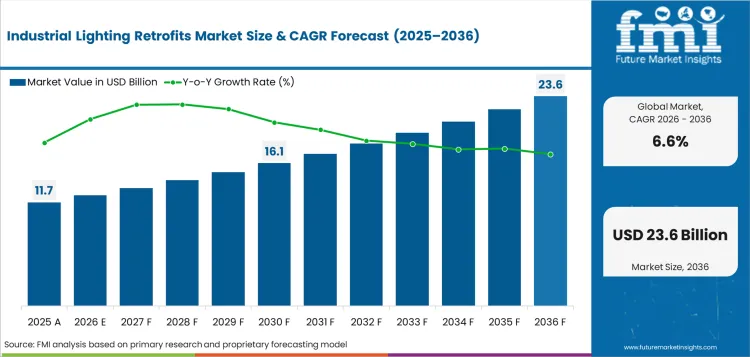
Industrial lighting retrofit market was valued at USD 11.7 billion in 2025 and is projected to reach USD 12.5 billion in 2026. It is forecast to reach USD 23.6 billion by 2036 at 6.6% CAGR. LED replacement is projected to lead retrofit type demand with 46.0% share in 2026. Manufacturing facilities are expected to hold 34.0% share in 2026.
Summary of the Industrial Lighting Retrofits Market
- Demand and Growth Drivers
- Manufacturing plants are upgrading high-bay and task fixtures to cut electricity use across long operating shifts.
- Controls retrofit is gaining attention as occupancy sensing and scheduling improve savings beyond the fixture swap.
- Factories retrofit older lighting systems to lower electricity costs without rebuilding full electrical infrastructure.
- Product and Segment View
- LED replacement is projected to dominate retrofit type with 46.0% share as it avoids deep electrical redesign in many plants.
- Manufacturing is expected to lead facility type with 34.0% share due to long runtime and maintenance access needs.
- EPC and turnkey is anticipated to lead contract model with 41.0% share where lighting audits and installation are bundled.
- Contractors are projected to lead sales channel with 52.0% share since site work decides schedule and commissioning quality.
- The 2 to 4 years payback band is expected to lead with 47.0% share as buyers avoid long recovery periods.
- Geography and Competitive Outlook
- Japan is projected to record 8.8% CAGR through 2036 as fluorescent phaseout pressure supports faster fixture replacement.
- France is expected to expand at 8.2% CAGR through 2036 as building performance rules support non-residential renovation.
- Signify, Acuity Brands, Schneider Electric and Siemens compete through product breadth and controls integration.
- Johnson Controls and ABB hold stronger positions where lighting retrofits are sold inside broader building upgrades.
- Analyst Opinion
- Nikhil Kaitwade, Principal Analyst at FMI says, "The industrial lighting retrofit opportunity is not just a fixture replacement cycle. I see buyers asking for measured savings, safer maintenance access and controls that fit older electrical layouts. This creates a practical split between simple LED changeouts and full upgrade projects. Suppliers with luminaires, controls and field partners will have an advantage over firms that only sell products. The key watchpoint is payback discipline. Many facilities will approve projects when the financial case fits a two to four year recovery window. That keeps the market steady but limits overbuilt systems."
- Industrial Lighting Retrofits Market Value Analysis
- The market is moving from quick fixture replacement into projects that include audits, controls and measured energy performance.
- LED replacement programs increase as companies seek better illumination with lower maintenance frequency.
- Government efficiency rules and utility incentives support lighting retrofit projects across industrial buildings.
- Retrofit demand rises when facility managers need faster payback than full lighting system replacement allows.
Key Takeaways
- The industrial lighting retrofits market was valued at USD 11.7 billion in 2025 based on the supplied 2026 anchor and CAGR.
- By 2036, the industrial lighting retrofits market is expected to reach USD 23.6 billion as plants replace older fixtures with lower-energy systems.
- From 2026 to 2036, the market is projected to expand at 6.6% CAGR during a steady replacement cycle.
- The market is projected to create an incremental opportunity of USD 11.1 billion between 2026 and 2036.
- LED replacement is projected to account for 46.0% share of retrofit type demand in 2026 as lamp and fixture changeouts remain simple.
- Contractors are expected to hold 52.0% share of sales channel demand in 2026 with field access and installation labor control.
- Japan at 8.8% CAGR and France at 8.2% CAGR are forecast to grow at a significant pace as policy and energy-cost pressure widen retrofit reviews.
Industrial lighting retrofits are moving away from quick lamp swaps toward documented safety and efficiency compliance. GSA guidance stated in January 2024 that high-bay luminaires range from 115 lm/W to 150 lm/W and federal LED luminaires must meet DLC requirements. That makes efficiency listing a procurement screen. UL Solutions stated in January 2024 that hazardous-location retrofit kits are certified under UL 1598C and UL 844. Retrofit providers therefore have a safer path for classified industrial sites. GSA also stated that its 2024 P100 no longer allows Type B TLED because of safety and compatibility concerns. Safer conversion methods are likely to gain share in public projects. Focus on Energy listed DLC SSL QPL requirements for high and low bay retrofit products in 2024. Incentive eligibility gives contractors a direct financial argument for compliant retrofit packages.
Industrial Lighting Retrofits Market Definition
The industrial lighting retrofits market covers revenue from replacing or upgrading lighting systems in existing industrial and large non-residential facilities. Scope includes LED luminaires, retrofit kits, controls, sensors, commissioning and contractor-led installation work. The market covers projects where lighting is upgraded for energy savings, maintenance reduction, safety compliance or payback. It excludes decorative residential lighting and new-build lighting that is not part of a retrofit.
Industrial Lighting Retrofits Market Inclusions
Market scope includes LED replacement, controls retrofit, full system upgrade and compliance-driven retrofit work. Facility coverage includes manufacturing plants, warehouses and distribution centers, cold storage buildings, public infrastructure and large service facilities. Contract coverage includes EPC and turnkey projects, ESCO and performance contracts, partial owner-led retrofits and service contracts. Revenue includes fixtures, controls, design work and installation labor when supplied as part of the lighting retrofit package.
Industrial Lighting Retrofits Market Exclusions
The scope excludes new construction lighting packages unless the project replaces an existing lighting system. It excludes decorative home lighting, consumer lamps, signage-only upgrades and automotive lighting. General building automation revenue is excluded unless the system directly controls lighting or records lighting savings. Electrical panel upgrades are counted only when they are sold as enabling work for a lighting retrofit.
Industrial Lighting Retrofits Market Research Methodology
- Primary Research: FMI analysts reviewed supplier portfolios, contractor channel activity, facility retrofit budgets and payback screening behavior in major countries.
- Desk Research: The study used public data from energy agencies, building regulation bodies, trade sources and official company releases.
- Market sizing and forecasting: The model started with supplied values and tested them against lighting electricity use, retrofit cycle timing and comparable efficiency service demand.
- Data validation: Forecast checks compared policy timelines, company developments, contractor channel role and facility-level buyer behavior across seven countries.
Why is the Industrial Lighting Retrofits Market Growing?
- Facilities are replacing older lamps as LED systems cut electricity use and reduce maintenance calls in high-ceiling work zones.
- Controls retrofits are rising as occupancy sensing and scheduling give savings that simple lamp changes do not capture.
- Performance contracts are expanding where facility owners want financing and verified savings before approving capital work.
Energy cost pressure keeps lighting visible in facility budgets. The International Energy Agency stated in March 2026 that building and outdoor lighting used about 2,200 terawatt hours in 2024. That figure keeps solid-state lighting in the energy savings discussion for factories and logistics buildings. Retrofit buyers therefore compare fixture price with runtime hours and maintenance access. This favors suppliers that show savings clearly before work starts.
Regulation is creating a second route for retrofit work across non-residential buildings. The European Commission said 85% of EU buildings were built before 2000 and 75% have poor energy performance. The same policy page says building automation and control requirements apply to non-residential buildings. This makes light management systems more relevant when owners upgrade older facilities.
Market Segmentation Analysis
- With 46.0% share in 2026, LED replacement is expected to lead retrofit type demand as it gives fast savings without deep redesign.
- Manufacturing facilities opting for lighting upgrades are projected to account for 34.0% of facility demand in 2026 due to long operating hours.
- EPC and turnkey contracts are anticipated to hold 41.0% of contract model demand in 2026 with audit and installation packaged together.
- Projects with 2 to 4 years payback are estimated to represent 47.0% of payback band demand in 2026 as buyers screen capital budgets.
- Contractors are expected to capture 52.0% of sales channel demand in 2026 where site labor and commissioning decide project quality.
The market is divided by retrofit type, facility type, contract model, payback band and sales channel. Retrofit type separates simple LED replacement from controls work and full system upgrade. Facility type explains why manufacturing and warehousing behave differently in runtime and access needs. Contract model captures how buyers approve work through EPC firms, ESCOs or internal teams. Payback band matters because many industrial buyers approve lighting products only when savings fit normal capital reviews.
Insights into the LED Replacement Retrofit Type Segment
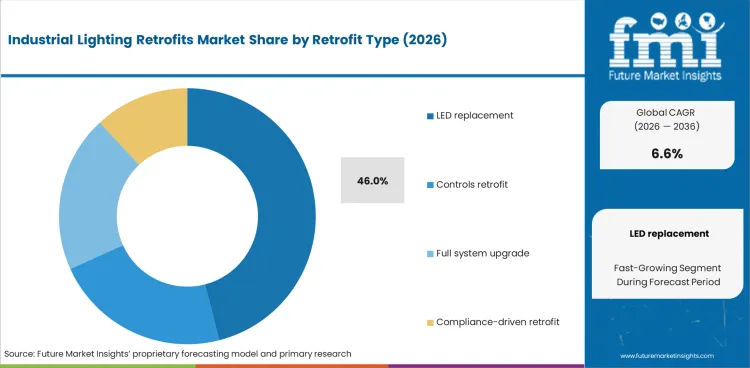
- LED replacement is projected to account for 46.0% of retrofit type demand in 2026 since fixture swaps offer the fastest route from audit to installation.
- Replacement work often starts with high-bay fixtures and fluorescent tubes. Mercury lamp restrictions and tube availability issues make legacy fixture planning more urgent.
Insights into the Manufacturing Facility Type Segment
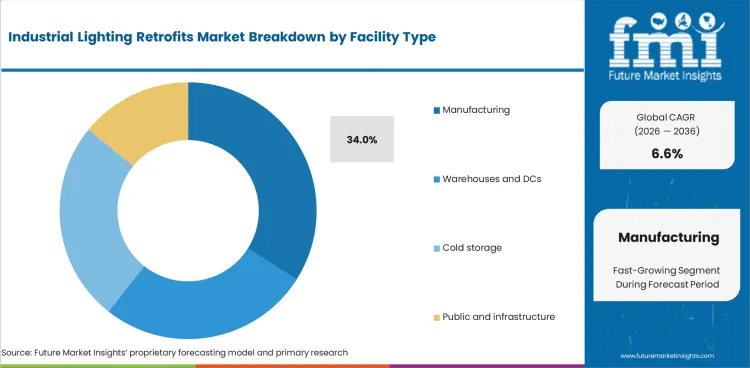
- Manufacturing is expected to account for 34.0% of facility demand in 2026 with long shifts and high ceilings raising lighting cost exposure.
- Factory buyers usually compare energy savings with production downtime. Night or weekend installation access often decides whether a project stays on schedule.
Insights into the EPC and Turnkey Contract Model Segment
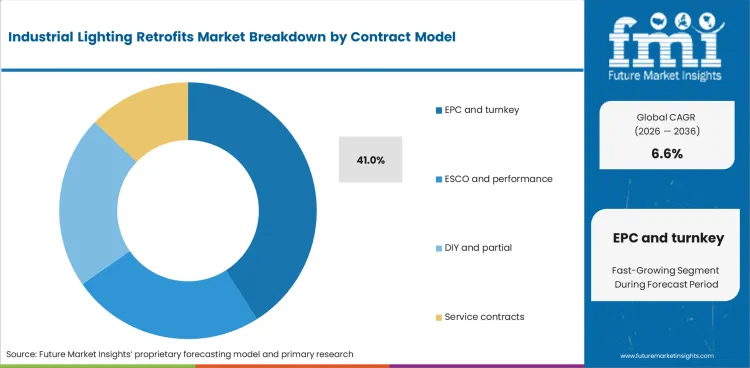
- EPC and turnkey is anticipated to account for 41.0% of contract demand in 2026 as facility teams bundle audit, design and installation risk.
- Turnkey awards favor firms that document fixture counts and lighting as a service options before purchase orders. This lowers internal approval work for plant managers.
Insights into the 2 to 4 Years Payback Band Segment
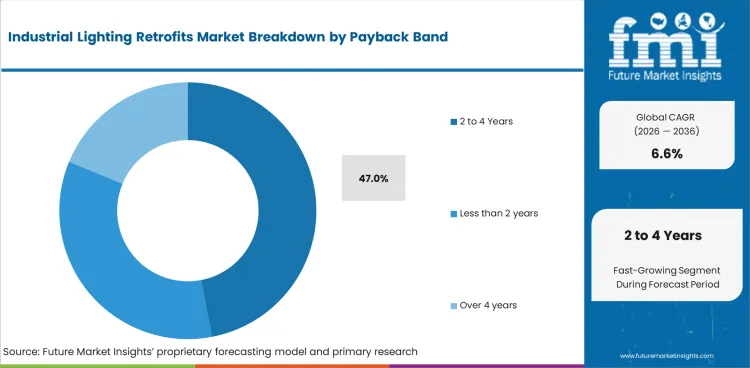
- The 2 to 4 years payback band is projected to account for 47.0% of demand in 2026 as it fits normal industrial capital reviews.
- Projects below two years often involve simple lamp changes. Longer payback projects usually need controls, wiring and commissioning to pass buyer review.
Insights into the Contractors Sales Channel Segment
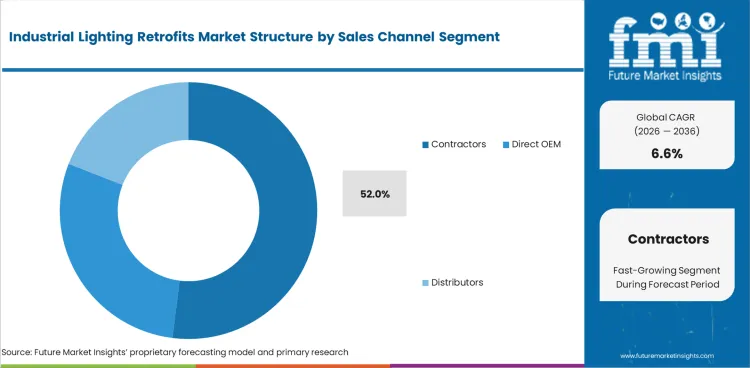
- Contractors are expected to hold 52.0% of channel demand in 2026 because field survey accuracy and labor timing decide retrofit success.
- Direct OEM sales work better for repeat facility groups. Distributor sales remain useful for replacement parts and smaller jobs needing quick stock access.
Industrial Lighting Retrofits Market Drivers, Restraints, and Opportunities
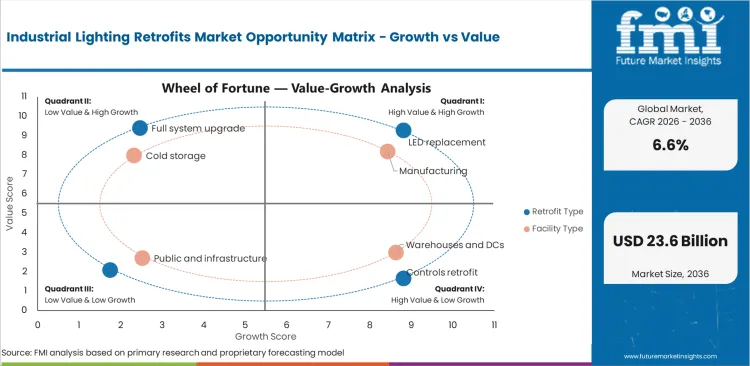
- LED fixture swaps reduce maintenance exposure in facilities where high-bay access needs lifts or production stoppage.
- Controls upgrades raise savings per site when occupancy and daylight profiles vary during shifts.
- Capital approval slows larger retrofits when project savings cannot fit the buyer payback band.
- Performance contracts create opportunity where owners want savings evidence before committing balance sheet capital.
Lighting load reduction
Lighting remains an energy target because it is visible and measurable after installation. The International Energy Agency estimated that lighting in buildings and outdoor applications used around 8% of global electricity demand in 2024. That size makes LED drivers and efficient luminaires part of facility energy reviews. The practical result is a steady funnel of projects that start with fixture audits. Suppliers that pair products with clear energy calculations can shorten buyer approval time.
Non-residential automation rules
Controls are gaining weight as building rules move beyond fixture efficiency. The European Commission said the revised Energy Performance of Buildings Directive entered into force in May 2024 and covers automation needs for non-residential buildings. That raises the value of sensors and light control switches in retrofit scopes. Facility owners can then prove that lighting use changes with occupancy. This favors vendors able to commission controls after installation.
Payback screening pressure
Budget limits keep the retrofit market disciplined. Siemens reported in 2025 that 57% of survey respondents planned to increase energy efficiency investment and 55% planned smart building technology investment. The same buyer pool still cited capital and equipment cost barriers. This explains why the 2 to 4 years payback band leads the market. Suppliers that reduce disruption can win projects before deeper building upgrades are approved.
Analysis of Industrial Lighting Retrofits Market By Key Countries
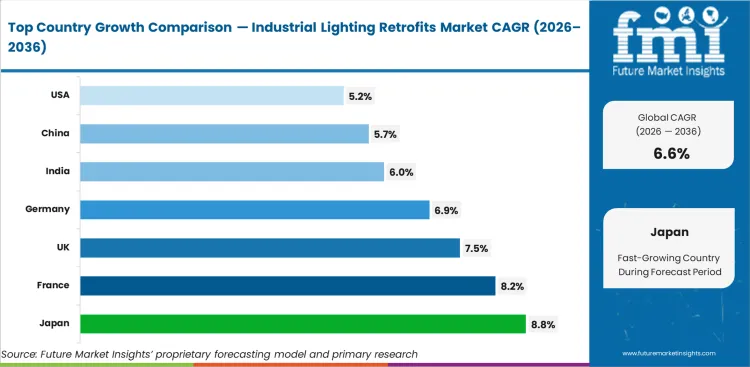
.webp "Top Country Growth Comparison Industrial Lighting Retrofits Market Cagr (2026 2036)")
| Country | CAGR |
|---|---|
| Japan | 8.8% |
| France | 8.2% |
| United Kingdom | 7.5% |
| Germany | 6.9% |
| India | 6.0% |
| China | 5.7% |
| United States | 5.2% |
Source: FMI analysis based on primary research and proprietary forecasting model.
Industrial Lighting Retrofits Market CAGR Analysis By Country
- Japan is projected to record a 8.8% CAGR through 2036 as fluorescent replacement pressure speeds fixture reviews.
- France is expected to expand at 8.2% CAGR through 2036 since tertiary building renovation rules support energy work.
- The United Kingdom is forecast to grow at 7.5% CAGR through 2036 as non-domestic energy data sharpens owner focus.
- Germany is expected to advance at 6.9% CAGR through 2036 given energy cost control and renewable electricity targets.
- India is projected to rise at 6.0% CAGR through 2036 where building codes and factory expansion widen the project pool.
- China is forecast at 5.7% CAGR through 2036 as energy intensity policy supports efficiency work in large buildings.
- The United States is expected to post 5.2% CAGR through 2036 as mature LED penetration shifts work toward controls.
Country spread reflects a mix of policy timing and replacement maturity. Japan and France are forecast above the global pace due to older lighting stock and policy pressure. The United States tracks below the global pace as many easy LED replacements have already moved. China and India remain volume markets where outdoor LED lighting and indoor retrofit supply chains support cost-sensitive adoption.
Demand Outlook for Industrial Lighting Retrofits Market in Japan
Japan facilities face a faster retrofit trigger as fluorescent lamp phaseout planning moves into maintenance budgets. Japan is projected to record a 8.8% CAGR through 2036 as facility owners reduce reliance on legacy fixtures. Japanese government statistics classify electric bulbs and lighting fixtures as industry code 294 in official business data. That classification shows a local supply category that supports replacement planning. Suppliers with LED fixtures and service partners should gain where factories need safe changeouts.
- Tokyo commercial districts create early controls demand where office towers need lighting schedules and measured electricity reductions.
- Osaka manufacturing users support fixture swaps as older high-bay systems become harder to service during production hours.
- Nagoya automotive plants give retrofit suppliers a route into repeat factory projects tied to maintenance planning.
Sales Analysis of Industrial Lighting Retrofits Market in France
France has a policy-driven retrofit setting as European building rules move into national implementation. France is expected to expand at 8.2% CAGR through 2036 with stronger activity in tertiary buildings and public facilities. The European Commission states that EU countries must transpose the revised building directive into national law by May 2026. This timeline gives owners a reason to review lighting controls before deeper building work. Suppliers should target sites where lighting changes fit renovation schedules.
- Paris office owners face stronger energy performance reviews as tertiary buildings prepare for new compliance steps.
- Lyon logistics facilities can combine warehouse LED replacement with occupancy controls for aisle lighting.
- Marseille street and roadway lighting public buildings create project demand where renovation budgets favor visible electricity savings.
Demand Analysis of Industrial Lighting Retrofits Market in the United Kingdom
United Kingdom buyers are using building-level energy data to sort retrofit priorities across commercial and industrial stock. The United Kingdom is forecast to grow at 7.5% CAGR through 2036 as non-domestic owners compare lighting bills with upgrade cost. The Department for Energy Security and Net Zero published the 2024 non-domestic energy dataset in August 2024. That evidence base supports benchmarking by building use and size. Contractors with audit tools should convert more sites into funded retrofit work.
- London offices give controls suppliers a dense market for floor-by-floor lighting schedules and commissioning work.
- Midlands rack-ready luminaires warehouses support LED changeouts where high-rack aisles need better visibility and lower maintenance exposure.
- Manchester public estates can use non-domestic benchmarking to rank schools, depots and health buildings for upgrades.
Opportunity Analysis of Industrial Lighting Retrofits Market in Germany
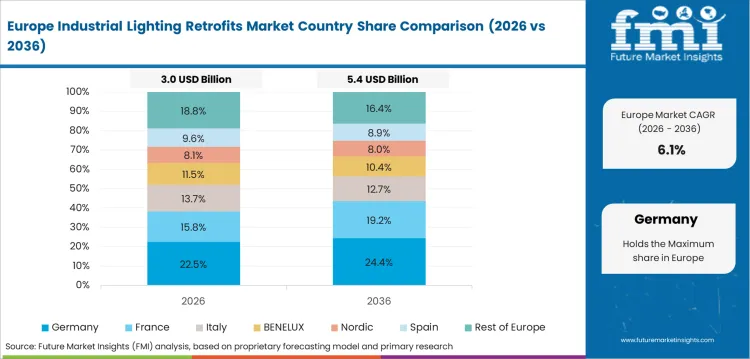
Germany links retrofit decisions with energy cost control and wider building efficiency goals. Germany is expected to advance at 6.9% CAGR through 2036 as industrial buyers keep electricity savings high on capital lists. The International Trade Administration reported in August 2025 that Germany achieved 59% renewable electricity supply in 2024 against an 80% target for 2030. This supports efficient electric end-use upgrades. Lighting suppliers should position retrofits as part of broader electrified building management.
- Bavaria manufacturing plants create demand for explosion-proof lighting and high-bay LED replacement where production quality depends on stable light levels.
- North Rhine-Westphalia logistics hubs favor contractor-led work because site access and shift timing affect installation cost.
- Berlin public infrastructure owners can align lighting upgrades with building renovation and climate planning programs.
Future Outlook for Industrial Lighting Retrofits Market in India
India combines new building codes with a large factory and logistics buildout. India is projected to rise at 6.0% CAGR through 2036 as owners update lighting within wider energy efficiency work. The Bureau of Energy Efficiency issued the Energy Conservation and Sustainable Building Code 2024 for commercial and office buildings. This code gives designers and facility teams a clearer route to energy-conscious systems. Retrofit demand should develop fastest where older sites compete with newer efficient buildings.
- Gujarat factories can use lighting replacement to lower electricity use during long industrial shifts.
- Maharashtra warehouses support controls adoption where distribution activity creates uneven occupancy across storage areas.
- Delhi public buildings create demand for audits under Bureau of Energy Efficiency building programs and rating work.
Demand Outlook for Industrial Lighting Retrofits Market in China
China remains a large volume retrofit market where efficiency policy and manufacturing scale work together. China is forecast at 5.7% CAGR through 2036 as projects balance cost control with industrial electricity needs. The International Energy Agency reported in November 2024 that China achieved average annual energy intensity improvement of almost 4% during 2010 to 2019. That policy history supports continued efficiency work. Suppliers must compete on price and delivery speed in this market.
- Shenzhen electronics factories create demand for human-centric lighting task lighting and fast replacement work on production lines.
- Guangdong warehouse clusters support aisle lighting upgrades where high inventory throughput increases runtime hours.
- Shanghai commercial districts can adopt connected controls as building owners track energy use and tenant expectations.
In-depth Analysis of Industrial Lighting Retrofits Market in the United States
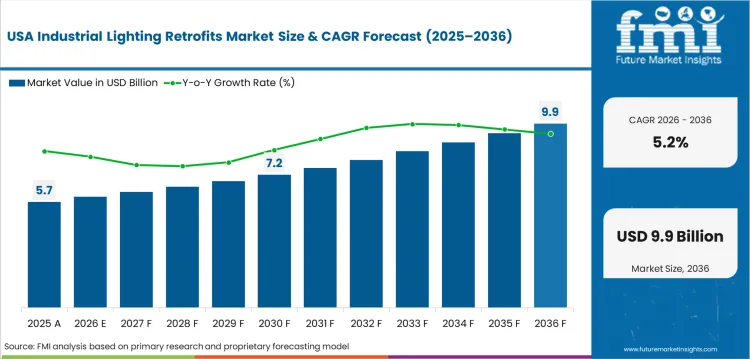
The United States has a mature LED retrofit setting and a growing controls upgrade opportunity. The United States is expected to post 5.2% CAGR through 2036 as simple replacement gives way to networked controls and service work. The United States Department of Energy recognized 16 organizations in 2024 for integrated lighting performance and efficiency work. That signal shows that leading buyers now evaluate systems rather than lamps alone.
- California warehouses support controls retrofits where energy codes and utility programs reward measured electricity reductions.
- Texas manufacturing sites favor fixture replacement where heat and high-ceiling access raise maintenance costs.
- New York public buildings create demand for contractors that can document savings across phased facility upgrades.
Competitive Landscape and Strategic Positioning
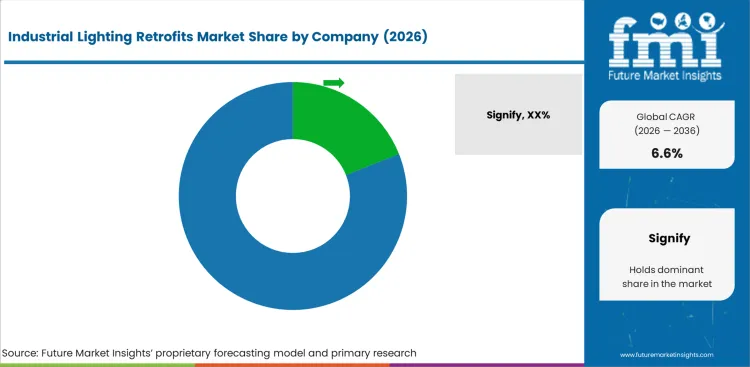
- The market is moderately concentrated because global lighting brands lead products while contractors control field delivery.
- Signify and Acuity Brands stand out through luminaire breadth, controls portfolios and route-to-site coverage.
- Specialist contractors win smaller projects by moving fast through audits, rebates and installation scheduling.
- Entry barriers include site surveys, safety access, controls commissioning and proof of energy savings.
Competition is shaped by who can turn a lighting audit into a funded project. Signify said its EnabLED program reached 1,700 licensees in May 2025. This supports a large technology base for LED luminaires and retrofit bulbs. For buyers, the benefit is not only product choice. It is access to proven designs that fit replacement needs across different facilities.
Building systems companies compete in the industry as lighting is part of a wider controls upgrade. Schneider Electric launched the SpaceLogic Touchscreen Room Controller in February 2025 for new and retrofitted buildings [10]. That product links comfort, energy and lighting in one room control layer. This makes LED control units important where owners want a manageable upgrade rather than a complex building management project.
Channel reach is another competitive filter. Acuity Brands agreed to acquire QSC for USD 1.215 billion in October 2024. The deal widened its intelligent spaces platform and shows how lighting suppliers are moving toward connected building systems. Johnson Controls, Siemens and ABB compete when retrofit work is sold through energy performance and automation programs. Smaller firms hold ground through local labor and faster site work.
Key Companies in the Industrial Lighting Retrofits Market
Competition is best read by role because product suppliers, controls firms and service integrators meet different buyer needs.
- Lighting and controls leaders: Signify, Acuity Brands, Zumtobel Group and Trilux compete through LED luminaires, lighting controls and professional lighting channels. Signify has broad LED licensing reach. Acuity Brands combines lighting with intelligent spaces. Zumtobel and Trilux carry strong European professional lighting positions.
- Building systems integrators: Schneider Electric, Siemens, ABB and Johnson Controls compete when lighting upgrades are tied to building automation, energy performance and facility services. Their advantage comes from controls platforms, energy management tools and access to owners planning broader retrofit work.
- Electrical infrastructure specialists: Eaton and Legrand support retrofit work through distribution, switchgear, wiring devices and control products. Legrand added Matter-enabled lighting products in 2024 [12]. Eaton supports facility electrical upgrades where lighting replacement needs safe power and controls integration.
Competitive Benchmarking: Industrial Lighting Retrofits Market
| Company | Retrofit fixture breadth | Controls commissioning support | Energy project delivery | Geographic footprint |
|---|---|---|---|---|
| Signify | High | Strong | Strong | Global with strong Europe and North America reach |
| Acuity Brands | High | Strong | Strong | North America centered with expanding intelligent spaces platform |
| Schneider Electric | Medium | High | Strong | Global with building energy management depth |
| Siemens | Medium | High | Strong | Global with smart infrastructure and services depth |
| Eaton | Medium | Medium | Strong | Global with electrical distribution reach |
| ABB | Medium | High | Medium | Global with smart buildings and electrification channels |
| Legrand | Medium | Strong | Medium | Global with controls and electrical infrastructure products |
| Zumtobel Group | High | Medium | Medium | Europe centered professional lighting footprint |
| Trilux | High | Medium | Medium | Europe centered industrial and professional lighting footprint |
| Johnson Controls | Low | High | Strong | Global with building services and performance programs |
Source: Future Market Insights competitive analysis, 2026. Ratings reflect relative positioning based on retrofit fixture breadth, controls commissioning support and energy project delivery.
Key Developments in Industrial Lighting Retrofits Market
- In October 2024, Acuity Brands agreed to acquire QSC for USD 1.215 billion. The deal strengthened its connected building and intelligent spaces position.
- In February 2025, Schneider Electric launched SpaceLogic Touchscreen Room Controller for new and retrofitted buildings. The product supports room-level energy control.
- In May 2025, Signify reported that its EnabLED lighting program reached 1,700 licensees. This shows wide LED technology diffusion.
- In October 2025, ABB expanded its smart buildings portfolio and appointed a Vietnam retail distributor. The move improved channel access in Southeast Asia.
- In September 2024, Legrand acquired UPSistemas in Colombia and APP in Australia. The acquisitions strengthened technical infrastructure and cable management reach.
Key Players in the Industrial Lighting Retrofits Market
Lighting and controls leaders
- Signify
- Acuity Brands
- Zumtobel Group
- Trilux
Building systems integrators
- Schneider Electric
- Siemens
- ABB
- Johnson Controls
Electrical infrastructure specialists
- Eaton
- Legrand
Report Scope and Coverage
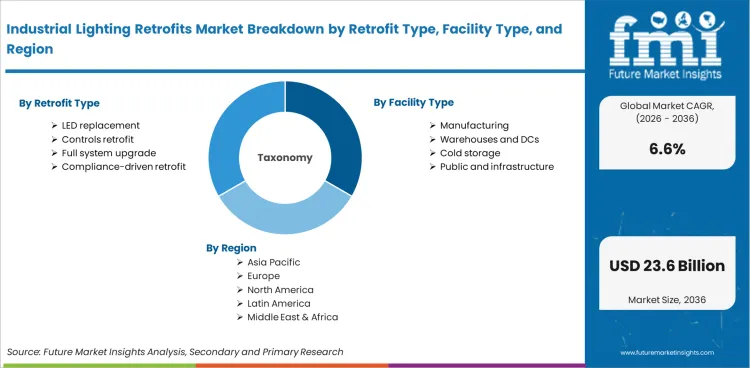
Industrial Lighting Retrofits Market Breakdown By Retrofit Type, Facility Type, Contract Model, Payback Band, Sales Channel and Region
| Parameter | Details |
|---|---|
| Quantitative Units | USD 12.5 billion to USD 23.6 billion, at a CAGR of 6.6% |
| Market Definition | Lighting replacement and upgrade revenue in existing industrial and large non-residential facilities |
| Retrofit Type | LED replacement, controls retrofit, full system upgrade, compliance-driven retrofit |
| Facility Type | Manufacturing, warehouses and DCs, cold storage, public and infrastructure |
| Contract Model | EPC and turnkey, ESCO and performance, DIY and partial, service contracts |
| Payback Band | Less than 2 years, 2 to 4 years, over 4 years |
| Sales Channel | Contractors, direct OEM, distributors |
| Regions Covered | North America, Latin America, Europe, East Asia, South Asia and Pacific, Middle East and Africa |
| Countries Covered | Japan, France, United Kingdom, Germany, India, China, United States and 30+ countries |
| Key Companies Profiled | Signify, Acuity Brands, Schneider Electric, Siemens, Eaton, ABB, Legrand, Zumtobel Group, Trilux, Johnson Controls |
| Forecast Period | 2026 to 2036 |
| Approach | Hybrid bottom-up and top-down methodology using supplied anchors, policy signals, supplier activity and facility retrofit behavior |
Industrial Lighting Retrofits Market by Segments
Industrial Lighting Retrofits Market Segmented by Retrofit Type:
- LED replacement
- Controls retrofit
- Full system upgrade
- Compliance-driven retrofit
Industrial Lighting Retrofits Market Segmented by Facility Type:
- Manufacturing
- Warehouses and DCs
- Cold storage
- Public and infrastructure
Industrial Lighting Retrofits Market Segmented by Contract Model:
- EPC and turnkey
- ESCO and performance
- DIY and partial
- Service contracts
Industrial Lighting Retrofits Market Segmented by Payback Band:
- Less than 2 years
- 2 to 4 years
- Over 4 years
Industrial Lighting Retrofits Market Segmented by Sales Channel:
- Contractors
- Direct OEM
- Distributors
Industrial Lighting Retrofits Market by Region:
- North America
- United States
- Canada
- Mexico
- Latin America
- Brazil
- Chile
- Rest of Latin America
- Western Europe
- Germany
- United Kingdom
- Italy
- Spain
- France
- Nordic
- BENELUX
- Rest of Western Europe
- Eastern Europe
- Russia
- Poland
- Hungary
- Balkan and Baltic
- Rest of Eastern Europe
- East Asia
- China
- Japan
- South Korea
- South Asia and Pacific
- India
- ASEAN
- Australia and New Zealand
- Rest of South Asia and Pacific
- Middle East and Africa
- Kingdom of Saudi Arabia
- Other GCC Countries
- Turkiye
- South Africa
- Other African Union
- Rest of Middle East and Africa
Research Sources and Bibliography
- International Energy Agency. (2026, March 6). The next wave of LED lighting: Smarter, circular and more efficient.
- United States Department of Energy. (2024). 2024 recognitions: Integrated Lighting Campaign.
- European Commission. (2024, May 28). Energy Performance of Buildings Directive.
- International Energy Agency. (2024, November 7). Energy Efficiency 2024.
- Department for Energy Security and Net Zero. (2024, August 9). Non-domestic National Energy Efficiency Data Framework 2024.
- International Trade Administration. (2025, August 1). Germany - Energy.
- Siemens. (2025). Energy efficiency in buildings tops organizations infrastructure priorities.
- Acuity Inc. (2024, October 24). Acuity announces agreement to acquire QSC, LLC.
- Signify. (2025, May 12). 1700th licensee joins the Signify licensing program.
- Schneider Electric. (2025, February 10). Schneider Electric enhances energy management controls and capabilities with SpaceLogic Touchscreen Room Controller.
- ABB. (2025, October 10). ABB expands building solutions portfolio and appoints new retail distributor in Vietnam.
- Legrand. (2024, February 5). Legrand showcases full spectrum of Limitless Lighting Controls.
- Legrand. (2024, September 3). Legrand announces the acquisitions of UPSistemas in Colombia and APP in Australia.
- Statistics Bureau of Japan. (2024). Economic Census for Business Frame 2024.
- Bureau of Energy Efficiency. (2024). Energy Conservation and Sustainable Building Code 2024.
This Report Answers
- What is the current and future value of the industrial lighting retrofits market from 2026 to 2036?
- What CAGR is expected for the industrial lighting retrofits market during the forecast period?
- Which retrofit type is projected to lead industrial lighting retrofit demand in 2026?
- Which facility type is expected to hold the leading share in industrial lighting retrofits?
- What factors are driving LED replacement and controls retrofit work in industrial facilities?
- How do payback bands affect approval for industrial lighting retrofit projects?
- Which countries are expected to grow fastest in industrial lighting retrofits?
- Which companies are positioned across fixtures, controls and building energy systems?
- How does FMI define the industrial lighting retrofits revenue scope?
- What forecasting approach was used to estimate retrofit demand from 2026 to 2036?
Frequently Asked Questions
What is the industrial lighting retrofits market size in 2026?
The industrial lighting retrofits market is projected to be worth USD 12.5 billion in 2026 based on supplied FMI sizing anchors.
What will the industrial lighting retrofits market be worth by 2036?
The industrial lighting retrofits market is forecast to reach USD 23.6 billion by 2036 as replacement and controls work expands.
What CAGR is expected for the industrial lighting retrofits market?
The industrial lighting retrofits market is projected to expand at 6.6% CAGR from 2026 to 2036 across the forecast decade.
Which retrofit type leads the industrial lighting retrofits market?
LED replacement is projected to lead retrofit type demand with 46.0% share in 2026 due to faster installation and simpler approvals.
Which sales channel leads the industrial lighting retrofits market?
Contractors are expected to lead sales channel demand with 52.0% share in 2026 as field surveys and installation quality drive results.
Why is Japan the fastest growing industrial lighting retrofits market?
Japan is projected to record 8.8% CAGR through 2036 as fluorescent replacement planning and facility maintenance needs accelerate upgrades.
What does the industrial lighting retrofits market include?
The scope includes LED replacement, controls retrofit, full system upgrades and related installation work in existing industrial facilities.
How was the industrial lighting retrofits market forecast prepared?
The forecast used supplied market anchors, retrofit cycle checks, policy signals, company activity and facility payback assumptions.
How long does a typical industrial lighting retrofit take to pay back?
Most approved projects fall in the 2 to 4 years payback band, which is projected to hold 47.0% share in 2026.
How do controls change an industrial lighting retrofit project?
Controls add sensing and scheduling, which allows lighting use to match occupancy instead of running at full output during low-use periods.
Preview the report firsthand - request a free sample
Get SampleGet the brochure for pricing and purchase details.
Get PDFTable of Content
- Key Takeaways
- Market Size and CAGR
- Top Growth Driver
- Fastest Growing Segment
- Leading Region
- Key Companies
- Emerging Opportunities
- Executive Summary
- Global Market Outlook
- Demand-side Trends
- Supply-side Trends
- Technology Roadmap Analysis
- Analysis and Recommendations
- Analyst Perspective (What is happening? Why now? What should investors know?)
- Key Questions Answered
- How large is the market?
- What is the CAGR?
- What are key trends?
- Which region dominates?
- Who are the leaders?
- Market Overview
- Market Coverage / Taxonomy
- Market Definition / Scope / Limitations
- Research Methodology
- Chapter Orientation
- Analytical Lens and Working Hypotheses
- Market Structure, Signals, and Trend Drivers
- Benchmarking and Cross-market Comparability
- Market Sizing, Forecasting, and Opportunity Mapping
- Research Design and Evidence Framework
- Desk Research Programme (Secondary Evidence)
- Expert Input and Fieldwork (Primary Evidence)
- Tooling, Models, and Reference Databases
- Data Engineering and Model Build
- Quality Assurance and Audit Trail
- Market Background
- Market Dynamics (Drivers, Restraints, Opportunity, Trends)
- Scenario Forecast (Optimistic, Likely, Conservative)
- Impact Analysis
- AI Impact
- Sustainability Impact
- Regulatory Impact
- Technology Impact
- Consumer / Buyer Analysis
- Purchase Drivers
- Adoption Barriers
- Buyer Journey
- Opportunity Map Analysis
- Product Life Cycle Analysis
- Supply Chain Analysis
- Investment Feasibility Matrix
- Value Chain Analysis
- PESTLE and Porter's Analysis
- Regulatory Landscape
- Regional Parent Market Outlook
- Production and Consumption Statistics
- Import and Export Statistics
- Global Market Analysis and Forecast, 2021 to 2036
- Historical Market Size Value (USD Billion) & Volume (Unit) Analysis, 2021 to 2025
- Current and Future Market Size Value (USD Billion) & Volume (Unit) Projections, 2026 to 2036
- Y-o-Y Growth Trend Analysis
- Absolute $ Opportunity Analysis
- Global Market Pricing Analysis, 2021 to 2036
- Global Market Analysis and Forecast, By Retrofit Type, 2021 to 2036
- Introduction / Key Findings
- Historical Market Size Value (USD Billion) & Volume (Unit) Analysis By Retrofit Type, 2021 to 2025
- Current and Future Market Size Value (USD Billion) & Volume (Unit) Analysis and Forecast By Retrofit Type, 2026 to 2036
- LED replacement
- Controls retrofit
- Full system upgrade
- Compliance-driven retrofit
- LED replacement
- Y-o-Y Growth Trend Analysis By Retrofit Type, 2021 to 2025
- Absolute $ Opportunity Analysis By Retrofit Type, 2026 to 2036
- Global Market Analysis and Forecast, By Facility Type, 2021 to 2036
- Introduction / Key Findings
- Historical Market Size Value (USD Billion) & Volume (Unit) Analysis By Facility Type, 2021 to 2025
- Current and Future Market Size Value (USD Billion) & Volume (Unit) Analysis and Forecast By Facility Type, 2026 to 2036
- Manufacturing
- Warehouses and DCs
- Cold storage
- Public and infrastructure
- Manufacturing
- Y-o-Y Growth Trend Analysis By Facility Type, 2021 to 2025
- Absolute $ Opportunity Analysis By Facility Type, 2026 to 2036
- Global Market Analysis and Forecast, By Contract Model, 2021 to 2036
- Introduction / Key Findings
- Historical Market Size Value (USD Billion) & Volume (Unit) Analysis By Contract Model, 2021 to 2025
- Current and Future Market Size Value (USD Billion) & Volume (Unit) Analysis and Forecast By Contract Model, 2026 to 2036
- EPC and turnkey
- ESCO and performance
- DIY and partial
- Service contracts
- EPC and turnkey
- Y-o-Y Growth Trend Analysis By Contract Model, 2021 to 2025
- Absolute $ Opportunity Analysis By Contract Model, 2026 to 2036
- Global Market Analysis and Forecast, By Payback Band, 2021 to 2036
- Introduction / Key Findings
- Historical Market Size Value (USD Billion) & Volume (Unit) Analysis By Payback Band, 2021 to 2025
- Current and Future Market Size Value (USD Billion) & Volume (Unit) Analysis and Forecast By Payback Band, 2026 to 2036
- 2 to 4 years
- Less than 2 years
- Over 4 years
- 2 to 4 years
- Y-o-Y Growth Trend Analysis By Payback Band, 2021 to 2025
- Absolute $ Opportunity Analysis By Payback Band, 2026 to 2036
- Global Market Analysis and Forecast, By Sales Channel, 2021 to 2036
- Introduction / Key Findings
- Historical Market Size Value (USD Billion) & Volume (Unit) Analysis By Sales Channel, 2021 to 2025
- Current and Future Market Size Value (USD Billion) & Volume (Unit) Analysis and Forecast By Sales Channel, 2026 to 2036
- Contractors
- Direct OEM
- Distributors
- Contractors
- Y-o-Y Growth Trend Analysis By Sales Channel, 2021 to 2025
- Absolute $ Opportunity Analysis By Sales Channel, 2026 to 2036
- Global Market Analysis and Forecast, By Region, 2021 to 2036
- Introduction
- Historical Market Size Value (USD Billion) & Volume (Unit) Analysis By Region, 2021 to 2025
- Current Market Size Value (USD Billion) & Volume (Unit) Analysis and Forecast By Region, 2026 to 2036
- North America
- Latin America
- Western Europe
- Eastern Europe
- East Asia
- South Asia and Pacific
- Middle East & Africa
- Market Attractiveness Analysis By Region
- North America Market Analysis and Forecast, By Country, 2021 to 2036
- Historical Market Size Value (USD Billion) & Volume (Unit) Trend Analysis By Market Taxonomy, 2021 to 2025
- Market Size Value (USD Billion) & Volume (Unit) Forecast By Market Taxonomy, 2026 to 2036
- By Country
- USA
- Canada
- Mexico
- By Retrofit Type
- By Facility Type
- By Contract Model
- By Payback Band
- By Sales Channel
- By Country
- Market Attractiveness Analysis
- By Country
- By Retrofit Type
- By Facility Type
- By Contract Model
- By Payback Band
- By Sales Channel
- Key Takeaways
- Latin America Market Analysis and Forecast, By Country
- Historical Market Size Value (USD Billion) & Volume (Unit) Trend Analysis By Market Taxonomy, 2021 to 2025
- Market Size Value (USD Billion) & Volume (Unit) Forecast By Market Taxonomy, 2026 to 2036
- By Country
- Brazil
- Chile
- Rest of Latin America
- By Retrofit Type
- By Facility Type
- By Contract Model
- By Payback Band
- By Sales Channel
- By Country
- Market Attractiveness Analysis
- By Country
- By Retrofit Type
- By Facility Type
- By Contract Model
- By Payback Band
- By Sales Channel
- Key Takeaways
- Western Europe Market Analysis and Forecast, By Country
- Historical Market Size Value (USD Billion) & Volume (Unit) Trend Analysis By Market Taxonomy, 2021 to 2025
- Market Size Value (USD Billion) & Volume (Unit) Forecast By Market Taxonomy, 2026 to 2036
- By Country
- Germany
- UK
- Italy
- Spain
- France
- Nordic
- BENELUX
- Rest of Western Europe
- By Retrofit Type
- By Facility Type
- By Contract Model
- By Payback Band
- By Sales Channel
- By Country
- Market Attractiveness Analysis
- By Country
- By Retrofit Type
- By Facility Type
- By Contract Model
- By Payback Band
- By Sales Channel
- Key Takeaways
- Eastern Europe Market Analysis and Forecast, By Country
- Historical Market Size Value (USD Billion) & Volume (Unit) Trend Analysis By Market Taxonomy, 2021 to 2025
- Market Size Value (USD Billion) & Volume (Unit) Forecast By Market Taxonomy, 2026 to 2036
- By Country
- Russia
- Poland
- Hungary
- Balkan & Baltic
- Rest of Eastern Europe
- By Retrofit Type
- By Facility Type
- By Contract Model
- By Payback Band
- By Sales Channel
- By Country
- Market Attractiveness Analysis
- By Country
- By Retrofit Type
- By Facility Type
- By Contract Model
- By Payback Band
- By Sales Channel
- Key Takeaways
- East Asia Market Analysis and Forecast, By Country
- Historical Market Size Value (USD Billion) & Volume (Unit) Trend Analysis By Market Taxonomy, 2021 to 2025
- Market Size Value (USD Billion) & Volume (Unit) Forecast By Market Taxonomy, 2026 to 2036
- By Country
- China
- Japan
- South Korea
- By Retrofit Type
- By Facility Type
- By Contract Model
- By Payback Band
- By Sales Channel
- By Country
- Market Attractiveness Analysis
- By Country
- By Retrofit Type
- By Facility Type
- By Contract Model
- By Payback Band
- By Sales Channel
- Key Takeaways
- South Asia and Pacific Market Analysis and Forecast, By Country
- Historical Market Size Value (USD Billion) & Volume (Unit) Trend Analysis By Market Taxonomy, 2021 to 2025
- Market Size Value (USD Billion) & Volume (Unit) Forecast By Market Taxonomy, 2026 to 2036
- By Country
- India
- ASEAN
- Australia & New Zealand
- Rest of South Asia and Pacific
- By Retrofit Type
- By Facility Type
- By Contract Model
- By Payback Band
- By Sales Channel
- By Country
- Market Attractiveness Analysis
- By Country
- By Retrofit Type
- By Facility Type
- By Contract Model
- By Payback Band
- By Sales Channel
- Key Takeaways
- Middle East & Africa Market Analysis and Forecast, By Country
- Historical Market Size Value (USD Billion) & Volume (Unit) Trend Analysis By Market Taxonomy, 2021 to 2025
- Market Size Value (USD Billion) & Volume (Unit) Forecast By Market Taxonomy, 2026 to 2036
- By Country
- Kingdom of Saudi Arabia
- Other GCC Countries
- Türkiye
- South Africa
- Other African Union
- Rest of Middle East & Africa
- By Retrofit Type
- By Facility Type
- By Contract Model
- By Payback Band
- By Sales Channel
- By Country
- Market Attractiveness Analysis
- By Country
- By Retrofit Type
- By Facility Type
- By Contract Model
- By Payback Band
- By Sales Channel
- Key Takeaways
- Key Countries Market Analysis
- USA
- Pricing Analysis
- Market Share Analysis, 2025
- By Retrofit Type
- By Facility Type
- By Contract Model
- By Payback Band
- By Sales Channel
- Canada
- Pricing Analysis
- Market Share Analysis, 2025
- By Retrofit Type
- By Facility Type
- By Contract Model
- By Payback Band
- By Sales Channel
- Mexico
- Pricing Analysis
- Market Share Analysis, 2025
- By Retrofit Type
- By Facility Type
- By Contract Model
- By Payback Band
- By Sales Channel
- Brazil
- Pricing Analysis
- Market Share Analysis, 2025
- By Retrofit Type
- By Facility Type
- By Contract Model
- By Payback Band
- By Sales Channel
- Chile
- Pricing Analysis
- Market Share Analysis, 2025
- By Retrofit Type
- By Facility Type
- By Contract Model
- By Payback Band
- By Sales Channel
- Germany
- Pricing Analysis
- Market Share Analysis, 2025
- By Retrofit Type
- By Facility Type
- By Contract Model
- By Payback Band
- By Sales Channel
- UK
- Pricing Analysis
- Market Share Analysis, 2025
- By Retrofit Type
- By Facility Type
- By Contract Model
- By Payback Band
- By Sales Channel
- Italy
- Pricing Analysis
- Market Share Analysis, 2025
- By Retrofit Type
- By Facility Type
- By Contract Model
- By Payback Band
- By Sales Channel
- Spain
- Pricing Analysis
- Market Share Analysis, 2025
- By Retrofit Type
- By Facility Type
- By Contract Model
- By Payback Band
- By Sales Channel
- France
- Pricing Analysis
- Market Share Analysis, 2025
- By Retrofit Type
- By Facility Type
- By Contract Model
- By Payback Band
- By Sales Channel
- India
- Pricing Analysis
- Market Share Analysis, 2025
- By Retrofit Type
- By Facility Type
- By Contract Model
- By Payback Band
- By Sales Channel
- ASEAN
- Pricing Analysis
- Market Share Analysis, 2025
- By Retrofit Type
- By Facility Type
- By Contract Model
- By Payback Band
- By Sales Channel
- Australia & New Zealand
- Pricing Analysis
- Market Share Analysis, 2025
- By Retrofit Type
- By Facility Type
- By Contract Model
- By Payback Band
- By Sales Channel
- China
- Pricing Analysis
- Market Share Analysis, 2025
- By Retrofit Type
- By Facility Type
- By Contract Model
- By Payback Band
- By Sales Channel
- Japan
- Pricing Analysis
- Market Share Analysis, 2025
- By Retrofit Type
- By Facility Type
- By Contract Model
- By Payback Band
- By Sales Channel
- South Korea
- Pricing Analysis
- Market Share Analysis, 2025
- By Retrofit Type
- By Facility Type
- By Contract Model
- By Payback Band
- By Sales Channel
- Russia
- Pricing Analysis
- Market Share Analysis, 2025
- By Retrofit Type
- By Facility Type
- By Contract Model
- By Payback Band
- By Sales Channel
- Poland
- Pricing Analysis
- Market Share Analysis, 2025
- By Retrofit Type
- By Facility Type
- By Contract Model
- By Payback Band
- By Sales Channel
- Hungary
- Pricing Analysis
- Market Share Analysis, 2025
- By Retrofit Type
- By Facility Type
- By Contract Model
- By Payback Band
- By Sales Channel
- Kingdom of Saudi Arabia
- Pricing Analysis
- Market Share Analysis, 2025
- By Retrofit Type
- By Facility Type
- By Contract Model
- By Payback Band
- By Sales Channel
- Türkiye
- Pricing Analysis
- Market Share Analysis, 2025
- By Retrofit Type
- By Facility Type
- By Contract Model
- By Payback Band
- By Sales Channel
- South Africa
- Pricing Analysis
- Market Share Analysis, 2025
- By Retrofit Type
- By Facility Type
- By Contract Model
- By Payback Band
- By Sales Channel
- USA
- Market Structure Analysis
- Competition Dashboard
- Competition Benchmarking
- Market Share Analysis of Top Players
- By Regional
- By Retrofit Type
- By Facility Type
- By Contract Model
- By Payback Band
- By Sales Channel
- Emerging Startups
- Innovation Benchmarking
- Competition Analysis
- Competition Deep Dive
- Signify
- Overview
- Product Portfolio
- Profitability by Market Segments (Product/Region/Sales Channel)
- Sales Footprint
- Strategy Overview
- Marketing Strategy
- Product Strategy
- Channel Strategy
- Acuity Brands
- Schneider Electric
- Siemens
- Eaton
- ABB
- Legrand
- Zumtobel Group
- Trilux
- Johnson Controls
- Signify
- Case Studies
- Success Stories
- Recent Developments
- Competition Deep Dive
- Assumptions & Acronyms Used


