

- Industry Size (2025)
- USD 775.6 Mn
- Forecast (2035)
- USD 1483.5 Mn
- CAGR (2025 to 2035)
- 6.7%
Pick to Light Market Size and Share Forecast Outlook 2025 to 2035
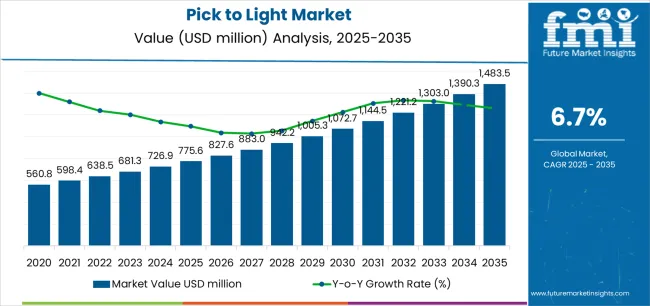
The global pick to light market is valued at USD 775.6 million in 2025. It is slated to reach USD 1,483.5 million by 2035, recording an absolute increase of USD 707.9 million over the forecast period. This translates into a total growth of 91.3%, with the market forecast to expand at a compound annual growth rate (CAGR) of 6.7% between 2025 and 2035. The overall market size is expected to grow by nearly 1.91X during the same period, supported by increasing e-commerce fulfillment demands and omnichannel distribution complexity, growing emphasis on order accuracy and picking productivity in distribution operations, expanding warehouse automation and smart logistics implementations, and rising adoption of wireless connectivity and AMR-integrated pick to light systems across diverse warehousing, manufacturing, apparel, electronics, and pharmaceutical distribution applications.
Between 2025 and 2030, the pick to light market is projected to expand from USD 775.6 million to USD 1,068.9 million, resulting in a value increase of USD 293.3 million, which represents 41.4% of the total forecast growth for the decade. This phase of development will be shaped by increasing e-commerce order complexity and SKU proliferation, rising adoption of wireless pick to light systems reducing installation costs, and growing demand for AMR-integrated guidance systems supporting dynamic warehouse layouts. Distribution center operators and third-party logistics providers are expanding their pick to light capabilities to address the growing need for accurate and efficient order fulfillment systems that ensure picking productivity and reduce training requirements.
Market dynamics reveal sophisticated procurement requirements where operational specifications must satisfy competing performance criteria across diverse application environments. Distribution center operators evaluate pick-to-light systems based on integration capabilities with warehouse management systems, picking accuracy improvements, and throughput velocity enhancements during peak seasonal operations. Manufacturing facilities prioritize error-proofing capabilities that support lean production processes and continuous improvement initiatives across assembly lines and kitting operations.
E-commerce fulfillment centers represent a rapidly expanding market segment where pick-to-light procurement decisions involve complex performance trade-offs between installation costs, operator training requirements, and order accuracy improvements. Omnichannel retailers require flexible systems that accommodate diverse product assortments and varying order profiles across subscription box fulfillment, split-case picking, and batch processing operations. Third-party logistics providers evaluate scalability features that support multiple client requirements and seasonal volume fluctuations.
Training requirements create operational considerations for organizations implementing pick-to-light technology across diverse workforce demographics. Multi-language support capabilities accommodate international operations and seasonal staffing patterns common in distribution centers. Visual guidance features reduce training time compared to paper-based systems while supporting productivity gains among temporary and part-time personnel.
Supply chain considerations affect equipment availability and technical support across different geographic markets. Pick-to-light manufacturers must maintain component inventory levels for LED displays, control processors, and connectivity hardware while providing timely technical support for system modifications and expansions. Installation scheduling may require coordination with facility operations to minimize disruptions during peak operating periods.
Quick Stats for Pick to Light Market
- Pick to Light Market Value (2025): USD 775.6 million
- Pick to Light Market Forecast Value (2035): USD 1,483.5 million
- Pick to Light Market Forecast CAGR: 6.7%
- Leading Operation in Pick to Light Market: Picking
- Key Growth Regions in Pick to Light Market: East Asia, North America, and Western Europe
- Key Players in Pick to Light Market: Honeywell Intelligrated, Daifuku, Swisslog (KUKA Group), SSI SCHAEFER, KNAPP AG, AIOI-Systems, Kardex, Banner Engineering, Bastian Solutions, Lightning Pick (Matthews)
Key Takeaways, Market Size, and Forecast
| Metric | Value |
|---|---|
| Market Size (2025) | USD 775.6 Million |
| Market Size (2035) | USD 1,483.5 Million |
| CAGR (2025–2035) | 6.7% |
| Leading Application | Picking |
| Picking Share | 73.6% |
| Leading Method | Manual (Operator-Guided) |
| Manual (Operator-Guided) Share | 62.0% |
Pick to Light Market Key Takeaways
| Metric | Value |
|---|---|
| Estimated Value in (2025E) | USD 775.6 million |
| Forecast Value in (2035F) | USD 1,483.5 million |
| Forecast CAGR (2025 to 2035) | 6.7% |
From 2030 to 2035, the market is forecast to grow from USD 1,068.9 million to USD 1,483.5 million, adding another USD 414.6 million, which constitutes 58.6% of the overall ten-year expansion. This period is expected to be characterized by the expansion of artificial intelligence-powered order optimization and predictive replenishment, the development of augmented reality integration and wearable device convergence, and the growth of micro-fulfillment centers and dark store operations requiring compact guidance systems. The growing adoption of cloud-based warehouse management integration and real-time analytics will drive demand for pick to light systems with enhanced connectivity and performance monitoring features.
Between 2020 and 2025, the pick to light market experienced steady growth, driven by increasing e-commerce fulfillment requirements and growing recognition of visual guidance systems as essential technologies for improving picking accuracy and reducing training time in diverse distribution center, manufacturing assembly, and order fulfillment applications. The market developed as warehouse managers and operations directors recognized the potential for light-directed picking technology to eliminate paper-based processes, reduce picking errors, and support throughput optimization objectives while meeting accuracy requirements. Technological advancement in wireless connectivity and LED display design began emphasizing the critical importance of maintaining system flexibility and reducing installation complexity in dynamic warehouse environments.
Why is the Pick to Light Market Growing?
Market expansion is being supported by the increasing global e-commerce penetration and omnichannel retail complexity driven by consumer delivery expectations and inventory distribution strategies, alongside the corresponding need for accurate order fulfillment technologies that can enhance picking productivity, eliminate order errors, and maintain operational efficiency across various distribution centers, manufacturing facilities, fashion fulfillment, electronics assembly, and pharmaceutical distribution applications. Modern warehouse operators and logistics managers are increasingly focused on implementing pick to light solutions that can reduce training time, improve picking accuracy, and provide real-time performance visibility in high-velocity fulfillment environments.
The growing emphasis on labor productivity and workforce optimization is driving demand for pick to light systems that can support intuitive operator guidance, enable multi-order batch picking, and ensure comprehensive accuracy tracking across diverse fulfillment operations. Operations leaders' preference for guidance technologies that combine ease of use with system reliability and integration flexibility is creating opportunities for innovative pick to light implementations. The rising influence of autonomous mobile robot adoption and micro-fulfillment center development is also contributing to increased deployment of pick to light systems that can provide superior guidance capabilities without requiring extensive training or complex warehouse management system integration.
Segmental Analysis
The market is segmented by operation, method, connection, end-use, and region. By operation, the market is divided into picking and placing. Based on method, the market is categorized into manual (operator-guided) and auto-guided (robot/AMR-assisted). By connection, the market includes wired and wireless. Based on end-use, the market comprises warehousing & 3PL, manufacturing & assembly, apparel & fashion, electronics, food & beverages, pharmaceuticals & cosmetics, healthcare, and others. Regionally, the market is divided into East Asia, North America, Western Europe, South Asia & Pacific, Eastern Europe, Latin America, and Middle East & Africa.
By Operation, the Picking Segment Leads the Market
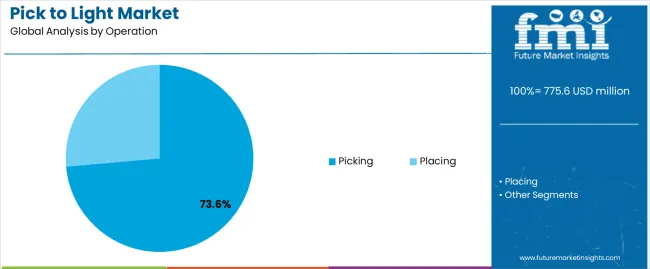
The picking segment is projected to maintain its leading position in the pick to light market in 2025 with a 73.6% market share, reaffirming its role as the preferred operation category for order fulfillment, inventory retrieval, and product selection applications across distribution and manufacturing facilities. Warehouse operators and logistics managers increasingly utilize pick to light systems for picking operations due to their superior accuracy improvement characteristics, excellent productivity enhancement capabilities, and proven effectiveness in reducing training time while eliminating paper-based picking processes. Pick to light technology's proven effectiveness and application versatility directly address the fulfillment industry requirements for error-free order assembly and rapid throughput across diverse product categories and order profiles.
This operation segment forms the foundation of guided warehouse operations, as it represents the primary application with the greatest impact on order accuracy and established performance record across multiple distribution scenarios and fulfillment strategies. E-commerce sector investments in fulfillment accuracy technologies continue to strengthen adoption among distribution center operators and third-party logistics providers. With operational pressures requiring enhanced accuracy and improved productivity, picking-focused pick to light systems align with both quality objectives and throughput requirements, making them the central component of comprehensive order fulfillment strategies.
The placing segment represents 26.4% of market demand, serving put-away operations, replenishment activities, goods-to-person station consolidation, and assembly sequencing where visual guidance directs operators to correct storage locations or assembly positions supporting inventory accuracy and production flow optimization.
By Method, the Manual Segment Dominates Market Demand
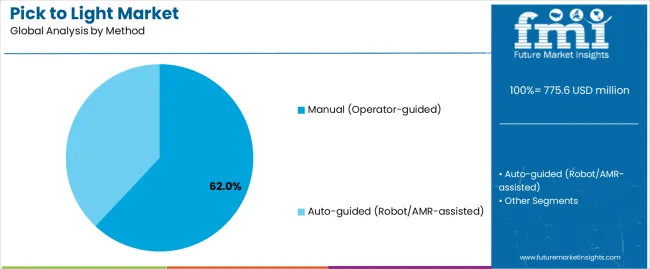
The manual (operator-guided) method segment is projected to represent the largest share of pick to light demand in 2025 with a 62% market share, underscoring its critical role as the primary deployment approach for human picker guidance across conventional distribution centers, manufacturing assembly lines, and retail fulfillment operations. Warehouse operators prefer manual pick to light systems for order fulfillment due to their exceptional flexibility characteristics, proven reliability across diverse applications, and ability to support various picking strategies including discrete, batch, and zone picking while maintaining operator control. Positioned as essential technologies for human-centric fulfillment operations, manual pick to light systems offer both accuracy advantages and productivity benefits.
The segment is supported by continuous innovation in display technologies and the growing availability of wireless systems that enable superior flexibility with reduced installation complexity and reconfiguration capabilities. Additionally, distribution facilities are investing in comprehensive pick to light deployments to support increasingly demanding accuracy requirements and order complexity management. As e-commerce fulfillment evolves and SKU proliferation continues, the manual operation method will continue to dominate the market while supporting diverse picking strategies and operational optimization approaches.
The auto-guided (robot/AMR-assisted) method represents 38% of market demand, driven by autonomous mobile robot integration, goods-to-person workstation guidance, and collaborative picking scenarios where pick to light systems direct both human operators and robotic systems in coordinated fulfillment operations supporting advanced warehouse automation strategies.
What are the Drivers, Restraints, and Key Trends of the Pick to Light Market?
The pick to light market is advancing steadily due to increasing demand for order accuracy and labor productivity driven by e-commerce growth and growing adoption of omnichannel distribution strategies that require flexible fulfillment technologies providing enhanced picking guidance and error reduction across diverse warehousing, manufacturing, fashion, electronics, and pharmaceutical distribution applications. However, the market faces challenges, including high initial capital investment for large-scale implementations, integration complexity with existing warehouse management systems and material handling equipment, and competitive pressure from alternative guidance technologies including voice picking and augmented reality. Innovation in wireless connectivity and AMR integration continues to influence product development and market expansion patterns.
Expansion of E-Commerce Fulfillment and Micro-Fulfillment Centers
The growing e-commerce penetration and last-mile delivery acceleration is driving demand for specialized pick to light solutions that address critical operational requirements including high SKU density, multi-order batch picking, and rapid order assembly supporting same-day and next-day delivery expectations. Distribution center operators face increasing pressure to process growing order volumes with increasing line-item complexity while managing seasonal fluctuations and maintaining accuracy standards across diverse product categories. E-commerce retailers and urban micro-fulfillment operators are increasingly recognizing the essential role of visual guidance technologies for maximizing picking productivity in compact footprints, creating opportunities for wireless pick to light systems specifically designed for flexible layouts and rapid deployment scenarios supporting dynamic fulfillment network expansion.
Integration of Autonomous Mobile Robots and Collaborative Picking
Modern pick to light system manufacturers are incorporating autonomous mobile robot compatibility and goods-to-person workstation integration to enhance operational flexibility, enable dynamic inventory positioning, and support comprehensive fulfillment automation through coordinated human-robot collaboration. Leading companies are developing AMR-mounted pick to light displays with mobile guidance capabilities, implementing station-based systems for goods-to-person workflows, and advancing technologies that coordinate robot delivery with operator picking guidance. These technologies improve fulfillment efficiency while enabling new operational models, including mobile shelf picking, dynamic zone assignment, and flexible capacity deployment. Advanced AMR integration also allows warehouse operators to support scalable automation objectives and adaptive capacity management beyond traditional fixed-aisle picking approaches.
Development of Wireless Connectivity and NFC Configuration
The expansion of dynamic warehouse layouts, temporary fulfillment operations, and frequent SKU rotations is driving demand for wireless pick to light systems with simplified installation, NFC-based configuration, and battery-powered operation that eliminate cabling requirements and enable rapid system reconfiguration. These advanced wireless systems incorporate long-life batteries, robust RF communication, and touch-free setup that reduce deployment costs and installation time, creating accessible market segments with simplified implementation propositions. Manufacturers are investing in wireless protocol development and energy-efficient display technologies to serve dynamic warehouse environments requiring frequent reconfiguration while supporting operational flexibility and seasonal capacity expansion throughout diverse fulfillment operations and temporary distribution facilities.
Analysis of the Pick to Light Market by Key Countries
| Country | CAGR (2025-2035) |
|---|---|
| India | 7.7% |
| China | 7.4% |
| Japan | 6.7% |
| South Korea | 6% |
| United States | 5.7% |
| Germany | 5.4% |
| United Kingdom | 5.2% |
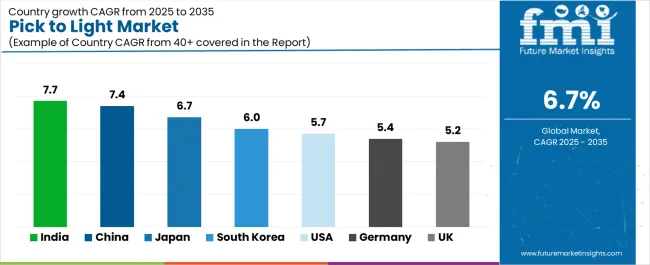
The pick to light market is experiencing solid growth globally, with India leading at a 7.7% CAGR through 2035, driven by production-linked incentive programs and distribution center automation in Tier-1 and Tier-2 cities supporting e-commerce expansion. China follows at 7.4%, supported by e-commerce fulfillment scale-up and comprehensive smart warehouse programs across logistics sectors. Japan shows growth at 6.7%, emphasizing lean intralogistics upgrades and aging workforce automation supporting operational efficiency. South Korea demonstrates 6% growth, supported by electronics kitting accuracy requirements and high-throughput mini-distribution center operations. The United States records 5.7%, focusing on high-SKU e-commerce operations and micro-fulfillment center growth. Germany exhibits 5.4% growth, emphasizing brownfield retrofits in FMCG and omnichannel grocery distribution. The United Kingdom shows 5.2% growth, supported by omnichannel distribution center consolidation and labor efficiency initiatives.
The report covers an in-depth analysis of 40+ countries, the top-performing countries are highlighted below.
India Leads Global Market Growth with Production Incentives and Urban DC Automation
Revenue from pick to light systems in India is projected to exhibit exceptional growth with a CAGR of 7.7% through 2035, driven by production-linked incentive schemes supporting manufacturing automation and extensive distribution center development in Tier-1 and Tier-2 cities supported by e-commerce expansion and retail modernization programs. The country's rapid e-commerce growth and warehouse infrastructure development are creating substantial demand for pick to light solutions. Major logistics technology providers and warehouse automation companies are establishing comprehensive distribution and installation capabilities to serve both e-commerce and manufacturing markets.
- Government support for manufacturing automation and logistics infrastructure development is driving demand for pick to light systems throughout major urban regions and emerging logistics hubs across e-commerce fulfillment centers, third-party logistics facilities, and manufacturing assembly operations.
- Strong e-commerce sector growth and an expanding network of modern distribution centers are supporting the rapid adoption of wireless pick to light technologies among warehouse operators seeking enhanced picking accuracy and reduced training time for variable workforce deployment.
China Demonstrates Strong Market Potential with E-Commerce Scale and Smart Warehousing
Revenue from pick to light systems in China is expanding at a CAGR of 7.4%, supported by the country's massive e-commerce fulfillment scale-up, comprehensive smart warehouse programs, and extensive logistics automation initiatives driven by retail digitalization and supply chain efficiency objectives. The country's advanced logistics infrastructure and automation sophistication are driving widespread pick to light capabilities throughout distribution and manufacturing sectors. Leading warehouse automation providers and e-commerce platforms are establishing extensive smart warehouse facilities incorporating pick to light guidance systems.
- Rising e-commerce order volumes and expanding automated warehouse networks are creating opportunities for pick to light system adoption across e-commerce fulfillment centers, retail distribution facilities, and cross-border logistics hubs throughout major logistics corridors.
- Growing emphasis on fulfillment accuracy and labor productivity is driving deployment of advanced pick to light technologies among logistics operators seeking enhanced operational efficiency and reduced error rates across high-velocity distribution operations.
Japan Focuses on Lean Intralogistics and Workforce Demographics Mitigation
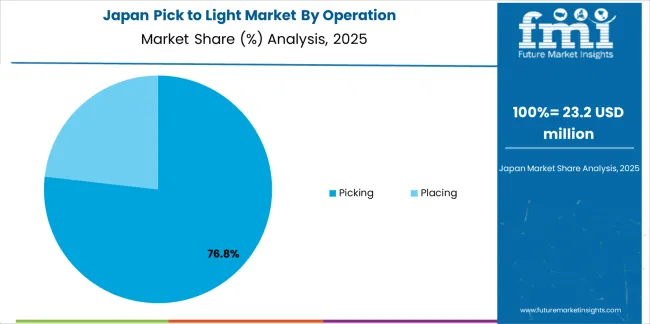
Revenue from pick to light systems in Japan is expanding at a CAGR of 6.7%, supported by the country's lean manufacturing principles, comprehensive intralogistics upgrade programs, and aging workforce automation requirements addressing demographic challenges. Japan's operational excellence culture and labor constraints are driving demand for productivity-enhancing pick to light solutions. Leading manufacturers and logistics operators are investing in visual guidance technologies addressing workforce efficiency and quality objectives.
- Advanced lean manufacturing implementations and kaizen continuous improvement programs are creating demand for pick to light systems among manufacturers seeking enhanced kitting accuracy and reduced assembly errors throughout production operations.
- Strong demographic pressures and aging warehouse workforce are driving adoption of intuitive guidance technologies throughout distribution centers and manufacturing facilities seeking to maintain productivity despite experienced worker retirements and training time reduction requirements.
South Korea Demonstrates Electronics Precision and Mini-DC Operations
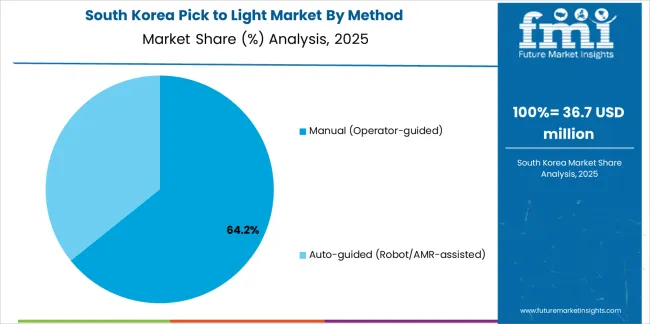
Revenue from pick to light systems in South Korea is expanding at a CAGR of 6%, driven by the country's electronics manufacturing kitting accuracy requirements, high-throughput mini-distribution center operations, and comprehensive urban logistics automation supporting rapid delivery services. South Korea's technological sophistication and dense urban markets are driving advanced pick to light capabilities throughout electronics and retail sectors. Leading electronics manufacturers and e-commerce operators are investing extensively in accurate order fulfillment technologies.
- Advanced electronics manufacturing and component kitting requirements are creating demand for precision pick to light systems among electronics producers seeking enhanced small-parts handling accuracy and assembly efficiency.
- Strong quick-commerce growth and urban micro-fulfillment development are supporting the adoption of compact pick to light installations throughout mini-distribution centers and dark stores supporting rapid grocery and consumer goods delivery across metropolitan areas.
United States Emphasizes High-SKU Operations and Micro-Fulfillment Growth
Revenue from pick to light systems in the United States is expanding at a CAGR of 5.7%, supported by the country's high-SKU e-commerce operations, expanding micro-fulfillment center network, and comprehensive omnichannel distribution strategies addressing complex inventory management. The nation's sophisticated e-commerce sector and retail innovation are driving demand for flexible pick to light solutions. E-commerce retailers and grocery chains are investing in pick to light systems addressing accuracy and productivity requirements.
- Advanced e-commerce operations and extensive SKU proliferation are creating demand for scalable pick to light systems among online retailers seeking enhanced picking productivity and accuracy across complex multi-line orders.
- Strong micro-fulfillment center deployment and urban last-mile automation are driving adoption of compact wireless pick to light solutions throughout grocery fulfillment operations and quick-commerce facilities supporting rapid urban delivery services.
Germany Demonstrates Brownfield Retrofits and Omnichannel Grocery Automation
Revenue from pick to light systems in Germany is expanding at a CAGR of 5.4%, driven by the country's extensive brownfield warehouse retrofits, omnichannel grocery distribution automation, and comprehensive FMCG fulfillment modernization supporting retail transformation. Germany's mature distribution infrastructure and retail innovation are driving sophisticated pick to light capabilities throughout grocery and consumer goods sectors. Leading grocery retailers and logistics providers are establishing comprehensive pick to light deployments across distribution networks.
- Advanced grocery automation programs and omnichannel fulfillment strategies are creating demand for flexible pick to light systems among retailers seeking enhanced order accuracy and improved productivity across store replenishment and home delivery operations.
- Strong FMCG distribution modernization and brownfield facility upgrades are supporting the adoption of retrofit-friendly pick to light technologies throughout existing distribution centers requiring accuracy improvement without major structural modifications or operational disruptions.
United Kingdom Focuses on Omnichannel Consolidation and Labor Efficiency
Revenue from pick to light systems in the United Kingdom is expanding at a CAGR of 5.2%, supported by the country's omnichannel distribution center consolidation programs, labor efficiency initiatives, and comprehensive retail fulfillment modernization addressing operational cost pressures. The UK's retail sector transformation and labor market constraints are driving demand for productivity-enhancing pick to light technologies. Grocery retailers and third-party logistics providers are investing in pick to light systems addressing accuracy and efficiency objectives.
- Advanced omnichannel consolidation and multi-format fulfillment are creating opportunities for pick to light deployments throughout consolidated distribution centers serving both store replenishment and direct-to-consumer delivery channels.
- Strong labor cost pressures and workforce availability constraints are driving adoption of pick to light technologies throughout distribution operations seeking enhanced productivity and reduced training requirements across variable seasonal workforce deployment.
Europe Market Split by Country
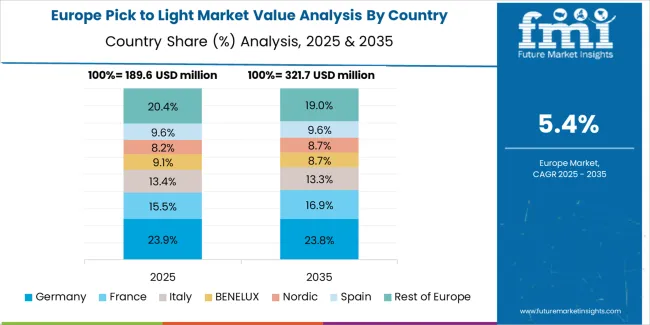
The pick to light market in Europe is projected to grow from USD 209.4 million in 2025 to USD 392.8 million by 2035, registering a CAGR of 6.5% over the forecast period. Germany is expected to lead with a 26.8% market share in 2025, easing to 25.6% by 2035, supported by continued retrofits in grocery distribution and parcel fulfillment operations, brownfield warehouse modernization programs, and comprehensive omnichannel automation initiatives.
France follows with 18.9% in 2025, nudging to 19.2% by 2035, driven by pharmaceutical and cosmetics distribution automation and public logistics hub modernization programs adopting pick to light technologies. The United Kingdom holds 17.3% in 2025, trending to 16.9% by 2035, supported by consolidation of omnichannel distribution centers and retail fulfillment network optimization. Italy accounts for 14.2% in 2025, driven by fashion distribution, food & beverage fulfillment, and electronics assembly operations. Spain represents 11.6% in 2025, supported by apparel distribution, grocery fulfillment, and consumer electronics operations. The Rest of Europe region collectively rises from 11.2% to 12.7% by 2035, reflecting accelerated adoption throughout Nordic countries and Central and Eastern European markets with expanding smart logistics deployments, e-commerce fulfillment center development, and warehouse automation programs across diverse distribution and manufacturing facilities.
Competitive Landscape of the Pick to Light Market
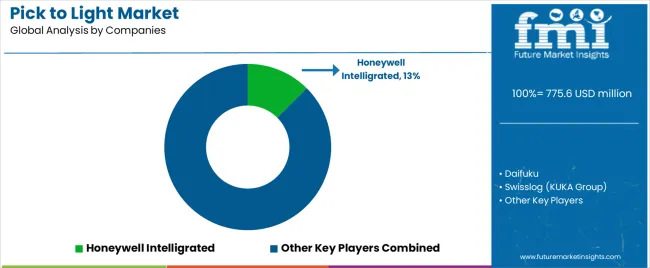
The Pick-to-Light Market is expanding quickly as warehouses, e-commerce fulfillment centers, and manufacturing facilities accelerate their shift toward faster, more accurate order-picking systems. Pick-to-light solutions are increasingly preferred because they reduce human error, shorten picking cycles, and improve labor productivity, key advantages as supply chains face rising order volumes and labor shortages. With growing adoption of warehouse automation, these systems are becoming integral to lean operations, particularly in fast-moving consumer goods, retail, automotive, and 3PL environments.
Honeywell Intelligrated, Daifuku, and Swisslog (KUKA Group) are among the strongest players, offering integrated pick-to-light solutions that combine advanced software, IoT connectivity, and flexible hardware suited for high-throughput distribution centers. SSI SCHAEFER and KNAPP AG continue to strengthen their position through scalable systems designed for large omnichannel operations.
Companies like AIOI-Systems, Kardex, and Bastian Solutions bring specialized expertise in modular, easy-to-deploy pick-to-light setups that support both small warehouses and highly automated environments. Meanwhile, Banner Engineering and Lightning Pick (Matthews) are known for innovative sensor-driven and LED-guided picking technologies that enhance accuracy, streamline workflows, and integrate seamlessly with existing warehouse management systems.
Pick to Light Market - Stakeholder Contribution Framework
Pick to light systems represent a critical warehouse guidance technology segment within distribution centers, manufacturing facilities, and order fulfillment operations, projected to grow from USD 775.6 million in 2025 to USD 1,483.5 million by 2035 at a 6.7% CAGR. These visual guidance systems-encompassing wired and wireless configurations for diverse operational methods-serve as essential accuracy enhancement technologies in order picking, inventory placement, manufacturing assembly, and kitting operations where error elimination, productivity improvement, and operator training reduction are essential. Market expansion is driven by increasing e-commerce fulfillment complexity, growing labor productivity pressures, expanding omnichannel distribution requirements, and rising adoption of wireless and AMR-integrated guidance systems across diverse warehousing and manufacturing sectors.
How Operations Standards Bodies Could Strengthen Accuracy Requirements and Performance Metrics?
- Accuracy and Performance Standards: Establish comprehensive operational standards for order fulfillment accuracy, picking productivity metrics, error rate targets, and throughput specifications that encourage adoption of visual guidance technologies and improve overall supply chain quality across distribution operations.
- System Integration Guidelines: Develop technical standards for pick to light integration with warehouse management systems, material handling equipment, and enterprise resource planning platforms enabling seamless data exchange, real-time inventory updates, and comprehensive performance tracking.
- Training and Competency Requirements: Create guidelines for operator training programs, system familiarization procedures, and performance evaluation methodologies that ensure effective pick to light utilization and maximize return on investment across warehouse operations.
- Safety and Ergonomics Standards: Implement requirements addressing visual display ergonomics, workspace lighting conditions, and operator fatigue prevention that ensure pick to light systems enhance rather than compromise workplace safety and operator wellbeing.
- Innovation Support Programs: Provide regulatory facilitation and industry standards development for emerging pick to light technologies including wireless systems, AMR integration, and augmented reality convergence that advance warehouse automation capabilities.
How Industry Associations Could Advance Application Guidelines and Best Practices?
- Deployment Guidelines: Develop comprehensive technical guidelines for pick to light system specification, layout design, lighting optimization, and integration procedures that maximize accuracy benefits, ensure operational reliability, and maintain cost-effectiveness across diverse warehouse and manufacturing applications.
- Performance Benchmarking: Establish industry-wide metrics for pick to light system evaluation, including accuracy improvement targets, productivity enhancement specifications, return on investment models, and total cost of ownership calculations that enable objective technology comparison.
- Implementation Best Practices: Create standardized methodologies for pick to light deployment, addressing change management, operator training, system commissioning, and performance optimization that ensure successful implementations and maximize operational benefits.
- Technology Selection Frameworks: Develop decision tools for choosing between wired/wireless systems, manual/automated methods, and alternative guidance technologies based on operational characteristics, SKU profiles, and throughput requirements supporting informed investment decisions.
- Cross-Industry Collaboration: Facilitate partnerships between pick to light manufacturers, warehouse management software providers, AMR suppliers, and end-user facilities to advance system integration, address interoperability challenges, and accelerate beneficial innovation in guided fulfillment technologies.
How Pick to Light System Manufacturers Could Drive Innovation and Market Leadership?
- Wireless Technology Development: Invest in long-life battery technologies, robust RF communication protocols, energy-efficient displays, and NFC configuration capabilities that eliminate cabling requirements, reduce installation costs, and enable flexible system reconfiguration supporting dynamic warehouse operations.
- AMR Integration Capabilities: Develop comprehensive autonomous mobile robot compatibility, goods-to-person workstation integration, mobile display mounting solutions, and coordinated guidance algorithms that enable collaborative picking and support advanced warehouse automation strategies.
- Software Platform Innovation: Establish cloud-connected monitoring systems, real-time analytics dashboards, predictive maintenance alerts, and performance optimization tools that maximize system value, enable remote management, and support continuous improvement initiatives.
- User Experience Design: Create intuitive display interfaces, simplified configuration procedures, multi-language support, and adaptive brightness controls that enhance operator experience, reduce training requirements, and improve picking accuracy across diverse workforce capabilities.
- Turnkey Solution Packages: Provide complete pick to light offerings with pre-engineered configurations, integrated software, installation services, and training programs that reduce deployment complexity, accelerate implementation timelines, and lower total project costs.
How Warehouse Operators Could Optimize Pick to Light Performance and ROI?
- Proper System Specification: Conduct thorough operational assessments, SKU analysis, throughput modeling, and workflow evaluation to optimize pick to light system design and ensure appropriate technology selection for specific fulfillment requirements and operational characteristics.
- Effective Implementation: Implement systematic deployment approaches with pilot testing, phased rollout, comprehensive training, and change management that ensure successful adoption, minimize operational disruptions, and achieve projected productivity improvements.
- Operator Training Excellence: Develop thorough training programs for warehouse personnel covering system operation, picking procedures, quality standards, and performance expectations that maximize system utilization and ensure consistent accuracy achievement.
- Performance Monitoring: Establish comprehensive metrics tracking including picking accuracy, productivity rates, error frequencies, and system uptime that enable data-driven optimization, identify improvement opportunities, and demonstrate return on investment.
- Continuous Improvement: Leverage pick to light performance data for process optimization, layout refinement, training enhancement, and operational excellence through systematic review, root cause analysis, and iterative improvement initiatives.
How Research Institutions Could Enable Technology Advancement?
- Human Factors Research: Conduct scientific investigations into visual perception, cognitive load, ergonomic design, and operator interaction that advance understanding of effective guidance system design and inform user interface development for diverse operator populations.
- Display Technology Development: Develop advanced LED technologies, e-paper displays, projected light systems, and adaptive brightness solutions that improve visibility, reduce energy consumption, and enhance pick to light system performance across diverse warehouse environments.
- Communication Protocol Research: Investigate wireless communication technologies, mesh networking approaches, energy-efficient protocols, and interference mitigation techniques that improve system reliability, reduce power consumption, and enable scalable wireless implementations.
- Integration Studies: Provide comprehensive analysis of warehouse management system integration, AMR coordination, augmented reality convergence, and multi-technology guidance approaches that inform effective pick to light deployment within complex automation ecosystems.
- Knowledge Transfer: Facilitate technology commercialization through industry partnerships, pilot programs, technical publications, and collaborative research projects that accelerate pick to light innovation adoption and strengthen warehouse automation advancement.
How Investors and Financial Enablers Could Support Market Growth and Innovation?
- Manufacturing Capacity Investment: Provide capital for pick to light component production expansion, display manufacturing facilities, electronic assembly operations, and supply chain infrastructure that address growing market demand while improving manufacturing efficiency.
- Technology Development Financing: Fund research and development of breakthrough pick to light technologies, including advanced wireless systems, AMR integration platforms, AI-powered optimization, and next-generation display technologies that address current limitations and create competitive advantages.
- Market Expansion Support: Finance geographic expansion initiatives, distribution network development, system integrator partnerships, and installation service infrastructure that accelerate market penetration and strengthen competitive positioning in high-growth regions.
- Customer Financing Programs: Support equipment leasing options, technology-as-a-service models, performance-based contracts, and flexible payment structures that reduce capital barriers and enable broader pick to light adoption across small and medium-sized warehouse operations.
- Innovation Ecosystem Development: Provide funding for collaborative research programs, application development centers, technology demonstration facilities, and industry consortia that accelerate pick to light innovation and strengthen overall warehouse automation technology advancement and market competitiveness.
Key Players in the Pick to Light Market
- Honeywell Intelligrated
- Daifuku
- Swisslog (KUKA Group)
- SSI SCHAEFER
- KNAPP AG
- AIOI-Systems
- Kardex
- Banner Engineering
- Bastian Solutions
- Lightning Pick (Matthews)
Scope of the Report
| Items | Values |
|---|---|
| Quantitative Units (2025) | USD 775.6 million |
| Operation | Picking, Placing |
| Method | Manual (Operator-guided), Auto-guided (Robot/AMR-assisted) |
| Connection | Wired, Wireless |
| End-Use | Warehousing & 3PL, Manufacturing & Assembly, Apparel & Fashion, Electronics, Food & Beverages, Pharmaceuticals & Cosmetics, Healthcare, Others |
| Regions Covered | East Asia, North America, Western Europe, South Asia & Pacific, Eastern Europe, Latin America, Middle East & Africa |
| Countries Covered | India, China, Japan, South Korea, United States, Germany, United Kingdom, and 40+ countries |
| Key Companies Profiled | Honeywell Intelligrated, Daifuku, Swisslog (KUKA Group), SSI SCHAEFER, KNAPP AG, AIOI-Systems, Kardex, Banner Engineering, Bastian Solutions, Lightning Pick (Matthews) |
| Additional Attributes | Dollar sales by operation, method, connection, and end-use categories, regional demand trends, competitive landscape, technological advancements in wireless connectivity, AMR integration, NFC configuration, and cloud analytics platforms |
Pick to Light Market by Segments
Operation:
- Picking
- Placing
Method:
- Manual (Operator-guided)
- Auto-guided (Robot/AMR-assisted)
Connection:
- Wired
- Wireless
End-Use:
- Warehousing & 3PL
- Manufacturing & Assembly
- Apparel & Fashion
- Electronics
- Food & Beverages
- Pharmaceuticals & Cosmetics
- Healthcare
- Others
Region:
- East Asia
- China
- Japan
- South Korea
- Taiwan
- Rest of East Asia
- North America
- United States
- Canada
- Mexico
- Western Europe
- Germany
- France
- United Kingdom
- Italy
- Spain
- Nordic Countries
- Rest of Western Europe
- South Asia & Pacific
- India
- Australia
- Southeast Asia
- Rest of South Asia & Pacific
- Eastern Europe
- Russia
- Poland
- Rest of Eastern Europe
- Latin America
- Brazil
- Argentina
- Chile
- Rest of Latin America
- Middle East & Africa
- Kingdom of Saudi Arabia
- United Arab Emirates
- Other GCC Countries
- South Africa
- Rest of Middle East & Africa
Frequently Asked Questions
How big is the pick to light market in 2025?
The global pick to light market is estimated to be valued at USD 775.6 million in 2025.
What will be the size of pick to light market in 2035?
The market size for the pick to light market is projected to reach USD 1,483.5 million by 2035.
How much will be the pick to light market growth between 2025 and 2035?
The pick to light market is expected to grow at a 6.7% CAGR between 2025 and 2035.
What are the key product types in the pick to light market?
The key product types in pick to light market are picking and placing.
Which method segment to contribute significant share in the pick to light market in 2025?
In terms of method, manual (operator-guided) segment to command 62.0% share in the pick to light market in 2025.
Preview the report firsthand - request a free sample
Get SampleGet the brochure for pricing and purchase details.
Get PDFTable of Content
- Executive Summary
- Global Market Outlook
- Demand-side Trends
- Supply-side Trends
- Technology Roadmap Analysis
- Analysis and Recommendations
- Market Overview
- Market Coverage / Taxonomy
- Market Definition / Scope / Limitations
- Market Background
- Market Dynamics
- Drivers
- Restraints
- Opportunity
- Trends
- Scenario Forecast
- Demand in Optimistic Scenario
- Demand in Likely Scenario
- Demand in Conservative Scenario
- Opportunity Map Analysis
- Product Life Cycle Analysis
- Supply Chain Analysis
- Investment Feasibility Matrix
- Value Chain Analysis
- PESTLE and Porter’s Analysis
- Regulatory Landscape
- Regional Parent Market Outlook
- Production and Consumption Statistics
- Import and Export Statistics
- Market Dynamics
- Global Market Analysis 2020 to 2024 and Forecast, 2025 to 2035
- Historical Market Size Value (USD Million) Analysis, 2020 to 2024
- Current and Future Market Size Value (USD Million) Projections, 2025 to 2035
- Y-o-Y Growth Trend Analysis
- Absolute $ Opportunity Analysis
- Global Market Pricing Analysis 2020 to 2024 and Forecast 2025 to 2035
- Global Market Analysis 2020 to 2024 and Forecast 2025 to 2035, By Operation
- Introduction / Key Findings
- Historical Market Size Value (USD Million) Analysis By Operation , 2020 to 2024
- Current and Future Market Size Value (USD Million) Analysis and Forecast By Operation , 2025 to 2035
- Picking
- Placing
- Y-o-Y Growth Trend Analysis By Operation , 2020 to 2024
- Absolute $ Opportunity Analysis By Operation , 2025 to 2035
- Global Market Analysis 2020 to 2024 and Forecast 2025 to 2035, By Method
- Introduction / Key Findings
- Historical Market Size Value (USD Million) Analysis By Method, 2020 to 2024
- Current and Future Market Size Value (USD Million) Analysis and Forecast By Method, 2025 to 2035
- Manual (Operator-guided)
- Auto-guided (Robot/AMR-assisted)
- Y-o-Y Growth Trend Analysis By Method, 2020 to 2024
- Absolute $ Opportunity Analysis By Method, 2025 to 2035
- Global Market Analysis 2020 to 2024 and Forecast 2025 to 2035, By Region
- Introduction
- Historical Market Size Value (USD Million) Analysis By Region, 2020 to 2024
- Current Market Size Value (USD Million) Analysis and Forecast By Region, 2025 to 2035
- North America
- Latin America
- Western Europe
- Eastern Europe
- East Asia
- South Asia and Pacific
- Middle East & Africa
- Market Attractiveness Analysis By Region
- North America Market Analysis 2020 to 2024 and Forecast 2025 to 2035, By Country
- Historical Market Size Value (USD Million) Trend Analysis By Market Taxonomy, 2020 to 2024
- Market Size Value (USD Million) Forecast By Market Taxonomy, 2025 to 2035
- By Country
- USA
- Canada
- Mexico
- By Operation
- By Method
- By Country
- Market Attractiveness Analysis
- By Country
- By Operation
- By Method
- Key Takeaways
- Latin America Market Analysis 2020 to 2024 and Forecast 2025 to 2035, By Country
- Historical Market Size Value (USD Million) Trend Analysis By Market Taxonomy, 2020 to 2024
- Market Size Value (USD Million) Forecast By Market Taxonomy, 2025 to 2035
- By Country
- Brazil
- Chile
- Rest of Latin America
- By Operation
- By Method
- By Country
- Market Attractiveness Analysis
- By Country
- By Operation
- By Method
- Key Takeaways
- Western Europe Market Analysis 2020 to 2024 and Forecast 2025 to 2035, By Country
- Historical Market Size Value (USD Million) Trend Analysis By Market Taxonomy, 2020 to 2024
- Market Size Value (USD Million) Forecast By Market Taxonomy, 2025 to 2035
- By Country
- Germany
- UK
- Italy
- Spain
- France
- Nordic
- BENELUX
- Rest of Western Europe
- By Operation
- By Method
- By Country
- Market Attractiveness Analysis
- By Country
- By Operation
- By Method
- Key Takeaways
- Eastern Europe Market Analysis 2020 to 2024 and Forecast 2025 to 2035, By Country
- Historical Market Size Value (USD Million) Trend Analysis By Market Taxonomy, 2020 to 2024
- Market Size Value (USD Million) Forecast By Market Taxonomy, 2025 to 2035
- By Country
- Russia
- Poland
- Hungary
- Balkan & Baltic
- Rest of Eastern Europe
- By Operation
- By Method
- By Country
- Market Attractiveness Analysis
- By Country
- By Operation
- By Method
- Key Takeaways
- East Asia Market Analysis 2020 to 2024 and Forecast 2025 to 2035, By Country
- Historical Market Size Value (USD Million) Trend Analysis By Market Taxonomy, 2020 to 2024
- Market Size Value (USD Million) Forecast By Market Taxonomy, 2025 to 2035
- By Country
- China
- Japan
- South Korea
- By Operation
- By Method
- By Country
- Market Attractiveness Analysis
- By Country
- By Operation
- By Method
- Key Takeaways
- South Asia and Pacific Market Analysis 2020 to 2024 and Forecast 2025 to 2035, By Country
- Historical Market Size Value (USD Million) Trend Analysis By Market Taxonomy, 2020 to 2024
- Market Size Value (USD Million) Forecast By Market Taxonomy, 2025 to 2035
- By Country
- India
- ASEAN
- Australia & New Zealand
- Rest of South Asia and Pacific
- By Operation
- By Method
- By Country
- Market Attractiveness Analysis
- By Country
- By Operation
- By Method
- Key Takeaways
- Middle East & Africa Market Analysis 2020 to 2024 and Forecast 2025 to 2035, By Country
- Historical Market Size Value (USD Million) Trend Analysis By Market Taxonomy, 2020 to 2024
- Market Size Value (USD Million) Forecast By Market Taxonomy, 2025 to 2035
- By Country
- Kingdom of Saudi Arabia
- Other GCC Countries
- Turkiye
- South Africa
- Other African Union
- Rest of Middle East & Africa
- By Operation
- By Method
- By Country
- Market Attractiveness Analysis
- By Country
- By Operation
- By Method
- Key Takeaways
- Key Countries Market Analysis
- USA
- Pricing Analysis
- Market Share Analysis, 2024
- By Operation
- By Method
- Canada
- Pricing Analysis
- Market Share Analysis, 2024
- By Operation
- By Method
- Mexico
- Pricing Analysis
- Market Share Analysis, 2024
- By Operation
- By Method
- Brazil
- Pricing Analysis
- Market Share Analysis, 2024
- By Operation
- By Method
- Chile
- Pricing Analysis
- Market Share Analysis, 2024
- By Operation
- By Method
- Germany
- Pricing Analysis
- Market Share Analysis, 2024
- By Operation
- By Method
- UK
- Pricing Analysis
- Market Share Analysis, 2024
- By Operation
- By Method
- Italy
- Pricing Analysis
- Market Share Analysis, 2024
- By Operation
- By Method
- Spain
- Pricing Analysis
- Market Share Analysis, 2024
- By Operation
- By Method
- France
- Pricing Analysis
- Market Share Analysis, 2024
- By Operation
- By Method
- India
- Pricing Analysis
- Market Share Analysis, 2024
- By Operation
- By Method
- ASEAN
- Pricing Analysis
- Market Share Analysis, 2024
- By Operation
- By Method
- Australia & New Zealand
- Pricing Analysis
- Market Share Analysis, 2024
- By Operation
- By Method
- China
- Pricing Analysis
- Market Share Analysis, 2024
- By Operation
- By Method
- Japan
- Pricing Analysis
- Market Share Analysis, 2024
- By Operation
- By Method
- South Korea
- Pricing Analysis
- Market Share Analysis, 2024
- By Operation
- By Method
- Russia
- Pricing Analysis
- Market Share Analysis, 2024
- By Operation
- By Method
- Poland
- Pricing Analysis
- Market Share Analysis, 2024
- By Operation
- By Method
- Hungary
- Pricing Analysis
- Market Share Analysis, 2024
- By Operation
- By Method
- Kingdom of Saudi Arabia
- Pricing Analysis
- Market Share Analysis, 2024
- By Operation
- By Method
- Turkiye
- Pricing Analysis
- Market Share Analysis, 2024
- By Operation
- By Method
- South Africa
- Pricing Analysis
- Market Share Analysis, 2024
- By Operation
- By Method
- USA
- Market Structure Analysis
- Competition Dashboard
- Competition Benchmarking
- Market Share Analysis of Top Players
- By Regional
- By Operation
- By Method
- Competition Analysis
- Competition Deep Dive
- Honeywell Intelligrated
- Overview
- Product Portfolio
- Profitability by Market Segments (Product/Age /Sales Channel/Region)
- Sales Footprint
- Strategy Overview
- Marketing Strategy
- Product Strategy
- Channel Strategy
- Daifuku
- Swisslog (KUKA Group)
- SSI SCHAEFER
- KNAPP AG
- AIOI-Systems
- Kardex
- Banner Engineering
- Bastian Solutions
- Lightning Pick (Matthews)
- Honeywell Intelligrated
- Competition Deep Dive
- Assumptions & Acronyms Used
- Research Methodology


