

- Industry Size (2026)
- USD 567.12 Mn
- Forecast (2036)
- USD 1525.35 Mn
- CAGR (2026 to 2036)
- 10.4%
Residential Solar Generator Market Size, Market Forecast and Outlook By FMI
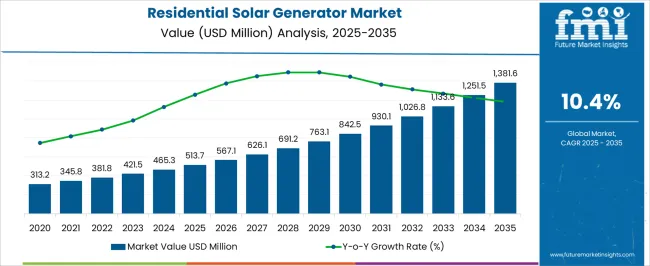
The residential solar generator market was valued at USD 513.7 million in 2025, projected to reach USD 567.12 million in 2026, and is forecast to expand to USD 1525.35 million by 2036 at a 10.4% CAGR. Growing consumer interest in portable, zero-emission power sources for outdoor activities and emergency backup is driving demand for integrated solar panel and lithium battery generator systems. Single-phase units command 57.4% share, reflecting the predominance of household-compatible AC output configurations for powering standard residential appliances and electronics during grid outages.
Summary of Residential Solar Generator Market
- Market Snapshot:
- The residential solar generator market is valued at USD 513.7 million in 2025 and is projected to reach USD 1525.35 million by 2036.
- The industry is expected to grow at a 10.4% CAGR from 2026 to 2036, creating an incremental opportunity of USD 958.23 million.
- The market is a dual-use portable power category where solar conversion efficiency, battery capacity, and output compatibility define competitive positioning across both emergency preparedness and outdoor recreation segments.
- Demand and Growth Drivers:
- Growing consumer interest in portable, zero-emission power sources for outdoor recreation and emergency backup is expanding the residential solar generator market beyond off-grid niche applications.
- Declining lithium battery and solar panel costs have reduced portable solar generator prices by over 40% in the past five years, making them accessible to mainstream consumers.
- Grid reliability concerns driven by increasing frequency of weather-related power outages are prompting suburban and exurban homeowners to invest in solar-powered backup solutions.
- Among key countries, China at 14.0%, India at 13.0%, Germany at 12.0%, France at 10.9%, UK at 9.9%, USA at 8.8%, Brazil at 7.8%.
- Product and Segment View:
- The market includes portable solar-battery integrated generator systems in single-phase and three-phase configurations with capacities from under 1,000 W to over 3,000 W.
- Single Phase leads by Phase with 57.4% share in 2026.
- Up to 1,000 W leads by Capacity with 39.6% share in 2026.
- Scope includes market scope includes portable solar generator units with integrated lithium battery storage, foldable and rigid solar panel inputs, mppt charge controllers, and ac/dc inverter outputs. Rooftop solar panel installations and fixed residential battery storage systems are excluded.
- Geography and Competitive Outlook
- China and India are the fastest-growing markets at 14.0% and 13.0% CAGR respectively, driven by expanding solar equipment adoption and portable power demand.
- USA represents a mature demand base where hurricane preparedness and recreational vehicle solar power demand sustain portable solar generator adoption.
- Competition is shaped by solar panel efficiency, battery capacity, output compatibility, and direct-to-consumer distribution reach, with key players including ACOPOWER, Jackery, GROWATT, Goal Zero, Lion Energy, Generac Power Systems, Anker.
- Analyst Opinion at FMI:
- Nikhil Kaitwade, Principal Consultant for Energy, opines: 'In my analysis, I have observed that portable solar generators are transitioning from outdoor enthusiast equipment to mainstream household backup power investments. Homeowners relying on fuel-powered generators for emergency backup face ongoing fuel procurement and storage challenges that solar-battery systems eliminate entirely. Retailers that fail to stock portable solar generators alongside conventional generator inventory will lose share as consumer awareness of zero-fuel, zero-emission portable power alternatives increases.'
- Strategic Implications / Executive Takeaways:
- Solar generator manufacturers must expand lithium iron phosphate battery capacity and fast-charging capability to match growing consumer expectations for rapid recharge and extended backup duration.
- Retail distribution partners should position portable solar generators alongside both outdoor recreation and home emergency preparedness categories to capture dual purchase motivation.
- Product development teams must prioritize smart home integration features including app-based monitoring, scheduled charging, and automatic transfer switching to compete with fixed residential battery systems.
Residential Solar Generator Market Key Takeaways
| Metric | Details |
|---|---|
| Industry Size (2026) | USD 567.12 million |
| Industry Value (2036) | USD 1525.35 million |
| CAGR (2026-2036) | 10.4% |
Source: Future Market Insights, 2026
The incremental opportunity of USD 958.23 million over the forecast period reflects both emergency preparedness demand and the growing lifestyle adoption of portable solar power for camping, tailgating, and outdoor events. Units up to 1,000 W account for 39.6% of capacity share, serving individual device charging and small appliance power requirements that constitute the majority of recreational and light backup use cases.
China leads at 14.0 CAGR, driven by the distributed solar generation targets under the 14th Five-Year Plan and growing consumer adoption of portable solar generators for outdoor recreation and rural household backup. India follows at 13.0, propelled by the PM Surya Ghar programme incentivising household solar adoption and intermittent grid supply in rural and semi-urban areas creating demand for portable solar backup systems. Germany registers 12.0, anchored by growing consumer demand for emission-free portable power and the elimination of VAT on solar equipment purchases. France advances at 10.9, supported by the MaPrimeRenov solar incentive integration and growing outdoor recreation markets driving portable solar generator adoption. The United Kingdom posts 9.9, driven by growing camping and outdoor festival culture combined with storm preparedness awareness among rural households. The United States expands at 8.8, supported by hurricane preparedness demand in coastal states and the growing overlanding and recreational vehicle market requiring portable solar power systems. Brazil records 7.8 growth as grid instability in northern and northeastern states and growing outdoor leisure markets drive portable solar generator adoption.
Residential Solar Generator Market Definition
The residential solar generator market encompasses portable, integrated solar panel and battery storage systems designed to convert solar energy into stored electrical power for residential backup, outdoor recreation, and off-grid applications. Products include portable solar generators in single-phase and three-phase configurations with capacities ranging from under 1,000 W to over 3,000 W, combining photovoltaic panels, lithium battery packs, charge controllers, and AC/DC inverter output ports.
Residential Solar Generator Market Inclusions
Market scope includes portable solar generator units with integrated lithium battery storage, foldable and rigid solar panel inputs, MPPT charge controllers, and AC/DC inverter outputs. Single-phase and three-phase configurations in capacities from under 1,000 W through over 3,000 W are covered.
Residential Solar Generator Market Exclusions
Rooftop solar panel installations and fixed residential battery storage systems are excluded. The scope omits fuel-powered portable generators, standalone portable battery stations without solar input, and commercial solar generator systems. Solar panels sold separately without integrated battery and inverter components fall outside analytical parameters.
Residential Solar Generator Market Research Methodology
- Primary Research: Analysts engaged with portable solar generator retailers, outdoor equipment distributors, and emergency preparedness specialists to map purchasing patterns and specification requirements.
- Desk Research: Data collection phases aggregated solar equipment trade statistics, lithium battery pricing indices, portable generator safety certification registries, and outdoor recreation market surveys.
- Market-Sizing and Forecasting: Baseline values derive from a bottom-up aggregation of installation and procurement tracking data, applying region-specific adoption curves to project future deployment velocity.
- Data Validation and Update Cycle: Projections are tested against publicly reported expenditure guidance from leading industry participants and cross-referenced with regulatory filing data.
Why is the Residential Solar Generator Market Growing?
The residential solar generator market is registering strong growth as households increasingly seek reliable, sustainable, and cost-effective backup power solutions. Rising concerns over grid instability, frequent power outages, and the environmental impact of fossil fuels are accelerating the adoption of solar-based energy systems. Technological advancements in photovoltaic panels, energy storage systems, and inverter efficiency are enhancing the performance and affordability of residential solar generators.
Government incentives, tax rebates, and net metering policies are also encouraging homeowners to invest in solar-based power solutions. The growing demand for portable, low-maintenance, and eco-friendly energy systems for both emergency and daily use is further driving market penetration.
In addition, heightened consumer awareness about carbon footprint reduction and the benefits of energy independence is supporting sustained adoption As product designs become more compact, aesthetically integrated, and technologically advanced, residential solar generators are expected to play a pivotal role in decentralized energy generation, paving the way for continuous market expansion in the coming years.
Segmental Analysis
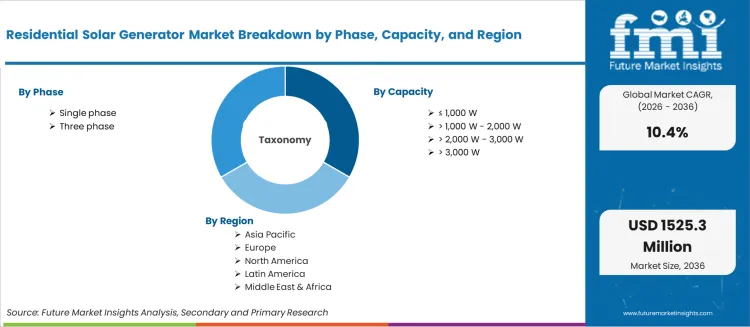
The residential solar generator market is segmented by phase, capacity, and geographic regions. By phase, residential solar generator market is divided into Single phase and Three phase. In terms of capacity, residential solar generator market is classified into ≤ 1,000 W, > 1,000 W - 2,000 W, > 2,000 W - 3,000 W, and > 3,000 W. Regionally, the residential solar generator industry is classified into North America, Latin America, Western Europe, Eastern Europe, Balkan & Baltic Countries, Russia & Belarus, Central Asia, East Asia, South Asia & Pacific, and the Middle East & Africa.
Insights into the Single Phase Segment
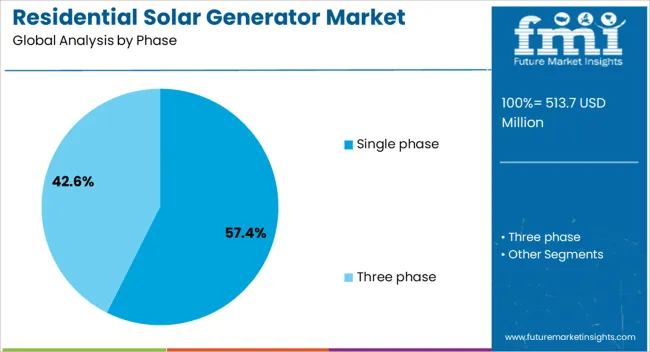
The single phase segment is projected to hold 57.4% of the residential solar generator market revenue share in 2026, making it the leading phase category. This dominance is driven by its suitability for most household electrical systems, enabling direct integration without costly infrastructure upgrades. Single phase solar generators are preferred for their ease of installation, compact design, and compatibility with the majority of residential appliances and energy loads.
The cost-effectiveness of single phase configurations compared to three phase systems has further strengthened their adoption among homeowners seeking efficient yet affordable solutions. Continuous improvements in inverter technology and power management software are enhancing performance reliability, making these systems capable of supporting a wide range of home energy needs.
Additionally, government programs and local utility incentives targeting residential-scale renewable energy adoption are boosting demand The ability to deliver stable power output, coupled with low operational complexity, is ensuring the single phase segment maintains its leadership in the market over the forecast period.
Insights into the ≤ 1,000 W Capacity Segment
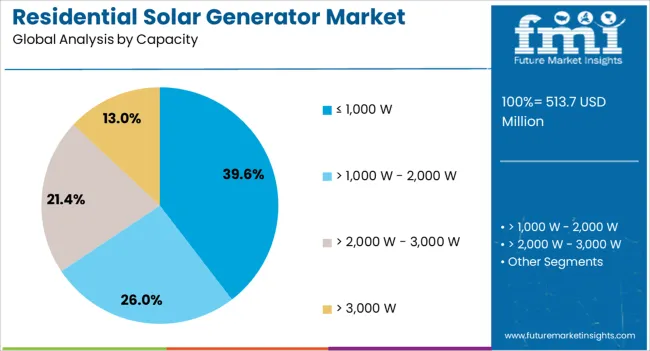
The capacity segment of ≤ 1,000 W is expected to account for 39.6% of the residential solar generator market revenue share in 2026, establishing it as the leading capacity range. This leadership is being reinforced by the growing preference for compact and portable solar generators designed for small-scale residential use. Units within this capacity range are ideal for powering essential household devices, emergency lighting, and basic appliances, making them attractive for both urban and off-grid scenarios.
Their affordability, low maintenance requirements, and ease of transportation are appealing to homeowners seeking flexible backup power solutions. The segment’s growth is supported by advances in lithium-ion battery technology, which have increased storage capacity, reduced charging times, and extended product lifespans.
Rising demand for clean and quiet power alternatives in areas with unstable grid supply is also contributing to adoption As consumer awareness of renewable energy options grows and product designs continue to improve in efficiency and portability, the ≤ 1,000 W capacity range is expected to sustain its market-leading position.
What are the Drivers, Restraints, and Key Trends of the Residential Solar Generator Market?
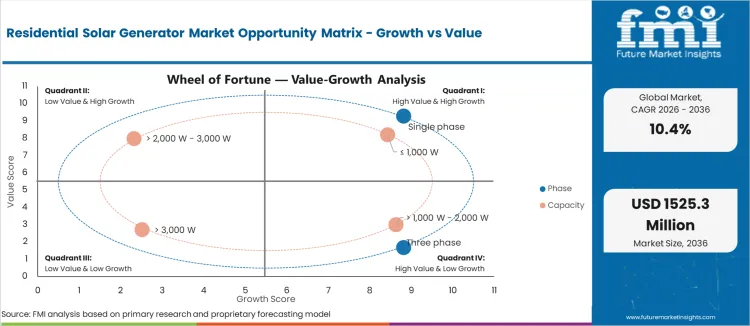
The residential solar generator market is witnessing strong demand due to the increasing desire for off-grid energy solutions and energy independence. Opportunities abound as consumers look for sustainable and cost-effective ways to power their homes, supported by technological advancements in solar efficiency and storage. However, high initial costs and installation complexity remain barriers to widespread adoption. With ongoing innovations and financial incentives, the market is expected to continue growing, providing consumers with reliable, eco-friendly energy options.
Growing Demand for Off-Grid Energy Solutions
The demand for residential solar generators is rising as consumers seek independent energy solutions, particularly in remote and off-grid locations. Increased awareness of energy security and the need for backup power during outages are significant drivers. As electricity prices continue to climb and grid instability concerns grow, homeowners are turning to solar generators as a reliable, cost-effective alternative. This trend is expected to expand further, especially in regions with limited access to reliable power, pushing the market toward steady growth.
Opportunities in Energy Independence and Sustainability
As homeowners strive for greater energy independence and sustainability, residential solar generators are increasingly viewed as a viable solution. The growing interest in reducing reliance on traditional energy sources and lowering carbon footprints is boosting market prospects. Additionally, government incentives and subsidies for solar energy adoption further support growth. Companies are innovating to make solar generators more affordable and accessible, ensuring that consumers can benefit from energy autonomy while contributing to environmental sustainability, which presents significant long-term opportunities.
Technological Trends in Solar Efficiency and Storage
Technological advancements in solar energy efficiency and energy storage are playing a key role in the growth of the residential solar generator market. The integration of more efficient photovoltaic (PV) panels and advanced battery storage solutions is improving overall system performance and reliability. Innovations such as compact, high-capacity lithium-ion batteries and hybrid systems that combine solar energy with grid power are gaining traction. As technology continues to evolve, consumers can expect more affordable, efficient, and user-friendly solar generator solutions in the coming years.
Challenges with High Initial Costs and Installation
One of the main barriers to widespread adoption of residential solar generators is the high upfront cost associated with purchasing and installing the system. While solar energy offers long-term savings, the initial financial outlay remains a challenge for many households. Additionally, the complexity of installation and the need for professional services can deter potential buyers. Although financing options and government subsidies are available, addressing these cost-related challenges will be crucial for making solar generators more accessible to a broader range of consumers.
Analysis of Residential Solar Generator Market By Key Countries
.webp "Top Country Growth Comparison Residential Solar Generator Market Cagr (2026 2036)")
| Country | CAGR |
|---|---|
| China | 14.0% |
| India | 13.0% |
| Germany | 12.0% |
| France | 10.9% |
| UK | 9.9% |
| USA | 8.8% |
| Brazil | 7.8% |
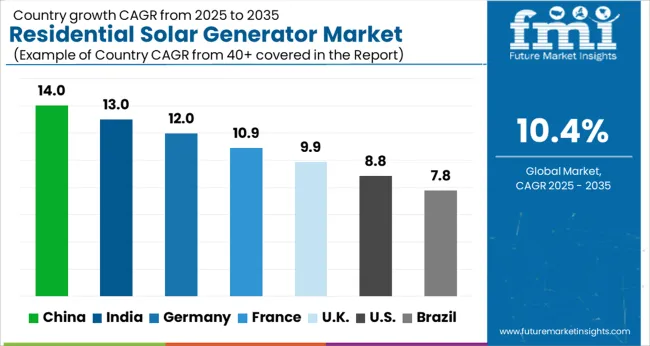
The global residential solar generator market is projected to grow at a 10.4% CAGR from 2026 to 2036. China leads with a growth rate of 14%, followed by India at 13%, and France at 10.9%. The United Kingdom records a growth rate of 9.9%, while the United States shows the slowest growth at 8.8%. The varying growth rates are primarily driven by government initiatives, rising electricity costs, and the increasing demand for sustainable and off-grid power solutions. Emerging markets like China and India are experiencing higher growth due to favorable policies, rapid urbanization, and the increasing adoption of renewable energy solutions. More mature markets like the USA and the UK see steady growth, supported by financial incentives, environmental regulations, and a growing focus on energy independence. This report includes insights on 40+ countries; the top markets are shown here for reference.
Sales Outlook for Residential Solar Generator Market in China
The residential solar generator market in China is projected to grow at a robust CAGR of 14%. The demand for solar energy solutions is rising due to China’s increasing commitment to renewable energy, especially in residential sectors. The government has set ambitious goals for carbon neutrality and is incentivizing solar energy adoption through subsidies, grants, and favorable policies. These factors are accelerating the adoption of residential solar generators, particularly in urban areas where energy consumption is high. Furthermore, the rapid urbanization and industrial growth in China are contributing to the growing demand for sustainable energy sources. The high levels of solar radiation and government support for energy-efficient technologies make China a key market for solar generators. As consumers look for cost-effective, off-grid power solutions, China is expected to lead the global market with substantial growth in residential solar generator installations.
- China’s rapid urbanization and demand for energy-efficient solutions are significantly driving the adoption of residential solar generators.
- Government policies, including subsidies and tax incentives for renewable energy, are expected to accelerate market growth in China.
- The growing shift towards self-sufficiency and sustainability in energy generation is propelling residential solar generator adoption.
Demand Analysis for Residential Solar Generator Market in India
The residential solar generator market in India is projected to grow at a CAGR of 13%. India’s rapid urbanization and the rise of the middle class are key drivers of demand for reliable and efficient power solutions in homes. With frequent power outages and increasing electricity costs, residential solar generators have become a practical alternative. The Indian government is supporting solar energy adoption with various subsidies and policies designed to make solar power affordable. This support has been crucial for driving growth in residential solar generators, particularly in semi-urban and rural areas where grid power is unreliable. India’s commitment to achieving renewable energy targets by 2030 and its push for energy independence are further fueling the market. As consumers look for long-term energy solutions, residential solar generators are expected to play a key role in India’s energy landscape, offering both sustainability and cost-effectiveness.
- Frequent power outages and rising electricity costs are increasing the demand for residential solar generators in India.
- Government initiatives and financial incentives for solar adoption are accelerating the growth of solar generators in the residential sector.
- The growing emphasis on energy independence and sustainability continues to drive the market for residential solar generators in India.
In-depth Analysis of Residential Solar Generator Market in France
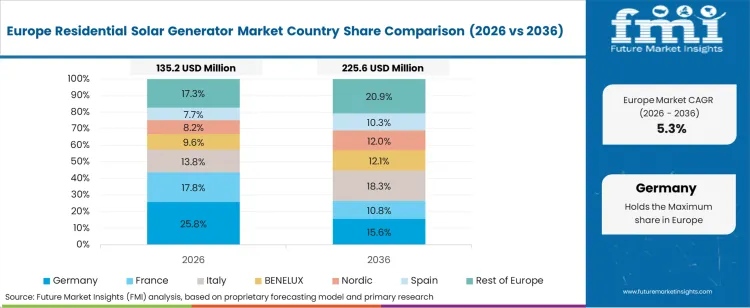
The residential solar generator market in France is projected to grow at a CAGR of 10.9%. France’s commitment to sustainability and renewable energy is pushing the demand for residential solar solutions. With a government-mandated push for carbon neutrality and a growing focus on reducing dependence on traditional energy sources, French homeowners are increasingly opting for solar power. The government’s subsidies for solar panel installations, including tax credits and incentives, make residential solar generators more accessible to the general population. Furthermore, France’s abundant sunlight, especially in southern regions, positions it as an ideal market for solar energy adoption. As the cost of solar technology continues to decrease and the benefits of energy independence become more appealing, the residential solar generator market in France is poised for steady growth. With the country’s strong environmental goals, the shift to solar energy in residential applications is expected to accelerate in the coming years.
- Government policies promoting carbon neutrality and sustainable energy are driving the growing demand for residential solar generators in France.
- Subsidies and financial incentives for solar installations are accelerating the adoption of solar generators in French households.
- The declining cost of solar technologies and the growing appeal of energy independence are expected to continue fueling market growth in France.
Opportunity Analysis for Residential Solar Generator Market in United Kingdom
The residential solar generator market in the United Kingdom is projected to grow at a CAGR of 9.9%. The UK is seeing steady growth in the demand for solar energy solutions, primarily driven by government initiatives supporting renewable energy. The country has set ambitious goals to achieve net-zero emissions by 2050, and residential solar generators are a key component of achieving these targets. Rising electricity costs, along with government schemes such as Feed-in Tariffs (FiT) and Renewable Heat Incentive (RHI), are encouraging homeowners to adopt solar power as an alternative to conventional energy sources. The UK’s climate is suitable for solar power, particularly in southern regions, making residential solar generators increasingly popular. As more consumers seek energy independence and look for long-term cost-saving solutions, the UK is expected to see continued growth in the residential solar generator market. The combination of financial incentives and environmental goals will drive further adoption.
- Government initiatives and net-zero emission targets are significantly contributing to the rise in residential solar generator installations in the UK.
- Rising electricity costs and financial incentives, such as the Feed-in Tariff, are encouraging more households to invest in solar generators.
- Growing concerns over energy security and long-term cost savings continue to drive demand for residential solar generators in the UK.
Growth and Expansion Outlook for Residential Solar Generator Market in the United States
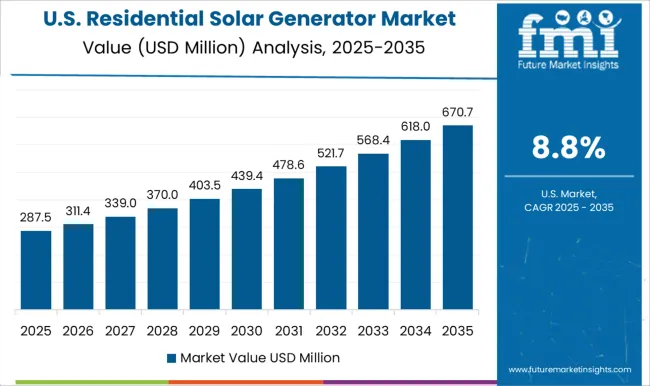
The residential solar generator market in the United States is projected to grow at a CAGR of 8.8%. The market in the USA is driven by increasing interest in renewable energy, particularly in regions with abundant sunlight. With rising electricity costs and growing concerns about energy security, homeowners are looking for more sustainable and cost-effective solutions. Government incentives, such as the federal tax credit and state-based rebates, are playing a crucial role in making solar generators more accessible. Solar energy is increasingly seen as a reliable, eco-friendly solution to power needs. The USA is seeing adoption in both urban and rural areas, with more installations in suburban homes looking for energy independence. Despite slower growth compared to emerging markets, the USA remains a key player in the residential solar generator market, supported by continued technological improvements and financial incentives.
- Rising electricity costs and government incentives are driving the growing adoption of residential solar generators in the USA
- The shift towards energy independence and the increasing desire for renewable energy solutions are further accelerating the market for solar generators.
- State-based incentives and federal tax credits are making solar energy more accessible to homeowners across the USA, fueling growth in the residential solar generator market.
Competitive Landscape of Residential Solar Generator Market
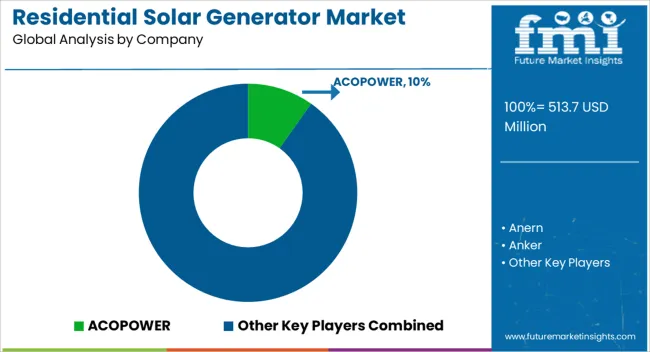
The residential solar generator market is growing rapidly as consumers shift toward sustainable, off-grid, and backup energy solutions for homes. The market is highly competitive, with both established energy brands and new entrants focusing on portable, efficient, and smart solar systems to meet rising demand driven by energy independence and climate-conscious consumers.
Generac Power Systems leads the market with its high-capacity solar and hybrid backup systems, integrating advanced battery storage and power management technologies for residential applications. Jackery, Goal Zero, and Anker have built strong consumer recognition through portable solar generator solutions, prioritizing compact design, ease of use, and reliability. EcoFlow stands out for its smart energy management platforms, app-based control, and fast-charging lithium-ion systems, while ACOPOWER and Renogy focus on affordable, modular setups ideal for off-grid and remote area applications.
GROWATT and Lion Energy are strengthening their positions by introducing scalable solar energy storage systems designed for both emergency backup and daily home use. Powerenz caters to niche consumer groups seeking lightweight, customizable solar generators.
Across the sector, success depends on continuous innovation, cost optimization, and distribution expansion through partnerships with installers, retailers, and online platforms. As residential users increasingly prioritize eco-friendly and resilient energy systems, leading suppliers are differentiating through advanced battery efficiency, sustainability, and seamless smart-home integration.
Key Players in the Residential Solar Generator Market
- Generac Power Systems
- Jackery
- GROWATT
- Goal Zero
- Lion Energy
- ACOPOWER
- Anker
- EcoFlow
- Powerenz
- Renogy
Scope of the Report
| Metric | Value |
|---|---|
| Quantitative Units | USD 567.12 million to USD 1525.35 million, at a CAGR of 10.4% |
| Market Definition | The residential solar generator market encompasses portable, integrated solar panel and battery storage systems designed to convert solar energy into stored electrical power for residential backup, ou... |
| Segmentation | Phase: Single Phase, Three Phase; Capacity: Up to 1,000 W, Greater than 1,000 W to 2,000 W, Greater than 2,000 W to 3,000 W, Greater than 3,000 W |
| Regions Covered | North America, Latin America, Europe, East Asia, South Asia, Oceania, Middle East & Africa |
| Countries Covered | China, India, Germany, France, UK, USA, Brazil, and 40 plus countries |
| Key Companies Profiled | ACOPOWER, Jackery, GROWATT, Goal Zero, Lion Energy, Generac Power Systems, Anker, EcoFlow, Powerenz, Renogy |
| Forecast Period | 2026 to 2036 |
| Approach | Forecasting models apply a bottom-up methodology starting with installation and procurement tracking data and projecting adoption rates using region-specific deployment curves. |
Residential Solar Generator Market by Segments
Phase:
- Single phase
- Three phase
Capacity:
- ≤ 1,000 W
- > 1,000 W - 2,000 W
- > 2,000 W - 3,000 W
- > 3,000 W
Region:
- North America
- USA
- Canada
- Mexico
- Latin America
- Brazil
- Chile
- Rest of Latin America
- Western Europe
- Germany
- UK
- Italy
- Spain
- France
- Nordic
- BENELUX
- Rest of Western Europe
- Eastern Europe
- Russia
- Poland
- Hungary
- Balkan & Baltic
- Rest of Eastern Europe
- East Asia
- China
- Japan
- South Korea
- South Asia and Pacific
- India
- ASEAN
- Australia & New Zealand
- Rest of South Asia and Pacific
- Middle East & Africa
- Kingdom of Saudi Arabia
- Other GCC Countries
- Turkiye
- South Africa
- Other African Union
- Rest of Middle East & Africa
Bibliography
- International Energy Agency. (2024). World energy outlook: Distributed solar and storage deployment trends. IEA.
- U.S. Department of Energy. (2024). Portable solar generator safety and performance standards guidance. DOE.
- Ministry of New and Renewable Energy, India. (2024). PM Surya Ghar Muft Bijli Yojana programme implementation guidelines. MNRE.
- European Commission. (2024). Ecodesign requirements for energy-related products: Portable power systems. European Commission.
- National Oceanic and Atmospheric Administration. (2024). U.S. billion-dollar weather and climate disasters report. NOAA.
This bibliography is provided for reader reference. The full Future Market Insights report contains the complete reference list with primary research documentation.
Frequently Asked Questions
How large is the demand for Residential Solar Generator Market in the global market in 2026?
Demand for residential solar generator in the global market is estimated to be valued at USD 567.12 million in 2026.
What will be the market size of Residential Solar Generator Market in the global market by 2036?
Market size for residential solar generator is projected to reach USD 1525.35 million by 2036.
What is the expected demand growth for Residential Solar Generator Market between 2026 and 2036?
Demand for residential solar generator is expected to grow at a CAGR of 10.4% between 2026 and 2036.
Which Phase is poised to lead global sales by 2026?
Single Phase accounts for 57.4% share in 2026 as single-phase AC output matches standard residential electrical configurations for powering household appliances and electronics.
How is the role of Up to 1,000 W in driving Residential Solar Generator Market adoption in 2026?
Up to 1,000 W represents 39.6% of Capacity share in 2026 as units up to 1,000 W serve the majority of individual device charging and small appliance power requirements for recreational and light backup use.
What is driving demand in China?
China is projected to grow at a CAGR of 14.0% during 2026 to 2036, driven by the 14th Five-Year Plan distributed solar targets and growing consumer adoption of portable solar generators for outdoor recreation and rural backup.
What is Residential Solar Generator and what is it mainly used for?
Residential solar generators are portable, integrated solar panel and battery storage systems that convert solar energy into stored electrical power. They are used for residential backup power during grid outages and portable power supply for outdoor recreation and off-grid applications.
How does FMI build and validate the Residential Solar Generator Market forecast?
Forecasting models apply a bottom-up methodology starting with procurement and installation tracking data and cross-validate projections against publicly reported expenditure data from leading industry participants.
Preview the report firsthand - request a free sample
Get SampleGet the brochure for pricing and purchase details.
Get PDFTable of Content
- Executive Summary
- Global Market Outlook
- Demand-side Trends
- Supply-side Trends
- Technology Roadmap Analysis
- Analysis and Recommendations
- Market Overview
- Market Coverage / Taxonomy
- Market Definition / Scope / Limitations
- Research Methodology
- Chapter Orientation
- Analytical Lens and Working Hypotheses
- Market Structure, Signals, and Trend Drivers
- Benchmarking and Cross-market Comparability
- Market Sizing, Forecasting, and Opportunity Mapping
- Research Design and Evidence Framework
- Desk Research Programme (Secondary Evidence)
- Company Annual and Sustainability Reports
- Peer-reviewed Journals and Academic Literature
- Corporate Websites, Product Literature, and Technical Notes
- Earnings Decks and Investor Briefings
- Statutory Filings and Regulatory Disclosures
- Technical White Papers and Standards Notes
- Trade Journals, Industry Magazines, and Analyst Briefs
- Conference Proceedings, Webinars, and Seminar Materials
- Government Statistics Portals and Public Data Releases
- Press Releases and Reputable Media Coverage
- Specialist Newsletters and Curated Briefings
- Sector Databases and Reference Repositories
- FMI Internal Proprietary Databases and Historical Market Datasets
- Subscription Datasets and Paid Sources
- Social Channels, Communities, and Digital Listening Inputs
- Additional Desk Sources
- Expert Input and Fieldwork (Primary Evidence)
- Primary Modes
- Qualitative Interviews and Expert Elicitation
- Quantitative Surveys and Structured Data Capture
- Blended Approach
- Why Primary Evidence is Used
- Field Techniques
- Interviews
- Surveys
- Focus Groups
- Observational and In-context Research
- Social and Community Interactions
- Stakeholder Universe Engaged
- C-suite Leaders
- Board Members
- Presidents and Vice Presidents
- R&D and Innovation Heads
- Technical Specialists
- Domain Subject-matter Experts
- Scientists
- Physicians and Other Healthcare Professionals
- Governance, Ethics, and Data Stewardship
- Research Ethics
- Data Integrity and Handling
- Primary Modes
- Tooling, Models, and Reference Databases
- Desk Research Programme (Secondary Evidence)
- Data Engineering and Model Build
- Data Acquisition and Ingestion
- Cleaning, Normalisation, and Verification
- Synthesis, Triangulation, and Analysis
- Quality Assurance and Audit Trail
- Market Background
- Market Dynamics
- Drivers
- Restraints
- Opportunity
- Trends
- Scenario Forecast
- Demand in Optimistic Scenario
- Demand in Likely Scenario
- Demand in Conservative Scenario
- Opportunity Map Analysis
- Product Life Cycle Analysis
- Supply Chain Analysis
- Investment Feasibility Matrix
- Value Chain Analysis
- PESTLE and Porter’s Analysis
- Regulatory Landscape
- Regional Parent Market Outlook
- Production and Consumption Statistics
- Import and Export Statistics
- Market Dynamics
- Global Market Analysis 2021 to 2025 and Forecast, 2026 to 2036
- Historical Market Size Value (USD Million) Analysis, 2021 to 2025
- Current and Future Market Size Value (USD Million) Projections, 2026 to 2036
- Y-o-Y Growth Trend Analysis
- Absolute $ Opportunity Analysis
- Global Market Pricing Analysis 2021 to 2025 and Forecast 2026 to 2036
- Global Market Analysis 2021 to 2025 and Forecast 2026 to 2036, By Phase
- Introduction / Key Findings
- Historical Market Size Value (USD Million) Analysis By Phase , 2021 to 2025
- Current and Future Market Size Value (USD Million) Analysis and Forecast By Phase , 2026 to 2036
- Single phase
- Three phase
- Single phase
- Y-o-Y Growth Trend Analysis By Phase , 2021 to 2025
- Absolute $ Opportunity Analysis By Phase , 2026 to 2036
- Global Market Analysis 2021 to 2025 and Forecast 2026 to 2036, By Capacity
- Introduction / Key Findings
- Historical Market Size Value (USD Million) Analysis By Capacity, 2021 to 2025
- Current and Future Market Size Value (USD Million) Analysis and Forecast By Capacity, 2026 to 2036
- ≤ 1,000 W
- > 1,000 W - 2,000 W
- > 2,000 W - 3,000 W
- > 3,000 W
- ≤ 1,000 W
- Y-o-Y Growth Trend Analysis By Capacity, 2021 to 2025
- Absolute $ Opportunity Analysis By Capacity, 2026 to 2036
- Global Market Analysis 2021 to 2025 and Forecast 2026 to 2036, By Region
- Introduction
- Historical Market Size Value (USD Million) Analysis By Region, 2021 to 2025
- Current Market Size Value (USD Million) Analysis and Forecast By Region, 2026 to 2036
- North America
- Latin America
- Western Europe
- Eastern Europe
- East Asia
- South Asia and Pacific
- Middle East & Africa
- Market Attractiveness Analysis By Region
- North America Market Analysis 2021 to 2025 and Forecast 2026 to 2036, By Country
- Historical Market Size Value (USD Million) Trend Analysis By Market Taxonomy, 2021 to 2025
- Market Size Value (USD Million) Forecast By Market Taxonomy, 2026 to 2036
- By Country
- USA
- Canada
- Mexico
- By Phase
- By Capacity
- By Country
- Market Attractiveness Analysis
- By Country
- By Phase
- By Capacity
- Key Takeaways
- Latin America Market Analysis 2021 to 2025 and Forecast 2026 to 2036, By Country
- Historical Market Size Value (USD Million) Trend Analysis By Market Taxonomy, 2021 to 2025
- Market Size Value (USD Million) Forecast By Market Taxonomy, 2026 to 2036
- By Country
- Brazil
- Chile
- Rest of Latin America
- By Phase
- By Capacity
- By Country
- Market Attractiveness Analysis
- By Country
- By Phase
- By Capacity
- Key Takeaways
- Western Europe Market Analysis 2021 to 2025 and Forecast 2026 to 2036, By Country
- Historical Market Size Value (USD Million) Trend Analysis By Market Taxonomy, 2021 to 2025
- Market Size Value (USD Million) Forecast By Market Taxonomy, 2026 to 2036
- By Country
- Germany
- UK
- Italy
- Spain
- France
- Nordic
- BENELUX
- Rest of Western Europe
- By Phase
- By Capacity
- By Country
- Market Attractiveness Analysis
- By Country
- By Phase
- By Capacity
- Key Takeaways
- Eastern Europe Market Analysis 2021 to 2025 and Forecast 2026 to 2036, By Country
- Historical Market Size Value (USD Million) Trend Analysis By Market Taxonomy, 2021 to 2025
- Market Size Value (USD Million) Forecast By Market Taxonomy, 2026 to 2036
- By Country
- Russia
- Poland
- Hungary
- Balkan & Baltic
- Rest of Eastern Europe
- By Phase
- By Capacity
- By Country
- Market Attractiveness Analysis
- By Country
- By Phase
- By Capacity
- Key Takeaways
- East Asia Market Analysis 2021 to 2025 and Forecast 2026 to 2036, By Country
- Historical Market Size Value (USD Million) Trend Analysis By Market Taxonomy, 2021 to 2025
- Market Size Value (USD Million) Forecast By Market Taxonomy, 2026 to 2036
- By Country
- China
- Japan
- South Korea
- By Phase
- By Capacity
- By Country
- Market Attractiveness Analysis
- By Country
- By Phase
- By Capacity
- Key Takeaways
- South Asia and Pacific Market Analysis 2021 to 2025 and Forecast 2026 to 2036, By Country
- Historical Market Size Value (USD Million) Trend Analysis By Market Taxonomy, 2021 to 2025
- Market Size Value (USD Million) Forecast By Market Taxonomy, 2026 to 2036
- By Country
- India
- ASEAN
- Australia & New Zealand
- Rest of South Asia and Pacific
- By Phase
- By Capacity
- By Country
- Market Attractiveness Analysis
- By Country
- By Phase
- By Capacity
- Key Takeaways
- Middle East & Africa Market Analysis 2021 to 2025 and Forecast 2026 to 2036, By Country
- Historical Market Size Value (USD Million) Trend Analysis By Market Taxonomy, 2021 to 2025
- Market Size Value (USD Million) Forecast By Market Taxonomy, 2026 to 2036
- By Country
- Kingdom of Saudi Arabia
- Other GCC Countries
- Turkiye
- South Africa
- Other African Union
- Rest of Middle East & Africa
- By Phase
- By Capacity
- By Country
- Market Attractiveness Analysis
- By Country
- By Phase
- By Capacity
- Key Takeaways
- Key Countries Market Analysis
- USA
- Pricing Analysis
- Market Share Analysis, 2025
- By Phase
- By Capacity
- Canada
- Pricing Analysis
- Market Share Analysis, 2025
- By Phase
- By Capacity
- Mexico
- Pricing Analysis
- Market Share Analysis, 2025
- By Phase
- By Capacity
- Brazil
- Pricing Analysis
- Market Share Analysis, 2025
- By Phase
- By Capacity
- Chile
- Pricing Analysis
- Market Share Analysis, 2025
- By Phase
- By Capacity
- Germany
- Pricing Analysis
- Market Share Analysis, 2025
- By Phase
- By Capacity
- UK
- Pricing Analysis
- Market Share Analysis, 2025
- By Phase
- By Capacity
- Italy
- Pricing Analysis
- Market Share Analysis, 2025
- By Phase
- By Capacity
- Spain
- Pricing Analysis
- Market Share Analysis, 2025
- By Phase
- By Capacity
- France
- Pricing Analysis
- Market Share Analysis, 2025
- By Phase
- By Capacity
- India
- Pricing Analysis
- Market Share Analysis, 2025
- By Phase
- By Capacity
- ASEAN
- Pricing Analysis
- Market Share Analysis, 2025
- By Phase
- By Capacity
- Australia & New Zealand
- Pricing Analysis
- Market Share Analysis, 2025
- By Phase
- By Capacity
- China
- Pricing Analysis
- Market Share Analysis, 2025
- By Phase
- By Capacity
- Japan
- Pricing Analysis
- Market Share Analysis, 2025
- By Phase
- By Capacity
- South Korea
- Pricing Analysis
- Market Share Analysis, 2025
- By Phase
- By Capacity
- Russia
- Pricing Analysis
- Market Share Analysis, 2025
- By Phase
- By Capacity
- Poland
- Pricing Analysis
- Market Share Analysis, 2025
- By Phase
- By Capacity
- Hungary
- Pricing Analysis
- Market Share Analysis, 2025
- By Phase
- By Capacity
- Kingdom of Saudi Arabia
- Pricing Analysis
- Market Share Analysis, 2025
- By Phase
- By Capacity
- Turkiye
- Pricing Analysis
- Market Share Analysis, 2025
- By Phase
- By Capacity
- South Africa
- Pricing Analysis
- Market Share Analysis, 2025
- By Phase
- By Capacity
- USA
- Market Structure Analysis
- Competition Dashboard
- Competition Benchmarking
- Market Share Analysis of Top Players
- By Regional
- By Phase
- By Capacity
- Competition Analysis
- Competition Deep Dive
- ACOPOWER
- Overview
- Product Portfolio
- Profitability by Market Segments (Product/Age /Sales Channel/Region)
- Sales Footprint
- Strategy Overview
- Marketing Strategy
- Product Strategy
- Channel Strategy
- Jackery
- GROWATT
- Goal Zero
- Lion Energy
- Generac Power Systems
- Anker
- EcoFlow
- Powerenz
- Renogy
- ACOPOWER
- Competition Deep Dive
- Assumptions & Acronyms Used


