

- Industry Size (2026)
- USD 160 Mn
- Forecast (2036)
- USD 520 Mn
- CAGR (2026 to 2036)
- 12.5%
Mono-Material PP Airless Pump Dispensers Market Forecast and Outlook By FMI
In 2025, the mono-material PP airless pump dispensers market was valued at USD 150 million. Based on Future Market Insights' analysis, demand for mono-material PP airless pump dispensers is estimated to grow to USD 160 million in 2026 and USD 520 million by 2036. FMI projects a CAGR of 12.5% during the forecast period.
Absolute dollar growth of USD 370 million over the decade represents a transformational shift driven by regulatory mandates requiring recyclable packaging and brand owner sustainability commitments, eliminating multi-material dispensers from premium beauty portfolios. Growth accelerates as beauty retailers, including Sephora, Ulta, and Credo, establish packaging standards requiring APR Design Recognition or equivalent recyclability certification, forcing convergence toward mono-material polypropylene pump systems compatible with existing recycling infrastructure.
Summary of Mono-Material PP Airless Pump Dispensers Market
- Mono-Material PP Airless Pump Dispensers Market Definition
- The industry covers complete polypropylene-based airless dispensing systems enabling vacuum-based product protection and simplified recycling through single-polymer construction without metal or mixed-material components.
- Demand Drivers in the Market
- Major beauty retailers including Sephora, Ulta, and Credo Beauty establish packaging standards requiring APR Design Recognition or recyclability certification, mandating mono-material dispenser adoption for shelf access.
- Extended Producer Responsibility legislation in California, Oregon, and European Union member states implements fee structures penalizing hard-to-recycle multi-material packaging, creating cost incentive for mono-PP systems.
- Key Segments Analyzed in the FMI Report
- Pump Architecture: Piston airless systems dominate with 64% share through proven technical performance and established tooling infrastructure.
- End-use Application: Skincare and dermocosmetics lead with 67% share driven by anti-aging serums, eye creams, and treatment formulations requiring airless protection.
- Capacity Range: 31-50 ml formats hold 41% share as standard retail size for facial serums and treatment products.
- Analyst Opinion at FMI
- Ismail Sutaria, Senior Consultant at Future Market Insights, opines, "In the updated version of the Mono-Material PP Airless Pump Dispensers Market Report for 2026 to 2036, packaging executives will find critical insights into APR Design Recognition qualification pathways that determine retail acceptance and formula compatibility validation protocols required before commercial launch. My findings indicate that tooling conversion costs and performance parity challenges versus conventional metal-spring pumps could constrain adoption timelines for mid-tier brands lacking dedicated packaging development resources."
- Strategic Implications / Executive Takeaways
- Prioritize APR Design Recognition qualification for mono-PP pump designs before commercial launch to satisfy beauty retailer packaging standards and Extended Producer Responsibility compliance requirements.
- Invest in formula compatibility testing protocols validating pump performance across viscosity ranges and active ingredient systems to prevent reformulation delays during conversion from conventional dispensers.
- Secure long-term supply agreements with pump manufacturers offering certified mono-PP platforms to guarantee component availability during industry-wide transition from multi-material assemblies.
- Methodology
- Validated through direct engagement with airless pump manufacturers and beauty brand owner packaging development teams across major markets.
- Zero reliance on commercial beauty packaging research aggregators or unverified secondary sources.
- Based on verifiable pump manufacturer production data, APR Design Recognition documentation, and brand owner sustainability commitment disclosures.
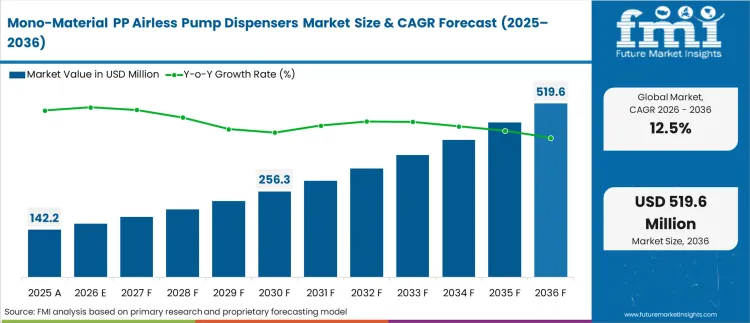
| Metric | Value |
|---|---|
| Market Size (2026) | USD 160 Million |
| Forecast Value (2036) | USD 520 Million |
| CAGR (2026-2036) | 12.5% |
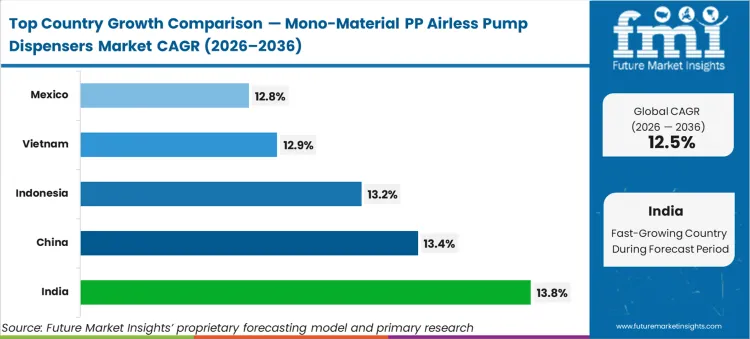
India (13.8% CAGR) and China (13.4% CAGR) drive expansion through organised beauty retail growth, requiring international packaging standards and domestic manufacturing capacity additions serving multinational brand owners. Indonesia (13.2% CAGR), Vietnam (12.9% CAGR), and Mexico (12.8% CAGR) contribute through export-oriented cosmetics manufacturing, adopting European and North American recyclability specifications. Mature markets demonstrate steady replacement demand as established beauty brands reformulate existing SKUs with mono-material alternatives, constrained by tooling conversion costs and validation timelines for formula compatibility testing.
Mono-Material PP Airless Pump Dispensers Market Definition
The mono-material PP airless pump dispensers market comprises complete dispensing systems manufactured entirely from polypropylene without metal springs, mixed-polymer gaskets, or multi-material assemblies. These airless pump mechanisms protect sensitive cosmetic formulations from oxidation and contamination through vacuum-based dispensing that eliminates air exposure, while mono-material construction enables recycling without component disassembly.
Market Inclusions
The report includes comprehensive analysis of market dynamics, featuring global and regional market sizes in dispensing unit volumes and revenue (USD million) with a 10-year forecast from 2026 to 2036. Coverage encompasses segmental breakdowns by pump architecture (bag-on-valve, piston, diaphragm, twin-chamber), end-use application (skincare, haircare, color cosmetics, OTC topicals), capacity range (below 15 ml to above 50 ml), and regional adoption patterns across markets with established beauty retail infrastructure.
Market Exclusions
The scope excludes conventional multi-material airless pumps containing metal springs or mixed-polymer components requiring disassembly before recycling. It omits non-airless dispensing systems such as standard lotion pumps, spray pumps, and droppers. Non-polypropylene mono-material systems using polyethylene or other single resins are excluded, as are finished filled cosmetic products, focusing strictly on empty dispenser components supplied to beauty brand owners and contract fillers.
Mono-Material PP Airless Pump Dispensers Market Research Methodology
Primary Research: Interviews were conducted with airless pump manufacturers, beauty packaging converters, brand owner procurement teams, sustainability managers at cosmetics companies, and certification bodies including Association of Plastic Recyclers representatives across North America, Europe, and Asia Pacific regions.
Desk Research: Technical specifications from APR Design Guide for Plastics Recyclability, RecyClass recyclability protocols, beauty retailer packaging guidelines from Sephora and Ulta, and publicly disclosed brand owner sustainability commitments supported regulatory context and adoption benchmarking.
Market-Sizing and Forecasting: A hybrid bottom-up and top-down model was developed. Demand was reconstructed from premium skincare SKU counts transitioning to airless formats, brand owner recyclability conversion timelines, dispenser unit pricing and volumes, then validated against pump manufacturer production capacity data and beauty packaging converter order books.
Data Validation and Update Cycle: Outputs undergo cross-validation against beauty packaging trade flows, pump manufacturer revenue disclosures for dispensing divisions, and structured peer review with packaging technology experts prior to publication.
Segmental Analysis
Mono-Material PP Airless Pump Dispensers Market Analysis by Pump Architecture
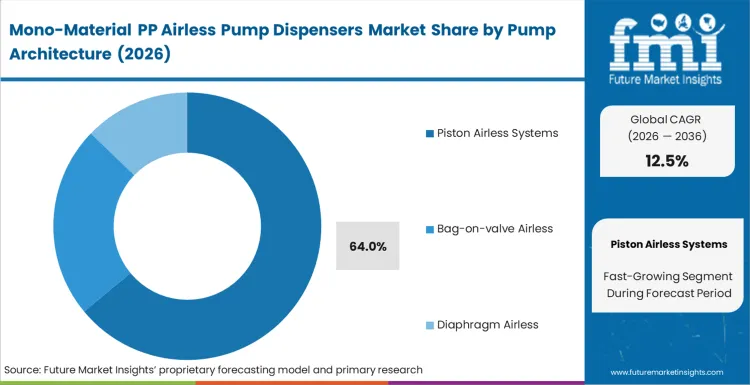
Based on FMI's mono-material PP airless pump dispensers market report, consumption of piston airless systems is estimated to hold 64% share in 2026. Growth in demand for piston airless architecture comes from established technical maturity enabling predictable evacuation rates across diverse formula viscosities, tooling infrastructure supporting high-volume production, and proven compatibility with APR Design Recognition testing protocols for PP rigid packaging applications.
Mono-Material PP Airless Pump Dispensers Market Analysis by End-use Application
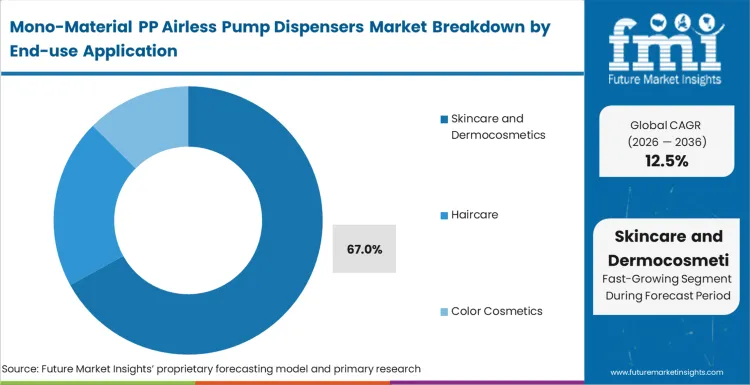
Skincare and dermocosmetics' 67% market share in 2026 stems from the segment's concentration of premium-priced formulations requiring airless protection to prevent oxidation of active ingredients, including vitamin C, retinol, and peptide complexes. The segment's reliance on clinical efficacy claims and luxury positioning creates a willingness to absorb a 15 to 25% cost premium for mono-material PP pumps versus conventional multi-material assemblies, while regulatory requirements for stability testing and formula compatibility validation create technical barriers favouring established skincare manufacturers with dedicated packaging development resources.
Mono-Material PP Airless Pump Dispensers Market Drivers, Restraints, and Opportunities
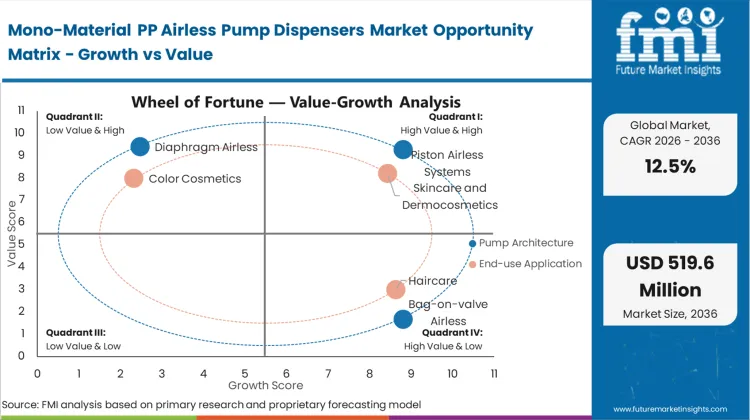
Future Market Insights analysis indicates that historical patterns point to nascent specialty segment where mono-material PP airless pumps remain premium-priced alternative until regulatory mandates and retailer requirements force industry-wide conversion from conventional multi-material assemblies. The 2026 valuation represents early-stage commercial adoption concentrated among sustainability-focused beauty brands and dermocosmetic companies, while growth derives from progressive expansion as Extended Producer Responsibility legislation and retail packaging standards eliminate multi-material dispensers from mainstream beauty distribution channels.
Growth trajectory reflects simultaneous volume expansion through SKU conversions at established beauty brands and value growth through new product launches incorporating mono-PP pumps as baseline packaging specification. Premium pricing maintains throughout forecast period as technical complexity of single-polymer airless pump engineering and APR Design Recognition qualification costs create barriers to commoditization, though cost differential versus conventional pumps narrows from 25% premium in 2026 toward 10 to 15% premium by 2036 as production volumes scale and tooling amortization improves.
Regional Analysis
Based on regional analysis, the mono-material PP airless pump dispensers market is segmented into North America, Latin America, Europe, East Asia, South Asia, Oceania, and Middle East and Africa across 30+ countries. The full report offers market attractiveness analysis based on beauty retail infrastructure development, Extended Producer Responsibility implementation status, and brand owner sustainability commitment timelines.
.webp "Top Country Growth Comparison Mono Material Pp Airless Pump Dispensers Market Cagr (2026 2036)")
| Country | CAGR (2026 to 2036) |
|---|---|
| India | 13.8% |
| China | 13.4% |
| Indonesia | 13.2% |
| Vietnam | 12.9% |
| Mexico | 12.8% |
Source: Future Market Insights (FMI) analysis, based on proprietary forecasting model and primary research
Asia Pacific Mono-Material PP Airless Pump Dispensers Market Analysis
Asia Pacific represents the fastest-growing region globally, leveraging organized beauty retail expansion and export-oriented cosmetics manufacturing to drive mono-material PP airless pump adoption despite limited domestic recycling infrastructure. Key regional players include AptarGroup Inc. operating technical centers in China supporting pump development, Quadpack Industries supplying Asian beauty brands, and regional pump manufacturers including HCP Packaging and Sun-Rain establishing mono-material product lines.
- India: Demand for mono-material PP airless pump dispensers in India is rising at 13.8% CAGR through 2036, driven by organized beauty retail expansion through modern trade channels and domestic cosmetics manufacturers adopting international packaging standards for export competitiveness. As per FMI analysis, Indian skincare brands serving premium retail segments transition to mono-PP airless pumps to satisfy multinational retailer sustainability requirements and differentiate from traditional beauty formats using basic pump dispensers or jars. AptarGroup Inc. launched recyclable airless pumps in March 2024 designed for skincare industry focusing on sustainability and user convenience, establishing technical precedent for mono-material pump performance meeting dermocosmetic formulation protection requirements. [4]
- China: Demand for mono-material PP airless pump dispensers in China is projected to rise at 13.4% CAGR through 2036, supported by domestic beauty brand premiumization strategies and export-oriented cosmetics manufacturing serving Western markets requiring recyclable packaging.
- Indonesia: Projected growth of 13.2% CAGR through 2036 is driven by export-oriented cosmetics manufacturing targeting halal-certified beauty markets and domestic organized retail penetration in urban centers. As per FMI analysis, Indonesian contract fillers serving Middle Eastern and Southeast Asian beauty brands adopt mono-PP airless pumps to meet importer sustainability specifications and differentiate from regional competitors using conventional packaging formats.
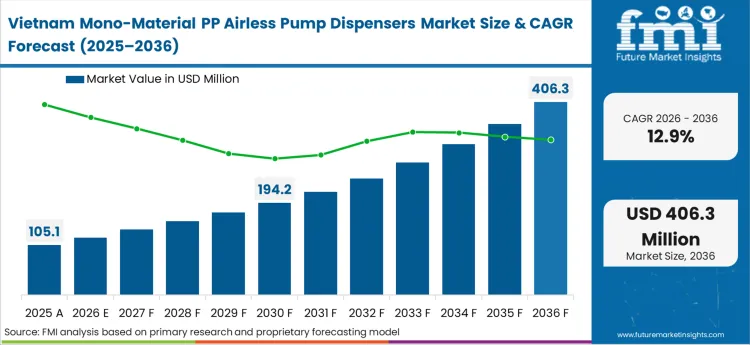
- Vietnam: Demand for mono-material PP airless pump dispensers in Vietnam is rising at 12.9% CAGR through 2036, supported by export-oriented cosmetics manufacturing serving South Korean and Japanese beauty brands requiring recyclable packaging specifications. As per FMI analysis, Vietnamese contract manufacturers filling K-beauty and J-beauty products for export adopt mono-PP airless pump systems to maintain supplier qualification with established beauty brands implementing global packaging sustainability standards across regional supply chains.
- Mexico: Demand for mono-material PP airless pump dispensers in Mexico is projected to rise at 12.8% CAGR through 2036, driven by USMCA trade integration enabling Mexican contract manufacturers to supply US and Canadian beauty brands requiring recyclable packaging. As per FMI analysis, Mexican cosmetics fillers serving North American markets establish mono-PP airless pump capabilities to capture nearshoring opportunities as US brands diversify supply chains and prioritize regional sourcing with lower freight costs and faster lead times versus Asian manufacturing.
The full report analyzes the mono-material PP airless pump dispensers market across East Asia, South Asia, and Latin America from 2021 to 2036, covering pump manufacturer capacity expansion, beauty brand sustainability commitments, and retail packaging standard adoption in India, China, Indonesia, Vietnam, Mexico, Thailand, Malaysia, and Philippines. The assessment highlights organized retail infrastructure and export compliance requirements dictating regional mono-PP airless pump adoption patterns.
Competitive Aligners for Market Players
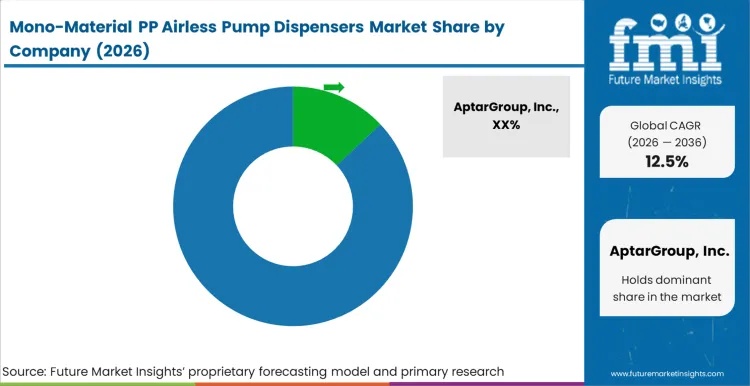
Market structure remains concentrated among established dispensing system manufacturers with proprietary mono-material pump technologies and Association of Plastic Recyclers Design Recognition qualification expertise. Approximately 70% of certified mono-PP airless pump capacity sits with AptarGroup Inc., Silgan Dispensing Systems, and Quadpack operating multi-regional production networks and maintaining long-term supply agreements with multinational beauty brands, while remaining capacity operates through specialized packaging converters and emerging Asian pump manufacturers pursuing APR or RecyClass certification.
Suppliers with established mono-material pump platforms and certified production capacity absorb beauty brand conversion timelines more effectively than suppliers dependent on technology licensing or external certification services. Integrated dispensing system manufacturers maintain dedicated engineering resources for formula compatibility testing and pump performance validation, securing committed volumes justifying tooling investment and certification costs. Non-integrated regional suppliers face margin pressure competing for emerging brand opportunities without Design Recognition documentation.
Operational success requires achieving technical parity with conventional metal-spring airless pumps across evacuation efficiency, dose consistency, and formula compatibility while maintaining polypropylene material specifications enabling APR Design Guide compliance. Suppliers unable to demonstrate performance equivalence across viscosity ranges face limited commercial adoption as beauty brands prioritize proven dispensing reliability over sustainability attributes. Customer concentration reinforces supplier qualification cycles, with major beauty brands establishing approved vendor lists limiting new entrant access through stringent validation requirements.
Key Players in Mono-Material PP Airless Pump Dispensers Market
- AptarGroup, Inc.
- Silgan Dispensing Systems
- Quadpack Industries
- Albéa Group
- Lumson S.p.A.
- Berry Global Group, Inc.
- HCP Packaging
- SR Packaging
- Richmond Containers
- Sun-Rain
Scope of the Report
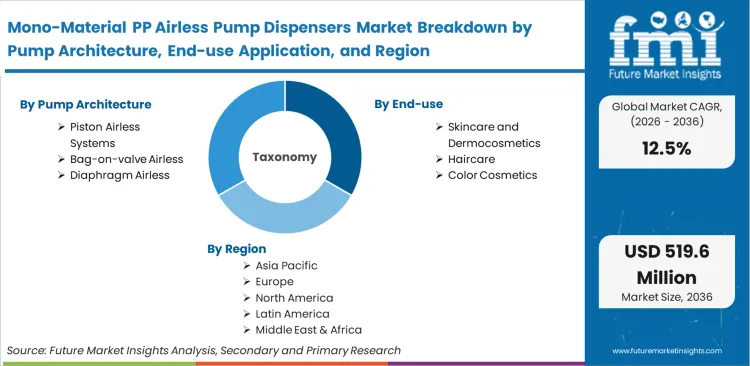
| Metric | Value |
|---|---|
| Quantitative Units | USD 160 million (2026) to USD 520 million (2036), at a CAGR of 12.5% |
| Market Definition | The mono-material PP airless pump dispensers market comprises complete dispensing systems manufactured entirely from polypropylene without metal springs or mixed-polymer components, enabling vacuum-based product protection and simplified recycling through single-polymer construction. |
| Pump Architecture Segmentation | Bag-on-valve Airless, Piston Airless, Diaphragm Airless, Twin-chamber Airless |
| End-use Application Segmentation | Skincare and Dermocosmetics, Haircare, Color Cosmetics, OTC and Medical Topicals |
| Capacity Range Segmentation | Below 15 ml, 15-30 ml, 31-50 ml, Above 50 ml |
| Regions Covered | North America, Latin America, Europe, East Asia, South Asia, Oceania, Middle East and Africa |
| Countries Covered | United States, Canada, Mexico, Brazil, Argentina, Germany, France, United Kingdom, Italy, Spain, China, India, Japan, South Korea, Indonesia, Vietnam, Thailand, Malaysia, Philippines, Australia and 30 plus countries |
| Key Companies Profiled | AptarGroup Inc., Silgan Dispensing Systems, Quadpack Industries, Albéa Group, Lumson S.p.A., Berry Global Group Inc., HCP Packaging, SR Packaging, Richmond Containers, Sun-Rain |
| Forecast Period | 2026 to 2036 |
| Approach | Hybrid bottom-up and top-down market modeling validated through primary interviews with airless pump manufacturers, beauty brand packaging development teams, and certification bodies, supported by APR Design Recognition documentation and brand owner sustainability commitment verification |
Mono-Material PP Airless Pump Dispensers Market Analysis by Segments
Pump Architecture
- Bag-on-valve Airless
- Piston Airless
- Diaphragm Airless
- Twin-chamber Airless
End-use Application
- Skincare and Dermocosmetics (anti-aging serums, eye creams, treatment products)
- Haircare (scalp treatments, leave-in serums)
- Color Cosmetics (foundations, concealers, primers)
- OTC and Medical Topicals (dermatological creams, wound care)
Capacity Range
- Below 15 ml (eye creams, spot treatments)
- 15-30 ml (facial serums, concentrated treatments)
- 31-50 ml (daily use serums, moisturizers)
- Above 50 ml (body treatments, salon-size products)
Region
- Asia Pacific
- India
- China
- Indonesia
- Vietnam
- Thailand
- Malaysia
- Philippines
- Japan
- South Korea
- Australia & New Zealand
- Rest of Asia Pacific
- Europe
- Germany
- France
- United Kingdom
- Italy
- Spain
- Netherlands
- Belgium
- Switzerland
- Rest of Europe
- North America
- United States
- Canada
- Mexico
- Latin America
- Brazil
- Argentina
- Chile
- Rest of Latin America
- Middle East & Africa
- United Arab Emirates
- Kingdom of Saudi Arabia
- South Africa
- Turkey
- Rest of Middle East & Africa
Bibliography
- [1] Beauty Packaging. (2024). Why Mono-Material Packaging Is A Win-Win For Beauty Brands & Consumers. Beauty Packaging Feature Article, October 2024.
- [2] Mordor Intelligence. (2023). AptarGroup Inc. unveiled Mono Micro mono-material airless dispenser. Airless Packaging Market Report, November 2023.
- [3] Association of Plastic Recyclers. (2021). APR Announces First Recipients of Meets Preferred Guidance Recognition. APR Press Release, December 9, 2021.
- [4] OpenPR. (2024). AptarGroup Inc. launched new range of recyclable airless pumps. Airless Packaging Market News Release, March 2024.
- [5] Association of Plastic Recyclers. (2024). APR Design Recognition Program provides third-party validation for recyclable packaging. APR Recognition Program Overview, August 18, 2025.
- [6] BeautyMatter. (2023). Mono-Material Airless Pump Unlocks Beauty Recycling Challenges - FusionPKG APR-certified pump technology. Industry Analysis, September 20, 2023.
- [7] Association of Plastic Recyclers. (2024). 2024 Year In Review: APR Design Guide Digital Tool and Recognition Program expansion. APR Annual Review, April 8, 2025.
- [8] Packaging Europe. (2024). Mono-material dispenser pump with down-lock released by ALPLAhana. Sustainable Packaging News, October 1, 2024.
- [9] Association of Plastic Recyclers. (2025). APR and RecyClass Mark Second Year of Progress in Global Harmonization of Plastic Recyclability. Cooperation Progress Report, April 16, 2025.
- [10] Aptar Beauty. (2025). Skincare Packaging and Dispensing Solutions - Airless packaging provides product integrity for sensitive formulations. Product Solutions Overview, December 25, 2025.
This bibliography is provided for the reader's reference and is not exhaustive. The full report contains the complete reference list and detailed citations.
This Report Addresses
- Market intelligence to enable structured strategic decision-making across mono-material pump adoption and APR Design Recognition qualification planning
- Market size estimation and 10-year revenue forecasts from 2026 to 2036, supported by validated pump manufacturer production data and beauty brand sustainability commitment timelines
- Growth opportunity mapping across piston, diaphragm, and bag-on-valve airless architectures with emphasis on skincare versus colour cosmetics application dynamics
- Segment and regional revenue forecasts covering dermocosmetics, haircare, and OTC topicals across North America, Europe, and Asia Pacific markets
- Competition strategy assessment including Design Recognition positioning, formula compatibility validation capabilities, and brand owner approved vendor list qualification
- Pump technology development tracking including 100% PCR polypropylene integration, evacuation efficiency improvements, and tooling cost reduction initiatives
- Regulatory impact analysis covering Extended Producer Responsibility fee modulation structures, beauty retailer packaging standards, and APR Design Guide compliance requirements
- Market report delivery in PDF, Excel, PPT, and interactive dashboard formats for executive and operational use
Frequently Asked Questions
How large is the demand for Mono-Material PP Airless Pump Dispensers in the global market in 2026?
Demand for mono-material PP airless pump dispensers in the global market is estimated to be valued at USD 160 million in 2026.
What will be the market size of Mono-Material PP Airless Pump Dispensers in the global market by 2036?
Market size for mono-material PP airless pump dispensers is projected to reach USD 520 million by 2036.
What is the expected demand growth for Mono-Material PP Airless Pump Dispensers in the global market between 2026 and 2036?
Demand for mono-material PP airless pump dispensers in the global market is expected to grow at a CAGR of 12.5% between 2026 and 2036.
Which Pump Architecture is poised to lead global sales by 2026?
Piston airless systems are expected to be the dominant pump architecture, capturing approximately 64% of global market share in 2026 due to established technical maturity and proven formula compatibility.
How significant is the role of Skincare and Dermocosmetics in driving Mono-PP Pump adoption in 2026?
Skincare and dermocosmetics represent the leading end-use application segment, projected to hold approximately 67% share of the total market in 2026 as premium formulations requiring airless protection drive adoption.
What is Driving Mono-Material Pump Demand in North America?
Beauty retailer packaging standards from Sephora and Ulta requiring APR Design Recognition combined with Extended Producer Responsibility fee modulation in California and Oregon are driving mono-PP pump adoption.
What Compliance Standards are Referenced for North American Markets?
Association of Plastic Recyclers Design Guide for Plastics Recyclability and APR Design Recognition program are referenced as key compliance benchmarks for beauty packaging.
What is the India Growth Outlook in this Report?
India is projected to grow at a CAGR of 13.8% during 2026 to 2036, driven by organized beauty retail expansion and export-oriented cosmetics manufacturing adopting international packaging standards.
Why is Asia Pacific the Fastest Growing Region in this Report?
Growth is driven by organized beauty retail penetration enabling premium skincare distribution and export-oriented manufacturing requiring Western market recyclability specifications.
What are Mono-Material PP Airless Pump Dispensers and What are They Used For?
Mono-material PP airless pump dispensers are complete polypropylene-based dispensing systems enabling vacuum-based product protection and simplified recycling for premium skincare and cosmetics applications.
What does Mono-Material PP Airless Pump Dispensers Market Mean in this Report?
The market refers to complete dispensing systems manufactured entirely from polypropylene without metal springs or mixed-polymer components, enabling airless protection and recyclability.
What is Included in the Scope of this Mono-Material PP Airless Pump Dispensers Market Report?
Scope covers pump architectures (piston, diaphragm, bag-on-valve, twin-chamber), end-use applications (skincare, haircare, color cosmetics, OTC topicals), and capacity ranges from below 15 ml to above 50 ml.
What is Excluded from the Scope of this Report?
Conventional multi-material airless pumps containing metal springs, non-airless dispensing systems, non-polypropylene mono-material pumps, and finished filled cosmetic products are excluded from coverage.
How does FMI Build and Validate the Mono-Material PP Airless Pump Dispensers Market Forecast?
Forecast is developed using hybrid bottom-up and top-down modeling validated through pump manufacturer production data, APR Design Recognition documentation, beauty brand sustainability commitments, and primary interviews with industry stakeholders.
What is the China Growth Outlook in this Report?
China is projected to grow at a CAGR of 13.4% during 2026 to 2036, supported by domestic beauty brand premiumization and export-oriented manufacturing serving Western markets.
What is the Indonesia Growth Outlook in this Report?
Indonesia is projected to grow at a CAGR of 13.2% during 2026 to 2036, driven by export-oriented cosmetics manufacturing and organized retail penetration in urban centers.
What is the Vietnam Growth Outlook in this Report?
Vietnam is projected to grow at a CAGR of 12.9% during 2026 to 2036, supported by export-oriented manufacturing serving K-beauty and J-beauty brands requiring recyclable packaging.
What is the Mexico Growth Outlook in this Report?
Mexico is projected to grow at a CAGR of 12.8% during 2026 to 2036, driven by USMCA trade integration enabling nearshoring opportunities for US and Canadian beauty brands.
What Role Does APR Design Recognition Play in this Market?
APR Design Recognition provides third-party validation that pump components meet North American recycling system compatibility standards, satisfying beauty brand procurement requirements.
Which Capacity Range Dominates the Market?
The 31-50 ml capacity range holds approximately 41% share as standard retail size for facial serums and treatment products in premium skincare applications.
Preview the report firsthand - request a free sample
Get SampleGet the brochure for pricing and purchase details.
Get PDFTable of Content
- Executive Summary
- Global Market Outlook
- Demand-side Trends
- Supply-side Trends
- Technology Roadmap Analysis
- Analysis and Recommendations
- Market Overview
- Market Coverage / Taxonomy
- Market Definition / Scope / Limitations
- Research Methodology
- Chapter Orientation
- Analytical Lens and Working Hypotheses
- Market Structure, Signals, and Trend Drivers
- Desk Research Programme (Secondary Evidence)
- Company Annual and Sustainability Reports
- Peer-reviewed Journals and Academic Literature
- Corporate Websites, Product Literature, and Technical Notes
- Earnings Decks and Investor Briefings
- Statutory Filings and Regulatory Disclosures
- Technical White Papers and Standards Notes
- Trade Journals, Industry Magazines, and Analyst Briefs
- Conference Proceedings, Webinars, and Seminar Materials
- Government Statistics Portals and Public Data Releases
- Press Releases and Reputable Media Coverage
- Specialist Newsletters and Curated Briefings
- Sector Databases and Reference Repositories
- FMI Internal Proprietary Databases and Historical Market Datasets
- Subscription Datasets and Paid Sources
- Social Channels, Communities, and Digital Listening Inputs
- Additional Desk Sources
- Expert Input and Fieldwork (Primary Evidence)
- Primary Modes
- Qualitative Interviews and Expert Elicitation
- Quantitative Surveys and Structured Data Capture
- Blended Approach
- Why Primary Evidence is Used
- Field Techniques
- Interviews
- Surveys
- Focus Groups
- Observational and In-context Research
- Social and Community Interactions
- Stakeholder Universe Engaged
- C-suite Leaders
- Board Members
- Presidents and Vice Presidents
- R&D and Innovation Heads
- Technical Specialists
- Domain Subject-matter Experts
- Scientists
- Physicians and Other Healthcare Professionals
- Governance, Ethics, and Data Stewardship
- Research Ethics
- Data Integrity and Handling
- Primary Modes
- Tooling, Models, and Reference Databases
- Data Engineering and Model Build
- Data Acquisition and Ingestion
- Cleaning, Normalisation, and Verification
- Synthesis, Triangulation, and Analysis
- Quality Assurance and Audit Trail
- Market Background
- Market Dynamics
- Drivers
- Restraints
- Opportunity
- Trends
- Scenario Forecast
- Demand in Optimistic Scenario
- Demand in Likely Scenario
- Demand in Conservative Scenario
- Opportunity Map Analysis
- Product Life Cycle Analysis
- Supply Chain Analysis
- Investment Feasibility Matrix
- Value Chain Analysis
- PESTLE and Porter’s Analysis
- Regulatory Landscape
- Regional Parent Market Outlook
- Production and Consumption Statistics
- Import and Export Statistics
- Market Dynamics
- Global Market Analysis 2021 to 2025 and Forecast, 2026 to 2036
- Historical Market Size Value (USD Million) Analysis, 2021 to 2025
- Current and Future Market Size Value (USD Million) Projections, 2026 to 2036
- Y-o-Y Growth Trend Analysis
- Absolute $ Opportunity Analysis
- Global Market Pricing Analysis 2021 to 2025 and Forecast 2026 to 2036
- Global Market Analysis 2021 to 2025 and Forecast 2026 to 2036, By Pump Architecture
- Introduction / Key Findings
- Historical Market Size Value (USD Million) Analysis By Pump Architecture , 2021 to 2025
- Current and Future Market Size Value (USD Million) Analysis and Forecast By Pump Architecture , 2026 to 2036
- Piston Airless Systems
- Bag-on-valve Airless
- Diaphragm Airless
- Piston Airless Systems
- Y-o-Y Growth Trend Analysis By Pump Architecture , 2021 to 2025
- Absolute $ Opportunity Analysis By Pump Architecture , 2026 to 2036
- Global Market Analysis 2021 to 2025 and Forecast 2026 to 2036, By End-use Application
- Introduction / Key Findings
- Historical Market Size Value (USD Million) Analysis By End-use Application, 2021 to 2025
- Current and Future Market Size Value (USD Million) Analysis and Forecast By End-use Application, 2026 to 2036
- Skincare and Dermocosmetics
- Haircare
- Color Cosmetics
- Skincare and Dermocosmetics
- Y-o-Y Growth Trend Analysis By End-use Application, 2021 to 2025
- Absolute $ Opportunity Analysis By End-use Application, 2026 to 2036
- Global Market Analysis 2021 to 2025 and Forecast 2026 to 2036, By Region
- Introduction
- Historical Market Size Value (USD Million) Analysis By Region, 2021 to 2025
- Current Market Size Value (USD Million) Analysis and Forecast By Region, 2026 to 2036
- North America
- Latin America
- Western Europe
- Eastern Europe
- East Asia
- South Asia and Pacific
- Middle East & Africa
- Market Attractiveness Analysis By Region
- North America Market Analysis 2021 to 2025 and Forecast 2026 to 2036, By Country
- Historical Market Size Value (USD Million) Trend Analysis By Market Taxonomy, 2021 to 2025
- Market Size Value (USD Million) Forecast By Market Taxonomy, 2026 to 2036
- By Country
- USA
- Canada
- Mexico
- By Pump Architecture
- By End-use Application
- By Country
- Market Attractiveness Analysis
- By Country
- By Pump Architecture
- By End-use Application
- Key Takeaways
- Latin America Market Analysis 2021 to 2025 and Forecast 2026 to 2036, By Country
- Historical Market Size Value (USD Million) Trend Analysis By Market Taxonomy, 2021 to 2025
- Market Size Value (USD Million) Forecast By Market Taxonomy, 2026 to 2036
- By Country
- Brazil
- Chile
- Rest of Latin America
- By Pump Architecture
- By End-use Application
- By Country
- Market Attractiveness Analysis
- By Country
- By Pump Architecture
- By End-use Application
- Key Takeaways
- Western Europe Market Analysis 2021 to 2025 and Forecast 2026 to 2036, By Country
- Historical Market Size Value (USD Million) Trend Analysis By Market Taxonomy, 2021 to 2025
- Market Size Value (USD Million) Forecast By Market Taxonomy, 2026 to 2036
- By Country
- Germany
- UK
- Italy
- Spain
- France
- Nordic
- BENELUX
- Rest of Western Europe
- By Pump Architecture
- By End-use Application
- By Country
- Market Attractiveness Analysis
- By Country
- By Pump Architecture
- By End-use Application
- Key Takeaways
- Eastern Europe Market Analysis 2021 to 2025 and Forecast 2026 to 2036, By Country
- Historical Market Size Value (USD Million) Trend Analysis By Market Taxonomy, 2021 to 2025
- Market Size Value (USD Million) Forecast By Market Taxonomy, 2026 to 2036
- By Country
- Russia
- Poland
- Hungary
- Balkan & Baltic
- Rest of Eastern Europe
- By Pump Architecture
- By End-use Application
- By Country
- Market Attractiveness Analysis
- By Country
- By Pump Architecture
- By End-use Application
- Key Takeaways
- East Asia Market Analysis 2021 to 2025 and Forecast 2026 to 2036, By Country
- Historical Market Size Value (USD Million) Trend Analysis By Market Taxonomy, 2021 to 2025
- Market Size Value (USD Million) Forecast By Market Taxonomy, 2026 to 2036
- By Country
- China
- Japan
- South Korea
- By Pump Architecture
- By End-use Application
- By Country
- Market Attractiveness Analysis
- By Country
- By Pump Architecture
- By End-use Application
- Key Takeaways
- South Asia and Pacific Market Analysis 2021 to 2025 and Forecast 2026 to 2036, By Country
- Historical Market Size Value (USD Million) Trend Analysis By Market Taxonomy, 2021 to 2025
- Market Size Value (USD Million) Forecast By Market Taxonomy, 2026 to 2036
- By Country
- India
- ASEAN
- Australia & New Zealand
- Rest of South Asia and Pacific
- By Pump Architecture
- By End-use Application
- By Country
- Market Attractiveness Analysis
- By Country
- By Pump Architecture
- By End-use Application
- Key Takeaways
- Middle East & Africa Market Analysis 2021 to 2025 and Forecast 2026 to 2036, By Country
- Historical Market Size Value (USD Million) Trend Analysis By Market Taxonomy, 2021 to 2025
- Market Size Value (USD Million) Forecast By Market Taxonomy, 2026 to 2036
- By Country
- Kingdom of Saudi Arabia
- Other GCC Countries
- Turkiye
- South Africa
- Other African Union
- Rest of Middle East & Africa
- By Pump Architecture
- By End-use Application
- By Country
- Market Attractiveness Analysis
- By Country
- By Pump Architecture
- By End-use Application
- Key Takeaways
- Key Countries Market Analysis
- USA
- Pricing Analysis
- Market Share Analysis, 2025
- By Pump Architecture
- By End-use Application
- Canada
- Pricing Analysis
- Market Share Analysis, 2025
- By Pump Architecture
- By End-use Application
- Mexico
- Pricing Analysis
- Market Share Analysis, 2025
- By Pump Architecture
- By End-use Application
- Brazil
- Pricing Analysis
- Market Share Analysis, 2025
- By Pump Architecture
- By End-use Application
- Chile
- Pricing Analysis
- Market Share Analysis, 2025
- By Pump Architecture
- By End-use Application
- Germany
- Pricing Analysis
- Market Share Analysis, 2025
- By Pump Architecture
- By End-use Application
- UK
- Pricing Analysis
- Market Share Analysis, 2025
- By Pump Architecture
- By End-use Application
- Italy
- Pricing Analysis
- Market Share Analysis, 2025
- By Pump Architecture
- By End-use Application
- Spain
- Pricing Analysis
- Market Share Analysis, 2025
- By Pump Architecture
- By End-use Application
- France
- Pricing Analysis
- Market Share Analysis, 2025
- By Pump Architecture
- By End-use Application
- India
- Pricing Analysis
- Market Share Analysis, 2025
- By Pump Architecture
- By End-use Application
- ASEAN
- Pricing Analysis
- Market Share Analysis, 2025
- By Pump Architecture
- By End-use Application
- Australia & New Zealand
- Pricing Analysis
- Market Share Analysis, 2025
- By Pump Architecture
- By End-use Application
- China
- Pricing Analysis
- Market Share Analysis, 2025
- By Pump Architecture
- By End-use Application
- Japan
- Pricing Analysis
- Market Share Analysis, 2025
- By Pump Architecture
- By End-use Application
- South Korea
- Pricing Analysis
- Market Share Analysis, 2025
- By Pump Architecture
- By End-use Application
- Russia
- Pricing Analysis
- Market Share Analysis, 2025
- By Pump Architecture
- By End-use Application
- Poland
- Pricing Analysis
- Market Share Analysis, 2025
- By Pump Architecture
- By End-use Application
- Hungary
- Pricing Analysis
- Market Share Analysis, 2025
- By Pump Architecture
- By End-use Application
- Kingdom of Saudi Arabia
- Pricing Analysis
- Market Share Analysis, 2025
- By Pump Architecture
- By End-use Application
- Turkiye
- Pricing Analysis
- Market Share Analysis, 2025
- By Pump Architecture
- By End-use Application
- South Africa
- Pricing Analysis
- Market Share Analysis, 2025
- By Pump Architecture
- By End-use Application
- USA
- Market Structure Analysis
- Competition Dashboard
- Competition Benchmarking
- Market Share Analysis of Top Players
- By Regional
- By Pump Architecture
- By End-use Application
- Competition Analysis
- Competition Deep Dive
- AptarGroup, Inc.
- Overview
- Product Portfolio
- Profitability by Market Segments (Product/Age /Sales Channel/Region)
- Sales Footprint
- Strategy Overview
- Marketing Strategy
- Product Strategy
- Channel Strategy
- Silgan Dispensing Systems
- Quadpack Industries
- Albéa Group
- Lumson S.p.A.
- Berry Global Group, Inc.
- HCP Packaging
- SR Packaging
- AptarGroup, Inc.
- Competition Deep Dive
- Assumptions & Acronyms Used


