

- Industry Size (2026)
- USD 0.85 Bn
- Forecast (2036)
- USD 3.06 Bn
- CAGR (2026 to 2036)
- 13.7%
Retail-Based Liquid Packaging Refill Kiosks Market Size, Market Forecast and Outlook by FMI
The retail‑based liquid packaging refill kiosks market was valued at USD 0.75 billion in 2025. The industry is poised to reach USD 0.85 billion in 2026 at a CAGR of 13.7% during the forecast period. The demand outlook carries the market valuation to USD 3.06 billion by 2036 as the rising economic penalty of single‑use packaging pushes retailers to standardize metered refill infrastructure.
Transitioning from disposable formats to controlled dispensing environments forces store operations directors to prioritize equipment reliability over brand storytelling. According to FMI's estimates, integrating sustainable refill packaging formats alters the margin profile for high-rotation household chemicals. FMCG brand directors who previously resisted retail-level liquid packaging dispensing now utilize smart kiosks to maintain customer loyalty while decoupling product pricing from rigid plastic container costs. This commercial realignment converts refill mechanics from a niche environmental initiative into a baseline supply chain requirement.
Summary of Retail-Based Liquid Packaging Refill Kiosks Market
- Retail-Based Liquid Packaging Refill Kiosks Market Definition
- The retail-based liquid packaging refill kiosks market covers in-store dispensing systems that sell liquids by volume into reusable containers or durable refill packs, encompassing kiosk hardware, metering software, and the service operations required to maintain retail-grade hygiene.
- Demand Drivers in the Market
- Regulatory frameworks assessing financial penalties on single-use plastics compel grocery chain procurement directors to specify measurable dispensing infrastructure.
- Escalating rigid resin costs push home care brand managers to separate fluid pricing from container expenditure via metered in-store modules.
- Digital wallet integration allows kiosk technology suppliers to capture transaction data and enforce precise dosage controls that prevent product shrink.
- Key Segments Analyzed in the FMI Report
- Retailer-Owned and operated In-Store Kiosks: 47.0% share in 2026, as supermarket format planners secure internal control over category pricing and maintenance routines.
- Laundry Detergents and Fabric Conditioners: 41.0% share in 2026, driven by high purchase frequency and the immediate consumer value proposition of bulk pricing.
- Supermarkets and Hypermarkets: 58.0% share in 2026, supported by adequate floor space and the administrative capacity to manage localized calibration tasks.
- Analyst Opinion at FMI
- Ismail Sutaria, Principal Consultant for Packaging, opines: Store operations directors recognize that the true barrier to dispensing scale is not consumer demand, but the hidden labor cost of spill containment and sensor calibration. Retail environments deploying modular refill systems face unavoidable maintenance friction that disrupts standard aisle restocking cycles. Kiosk technology engineers who continue engineering complex, multi-fluid pump matrices will find themselves unable to meet the operational simplicity thresholds required for mid-tier grocery chain integration.
- Strategic Implications / Executive Takeaways
- Hardware engineers must standardize container interfaces to eliminate the cross-contamination risks that slow deployment approvals in food-grade liquid categories.
- Store operations directors should integrate automated metering software to track real-time fluid depletion and prevent stockouts during peak shopping hours.
- FMCG supply chain leads must rethink secondary distribution packaging to optimize the bulk delivery pouches that resupply these retail kiosks.
- Methodology
- Primary research involved interviews with grocery operations directors, packaging compliance officers, and kiosk technology engineers to map adoption timelines.
- Desk research aggregated public policy documents on extended producer responsibility, corporate sustainability filings, and regional waste reduction mandates.
- Market-sizing and forecasting utilized a hybrid model linking retail store expansion rates, localized kiosk utilization benchmarks, and specific category allocation parameters.
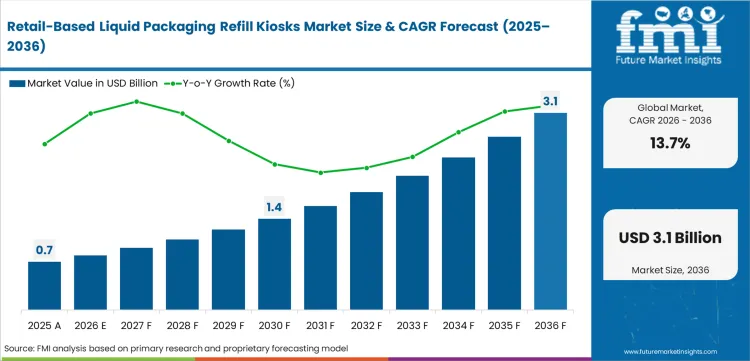
The scale represented in this financial trajectory reveals a structural realignment in how high-volume fluids reach the end consumer. FMI analysts observe that the projected compound expansion relies entirely on a shift from isolated sustainability experiments to integrated, revenue-generating retail fixtures. This transition forces grocery procurement teams to abandon fragmented third-party service agreements and commit significant capital to cohesive, multi-category dispensing architectures. This baseline of capital commitment establishes the groundwork for the geographic growth disparities detailed in the regional assessment.
Retail-Based Liquid Packaging Refill Kiosks Key Takeaways
| Metric | Details |
|---|---|
| Industry Size (2026) | USD 0.85 billion |
| Industry Value (2036) | USD 3.06 billion |
| CAGR (2026-2036) | 13.7% |
Source: Future Market Insights
Retail-Based Liquid Packaging Refill Kiosks Market Definition
The retail-based liquid packaging refill kiosks market covers in-store dispensing systems that sell liquids by volume into reusable containers or durable refill-system compatible PCR packaging packs. The ecosystem includes kiosk hardware, fluid dispensing and metering systems, software that links transactions to customer accounts, and the maintenance service models that keep liquids supplied and equipment calibrated. Regulatory frameworks defining packaging waste reduction targets dictate the operational parameters for these precise commercial deployments.
Retail-Based Liquid Packaging Refill Kiosks Market Inclusions
The market scope includes standalone refill wall modules, compact single-station kiosks, and smart connected liquid dispensing kiosks featuring IoT metering and app-linked accounts. Hardware designed to dispense laundry detergents, dishwashing liquids, surface cleaners, personal care fluids, and applicable food-grade liquids directly to consumers in retail environments falls within the boundaries. Products utilizing profile-specific payment integration mechanisms for tracking refill at home and refill in-store packaging collection and reuse loops are fully incorporated.
Retail-Based Liquid Packaging Refill Kiosks Market Exclusions
Home dispensing devices sold for private household use, including countertop dispensers and subscription refill pouches delivered direct-to-consumer, are excluded. Pure industrial bulk dispensing systems utilized in hospitality back-of-house operations, laundromats, or institutional cleaning contracts lacking retail checkout integration fall outside the defined parameters. Legacy deposit-return loops or refillable low-waste modular packaging formats without an active in-store dispensing mechanism are explicitly omitted from the valuation.
Retail-Based Liquid Packaging Refill Kiosks Market Research Methodology
- Primary Research: Analysts engaged with retail operations directors, packaging compliance officers, and automated dispensing engineers to map the specific decision gates triggering infrastructure upgrades.
- Desk Research: The data collection phase aggregated compliance roadmaps from regional environmental ministries, circular economy frameworks, and major FMCG vendor guidelines.
- Market-Sizing and Forecasting: The baseline value derives from a bottom-up aggregation of kiosk shipments, applying region-specific modernization curves to project the future adoption velocity.
- Data Validation and Update Cycle: Projections are rigorously tested against publicly reported capital expenditure guidance from leading supermarket and hypermarket conglomerates.
Segmental Analysis
Retail-Based Liquid Packaging Refill Kiosks Market Analysis by Kiosk Model and Ownership
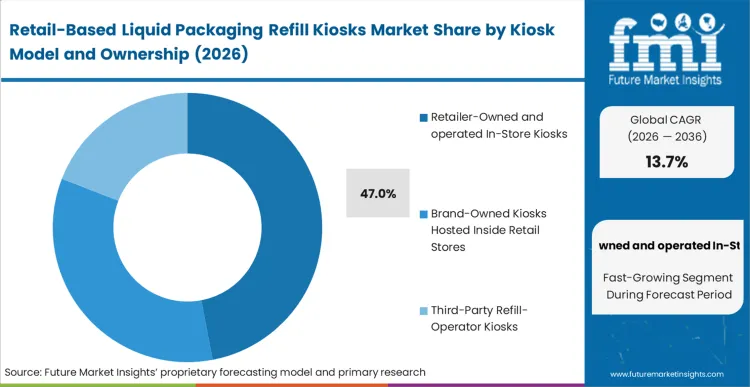
Retailer-Owned and operated In-Store Kiosks emerge as the dominant model, expected to represent 47.0% of total market share in 2026, as store directors reject fragmented third-party service agreements that complicate floor management. FMI analysts opine that internalizing ownership directly enables real-time inventory tracking and immediate maintenance response. Supermarket procurement teams deploying retail refill kiosk systems demand hardware that integrates flawlessly with existing point-of-sale architecture. Centralizing the operational burden forces retail technology buyers to source highly modular equipment capable of minimizing downtime. Service operators failing to provide comprehensive, plug-and-play maintenance platforms lose priority status in critical retail expansion cycles.
- Asset Control: Internalizing the hardware allows category managers to adjust pricing dynamically based on local promotional strategies without negotiating through external intermediaries.
- Maintenance Velocity: Direct ownership empowers on-site staff to execute immediate sensor cleaning routines rather than waiting for external technicians to resolve minor dispensing faults.
- Data Sovereignty: Managing the transaction layer internally ensures that valuable consumer repeat-purchase metrics remain within the retailer's proprietary digital ecosystem.
Retail-Based Liquid Packaging Refill Kiosks Market Analysis by Liquid Category Dispensed
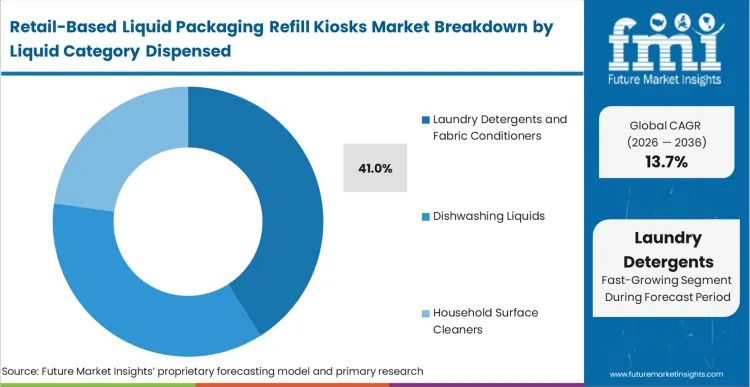
With legacy single-use plastic formats proving inadequate for impending extended producer responsibility targets, FMCG directors execute full-scale bulk delivery strategies for high-rotation chemicals. Laundry Detergents and Fabric Conditioners capture 41.0% of the market share in 2026 by providing the volume density necessary to justify the square footage required for dispensing hardware. Dispensing thick surfactants demands specialized bulk liquid refill kiosks equipped with high-torque peristaltic pumps that prevent nozzle clogging. As per FMI's projection, the convergence of concentrated formulations and heavy purchase frequency amplifies the demand for reliable laundry dispensing stations or personal care refill kiosks. Fluid brands unable to supply stable, concentrated formulas that perform well in gravity-fed retail units risk immediate exclusion from the next wave of hypermarket shelf resets.
- Viscosity Management: Engineered pump modules ensure precise volumetric dosing for heavy detergents without introducing air bubbles that distort consumer billing metrics.
- Cross-Contamination Barriers: Dedicated supply lines for distinct fabric conditioners prevent chemical mixing that compromises scent profiles and formula efficacy.
- Volume Economics: High-capacity reservoir tanks reduce the restocking frequency required for fast-moving laundry liquids in dense urban grocery locations.
Retail-Based Liquid Packaging Refill Kiosks Market Analysis by Deployment Format and Channel
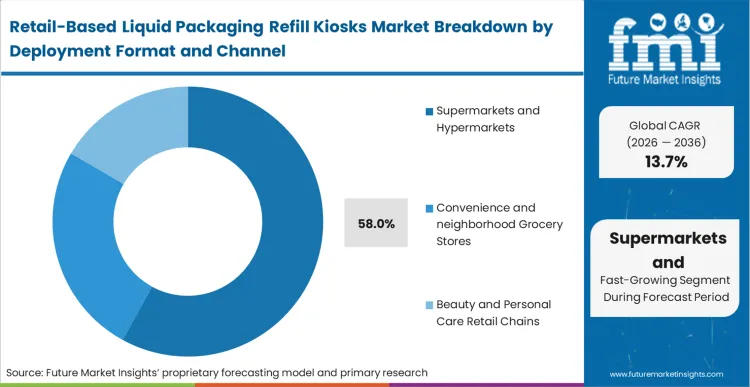
Every retail expansion director bidding on new commercial property development now faces strict adherence criteria for sustainable store footprints. Supermarkets and Hypermarkets represent a leading 58.0% segment share in 2026, reflecting the absolute requirement for massive floor space to accommodate complex, multi-liquid installations. FMI's analysis indicates that optimizing these large-format environments requires in-store refill stations that can handle continuous weekend consumer traffic without structural failure. Floor planners operating high-traffic grocery outlets reject compact units that require hourly reservoir replenishment, favoring larger automated refill stations instead. Kiosk hardware vendors unable to supply high-capacity, heavy-duty dispensing modules face systematic disqualification from national supermarket chain procurement frameworks.
- Traffic Endurance: Reinforced chassis designs withstand the physical impact of shopping carts and continuous consumer interaction during peak weekend retail hours.
- Inventory Buffering: Massive back-of-house storage connections allow hypermarket systems to draw from standard intermediate bulk containers rather than small retail pouches or modular refill pod cartons.
- Aisle Integration: Standardized modular dimensions permit store planners to slot dispensing units directly into existing home care shelving sections without architectural modifications.
Retail-Based Liquid Packaging Refill Kiosks Market Drivers, Restraints, and Opportunities
The convergence of stringent packaging taxes and corporate sustainability commitments forces FMCG supply chain leads to extract packaging weight directly from the retail distribution channel. This regulatory requirement renders fragmented, disposable bottle supply chains financially burdensome under new extended producer responsibility frameworks. Transitioning to a unified dispensing backbone simplifies reverse logistics and enables direct deployment of zero waste refill packaging solutions for loyal consumers. Furthermore, shifting to reusable liquid packaging solutions ensures that brands modernizing their core delivery mechanisms avoid severe margin compression as per-unit plastic taxes escalate.
The intricate calibration parameters required to optimize continuous fluid dispensing create steep learning curves for traditional retail floor staff. Managing unavoidable spill events and maintaining sanitary nozzle conditions across multi-fluid hardware demands specialized maintenance expertise that most neighborhood grocery facilities lack internally. To mitigate this skill gap, store operations directors increasingly rely on automated cleaning cycles and simplified interface designs that validate sanitary conditions before consumer interaction.
- Digital Wallet Integration: Next-generation connected endpoints enable retail loyalty directors to run automated discount logic directly on the dispensing interface. This capability prevents price friction and drastically simplifies the consumer checkout sequence.
- Automated Viscosity Sensors: Upgraded pump bandwidth permits quality assurance teams to deploy inline fluid monitoring without impacting critical dispensing speeds. This mechanism prevents aerated or diluted product from progressing into consumer containers.
- Backroom Resupply Architectures: Supermarket network planners integrating direct pipeline connections require precise reservoir measurement data. High-capacity switching provides the accuracy necessary to balance bulk chemical resupply across the wide-area store network.
Regional Analysis
Based on the regional analysis, the retail-based liquid packaging refill kiosks market is segmented into North America, Latin America, Europe, East Asia, South Asia, Oceania and Middle East & Africa across 40+ countries. The full report also offers market attractiveness analysis based on regional trends.
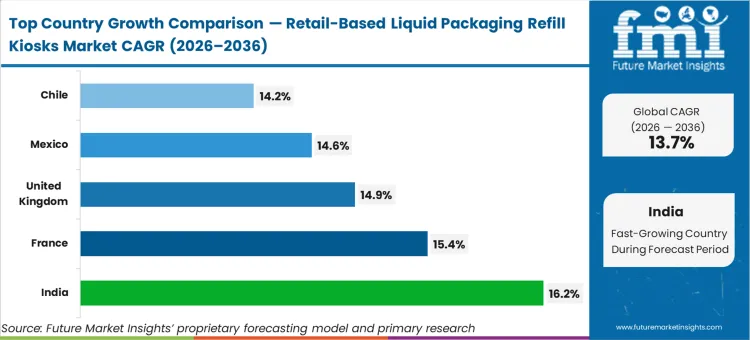
.webp "Top Country Growth Comparison Retail Based Liquid Packaging Refill Kiosks Market Cagr (2026 2036)")
| Country | CAGR (2026 to 2036) |
|---|---|
| India | 16.2% |
| France | 15.4% |
| United Kingdom | 14.9% |
| Mexico | 14.6% |
| Chile | 14.2% |
Source: Future Market Insights (FMI) analysis, based on proprietary forecasting model and primary research
Asia Pacific Retail-Based Liquid Packaging Refill Kiosks Market Analysis
Greenfield retail infrastructure development across the Asia Pacific region accelerates the bypass of legacy consumer packaging constraints. Supermarket expansion directors constructing new urban commercial centers specify unified dispensing architectures in their initial floor blueprints. This clean-slate approach entirely eliminates the costly and time-consuming aisle retrofit phase that plagues older retail environments. By building native fluid supply capabilities into the store foundation and prioritizing eco-friendly liquid packaging, regional grocery owners establish highly flexible merchandising zones capable of rapid formula changeovers. This aggressive greenfield expansion strategy directly fuels the demand for high-performance kiosk hardware.
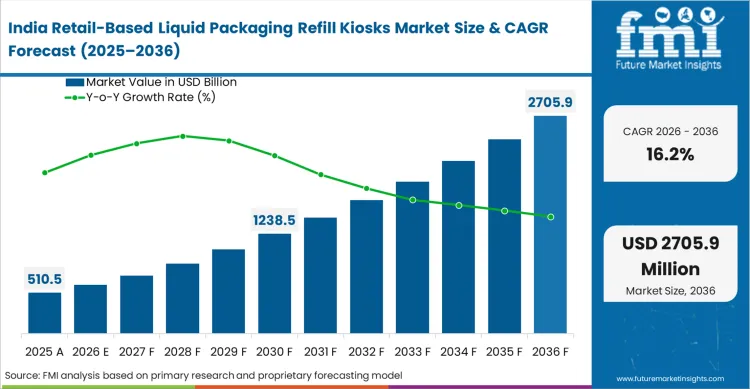
- India: India's modern trade grocery sector operates under aggressive store expansion targets that mandate immediate compliance with regional plastic waste management guidelines. This regulatory pressure forces retail operations directors to deploy fluid dispensing networks capable of guaranteeing accurate volumetric delivery without secondary plastic waste generation. Regional environmental reporting frameworks create a rigid compliance calendar that precedes any new retail facility specification. This systemic qualification pressure drives a 16.2% CAGR for automated refill infrastructure in India through 2036. Suppliers failing to provide hardware with built-in data logging mechanisms face disqualification from major corporate retail facility tenders before the 2028 enforcement wave.
- Indonesia: Indonesia's urban convenience store networks deploy highly digitalized payment ecosystems requiring seamless data exchange between digital wallets and physical dispensing hardware. Greenfield facility architects bypass traditional rigid bottle shelving entirely, specifying native smart kiosks for all new home care category procurement contracts. The concentration of QR-linked receipt adoption and mobile payment infrastructure establishes a massive installed base of interoperable consumer engagement. This digital integration dynamic anchors Indonesia's 13.9% compound trajectory to 2036 as retail chains systematically upgrade their operational backbones. Vendors unable to demonstrate verified digital wallet compatibility lose access to the most lucrative greenfield expansion projects in the Jakarta commercial corridor.
FMI's report includes extensive coverage of the Asia Pacific dispensing landscape. It incorporates detailed analysis of Japan, South Korea, and the broader ASEAN region. A primary trend shaping these nations is the rapid localization of high-viscosity fluid production, forcing regional FMCG distributors to deploy unified bulk delivery architectures to satisfy stringent urban density logistics requirements.
Europe Retail-Based Liquid Packaging Refill Kiosks Market Analysis
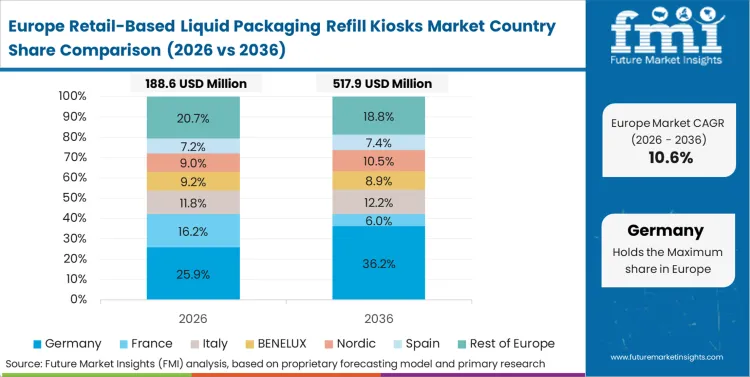
European environmental policy actively penalizes the continued operation of material-inefficient and single-use dependent supply chains. Retail operations directors redesigning legacy supermarket aisles must integrate continuous volume dispensing capabilities alongside standard packaged goods. This dual-purpose merchandising requirement forces the rapid adoption of highly reliable pump modules to guarantee consumer satisfaction while transmitting heavy digital transaction data. The transition requires a complete overhaul of existing floor topologies, shifting from static shelving structures to active, utility-connected dispensing architectures. Upgrading the core store infrastructure provides the necessary physical space to support advanced sustainable commercial practices.
- France: France's supermarket sector operates under national circular economy frameworks, creating a strict legal trajectory that mandates dedicated floor space for reusable container systems. Store format planners must demonstrate flawless execution of bulk dispensing flows before receiving authorization to finalize annual store remodeling budgets. Local environmental agency guidance for professional packaging reporting establishes the baseline metrics for these required architectural transformations. This regulatory compliance mandate anchors France's 15.4% compound expansion of dispensing kiosk demand to 2036. Hardware infrastructure providers targeting domestic hypermarket retooling projects must guarantee automated sanitation compliance prior to the finalization of capital procurement budgets.
- United Kingdom: The United Kingdom's grocery distribution network enforces strict extended producer responsibility cost reallocations across its entire multi-tier supplier ecosystem. Packaging compliance leads replacing aging single-use merchandising systems must deploy converged dispensing architectures capable of supporting both real-time volume accuracy and secure digital reporting. Government mandates actively penalize heavy plastic footprints, forcing a migration toward standardized circular economy refill packaging ecosystems. This aggressive cost-reduction strategy sustains a 14.9% compound rate for advanced dispensing hardware in the UK retail corridor. Kiosk vendors lacking documented compliance with rigorous volumetric weights and measures standards face immediate exclusion from national supermarket modernization contracts.
FMI's report includes thorough investigation of the European retail dispensing framework. The analysis encompasses Germany, Italy, Spain, and the Nordics. A prevailing structural condition across these nations is the mandatory compliance with strict consumer hygiene safety directives, forcing asset owners to specify dispensing modules that can reliably sanitize nozzles between individual consumer transactions.
Latin America Retail-Based Liquid Packaging Refill Kiosks Market Analysis
Economic volatility and price sensitivity across Latin America target the systematic eradication of unnecessary packaging premiums from daily essential goods. Category managers leading private-label strategy overhauls face strict directives to unify disparate product lines under a single manageable bulk delivery architecture. The fast-moving consumer goods sector actively drives this consolidation to secure volume sales against sophisticated localized discount competitors. Implementing a standardized dispensing backbone enables retail facilities to deploy aggressive pricing algorithms without compromising core product margins.
- Mexico: Mexico's private-label household chemical sector deploys highly price-optimized product lines, forcing retail expansion directors to bypass premium rigid packaging or refillable pouches and specify native bulk dispensing endpoints. General merchandise planners must deploy store networks capable of guaranteeing essential cleaning fluid delivery to consumers at highly competitive per-liter price points. The national push toward localized circular economy frameworks triggers a wave of facility upgrades prioritizing unified, durable dispensing hardware. Mexico advances at a 14.6% compound rate across the forecast decade as grocery retailers unify their logical dispensing topologies. Suppliers failing to provide hardware with robust, tamper-proof fluid reservoirs face disqualification from major national discount chain tenders.
- Chile: Chile's retail supply chain enforces strict reuse integration through national waste management frameworks that precede standard corporate sustainability targets. Every new store format architecture must validate kiosk placement compliance before receiving authorization for commercial launch. The domestic fluid manufacturing sector embeds specialized supply connections directly into bulk delivery vehicles to maintain competitive advantage in high-speed store resupply operations. This systemic operational alignment positions Chile's retail refill segment at a 14.2% compound growth rate through 2036. Component suppliers lacking verified heavy-duty pump testing records forfeit access to the next generation of national retail expansion contracts.
FMI's report includes comprehensive evaluation of the Latin American dispensing sector. It features specific analysis of the Brazilian and Argentine retail markets. A defining dynamic in these countries involves the integration of neighborhood micro-retail supply chains, which requires localized, highly durable dispensing protocols to coordinate continuous delivery sequences across diverse socioeconomic zones.
Competitive Aligners for Market Players
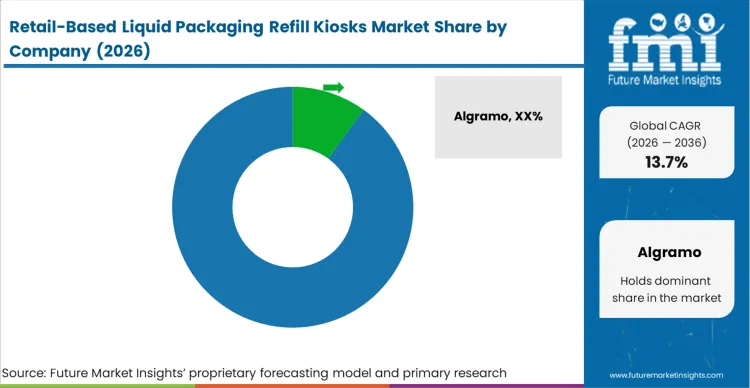
The introduction of standardized hygiene compliance profiles under national consumer safety initiatives is reshaping how supermarket operations directors evaluate dispensing hardware. Instead of accepting proprietary closed-loop fluid systems, procurement teams now demand certified, interoperable pumping modules in all new retail tenders. FMI's proprietary forecasting model projects this capability shift has raised the performance bar across the industry, meaning kiosk vendors that continue to rely on localized, non-digital mechanisms risk losing position during early-stage vendor shortlisting. Equipment manufacturers of retail automation kiosks unable to prove integrated digital compliance tracking forfeit access to major grocery chain rollouts before the 2027 procurement cycle opens.
Hardware suppliers embedding intelligent metering and automated sanitation protocols directly into dispensing endpoints gain a significant architectural advantage. This silicon-level integration eliminates the need for expensive secondary floor staff monitoring and drastically simplifies the operational footprint within crowded supermarket aisles. As FMI's research confirms, eliminating intermediate manual calibration steps accelerates brownfield store migration projects, allowing format planners to prioritize platforms that avoid the complexity associated with manual fluid measurement. Component manufacturers slow to adopt native digital measurement designs lose priority status during critical infrastructure upgrade cycles.
The expansion of cross-vendor fluid supply ecosystems forces kiosk manufacturers to rethink traditional hardware lock-in strategies. With more retail data layers becoming standardized, retail technology integrators designing converged store architectures can now select dispensing components from multiple specialized suppliers without worrying about volume drift or billing failures. This expanded operational flexibility empowers hypermarket owners to optimize aisles for throughput and reliability instead of being constrained by single-brand hardware agreements. Kiosk technology firms that fail to develop open API architectures for retail loyalty integration lose their strategic foothold in top-tier supermarket modernization initiatives.
Key Players in the Retail-Based Liquid Packaging Refill Kiosks Market
- Algramo
- Replenish
- Loop (TerraCycle)
- Unilever
- The Body Shop
- L'Oréal
- Ecover
- Sodastream
Scope of the Report
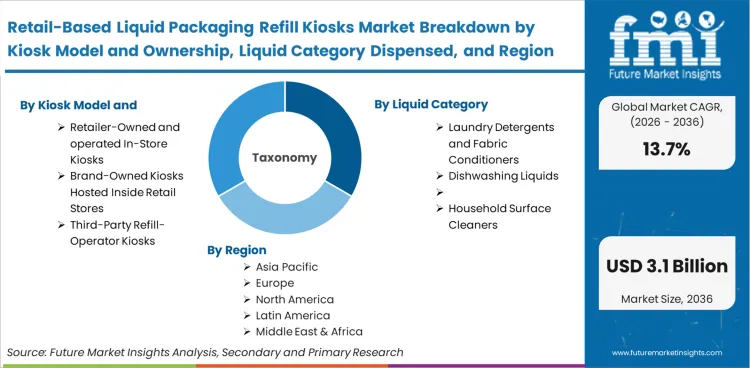
| Metric | Value |
|---|---|
| Quantitative Units | USD 0.85 billion to USD 3.06 billion, at a CAGR of 13.7% |
| Market Definition | The retail-based liquid packaging refill kiosks market covers in-store dispensing systems that sell liquids by volume into reusable containers or durable refill packs. |
| Kiosk Model and Ownership Segmentation | Retailer-Owned and operated In-Store Kiosks, Brand-Owned Kiosks Hosted Inside Retail Stores, Third-Party Refill-Operator Kiosks, Smart/Connected Kiosks, Standalone Refill Wall Modules vs Compact Single-Station Kiosks |
| Liquid Category Dispensed Segmentation | Laundry Detergents and Fabric Conditioners, Dishwashing Liquids, Household Surface Cleaners, Personal Care Liquids, Food-Grade Liquids in Retail |
| Deployment Format and Channel Segmentation | Supermarkets and Hypermarkets, Convenience and neighborhood Grocery Stores, Beauty and Personal Care Retail Chains, Warehouse Clubs / Cash-and-Carry, Specialty Zero-Waste Stores and Refill Boutiques, Retail Pop-Ups and Pilot Installations |
| Regions Covered | North America, Latin America, Europe, Asia Pacific, Middle East & Africa |
| Countries Covered | India, France, United Kingdom, Mexico, Chile, and 40 plus countries |
| Key Companies Profiled | Comprehensive coverage of leading market participants and supply chain partners. |
| Forecast Period | 2026 to 2036 |
| Approach | Hybrid top-down and bottom-up modeling using retailer rollout assumptions, kiosk utilization benchmarks, and category allocation parameters. |
Retail-Based Liquid Packaging Refill Kiosks Market Analysis by Segments
Kiosk Model and Ownership:
- Retailer-Owned and operated In-Store Kiosks
- Brand-Owned Kiosks Hosted Inside Retail Stores
- Third-Party Refill-Operator Kiosks
- Smart/Connected Kiosks
- Standalone Refill Wall Modules vs Compact Single-Station Kiosks
Liquid Category Dispensed:
- Laundry Detergents and Fabric Conditioners
- Dishwashing Liquids
- Household Surface Cleaners
- Personal Care Liquids
- Food-Grade Liquids in Retail
Deployment Format and Channel:
- Supermarkets and Hypermarkets
- Convenience and neighborhood Grocery Stores
- Beauty and Personal Care Retail Chains
- Warehouse Clubs / Cash-and-Carry
- Specialty Zero-Waste Stores and Refill Boutiques
- Retail Pop-Ups and Pilot Installations
Region:
- Asia Pacific
- India
- Indonesia
- Japan
- South Korea
- Australia & New Zealand
- ASEAN
- Rest of Asia Pacific
- Europe
- Germany
- France
- United Kingdom
- Italy
- Spain
- Benelux
- Nordics
- Central & Eastern Europe
- Rest of Europe
- North America
- United States
- Canada
- Mexico
- Latin America
- Brazil
- Argentina
- Chile
- Rest of Latin America
- Middle East & Africa
- Kingdom of Saudi Arabia
- United Arab Emirates
- South Africa
- Turkey
- Rest of Middle East & Africa
Bibliography
- European Parliament and the Council of the European Union. (2025). Regulation (EU) 2025/40 of the European Parliament and of the Council of 19 December 2024 on packaging and packaging waste. EUR-Lex.
- European Commission, Directorate-General for Environment. (2024, December 16). Packaging and Packaging Waste Regulation (PPWR) [Presentation slides]. European Commission.
- United Kingdom. (2024). The Producer Responsibility Obligations (Packaging and Packaging Waste) Regulations 2024. legislation.gov.uk.
- Agence de la transition écologique. (2024). Declaration of reuse of industrial and commercial packaging and food services packaging. ADEME.
- Council on Energy, Environment and Water. (2024, May). Landscape assessment: Reuse models in India. CEEW.
- USA Food and Drug Administration. (2024, December). Supplement to the 2022 Food Code. USA Department of Health and Human Services.
- Canada Plastics Pact. (2025, May). Study on reuse and refill of plastic packaging. Canada Plastics Pact.
This Report Addresses
- Market sizing and quantitative forecast metrics detailing the precise capital expenditure dedicated to dispensing hardware across major retail sectors through 2036.
- Segmentation analysis mapping the adoption velocity of specific kiosk models and evaluating the technical limitations driving component upgrades.
- Regional deployment intelligence comparing the aggressive greenfield construction strategies in Asia Pacific against the complex brownfield modernization requirements prevalent in European supermarket hubs.
- Regulatory compliance assessment analyzing how stringent extended producer responsibility directives and hygiene standards force the adoption of unified dispensing architectures.
- Competitive posture evaluation tracking the mandatory shift toward third-party interoperability certification and the resulting commoditization of the physical pumping layer.
- Capital project strategic guidance defining the exact procurement specifications and calibration tolerances required to support next-generation automated retail refilling.
- Supply chain vulnerability analysis identifying the specific network integration bottlenecks that extend facility commissioning timelines.
- Custom data delivery formats encompassing interactive dashboards, raw Excel datasets, and comprehensive PDF narrative reports.
Frequently Asked Questions
How large is the demand for Retail-Based Liquid Packaging Refill Kiosks in the global market in 2026?
Demand for Retail-Based Liquid Packaging Refill Kiosks in the global market is estimated to be valued at USD 0.85 billion in 2026.
What will be the market size of Retail-Based Liquid Packaging Refill Kiosks in the global market by 2036?
Market size for Retail-Based Liquid Packaging Refill Kiosks is projected to reach USD 3.06 billion by 2036.
What is the expected demand growth for Retail-Based Liquid Packaging Refill Kiosks in the global market between 2026 and 2036?
Demand for Retail-Based Liquid Packaging Refill Kiosks is expected to grow at a CAGR of 13.7% between 2026 and 2036.
Which Kiosk Model and Ownership is poised to lead global sales by 2026?
Retailer-Owned and operated In-Store Kiosks accounts for 47.0% in 2026 as supermarket format planners secure internal control over category pricing and maintenance routines.
How significant is the role of Laundry Detergents and Fabric Conditioners in driving Retail-Based Liquid Packaging Refill Kiosks adoption in 2026?
Laundry Detergents and Fabric Conditioners represents 41.0% of segment share as brand directors execute full-scale bulk delivery strategies to bypass rigid packaging costs.
What is driving demand in India?
India's modern trade grocery sector operates under aggressive store expansion targets that mandate immediate compliance with regional plastic waste management guidelines.
What compliance standards or regulations are referenced for France?
France's supermarket sector operates under national circular economy frameworks which mandate dedicated floor space for reusable container systems.
What is the India growth outlook in this report?
India is projected to grow at a CAGR of 16.2% during 2026 to 2036.
Why is Europe described as a priority region in this report?
European environmental policy actively penalizes the continued operation of material-inefficient and single-use dependent grocery supply chains.
What type of demand dominates in Europe?
Demand heavily focuses on replacing aging single-use merchandising systems with converged dispensing architectures capable of digital reporting.
What is France's growth outlook in this report?
France is projected to expand at a CAGR of 15.4% during 2026 to 2036.
Does the report cover the United Kingdom in its regional analysis?
Yes, the United Kingdom is included within Europe under the regional scope of analysis.
What are the sources referred to for analyzing the United Kingdom?
National government guidance on extended producer responsibility and localized retail pilot data form the analytical basis.
What is the main demand theme linked to the United Kingdom in its region coverage?
Strict extended producer responsibility cost reallocations across multi-tier supplier ecosystems force the deployment of converged dispensing architectures.
Does the report cover Mexico in its regional analysis?
Yes, Mexico is included within Latin America under the regional coverage framework.
What is the main Mexico related demand theme in its region coverage?
Category managers leading private-label strategy overhauls face strict directives to unify disparate product lines under single bulk delivery endpoints.
Which product formats or configurations are strategically important for Asia Pacific supply chains?
Smart connected kiosks integrated directly into digital wallet payment ecosystems are critical for streamlining localized retail delivery.
What is Retail-Based Liquid Packaging Refill Kiosks and what is it mainly used for?
The market covers in-store hardware systems that sell household liquids by volume. It is primarily used to dispense detergents, cleaners, and personal care fluids into reusable containers.
What does Retail-Based Liquid Packaging Refill Kiosks mean in this report?
The scope encompasses kiosk hardware, fluid dispensing and metering systems, and software that links transactions directly to retail environments.
What is included in the scope of this Retail-Based Liquid Packaging Refill Kiosks report?
The market covers standalone refill modules, compact single-station kiosks, and connected units featuring IoT metering for retail channels.
What is excluded from the scope of this report?
Home dispensing devices sold for private household use and pure industrial bulk dispensing systems without retail checkout integration are explicitly excluded.
What does market forecast mean on this page?
The market forecast represents a model-based projection built on defined industrial capacity and adoption assumptions for strategic planning purposes.
How does FMI build and validate the Retail-Based Liquid Packaging Refill Kiosks forecast?
The model applies a hybrid top-down and bottom-up methodology utilizing retail rollout assumptions and cross-validates projections against publicly reported capital expenditure guidance.
What does zero reliance on speculative third-party market research mean here?
Primary interviews, verified sustainability filings, and official government environmental datasets are used exclusively instead of unverified syndicated estimates.
Preview the report firsthand - request a free sample
Get SampleGet the brochure for pricing and purchase details.
Get PDF

