

- Industry Size (2026)
- USD 1.5 Bn
- Forecast (2036)
- USD 4.5 Bn
- CAGR (2026 to 2036)
- 11.6%
Refill-at-Home Concentrated Cleaning Pouches Market Size, Market Forecast and Outlook By FMI
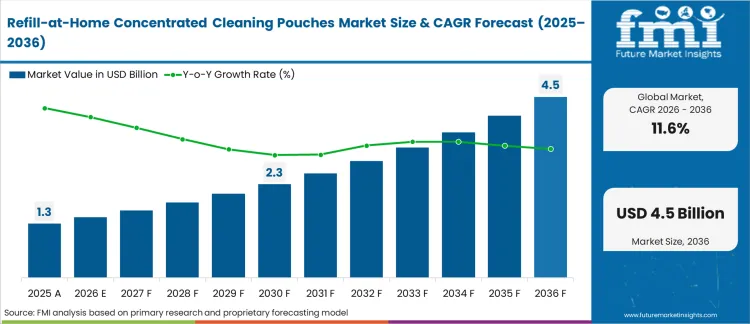
The refill-at-home concentrated cleaning pouches market was valued at USD 1.3 billion in 2025. Industry is poised to reach USD 1.5 billion in 2026 at a CAGR of 11.6% during the forecast. Demand outlook carries the market valuation to USD 4.5 billion through 2036 as supply chain economics favor eliminating water transport weight from distribution networks.
The fundamental transformation shifts the industry from shipping heavy diluted liquid formulations in single-use high-density polyethylene bottles to distributing hyper-concentrated active chemical ingredients in flexible packaging. Facility managers and retail logistics coordinators replacing bulky liquid inventories with compact pouches eliminate significant warehousing and freight costs. Fast-moving consumer goods conglomerates that delay transitioning to a waterless distribution model face eroding profit margins against disruptive direct-to-consumer native refill brands. This logistical pivot allows manufacturers to drastically reduce transport emissions while maintaining identical retail price points for the consumer.
Summary of Refill-at-Home Concentrated Cleaning Pouches Market
- Refill-at-Home Concentrated Cleaning Pouches Market Definition:
- Refill-at-Home Concentrated Cleaning Pouches deliver concentrated active cleaning ingredients in lightweight flexible packaging designed for consumer dilution. This structural dependency on the end-user adding water defines the market boundary against traditional ready-to-use liquid formulations.
- Demand Drivers in the Market:
- Escalating extended producer responsibility taxes force procurement directors to adopt lightweight flexible formats to minimize packaging compliance costs per retail unit.
- E-commerce logistics managers mandate compact leak-proof direct-to-consumer household products to eliminate the severe shipping penalties associated with transporting heavy water-based liquids.
- National retail chains implement strict plastic-reduction quotas compelling home care brand managers to transition core product lines into refillable ecosystems to retain shelf space.
- Key Segments Analyzed in the FMI Report:
- Surface Cleaners: 42.0% share in 2026, as consumers readily adopt simple tap-water dilution for standard multi-purpose formulations.
- Mono-material Plastics: 38.0% share in 2026, driven by strict recyclability mandates across European retail environments.
- UK: 15.0% compound growth, anchored by aggressive national plastic packaging taxes punishing virgin rigid polymers.
- Analyst Opinion at FMI:
- Ismail Sutaria, Principal Consultant for Packaging at Future Market Insights, opines, “In our latest Refill-at-Home Concentrated Cleaning Pouches Market evaluation, my team and I have identified material efficiency as the central value proposition. Concentrated cleaning systems dramatically reduce packaging weight and transport emissions, but pouch design must ensure leak resistance, controlled dispensing, and consumer-friendly dilution guidance. The long-term opportunity lies in developing mono-material flexible pouches that support recyclability while maintaining durability during e-commerce distribution and repeated household handling.”
- Strategic Implications / Executive Takeaways:
- Packaging procurement directors must shift sourcing toward mono-material flexible packaging to meet impending European Union recyclability directives.
- Chemical formulation leads should prioritize viscosity engineering to ensure rapid residue-free dissolution of high-active concentrates in cold water.
- Retail category managers must restructure aisle schematics to dedicate permanent premium space to reusable primary bottles and adjacent refill pouch displays.
- Methodology:
- Primary Research: FMI conducted detailed technical interviews with packaging engineers, surfactant formulators, and retail supply chain directors across 40 countries to validate pouch adoption timelines.
- Desk Research: Analysts aggregated public legislative documentation regarding plastic taxes, corporate sustainability commitments, and raw material pricing for bio-based films.
- Market-Sizing and Forecasting: The model applies a bottom-up methodology starting with global installed base metrics for reusable trigger spray bottles and projecting the conversion rate to refill pouch purchasing.
- Data Validation and Update Cycle: Segment forecasts undergo cross-validation against quarterly resin shipment volumes for specialized flexible barrier films.
The true inflection point for mass adoption relies on achieving absolute viscosity equilibrium in cold tap water, a threshold that eliminates the need for mechanical agitation by the end-user. Chemical formulation leads at Tier-1 brands must engineer these spontaneously dissolving micro-emulsions before the upcoming retail planogram reset window closes in late 2026. Transitioning past this technical hurdle guarantees that hyper-concentrates match the immediate visual and functional efficacy of legacy ready-to-use liquids, permanently shifting aisle demographics.
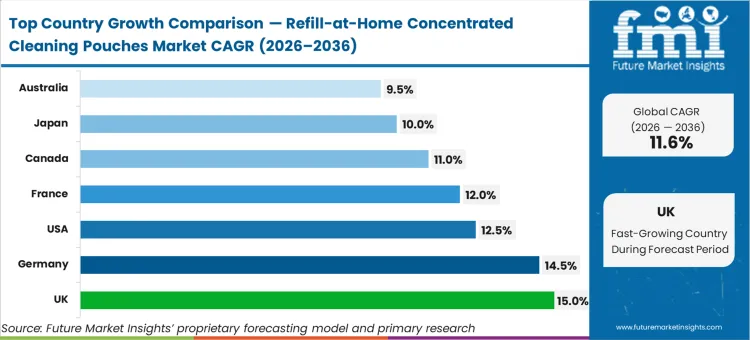
Geographically the United Kingdom advances at a 15.0% CAGR as stringent plastic packaging taxes penalize traditional bottle weights. Germany tracks at a 14.5% rate driven by mature consumer adoption of zero-waste retail systems. The United States expands at a 12.5% trajectory supported by corporate sustainability commitments from national retail chains. France grows at 12.0% as eco-modulation fees under national waste laws make single-use plastics economically unviable. Canada records an 11.0% expansion while Japan posts a 10.0% rate both reflecting high population density optimizing localized refill distribution. Australia follows at 9.5% to mitigate the severe freight costs of transporting liquid cleaning products across vast distances. This uneven geographic dispersion remains structural because the localized cost of waste management directly dictates the financial viability of adopting concentrate distribution models.
Refill-at-Home Concentrated Cleaning Pouches Market Key Takeaways
| Metric | Details |
|---|---|
| Industry Size (2026) | USD 1.5 billion |
| Industry Value (2036) | USD 4.5 billion |
| CAGR (2026-2036) | 11.6% |
Source: Future Market Insights (FMI) analysis, based on proprietary forecasting model and primary research
Refill-at-Home Concentrated Cleaning Pouches Market Definition
Refill-at-Home Concentrated Cleaning Pouches represent flexible packaging formats containing highly concentrated liquid, gel, or powder cleaning agents designed for consumer dilution in reusable vessels. The market specifically covers the flexible pouch delivery mechanism and the concentrated chemical payload within it which structurally distinguishes this category from traditional ready-to-use cleaning products that ship with water pre-mixed.
Refill-at-Home Concentrated Cleaning Pouches Market Inclusions
The market scope includes liquid concentrated cleaning solutions, dissolvable powder sachets, and gel concentrates packaged in flexible films. Spouted pouches designed for precise pouring into secondary bottles, tear-top sachets, and water soluble packaging formats containing multi-surface, laundry, and dishwashing active agents are fully incorporated. The valuation captures both the specialized flexible packaging material and the formulated chemical concentrate sold as a combined retail unit.
Refill-at-Home Concentrated Cleaning Pouches Market Exclusions
Ready-to-use liquid cleaning products sold in standard rigid plastic trigger spray bottles are excluded. Standalone reusable spray bottles sold empty, in-store bulk dispensing machines, and large industrial drums of concentrated chemicals for commercial dilution systems fall outside the defined parameters. Solid bar soaps, traditional tablet formats not packaged in liquid-tight flexible pouches, and standard single-dose laundry pods used directly in washing machines without prior dilution are explicitly omitted.
Refill-at-Home Concentrated Cleaning Pouches Market Research Methodology
- Primary Research: Analysts engaged with packaging innovation directors, chemical formulators, and retail category managers to map the specific decision gates triggering the transition to flexible concentrate formats.
- Desk Research: The data collection phase aggregated compliance roadmaps from the Ellen MacArthur Foundation, national extended producer responsibility tax schedules, and sustainability reports from top consumer goods conglomerates.
- Market-Sizing and Forecasting: The baseline value derives from a bottom-up aggregation of flexible packaging pouches shipments specifically allocated to home care categories applying regional plastic tax curves to project the future adoption velocity.
- Data Validation and Update Cycle: Projections are rigorously tested against publicly reported revenue guidance from leading direct-to-consumer sustainable home care brands and major retail shelf-space allocations.
Segmental Analysis
Refill-at-Home Concentrated Cleaning Pouches Market Analysis by Product Type
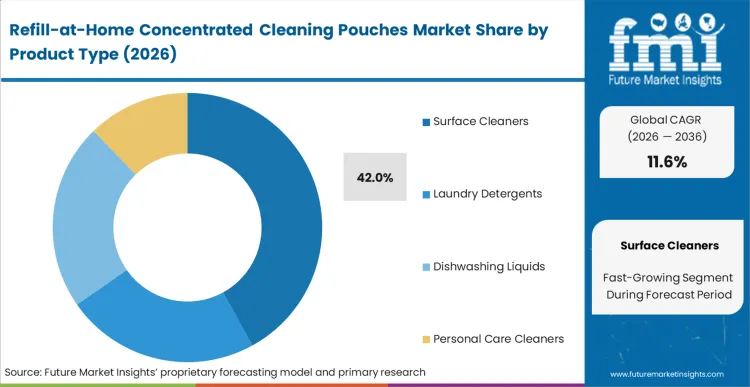
The simple chemistry of standard sanitizing sprays makes them the natural entry point for households transitioning to self-dilution routines. Surface Cleaners secure a commanding 42.0% share in 2026 as formulation leads successfully engineer micro-emulsions that disperse instantly without mechanical agitation. Brand managers utilizing specialized surface cleaners profiles establish the foundational consumer habit of retaining the primary trigger bottle. This initial behavioral shift breaks the long-standing cycle of discarding functional spray mechanisms. FMI analysts opine that once consumers overcome the friction of the first refill experience they rapidly extend the behavior to more complex formulations. Formulators facing tight margin constraints must optimize surfactant blends to ensure rapid dissolution.
- Emulsion Stability: Highly concentrated active ingredients require specialized solubilizers to prevent phase separation during prolonged shelf storage.
- Viscosity Control: Rheology modifiers ensure the thick concentrate flows smoothly from the spouted pouch into the narrow neck of the reusable bottle.
- Preservative Efficacy: Eliminating water during distribution mandates concentrated preservative systems to prevent microbial growth once the consumer introduces unpurified tap water.
Refill-at-Home Concentrated Cleaning Pouches Market Analysis by Pouch Material
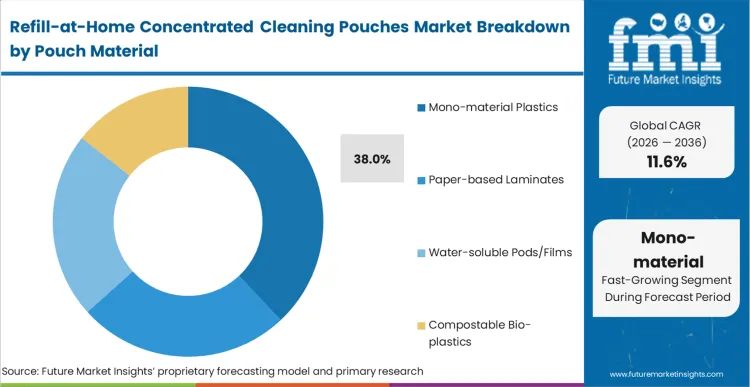
Impending regulatory deadlines regarding packaging recyclability force procurement teams to abandon complex multi-layer laminate structures. Mono-material Plastics capture 38.0% share in 2026 as packaging engineers specify unified polyethylene structures to satisfy stringent retail compliance mandates. Manufacturers deploying advanced compostable pouches alternatives face significant barrier property limitations when holding highly aggressive surfactants. This functional constraint leaves recyclable mono-materials as the only scalable compliance pathway for mass-market brands. As per FMI's projection, achieving high barrier performance without metallic layers represents the primary technical hurdle for film extruders. Packaging buyers demanding compliant solutions face severe supply constraints if they fail to secure mono-material extrusion capacity early.
- Barrier Integrity: Specialized orientation techniques during film extrusion impart the necessary chemical resistance to prevent the concentrated surfactant from degrading the pouch.
- Seal Strength: Ultrasonic welding parameters must be precisely calibrated to ensure mono-material seams withstand severe drop-impact forces during e-commerce transit.
- Recycling Compliance: Adherence to strict material sorting protocols ensures the empty pouch successfully navigates municipal recycling facility optical scanners.
Refill-at-Home Concentrated Cleaning Pouches Market Analysis by Distribution Channel
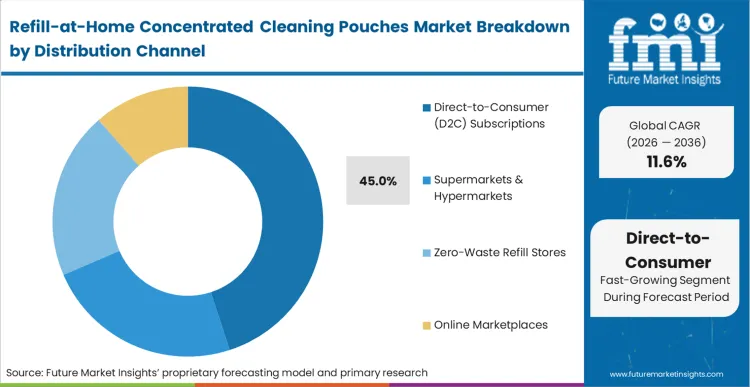
E-commerce logistics perfectly complement the high value-to-weight ratio of waterless cleaning concentrates. Direct-to-Consumer (D2C) Subscriptions hold a 45.0% share in 2026 as digitally native brands leverage the format's mail-ability to bypass traditional retail gatekeepers entirely. Logistics directors shipping subscription-based home care boxes avoid the catastrophic damage rates associated with mailing heavy liquid-filled trigger bottles. This direct pipeline establishes a recurring revenue model shielded from supermarket shelf-space battles. Based on FMI's assessment, traditional retailers are now forcing established brands to replicate this lightweight efficiency in physical aisles. E-commerce fulfillment operators utilizing automated pouch insertion systems drastically reduce their dimensional weight shipping penalties.
- Dimensional Efficiency: Flexible pouches pack flat within standard postal letterbox dimensions completely circumventing premium parcel shipping tariffs.
- Inventory Density: Warehousing high-concentration active ingredients slashes the pallet footprint required to support a national distribution network.
- Retention Mechanics: Automated replenishment schedules prevent consumers from reverting to impulse purchases of single-use bottles during routine grocery shopping.
Refill-at-Home Concentrated Cleaning Pouches Market Analysis by End User
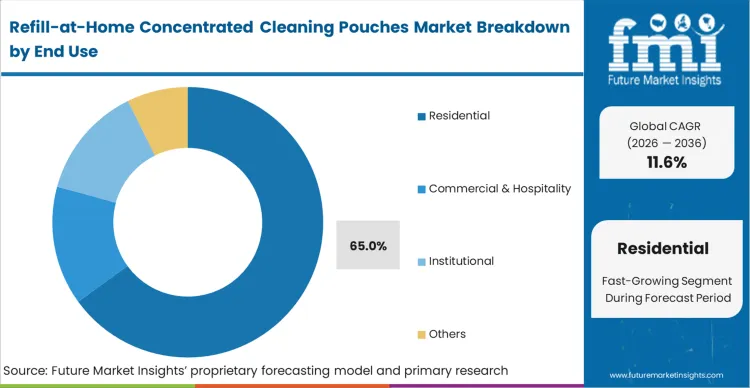
Household procurement behaviors heavily prioritize convenience and immediate accessibility for daily hygiene tasks. The Residential sector commands a 65.0% segment share in 2026 after regulatory campaigns successfully stigmatize the accumulation of single-use plastic waste under kitchen sinks. Brand managers targeting this demographic must design highly intuitive pouring experiences that prevent accidental chemical spills during the dilution process. Incorporating smart spouted pouches for household care designs guarantees that novice users achieve the exact formulation ratios required for optimal cleaning efficacy. FMI's analysis indicates that the sensory experience of the final diluted product remains the ultimate arbiter of repeat purchasing. Retail category managers failing to educate residential buyers on the dilution process suffer immediate velocity drops.
- Dilution Indexing: Fill-line indicators printed directly on the reusable vessel guide users to achieve the precise chemical-to-water ratio intended by the formulator.
- Scent Preservation: Encapsulated fragrance technologies ensure the concentrated perfume profile survives the dilution phase to deliver the expected olfactory cue during use.
- Spill Mitigation: Specialized directional spouts prevent concentrated surfactants from contacting human skin or damaging delicate countertop surfaces during transfer.
Refill-at-Home Concentrated Cleaning Pouches Market Drivers, Restraints, and Opportunities
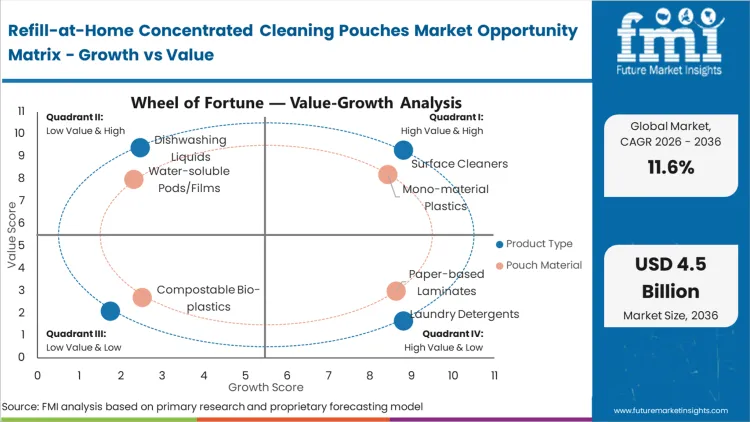
The exponential rise in extended producer responsibility taxes forces fast-moving consumer goods conglomerates to fundamentally restructure their physical supply chains. Packaging procurement directors facing millions in annual compliance penalties must aggressively lightweight their portfolios by eliminating rigid high-density polyethylene bottles. Transitioning to flexible refillable cleaning products allows these brands to slash their taxable plastic tonnage by up to eighty percent per retail unit. Supermarket category managers who refuse to allocate premium aisle space to these concentrated formats lose access to margin-enhancing sustainability incentives.
The highly aggressive chemical nature of hyper-concentrated surfactants creates severe material compatibility issues for flexible film structures. Packaging engineers attempting to utilize eco-friendly cellulose or thin-gauge plastics face critical barrier failures leading to delamination and catastrophic pouch rupture during transit. Utilizing specialized liquid pouch packaging with advanced chemical-resistant coatings provides a functional workaround but significantly inflates the per-unit material cost.
Opportunities in the Refill-at-Home Concentrated Cleaning Pouches Market
- Bio-based Film Extrusion: Advancements in polymer science enable extruders to manufacture high-barrier films derived entirely from renewable feedstocks. Packaging procurement directors capture massive incentives by deploying these next-generation bio-based cleaning pouches solutions without compromising shelf-life stability.
- Smart Dilution Caps: The integration of mechanical dosing chambers directly into the pouch spout allows consumers to accurately meter multiple bottle refills from a single large-format concentrate. Industrial designers engineering these mechanisms eliminate user dilution errors and guarantee consistent chemical efficacy.
- Water-Soluble Pods: Transitioning specific surface cleaning formulations into completely dissolvable polyvinyl alcohol films eliminates the physical pouch waste entirely. Formulators who master this extreme concentration threshold secure premium positioning among hyper-aware zero-waste consumer demographics.
Regional Analysis
Based on the regional analysis, the Refill-at-Home Concentrated Cleaning Pouches market is segmented into North America, Latin America, Europe, East Asia, South Asia, Oceania and Middle East & Africa across 40 plus countries.
.webp "Top Country Growth Comparison Refill At Home Concentrated Cleaning Pouches Market Cagr (2026 2036)")
| Country | CAGR (2026 to 2036) |
|---|---|
| UK | 15.0% |
| Germany | 14.5% |
| USA | 12.5% |
| France | 12.0% |
| Canada | 11.0% |
| Japan | 10.0% |
| Australia | 9.5% |
Source: Future Market Insights (FMI) analysis, based on proprietary forecasting model and primary research
Europe Refill-at-Home Concentrated Cleaning Pouches Market Analysis
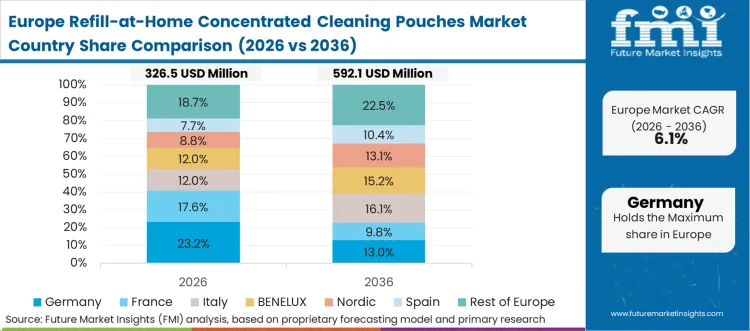
European legislative frameworks aggressively penalize corporations that maintain linear single-use packaging models within the consumer goods sector. Compliance directors navigating the impending Packaging and Packaging Waste Regulation mandate a rapid shift toward reusable primary vessels and lightweight refill systems. In FMI's view, this severe regulatory environment structurally guarantees the mass-market proliferation of concentrated flexible formats.
- UK: The United Kingdom's aggressive Plastic Packaging Tax imposes immediate financial penalties on components containing less than thirty percent recycled content. This fiscal mechanism drives a 15.0% CAGR for refill formats in the UK. Supermarket buyers facing these margin compressions actively replace heavy virgin-plastic trigger sprays with lightweight pouch alternatives. Retail category managers mandating space allocations for plastic-free cleaning products displays achieve significantly higher profit margins per linear foot of shelf space.
- Germany: Mature deposit-return schemes in Germany heavily condition the consumer base to participate in structured container-reuse behaviors. The ingrained habit of retaining primary packaging accelerates the adoption of localized concentrate dilution models. German formulation leads actively exploit this behavioral readiness to push highly concentrated zero waste home care solutions. Germany's market demand is rising at a CAGR of 14.5% as retail chains systematically delist single-use cleaning vessels. Packaging procurement directors failing to provide fully recyclable mono-material pouch structures face immediate exclusion from national drugstore assortments.
- France: France's Anti-Waste for a Circular Economy law legally obligates supermarkets to dedicate specific floor space to refillable dispensing models. This legislative condition structurally forces brand managers to develop proprietary flexible concentrate formats to feed these retail refill station dispensers. The compliance obligation drives a 12.0% annual expansion rate as conglomerates rapidly overhaul their distribution mechanics. Supply chain directors who successfully localize the blending of these hyper-concentrates dramatically reduce their national transportation carbon footprint.
FMI's report includes extensive coverage of the broader European packaging transition. Regional nuances across Italy, Spain, and the Nordics highlight the diverse regulatory approaches to enforcing circular economy principles within the household chemicals sector.
North America Refill-at-Home Concentrated Cleaning Pouches Market Analysis
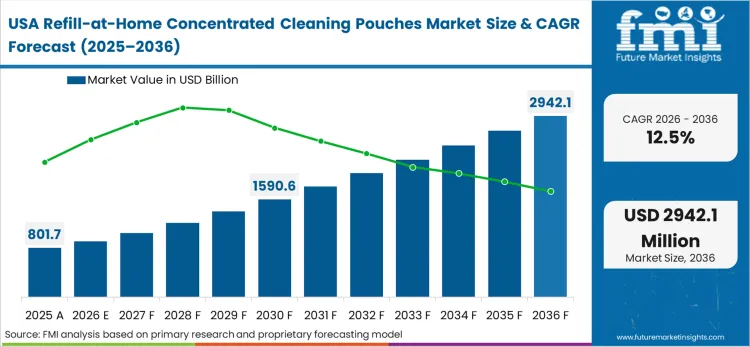
The vast geographic scale of North American retail distribution networks imposes crippling freight costs on heavy water-based consumer goods. Logistics directors mapping national fulfillment strategies increasingly demand highly concentrated formulations to maximize pallet density and minimize diesel fuel surcharges. FMI's research confirms that eliminating the transportation of water fundamentally alters the profitability matrix for both digitally native brands and traditional retail conglomerates.
- USA: National big-box retailers in the United States implement strict supplier scorecards that heavily penalize excessive plastic packaging. Brand managers seeking favorable placement on competitive supermarket shelves must deploy innovative eco-friendly cleaning products in minimal flexible packaging. E-commerce fulfillment algorithms actively prioritize lightweight pouches to reduce dimensional shipping penalties. The United States advances at a 12.5% compound rate as multi-channel distribution efficiencies scale. Supply chain directors lacking dedicated automated pouch-filling infrastructure face severe delays during high-volume promotional periods.
- Canada: Canada's geographically dispersed population centers necessitate highly efficient low-weight logistics pipelines to maintain viable margins on low-cost consumer goods. Retail logistics coordinators rely on hyper-concentrated flexible formats to offset extreme long-haul transportation expenses. The harsh winter climate also demands specialized flexible film structures that prevent freeze-thaw damage during transit. The extreme freight constraint sustains an 11.0% compound rate for refill solutions in Canada. Chemical formulators unable to engineer cold-temperature stability into their liquid concentrates suffer catastrophic product failures within the unheated distribution network.
FMI's report includes comprehensive evaluation of the North American home care sector. It features specific analysis of the Mexican market where rising urbanization drives demand for compact affordable concentrate solutions suited for smaller living spaces.
Asia Pacific Refill-at-Home Concentrated Cleaning Pouches Market Analysis
Rapid urbanization across Asian mega-cities creates an acute demand for space-efficient household products. Retail space planners operating within incredibly constrained hypermarket environments heavily favor compact flexible pouches over bulky rigid bottles. Based on FMI's assessment, the high penetration of mobile-first e-commerce platforms perfectly synergizes with the low shipping weight of concentrated refill systems.
- Japan: Japan's extremely rigid municipal waste sorting regulations force households to aggressively minimize their daily generation of rigid plastic refuse. This civic obligation perfectly aligns with the adoption of lightweight sustainable packaging for cleaning alternatives. Japanese formulators traditionally lead global innovation in hyper-concentrated laundry and dishwashing chemistries. This advanced chemical infrastructure drives a 10.0% CAGR for the market in Japan. Innovation directors failing to secure patents on next-generation instantly-dissolving powder formulations lose critical market share to nimble domestic competitors.
- Australia: Severe long-haul freight costs across Australia's vast interior heavily penalize the distribution of traditional water-filled cleaning products. Logistics directors must strip out every ounce of unnecessary weight to maintain national retail price parity. The integration of highly concentrated green cleaning ingredients into flexible mailing formats enables profitable direct-to-consumer subscription models. Australia advances at a 9.5% compound trajectory to 2036. E-commerce fulfillment operators utilizing automated flat-packing technology drastically improve their margin structures against traditional retail distributors.
FMI's report includes thorough investigation of the Asia Pacific home care packaging landscape. The analysis encompasses China, India, and the ASEAN region where middle-class expansion drives demand for premium sustainable cleaning formats.
Competitive Aligners for Market Players
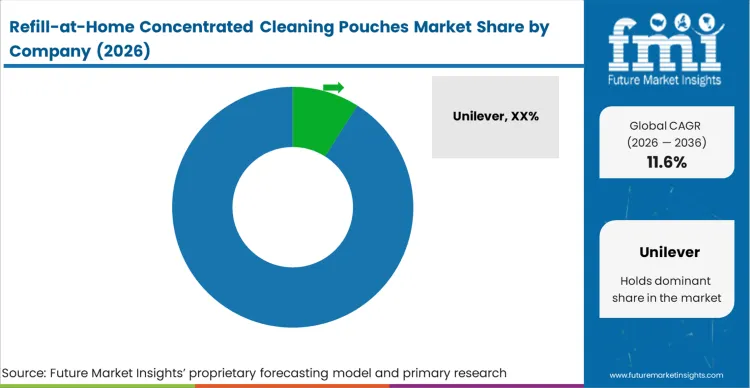
The transition toward concentrated flexible packaging creates a highly concentrated market structure dominated by multinational fast-moving consumer goods giants and specialized digitally native disruptors. This structure exists because engineering stable micro-emulsions and securing high-barrier smart refillable packaging supply chains requires immense research and development capital. Leading entities such as Unilever, Procter & Gamble, and CleanCult leverage their deep chemical formulation expertise to define the competitive baseline. The primary competitive variable retail buyers use to evaluate these brands is the dissolution velocity of the concentrate in standard cold tap water.
Incumbent conglomerates maintain a massive structural advantage through their existing relationships with global film extruders and contract packagers. Companies like SC Johnson possess the operational leverage to demand custom tooling for proprietary spouted pouch designs that guarantee precise consumer dosing. A challenger attempting to replicate this advantage must invest heavily in custom laundry detergent pods and pouches filling lines which severely limits early-stage scalability. Brand managers launching new concentrate lines must secure these specialized manufacturing partnerships years before commercial rollout.
Major retail buyers actively prevent supplier lock-in by maintaining strict multi-vendor qualification protocols for their dedicated refill aisles. This behavior structurally limits the pricing power of dominant brands forcing them to compete aggressively on formulation efficacy and packaging aesthetics. The fundamental structural tension pits the giant's desire for proprietary incompatible refill systems against the retailer's demand for universal brand-agnostic primary bottles. As the forecast period progresses the market inevitably gravitates toward standardized dilution ratios and universal pouch interfaces dictated by dominant retail chains.
Key Players in Refill-at-Home Concentrated Cleaning Pouches Market
- Unilever
- Procter & Gamble
- SC Johnson
- CleanCult
- Blueland
- Splosh
- Ecover
Scope of the Report
| Metric | Value |
|---|---|
| Quantitative Units | USD 1.5 billion to USD 4.5 billion, at a CAGR of 11.6% |
| Market Definition | Refill-at-Home Concentrated Cleaning Pouches deliver highly concentrated active cleaning ingredients in lightweight flexible packaging designed specifically for consumer dilution in reusable vessels. |
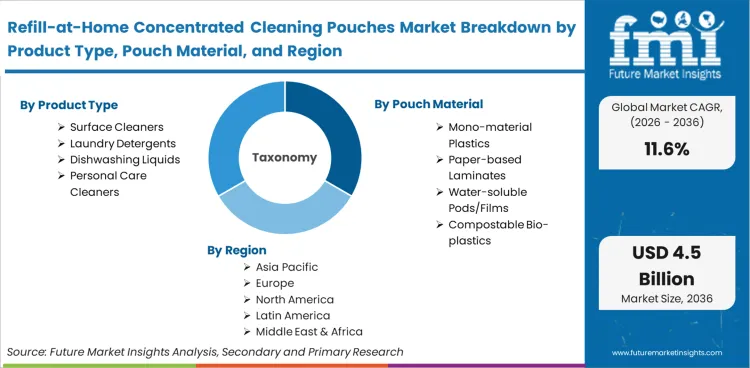
| Product Type Segmentation | Surface Cleaners, Laundry Detergents, Dishwashing Liquids, Personal Care Cleaners |
| Pouch Material Segmentation | Mono-material Plastics, Paper-based Laminates, Water-soluble Pods/Films, Compostable Bio-plastics |
| Distribution Channel Segmentation | Direct-to-Consumer (D2C) Subscriptions, Supermarkets & Hypermarkets, Zero-Waste Refill Stores, Online Marketplaces |
| End User Segmentation | Residential, Commercial & Hospitality, Institutional, Others |
| Regions Covered | North America, Latin America, Europe, East Asia, South Asia, Oceania, Middle East & Africa |
| Countries Covered | UK, Germany, USA, France, Canada, Japan, Australia, and 40 plus countries |
| Key Companies Profiled | Unilever, Procter & Gamble, SC Johnson, CleanCult, Blueland, Splosh, Ecover |
| Forecast Period | 2026 to 2036 |
| Approach | The baseline valuation utilizes FMI's flexible packaging tracker adjusting for the specific penetration rate of home care concentrates. Growth validation relies on correlating projected plastic tax impacts with corporate capital expenditure guidance. |
Source: Future Market Insights (FMI) analysis, based on proprietary forecasting model and primary research
Refill-at-Home Concentrated Cleaning Pouches Market Analysis by Segments
Product Type:
- Surface Cleaners
- Laundry Detergents
- Dishwashing Liquids
- Personal Care Cleaners
Pouch Material:
- Mono-material Plastics
- Paper-based Laminates
- Water-soluble Pods/Films
- Compostable Bio-plastics
Distribution Channel:
- Direct-to-Consumer (D2C) Subscriptions
- Supermarkets & Hypermarkets
- Zero-Waste Refill Stores
- Online Marketplaces
End User:
- Residential
- Commercial & Hospitality
- Institutional
- Others
Region:
- Asia Pacific
- India
- China
- Japan
- South Korea
- Indonesia
- Australia & New Zealand
- ASEAN
- Rest of Asia Pacific
- Europe
- Germany
- Italy
- France
- United Kingdom
- Spain
- Benelux
- Nordics
- Central & Eastern Europe
- Rest of Europe
- North America
- United States
- Canada
- Mexico
- Latin America
- Brazil
- Argentina
- Chile
- Rest of Latin America
- Middle East & Africa
- Kingdom of Saudi Arabia
- United Arab Emirates
- South Africa
- Turkey
- Rest of Middle East & Africa
Bibliography
- Department for Environment, Food & Rural Affairs. (2026). PackUK extended producer responsibility (EPR) for packaging producer disposal fees modulation statement. GOV.UK.
- Environment and Climate Change Canada. (2024). Notice with respect to reporting of plastic resins and certain plastic products for the Federal Plastics Registry for 2024, 2025 and 2026. Canada Gazette, Part I.
- USA Environmental Protection Agency. (2024). EPA’s Safer Choice and Design for the Environment standard.
- Sustainable Packaging Coalition. (2025). 2025 sustainable packaging trends report.
- Mastria, S., Vezzil, A., & De Cesarei, A. (2024). Switching to Reuse: The Impact of Information on Consumers’ Choices for Reusable Food Packaging. Sustainability, 16(14), 5937.
- India Plastics Pact. (2024). Design for recycling guidance for films and flexible packaging.
This bibliography is provided for reader reference. The full FMI report contains the complete reference list with primary source documentation.
This Report Addresses
- Market sizing for the organized refill-at-home concentrated cleaning pouches layer
- Forecast demand for advanced mono-material pouch extrusion capability from 2026 to 2036
- Product Type analysis across Surface Cleaners, Laundry Detergents, Dishwashing Liquids, and Personal Care Cleaners
- Pouch Material demand patterns across Mono-material Plastics, Paper-based Laminates, Water-soluble Pods/Films, and Compostable Bio-plastics
- Regional growth comparisons shaped by localized extended producer responsibility tax frameworks
- Competitive positioning factors for specialized chemical formulators and flexible film extruders
- Revenue opportunities tied to automated direct-to-consumer pouch fulfillment streams
- Strategic implications for packaging procurement directors and retail category managers
Frequently Asked Questions
How large is the Refill-at-Home Concentrated Cleaning Pouches market in 2026?
The market is valued at USD 1.5 billion in 2026, reflecting immediate demand from major consumer goods brands replacing rigid plastic bottles with lightweight flexible formats.
What will the Refill-at-Home Concentrated Cleaning Pouches market be valued at by 2036?
The market is projected to reach USD 4.5 billion by 2036 as retail logistics networks increasingly support waterless chemical distribution.
What CAGR is projected for the Refill-at-Home Concentrated Cleaning Pouches market from 2026 to 2036?
The market is expected to expand at a CAGR of 11.6% during the forecast period due to the cost advantage of reducing water transport weight.
Which Product Type holds the largest share in 2026?
Surface Cleaners hold the largest share at 42.0% in 2026 as their simple chemistry makes them an easy entry point for home dilution.
Which Pouch Material commands the market in 2026?
Mono-material Plastics lead the market with a 38.0% share in 2026 because recyclability mandates favor unified polyethylene structures.
Which Distribution Channel leads consumer adoption?
Direct-to-Consumer subscriptions dominate with a 45.0% share because flat flexible pouches are easier and cheaper to ship directly.
Which End User segment dictates market volume?
The Residential segment leads with a 65.0% share as households increasingly adopt reusable bottles to reduce plastic waste.
What specific policy mechanism accelerates the UK's expansion?
The United Kingdom’s Plastic Packaging Tax accelerates growth by penalizing virgin rigid polymers and encouraging compliant pouch alternatives.
What structural limitation restricts compostable pouch adoption?
Compostable bioplastics face adoption limits because they often lack the barrier performance needed for aggressive chemical surfactants.
What defines the primary competitive battleground for FMCG brands?
The main competitive factor is how quickly and completely the concentrate dissolves in standard cold tap water.
What drives the 15.0% CAGR in the UK?
The UK grows at a 15.0% CAGR due to strong legislation targeting single-use packaging and encouraging refill pouch use.
What supports the 14.5% growth rate in Germany?
Germany’s 14.5% growth is supported by mature deposit-return systems that reinforce consumer familiarity with reuse models.
What shapes the 12.5% expansion in the USA?
The USA grows at 12.5% because major retailers increasingly penalize suppliers that rely on excessive plastic packaging.
Why is France expanding at a 12.0% rate?
France records a 12.0% CAGR because anti-waste laws push supermarkets to allocate space to refill and reuse formats.
How does Canada maintain an 11.0% growth trajectory?
Canada maintains 11.0% growth because its wide logistics footprint favors lightweight packaging over transporting water-heavy products.
What factors into Japan's 10.0% CAGR?
Japan’s 10.0% CAGR is supported by strict waste sorting practices and strong domestic chemical manufacturing capabilities.
Why does Australia post a 9.5% compound rate?
Australia grows at 9.5% because flexible refill formats help reduce high freight costs across long domestic distances.
How do European sustainability mandates impact North American brands?
European sustainability mandates push North American brands to standardize packaging around stricter recyclability requirements.
What causes supply chain bottlenecks during promotional periods?
Supply chain bottlenecks emerge because specialized filling equipment for viscous concentrate formulations remains limited.
What defines the core scope of this market report?
The report covers flexible pouches containing concentrated cleaning products for home dilution and excludes ready-to-use rigid bottle cleaners.
What methodology validates the baseline valuation?
The baseline valuation is validated through bottom-up shipment analysis cross-checked against corporate capital expenditure guidance.
What is the strategic takeaway for chemical formulators?
Chemical formulators must focus on viscosity control and stable micro-emulsions to ensure fast, residue-free mixing in water.
What specific action must retail category managers take?
Retail category managers must allocate permanent shelf space for reusable bottles alongside refill pouch assortments.
Are tablet formats included in this analysis?
Tablet formats are excluded unless they are sold in liquid-tight flexible pouches within the refill delivery format.
Preview the report firsthand - request a free sample
Get SampleGet the brochure for pricing and purchase details.
Get PDFTable of Content
- Executive Summary
- Global Market Outlook
- Demand-side Trends
- Supply-side Trends
- Technology Roadmap Analysis
- Analysis and Recommendations
- Market Overview
- Market Coverage / Taxonomy
- Market Definition / Scope / Limitations
- Research Methodology
- Chapter Orientation
- Analytical Lens and Working Hypotheses
- Market Structure, Signals, and Trend Drivers
- Benchmarking and Cross-market Comparability
- Market Sizing, Forecasting, and Opportunity Mapping
- Research Design and Evidence Framework
- Desk Research Programme (Secondary Evidence)
- Company Annual and Sustainability Reports
- Peer-reviewed Journals and Academic Literature
- Corporate Websites, Product Literature, and Technical Notes
- Earnings Decks and Investor Briefings
- Statutory Filings and Regulatory Disclosures
- Technical White Papers and Standards Notes
- Trade Journals, Industry Magazines, and Analyst Briefs
- Conference Proceedings, Webinars, and Seminar Materials
- Government Statistics Portals and Public Data Releases
- Press Releases and Reputable Media Coverage
- Specialist Newsletters and Curated Briefings
- Sector Databases and Reference Repositories
- FMI Internal Proprietary Databases and Historical Market Datasets
- Subscription Datasets and Paid Sources
- Social Channels, Communities, and Digital Listening Inputs
- Additional Desk Sources
- Expert Input and Fieldwork (Primary Evidence)
- Primary Modes
- Qualitative Interviews and Expert Elicitation
- Quantitative Surveys and Structured Data Capture
- Blended Approach
- Why Primary Evidence is Used
- Field Techniques
- Interviews
- Surveys
- Focus Groups
- Observational and In-context Research
- Social and Community Interactions
- Stakeholder Universe Engaged
- C-suite Leaders
- Board Members
- Presidents and Vice Presidents
- R&D and Innovation Heads
- Technical Specialists
- Domain Subject-matter Experts
- Scientists
- Physicians and Other Healthcare Professionals
- Governance, Ethics, and Data Stewardship
- Research Ethics
- Data Integrity and Handling
- Primary Modes
- Tooling, Models, and Reference Databases
- Desk Research Programme (Secondary Evidence)
- Data Engineering and Model Build
- Data Acquisition and Ingestion
- Cleaning, Normalisation, and Verification
- Synthesis, Triangulation, and Analysis
- Quality Assurance and Audit Trail
- Market Background
- Market Dynamics
- Drivers
- Restraints
- Opportunity
- Trends
- Scenario Forecast
- Demand in Optimistic Scenario
- Demand in Likely Scenario
- Demand in Conservative Scenario
- Opportunity Map Analysis
- Product Life Cycle Analysis
- Supply Chain Analysis
- Investment Feasibility Matrix
- Value Chain Analysis
- PESTLE and Porter’s Analysis
- Regulatory Landscape
- Regional Parent Market Outlook
- Production and Consumption Statistics
- Import and Export Statistics
- Market Dynamics
- Global Market Analysis 2021 to 2025 and Forecast, 2026 to 2036
- Historical Market Size Value (USD Million) Analysis, 2021 to 2025
- Current and Future Market Size Value (USD Million) Projections, 2026 to 2036
- Y-o-Y Growth Trend Analysis
- Absolute $ Opportunity Analysis
- Global Market Pricing Analysis 2021 to 2025 and Forecast 2026 to 2036
- Global Market Analysis 2021 to 2025 and Forecast 2026 to 2036, By Product Type
- Introduction / Key Findings
- Historical Market Size Value (USD Million) Analysis By Product Type , 2021 to 2025
- Current and Future Market Size Value (USD Million) Analysis and Forecast By Product Type , 2026 to 2036
- Surface Cleaners
- Laundry Detergents
- Dishwashing Liquids
- Personal Care Cleaners
- Surface Cleaners
- Y-o-Y Growth Trend Analysis By Product Type , 2021 to 2025
- Absolute $ Opportunity Analysis By Product Type , 2026 to 2036
- Global Market Analysis 2021 to 2025 and Forecast 2026 to 2036, By Pouch Material
- Introduction / Key Findings
- Historical Market Size Value (USD Million) Analysis By Pouch Material, 2021 to 2025
- Current and Future Market Size Value (USD Million) Analysis and Forecast By Pouch Material, 2026 to 2036
- Mono-material Plastics
- Paper-based Laminates
- Water-soluble Pods/Films
- Compostable Bio-plastics
- Mono-material Plastics
- Y-o-Y Growth Trend Analysis By Pouch Material, 2021 to 2025
- Absolute $ Opportunity Analysis By Pouch Material, 2026 to 2036
- Global Market Analysis 2021 to 2025 and Forecast 2026 to 2036, By Distribution Channel
- Introduction / Key Findings
- Historical Market Size Value (USD Million) Analysis By Distribution Channel, 2021 to 2025
- Current and Future Market Size Value (USD Million) Analysis and Forecast By Distribution Channel, 2026 to 2036
- Direct-to-Consumer (D2C) Subscriptions
- Supermarkets & Hypermarkets
- Zero-Waste Refill Stores
- Online Marketplaces
- Direct-to-Consumer (D2C) Subscriptions
- Y-o-Y Growth Trend Analysis By Distribution Channel, 2021 to 2025
- Absolute $ Opportunity Analysis By Distribution Channel, 2026 to 2036
- Global Market Analysis 2021 to 2025 and Forecast 2026 to 2036, By End Use
- Introduction / Key Findings
- Historical Market Size Value (USD Million) Analysis By End Use, 2021 to 2025
- Current and Future Market Size Value (USD Million) Analysis and Forecast By End Use, 2026 to 2036
- Residential
- Commercial & Hospitality
- Institutional
- Others
- Residential
- Y-o-Y Growth Trend Analysis By End Use, 2021 to 2025
- Absolute $ Opportunity Analysis By End Use, 2026 to 2036
- Global Market Analysis 2021 to 2025 and Forecast 2026 to 2036, By Region
- Introduction
- Historical Market Size Value (USD Million) Analysis By Region, 2021 to 2025
- Current Market Size Value (USD Million) Analysis and Forecast By Region, 2026 to 2036
- North America
- Latin America
- Western Europe
- Eastern Europe
- East Asia
- South Asia and Pacific
- Middle East & Africa
- Market Attractiveness Analysis By Region
- North America Market Analysis 2021 to 2025 and Forecast 2026 to 2036, By Country
- Historical Market Size Value (USD Million) Trend Analysis By Market Taxonomy, 2021 to 2025
- Market Size Value (USD Million) Forecast By Market Taxonomy, 2026 to 2036
- By Country
- USA
- Canada
- Mexico
- By Product Type
- By Pouch Material
- By Distribution Channel
- By End Use
- By Country
- Market Attractiveness Analysis
- By Country
- By Product Type
- By Pouch Material
- By Distribution Channel
- By End Use
- Key Takeaways
- Latin America Market Analysis 2021 to 2025 and Forecast 2026 to 2036, By Country
- Historical Market Size Value (USD Million) Trend Analysis By Market Taxonomy, 2021 to 2025
- Market Size Value (USD Million) Forecast By Market Taxonomy, 2026 to 2036
- By Country
- Brazil
- Chile
- Rest of Latin America
- By Product Type
- By Pouch Material
- By Distribution Channel
- By End Use
- By Country
- Market Attractiveness Analysis
- By Country
- By Product Type
- By Pouch Material
- By Distribution Channel
- By End Use
- Key Takeaways
- Western Europe Market Analysis 2021 to 2025 and Forecast 2026 to 2036, By Country
- Historical Market Size Value (USD Million) Trend Analysis By Market Taxonomy, 2021 to 2025
- Market Size Value (USD Million) Forecast By Market Taxonomy, 2026 to 2036
- By Country
- Germany
- UK
- Italy
- Spain
- France
- Nordic
- BENELUX
- Rest of Western Europe
- By Product Type
- By Pouch Material
- By Distribution Channel
- By End Use
- By Country
- Market Attractiveness Analysis
- By Country
- By Product Type
- By Pouch Material
- By Distribution Channel
- By End Use
- Key Takeaways
- Eastern Europe Market Analysis 2021 to 2025 and Forecast 2026 to 2036, By Country
- Historical Market Size Value (USD Million) Trend Analysis By Market Taxonomy, 2021 to 2025
- Market Size Value (USD Million) Forecast By Market Taxonomy, 2026 to 2036
- By Country
- Russia
- Poland
- Hungary
- Balkan & Baltic
- Rest of Eastern Europe
- By Product Type
- By Pouch Material
- By Distribution Channel
- By End Use
- By Country
- Market Attractiveness Analysis
- By Country
- By Product Type
- By Pouch Material
- By Distribution Channel
- By End Use
- Key Takeaways
- East Asia Market Analysis 2021 to 2025 and Forecast 2026 to 2036, By Country
- Historical Market Size Value (USD Million) Trend Analysis By Market Taxonomy, 2021 to 2025
- Market Size Value (USD Million) Forecast By Market Taxonomy, 2026 to 2036
- By Country
- China
- Japan
- South Korea
- By Product Type
- By Pouch Material
- By Distribution Channel
- By End Use
- By Country
- Market Attractiveness Analysis
- By Country
- By Product Type
- By Pouch Material
- By Distribution Channel
- By End Use
- Key Takeaways
- South Asia and Pacific Market Analysis 2021 to 2025 and Forecast 2026 to 2036, By Country
- Historical Market Size Value (USD Million) Trend Analysis By Market Taxonomy, 2021 to 2025
- Market Size Value (USD Million) Forecast By Market Taxonomy, 2026 to 2036
- By Country
- India
- ASEAN
- Australia & New Zealand
- Rest of South Asia and Pacific
- By Product Type
- By Pouch Material
- By Distribution Channel
- By End Use
- By Country
- Market Attractiveness Analysis
- By Country
- By Product Type
- By Pouch Material
- By Distribution Channel
- By End Use
- Key Takeaways
- Middle East & Africa Market Analysis 2021 to 2025 and Forecast 2026 to 2036, By Country
- Historical Market Size Value (USD Million) Trend Analysis By Market Taxonomy, 2021 to 2025
- Market Size Value (USD Million) Forecast By Market Taxonomy, 2026 to 2036
- By Country
- Kingdom of Saudi Arabia
- Other GCC Countries
- Turkiye
- South Africa
- Other African Union
- Rest of Middle East & Africa
- By Product Type
- By Pouch Material
- By Distribution Channel
- By End Use
- By Country
- Market Attractiveness Analysis
- By Country
- By Product Type
- By Pouch Material
- By Distribution Channel
- By End Use
- Key Takeaways
- Key Countries Market Analysis
- USA
- Pricing Analysis
- Market Share Analysis, 2025
- By Product Type
- By Pouch Material
- By Distribution Channel
- By End Use
- Canada
- Pricing Analysis
- Market Share Analysis, 2025
- By Product Type
- By Pouch Material
- By Distribution Channel
- By End Use
- Mexico
- Pricing Analysis
- Market Share Analysis, 2025
- By Product Type
- By Pouch Material
- By Distribution Channel
- By End Use
- Brazil
- Pricing Analysis
- Market Share Analysis, 2025
- By Product Type
- By Pouch Material
- By Distribution Channel
- By End Use
- Chile
- Pricing Analysis
- Market Share Analysis, 2025
- By Product Type
- By Pouch Material
- By Distribution Channel
- By End Use
- Germany
- Pricing Analysis
- Market Share Analysis, 2025
- By Product Type
- By Pouch Material
- By Distribution Channel
- By End Use
- UK
- Pricing Analysis
- Market Share Analysis, 2025
- By Product Type
- By Pouch Material
- By Distribution Channel
- By End Use
- Italy
- Pricing Analysis
- Market Share Analysis, 2025
- By Product Type
- By Pouch Material
- By Distribution Channel
- By End Use
- Spain
- Pricing Analysis
- Market Share Analysis, 2025
- By Product Type
- By Pouch Material
- By Distribution Channel
- By End Use
- France
- Pricing Analysis
- Market Share Analysis, 2025
- By Product Type
- By Pouch Material
- By Distribution Channel
- By End Use
- India
- Pricing Analysis
- Market Share Analysis, 2025
- By Product Type
- By Pouch Material
- By Distribution Channel
- By End Use
- ASEAN
- Pricing Analysis
- Market Share Analysis, 2025
- By Product Type
- By Pouch Material
- By Distribution Channel
- By End Use
- Australia & New Zealand
- Pricing Analysis
- Market Share Analysis, 2025
- By Product Type
- By Pouch Material
- By Distribution Channel
- By End Use
- China
- Pricing Analysis
- Market Share Analysis, 2025
- By Product Type
- By Pouch Material
- By Distribution Channel
- By End Use
- Japan
- Pricing Analysis
- Market Share Analysis, 2025
- By Product Type
- By Pouch Material
- By Distribution Channel
- By End Use
- South Korea
- Pricing Analysis
- Market Share Analysis, 2025
- By Product Type
- By Pouch Material
- By Distribution Channel
- By End Use
- Russia
- Pricing Analysis
- Market Share Analysis, 2025
- By Product Type
- By Pouch Material
- By Distribution Channel
- By End Use
- Poland
- Pricing Analysis
- Market Share Analysis, 2025
- By Product Type
- By Pouch Material
- By Distribution Channel
- By End Use
- Hungary
- Pricing Analysis
- Market Share Analysis, 2025
- By Product Type
- By Pouch Material
- By Distribution Channel
- By End Use
- Kingdom of Saudi Arabia
- Pricing Analysis
- Market Share Analysis, 2025
- By Product Type
- By Pouch Material
- By Distribution Channel
- By End Use
- Turkiye
- Pricing Analysis
- Market Share Analysis, 2025
- By Product Type
- By Pouch Material
- By Distribution Channel
- By End Use
- South Africa
- Pricing Analysis
- Market Share Analysis, 2025
- By Product Type
- By Pouch Material
- By Distribution Channel
- By End Use
- USA
- Market Structure Analysis
- Competition Dashboard
- Competition Benchmarking
- Market Share Analysis of Top Players
- By Regional
- By Product Type
- By Pouch Material
- By Distribution Channel
- By End Use
- Competition Analysis
- Competition Deep Dive
- Unilever
- Overview
- Product Portfolio
- Profitability by Market Segments (Product/Age /Sales Channel/Region)
- Sales Footprint
- Strategy Overview
- Marketing Strategy
- Product Strategy
- Channel Strategy
- Procter & Gamble
- SC Johnson
- CleanCult
- Blueland
- Splosh
- Ecover
- Unilever
- Competition Deep Dive
- Assumptions & Acronyms Used


