

- Market Size (2026)
- USD 4.1 Bn
- Forecast (2036)
- USD 7.3 Bn
- CAGR (2026 to 2036)
- 5.9%
Spout Pouches Market Forecast and Outlook By FMI
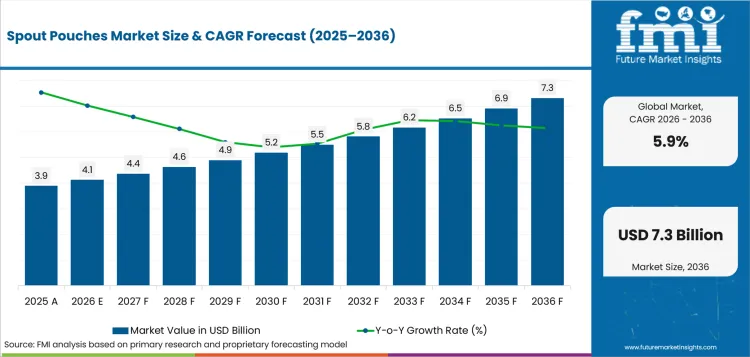
The spout pouches market value is projected to increase from USD 3.9 billion in 2025 to USD 7.3 billion by 2036 at 5.9% CAGR, supported by converter-led pack qualification and liquid product migration. Direct sales are forecast to hold 73.6% share in 2026 as brand owners rely on converter-managed pouch trials and filling-line support. Plastic laminates are projected to represent 67.4% share in 2026 as barrier protection and spout-seal strength remain central to liquid and semi-liquid packs.
Key Takeaways, Market Size, and Forecast
| Metric | Value |
|---|---|
| Market Size (2026) | USD 4.1 Billion |
| Market Size (2036) | USD 7.3 Billion |
| Forecast CAGR | 5.9% from 2026 to 2036 |
| Leading Sales Channel | Direct Sales |
| Direct Sales Share In 2026 | 73.6% |
| Leading Material | Plastic Laminates |
| Plastic Laminates Share In 2026 | 67.4% |
| Leading Application | Food And Beverages |
| Food And Beverages Share In 2026 | 61.9% |
| Fastest-Growing Country | India |
| India CAGR | 7.4% through 2036 |
Summary of Spout Pouches Market
- Demand and Growth Drivers
- Food and beverage brands are using spouted packs for controlled pouring and smaller household pack sizes.
- Home-care refill programs are shifting liquid detergents and cleaners into lighter dispensing formats.
- Closure suppliers are taking a larger role as cap safety and leak resistance affect repeat orders.
- Product and Segment View
- Direct sales are forecast to hold 73.6% share in 2026, driven by converter-managed sampling and brand-specific pack validation.
- Plastic laminates are projected to represent 67.4% share in 2026, influenced by barrier protection and liquid-pack seal strength.
- Food and beverages are expected to account for 61.9% share in 2026 due to puree and drinkable snack use.
- Geography and Competitive Outlook
- India is projected to record 7.4% CAGR by 2036 owing to food processing capacity and regional filling growth.
- China is forecast to expand at 6.8% CAGR by 2036 due to online food sales and parcel movement.
- Amcor and Mondi compete based on recycle-ready structures and large-brand conversion work.
- Gualapack and Cheer Pack North America compete by premade spouted pouch depth and cap-system experience.
- Analyst Opinion
- Ismail Sutaria, Principal Consultant for Packaging at FMI, observes, “Spout pouches are now more than a light-pack option. Buyers now test weld strength and fill compatibility before approving conversion from bottles or tubs. Suppliers with film design and filling support should protect repeat programs more effectively.”
- Spout Pouches Market Value Analysis
- Market value is driven by finished spouted pouch revenue before caps and filling support add incremental income.
- Supplier pricing reflects resin cost and conversion complexity.
- Revenue improves as brands convert rigid bottles and tubs into refill packs for food and home-care liquids.
- Retail trust rises as packs show clear fill volume and disposal guidance.
Pack approval has become tighter as brands ask for recyclable films without losing spout seal strength or filling speed. Supplier evaluation now favors measurable process proof before price comparison. In October 2024, Dukane stated that its SynQro ultrasonic module sealed mono-material PE spouted pouches in one step and reached under-one-second cycle times at 40 pouches per minute. This makes mono-material sealing a commercial throughput issue for co-packers. In June 2024, SÜDPACK stated that its roll-stock spouted pouch system can pay back in less than one year and supports liquid or pasty foods requiring thermal treatment. This gives fillers a clearer case for placing pouch forming closer to filling. In May 2024, UFlex stated that a 5-kg Asal idly-dosa batter pouch used a 17mm spout while More Light liquid detergent used a 5-litre spouted preformed pouch. This moves spouted formats into institutional foodservice and household refill packs. In 2025, the European Commission stated that packaging must be recyclable in an economically viable way by 2030.
Spout Pouches Market Definition
Spout pouches cover flexible pouches fitted with a dispensing spout, cap, valve, or similar closure. Scope includes stand-up spouted pouches, refill pouches, baby-food pouches, retort spouted pouches, and liquid refill pouches. Revenue includes finished pouches sold to packaged food, beverage, personal-care, home-care, pet food, and selected healthcare product brands.
Spout Pouches Market Inclusions
Market scope covers commercially supplied spout pouches categorized by product type such as stand-up pouches, flat pouches, shaped pouches, retort pouches, and refill pouches. Material coverage includes plastic laminates, mono-material PE, mono-material PP, paper-based barrier, and aluminum-free barrier formats. Closure coverage includes screw caps, flip-top caps, valve spouts, tamper-evident caps, and child-resistant caps. End-use coverage includes food and beverages, baby food, personal care, home care, and pet food. Revenue scope covers 2026 to 2036. Key stakeholders include flexible packaging converters, cap suppliers, spout makers, resin producers, packaged goods brands, contract fillers, filling-line suppliers, distributors, and recycling bodies.
Spout Pouches Market Exclusions
Scope excludes rigid bottles, metal cans, cartons, non-spouted sachets, zipper pouches without dispensing features, flexible tubes, bag-in-box formats, and industrial bulk liners. Filling equipment revenue is excluded unless bundled pricing clearly assigns value to finished pouches.
Spout Pouches Market Research Methodology
- Primary Research: FMI analysts reviewed converter portfolios, filling-line checks, cap supplier capabilities, and brand owner pack trials across food, beverage, personal-care, and home-care applications.
- Desk Research: Public data from Amcor, Mondi, AptarGroup, Gualapack, ProAmpac, Glenroy, SIG Group, Eurostat, Ministry of Food Processing Industries, National Bureau of Statistics of China, USA Census Bureau, Statistics Canada, HM Revenue & Customs, and United States Department of Agriculture Foreign Agricultural Service were checked against spout pouch evidence.
- Market Sizing and Forecasting: Estimated using a bottom-up product-boundary approach based on eligible SKU revenue, channel presence, retail pricing, product positioning, and country-level adoption.
- Data Validation: Forecast checks compared liquid-pack conversion, spout closure use, refill packaging activity, food processing capacity, and active supplier portfolios across leading countries.
Why is the Spout Pouches Market Growing?
- Packaged food brands are choosing spouted packs to improve pour control, resealing, and portion handling.
- Home-care and personal-care brands are using refill pouches to reduce rigid container dependence.
- Converters are improving mono-material and aluminum-free structures for brands that need simpler material claims.
Spout pouches are drawing more brand support as refill economics and dispensing control move into the same pack decision. Mondi stated in February 2025 that its re/cycle SpoutedPouch for Sherwin-Williams reduced plastic consumption by 90.0% compared with a 5L bucket. Amcor stated in February 2024 that its all-PE YoBaby pouch removed foil and metallized layers from the previous structure. AptarGroup stated in April 2026 that its SureSnap valve was selected for on-the-go pouched beverages and low-viscosity foods.
Market Segmentation Analysis
- Stand-up pouches are anticipated to account for 58.2% share in 2026 since upright shelf display and bottom-gusset stability support sauces and home-care refills.
- Plastic laminates are projected to capture 67.4% share in 2026 owing to barrier strength and spout-weld security across liquid and semi-liquid products.
- 200 to 500 ml packs are forecast to hold 42.8% share in 2026, reflected by household portion needs and mid-size refill use.
- Screw caps are projected to represent 55.3% share in 2026 due to reseal convenience and established line compatibility.
- Food and beverages are expected to secure 61.9% share in 2026 as purees and snack formats use controlled dispensing.
- Direct sales are forecast to hold 73.6% share in 2026 as brand owners require converter-led samples and filling-line qualification before approving pouch conversion.
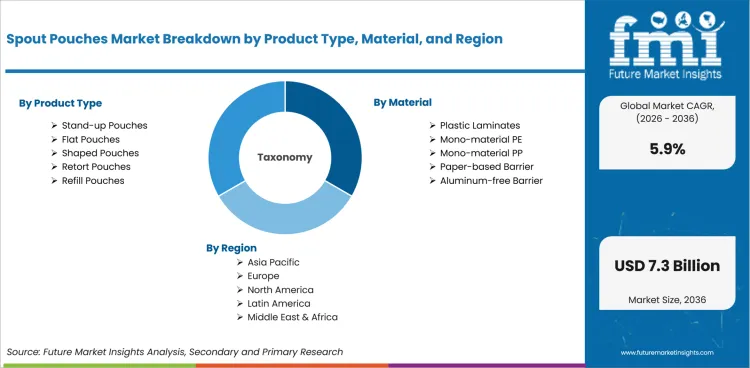
The spout pouches market is divided into six primary segment groups based on product type and material. Capacity, closure type, end use, and sales channel complete the structure. Product type covers stand-up pouches and flat pouches. Shaped pouches, retort pouches, and refill pouches complete the group. Material coverage includes plastic laminates and mono-material PE. Mono-material PP, paper-based barrier, and aluminum-free barrier formats complete the material scope. Capacity coverage includes below 200 ml and 200 to 500 ml. Larger packs and bulk refill formats complete the capacity scope. Closure type includes screw caps and flip-top caps. Valve spouts, tamper-evident caps, and child-resistant caps complete the closure scope. End use includes food and beverages, baby food, personal care, home care, and pet food. Sales channel coverage includes direct sales, contract converters, packaging distributors, online B2B, and retail supply programs.
Insights into Spout Pouches Market by Product Type
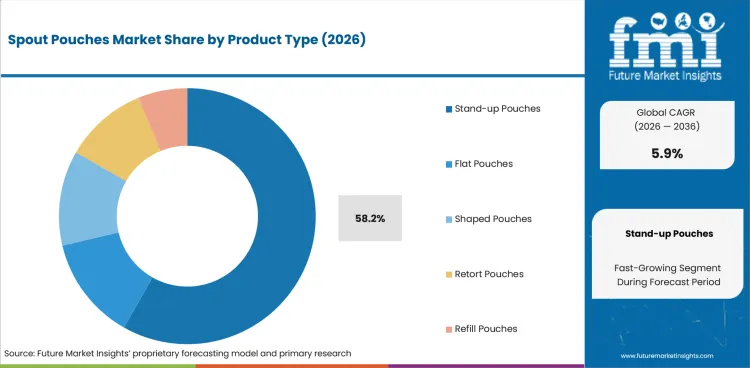
- Stand-up pouches are projected to hold 58.2% share in 2026, led by upright display and easy shelf handling.
- Refill pouches gain use as detergent and paint concentrate brands seek lighter packs for repeat household purchases.
Insights into Spout Pouches Market by Material
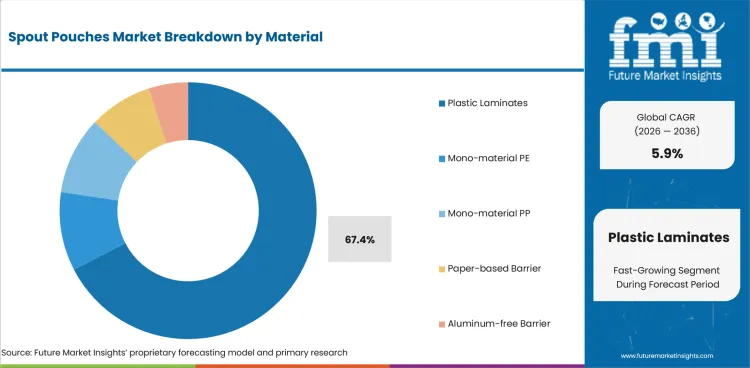
- Plastic laminates are forecast to hold 67.4% share in 2026, supported by barrier control and strong spout-seal performance.
- Mono-material PE formats secure placement as brands test recyclable pouch structures without removing reseal function.
Insights into Spout Pouches Market by Capacity
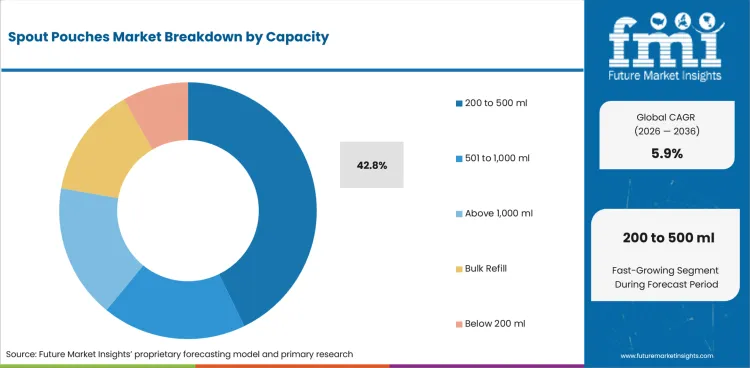
- 200 to 500 ml pouches are expected to account for 42.8% share in 2026, driven by family-use and portion-controlled liquid products.
- Above 1,000 ml formats gain traction in laundry and foodservice refills requiring larger pour volumes.
Insights into Spout Pouches Market by Closure Type
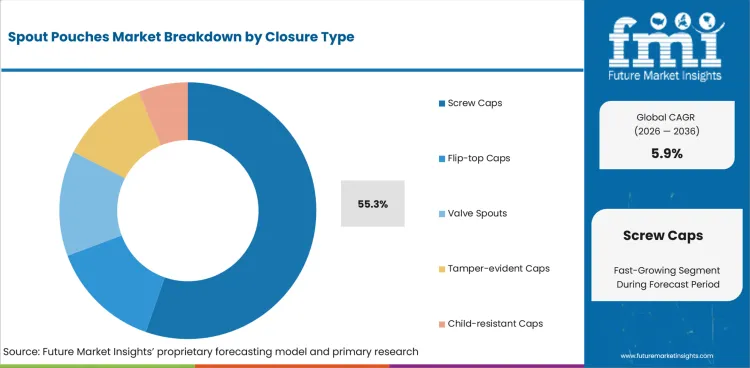
- Screw caps are anticipated to represent 55.3% share in 2026, backed by familiar resealing and filling-line compatibility.
- Valve spouts gain use in beverages and low-viscosity foods as controlled flow reduces accidental leakage.
Insights into Spout Pouches Market by End Use
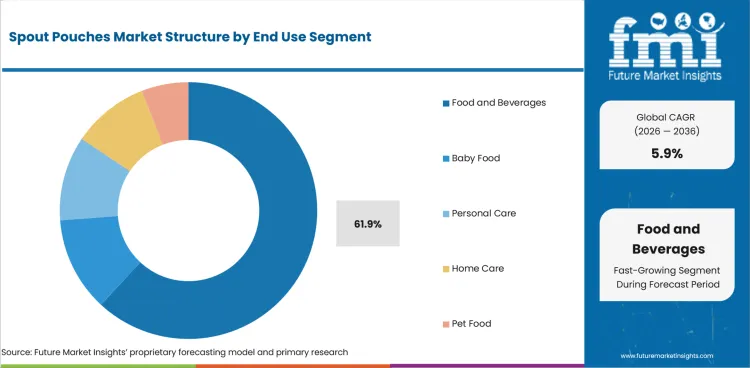
- Food and beverages are projected to secure 61.9% share in 2026 due to fruit purees and drinkable snacks.
- Home care gains share as liquid detergent and cleaning concentrate brands convert rigid bottles into refill packs.
Insights into Spout Pouches Market by Sales Channel
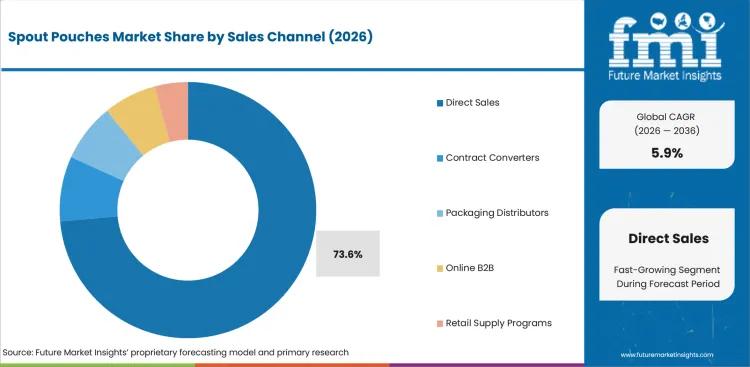
- Direct sales are forecast to hold 73.6% share in 2026, driven by converter-managed trials and brand-specific closure testing.
- Packaging distributors support smaller brands requiring standard spout sizes and shorter order cycles.
Spout Pouches Market Drivers, Restraints and Opportunities
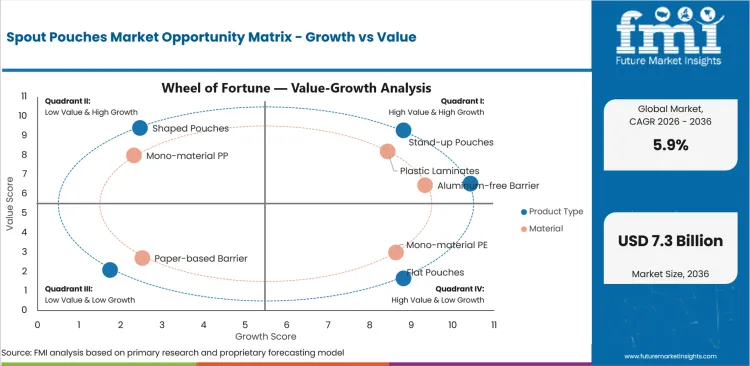
- Driver: Rigid-pack conversion is shifting liquid and semi-liquid brands toward lighter resealable pouch formats.
- Restraint: Mono-material qualification can delay launches as film and spout materials require compatibility checks.
- Opportunity: Valve closures and refill packs can help suppliers capture higher-value pouch programs across food and home care.
Single-Serve Liquid Formats Expand Spout Pouch Use
Single-serve liquid products are extending spout pouch use beyond baby food and home-care refills. In November 2025, SIG stated that Zydus Lifesciences selected single-serve spouted pouches for liquid cough and cold medication in India, using 5 ml and 10 ml mini-portions with SIG StrawCap 30 Linked and SIG Motion Servo 3.2 filling technology. SIG also stated that StrawCap 30 Linked uses 3x less plastic than a conventional pouch closure with cap. Such use cases show demand is building for spout pouches where brands need precise dosing and reduced product waste in liquid formats. Pouch suppliers combining closure design and product safety documentation are better placed to win higher-value programs across healthcare and functional liquid products.
Material Compatibility Limits Faster Qualification
Recycle-ready pouch design remains harder than simple film replacement. Cap resin and product chemistry all affect final pack performance. Food and household chemical brands often require migration testing and hot-fill or cold-fill trials before scale-up. Smaller converters can lose time if testing support is outsourced.
Valve and Cap Systems Open Higher-Value Pack Positions
Closure design is now a direct value lever for spout pouch suppliers. AptarGroup’s SureSnap valve selection by Cheer Pack North America in April 2026 shows demand for controlled dispensing in low-viscosity foods and beverages. Cap specialists can gain share as brands look beyond film cost and test user experience through spout design.
Format-wise Demand Analysis
Format-wise demand is shifting by application as food brands match pack type with shelf life and compliance requirements. In April 2025, the Food Safety and Standards Authority of India listed approved food packaging formats across 10 food category groups, including glass bottles and flexible multilayer structures. Such range indicates demand will stay split across rigid and flexible formats, with spout pouches taking a larger role in products requiring controlled dispensing and compact storage while bottles and tubs remain important where rigidity or display protection carries more value.
Format-level Price Benchmarking Analysis
Format-level price benchmarking may tighten as buyers compare pouch conversion against rigid bottles and glass containers using inflation-linked producer price evidence. FRED data from the USA Bureau of Labor Statistics show April 2026 index levels of 177.114 for other polyethylene bags and liners, 184.728 for plastic bottles, 196.660 for single-web flexible packaging films, and 220.672 for glass containers. Pouches therefore benchmark below plastic bottles and glass containers on the listed producer-price indexes, supporting their use where brands need lightweight refill packs and lower material exposure. Higher-index glass and film-heavy structures still require justification through premium positioning or end-use protection needs.
Competitive Landscape and Strategic Positioning
- Supplier selection is shaped by seal strength and documentation quality.
- Flexible packaging suppliers compete on barrier performance and spout-seal reliability.
- Closure specialists compete through leak control and flow management.
- Premade pouch suppliers gain ground by serving baby food and refill products.
- Converters shape success through trial speed and filling-line support.
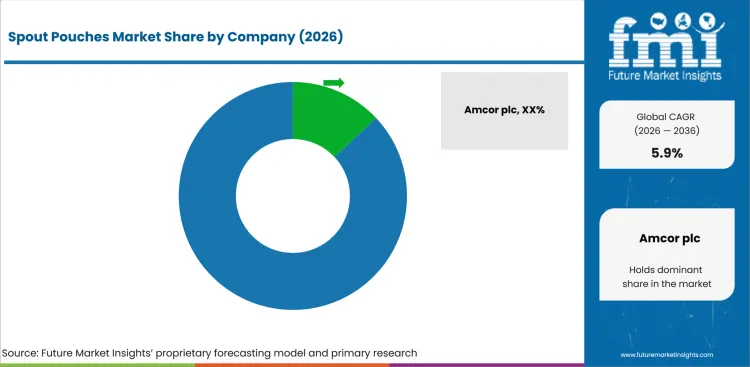
Competitive outlook is supported by suppliers combining pouch films and conversion support. Amcor plc holds a stronger position after completing its combination with Berry Global in April 2025, creating a larger consumer packaging platform with stronger closure and flexible packaging depth. Mondi plc competes led by mono-material refill formats and strong European packaging reach. Gualapack S.p.A. and Cheer Pack North America LLC compete based on premade spouted pouch systems and cap integration. ProAmpac Holdings Inc. and Glenroy Inc. compete with rigid-to-pouch conversion support and North American brand access. AptarGroup Inc. adds closure depth through valve and dispensing technologies. SIG Group AG competes through spouted pouch packaging and filling technology for food and beverage applications.
Supplier advantage is expected to come from tested material structures and reliable cap performance. Larger suppliers are best placed to support global food and home-care brands that need consistent films across regions. Regional converters can gain if they deliver short-run samples and local service without weakening seal quality. Companies with integrated film and testing support are best placed to win repeat programs.
Key Companies in the Spout Pouches Market
Competitive structure is differentiated by global converters, spout system specialists, and closure technology suppliers.
- Global Flexible Packaging Suppliers: Amcor plc, Mondi plc, ProAmpac Holdings Inc., Huhtamaki Oyj, and SIG Group AG compete by barrier films and large-brand pack trials. Amcor supports spouted stand-up formats with multiple cap types. Mondi serves mono-material spouted pouches for refill uses. ProAmpac supports spouted pouch conversion across food and industrial products. Huhtamaki offers customized pouches and spout-enabled flexible formats. SIG Group AG offers spouted pouch packaging and filling technology.
- Spout System Specialists: Gualapack S.p.A., Cheer Pack North America LLC, and Glenroy Inc. compete through premade pouch formats=and filling knowledge. Gualapack serves baby food and home-care packs. Cheer Pack North America supports pouch and cap systems for drinkable products. Glenroy supports barrier spouted pouches and rigid-to-pouch conversion work.
- Closure and Dispensing Suppliers: AptarGroup Inc. competes through valve systems and dispensing components used in spouted pouch formats. Closure selection affects leak control and consumer handling. Cap suppliers gain stronger positions when brands require testing support for low-viscosity foods and household liquids.
Competitive Benchmarking: Spout Pouches Market
| Company | Spout and Cap Integration | Mono-material Pouch Capability | Liquid Fill Support | Refill Conversion Depth | Geographic Footprint |
|---|---|---|---|---|---|
| Amcor plc | Very Strong | Very Strong | Strong | Very Strong | Global |
| Mondi plc | Strong | Very Strong | Strong | Very Strong | Europe and global |
| Gualapack S.p.A. | Very Strong | Strong | Very Strong | Strong | Global |
| ProAmpac Holdings Inc. | Strong | Strong | Very Strong | Very Strong | North America and Europe |
| Cheer Pack North America LLC | Very Strong | Strong | Strong | Strong | North America |
| Glenroy Inc. | Strong | Moderate | Strong | Strong | North America |
| AptarGroup Inc. | Very Strong | Moderate | Very Strong | Moderate | Global |
| SIG Group AG | Strong | Strong | Very Strong | Strong | Global |
| Huhtamaki Oyj | Strong | Strong | Strong | Moderate | Global |
Source: Future Market Insights competitive analysis, 2026.
Key Developments in Spout Pouches Market
- In November 2024, the USA Environmental Protection Agency clarified that pesticide products marketed in flexible spouted pouches of 20 fluid ounces or less and intended for residential use are subject to Child Resistant Packaging mitigation measures.
- In October 2025, SIG and ALCA Corp launched the first products filled on SIG Prime 55 In-Line Aseptic, a next-generation aseptic spouted pouch system with in-line pouch sterilization.
- In October 2025, Polmlek opened an aseptic spouted pouch filling line using IMA Fillshape’s Ermetika Aseptic EAS240 for ESL and low-acid dairy products and desserts.
Key Players in the Spout Pouches Market
- Amcor plc
- Mondi plc
- Gualapack S.p.A.
- ProAmpac Holdings Inc.
- Cheer Pack North America LLC
- Glenroy Inc.
- AptarGroup Inc.
- SIG Group AG
- Huhtamaki Oyj
Analysis of Spout Pouches Market by Key Countries
.webp "Top Country Growth Comparison Spout Pouches Market Cagr (2026 2036)")
| Country | CAGR |
|---|---|
| India | 7.4% |
| China | 6.8% |
| United States | 5.6% |
| Canada | 5.2% |
| Germany | 4.9% |
| United Kingdom | 4.6% |
| Japan | 4.2% |
Source: Future Market Insights, 2026.
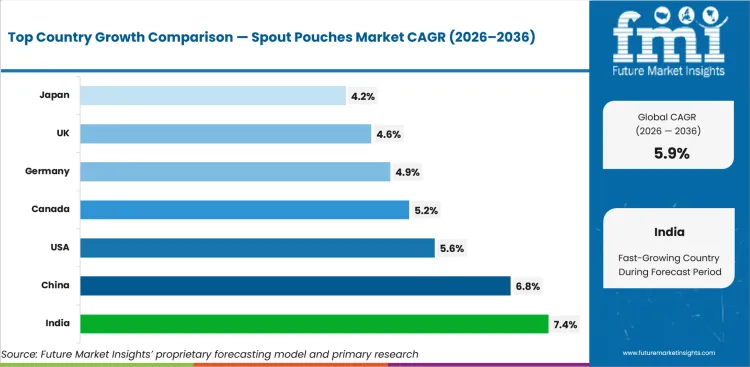
Spout Pouches Market CAGR Analysis by Country
- India is projected to record 7.4% CAGR through 2036, driven by food processing capacity and regional contract filling.
- China is expected to expand at 6.8% CAGR through 2036, influenced by online food retail and parcel logistics.
- The United States is forecast to grow at 5.6% CAGR through 2036, backed by branded food, baby food, and home-care refill conversion.
- Canada is expected to advance at 5.2% CAGR through 2036, aided by packaged food retail and regional processing corridors.
- Germany is projected to rise at 4.9% CAGR through 2036, led by packaging waste rules and retailer material checks.
- The United Kingdom is forecast at 4.6% CAGR through 2036, supported by recycled-content tax exposure and grocery refill programs.
- Japan is expected to post 4.2% CAGR through 2036, guided by compact retail formats and premium dispensing standards.
Sales Outlook for Spout Pouches Market in India
Packaged food and regional filling center, 2026 to 2036
Country Market Snapshot Table
| Parameter | Value |
|---|---|
| Market Size in 2025 (Value) | USD 238.2 million |
| Market Size in 2026 (Value) | USD 255.8 million |
| Market Forecast in 2036 (Value) | USD 522.3 million |
| CAGR (2026-2036) | 7.4% CAGR |
| Years Considered | 2021-2036 |
| Base Year | 2025 |
| Forecast Period | 2026-2036 |
| Units Considered | Value (USD million) |
| Leading Sub-Region | West India and South India food processing corridors |
India Spout Pouches Market Outlook
India spout pouch demand is shaped by packaged food expansion and regional contract filling. Sauce and personal-care brands use resealable formats to reach smaller households.
Local converters benefit from short sampling cycles and faster support for pouch artwork. Suppliers with cap sourcing and regional service teams should gain stronger access to branded liquid-pack programs.
Key Growth Drivers
- Food processing expansion supports spout pouch demand in sauce and ready-to-cook formats. Ministry of Food Processing Industries reported 34.0 lakh MT per annum of processing and preservation capacity as of February 2026.
- Dairy output gives pouch fillers a large base for yogurt and fruit-dairy blends. Department of Animal Husbandry and Dairying reported milk production of 247.9 million tonnes during 2024-25.
- Metro grocery brands are testing tamper-evident caps for purees and nutrition packs sold through modern retail.
- Western India converters gain order support from Maharashtra and Gujarat food clusters serving sauces and home-care liquids.
Key Restraints
- Flexible pouch recycling remains under review as plastic waste scrutiny grows. United Nations Environment Programme estimated 19.0 million to 23.0 million tonnes of plastic waste entering aquatic ecosystems each year in its 2025 update.
- Small fillers often require outside labs for migration and seal-strength checks before retailer approval.
- Material collection differences across cities can slow movement from multilayer laminates into higher-priced recyclable structures.
What makes India unique
India is unique due to fast packaged food capacity expansion and domestic converters serving regional food brands.
Key Companies
- UFlex Limited
- Huhtamaki India Limited
- Amcor Flexibles India Private Limited
- SIG Combibloc India Private Limited
- EPL Limited
- Gualapack India Private Limited
Sales & Marketing Channels
- Direct converter sales
- Contract filling partners
- Packaging distributors
- Online B2B platforms
- Regional food clusters
- Export pack suppliers
Country Segment Breakdown Table
| Segment | Sub-Segments |
|---|---|
| By Product Type | Stand-up Pouches, Flat Pouches, Shaped Pouches, Retort Pouches, Refill Pouches |
| By Material | Plastic Laminates, Mono-material PE, Mono-material PP, Paper-based Barrier, Aluminum-free Barrier |
| By Capacity | Below 200 ml, 200 to 500 ml, 501 to 1,000 ml, Above 1,000 ml, Bulk Refill |
| By Closure Type | Screw Caps, Flip-top Caps, Valve Spouts, Tamper-evident Caps, Child-resistant Caps |
| By End Use | Food and Beverages, Baby Food, Personal Care, Home Care, Pet Food |
| By Sales Channel | Direct Sales, Contract Converters, Packaging Distributors, Online B2B, Retail Supply Programs |
| Key Sub-Regions Covered, Packaging Clusters | Maharashtra, Gujarat, Karnataka, Tamil Nadu, Telangana, Delhi NCR |
Frequently Asked Questions
How fast is India spout pouches market growing?
India spout pouches market is forecast to record 7.4% CAGR from 2026 to 2036 due to food processing expansion.
Who leads India spout pouches market?
UFlex, Huhtamaki India, Amcor Flexibles India, SIG Combibloc India, EPL, and Gualapack India compete led by film converting and regional customer support.
What is driving adoption in India spout pouches market?
Dairy and home-care brands are moving toward resealable pouches for small and mid-size packs.
Sales Outlook for Spout Pouches Market in China
E-commerce food and parcel distribution center, 2026 to 2036
Country Market Snapshot Table
| Parameter | Value |
|---|---|
| Market Size in 2025 (Value) | USD 678.4 million |
| Market Size in 2026 (Value) | USD 724.5 million |
| Market Forecast in 2036 (Value) | USD 1,398.8 million |
| CAGR (2026-2036) | 6.8% CAGR |
| Years Considered | 2021-2036 |
| Base Year | 2025 |
| Forecast Period | 2026-2036 |
| Units Considered | Value (USD million) |
| Leading Sub-Region | East China and South China consumer goods corridors |
China Spout Pouches Market Outlook
China spout pouch demand is guided by online grocery activity and convenience retail. Food and refill brands use pouches to reduce pack weight and support parcel handling.
Local film and filling suppliers should gain share as national brands shorten launch cycles. Coastal consumer goods corridors are expected to remain the core base for large-volume pouch programs.
Key Growth Drivers
- Online food movement supports lightweight pouch formats. National Bureau of Statistics of China reported online retail sales of physical goods food rose 14.5% in 2025.
- Parcel infrastructure supports pouch-ready delivery formats. State Post Bureau data showed China’s express delivery volume crossed 150.0 billion parcels by October 2025.
- Convenience retail supports small pouches for sauces and on-the-go beverages.
- East China converters benefit from nearby food and beverage brands in Shanghai and Guangdong.
Key Restraints
- Food processing revenue pressure can delay higher-priced pouch structures. United States Department of Agriculture Foreign Agricultural Service reported China’s food processing industry grew 2.2% in 2024 amid declining prices and revenue pressure.
- Low-priced bottles still compete in value-tier household liquids and commodity sauces.
- Regional collection and sorting differences can slow approval for recyclable pouch claims across provincial markets.
What makes China unique
China is unique due to platform grocery buying and strong parcel logistics across coastal consumer markets.
Key Companies
- Amcor China
- Gualapack China
- Shanghai Zijiang Enterprise Group Co., Ltd.
- SIG China
- Aptar China
- Huhtamaki China
Sales & Marketing Channels
- Direct converter sales
- E-commerce brand suppliers
- Contract filling partners
- Food processing clusters
- Packaging distributors
- Retail supply programs
Country Segment Breakdown Table
| Segment | Sub-Segments |
|---|---|
| By Product Type | Stand-up Pouches, Flat Pouches, Shaped Pouches, Retort Pouches, Refill Pouches |
| By Material | Plastic Laminates, Mono-material PE, Mono-material PP, Paper-based Barrier, Aluminum-free Barrier |
| By Capacity | Below 200 ml, 200 to 500 ml, 501 to 1,000 ml, Above 1,000 ml, Bulk Refill |
| By Closure Type | Screw Caps, Flip-top Caps, Valve Spouts, Tamper-evident Caps, Child-resistant Caps |
| By End Use | Food and Beverages, Baby Food, Personal Care, Home Care, Pet Food |
| By Sales Channel | Direct Sales, Contract Converters, Packaging Distributors, Online B2B, Retail Supply Programs |
| Key Sub-Regions Covered, Packaging Clusters | Shanghai, Guangdong, Zhejiang, Jiangsu, Shandong, Sichuan |
Frequently Asked Questions
How fast is China spout pouches market growing?
China spout pouches sector is projected to expand at 6.8% CAGR by 2036 with online food and parcel distribution.
Who leads China spout pouches market?
Global converters and local film suppliers compete through sample speed, local caps, and high-volume food brand access.
What is driving adoption in China spout pouches market?
E-commerce food sales and convenience formats are moving Chinese brands toward lighter dispensing pouches.
Industry Outlook for Spout Pouches Market in United States
National food brand and refill conversion center, 2026 to 2036
Country Market Snapshot Table
| Parameter | Value |
|---|---|
| Market Size in 2025 (Value) | USD 768.7 million |
| Market Size in 2026 (Value) | USD 811.7 million |
| Market Forecast in 2036 (Value) | USD 1,399.7 million |
| CAGR (2026-2036) | 5.6% CAGR |
| Years Considered | 2021-2036 |
| Base Year | 2025 |
| Forecast Period | 2026-2036 |
| Units Considered | Value (USD million) |
| Leading Sub-Region | Midwest and West Coast packaged goods corridors |
United States Spout Pouches Market Outlook
United States spout pouch demand is centered on branded baby food and refill products. Buyers compare pouch durability and claim documentation before approving rigid-pack conversion.
National brands are expected to keep trial activity steady across food and home-care lines. Suppliers with proven film structures and cap safety records should gain repeat programs.
Key Growth Drivers
- Online retail scale supports lightweight consumer packaged goods. USA Census Bureau estimated first-quarter 2026 retail e-commerce sales at USD 302.3 billion on a not adjusted basis.
- Retail channel activity supports pouch-ready foods and home-care refills. USA Census Bureau reported April 2026 retail and food services sales of USD 757.1 billion.
- Baby food and drinkable dairy brands keep spout pouches active as parents value resealability and portion control.
- North American converters benefit from domestic cap suppliers and established brand testing programs.
Key Restraints
- Recycle-ready claims face infrastructure limits. USA Plastics Pact reported a 13.3% national recycling rate for plastic packaging in its 2024 impact reporting.
- Child-facing food packs require cap safety checks and retailer documentation before national launch.
- Rigid bottles continue to compete in products requiring one-hand pour control and high shelf impact.
What makes United States unique
United States is unique due to national brand scale and strict buyer review for child-facing pouch products.
Key Companies
- Amcor plc
- Cheer Pack North America LLC
- ProAmpac Holdings Inc.
- Glenroy Inc.
- AptarGroup Inc.
- SIG Group AG
Sales & Marketing Channels
- Direct converter sales
- Contract packers
- Retail brand programs
- Packaging distributors
- Online B2B platforms
- Club store suppliers
Country Segment Breakdown Table
| Segment | Sub-Segments |
|---|---|
| By Product Type | Stand-up Pouches, Flat Pouches, Shaped Pouches, Retort Pouches, Refill Pouches |
| By Material | Plastic Laminates, Mono-material PE, Mono-material PP, Paper-based Barrier, Aluminum-free Barrier |
| By Capacity | Below 200 ml, 200 to 500 ml, 501 to 1,000 ml, Above 1,000 ml, Bulk Refill |
| By Closure Type | Screw Caps, Flip-top Caps, Valve Spouts, Tamper-evident Caps, Child-resistant Caps |
| By End Use | Food and Beverages, Baby Food, Personal Care, Home Care, Pet Food |
| By Sales Channel | Direct Sales, Contract Converters, Packaging Distributors, Online B2B, Retail Supply Programs |
| Key Sub-Regions Covered, Packaging Clusters | California, Texas, Illinois, Ohio, New York, North Carolina |
Frequently Asked Questions
How fast is United States spout pouches market growing?
United States spout pouches market is expected to rise at 5.6% CAGR by 2036, led by refill and baby-food pack conversion.
Who leads United States spout pouches market?
Amcor, Cheer Pack North America, ProAmpac, Glenroy, AptarGroup, and SIG Group compete based on film and filling support.
What is driving adoption in United States spout pouches market?
Baby food and home-care refills are shifting more packaging work toward resealable pouches.
Demand Outlook for Spout Pouches Market in Canada
Grocery food processing and refill-pack center, 2026 to 2036
Country Market Snapshot Table
| Parameter | Value |
|---|---|
| Market Size in 2025 (Value) | USD 139.6 million |
| Market Size in 2026 (Value) | USD 146.9 million |
| Market Forecast in 2036 (Value) | USD 243.9 million |
| CAGR (2026-2036) | 5.2% CAGR |
| Years Considered | 2021-2036 |
| Base Year | 2025 |
| Forecast Period | 2026-2036 |
| Units Considered | Value (USD million) |
| Leading Sub-Region | Ontario and Quebec packaged food corridors |
Canada Spout Pouches Market Outlook
Canada spout pouch demand is shaped by grocery retail and concentrated food processing in Ontario and Quebec. Sauce and home-care brands use pouches to control pack weight and shelf space.
Suppliers with bilingual labeling support and recycled-content documentation should gain stronger access to grocery-led programs. Cross-border specification alignment also supports North American pouch programs.
Key Growth Drivers
- Grocery retail scale supports pouch-ready packaged food programs. Statistics Canada reported retail sales of CAD 69.3 billion in February 2025.
- Food processing depth supports sauce and refill pouch demand. Agriculture and Agri-Food Canada described food and beverage processing as Canada’s second-largest manufacturing sector by production value in 2024.
- Ontario and Quebec processors support regional trials for dairy and pet food pouches.
- Cross-border brand programs allow Canadian pouch suppliers to align specifications with USA buyers.
Key Restraints
- Plastic recovery limits can slow higher-cost pouch transitions. Canada Plastics Pact reported overall plastic packaging recycling at 16.0% in its 2024 packaging flow model.
- Freight distance between provinces raises cost pressure for refill pouch distribution outside major corridors.
- Cold-chain products need more rigorous film and cap testing before dairy and baby-food expansion.
What makes Canada unique
Canada is unique due to concentrated food processing corridors and retailer-led packaging documentation standards.
Key Companies
- Amcor Canada
- Winpak Ltd.
- ProAmpac Canada
- Huhtamaki Canada Limited
- Glenroy Inc.
- AptarGroup Inc.
Sales & Marketing Channels
- Direct converter sales
- Retail brand programs
- Food processor networks
- Packaging distributors
- Contract filling partners
- Cross-border supply channels
Country Segment Breakdown Table
| Segment | Sub-Segments |
|---|---|
| By Product Type | Stand-up Pouches, Flat Pouches, Shaped Pouches, Retort Pouches, Refill Pouches |
| By Material | Plastic Laminates, Mono-material PE, Mono-material PP, Paper-based Barrier, Aluminum-free Barrier |
| By Capacity | Below 200 ml, 200 to 500 ml, 501 to 1,000 ml, Above 1,000 ml, Bulk Refill |
| By Closure Type | Screw Caps, Flip-top Caps, Valve Spouts, Tamper-evident Caps, Child-resistant Caps |
| By End Use | Food and Beverages, Baby Food, Personal Care, Home Care, Pet Food |
| By Sales Channel | Direct Sales, Contract Converters, Packaging Distributors, Online B2B, Retail Supply Programs |
| Key Sub-Regions Covered, Packaging Clusters | Ontario, Quebec, British Columbia, Alberta, Manitoba, Saskatchewan |
Frequently Asked Questions
How fast is Canada spout pouches market growing?
The Canada spout pouches market is projected at 5.2% CAGR from 2026 to 2036, backed by packaged food and refill programs.
Who leads Canada spout pouches market?
Amcor Canada, Winpak, ProAmpac Canada, Huhtamaki Canada, Glenroy, and AptarGroup compete on food-pack and closure support.
What is driving adoption in Canada spout pouches market?
Sauce and home-care refill brands are supporting spout pouch use in national grocery channels.
Industry Analysis for Spout Pouches Market in Germany
Packaging rule and refill conversion center, 2026 to 2036
Country Market Snapshot Table
| Parameter | Value |
|---|---|
| Market Size in 2025 (Value) | USD 303.5 million |
| Market Size in 2026 (Value) | USD 318.4 million |
| Market Forecast in 2036 (Value) | USD 513.7 million |
| CAGR (2026-2036) | 4.9% CAGR |
| Years Considered | 2021-2036 |
| Base Year | 2025 |
| Forecast Period | 2026-2036 |
| Units Considered | Value (USD million) |
| Leading Sub-Region | North Rhine-Westphalia and Bavaria consumer goods corridors |
Germany Spout Pouches Market Outlook
Germany spout pouch demand is guided by packaging waste expectations and a large branded food sector. Retailers assess pouch structures through recyclability and shelf handling before converting from rigid packs.
Suppliers with recyclable film documentation and cap-material alignment should gain wider access to branded and private-label refill programs. Buyer approval is expected to remain disciplined due to strict material evidence requirements.
Key Growth Drivers
- Packaged food and beverage price pressure supports lighter refill trials. Federal Statistical Office of Germany reported wholesale prices for food and tobacco rose 3.9% on annual average in 2025.
- Packaging policy creates buyer focus on recyclable structures. European Union packaging rules require 65.0% packaging waste recycling by the end of 2025.
- Home-care refill brands use spouted packs to reduce rigid container use in detergent and cleaning products.
- North Rhine-Westphalia and Bavaria support pouch demand through dense consumer goods and food processing activity.
Key Restraints
- Material documentation remains strict under Germany’s packaging compliance system. Federal Ministry for the Environment reported 2025 updates for packaging waste reporting and recycling quota measurement.
- Retailer documentation expectations increase qualification time for new film and spout combinations.
- Premium refill packs must prove leakage control before replacing rigid bottles in household liquids.
What makes Germany unique
Germany is unique due to strict packaging documentation expectations and high retailer influence over material selection.
Key Companies
- Mondi plc
- Amcor Germany
- Gualapack S.p.A.
- AptarGroup Germany
- Huhtamaki Germany
- SIG Group AG
Sales & Marketing Channels
- Direct converter sales
- Private-label retail programs
- Contract filling partners
- Packaging distributors
- Home-care brand programs
- Food processing suppliers
Country Segment Breakdown Table
| Segment | Sub-Segments |
|---|---|
| By Product Type | Stand-up Pouches, Flat Pouches, Shaped Pouches, Retort Pouches, Refill Pouches |
| By Material | Plastic Laminates, Mono-material PE, Mono-material PP, Paper-based Barrier, Aluminum-free Barrier |
| By Capacity | Below 200 ml, 200 to 500 ml, 501 to 1,000 ml, Above 1,000 ml, Bulk Refill |
| By Closure Type | Screw Caps, Flip-top Caps, Valve Spouts, Tamper-evident Caps, Child-resistant Caps |
| By End Use | Food and Beverages, Baby Food, Personal Care, Home Care, Pet Food |
| By Sales Channel | Direct Sales, Contract Converters, Packaging Distributors, Online B2B, Retail Supply Programs |
| Key Sub-Regions Covered, Packaging Clusters | North Rhine-Westphalia, Bavaria, Baden-Württemberg, Hesse, Lower Saxony, Hamburg |
Frequently Asked Questions
How fast is Germany spout pouches market growing?
The Germany spout pouches sector is projected at 4.9% CAGR over the assessment period through refill and material documentation.
Who leads Germany spout pouches market?
Mondi, Amcor Germany, Gualapack, AptarGroup Germany, Huhtamaki Germany, and SIG Group compete through recyclable structures.
What is driving adoption in Germany spout pouches market?
Home-care refills and retailer material checks are supporting spout pouch conversion.
Demand Outlook for Spout Pouches Market in United Kingdom
Recycled-content tax and grocery refill center, 2026 to 2036
Country Market Snapshot Table
| Parameter | Value |
|---|---|
| Market Size in 2025 (Value) | USD 194.7 million |
| Market Size in 2026 (Value) | USD 203.7 million |
| Market Forecast in 2036 (Value) | USD 319.4 million |
| CAGR (2026-2036) | 4.6% CAGR |
| Years Considered | 2021-2036 |
| Base Year | 2025 |
| Forecast Period | 2026-2036 |
| Units Considered | Value (USD million) |
| Leading Sub-Region | England grocery and home-care corridors |
United Kingdom Spout Pouches Market Outlook
United Kingdom spout pouch demand is shaped by grocery private-label programs and recycled-content cost pressure. Brand owners review refill pouches for shelf space, delivery weight, and Plastic Packaging Tax exposure.
Suppliers able to document recycled content, food-contact suitability, and cap compatibility should gain more buyer confidence in grocery-led projects. Retailer approval should remain tied to material evidence and leakage control.
Key Growth Drivers
- Recycled-content tax rules encourage pack material review. HM Revenue & Customs states plastic packaging components with less than 30.0% recycled plastic can fall under Plastic Packaging Tax.
- Tax exposure became more specific in 2026. HM Revenue & Customs set the Plastic Packaging Tax rate at GBP 228.8 per tonne from April 2026.
- Grocery brands use refill pouches to reduce bulky rigid formats in home-care and personal-care shelves.
- Sauce and baby-food suppliers favor spouted packs that support controlled dispensing and compact storage.
Key Restraints
- Food manufacturing cost exposure remains material-sensitive. Department for Business and Trade describes food and drink manufacturing as a sector with GBP 104.4 billion turnover.
- Recycled-content documentation increases supplier workload for every new pouch structure.
- Retailers may slow launches if cap supply or film certification does not match pack claims.
What makes United Kingdom unique
United Kingdom is unique due to recycled-content tax pressure and concentrated grocery buyer influence.
Key Companies
- Mondi UK
- Amcor UK
- ProAmpac UK
- Aptar UK
- Huhtamaki UK
- SIG Group AG
Sales & Marketing Channels
- Direct converter sales
- Grocery private-label programs
- Contract packers
- Packaging distributors
- Online B2B platforms
- Home-care refill suppliers
Country Segment Breakdown Table
| Segment | Sub-Segments |
|---|---|
| By Product Type | Stand-up Pouches, Flat Pouches, Shaped Pouches, Retort Pouches, Refill Pouches |
| By Material | Plastic Laminates, Mono-material PE, Mono-material PP, Paper-based Barrier, Aluminum-free Barrier |
| By Capacity | Below 200 ml, 200 to 500 ml, 501 to 1,000 ml, Above 1,000 ml, Bulk Refill |
| By Closure Type | Screw Caps, Flip-top Caps, Valve Spouts, Tamper-evident Caps, Child-resistant Caps |
| By End Use | Food and Beverages, Baby Food, Personal Care, Home Care, Pet Food |
| By Sales Channel | Direct Sales, Contract Converters, Packaging Distributors, Online B2B, Retail Supply Programs |
| Key Sub-Regions Covered, Grocery and Home-Care Areas | England, Scotland, Wales, Northern Ireland, Midlands, Greater London |
Frequently Asked Questions
How fast is United Kingdom spout pouches market growing?
United Kingdom spout pouches demand is expected to increase at 4.6% CAGR by 2036 with grocery refill programs.
Who leads United Kingdom spout pouches market?
Mondi UK, Amcor UK, ProAmpac UK, Aptar UK, Huhtamaki UK, and SIG Group compete led by refill pack support.
What is driving adoption in United Kingdom spout pouches market?
Recycled-content tax exposure and grocery refill formats are increasing buyer review of spouted pouches.
Growth Outlook for Spout Pouches Market in Japan
Premium food retail and compact dispensing center, 2026 to 2036
Country Market Snapshot Table
| Parameter | Value |
|---|---|
| Market Size in 2025 (Value) | USD 276.0 million |
| Market Size in 2026 (Value) | USD 287.6 million |
| Market Forecast in 2036 (Value) | USD 434.0 million |
| CAGR (2026-2036) | 4.2% CAGR |
| Years Considered | 2021-2036 |
| Base Year | 2025 |
| Forecast Period | 2026-2036 |
| Units Considered | Value (USD million) |
| Leading Sub-Region | Kanto and Kansai premium retail corridors |
Japan Spout Pouches Market Outlook
Japan spout pouch demand is shaped by compact retail formats and high expectations for dispensing quality. Food processors use pouches for purees and refill formats suited to smaller homes.
Suppliers with precise cap control and small-volume pouch expertise should gain stronger access to premium food brands. Buyer review is expected to focus on spout cutoff and pack stability.
Key Growth Drivers
- Food processing scale supports spout pouch demand in sauces and health-oriented foods. United States Department of Agriculture Foreign Agricultural Service reported Japan’s food processing sector at USD 174.0 billion in 2025.
- Retail food scale supports pouch use in household and convenience formats. United States Department of Agriculture Foreign Agricultural Service reported Japan’s retail food and beverage sales at USD 193.0 billion in 2024.
- Compact household storage supports resealable pouch use in condiments and drinkable products.
- Kanto and Kansai buyers often require high print quality and precise cap performance before approving premium liquid packs.
Key Restraints
- Convenience store format standards can limit pack sizes. United States Department of Agriculture Foreign Agricultural Service reported convenience stores accounted for about 28.0% of retail food sales in Japan.
- Strict quality expectations increase testing time for caps and weld points.
- Retail buyers often require proof of dispensing accuracy before replacing rigid bottles in sauces and condiments.
What makes Japan unique
Japan is unique due to compact consumer formats and high buyer expectations for pack precision.
Key Companies
- TOPPAN Holdings Inc.
- Dai Nippon Printing Co., Ltd.
- Toyo Seikan Group Holdings, Ltd.
- Amcor Japan
- Gualapack Japan
- Aptar Japan
Sales & Marketing Channels
- Direct converter sales
- Convenience retail suppliers
- Food processor networks
- Contract filling partners
- Packaging distributors
- Premium retail programs
Country Segment Breakdown Table
| Segment | Sub-Segments |
|---|---|
| By Product Type | Stand-up Pouches, Flat Pouches, Shaped Pouches, Retort Pouches, Refill Pouches |
| By Material | Plastic Laminates, Mono-material PE, Mono-material PP, Paper-based Barrier, Aluminum-free Barrier |
| By Capacity | Below 200 ml, 200 to 500 ml, 501 to 1,000 ml, Above 1,000 ml, Bulk Refill |
| By Closure Type | Screw Caps, Flip-top Caps, Valve Spouts, Tamper-evident Caps, Child-resistant Caps |
| By End Use | Food and Beverages, Baby Food, Personal Care, Home Care, Pet Food |
| By Sales Channel | Direct Sales, Contract Converters, Packaging Distributors, Online B2B, Retail Supply Programs |
| Key Sub-Regions Covered, Packaging Clusters | Kanto, Kansai, Chubu, Kyushu, Tohoku, Hokkaido |
Frequently Asked Questions
How fast is Japan spout pouches market growing?
Japan spout pouches industry is expected to record 4.2% CAGR during the projection period.
Who leads Japan spout pouches market?
TOPPAN Holdings, Dai Nippon Printing, Toyo Seikan Group, Amcor Japan, Gualapack Japan, and Aptar Japan compete through quality control.
What is driving adoption in Japan spout pouches market?
Condiments and compact refill packs are improving use of resealable pouches.
Spout Pouches Market - Report Scope
| Parameter | Details |
|---|---|
| Market size by 2036 | USD 7.3 billion |
| Growth rate | 5.9% CAGR from 2026 to 2036 |
| Forecast period | 2026 to 2036 |
| Base year value (2025) | USD 3.9 billion |
| By product type | Stand-up Pouches, Flat Pouches, Shaped Pouches, Retort Pouches, Refill Pouches |
| By material | Plastic Laminates, Mono-material PE, Mono-material PP, Paper-based Barrier, Aluminum-free Barrier |
| By capacity | Below 200 ml, 200 to 500 ml, 501 to 1,000 ml, Above 1,000 ml, Bulk Refill |
| By closure type | Screw Caps, Flip-top Caps, Valve Spouts, Tamper-evident Caps, Child-resistant Caps |
| By end use | Food and Beverages, Baby Food, Personal Care, Home Care, Pet Food |
| By sales channel | Direct Sales, Contract Converters, Packaging Distributors, Online B2B, Retail Supply Programs |
| Regions covered | North America, Latin America, Europe, East Asia, South Asia, Oceania, Middle East and Africa |
| Countries covered | India, China, United States, Canada, Germany, United Kingdom, Japan |
| Key companies profiled | Amcor plc, Mondi plc, Gualapack S.p.A., ProAmpac Holdings Inc., Cheer Pack North America LLC, Glenroy Inc., AptarGroup Inc., SIG Group AG, Huhtamaki Oyj |
| Approach | Bottom-up product-boundary approach using eligible SKU revenue, channel presence, retail pricing, product positioning, pouch format depth, closure compatibility, filling-line support, and country-level adoption |
Source: Future Market Insights, 2026.
Spout Pouches Market Breakdown by Product Type, Material, Capacity, Closure Type, End Use, Sales Channel and Region
By Product Type
- Stand-up Pouches
- Flat Pouches
- Shaped Pouches
- Retort Pouches
- Refill Pouches
By Material
- Plastic Laminates
- Mono-material PE
- Mono-material PP
- Paper-based Barrier
- Aluminum-free Barrier
By Capacity
- Below 200 ml
- 200 to 500 ml
- 501 to 1,000 ml
- Above 1,000 ml
- Bulk Refill
By Closure Type
- Screw Caps
- Flip-top Caps
- Valve Spouts
- Tamper-evident Caps
- Child-resistant Caps
By End Use
- Food and Beverages
- Baby Food
- Personal Care
- Home Care
- Pet Food
By Sales Channel
- Direct Sales
- Contract Converters
- Packaging Distributors
- Online B2B
- Retail Supply Programs
By Region
- North America
- Latin America
- Europe
- East Asia
- South Asia
- Oceania
- Middle East and Africa
Research Sources and Bibliography
- SIG Group AG. (2025, October 3). ALCA Corp launches first products filled on SIG’s next-gen aseptic spouted pouch system featuring in-line pouch sterilization.
- IMA Group. (2026, March 10). Poland dairy “Polmlek” filling new ESL and aseptic (low acid) dairy products and desserts in spouted pouches.
- USA Environmental Protection Agency. (2024, November 15). Pesticides; flexible packaging; child resistant packaging requirements; notice of clarification. Federal Register.
- Amcor. (2024, February 28). Amcor collaborates with Stonyfield Organic and Cheer Pack North America to launch first all-polyethylene spouted pouch.
- Amcor. (2025, April 30). Amcor completes combination with Berry Global; positioned to significantly enhance value for customers and shareholders.
- AptarGroup. (2026, April 13). Aptar Closures’ flow control valve/retaining ring combination adopted by spouted pouch specialist Cheer Pack North America.
- Agriculture and Agri-Food Canada. (2025, July 18). Food and beverage processing industry.
- Canada Plastics Pact. (2024). Canada-wide plastic packaging flows progress report.
- Department for Business and Trade. (2025). Food and drink manufacturing investment profile.
- Department of Animal Husbandry and Dairying. (2025, November 26). Basic Animal Husbandry Statistics 2025.
- Dukane. (2024, October 15). Ultrasonic spouted pouch sealing solution at Pack Expo 2024.
- European Commission. (2025). Packaging waste. Directorate-General for Environment.
- Eurostat. (2025, October 10). Packaging waste statistics.
- Federal Ministry for the Environment, Nature Conservation, Nuclear Safety and Consumer Protection. (2025, December 19). Packaging waste data for Germany.
- Federal Statistical Office of Germany. (2026, January 15). Wholesale prices in December 2025.
- Food Safety and Standards Authority of India. (2025, April 2). Compendium of Food Safety and Standards (Packaging) Regulations, 2018: Version V.
- HM Revenue & Customs. (2026, February 12). Plastic Packaging Tax: Steps to take.
- Ministry of Food Processing Industries. (2026, April 21). Strengthening India’s food processing ecosystem.
- Mondi plc. (2025, February 26). Mondi’s re/cycle SpoutedPouch replaces plastic tubs for paint.
- National Bureau of Statistics of China. (2026, January 20). Total retail sales of consumer goods in December 2025.
- ProAmpac Holdings Inc. (2024, May 3). Rigid to spouted pouches.
- SIG Group AG. (2025, November 18). Zydus and SIG sign deal for novel packaging solution to launch India’s first single-serve spouted pouches for liquid cough and cold medication.
- State Post Bureau. (2025, October 12). China’s express delivery volume tops 150 billion parcels.
- Statistics Canada. (2025, April 25). Retail trade, February 2025.
- SÜDPACK Verpackungen GmbH & Co. KG. (2024, June 21). Live event for the in-house production of spouted pouches: SÜDPACK, SN Maschinenbau and Menshen invite you to Erolzheim.
- UFlex Limited. (2024, May 29). UFlex launches a slew of innovative solutions in the fourth quarter of FY24.
- United Nations Environment Programme. (2025). Plastic pollution facts and figures.
- United States Census Bureau. (2026, May 14). Monthly retail trade report.
- United States Census Bureau. (2026, May 18). Quarterly retail e-commerce sales, first quarter 2026.
- United States Department of Agriculture Foreign Agricultural Service. (2025, September 30). Retail foods annual: China.
- United States Department of Agriculture Foreign Agricultural Service. (2025, November 19). Retail foods annual: Japan.
- United States Department of Agriculture Foreign Agricultural Service. (2026, April 1). Food processing ingredients annual: Japan.
- USA Bureau of Labor Statistics. (2026, May 13). Producer Price Index by Industry: Plastics bag and pouch manufacturing: Other polyethylene bags, pouches, and liners [PCU32611132611115]. FRED, Federal Reserve Bank of St. Louis.
- USA Bureau of Labor Statistics. (2026, May 13). Producer Price Index by Industry: Plastics bottle manufacturing: Plastics bottles [PCU3261603261600]. FRED, Federal Reserve Bank of St. Louis.
- USA Bureau of Labor Statistics. (2026, May 13). Producer Price Index by Industry: Plastics packaging film and sheet manufacturing: Single-web film, rolls, and sheets, including coextruded, for flexible packaging uses [PCU3261123261121]. FRED, Federal Reserve Bank of St. Louis.
- USA Bureau of Labor Statistics. (2026, May 13). Producer Price Index by Industry: Glass container manufacturing: Glass containers [PCU3272133272130]. FRED, Federal Reserve Bank of St. Louis.
- USA Plastics Pact. (2024). 2023-24 impact report.
This bibliography is provided for reader reference and is not exhaustive. The full report contains the complete reference list and detailed citations.
This Report Answers
- What are the 2026 value and 2036 forecast for the spout pouches market?
- Which sales channel is projected to hold the leading share during the forecast period?
- Which material is forecast to account for the leading 2026 share?
- How do refill packs and mono-material structures affect spout pouch demand?
- Which companies compete in the spout pouches market?
Frequently Asked Questions
What is the spout pouches market size in 2026?
The spout pouches market size is expected to cross USD 4.1 billion in 2026 across food and pet food applications.
What is the spout pouches market forecast for 2036?
The spout pouches industry revenue is forecast to reach USD 7.3 billion by 2036 as refill packs and resealable liquid formats expand.
What is the spout pouches market CAGR?
The spout pouches sector is projected to expand at 5.9% CAGR from 2026 to 2036.
What segment leads the spout pouches market?
Direct sales are likely to garner 73.6% share in 2026 due to converter-led sampling, closure validation, and filling-line support.
What country grows fastest in the spout pouches market?
India is forecast to record 7.4% CAGR by 2036 owing to packaged food capacity and regional filling growth.
Which companies compete in the spout pouches market?
Amcor, Mondi, Gualapack, ProAmpac, Cheer Pack North America, Glenroy, AptarGroup, SIG Group, and Huhtamaki compete through films, caps, filling systems, and pouch formats.
Preview the report firsthand - request a free sample
Get SampleGet the brochure for pricing and purchase details.
Get PDFTable of Content
- Key Takeaways
- Market Size and CAGR
- Top Growth Driver
- Fastest Growing Segment
- Leading Region
- Key Companies
- Emerging Opportunities
- Executive Summary
- Global Market Outlook
- Demand-side Trends
- Supply-side Trends
- Technology Roadmap Analysis
- Analysis and Recommendations
- Analyst Perspective (What is happening? Why now? What should investors know?)
- Key Questions Answered
- How large is the market?
- What is the CAGR?
- What are key trends?
- Which region dominates?
- Who are the leaders?
- Market Overview
- Market Coverage / Taxonomy
- Market Definition / Scope / Limitations
- Research Methodology
- Chapter Orientation
- Analytical Lens and Working Hypotheses
- Market Structure, Signals, and Trend Drivers
- Benchmarking and Cross-market Comparability
- Market Sizing, Forecasting, and Opportunity Mapping
- Research Design and Evidence Framework
- Desk Research Programme (Secondary Evidence)
- Expert Input and Fieldwork (Primary Evidence)
- Tooling, Models, and Reference Databases
- Data Engineering and Model Build
- Quality Assurance and Audit Trail
- Market Background
- Market Dynamics (Drivers, Restraints, Opportunity, Trends)
- Scenario Forecast (Optimistic, Likely, Conservative)
- Impact Analysis
- AI Impact
- Sustainability Impact
- Regulatory Impact
- Technology Impact
- Consumer / Buyer Analysis
- Purchase Drivers
- Adoption Barriers
- Buyer Journey
- Opportunity Map Analysis
- Product Life Cycle Analysis
- Supply Chain Analysis
- Investment Feasibility Matrix
- Value Chain Analysis
- PESTLE and Porter's Analysis
- Regulatory Landscape
- Regional Parent Market Outlook
- Production and Consumption Statistics
- Import and Export Statistics
- Global Market Analysis and Forecast, 2021 to 2036
- Historical Market Size Value (USD Billion) Analysis, 2021 to 2025
- Current and Future Market Size Value (USD Billion) Projections, 2026 to 2036
- Y-o-Y Growth Trend Analysis
- Absolute $ Opportunity Analysis
- Global Market Pricing Analysis, 2021 to 2036
- Global Market Analysis and Forecast, By Product Type, 2021 to 2036
- Introduction / Key Findings
- Historical Market Size Value (USD Billion) Analysis By Product Type, 2021 to 2025
- Current and Future Market Size Value (USD Billion) Analysis and Forecast By Product Type, 2026 to 2036
- Stand-up Pouches
- Flat Pouches
- Shaped Pouches
- Retort Pouches
- Refill Pouches
- Stand-up Pouches
- Y-o-Y Growth Trend Analysis By Product Type, 2021 to 2025
- Absolute $ Opportunity Analysis By Product Type, 2026 to 2036
- Global Market Analysis and Forecast, By Material, 2021 to 2036
- Introduction / Key Findings
- Historical Market Size Value (USD Billion) Analysis By Material, 2021 to 2025
- Current and Future Market Size Value (USD Billion) Analysis and Forecast By Material, 2026 to 2036
- Plastic Laminates
- Mono-material PE
- Mono-material PP
- Paper-based Barrier
- Aluminum-free Barrier
- Plastic Laminates
- Y-o-Y Growth Trend Analysis By Material, 2021 to 2025
- Absolute $ Opportunity Analysis By Material, 2026 to 2036
- Global Market Analysis and Forecast, By Capacity, 2021 to 2036
- Introduction / Key Findings
- Historical Market Size Value (USD Billion) Analysis By Capacity, 2021 to 2025
- Current and Future Market Size Value (USD Billion) Analysis and Forecast By Capacity, 2026 to 2036
- 200 to 500 ml
- Below 200 ml
- 501 to 1,000 ml
- Above 1,000 ml
- Bulk Refill
- 200 to 500 ml
- Y-o-Y Growth Trend Analysis By Capacity, 2021 to 2025
- Absolute $ Opportunity Analysis By Capacity, 2026 to 2036
- Global Market Analysis and Forecast, By Closure Type, 2021 to 2036
- Introduction / Key Findings
- Historical Market Size Value (USD Billion) Analysis By Closure Type, 2021 to 2025
- Current and Future Market Size Value (USD Billion) Analysis and Forecast By Closure Type, 2026 to 2036
- Screw Caps
- Flip-top Caps
- Valve Spouts
- Tamper-evident Caps
- Child-resistant Caps
- Screw Caps
- Y-o-Y Growth Trend Analysis By Closure Type, 2021 to 2025
- Absolute $ Opportunity Analysis By Closure Type, 2026 to 2036
- Global Market Analysis and Forecast, By End Use, 2021 to 2036
- Introduction / Key Findings
- Historical Market Size Value (USD Billion) Analysis By End Use, 2021 to 2025
- Current and Future Market Size Value (USD Billion) Analysis and Forecast By End Use, 2026 to 2036
- Food and Beverages
- Baby Food
- Personal Care
- Home Care
- Pet Food
- Food and Beverages
- Y-o-Y Growth Trend Analysis By End Use, 2021 to 2025
- Absolute $ Opportunity Analysis By End Use, 2026 to 2036
- Global Market Analysis and Forecast, By Sales Channel
- Introduction / Key Findings
- Historical Market Size Value (USD Billion) Analysis By Sales Channel, 2021 to 2025
- Current and Future Market Size Value (USD Billion) Analysis and Forecast By Sales Channel, 2026 to 2036
- Direct Sales
- Contract Converters
- Packaging Distributors
- Online B2B
- Retail Supply Programs
- Direct Sales
- Y-o-Y Growth Trend Analysis By Sales Channel, 2021 to 2025
- Absolute $ Opportunity Analysis By Sales Channel, 2026 to 2036
- Global Market Analysis and Forecast, By Region, 2021 to 2036
- Introduction
- Historical Market Size Value (USD Billion) Analysis By Region, 2021 to 2025
- Current Market Size Value (USD Billion) Analysis and Forecast By Region, 2026 to 2036
- North America
- Latin America
- Western Europe
- Eastern Europe
- East Asia
- South Asia and Pacific
- Middle East & Africa
- Market Attractiveness Analysis By Region
- North America Market Analysis and Forecast, By Country, 2021 to 2036
- Historical Market Size Value (USD Billion) Trend Analysis By Market Taxonomy, 2021 to 2025
- Market Size Value (USD Billion) Forecast By Market Taxonomy, 2026 to 2036
- By Country
- USA
- Canada
- By Product Type
- By Material
- By Capacity
- By Closure Type
- By End Use
- By Sales Channel
- By Country
- Market Attractiveness Analysis
- By Country
- By Product Type
- By Material
- By Capacity
- By Closure Type
- By End Use
- By Sales Channel
- Key Takeaways
- Latin America Market Analysis and Forecast, By Country
- Historical Market Size Value (USD Billion) Trend Analysis By Market Taxonomy, 2021 to 2025
- Market Size Value (USD Billion) Forecast By Market Taxonomy, 2026 to 2036
- By Country
- Brazil
- Mexico
- Chile
- Rest of Latin America
- By Product Type
- By Material
- By Capacity
- By Closure Type
- By End Use
- By Sales Channel
- By Country
- Market Attractiveness Analysis
- By Country
- By Product Type
- By Material
- By Capacity
- By Closure Type
- By End Use
- By Sales Channel
- Key Takeaways
- Western Europe Market Analysis and Forecast, By Country
- Historical Market Size Value (USD Billion) Trend Analysis By Market Taxonomy, 2021 to 2025
- Market Size Value (USD Billion) Forecast By Market Taxonomy, 2026 to 2036
- By Country
- Germany
- UK
- Italy
- Spain
- France
- Nordic
- BENELUX
- Rest of Western Europe
- By Product Type
- By Material
- By Capacity
- By Closure Type
- By End Use
- By Sales Channel
- By Country
- Market Attractiveness Analysis
- By Country
- By Product Type
- By Material
- By Capacity
- By Closure Type
- By End Use
- By Sales Channel
- Key Takeaways
- Eastern Europe Market Analysis and Forecast, By Country
- Historical Market Size Value (USD Billion) Trend Analysis By Market Taxonomy, 2021 to 2025
- Market Size Value (USD Billion) Forecast By Market Taxonomy, 2026 to 2036
- By Country
- Russia
- Poland
- Hungary
- Balkan & Baltic
- Rest of Eastern Europe
- By Product Type
- By Material
- By Capacity
- By Closure Type
- By End Use
- By Sales Channel
- By Country
- Market Attractiveness Analysis
- By Country
- By Product Type
- By Material
- By Capacity
- By Closure Type
- By End Use
- By Sales Channel
- Key Takeaways
- East Asia Market Analysis and Forecast, By Country
- Historical Market Size Value (USD Billion) Trend Analysis By Market Taxonomy, 2021 to 2025
- Market Size Value (USD Billion) Forecast By Market Taxonomy, 2026 to 2036
- By Country
- China
- Japan
- South Korea
- By Product Type
- By Material
- By Capacity
- By Closure Type
- By End Use
- By Sales Channel
- By Country
- Market Attractiveness Analysis
- By Country
- By Product Type
- By Material
- By Capacity
- By Closure Type
- By End Use
- By Sales Channel
- Key Takeaways
- South Asia and Pacific Market Analysis and Forecast, By Country
- Historical Market Size Value (USD Billion) Trend Analysis By Market Taxonomy, 2021 to 2025
- Market Size Value (USD Billion) Forecast By Market Taxonomy, 2026 to 2036
- By Country
- India
- ASEAN
- Australia & New Zealand
- Rest of South Asia and Pacific
- By Product Type
- By Material
- By Capacity
- By Closure Type
- By End Use
- By Sales Channel
- By Country
- Market Attractiveness Analysis
- By Country
- By Product Type
- By Material
- By Capacity
- By Closure Type
- By End Use
- By Sales Channel
- Key Takeaways
- Middle East & Africa Market Analysis and Forecast, By Country
- Historical Market Size Value (USD Billion) Trend Analysis By Market Taxonomy, 2021 to 2025
- Market Size Value (USD Billion) Forecast By Market Taxonomy, 2026 to 2036
- By Country
- Kingdom of Saudi Arabia
- Other GCC Countries
- Türkiye
- South Africa
- Other African Union
- Rest of Middle East & Africa
- By Product Type
- By Material
- By Capacity
- By Closure Type
- By End Use
- By Sales Channel
- By Country
- Market Attractiveness Analysis
- By Country
- By Product Type
- By Material
- By Capacity
- By Closure Type
- By End Use
- By Sales Channel
- Key Takeaways
- Key Countries Market Analysis
- USA
- Pricing Analysis
- Market Share Analysis, 2025
- By Product Type
- By Material
- By Capacity
- By Closure Type
- By End Use
- By Sales Channel
- Canada
- Pricing Analysis
- Market Share Analysis, 2025
- By Product Type
- By Material
- By Capacity
- By Closure Type
- By End Use
- By Sales Channel
- Mexico
- Pricing Analysis
- Market Share Analysis, 2025
- By Product Type
- By Material
- By Capacity
- By Closure Type
- By End Use
- By Sales Channel
- Brazil
- Pricing Analysis
- Market Share Analysis, 2025
- By Product Type
- By Material
- By Capacity
- By Closure Type
- By End Use
- By Sales Channel
- Chile
- Pricing Analysis
- Market Share Analysis, 2025
- By Product Type
- By Material
- By Capacity
- By Closure Type
- By End Use
- By Sales Channel
- Germany
- Pricing Analysis
- Market Share Analysis, 2025
- By Product Type
- By Material
- By Capacity
- By Closure Type
- By End Use
- By Sales Channel
- UK
- Pricing Analysis
- Market Share Analysis, 2025
- By Product Type
- By Material
- By Capacity
- By Closure Type
- By End Use
- By Sales Channel
- Italy
- Pricing Analysis
- Market Share Analysis, 2025
- By Product Type
- By Material
- By Capacity
- By Closure Type
- By End Use
- By Sales Channel
- Spain
- Pricing Analysis
- Market Share Analysis, 2025
- By Product Type
- By Material
- By Capacity
- By Closure Type
- By End Use
- By Sales Channel
- France
- Pricing Analysis
- Market Share Analysis, 2025
- By Product Type
- By Material
- By Capacity
- By Closure Type
- By End Use
- By Sales Channel
- India
- Pricing Analysis
- Market Share Analysis, 2025
- By Product Type
- By Material
- By Capacity
- By Closure Type
- By End Use
- By Sales Channel
- ASEAN
- Pricing Analysis
- Market Share Analysis, 2025
- By Product Type
- By Material
- By Capacity
- By Closure Type
- By End Use
- By Sales Channel
- Australia & New Zealand
- Pricing Analysis
- Market Share Analysis, 2025
- By Product Type
- By Material
- By Capacity
- By Closure Type
- By End Use
- By Sales Channel
- China
- Pricing Analysis
- Market Share Analysis, 2025
- By Product Type
- By Material
- By Capacity
- By Closure Type
- By End Use
- By Sales Channel
- Japan
- Pricing Analysis
- Market Share Analysis, 2025
- By Product Type
- By Material
- By Capacity
- By Closure Type
- By End Use
- By Sales Channel
- South Korea
- Pricing Analysis
- Market Share Analysis, 2025
- By Product Type
- By Material
- By Capacity
- By Closure Type
- By End Use
- By Sales Channel
- Russia
- Pricing Analysis
- Market Share Analysis, 2025
- By Product Type
- By Material
- By Capacity
- By Closure Type
- By End Use
- By Sales Channel
- Poland
- Pricing Analysis
- Market Share Analysis, 2025
- By Product Type
- By Material
- By Capacity
- By Closure Type
- By End Use
- By Sales Channel
- Hungary
- Pricing Analysis
- Market Share Analysis, 2025
- By Product Type
- By Material
- By Capacity
- By Closure Type
- By End Use
- By Sales Channel
- Kingdom of Saudi Arabia
- Pricing Analysis
- Market Share Analysis, 2025
- By Product Type
- By Material
- By Capacity
- By Closure Type
- By End Use
- By Sales Channel
- Türkiye
- Pricing Analysis
- Market Share Analysis, 2025
- By Product Type
- By Material
- By Capacity
- By Closure Type
- By End Use
- By Sales Channel
- South Africa
- Pricing Analysis
- Market Share Analysis, 2025
- By Product Type
- By Material
- By Capacity
- By Closure Type
- By End Use
- By Sales Channel
- USA
- Market Structure Analysis
- Competition Dashboard
- Competition Benchmarking
- Market Share Analysis of Top Players
- By Regional
- By Product Type
- By Material
- By Capacity
- By Closure Type
- By End Use
- By Sales Channel
- Emerging Startups
- Innovation Benchmarking
- Competition Analysis
- Competition Deep Dive
- Amcor plc
- Overview
- Product Portfolio
- Profitability by Market Segments
- Sales Footprint
- Strategy Overview
- Marketing Strategy
- Product Strategy
- Channel Strategy
- Mondi plc
- Gualapack S.p.A.
- ProAmpac Holdings Inc.
- Cheer Pack North America LLC
- Glenroy Inc.
- AptarGroup Inc.
- SIG Group AG
- Huhtamaki Oyj
- Amcor plc
- Case Studies
- Success Stories
- Recent Developments
- Competition Deep Dive
- Assumptions & Acronyms Used


