

- Industry Size (2026)
- USD 3.5 Bn
- Forecast (2036)
- USD 7.9 Bn
- CAGR (2026 to 2036)
- 8.5%
100% rPET Bottle and Container Market Forecast and Outlook 2026 to 2036
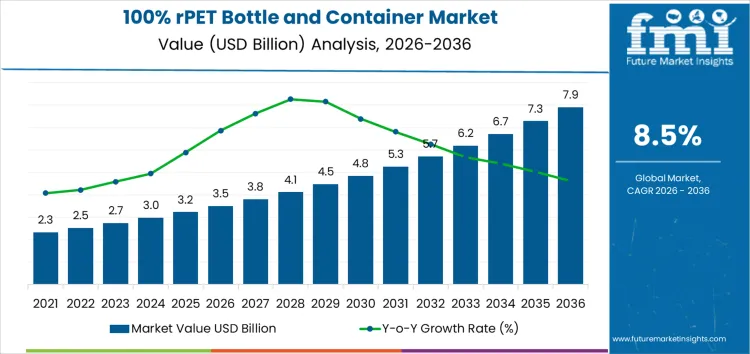
The 100% rPET bottle and container market is valued at USD 3.5 billion in 2026 and is projected to reach USD 7.9 billion by 2036, reflecting a CAGR of 8.5%. Market performance over this period is shaped by resin purity thresholds, collection efficiency, and reprocessing yield rather than packaging volume growth alone. Feedstock availability depends on deposit return systems, sorting accuracy, and contamination control at the municipal level. Producers with access to closed loop collection networks achieve more stable input quality and lower reprocessing loss. These structural factors influence production costs and determine which suppliers can meet consistent bottle grade specifications.
From 2026 to 2036, value concentration increasingly reflects qualification status with beverage and personal care brands. Buyers prioritize long term supply security, color consistency, and regulatory acceptance over short term pricing. Certification timelines and testing protocols create switching friction once supplier approval is secured. Firms investing in traceability systems and quality assurance retain stronger contract continuity. Tradeoffs emerge between capacity expansion and feedstock reliability, limiting aggressive scale strategies. Profitability favors operators aligning sourcing infrastructure with customer qualification cycles, enabling predictable output and steadier margins across demand cycles.
Quick Stats for 100% rPET Bottle and Container Market
- 100% rPET Bottle and Container Market Value (2026): USD 3.5 billion
- 100% rPET Bottle and Container Market Forecast Value (2036): USD 7.9 billion
- 100% rPET Bottle and Container Market Forecast CAGR (2026-2036): 8.5%
- Leading Type in 100% rPET Bottle and Container Market: Food-grade rPET
- Key Growth Regions in 100% rPET Bottle and Container Market: Asia Pacific, Europe, North America
- Top Players in 100% rPET Bottle and Container Market: Plastipak, ALPLA, Indorama Ventures, Manjushree, Braskem, Suntory Packaging, Amcor
What Is the Growth Forecast for 100% rPET Bottle and Container Market through 2036?
Pricing dynamics and resin availability set the tone for early growth in the 100% rPET bottle and container market between 2026 and 2031. During this period, the market expands from USD 3.5 billion to USD 4.6 billion, adding USD 1.1 billion in value. Annual progression reflects steady expansion from the 2026 base as food-grade rPET supply normalizes reflects gradual normalization of food grade rPET supply and improving collection and sorting efficiency. Historical growth was constrained by inconsistent feedstock quality and cost premiums over virgin PET. Forward expansion in this phase is supported by long term supply contracts, gradual standardization of bottle designs, and rising adoption in non-carbonated beverages and household packaging formats.
Material substitution intensity and downstream filling compatibility drive the second growth phase from 2031 to 2036. The market increases from USD 4.6 billion to USD 7.9 billion, adding USD 3.3 billion and representing the faster expansion window. Annual values rise from USD 4.9 billion to USD 7.9 billion, indicating stronger year over year compounding. Earlier growth relied on pilot scale transitions, while future demand reflects broader brand level commitments, improved performance parity with virgin PET, and higher utilization in personal care and food packaging. Growth increasingly comes from deeper penetration within existing applications rather than entirely new container categories.
100% rPET Bottle and Container Market Key Takeaways
| Metric | Value |
|---|---|
| Market Value (2026) | USD 3.5 billion |
| Forecast Value (2036) | USD 7.9 billion |
| Forecast CAGR (2026-2036) | 8.5% |
What Is Driving Growth in the 100% rPET Bottle and Container Market?
Growth in the 100% recycled polyethylene terephthalate (rPET) bottle and container market is rooted in performance expectations and material use mandates rather than simple recycling volume increases. Historically, recycled PET from bottles and containers was blended with virgin resin to mitigate quality variability, mechanical property loss, and clarity issues in the final product. Industry use of high-percentage rPET was constrained by concerns over colour uniformity, polymer degradation from thermal history, and potential regulatory limits for food contact applications. Early adoption of higher rPET formulations occurred mainly in non-food packaging and consumer goods where performance compromises were acceptable, limiting broad market penetration.
Future demand for 100% rPET bottles and containers is being driven by clear regulatory recycled content requirements, brand sustainability commitments, and advancements in material recovery and processing technologies. Governments in major markets are specifying minimum recycled content levels and extended producer responsibility frameworks that encourage closed-loop recycling at scale. Consumer goods companies are responding with procurement policies that mandate high-percentage rPET to meet corporate environmental goals and reduce reliance on virgin polymer. Improvements in collection infrastructure, enhanced bottle sorting, and advanced washing and reconditioning processes are producing feedstock with greater consistency and fewer contaminants.
What Factors Are Affecting the Demand for 100% rPET Bottle and Container Market in Terms of Material and Technology?
The 100% rPET bottle and container market is driven by packaging regulations, brand recycled content commitments, and demand for food-contact safety. Adoption depends on resin quality, regulatory approval, and consistency at scale. Market growth favors closed-loop systems that deliver virgin-equivalent performance while meeting compliance requirements. Investment prioritizes technologies that manage contamination risk and maintain intrinsic viscosity. Leadership reflects operational reliability and certification readiness rather than maximum recycled content claims alone across beverage, food, and household packaging supply chains globally today.
What Is Driving Leadership by Material in the 100% rPET Bottle and Container Market?
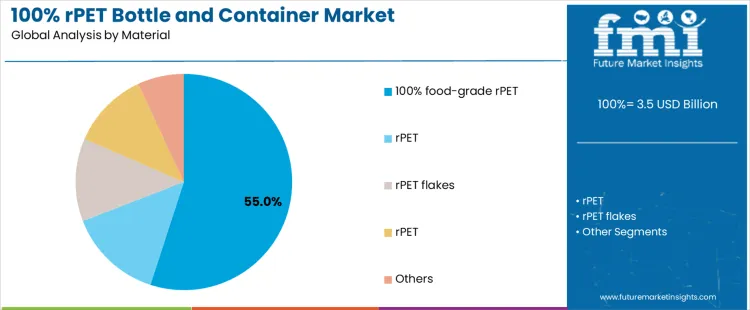
Food-grade rPET accounts for about 55% of demand because it meets stringent safety and performance requirements for bottles and containers. Beverage and food brands require materials approved for direct contact, consistent clarity, and stable mechanical properties. Food-grade rPET delivers predictable intrinsic viscosity and low contaminant levels, supporting carbonation resistance and shelf life. Regulatory approvals and customer specifications favor certified grades, concentrating demand. High-volume applications such as water, soft drinks, and household liquids reinforce scale advantages, enabling converters to secure long-term supply contracts and justify investment in dedicated purification and quality assurance systems for consistent global packaging operations and compliance continuity.
Non-food-grade rPET, flakes, and alternative grades support secondary packaging but do not displace certified material leadership. Flakes require additional processing to reach bottle quality, increasing cost and risk. Cost-efficient rPET grades serve non-carbonated containers, cleaning products, and household applications where regulatory thresholds differ. These segments absorb variable feedstock and provide outlets for broader recycling streams. However, converters and brand owners prioritize reliability and certification for flagship products. As a result, secondary materials complement supply chains, improve overall recovery economics, and stabilize feedstock demand without challenging the dominance of food-grade rPET in primary bottle markets across regulated consumer packaging segments globally.
What Is Driving Leadership by Technology in the 100% rPET Bottle and Container Market?
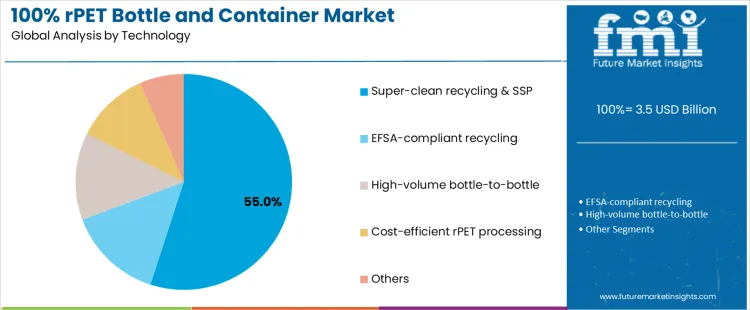
Super-clean recycling combined with solid-state polycondensation accounts for about 55% of technology demand because it restores polymer purity and intrinsic viscosity to food-contact standards. These processes remove contaminants, rebuild molecular weight, and deliver consistent pellet quality suitable for bottle-to-bottle recycling. Regulators and brand auditors recognize these systems, accelerating approvals and customer acceptance. High capital intensity is offset by long asset life and premium pricing. As beverage producers scale recycled content commitments, SSP-enabled lines become central to meeting volume, safety, and performance requirements reliably across multinational bottling networks and converters worldwide with audited compliance frameworks and consistent regulatory acceptance globally today.
EFSA-compliant recycling, high-volume bottle-to-bottle lines, and cost-efficient processing support broader market participation. EFSA-compliant routes enable regional approvals, while high-volume systems reduce unit costs through scale. Cost-efficient processing serves non-food containers and transitional programs. These technologies expand capacity, absorb mixed feedstock, and improve economics. However, without SSP or equivalent purification, output is limited to lower-risk uses. Consequently, these approaches complement super-clean systems by widening supply, balancing costs, and supporting incremental adoption without undermining the central role of premium recycling platforms for regulated beverage and household packaging markets worldwide today with long-term investment visibility and stable compliance economics across regions globally now.
How Is the 100% rPET Bottle and Container Market Being Applied Across Beverage and Consumer Goods Packaging?
Use appears in beverage, dairy, personal care, and household product packaging where full recycled content is mandated or preferred. Manufacturers adopt 100% rPET bottles and containers to meet sustainability targets, reduce carbon footprint, and comply with extended producer responsibility (EPR) regulations. Brand owners integrate these containers for water, soft drinks, juices, and condiments while maintaining clarity, barrier properties, and mechanical strength. These applications reflect operational and environmental priorities rather than purely aesthetic objectives, with adoption driven by recyclate utilization, regulatory compliance, and consumer demand for sustainable packaging.
What Operational and Material Conditions Support Adoption of 100% rPET Bottles and Containers?
Selection aligns with facilities capable of processing high-quality post-consumer PET feedstock with consistent melt flow, color, and low contaminant levels. Extrusion and injection molding processes are optimized to preserve clarity, tensile strength, and barrier properties while avoiding yellowing or haze. Quality control monitors intrinsic viscosity, contaminant levels, and dimensional consistency to meet packaging and food-contact standards. These conditions emerge from operational reliability, recyclate quality, and regulatory compliance priorities in structured production workflows.
Which Practical Considerations Limit Wider Use of 100% rPET Bottles and Containers?
Feedstock variability, residual contaminants, and inconsistent intrinsic viscosity can affect clarity, strength, and processability. Higher production costs compared with virgin PET may influence adoption in low-margin products. Compatibility with additives, labels, and closures must be validated to maintain performance. Regulatory approvals and food-contact certifications differ across regions. These factors lead to selective deployment where sustainability, recyclate utilization, and packaging performance justify incremental cost and operational adaptation.
What is the Demand for 100% rPET Bottles and Containers by Country?
| Country | CAGR (%) |
|---|---|
| USA | 7.8% |
| Germany | 7.2% |
| China | 10.5% |
| India | 11.8% |
| Brazil | 8.0% |
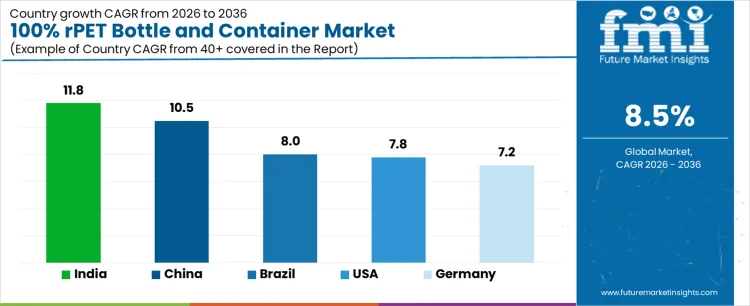
The demand for 100% rPET bottles and containers varies across countries, driven by sustainable packaging adoption, recycling initiatives, and regulatory support for recycled content. India leads with an 11.8% CAGR, supported by growing beverage and food packaging industries, rising consumer awareness, and government incentives for using recycled plastics. China follows at 10.5%, driven by large scale production of recycled PET, packaging modernization, and regulatory enforcement for circular economy practices. The USA grows at 7.8%, reflecting steady adoption in retail and industrial packaging. Brazil records 8.0%, shaped by sustainable packaging initiatives and organized retail expansion. Germany posts 7.2%, supported by mature recycling infrastructure and regulatory compliance.
How Is the 100% rPET Bottle and Container Market Expanding in the United States?
In the United States, the 100% rPET Bottle and Container Market is growing at a CAGR of 7.8% through 2036, driven by increasing demand for sustainable packaging in beverages, personal care, and food industries. Manufacturers are adopting fully recycled PET bottles and containers to meet corporate sustainability goals, reduce virgin plastic usage, and comply with state and federal recycling regulations. Demand is concentrated in beverage bottling plants, personal care product lines, and large-scale food packaging facilities. Compared to Germany, where regulatory compliance primarily drives adoption, the U.S. market emphasizes both environmental and operational efficiency. Recurring production and refill cycles sustain consistent adoption.
- Beverage bottling plants, food packaging, and personal care product lines drive adoption
- Fully recycled PET reduces virgin plastic usage and supports sustainability
- Domestic suppliers provide high-performance, recyclable rPET solutions
- Recurring production and refill cycles sustain consistent adoption
How Are Regulatory Standards Driving Growth in Germany?
In Germany, revenue is growing at a CAGR of 7.2% through 2036, supported by EU mandates on recycled content in packaging and stringent environmental regulations. Beverage producers, food packaging companies, and personal care manufacturers are integrating 100% rPET bottles and containers to ensure compliance, reduce carbon footprint, and meet recycling standards. Demand is concentrated in industrial packaging hubs, beverage production zones, and retail-focused bottling facilities. Compared to the U.S., adoption is more compliance-driven than operational-efficiency-focused. Domestic suppliers provide high-quality rPET solutions compatible with automated bottling and container production lines. Recurring production cycles and regulatory monitoring sustain steady adoption.
- Industrial packaging hubs, beverage zones, and retail bottling facilities drive adoption
- rPET bottles ensure compliance with recycled content mandates
- Domestic suppliers provide high-quality, production-compatible solutions
- Recurring production cycles sustain steady adoption
How Is Industrial and Beverage Production Driving Adoption in China?
In China, the market is expanding at a CAGR of 10.5% through 2036, fueled by rapid growth in beverage production, personal care packaging, and urban consumption. Manufacturers are adopting 100% rPET bottles and containers to meet sustainability initiatives, reduce virgin plastic consumption, and comply with local environmental regulations. Demand is concentrated in beverage bottling hubs, industrial packaging zones, and food processing plants. Domestic suppliers are scaling production of high-performance rPET solutions compatible with automated filling and packaging systems. Compared to Brazil, adoption focuses on large-scale industrial integration in urban manufacturing centers. Recurring production cycles sustain rapid adoption.
- Beverage bottling hubs, industrial packaging zones, and food plants drive adoption
- rPET bottles reduce virgin plastic use and meet sustainability targets
- Domestic suppliers scale high-performance, production-compatible solutions
- Recurring production cycles sustain rapid adoption
How Are Emerging Industrial Zones Driving Market Growth in India?
In India, revenue is growing at a CAGR of 11.8% through 2036, supported by expansion of industrial parks, beverage and personal care manufacturing, and e-commerce packaging facilities. Companies are adopting 100% rPET bottles and containers to reduce environmental impact, meet corporate ESG goals, and comply with emerging packaging regulations. Demand is concentrated in urban industrial clusters, beverage production facilities, and personal care manufacturing units. Domestic suppliers provide cost-effective, high-performance rPET solutions suitable for automated production lines. Compared to China, adoption in India is heavily influenced by new industrial zones and government incentives. Recurring production and refill cycles sustain robust adoption nationwide.
- Industrial clusters, beverage facilities, and personal care manufacturing units drive adoption
- rPET bottles reduce environmental impact and support ESG goals
- Domestic suppliers provide cost-effective, high-performance solutions
- Recurring production and refill cycles sustain robust adoption
How Are Regional Beverage and Industrial Hubs Supporting Growth in Brazil?
In Brazil, the market is growing at a CAGR of 8% through 2036, driven by adoption of 100% rPET bottles and containers in established beverage production centers, food processing plants, and industrial packaging hubs. Manufacturers are using rPET solutions to reduce virgin plastic usage, comply with environmental standards, and meet corporate sustainability initiatives. Demand is concentrated in chemical and beverage hubs, industrial zones, and urban packaging facilities. Domestic suppliers provide high-performance rPET solutions compatible with existing production lines. Compared to India, adoption is more focused on established hubs than emerging industrial zones. Recurring production cycles sustain steady adoption.
- Beverage hubs, industrial zones, and packaging facilities drive adoption
- rPET bottles reduce virgin plastic use and improve sustainability
- Domestic suppliers provide high-performance, production-compatible solutions
- Recurring production cycles sustain steady adoption
Which Strategic Approaches Define Competition in the 100% rPET Bottle and Container Market through Supply Security and Qualification Discipline?
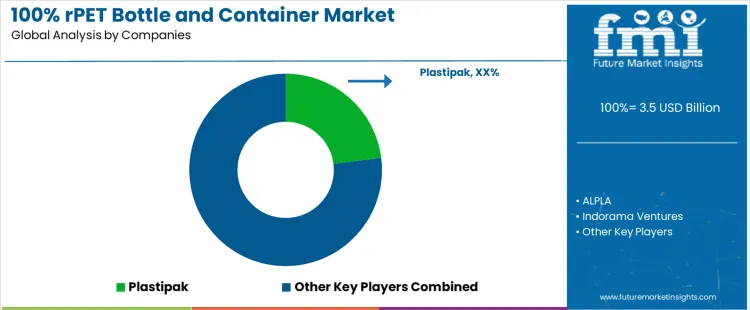
Competition in the 100% rPET bottle and container market is governed by access to consistent food grade rPET and the ability to hold tight quality windows at scale. Plastipak and ALPLA prioritize vertical integration and long term feedstock contracts to stabilize resin availability and color control. Indorama Ventures competes through upstream resin capability and recycling assets, using process control to deliver uniform IV and clarity across production lots. Brand owners favor suppliers that can sustain year round output without specification drift, making supply assurance and process repeatability more decisive than short term pricing. Qualification focuses on drop performance, stress cracking resistance, and migration behavior under real filling conditions.
Downstream execution and regional adaptation shape competitive outcomes. Manjushree emphasizes application level validation for personal care and household containers, where aesthetics and wall distribution are critical. Amcor positions 100% rPET within global packaging programs, aligning container design, lightweighting, and brand approvals across regions. Braskem and Suntory Packaging influence the market through resin and captive packaging strategies that prioritize circularity targets within defined portfolios. Competitive advantage is built through feedstock governance, disciplined qualification cycles, and the ability to manage visual and mechanical consistency at scale rather than by expanding recycled content claims alone.
Key Players in the 100% rPET Bottle and Container Market
- Plastipak
- ALPLA
- Indorama Ventures
- Manjushree
- Braskem
- Suntory Packaging
- Amcor
Scope of the Report
| Items | Values |
|---|---|
| Quantitative Units (2026) | USD billion |
| Type | Bottles, Containers |
| Application | Beverages and Water, Soft Drinks and Juices, FMCG Beverages, Packaged Water, Carbonated Drinks, Premium Beverages |
| End User | Beverage Producers, Food Packaging Companies, Personal Care Manufacturers, FMCG Brand Owners |
| Regions Covered | Asia Pacific, Europe, North America, Latin America, Middle East & Africa |
| Countries Covered | USA, Germany, China, India, Japan, South Korea, Brazil, United Kingdom, France, Italy, Canada, Mexico, ASEAN countries, GCC countries, and other global regions |
| Key Companies Profiled | Plastipak, ALPLA, Indorama Ventures, Manjushree, Braskem, Suntory Packaging, Amcor |
| Additional Attributes | Dollar sales by material and technology categories, regional adoption trends across Asia Pacific, Europe, and North America, competitive landscape across global and regional rPET bottle and container manufacturers, food contact certification and regulatory approval requirements, feedstock sourcing, traceability, and bottle to bottle recycling integration |
100% rPET Bottle and Container Market Segmentation
End-use:
- Beverages & water
- Soft drinks & juices
- FMCG beverages
- Packaged water
- Carbonated drinks
- Premium beverages
Material:
- 100% food-grade rPET
- rPET
- rPET flakes
- Others
Technology:
- Super-clean recycling & SSP
- EFSA-compliant recycling
- High-volume bottle-to-bottle
- Cost-efficient rPET processing
- Others
Region:
- Asia Pacific
- China
- Japan
- South Korea
- India
- Australia & New Zealand
- ASEAN
- Rest of Asia Pacific
- Europe
- Germany
- United Kingdom
- France
- Italy
- Spain
- Nordic
- BENELUX
- Rest of Europe
- North America
- United States
- Canada
- Mexico
- Latin America
- Brazil
- Chile
- Rest of Latin America
- Middle East & Africa
- Kingdom of Saudi Arabia
- Other GCC Countries
- Turkey
- South Africa
- Other African Union
- Rest of Middle East & Africa
Bibliography
- European Food Safety Authority. (2011). Scientific opinion on the criteria to be used for safety evaluation of a recycling process to produce recycled PET intended for food contact materials. EFSA Journal, 9(7), 2184.
- USA Food and Drug Administration. (2022). Guidance for industry: Use of recycled plastics in food packaging (Chemistry considerations). Center for Food Safety and Applied Nutrition.
Frequently Asked Questions
How big is the 100% rPET bottle and container market in 2026?
The global 100% rPET bottle and container market is estimated to be valued at USD 3.5 billion in 2026.
What will be the size of 100% rPET bottle and container market in 2036?
The market size for the 100% rPET bottle and container market is projected to reach USD 7.9 billion by 2036.
How much will be the 100% rPET bottle and container market growth between 2026 and 2036?
The 100% rPET bottle and container market is expected to grow at a 8.5% CAGR between 2026 and 2036.
What are the key end-use types in the 100% rPET bottle and container market?
The key end-use types in 100% rPET bottle and container market are beverages & water, soft drinks & juices, fmcg beverages, packaged water, carbonated drinks and premium beverages.
Which material segment to contribute significant share in the 100% rPET bottle and container market in 2026?
In terms of material, 100% food-grade rPET segment to command 55.0% share in the 100% rPET bottle and container market in 2026.
Preview the report firsthand - request a free sample
Get SampleGet the brochure for pricing and purchase details.
Get PDFTable of Content
- Executive Summary
- Global Market Outlook
- Demand-side Trends
- Supply-side Trends
- Technology Roadmap Analysis
- Analysis and Recommendations
- Market Overview
- Market Coverage / Taxonomy
- Market Definition / Scope / Limitations
- Market Background
- Market Dynamics
- Drivers
- Restraints
- Opportunity
- Trends
- Scenario Forecast
- Demand in Optimistic Scenario
- Demand in Likely Scenario
- Demand in Conservative Scenario
- Opportunity Map Analysis
- Product Life Cycle Analysis
- Supply Chain Analysis
- Investment Feasibility Matrix
- Value Chain Analysis
- PESTLE and Porter’s Analysis
- Regulatory Landscape
- Regional Parent Market Outlook
- Production and Consumption Statistics
- Import and Export Statistics
- Market Dynamics
- Global Market Analysis 2021 to 2025 and Forecast, 2026 to 2036
- Historical Market Size Value (USD Million) Analysis, 2021 to 2025
- Current and Future Market Size Value (USD Million) Projections, 2026 to 2036
- Y-o-Y Growth Trend Analysis
- Absolute $ Opportunity Analysis
- Global Market Pricing Analysis 2021 to 2025 and Forecast 2026 to 2036
- Global Market Analysis 2021 to 2025 and Forecast 2026 to 2036, By End-use
- Introduction / Key Findings
- Historical Market Size Value (USD Million) Analysis By End-use , 2021 to 2025
- Current and Future Market Size Value (USD Million) Analysis and Forecast By End-use , 2026 to 2036
- Beverages & water
- Soft drinks & juices
- FMCG beverages
- Packaged water
- Carbonated drinks
- Premium beverages
- Beverages & water
- Y-o-Y Growth Trend Analysis By End-use , 2021 to 2025
- Absolute $ Opportunity Analysis By End-use , 2026 to 2036
- Global Market Analysis 2021 to 2025 and Forecast 2026 to 2036, By Material
- Introduction / Key Findings
- Historical Market Size Value (USD Million) Analysis By Material, 2021 to 2025
- Current and Future Market Size Value (USD Million) Analysis and Forecast By Material, 2026 to 2036
- 100% food-grade rPET
- rPET
- rPET flakes
- rPET
- Others
- 100% food-grade rPET
- Y-o-Y Growth Trend Analysis By Material, 2021 to 2025
- Absolute $ Opportunity Analysis By Material, 2026 to 2036
- Global Market Analysis 2021 to 2025 and Forecast 2026 to 2036, By Technology
- Introduction / Key Findings
- Historical Market Size Value (USD Million) Analysis By Technology, 2021 to 2025
- Current and Future Market Size Value (USD Million) Analysis and Forecast By Technology, 2026 to 2036
- Super-clean recycling & SSP
- EFSA-compliant recycling
- High-volume bottle-to-bottle
- Cost-efficient rPET processing
- Others
- Super-clean recycling & SSP
- Y-o-Y Growth Trend Analysis By Technology, 2021 to 2025
- Absolute $ Opportunity Analysis By Technology, 2026 to 2036
- Global Market Analysis 2021 to 2025 and Forecast 2026 to 2036, By Region
- Introduction
- Historical Market Size Value (USD Million) Analysis By Region, 2021 to 2025
- Current Market Size Value (USD Million) Analysis and Forecast By Region, 2026 to 2036
- North America
- Latin America
- Western Europe
- Eastern Europe
- East Asia
- South Asia and Pacific
- Middle East & Africa
- Market Attractiveness Analysis By Region
- North America Market Analysis 2021 to 2025 and Forecast 2026 to 2036, By Country
- Historical Market Size Value (USD Million) Trend Analysis By Market Taxonomy, 2021 to 2025
- Market Size Value (USD Million) Forecast By Market Taxonomy, 2026 to 2036
- By Country
- USA
- Canada
- Mexico
- By End-use
- By Material
- By Technology
- By Country
- Market Attractiveness Analysis
- By Country
- By End-use
- By Material
- By Technology
- Key Takeaways
- Latin America Market Analysis 2021 to 2025 and Forecast 2026 to 2036, By Country
- Historical Market Size Value (USD Million) Trend Analysis By Market Taxonomy, 2021 to 2025
- Market Size Value (USD Million) Forecast By Market Taxonomy, 2026 to 2036
- By Country
- Brazil
- Chile
- Rest of Latin America
- By End-use
- By Material
- By Technology
- By Country
- Market Attractiveness Analysis
- By Country
- By End-use
- By Material
- By Technology
- Key Takeaways
- Western Europe Market Analysis 2021 to 2025 and Forecast 2026 to 2036, By Country
- Historical Market Size Value (USD Million) Trend Analysis By Market Taxonomy, 2021 to 2025
- Market Size Value (USD Million) Forecast By Market Taxonomy, 2026 to 2036
- By Country
- Germany
- UK
- Italy
- Spain
- France
- Nordic
- BENELUX
- Rest of Western Europe
- By End-use
- By Material
- By Technology
- By Country
- Market Attractiveness Analysis
- By Country
- By End-use
- By Material
- By Technology
- Key Takeaways
- Eastern Europe Market Analysis 2021 to 2025 and Forecast 2026 to 2036, By Country
- Historical Market Size Value (USD Million) Trend Analysis By Market Taxonomy, 2021 to 2025
- Market Size Value (USD Million) Forecast By Market Taxonomy, 2026 to 2036
- By Country
- Russia
- Poland
- Hungary
- Balkan & Baltic
- Rest of Eastern Europe
- By End-use
- By Material
- By Technology
- By Country
- Market Attractiveness Analysis
- By Country
- By End-use
- By Material
- By Technology
- Key Takeaways
- East Asia Market Analysis 2021 to 2025 and Forecast 2026 to 2036, By Country
- Historical Market Size Value (USD Million) Trend Analysis By Market Taxonomy, 2021 to 2025
- Market Size Value (USD Million) Forecast By Market Taxonomy, 2026 to 2036
- By Country
- China
- Japan
- South Korea
- By End-use
- By Material
- By Technology
- By Country
- Market Attractiveness Analysis
- By Country
- By End-use
- By Material
- By Technology
- Key Takeaways
- South Asia and Pacific Market Analysis 2021 to 2025 and Forecast 2026 to 2036, By Country
- Historical Market Size Value (USD Million) Trend Analysis By Market Taxonomy, 2021 to 2025
- Market Size Value (USD Million) Forecast By Market Taxonomy, 2026 to 2036
- By Country
- India
- ASEAN
- Australia & New Zealand
- Rest of South Asia and Pacific
- By End-use
- By Material
- By Technology
- By Country
- Market Attractiveness Analysis
- By Country
- By End-use
- By Material
- By Technology
- Key Takeaways
- Middle East & Africa Market Analysis 2021 to 2025 and Forecast 2026 to 2036, By Country
- Historical Market Size Value (USD Million) Trend Analysis By Market Taxonomy, 2021 to 2025
- Market Size Value (USD Million) Forecast By Market Taxonomy, 2026 to 2036
- By Country
- Kingdom of Saudi Arabia
- Other GCC Countries
- Turkiye
- South Africa
- Other African Union
- Rest of Middle East & Africa
- By End-use
- By Material
- By Technology
- By Country
- Market Attractiveness Analysis
- By Country
- By End-use
- By Material
- By Technology
- Key Takeaways
- Key Countries Market Analysis
- USA
- Pricing Analysis
- Market Share Analysis, 2025
- By End-use
- By Material
- By Technology
- Canada
- Pricing Analysis
- Market Share Analysis, 2025
- By End-use
- By Material
- By Technology
- Mexico
- Pricing Analysis
- Market Share Analysis, 2025
- By End-use
- By Material
- By Technology
- Brazil
- Pricing Analysis
- Market Share Analysis, 2025
- By End-use
- By Material
- By Technology
- Chile
- Pricing Analysis
- Market Share Analysis, 2025
- By End-use
- By Material
- By Technology
- Germany
- Pricing Analysis
- Market Share Analysis, 2025
- By End-use
- By Material
- By Technology
- UK
- Pricing Analysis
- Market Share Analysis, 2025
- By End-use
- By Material
- By Technology
- Italy
- Pricing Analysis
- Market Share Analysis, 2025
- By End-use
- By Material
- By Technology
- Spain
- Pricing Analysis
- Market Share Analysis, 2025
- By End-use
- By Material
- By Technology
- France
- Pricing Analysis
- Market Share Analysis, 2025
- By End-use
- By Material
- By Technology
- India
- Pricing Analysis
- Market Share Analysis, 2025
- By End-use
- By Material
- By Technology
- ASEAN
- Pricing Analysis
- Market Share Analysis, 2025
- By End-use
- By Material
- By Technology
- Australia & New Zealand
- Pricing Analysis
- Market Share Analysis, 2025
- By End-use
- By Material
- By Technology
- China
- Pricing Analysis
- Market Share Analysis, 2025
- By End-use
- By Material
- By Technology
- Japan
- Pricing Analysis
- Market Share Analysis, 2025
- By End-use
- By Material
- By Technology
- South Korea
- Pricing Analysis
- Market Share Analysis, 2025
- By End-use
- By Material
- By Technology
- Russia
- Pricing Analysis
- Market Share Analysis, 2025
- By End-use
- By Material
- By Technology
- Poland
- Pricing Analysis
- Market Share Analysis, 2025
- By End-use
- By Material
- By Technology
- Hungary
- Pricing Analysis
- Market Share Analysis, 2025
- By End-use
- By Material
- By Technology
- Kingdom of Saudi Arabia
- Pricing Analysis
- Market Share Analysis, 2025
- By End-use
- By Material
- By Technology
- Turkiye
- Pricing Analysis
- Market Share Analysis, 2025
- By End-use
- By Material
- By Technology
- South Africa
- Pricing Analysis
- Market Share Analysis, 2025
- By End-use
- By Material
- By Technology
- USA
- Market Structure Analysis
- Competition Dashboard
- Competition Benchmarking
- Market Share Analysis of Top Players
- By Regional
- By End-use
- By Material
- By Technology
- Competition Analysis
- Competition Deep Dive
- Plastipak
- Overview
- Product Portfolio
- Profitability by Market Segments (Product/Age /Sales Channel/Region)
- Sales Footprint
- Strategy Overview
- Marketing Strategy
- Product Strategy
- Channel Strategy
- ALPLA
- Indorama Ventures
- Manjushree
- Braskem
- Suntory Packaging
- Amcor
- Plastipak
- Competition Deep Dive
- Assumptions & Acronyms Used
- Research Methodology


