

- Industry Size (2026)
- USD 1.2 Bn
- Forecast (2036)
- USD 4.3 Bn
- CAGR (2026 to 2036)
- 12.90%
Refill-at-Home and Refill-in-Store Packaging Collection and Reuse Market Forecast and Outlook 2026 to 2036
Refill-at-home and refill-in-store packaging collection and reuse market is expected to grow from USD 1.2 billion in 2026 to USD 4.3 billion by 2036, reflecting a compound annual growth rate (CAGR) of 12.9%. As sustainability efforts intensify globally, refillable packaging systems are becoming increasingly popular across industries such as food and beverage, personal care, and household products. These systems, which allow consumers to refill packaging at home or in-store, are seen as key solutions to reduce single-use plastic waste and improve the circularity of packaging materials. With growing consumer awareness of environmental issues, both refill-at-home and refill-in-store options are gaining traction as they align with consumer preferences for sustainable, reusable solutions.
The market is also driven by regulatory pressures to reduce plastic waste, innovations in packaging technology that make refilling more convenient, and the establishment of infrastructure to support these systems. As businesses work to meet sustainability goals and reduce environmental footprints, the demand for refillable packaging systems will continue to rise over the next decade. By enabling consumers to reuse packaging, businesses can reduce costs, improve sustainability metrics, and meet growing consumer demand for eco-friendly solutions.
Quick Stats for Refill-at-Home and Refill-in-Store Packaging Collection and Reuse Market
- Refill-at-Home and Refill-in-Store Packaging Collection and Reuse Market Value (2026): USD 1.2 billion
- Refill-at-Home and Refill-in-Store Packaging Collection and Reuse Market Forecast Value (2036): USD 4.3 billion
- Refill-at-Home and Refill-in-Store Packaging Collection and Reuse Market Global Forecast CAGR (2026 to 2036): 12.90%
- Top Refill Format by Share in Refill-at-Home and Refill-in-Store Packaging Collection and Reuse Market: Refill-at-Home Solutions (41%)
- Key Growth Regions in Refill-at-Home and Refill-in-Store Packaging Collection and Reuse Market: India, China, Germany, UK, USA
- Top Players in Refill-at-Home and Refill-in-Store Packaging Collection and Reuse Market: Loop (by Terracycle), Unilever, Procter & Gamble (P&G), Seventh Generation, Algramo / FillGood
What is the Growth Forecast for the Refill-at-Home and Refill-in-Store Packaging Collection and Reuse Market through 2036?
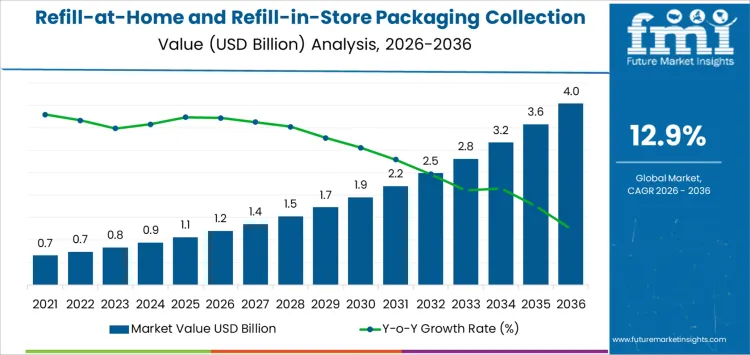
The acceleration and deceleration pattern for the refill-at-home and refill-in-store packaging collection and reuse market shows steady growth with noticeable acceleration in the middle of the forecast period. Starting at USD 1.2 billion in 2026, the market grows to USD 1.4 billion in 2027 and USD 1.6 billion in 2028, reflecting early-stage adoption of refillable packaging systems. The initial phase of growth is moderate, driven by increasing awareness and initial implementation of refill systems across select industries.
From 2028 to 2030, the market accelerates, with the value reaching USD 1.8 billion in 2029 and USD 2.0 billion in 2030. This acceleration is driven by increased consumer acceptance, technological innovations in packaging, and a growing network of refill stations both at home and in-store. The deceleration starts around 2031, with growth slowing slightly, reaching USD 2.2 billion in 2031 and USD 2.5 billion in 2032, as the market matures and adoption becomes more widespread.
By 2035, the market reaches USD 3.6 billion, and by 2036, it is projected to reach USD 4.3 billion. The final years of the forecast period show a gradual deceleration in the rate of growth as refillable packaging systems become more integrated and standard across multiple industries. Despite this deceleration, the overall growth is strong, indicating that refill-at-home and refill-in-store systems will continue to expand significantly, with increasing market maturity and infrastructure development supporting the widespread adoption of these sustainable packaging solutions.
Refill-at-Home and Refill-in-Store Packaging Collection and Reuse Market Key Takeaways
| Metric | Value |
|---|---|
| Industry Sales Value (2026) | USD 1.2 billion |
| Industry Forecast Value (2036) | USD 4.3 billion |
| Industry Forecast CAGR (2026 to 2036) | 12.9% |
What Is Driving the Demand for Refill at Home and Refill in Store Packaging Collection and Reuse Globally?
The global demand for refill at home and refill in store packaging collection and reuse systems is driven by growing concern over packaging waste and regulatory pressure to reduce single use plastics. Consumers, brands, and governments are increasingly focused on minimising environmental impact and improving circularity of materials. Refill at home and refill in store models enable households and shoppers to reuse containers for products such as detergents, personal care items, beverages, and dry goods, which reduces reliance on new packaging and limits waste generation. Retailers and manufacturers are adopting these systems to meet sustainability targets, respond to extended producer responsibility frameworks, and attract eco conscious consumers. Collection and reuse models rely on infrastructure that supports tracking, sanitisation, and redistribution of packaging, making efficient collection and reuse services essential. The return of used containers to retail or distribution points enhances material recovery and enables multiple use cycles, which aligns with circular economy strategies in regions such as Europe, North America, and Asia Pacific.
Future demand for refill packaging collection and reuse systems is expected to grow as refill models become more mainstream and policy frameworks continue to emphasise waste reduction and recycling. As refill at home and in store solutions expand, stakeholders will invest in collection logistics, sanitisation facilities, and tracking technologies that facilitate efficient reuse loops. Consumer preference for sustainable shopping options and digital tools that simplify returns and refills will also support adoption. Retail and brand partnerships that integrate refill programmes with loyalty and rewards systems may increase participation. The pace of market expansion will depend on the availability of shared infrastructure, ease of use for consumers, and demonstrated cost and environmental benefits relative to single use alternatives. As global focus on packaging waste intensifies and circular packaging becomes a competitive differentiator, demand for refill collection and reuse systems is expected to increase steadily across sectors that supply personal care, household, and food products.
What Are the Key Segments in Refill-at-Home and Refill-in-Store Packaging Collection and Reuse Market?
The refill-at-home and refill-in-store packaging collection and reuse market is segmented by refill format and product category. Refill-at-home solutions lead the refill format segment with 41% of the market share, providing consumers with the convenience of refilling products at home. Personal care & beauty products dominate the product category segment with 38%, driven by the increasing demand for sustainable packaging solutions in the beauty industry. The market is expanding as consumers and businesses seek eco-friendly alternatives to single-use plastic packaging.
Which Refill Format Drives Refill-at-Home and Refill-in-Store Packaging Collection and Reuse Market Demand Globally?
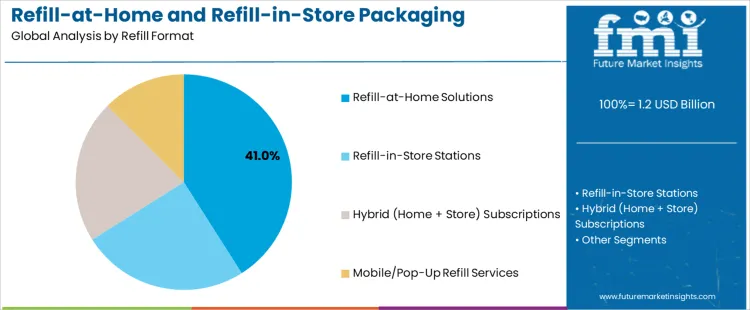
Refill-at-home solutions account for 41% of the market share. This format allows consumers to refill products in the comfort of their homes, reducing the need for single-use packaging and promoting sustainability. Refill-at-home systems are particularly popular for personal care and household products, where customers can purchase refill pouches or bulk containers and use them to refill their original packaging. The convenience of home-based refilling combined with the growing consumer awareness about plastic waste is driving demand for refill-at-home solutions. These solutions offer a simple and effective way for consumers to reduce their environmental impact while maintaining the performance and quality of their preferred products. The rise of subscription services that deliver refills directly to consumers' homes further supports the growth of this segment. As the focus on reducing plastic waste intensifies, refill-at-home solutions are becoming a key component of sustainable consumption practices.
Which Product Category Drives Refill-at-Home and Refill-in-Store Packaging Collection and Reuse Market Demand Globally?
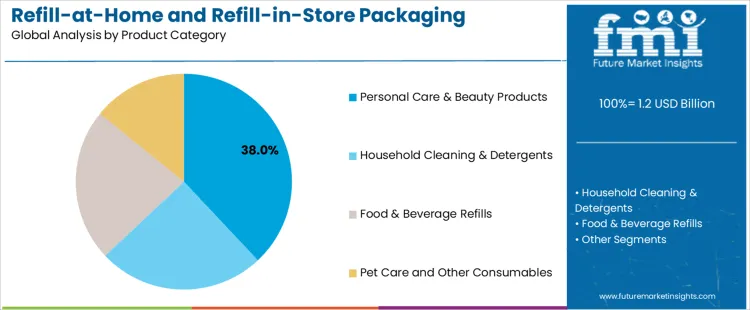
Personal care & beauty products lead the product category segment with 38% of the market share. This category includes products such as shampoo, conditioner, body wash, and skincare items, where the demand for sustainable packaging has been rapidly increasing. Personal care and beauty brands are increasingly offering refillable options to reduce the environmental impact of single-use packaging, responding to both consumer preferences for eco-friendly products and regulatory pressures to reduce plastic waste. Refill-at-home solutions in the personal care industry often include bulk refills or reusable containers, enabling customers to cut down on plastic waste while still enjoying their favorite beauty products. The trend toward sustainability is particularly strong in the beauty sector, where consumers are seeking clean, environmentally conscious brands. While household cleaning & detergents, food & beverage refills, and pet care and other consumables also contribute to the market, personal care and beauty products remain the dominant segment due to the high volume of product usage and the growing consumer demand for sustainable, refillable packaging options.
What are the Key Dynamics of the Global Refill at Home and Refill in Store Packaging Collection and Reuse Market?
The global refill at home and refill in store packaging collection and reuse market is expanding as retailers, brands and consumers seek ways to reduce single use packaging waste and enhance circularity. Refill systems enable products such as detergents, personal care, food and beverage essentials to be supplied in reusable containers that are refilled either at home or in store. Growth reflects rising environmental awareness, retailer sustainability commitments and development of infrastructure that supports collection, cleaning and reuse cycles. Adoption spans supermarkets, pharmacies and direct to consumer channels, driving evolution of packaging reuse models worldwide.
What are the Key Drivers for the Global Refill at Home and Refill in Store Packaging Collection and Reuse Market?
Key drivers include increasing consumer focus on waste reduction and demand for sustainable packaging options that cut environmental impact. Retailer and brand commitments to zero waste targets encourage implementation of refill stations and return programs that reduce reliance on new packaging. Advances in digital systems support tracking, return incentives and management of refill assets, improving user participation. Regulatory frameworks in many regions promote circular solutions and extended producer responsibility, motivating investment in reuse infrastructure. Growth of refill friendly product portfolios and partnerships between retailers, supply chain providers and reuse platforms help scale systems across diverse markets.
What are the Restraints for the Global Refill at Home and Refill in Store Packaging Collection and Reuse Market?
One restraint is the logistical complexity of establishing efficient collection, cleaning and redistribution networks that ensure product safety and usability. Costs associated with building and operating refill stations, cleaning facilities and reverse logistics systems can be significant, especially for smaller operators. Consumer habits and return behaviour influence system efficiency, as inconsistent participation can reduce asset utilisation. Standardising refill packaging formats across brands and product types is challenging when product dimensions and formulations vary. Infrastructure gaps in some regions limit reach and slow adoption where supportive services are not yet developed.
What is the Key Trends in the Global Refill at Home and Refill in Store Packaging Collection and Reuse Market?
A key trend is integration of digital engagement and incentive mechanisms that encourage consumer participation and track reuse flows. Technologies such as QR codes, mobile apps and digital wallets support deposit refunds, refill records and loyalty rewards, improving return rates. Collaboration among retailers, product brands and reuse technology providers is growing to create shared refill ecosystems that span multiple store formats and product categories. Standardised refill packaging designs and interoperable systems are emerging to simplify consumer experience and enable broader scalability. Data analytics is increasingly used to optimise refill network operations and improve forecasting of asset circulation needs across regions.
What is the Country-Wise Outlook for Refill-at-Home and Refill-in-Store Packaging Collection and Reuse?
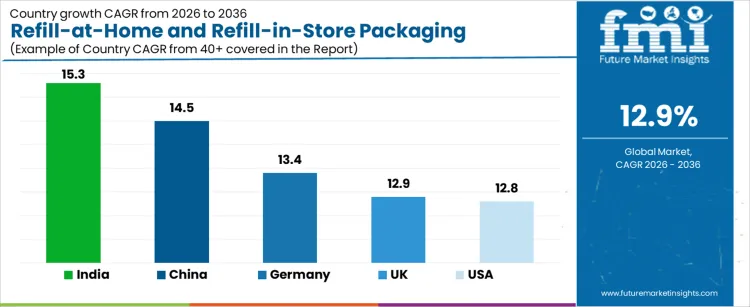
The Refill-at-Home and Refill-in-Store Packaging Collection and Reuse market is expanding rapidly due to growing consumer demand for more sustainable packaging solutions and the increasing emphasis on reducing plastic waste. Countries like India, China, and Germany are leading this growth, driven by the rising popularity of refillable packaging in sectors like personal care, household products, and beverages. Refill-at-home and refill-in-store systems allow consumers to reuse packaging, reducing the need for single-use plastics and promoting a circular economy. As environmental regulations tighten and sustainability becomes more central to consumer behavior, the market for these refillable packaging systems is expected to grow significantly across these regions.
| Country | CAGR (2026 to 2036) |
|---|---|
| India | 15.3% |
| China | 14.5% |
| Germany | 13.4% |
| UK | 12.9% |
| USA | 12.8% |
What is Driving the Growth of Refill-at-Home and Refill-in-Store Packaging Collection and Reuse in India?
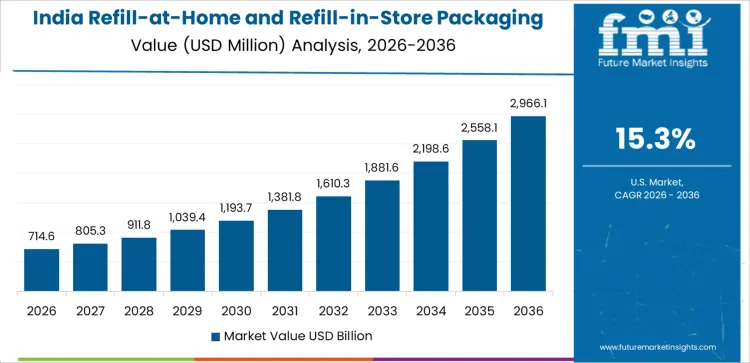
India’s Refill-at-Home and Refill-in-Store Packaging Collection and Reuse market is projected to grow at a CAGR of 15.3%. The rapid expansion of the retail and consumer goods sectors in India, along with increasing awareness about the environmental impact of single-use plastic packaging, is driving this growth. As consumers become more environmentally conscious and seek sustainable packaging options, the demand for refillable packaging solutions is increasing. Both refill-at-home and refill-in-store systems are gaining traction in India as cost-effective and eco-friendly alternatives to traditional packaging. Government regulations encouraging waste reduction and circular economy practices are further supporting the adoption of these systems, driving market growth.
What is Contributing to the Growth of Refill-at-Home and Refill-in-Store Packaging Collection and Reuse in China?
China’s Refill-at-Home and Refill-in-Store Packaging Collection and Reuse market is expected to grow at a CAGR of 14.5%. China’s rapidly expanding retail and e-commerce sectors, combined with increasing government support for sustainability, are key drivers of this market. As the demand for sustainable packaging grows, consumers and businesses alike are turning to refillable solutions that reduce waste and lower packaging costs. Refill-at-home and refill-in-store systems help reduce plastic waste and promote the reuse of packaging, aligning with China’s focus on environmental conservation. The government’s efforts to reduce plastic usage and promote eco-friendly alternatives are expected to continue driving the market’s growth in the coming years.
What is Driving the Refill-at-Home and Refill-in-Store Packaging Collection and Reuse Market Growth in Germany?
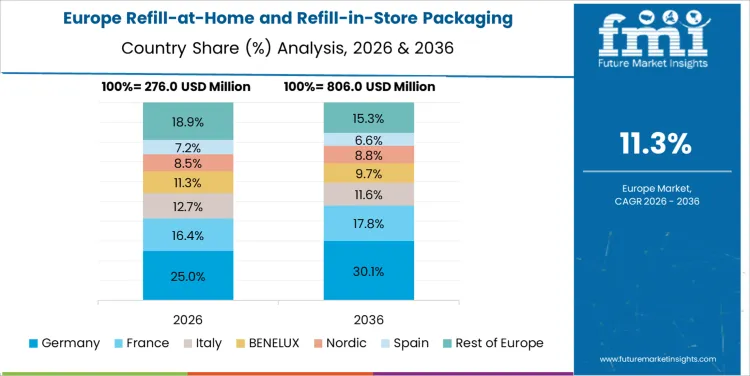
Germany’s Refill-at-Home and Refill-in-Store Packaging Collection and Reuse market is projected to grow at a CAGR of 13.4%. As one of the leading countries in environmental sustainability, Germany is heavily focused on reducing packaging waste and improving recycling systems. The increasing adoption of refillable packaging systems by both consumers and businesses is helping to drive this growth. Refill-at-home and refill-in-store solutions are becoming integral to the German retail and consumer goods sectors, where sustainability and circular economy practices are prioritized. With government regulations encouraging the reduction of single-use plastics and a strong consumer preference for environmentally responsible packaging, the market for these systems is expected to continue expanding.
What is Influencing the Growth of Refill-at-Home and Refill-in-Store Packaging Collection and Reuse in the UK?
The UK’s Refill-at-Home and Refill-in-Store Packaging Collection and Reuse market is expected to grow at a CAGR of 12.9%. The growing public awareness of the environmental impact of plastic waste, coupled with the UK’s commitment to reducing plastic packaging, is driving the adoption of refillable packaging systems. Consumers are increasingly seeking sustainable alternatives to traditional packaging, and refill-at-home and refill-in-store solutions offer an attractive option. Government initiatives aimed at reducing single-use plastics and promoting the circular economy are further contributing to the market’s growth. As sustainability becomes a higher priority for both consumers and businesses, the demand for refillable packaging solutions in the UK is set to rise.
What is Contributing to the Growth of Refill-at-Home and Refill-in-Store Packaging Collection and Reuse in the USA?
The USA’s Refill-at-Home and Refill-in-Store Packaging Collection and Reuse market is projected to grow at a CAGR of 12.8%. As sustainability becomes a major focus in the retail and consumer goods sectors, the demand for refillable packaging solutions is rising. Refill-at-home and refill-in-store systems allow consumers to reduce packaging waste while benefiting from cost-effective, eco-friendly alternatives. In the USA, the growing consumer shift toward sustainability, combined with government regulations encouraging waste reduction, is supporting the growth of this market. The increasing adoption of refillable packaging across various industries, including personal care, cleaning products, and beverages, is expected to contribute to the continued expansion of the market.
What is the Competitive Landscape for the Refill at Home and Refill in Store Packaging Collection and Reuse Market?
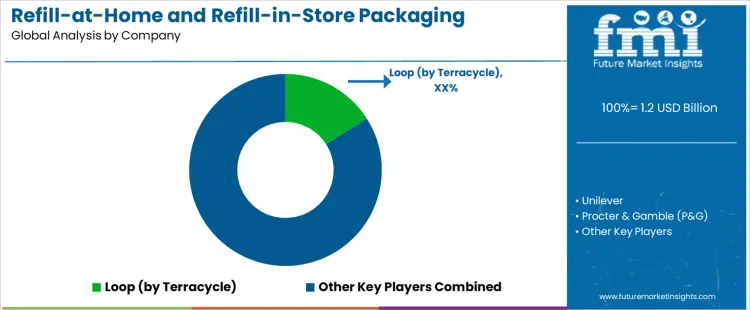
Global demand for refill at home and refill in store packaging collection and reuse solutions is expanding rapidly as consumers, retailers and brands embrace circular economy practices. Rising awareness of single use plastic waste and regulatory pressure on packaging waste drive interest in systems that keep packaging in circulation rather than discarding it after one use. Refill options for personal care, household products, groceries and cleaning supplies help reduce material use, lower costs over time and appeal to environmentally conscious buyers. Retailers benefit from higher customer engagement and reduced packaging costs, while consumers enjoy convenient refill formats that align with sustainability preferences. Growth in urban markets and adoption by major retail chains further support scaling of refill oriented models.
On the supply side, a set of global and innovative firms competes to lead this evolving segment. Loop (by TerraCycle) is recognised as a leading player with a platform that integrates branded refill systems with collection, cleaning and reuse logistics. Other notable competitors include major consumer goods manufacturers Unilever, Procter & Gamble (P&G) and Seventh Generation, which are incorporating refill formats into their product portfolios and partnering with retailers. Algramo / FillGood offers modular refill dispensers and digital payment systems that support consumer adoption. Competition among these providers focuses on ease of use, breadth of supported product categories, integration with retail systems, consumer incentives and tracking of reuse cycles. Firms that combine strong brand partnerships, seamless refill experience, robust collection and cleaning infrastructure and clear sustainability impact measurement are best positioned to capture growth as refill based business models expand in global markets.
Key Players of the Refill-at-Home and Refill-in-Store Packaging Collection and Reuse Market
- Loop (by Terracycle)
- Unilever
- Procter & Gamble (P&G)
- Seventh Generation
- Algramo / FillGood
Scope of the Report
| Items | Values |
|---|---|
| Quantitative Units (2026) | USD Billion |
| Refill Format | Refill-at-Home Solutions, Refill-in-Store Stations, Hybrid (Home + Store) Subscriptions, Mobile/Pop-Up Refill Services |
| Product Category | Personal Care & Beauty Products, Household Cleaning & Detergents, Food & Beverage Refills, Pet Care and Other Consumables |
| Companies | Loop (by Terracycle), Unilever, Procter & Gamble (P&G), Seventh Generation, Algramo / FillGood |
| Regions Covered | North America, Latin America, Western Europe, Eastern Europe, South Asia and Pacific, East Asia, Middle East & Africa |
| Countries Covered | United States, Canada, Mexico, Brazil, Argentina, Germany, France, United Kingdom, Italy, Spain, Netherlands, China, India, Japan, South Korea, ANZ, GCC Countries, South Africa |
| Additional Attributes | Dollar by sales by refill format, product category, and region. Includes market trends in refill-at-home and refill-in-store packaging collection and reuse, performance in personal care, household, food, and beverage refills, cost-effectiveness, sustainability practices, regulatory compliance, market share and competitive positioning of key companies, and the role of refill systems in reducing plastic waste, promoting sustainability, and enhancing consumer engagement in the circular economy. |
Key Segments in the Refill-at-Home and Refill-in-Store Packaging Collection and Reuse Market
By Refill Format:
- Refill at Home Solutions
- Refill in Store Stations
- Hybrid (Home + Store) Subscriptions
- Mobile/Pop Up Refill Services
By Product Category:
- Personal Care & Beauty Products
- Household Cleaning & Detergents
- Food & Beverage Refills
- Pet Care and Other Consumables
By Region:
- Asia Pacific
- China
- India
- Japan
- South Korea
- ASEAN
- Rest of Asia Pacific
- Europe
- Germany
- United Kingdom
- France
- Italy
- Spain
- Nordic
- BENELUX
- Rest of Europe
- North America
- United States
- Canada
- Mexico
- Latin America
- Brazil
- Chile
- Rest of Latin America
- Middle East & Africa
- Kingdom of Saudi Arabia
- Other GCC Countries
- Turkey
- South Africa
- Other African Union
- Rest of Middle East & Africa
Frequently Asked Questions
How big is the refill-at-home and refill-in-store packaging collection and reuse market in 2026?
The global refill-at-home and refill-in-store packaging collection and reuse market is estimated to be valued at USD 1.2 billion in 2026.
What will be the size of refill-at-home and refill-in-store packaging collection and reuse market in 2036?
The market size for the refill-at-home and refill-in-store packaging collection and reuse market is projected to reach USD 4.0 billion by 2036.
How much will be the refill-at-home and refill-in-store packaging collection and reuse market growth between 2026 and 2036?
The refill-at-home and refill-in-store packaging collection and reuse market is expected to grow at a 12.9% CAGR between 2026 and 2036.
What are the key product types in the refill-at-home and refill-in-store packaging collection and reuse market?
The key product types in refill-at-home and refill-in-store packaging collection and reuse market are refill‑at‑home solutions, refill‑in‑store stations, hybrid (home + store) subscriptions and mobile/pop‑up refill services.
Which product category segment to contribute significant share in the refill-at-home and refill-in-store packaging collection and reuse market in 2026?
In terms of product category, personal care & beauty products segment to command 38.0% share in the refill-at-home and refill-in-store packaging collection and reuse market in 2026.
Preview the report firsthand - request a free sample
Get SampleGet the brochure for pricing and purchase details.
Get PDFTable of Content
- Executive Summary
- Global Market Outlook
- Demand-side Trends
- Supply-side Trends
- Technology Roadmap Analysis
- Analysis and Recommendations
- Market Overview
- Market Coverage / Taxonomy
- Market Definition / Scope / Limitations
- Market Background
- Market Dynamics
- Drivers
- Restraints
- Opportunity
- Trends
- Scenario Forecast
- Demand in Optimistic Scenario
- Demand in Likely Scenario
- Demand in Conservative Scenario
- Opportunity Map Analysis
- Product Life Cycle Analysis
- Supply Chain Analysis
- Investment Feasibility Matrix
- Value Chain Analysis
- PESTLE and Porter’s Analysis
- Regulatory Landscape
- Regional Parent Market Outlook
- Production and Consumption Statistics
- Import and Export Statistics
- Market Dynamics
- Global Market Analysis 2021 to 2025 and Forecast, 2026 to 2036
- Historical Market Size Value (USD Million) Analysis, 2021 to 2025
- Current and Future Market Size Value (USD Million) Projections, 2026 to 2036
- Y-o-Y Growth Trend Analysis
- Absolute $ Opportunity Analysis
- Global Market Pricing Analysis 2021 to 2025 and Forecast 2026 to 2036
- Global Market Analysis 2021 to 2025 and Forecast 2026 to 2036, By Refill Format
- Introduction / Key Findings
- Historical Market Size Value (USD Million) Analysis By Refill Format , 2021 to 2025
- Current and Future Market Size Value (USD Million) Analysis and Forecast By Refill Format , 2026 to 2036
- Refill‑at‑Home Solutions
- Refill‑in‑Store Stations
- Hybrid (Home + Store) Subscriptions
- Mobile/Pop‑Up Refill Services
- Y-o-Y Growth Trend Analysis By Refill Format , 2021 to 2025
- Absolute $ Opportunity Analysis By Refill Format , 2026 to 2036
- Global Market Analysis 2021 to 2025 and Forecast 2026 to 2036, By Product Category
- Introduction / Key Findings
- Historical Market Size Value (USD Million) Analysis By Product Category, 2021 to 2025
- Current and Future Market Size Value (USD Million) Analysis and Forecast By Product Category, 2026 to 2036
- Personal Care & Beauty Products
- Household Cleaning & Detergents
- Food & Beverage Refills
- Pet Care and Other Consumables
- Y-o-Y Growth Trend Analysis By Product Category, 2021 to 2025
- Absolute $ Opportunity Analysis By Product Category, 2026 to 2036
- Global Market Analysis 2021 to 2025 and Forecast 2026 to 2036, By Region
- Introduction
- Historical Market Size Value (USD Million) Analysis By Region, 2021 to 2025
- Current Market Size Value (USD Million) Analysis and Forecast By Region, 2026 to 2036
- North America
- Latin America
- Western Europe
- Eastern Europe
- East Asia
- South Asia and Pacific
- Middle East & Africa
- Market Attractiveness Analysis By Region
- North America Market Analysis 2021 to 2025 and Forecast 2026 to 2036, By Country
- Historical Market Size Value (USD Million) Trend Analysis By Market Taxonomy, 2021 to 2025
- Market Size Value (USD Million) Forecast By Market Taxonomy, 2026 to 2036
- By Country
- USA
- Canada
- Mexico
- By Refill Format
- By Product Category
- By Country
- Market Attractiveness Analysis
- By Country
- By Refill Format
- By Product Category
- Key Takeaways
- Latin America Market Analysis 2021 to 2025 and Forecast 2026 to 2036, By Country
- Historical Market Size Value (USD Million) Trend Analysis By Market Taxonomy, 2021 to 2025
- Market Size Value (USD Million) Forecast By Market Taxonomy, 2026 to 2036
- By Country
- Brazil
- Chile
- Rest of Latin America
- By Refill Format
- By Product Category
- By Country
- Market Attractiveness Analysis
- By Country
- By Refill Format
- By Product Category
- Key Takeaways
- Western Europe Market Analysis 2021 to 2025 and Forecast 2026 to 2036, By Country
- Historical Market Size Value (USD Million) Trend Analysis By Market Taxonomy, 2021 to 2025
- Market Size Value (USD Million) Forecast By Market Taxonomy, 2026 to 2036
- By Country
- Germany
- UK
- Italy
- Spain
- France
- Nordic
- BENELUX
- Rest of Western Europe
- By Refill Format
- By Product Category
- By Country
- Market Attractiveness Analysis
- By Country
- By Refill Format
- By Product Category
- Key Takeaways
- Eastern Europe Market Analysis 2021 to 2025 and Forecast 2026 to 2036, By Country
- Historical Market Size Value (USD Million) Trend Analysis By Market Taxonomy, 2021 to 2025
- Market Size Value (USD Million) Forecast By Market Taxonomy, 2026 to 2036
- By Country
- Russia
- Poland
- Hungary
- Balkan & Baltic
- Rest of Eastern Europe
- By Refill Format
- By Product Category
- By Country
- Market Attractiveness Analysis
- By Country
- By Refill Format
- By Product Category
- Key Takeaways
- East Asia Market Analysis 2021 to 2025 and Forecast 2026 to 2036, By Country
- Historical Market Size Value (USD Million) Trend Analysis By Market Taxonomy, 2021 to 2025
- Market Size Value (USD Million) Forecast By Market Taxonomy, 2026 to 2036
- By Country
- China
- Japan
- South Korea
- By Refill Format
- By Product Category
- By Country
- Market Attractiveness Analysis
- By Country
- By Refill Format
- By Product Category
- Key Takeaways
- South Asia and Pacific Market Analysis 2021 to 2025 and Forecast 2026 to 2036, By Country
- Historical Market Size Value (USD Million) Trend Analysis By Market Taxonomy, 2021 to 2025
- Market Size Value (USD Million) Forecast By Market Taxonomy, 2026 to 2036
- By Country
- India
- ASEAN
- Australia & New Zealand
- Rest of South Asia and Pacific
- By Refill Format
- By Product Category
- By Country
- Market Attractiveness Analysis
- By Country
- By Refill Format
- By Product Category
- Key Takeaways
- Middle East & Africa Market Analysis 2021 to 2025 and Forecast 2026 to 2036, By Country
- Historical Market Size Value (USD Million) Trend Analysis By Market Taxonomy, 2021 to 2025
- Market Size Value (USD Million) Forecast By Market Taxonomy, 2026 to 2036
- By Country
- Kingdom of Saudi Arabia
- Other GCC Countries
- Turkiye
- South Africa
- Other African Union
- Rest of Middle East & Africa
- By Refill Format
- By Product Category
- By Country
- Market Attractiveness Analysis
- By Country
- By Refill Format
- By Product Category
- Key Takeaways
- Key Countries Market Analysis
- USA
- Pricing Analysis
- Market Share Analysis, 2025
- By Refill Format
- By Product Category
- Canada
- Pricing Analysis
- Market Share Analysis, 2025
- By Refill Format
- By Product Category
- Mexico
- Pricing Analysis
- Market Share Analysis, 2025
- By Refill Format
- By Product Category
- Brazil
- Pricing Analysis
- Market Share Analysis, 2025
- By Refill Format
- By Product Category
- Chile
- Pricing Analysis
- Market Share Analysis, 2025
- By Refill Format
- By Product Category
- Germany
- Pricing Analysis
- Market Share Analysis, 2025
- By Refill Format
- By Product Category
- UK
- Pricing Analysis
- Market Share Analysis, 2025
- By Refill Format
- By Product Category
- Italy
- Pricing Analysis
- Market Share Analysis, 2025
- By Refill Format
- By Product Category
- Spain
- Pricing Analysis
- Market Share Analysis, 2025
- By Refill Format
- By Product Category
- France
- Pricing Analysis
- Market Share Analysis, 2025
- By Refill Format
- By Product Category
- India
- Pricing Analysis
- Market Share Analysis, 2025
- By Refill Format
- By Product Category
- ASEAN
- Pricing Analysis
- Market Share Analysis, 2025
- By Refill Format
- By Product Category
- Australia & New Zealand
- Pricing Analysis
- Market Share Analysis, 2025
- By Refill Format
- By Product Category
- China
- Pricing Analysis
- Market Share Analysis, 2025
- By Refill Format
- By Product Category
- Japan
- Pricing Analysis
- Market Share Analysis, 2025
- By Refill Format
- By Product Category
- South Korea
- Pricing Analysis
- Market Share Analysis, 2025
- By Refill Format
- By Product Category
- Russia
- Pricing Analysis
- Market Share Analysis, 2025
- By Refill Format
- By Product Category
- Poland
- Pricing Analysis
- Market Share Analysis, 2025
- By Refill Format
- By Product Category
- Hungary
- Pricing Analysis
- Market Share Analysis, 2025
- By Refill Format
- By Product Category
- Kingdom of Saudi Arabia
- Pricing Analysis
- Market Share Analysis, 2025
- By Refill Format
- By Product Category
- Turkiye
- Pricing Analysis
- Market Share Analysis, 2025
- By Refill Format
- By Product Category
- South Africa
- Pricing Analysis
- Market Share Analysis, 2025
- By Refill Format
- By Product Category
- USA
- Market Structure Analysis
- Competition Dashboard
- Competition Benchmarking
- Market Share Analysis of Top Players
- By Regional
- By Refill Format
- By Product Category
- Competition Analysis
- Competition Deep Dive
- Loop (by Terracycle)
- Overview
- Product Portfolio
- Profitability by Market Segments (Product/Age /Sales Channel/Region)
- Sales Footprint
- Strategy Overview
- Marketing Strategy
- Product Strategy
- Channel Strategy
- Unilever
- Procter & Gamble (P&G)
- Seventh Generation
- Algramo / FillGood
- Loop (by Terracycle)
- Competition Deep Dive
- Assumptions & Acronyms Used
- Research Methodology


