

- Industry Size (2026)
- USD 18.6 Bn
- Forecast (2036)
- USD 32.3 Bn
- CAGR (2026 to 2036)
- 5.6%
Foaming Cleansers and Body Washes Market Forecast and Outlook 2026 to 2036
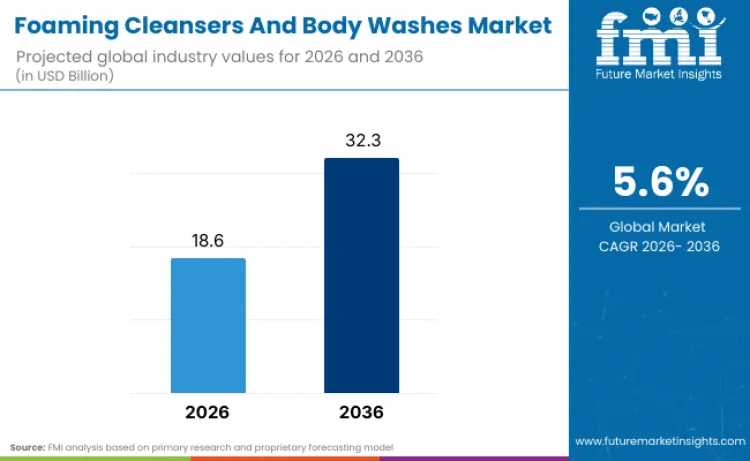
The Foaming Cleansers and Body Washes market is projected to expand from USD 18.6 Billion in 2026 to USD 32.3 Billion by 2036, at a 5.6% CAGR. Growth is being reinforced by scaled personal care portfolios treating skin cleansing as a repeatable, high-volume lane supported by science-backed renovation and stepped-up marketing. Unilever reported that Personal Care grew in 2024 and explicitly cites Skin Cleansing delivering volume growth in the fourth quarter, signalling continued capital and commercial attention on wash categories.
Large multinationals are also using digital channels to widen replenishment frequency and reduce dependence on single retail formats. L’Oréal reports that 28.2% of consolidated sales were in e-commerce in 2024, showing how major beauty groups are scaling daily-use categories through owned sites, pure players, and retailer websites. P&G adds a direct signal on channel mix: ‘E-commerce sales increased 9%, now representing 18% of the Company total,’ which matters for cleansing where repeat purchase and bundle economics are increasingly orchestrated online.
In India, local scale brands are communicating active renovation and body wash growth as operational priorities. Hindustan Unilever highlights that bodywash grew competitively in double-digit terms and cites formula enhancement work in its skin cleansing portfolio, indicating continued renovation cycles in mass cleansing platforms.
Summary of the Foaming Cleansers And Body Washes Market
What is the Foaming Cleansers And Body Washes Market size in 2026 and 2036 as per FMI projection?
It is projected to be USD 18.6 Billion in 2026 and USD 32.3 Billion by 2036, expanding at a 5.6% CAGR.
FMI Research Approach: Forecast anchored in cleansing routine frequency, channel throughput, and regulatory compliance load in cosmetics.
Which product type leads demand in 2026 and what structurally supports it?
Foaming facial cleansers lead with a 34.7% share in 2026, supported by daily-use regimen intensity and the ability of large operators to renovate formulas while holding price ladders.
FMI Research Approach: Segment share mapped to routine frequency, brand portfolio weighting, and retail conversion mechanics.
Which skin type segment is largest in 2026 and what does that imply for formulation strategy?
Normal skin leads with a 28.9% share in 2026, reflecting mass-market formulation and broad shelf throughput where balanced cleansing claims scale most efficiently.
FMI Research Approach: Skin-type split sized using mainstream product architectures and retail mix.
Which distribution channel is largest in 2026 and why does it retain control of volume?
Supermarkets and hypermarkets lead with a 36.2% share in 2026 because they remain the primary replenishment lane for body wash and mass facial cleansing across organised retail.
FMI Research Approach: Channel sizing aligned to store throughput, basket economics, and FMCG replenishment cadence.
Which end user dominates in 2026?
Women lead with a 54.6% share in 2026, reflecting higher routine intensity and multi-step skincare adoption that amplifies facial cleansing volumes.
FMI Research Approach: End-user split modelled through penetration and regimen intensity across wash categories.
Foaming Cleansers And Body Washes Market Key Takeaways
| Items | Values |
|---|---|
| Market Size (2026) | USD 18.6 Billion |
| Forecast Value (2036) | USD 32.3 Billion |
| CAGR (2026 to 2036) | 5.6% |
Source: FMI’s proprietary forecasting model and primary research
What is Driving Demand for Foaming Cleansers and Body Washes?
Demand is being driven by scaled personal care operators treating skin cleansing as a volume growth platform and investing in repeated renovation cycles that protect routine adherence and shelf conversion. Unilever’s full-year reporting highlights Personal Care growth and specifies Skin Cleansing delivering volume growth in Q4 2024, indicating that large portfolios are actively pushing cleansing, not merely maintaining it. Channel expansion is tightening the loop between routine categories and digital replenishment systems. In parallel, regulatory governance is raising the cost of weak compliance and pushing procurement toward credible, documented suppliers. The EU cosmetics framework sets harmonised obligations to ensure a high level of protection of human health, which amplifies compliance discipline in rinse-off formulations sold at scale.
How is the Foaming Cleansers and Body Washes Market Segmented?
The market for foaming cleansers and body washes is segmented into Product Type (foaming facial cleansers, foaming body washes, medicated foaming cleansers positioned as cosmetics, and organic and natural foaming cleansers), Skin Type (normal skin, dry skin, oily skin, sensitive skin, and combination skin), Distribution Channel (supermarkets and hypermarkets, specialty stores, pharmacies and drug stores, and online retail), and End User (women, men, and unisex consumers). This segmentation reflects how cleansing demand is structured around high-frequency daily routines, broad skin-tolerance formulation architectures, and mass retail throughput supported by expanding digital replenishment lanes. Product type segmentation captures the distinction between face-led routine cleansing and body wash volume, skin-type segmentation reflects mainstream formulation scalability versus targeted adjacencies, channel segmentation mirrors the dominance of organised retail alongside growing online repeat purchase, and end-user segmentation highlights routine intensity differences that drive volume concentration.
Why do Foaming Facial Cleansers Hold the Largest Product-Type Share in 2026?
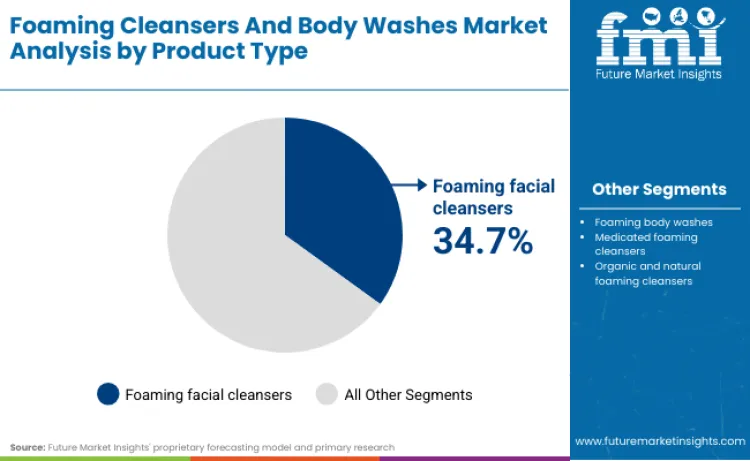
Foaming facial cleansers lead with a 34.7% share in 2026 because the category sits inside daily skincare routines where regimen adherence and repeat purchase are structurally higher than body-only cleansing. The competitive signal is consistent investment by large beauty groups in digital and innovation infrastructure that allows routine categories to scale without relying solely on physical retail. L’Oréal reports that 28.2% of consolidated sales were in e-commerce in 2024, demonstrating that major players are building demand engines that keep facial cleansing replenishment visible and convenient through online conversion. Large consumer groups also signal that cleansing is treated as an operational growth lever. Unilever reports Skin Cleansing delivering volume growth in Q4 2024 within Personal Care, indicating that major portfolios are actively driving the cleansing lane with marketing and innovation support. This combination makes facial foaming cleansers the most structurally advantaged product type, daily routine intensity translates into predictable throughput, and scaled omnichannel execution keeps conversion high across premium and mass price tiers.
What Keeps Normal Skin as the Largest Skin-Type Segment in 2026?
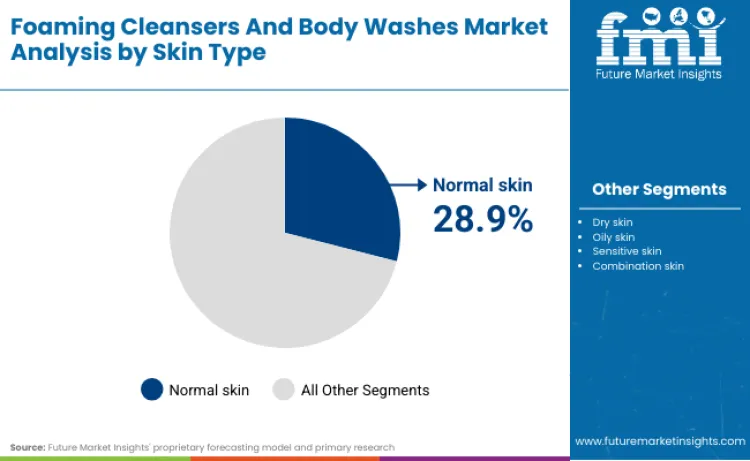
Normal skin leads with a 28.9% share in 2026 because mass cleansing portfolios are built around broadly tolerated surfactant systems and simple claims that scale across retailers and geographies with minimal friction. Governance reinforces this behaviour. The EU cosmetics regulation is designed to harmonise rules while ensuring a high level of protection of human health, which increases the value of mainstream, well-understood formulation choices for high-volume rinse-off products. In the United States, FDA’s MoCRA-linked guidance on facility registration and product listing adds operational discipline to cosmetics supply chains, raising the advantage of large-scale, documented manufacturing systems that can repeatedly deliver compliant products. Under these constraints, companies tend to prioritise formulations that can serve the largest consumer pool with minimal irritation risk and stable sensory performance. Normal-skin positioning is the most scalable outcome of that logic, supporting its lead share while specialty skin types become innovation adjacencies rather than the primary volume centre.
How Is Omnichannel Replenishment Reshaping Cleansing Category Execution?
Industry evolution in the foaming cleansers and body washes market is being shaped by the industrialisation of omnichannel replenishment, where growth is no longer driven by seasonal promotion but by repeat purchase systems that integrate store throughput with digital checkout. Large FMCG operators are embedding cleansing into online demand capture through subscriptions, bundled baskets, and routine-based merchandising while maintaining mass retail scale. Procter & Gamble’s disclosure that e-commerce now represents 18% of total company sales illustrates how everyday rinse-off categories are being actively designed for online repeat conversion rather than treated as store-only staples. This shift is pushing operators to prioritise formats, pack sizes, and pricing ladders that work consistently across physical shelves and digital carts, reinforcing cleansing as a structurally repeatable volume engine.
Why Is Compliance and Documentation Load Reshaping Product Launch and Portfolio Strategy?
Rising compliance and documentation requirements represent a core restraint shaping the foaming cleansers and body washes market by increasing friction across product launches, claims refresh cycles, and supplier onboarding. FDA guidance on registration and listing under MoCRA clearly defines who must submit, what information is required, and when submissions must occur, transforming compliance into an ongoing operational system rather than a one-time hurdle. In Europe, the harmonised cosmetics framework strengthens in-market control to ensure protection of human health, reducing tolerance for weak documentation and inconsistent quality at scale. These governance dynamics push portfolios toward fewer, well-documented SKUs and favour operators with established regulatory infrastructure, while slowing experimentation and rapid renovation for smaller or under-resourced brands.
How Are Execution Discipline and Scale Becoming Competitive Filters in Rinse-Off Categories?
The interaction between omnichannel replenishment and escalating compliance expectations is elevating execution discipline as a primary competitive filter in foaming cleansers and body washes. As documentation, traceability, and submission accuracy become non-negotiable, brands are concentrating innovation around scalable formulations and repeatable surfactant systems that can be defended across regions without frequent reformulation. This reduces tolerance for novelty-driven launches and prioritises products that deliver stable sensory performance, broad skin tolerance, and predictable supply. Market growth is therefore increasingly captured by operators that can align digital conversion performance with compliance readiness, enabling sustained expansion through disciplined portfolio management rather than broad assortment proliferation.
How Will Foaming Cleansers and Body Washes Market Expansion Unfold Across Key Global Regions?
Future Market Insights identifies China (CAGR 7.6%), India (7.1%), Germany (6.5%), Brazil (5.9%), United States (5.4%), United Kingdom (4.8%), and Japan (4.2%) as the core regional growth drivers shaping the global foaming cleansers and body washes market through 2036. China leads expansion through formalised cosmetics registration and filing discipline under NMPA oversight, which favours large, compliant portfolios capable of scaling high-volume rinse-off products nationally. India’s growth is supported by rising organised retail penetration and explicit cosmetics import registration requirements that strengthen supply consistency and consumer trust, while local majors continue to invest in formula renovation and body wash expansion.
The United States benefits from stable replenishment demand anchored in daily-use routines, with MoCRA-linked registration and listing requirements professionalising cosmetics supply chains and supporting predictable category availability. Germany’s growth reflects the EU-wide cosmetics compliance baseline, which reinforces retailer preference for well-documented, high-throughput cleansing products and sustains steady expansion in a mature market. Brazil’s demand is shaped by ANVISA’s structured regularisation framework, which accelerates formalisation and supports growth by compliant manufacturers and importers. The United Kingdom shows moderate but resilient growth as post-Brexit notification requirements stabilise market participation, while Japan’s expansion remains steady but constrained by market maturity and conservative cosmetics standards that prioritise compliance and quality over rapid volume acceleration. Collectively, these regions combine routine-led consumption with governance-driven market access, creating structurally durable growth for foaming cleansers and body washes through 2036.
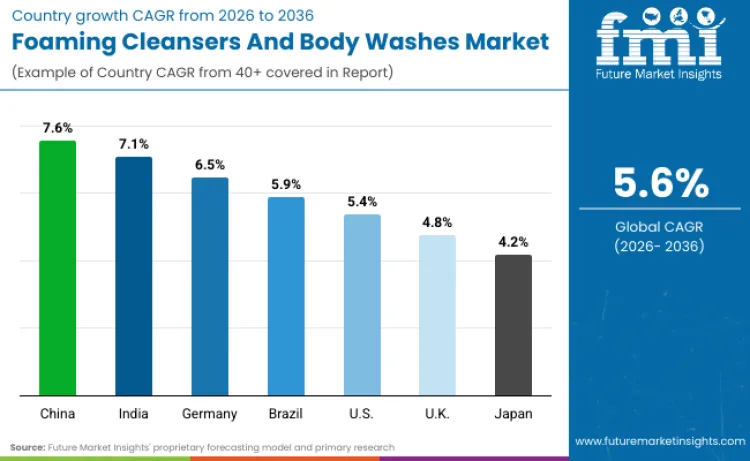
| Country | CAGR (2026 to 2036) |
|---|---|
| China | 7.6% |
| India | 7.1% |
| Germany | 6.5% |
| Brazil | 5.9% |
| USA | 5.4% |
| UK | 4.8% |
| Japan | 4.2% |
Source: Future Market Insights (FMI) analysis, based on proprietary forecasting model and primary research.
Why does China Lead Growth for Foaming Cleansers and Body Washes from 2026 to 2036?
China grows at a 7.6% CAGR because cosmetics market access is structured around formal registration and filing discipline, which raises the advantage of scaled brands that can execute documentation and compliance at speed. NMPA’s Provisions for Registration and Filing of Cosmetics are explicitly framed to regulate registration and filing while ensuring quality and safety, creating a governance structure that favours organised, compliant portfolios. The Provisions for Supervision and Administration of Cosmetics also define NMPA’s nationwide responsibility for cosmetics supervision and local enforcement responsibility, reinforcing that compliance is an operational requirement, not an optional standard. For cleansing categories, this encourages portfolio concentration in large groups with robust quality systems, supports faster rollout of renovated foaming systems and sensitive-skin lines that can pass scrutiny, and reduces the ability of informal players to scale nationally.
What Anchors India’s Growth Profile in Foaming Cleansers and Body Washes?
India expands at a 7.1% CAGR because cosmetics import and market participation are governed through explicit registration requirements that raise quality baselines and support wider distribution of organised portfolios. CDSCO states that no cosmetic shall be imported unless the product is registered under the Cosmetics Rules, and it clarifies that products must be registered with pack size, variants, and manufacturing premises before import. This mechanism supports cleansing growth by improving consistency of supply for multinational brands and strengthening consumer trust in routine products as organised retail and modern trade expand. Local scale signals also show continued category investment. Hindustan Unilever highlights competitive double-digit bodywash growth and formula enhancement activity in its skin cleansing portfolio, indicating ongoing renovation and marketing focus in mass cleansing.
Why does Germany Sustain a Higher CAGR in a Mature Cleansing Market?
Germany grows at a 6.5% CAGR because EU-wide cosmetics governance drives disciplined product renovation cycles and reinforces retailer preference for compliant, well-documented rinse-off products, which favours large operators and organised distribution. Regulation (EC) No 1223/2009 harmonises cosmetics rules and strengthens in-market control to ensure a high level of protection of human health, which increases the value of stable, compliant formulations for high-volume cleansing sold through mass retail. This governance framework raises barriers for smaller or weakly documented brands, supporting portfolio concentration among established players that can manage safety assessment documentation, labelling updates, and cross-border compliance at scale. In cleansing, where volumes are high and margins are defended through supply efficiency, compliance-driven consolidation supports steady expansion even in a mature consumption environment, keeping Germany’s CAGR elevated relative to lower-growth mature markets.
What Drives Brazil’s Cleansing Market Expansion through 2036?
Brazil advances at a 5.9% CAGR because ANVISA’s regulatory framework structures cosmetics classification, labelling, microbiological control, and regularisation through defined procedures, pushing the market toward formalised, compliant products and raising the advantage of scaled manufacturers and importers. RDC 752/2022 explicitly sets requirements and procedures for the regularisation of personal hygiene products, cosmetics, and perfumes, and includes provisions that regularisation is conducted electronically via ANVISA’s portal, which formalises market access workflows. For wash categories, this governance system supports broader retail participation by ensuring product quality and labelling discipline, but it also increases operational requirements that smaller informal brands struggle to meet. The effect is steady growth driven by formalisation and portfolio scaling by compliant operators across supermarkets, pharmacies, and online channels.
Why is the United States a Steady Growth Market for Foaming Cleansers and Body Washes?
The United States grows at a 5.4% CAGR because MoCRA-linked operational requirements are raising compliance discipline across cosmetics supply chains, which favours large, documented cleansing portfolios and stabilises availability in high-frequency routine categories. FDA’s guidance on registration and listing explains statutory requirements, who must submit, what information is required, and when submissions must occur, making compliance a repeatable operating system for cosmetics manufacturers and brand owners. This supports steady category expansion by reducing product risk events and improving traceability expectations across supply. For daily wash categories, the result is consistent shelf presence and robust supply continuity, which sustains market growth rather than relying on episodic novelty.
Why does the UK Grow More Moderately through 2036?
The UK expands at a 4.8% CAGR because post-Brexit product placement in Great Britain requires formal notification through the Submit Cosmetic Product Notifications service, reinforcing compliance-led participation while adding administrative overhead that moderates acceleration. GOV.UK guidance states that cosmetic products must be notified using the Submit service before being made available to consumers in Great Britain. This creates a structured baseline that supports trusted cleansing portfolios, but it also increases the cost of maintaining broad SKU ranges and frequent claim refresh, particularly for smaller brands. Growth remains durable, shaped by stable replenishment demand and disciplined market participation rather than rapid channel disruption.
What Underpins Japan’s Growth While Keeping It Below Faster-Growing Markets?
Japan grows at a 4.2% CAGR because cosmetics are regulated under standards that constrain ingredient use and emphasise compliance discipline, supporting trust but limiting rapid category expansion in a mature wash market. MHLW’s Standards for Cosmetic Products set baseline prohibitions and constraints on ingredients and reference broader standards frameworks, reinforcing a conservative compliance environment for rinse-off products sold at scale. This supports stable growth led by established domestic and multinational players that can operate within standards while maintaining quality and sensory performance, but the maturity of the market and disciplined constraints keep growth moderate versus China and India.
How is Competition Structured in the Global Foaming Cleansers And Body Washes Market?
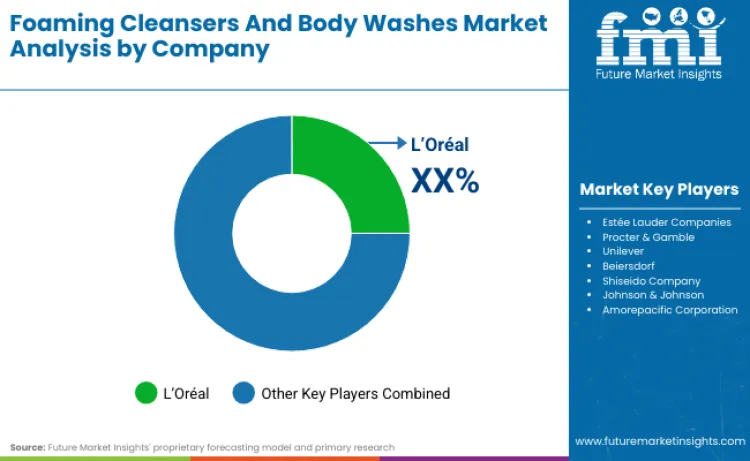
Competition is led by scaled personal care and beauty groups with repeatable execution in skin cleansing, distribution reach, and compliance systems for high-volume rinse-off cosmetics. Scope includes foaming facial cleansers, foaming body washes, medicated foaming cleansers positioned as cosmetics, and organic and natural foaming cleansers sold as finished consumer products. Scope excludes prescription dermatology drugs, medical devices, and professional in-clinic cleansing procedures.
In North America, the competitive edge increasingly includes compliance capability under MoCRA, where FDA guidance clarifies registration and listing expectations that raise the operating bar for cosmetics supply chains, favouring established operators. In Asia, China’s registration and filing discipline under NMPA provisions shapes market access and favours compliant portfolios, meaning global leadership must be matched with local regulatory execution to translate into share. Japan remains structurally distinct due to MHLW standards governing cosmetic products, reinforcing a compliance-led, incumbency-favouring market where global scale does not automatically translate into leadership.
Recent developments
- In December 2024 The FDA finalized its guidance on cosmetic registration and listing, officially setting the ground rules for MoCRA compliance. This release clarified exactly what the agency expects for facility and product submissions, giving manufacturers a clear operational target for the new electronic reporting system.
- In February 2025 Unilever released its Q4 and Full Year 2024 results, reporting that its Personal Care division is back to growing volumes. The announcement highlighted that Skin Cleansing was a key driver in the fourth quarter, showing that the core wash-and-care business is stabilizing and picking up momentum.
- In January 2025 Hindustan Unilever’s performance update spotlighted a major win for body wash, noting "competitive double-digit" growth in the category. They attributed this success directly to product quality, citing recent formula enhancements across their skin cleansing portfolio as the catalyst for the jump in sales.
Key Players
- L’Oréal
- Unilever
- Procter & Gamble
- Johnson & Johnson
- Beiersdorf
- The Estée Lauder Companies
- Shiseido Company
- Amorepacific Corporation
- Kao Corporation
- Colgate-Palmolive
Market Definition
The Foaming Cleansers And Body Washes market covers finished consumer rinse-off cleansing products formulated to create foam and sold for facial cleansing and body cleansing. It includes foaming facial cleansers, foaming body washes, medicated foaming cleansers marketed as cosmetics, and organic and natural foaming cleansers sold through retail and direct channels. It operates within cosmetics regulatory frameworks that govern safety, labelling, and market access. In Europe, the cosmetics regulation harmonises requirements and strengthens in-market control to protect human health, shaping formulation and documentation expectations for high-volume wash categories.
Market Inclusion
Included revenues cover branded, packaged foaming cleansers and body washes sold via supermarkets and hypermarkets, specialty stores, pharmacies and drug stores, and online retail. Included also covers products placed on the market under country-specific compliance regimes, including US requirements operationalised through FDA’s registration and listing guidance under MoCRA, and China’s registration and filing provisions that govern cosmetics market access. Included end users cover women, men, and unisex purchase profiles, and included skin-type positioning spans normal, dry, oily, sensitive, and combination skin.
Market Exclusion
Excluded revenues cover prescription dermatology therapies, antiseptic drugs, and products regulated primarily as medicines rather than cosmetics, as well as professional cleansing services delivered in clinics. Excluded also covers bulk surfactants and intermediate ingredients sold B2B without finished consumer packaging, and contract manufacturing revenues not attributable to branded finished goods sell-through. Markets and activities outside cosmetics governance are excluded unless they directly gate product placement. In Japan, MHLW standards define baseline constraints for cosmetics, but quasi-drug pathways and medical claims regimes sit outside this scope when products move into medicated approvals.
Scope of Report
| Items | Values |
|---|---|
| Quantitative Units (2026) | USD 18.6 Billion |
| Product Type Segments | Foaming Facial Cleansers; Foaming Body Washes; Medicated Foaming Cleansers (Cosmetic Positioning); Organic & Natural Foaming Cleansers |
| Skin Type Categories | Normal Skin; Dry Skin; Oily Skin; Sensitive Skin; Combination Skin |
| Distribution Channels | Supermarkets & Hypermarkets; Specialty Stores; Pharmacies & Drug Stores; Online Retail |
| End-user Categories | Women; Men; Unisex Consumers |
| Regions Covered | North America, Latin America, Western Europe, Eastern Europe, South Asia & Pacific, East Asia, Middle East & Africa |
| Key Countries | China, India, Germany, United States, Brazil, United Kingdom, Japan |
| Key Companies Profiled | L’Oréal; Unilever; Procter & Gamble; Johnson & Johnson; Beiersdorf; The Estée Lauder Companies; Shiseido Company; Amorepacific Corporation; Kao Corporation; Colgate-Palmolive |
| Additional Attributes | Dollar sales measured for foaming cleansers and body washes across product type, skin type, channel and end-user demand, retail throughput intensity in high-frequency rinse-off categories, compliance impact under global cosmetics regulation frameworks (EU 1223/2009, US MoCRA registration and listing, China NMPA filing systems), omnichannel replenishment dynamics, formula renovation cycles by scale brands, and country-level formalisation effects on supplier participation and portfolio concentration |
Source: FMI’s proprietary forecasting model and primary research
Foaming Cleansers and Body Washes Market by Key Segments
Product Type
- Foaming Facial Cleansers
- Foaming Body Washes
- Medicated Foaming Cleansers
- Organic and Natural Foaming Cleansers
Skin Type
- Normal Skin
- Dry Skin
- Oily Skin
- Sensitive Skin
- Combination Skin
Distribution Channel
- Supermarkets and Hypermarkets
- Specialty Stores
- Online Retail
- Pharmacies and Drug Stores
End User
- Women
- Men
- Unisex
Bibliography
- Government of the United Kingdom. (2025). Submit cosmetic product notifications: Guidance for the Office for Product Safety and Standards. GOV.UK.
- Ministry of Health and Family Welfare (India). (2025, September). Cosmetics (Amendment) Rules, 2025. Gazette of India.
- National Institutes for Food and Drug Control (China). (2025, May). 2024 annual cosmetic evaluation report. National Medical Products Administration.
Frequently Asked Questions
What is the current global market size for the Foaming Cleansers and Body Washes Market?
The foaming cleansers and body washes market is valued at USD 18.6 billion in 2026, supported by high-frequency daily cleansing routines and mass retail throughput.
What is the projected CAGR for the Foaming Cleansers and Body Washes Market?
The market is projected to expand at a 5.6% CAGR from 2026 to 2036.
Which segment currently dominates the market?
Foaming facial cleansers lead with a 34.7% share while normal skin formulations dominate with 28.9% of total demand.
What are the primary drivers of market growth?
Growth is driven by routine-led replenishment, large brand investment in cleansing innovation, omnichannel repeat purchasing, and tightening regulatory compliance.
Who are the leading players in the Foaming Cleansers and Body Washes Market?
Key players include Unilever, L’Oréal, Procter & Gamble, Johnson & Johnson, Beiersdorf, Shiseido Company, and Colgate-Palmolive.
Preview the report firsthand - request a free sample
Get SampleGet the brochure for pricing and purchase details.
Get PDFTable of Content
- Executive Summary
- Global Market Outlook
- Demand Side Trends
- Supply Side Trends
- Technology Roadmap Analysis
- Analysis and Recommendations
- Market Overview
- Market Coverage / Taxonomy
- Market Definition / Scope / Limitations
- Research Methodology
- Chapter Orientation
- Analytical Lens and Working Hypotheses
- Market Structure, Signals, and Trend Drivers
- Benchmarking and Cross-market Comparability
- Market Sizing, Forecasting, and Opportunity Mapping
- Research Design and Evidence Framework
- Desk Research Programme (Secondary Evidence)
- Company Annual Reports and Integrated Reports
- Cosmetics Regulatory Publications
- Corporate Websites and Product Documentation
- Investor Presentations and Earnings Communications
- Ingredient and Surfactant Safety Frameworks
- Scientific and Dermatology Literature
- Trade Journals and Personal Care Industry Magazines
- Press Releases and Verified Media Coverage
- Government Publications and Regulatory Databases
- FMI Internal Knowledge Base
- Subscription-based Industry Databases
- Additional Desk Sources
- Expert Input and Fieldwork (Primary Evidence)
- Primary Modes
- Qualitative Interviews
- Quantitative Surveys
- Hybrid Validation Approach
- Why Primary Evidence is Used
- Field Techniques
- Brand and Portfolio Leader Interviews
- Regulatory and Compliance Expert Consultations
- Retail and Channel Partner Interviews
- R&D and Formulation Expert Discussions
- Stakeholder Universe Engaged
- C-suite Executives
- Brand and Category Heads
- Regulatory and Quality Leaders
- R&D and Formulation Scientists
- Retail and Digital Commerce Executives
- Governance, Ethics, and Data Stewardship
- Research Ethics
- Data Integrity and Handling
- Primary Modes
- Tooling, Models, and Reference Databases
- Desk Research Programme (Secondary Evidence)
- Data Engineering and Model Build
- Data Acquisition and Ingestion
- Cleaning, Normalisation, and Verification
- Synthesis, Triangulation, and Analysis
- Quality Assurance and Audit Trail
- Market Background
- Market Dynamics
- Drivers
- Restraints
- Opportunity
- Trends
- Scenario Forecast
- Demand in Optimistic Scenario
- Demand in Likely Scenario
- Demand in Conservative Scenario
- Opportunity Map Analysis
- Product Life Cycle Analysis
- Supply Chain Analysis
- Investment Feasibility Matrix
- Value Chain Analysis
- PESTLE and Porter’s Analysis
- Regulatory Landscape
- Regional Parent Market Outlook
- Personal Care Consumption Statistics
- Import and Export Statistics
- Market Dynamics
- Global Market Analysis 2021 to 2025 and Forecast, 2026 to 2036
- Historical Market Size Value (USD Billion) Analysis, 2021 to 2025
- Current and Future Market Size Value (USD Billion) Projections, 2026 to 2036
- Year-on-Year Growth Trend Analysis
- Absolute $ Opportunity Analysis
- Global Market Pricing Analysis 2021 to 2025 and Forecast 2026 to 2036
- Global Market Analysis 2021 to 2025 and Forecast 2026 to 2036, By Product Type
- Year-on-Year Growth Trend Analysis By Product Type
- Absolute $ Opportunity Analysis By Product Type
- Global Market Analysis 2021 to 2025 and Forecast 2026 to 2036, By Skin Type
- Year-on-Year Growth Trend Analysis By Skin Type
- Absolute $ Opportunity Analysis By Skin Type
- Global Market Analysis 2021 to 2025 and Forecast 2026 to 2036, By Distribution Channel
- Year-on-Year Growth Trend Analysis By Distribution Channel
- Absolute $ Opportunity Analysis By Distribution Channel
- Global Market Analysis 2021 to 2025 and Forecast 2026 to 2036, By End User
- Year-on-Year Growth Trend Analysis By End User
- Absolute $ Opportunity Analysis By End User
- Global Market Analysis 2021 to 2025 and Forecast 2026 to 2036, By Region
- Introduction
- Historical Market Size Value (USD Billion) Analysis By Region, 2021 to 2025
- Current Market Size Value (USD Billion) Analysis and Forecast By Region, 2026 to 2036
- North America
- Latin America
- Western Europe
- Eastern Europe
- East Asia
- South Asia and Pacific
- Middle East & Africa
- Market Attractiveness Analysis By Region
- Key Countries Market Analysis
- Market Structure Analysis
- Competition Dashboard
- Competition Benchmarking
- Market Share Analysis of Top Players
- By Product Type
- By Skin Type
- By Distribution Channel
- By End User
- By Region
- Competition Analysis
- Competition Deep Dive
- Assumptions & Acronyms Used


