

- Industry Size (2026)
- USD 2292.9 Mn
- Forecast (2036)
- USD 3679.1 Mn
- CAGR (2026 to 2036)
- 4.8%
Demand for Professional Hair Care Products in the UK 2026 to 2036
Demand for professional hair care products in the UK is expected to be valued at USD 2,292.9 million in 2026 and is projected to reach USD 3,679.1 million by 2036, reflecting a 4.8% CAGR. This demand is anchored in the growing role of performance-led hair treatments within both salon services and home maintenance routines. Consumers increasingly expect visible results tied to repair, color longevity, scalp balance, and styling control rather than basic cleansing alone.
Professional hair care purchasing is shaped by trust in formulation efficacy and expert recommendation. UK buyers associate professional products with higher concentrations of active ingredients, targeted treatment outcomes, and predictable performance across repeated use. Texture feel, fragrance sophistication, and compatibility with chemically treated or color-processed hair influence repeat purchasing decisions. Products that deliver consistent improvement without requiring complex routines gain stronger household adoption.
Supply-side structure reinforces demand continuity. Salons and specialist retailers favor brands that support education, treatment protocols, and reliable replenishment cycles. Distribution through supermarkets, beauty specialists, and digital platforms improves access while preserving professional positioning. Demand growth remains tied to credibility, treatment effectiveness, and alignment with evolving hair health priorities rather than routine cosmetic replacement.
Quick Stats for Professional Hair Care Products Industry in the UK
- Professional Hair Care Products Industry Value (2026): USD 2,292.9 million
- Professional Hair Care Products Industry Forecast Value (2036): USD 3,679.1 million
- Professional Hair Care Products Industry Forecast CAGR 2026 to 2036: 4.8%
- Leading Product Type by Demand Share: Hair coloring
- Fastest-Growing Regions: England, Scotland, Wales, Northern Ireland
- Key Industry Participants: L’Oréal Group, Henkel, Procter & Gamble, KAO Corporation, Aveda Corporation
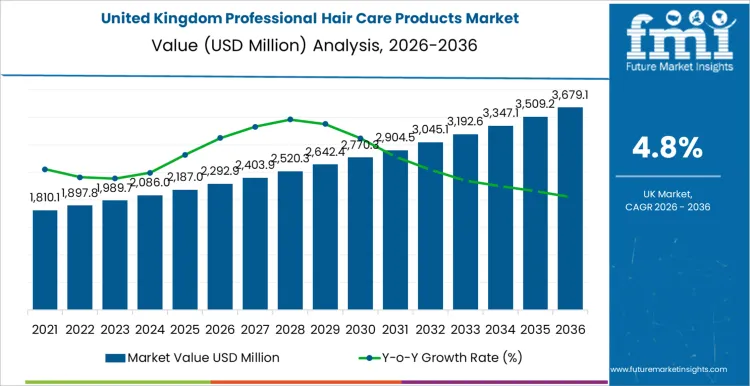
Professional Hair Care Products Industry in the UK Key Takeaways
| Metric | Value |
|---|---|
| Industry Value (2026) | USD 2,292.9 million |
| Industry Forecast Value (2036) | USD 3,679.1 million |
| Forecast CAGR (2026 to 2036) | 4.8% |
Why is the UK Building Steady Demand for Professional Hair Care Products?
Demand for professional hair care products in the UK rises as consumers pursue salon-grade results at home and through stylist services. People look beyond basic shampoos and conditioners toward formulas that address colour preservation, damage repair or scalp health. This reflects a shift in personal care routines where performance and problem-focused solutions matter more than standard maintenance products.
Salon professionals and stylists in the UK play a central role in shaping purchase behaviour. They recommend targeted treatments and specialised serums that are not easily found in general retail aisles. UK salons often stock exclusive lines that promise visible improvement after a few applications, which encourages repeat buying. Retailers respond by allocating dedicated spaces for these products, reinforcing their distinction from mass-tier hair care.
Retail channels also influence consumption patterns. Department stores and specialist beauty outlets cater to informed shoppers seeking expert-endorsed solutions. Online platforms support detailed product information and peer reviews, helping buyers choose treatments that fit specific hair concerns. This combination of professional recommendation and informed retail presence supports consistent uptake of professional hair care products across diverse consumer segments in the UK.
How is Professional Hair Care Products Demand Segmented by Product Type, End User, and Sales Channel in the UK?
Demand for professional hair care products in the UK reflects how performance expectations, routine maintenance needs, and access convenience shape purchasing behaviour. Segmentation patterns follow treatment intensity, frequency of use, and trust placed in product outcomes rather than experimentation.
Why does hair coloring remain the leading product type?
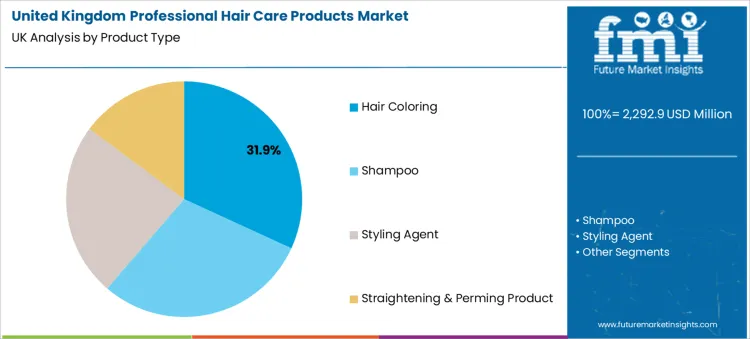
Hair coloring holds a 31.9% share, placing it as the most selected product category. This reflects sustained demand for colour maintenance, coverage, and tonal enhancement across a wide age range. Users prioritize predictable colour payoff, durability between washes, and compatibility with treated hair, which positions colouring products as recurring essentials rather than occasional purchases.
Formulators focus on pigment stability and conditioning balance to reduce damage perception while maintaining shade accuracy. This reinforces repeat usage and supports strong volume movement across professional-grade colour ranges.
What positions individual consumers as the primary end-user group?
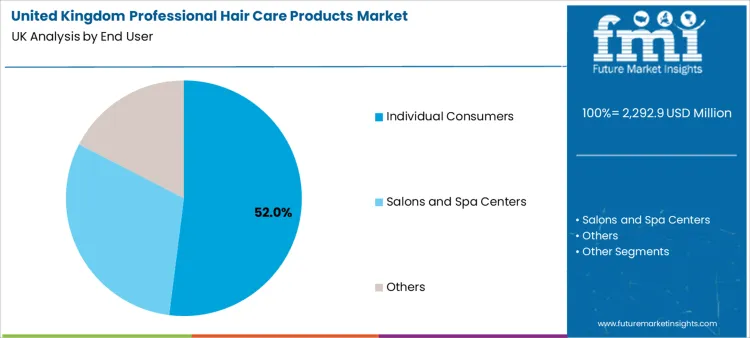
Individual consumers represent a 52.0% share, indicating strong adoption of professional formulations within home care routines. Many users seek salon-grade results without frequent appointments, driving demand for products that deliver visible performance with simplified application steps. Confidence in branded outcomes reduces reliance on in-salon services for routine maintenance.
This shift aligns with greater consumer familiarity with professional techniques and willingness to invest in higher-quality formulations for regular use.
Why do hypermarkets and supermarkets lead sales channel demand?
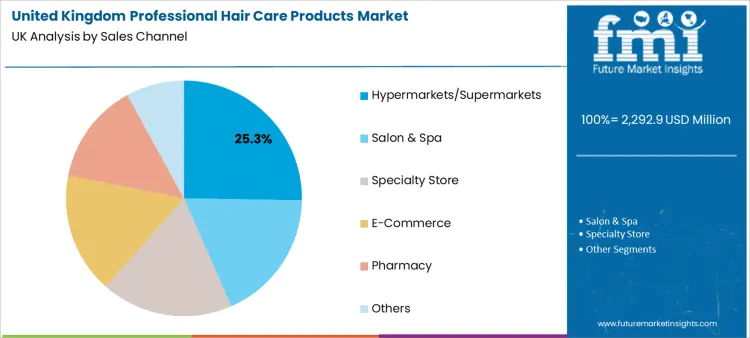
Hypermarkets and supermarkets account for a 25.3% share, reflecting their role as accessible replenishment points for professional hair care products. These outlets support impulse replacement and planned purchasing within regular shopping trips.
Broad assortment visibility and price transparency encourage trial while maintaining convenience.For suppliers, this channel offers scale, consistent shelf exposure, and predictable distribution, supporting steady demand across core professional hair care categories.
What are the Key Dynamics in Demand for Professional Hair Care Products in the UK?
Demand for professional hair care products in the UK is defined by salon channel trends, consumer expectations for high-performance formulations, and differentiation through targeted hair concerns. Salon brands and stylists influence purchase behavior by recommending professional shampoos, conditioners, treatments, and styling systems that promise visible results for breakage, frizz control, scalp health, and color longevity. Retail penetration of professional lines in specialist beauty stores, premium department sections, and online platforms expands availability beyond salon appointments, supporting an elevated segment of consumer spending driven by performance and expertise.
How do stylist endorsement and targeted performance needs shape uptake?
Stylist endorsement remains a central driver of demand because UK consumers often associate professional hair care with superior efficacy and bespoke solutions. Products formulated for specific scalp or strand issues such as dryness, sensitivity, or chemical damage attract interest when professional brands demonstrate measurable improvement through ingredient actives and salon protocols. Color-treated hair categories show strong demand for professional conditioners and masks that protect shade vibrancy and reduce fading between salon visits. Keratin and strengthening systems, designed to reinforce cortical structure, are selected in salons and adopted by consumers seeking salon-like results at home. Hair stylists’ recommendations on treatment frequency and product layering contribute directly to repeat purchase patterns in the UK industry, where education and professional training influence brand credibility.
How do pricing models and distribution channels influence demand patterns?
Pricing and channel strategy significantly influence demand for professional hair care products in the UK. Salon-exclusive products usually carry a premium that reflects formulation complexity, salon service value, and brand equity, and many consumers are willing to invest in these products because they associate them with longer-term hair quality improvements. The expansion of professional lines into online specialist retailers and marketplace platforms increases access for consumers outside urban centers with limited salon presence, moderating traditional geographic barriers to trial. Price-sensitive consumers may opt for entry professional ranges or promotional pack formats that lower barriers to initial adoption, especially when paired with tutorial content or cosmetic advice.
How is Professional Hair Care Products Demand Evolving across Key Regions in the UK?
Demand for professional hair care products across the UK progresses as salons focus on performance credibility, treatment-led services, and repeat purchase programs. Regional variation reflects salon density, training intensity, brand-led education models, and how professionals align product choice with service differentiation and client retention goals.
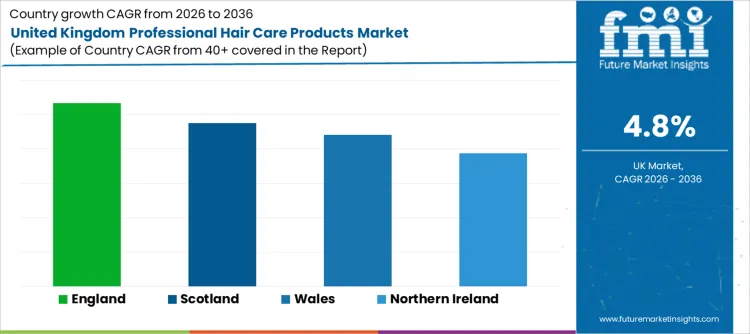
| Region | CAGR 2026 to 2036 |
|---|---|
| England | 5.3% |
| Scotland | 4.7% |
| Wales | 4.4% |
| Northern Ireland | 3.9% |
Why is England leading expansion through salon concentration and service diversification?
England grows at 5.3%, supported by a high concentration of salons offering specialized treatments and premium service menus. Demand rises where stylists rely on professional-grade formulations to support colouring, repair, and scalp services. Product selection prioritizes predictable performance, stylist training support, and consistency across multi-location salon groups managing standardized service outcomes.
How is Scotland progressing through steady uptake in premium and independent salons?
Scotland expands at 4.7%, shaped by adoption among premium and independent salons emphasising personalised care. Professionals value products that deliver visible results while supporting consultation-driven services. Demand builds where brands provide technical guidance, treatment protocols, and reliable replenishment cycles suited to smaller yet quality-focused salon operations.
What is shaping Wales as salons balance performance credibility with commercial discipline?
Wales advances at 4.4%, driven by selective purchasing among salons managing tighter service margins. Demand strengthens when professional hair care products support multiple services without increasing inventory complexity. Buyers favour ranges that deliver conditioning, repair, and styling reliability while fitting controlled stock levels and predictable reorder patterns.
Why is Northern Ireland showing measured growth tied to focused service portfolios?
Northern Ireland records 3.9% growth, reflecting focused service portfolios and cautious range expansion. Salons adopt professional products where treatment outcomes justify premium positioning. Demand improves when formulations demonstrate consistency across repeat services and when supplier support aligns with practical training needs and stable delivery schedules.
What Defines the Competitive Landscape for Professional Hair Care Products in the UK?
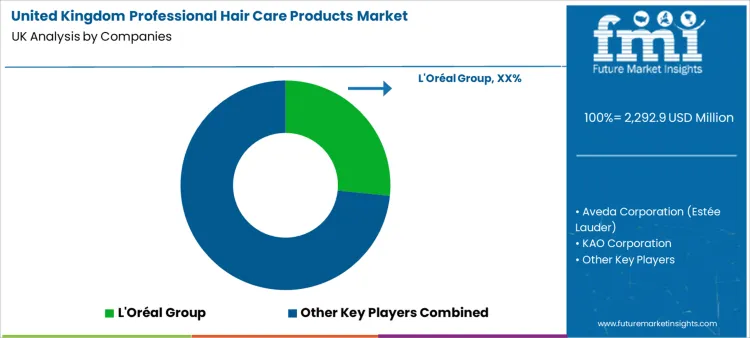
Demand for professional hair care products in the UK is driven by salon channel recovery, premiumisation trends, and rising consumer focus on hair health and treatment efficacy. Salon professionals evaluate product performance, ingredient quality, scalp and hair repair outcomes, and consistency across coloring, styling, and treatment ranges. Buyer assessment also includes brand education support, sustainability credentials, and compatibility with diverse hair types and textures. Salon procurement behavior favors brands offering strong technical training, reliable supply, and differentiated formulations that justify professional-only positioning. Trend in the UK industry reflects steady shift toward clean formulations, damage-repair systems, and retail-ready professional products extending beyond salons.
L’Oréal Group holds leading positioning in the UK through extensive professional brand portfolios supported by strong salon relationships and education platforms. Henkel maintains relevance via professional color and care brands with deep penetration in independent salons. Procter and Gamble participates through selective professional offerings linked to performance-driven formulations. Kao Corporation supports demand with premium salon brands emphasizing hair repair and Asian-inspired technology. Aveda Corporation differentiates through plant-based positioning and sustainability-led salon partnerships. Revlon Inc. remains active in value-oriented professional segments. Competitive differentiation centers on salon loyalty, product efficacy credibility, education infrastructure, and brand-driven retail pull.
Key Industry Participants
- Aveda Corporation (Estée Lauder)
- KAO Corporation
- Henkel
- Procter & Gamble (P&G)
- Revlon Inc.
- L'Oréal Group
Scope of Report
| Items | Values |
|---|---|
| Quantitative Units | USD million |
| Product Type | Hair Coloring; Shampoo; Styling Agent; Straightening & Perming Product |
| End User | Individual Consumers; Salons and Spa Centers; Others |
| Sales Channel | Hypermarkets/Supermarkets; Salon & Spa; Specialty Store; E-Commerce; Pharmacy; Others |
| Regions Covered | England; Scotland; Wales; Northern Ireland |
| Key Companies Profiled | Aveda Corporation (Estée Lauder); KAO Corporation; Henkel; Procter & Gamble (P&G); Revlon Inc.; L'Oréal Group |
Professional Hair Care Products Demand in the UK by Segments
Product Type:
- Hair Coloring
- Shampoo
- Styling Agent
- Straightening & Perming Product
End User:
- Individual Consumers
- Salons and Spa Centers
- Others
Sales Channel:
- Hypermarkets/Supermarkets
- Salon & Spa
- Specialty Store
- E-Commerce
- Pharmacy
- Others
By Region
- England
- Scotland
- Wales
- Northern Ireland
Bibliography
- British Beauty Council. (2023). The professional beauty sector in the UK: Economic contribution and structural trends. British Beauty Council.
- Cosmetics Europe. (2023). Cosmetic products in the EU and UK: Safety, performance, and professional use considerations. Cosmetics Europe.
- Office for National Statistics. (2024). Consumer spending patterns on personal care products in the UK. UK Government.
- Gavazzoni Dias, M. F. R., de Almeida, A. M., & Cecato, P. M. (2023). Hair cosmetics: An overview of formulation, performance, and consumer expectations. Journal of Cosmetic Dermatology, 22(4), 1121-1131.
Frequently Asked Questions
How big is the demand for professional hair care products in the uk in 2026?
The demand for professional hair care products in the uk is estimated to be valued at USD 2,292.9 million in 2026.
What will be the size of professional hair care products in the uk in 2036?
The market size for the professional hair care products in the uk is projected to reach USD 3,679.1 million by 2036.
How much will be the demand for professional hair care products in the uk growth between 2026 and 2036?
The demand for professional hair care products in the uk is expected to grow at a 4.8% CAGR between 2026 and 2036.
What are the key product types in the professional hair care products in the uk?
The key product types in professional hair care products in the uk are hair coloring, shampoo, styling agent and straightening & perming product.
Which end user segment is expected to contribute significant share in the professional hair care products in the uk in 2026?
In terms of end user, individual consumers segment is expected to command 52.0% share in the professional hair care products in the uk in 2026.
Preview the report firsthand - request a free sample
Get SampleGet the brochure for pricing and purchase details.
Get PDFTable of Content
- Executive Summary
- UK Market Outlook
- Demand-side Trends
- Supply-side Trends
- Technology Roadmap Analysis
- Analysis and Recommendations
- Market Overview
- Market Coverage / Taxonomy
- Market Definition / Scope / Limitations
- Market Background
- Market Dynamics
- Drivers
- Restraints
- Opportunity
- Trends
- Scenario Forecast
- Demand in Optimistic Scenario
- Demand in Likely Scenario
- Demand in Conservative Scenario
- Opportunity Map Analysis
- Product Life Cycle Analysis
- Supply Chain Analysis
- Investment Feasibility Matrix
- Value Chain Analysis
- PESTLE and Porter’s Analysis
- Regulatory Landscape
- Regional Parent Market Outlook
- Production and Consumption Statistics
- Import and Export Statistics
- Market Dynamics
- UK Market Analysis 2021 to 2025 and Forecast, 2026 to 2036
- Historical Market Size Value (USD Million) Analysis, 2021 to 2025
- Current and Future Market Size Value (USD Million) Projections, 2026 to 2036
- Y-o-Y Growth Trend Analysis
- Absolute $ Opportunity Analysis
- UK Market Pricing Analysis 2021 to 2025 and Forecast 2026 to 2036
- UK Market Analysis 2021 to 2025 and Forecast 2026 to 2036, By Product Type
- Introduction / Key Findings
- Historical Market Size Value (USD Million) Analysis By Product Type , 2021 to 2025
- Current and Future Market Size Value (USD Million) Analysis and Forecast By Product Type , 2026 to 2036
- Hair Coloring
- Shampoo
- Styling Agent
- Straightening & Perming Product
- Hair Coloring
- Y-o-Y Growth Trend Analysis By Product Type , 2021 to 2025
- Absolute $ Opportunity Analysis By Product Type , 2026 to 2036
- UK Market Analysis 2021 to 2025 and Forecast 2026 to 2036, By End User
- Introduction / Key Findings
- Historical Market Size Value (USD Million) Analysis By End User, 2021 to 2025
- Current and Future Market Size Value (USD Million) Analysis and Forecast By End User, 2026 to 2036
- Individual Consumers
- Salons and Spa Centers
- Others
- Individual Consumers
- Y-o-Y Growth Trend Analysis By End User, 2021 to 2025
- Absolute $ Opportunity Analysis By End User, 2026 to 2036
- UK Market Analysis 2021 to 2025 and Forecast 2026 to 2036, By Sales Channel
- Introduction / Key Findings
- Historical Market Size Value (USD Million) Analysis By Sales Channel, 2021 to 2025
- Current and Future Market Size Value (USD Million) Analysis and Forecast By Sales Channel, 2026 to 2036
- Hypermarkets/Supermarkets
- Salon & Spa
- Specialty Store
- E-Commerce
- Pharmacy
- Others
- Hypermarkets/Supermarkets
- Y-o-Y Growth Trend Analysis By Sales Channel, 2021 to 2025
- Absolute $ Opportunity Analysis By Sales Channel, 2026 to 2036
- Market Structure Analysis
- Competition Dashboard
- Competition Benchmarking
- Market Share Analysis of Top Players
- By Regional
- By Product Type
- By End User
- By Sales Channel
- Competition Analysis
- Competition Deep Dive
- L'Oréal Group
- Overview
- Product Portfolio
- Profitability by Market Segments (Product/Age /Sales Channel/Region)
- Sales Footprint
- Strategy Overview
- Marketing Strategy
- Product Strategy
- Channel Strategy
- Aveda Corporation (Estée Lauder)
- KAO Corporation
- Henkel
- Procter & Gamble (P&G)
- Revlon Inc.
- L'Oréal Group
- Competition Deep Dive
- Assumptions & Acronyms Used
- Research Methodology


