

- Industry Size (2026)
- USD 14.2 Bn
- Forecast (2036)
- USD 24.7 Bn
- CAGR (2026 to 2036)
- 5.7%
Mattifying Skin Care Products Market Forecast and Outlook 2026 to 2036
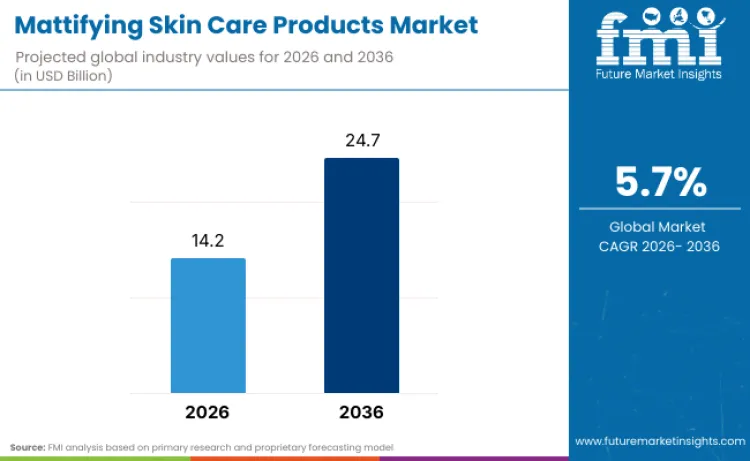
The Mattifying Skin Care Products market is forecast to expand from USD 14.2 Billion in 2026 to USD 24.7 Billion by 2036, registering a 5.7% CAGR. Category expansion is being supported by large-scale brand systems that are prioritising facial care and dermatology-adjacent skin routines across mass and premium tiers. L’Oréal reported like-for-like growth of 5.1% in 2024 and positioned this performance as outperformance versus the global beauty market.
Portfolio and channel strategy are also shaping category economics. P&G’s 2024 annual report ties performance to execution discipline, with Jon Moeller stating: ‘Execution of our integrated strategy enabled the Company to meet or exceed our going-in guidance ranges for organic sales growth.’
Regulatory compliance intensity is rising in parallel. In the United States, FDA’s MoCRA implementation expands expectations around facility registration and product listing, increasing compliance overhead for skincare producers and tightening supplier qualification for large retailers.
Summary of the Mattifying Skin Care Products Market
What is Growth Outlook for Mattifying Skin Care Products Market as per Future Market Insights Projection?
Future Market Insights projects the market to expand from USD 14.2 Billion in 2026 to USD 24.7 Billion by 2036, reflecting a 5.7% CAGR.
FMI Research Approach: Forecast links facial care consumption to channel expansion, portfolio renovation cadence, and compliance-driven product continuity across major retail systems.
How do FMI Analysts Perceive Mattifying Skin Care Products Market to Evolve?
FMI expects oil-control claims to shift toward regimen-led positioning where daily moisturising, pore appearance management, and long-wear shine control are built into core skincare routines, not episodic cosmetic usage.
FMI Research Approach: Competitive tracking of skincare platform expansion by global players, claim architecture tightening under cosmetics regulation, and online sell-through signals.
Which Country is Expected to be the Fastest Growing in Mattifying Skin Care Products Market?
China is expected to grow at a 7.6% CAGR from 2026 to 2036 as compliance requirements under the national cosmetics supervision framework increase the value of scaled brands that can sustain filing discipline and claim substantiation at speed.
FMI Research Approach: Country model weighted to regulatory compliance load, platform scale of leading brands, and online channel penetration.
Which Product Type Leads the Mattifying Skin Care Products Market in 2026?
Mattifying creams lead with a 34.7% share in 2026 due to their role as the default daily-use base layer in facial care routines across mass and premium systems.
FMI Research Approach: Product share derived from regimen frequency, moisturiser-led category structure, and repeat purchase intensity.
Which Skin Type Accounts for the Largest Share in 2026?
Oily skin leads with a 46.3% share in 2026 because sebum-management needs create repeat purchase cycles and higher trial rates for texture and finish claims.
FMI Research Approach: Skin-type allocation based on regimen adherence and oil-control product utilisation patterns.
Mattifying Skin Care Products Market Key Takeaways
| Metric | Value |
|---|---|
| Market Size (2026) | USD 14.2 Billion |
| Forecast Value (2036) | USD 24.7 Billion |
| CAGR (2026 to 2036) | 5.7% |
What is Powering the Expansion of the Mattifying Skin Care Products Category?
Expansion is being powered by two structural forces that directly raise category throughput. First, major beauty groups are scaling skincare platforms with disciplined renovation cycles, sustaining shelf presence for oil-control lines within broader facial care systems. Compliance requirements are tightening and favouring scaled operators that can maintain documentation, traceability, and product continuity across retail footprints. FDA’s MoCRA implementation sets facility registration and product listing expectations, raising the operational bar for cosmetics producers and increasing retailer dependence on suppliers with repeatable compliance systems. These forces increase the advantage of large portfolios that can fund both claim support and compliance while feeding online retail replenishment loops.
How is the Mattifying Skin Care Products Market Segmented?
The market for Mattifying Skin Care Products is segmented into Product & Format Mix (mattifying creams, lotions, gels, skincare-positioned powders, and skincare-hybrid mattifying primers), Skin-Type Pathways (oily skin management, combination skin balance, acne-prone skin oil control, and sensitive-skin compatible mattifying routines), and End User / Channel (women-focused facial care routines, men’s grooming and skincare adoption, unisex formulations, and distribution through online retail platforms, pharmacies and drug stores, specialty beauty retailers, and mass retail). This segmentation reflects how oil and shine control has shifted from episodic cosmetic use to daily regimen integration, how demand concentrates around repeat-use skin types with visible performance feedback, and how digitally led retail channels accelerate claim iteration, replenishment velocity, and portfolio renovation within compliance-governed skincare systems.
Why do Mattifying Creams Hold the Lead When Buyers Want Oil Control Without Regimen Friction?
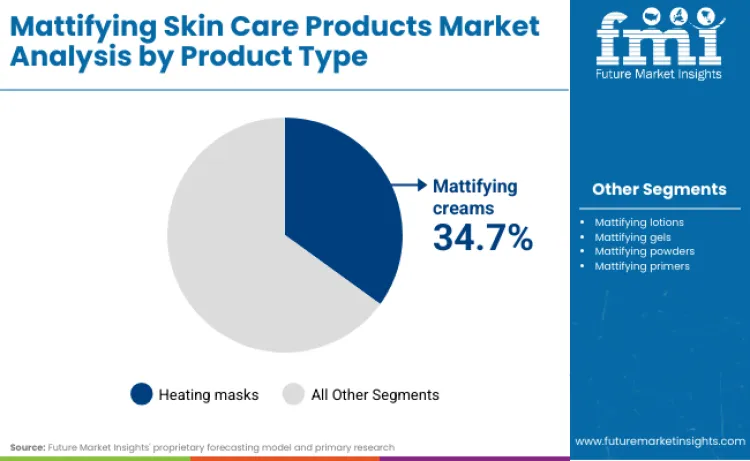
Mattifying creams lead with a 34.7% share in 2026 because they sit at the intersection of daily moisturising and finish control, making them the least disruptive switch within an established skincare routine. Large brand systems have structurally reinforced moisturiser-led facial care as the centre of the regimen, then layered additional performance attributes into that base step. The platform logic favours cream textures because they can carry multi-claim architectures and remain compatible with downstream sunscreen and makeup usage. Operationally, compliance requirements also favour fewer, more scalable hero formats. FDA’s MoCRA requirements for facility registration and product listing increase compliance obligations, which strengthens the business case for concentrating innovation into high-volume moisturiser formats rather than proliferating niche SKUs.
What Makes Oily Skin the Core Demand Engine Rather Than a Niche Dermatology Subset?
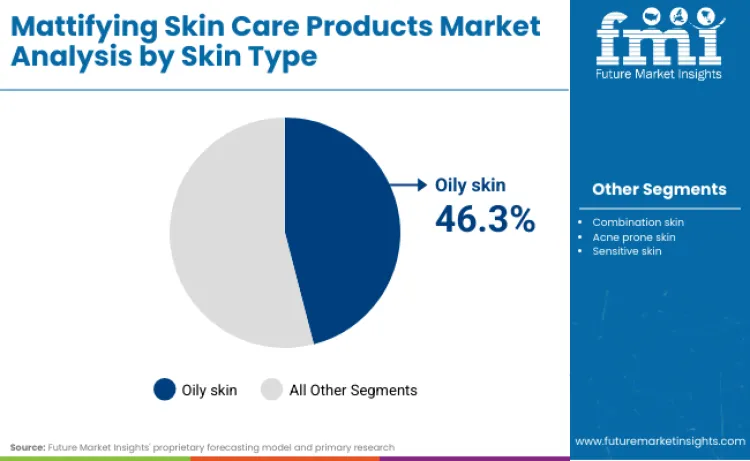
Oily skin leads with a 46.3% share in 2026 because the purchase cycle is structurally repeat-driven and performance-evaluated in short time windows, which increases trial frequency and replenishment intensity. The market’s largest operators have reinforced facial care routines as a daily system, then pushed performance claims tied to visible outcomes such as shine control and pore appearance, which aligns with oily-skin consumer evaluation behaviour. Regulatory tightening increases the value of credible, repeatable claim support. In Great Britain, the responsible person framework requires safety assessment and compliance before products are placed on the market, reinforcing discipline around claim positioning and product dossiers. This combination favours oily-skin focused positioning because it delivers clear, repeatable consumer feedback loops that support online conversion, subscription behaviour, and long-tail replenishment, which translates into structurally higher category throughput than skin types where performance is harder to verify quickly.
What are the Key Trends and Restraints Shaping the Mattifying Skin Care Products Market?
A defining trend is the tightening link between skincare performance claims and compliance-ready product systems. In Great Britain, the responsible person framework requires safety assessment and compliance before products are placed on the market, reinforcing a shift toward claim discipline and structured documentation that favours large operators with repeatable processes. In the United States, FDA’s MoCRA implementation extends regulatory expectations through facility registration and product listing, creating stronger incentives to standardise formulations and reduce SKU volatility in high-volume facial care lines. This trend supports mattifying creams and hybrid daily-use formats because they concentrate innovation into fewer, scalable platforms that can carry oil-control claims without fragmenting compliance overhead.
A key restraint is rising compliance and documentation load that increases time-to-market friction and compresses the economics of small-batch innovation. MoCRA requirements around facility registration and product listing create recurring obligations that smaller producers must fund alongside testing and quality systems, raising fixed costs per SKU. In Europe, the core cosmetics framework requires safety and compliance disciplines that add dossier and assessment overhead, which becomes a practical barrier when brands attempt to launch multiple finish variants across markets. As compliance costs rise, brands prioritise fewer hero mattifying claims and reduce experimentation outside high-volume platforms, limiting assortment breadth and slowing micro-segmentation in some channels.
How Will Mattifying Skin Care Products Market Expansion Unfold Across Key Global Regions?
Future Market Insights identifies China (CAGR 7.6%), India (7.1%), Germany (6.5%), Brazil (5.9%), United States (5.4%), United Kingdom (4.8%), and Japan (4.2%) as the core demand drivers shaping the global mattifying skin care products market through 2036. China leads growth as tighter cosmetics supervision under the national regulatory framework increases the advantage of scaled brands that can sustain rapid filing discipline, claim substantiation, and online retail execution for oil-control facial care. India’s expansion is driven by formalisation under Cosmetics Rules and BIS-aligned labelling, which strengthens organised retail and repeat-purchase facial care routines in urban markets.
The United States benefits from sustained demand for daily oil-control performance combined with MoCRA-driven supplier consolidation that favours large portfolios with mature compliance systems. Germany’s demand reflects EU-grade compliance discipline and a strong dermo-skincare manufacturing base that supports stable adoption of mattifying moisturisers. Brazil’s growth is anchored in ANVISA governance, which filters demand toward compliant, high-throughput facial care lines. The UK shows moderate growth as responsible person enforcement tightens portfolio discipline, while Japan’s slower trajectory reflects mature consumption shaped by domestic incumbents and technology-led skincare renovation. FMI emphasises that across regions, growth is governed by the interaction of regimen-led skincare adoption, regulatory compliance capability, and scalable brand execution rather than by novelty-driven cosmetic demand.
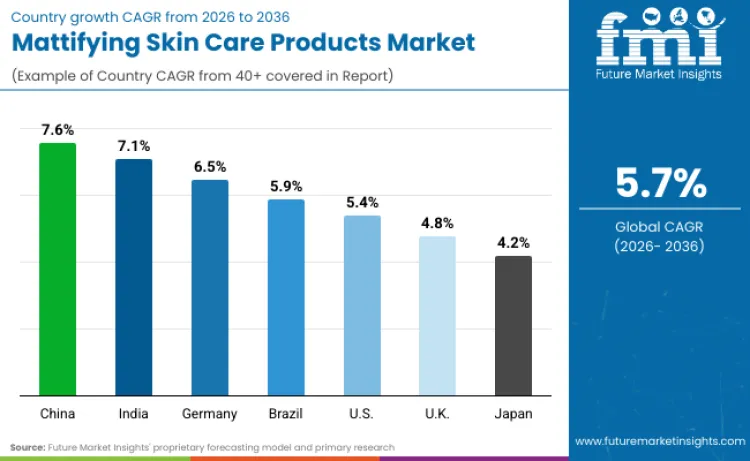
| Country | CAGR (2026 to 2036) |
|---|---|
| China | 7.6% |
| India | 7.1% |
| Germany | 6.5% |
| Brazil | 5.9% |
| USA | 5.4% |
| UK | 4.8% |
| Japan | 4.2% |
Source: Future Market Insights (FMI) analysis, based on proprietary forecasting model and primary research.
How is China’s cosmetics supervision regime increasing the advantage of scaled, compliance-ready mattifying skincare portfolios?
China will grow at a 7.6% CAGR from 2026 to 2036 because regulatory supervision under the CSAR era increases the value of operators that can maintain filing discipline, ingredient governance, and claim substantiation at speed, especially for functional facial care. The WTO trade concerns record notes that after implementation of the Regulations on the Supervision and Administration of Cosmetics, products are divided into special cosmetics and general cosmetics, reflecting a more structured oversight environment that pushes brands toward stronger compliance systems. This favours large portfolios that can repeatedly renovate mattifying claims while keeping documentation consistent across variants. China’s scale also amplifies online retail conversion dynamics, making oil-control messaging and texture performance more commercially decisive, and raising the payoff for large players that can coordinate marketing, compliance, and distribution execution in one operating model.
Why will India’s cosmetics rules and BIS-linked labelling discipline accelerate formal, repeat-purchase facial care for oil-control routines?
India will expand at a 7.1% CAGR from 2026 to 2036 because the regulatory framework increases formalisation and improves supply reliability in organised channels where mattifying products are repeatedly replenished. CDSCO’s Cosmetics Rules, 2020 page provides the official rules framework and enforcement structure, while the rules text references conformity with labelling requirements and Indian standards laid down by the Bureau of Indian Standards for covered cosmetics. This mechanism increases retailer confidence in documented, standard-compliant products, strengthening the operating space for scaled brands and organised online and pharmacy-led sales. As compliance normalises, the category benefits from broader availability of daily facial care products that combine moisturising with finish control, supporting higher repeat purchase in urban markets where climate and commute-driven shine control remains a routine need.
How does Germany’s dermo-skincare manufacturing base and EU compliance architecture support sustained adoption of oil-control facial care?
Germany will grow at a 6.5% CAGR from 2026 to 2036 because EU compliance requirements and strong domestic skincare manufacturing create stable pathways for facial care innovation and distribution scale. The EU Cosmetics Regulation (EC) No 1223/2009 establishes the mandatory legal framework for all cosmetics on the EU market, requiring a designated Responsible Person and a comprehensive Product Information File for every product. Germany’s advantage is the concentration of globally relevant skincare operators and disciplined retail execution across drugstore and pharmacy ecosystems, which supports consistent replenishment behaviour for daily mattifying moisturisers and related formats. Beiersdorf’s 2024 annual report highlights strong performance in NIVEA skin care, particularly facial care.
What makes Brazil’s ANVISA governance a practical filter that rewards compliant, high-throughput facial care lines in organised retail?
Brazil will rise at a 5.9% CAGR through 2036 because ANVISA’s regulatory structure reinforces documentation, classification, and labelling discipline, pushing the market toward organised, compliance-ready portfolios with stable distribution. ANVISA’s official English regulatory page states that the general regulation applicable to marketing authorisation for personal hygiene products, cosmetics and fragrances is RDC 907/2024, establishing a formal governance perimeter for cosmetics placed on the market. Earlier frameworks such as RDC 752/2022 also specify definitions, classification, and technical requirements for labelling and packaging. This environment rewards larger brands with controlled quality systems and consistent labelling practices, which aligns with high-volume facial care categories where mattifying claims must be repeated across SKUs without compliance drift.
How will MoCRA-linked compliance obligations reshape supplier selection for mattifying skincare in the United States?
The United States will grow at a 5.4% CAGR from 2026 to 2036 because regulatory reform increases compliance expectations and pushes retailers toward suppliers with strong quality and documentation systems, while consumers continue to sustain demand for oil-control performance in daily facial care. FDA’s MoCRA page sets out ongoing regulatory actions and expectations, including the operational direction of facility and product registration and related compliance elements, and FDA’s registration and listing page states that manufacturers and processors must register facilities and renew every two years. This raises the baseline operating requirements for brands supplying large retail footprints, improving the competitive position of global players that already run multi-market compliance systems. The structural result is more stable shelf continuity for high-volume mattifying moisturisers and creams, while smaller brands face higher fixed costs to maintain frequent launches.
Why does the UK’s responsible person system concentrate demand in established facial care portfolios with repeatable documentation?
The United Kingdom will expand at a 4.8% CAGR across 2026 to 2036 because the responsible person and notification regime strengthens enforcement of product safety and documentation requirements, favouring established operators and organised retail that can sustain compliance at scale. The UK government guidance on cosmetics enforcement describes the responsible person obligation and the requirement for safety assessment before a cosmetic is placed on the Great Britain market, while the cosmetic product notification service reinforces the responsible person requirement for products placed on the GB market. This concentrates distribution power in suppliers that can run consistent product information files and maintain portfolio continuity across retailers. For mattifying skincare, that mechanism supports standardised daily-use products where finish control claims are delivered through repeatable formulations that can be maintained under compliance scrutiny.
How is Japan’s corporate restructuring in prestige skincare and technology investment shaping the pace of oil-control and finish-led skincare renovation?
Japan will grow at a 4.2% CAGR from 2026 to 2036 because domestic leaders are actively reshaping skincare portfolios and investing in formulation technology that supports differentiated sensory performance, including finish control. Shiseido’s investor presentation on 2023 results and 2024 outlook includes its stated emphasis on reinforcing the skin beauty category and category creation, signalling continued focus on skin care architecture and profitability. Shiseido’s integrated reporting and corporate communications also highlight ongoing development of formulation technologies to improve skincare effects, supporting the technical basis for texture and finish innovation. This technology and portfolio focus shapes category renovation cadence in Japan, with execution depth and domestic retail relationships determining how quickly mattifying formats scale.
Who Holds Competitive Power in the Mattifying Skin Care Products Market, and Where Does Leadership Differ by Region?
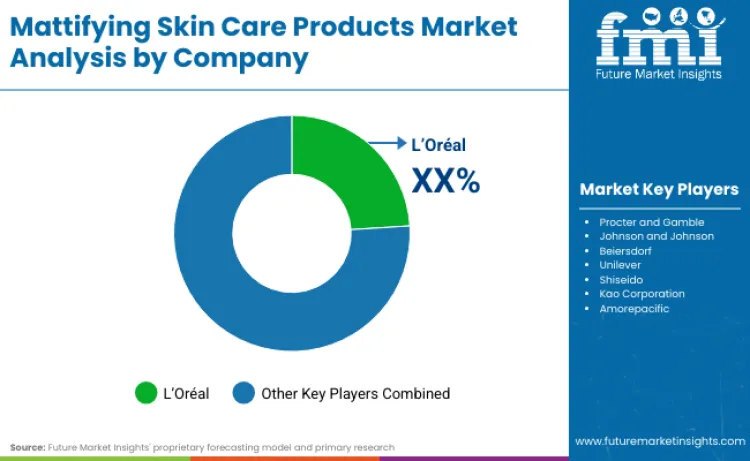
This market includes mattifying creams, lotions, gels, powders positioned as skincare, and mattifying primers sold as skincare-hybrid facial products through mass, prestige, pharmacy, and online channels. It excludes colour cosmetics where mattifying is purely a makeup finish effect, blotting papers, aerosol oil-control sprays, and professional-only salon treatments. L’Oréal is the largest player in this market, supported by global scale and repeatable skincare platform execution, reinforced by its annual report performance and continued market outperformance narrative. In North America, leadership is more balanced across multi-category groups because MoCRA-driven compliance requirements increase the advantage of operators with strong quality systems and retailer integration with mature operating models. In Europe, the EU cosmetics framework favours established brands with robust documentation and safety assessment infrastructure, supporting large incumbents. In Asia, global leadership does not always translate into regional leadership because domestic platforms in Japan and Korea can win through local channel power and formulation sensoriality, with Shiseido’s skin beauty reinforcement signalling continued domestic execution focus.
Recent developments
- December 2025, Under the Modernization of Cosmetics Regulation Act of 2022 (MoCRA), the USA Food and Drug Administration published a report assessing PFAS use in cosmetic products, summarizing scientific evidence on safety, exposure pathways, and associated health risks to inform regulatory oversight.
- In June 2025, L’Oréal was reported by the Financial Times to be nearing a USD 1.6 billion acquisition of Medik8, strengthening its Dermatological Beauty division and reinforcing growth across science-led premium skincare portfolios.
Key Players
- L’Oréal
- Procter & Gamble
- Unilever
- Beiersdorf
- Shiseido
- Kao Corporation
- The Estée Lauder Companies
- Johnson & Johnson
- Coty
- LG Household & Health Care
- Amorepacific
Market Definition
Mattifying skin care products are leave-on facial skincare formulations designed to reduce visible shine and oil appearance through sebum-management, blurring, or finish-modifying properties while remaining positioned as skincare rather than pure colour cosmetics. This market covers daily-use formats such as creams, lotions, gels, skincare-positioned powders, and skincare-hybrid primers where the consumer intent is oil-control as part of a facial care routine.
Market Inclusion
Included revenues cover mattifying creams, mattifying lotions, mattifying gels, mattifying powders positioned for skincare use, and mattifying primers sold as skincare-hybrid facial products across online retail, pharmacies and drug stores, supermarkets and hypermarkets, and specialty beauty stores. Brand leadership is assessed using portfolio scale, global distribution reach, and repeatable platform execution, with L’Oréal treated as the largest player based on the provided 2026 share and its documented platform scale in annual reporting.
Market Exclusion
Excluded are colour cosmetics where mattifying is solely a makeup finish effect, blotting papers, oil-control wipes, aerosol sprays, professional salon-only treatments, and medical dermatology prescriptions. Revenues from devices, clinic procedures, and non-topical interventions are excluded. Regulatory and compliance requirements that are not product revenues are excluded, but they are considered as structural constraints shaping supplier selection and portfolio continuity.
Scope of Report
| Items | Values |
|---|---|
| Quantitative Units | USD Billion |
| Product Type Segments | Mattifying Creams; Mattifying Lotions; Mattifying Gels; Mattifying Powders (Skincare-Positioned); Mattifying Primers (Skincare-Hybrid) |
| Skin Type Categories | Oily Skin; Combination Skin; Acne-Prone Skin; Sensitive Skin |
| End User Groups | Women; Men; Unisex Consumers |
| Distribution Channels | Online Retail; Supermarkets & Hypermarkets; Specialty Beauty Stores; Pharmacies & Drug Stores |
| Regions Covered | North America, Latin America, Western Europe, Eastern Europe, South Asia & Pacific, East Asia, Middle East & Africa |
| Key Countries | China, India, Germany, United States, Brazil, United Kingdom, Japan |
| Key Companies Profiled | L’Oréal; Procter & Gamble; Unilever; Beiersdorf; Shiseido; Kao Corporation; Estée Lauder Companies; Johnson & Johnson; Coty; LG Household & Health Care; Amorepacific |
| Additional Attributes | Dollar sales measured for mattifying facial skincare by product format, skin-type pathway, end-user adoption and channel flow; regimen-led oil-control integration into daily moisturising routines; compliance-driven portfolio consolidation under EU cosmetics regulation and USA MoCRA requirements; online retail iteration speed and replenishment intensity; claim substantiation discipline shaping SKU concentration; organised retail throughput for high-frequency facial care; competitive positioning based on scalable skincare platforms and regulatory-ready formulation systems |
Mattifying Skin Care Products Market by Key Segments
Product Type
- Mattifying creams
- Mattifying lotions
- Mattifying gels
- Mattifying powders
- Mattifying primers
Skin Type
- Oily skin
- Combination skin
- Acne prone skin
- Sensitive skin
Distribution Channel
- Online retail
- Supermarkets and hypermarkets
- Specialty beauty stores
- Pharmacies and drug stores
End User
- Women
- Men
- Unisex
Bibliography (APA)
- Beiersdorf AG. (2025). Annual Report 2024: Bridging the gap between skin care and health.
- USA Food and Drug Administration. (2026). Modernization of Cosmetics Regulation Act of 2022 (MoCRA).
- Shiseido Company, Limited. (2024). Notice regarding the new management structure and "SHIFT 2025 and Beyond" strategy.
Frequently Asked Questions
What is the Mattifying Skin Care Products Market size in 2026 and 2036, and what is the CAGR?
The mattifying skin care products market is valued at USD 14.2 billion in 2026 and is projected to reach USD 24.7 billion by 2036, growing at a 5.7% CAGR.
Which product type leads the Mattifying Skin Care Products Market in 2026?
Mattifying creams lead with a 34.7% share in 2026 as they serve as the daily-use base layer within facial care routines across mass and premium brands.
Which skin type drives the highest demand for mattifying skin care products in 2026?
Oily skin dominates with a 46.3% share in 2026 due to high repeat purchase cycles driven by ongoing sebum-control needs.
Which country is expected to grow the fastest in the Mattifying Skin Care Products Market from 2026 to 2036?
China leads growth at a 7.6% CAGR as stricter cosmetics supervision favours large, compliance-ready skincare portfolios.
Which regulatory shift most affects supplier economics for mattifying skincare brands in the United States?
MoCRA-linked FDA facility registration and product listing requirements significantly raise compliance and documentation obligations for skincare producers.
Preview the report firsthand - request a free sample
Get SampleGet the brochure for pricing and purchase details.
Get PDFTable of Content
- Executive Summary
- Global Market Outlook
- Demand-side Trends
- Supply-side Trends
- Technology Roadmap Analysis
- Analysis and Recommendations
- Market Overview
- Market Coverage / Taxonomy
- Market Definition / Scope / Limitations
- Research Methodology
- Chapter Orientation
- Analytical Lens and Working Hypotheses
- Market Structure, Signals, and Trend Drivers
- Benchmarking and Cross-market Comparability
- Market Sizing, Forecasting, and Opportunity Mapping
- Research Design and Evidence Framework
- Desk Research Programme (Secondary Evidence)
- Company Annual Reports and Integrated Reports
- Peer-reviewed Dermatology and Cosmetic Science Journals
- Corporate Websites and Product Technical Literature
- Investor Presentations and Earnings Communications
- Regulatory Filings and Cosmetics Compliance Standards
- Clinical Guidelines and Public Health Publications
- Trade Journals and Beauty Industry Magazines
- Conference Proceedings and Skincare Congress Materials
- Government Health Statistics and Surveillance Data
- Press Releases and Verified Media Coverage
- Specialist Skincare Newsletters
- Sector Databases and Cosmetics Product Repositories
- FMI Internal Knowledge Base
- Subscription-based Beauty and Retail Databases
- Retail and E-commerce Sell-through Inputs
- Additional Desk Sources
- Expert Input and Fieldwork (Primary Evidence)
- Primary Modes
- Qualitative Interviews
- Quantitative Surveys
- Hybrid Validation Approach
- Why Primary Evidence is Used
- Field Techniques
- Brand Owner and Category Head Interviews
- Retail and E-commerce Channel Checks
- Pharmacy and Drugstore Category Reviews
- Claims and Substantiation Review Workshops
- Regulatory and Compliance Consultations
- Stakeholder Universe Engaged
- C-suite Executives
- Brand and Category Heads
- Regulatory and Compliance Officers
- R&D and Formulation Leaders
- Retail Category Managers and Distributors
- Dermatology and Skin Health Advisors
- Governance, Ethics, and Data Stewardship
- Research Ethics
- Data Integrity and Handling
- Primary Modes
- Tooling, Models, and Reference Databases
- Desk Research Programme (Secondary Evidence)
- Data Engineering and Model Build
- Data Acquisition and Ingestion
- Cleaning, Normalisation, and Verification
- Synthesis, Triangulation, and Analysis
- Quality Assurance and Audit Trail
- Market Background
- Market Dynamics
- Drivers
- Restraints
- Opportunity
- Trends
- Scenario Forecast
- Demand in Optimistic Scenario
- Demand in Likely Scenario
- Demand in Conservative Scenario
- Opportunity Map Analysis
- Product Life Cycle Analysis
- Supply Chain Analysis
- Investment Feasibility Matrix
- Value Chain Analysis
- PESTLE and Porter’s Analysis
- Regulatory Landscape
- Regional Parent Market Outlook
- Facial Care Utilisation and Skincare Routine Statistics
- Import and Export Statistics
- Market Dynamics
- Global Market Analysis 2021 to 2025 and Forecast, 2026 to 2036
- Historical Market Size Value (USD Billion) Analysis, 2021 to 2025
- Current and Future Market Size Value (USD Billion) Projections, 2026 to 2036
- Y-o-Y Growth Trend Analysis
- Absolute $ Opportunity Analysis
- Global Market Pricing Analysis 2021 to 2025 and Forecast 2026 to 2036
- Global Market Analysis 2021 to 2025 and Forecast 2026 to 2036, By Product Type
- Introduction / Key Findings
- Historical Market Size Value (USD Billion) Analysis By Product Type, 2021 to 2025
- Current and Future Market Size Value (USD Billion) Analysis and Forecast By Product Type, 2026 to 2036
- Y-o-Y Growth Trend Analysis By Product Type, 2021 to 2025
- Absolute $ Opportunity Analysis By Product Type, 2026 to 2036
- Global Market Analysis 2021 to 2025 and Forecast 2026 to 2036, By Skin Type
- Introduction / Key Findings
- Historical Market Size Value (USD Billion) Analysis By Skin Type, 2021 to 2025
- Current and Future Market Size Value (USD Billion) Analysis and Forecast By Skin Type, 2026 to 2036
- Y-o-Y Growth Trend Analysis By Skin Type, 2021 to 2025
- Absolute $ Opportunity Analysis By Skin Type, 2026 to 2036
- Global Market Analysis 2021 to 2025 and Forecast 2026 to 2036, By Distribution Channel
- Introduction / Key Findings
- Historical Market Size Value (USD Billion) Analysis By Distribution Channel, 2021 to 2025
- Current and Future Market Size Value (USD Billion) Analysis and Forecast By Distribution Channel, 2026 to 2036
- Y-o-Y Growth Trend Analysis By Distribution Channel, 2021 to 2025
- Absolute $ Opportunity Analysis By Distribution Channel, 2026 to 2036
- Global Market Analysis 2021 to 2025 and Forecast 2026 to 2036, By End User
- Introduction / Key Findings
- Historical Market Size Value (USD Billion) Analysis By End User, 2021 to 2025
- Current and Future Market Size Value (USD Billion) Analysis and Forecast By End User, 2026 to 2036
- Y-o-Y Growth Trend Analysis By End User, 2021 to 2025
- Absolute $ Opportunity Analysis By End User, 2026 to 2036
- Global Market Analysis 2021 to 2025 and Forecast 2026 to 2036, By Region
- Introduction
- Historical Market Size Value (USD Billion) Analysis By Region, 2021 to 2025
- Current Market Size Value (USD Billion) Analysis and Forecast By Region, 2026 to 2036
- North America
- Latin America
- Europe
- South Asia
- East Asia
- Oceania
- Middle East and Africa
- Market Attractiveness Analysis By Region
- Key Countries Market Analysis
- China
- India
- Germany
- Brazil
- USA
- UK
- Japan
- Market Structure Analysis
- Competition Dashboard
- Competition Benchmarking
- Market Share Analysis of Top Players
- By Regional
- By Product Type
- By Skin Type
- By Distribution Channel
- By End User
- Competition Analysis
- Competition Deep Dive
- Assumptions & Acronyms Used


