

- Industry Size (2026)
- USD 155.9 Bn /li> Forecast (2036): USD 249.1 Bn
- CAGR (2026 to 2036)
- 4.80%
Rebalancing Skin Care Products Market Forecast and Outlook 2026 to 2036
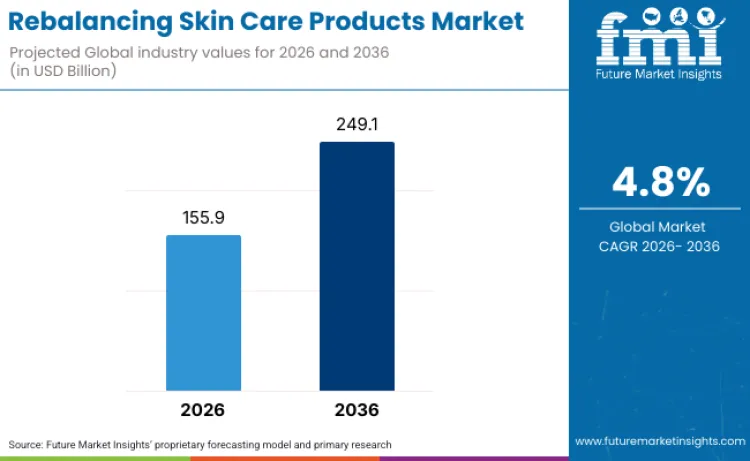
The global rebalancing skin care products market is projected to reach a valuation of USD 155.9 billion in 2026 and expand to USD 249.1 billion by 2036, registering a steady 4.80% CAGR over the forecast period. Demand for rebalancing skin care products, as per Future Market Insights, is being driven by a structural convergence of beauty and skin health, where consumers increasingly prioritize barrier repair, inflammation control, and long-term skin resilience over purely aesthetic outcomes.
Leading innovation in this category is being shaped by manufacturers that integrate dermatological science with wellness-oriented product design. Kevin Cureton, President and CEO of Soléscence, highlighted this shift by stating: “I think where innovation comes in is that fusion with the health aspects of beauty – how do I improve or repair or protect skin.” This executive perspective underscores how rebalancing skincare is moving beyond cosmetic correction toward preventive and restorative skin health platforms.
Advances in ingredient science, skin barrier biology, and sun-care integration are reinforcing this transition. Manufacturers are increasingly aligning portfolios around multifunctional products that protect, repair, and rebalance skin simultaneously, positioning rebalancing skincare as a foundational pillar of modern skin health rather than a niche sub-segment within personal care.
Summary of Rebalancing Skin Care Products Market
What Is Growth Outlook for Rebalancing Skin Care Products Market as per Future Market Insights Projection?
Future Market Insights projects the rebalancing skin care products market to expand at a CAGR of 4.8% from 2026 to 2036, increasing from USD 155.9 Billion in 2026 to USD 249.1 Billion by 2036.
FMI Research Approach: FMI proprietary forecasting model based on premium skincare penetration, portfolio rationalization trends, and margin-led beauty consumption.
How Do FMI Analysts Perceive Rebalancing Skin Care Products Market to Evolve?
FMI analysts perceive the market evolving toward science-backed, profitability-led skincare, prioritizing barrier repair, clinical efficacy, and long-term skin resilience over volume growth.
FMI Research Approach: Analysis of operating model transformation, dermatology-aligned innovation, and premium skincare repositioning.
Which Country Holds Largest Share in Global Rebalancing Skin Care Products Market?
China holds a significant share of the global rebalancing skin care products market, supported by rapid premiumization of face care and strong digital skincare adoption.
FMI Research Approach: FMI country-level revenue modeling based on premium face care uptake, e-commerce penetration, and dermatologist-influenced routines.
How Large Will Rebalancing Skin Care Products Market Be by 2036?
The global rebalancing skin care products market is projected to reach USD 249.1 Billion by 2036.
FMI Research Approach: FMI long-term revenue forecast derived from hero product concentration, repeat purchase behavior, and margin-focused portfolio strategies.
What Is Definition of Rebalancing Skin Care Products Market?
The rebalancing skin care products market comprises clinically positioned skincare products optimized for barrier repair, preventive skin health, and premium value creation.
FMI Research Approach: FMI market taxonomy and inclusion-exclusion framework aligned with portfolio optimization and dermatology-led skincare categories.
What Are Globally Unique Trends Shaping Rebalancing Skin Care Products Market?
Globally unique trends include portfolio rationalization, AI-driven skin diagnostics, and the shift toward premium, dermatology-backed hero products.
FMI Research Approach: Analysis of regulatory maturation, AI adoption in skincare assessment, and global premiumization strategies.
Rebalancing Skin Care Products Market Key Takeaways
| Metric | Details |
|---|---|
| Industry Size (2026) | USD 155.9 Billion |
| Industry Value (2036) | USD 249.1 Billion |
| CAGR (2026-2036) | 4.8% |
Source: Future Market Insights (FMI) analysis, based on proprietary forecasting model and primary research
Which Factors Drive Rebalancing Skin Care Products Market Expansion?
The rebalancing skin care products market is being reshaped by a decisive shift toward profitability led growth, portfolio rationalisation, and sharper focus on prestige and clinically positioned skin care. Large beauty companies are moving away from broad based SKU proliferation and promotional dependency, instead prioritising high efficacy formulations, hero franchises, and segments with stronger pricing power and repeat purchase dynamics. This transition reflects a wider industry recognition that sustainable growth in skin care now depends on operational discipline and brand equity rather than sheer volume expansion.
This strategic reset is being actively reinforced by leadership level transformation initiatives. Stéphane de La Faverie, President and CEO of The Estée Lauder Companies, articulated this momentum clearly, stating: “We had a strong start to fiscal 2026 as we execute on our Beauty Reimagined strategy, returning to organic sales growth, gaining prestige beauty share in a few key strategic areas of focus and improving profitability. Encouragingly, we are building momentum across the organization from the significant operational changes we have executed to-date to be faster and more agile.” His remarks underscore how internal operating model redesign is directly influencing category rebalancing decisions.
At a market level, these operational changes are translating into tighter innovation pipelines, faster go to market execution, and increased investment in premium skin care regimens that align clinical credibility with consumer trust. Brands that successfully integrate agility, selective portfolio focus, and margin accountability are emerging as the primary beneficiaries of the rebalancing skin care products market, as competitive advantage increasingly shifts from scale alone to execution quality and strategic clarity.
How Is the Rebalancing Skin Care Products Market Segmented?
The rebalancing skin care products market is segmented by product type, gender, distribution channel, and region to reflect shifting consumption priorities and profitability-led portfolio strategies. By product type, the market includes face creams and moisturizers, cleansers and face wash, sunscreens, body creams and moisturizers, shaving lotions and creams, and other supporting formats that collectively define daily and treatment-oriented skin care routines. By gender, demand is primarily driven by female consumers, while male-focused products represent a smaller but steadily expanding share as grooming adoption broadens. By distribution channel, sales are led by supermarkets and hypermarkets, followed by pharmacies and drugstores, online platforms, convenience stores, and other retail formats that together shape accessibility and purchase behavior.
FMI analysis suggests that while category breadth remains important, the market structure is increasingly centred on high-rotation product types, female-led consumption, and channels that balance scale with margin control. This segmentation highlights a rebalancing dynamic where core skin care formats and dominant consumer groups provide revenue stability, while digital and specialty channels offer flexibility and incremental growth opportunities.
Why do Face Creams and Moisturizers hold a Dominant Share?
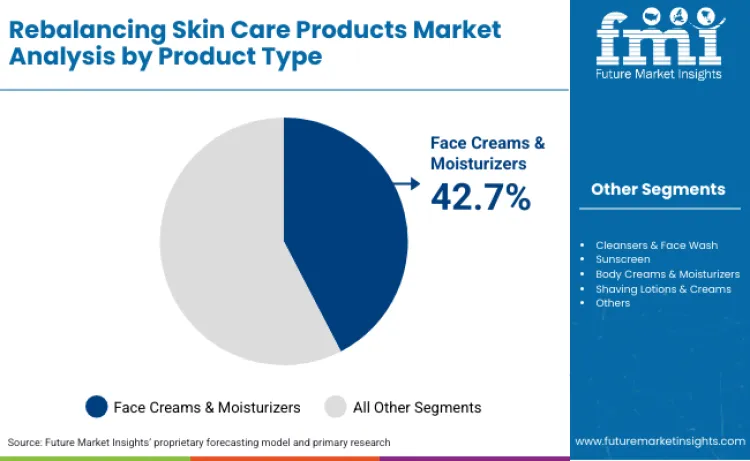
Face creams and moisturizers command a dominant 42.70% share in the rebalancing skin care products market because they sit at the intersection of daily necessity, clinical credibility, and margin resilience. As global beauty groups pivot away from mass volume toward high-value, R&D-intensive portfolios, moisturization and barrier-repair products have emerged as core “hero” categories that can sustain repeat purchase, premium pricing, and long product lifecycles. Unlike trend-led formats, face creams and moisturizers anchor dermatological routines, longevity positioning, and prescription-adjacent regimens, making them central to capital reallocation strategies focused on profitability rather than scale.
This dominance is reinforced by leadership-level strategy shifts across major beauty houses. Kentaro Fujiwara, President and CEO of Shiseido, articulated the rationale behind this focus during the company’s November 2025 strategy reset: “In our previous strategy, ‘SHIFT 2025 and Beyond,’ along with the ‘Action Plan 2025–2026,’ we focused on the selection and concentration of key brands and implementing fundamental global structural reforms to fortify our business foundation. Building upon this solid base, the new strategy aims to maximize brand value through various initiatives, fostering a virtuous cycle that enables reinvestment in new value creation essential for sustainable growth.” This emphasis on selection and concentration directly favors high-efficacy moisturizing and treatment-led products.
Why does the Female Segment Dominate Market Rebalancing?
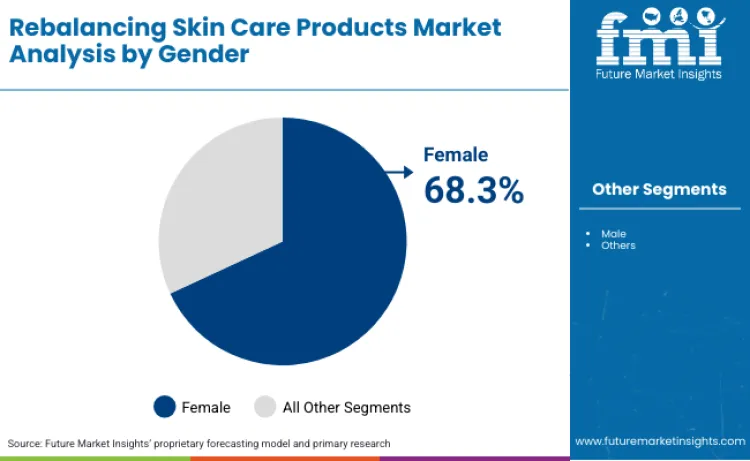
The female segment leads the rebalancing skin care products market with a 68.30% share, as women remain the primary adopters of high-efficacy, innovation-led skin care routines where market rebalancing is most pronounced. Demand is concentrated in advanced face care categories such as anti-aging, hyperpigmentation correction, and clinical moisturization, where breakthrough actives, longer regimens, and higher price points support margin-focused growth strategies. As beauty companies pivot away from broad mass-market volume toward premium and dermatology-aligned portfolios, female consumers represent the most consistent and scalable audience for these R&D-intensive products.
This dominance is reinforced by strategic priorities articulated by leading skin care groups. Vincent Warnery, CEO of Beiersdorf, emphasized this focus in February 2025, stating: “In our quest to be the undisputed authority in skin care, we are relying on our strong brands. We create skin care innovations that make a real difference in the lives of our consumers, focusing in particular on three key future-oriented areas of the skin care market: hyperpigmentation, aging skin, and acne.” These categories are overwhelmingly driven by female purchasing behavior, anchoring women as the core demand base for innovation-led growth.
Why Is AI-Driven Rapid Diagnostics Reshaping Assessment?
Artificial intelligence is fundamentally reshaping skin care assessment by replacing subjective visual evaluation with quantifiable data generated through computer vision, augmented reality, and agentic AI systems. Leading beauty companies are deploying AI-powered tools that analyze micro-level skin cues such as texture irregularities, pigmentation patterns, and hydration signals using consumer smartphones. This shift enables high-fidelity diagnostic inputs to be captured outside clinical settings, reducing dependence on in-store consultations and lowering product return rates by aligning recommendations more precisely with individual skin profiles. AI-driven assessment is therefore functioning as an always-on diagnostic layer that supports personalized regimen design at scale.
How Is Physiological Biomarker Commercialization Changing Clinical Practice?
The skin care sector is pivoting aggressively from surface-level aesthetic evaluation toward objective biological evidence rooted in cellular health, hydration dynamics, and longevity science. In early 2025, Kenvue advanced this transition by presenting clinical data linking formulations from Neutrogena and Aveeno to measurable improvements in skin cellular health and barrier function. This biomarker-led approach moves skin care closer to medical-grade validation by providing a biological positive that addresses root causes such as aging and dehydration rather than masking symptoms. By grounding efficacy claims in clinical studies, brands are redefining trust and enabling consumers to make decisions based on measurable outcomes rather than subjective promises.
What Role Does Regulatory Maturation Play in Lab Innovation?
Increased regulatory clarity under the U.S. Food & Drug Administration framework, particularly through enforcement of the Modernization of Cosmetics Regulation Act, is stabilizing the innovation environment for skin care laboratories. By mid-2025, mandatory safety substantiation and facility registration requirements created a standardized baseline for product validation, allowing companies to invest more confidently in advanced assays and next-generation actives. This regulatory maturation lowers consumer trust barriers and enables specialized labs to introduce high-performance testing methodologies, including updated UV filter evaluation and cellular health assays, without regulatory ambiguity. As a result, innovation is accelerating within a clearly defined compliance structure, supporting long-term scientific advancement in skin care development.
What Is the Rebalancing Skin Care Products Market Regional Outlook?
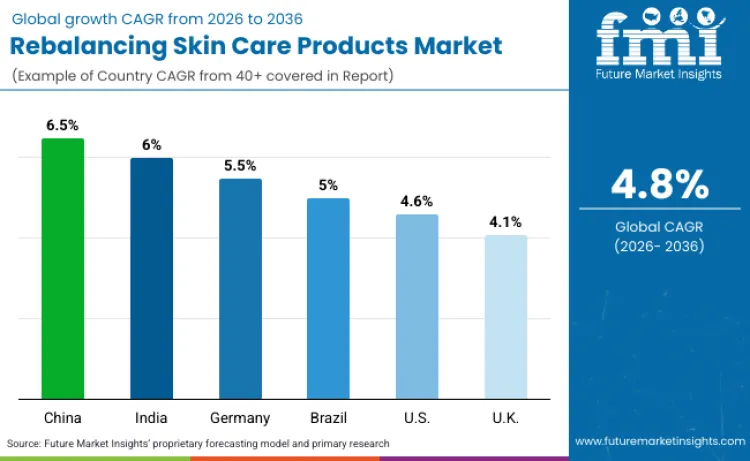
Growth in the rebalancing skin care products market is increasingly concentrated in Asia, where premiumization, digital-first engagement, and rising skin health awareness are accelerating category evolution. While the global market advances at a 4.80% CAGR, emerging economies are outperforming mature regions as multinational beauty companies prioritize high-growth geographies for portfolio reinvestment. China leads the regional outlook with a 6.5% CAGR, supported by strong uptake of premium face care and dermatologist-influenced routines. India follows closely at 6.0%, driven by rapid urbanization, expanding middle-income consumers, and increased penetration of structured skin care regimens.
In contrast, developed markets are growing at comparatively moderate rates as rebalancing strategies emphasize margin optimization, brand strength, and channel efficiency over volume expansion. Germany records a 5.5% CAGR, anchored by pharmacy-led and clinically positioned skin care, while Brazil grows at 5.0% due to consistent demand for sunscreen and daily care products. The United States and the United Kingdom trail with CAGRs of 4.6% and 4.1% respectively, reflecting stable but mature demand where innovation is focused on premium formulations and loyalty-driven repeat purchases. FMI analysis indicates that incremental growth will continue to originate from Asia, while North America and Europe serve as profitability stabilizers within global rebalancing strategies.
| Country | CAGR (2026 to 2036) |
|---|---|
| China | 6.5% |
| India | 6.0% |
| Germany | 5.5% |
| Brazil | 5.0% |
| United States | 4.6% |
| United Kingdom | 4.1% |
Source: FMI historical analysis and forecast data.
Why is China Prioritizing Premium Face Care?
China is expanding at a 6.5% CAGR, and its role in skin care market rebalancing is being shaped by rapid premiumization rather than volume recovery. Official data from the National Bureau of Statistics of China shows that retail cosmetics sales grew 4.5% year-on-year in July 2025 to 26.5 billion yuan, while online sales increased 9.2% over the first seven months of the year, highlighting how digital channels are accelerating access to higher-value products.
This shift is favoring premium face care, where dermatological credibility, visible efficacy, and science-backed claims justify higher price points. Consumers are increasingly trading up from basic moisturizers to targeted solutions for aging, pigmentation, and barrier repair. FMI analysis indicates that China’s rebalancing is structurally linked to e-commerce-led education, influencer-driven dermatology narratives, and rising willingness to pay for clinically positioned products. As a result, premium face care has become the primary lever for margin expansion, positioning China as a profit-upgrading market rather than a volume-led recovery story.
Why is India Accelerating Through Policy-Backed Industry Collaboration?
India is growing at a 6.0% CAGR, supported by demographic scale, rapid urbanization, and increasing institutional support for the beauty and personal care sector. Beyond rising disposable incomes, market rebalancing is being reinforced by formal policy engagement, notably the Memorandum of Understanding between the Department for Promotion of Industry and Internal Trade and The Estée Lauder Companies Inc. to foster innovation and entrepreneurship. This collaboration signals a shift toward structured, innovation-driven growth rather than fragmented mass consumption. Indian consumers are increasingly adopting regimented skin care routines, particularly in face care, as awareness around ingredients, efficacy, and preventive care rises. Organized retail and digital platforms are accelerating access to premium and masstige products, while domestic brands are upgrading formulations to compete with global players. FMI analysis suggests that India’s rebalancing trajectory will be driven by ecosystem formalization, local R&D capability building, and premium face care penetration, positioning the country as a long-term strategic growth engine.
Why is Germany Anchored by Clinical Positioning?
Germany is expanding at a 5.5% CAGR, with market rebalancing firmly anchored in clinical credibility and pharmacy-led consumption. According to industry data from the German Cosmetic Association, domestic cosmetics sales reached EUR 23.9 billion, with skin and face care growing at 11.1%, underscoring the category’s everyday relevance. German consumers demonstrate strong trust in dermatologist-recommended products, evidence-based claims, and medically positioned formulations, which limits speculative trend cycles but ensures stable demand.
Pharmacies and drugstores remain dominant channels, reinforcing disciplined purchasing behavior centered on efficacy and safety. FMI analysis indicates that Germany’s rebalancing is less about premium experimentation and more about reinforcing trusted face care and treatment categories that deliver consistent outcomes. This clinical anchoring makes Germany a stabilizing market within Europe, where profitability is defended through credibility, repeat usage, and long product life cycles rather than rapid innovation churn.
How is Brazil Leveraging Daily Care and Sun Protection?
Brazil is growing at a 5.0% CAGR, with rebalancing driven by structurally high engagement in daily care routines and sun protection products. Skin care consumption in Brazil is closely tied to climate conditions, making sunscreens and body care non-discretionary rather than seasonal purchases. In 2025, appreciation of the Brazilian real against the U.S. dollar helped reduce inflationary pressure by lowering the cost of imported ingredients and finished goods, supporting affordability across skin care categories. This macroeconomic relief has reinforced steady consumption rather than premium volatility. FMI analysis indicates that Brazil’s market rebalancing is anchored in volume-stable daily care formats, with gradual upgrades in formulation quality and SPF efficacy rather than sharp shifts to ultra-premium positioning. As a result, Brazil functions as a resilience-driven growth market, where consistency in usage and broad penetration underpin long-term demand rather than discretionary luxury spending.
Why is the United States Shifting Toward Premium Innovation?
The United States is expanding at a 4.6% CAGR, reflecting a mature but innovation-intensive skin care landscape. The industry is characterized by a dense ecosystem of small and medium-sized firms engaged in advanced product and ingredient research, as noted by the International Trade Administration. Market rebalancing is therefore centered on premium innovation rather than user expansion. Brands are competing on novel actives, biotech-derived ingredients, and differentiated delivery systems, particularly in face care and anti-aging.
Consumers are highly educated, comparison-driven, and willing to pay for perceived performance gains, reinforcing premium price structures. FMI analysis suggests that the U.S. market is reallocating capital toward fewer, higher-impact launches that can command loyalty and pricing power. This innovation-first dynamic positions the U.S. as a testing ground for next-generation formulations that later scale globally, while serving as a margin-defense market rather than a high-growth volume engine.
How is the United Kingdom Focusing on Loyalty-Driven Prevention?
The United Kingdom trails at a 4.1% CAGR, reflecting stable but mature demand conditions. Data from the Office for National Statistics shows that annual sales volumes rose 1.3% through 2025, despite broader economic uncertainty, indicating resilient consumer loyalty. Market rebalancing in the UK is centered on prevention-oriented skin care, repeat purchase behavior, and long-term brand trust rather than aggressive category expansion. Consumers increasingly prioritize maintenance, sensitive-skin solutions, and preventive face care over experimental products. Retailers and brands are responding by emphasizing subscription models, continuity of regimens, and value reinforcement rather than rapid innovation cycles. FMI analysis indicates that the UK’s role in global rebalancing is as a profitability anchor, where predictable demand, strong brand relationships, and disciplined purchasing behavior provide stability to multinational portfolios amid more volatile emerging markets.
How Is the Competition in the Rebalancing Skin Care Products Market?
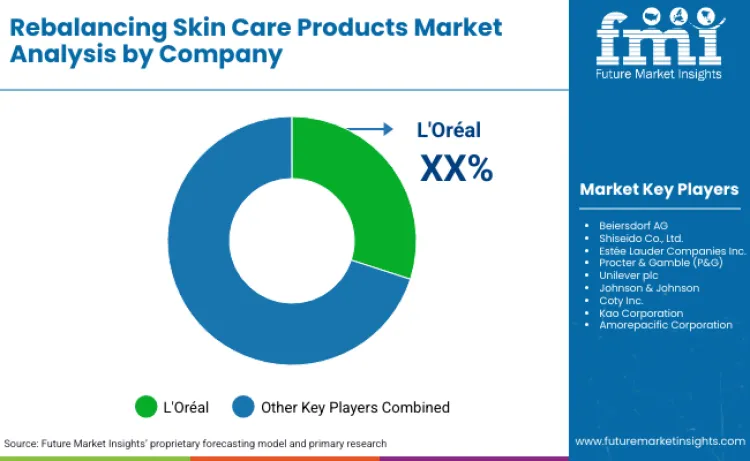
Competition in the rebalancing skin care products market is increasingly defined by strategic focus rather than sheer scale. Established leaders such as L’Oréal are defending their positions by concentrating investment on geographic priorities, core demographics, and highly promising technologies that deliver science-based beauty solutions. This approach reflects a deliberate shift toward fewer, higher-impact innovation platforms built around advanced actives, diagnostics, and personalization, allowing large groups to maintain leadership while improving margin quality. Their competitive strength lies in global R&D depth, data-driven consumer insight, and the ability to scale validated technologies across multiple brands and regions.
At the same time, startups and agile legacy brands are actively challenging this dominance by securing leadership in narrowly defined, high-performance niches such as clinical face care, dermatology-adjacent formulations, and condition-specific solutions. Vincent Warnery, CEO of Beiersdorf, validated the clinical relevance of these competitive moves, stating: “We are focusing on our strong brands, delivering breakthrough innovations and expanding into new markets, categories, and channels.” These focused entries are forcing incumbents to defend share through speed, clinical proof, and sharper portfolio discipline.
Strategic partnerships, selective acquisitions, and technology alliances are further intensifying competition, shifting the market away from mass positioning toward credibility, efficacy, and innovation leadership. As a result, competitive advantage in the rebalancing skin care products market is increasingly determined by scientific differentiation and execution agility rather than brand scale alone.
Recent Developments:
In March 2025, Shiseido introduced a renewed ULTIMUNE serum, built on over 30 years of skin research and powered by patented Power Fermented Camellia+, designed to strengthen skin’s natural defenses, support regeneration, and visibly slow signs of aging over time.
In May 2025, Unilever shared new research showing a link between the skin microbiome and psychological wellbeing across areas such as the face and scalp. Published in the British Journal of Dermatology, the study builds on Unilever’s long-term microbiome research and growing innovation in skin and wellness science.
Key Players in Rebalancing Skin Care Products Market
- L’Oréal S.A.
- Beiersdorf AG
- Shiseido Co., Ltd.
- Estée Lauder Companies Inc.
- Procter & Gamble (P&G)
- Unilever plc
- Johnson & Johnson
- Coty Inc.
- Kao Corporation
- Amorepacific Corporation
Market Definition
The Rebalancing Skin Care Products Market refers to the global shift within the skin care industry from volume-led, mass-market expansion toward margin-driven, science-backed, and portfolio-rationalized growth models. This market captures products and strategies that prioritize high-efficacy face care, dermatology-aligned formulations, premium moisturization, targeted treatments, and longevity-focused skin health over broad SKU proliferation. Rebalancing reflects how manufacturers reallocate capital toward fewer hero products, clinically validated actives, and consumer segments with higher lifetime value. It also includes strategic changes in channel mix, with stronger emphasis on pharmacies, digital platforms, and premium retail. The market is defined not only by product categories but by how companies optimize innovation pipelines, pricing discipline, and operational agility to achieve sustainable profitability rather than rapid volume growth.
Market Inclusion
The market includes face creams and moisturizers, cleansers, sunscreens, body care, shaving products, and other skin care formats that are part of portfolio optimization and premiumization strategies. It covers products positioned around clinical efficacy, dermatological validation, ingredient science, longevity, barrier repair, and preventive skin health. Included are mass-premium, premium, and dermo-cosmetic offerings sold through supermarkets, pharmacies, online platforms, and specialty retail where brands actively rebalance channel and pricing strategies. The scope also includes innovation-led launches, reformulated legacy products, and AI- or data-informed personalization initiatives that support margin improvement. Geographic inclusion spans both emerging and developed markets where rebalancing is evident through premium face care adoption, channel shifts, and focused brand investment.
Market Exclusion
The market excludes decorative cosmetics such as color makeup, fragrances, and hair care products that do not directly contribute to skin health or treatment-oriented positioning. It also excludes commoditized, low-margin private-label skin care products that compete primarily on price without clinical, scientific, or innovation-led differentiation. Over-the-counter pharmaceutical dermatology drugs, prescription-only treatments, and medical devices are not included unless they are marketed as cosmetic skin care solutions. Short-term trend products with no repeat usage profile, novelty formats, and one-time promotional SKUs are excluded, as they do not align with rebalancing objectives. Additionally, purely volume-driven distribution strategies focused on discounting rather than profitability are outside the defined market scope.
Scope of Report
| Items | Values |
|---|---|
| Quantitative Units | USD billion |
| Product Type | Radiance & Brightening Creams; Radiance Serums (Vitamin C, multi-active); Exfoliating Radiance Masks; Toners & Essences; Radiance-Boosting Cleansers; Sunscreens with Glow Enhancement |
| Ingredient Profile | Vitamin C & Derivatives; Niacinamide; Alpha Arbutin; Tranexamic Acid; Peptides & Antioxidants; Botanical Brightening Extracts |
| Distribution Channel | E-Commerce Platforms; Specialty Beauty Retail; Department Stores; Pharmacies & Drugstores; Supermarkets & Hypermarkets |
| End User | Women; Men; Unisex / All Gender |
| Technology & Science Focus | Longevity-driven brightening actives; oxidative stress reduction systems; cellular renewal boosters; biomarker-validated radiance pathways; AI-guided personalization platforms |
| Regions Covered | North America; Europe; Asia Pacific; Latin America; Middle East & Africa |
| Countries Covered | China; India; Germany; Brazil; United States; United Kingdom; Japan; South Korea; France; and 40+ additional countries |
| Key Companies Profiled | L’Oréal; Estée Lauder; Shiseido; Procter & Gamble; Unilever; Beiersdorf; Johnson & Johnson; The Ordinary; Clinique; Garnier; Olay; Innisfree |
| Additional Attributes | Dollar sales by product format and ingredient platform; clinical substantiation intensity; regulatory-driven ingredient adoption; longevity science penetration; e-commerce education-led demand; premiumization versus mass scalability dynamics |
Radiance-Boosting Skin Care Market by Segments
By Product Type:
- Radiance & Brightening Creams
- Radiance Serums with Active Brightening Ingredients (e.g., Vitamin C)
- Exfoliating Radiance Masks
- Toners & Essences
- Radiance-Boosting Cleansers
- Sunscreens with Glow Enhancement
By Ingredient Profile:
- Vitamin C & Derivatives
- Niacinamide
- Alpha Arbutin
- Tranexamic Acid
- Peptides & Antioxidants
- Botanical Brightening Extracts
By Distribution Channel:
- E-Commerce Platforms
- Specialty Beauty Retail
- Department Stores
- Pharmacies & Drugstores
- Supermarkets & Hypermarkets
By End User:
- Women
- Men
- Unisex / All Gender
By Region:
- North America
- Europe
- Asia Pacific
- Latin America
- Middle East & Africa
Bibliography
- National Bureau of Statistics of China. (2025, August). Retail Sales of Consumer Goods Report: July 2025 Cosmetics Performance and Online Penetration.
- Department for Promotion of Industry and Internal Trade (DPIIT), India. (2024, March). Memorandum of Understanding between DPIIT and The Estée Lauder Companies for Beauty Innovation.
- IKW (German Cosmetic, Toiletry, Perfumery and Detergent Association). (2025, February). The Household and Personal Care Market in Germany: 2024 Annual Sales and 2025 Forecast.
Frequently Asked Questions
What is the current global market size for Rebalancing Skin Care Products?
The global market is valued at USD 155.9 billion in 2026, driven by growing consumer focus on barrier repair, inflammation control, and long-term skin resilience
What is the projected CAGR for the Rebalancing Skin Care Products market?
The market is projected to grow at a 4.8% CAGR from 2026 to 2036, reflecting steady expansion anchored in clinically positioned and premium skincare portfolios.
Which segment currently dominates the industry?
Face creams and moisturizers lead with a 42.7% share, while female consumers dominate demand with 68.3% of total usage.
What are the primary drivers for adoption in emerging markets?
Rapid premiumization of face care, expanding structured skincare routines, and strong digital retail penetration in China and India are the main growth drivers.
Who are the leading players in the Rebalancing Skin Care Products space?
Major companies include L’Oréal, Beiersdorf, Shiseido, Estée Lauder Companies, Procter & Gamble, Unilever, Johnson & Johnson, Kao Corporation, Coty, and Amorepacific.
Preview the report firsthand - request a free sample
Get SampleGet the brochure for pricing and purchase details.
Get PDFTable of Content
- Executive Summary
- Global Market Outlook
- Demand Side Trends
- Supply Side Trends
- Technology Roadmap Analysis
- Analysis and Recommendations
- Market Overview
- Market Coverage / Taxonomy
- Market Definition / Scope / Limitations
- Research Methodology
- Chapter Orientation
- Analytical Lens and Working Hypotheses
- Market Structure, Signals, and Trend Drivers
- Benchmarking and Cross-market Comparability
- Market Sizing, Forecasting, and Opportunity Mapping
- Research Design and Evidence Framework
- Desk Research Programme (Secondary Evidence)
- Company Annual and Sustainability Reports
- Peer-reviewed Journals and Academic Literature
- Corporate Websites, Product Literature, and Technical Notes
- Earnings Decks and Investor Briefings
- Statutory Filings and Regulatory Disclosures
- Technical White Papers and Standards Notes
- Trade Journals, Industry Magazines, and Analyst Briefs
- Conference Proceedings, Webinars, and Seminar Materials
- Government Statistics Portals and Public Data Releases
- Press Releases and Reputable Media Coverage
- Specialist Newsletters and Curated Briefings
- Sector Databases and Reference Repositories
- FMI Internal Knowledge Base and Historical Datasets
- Subscription Datasets and Paid Sources
- Social Channels, Communities, and Digital Listening Inputs
- Additional Desk Sources
- Expert Input and Fieldwork (Primary Evidence)
- Primary Modes
- Qualitative Interviews and Expert Elicitation
- Quantitative Surveys and Structured Data Capture
- Blended Approach
- Why Primary Evidence is Used
- Field Techniques
- Interviews
- Surveys
- Focus Groups
- Observational and In-context Research
- Social and Community Interactions
- Stakeholder Universe Engaged
- C-suite Leaders
- Board Members
- Presidents and Vice Presidents
- R&D and Innovation Heads
- Technical Specialists
- Domain Subject-matter Experts
- Scientists
- Physicians and Other Healthcare Professionals
- Governance, Ethics, and Data Stewardship
- Research Ethics
- Data Integrity and Handling
- Primary Modes
- Tooling, Models, and Reference Databases
- Desk Research Programme (Secondary Evidence)
- Data Engineering and Model Build
- Data Acquisition and Ingestion
- Cleaning, Normalisation, and Verification
- Synthesis, Triangulation, and Analysis
- Quality Assurance and Audit Trail
- Market Background
- Market Dynamics
- Drivers
- Restraints
- Opportunity
- Trends
- Scenario Forecast
- Demand in Optimistic Scenario
- Demand in Likely Scenario
- Demand in Conservative Scenario
- Opportunity Map Analysis
- Product Life Cycle Analysis
- Supply Chain Analysis
- Investment Feasibility Matrix
- Value Chain Analysis
- PESTLE and Porter's Analysis
- Regulatory Landscape
- Regional Parent Market Outlook
- Production and Consumption Statistics
- Import and Export Statistics
- Market Dynamics
- Global Market Analysis 2021 to 2025 and Forecast, 2026 to 2036
- Historical Market Size Value (USD Million) Analysis, 2021 to 2025
- Current and Future Market Size Value (USD Million) Projections, 2026 to 2036
- Y-o-Y Growth Trend Analysis
- Absolute $ Opportunity Analysis
- Global Market Pricing Analysis 2021 to 2025 and Forecast 2026 to 2036
- Y-o-Y Growth Trend Analysis 2021 to 2025
- Absolute $ Opportunity Analysis 2026 to 2036
- Global Market Analysis 2021 to 2025 and Forecast 2026 to 2036, By Product Type
- Introduction / Key Findings
- Historical Market Size Value (USD Million) Analysis By Product Type, 2021 to 2025
- Current and Future Market Size Value (USD Million) Analysis and Forecast By Product Type, 2026 to 2036
- Face Creams & Moisturizers
- Cleansers & Face Wash
- Sunscreen
- Body Creams & Moisturizers
- Shaving Lotions & Creams
- Others
- Y-o-Y Growth Trend Analysis By Product Type, 2021 to 2025
- Absolute $ Opportunity Analysis By Product Type, 2026 to 2036
- Global Market Analysis 2021 to 2025 and Forecast 2026 to 2036, By Gender
- Introduction / Key Findings
- Historical Market Size Value (USD Million) Analysis By Gender, 2021 to 2025
- Current and Future Market Size Value (USD Million) Analysis and Forecast By Gender, 2026 to 2036
- Female
- Male
- Unisex / All Gender
- Y-o-Y Growth Trend Analysis By Gender, 2021 to 2025
- Absolute $ Opportunity Analysis By Gender, 2026 to 2036
- Global Market Analysis 2021 to 2025 and Forecast 2026 to 2036, By Distribution Channel
- Introduction / Key Findings
- Historical Market Size Value (USD Million) Analysis By Distribution Channel, 2021 to 2025
- Current and Future Market Size Value (USD Million) Analysis and Forecast By Distribution Channel, 2026 to 2036
- Supermarkets & Hypermarkets
- Pharmacy & Drugstore
- Online
- Convenience Stores
- Others
- Y-o-Y Growth Trend Analysis By Distribution Channel, 2021 to 2025
- Absolute $ Opportunity Analysis By Distribution Channel, 2026 to 2036
- Global Market Analysis 2021 to 2025 and Forecast 2026 to 2036, By Region
- Introduction
- Historical Market Size Value (USD Million) Analysis By Region, 2021 to 2025
- Current Market Size Value (USD Million) Analysis and Forecast By Region, 2026 to 2036
- North America
- Latin America
- Western Europe
- Eastern Europe
- East Asia
- South Asia and Pacific
- Middle East & Africa
- Market Attractiveness Analysis By Region
- North America Market Analysis 2021 to 2025 and Forecast 2026 to 2036, By Country
- Historical Market Size Value (USD Million) Trend Analysis By Market Taxonomy, 2021 to 2025
- Market Size Value (USD Million) Forecast By Market Taxonomy, 2026 to 2036
- By Country
- USA
- Canada
- Mexico
- By Product Type
- By Gender
- By Distribution Channel
- By Country
- Market Attractiveness Analysis
- By Country
- By Product Type
- By Gender
- By Distribution Channel
- Key Takeaways
- Latin America Market Analysis 2021 to 2025 and Forecast 2026 to 2036, By Country
- Historical Market Size Value (USD Million) Trend Analysis By Market Taxonomy, 2021 to 2025
- Market Size Value (USD Million) Forecast By Market Taxonomy, 2026 to 2036
- By Country
- Brazil
- Chile
- Rest of Latin America
- By Product Type
- By Gender
- By Distribution Channel
- By Country
- Market Attractiveness Analysis
- By Country
- By Product Type
- By Gender
- By Distribution Channel
- Key Takeaways
- Western Europe Market Analysis 2021 to 2025 and Forecast 2026 to 2036, By Country
- Historical Market Size Value (USD Million) Trend Analysis By Market Taxonomy, 2021 to 2025
- Market Size Value (USD Million) Forecast By Market Taxonomy, 2026 to 2036
- By Country
- Germany
- UK
- Italy
- Spain
- France
- Nordic
- BENELUX
- Rest of Western Europe
- By Product Type
- By Gender
- By Distribution Channel
- By Country
- Market Attractiveness Analysis
- By Country
- By Product Type
- By Gender
- By Distribution Channel
- Key Takeaways
- Eastern Europe Market Analysis 2021 to 2025 and Forecast 2026 to 2036, By Country
- Historical Market Size Value (USD Million) Trend Analysis By Market Taxonomy, 2021 to 2025
- Market Size Value (USD Million) Forecast By Market Taxonomy, 2026 to 2036
- By Country
- Russia
- Poland
- Hungary
- Balkan & Baltic
- Rest of Eastern Europe
- By Product Type
- By Gender
- By Distribution Channel
- By Country
- Market Attractiveness Analysis
- By Country
- By Product Type
- By Gender
- By Distribution Channel
- Key Takeaways
- East Asia Market Analysis 2021 to 2025 and Forecast 2026 to 2036, By Country
- Historical Market Size Value (USD Million) Trend Analysis By Market Taxonomy, 2021 to 2025
- Market Size Value (USD Million) Forecast By Market Taxonomy, 2026 to 2036
- By Country
- China
- Japan
- South Korea
- By Product Type
- By Gender
- By Distribution Channel
- By Country
- Market Attractiveness Analysis
- By Country
- By Product Type
- By Gender
- By Distribution Channel
- Key Takeaways
- South Asia and Pacific Market Analysis 2021 to 2025 and Forecast 2026 to 2036, By Country
- Historical Market Size Value (USD Million) Trend Analysis By Market Taxonomy, 2021 to 2025
- Market Size Value (USD Million) Forecast By Market Taxonomy, 2026 to 2036
- By Country
- India
- ASEAN
- Australia & New Zealand
- Rest of South Asia and Pacific
- By Product Type
- By Gender
- By Distribution Channel
- By Country
- Market Attractiveness Analysis
- By Country
- By Product Type
- By Gender
- By Distribution Channel
- Key Takeaways
- Middle East & Africa Market Analysis 2021 to 2025 and Forecast 2026 to 2036, By Country
- Historical Market Size Value (USD Million) Trend Analysis By Market Taxonomy, 2021 to 2025
- Market Size Value (USD Million) Forecast By Market Taxonomy, 2026 to 2036
- By Country
- Kingdom of Saudi Arabia
- Other GCC Countries
- Turkiye
- South Africa
- Other African Union
- Rest of Middle East & Africa
- By Product Type
- By Gender
- By Distribution Channel
- By Country
- Market Attractiveness Analysis
- By Country
- By Product Type
- By Gender
- By Distribution Channel
- Key Takeaways
- Key Countries Market Analysis
- USA
- Pricing Analysis
- Market Share Analysis, 2025
- By Product Type
- By Gender
- By Distribution Channel
- Canada
- Pricing Analysis
- Market Share Analysis, 2025
- By Product Type
- By Gender
- By Distribution Channel
- Mexico
- Pricing Analysis
- Market Share Analysis, 2025
- By Product Type
- By Gender
- By Distribution Channel
- Brazil
- Pricing Analysis
- Market Share Analysis, 2025
- By Product Type
- By Gender
- By Distribution Channel
- Chile
- Pricing Analysis
- Market Share Analysis, 2025
- By Product Type
- By Gender
- By Distribution Channel
- Germany
- Pricing Analysis
- Market Share Analysis, 2025
- By Product Type
- By Gender
- By Distribution Channel
- UK
- Pricing Analysis
- Market Share Analysis, 2025
- By Product Type
- By Gender
- By Distribution Channel
- Italy
- Pricing Analysis
- Market Share Analysis, 2025
- By Product Type
- By Gender
- By Distribution Channel
- Spain
- Pricing Analysis
- Market Share Analysis, 2025
- By Product Type
- By Gender
- By Distribution Channel
- France
- Pricing Analysis
- Market Share Analysis, 2025
- By Product Type
- By Gender
- By Distribution Channel
- India
- Pricing Analysis
- Market Share Analysis, 2025
- By Product Type
- By Gender
- By Distribution Channel
- ASEAN
- Pricing Analysis
- Market Share Analysis, 2025
- By Product Type
- By Gender
- By Distribution Channel
- Australia & New Zealand
- Pricing Analysis
- Market Share Analysis, 2025
- By Product Type
- By Gender
- By Distribution Channel
- China
- Pricing Analysis
- Market Share Analysis, 2025
- By Product Type
- By Gender
- By Distribution Channel
- Japan
- Pricing Analysis
- Market Share Analysis, 2025
- By Product Type
- By Gender
- By Distribution Channel
- South Korea
- Pricing Analysis
- Market Share Analysis, 2025
- By Product Type
- By Gender
- By Distribution Channel
- Russia
- Pricing Analysis
- Market Share Analysis, 2025
- By Product Type
- By Gender
- By Distribution Channel
- Poland
- Pricing Analysis
- Market Share Analysis, 2025
- By Product Type
- By Gender
- By Distribution Channel
- Hungary
- Pricing Analysis
- Market Share Analysis, 2025
- By Product Type
- By Gender
- By Distribution Channel
- Kingdom of Saudi Arabia
- Pricing Analysis
- Market Share Analysis, 2025
- By Product Type
- By Gender
- By Distribution Channel
- Turkiye
- Pricing Analysis
- Market Share Analysis, 2025
- By Product Type
- By Gender
- By Distribution Channel
- South Africa
- Pricing Analysis
- Market Share Analysis, 2025
- By Product Type
- By Gender
- By Distribution Channel
- USA
- Market Structure Analysis
- Competition Dashboard
- Competition Benchmarking
- Market Share Analysis of Top Players
- By Regional
- By Product Type
- By Gender
- By Distribution Channel
- Competition Analysis
- Competition Deep Dive
- L'Oréal S.A.
- Beiersdorf AG
- Shiseido Co., Ltd.
- Estée Lauder Companies Inc.
- Procter & Gamble (P&G)
- Unilever plc
- Johnson & Johnson
- Coty Inc.
- Kao Corporation
- Amorepacific Corporation
- Competition Deep Dive
- Assumptions & Acronyms Used


