

- Industry Size (2026)
- USD 44.1 Bn
- Forecast (2036)
- USD 63.8 Bn
- CAGR (2026 to 2036)
- 3.80%
Soothing Skin Care Products Market Forecast and Outlook 2026 to 2036
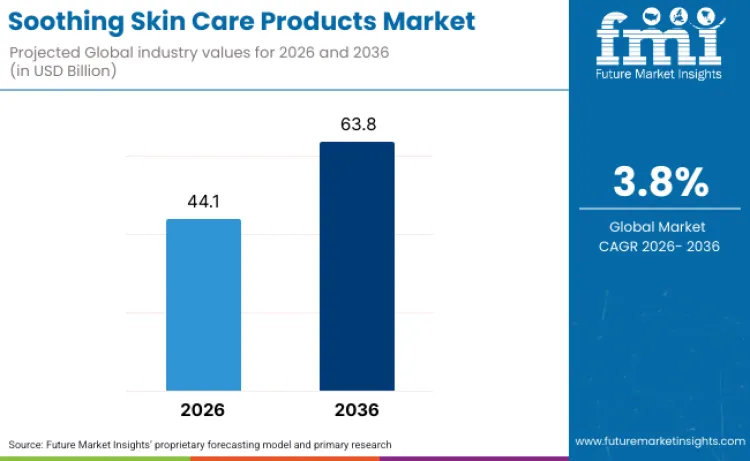
The global soothing skin care products market is projected to reach a valuation of USD 44.1 billion in 2026 and expand to USD 63.8 billion by 2036, recording a steady 3.80% CAGR during the forecast period. Demand for soothing skin care products, as per Future Market Insights, is being shaped by the rising global incidence of sensitive skin conditions, eczema, rosacea, and post-procedure irritation, alongside growing consumer prioritization of daily skin comfort, barrier repair, and dermatologically validated formulations.
Leading dermatological skincare manufacturers are increasingly positioning their portfolios around therapeutic credibility and social responsibility rather than cosmetic claims alone. Vincent Warnery, CEO of Beiersdorf AG, reinforced this strategic direction by stating: "Our products are not only designed for a wide range of skin indications, but also improve daily well-being, self-confidence, and ultimately quality of life. Our Eucerin brand, for example, takes an active stand against the stigmatization of people with chronic skin diseases." This executive emphasis underscores how soothing skincare is evolving into a quality-of-life category, where efficacy, empathy, and long-term skin health outcomes are central to brand differentiation.
Regulatory endorsement of barrier-safe ingredients, combined with dermatologist-led education and pharmacy-channel expansion, is further accelerating adoption across both therapeutic and preventive use cases. Manufacturers are responding by prioritizing clinically tested formulations, fragrance-free systems, and evidence-backed claims, positioning soothing skincare as a foundational pillar of modern dermatological care rather than a niche adjunct within personal care routines.
Summary of Soothing Skin Care Products Market
What Is Growth Outlook for Soothing Skin Care Products Market as per Future Market Insights Projection?
Future Market Insights projects the soothing skin care products market to expand at a CAGR of 3.8% from 2026 to 2036, growing from USD 44.1 Billion in 2026 to USD 63.8 Billion by 2036.
FMI Research Approach: Based on primary sales data from dermocosmetic brands and prevalence-adjusted modeling of sensitive skin conditions.
How Do FMI Analysts Perceive Soothing Skin Care Products Market to Evolve?
FMI analysts perceive the market shifting from niche calming formulas to mainstream clinical skincare, focused on barrier repair, inflammation control, and neuro-soothing actives.
FMI Research Approach: Ingredient efficacy benchmarking, dermatology channel tracking, and regulatory influence mapping.
Which Country Holds Largest Share in Global Soothing Skin Care Products Market?
China holds a leading share of the soothing skin care market, driven by urban sensitivity prevalence, air pollution-linked skin issues, and rapid dermocosmetic expansion.
FMI Research Approach: Country-level demand modeling by environmental stressor exposure and NMPA formulation regulations.
How Large Will Soothing Skin Care Products Market Be by 2036?
The global soothing skin care products market is projected to reach USD 63.8 Billion by 2036.
FMI Research Approach: Long-range forecast aligned with product usage across facial care, pharmacy-led adoption, and pediatric skin condition prevalence rates.
What Is Definition of Soothing Skin Care Products Market?
The market comprises barrier-supportive skincare products clinically formulated to reduce redness, irritation, and inflammation across sensitive and compromised skin types.
FMI Research Approach: Defined by ISO 11930 test protocols, dermatology validation, and anti-inflammatory active inclusion criteria.
What Are Globally Unique Trends Shaping Soothing Skin Care Products Market?
Key trends include the rise of microbiome-safe ingredients, pH-balanced cleansing, neuroscience-led formulation, and pharmacy channel expansion.
FMI Research Approach: Analysis of R&D investment shifts, wellness integration in formulation pipelines, and cross-brand active ingredient reuse.
Soothing Skin Care Products Market Key Takeaways
| Metric | Details |
|---|---|
| Industry Size (2026) | USD 44.1 Billion |
| Industry Value (2036) | USD 63.8 Billion |
| CAGR (2026-2036) | 3.8% |
Source: Future Market Insights (FMI) analysis, based on proprietary forecasting model and primary research
Which Factors Drive Soothing Skin Care Products Adoption?
Soothing skin care product adoption is being driven by a measurable shift toward science-led formulation platforms that can scale efficiently across multiple brands and geographies without reformulation risk. Rising incidence of sensitive skin conditions, combined with stricter ingredient scrutiny and dermatologist influence, is forcing manufacturers to prioritize active ingredients with proven tolerability, barrier repair efficacy, and regulatory acceptance across global markets.
This strategic direction is explicitly reflected in the innovation-led growth models of major dermatological players. Beiersdorf AG articulated this approach in its press release, stating: "As a pioneer in modern skin care, innovation is the heartbeat of Beiersdorf. We are leveraging our R&D capabilities as a growth engine to drive groundbreaking innovations. The formula is simple: Our successful active ingredients are integrated across Beiersdorf's brands in both established markets and emerging growth regions." This philosophy highlights how cross-brand active ingredient standardization is accelerating global rollouts while maintaining clinical credibility.
The result is a structural transition away from fragmented, brand-specific soothing claims toward scalable dermatological platforms built on shared R&D, clinical validation, and supply-chain efficiency. As consumer trust increasingly aligns with scientific consistency and long-term skin health outcomes, manufacturers that can replicate proven soothing actives across portfolios are gaining a decisive adoption advantage in both mature and high-growth regions.
How is the Soothing Skin Care Products Market Segmented?
The soothing skin care products market is segmented by product type, application, target group, ingredient type, and distribution channel to reflect the diverse pathways through which sensitive skin care is adopted and used. By product type, the market includes cleansers, moisturizers, serums, masks, and specialty treatments that form the core interface for calming irritation and supporting barrier repair. By application, demand spans facial, body, hand, and lip care, reflecting varying exposure levels, sensitivity risks, and daily usage intensity across skin areas. By target group, adoption is led by women, while infants and pediatric users are emerging as critical growth segments due to rising atopic dermatitis prevalence and preventive dermatology practices.
From a formulation and access perspective, the market is further segmented by ingredient type into natural and synthetic systems, and by distribution channel into online platforms, pharmacies, dermatology clinics, and mass retail. FMI analysis suggests that while digital channels and natural ingredient claims are expanding rapidly, the market structure remains strongly anchored in dermatological validation and pharmacy-led trust. This segmentation highlights a dual-track market where everyday soothing products scale through e-commerce, while clinically validated formulations gain depth, authority, and long-term loyalty through medical and professional care channels.
Why do Cleansers hold a Dominant Share?
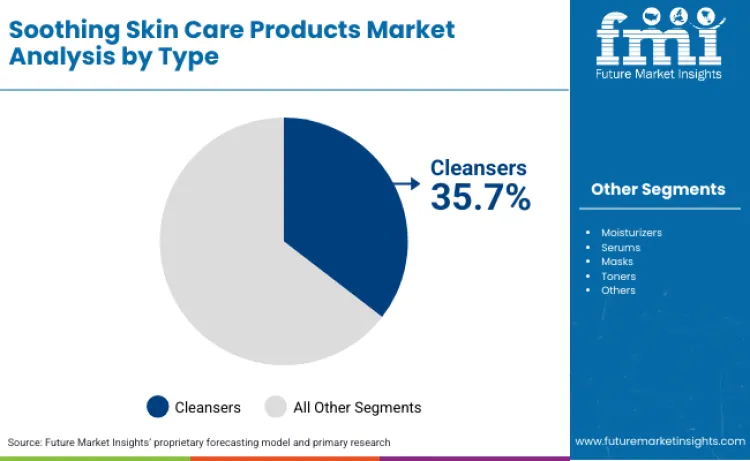
Cleansers command a dominant 35.70% share because they represent the essential daily interface in soothing skin care routines, where irritation prevention, barrier preservation, and residue-free cleansing are critical for sensitive and compromised skin. Leading dermatological and skin health companies continue to reinforce this position by anchoring cleanser development in clinical science rather than cosmetic performance alone.
Kenvue articulated this commitment in its March 7, 2025 official press release, stating: "Our Skin Health and Beauty brands are at the forefront of next-generation science as high-performance products that are effective in promoting the health and longevity of skin. The results of these clinical studies further illustrate our commitment to developing innovative, science-backed experiences for consumers."
This emphasis on clinically validated cleansing systems protects the segment from displacement by secondary treatment products, as dermatologists and consumers alike prioritize gentle, proven cleansing as the foundation of long-term skin health. Traditional cleansers are evolving, with many now incorporating barrier-supporting actives and pH-balanced formulations to align with therapeutic skincare protocols rather than standalone cosmetic use.
Why does Face application hold a Dominant Share?
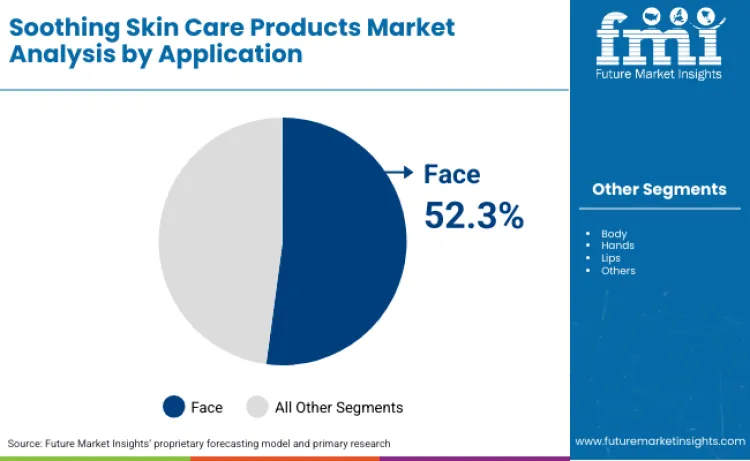
Face applications command a dominant 52.30% share because facial skin is the most exposed to environmental stressors and aesthetic sensitivity triggers, making soothing formulations essential for daily comfort, barrier repair, and visible redness control. Beiersdorf AG, a leader in dermacosmetics, continues to defend this position by expanding clinically positioned facial skincare portfolios that combine efficacy with long-term brand trust.
The company reinforced this strategic focus in its 9M 2025 Results official statement: "We are pleased to see the outstanding performance of our derma business. It proves that we can continue to outperform the competition and deliver double-digit growth.
By broadening our skin care focus and reinforcing deodorants as a strategic growth pillar, we are strengthening NIVEA's position for long-term success." This deep-rooted investment in facial skin health protects the segment from displacement by peripheral body-care applications, as consumers prioritize face-specific solutions they rely on daily. Facial soothing products are evolving, with many now integrating barrier-repair actives and dermatologist-tested claims to align with long-term skin health management rather than short-term cosmetic relief.
Why does the Women target group dominate demand?
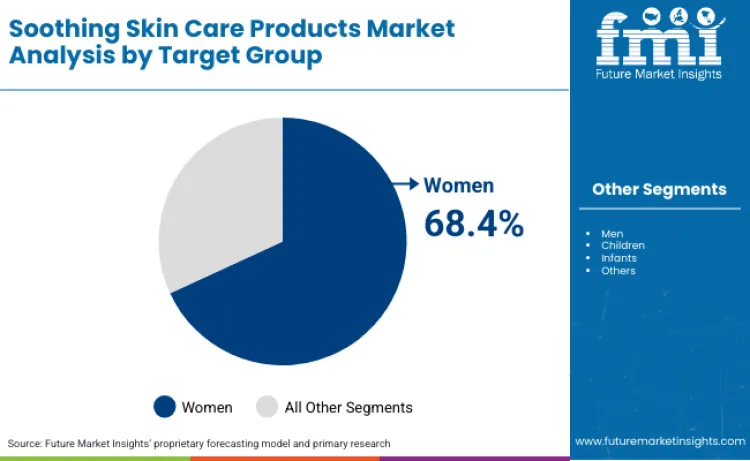
The women segment accounts for a dominant 68.40% share as female consumers show higher prevalence of self-reported sensitive skin, greater engagement with preventive dermatology routines, and stronger adoption of tailored skincare solutions across life stages. La Roche-Posay reinforced this positioning through its formulation philosophy, as highlighted in Reader’s Digest via L’Oréal Executive Insights on August 15, 2025: "La Roche-Posay is renowned for incorporating high-quality ingredients that are well-tolerated and beneficial for the skin, with a particular focus on catering to sensitive skin types.
They offer a wide range of products that cater to individual needs, providing tailored solutions." This emphasis on tolerance, personalization, and clinical reassurance transforms women-focused soothing skincare from discretionary beauty purchases into routine skin health necessities. As product ranges expand to address hormonal sensitivity, stress-related inflammation, and aging-linked barrier decline, brands are deepening loyalty among women consumers, sustaining the segment’s structural dominance in overall market demand.
Why Is Wellness-Led R&D Reshaping Soothing Skin Care Innovation?
Wellness-led R&D is fundamentally reshaping soothing skin care by reframing products as long-term skin health solutions rather than short-term cosmetic fixes. Leading beauty groups are integrating dermatology, neuroscience, and emotional well-being to address sensitive skin as a lifelong condition influenced by stress, aging, and environmental exposure. Shiseido articulated this shift in its Official 2030 Strategy Release, stating: "Shiseido set its target on becoming a 'Personal Beauty Wellness Company' by 2030, integrating skin beauty with wellness.
Value creation is driven by R&D that supports people over a lifetime, studying the skin, body, and mind as a whole, alongside production technologies and quality assurance systems." This holistic science model enables soothing skincare to function as preventive dermatological care, reinforcing daily routines that support barrier resilience and long-term skin comfort.
How Is Operating Model Transformation Accelerating Product Commercialization?
Soothing skin care manufacturers are aggressively transforming their operating models to accelerate innovation cycles and respond faster to evolving sensitive-skin needs. Leaner, more agile organizations are enabling quicker translation of clinical insights into market-ready formulations, while expanded consumer coverage ensures that science-backed products reach both mass and premium audiences efficiently.
Stéphane de La Faverie emphasized this strategic urgency in a February 5, 2025 statement covered by Premium Beauty News: "We are significantly transforming our operating model to be leaner, faster, and more agile, while taking decisive actions to expand consumer coverage, step-change innovation, and increase consumer-facing investments to better capture growth and drive profitability." This operational shift allows soothing skincare brands to scale validated actives globally without sacrificing formulation integrity or clinical positioning.
What Role Does Integrated Science Play in Long-Term Market Differentiation?
Integrated science across skin, body, and mind is stabilizing competitive advantage in the soothing skin care market by creating defensible innovation platforms rather than isolated hero products. By aligning R&D, production technologies, and quality assurance under unified wellness strategies, manufacturers are building trust with dermatologists and consumers alike.
This approach supports consistent efficacy across regions, reduces reformulation risk under regulatory scrutiny, and positions soothing skincare as an essential component of personal health management. As a result, brands investing in lifetime skin health science are better positioned to sustain premium pricing, deepen consumer loyalty, and withstand competitive pressure from trend-driven cosmetic entrants.
What is the Soothing Skin Care Products Market Regional Outlook?
Growth in the soothing skin care products market is being led by emerging and mid-growth economies where rising environmental stress, urbanization, and increasing dermatological awareness are expanding the sensitive skin consumer base faster than the global average. While the global market advances at a moderate 3.80% CAGR, Asia-Pacific countries are outperforming due to pollution exposure, climate variability, and rapid expansion of dermocosmetic distribution through digital and pharmacy channels.
China leads regional growth at a 5.1% CAGR, driven by air quality-related skin inflammation and strong domestic brand momentum, followed by India at 4.7%, where rising pediatric dermatitis diagnosis and urban lifestyle changes are accelerating adoption.
European and American markets exhibit comparatively lower but stable growth, shaped more by clinical validation, pharmacy dominance, and replacement demand rather than first-time adoption. Germany grows at 4.3% CAGR, supported by its pharmacy-led dermocosmetics model and strict hypoallergenic regulations, while Brazil records 4.0% CAGR as tropical climate conditions intensify seasonal skin sensitivity.
Mature markets such as the United States (3.6%) and the United Kingdom (3.2%) are increasingly focused on dermatologist endorsement, ingredient transparency, and premiumization rather than volume expansion. FMI analysis indicates that future regional momentum will be anchored in Asia-led demand expansion, while developed markets sustain growth through medicalization and long-term skin health positioning.
| Country | CAGR (2026 to 2036) |
|---|---|
| China | 5.1% |
| India | 4.7% |
| Germany | 4.3% |
| Brazil | 4.0% |
| United States | 3.6% |
| United Kingdom | 3.2% |
Source: Future Market Insights (FMI) historical analysis and forecast data
Why is India Emerging as the New Frontier for Premium Dermocosmetics?
India is expanding at a 4.7% CAGR, driven by the rapid formalization of skincare consumption and the entry of global dermocosmetic brands into previously underserved urban and digital channels. Rising diagnosis rates of atopic dermatitis, contact dermatitis, and pollution-induced skin sensitivity are reshaping consumer expectations away from mass creams toward clinically positioned soothing formulations. Organized e-commerce platforms and dermatology-led retail are accelerating trust in science-backed brands, particularly among middle- and upper-income consumers in Tier I and Tier II cities.
Beiersdorf AG has identified India as a strategic expansion pillar. Vincent Warnery confirmed this trajectory in October 2025 by announcing the launch of La Prairie in India following the successful establishment of NIVEA Face and Eucerin. FMI analysis indicates that India’s growth will remain structurally strong, supported by premiumization, dermatologist advocacy, and increasing consumer willingness to invest in long-term skin barrier protection rather than short-term cosmetic relief.
How is China Rebounding through Dermocosmetic Innovation?
China is growing at a 5.1% CAGR, fueled by a rebound in selective beauty demand and a structural shift toward medical-grade soothing skincare. Following market softness in earlier cycles, 2024 and 2025 marked a return to positive growth as consumers gravitated toward “intrinsic value” brands offering clinically validated solutions for inflammation, redness, and barrier disruption. Pollution exposure, climate stress, and rising dermatology awareness continue to elevate sensitivity-driven demand.
Vincent Boinay, Managing Director for North Asia at L'Oréal, confirmed this recovery in April 2025, stating that China’s growth target aligns with L’Oréal’s global momentum. Localized innovation is a critical accelerator, illustrated by CeraVe’s Hydrating Soothing Cleanser developed specifically for Chinese skin needs. FMI expects China to remain the global testbed for ingredient-led dermocosmetic innovation, combining scale, speed, and clinical sophistication.
How is Germany Anchoring the Clinical Pharmacy Model?
Germany is expanding at a 4.3% CAGR, supported by its deeply entrenched pharmacy-led dermocosmetic distribution model and stringent regulatory standards for hypoallergenic and clinical claims. German consumers place high trust in pharmacist recommendations and dermatological validation, concentrating demand around established medical-heritage brands rather than mass retail alternatives. The market increasingly favors “cleanical” formulations that combine clinical efficacy with minimal irritation risk.
Beiersdorf AG continues to dominate this structure through its Derma portfolio, with Eucerin serving as a flagship brand in pharmacies nationwide. FMI analysis shows that Germany functions as a validation hub where clinical success precedes broader European rollout. Growth remains steady rather than explosive, driven by replacement demand, aging populations, and rising adoption of epigenetic and barrier-repair innovations that address sensitivity and skin longevity simultaneously.
Why is the United States Pivoting Toward Skin Longevity?
The United States is growing at a 3.6% CAGR, reflecting a mature market transitioning from volume-led soothing skincare toward premium “skin longevity” and barrier-repair positioning. Increasing clinical recognition of rosacea, eczema, and post-procedure sensitivity is reinforcing demand for dermatologist-developed brands supported by published clinical research. Online specialty retail and dermatology channels are gaining influence as consumers seek education-driven purchasing decisions.
Stéphane de La Faverie, CEO of The Estée Lauder Companies, described this evolution in October 2025 as part of the company’s “Beauty Reimagined” strategy focused on prestige share and profitability. FMI analysis indicates that USA growth will be sustained by premiumization, dermatologist endorsement, and consumer prioritization of long-term skin resilience over short-term cosmetic benefits.
How is Brazil Redefining Intrinsic Value in High-Stress Skin Care Markets?
Brazil is expanding at a 4.0% CAGR, outperforming global mass-market trends by pivoting toward dermatologically positioned soothing skincare despite macroeconomic volatility. Tropical climate conditions, high UV exposure, and humidity-driven inflammation significantly elevate sensitivity prevalence, making soothing formulations a functional necessity rather than discretionary spending. Brazilian consumers increasingly prioritize products that deliver measurable quality-of-life improvements for chronic skin irritation.
Beiersdorf AG highlighted Brazil’s standout performance in August 2025, noting strong growth for Eucerin and Aquaphor within the Derma segment. FMI analysis shows that Brazil’s market is structurally resilient, anchored by climate-driven need, pharmacy trust, and growing acceptance of clinically validated skincare. This positions Brazil as a long-term growth engine for dermocosmetic brands targeting high-stress skin environments.
How is the Competition in the Soothing Skin Care Products Market?
Competition in the soothing skin care products market is defined by science-led incumbents that protect share through long-term dermatological credibility, proprietary active platforms, and deep integration with pharmacy and dermatologist ecosystems. Established leaders continue to widen the gap by translating high-cost clinical research into scalable consumer-facing brands positioned around skin longevity and barrier repair rather than cosmetic relief alone. This strategy is reinforced by portfolio-level innovation spillover, where validated actives are redeployed across multiple brands to accelerate growth while minimizing formulation risk.
Beiersdorf AG exemplifies this competitive model. In its H1 2025 Results Press Release, the company stated: “Validated by the successful performance of Epicelline in our Eucerin brand, the launch of the NIVEA Epigenetics Serum is expected to contribute significantly to our business in the second half of 2025 and bring NIVEA back to its stronger growth path.” This ability to migrate breakthrough actives across mass and derma brands creates structural defense against niche challengers.
At the same time, competition is intensifying as science-backed players emphasize skin longevity platforms. One global peer summarized this direction by stating: “Our Skin Health and Beauty brands are at the forefront of next-generation science as high-performance products that are effective in promoting the health and longevity of skin.” As a result, competitive advantage is increasingly determined by clinical validation depth, active ingredient scalability, and the ability to convert scientific credibility into sustained, multi-brand growth rather than short-lived trend cycles.
Recent Developments:
- In January 2026, CeraVe launched the 24/7 “Skincident Hotline,” offering dermatologist-approved advice, live support, and free moisturizer to help consumers recognize, manage, and prevent winter dry-skin “skincidents” during extreme cold, wind, and indoor heating, with expert guidance accessible nationwide all season.
- In January 2026, Kimberly-Clark and Kenvue shareholders approved proposals clearing the way for Kimberly-Clark’s acquisition of Kenvue, a major step toward building a global health and wellness leader, with the deal expected to close in the second half of 2026.
Key Players in Soothing Skin Care Products Market
- Cetaphil
- Eucerin
- Aveeno
- La Roche-Posay
- Neutrogena
- Burt’s Bees
- Avene
- CeraVe
- Vichy
Market Definition
The soothing skin care products market refers to dermatologically formulated personal care products designed to calm irritated, sensitive, inflamed, or compromised skin while supporting barrier repair and long-term skin comfort. These products are developed using low-irritation formulations and clinically validated actives that reduce redness, itching, burning, and dryness associated with conditions such as sensitive skin, eczema-prone skin, rosacea, post-procedure irritation, and environmentally stressed skin. The market spans daily-use and therapeutic-adjacent products positioned between cosmetic skincare and medical dermatology. It includes both mass and premium dermocosmetic offerings sold through online platforms, pharmacies, dermatology clinics, and specialty retail. Market demand is shaped by rising skin sensitivity prevalence, regulatory scrutiny of ingredients, dermatologist endorsement, and consumer preference for evidence-backed, fragrance-free, and barrier-supportive formulations.
Market Inclusion
The soothing skin care products market includes cleansers, moisturizers, serums, masks, toners, and specialty treatments specifically formulated to reduce skin irritation and support barrier function. Products targeting facial, body, hand, lip, infant, and pediatric applications are included when they emphasize calming, anti-inflammatory, or skin-protective benefits. The scope covers formulations using natural, synthetic, hypoallergenic, and clinically validated ingredients such as colloidal oatmeal, ceramides, niacinamide, centella asiatica, and thermal waters. Distribution through online channels, pharmacies, dermatologist clinics, medical spas, and organized retail is included. Brands positioned as dermocosmetic, sensitive-skin, or therapeutic skincare are within scope, regardless of price tier, provided claims are supported by testing, dermatological positioning, or regulatory-compliant substantiation.
Market Exclusion
The market excludes conventional cosmetic skincare products that focus primarily on fragrance, color cosmetics, anti-aging aesthetics, or decorative benefits without a soothing or skin-calming objective. Products marketed solely for whitening, tanning, exfoliation, or aggressive resurfacing without barrier-support claims are excluded. Prescription dermatological drugs, topical pharmaceuticals, corticosteroids, immunomodulators, and medicated treatments regulated strictly as drugs are not included. Soaps, cleansers, or creams without sensitive-skin positioning or irritation-reduction claims are excluded, even if widely used. The scope also excludes professional in-clinic medical procedures, aesthetic devices, and oral supplements. Private-label products lacking dermatological validation or soothing-specific formulation intent are not considered part of the defined market.
Scope of Report
| Items | Values |
|---|---|
| Quantitative Units | USD billion |
| Product Type | Cleansers; Moisturizers; Serums; Masks; Toners; Specialty Soothing Treatments |
| Application | Face; Body; Hands; Lips |
| Target Group | Women; Men; Children; Infants |
| Ingredient Type | Natural Actives; Synthetic Dermatological Compounds; Organic Extracts; Hypoallergenic Formulations |
| Distribution Channel | Online Platforms; Pharmacies & Drugstores; Dermatology Clinics; Supermarkets & Specialty Retail |
| Clinical & Formulation Focus | Barrier-Repair Systems; Anti-Inflammatory Actives; pH-Balanced Cleansing Technologies; Fragrance-Free & Low-Irritant Formulations; Microbiome-Friendly Platforms |
| Regions Covered | North America; Europe; Asia Pacific; Latin America; Middle East & Africa |
| Countries Covered | China; India; Germany; Brazil; United States; United Kingdom; Japan; South Korea; France; and 40+ additional countries |
| Key Companies Profiled | Cetaphil; Eucerin; Aveeno; La Roche-Posay; Neutrogena; Burt’s Bees; Avène; CeraVe; Vichy |
| Additional Attributes | Dollar sales by product type, application, and target group; clinical adoption across dermatology and pediatric care; ingredient efficacy benchmarking; pharmacy-led dermocosmetic penetration; online education-driven purchasing dynamics; regional sensitivity prevalence impact |
Soothing Skin Care Products Market by Segments
By Product Type:
- Cleansers
- Moisturizers
- Serums
- Masks
- Toners
- Specialty Soothing Treatments
By Application:
- Face
- Body
- Hands
- Lips
By Target Group:
- Women
- Men
- Children
- Infants
By Ingredient Type:
- Natural Actives
- Synthetic Dermatological Compounds
- Organic Extracts
- Hypoallergenic Formulations
By Distribution Channel:
- Online Platforms
- Pharmacies & Drugstores
- Dermatology Clinics
- Supermarkets & Specialty Retail
By Region:
- North America
- Europe
- Asia Pacific
- Latin America
- Middle East & Africa
Bibliography
- American Academy of Dermatology. (2024). Guidelines of care for the management of sensitive skin, eczema, and rosacea.
- National Rosacea Society. (2024). Rosacea prevalence and patient impact data.
- L'Oréal. (2023). Annual report 2023: Dermatological beauty division performance.
Frequently Asked Questions
What is the current global market size for Soothing Skin Care Products?
The global market is valued at USD 44.1 billion in 2026, driven by rising prevalence of sensitive skin conditions and growing demand for dermatologically validated barrier-repair formulations.
What is the projected CAGR for the Soothing Skin Care Products market?
Sales are projected to grow at a 3.8% CAGR from 2026 to 2036, reflecting steady expansion anchored in clinical skincare adoption and daily comfort-focused routines.
Which segment currently dominates the industry?
Cleansers lead with a 35.7% share, while facial applications dominate usage with 52.3% of total demand.
What are the primary drivers for adoption in emerging markets?
Rising pollution exposure, increasing diagnosis of dermatitis, expanding dermocosmetic retail, and growing dermatologist influence in China and India are key growth drivers.
Who are the leading players in the Soothing Skin Care Products space?
Major players include Eucerin, La Roche-Posay, CeraVe, Cetaphil, Aveeno, Avene, Neutrogena, Vichy, and Burt’s Bees.
Preview the report firsthand - request a free sample
Get SampleGet the brochure for pricing and purchase details.
Get PDFTable of Content
- Executive Summary
- Global Market Outlook
- Demand Side Trends
- Supply Side Trends
- Technology Roadmap Analysis
- Analysis and Recommendations
- Market Overview
- Market Coverage / Taxonomy
- Market Definition / Scope / Limitations
- Research Methodology
- Chapter Orientation
- Analytical Lens and Working Hypotheses
- Market Structure, Signals, and Trend Drivers
- Benchmarking and Cross-market Comparability
- Market Sizing, Forecasting, and Opportunity Mapping
- Research Design and Evidence Framework
- Desk Research Programme (Secondary Evidence)
- Company Annual and Sustainability Reports
- Peer-reviewed Journals and Academic Literature
- Corporate Websites, Product Literature, and Technical Notes
- Earnings Decks and Investor Briefings
- Statutory Filings and Regulatory Disclosures
- Technical White Papers and Standards Notes
- Trade Journals, Industry Magazines, and Analyst Briefs
- Conference Proceedings, Webinars, and Seminar Materials
- Government Statistics Portals and Public Data Releases
- Press Releases and Reputable Media Coverage
- Specialist Newsletters and Curated Briefings
- Sector Databases and Reference Repositories
- FMI Internal Knowledge Base and Historical Datasets
- Subscription Datasets and Paid Sources
- Social Channels, Communities, and Digital Listening Inputs
- Additional Desk Sources
- Expert Input and Fieldwork (Primary Evidence)
- Primary Modes
- Qualitative Interviews and Expert Elicitation
- Quantitative Surveys and Structured Data Capture
- Blended Approach
- Why Primary Evidence is Used
- Field Techniques
- Interviews
- Surveys
- Focus Groups
- Observational and In-context Research
- Social and Community Interactions
- Stakeholder Universe Engaged
- C-suite Leaders
- Board Members
- Presidents and Vice Presidents
- R&D and Innovation Heads
- Technical Specialists
- Domain Subject-matter Experts
- Scientists
- Physicians and Other Healthcare Professionals
- Governance, Ethics, and Data Stewardship
- Research Ethics
- Data Integrity and Handling
- Primary Modes
- Tooling, Models, and Reference Databases
- Desk Research Programme (Secondary Evidence)
- Data Engineering and Model Build
- Data Acquisition and Ingestion
- Cleaning, Normalisation, and Verification
- Synthesis, Triangulation, and Analysis
- Quality Assurance and Audit Trail
- Market Background
- Market Dynamics
- Drivers
- Restraints
- Opportunity
- Trends
- Scenario Forecast
- Demand in Optimistic Scenario
- Demand in Likely Scenario
- Demand in Conservative Scenario
- Opportunity Map Analysis
- Product Life Cycle Analysis
- Supply Chain Analysis
- Investment Feasibility Matrix
- Value Chain Analysis
- PESTLE and Porter's Analysis
- Regulatory Landscape
- Regional Parent Market Outlook
- Production and Consumption Statistics
- Import and Export Statistics
- Market Dynamics
- Global Market Analysis 2021 to 2025 and Forecast, 2026 to 2036
- Historical Market Size Value (USD Million) Analysis, 2021 to 2025
- Current and Future Market Size Value (USD Million) Projections, 2026 to 2036
- Y-o-Y Growth Trend Analysis
- Absolute $ Opportunity Analysis
- Global Market Pricing Analysis 2021 to 2025 and Forecast 2026 to 2036
- Y-o-Y Growth Trend Analysis 2021 to 2025
- Absolute $ Opportunity Analysis 2026 to 2036
- Global Market Analysis 2021 to 2025 and Forecast 2026 to 2036, By Product Type
- Introduction / Key Findings
- Historical Market Size Value (USD Million) Analysis By Product Type, 2021 to 2025
- Current and Future Market Size Value (USD Million) Analysis and Forecast By Product Type, 2026 to 2036
- Cleansers
- Moisturizers
- Serums
- Masks
- Toners
- Others
- Y-o-Y Growth Trend Analysis By Product Type, 2021 to 2025
- Absolute $ Opportunity Analysis By Product Type, 2026 to 2036
- Global Market Analysis 2021 to 2025 and Forecast 2026 to 2036, By Application
- Introduction / Key Findings
- Historical Market Size Value (USD Million) Analysis By Application, 2021 to 2025
- Current and Future Market Size Value (USD Million) Analysis and Forecast By Application, 2026 to 2036
- Face
- Body
- Hands
- Lips
- Y-o-Y Growth Trend Analysis By Application, 2021 to 2025
- Absolute $ Opportunity Analysis By Application, 2026 to 2036
- Global Market Analysis 2021 to 2025 and Forecast 2026 to 2036, By Target Group
- Introduction / Key Findings
- Historical Market Size Value (USD Million) Analysis By Target Group, 2021 to 2025
- Current and Future Market Size Value (USD Million) Analysis and Forecast By Target Group, 2026 to 2036
- Women
- Men
- Infants
- Unisex
- Y-o-Y Growth Trend Analysis By Target Group, 2021 to 2025
- Absolute $ Opportunity Analysis By Target Group, 2026 to 2036
- Global Market Analysis 2021 to 2025 and Forecast 2026 to 2036, By Ingredient Type
- Introduction / Key Findings
- Historical Market Size Value (USD Million) Analysis By Ingredient Type, 2021 to 2025
- Current and Future Market Size Value (USD Million) Analysis and Forecast By Ingredient Type, 2026 to 2036
- Natural/Botanical
- Synthetic/Clinical
- Hybrid/Blended
- Y-o-Y Growth Trend Analysis By Ingredient Type, 2021 to 2025
- Absolute $ Opportunity Analysis By Ingredient Type, 2026 to 2036
- Global Market Analysis 2021 to 2025 and Forecast 2026 to 2036, By Distribution Channel
- Introduction / Key Findings
- Historical Market Size Value (USD Million) Analysis By Distribution Channel, 2021 to 2025
- Current and Future Market Size Value (USD Million) Analysis and Forecast By Distribution Channel, 2026 to 2036
- Online
- Pharmacy & Drugstore
- Supermarkets & Hypermarkets
- Specialty Stores
- Others
- Y-o-Y Growth Trend Analysis By Distribution Channel, 2021 to 2025
- Absolute $ Opportunity Analysis By Distribution Channel, 2026 to 2036
- Global Market Analysis 2021 to 2025 and Forecast 2026 to 2036, By Region
- Introduction
- Historical Market Size Value (USD Million) Analysis By Region, 2021 to 2025
- Current Market Size Value (USD Million) Analysis and Forecast By Region, 2026 to 2036
- North America
- Latin America
- Western Europe
- Eastern Europe
- East Asia
- South Asia and Pacific
- Middle East & Africa
- Market Attractiveness Analysis By Region
- North America Market Analysis 2021 to 2025 and Forecast 2026 to 2036, By Country
- Historical Market Size Value (USD Million) Trend Analysis By Market Taxonomy, 2021 to 2025
- Market Size Value (USD Million) Forecast By Market Taxonomy, 2026 to 2036
- By Country
- USA
- Canada
- Mexico
- By Product Type
- By Application
- By Target Group
- By Ingredient Type
- By Distribution Channel
- By Country
- Market Attractiveness Analysis
- By Country
- By Product Type
- By Application
- By Target Group
- By Ingredient Type
- By Distribution Channel
- Key Takeaways
- Latin America Market Analysis 2021 to 2025 and Forecast 2026 to 2036, By Country
- Historical Market Size Value (USD Million) Trend Analysis By Market Taxonomy, 2021 to 2025
- Market Size Value (USD Million) Forecast By Market Taxonomy, 2026 to 2036
- By Country
- Brazil
- Chile
- Rest of Latin America
- By Product Type
- By Application
- By Target Group
- By Ingredient Type
- By Distribution Channel
- By Country
- Market Attractiveness Analysis
- By Country
- By Product Type
- By Application
- By Target Group
- By Ingredient Type
- By Distribution Channel
- Key Takeaways
- Western Europe Market Analysis 2021 to 2025 and Forecast 2026 to 2036, By Country
- Historical Market Size Value (USD Million) Trend Analysis By Market Taxonomy, 2021 to 2025
- Market Size Value (USD Million) Forecast By Market Taxonomy, 2026 to 2036
- By Country
- Germany
- UK
- Italy
- Spain
- France
- Nordic
- BENELUX
- Rest of Western Europe
- By Product Type
- By Application
- By Target Group
- By Ingredient Type
- By Distribution Channel
- By Country
- Market Attractiveness Analysis
- By Country
- By Product Type
- By Application
- By Target Group
- By Ingredient Type
- By Distribution Channel
- Key Takeaways
- Eastern Europe Market Analysis 2021 to 2025 and Forecast 2026 to 2036, By Country
- Historical Market Size Value (USD Million) Trend Analysis By Market Taxonomy, 2021 to 2025
- Market Size Value (USD Million) Forecast By Market Taxonomy, 2026 to 2036
- By Country
- Russia
- Poland
- Hungary
- Balkan & Baltic
- Rest of Eastern Europe
- By Product Type
- By Application
- By Target Group
- By Ingredient Type
- By Distribution Channel
- By Country
- Market Attractiveness Analysis
- By Country
- By Product Type
- By Application
- By Target Group
- By Ingredient Type
- By Distribution Channel
- Key Takeaways
- East Asia Market Analysis 2021 to 2025 and Forecast 2026 to 2036, By Country
- Historical Market Size Value (USD Million) Trend Analysis By Market Taxonomy, 2021 to 2025
- Market Size Value (USD Million) Forecast By Market Taxonomy, 2026 to 2036
- By Country
- China
- Japan
- South Korea
- By Product Type
- By Application
- By Target Group
- By Ingredient Type
- By Distribution Channel
- By Country
- Market Attractiveness Analysis
- By Country
- By Product Type
- By Application
- By Target Group
- By Ingredient Type
- By Distribution Channel
- Key Takeaways
- South Asia and Pacific Market Analysis 2021 to 2025 and Forecast 2026 to 2036, By Country
- Historical Market Size Value (USD Million) Trend Analysis By Market Taxonomy, 2021 to 2025
- Market Size Value (USD Million) Forecast By Market Taxonomy, 2026 to 2036
- By Country
- India
- ASEAN
- Australia & New Zealand
- Rest of South Asia and Pacific
- By Product Type
- By Application
- By Target Group
- By Ingredient Type
- By Distribution Channel
- By Country
- Market Attractiveness Analysis
- By Country
- By Product Type
- By Application
- By Target Group
- By Ingredient Type
- By Distribution Channel
- Key Takeaways
- Middle East & Africa Market Analysis 2021 to 2025 and Forecast 2026 to 2036, By Country
- Historical Market Size Value (USD Million) Trend Analysis By Market Taxonomy, 2021 to 2025
- Market Size Value (USD Million) Forecast By Market Taxonomy, 2026 to 2036
- By Country
- Kingdom of Saudi Arabia
- Other GCC Countries
- Turkiye
- South Africa
- Other African Union
- Rest of Middle East & Africa
- By Product Type
- By Application
- By Target Group
- By Ingredient Type
- By Distribution Channel
- By Country
- Market Attractiveness Analysis
- By Country
- By Product Type
- By Application
- By Target Group
- By Ingredient Type
- By Distribution Channel
- Key Takeaways
- Key Countries Market Analysis
- USA
- Pricing Analysis
- Market Share Analysis, 2025
- By Product Type
- By Application
- By Target Group
- By Ingredient Type
- By Distribution Channel
- Canada
- Pricing Analysis
- Market Share Analysis, 2025
- By Product Type
- By Application
- By Target Group
- By Ingredient Type
- By Distribution Channel
- Mexico
- Pricing Analysis
- Market Share Analysis, 2025
- By Product Type
- By Application
- By Target Group
- By Ingredient Type
- By Distribution Channel
- Brazil
- Pricing Analysis
- Market Share Analysis, 2025
- By Product Type
- By Application
- By Target Group
- By Ingredient Type
- By Distribution Channel
- Chile
- Pricing Analysis
- Market Share Analysis, 2025
- By Product Type
- By Application
- By Target Group
- By Ingredient Type
- By Distribution Channel
- Germany
- Pricing Analysis
- Market Share Analysis, 2025
- By Product Type
- By Application
- By Target Group
- By Ingredient Type
- By Distribution Channel
- UK
- Pricing Analysis
- Market Share Analysis, 2025
- By Product Type
- By Application
- By Target Group
- By Ingredient Type
- By Distribution Channel
- Italy
- Pricing Analysis
- Market Share Analysis, 2025
- By Product Type
- By Application
- By Target Group
- By Ingredient Type
- By Distribution Channel
- Spain
- Pricing Analysis
- Market Share Analysis, 2025
- By Product Type
- By Application
- By Target Group
- By Ingredient Type
- By Distribution Channel
- France
- Pricing Analysis
- Market Share Analysis, 2025
- By Product Type
- By Application
- By Target Group
- By Ingredient Type
- By Distribution Channel
- India
- Pricing Analysis
- Market Share Analysis, 2025
- By Product Type
- By Application
- By Target Group
- By Ingredient Type
- By Distribution Channel
- ASEAN
- Pricing Analysis
- Market Share Analysis, 2025
- By Product Type
- By Application
- By Target Group
- By Ingredient Type
- By Distribution Channel
- Australia & New Zealand
- Pricing Analysis
- Market Share Analysis, 2025
- By Product Type
- By Application
- By Target Group
- By Ingredient Type
- By Distribution Channel
- China
- Pricing Analysis
- Market Share Analysis, 2025
- By Product Type
- By Application
- By Target Group
- By Ingredient Type
- By Distribution Channel
- Japan
- Pricing Analysis
- Market Share Analysis, 2025
- By Product Type
- By Application
- By Target Group
- By Ingredient Type
- By Distribution Channel
- South Korea
- Pricing Analysis
- Market Share Analysis, 2025
- By Product Type
- By Application
- By Target Group
- By Ingredient Type
- By Distribution Channel
- Russia
- Pricing Analysis
- Market Share Analysis, 2025
- By Product Type
- By Application
- By Target Group
- By Ingredient Type
- By Distribution Channel
- Poland
- Pricing Analysis
- Market Share Analysis, 2025
- By Product Type
- By Application
- By Target Group
- By Ingredient Type
- By Distribution Channel
- Hungary
- Pricing Analysis
- Market Share Analysis, 2025
- By Product Type
- By Application
- By Target Group
- By Ingredient Type
- By Distribution Channel
- Kingdom of Saudi Arabia
- Pricing Analysis
- Market Share Analysis, 2025
- By Product Type
- By Application
- By Target Group
- By Ingredient Type
- By Distribution Channel
- Turkiye
- Pricing Analysis
- Market Share Analysis, 2025
- By Product Type
- By Application
- By Target Group
- By Ingredient Type
- By Distribution Channel
- South Africa
- Pricing Analysis
- Market Share Analysis, 2025
- By Product Type
- By Application
- By Target Group
- By Ingredient Type
- By Distribution Channel
- USA
- Market Structure Analysis
- Competition Dashboard
- Competition Benchmarking
- Market Share Analysis of Top Players
- By Regional
- By Product Type
- By Application
- By Target Group
- By Ingredient Type
- By Distribution Channel
- Competition Analysis
- Competition Deep Dive
- Cetaphil (Galderma)
- Eucerin (Beiersdorf AG)
- Aveeno (Johnson & Johnson)
- La Roche-Posay (L'Oréal S.A.)
- Neutrogena (Johnson & Johnson)
- Burt's Bees (Clorox Company)
- Avene (Pierre Fabre Group)
- CeraVe (L'Oréal S.A.)
- Vichy (L'Oréal S.A.)
- Kiehl's (L'Oréal S.A.)
- Competition Deep Dive
- Assumptions & Acronyms Used


