

- Industry Size (2026)
- USD 4.9 Bn
- Forecast (2036)
- USD 8.9 Bn
- CAGR (2026 to 2036)
- 6.3%
Restructuring Hair Care Products Market Forecast and Outlook 2026 to 2036
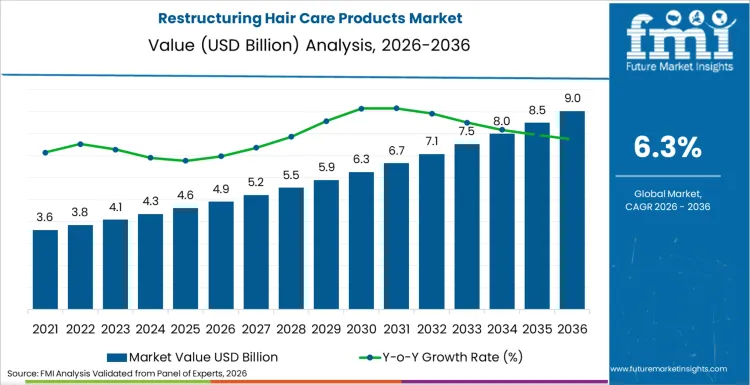
The restructuring hair care products market is valued at USD 4.9 billion in 2026 and is projected to reach USD 8.9 billion by 2036, expanding at a 6.3% CAGR. As per Future Market Insights, market expansion is being driven by rising consumer awareness of hair fiber damage, increasing exposure to environmental stressors such as UV radiation and pollution, and growing demand for corrective treatments following chemical coloring, heat styling, and salon-based procedures.
Restructuring formats address several structural limitations of conventional conditioning products, including insufficient penetration into the hair cortex, short-lived surface smoothing effects, and limited durability of repair claims. Product activity between 2025 and 2026 reflects a shift toward bond-repair and protein-reinforcement technologies incorporating actives such as peptide complexes, ceramide analogues, and biomimetic lipids to target breakage, porosity, and cuticle erosion. Established hair care companies are extending professional salon repair systems into at-home maintenance lines to protect category relevance, while emerging brands are leveraging clinical repair narratives to attract younger, damage-conscious consumers.
The shift toward intensive, treatment-led hair care routines and localized damage repair is supporting stronger uptake of restructuring products across routine wash and post-styling regimens. These products align with high-frequency heat styling habits, chemical service aftercare, and growing consumer willingness to invest in multi-step repair protocols, strengthening their relevance across daily, weekly, and post-procedure use scenarios. Repair-first positioning is increasingly shaping how brands frame new launches within premium and masstige segments.
As hair-care scientist Robinson explains, “Bond builders work by rebuilding the S-S bonds. Bond builders like that in Olaplex put a compound between the sulfurs so instead of your hair’s natural S-S bond you have something like an S-bond builder-S-bond. It’s supposed to work well as an S-S bond, and that should then theoretically restore the hair’s strength and resilience,” reflecting the industry-wide repositioning of restructuring treatments toward internal fiber repair rather than surface-level conditioning. Future Market Insights notes that e-commerce and professional salon channels continue to play a central role in category visibility, as bond-repair demonstrations and before-and-after transformations perform strongly across digital platforms. Growing acceptance of treatment-led hair care routines is expected to support sustained value growth and broader brand participation through 2036.
Summary of the Restructuring Hair Care Products Market
What Is Growth Outlook for the Restructuring Hair Care Products Market as per Future Market Insights Projection?
Future Market Insights projects the restructuring hair care products market to grow at a 6.30% CAGR from 2026 to 2036, expanding from USD 4.9 billion in 2026 to USD 8.9 billion by 2036.
FMI Research Approach: FMI proprietary forecasting model based on bottom-up revenue estimation, tracking penetration of bond-repair, keratin treatment, and fiber-restructuring solutions across mass, premium, and professional hair care portfolios, and demand modeling linked to chemical damage repair, heat styling recovery, and post-salon care routines.
How Do FMI Analysts Perceive Restructuring Hair Care Products Market to Evolve?
FMI analysts perceive the market shifting from occasional repair treatments toward routine, treatment-led hair care adoption, supported by rising consumer focus on long-term fiber integrity and structural damage correction. Restructuring products are increasingly used as part of regular wash, post-styling, and post-chemical service routines rather than as intermittent recovery solutions.
FMI Research Approach: Assessment of product positioning centered on bond repair, keratin reinforcement, and cortex-level strengthening, expansion of restructuring products within mainstream shampoo, conditioner, serum, and treatment assortments, and evaluation of consumer acceptance of multi-step repair regimens.
Which Country Holds Largest Share in the Global Restructuring Hair Care Products Market?
China holds the largest share of the global restructuring hair care products market by value, supported by high frequency of chemical hair treatments, strong salon culture across tier-1 and tier-2 cities, and premiumization of hair repair routines among urban consumers.
FMI Research Approach: FMI country-level demand assessment across salon service penetration, frequency of keratin treatments and chemical straightening, and tracking of domestic and international brand expansion within professional and at-home restructuring hair care segments.
How Large Will the Restructuring Hair Care Products Market Be by 2036?
The global restructuring hair care products market is projected to reach USD 8.9 billion by 2036.
FMI Research Approach: FMI long-term forecast by country, product type, formulation format, and distribution channel, incorporating scaling assumptions for routine bond-repair and keratin treatment adoption and cross-checking against broader premium and professional hair care growth trends.
What Is Definition of Restructuring Hair Care Products Market?
The restructuring hair care products market comprises hair treatment products formulated to repair, reinforce, and restructure damaged hair fibers by targeting the cuticle, cortex, and internal bonding structures, addressing breakage, porosity, and chemical or thermal damage.
FMI Research Approach: FMI market taxonomy and inclusion-exclusion framework covering keratin treatment products, hair straightening, smoothing, and relaxing treatments, along with restructuring creams, lotions, serums, and gels, while excluding routine cosmetic conditioners and styling products without structural repair claims.
What Are Globally Unique Trends Shaping Restructuring Hair Care Products Market?
Globally unique trends include the dominance of keratin treatment products accounting for 36.80% of product type share, rising preference for cream-based restructuring formats with 42.50% share, and the leading role of salons and professional stores as the primary distribution channel with 39.40% share. Professional salon use represents the largest end-user segment at 58.70%, reflecting the continued influence of salon-led repair protocols on consumer hair care routines.
FMI Research Approach: Analysis of segment-level demand shares by product type, form, distribution channel, and end-user, country-wise growth differentials across China, India, Germany, Brazil, the USA, the UK, and Japan, and competitive share assessment led by L’Oréal S.A. holding 29.60% share, alongside Procter & Gamble, Unilever plc, Henkel AG & Co. KGaA, Kao Corporation, Shiseido Company Limited, Estée Lauder Companies Inc., and Revlon, Inc.
Restructuring Hair Care Products Market Key Takeaways
| Metric | Details |
|---|---|
| Industry Size (2026) | USD 4.9 Billion |
| Industry Value (2036) | USD 8.9 Billion |
| CAGR (2026-2036) | 6.30% |
Source: Future Market Insights (FMI) analysis, based on proprietary forecasting model and primary research.
Why Is the Demand for Restructuring Hair Care Products Growing?
Perceptions around hair repair are shifting as restructuring treatments transition from being seen as occasional corrective solutions to becoming part of routine hair maintenance practices. Future Market Insights observes that consumers now prioritize ongoing fiber recovery, resilience against repeated heat exposure, and compatibility with frequent washing and styling cycles. Earlier generations of restructuring products were typically used as intermittent remedies following intensive chemical services, which constrained their relevance within everyday hair care habits. This usage pattern is gradually changing as repair-focused products gain placement alongside mainstream shampoos, conditioners, and leave-in care solutions.
Portfolio design strategies demonstrate this change in adoption patterns. K18 Hair positions its molecular repair products within complete hair care routines rather than isolating them as specialty treatments used only after severe damage events. These formulations are framed for regular use, encouraging consumers to integrate restructuring steps into standard wash and post-styling regimens without altering their established hair care behaviors. FMI notes that brands embedding restructuring solutions into routine care frameworks, supported by consistent performance and repeat-use suitability, are better positioned to normalize treatment-led hair care and expand category penetration beyond episodic recovery use.
How Is the Restructuring Hair Care Products Market Structured by Segment?
The restructuring hair care products market is organized by product type, formulation form, distribution channel, and end user, reflecting varied damage profiles and usage contexts across consumer and professional hair care routines. By product type, the market includes keratin treatment products, hair straightening products, hair smoothing products, and hair relaxing products, with keratin treatment products accounting for the largest share due to their frequent use in damage recovery and post-chemical service maintenance. By formulation form, creams represent the leading format as they enable controlled application, even distribution, and prolonged contact with damaged hair fibers. By distribution channel, salons and professional stores account for the highest share of sales, supported by treatment-led purchasing and recommendation-driven uptake. By end user, professional salon use represents the dominant segment, reflecting the continued role of salon services as entry points for restructuring treatments and regimen adoption.
What Factors Explain the Leadership of Keratin Treatment Products?
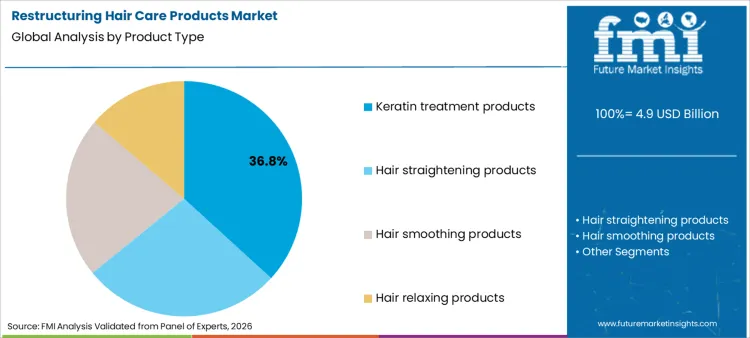
Keratin treatment products account for 36.80% of the restructuring hair care products market, driven by their strong association with fiber reinforcement and visible smoothness outcomes following chemical and thermal damage. These products are widely used to address breakage, frizz, and porosity, particularly among consumers undergoing coloring, straightening, and frequent heat styling. Keratin-based treatments are perceived as delivering tangible structural benefits, supporting stronger attachment to repeat usage cycles within both salon and at-home routines. Their compatibility with professional salon protocols strengthens trust in efficacy, which anchors their leading position within the product type mix. FMI observes that keratin-focused offerings are framed as foundational repair solutions rather than optional enhancements, allowing them to capture higher frequency of use within restructuring regimens.
Why Do Cream-Based Restructuring Formats Account for the Largest Share?
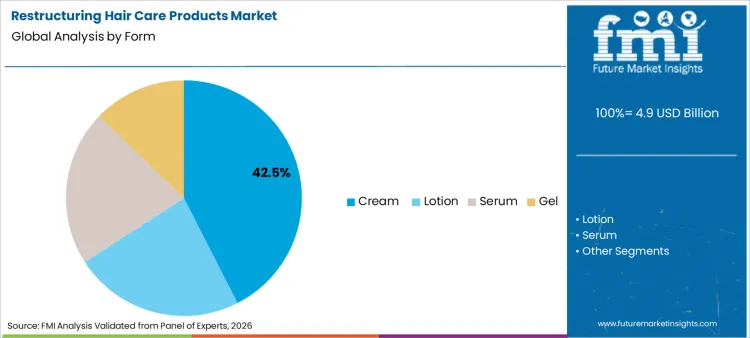
Cream formulations hold 42.50% of the market, supported by their balanced texture, ease of application, and suitability for controlled delivery of restructuring actives. Creams enable consistent coating of damaged strands and longer residence time during treatment steps, which improves perceived performance in repair and smoothing routines. Compared with lotions or gels, creams are favored in both salon protocols and home-care maintenance due to their versatility across hair types and damage levels. Their familiarity within existing conditioning practices reduces behavioral friction for consumers adopting restructuring treatments more frequently. FMI notes that cream-based formats align well with multi-step repair regimens that emphasize dwell time and targeted application to compromised hair sections.
What Drives the Prominence of Salons and Professional Stores as a Sales Channel?
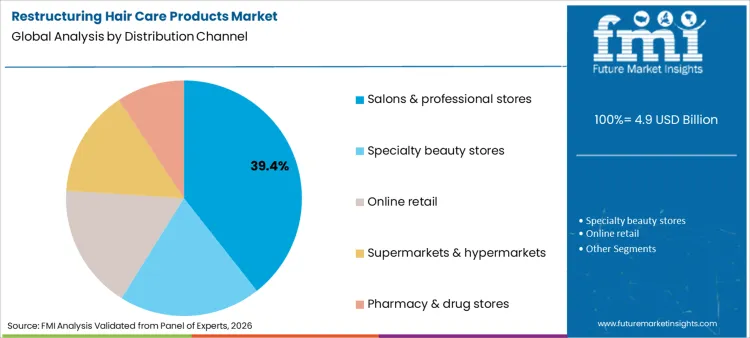
Salons and professional stores account for 39.40% of restructuring hair care product sales, reflecting the importance of expert recommendation and treatment-led purchasing in this category. Many consumers are introduced to restructuring products during in-salon services such as keratin treatments, smoothing procedures, or post-color repair protocols, which shapes subsequent at-home purchasing behavior. Professional environments reinforce perceptions of efficacy and product credibility, supporting premium pricing and regimen adherence. Specialty beauty stores extend this influence through curated assortments and trained staff, while online retail and mass channels support broader access and replenishment. FMI highlights that salon-led distribution remains central to educating consumers about restructuring benefits and anchoring long-term usage patterns.
Why Does Professional Salon Use Represent the Largest End-User Segment?
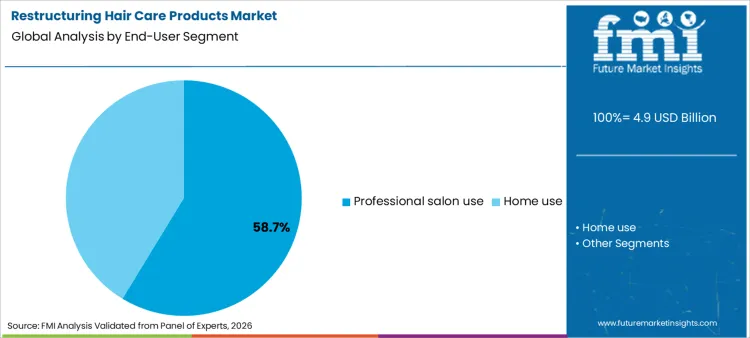
Professional salon use represents 58.70% of total end-user demand, reflecting the continued dominance of in-salon treatments as the primary setting for intensive hair restructuring services. Salons serve as high-frequency intervention points for chemical straightening, smoothing, and repair treatments, which drives bulk consumption of restructuring products within professional workflows. The reliance on trained application techniques and controlled processing conditions supports consistent outcomes, reinforcing salon dependence for advanced repair protocols. Home use is expanding as consumers adopt maintenance products recommended during salon visits, yet professional environments remain the main volume driver due to the intensity and regularity of restructuring treatments delivered within salon service menus.
What Forces Are Driving Industry Transformation Through Bond-Repair Hair Care Solutions?
Bond-repair hair care solutions are gaining traction as brands respond to rising demand for visible damage correction, internal fiber strengthening, and compatibility with frequent heat styling and chemical services. Unlike conventional conditioners that mainly smooth the cuticle, restructuring formats target internal bonds and protein loss, enabling longer-lasting repair outcomes. These products support targeted application across high-damage zones such as mid-lengths and ends, where breakage and porosity are most pronounced. Brands are advancing multi-step repair systems that pair cleansing with treatment-led recovery, reinforcing routine use rather than episodic intervention. As per Future Market Insights, bond-repair positioning is increasingly framed around routine hair resilience rather than post-damage recovery alone. This reframing reduces adoption friction and strengthens acceptance of restructuring products as everyday care tools within regular wash and post-styling regimens.
How Is Portfolio Integration Strengthening Competitive Hair Repair Platforms?
Portfolio integration is enhancing competitive positioning by embedding restructuring products within complete hair care systems alongside shampoos, conditioners, masks, and leave-in treatments. Large hair care groups are expanding repair lines to ensure continuity across cleansing, treatment, and maintenance steps, emphasizing routine compatibility instead of one-off repair usage. This approach improves formulation coherence, retail presence, and consumer familiarity with repair protocols. According to FMI, incorporating restructuring formats into established hair care portfolios accelerates adoption by leveraging existing brand trust and habitual purchasing patterns. Multi-format integration supports cross-selling within premium and masstige tiers without requiring consumers to alter core routines. As repair narratives become standardized across portfolios, restructuring products gain legitimacy as essential maintenance tools, strengthening repeat purchase behavior and supporting broader scaling across professional and home-use channels.
Why Is Formulation Optimization Accelerating Product and Format Innovation in Hair Repair?
Rising performance expectations and cost pressures are prompting manufacturers to optimize restructuring formulations while preserving sensory performance and hair comfort. Repair formats require careful calibration of proteins, peptides, ceramide analogues, and delivery systems to ensure penetration without residue buildup or stiffness. Small formulation changes can significantly affect slip, spreadability, and post-rinse feel, shaping user perception during repeated use. FMI notes that intensifying competition is elevating formulation discipline, with greater focus on stability across hair types, climates, and usage frequency. This emphasis on formulation efficiency enables scalable repair platforms that perform consistently in salon protocols and home routines. As optimization advances, restructuring products are positioned as dependable maintenance solutions, supporting routine adoption rather than remaining limited to occasional corrective treatments.
How Does Country-Level Demand Vary in the Restructuring Hair Care Products Market?
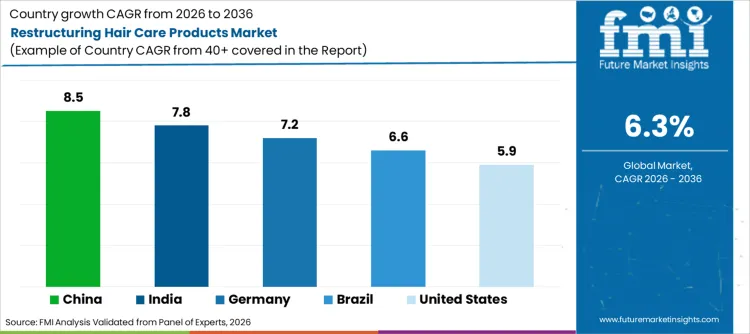
Country-level growth patterns for restructuring hair care products show marked differences shaped by salon service intensity, heat styling frequency, chemical treatment penetration, and consumer willingness to invest in repair-led routines. China leads growth with an 8.5% CAGR, supported by strong urban salon culture and rapid uptake of bond-repair regimens. India follows at 7.8%, driven by expanding premium hair care consumption and rising adoption of post-treatment maintenance products. Germany posts 7.2% growth, reflecting structured grooming routines and steady demand for professional-grade repair solutions. Brazil grows at 6.6%, supported by frequent smoothing and straightening needs in humid climates. The USA records 5.9%, indicating selective adoption in a mature hair care market. The UK reaches 5.3%, while Japan trails at 4.7%, shaped by conservative switching and established reliance on traditional conditioning routines.
| Country | CAGR (2026 to 2036) |
|---|---|
| China | 8.5% |
| India | 7.8% |
| Germany | 7.2% |
| Brazil | 6.6% |
| United States | 5.9% |
| UK | 5.3% |
| Japan | 4.7% |
Source: FMI historical analysis and forecast data.
What Is Powering China’s Lead in Restructuring Hair Care Growth?
China’s 8.5% CAGR reflects high frequency of chemical services, rising urban income levels, and the fast spread of professional repair protocols into home care routines. Urban consumers increasingly opt for coloring, straightening, and frequent heat styling, which drives recurring demand for bond-repair and keratin reinforcement products. Salon-led guidance plays an important role in shaping regimen adoption, with repair treatments positioned as routine maintenance rather than occasional recovery steps. This professional-to-home shift is visible in the expansion of China-based premium hair care brands such as Adolph, which has pivoted from fragrance-led roots to professional-grade repair positioning, extending its clinical treatment lines into consumer-facing platforms into consumer-facing treatment lines sold through major e-commerce platforms. Online retail speeds up replenishment for premium repair products, while social platforms encourage multi-step hair repair routines through tutorials and routine-led content. Growth comes more from higher treatment frequency per user and greater spending on post-procedure care. As repair concepts become part of daily grooming habits, restructuring products are gaining wider acceptance as everyday hair health solutions across major Chinese cities.
Why Is India Emerging as a High-Growth Market for Hair Restructuring Products?
India’s 7.8% CAGR reflects expanding urban grooming awareness and growing engagement with premium and professional hair care. Increased exposure to heat styling, chemical coloring, and straightening services is creating sustained demand for repair-oriented treatments. Consumers are adopting restructuring products to manage breakage, frizz, and porosity, especially in regions with hard water and humid climates. Digital retail broadens access beyond metro areas, enabling trial of repair regimens across multiple price tiers. Younger consumers show rising willingness to invest in multi-step care routines promoted through salon recommendations and digital content. Growth is anchored in rising frequency of damage-inducing practices and a gradual shift toward treatment-led maintenance rather than reliance on surface-smoothing conditioners alone.
What Explains Germany’s Consistent Uptake of Restructuring Hair Care?
Germany’s 7.2% CAGR is supported by disciplined grooming habits and steady adoption of professional-grade repair solutions. Consumers prioritize functional performance, ingredient credibility, and product longevity, which aligns well with restructuring formats positioned around fiber strengthening and bond repair. Adoption is measured, with repair products integrated into existing routines rather than replacing conventional conditioners outright. Salons play a role in introducing repair protocols, while specialty retail reinforces trust in efficacy through curated assortments. Growth reflects stable repeat usage among consumers managing chemically treated or frequently styled hair. This pragmatic adoption pattern sustains moderate but reliable expansion, driven by emphasis on long-term hair resilience, consistent outcomes, and controlled use of intensive treatments within structured hair care routines.
How Are Climate and Styling Habits Supporting Growth in Brazil?
Brazil’s 6.6% CAGR is shaped by climate conditions, high humidity, and widespread use of smoothing and straightening treatments to manage frizz and texture challenges. Frequent salon services increase the need for post-procedure repair and ongoing fiber reinforcement, sustaining demand for restructuring products. Urban consumers favor products that support regular maintenance across wash and styling cycles, especially in warm conditions that amplify hair stress. Expanding availability through digital platforms and specialty beauty retail improves access to professional repair formats. Adoption remains steady as consumers position restructuring products as complements to everyday conditioning for targeted damage management. Growth is driven by recurring treatment needs and the normalization of repair regimens within routine grooming practices.
Why Is Growth More Gradual in the United States?
The United States posts a 5.9% CAGR, reflecting selective uptake in a mature hair care market where traditional conditioners and masks remain dominant. Restructuring products are often layered onto existing routines rather than replacing them, limiting rapid volume shifts. Adoption is strongest among consumers with high heat styling frequency, regular coloring habits, and post-salon maintenance needs. Professional endorsement supports credibility, while e-commerce and social content fuel trial of bond-repair regimens. However, entrenched brand loyalty and price sensitivity temper faster switching toward intensive repair systems. Growth remains steady as restructuring formats gain recognition as routine maintenance tools rather than episodic recovery solutions.
What Is the Competitive Outlook for the Restructuring Hair Care Products Market?
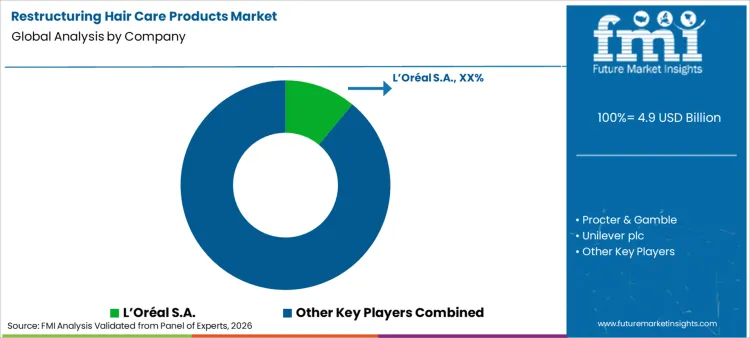
The competitive landscape for restructuring hair care products is shaped by large global hair care and beauty groups that are extending beyond basic conditioning into repair-focused treatment systems to protect category relevance and portfolio depth. Players such as L’Oréal S.A., Procter & Gamble, Unilever plc, Henkel AG & Co. KGaA, Kao Corporation, Shiseido Company Limited, Estée Lauder Companies Inc., and Revlon, Inc. benefit from strong salon relationships, broad retail presence, and established professional and consumer hair care franchises. L’Oréal S.A. holds largest share, reflecting its ability to scale bond-repair and restructuring formats across professional and at-home lines while leveraging distribution reach and brand equity. Competitive positioning in this market centers less on rapid volume capture and more on embedding repair solutions within complete hair care systems.
Future Market Insights observes that competition increasingly focuses on treatment performance, fiber-strengthening efficacy, and routine compatibility rather than aggressive footprint expansion. Companies such as Henkel AG & Co. KGaA and Kao Corporation emphasize damage repair reliability and hair feel, while Shiseido Company Limited and Estée Lauder Companies Inc. focus on premium repair positioning and regimen-based care. At the same time, brands under Procter & Gamble, Unilever plc, and Revlon, Inc. support wider adoption through accessible repair offerings across mass and masstige tiers. FMI notes that sustained advantage will depend on how effectively restructuring products are integrated into regular wash, treatment, and styling routines rather than positioned as one-off corrective solutions.
Recent Developments:
- In October 2025, Henkel AG & Co. KGaA expanded its professional hair care portfolio by introducing a bond-repair intensive treatment under its Schwarzkopf Professional range, positioned for post-color and post-bleaching hair recovery. The launch reflects rising demand for restructuring treatments that can be used both in salons and as part of structured at-home maintenance regimens, reinforcing the shift toward routine repair-led hair care protocols.
- In February 2026, Kao Corporation broadened its premium hair care lineup in Japan with the launch of a fiber-restructuring treatment mask designed to address heat and chemical damage in frequently styled hair. The product was positioned for use within multi-step repair routines, highlighting increasing emphasis on structured treatment systems rather than single-use recovery products within mature Asian hair care markets.
- In November 2025, Estée Lauder Companies Inc. introduced a repair-focused leave-in treatment within its salon-linked hair care portfolio, targeting cuticle reinforcement and moisture retention following chemical services. Although positioned within premium retail and professional channels, the launch demonstrates the growing convergence of salon-grade restructuring technologies with consumer-accessible maintenance formats.
Key Players in Restructuring Hair Care Products Market
- L’Oréal S.A.
- Procter & Gamble
- Unilever plc
- Henkel AG & Co. KGaA
- Kao Corporation
- Shiseido Company Limited
- Estée Lauder Companies Inc.
- Revlon, Inc.
Market Definition
The restructuring hair care products market captures revenue from finished hair treatment products formulated to repair, reinforce, and restore damaged hair fibers through structural repair mechanisms. In this assessment, the market covers commercially available restructuring products positioned for bond repair, keratin reinforcement, cuticle repair, and fiber strengthening following chemical, thermal, or mechanical damage. Market sizing reflects the value of finished consumer and professional-use products sold through physical retail, salons, and online platforms. The analysis is structured by product type, formulation format, distribution channel, and region, and reported in USD billion. The market reflects demand generated by routine repair usage and post-procedure maintenance, where consumers seek visible improvements in strength, texture, and resilience rather than short-term cosmetic smoothing.
The scope includes restructuring products developed for damage repair, post-color and post-straightening maintenance, breakage reduction, porosity management, and fiber strengthening. Product formats covered include creams, lotions, serums, gels, masks, and leave-in treatments marketed specifically for restructuring or repair functions. Sales through salons and professional stores , specialty beauty retailers, pharmacies and drug stores, supermarkets and hypermarkets, and online retail channels are counted. Geographic coverage spans North America, Europe, Asia Pacific, Latin America, and the Middle East & Africa.
The market excludes routine cosmetic shampoos and conditioners without explicit restructuring or repair claims, general styling products, temporary smoothing serums positioned solely for cosmetic shine, and scalp treatment products not intended for hair fiber repair. Revenues from bulk ingredients, active raw materials, private-label contract manufacturing, packaging supply, and logistics services are excluded. Products sold exclusively for in-salon professional use without consumer retail availability are outside the defined market scope.
Scope of Report
| Items | Values |
|---|---|
| Quantitative Units (2026) | USD 4.9 Billion |
| Product Type | Keratin treatment products; Hair straightening products; Hair smoothing products; Hair relaxing products |
| Form | Cream; Lotion; Serum; Gel |
| Distribution Channel | Salons & professional stores; Specialty beauty stores; Online retail; Supermarkets & hypermarkets; Pharmacy & drug stores |
| End User | Professional salon use; Home use |
| Regions Covered | North America, Europe, Asia Pacific, Latin America, Middle East & Africa |
| Countries Covered | United States, Germany, United Kingdom, India, China, Brazil, and 40+ countries |
| Key Companies Profiled | L’Oréal S.A.; Procter & Gamble; Unilever plc; Henkel AG & Co. KGaA; Kao Corporation; Shiseido Company Limited; Estée Lauder Companies Inc.; Revlon, Inc. |
| Additional Attributes | Dollar sales by product type, form, distribution channel, and end user; country-wise CAGR analysis; adoption trends for bond-repair and keratin-based restructuring treatments; usage patterns across salon-led and home maintenance routines; competitive positioning across professional, premium, and mass hair care channels |
Source: FMI historical analysis and forecast data
Restructuring Hair Care Products Market by Segments
By Product Type:
- Keratin treatment products
- Hair straightening products
- Hair smoothing products
- Hair relaxing products
By Form:
- Cream
- Lotion
- Serum
- Gel
By Distribution Channel:
- Salons & professional stores
- Specialty beauty stores
- Online retail
- Supermarkets & hypermarkets
- Pharmacy & drug stores
By End User:
- Professional salon use
- Home use
By Region:
- North America
- Europe
- Asia Pacific
- Latin America
- Middle East & Africa
Bibliography
- Henkel AG & Co. KGaA. (2026). Annual Report 2025. (Referencing the Schwarzkopf/Bonacure strategic shift).
- Kao Corporation. (2026). Kao Integrated Report 2025. (Referencing the "New Essential Premium" and fiber strategy).
- Shiseido Company, Limited. (2025). Integrated Report 2024. (Referencing "Beauty Innovations" and core structural repair).
Frequently Asked Questions
How big is the global restructuring hair care products market?
The global restructuring hair care products market is valued at USD 4.9 billion in 2026 and is projected to reach USD 8.9 billion by 2036.
What is the growth outlook for the restructuring hair care products market over the next 10 years?
The market is expected to expand at a 6.3% CAGR from 2026 to 2036, driven by rising demand for bond-repair, keratin reinforcement, and treatment-led hair care routines.
Which product segments or formats drive demand in this market?
Keratin treatment products and cream-based restructuring formats drive demand due to their strong association with fiber repair, controlled application, and routine compatibility.
How does consumer behavior differ by region?
Adoption is strongest in China and India due to high salon service intensity and repair-led routines, while growth is more gradual in mature markets such as the USA, UK, and Japan where restructuring products are layered onto existing habits.
What are the main risks and constraints affecting this market?
Market growth is constrained by high product costs, consumer reliance on traditional conditioners, and the need to consistently demonstrate long-term repair efficacy beyond cosmetic smoothing.
Preview the report firsthand - request a free sample
Get SampleGet the brochure for pricing and purchase details.
Get PDF

