

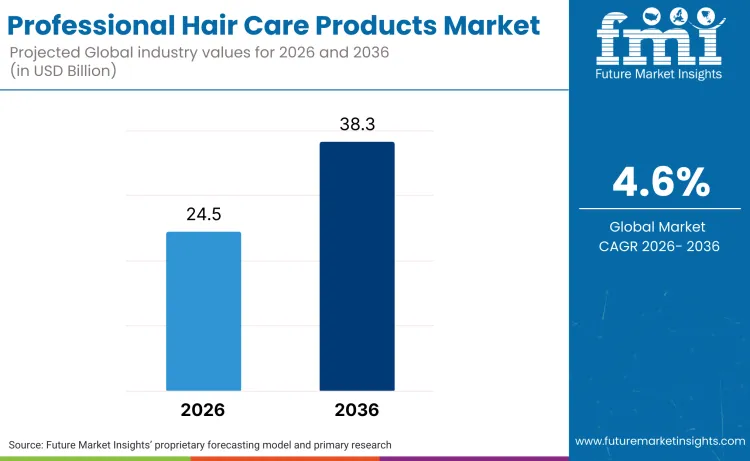
- Industry Size (2026)
- USD 24.5 Bn
- Forecast (2036)
- USD 38.3 Bn
- CAGR (2026 to 2036)
- 4.6%
Professional Hair Care Products Market Forecast and Outlook 2026 to 2036
The global professional hair care products market is poised to achieve a substantial valuation of USD 24.5 billion in 2026, with a trajectory set to ascend towards USD 38.3 billion by 2036. This represents a compound annual growth rate (CAGR) of 4.6% over the decadal forecast period. Robust expansion is not merely speculative but is supported by major industry performance metrics, specifically the L’Oréal’s Professional Products Division reported a compelling +5.3 % like-for-like growth in its 2024 annual results, a performance that significantly outpaced the broader beauty market and underscored resilience in professional channels.
In the 2024 Annual Report, Nicolas Hieronimus, CEO of L’Oréal, reinforced this sentiment, stating: “2024 was a defining year as we made L’Oréal future fit and laid many foundations for our next conquests: we augmented our marketing and R&I capabilities with AI and tech, advanced with the harmonisation of our IT, simplified our organisational structures, and strengthened our industrial and supply chain resilience. We also continued to sharpen our portfolio.”
Growth is further propelled by expansion of the hair care market in emerging economies and the simultaneous premiumization of services in mature Western markets. The US Bureau of Labor Statistics reported that the Consumer Price Index for "Personal Care Services" rose by 3.0% from January 2024 to January 2025, indicating strong, sustained pricing power within the professional sector. This economic leverage allows salons to support higher margins for advanced hair styling products and technical treatments. As salons increasingly pass these operational costs to consumers, the market demand for high-efficacy, "result-guaranteed" products, such as clinical hair serums and molecular bond-builders, becomes non-negotiable to justify the elevated service prices to a discerning clientele.
Summary of Professional Hair Care Products Market
What is the Growth Outlook for the Professional Hair Care Products Market as per Future Market Insights Projection?
Future Market Insights projects the global professional hair care products market to escalate from USD 24.5 billion in 2026 to USD 38.3 billion by 2036, representing a steady 4.6% CAGR over the forecast period.
FMI Research Approach: Derived from FMI’s proprietary global modeling framework combining salon service pricing indices, cosmetologist employment statistics, and corporate organic growth data from key conglomerates such as Henkel and Kao. The model factors in the shift from mass‑market retail to high‑value professional treatments offering measurable, health‑driven results.
How Do FMI Analysts Perceive the Professional Hair Care Products Market to Evolve?
FMI analysts perceive the market transitioning from a volume‑based back‑bar consumption model toward a high‑value, clinical‑grade ecosystem driven by the “Skinification of Hair,” where molecular repair science and scalp‑health methodologies converge.
FMI Research Approach: Built using analysis of biotech‑driven repair system acquisitions, data‑driven customization trends, and performance disclosures from professional divisions such as L’Oréal’s Professional Products Division, which reported +5.3% like‑for‑like growth in 2024, signaling market resilience and premiumization.
Which Country Holds the Largest Share in the Professional Hair Care Products Market?
The United States holds the largest global share, supported by a workforce of over 651,200 licensed barbers and cosmetologists, paired with high disposable income and 92% health insurance coverage, enabling sustained demand for premium salon services.
FMI Research Approach: Structured using 2024 BLS industry workforce data, USA Census Bureau insurance coverage statistics, and evaluation of consumer discretionary patterns that support recurrent salon spending, solidifying the USA as the dominant engine of global value creation.
How Large Will the Professional Hair Care Products Market Be by 2036?
The global professional hair care products market is expected to reach USD 38.3 billion by 2036, driven by persistent demand for premium colouring services, which hold a 35.7% share, supported by rising safety‑driven reformulation and growing preference for damage‑free, bond‑building technologies.
FMI Research Approach: Forecasts rely on analysis of ingredient regulatory changes, worldwide demand for clinical‑grade bond builders, and product innovation cycles including ammonia‑free and pre‑bonded colour systems adopted to meet modern safety standards.
What Is the Definition of the Professional Hair Care Products Market?
The professional hair care products market includes revenue generated from salon‑grade formulations and chemical treatments designed specifically for licensed cosmetologists and barbers. This includes colouring systems, technical care products, molecular bond‑builders, and precision styling agents, distributed via authorized professional channels or used in back‑bar services. It excludes mass‑market retail products unless they belong to professional heritage brands.
FMI Research Approach: Definition aligned with FMI’s segmentation taxonomy, incorporating product type, distribution channel, and professional‑use criteria, including distinctions between back‑bar consumption and take‑home retail purchased directly from salons.
What Are Globally Unique Trends Shaping the Professional Hair Care Products Market?
Globally, the industry is shifting from cosmetic‑chemistry‑driven formulations to biotech‑powered molecular repair systems, fueled by acquisitions such as Olaplex-Purvala (2025) and reinforced by regulatory actions like upcoming Formaldehyde restrictions, which push brands toward safer, high‑efficacy solutions.
FMI Research Approach: Insights derived from global patent analytics, biotech‑beauty M&A activity, and regulatory impact tracking, revealing a market transitioning toward clinical, bio‑engineered, and sustainability‑aligned innovations.
Professional Hair Care Products Market Key Takeaways
| Metric | Details |
|---|---|
| Industry Size (2026) | USD 24.5 billion |
| Industry Value (2036) | USD 38.3 billion |
| CAGR (2026 to 2036) | 4.6% |
Source: Future Market Insights (FMI) analysis, based on proprietary forecasting model and primary research.
Which Factors Propel Adoption of Professional Hair Care Products?
The profound convergence of skincare and haircare methodologies is radically reshaping the competitive market landscape. This massive consumer shift is fueling the therapeutic hair oil market and medicated shampoo market, as educated consumers begin to treat their scalps with the same rigorous care routines as their faces. L'Oréal Groupe explicitly validated this trend in June 2025 by acquiring Medik8, a move designed to leverage skin-science IP for broader applications. Cyril Chapuy, President of L'Oréal Luxe, noted: "Medik8 perfectly complements our existing skincare portfolio," signaling an imminent future where professional hair treatments adopt clinical skincare-grade ingredients like hyaluronic acid and peptides.
Rising regulatory pressure is acting as a powerful catalyst for formulation innovation across the sector. The FDA's proposed rule in Spring 2024 (RIN: 0910-AI83) to ban formaldehyde in hair smoothing products is forcing a massive, industry-wide reformulation wave. This legislative action has accelerated the adoption of sulfate-free shampoos and acid-based smoothing systems that offer safety without compromising performance.
Wella Professionals responded to this urgent demand in January 2025 by launching SMOOTHFILLER™, a demi-permanent smoothing service with a minimalist, patent-pending formulation designed to deliver long-lasting smoothness and manageability. In the official launch announcement, Romeu Felipe, Wella Global Ambassador, stated: “This is the professional solution our clients have been asking for. They want softness, shine, manageability, and they want it to last. What sets SMOOTHFILLER apart is its patent-pending, minimalist formulation.” This highlights the critical need for safer, compliant professional alternatives that meet contemporary stylist and client expectations in professional haircare services.
How is the Professional Hair Care Products Market Segmented?
The market is segmented by product type, distribution channel, and active ingredients to address diverse professional needs. Product types encompass coloring, care (shampoos/conditioners), and styling, while the distribution landscape is split between direct-to-salon sales and professional retail outlets like Salon Centric and Ulta Beauty. The shift toward "Clean Professional" is increasingly evident, with oil control shampoo and anti-static hair care products gaining significant traction among eco-conscious salons. The employment outlook for cosmetologists, projected to grow 5% from 2024 to 2034 by the US BLS, ensures a steady, expanding B2B channel for back-bar conditioning hair treatments that form the backbone of salon revenue.
Why Does Hair Colouring Hold Dominant Product Type Share?
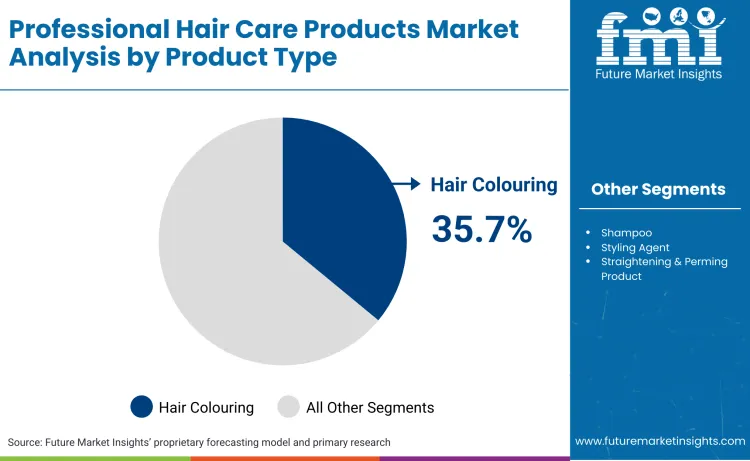
Hair Colouring maintains the dominant market share, accounting for approximately 35.7% of the total value. This enduring dominance is driven by the high level of technical expertise required for application, which effectively insulates the category from retail disintermediation and DIY alternatives. However, the segment is rapidly evolving toward "Damage-Free" claims to meet modern safety standards. Matrix (L'Oréal) introduced "Matrix Super Sync" in early 2025, an ammonia-free alkaline demi-permanent color with pre-bonded complex. The FDA's reiterated safety checklists for coal-tar hair dyes in late 2024 have further pushed salons toward safer, premium colour lines that mitigate liability risks while delivering superior, long-lasting results that consumers cannot replicate at home.
Why is the Individual Consumers Segment Experiencing Surge?
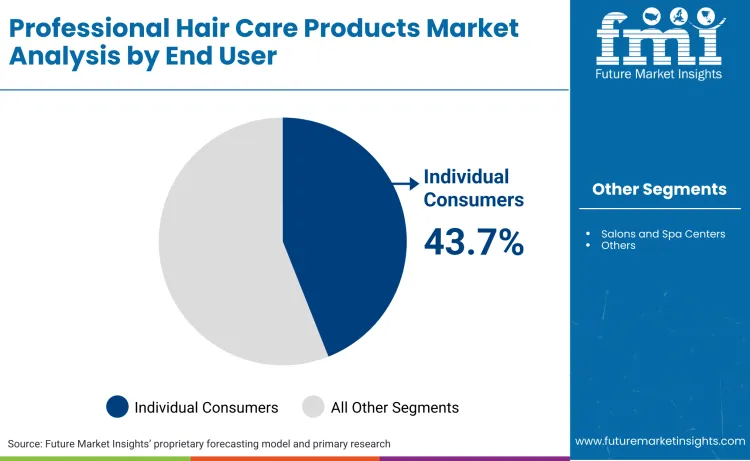
Individual consumers dominate the end-user segment in the professional hair care products market with a 43.7% share in 2024, mirroring broader USA personal care trends where consumers spent USD 74 billion nationwide in 2024, including USD 14.1 billion (19%) specifically on hair care products. This preference stems from greater accessibility via retail and online channels, allowing non-professionals to achieve salon-quality results without salon visits. Brands are responding by formulating user-friendly, high-performance products tailored for daily self-application, boosting loyalty and repeat purchases in this segment.
What Share Does E-Commerce Hold in Beauty/Personal Care Distribution?
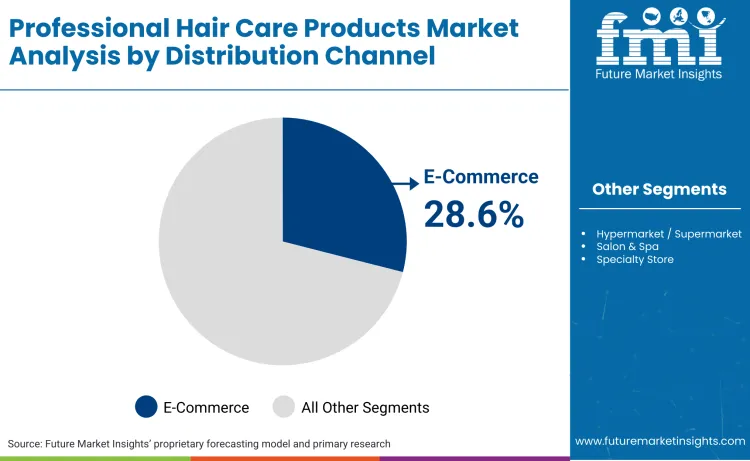
E-commerce leads distribution channels with a 28.6% share in 2024, as USA Census Bureau data shows e-commerce retail sales reached 16.4% of total retail sales in Q3 2024 (August 2024), up from prior quarters amid rising online beauty adoption. Platforms enable direct-to-consumer models, subscriptions, and exclusive online launches, outpacing traditional retail amid rising digital adoption. This shift not only accelerates market penetration but also allows brands to gather real-time data for targeted innovations in professional hair care formulations.
How is Biotech Transforming Repair Systems?
The industry is decisively moving from synthetic chemicals to bio-mimetic repair mechanisms. This trend was firmly cemented when Olaplex acquired Purvala in August 2025 to integrate biotech-driven solutions into its bond-building portfolio. Amanda Baldwin, CEO of Olaplex, emphasized the strategic importance of this shift, stating: "We have the potential to create the next generation of disruptive science-backed product innovation." This pivot is absolutely critical for the hair loss prevention products market, as biotech offers more targeted, efficacious repair mechanisms than traditional cosmetic chemistry, allowing brands to make stronger, clinically-validated claims that resonate with the modern "skintellectual" consumer.
Why Are Sustainable Formats Becoming Standard?
Sustainability is no longer a niche marketing angle but an operational requirement for market entry. The rise of solid shampoo bars and solid conditioner bars in professional salons reflects this deep systemic change. Additionally, dry format hair cleansers are gaining immense popularity as global water scarcity concerns increasingly influence product development cycles. Henkel's Consumer Brands unit reported strong organic sales growth of 3.0% in 2024, partly driven by their sustainability initiatives and "Clean Performance" lines, proving that environmental responsibility and financial performance are now inextricably linked in the professional beauty sector.
How Will Professional Hair Care Expansion Unfold Across Key Regional Countries?
The expansion of the professional hair care products market across key regional countries reflects a distinctly bifurcated global growth pattern, where mature Western regions contrast sharply with fast‑growing Asian economies. The market divides into “Value‑Driven” mature markets, such as the USA and UK, which rely on premiumization and inflation‑linked service upgrades to preserve margins, and “Volume‑Driven” emerging economies, primarily in Indonesia and India, where rapid consumer adoption, digital commerce acceleration, and expanding salon networks fuel considerably higher growth. While the USA and UK are projected to grow at 4.2% and 3.8% respectively, driven by high‑value services and a strong professional ecosystem, Indonesia and India outpace them with projected CAGRs of 5.3% and 5.1%, supported by expanding middle‑class spending and rising professional beauty penetration.
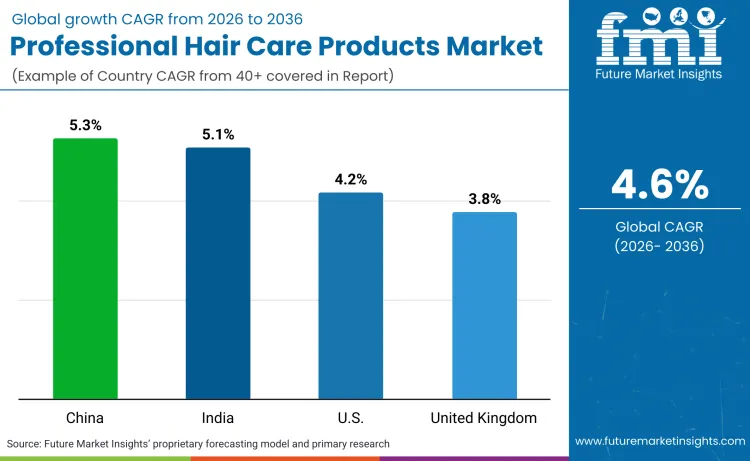
| Country | CAGR (2026 to 2036) |
|---|---|
| Indonesia | 5.3% |
| India | 5.1% |
| US | 4.2% |
| UK | 3.8% |
Source: FMI historical analysis and forecast data.
What Dynamics Drive the United States Professional Landscape?
The US industry remains the largest by value, growing at a forecast CAGR of 4.2%. The key driver is the structural shortage of skilled labor, which drives wages and service prices up. The median hourly wage for hairstylists was USD 16.95 in May 2024, leading to a rise in independent "booth rental" models where stylists purchase their own preferred brands. This fragmentation supports direct-to-stylist sales channels. The market here is also heavily influenced by the race for technological supremacy. Following the acquisition of Purvala, Amanda Baldwin, CEO of Olaplex, highlighted the strategic necessity of this shift: "We believe that with Purvala we have the potential to create the next generation of disruptive science-backed product innovation." This quote underscores how the US market is evolving from cosmetic aesthetics to genuine biological repair, validating the high expenditure on R&D in this region.
How Are Digital Ecosystems Reshaping the Chinese Salon Economy?
China is forecasted to grow at 5.3%, fueled by a massive e-commerce ecosystem. The National Bureau of Statistics reported that retail sales of cosmetics rose 4.5% year-on-year in July 2025. Unlike the West, where salons are the primary gatekeepers, China's professional market is heavily influenced by Douyin (TikTok) trends, where consumers purchase professional-grade hair growth serums for home use. Brands like Shiseido and Kao are pivoting to high-end "prestige" lines to compete with domestic players. The market is increasingly defined by the blur between professional salon services and high-end at-home maintenance facilitated by seamless digital retail platforms, creating a unique "hybrid professional" consumer segment that demands salon-quality results in their daily routine.
Why Is the United Kingdom A Critical Hybrid Market?
The UK market is forecast to grow at 3.8%, driven by a resilient recovery in the high-street salon sector. The Office for National Statistics (ONS) released specific analysis for the hairdressing industry in January 2025, tracking turnover recovery. The market is seeing a blurring of lines between retail and professional, with retailers like Justmylook launching "Incredilox," a salon-quality private label, to capture value-conscious consumers who still demand professional results. Corporate confidence in the European sector remains robust despite economic fluctuations. Carsten Knobel, CEO of Henkel AG & Co. KGaA, noted in their recent financial disclosure of the 2024 annual results:
“In 2024, we achieved good organic sales growth and very significantly improved our profitability - with an outstanding margin increase of 2.4 percentage points, supported by an excellent gross margin development, and with an extraordinary increase in earnings per preferred share of 25 percent. The targeted enhancement of our products' value for customers and consumers was a key driver of our earnings improvement. Additionally, savings from the Consumer Brands integration, as well as the announced portfolio optimization measures contributed to these strong results.”
Statement reflects the underlying strength of Henkel’s markets, including the UK and broader Europe, where established players like Henkel and its Schwarzkopf brand continue to find value through strategic efficiency improvements and premium positioning, insulating performance despite broader macroeconomic headwinds.
What Is Powering India’s Rapid Market Acceleration?
India is projected to grow at a 5.1% CAGR, driven by the "westernization" of salon culture and a rapidly expanding middle class. Government initiatives project the sector to grow at double digits, creating a massive opportunity for international brands. Local developments, such as Godrej Professional launching the Aurum Browns Collection specifically for Indian hair types, demonstrate the market's need for localized solutions. The launch of the Dyson Airstrait in "Ceramic Pink" for the Indian wedding season further illustrates the demand for luxury styling tools. This dual demand for localized chemical formulations and high-end global hardware creates a vibrant, complex market where success requires a deep understanding of unique cultural hair needs and spending habits.
How is South Korea Influencing Global Trends?
South Korea has evolved into a global export powerhouse, fundamentally altering the flow of beauty trends. The Ministry of Food and Drug Safety reported cosmetic exports hit a record USD 11.43 billion in 2025, with the USA overtaking China as the top destination. This signals a major geopolitical shift in beauty trade. The "Head Spa" trend, originating in Korea and Japan, is driving global demand for specialized scalp care products, influencing the therapeutic hair oil market worldwide. The export success validates the Korean approach to holistic scalp-and-hair health, forcing Western competitors to adopt similar "root-to-tip" philosophies in their professional product lines or risk irrelevance.
How Is Competition Evolving in the Professional Hair Care Products Market?
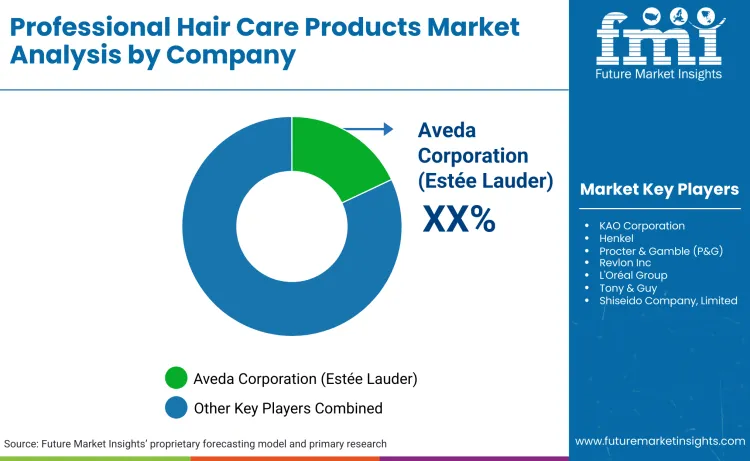
The competitive landscape is being defined by an intense race for "Hero Technologies" and intellectual property. Major conglomerates are increasingly acquiring innovation rather than building it internally to speed up time-to-market. L'Oréal's acquisition of Color Wow in June 2025 is a prime example of this strategy.
Omar Hajeri, President of L’Oréal’s Professional Products Division, stated regarding L’Oréal’s acquisition of professional haircare brand Color Wow: “As a premium haircare brand, with high levels of proven efficacy at an accessible price point, this acquisition will give us an increased foothold in haircare and in the styling category. Convinced of its strong” This strategic move secures L'Oréal's dominance in humidity-blocking technology, a critical segment in the increasingly volatile global climate, effectively buying them a leadership position in climate-adaptive styling.
Olaplex's decisive pivot to biotech through the Purvala acquisition indicates that the next competitive battleground is molecular repair. Henkel continues to drive organic growth through its Schwarzkopf Professional brand, leveraging its strong European foothold and operational excellence. Carsten Knobel, CEO of Henkel, highlighted their "In 2024, we achieved good organic sales growth and very significantly improved our profitability - with an outstanding margin increase of 2.4 percentage points, supported by an excellent gross margin development, and with an extraordinary increase in earnings per preferred share of 25 percent" in 2024, proving that operational efficiency and premiumization are winning strategies in a cost-heavy environment. This dichotomy between acquiring innovation and optimizing legacy operations characterizes the current market, where players must decide whether to buy their way into the future or build resilience through efficiency.
Recent Developments:
- In April 2025, Cécred, founded by Beyoncé Knowles-Carter, formed a strategic alliance with Ulta Beauty to launch its hair care products in over 1,400 stores nationwide and online. This partnership marks Ulta's largest exclusive hair care launch, expanding access to professional-grade treatments focused on transformative hair repair and strengthening Cécred's retail presence in the professional market.
- In April 2025, Paul Mitchell launched "Clear," a new professional hair care line designed for individuals with sensitive scalps. This innovation addresses scalp health with gentle, effective formulations, reinforcing Paul Mitchell's position in the salon-exclusive segment by meeting consumer needs for targeted, irritant-free professional products.
- In May 2025, KT Professional partnered with JioStar Consumer Products to launch KT Kids, India's first pediatric-approved, dermatologically tested natural hair care range for children aged 3 to 12. This collaboration introduces salon-grade products tailored for young users, emphasizing safety and natural ingredients to tap into the growing demand for specialized professional hair care in emerging markets.
Key Players in Professional Hair Care Products Market
- L'Oréal Groupe (L'Oréal Professionnel, Kérastase, Redken, Matrix, Color Wow)
- Henkel AG & Co. KGaA (Schwarzkopf Professional, Authentic Beauty Concept)
- Kao Corporation (Goldwell, Oribe, KMS, Melt)
- Wella Company (Wella Professionals, Sebastian, Nioxin)
- Olaplex Holdings, Inc.
- Estée Lauder Companies (Aveda, Bumble and bumble)
- Godrej Professional
- Milbon Co., Ltd.
- Kevin Murphy
- Davines Group
Market Definition
The professional hair care products market encompasses the total revenue generated from the sale of hair care formulations and chemical treatments specifically designed for use by licensed cosmetologists, barbers, and hair stylists in a professional salon setting, or sold through authorized professional retail channels. This definition strictly categorizes products based on their intended distribution channel and formulation strength, differentiating them from mass-market alternatives. The scope includes high-performance hair colouring agents (oxidative and non-oxidative), technical care products (back-bar shampoos, molecular bond builders), and precision styling agents (sprays, mousses, serums) that are engineered to deliver salon-grade results under the supervision of a trained professional.
The market definition explicitly excludes mass-market retail hair care products sold in supermarkets or drugstores, unless they are "diversion" stocks or specific "masstige" brands owned by professional entities that maintain a professional heritage. The financial scope covers both services revenue derived from product usage (back-bar consumption) and take-home retail sales generated within professional establishments. This comprehensive approach ensures that the market sizing reflects the full economic value of the professional beauty ecosystem, capturing both the service-based economy of the salon and the retail-based economy of product maintenance recommended by experts.
Report Scope
| Items | Values |
|---|---|
| Quantitative Units (2026) | USD 24.5 billion |
| Product Type | Hair Colouring, Hair Care (Shampoos, Conditioners, Masks & Treatments, Serums & Oils, Bond Builders), Styling Agents, Perming & Straightening Agents |
| Distribution Channel | Direct-to-Salon (B2B), Professional Retail (Salon Centric, Ulta Beauty), Salon Retail (Take-Home), Authorized E-commerce |
| End User | Professional Salons, Licensed Cosmetologists & Barbers, Individual Consumers (Professional-Grade Usage) |
| Key Active Focus Areas | Molecular Repair Systems, Scalp Health Treatments, Damage-Free Colouring Technologies, Clean & Safety-Driven Reformulations |
| Regions Covered | North America, Europe, Asia Pacific, Latin America, Middle East & Africa |
| Countries Covered | United States, United Kingdom, Germany, China, India, Japan, South Korea, Brazil, and 40+ countries |
| Key Companies Profiled | L’Oréal Groupe, Henkel AG & Co. KGaA, Kao Corporation, Wella Company, Olaplex Holdings, Estée Lauder Companies, Godrej Professional, Milbon Co., Ltd., Kevin Murphy, Davines Group |
| Additional Attributes | Revenue analysis by product type and professional channel, salon back-bar versus take-home consumption assessment, colour services share analysis (35.7%), regulatory impact assessment (formaldehyde restrictions), biotech and bond-building innovation tracking, scalp health and skinification adoption trends, professional labour economics impact, and competitive positioning across global professional beauty ecosystems |
Professional Hair Care Products Market by Segments
By Product Type:
- Hair Colouring:
- Permanent
- Demi-Permanent
- Semi-Permanent
- Bleaching/Lighteners
- Hair Care:
- Shampoos
- Conditioners
- Hair Masks/Treatments
- Hair Serums & Oils
- Bond Builders
- Styling Agents:
- Hairsprays
- Mousses/Foams
- Gels/Waxes
- Creams/Pastes
- Perming & Straightening Agents
By Distribution Channel:
- Direct-to-Salon (B2B)
- Professional Retail (e.g., Salon Centric, Ulta)
- E-Commerce (Authorized Professional)
- Salon Retail (Take-home)
By Region:
- North America (USA, Canada)
- Europe (UK, Germany, France, Italy, Spain)
- Asia Pacific (China, India, Japan, South Korea, Australia)
- Latin America (Brazil, Mexico)
- Middle East & Africa
Bibliography
- Olaplex Holdings, Inc. (2025, August). Acquisition of Purvala. Olaplex Investor Relations.
- Henkel AG & Co. KGaA. (2025, March). Annual results 2024. Henkel Corporate.
- USA Bureau of Labor Statistics. (2025, February). Consumer Price Index - January 2025.
- Eurostat. (2025, August). Self-perceived health statistics. European Commission.
- Ministry of Economy, Trade and Industry (METI). (2025, August). FY2024 E-Commerce Market Survey. Government of Japan.
- Office of Information and Regulatory Affairs. (2024, April). Unified Agenda: Ban on formaldehyde in hair smoothing products. Reginfo.gov.
- Korea Customs Service. (2025). Cosmetics export statistics and K-beauty trade performance. Government of Korea.
- Ministry of Food and Drug Safety (MFDS). (2025). Cosmetic ingredient regulation and safety enforcement updates. Government of Korea.
Frequently Asked Questions
What is the current market size for Professional Hair Care Products?
The global market is valued at USD 24.5 billion in 2026, driven by a post-inflation pricing stabilization and renewed consumer interest in salon services.
What is the projected CAGR for the Professional Hair Care Products market?
Revenue is projected to expand at a 4.6% CAGR from 2026 to 2036, supported by the "skinification" of hair and the rise of biotech-enhanced formulations.
Which segment currently dominates the industry?
Hair Colouring holds the dominant share at 35.7%, as technical color services remain the primary reason clients visit professional salons over using DIY home kits.
What are the primary market drivers?
Growth is driven by the integration of skincare ingredients into haircare ("Skinification"), the rise of scalp health treatments, and stricter safety regulations forcing high-value product reformulations.
Who are the leading players in the Professional Hair Care space?
L'Oréal Groupe, Henkel, Wella Company, and Olaplex lead the market, with L'Oréal recently strengthening its position through the strategic acquisition of Color Wow.
Preview the report firsthand - request a free sample
Get SampleGet the brochure for pricing and purchase details.
Get PDFTable of Content
- Executive Summary
- Global Market Outlook
- Demand Side Trends
- Supply Side Trends
- Technology Roadmap Analysis
- Analysis and Recommendations
- Market Overview
- Market Coverage / Taxonomy
- Market Definition / Scope / Limitations
- Research Methodology
- Chapter Orientation
- Analytical Lens and Working Hypotheses
- Market Structure, Signals, and Trend Drivers
- Benchmarking and Cross-market Comparability
- Market Sizing, Forecasting, and Opportunity Mapping
- Research Design and Evidence Framework
- Desk Research Programme (Secondary Evidence)
- Company Annual and Sustainability Reports
- Peer-reviewed Journals and Academic Literature
- Corporate Websites, Product Literature, and Technical Notes
- Earnings Decks and Investor Briefings
- Statutory Filings and Regulatory Disclosures
- Technical White Papers and Standards Notes
- Trade Journals, Industry Magazines, and Analyst Briefs
- Government Statistics Portals and Public Data Releases
- Press Releases and Reputable Media Coverage
- Sector Databases and Reference Repositories
- FMI Internal Knowledge Base and Historical Datasets
- Expert Input and Fieldwork (Primary Evidence)
- Primary Modes
- Qualitative Interviews and Expert Elicitation
- Quantitative Surveys and Structured Data Capture
- Field Techniques
- Interviews
- Surveys
- Observational and In-context Research
- Stakeholder Universe Engaged
- C-suite Leaders
- R&D and Innovation Heads
- Technical Specialists and Stylists
- Domain Subject-matter Experts
- Primary Modes
- Data Engineering and Model Build
- Quality Assurance and Audit Trail
- Desk Research Programme (Secondary Evidence)
- Market Background
- Market Dynamics
- Drivers
- Restraints
- Opportunity
- Trends
- Scenario Forecast
- Demand in Optimistic Scenario
- Demand in Likely Scenario
- Demand in Conservative Scenario
- Opportunity Map Analysis
- Product Life Cycle Analysis
- Supply Chain Analysis
- Investment Feasibility Matrix
- Value Chain Analysis
- PESTLE and Porter's Analysis
- Regulatory Landscape
- Regional Parent Market Outlook
- Production and Consumption Statistics
- Import and Export Statistics
- Market Dynamics
- Global Market Analysis 2021 to 2025 and Forecast, 2026 to 2036
- Historical Market Size Value (USD Billion) Analysis, 2021 to 2025
- Current and Future Market Size Value (USD Billion) Projections, 2026 to 2036
- Y-o-Y Growth Trend Analysis
- Absolute $ Opportunity Analysis
- Global Market Pricing Analysis 2021 to 2025 and Forecast 2026 to 2036
- Y-o-Y Growth Trend Analysis 2021 to 2025
- Absolute $ Opportunity Analysis 2026 to 2036
- Global Market Analysis 2021 to 2025 and Forecast 2026 to 2036, By Product Type
- Introduction / Key Findings
- Historical Market Size Value (USD Billion) Analysis By Product Type, 2021 to 2025
- Current and Future Market Size Value (USD Billion) Analysis and Forecast By Product Type, 2026 to 2036
- Hair Colouring
- Permanent
- Demi-Permanent
- Semi-Permanent
- Bleaching/Lighteners
- Hair Care
- Shampoos
- Conditioners
- Hair Masks/Treatments
- Hair Serums & Oils
- Bond Builders
- Styling Agents
- Hairsprays
- Mousses/Foams
- Gels/Waxes
- Creams/Pastes
- Perming & Straightening Agents
- Hair Colouring
- Y-o-Y Growth Trend Analysis By Product Type, 2021 to 2025
- Absolute $ Opportunity Analysis By Product Type, 2026 to 2036
- Global Market Analysis 2021 to 2025 and Forecast 2026 to 2036, By Distribution Channel
- Introduction / Key Findings
- Historical Market Size Value (USD Billion) Analysis By Distribution Channel, 2021 to 2025
- Current and Future Market Size Value (USD Billion) Analysis and Forecast By Distribution Channel, 2026 to 2036
- Direct-to-Salon (B2B)
- Professional Retail
- E-Commerce (Authorized Professional)
- Salon Retail (Take-home)
- Y-o-Y Growth Trend Analysis By Distribution Channel, 2021 to 2025
- Absolute $ Opportunity Analysis By Distribution Channel, 2026 to 2036
- Global Market Analysis 2021 to 2025 and Forecast 2026 to 2036, By Region
- Introduction
- Historical Market Size Value (USD Billion) Analysis By Region, 2021 to 2025
- Current Market Size Value (USD Billion) Analysis and Forecast By Region, 2026 to 2036
- North America
- Latin America
- Western Europe
- Eastern Europe
- Asia Pacific
- Middle East & Africa
- Market Attractiveness Analysis By Region
- North America Market Analysis 2021 to 2025 and Forecast 2026 to 2036, By Country
- Historical Market Size Value (USD Billion) Trend Analysis By Market Taxonomy, 2021 to 2025
- Market Size Value (USD Billion) Forecast By Market Taxonomy, 2026 to 2036
- By Country
- USA
- Canada
- By Product Type
- By Distribution Channel
- By Country
- Market Attractiveness Analysis
- By Country
- By Product Type
- By Distribution Channel
- Key Takeaways
- Latin America Market Analysis 2021 to 2025 and Forecast 2026 to 2036, By Country
- Historical Market Size Value (USD Billion) Trend Analysis By Market Taxonomy, 2021 to 2025
- Market Size Value (USD Billion) Forecast By Market Taxonomy, 2026 to 2036
- By Country
- Brazil
- Mexico
- Rest of Latin America
- By Product Type
- By Distribution Channel
- By Country
- Market Attractiveness Analysis
- By Country
- By Product Type
- By Distribution Channel
- Key Takeaways
- Europe Market Analysis 2021 to 2025 and Forecast 2026 to 2036, By Country
- Historical Market Size Value (USD Billion) Trend Analysis By Market Taxonomy, 2021 to 2025
- Market Size Value (USD Billion) Forecast By Market Taxonomy, 2026 to 2036
- By Country
- Germany
- UK
- Italy
- Spain
- France
- Rest of Europe
- By Product Type
- By Distribution Channel
- By Country
- Market Attractiveness Analysis
- By Country
- By Product Type
- By Distribution Channel
- Key Takeaways
- Asia Pacific Market Analysis 2021 to 2025 and Forecast 2026 to 2036, By Country
- Historical Market Size Value (USD Billion) Trend Analysis By Market Taxonomy, 2021 to 2025
- Market Size Value (USD Billion) Forecast By Market Taxonomy, 2026 to 2036
- By Country
- China
- India
- Japan
- South Korea
- Indonesia
- Australia
- Rest of Asia Pacific
- By Product Type
- By Distribution Channel
- By Country
- Market Attractiveness Analysis
- By Country
- By Product Type
- By Distribution Channel
- Key Takeaways
- Middle East & Africa Market Analysis 2021 to 2025 and Forecast 2026 to 2036, By Country
- Historical Market Size Value (USD Billion) Trend Analysis By Market Taxonomy, 2021 to 2025
- Market Size Value (USD Billion) Forecast By Market Taxonomy, 2026 to 2036
- By Country
- GCC Countries
- South Africa
- Rest of Middle East & Africa
- By Product Type
- By Distribution Channel
- By Country
- Market Attractiveness Analysis
- By Country
- By Product Type
- By Distribution Channel
- Key Takeaways
- Key Countries Market Analysis
- USA
- Pricing Analysis
- Market Share Analysis, 2025
- By Product Type
- By Distribution Channel
- Canada
- Pricing Analysis
- Market Share Analysis, 2025
- By Product Type
- By Distribution Channel
- Brazil
- Pricing Analysis
- Market Share Analysis, 2025
- By Product Type
- By Distribution Channel
- Mexico
- Pricing Analysis
- Market Share Analysis, 2025
- By Product Type
- By Distribution Channel
- Germany
- Pricing Analysis
- Market Share Analysis, 2025
- By Product Type
- By Distribution Channel
- UK
- Pricing Analysis
- Market Share Analysis, 2025
- By Product Type
- By Distribution Channel
- Italy
- Pricing Analysis
- Market Share Analysis, 2025
- By Product Type
- By Distribution Channel
- Spain
- Pricing Analysis
- Market Share Analysis, 2025
- By Product Type
- By Distribution Channel
- France
- Pricing Analysis
- Market Share Analysis, 2025
- By Product Type
- By Distribution Channel
- China
- Pricing Analysis
- Market Share Analysis, 2025
- By Product Type
- By Distribution Channel
- India
- Pricing Analysis
- Market Share Analysis, 2025
- By Product Type
- By Distribution Channel
- Japan
- Pricing Analysis
- Market Share Analysis, 2025
- By Product Type
- By Distribution Channel
- South Korea
- Pricing Analysis
- Market Share Analysis, 2025
- By Product Type
- By Distribution Channel
- Indonesia
- Pricing Analysis
- Market Share Analysis, 2025
- By Product Type
- By Distribution Channel
- Australia
- Pricing Analysis
- Market Share Analysis, 2025
- By Product Type
- By Distribution Channel
- USA
- Market Structure Analysis
- Competition Dashboard
- Competition Benchmarking
- Market Share Analysis of Top Players
- By Regional
- By Product Type
- By Distribution Channel
- Competition Analysis
- Competition Deep Dive
- L'Oréal Groupe
- Henkel AG & Co. KGaA
- Kao Corporation
- Wella Company
- Olaplex Holdings, Inc.
- Estée Lauder Companies
- Godrej Professional
- Milbon Co., Ltd.
- Kevin Murphy
- Davines Group
- Competition Deep Dive
- Assumptions & Acronyms Used


