

- Industry Size (2026)
- USD 1.3 Bn
- Forecast (2036)
- USD 2.7 Bn
- CAGR (2026 to 2036)
- 7.40%
Solid Shampoo Bars Market Forecast and Outlook 2026 to 2036
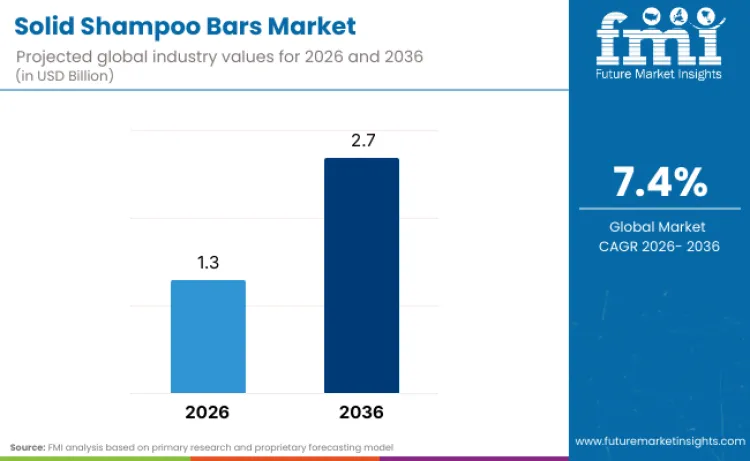
The global solid shampoo bars market is projected to reach USD 1.3 billion in 2026 and expand to USD 2.7 billion by 2036, registering a 7.40% CAGR. This growth reflects a measurable shift in how hair cleansing products are formulated and adopted by consumers. Initially positioned as an alternative format, solid shampoo bars have evolved into a performance-focused product category, with manufacturers developing concentrated, anhydrous systems that compete directly with liquid shampoos on foam density, rinse-off efficiency, and scalp comfort.
Product development strategies increasingly prioritise benefit-specific variants aligned with defined hair care needs, including formulations targeting hair repair, curl management, moisture retention, and scalp conditioning. This shift positions shampoo bars as functional cleansing solutions rather than format substitutes. Retail merchandising and category placement have improved visibility and trial rates, supporting broader consumer recognition of solid formats.
Quick Stats for Solid Shampoo Bars Market
- Solid Shampoo Bars Market Value (2026): USD 1.3 billion
- Solid Shampoo Bars Market Forecast Value (2036): USD 2.7 billion
- Solid Shampoo Bars Market Forecast CAGR (2026-2036): 7.40%
- Leading Product Type by Demand Share: Moisturizing solid formulations
- Fastest-Growing Regions: Europe, North America, Asia Pacific
- Top Players in Global Demand: Lush Cosmetics, Ethique, Unilever (Love Beauty and Planet), Procter & Gamble (Herbal Essences), The Body Shop
2024 was a defining year as we made L'Oréal future fit and laid many foundations for our next conquests: we augmented our marketing and R&I capabilities with AI and tech, advanced with the harmonisation of our IT, simplified our organisational structures, and strengthened our industrial and supply chain resilience.”- Nicolas Hieronimus, CEO of L’Oréal.
This operational emphasis explains why large multinational manufacturers are integrating solid formats into core product portfolios. As logistics and sourcing models adapt to lighter, concentrated product architectures and retailers increasingly favour space-efficient formats, solid shampoo bars are transitioning into a mainstream hair care category defined by performance and routine usability rather than positioning alone.
Solid Shampoo Bars Market Key Takeaways
| Metric | Value |
|---|---|
| Market Value (2026) | USD 1.3 billion |
| Market Forecast Value (2036) | USD 2.7 billion |
| Forecast CAGR (2026-2036) | 7.40% |
Source: Future Market Insights analysis, supported by a proprietary forecasting model and primary research
Key Shift in the Solid Shampoo Bars Market During 2026 to 2036
Before 2026, shampoo bars were selected primarily for format characteristics rather than delivered cleansing performance. Early adoption was concentrated among niche user groups willing to trade performance consistency for format novelty. Routine use exposed functional limitations that restricted repeat purchase, including inconsistent lather formation in mineral-rich water, a residual after-feel following rinsing, and surface roughness linked to formulation pH that reduced post-wash manageability. As a result, many consumers perceived shampoo bars as soap-derived substitutes rather than equivalent cleansing systems, constraining penetration beyond early adopters. From 2026 onward, the category enters an FMI-defined “Formulation Parity Phase,” where performance consistency overtakes format novelty as the primary purchase driver.
A structural shift away from saponified oil bases toward syndet-driven systems materially improves in-use results. Surfactant systems built around sodium cocoyl isethionate and selected glucosides deliver denser foam, faster rinse-off, and a cleaner after-feel, narrowing the experiential gap with liquid shampoos and improving reliability across varying water conditions. Shampoo bars are increasingly positioned as concentrated, function-specific cleansing systems aligned with scalp-care and treatment-oriented routines rather than basic hygiene use cases. Anhydrous matrices enable the stabilisation and delivery of targeted actives, supporting propositions linked to sebum regulation, flake management, and sensitivity-tolerant cleansing profiles. Manufacturing capabilities are advancing along the maturity curve, with hand-pressed production giving way to modular, higher-throughput lines and regionalised fulfilment models. In parallel, formulations are being optimised for humidity stability to maintain physical integrity and performance in high-humidity use environments.
What are the Various Segments of the Solid Shampoo Bars Market?
The solid shampoo bars market is segmented by product type into moisturizing, volumizing, anti-dandruff, color protection, and others; by application into household, commercial, and others; by distribution channel into online stores, supermarkets/hypermarkets, specialty stores, and others; by ingredient type into organic, conventional, vegan, and others; and by region into Asia Pacific (China, Japan, South Korea, India, Australia & New Zealand, ASEAN, rest of Asia Pacific), Europe (Germany, United Kingdom, France, Italy, Spain, Nordic, BENELUX, rest of Europe), North America (USA, Canada, Mexico), Latin America (Brazil, Chile, rest of Latin America), and Middle East & Africa (Kingdom of Saudi Arabia, other GCC countries, Turkey, South Africa, other African Union, rest of Middle East & Africa).
Which Product Type Holds the Largest Share in Solid Shampoo Bars?
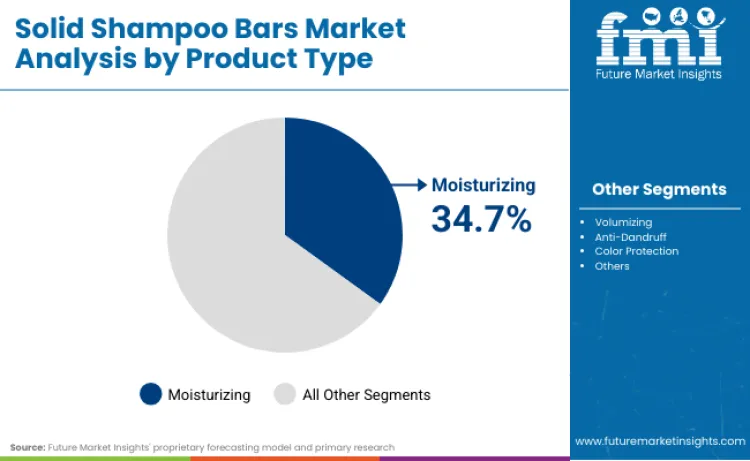
Moisturizing solid shampoo bars hold the largest demand share at 34.7%. These products are formulated to deliver hydration outcomes comparable to liquid shampoos. They address post-wash dryness through humectants, conditioning agents, and hair-compatible pH systems. Products such as Ethique Mintasy and Lush Coconut Rice Cake demonstrate strong first-use performance. Slip, detangling, and manageability improve early trial success. Broad suitability across hair textures supports repeat household use.
Moisturizing bars function as the primary entry format for new users. Other product types expand demand through targeted performance positioning. Volumizing bars from HiBAR (Volumize) and The Earthling Co. support fine hair using lightweight proteins and structure enhancers. Scalp-care bars such as KinKind CLEAR my head! and Ethique Heali Kiwi focus on flake control and itch reduction. Color-protecting bars from Davines use mild surfactants and cuticle-smoothing botanicals. Product portfolios are now organized by functional outcome rather than format identity.
How Do End Use Applications Influence Solid Shampoo Bar Preferences?
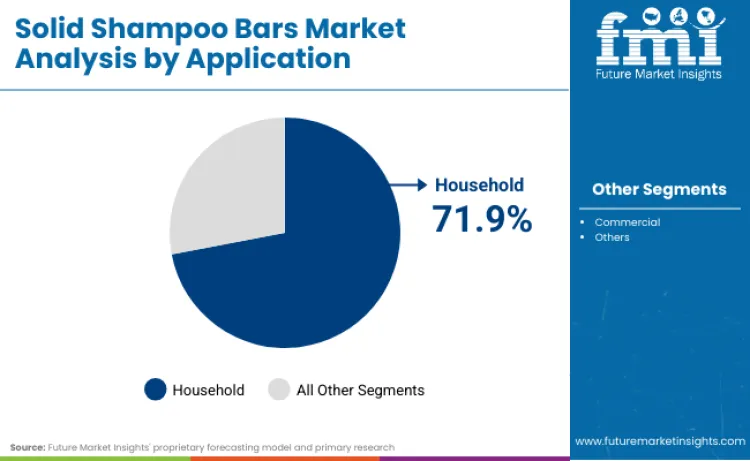
Household use represents 71.9% of total demand. Solid shampoo bars function as daily cleansing products in shared bathroom settings. Buyers prioritize storage simplicity, consistent performance, and extended use cycles. Brands such as J.R. Liggett’s Old-Fashioned Shampoo Bar and The Yellow Bird Peppermint & Tea Tree Bar address multi-user needs. Gentle formulations support use across age groups and hair types. Clean lathering and predictable rinse-off drive repeat purchase after initial trial.
Commercial adoption contributes to category validation. Hospitality brands introduce solid shampoo bars through amenity programs. Exposure occurs in premium service environments. Salons and spas integrate bars into scalp-health routines. Brands such as Davines and Kitsch Pro position bars as professional-grade options. Visibility across household and service channels reinforces trust. Reordering behavior increases across retail and online platforms.
What Structural Drivers Make Solid Shampoo Bars Win Share?
Solid shampoo bars gain share when adoption is driven by system-level incentives rather than individual preference alone. Retail normalization, where bars shift from niche shelving into mainstream haircare and travel-compact bays, changes the purchase trigger toward convenience-led trial, particularly among shoppers already familiar with compact formats through minis, kits, and replenishment routines. Packaging economics under regulatory fee and reporting regimes make the packaging-to-product ratio a measurable cost variable for producers, increasing exposure and reporting complexity for liquid formats. Institutional procurement, particularly in hospitality and travel, further supports adoption as solid formats simplify housekeeping logistics, standardize amenity handling, and align with chain-level operational efficiency targets.
Which Constraints Slow Adoption Even When Interest Exists?
Even when interest is present, conversion slows when perceived switching risk remains high. The most persistent constraint is performance variance under hard-water conditions, where minerals interfere with cleansing feel, reduce lather richness, and leave residue interpreted as incomplete cleansing, increasing churn after initial trial. Price elasticity remains a constraint relative to compliance and reformulation cost pass-through, as shelf prices often remain visibly higher than entry-level liquid alternatives during periods of cautious consumer spending. Administrative and manufacturing inertia also limit near-term expansion, with smaller brands facing elevated documentation and claims-discipline requirements for rinse-off products, while legacy manufacturing facilities designed for liquids cannot rapidly pivot to the milling, pressing, curing, and finishing precision required for consistent syndet bars.
What Recent Shifts Explain Why Momentum Has Increased Lately?
Recent momentum is driven by structural upgrades across the value chain rather than shifts in consumer sentiment alone. The most significant upgrade is the shift toward high-throughput syndet engineering, which reduces residue and improves rinse-off performance, allowing bars to compete with liquids on sensorial performance and scalp comfort. This technical parity has enabled integration into mainstream brand portfolios, reducing the effort required for consumers to locate and trial the format through hypermarkets and drug retail. The category is also benefiting from treatment-led positioning aligned with the skinification of hair, where concentrated matrices are positioned as carriers for targeted actives rather than basic cleansers. Finally, digital commerce expansion in Asia allows bar-focused brands to scale without reliance on physical planogram space, accelerating experimentation and access.
How Is the Solid Shampoo Bars Market Evolving Globally During 2026 to 2036?
The global solid shampoo bars market is undergoing structural realignment, shifting from an early-stage novelty into a default cleansing format as formulation maturity, regulatory cost exposure, and cross-channel availability converge. As manufacturers pivot toward syndet-based bar systems, the performance gap with liquid shampoos continues to narrow, particularly in foam density, rinse-off efficiency, and scalp comfort. Regulatory fee and reporting frameworks are forcing brands to reassess packaging-to-product ratios, creating measurable economic incentives for compact formats.
This convergence is most visible in mainstream retail, where solid shampoo bars are increasingly merchandised as direct category components rather than alternatives. Value framing around “washes per gram” and “bottle-equivalence” enables shampoo bars to compete on cost-per-use and functional efficiency. Brands are expanding portfolios toward multi-benefit routines, including volumizing, scalp-focused, and anti-dandruff applications, moving away from one-size-fits-all offerings. As a result, adoption during the forecast period is increasingly driven by convenience, regulatory compliance, and concentrated performance rather than value-based positioning.
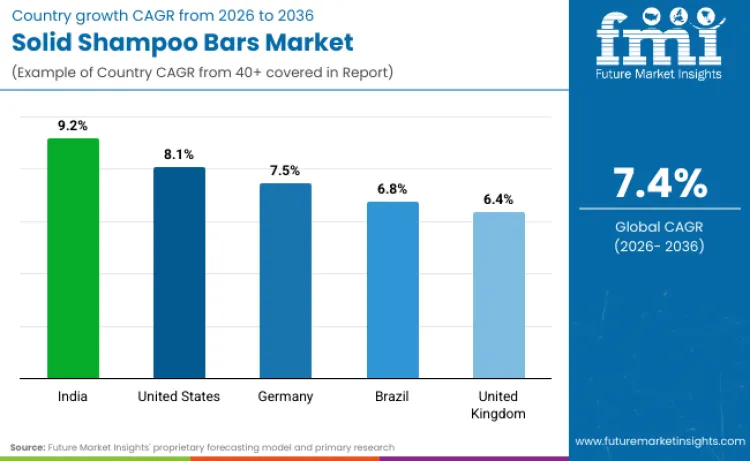
| Country | CAGR (2026-2036) |
|---|---|
| India | 9.2% |
| United Kingdom | 6.4% |
| United States | 8.1% |
| Brazil | 6.8% |
| Germany | 7.5% |
Source: Future Market Insights’ proprietary forecasting model and validated primary sources.
India: Why Are Shampoo Bars Gaining Popularity So Quickly?
India’s 9.2% CAGR reflects rising demand for cost-efficient, concentrated cleansing formats, particularly in tier-2 and tier-3 urban markets where travel frequency and household budgeting influence purchase decisions. Domestic D2C brands such as Earth Rhythm and The Switch Fix have reframed the proposition around wash equivalence, typically positioning a single bar as delivering 60–80 washes, aligning with value-per-use expectations. Tighter cosmetic registration requirements under the Bureau of Indian Standards (BIS) also favor lower-water, preservative-light formulations from a compliance standpoint. Expanding retail exposure through Nykaa and pharmacy chains has normalized shampoo bar usage among Gen Z and millennial consumers, while alignment with familiar botanical and Ayurvedic ingredients supports routine adoption across diverse climatic and water conditions.
United Kingdom: What Is Helping Shampoo Bars Grow Steadily?
The UK’s projected 6.4% CAGR is underpinned by one of Europe’s most stringent packaging accountability environments. The Plastic Packaging Tax and the phased rollout of Extended Producer Responsibility (EPR) between 2025 and 2026 have materially altered procurement economics, increasing cost and reporting exposure for packaging-intensive formats. Compact bar formats reduce administrative complexity and simplify compliance calculations. At the same time, expanded in-store ranging by retailers such as Boots has increased visibility and normalized shampoo bars within everyday haircare aisles. This reduces cognitive switching barriers, with consumers increasingly viewing bars as compact, travel-suitable options rather than a functional compromise.
United States: How Are Shampoo Bars Becoming a Regular Choice?
The USA market is expanding at an 8.1% CAGR, supported by broad channel integration and growing familiarity with concentrated personal-care formats. Brands such as Ethique and Love Beauty and Planet are positioned adjacent to premium liquid shampoos in retailers including Target and Whole Foods, transforming shampoo bars into a discovery-through-convenience category. Mass brands increasingly promote bar formats using bottle-equivalence metrics, aligning purchase decisions with performance expectations and cost efficiency. Travel-related use cases further reinforce adoption, supported by TSA liquid limits and consumer preference for leak-proof formats. Improved consumer education around lathering techniques, storage, and dry-down practices is also contributing to higher repeat usage rates.
Brazil: Why Do Consumers Find Shampoo Bars Practical?
Brazil’s 6.8% CAGR reflects strong alignment between shampoo bar formats and practical urban use cases, particularly in high-humidity environments where leakage and storage reliability matter. Brands such as B.O.B. and Lola Cosmetics position shampoo bars as concentrated, portable, and cost-conscious options rather than niche products. While packaging taxation frameworks remain less stringent than in Europe, brand-led education and in-store testing have improved consumer confidence and trial conversion. High sensitivity to value per use, combined with the rapid growth of e-commerce and subscription-based haircare, is accelerating penetration across middle-income segments. Shampoo bars also resonate strongly with Brazil’s travel-oriented beauty routines.
Germany: What Is Supporting Shampoo Bar Adoption?
Germany’s projected 7.5% CAGR is driven by tight integration between regulatory enforcement and evidence-based consumer evaluation. The LUCID Packaging Register and ZSVR impose strict requirements around packaging data submission and compliance, increasing administrative burden for packaging-heavy formats. Compact bar formats simplify reporting and retail listing processes. German consumers also rely heavily on independent testing organizations such as Öko-Test and Stiftung Warentest, which increasingly assess shampoo bars on efficacy, ingredient safety, and residue performance rather than format alone. In parallel, retailers including dm and Rossmann have integrated shampoo bars into standard shelf sets, merchandising them by hair function, such as volumizing or anti-dandruff, alongside liquids, reducing perceived format risk and supporting mainstream adoption.
Which Brands Are Leading the Solid Shampoo Bars Market?
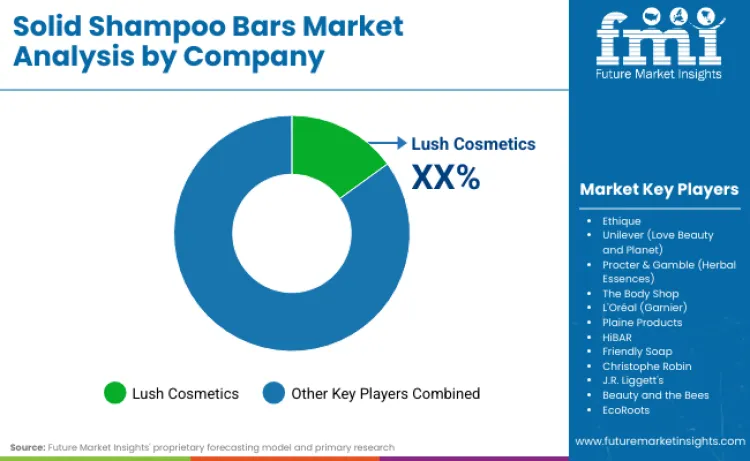
The solid shampoo bars market is being shaped by brands that can remove switching friction from liquid to solid formats by delivering immediate performance credibility at first use. Share gains are driven by products that lather reliably, rinse cleanly, and feel familiar during application. Companies gaining traction are those that control the trial experience, normalize usage, and place shampoo bars within established haircare shopping pathways rather than isolating them as a specialty format. Lush remains one of the most influential players globally due to its vertical control over retail, education, and usage framing. Within Lush stores, shampoo bars are demonstrated, explained, and merchandised as a core product rather than an adjacent offering.
By positioning the shampoo bar as a long-standing innovation dating back to 1988, Lush establishes heritage credibility and reinforces the format as a routine cleansing option rather than an experimental alternative. In Asia, particularly Japan, leadership dynamics differ between global and regional players. Japanese consumers place strong emphasis on scalp condition, aging hair, and functional outcomes. While multinational groups dominate liquid shampoo sales, solid bars gain preference through specialist positioning and routine-based adoption. In this context, shampoo bars are selected for targeted scalp performance rather than format attributes, supporting steady uptake among informed users. Mass-market players are pursuing a different strategy. L’Oréal, through its Garnier brand, has reported strong growth in solid shampoo sales and has expanded bar availability across multiple markets. This growth is largely driven by retail scale rather than category leadership. By positioning shampoo bars alongside familiar liquid variants in supermarkets, Garnier captures the “curious switcher” who is willing to trial the format within a trusted brand ecosystem.
Key Players in the Solid Shampoo Bars Market
- Lush Cosmetics
- Ethique
- Unilever (Love Beauty and Planet)
- Procter & Gamble (Herbal Essences)
- The Body Shop
- L'Oréal (Garnier)
- Plaine Products
- HiBAR
- Friendly Soap
- Christophe Robin
- J.R. Liggett's
- Beauty and the Bees
- EcoRoots
- Soapworks
- Foamie
- Lamazuna
- Chagrin Valley Soap & Salve
- Rocky Mountain Soap Company
- Bar None
- Basin
Market Definition
The solid shampoo bars market refers to revenues generated from compact hair cleansing products formulated in bar or pressed solid form and marketed specifically for shampooing purposes. These products are developed to perform core cleansing functions, including sebum removal, scalp refreshment, and hair fiber cleansing, without reliance on liquid carriers in the finished product format. Market size is measured in USD billion and analyzed over the 2026 to 2036 period. Solid shampoo bars are positioned as primary cleansing solutions for household, travel, professional, and hospitality use. The market includes syndet-based (synthetic detergent), plant-derived, and hybrid cleansing bars explicitly engineered to replicate or exceed the lather performance, pH balance, and sensorial experience of traditional liquid shampoos. This analysis treats solid shampoo bars as a standalone haircare category, distinct from soap bars, conditioning bars, and co-wash formats, and includes only products explicitly marketed and used for scalp and hair cleansing.
Market Inclusion
The scope of the solid shampoo bars market includes syndet bars formulated with mild surfactants such as Sodium Cocoyl Isethionate and Sodium Lauroyl Methyl Isethionate, soap-free cleansing bars, and hybrid formulations that combine surfactant systems with plant oils, essential oils, and pH-balanced ingredients. Included are bars marketed for specific hair and scalp profiles, including oily, dry, color-treated, curly, fine hair, and sensitive scalp variants. Performance-led formats such as volumizing, anti-dandruff, soothing, and clarifying shampoo bars are also included within scope. Finished products sold through household retail channels, professional salon use, and premium hospitality applications are included. Product positioning may include claims such as sulfate-free, paraben-free, silicone-free, vegan, cruelty-free, or organic, which are treated as segmentation attributes rather than defining criteria. Distribution through online marketplaces (including Amazon and brand direct-to-consumer platforms), supermarkets and hypermarkets, specialty beauty retailers such as Sephora and Lush, and professional salon retail networks is included. The analysis provides global coverage across North America, Europe, Asia Pacific, Latin America, and the Middle East & Africa, with country-level insights for key growth economies.
Market Exclusion
The solid shampoo bars market excludes all liquid-based shampoos irrespective of packaging format, including refill pouches and reduced-material containers. Also excluded are multipurpose body and hair bars, 2-in-1 shampoo-and-conditioner bars, co-washes, cleansing conditioners, and any product where shampooing is not the primary functional purpose. Artisan or multipurpose soap bars with incidental shampoo use are excluded unless explicitly marketed as solid shampoos. Leave-in scalp treatments, hair tonics, deep treatment bars, hair rinses, pomades, styling bars, and other non-cleansing solid hair products fall outside the market boundary. Accessories such as storage tins, travel cases, and application tools are excluded from revenue calculations. DIY shampoo bar kits, bulk institutional formats, experimental or pilot-stage products, and items not intended for repeated consumer use are also excluded. The analysis focuses exclusively on rinse-out shampoo bars explicitly designed and marketed for routine hair cleansing.
Scope of the Report
| Items | Values |
|---|---|
| Quantitative Units | USD billion |
| Product Type | Moisturizing; Volumizing; Anti-Dandruff; Color Protection; Others |
| Application | Household; Commercial; Others |
| Distribution Channel | Online Stores; Supermarkets/Hypermarkets; Specialty Stores; Others |
| Ingredient Type | Organic; Conventional; Vegan; Others |
| Regions Covered | Asia Pacific, Europe, North America, Latin America, Middle East & Africa |
| Countries Covered | United Kingdom, New Zealand, Canada, Germany, Australia, and 40+ countries |
| Key Companies Profiled | Lush Cosmetics; Ethique; Unilever; Procter & Gamble; The Body Shop; Others |
| Additional Attributes | Dollar sales by product type, application, and ingredient type; performance in cleansing concentration and environmental impact across waterless hair care, travel-friendly applications, and sustainable beauty matrices; ingredient concentration improvement, formulation stability enhancement, and plastic elimination benefit under personal care operations; impact on hair health, water conservation, and travel convenience during usage processes; compatibility with various water conditions and waterless lifestyle targets; consumer dynamics driven by zero-waste living expansion, waterless beauty programs, and long-term sustainable personal care partnerships. |
Solid Shampoo Bars Market by Segment
Product Type:
- Moisturizing
- Volumizing
- Anti-Dandruff
- Color Protection
- Others
Application:
- Household
- Commercial
- Others
Distribution Channel:
- Online Stores
- Supermarkets/Hypermarkets
- Specialty Stores
- Others
Ingredient Type:
- Organic
- Conventional
- Vegan
- Others
Region:
- Asia Pacific
- China
- Japan
- South Korea
- India
- Australia & New Zealand
- ASEAN
- Rest of Asia Pacific
- Europe
- Germany
- United Kingdom
- France
- Italy
- Spain
- Nordic
- BENELUX
- Rest of Europe
- North America
- U.S.
- Canada
- Mexico
- Latin America
- Brazil
- Chile
- Rest of Latin America
- Middle East & Africa
- Kingdom of Saudi Arabia
- Other GCC Countries
- Turkey
- South Africa
- Other African Union
- Rest of Middle East & Africa
Bibliography
- European Parliament and Council of the European Union. (2009/Consolidated 2023). Regulation (EC) No 1223/2009 on cosmetic products. Official Journal of the European Union.
- UK Government, Office for Product Safety and Standards. (2024). Guidance on cosmetic product regulation and safety. GOV.UK.
- USA Environmental Protection Agency. (2024). Reducing plastic waste and sustainable materials management. EPA.
- Cosmetics Europe - The Personal Care Association. (2024). Guidelines on cosmetic ingredient safety and responsible claims. Cosmetics Europe.
Frequently Asked Questions
How big is the global solid shampoo bars market?
The global solid shampoo bars market is valued at USD 1.3 billion in 2026 based on measured sales of concentrated, anhydrous hair cleansing products.
What is the growth outlook for the solid shampoo bars market over the next 10 years?
From 2026 to 2036, the market is projected to reach USD 2.7 billion, registering a 7.40% CAGR as concentrated formats gain wider retail and consumer adoption.
Which product segments drive demand in this market?
Demand is led by moisturizing solid shampoo bars, accounting for 34.70% share, supported by hydration-focused scalp care and dry-hair use cases.
How does consumer behavior differ by region?
Regional adoption varies based on retail maturity, travel usage patterns, regulatory cost exposure, and familiarity with concentrated personal-care formats.
What are the main risks and constraints affecting this market?
Key constraints include performance variability under hard-water conditions, shelf-price sensitivity versus liquids, and manufacturing precision required for consistent syndet bars.
Preview the report firsthand - request a free sample
Get SampleGet the brochure for pricing and purchase details.
Get PDFTable of Content
- Executive Summary
- Global Market Outlook
- Demand Side Trends
- Supply Side Trends
- Technology Roadmap Analysis
- Analysis and Recommendations
- Market Overview
- Market Coverage / Taxonomy
- Market Definition / Scope / Limitations
- Research Methodology
- Chapter Orientation
- Analytical Lens and Working Hypotheses
- Market Structure, Signals, and Trend Drivers
- Benchmarking and Cross-market Comparability
- Market Sizing, Forecasting, and Opportunity Mapping
- Research Design and Evidence Framework
- Desk Research Programme (Secondary Evidence)
- Company Annual and Sustainability Reports
- Peer-reviewed Journals and Academic Literature
- Corporate Websites, Product Literature, and Technical Notes
- Earnings Decks and Investor Briefings
- Statutory Filings and Regulatory Disclosures
- Technical White Papers and Standards Notes
- Trade Journals, Industry Magazines, and Analyst Briefs
- Conference Proceedings, Webinars, and Seminar Materials
- Government Statistics Portals and Public Data Releases
- Press Releases and Reputable Media Coverage
- Specialist Newsletters and Curated Briefings
- Sector Databases and Reference Repositories
- FMI Internal Knowledge Base and Historical Datasets
- Subscription Datasets and Paid Sources
- Social Channels, Communities, and Digital Listening Inputs
- Additional Desk Sources
- Expert Input and Fieldwork (Primary Evidence)
- Primary Modes
- Qualitative Interviews and Expert Elicitation
- Quantitative Surveys and Structured Data Capture
- Blended Approach
- Why Primary Evidence is Used
- Field Techniques
- Interviews
- Surveys
- Focus Groups
- Observational and In-context Research
- Social and Community Interactions
- Stakeholder Universe Engaged
- C-suite Leaders
- Board Members
- Presidents and Vice Presidents
- R&D and Innovation Heads
- Technical Specialists
- Domain Subject-matter Experts
- Scientists
- Physicians and Other Healthcare Professionals
- Governance, Ethics, and Data Stewardship
- Research Ethics
- Data Integrity and Handling
- Primary Modes
- Tooling, Models, and Reference Databases
- Desk Research Programme (Secondary Evidence)
- Data Engineering and Model Build
- Data Acquisition and Ingestion
- Cleaning, Normalisation, and Verification
- Synthesis, Triangulation, and Analysis
- Quality Assurance and Audit Trail
- Market Background
- Market Dynamics
- Drivers
- Restraints
- Opportunity
- Trends
- Scenario Forecast
- Demand in Optimistic Scenario
- Demand in Likely Scenario
- Demand in Conservative Scenario
- Opportunity Map Analysis
- Product Life Cycle Analysis
- Supply Chain Analysis
- Investment Feasibility Matrix
- Value Chain Analysis
- PESTLE and Porter's Analysis
- Regulatory Landscape
- Regional Parent Market Outlook
- Production and Consumption Statistics
- Import and Export Statistics
- Market Dynamics
- Global Market Analysis 2021 to 2025 and Forecast, 2026 to 2036
- Historical Market Size Value (USD Billion) Analysis, 2021 to 2025
- Current and Future Market Size Value (USD Billion) Projections, 2026 to 2036
- Y-o-Y Growth Trend Analysis
- Absolute $ Opportunity Analysis
- Global Market Pricing Analysis 2021 to 2025 and Forecast 2026 to 2036
- Y-o-Y Growth Trend Analysis 2021 to 2025
- Absolute $ Opportunity Analysis 2026 to 2036
- Global Market Analysis 2021 to 2025 and Forecast 2026 to 2036, By Product Type
- Introduction / Key Findings
- Historical Market Size Value (USD Billion) Analysis By Product Type, 2021 to 2025
- Current and Future Market Size Value (USD Billion) Analysis and Forecast By Product Type, 2026 to 2036
- Moisturizing
- Volumizing
- Anti-Dandruff
- Color Protection
- Others
- Y-o-Y Growth Trend Analysis By Product Type, 2021 to 2025
- Absolute $ Opportunity Analysis By Product Type, 2026 to 2036
- Global Market Analysis 2021 to 2025 and Forecast 2026 to 2036, By Application
- Introduction / Key Findings
- Historical Market Size Value (USD Billion) Analysis By Application, 2021 to 2025
- Current and Future Market Size Value (USD Billion) Analysis and Forecast By Application, 2026 to 2036
- Household
- Commercial
- Others
- Y-o-Y Growth Trend Analysis By Application, 2021 to 2025
- Absolute $ Opportunity Analysis By Application, 2026 to 2036
- Global Market Analysis 2021 to 2025 and Forecast 2026 to 2036, By Distribution Channel
- Introduction / Key Findings
- Historical Market Size Value (USD Billion) Analysis By Distribution Channel, 2021 to 2025
- Current and Future Market Size Value (USD Billion) Analysis and Forecast By Distribution Channel, 2026 to 2036
- Online Stores
- Supermarkets/Hypermarkets
- Specialty Stores
- Others
- Y-o-Y Growth Trend Analysis By Distribution Channel, 2021 to 2025
- Absolute $ Opportunity Analysis By Distribution Channel, 2026 to 2036
- Global Market Analysis 2021 to 2025 and Forecast 2026 to 2036, By Region
- Introduction
- Historical Market Size Value (USD Billion) Analysis By Region, 2021 to 2025
- Current Market Size Value (USD Billion) Analysis and Forecast By Region, 2026 to 2036
- North America
- Latin America
- Western Europe
- Eastern Europe
- East Asia
- South Asia and Pacific
- Middle East & Africa
- Market Attractiveness Analysis By Region
- North America Market Analysis 2021 to 2025 and Forecast 2026 to 2036, By Country
- Historical Market Size Value (USD Billion) Trend Analysis By Market Taxonomy, 2021 to 2025
- Market Size Value (USD Billion) Forecast By Market Taxonomy, 2026 to 2036
- By Country
- USA
- Canada
- Mexico
- By Product Type
- By Application
- By Distribution Channel
- By Country
- Market Attractiveness Analysis
- By Country
- By Product Type
- By Application
- By Distribution Channel
- Key Takeaways
- Latin America Market Analysis 2021 to 2025 and Forecast 2026 to 2036, By Country
- Historical Market Size Value (USD Billion) Trend Analysis By Market Taxonomy, 2021 to 2025
- Market Size Value (USD Billion) Forecast By Market Taxonomy, 2026 to 2036
- By Country
- Brazil
- Chile
- Rest of Latin America
- By Product Type
- By Application
- By Distribution Channel
- By Country
- Market Attractiveness Analysis
- By Country
- By Product Type
- By Application
- By Distribution Channel
- Key Takeaways
- Western Europe Market Analysis 2021 to 2025 and Forecast 2026 to 2036, By Country
- Historical Market Size Value (USD Billion) Trend Analysis By Market Taxonomy, 2021 to 2025
- Market Size Value (USD Billion) Forecast By Market Taxonomy, 2026 to 2036
- By Country
- Germany
- UK
- Italy
- Spain
- France
- Nordic
- BENELUX
- Rest of Western Europe
- By Product Type
- By Application
- By Distribution Channel
- By Country
- Market Attractiveness Analysis
- By Country
- By Product Type
- By Application
- By Distribution Channel
- Key Takeaways
- Eastern Europe Market Analysis 2021 to 2025 and Forecast 2026 to 2036, By Country
- Historical Market Size Value (USD Billion) Trend Analysis By Market Taxonomy, 2021 to 2025
- Market Size Value (USD Billion) Forecast By Market Taxonomy, 2026 to 2036
- By Country
- Russia
- Poland
- Hungary
- Balkan & Baltic
- Rest of Eastern Europe
- By Product Type
- By Application
- By Distribution Channel
- By Country
- Market Attractiveness Analysis
- By Country
- By Product Type
- By Application
- By Distribution Channel
- Key Takeaways
- East Asia Market Analysis 2021 to 2025 and Forecast 2026 to 2036, By Country
- Historical Market Size Value (USD Billion) Trend Analysis By Market Taxonomy, 2021 to 2025
- Market Size Value (USD Billion) Forecast By Market Taxonomy, 2026 to 2036
- By Country
- China
- Japan
- South Korea
- By Product Type
- By Application
- By Distribution Channel
- By Country
- Market Attractiveness Analysis
- By Country
- By Product Type
- By Application
- By Distribution Channel
- Key Takeaways
- South Asia and Pacific Market Analysis 2021 to 2025 and Forecast 2026 to 2036, By Country
- Historical Market Size Value (USD Billion) Trend Analysis By Market Taxonomy, 2021 to 2025
- Market Size Value (USD Billion) Forecast By Market Taxonomy, 2026 to 2036
- By Country
- India
- ASEAN
- Australia & New Zealand
- Rest of South Asia and Pacific
- By Product Type
- By Application
- By Distribution Channel
- By Country
- Market Attractiveness Analysis
- By Country
- By Product Type
- By Application
- By Distribution Channel
- Key Takeaways
- Middle East & Africa Market Analysis 2021 to 2025 and Forecast 2026 to 2036, By Country
- Historical Market Size Value (USD Billion) Trend Analysis By Market Taxonomy, 2021 to 2025
- Market Size Value (USD Billion) Forecast By Market Taxonomy, 2026 to 2036
- By Country
- Kingdom of Saudi Arabia
- Other GCC Countries
- Turkiye
- South Africa
- Other African Union
- Rest of Middle East & Africa
- By Product Type
- By Application
- By Distribution Channel
- By Country
- Market Attractiveness Analysis
- By Country
- By Product Type
- By Application
- By Distribution Channel
- Key Takeaways
- Key Countries Market Analysis
- USA
- Pricing Analysis
- Market Share Analysis, 2025
- By Product Type
- By Application
- By Distribution Channel
- Canada
- Pricing Analysis
- Market Share Analysis, 2025
- By Product Type
- By Application
- By Distribution Channel
- Mexico
- Pricing Analysis
- Market Share Analysis, 2025
- By Product Type
- By Application
- By Distribution Channel
- Brazil
- Pricing Analysis
- Market Share Analysis, 2025
- By Product Type
- By Application
- By Distribution Channel
- Chile
- Pricing Analysis
- Market Share Analysis, 2025
- By Product Type
- By Application
- By Distribution Channel
- Germany
- Pricing Analysis
- Market Share Analysis, 2025
- By Product Type
- By Application
- By Distribution Channel
- UK
- Pricing Analysis
- Market Share Analysis, 2025
- By Product Type
- By Application
- By Distribution Channel
- Italy
- Pricing Analysis
- Market Share Analysis, 2025
- By Product Type
- By Application
- By Distribution Channel
- Spain
- Pricing Analysis
- Market Share Analysis, 2025
- By Product Type
- By Application
- By Distribution Channel
- France
- Pricing Analysis
- Market Share Analysis, 2025
- By Product Type
- By Application
- By Distribution Channel
- India
- Pricing Analysis
- Market Share Analysis, 2025
- By Product Type
- By Application
- By Distribution Channel
- ASEAN
- Pricing Analysis
- Market Share Analysis, 2025
- By Product Type
- By Application
- By Distribution Channel
- Australia & New Zealand
- Pricing Analysis
- Market Share Analysis, 2025
- By Product Type
- By Application
- By Distribution Channel
- China
- Pricing Analysis
- Market Share Analysis, 2025
- By Product Type
- By Application
- By Distribution Channel
- Japan
- Pricing Analysis
- Market Share Analysis, 2025
- By Product Type
- By Application
- By Distribution Channel
- South Korea
- Pricing Analysis
- Market Share Analysis, 2025
- By Product Type
- By Application
- By Distribution Channel
- Russia
- Pricing Analysis
- Market Share Analysis, 2025
- By Product Type
- By Application
- By Distribution Channel
- Poland
- Pricing Analysis
- Market Share Analysis, 2025
- By Product Type
- By Application
- By Distribution Channel
- Hungary
- Pricing Analysis
- Market Share Analysis, 2025
- By Product Type
- By Application
- By Distribution Channel
- Kingdom of Saudi Arabia
- Pricing Analysis
- Market Share Analysis, 2025
- By Product Type
- By Application
- By Distribution Channel
- Turkiye
- Pricing Analysis
- Market Share Analysis, 2025
- By Product Type
- By Application
- By Distribution Channel
- South Africa
- Pricing Analysis
- Market Share Analysis, 2025
- By Product Type
- By Application
- By Distribution Channel
- USA
- Market Structure Analysis
- Competition Dashboard
- Competition Benchmarking
- Market Share Analysis of Top Players
- By Regional
- By Product Type
- By Application
- By Distribution Channel
- Competition Analysis
- Competition Deep Dive
- Lush Cosmetics
- Ethique
- Unilever (Love Beauty and Planet)
- Procter & Gamble (Herbal Essences)
- The Body Shop
- L'Oréal (Garnier)
- Plaine Products
- HiBAR
- Friendly Soap
- Christophe Robin
- Competition Deep Dive
- Assumptions & Acronyms Used


