

- Industry Size (2026)
- USD 9.5 Bn
- Forecast (2036)
- USD 20.5 Bn
- CAGR (2026 to 2036)
- 8%
Solid Night Creams Market Forecast and Outlook 2026 to 2036
The solid night creams market is valued at USD 9.5 billion in 2026 and is projected to reach USD 20.5 billion by 2036, advancing at an 8.0% CAGR. As per Future Market Insights, market expansion is being shaped by the growing shift toward water-efficient nighttime skincare and rising interest in solid, concentrated treatment formats that deliver prolonged nourishment during overnight skin recovery cycles. Solid night creams address several functional limitations of conventional jarred creams, including spillage risk, higher preservative dependence, and reduced portability. Product activity between 2025 and 2026 highlights increasing focus on barrier-repair actives, lipid-rich complexes, and time-release moisturizing systems designed to support skin renewal, firmness, and hydration during sleep. Established skincare brands are extending night treatment portfolios into solid formats to protect relevance within premium skincare routines, while newer brands are using compact, low-water formats to attract sustainability-focused consumers.
The shift toward concentrated, water-light formulations and targeted overnight treatment is supporting stronger uptake of solid night creams within routine facial care use. These formats align with minimalist packaging preferences, travel-friendly skincare habits, and growing demand for intensive overnight nourishment. Brands are increasingly anchoring product design and positioning to the skin’s natural nighttime repair cycle, strengthening the role of solid night creams within structured evening routines. As Ghazal Alagh, Co-Founder and Chief Innovation Officer at Honasa Consumer Limited, said, “Night skincare has long been treated as an extension of day routines, but the skin doesn’t follow our convenience; it follows its own biology. During the day, the skin is in defence mode, shielding itself from stressors. At night, it shifts into repair and regeneration mode, it absorbs better, loses more moisture and responds most effectively to targeted treatment. Luminéve is built to respect this science. It is purposeful, precise and designed for the time when skin naturally repairs the most, across different skin types.” Future Market Insights observes that digital retail and social commerce are central to product discovery, as solid night creams are visually demonstrable and resonate with sustainability-led purchasing cues. Broader acceptance of solid facial treatment formats is expected to support sustained value growth and wider brand participation through 2036.
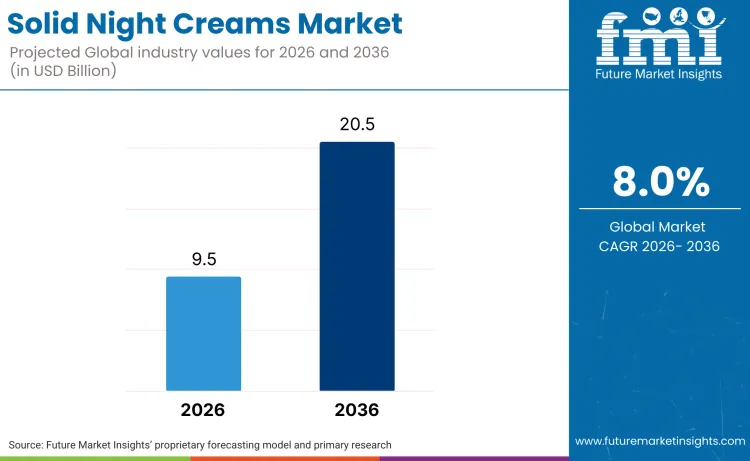
Summary of Solid Night Creams Market
What Is Growth Outlook for Solid Night Creams Market as per Future Market Insights Projection?
Future Market Insights projects the solid night creams industry to expand at a CAGR of 8.0% from 2026 to 2036, increasing from USD 9.5 Billion in 2026 to USD 20.5 Billion by 2036.
FMI Research Approach: FMI proprietary forecasting model based on premium skincare category growth rates, waterless format adoption curves, and prestige beauty channel expansion trends.
How Do FMI Analysts Perceive Solid Night Creams Market to Evolve?
FMI analysts perceive the market evolving toward multifunctional solid formats where anti-aging actives are combined with barrier repair lipids in anhydrous bases that eliminate water-dependent preservation challenges while delivering concentrated overnight treatment benefits.
FMI Research Approach: Ingredient innovation patent analysis and prestige beauty brand product launch tracking.
Which Country Holds Largest Share in Global Solid Night Creams Market?
The United States holds a significant share of the global solid night creams market by value which is supported by prestige beauty retail infrastructure and consumer willingness to adopt premium-priced innovative formats.
FMI Research Approach: FMI country-level revenue modeling by prestige beauty retail sales and clean beauty adoption rates.
How Large Will Solid Night Creams Market Be by 2036?
The global solid night creams market is projected to reach USD 20.5 Billion by 2036.
FMI Research Approach: FMI long-term revenue forecast derived from night skincare category growth projections and solid format penetration modeling across price tiers.
What Is Definition of Solid Night Creams Market?
The solid night creams market comprises anhydrous or low-water formulations delivered in solid formats including balms, sticks, and bars designed for overnight facial application, incorporating anti-aging peptides, moisturizing butters, and skin repair actives.
FMI Research Approach: FMI market taxonomy and inclusion-exclusion framework aligned with cosmetics industry product classification systems.
What Are Globally Unique Trends Shaping Solid Night Creams Market?
Globally unique trends include the elimination of single-use plastic jars through solid stick formats, the incorporation of microbiome-supporting prebiotics in waterless bases, and the rise of refillable solid systems where consumers purchase permanent applicators with replaceable product cartridges.
FMI Research Approach: European Commission Single-Use Plastics Directive impact modeling and beauty industry circular economy initiative tracking.
Solid Night Creams Market Key Takeaways
| Metric | Details |
|---|---|
| Industry Size (2026) | USD 9.5 Billion |
| Industry Value (2036) | USD 20.5 Billion |
| CAGR (2026-2036) | 8% |
Source: Future Market Insights (FMI) analysis, based on proprietary forecasting model and primary research
Which Factors Propel Adoption of Solid Night Creams?
Perceptions around overnight facial moisturization are shifting as solid night creams move from niche, sustainability-led positioning into more regular evening skincare routines. Future Market Insights indicates that consumers are placing stronger emphasis on concentrated performance, lower packaging impact, and formats that integrate smoothly into established nighttime regimens. Earlier solid products were often viewed as eco-focused alternatives or travel companions, which constrained their role in everyday facial care. This view is changing as solid night creams gain broader placement within premium and dermatology-aligned skincare ranges.
Portfolio strategies increasingly reflect regulatory and environmental pressures. Policy measures targeting cosmetics packaging waste are accelerating the shift toward low-plastic and refillable formats, particularly in markets with strict recycling mandates. At the same time, rising awareness of the environmental cost of transporting water-heavy products is strengthening interest in waterless skincare. Advances in solid formulation technology are improving texture and sensory performance, reducing the compromises that previously limited mainstream adoption.
How is the Solid Night Creams Market Segmented?
The solid night creams market is segmented by product type, distribution channel, and price tier, reflecting routine nighttime facial care usage. By product type, the market includes moisturizing night creams, anti-aging or night repair creams, skin whitening or brightening creams, and other functional types such as sensitive-skin and firming products. Moisturizing night creams hold the largest share at 42.8% due to regular use for overnight hydration and barrier support. By distribution channel, offline retail leads with a 58.6% share, supported by supermarkets, specialty stores, and pharmacies that enable product discovery and replenishment. Online channels continue to expand through convenience and access to premium offerings. By price tier, mid-range products lead with a 47.3% share, supported by demand for accessible, performance-led night creams.
Why does Moisturizing hold a Dominant Share?
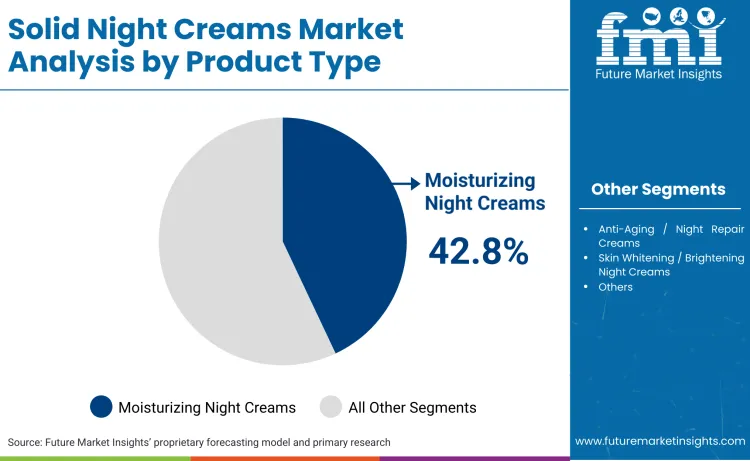
The dominance of moisturizing night creams, capturing 42.8% of the total market, is fueled by universal consumer need for overnight hydration across all age groups and skin types. The Institute of Personal Care Science notes that nighttime represents optimal conditions for transepidermal water loss prevention, creating sustained demand for barrier-repair formulations. L'Oréal's integration of ceramides and plant-derived butters in solid moisturizing formats addresses this fundamental skincare requirement while meeting clean beauty criteria. This broad applicability positions moisturizing as the entry segment that introduces consumers to solid formats before they graduate to specialized anti-aging treatments.
Why is Offline Retail the preferred Distribution Channel?
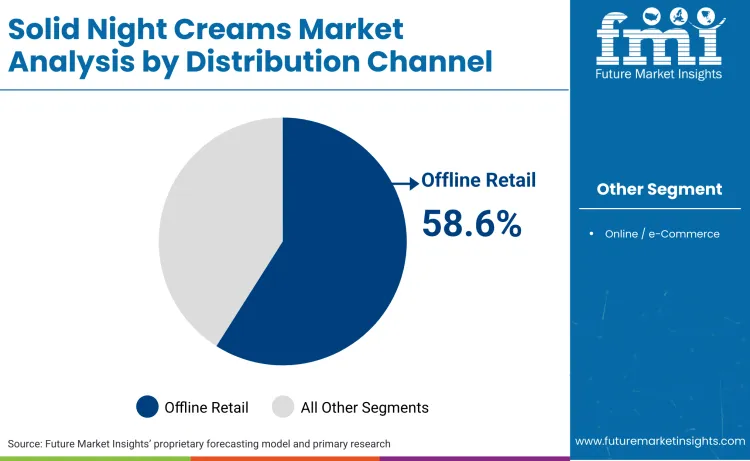
Offline retail maintains 58.6% channel share due to the tactile nature of solid products where consumers require in-store testing to evaluate texture and scent before purchase. Prestige department stores and specialty beauty retailers provide consultation services that educate consumers on solid format application techniques, reducing adoption barriers. Sephora's in-store testers for solid balms demonstrate product melt-on-skin properties that cannot be conveyed through online descriptions, making physical retail essential for format trial and conversion.
Why does Mid-Range dominate the Price Tier Mix?
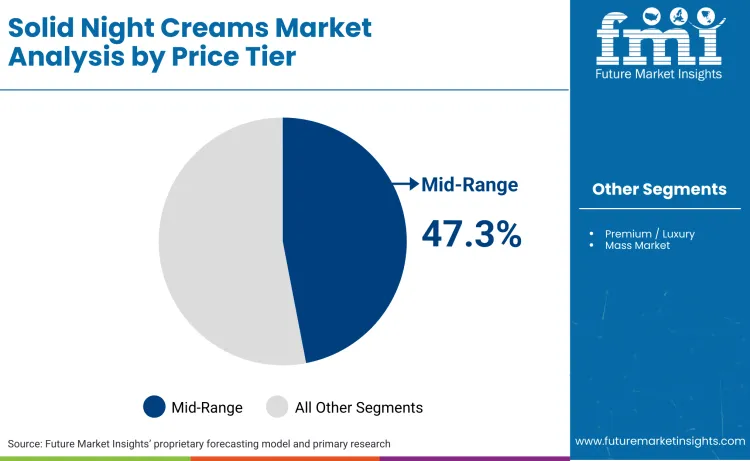
Mid-range pricing holds 47.3% market share as brands balance accessible entry points with premium positioning, typically pricing solid night creams between $25-60 per unit. This tier captures consumers trading up from mass-market liquids while remaining below luxury segment thresholds above $100. The mid-range position allows brands to incorporate quality actives like bakuchiol and niacinamide without prestige brand overhead costs, creating perceived value that drives repeat purchase in the category.
What Consumer Behavior Trends Are Shaping Industry Evolution in Solid Night Creams?
Consumer preferences are shifting toward simplified nighttime skincare routines that prioritize high performance over multi-step regimens. Time-constrained users increasingly seek multifunctional products that combine treatment and moisturization in a single step. This behavioral shift is encouraging brands to formulate solid night creams that deliver serum-strength actives within occlusive bases, reducing the need for layering multiple products. The broader move toward skinimalism, where consumers limit product count while expecting higher ingredient quality, is favoring concentrated solid formats that deliver visible results with fewer steps. FMI observes that this trend is reshaping how night creams are positioned, with emphasis on efficiency, treatment density, and routine compatibility.
How Are Biotechnology Advances Influencing Product Innovation in Solid Night Creams?
Manufacturers are accelerating the use of biotechnology-derived actives in solid night cream formulations to maintain clinical efficacy without water-based systems. Stabilizing peptides, growth factors, and bioengineered actives in anhydrous bases requires advanced formulation techniques, driving R&D investment across premium skincare brands. Research programs focused on anhydrous delivery platforms reflect industry efforts to combine performance-led skincare with preservative-light formulations. FMI notes that biotechnology integration is becoming a key innovation pathway, enabling solid formats to compete with liquid serums and creams on efficacy while supporting waterless product strategies aligned with sustainability goals.
What Texture and Sensory Innovations Are Redefining Solid Night Cream Formats?
Texture engineering is advancing toward solid-to-serum transformations, where balm-like formats melt upon skin contact to deliver cream-like application experiences. This sensory innovation addresses long-standing barriers to solid format adoption, where earlier wax-heavy textures limited ease of use and perceived comfort. Brands achieving fluid payoff from solid bases are improving user experience while maintaining shelf-stable formats. FMI notes that sensory parity with conventional creams is reducing resistance to solid night creams and supporting premium positioning by combining convenience, stability, and application luxury within next-generation nighttime skincare formats.
How Will Solid Night Creams Market Expansion Unfold Across Key Global Regions?
The solid night creams market is poised for significant expansion across key global regions, with varying growth rates projected from 2026 to 2036. China leads the way with a CAGR of 10.8%, driven by middle-class expansion and K-beauty influenced format innovation adoption. India follows at 10.0%, benefiting from youth demographics entering premium skincare categories. Germany records 9.2% growth, reflecting European sustainability mandates favoring waterless formats. Brazil is anticipated to grow at 8.4%, driven by prestige beauty retail expansion in major urban centers. The United States, with a CAGR of 7.6%, maintains market leadership through clean beauty movement adoption. The United Kingdom at 6.8% and Japan at 6.0% also present steady growth opportunities, fueled by mature prestige beauty markets.
| Country | CAGR (2026 to 2036) |
|---|---|
| China | 10.8% |
| India | 10.0% |
| Germany | 9.2% |
| Brazil | 8.4% |
| United States | 7.6% |
| UK | 6.8% |
| Japan | 6.0% |
Source: Future Market Insights (FMI) analysis, based on proprietary forecasting model and primary research
How is Middle-Class Consumption Fueling China's Growth?
China’s 10.8% CAGR positions it as the fastest-growing market for solid night creams, supported by rising demand for premium facial care among urban consumers with increasingly structured nighttime routines. Solid night creams align with dense urban lifestyles where compact formats, precise application, and reduced packaging waste are valued. These products are commonly used for targeted overnight treatment, such as brightening, hydration recovery, and barrier repair, rather than multi-step layering routines. Strong cross-border e-commerce penetration supports category expansion, as solid formats are easy to ship, store, and replenish through digital platforms. Adoption is shaped more by increased usage of concentrated night treatments and selective upgrading from conventional creams for specific concerns than by overall population growth. As consumers prioritize performance, convenience, and sustainability, solid night creams are becoming a practical addition to routine nighttime skincare practices.
Why is India's Youth Demographic Driving Expansion?
India’s 10.0% CAGR reflects rising spending capacity among millennials and Gen Z consumers who are entering premium skincare categories as first-time buyers, often moving directly into performance-led products rather than starting with basic mass-market creams. Solid night creams appeal due to compact packaging, suitability for warm and humid climates, and compatibility with simplified nighttime routines where heavy jar-based creams can feel occlusive. Younger consumers are increasingly adopting targeted overnight treatments for hydration recovery, brightening, and early-age management, supporting repeat usage. Rapid growth of online beauty platforms is extending trial beyond tier-one cities, with platforms such as Nykaa expanding visibility and access to premium and waterless skincare formats across urban markets. Wider availability across mid-range and premium price tiers supports gradual mainstream acceptance. Adoption is reinforced by rising interest in clean beauty, social media-led skincare education, and preference for products that deliver visible results without adding complexity to established nighttime skincare routines.
How is Germany's Circular Economy Mandate Supporting Growth?
Germany’s 9.2% CAGR is supported by regulatory pressure under the Circular Economy Act, which mandates high recycling rates for packaging and favors minimal-packaging solid formats over plastic jars. Cosmetics packaging waste has increased scrutiny on compliance, creating advantages for solid night creams in recyclable paperboard or refillable metal compacts. German consumers show strong environmental awareness and willingness to pay premiums for verified sustainable cosmetics. Retailers such as Douglas have expanded dedicated waterless beauty sections, improving mainstream visibility beyond niche segments. Domestic brands including Dr. Hauschka and Weleda are reformulating traditional night creams into solid balms using certified organic plant waxes sourced from European suppliers. This end-to-end sustainability positioning aligns with transparency expectations and supports broader acceptance of solid night creams within premium skincare routines.
What Drives Brazil's Prestige Beauty Expansion?
Brazil’s 8.4% CAGR reflects continued resilience within the prestige beauty segment, even amid periods of economic volatility, as middle-income consumers maintain discretionary spending on aspirational skincare products linked to self-care and status signaling. Growth in premium skincare is creating receptive conditions for solid night creams positioned as concentrated luxury treatments that deliver higher perceived value per application than conventional water-heavy creams. Brands are leveraging refillable formats and sustainability narratives to strengthen appeal among urban consumers seeking modern beauty routines with environmental alignment. Retail expansion in major cities such as São Paulo and Rio de Janeiro is improving physical access to prestige skincare, allowing consumers to experience solid textures and application feel through in-store trials. This in-person exposure supports adoption for sensory-driven categories, while digital channels continue to extend reach and reinforce awareness of solid night cream formats across broader consumer segments.
How Does the USA's Clean Beauty Movement Support 7.6% Growth?
The USA market is expanding at a 7.6% CAGR, supported by strong momentum in clean beauty, where consumers closely examine ingredient lists and expect clarity on sourcing and processing practices. Retail frameworks such as Sephora’s Clean at Sephora program are shaping product eligibility, encouraging brands to develop waterless solid formats that avoid preservative-related concerns. Premium skincare buyers show willingness to pay higher prices for products that combine ingredient transparency with sustainability narratives, strengthening pricing power for solid night creams within prestige channels. Mainstream retail adoption is widening reach, as large retailers integrate clean and waterless beauty concepts into broader assortments beyond niche natural stores. While federal regulation remains less prescriptive than in Europe, growing state-level scrutiny of cosmetic ingredients is prompting proactive reformulation. This environment is supporting gradual migration toward anhydrous solid formats positioned as cleaner, more transparent alternatives within routine nighttime skincare.
Why is the UK's Prestige Retail Infrastructure Driving 6.8% Growth?
The UK market growth at 6.8% CAGR shows mature prestige beauty infrastructure where Boots, Space NK, and Harrods provide curated retail environments that educate consumers on emerging formats through in-store beauty consultants and editorial content integration. British Beauty Council industry data indicates that prestige skincare grew 9% in 2023 to reach GBP 2.1 billion, with anti-aging treatments representing 38% of category value, creating substantial addressable market for solid night cream innovations targeting aging concerns. UK consumers, influenced by the BBC's environmental programming and print media sustainability coverage, demonstrate high awareness of beauty industry packaging waste, with 67% of UK beauty consumers stating they actively seek refillable or minimal-packaging options according to a 2023 Mintel survey. This environmental consciousness creates receptive conditions for premium-priced solid formats positioned as zero-waste alternatives to conventional jars. British independent brands like REN Clean Skincare and Pai Skincare pioneered refillable solid facial oils and balms in the UK market starting in 2021, establishing consumer familiarity with solid textures and application techniques that reduce adoption friction for mainstream prestige brands entering the category in subsequent years with competitive offerings.
What Strategic Moves Are Defining Competitive Landscape?
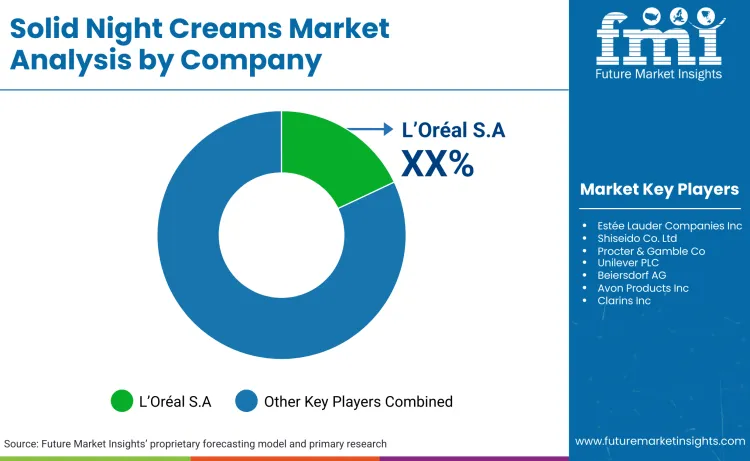
The competitive landscape is experiencing consolidation as global beauty conglomerates acquire independent clean beauty brands to gain solid formulation expertise and sustainability positioning. Manufacturers are investing in proprietary solid base technologies that achieve fluid payoff without petroleum-derived waxes, with significant R&D focused on plant-wax blends that mimic silicone sensory properties while maintaining clean ingredient credentials. The operational reality is defined by the need to educate consumers on application techniques unfamiliar from conventional jar formats, requiring brands to invest in digital content and in-store demonstration programs.
Supply chain strategies are shifting toward vertical integration where brands partner directly with botanical ingredient suppliers to ensure organic certification and fair-trade compliance that supports premium positioning narratives. Margin dynamics favor solid formats where concentrated actives command high per-gram pricing while reduced water content lowers shipping costs, creating profitability advantages over conventional creams despite higher raw material costs for specialty plant waxes and premium actives.
Recent Developments:
- In March 2023, L'Oréal Group launched a waterless beauty innovation hub in Paris to develop solid format technologies across skincare and haircare categories.
- In September 2023, Estée Lauder Companies introduced refillable solid night balm compacts for Aveda brand, expanding sustainable packaging initiatives beyond haircare into prestige skincare.
- In January 2024, Unilever completed acquisition of Garnier Green Labs assets to accelerate solid format development capabilities for its sustainable beauty portfolio.
Key Players in Solid Night Creams Market
- L'Oréal S.A.
- Estée Lauder Companies Inc.
- Shiseido Co. Ltd.
- Procter & Gamble Co.
- Unilever PLC
- Beiersdorf AG
- Avon Products Inc.
- Clarins Inc.
- Amorepacific Group
- KOSÉ Corporation
Market Definition
The solid night creams market represents revenue generated from anhydrous or low-water facial skincare formulations delivered in solid formats including balms, sticks, and bars, designed for overnight application. The market measures the value of moisturizing, anti-aging, and treatment products sold through prestige, mass, and online retail channels to consumers seeking concentrated nighttime skincare solutions.
Inclusions cover moisturizing night balms, anti-aging repair treatments, skin brightening formulations, and sensitive skin variants delivered in stick, jar balm, and bar formats. It encompasses formulations using plant-derived butters and waxes such as shea butter, coconut oil, candelilla wax, and jojoba esters, as well as bioengineered alternatives to petroleum-based structuring agents. Anti-aging actives including peptides, retinoids, and botanical extracts formulated into anhydrous bases are included when marketed for overnight use.
Exclusions include liquid or cream night moisturizers packaged in traditional jars or tubes containing more than 20% water content. Standard facial oils and serums in liquid form are outside the scope. Lip balms and eye treatment sticks are excluded. Body balms and hand creams marketed for non-facial use are not included. Multipurpose balms marketed primarily for daytime use or cleansing purposes fall outside the market definition.
Scope of Report
| Items | Values |
|---|---|
| Quantitative Units (2026) | USD 9.5 Billion |
| Product Type | Moisturizing Night Creams; Anti-Aging / Night Repair Creams; Skin Whitening / Brightening Night Creams; Other Functional Types (e.g., Sensitive Skin, Firming) |
| Distribution Channel | Offline Retail (Supermarkets/Hypermarkets, Specialty Stores, Pharmacies); Online / E-commerce |
| Price Tier | Mass Market; Mid-Range; Premium / Luxury |
| Regions Covered | North America, Europe, Asia Pacific, Latin America, Middle East & Africa |
| Countries Covered | United States, Germany, United Kingdom, India, China, Brazil, and 40+ countries |
| Key Companies Profiled | L’Oréal S.A.; Estée Lauder Companies Inc.; Shiseido Co. Ltd.; Procter & Gamble Co.; Unilever PLC; Beiersdorf AG; Avon Products Inc.; Clarins Inc.; Others |
| Additional Attributes | Dollar sales by product type, distribution channel, and price tier; country-wise growth analysis; adoption trends for solid and waterless night cream formats; application patterns for moisturizing, night repair, brightening, and sensitive skin care; competitive positioning across mass, premium, and dermatology-aligned nighttime skincare channels |
Solid Night Creams Market by Segments
By Product Type:
- Moisturizing Night Creams
- Anti-Aging / Night Repair Creams
- Skin Whitening / Brightening Night Creams
- Other Functional Types (sensitive skin, firming)
By Distribution Channel:
- Offline Retail (supermarkets/hypermarkets, specialty stores, pharmacies)
- Online / e-Commerce
By Price Tier:
- Mass Market
- Mid-Range
- Premium / Luxury
By Region:
- North America (United States, Canada, Mexico)
- Europe (Germany, France, United Kingdom, Italy, Spain, BENELUX, Nordics)
- East Asia (China, Japan, South Korea)
- South Asia (India, Australia & New Zealand, Southeast Asia)
- Latin America (Brazil, Chile, Colombia, Argentina)
- Middle East & Africa
Bibliography
- L'Oréal Group. (2023). Annual Report 2023. L'Oréal S.A.
- China Cosmetics Industry Association. (2023). China Prestige Beauty Market Report 2023. CCIA.
- India Brand Equity Foundation. (2024). Cosmetics Industry in India Report. Government of India, Ministry of Commerce and Industry.
- German Federal Environment Agency. (2023). Packaging Waste Statistics 2022. Umweltbundesamt.
- Brazilian Association of Personal Hygiene, Perfumes and Cosmetics. (2023). ABIHPEC Annual Report 2023. ABIHPEC.
- SPINS. (2023). USA Clean Beauty Market Report 2023. SPINS LLC.
- Japan Cosmetic Industry Association. (2023). Japanese Cosmetics Market Statistics 2023. JCIA.
Frequently Asked Questions
What is the current global market size for solid night creams?
The global market is valued at USD 9.5 Billion in 2026, driven by consumer demand for waterless concentrated formats and sustainable packaging alternatives.
What is the projected Compound Annual Growth Rate (CAGR) for the market over the next 10 years?
The market is projected to grow at 8.0% CAGR from 2026 to 2036, reaching USD 20.5 Billion by 2036.
Which regions are experiencing the fastest expansion?
China leads with 10.8% growth, followed closely by India at 10.0% and Germany at 9.2%, driven by middle-class expansion, youth demographics, and sustainability mandates respectively.
What are the primary market drivers?
Regulatory pressure on cosmetics packaging waste and consumer demand for waterless concentrated formats are fueling adoption across prestige and mass-market tiers.
Who are the leading suppliers in the industry?
L'Oréal S.A., Estée Lauder Companies, Shiseido, Procter & Gamble, and Unilever are key players, differentiating through formulation innovation, sustainability initiatives, and prestige retail partnerships.
Preview the report firsthand - request a free sample
Get SampleGet the brochure for pricing and purchase details.
Get PDFTable of Content
- Executive Summary
- Market Overview
- Key Demand Trends
- Technology and Formulation Shifts
- Strategic Implications
- Market Introduction
- Market Definition
- Market Scope and Coverage
- Market Taxonomy
- Research Methodology
- Report Structure and Chapter Orientation
- FMI Research Framework
- Market Sizing Methodology
- Forecasting Assumptions
- Primary and Secondary Research Inputs
- Data Validation and Triangulation
- Market Background
- Industry Dynamics
- Drivers
- Restraints
- Opportunities
- Trends
- Value Chain Analysis
- Supply Chain Assessment
- Regulatory and Sustainability Landscape
- Pricing and Cost Structure Analysis
- Industry Dynamics
- Global Solid Night Creams Market Analysis 2021 to 2025 and Forecast 2026 to 2036
- Market Size Value Analysis (USD Billion)
- Y-o-Y Growth Analysis
- Absolute Dollar Opportunity Analysis
- Global Solid Night Creams Market Analysis by Product Type
- Moisturizing Night Creams
- Anti-Aging / Night Repair Creams
- Skin Whitening / Brightening Night Creams
- Other Functional Types (Sensitive Skin, Firming)
- Global Solid Night Creams Market Analysis by Distribution Channel
- Offline Retail
- Supermarkets and Hypermarkets
- Specialty Stores
- Pharmacies and Drugstores
- Online / E-commerce
- Offline Retail
- Global Solid Night Creams Market Analysis by Price Tier
- Mass Market
- Mid-Range
- Premium / Luxury
- Global Solid Night Creams Market Analysis by Region
- North America
- Europe
- Asia Pacific
- Latin America
- Middle East & Africa
- North America Solid Night Creams Market Analysis
- United States
- Canada
- Mexico
- Europe Solid Night Creams Market Analysis
- Germany
- United Kingdom
- France
- Italy
- Spain
- BENELUX
- Nordics
- Rest of Europe
- Asia Pacific Solid Night Creams Market Analysis
- China
- India
- Japan
- South Korea
- Southeast Asia
- Australia and New Zealand
- Latin America Solid Night Creams Market Analysis
- Brazil
- Chile
- Colombia
- Argentina
- Rest of Latin America
- Middle East & Africa Solid Night Creams Market Analysis
- Competitive Landscape
- Market Share Analysis
- Competitive Dashboard
- Strategic Initiatives and Developments
- Company Profiles
- L’Oréal S.A.
- Estée Lauder Companies Inc.
- Shiseido Co. Ltd.
- Procter & Gamble Co.
- Unilever PLC
- Beiersdorf AG
- Avon Products Inc.
- Clarins Inc.
- Amorepacific Group
- KOSÉ Corporation
- Others
- Assumptions and Acronyms


