

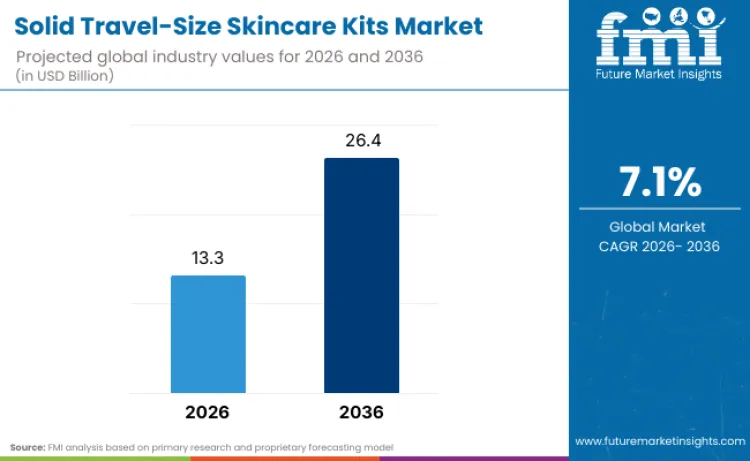
- Industry Size (2026)
- USD 13.3 Bn
- Forecast (2036)
- USD 26.4 Bn
- CAGR (2026 to 2036)
- 7.1%
Solid Travel-Size Skincare Kits Market Size, Market Forecast and Outlook By FMI
Solid travel size skincare kits are projected to reach USD 13.3 billion in 2026 and expand through 2036 as travelers look for routine ready formats that fit carry on constraints while keeping cleansing, hydration, and treatment steps consistent on the move. Growth is being reinforced by higher trip frequency and the consumer shift toward simplified routines that still feel premium, which is why brands are prioritizing solid cleansers, balms, and concentrated bars that deliver repeatable performance without leakage risk or dosing mess.
Summary of Solid Travel-Size Skincare Kits Market
- Market Snapshot
- The Solid Travel-Size Skincare Kits market is valued at USD 13.3 Billion in 2026.
- The Solid Travel-Size Skincare Kits market is projected to reach USD 26.4 Billion by 2036.
- The market is expected to expand at a CAGR of 7.1% from 2026 to 2036.
- Demand and Growth Drivers
- Airline liquid restrictions such as the 100 mL carry-on rule are driving adoption of solid skincare formats.
- Rising travel frequency is increasing demand for compact, routine-ready skincare kits.
- Waterless formulation technology is enabling concentrated products with improved portability and stability.
- Product and Segment View
- Cleansers lead the product segment with a 28.4% market share in 2026.
- Normal skin type accounts for 27.1% of total market share in 2026.
- Online stores dominate distribution channels with a 36.5% share in 2026.
- Geography and Competitive Outlook
- The United States is expected to grow at a CAGR of 8.2% from 2026 to 2036.
- China is projected to expand at a CAGR of 7.8% during the forecast period.
- Key companies include L'Oréal S.A., Estée Lauder Companies Inc., Shiseido Company Limited, Unilever PLC, and Johnson & Johnson.
Product strategy is increasingly built around waterless formulation engineering, since concentrating actives into solid matrices helps brands compete on portability, stability, and sustainability at the same time. Developers are investing in preservation free or low water systems, surfactant structuring for solid cleansers, and stabilization approaches that protect sensitive ingredients during temperature swings common in travel bags. This is also changing merchandising, with kits designed as step based regimens rather than random minis, supporting higher attachment rates and repeat purchase once consumers trial the full routine.
Quick Stats for Solid Travel-Size Skincare Kits Market
- Solid Travel-Size Skincare Kits Industry Value (2026): USD 13.3 Billion
- Solid Travel-Size Skincare Kits Industry Forecast Value (2036): USD 26.4 Billion
- Solid Travel-Size Skincare Kits Industry Forecast CAGR: 7.1%
- Solid Travel-Size Skincare Kits Industry Leading Product Type: Cleansers (28.4%)
- Solid Travel-Size Skincare Kits Industry Key Growth Regions: North America, Europe, Asia-Pacific
- Solid Travel-Size Skincare Kits Industry Key Players: L'Oréal S.A., Estée Lauder Companies Inc., Shiseido Company Limited, Unilever PLC, Johnson & Johnson
Government and aviation security rules remain a direct adoption driver. In the United States, the TSA 3 1 1 rule limits liquids, gels, creams, and pastes in carry on bags to 3.4 oz or 100 mL containers, which favors solid alternatives. The EU widely maintains the 100 mL cabin limit, although implementation can vary by airport as CT screening expands. International guidance also continues to reference the 100 mL framework for liquids, aerosols, and gels, keeping solid kits a practical compliance led choice for frequent travelers.
Solid Travel-Size Skincare Kits Market Key Takeaways
| Metric | Value |
|---|---|
| Industry Size (2026) | USD 13.3 Billion |
| Industry Value (2036) | USD 26.4 Billion |
| CAGR (2026-2036) | 7.1% |
Source: Future Market Insights’ proprietary forecasting model and primary research
What Is Driving Faster Adoption of Concentrated and Solid Cleanser Products?
Concentrated cleanser adoption is rising as consumers streamline travel routines and look for compact formats that stay convenient without sacrificing performance. Advances in solid cleanser manufacturing are helping brands deliver effective cleansing in waterless, travel-friendly forms that are easier to pack and less prone to leakage. Solid formats are also becoming more versatile as enzymatic cleansing technologies are incorporated to support gentle exfoliation and improved feel across sensitive-skin profiles. Retail and brand education around waterless cleansing is reinforcing trial, especially when messaging focuses on practicality, usage clarity, and barrier-friendly outcomes. In response, cosmetics companies are expanding portfolios with dermatologist-tested solid cleansers aimed at travel use, while botanical extract systems are increasingly used to support comfort and skin-barrier compatibility alongside cleansing efficacy.
How Is the Solid Travel-Size Skincare Kits Market Segmented Across Key Categories?
Global landscape is intricately segmented to address diverse requirements of the portable beauty industry, categorizing sector by product type, skin compatibility, distribution method, and consumer demographic. Structural division allows stakeholders to identify specific skincare targets, such as rising demand for serum concentrates in anti-aging applications or preference for moisturizer bars in hydration-focused travel routines. By analyzing these segments, manufacturers can tailor production lines to meet distinct needs of frequent business travelers versus occasional vacation consumers. Segmentation also highlights shift from traditional liquid approaches to concentrated solid interventions. As industry matures, granular segmentation becomes essential for understanding travel compliance pathways and regulatory requirements, ensuring product development aligns with evolving airline liquid restriction guidelines.
Why Do Cleansers Maintain Dominance?
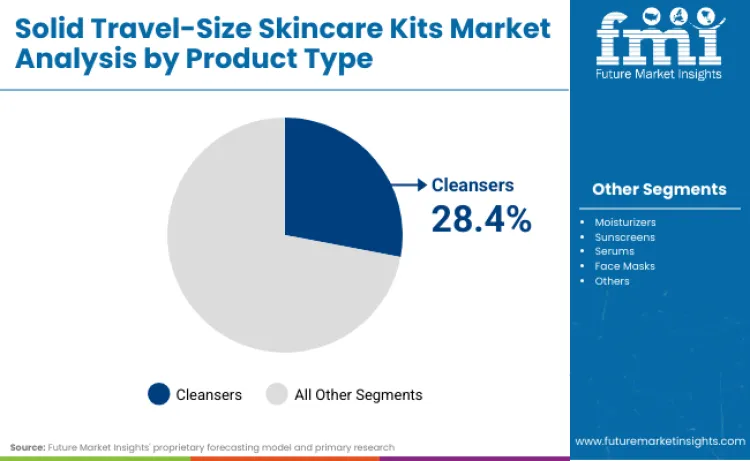
Cleansers account for 28.4% of product type share in 2026, driven by extensive consumer research supporting daily cleansing ritual importance. Leadership position is underpinned by dermatological approvals from skincare authorities recognizing gentle cleansing formulation claims. Segment benefits from continuous formulation improvements, such as pH-balanced technology maintaining skin microbiome health. As per FMI's projection, research focused on solid cleanser stability is renewing interest among premium beauty manufacturers. Critical role in managing travel-sized skincare routines further solidifies standing, as these products address primary skincare needs during travel. As dermatology guidelines prioritize gentle daily cleansing, demand for concentrated solid cleansing bars is expected to remain robust.
Why Are Normal Skin Types the Primary Focus?
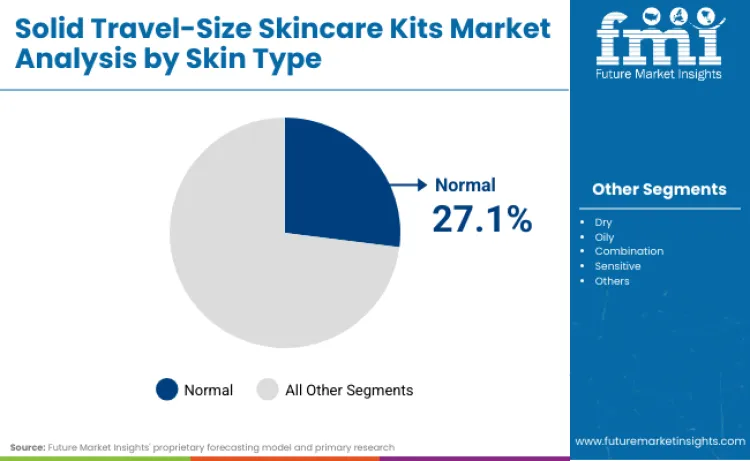
Normal skin type commands 27.1% share of sector in 2026, reflecting widespread consumer demographic seeking balanced skincare solutions. Dominance is linked to optimal formulation compatibility across diverse skin conditions compared to specialized formulations. Manufacturers rely on universal ingredient technology to ensure broad skin type acceptance and minimal sensitivity reactions. These formats are essential for delivering reliable skincare performance and travel convenience, driving priority status among mainstream beauty brands. FMI is of the opinion that relentless pursuit of universal skin compatibility ensures products designed for diverse consumer bases remain primary choice. High market acceptance necessitates versatile formulation capabilities, bolstering sustained revenue streams for travel skincare suppliers.
Why Do Online Stores Lead Distribution Channels?
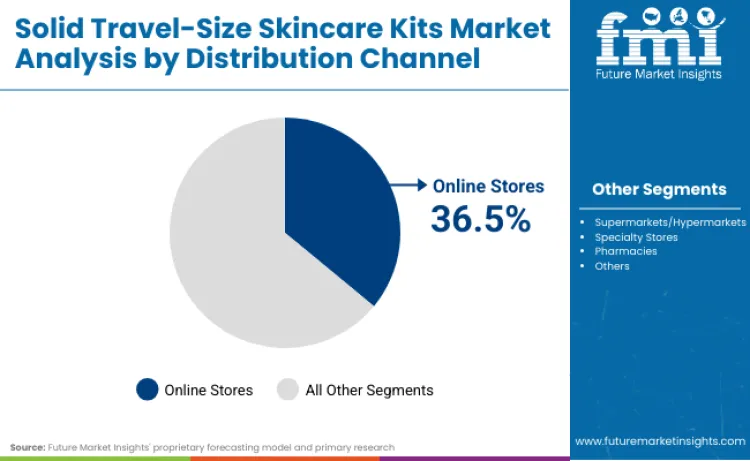
Online retail applications capture 36.5% of market share in 2026, owing to widespread e-commerce adoption requiring convenient purchasing experiences. Dominance stems from consumer shopping guidelines recommending direct-to-consumer brands alongside traditional retail channels for optimal product selection. Consumers prefer these platforms for their extensive product information and customer review accessibility. Usage in researching travel-specific skincare needs drives continuous volume growth among digitally savvy populations. As per FMI's estimates, compatibility with various subscription service models allows for automated replenishment across different travel frequency patterns. Manufacturers focusing on digital marketing and influencer partnerships for these high-engagement platforms secure significant loyalty among beauty-conscious travelers.
How Will Travel Recovery Influence Sales of Solid and Concentrated Skincare?
As travel rebounds, demand is shifting toward skincare formats that remove friction for frequent flyers and short-stay travelers, making portability a core purchase driver rather than a secondary benefit. Solid and concentrated products gain advantage because they reduce spill risk, simplify packing, and fit carry-on behaviors without forcing consumers to compromise on routine steps. Premium travel also supports trade-up, with buyers looking for elevated sensorial feel, refined packaging, and multifunctional formats that can cover cleansing, hydration, and barrier support in fewer items. Brands that do not clearly communicate “travel-first” usability, including fast routines and compact kits, can lose relevance to travelers who prioritize convenience but still expect premium performance.
How Will Airline Rules Shape Distribution and Channel Strategy?
Airline liquid rules continue to influence how travel beauty is merchandised, favoring solid alternatives that bypass volume limits and reduce checkout hesitation for international trips. This strengthens airport and travel-retail channels as discovery points where compliance-friendly formats can be positioned as “last-minute essentials,” supported by assortments curated around flight-ready routines. Duty-free operators and airport retailers also tend to favor products that are easy to educate, quick to trial, and simple to replenish, which helps solid skincare win shelf space when it is packaged with clear use instructions and strong portability cues. Digital travel planning behavior further amplifies this, as shoppers increasingly look for compliance clarity and destination-ready kits before departure.
How Will Sustainability Trends Affect Growth for Solid Travel Skincare?
Sustainability is supporting growth where waterless formats and reduced packaging can be linked to credible environmental benefits rather than vague “eco” language. Solid skincare aligns with waste-reduction narratives because it can cut single-use packaging intensity and reduce transport inefficiency tied to shipping water-heavy products. At the same time, the bar for proof is rising, pushing brands to back claims with stronger substantiation, clearer material disclosure, and packaging choices that match local recycling realities. This creates an advantage for companies that design refillable, low-material packs and build traceable sourcing stories, while those that rely on generic sustainability messaging face higher scrutiny and higher risk of consumer skepticism.
How Will the Solid Travel-Size Skincare Kits Industry Evolve in Major Nations?
Global landscape for portable skincare solutions is characterized by diverse travel patterns, influenced by tourism infrastructure and consumer mobility standards. Established markets prioritize premium concentrated formulations and dermatologist-tested manufacturing, whereas emerging economies focus on accessible pricing and basic travel convenience. Asia-Pacific is emerging as rapid growth hub due to increasing international travel and expanding beauty consciousness. Conversely, North American sectors pivot towards luxury travel beauty and personalized solid skincare protocols. Government travel policies in developed nations supporting tourism recovery ensure sustained demand for travel-optimized beauty products across all demographics.
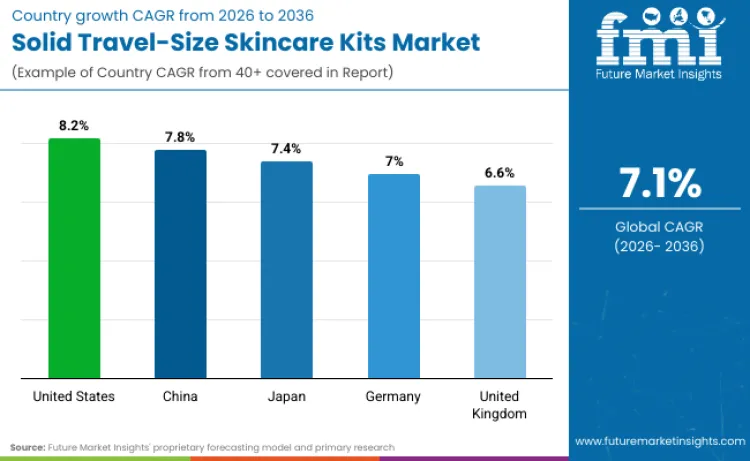
| Country | CAGR (2026 to 2036) |
|---|---|
| United States | 8.2% |
| China | 7.8% |
| Japan | 7.4% |
| Germany | 7.0% |
| United Kingdom | 6.6% |
Source: Future Market Insights - analysis driven by proprietary forecasting models and primary research
Why is the Solid Travel Size Skincare Kits Industry in United States Growing?
Solid travel size skincare kits in the United States are expanding because airline checkpoint rules continue to restrict carry on liquids, aerosols, gels, creams, and pastes, which directly affects common skincare formats. TSA guidance makes clear that many toiletry and skincare items fall under the liquids, aerosols, and gels rule, so solid formats reduce screening friction and the risk of discarding products at security. This creates a market pull for solid cleansers, balm bars, stick moisturizers, and concentrated formats that are easier to pack, easier to carry through checkpoints, and better suited to frequent travel behavior.
Why is the Solid Travel Size Skincare Kits Sector in China Expanding?
China’s growth is strongly tied to aviation security carry on rules that are more restrictive for liquids on domestic flights and tightly controlled on international flights. CAAC guidance states that liquids are generally prohibited in cabin baggage on domestic flights with limited exceptions for travel use cosmetics and certain items that must meet specific conditions, and it also sets controlled requirements for liquids on international and regional flights. This directly benefits solid travel kits because solids allow travelers to maintain routines without triggering liquid controls, while brands can design compact assortments specifically around what travelers can reliably carry on across route types.
Why is the Solid Travel Size Skincare Kits Industry in Japan Showing Potential?
Japan’s market is supported by aviation security controls on liquids, aerosols, and gels in cabin baggage, which shape what travelers can conveniently pack for skincare. MLIT materials describe screening requirements and restrictions for liquids, aerosols, and gels carried onboard, reinforcing a consistent operational reason for consumers to switch to solid or concentrated formats for travel. As a result, the category benefits from Japan’s quality focused beauty habits, where consumers look for travel kits that preserve routine performance while staying aligned with carry on rules.
Why is the Solid Travel Size Skincare Kits Industry in Germany Growing?
Germany’s expansion is linked to EU wide aviation security rules that restrict cabin baggage liquids, aerosols, and gels, which keeps solid skincare formats commercially attractive for frequent flyers within Europe. The EU implementing regulation framework includes detailed requirements for screening of liquids, aerosols, and gels, maintaining a predictable constraint on conventional travel toiletries. At the same time, EU updates on screening equipment recognize that certain advanced cabin baggage screening systems can enable airports to remove existing liquid limitations when deployed, which encourages brands to build flexible travel kits that still prioritize solids and concentrates for cross airport consistency.
Why is the Solid Travel Size Skincare Kits Sector in United Kingdom Expanding?
UK demand is being reinforced by airport security rules that still restrict liquids at most airports, while changes at some airports create uneven traveler expectations and increase the value of formats that work everywhere. UK government guidance states that liquids in hand luggage are restricted at most airports and notes that rules have changed at some UK airports, advising travelers to check before they travel. The UK Civil Aviation Authority also explains that current UK aviation security regulations restrict liquids in hand baggage through the security point above the standard container limit. This environment supports solid travel kits because they reduce compliance uncertainty and simplify packing for domestic and outbound trips where the traveler cannot rely on the same rules at every airport.
What is the Competitive Outlook for the Solid Travel-Size Skincare Kits Market?
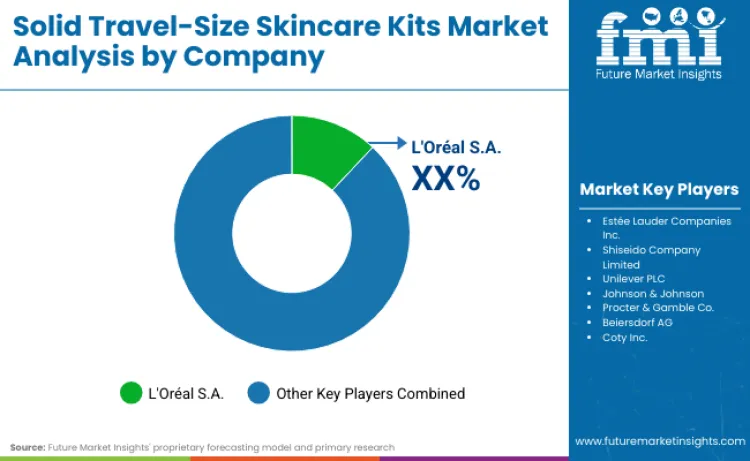
Competition in solid travel-size skincare kits is being shaped by airport-ready convenience and travel retail execution, not just new “clean” claims. Liquid limits in carry-on screening make solid formats attractive because they reduce packing friction and simplify compliance for frequent flyers. As a result, brands are treating travel as a dedicated route-to-market: L’Oréal frames Travel Retail as a distinct global channel (“the 6th Continent”) and is investing in experiential retail concepts and travel-exclusive activations to capture high-intent, last-minute purchases.
Aesop, now within L’Oréal’s orbit, already operates airport stores designed around carry-on essentials and quick trial, reinforcing how travel hubs are becoming a conversion engine for compact routines and kit-based regimens. This puts pressure on rivals to match three things: (1) kit engineering that survives heat, handling, and short-use cycles; (2) channel partnerships with duty-free and airport retailers (e.g., L’Oréal’s Heathrow concept work with Dufry); and (3) premium storytelling at shelf that makes small formats feel like a value upgrade, not a downsize.
Key Players in Solid Travel-Size Skincare Kits Market
- L'Oréal S.A.
- Estée Lauder Companies Inc.
- Shiseido Company Limited
- Unilever PLC
- Johnson & Johnson
- Procter & Gamble Co.
- Beiersdorf AG
- Coty Inc.
- Amorepacific Corporation
- Clarins Group
- Mary Kay Inc.
- Revlon Inc.
- Kao Corporation
- Colgate-Palmolive Company
- Avon Products Inc.
- The Himalaya Drug Company
- Burt's Bees (Clorox Company)
- Drunk Elephant (Shiseido)
- Tatcha LLC (Unilever)
- La Roche-Posay (L'Oréal)
Scope of Report
| Items | Values |
|---|---|
| Quantitative Units | USD Billion |
| Product Type Segments | Cleansers; Moisturizers; Sunscreens; Serums; Face Masks; Others |
| Skin Type Categories | Normal; Dry; Oily; Combination; Sensitive; Others |
| Distribution Channel Types | Online Stores; Supermarkets/Hypermarkets; Specialty Stores; Pharmacies; Others |
| End User Categories | Women; Men; Unisex; Others |
| Regions Covered | North America, Europe, East Asia, South Asia, Latin America, Middle East & Africa |
| Key Countries | United States, China, Japan, Germany, United Kingdom |
| Key Companies Profiled | L'Oréal S.A.; Estée Lauder Companies Inc.; Shiseido Company Limited; Unilever PLC; Johnson & Johnson; Procter & Gamble Co.; Beiersdorf AG; Coty Inc.; Amorepacific Corporation; Clarins Group; Mary Kay Inc.; Revlon Inc.; Kao Corporation; Colgate-Palmolive Company; Avon Products Inc.; The Himalaya Drug Company; Burt's Bees (Clorox Company); Drunk Elephant (Shiseido); Tatcha LLC (Unilever); La Roche-Posay (L'Oréal) |
| Additional Attributes | Dollar sales measured for solid travel-size skincare kits used in portable beauty and travel convenience applications, specified by product type (cleansers, moisturizers, serums, sunscreens), skin compatibility (normal, sensitive, combination, oily, dry), formulation concentration, gender preference (women, men, unisex), retail model (online vs. physical stores), and compliance alignment with evolving travel regulations and aviation liquid restriction standards. |
Solid Travel-Size Skincare Kits Market by Segments
Product Type
- Cleansers
- Moisturizers
- Sunscreens
- Serums
- Face Masks
- Others
Skin Type
- Normal
- Dry
- Oily
- Combination
- Sensitive
- Others
Distribution Channel
- Online Stores
- Supermarkets/Hypermarkets
- Specialty Stores
- Pharmacies
- Others
End User
- Women
- Men
- Unisex
- Others
Bibliography
- UK Government, Department for Business and Trade. (2024). Cosmetic products enforcement guidance. GOV.UK.
- International Civil Aviation Organization. (2023). Annex 17 to the Convention on International Civil Aviation: Security - Safeguarding international air transport against acts of unlawful interference. ICAO.
- Organisation for Economic Co‑operation and Development. (2024). Extended producer responsibility and sustainable packaging in consumer goods. OECD Publishing.
Frequently Asked Questions
How big is the global solid travel-size skincare kits market?
The global solid travel-size skincare kits market is valued at USD 13.3 billion in 2026.
What is the growth outlook for the solid travel-size skincare kits market over the next 10 years?
The market is expected to grow at a 7.1% CAGR from 2026 to 2036, reaching USD 26.4 billion.
Which product segments or formats drive demand in this market?
Demand is primarily driven by solid cleansers, followed by moisturizers and serums, due to their portability, leak-proof performance, and routine compatibility during travel.
How does consumer behavior differ by region?
North America and Europe favor premium, dermatologist-tested solid kits, while Asia-Pacific shows faster adoption driven by rising travel frequency and compact routine preferences.
What are the main risks and constraints affecting this market?
Key constraints include higher formulation development costs for waterless products, performance consistency across climates, and consumer education barriers around solid usage.
Preview the report firsthand - request a free sample
Get SampleGet the brochure for pricing and purchase details.
Get PDFTable of Content
- Executive Summary
- Global Market Outlook
- Demand Side Trends
- Supply Side Trends
- Technology Roadmap Analysis
- Analysis and Recommendations
- Market Overview
- Market Coverage / Taxonomy
- Market Definition / Scope / Limitations
- Research Methodology
- Chapter Orientation
- Analytical Lens and Working Hypotheses
- Market Structure, Signals, and Trend Drivers
- Benchmarking and Cross-market Comparability
- Market Sizing, Forecasting, and Opportunity Mapping
- Research Design and Evidence Framework
- Desk Research Programme (Secondary Evidence)
- Company Annual and Sustainability Reports
- Peer-reviewed Journals and Academic Literature
- Corporate Websites, Product Literature, and Technical Notes
- Earnings Decks and Investor Briefings
- Statutory Filings and Regulatory Disclosures
- Technical White Papers and Standards Notes
- Trade Journals, Industry Magazines, and Analyst Briefs
- Conference Proceedings, Webinars, and Seminar Materials
- Government Statistics Portals and Public Data Releases
- Press Releases and Reputable Media Coverage
- Specialist Newsletters and Curated Briefings
- Sector Databases and Reference Repositories
- FMI Internal Knowledge Base and Historical Datasets
- Subscription Datasets and Paid Sources
- Social Channels, Communities, and Digital Listening Inputs
- Additional Desk Sources
- Expert Input and Fieldwork (Primary Evidence)
- Primary Modes
- Qualitative Interviews and Expert Elicitation
- Quantitative Surveys and Structured Data Capture
- Blended Approach
- Why Primary Evidence is Used
- Field Techniques
- Interviews
- Surveys
- Focus Groups
- Observational and In-context Research
- Social and Community Interactions
- Stakeholder Universe Engaged
- C-suite Leaders
- Board Members
- Presidents and Vice Presidents
- R&D and Innovation Heads
- Technical Specialists
- Domain Subject-matter Experts
- Scientists
- Physicians and Other Healthcare Professionals
- Governance, Ethics, and Data Stewardship
- Research Ethics
- Data Integrity and Handling
- Primary Modes
- Tooling, Models, and Reference Databases
- Desk Research Programme (Secondary Evidence)
- Data Engineering and Model Build
- Data Acquisition and Ingestion
- Cleaning, Normalisation, and Verification
- Synthesis, Triangulation, and Analysis
- Quality Assurance and Audit Trail
- Market Background
- Market Dynamics
- Drivers
- Restraints
- Opportunity
- Trends
- Scenario Forecast
- Demand in Optimistic Scenario
- Demand in Likely Scenario
- Demand in Conservative Scenario
- Opportunity Map Analysis
- Product Life Cycle Analysis
- Supply Chain Analysis
- Investment Feasibility Matrix
- Value Chain Analysis
- PESTLE and Porter's Analysis
- Regulatory Landscape
- Regional Parent Market Outlook
- Production and Consumption Statistics
- Import and Export Statistics
- Market Dynamics
- Global Market Analysis 2021 to 2025 and Forecast, 2026 to 2036
- Historical Market Size Value (USD Billion) Analysis, 2021 to 2025
- Current and Future Market Size Value (USD Billion) Projections, 2026 to 2036
- Y-o-Y Growth Trend Analysis
- Absolute $ Opportunity Analysis
- Global Market Pricing Analysis 2021 to 2025 and Forecast 2026 to 2036
- Y-o-Y Growth Trend Analysis 2021 to 2025
- Absolute $ Opportunity Analysis 2026 to 2036
- Global Market Analysis 2021 to 2025 and Forecast 2026 to 2036, By Product Type
- Introduction / Key Findings
- Historical Market Size Value (USD Billion) Analysis By Product Type, 2021 to 2025
- Current and Future Market Size Value (USD Billion) Analysis and Forecast By Product Type, 2026 to 2036
- Cleansers
- Moisturizers
- Sunscreens
- Serums
- Face Masks
- Others
- Y-o-Y Growth Trend Analysis By Product Type, 2021 to 2025
- Absolute $ Opportunity Analysis By Product Type, 2026 to 2036
- Global Market Analysis 2021 to 2025 and Forecast 2026 to 2036, By Skin Type
- Introduction / Key Findings
- Historical Market Size Value (USD Billion) Analysis By Skin Type, 2021 to 2025
- Current and Future Market Size Value (USD Billion) Analysis and Forecast By Skin Type, 2026 to 2036
- Normal
- Dry
- Oily
- Combination
- Sensitive
- Others
- Y-o-Y Growth Trend Analysis By Skin Type, 2021 to 2025
- Absolute $ Opportunity Analysis By Skin Type, 2026 to 2036
- Global Market Analysis 2021 to 2025 and Forecast 2026 to 2036, By Distribution Channel
- Introduction / Key Findings
- Historical Market Size Value (USD Billion) Analysis By Distribution Channel, 2021 to 2025
- Current and Future Market Size Value (USD Billion) Analysis and Forecast By Distribution Channel, 2026 to 2036
- Online Stores
- Supermarkets/Hypermarkets
- Specialty Stores
- Pharmacies
- Others
- Y-o-Y Growth Trend Analysis By Distribution Channel, 2021 to 2025
- Absolute $ Opportunity Analysis By Distribution Channel, 2026 to 2036
- Global Market Analysis 2021 to 2025 and Forecast 2026 to 2036, By Region
- Introduction
- Historical Market Size Value (USD Billion) Analysis By Region, 2021 to 2025
- Current Market Size Value (USD Billion) Analysis and Forecast By Region, 2026 to 2036
- North America
- Latin America
- Western Europe
- Eastern Europe
- East Asia
- South Asia and Pacific
- Middle East & Africa
- Market Attractiveness Analysis By Region
- North America Market Analysis 2021 to 2025 and Forecast 2026 to 2036, By Country
- Historical Market Size Value (USD Billion) Trend Analysis By Market Taxonomy, 2021 to 2025
- Market Size Value (USD Billion) Forecast By Market Taxonomy, 2026 to 2036
- By Country
- USA
- Canada
- Mexico
- By Product Type
- By Skin Type
- By Distribution Channel
- By Country
- Market Attractiveness Analysis
- By Country
- By Product Type
- By Skin Type
- By Distribution Channel
- Key Takeaways
- Latin America Market Analysis 2021 to 2025 and Forecast 2026 to 2036, By Country
- Historical Market Size Value (USD Billion) Trend Analysis By Market Taxonomy, 2021 to 2025
- Market Size Value (USD Billion) Forecast By Market Taxonomy, 2026 to 2036
- By Country
- Brazil
- Chile
- Rest of Latin America
- By Product Type
- By Skin Type
- By Distribution Channel
- By Country
- Market Attractiveness Analysis
- By Country
- By Product Type
- By Skin Type
- By Distribution Channel
- Key Takeaways
- Western Europe Market Analysis 2021 to 2025 and Forecast 2026 to 2036, By Country
- Historical Market Size Value (USD Billion) Trend Analysis By Market Taxonomy, 2021 to 2025
- Market Size Value (USD Billion) Forecast By Market Taxonomy, 2026 to 2036
- By Country
- Germany
- UK
- Italy
- Spain
- France
- Nordic
- BENELUX
- Rest of Western Europe
- By Product Type
- By Skin Type
- By Distribution Channel
- By Country
- Market Attractiveness Analysis
- By Country
- By Product Type
- By Skin Type
- By Distribution Channel
- Key Takeaways
- Eastern Europe Market Analysis 2021 to 2025 and Forecast 2026 to 2036, By Country
- Historical Market Size Value (USD Billion) Trend Analysis By Market Taxonomy, 2021 to 2025
- Market Size Value (USD Billion) Forecast By Market Taxonomy, 2026 to 2036
- By Country
- Russia
- Poland
- Hungary
- Balkan & Baltic
- Rest of Eastern Europe
- By Product Type
- By Skin Type
- By Distribution Channel
- By Country
- Market Attractiveness Analysis
- By Country
- By Product Type
- By Skin Type
- By Distribution Channel
- Key Takeaways
- East Asia Market Analysis 2021 to 2025 and Forecast 2026 to 2036, By Country
- Historical Market Size Value (USD Billion) Trend Analysis By Market Taxonomy, 2021 to 2025
- Market Size Value (USD Billion) Forecast By Market Taxonomy, 2026 to 2036
- By Country
- China
- Japan
- South Korea
- By Product Type
- By Skin Type
- By Distribution Channel
- By Country
- Market Attractiveness Analysis
- By Country
- By Product Type
- By Skin Type
- By Distribution Channel
- Key Takeaways
- South Asia and Pacific Market Analysis 2021 to 2025 and Forecast 2026 to 2036, By Country
- Historical Market Size Value (USD Billion) Trend Analysis By Market Taxonomy, 2021 to 2025
- Market Size Value (USD Billion) Forecast By Market Taxonomy, 2026 to 2036
- By Country
- India
- ASEAN
- Australia & New Zealand
- Rest of South Asia and Pacific
- By Product Type
- By Skin Type
- By Distribution Channel
- By Country
- Market Attractiveness Analysis
- By Country
- By Product Type
- By Skin Type
- By Distribution Channel
- Key Takeaways
- Middle East & Africa Market Analysis 2021 to 2025 and Forecast 2026 to 2036, By Country
- Historical Market Size Value (USD Billion) Trend Analysis By Market Taxonomy, 2021 to 2025
- Market Size Value (USD Billion) Forecast By Market Taxonomy, 2026 to 2036
- By Country
- Kingdom of Saudi Arabia
- Other GCC Countries
- Turkiye
- South Africa
- Other African Union
- Rest of Middle East & Africa
- By Product Type
- By Skin Type
- By Distribution Channel
- By Country
- Market Attractiveness Analysis
- By Country
- By Product Type
- By Skin Type
- By Distribution Channel
- Key Takeaways
- Key Countries Market Analysis
- USA
- Pricing Analysis
- Market Share Analysis, 2025
- By Product Type
- By Skin Type
- By Distribution Channel
- Canada
- Pricing Analysis
- Market Share Analysis, 2025
- By Product Type
- By Skin Type
- By Distribution Channel
- Mexico
- Pricing Analysis
- Market Share Analysis, 2025
- By Product Type
- By Skin Type
- By Distribution Channel
- Brazil
- Pricing Analysis
- Market Share Analysis, 2025
- By Product Type
- By Skin Type
- By Distribution Channel
- Chile
- Pricing Analysis
- Market Share Analysis, 2025
- By Product Type
- By Skin Type
- By Distribution Channel
- Germany
- Pricing Analysis
- Market Share Analysis, 2025
- By Product Type
- By Skin Type
- By Distribution Channel
- UK
- Pricing Analysis
- Market Share Analysis, 2025
- By Product Type
- By Skin Type
- By Distribution Channel
- Italy
- Pricing Analysis
- Market Share Analysis, 2025
- By Product Type
- By Skin Type
- By Distribution Channel
- Spain
- Pricing Analysis
- Market Share Analysis, 2025
- By Product Type
- By Skin Type
- By Distribution Channel
- France
- Pricing Analysis
- Market Share Analysis, 2025
- By Product Type
- By Skin Type
- By Distribution Channel
- India
- Pricing Analysis
- Market Share Analysis, 2025
- By Product Type
- By Skin Type
- By Distribution Channel
- ASEAN
- Pricing Analysis
- Market Share Analysis, 2025
- By Product Type
- By Skin Type
- By Distribution Channel
- Australia & New Zealand
- Pricing Analysis
- Market Share Analysis, 2025
- By Product Type
- By Skin Type
- By Distribution Channel
- China
- Pricing Analysis
- Market Share Analysis, 2025
- By Product Type
- By Skin Type
- By Distribution Channel
- Japan
- Pricing Analysis
- Market Share Analysis, 2025
- By Product Type
- By Skin Type
- By Distribution Channel
- South Korea
- Pricing Analysis
- Market Share Analysis, 2025
- By Product Type
- By Skin Type
- By Distribution Channel
- Russia
- Pricing Analysis
- Market Share Analysis, 2025
- By Product Type
- By Skin Type
- By Distribution Channel
- Poland
- Pricing Analysis
- Market Share Analysis, 2025
- By Product Type
- By Skin Type
- By Distribution Channel
- Hungary
- Pricing Analysis
- Market Share Analysis, 2025
- By Product Type
- By Skin Type
- By Distribution Channel
- Kingdom of Saudi Arabia
- Pricing Analysis
- Market Share Analysis, 2025
- By Product Type
- By Skin Type
- By Distribution Channel
- Turkiye
- Pricing Analysis
- Market Share Analysis, 2025
- By Product Type
- By Skin Type
- By Distribution Channel
- South Africa
- Pricing Analysis
- Market Share Analysis, 2025
- By Product Type
- By Skin Type
- By Distribution Channel
- USA
- Market Structure Analysis
- Competition Dashboard
- Competition Benchmarking
- Market Share Analysis of Top Players
- By Regional
- By Product Type
- By Skin Type
- By Distribution Channel
- Competition Analysis
- Competition Deep Dive
- L'Oréal S.A.
- Estée Lauder Companies Inc.
- Shiseido Company Limited
- Unilever PLC
- Johnson & Johnson
- Procter & Gamble Co.
- Beiersdorf AG
- Coty Inc.
- Amorepacific Corporation
- Clarins Group
- Competition Deep Dive
- Assumptions & Acronyms Used


