

- Industry Size (2026)
- USD 474.8 Mn
- Forecast (2036)
- USD 1626.1 Mn
- CAGR (2026 to 2036)
- 13.1%
Solid Sorbents for Direct Air Capture Market Forecast and Outlook 2026 to 2036
The solid sorbents for direct air capture market is expected to reach USD 474.8 million in 2026 and grow to USD 1,626.1 million by 2036, with a compound annual growth rate (CAGR) of 13.1%. For decision-makers, it is crucial to understand the economic exposure associated with the capital-intensive nature of direct air capture technologies. While the market shows strong growth potential, prioritization should focus on technologies that align with evolving environmental regulations and sustainability goals. Timing is critical, as investments in solid sorbents are typically long-term, requiring strategic foresight in both research and deployment. As regulatory incentives increase, companies must assess which solutions will provide scalable, cost-effective outcomes. Immediate attention is needed to secure competitive positions, as the market is expected to mature, and early movers will benefit from stronger brand recognition and operational efficiency. Balancing innovation with regulatory compliance will determine success in this rapidly developing sector.
Quick Stats of the Solid Sorbents for Direct Air Capture Market
- Solid Sorbents for Direct Air Capture Market Value (2026): USD 474.8 million
- Solid Sorbents for Direct Air Capture Market Forecast Value (2036): USD 1,626.1 million
- Solid Sorbents for Direct Air Capture Market Global Forecast CAGR (2026-2036): 13.1%
- Solid Sorbents for Direct Air Capture Market Leading Segment: Technology Type (Temperature Swing Adsorption – TSA) 38%
- Key Growth Regions in Solid Sorbents for Direct Air Capture Market: USA
- Top Players in Solid Sorbents for Direct Air Capture Market: Climeworks, Carbon Engineering (Occidental), Global Thermostat, Heirloom Carbon Technologies, Carbon Capture Inc.
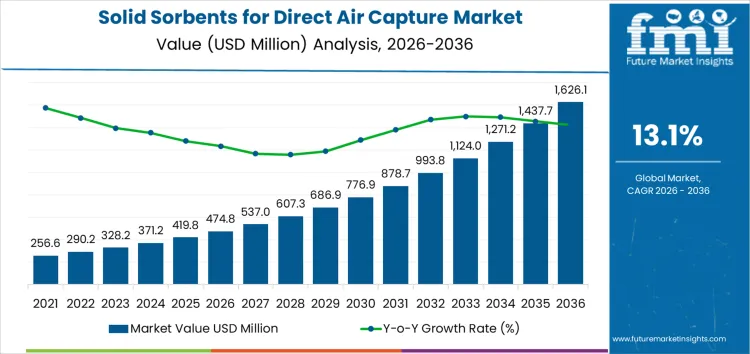
What is the Growth Forecast for the Solid Sorbents for Direct Air Capture Market through 2036?
The peak-to-trough analysis of the solid sorbents for direct air capture (DAC) market highlights the gradual but substantial growth expected over the forecast period. Starting in 2026, the market begins at USD 474.8 million, representing the initial stage of adoption for solid sorbents in DAC technologies. This value marks the "trough" of the market, as solid sorbents are still developing and DAC systems are in the early stages of widespread implementation. During this phase, the market will experience slower growth as the technology matures, and the application of solid sorbents for large-scale CO₂ capture continues to be refined. In this early period, adoption is expected to be more cautious as industries and governments continue exploring the full potential of DAC technologies.
By 2036, the market will reach its "peak" at USD 1,626.1 million, reflecting widespread adoption and technological optimization of solid sorbents in DAC systems. This peak represents a period where solid sorbents become a core component of carbon capture infrastructure, with increasing investments and scaling up of DAC facilities. The market will undergo steady growth throughout the forecast period, with gradual acceleration as the technology becomes more efficient and cost-effective. This analysis illustrates how the market transitions from early experimentation to mass adoption, with a clear upward trajectory as global demand for effective CO₂ removal solutions grows.
Solid Sorbents for Direct Air Capture Market Key Takeaways
| Metric | Value |
|---|---|
| Industry Sales Value (2026) | USD 474.8 million |
| Industry Forecast Value (2036) | USD 1,626.1 million |
| Industry Forecast CAGR (2026-2036) | 13.1% |
What Is Driving the Demand for the Solid Sorbents for Direct Air Capture Market Globally?
The global demand for solid sorbents for direct air capture (DAC) is driven by accelerating commitments to reduce atmospheric carbon dioxide and meet climate mitigation targets. Governments, multinational organizations, and major emitters are under growing pressure to implement technologies that can capture CO₂ directly from ambient air, addressing both current emissions and historical accumulation. Solid sorbents, materials engineered to selectively bind CO₂ at low concentrations, are central to many DAC systems because they can offer lower energy requirements, improved selectivity, and potential for repeated use compared with liquid solvent approaches.
As climate policies tighten in regions such as Europe, North America, and parts of Asia, regulatory frameworks and carbon pricing mechanisms incentivize investment in negative emission technologies. Corporate net zero pledges and environmental, social, and governance reporting also reinforce interest in scalable carbon removal solutions. Growth in climate finance, public funding for research, and private sector venture capital has expanded development of novel sorbent materials, such as amine functionalized solids, metal organic frameworks, and next generation porous polymers, that aim to lower overall capture cost.
Future demand for solid sorbents for direct air capture is expected to grow as both technology maturity and deployment scale increase. Advances in material science are improving sorbent capacity, regeneration efficiency, and durability under field conditions, which helps reduce operational costs and energy requirements. Integration of DAC systems with renewable energy sources will further strengthen economic viability, enabling lower carbon intensity and alignment with broader clean energy transitions. Policies that recognize and credit carbon removal for compliance or offset programs will expand market pull as companies and nations seek verified pathways to meet emission reduction goals.
Continued demonstration projects and early commercial facilities are generating real world performance data that inform design optimization and investor confidence. Demand will also be shaped by how well solid sorbent solutions can be integrated into existing industrial infrastructure, including pairing with utilization pathways or safe storage networks. As global focus on climate adaptation and mitigation deepens, interest in robust, cost effective direct air capture technologies supported by advanced solid sorbents is expected to expand steadily across regulatory, industrial, and voluntary markets.
What are the Leading Segments in the Global Solid Sorbents for Direct Air Capture Market?
The global solid sorbents for direct air capture (DAC) market is segmented by sorbent material type and technology type. Among sorbent material types, amine-functionalized solid sorbents lead the market, capturing 36% of the share, followed by metal-organic frameworks (MOFs), zeolites & activated alumina, activated carbon & carbon fiber sorbents, and other hybrid & emerging sorbents. Amine-functionalized sorbents are preferred for their high efficiency in capturing CO₂ from the atmosphere. On the technology type side, temperature swing adsorption (TSA) dominates the market, holding 38% of the share, followed by vacuum swing adsorption (VSA), pressure swing adsorption (PSA), electrochemical & moisture swing systems, and hybrid & novel DAC processes. TSA is widely used in DAC systems due to its ability to effectively release CO₂ at elevated temperatures.
What Drives the Growth of Amine-Functionalized Solid Sorbents in the Solid Sorbents for Direct Air Capture Market?
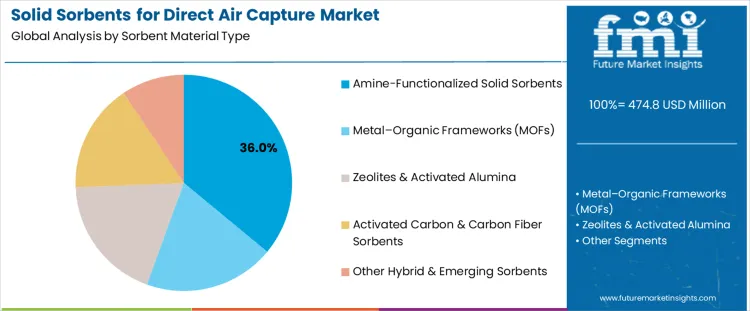
Amine-functionalized solid sorbents are the leading sorbent material type in the solid sorbents for direct air capture market, capturing 36% of the share. These sorbents are widely used in DAC technologies due to their high adsorption capacity for CO₂, making them highly effective in capturing carbon from ambient air. Amine-functionalized sorbents work by chemically binding CO₂ to the amine groups on the sorbent surface, enabling efficient CO₂ capture and storage. The growing demand for sustainable and scalable CO₂ removal technologies to mitigate climate change is driving the adoption of amine-functionalized sorbents. These materials are especially favored for their ability to operate effectively in ambient air conditions and their proven track record in capturing CO₂ in both industrial and direct air capture settings. As the need for large-scale carbon removal solutions intensifies, amine-functionalized solid sorbents are expected to remain a dominant solution in the market, offering a cost-effective and efficient method of addressing atmospheric CO₂ levels.
What is Driving the Demand for Temperature Swing Adsorption (TSA) in the Solid Sorbents for Direct Air Capture Market?
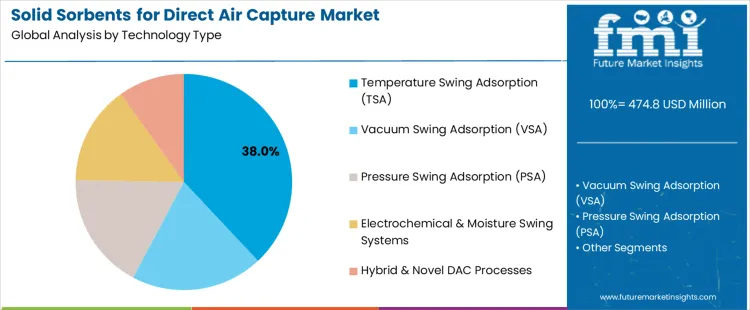
Temperature swing adsorption (TSA) is the leading technology type in the solid sorbents for direct air capture market, holding 38% of the share. TSA is favored for its efficiency in regenerating CO₂ sorbents, as it involves heating the sorbent to a high temperature to release the adsorbed CO₂, allowing the sorbent to be reused in the capture process. This method is highly effective for solid sorbents like amine-functionalized sorbents, which require thermal activation to release the captured CO₂. TSA systems are widely used in DAC applications due to their scalability, effectiveness, and ability to handle large volumes of air for CO₂ capture. The growing focus on direct air capture technologies as part of global efforts to combat climate change is driving the adoption of TSA systems, as they offer a reliable and energy-efficient means of CO₂ removal. As investments in DAC technologies continue to increase, TSA is expected to remain a dominant method for regenerating sorbents and capturing atmospheric CO₂.
What are the Key Dynamics in the Global Solid Sorbents for Direct Air Capture Market?
The global solid sorbents for direct air capture market is growing as climate mitigation strategies expand to include technologies that remove carbon dioxide directly from the atmosphere. Solid sorbents are engineered materials that bind CO₂ from ambient air, enabling capture and subsequent storage or utilization. Growth is driven by rising commitments to net zero targets, increased funding for carbon removal infrastructure, and interest from industries seeking to offset hard to abate emissions. Adoption spans large scale pilot plants, commercial DAC facilities and research initiatives focused on scalable, energy efficient carbon removal solutions worldwide.
What are the Key Drivers for the Solid Sorbents for Direct Air Capture Market?
A key driver is increased policy support and incentives for negative emissions technologies, including tax credits, carbon pricing and climate funding programs. Governments and corporations are investing in direct air capture to complement emissions reduction efforts and meet long term climate goals. Solid sorbents offer advantages such as high selectivity, potential for lower regeneration energy and modular deployment compared with liquid solvents. Advances in material science, including porous adsorbents and tailored surface chemistries, improve capture capacity and durability. Expansion of corporate climate action plans and sustainability commitments also stimulates demand for effective CO₂ removal solutions.
What are the Restraints for the Solid Sorbents for Direct Air Capture Market?
One restraint is the current cost and energy requirements associated with large scale direct air capture projects. Solid sorbent systems require controlled heat or pressure swings for CO₂ release and regeneration, which influences operational expense and integration with energy systems. Scale up from pilot installations to commercial scale units involves technical challenges, including sorbent lifetimes, material degradation and process optimization. Uncertainty in long term policy frameworks and variable governance of carbon removal credits can affect investment decisions. Competition from other carbon capture and natural climate solutions may influence how resources are allocated across climate mitigation portfolios.
What are the Key Trends in the Solid Sorbents for Direct Air Capture Market?
A key trend is development of next generation solid sorbent materials that increase CO₂ uptake and reduce energy demands for regeneration. Research focuses on advanced porous materials, structured adsorbents and hybrid systems that balance performance with stability over many capture cycles. Integration of solid sorbent DAC units with renewable energy and waste heat sources improves overall efficiency and cost profiles. Collaboration between academic institutions, startups and energy companies accelerates material innovation and pilot testing. Expansion of carbon removal certification frameworks and transparent measurement reporting supports market confidence and encourages broader adoption of direct air capture technologies.
What is the Country-Wise Analysis of the Solid Sorbents for Direct Air Capture Market?
The solid sorbents for direct air capture (DAC) market is expected to grow rapidly, driven by the increasing demand for effective technologies to mitigate climate change by removing CO₂ from the atmosphere. These sorbents are key components of DAC systems, which are being developed to capture CO₂ directly from the air and store it safely, contributing to the global effort to reduce atmospheric carbon. High-growth markets like the United States, China, and Germany are witnessing strong demand due to their commitments to reducing greenhouse gas emissions, advancing clean technologies, and adopting sustainable practices in industries such as power generation, transportation, and manufacturing. Emerging markets like India are also experiencing growth, driven by growing concerns about climate change and the need to meet international climate targets. Developed markets such as Canada are also witnessing growth, supported by government incentives for carbon capture technologies.
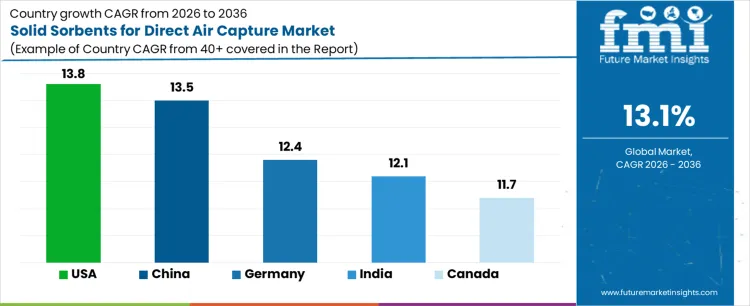
| Country | CAGR (2026-2036) |
|---|---|
| USA | 13.8% |
| China | 13.5% |
| Germany | 12.4% |
| India | 12.1% |
| Canada | 11.7% |
What is the Growth Outlook on the Solid Sorbents for Direct Air Capture Market in the United States?
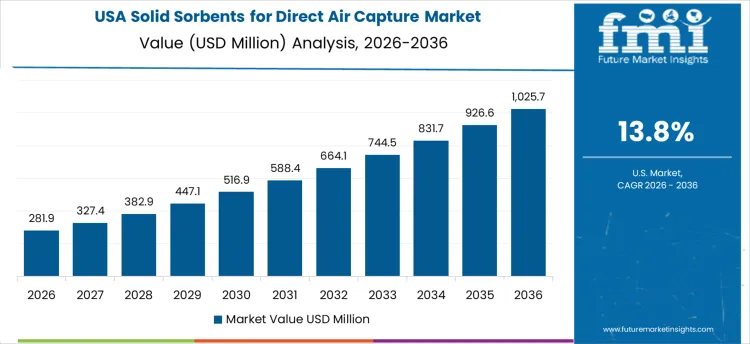
The solid sorbents for direct air capture market in the United States is expected to grow at the highest rate, with a projected CAGR of 13.8%. The U.S. government’s significant investment in clean technologies and the increasing focus on achieving net-zero emissions are major drivers of demand for DAC technologies. Solid sorbents, which play a critical role in direct air capture, are becoming an essential part of the U.S. strategy to meet its carbon reduction goals. Additionally, the growth of industries such as power generation, transportation, and manufacturing that contribute heavily to CO₂ emissions is driving the need for large-scale carbon capture systems. With ongoing research, technological innovation, and regulatory incentives, the market for solid sorbents in the U.S. is poised for rapid growth in the coming years.
What is the Market Outlook on the Solid Sorbents for Direct Air Capture Market in China?
The solid sorbents for direct air capture market in China is projected to grow steadily, with a projected CAGR of 13.5%. China, as one of the largest CO₂ emitters globally, is making significant strides to adopt technologies that can help reduce its carbon footprint. The Chinese government has made ambitious commitments to achieving carbon neutrality by 2060, driving the adoption of carbon capture technologies, including solid sorbents for DAC. As China continues to industrialize, the demand for carbon removal technologies is expected to increase, particularly in energy-intensive sectors. With ongoing investments in research and development, as well as the growing focus on sustainable energy, the market for solid sorbents in China is expected to see steady growth over the next decade.
What is the Growth Forecast for the Solid Sorbents for Direct Air Capture Market in Germany?
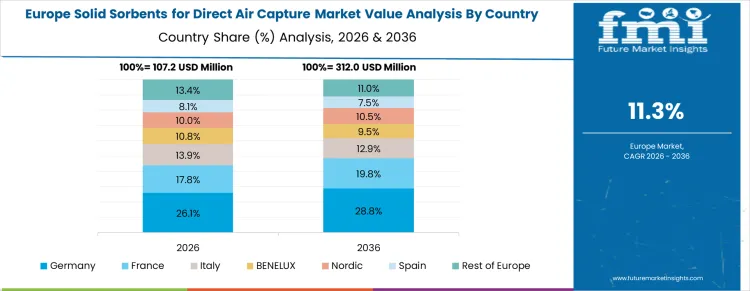
The solid sorbents for direct air capture market in Germany is expected to grow steadily, with a projected CAGR of 12.4%. Germany’s commitment to reducing carbon emissions, achieving climate neutrality, and advancing clean technologies is driving the demand for DAC solutions. Solid sorbents play a crucial role in the country’s carbon capture strategy, especially as Germany works to decarbonize its industrial sectors. The government’s support for sustainable innovation, the growing number of green initiatives, and stringent environmental regulations are encouraging the development and deployment of DAC systems using solid sorbents. As Germany continues to invest in carbon capture technologies and green energy solutions, the market for solid sorbents is expected to grow steadily in the coming years.
What is the Market Outlook on the Solid Sorbents for Direct Air Capture Market in India?
The solid sorbents for direct air capture market in India is projected to grow steadily, with a projected CAGR of 12.1%. India is increasingly focusing on addressing climate change and meeting its environmental goals, including reducing CO₂ emissions. As one of the world’s largest emitters, the country faces significant challenges in tackling air pollution and carbon emissions, particularly from industries such as energy, manufacturing, and transportation. The adoption of DAC technologies, including solid sorbents, is gaining traction as India works to meet its climate targets and improve air quality. The government’s support for renewable energy, clean technologies, and sustainable development is expected to drive demand for carbon capture solutions in the coming years, making the Indian market for solid sorbents a promising area for growth.
What are the Growth Prospects for the Solid Sorbents for Direct Air Capture Market in Canada?
The solid sorbents for direct air capture market in Canada is expected to grow steadily, with a projected CAGR of 11.7%. Canada is committed to achieving net-zero emissions by 2050, and carbon capture technologies, including solid sorbents, are integral to this goal. The Canadian government’s policies promoting clean technologies, renewable energy, and carbon capture and storage (CCS) are driving the demand for DAC solutions. Canada’s strong industrial base, combined with the country’s focus on sustainability, creates a growing need for advanced CO₂ capture technologies. As Canada continues to invest in research and development, as well as carbon-neutral infrastructure, the market for solid sorbents in the country is set to grow steadily in the coming years.
What is the Competitive Landscape for the Solid Sorbents for Direct Air Capture Market?
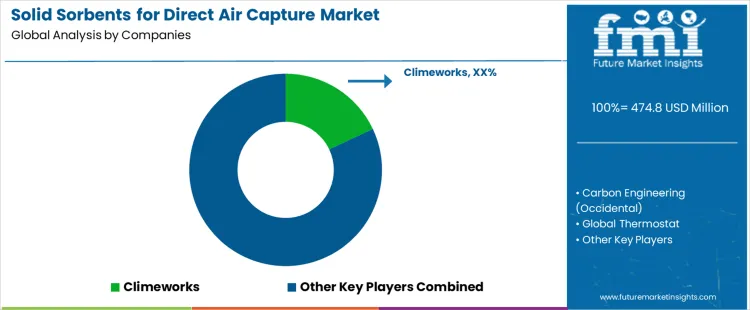
The solid sorbents for direct air capture (DAC) market is expanding rapidly as industries and governments seek sustainable and scalable solutions to remove CO₂ from the atmosphere in efforts to combat climate change. Climeworks leads the market with its innovative solid sorbent-based DAC technology, providing high-performance systems that capture CO₂ directly from the air. Their focus on efficiency, scalability, and environmental sustainability has positioned them as a dominant player in the DAC space. Carbon Engineering (Occidental), Global Thermostat, and Heirloom Carbon Technologies are significant competitors, each offering unique approaches to solid sorbent-based DAC solutions. Carbon Engineering focuses on large-scale DAC technology with a focus on cost-effectiveness and scalability, while Global Thermostat and Heirloom Carbon Technologies offer advanced materials and technologies for CO₂ capture, with a strong emphasis on reducing energy consumption and improving capture efficiency.
Carbon Capture Inc. further contributes to the competitive landscape by offering its own solid sorbent solutions for direct air capture. Carbon Capture Inc. focuses on developing cost-effective, high-capacity sorbents for large-scale CO₂ removal. These companies compete by focusing on technological innovation, cost reduction, and the ability to provide sustainable, efficient solutions for atmospheric CO₂ removal. As the urgency to address climate change intensifies, the market for solid sorbents in direct air capture is expected to grow, with increased investment in research and development to enhance performance and scalability.
Key Players of the Solid Sorbents for Direct Air Capture Market
- Climeworks
- Carbon Engineering (Occidental)
- Global Thermostat
- Heirloom Carbon Technologies
- Carbon Capture Inc.
Scope of the Report
| Items | Values |
|---|---|
| Quantitative Units (2026) | USD Million |
| Sorbent Material Type | Amine-Functionalized Solid Sorbents, Metal–Organic Frameworks (MOFs), Zeolites & Activated Alumina, Activated Carbon & Carbon Fiber Sorbents, Other Hybrid & Emerging Sorbents |
| Technology Type | Temperature Swing Adsorption (TSA), Vacuum Swing Adsorption (VSA), Pressure Swing Adsorption (PSA), Electrochemical & Moisture Swing Systems, Hybrid & Novel DAC Processes |
| End-Use Sector | Carbon Removal & Trading (Credits Market), Synthetic Fuels & e-Fuels Production, Industrial Carbon Utilization (CCU), Direct Geological Storage (CCS), Other Emerging Use Cases |
| Companies | Climeworks, Carbon Engineering (Occidental), Global Thermostat, Heirloom Carbon Technologies, Carbon Capture Inc. |
| Regions Covered | North America, Latin America, Western Europe, Eastern Europe, South Asia and Pacific, East Asia, Middle East & Africa |
| Countries Covered | United States, Canada, Mexico, Brazil, Argentina, Germany, France, United Kingdom, Italy, Spain, Netherlands, China, India, Japan, South Korea, ANZ, GCC Countries, South Africa |
| Additional Attributes | Dollar by sales by sorbent material type, technology type, end-use sector, and region. Includes market trends in solid sorbents for direct air capture, performance in various carbon removal and utilization technologies, cost-effectiveness, sustainability practices, regulatory compliance, market share and competitive positioning of key companies, and the role of solid sorbents in enhancing direct air capture efficiency, supporting synthetic fuel production, and improving industrial carbon utilization across emerging use cases. |
Solid Sorbents for Direct Air Capture Market Segmentation
Sorbent Material Type:
- Amine-Functionalized Solid Sorbents
- Metal–Organic Frameworks (MOFs)
- Zeolites & Activated Alumina
- Activated Carbon & Carbon Fiber Sorbents
- Other Hybrid & Emerging Sorbents
Technology Type:
- Temperature Swing Adsorption (TSA)
- Vacuum Swing Adsorption (VSA)
- Pressure Swing Adsorption (PSA)
- Electrochemical & Moisture Swing Systems
- Hybrid & Novel DAC Processes
End-Use Sector:
- Carbon Removal & Trading (Credits Market)
- Synthetic Fuels & e-Fuels Production
- Industrial Carbon Utilization (CCU)
- Direct Geological Storage (CCS)
- Other Emerging Use Cases
Region:
- Asia Pacific
- China
- Japan
- South Korea
- India
- Australia & New Zealand
- ASEAN
- Rest of Asia Pacific
- Europe
- Germany
- United Kingdom
- France
- Italy
- Spain
- Nordic
- BENELUX
- Rest of Europe
- North America
- United States
- Canada
- Mexico
- Latin America
- Brazil
- Chile
- Rest of Latin America
- Middle East & Africa
- Kingdom of Saudi Arabia
- Other GCC Countries
- Turkey
- South Africa
- Other African Union
- Rest of Middle East & Africa
Frequently Asked Questions
How big is the solid sorbents for direct air capture market in 2026?
The global solid sorbents for direct air capture market is estimated to be valued at USD 474.8 million in 2026.
What will be the size of solid sorbents for direct air capture market in 2036?
The market size for the solid sorbents for direct air capture market is projected to reach USD 1,626.1 million by 2036.
How much will be the solid sorbents for direct air capture market growth between 2026 and 2036?
The solid sorbents for direct air capture market is expected to grow at a 13.1% CAGR between 2026 and 2036.
What are the key product types in the solid sorbents for direct air capture market?
The key product types in solid sorbents for direct air capture market are amine-functionalized solid sorbents, metal–organic frameworks (mofs), zeolites & activated alumina, activated carbon & carbon fiber sorbents and other hybrid & emerging sorbents.
Which technology type segment to contribute significant share in the solid sorbents for direct air capture market in 2026?
In terms of technology type, temperature swing adsorption (tsa) segment to command 38.0% share in the solid sorbents for direct air capture market in 2026.
Preview the report firsthand - request a free sample
Get SampleGet the brochure for pricing and purchase details.
Get PDFTable of Content
- Executive Summary
- Global Market Outlook
- Demand-side Trends
- Supply-side Trends
- Technology Roadmap Analysis
- Analysis and Recommendations
- Market Overview
- Market Coverage / Taxonomy
- Market Definition / Scope / Limitations
- Market Background
- Market Dynamics
- Drivers
- Restraints
- Opportunity
- Trends
- Scenario Forecast
- Demand in Optimistic Scenario
- Demand in Likely Scenario
- Demand in Conservative Scenario
- Opportunity Map Analysis
- Product Life Cycle Analysis
- Supply Chain Analysis
- Investment Feasibility Matrix
- Value Chain Analysis
- PESTLE and Porter’s Analysis
- Regulatory Landscape
- Regional Parent Market Outlook
- Production and Consumption Statistics
- Import and Export Statistics
- Market Dynamics
- Global Market Analysis 2021 to 2025 and Forecast, 2026 to 2036
- Historical Market Size Value (USD Million) Analysis, 2021 to 2025
- Current and Future Market Size Value (USD Million) Projections, 2026 to 2036
- Y-o-Y Growth Trend Analysis
- Absolute $ Opportunity Analysis
- Global Market Pricing Analysis 2021 to 2025 and Forecast 2026 to 2036
- Global Market Analysis 2021 to 2025 and Forecast 2026 to 2036, By Sorbent Material Type
- Introduction / Key Findings
- Historical Market Size Value (USD Million) Analysis By Sorbent Material Type , 2021 to 2025
- Current and Future Market Size Value (USD Million) Analysis and Forecast By Sorbent Material Type , 2026 to 2036
- Amine-Functionalized Solid Sorbents
- Metal–Organic Frameworks (MOFs)
- Zeolites & Activated Alumina
- Activated Carbon & Carbon Fiber Sorbents
- Other Hybrid & Emerging Sorbents
- Amine-Functionalized Solid Sorbents
- Y-o-Y Growth Trend Analysis By Sorbent Material Type , 2021 to 2025
- Absolute $ Opportunity Analysis By Sorbent Material Type , 2026 to 2036
- Global Market Analysis 2021 to 2025 and Forecast 2026 to 2036, By Technology Type
- Introduction / Key Findings
- Historical Market Size Value (USD Million) Analysis By Technology Type, 2021 to 2025
- Current and Future Market Size Value (USD Million) Analysis and Forecast By Technology Type, 2026 to 2036
- Temperature Swing Adsorption (TSA)
- Vacuum Swing Adsorption (VSA)
- Pressure Swing Adsorption (PSA)
- Electrochemical & Moisture Swing Systems
- Hybrid & Novel DAC Processes
- Temperature Swing Adsorption (TSA)
- Y-o-Y Growth Trend Analysis By Technology Type, 2021 to 2025
- Absolute $ Opportunity Analysis By Technology Type, 2026 to 2036
- Global Market Analysis 2021 to 2025 and Forecast 2026 to 2036, By End-Use Sector
- Introduction / Key Findings
- Historical Market Size Value (USD Million) Analysis By End-Use Sector, 2021 to 2025
- Current and Future Market Size Value (USD Million) Analysis and Forecast By End-Use Sector, 2026 to 2036
- Carbon Removal & Trading (Credits Market)
- Synthetic Fuels & e-Fuels Production
- Industrial Carbon Utilization (CCU)
- Direct Geological Storage (CCS)
- Other Emerging Use Cases
- Carbon Removal & Trading (Credits Market)
- Y-o-Y Growth Trend Analysis By End-Use Sector, 2021 to 2025
- Absolute $ Opportunity Analysis By End-Use Sector, 2026 to 2036
- Global Market Analysis 2021 to 2025 and Forecast 2026 to 2036, By Region
- Introduction
- Historical Market Size Value (USD Million) Analysis By Region, 2021 to 2025
- Current Market Size Value (USD Million) Analysis and Forecast By Region, 2026 to 2036
- North America
- Latin America
- Western Europe
- Eastern Europe
- East Asia
- South Asia and Pacific
- Middle East & Africa
- Market Attractiveness Analysis By Region
- North America Market Analysis 2021 to 2025 and Forecast 2026 to 2036, By Country
- Historical Market Size Value (USD Million) Trend Analysis By Market Taxonomy, 2021 to 2025
- Market Size Value (USD Million) Forecast By Market Taxonomy, 2026 to 2036
- By Country
- USA
- Canada
- Mexico
- By Sorbent Material Type
- By Technology Type
- By End-Use Sector
- By Country
- Market Attractiveness Analysis
- By Country
- By Sorbent Material Type
- By Technology Type
- By End-Use Sector
- Key Takeaways
- Latin America Market Analysis 2021 to 2025 and Forecast 2026 to 2036, By Country
- Historical Market Size Value (USD Million) Trend Analysis By Market Taxonomy, 2021 to 2025
- Market Size Value (USD Million) Forecast By Market Taxonomy, 2026 to 2036
- By Country
- Brazil
- Chile
- Rest of Latin America
- By Sorbent Material Type
- By Technology Type
- By End-Use Sector
- By Country
- Market Attractiveness Analysis
- By Country
- By Sorbent Material Type
- By Technology Type
- By End-Use Sector
- Key Takeaways
- Western Europe Market Analysis 2021 to 2025 and Forecast 2026 to 2036, By Country
- Historical Market Size Value (USD Million) Trend Analysis By Market Taxonomy, 2021 to 2025
- Market Size Value (USD Million) Forecast By Market Taxonomy, 2026 to 2036
- By Country
- Germany
- UK
- Italy
- Spain
- France
- Nordic
- BENELUX
- Rest of Western Europe
- By Sorbent Material Type
- By Technology Type
- By End-Use Sector
- By Country
- Market Attractiveness Analysis
- By Country
- By Sorbent Material Type
- By Technology Type
- By End-Use Sector
- Key Takeaways
- Eastern Europe Market Analysis 2021 to 2025 and Forecast 2026 to 2036, By Country
- Historical Market Size Value (USD Million) Trend Analysis By Market Taxonomy, 2021 to 2025
- Market Size Value (USD Million) Forecast By Market Taxonomy, 2026 to 2036
- By Country
- Russia
- Poland
- Hungary
- Balkan & Baltic
- Rest of Eastern Europe
- By Sorbent Material Type
- By Technology Type
- By End-Use Sector
- By Country
- Market Attractiveness Analysis
- By Country
- By Sorbent Material Type
- By Technology Type
- By End-Use Sector
- Key Takeaways
- East Asia Market Analysis 2021 to 2025 and Forecast 2026 to 2036, By Country
- Historical Market Size Value (USD Million) Trend Analysis By Market Taxonomy, 2021 to 2025
- Market Size Value (USD Million) Forecast By Market Taxonomy, 2026 to 2036
- By Country
- China
- Japan
- South Korea
- By Sorbent Material Type
- By Technology Type
- By End-Use Sector
- By Country
- Market Attractiveness Analysis
- By Country
- By Sorbent Material Type
- By Technology Type
- By End-Use Sector
- Key Takeaways
- South Asia and Pacific Market Analysis 2021 to 2025 and Forecast 2026 to 2036, By Country
- Historical Market Size Value (USD Million) Trend Analysis By Market Taxonomy, 2021 to 2025
- Market Size Value (USD Million) Forecast By Market Taxonomy, 2026 to 2036
- By Country
- India
- ASEAN
- Australia & New Zealand
- Rest of South Asia and Pacific
- By Sorbent Material Type
- By Technology Type
- By End-Use Sector
- By Country
- Market Attractiveness Analysis
- By Country
- By Sorbent Material Type
- By Technology Type
- By End-Use Sector
- Key Takeaways
- Middle East & Africa Market Analysis 2021 to 2025 and Forecast 2026 to 2036, By Country
- Historical Market Size Value (USD Million) Trend Analysis By Market Taxonomy, 2021 to 2025
- Market Size Value (USD Million) Forecast By Market Taxonomy, 2026 to 2036
- By Country
- Kingdom of Saudi Arabia
- Other GCC Countries
- Turkiye
- South Africa
- Other African Union
- Rest of Middle East & Africa
- By Sorbent Material Type
- By Technology Type
- By End-Use Sector
- By Country
- Market Attractiveness Analysis
- By Country
- By Sorbent Material Type
- By Technology Type
- By End-Use Sector
- Key Takeaways
- Key Countries Market Analysis
- USA
- Pricing Analysis
- Market Share Analysis, 2025
- By Sorbent Material Type
- By Technology Type
- By End-Use Sector
- Canada
- Pricing Analysis
- Market Share Analysis, 2025
- By Sorbent Material Type
- By Technology Type
- By End-Use Sector
- Mexico
- Pricing Analysis
- Market Share Analysis, 2025
- By Sorbent Material Type
- By Technology Type
- By End-Use Sector
- Brazil
- Pricing Analysis
- Market Share Analysis, 2025
- By Sorbent Material Type
- By Technology Type
- By End-Use Sector
- Chile
- Pricing Analysis
- Market Share Analysis, 2025
- By Sorbent Material Type
- By Technology Type
- By End-Use Sector
- Germany
- Pricing Analysis
- Market Share Analysis, 2025
- By Sorbent Material Type
- By Technology Type
- By End-Use Sector
- UK
- Pricing Analysis
- Market Share Analysis, 2025
- By Sorbent Material Type
- By Technology Type
- By End-Use Sector
- Italy
- Pricing Analysis
- Market Share Analysis, 2025
- By Sorbent Material Type
- By Technology Type
- By End-Use Sector
- Spain
- Pricing Analysis
- Market Share Analysis, 2025
- By Sorbent Material Type
- By Technology Type
- By End-Use Sector
- France
- Pricing Analysis
- Market Share Analysis, 2025
- By Sorbent Material Type
- By Technology Type
- By End-Use Sector
- India
- Pricing Analysis
- Market Share Analysis, 2025
- By Sorbent Material Type
- By Technology Type
- By End-Use Sector
- ASEAN
- Pricing Analysis
- Market Share Analysis, 2025
- By Sorbent Material Type
- By Technology Type
- By End-Use Sector
- Australia & New Zealand
- Pricing Analysis
- Market Share Analysis, 2025
- By Sorbent Material Type
- By Technology Type
- By End-Use Sector
- China
- Pricing Analysis
- Market Share Analysis, 2025
- By Sorbent Material Type
- By Technology Type
- By End-Use Sector
- Japan
- Pricing Analysis
- Market Share Analysis, 2025
- By Sorbent Material Type
- By Technology Type
- By End-Use Sector
- South Korea
- Pricing Analysis
- Market Share Analysis, 2025
- By Sorbent Material Type
- By Technology Type
- By End-Use Sector
- Russia
- Pricing Analysis
- Market Share Analysis, 2025
- By Sorbent Material Type
- By Technology Type
- By End-Use Sector
- Poland
- Pricing Analysis
- Market Share Analysis, 2025
- By Sorbent Material Type
- By Technology Type
- By End-Use Sector
- Hungary
- Pricing Analysis
- Market Share Analysis, 2025
- By Sorbent Material Type
- By Technology Type
- By End-Use Sector
- Kingdom of Saudi Arabia
- Pricing Analysis
- Market Share Analysis, 2025
- By Sorbent Material Type
- By Technology Type
- By End-Use Sector
- Turkiye
- Pricing Analysis
- Market Share Analysis, 2025
- By Sorbent Material Type
- By Technology Type
- By End-Use Sector
- South Africa
- Pricing Analysis
- Market Share Analysis, 2025
- By Sorbent Material Type
- By Technology Type
- By End-Use Sector
- USA
- Market Structure Analysis
- Competition Dashboard
- Competition Benchmarking
- Market Share Analysis of Top Players
- By Regional
- By Sorbent Material Type
- By Technology Type
- By End-Use Sector
- Competition Analysis
- Competition Deep Dive
- Climeworks
- Overview
- Product Portfolio
- Profitability by Market Segments (Product/Age /Sales Channel/Region)
- Sales Footprint
- Strategy Overview
- Marketing Strategy
- Product Strategy
- Channel Strategy
- Carbon Engineering (Occidental)
- Global Thermostat
- Heirloom Carbon Technologies
- Carbon Capture Inc.
- Climeworks
- Competition Deep Dive
- Assumptions & Acronyms Used
- Research Methodology


