

- Industry Size (2026)
- USD 3.40 Bn
- Forecast (2036)
- USD 5.9 Bn
- CAGR (2026 to 2036)
- 5.70%
Aircraft Topcoats Market Forecast and Outlook 2026 to 2036
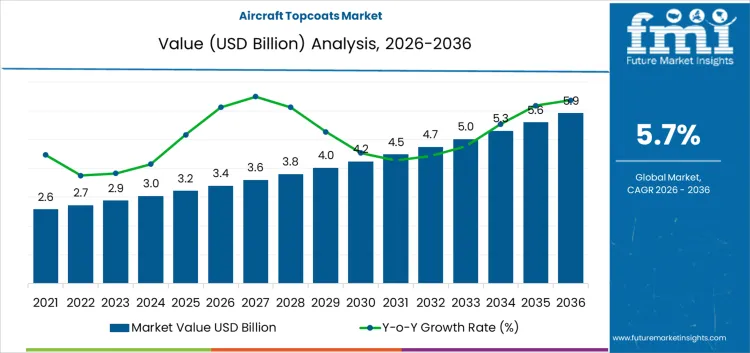
The aircraft topcoats market is valued at USD 3.40 billion in 2026 and is projected to reach USD 5.9 billion by 2036, reflecting a CAGR of 5.7%. Growth is influenced by increasing aircraft deliveries, maintenance programs, and the need for protective and aesthetic coatings. Cost structures are driven by raw material selection, surface preparation, and application precision. Pricing authority favors suppliers providing coatings with proven durability, corrosion resistance, and regulatory compliance. Margin concentration benefits firms integrating product formulation, technical support, and fleet-specific application services, capturing value through performance outcomes rather than volume alone.
Between 2026 and 2036, adoption varies by aircraft type, operational environment, and regional fleet distribution. Leading suppliers maintain higher margins through validated coating systems, multi-aircraft certifications, and technical support programs. Operators with proprietary formulations and service integration capture disproportionate value. Fragmentation persists in smaller regional applicators, while global providers leverage scale, technical expertise, and regulatory compliance to sustain pricing power. Revenue concentration is linked to coating performance, application reliability, and long-term client engagement rather than material throughput.
Quick Stats of the Aircraft Topcoats Market
- Aircraft Topcoats Market Value (2026): USD 3.40 billion
- Aircraft Topcoats Market Forecast Value (2036): USD 5.9 billion
- Aircraft Topcoats Market Forecast CAGR 2026 to 2036: 5.70%
- Aircraft Topcoats Leading Coating Layer: Primer Systems (28%)
- Aircraft Topcoats Key Growth Regions: China, Brazil, USA, UK, Japan
- Aircraft Topcoats Top Players: PPG Industries, AkzoNobel, Sherwin-Williams, Mankiewicz, Henkel, 3M, BASF, Hentzen Coatings, Deft (PPG), Axalta
What is the Growth Forecast for Aircraft Topcoats Market through 2036?
Between 2026 and 2031, the aircraft topcoats market is projected to grow from USD 3.4 billion to USD 4.5 billion, generating an absolute increase of USD 1.1 billion and reflecting a CAGR of 5.7%. Growth is driven by adoption of polyurethane, epoxy, and fluoropolymer topcoats across primer, basecoat, and specialty layers. Commercial aircraft account for 56% of applications. Cost structures are influenced by resin selection, layer system complexity, and application methods including conventional, electrostatic, and automated spraying. Value capture favors suppliers delivering high-quality coatings with consistent performance, reliability, and full-service support.
From 2031 to 2036, the market is expected to expand from USD 4.5 billion to USD 5.9 billion, adding USD 1.5 billion. Growth is supported by retrofit programs, new-build commercial and business jet projects, and military aircraft painting initiatives. Adoption increases across primer, basecoat, topcoat, and specialty coatings. Competitive advantage favors companies with validated coating chemistries, advanced application capabilities, and strong OEM and MRO partnerships. Leading suppliers include PPG Industries, AkzoNobel, Sherwin-Williams, Mankiewicz, Henkel, 3M, BASF, Hentzen Coatings, Deft (PPG), and Axalta, emphasizing durability, performance, and operational efficiency.
Aircraft Topcoats Market Key Takeaways
| Metric | Value |
|---|---|
| Market Value (2026) | USD 3.40 billion |
| Forecast Value (2036) | USD 5.9 billion |
| Forecast CAGR 2026 to 2036 | 5.70% |
What Is Driving Demand for Aircraft Topcoats?
Aircraft topcoats are increasingly applied to protect airframes from environmental damage, UV exposure, and corrosion while enhancing aerodynamics. Historically, coatings focused primarily on aesthetics and basic corrosion protection, with limited performance under extreme temperatures and weather conditions. Modern topcoats provide chemical resistance, color stability, and reduced surface roughness to improve fuel efficiency. Airlines, military operators, and maintenance providers prioritize coating durability, weight optimization, and regulatory compliance. Early adoption targeted new-build aircraft and premium military programs, while current applications extend to commercial fleet maintenance and retrofits to reduce lifecycle costs. Selection is influenced by performance testing, application method, and compatibility with primers and underlying substrates.
Rising fuel costs and stricter maintenance standards are increasing the focus on high-performance topcoats. Contemporary coatings emphasize wear resistance, adhesion, and uniform finish to maintain long-term aircraft performance. Cost structures depend on raw materials, surface preparation, and labor, concentrating margins among suppliers offering validated, repeatable coating systems. Operators adopt advanced topcoats to reduce maintenance cycles, protect structural integrity, and comply with environmental regulations. By 2036, aircraft topcoats are expected to be standard across new and existing fleets, supporting both operational efficiency and longevity in aerospace applications.
What Factors Are Shaping the Demand for Aircraft Topcoats in Terms of Resin and Binder Type and Coating Layer?
The demand for aircraft topcoats is segmented by resin and binder type and coating layer. Resin types include polyurethane, epoxy, fluoropolymer, and other specialized binders. Coating layers cover primer systems, basecoat, topcoat, and clearcoat or specialty coatings. Segment adoption is influenced by corrosion resistance, adhesion, durability, and compliance with aerospace standards. Uptake is driven by operational longevity, weight optimization, and surface protection. Selection of resin type and coating layer depends on aircraft type, exposure to environmental conditions, and maintenance schedules, ensuring performance, safety, and cost efficiency across commercial and military aviation applications.
Why Is Polyurethane Leading the Resin and Binder Type Segment in Aircraft Topcoats?
Polyurethane accounts for approximately 44% of total resin and binder demand, making it the leading category. It provides high flexibility, chemical resistance, and impact protection for aircraft surfaces. Airlines and manufacturers favor polyurethane for primer and topcoat layers where long-term durability and corrosion resistance are critical. Adoption is reinforced by compatibility with metallic and composite substrates, resistance to UV exposure, and ease of application. Polyurethane coatings maintain adhesion and surface integrity across thermal cycling and operational stress. Maintenance teams follow standardized application procedures to ensure consistent coating thickness, smooth finish, and protective performance.
Operational and functional characteristics further strengthen adoption. Polyurethane supports multi-layer coating systems, integrating primer, basecoat, and topcoat functions. It withstands high-speed airflow, moisture exposure, and chemical contact during cleaning or refueling operations. The segment leads because polyurethane combines mechanical strength, environmental resistance, and proven operational reliability, making it the primary choice for aerospace coating applications requiring long-term protection and consistent surface performance.
Why Do Primer Systems Represent the Largest Coating Layer Segment in Aircraft Topcoats?
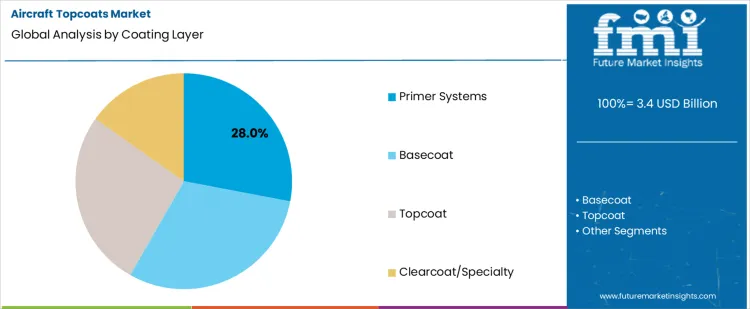
Primer systems account for approximately 28% of total coating layer demand, making them the largest segment. Primers provide adhesion between the substrate and subsequent layers while offering corrosion protection and surface leveling. Adoption is driven by regulatory requirements, aircraft performance specifications, and the need to extend component lifespan. Aircraft operators prioritize primers to reduce maintenance frequency, prevent substrate degradation, and ensure compatibility with basecoat and topcoat layers. Proper primer selection improves paint system durability and enhances operational safety.
Operational factors further shape primer demand. Primers must bond reliably to aluminum, titanium, and composite surfaces while withstanding thermal expansion and environmental exposure. Application involves controlled thickness and surface preparation to maximize adhesion and protective performance. Primers reduce corrosion, provide chemical resistance, and improve topcoat performance, maintaining aerodynamic smoothness. The segment leads because primer systems form the foundation of aircraft coating structures, ensuring long-term protection, surface integrity, and compliance with aerospace operational standards.
How Are Aircraft Topcoats Enhancing Aerodynamic Performance and Protection?
Aircraft topcoats are applied to airframes to protect surfaces from corrosion, UV radiation, and environmental wear while improving aerodynamic efficiency. Adoption is strongest among commercial airlines, military fleets, and business jet operators in regions with high aviation activity. Coatings are chosen for adhesion, chemical resistance, and long-term durability. Growth is driven by maintenance reduction, fuel efficiency gains, and regulatory compliance. Investment focuses on formulation stability, environmental compatibility, and integration with existing finishing processes. Operators prefer topcoats that provide consistent performance, extend aircraft service life, and support regional aviation safety and operational standards.
Why Are Maintenance Requirements and Environmental Regulations Driving Demand for Aircraft Topcoats?
Airlines and OEMs adopt advanced topcoats to meet stringent anti-corrosion and emission-related coating standards. Regulatory oversight mandates performance validation under extreme weather and operational stress. Coatings that maintain adhesion, gloss, and protective properties over multiple flight cycles gain preference. Regions with strict environmental and aviation standards show higher adoption rates. Operators seek topcoats that reduce maintenance frequency and ensure compliance with coating disposal and VOC limits. Product reliability and regulatory alignment drive procurement decisions more than cost considerations.
What Operational and Technical Factors Limit Wider Adoption of Aircraft Topcoats?
Surface preparation complexity and application precision challenge implementation across diverse aircraft types. Environmental exposure, temperature variation, and chemical contact can affect coating performance. Specialized equipment and trained personnel are required for consistent application. Certification and regulatory approval processes can delay deployment, particularly for new formulations. Smaller operators or maintenance providers may face difficulty meeting quality standards. These limitations concentrate early adoption among well-resourced fleets and OEM maintenance programs capable of supporting technical application requirements and compliance monitoring.
How Are Innovation and Industry Collaboration Shaping Aircraft Topcoat Applications?
Advances include formulations with improved corrosion resistance, UV protection, and lightweight properties for fuel efficiency. Partnerships between coating manufacturers, aircraft OEMs, and airlines enable real-world performance validation and regulatory compliance. Pilot programs and controlled testing confirm durability and adhesion before full-scale application. Quality control and traceability systems support consistent performance and audit readiness. Focus is on operational reliability, long-term protection, and regulatory compliance rather than cost or mass application. Collaborative approaches ensure topcoats meet regional performance and safety requirements while supporting reduced maintenance and extended aircraft lifecycle.
What is the Demand for Aircraft Topcoats by Country?
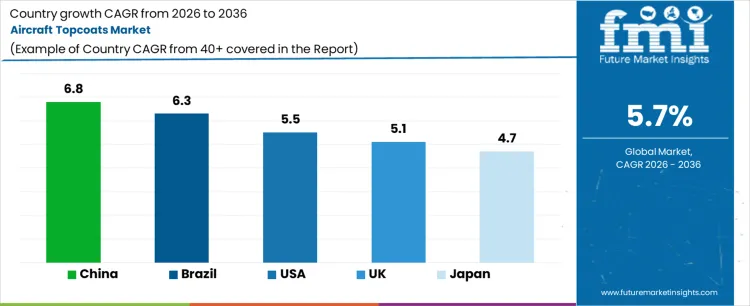
| Country | CAGR (%) |
|---|---|
| USA | 5.5% |
| Japan | 4.7% |
| China | 6.8% |
| UK | 5.1% |
| Brazil | 6.3% |
Demand for aircraft topcoats is rising as airlines and manufacturers aim to enhance corrosion protection, aesthetic appeal, and durability of airframes. China leads with a 6.8% CAGR, driven by rapid expansion of commercial aircraft fleets, growing MRO activities, and adoption of advanced coating technologies. Brazil follows at 6.3%, supported by domestic aircraft manufacturing and retrofitting initiatives. The USA grows at 5.5%, shaped by fleet maintenance, new aircraft production, and regulatory compliance. The UK records 5.1% growth, reflecting steady adoption in maintenance and repair operations. Japan shows 4.7% CAGR, influenced by moderate fleet growth, aging aircraft maintenance, and selective use of advanced topcoat formulations.
How Is the United States Experiencing Growth in the Aircraft Topcoats Market?
United States is experiencing growth at a CAGR of 5.5%, supported by increasing demand for protective and decorative coatings on commercial and military aircraft. Airlines and aerospace OEMs are applying topcoats to fuselage, wings, and tail sections to enhance corrosion resistance, UV protection, and surface aesthetics. Demand is concentrated in airline hubs, MRO centers, and aircraft manufacturing facilities. Investments prioritize coating performance, material durability, and environmental compliance rather than fleet expansion. Growth reflects the need to maintain aircraft longevity, reduce maintenance costs, and meet regulatory standards. Manufacturers are developing formulations with advanced chemical resistance, high adhesion, and compatibility with diverse aircraft surfaces to support operational efficiency and safety.
- Airlines and OEMs drive adoption.
- Topcoats enhance corrosion resistance and surface protection.
- Airline hubs and MRO centers concentrate demand.
- Coating performance and material durability guide investment.
How Is Japan Witnessing Steady Adoption Through Maintenance Programs?
Japan is witnessing steady adoption at a CAGR of 4.7%, fueled by airline maintenance schedules and the need for high-performance protective coatings on aircraft surfaces. Airlines and maintenance providers are applying topcoats on fuselage, wings, and tail sections to improve durability, UV resistance, and appearance. Demand is concentrated in urban airline hubs and aircraft maintenance centers. Investments focus on coating quality, application precision, and compliance with environmental regulations rather than production expansion. Growth reflects adherence to maintenance protocols and the use of advanced coatings to extend service life. Manufacturers are introducing formulations optimized for adhesion, corrosion protection, and long-term performance under varying climatic conditions.
- Maintenance and protective coating needs drive adoption.
- Fuselage, wings, and tail sections are primary applications.
- Urban airline hubs and MRO centers concentrate demand.
- Coating quality and application precision guide investment.
How Is China Experiencing Rapid Growth with Expanding Fleet and Manufacturing Activity?
China is experiencing rapid growth at a CAGR of 6.8%, supported by the expansion of commercial and military aircraft fleets and increased production of new aircraft. Airlines and OEMs are applying topcoats to fuselage, wings, and control surfaces to improve corrosion resistance, UV protection, and surface aesthetics. Demand is concentrated in major airline hubs, aerospace manufacturing facilities, and maintenance centers. Investments prioritize coating performance, durability, and application precision rather than fleet expansion. Growth reflects rising aircraft production, modernization programs, and the adoption of advanced surface technologies to enhance operational efficiency and reduce maintenance costs.
- Fleet expansion and aircraft production drive adoption.
- Topcoats improve corrosion resistance and surface aesthetics.
- Airline hubs and manufacturing facilities concentrate demand.
- Coating performance and durability guide investment.
How Is the United Kingdom Growing Through Aircraft Maintenance and Operational Efficiency?
The United Kingdom is growing at a CAGR of 5.1%, supported by adoption of high-performance topcoats on commercial and military aircraft to extend service life and reduce maintenance. Airlines and aerospace OEMs are applying coatings to fuselage, wings, and tail sections to enhance corrosion protection, UV resistance, and appearance. Demand is concentrated in airline hubs, MRO centers, and aerospace manufacturing facilities. Investments focus on material quality, coating performance, and environmental compliance rather than fleet expansion. Growth reflects adoption of advanced surface technologies, maintenance program requirements, and operational efficiency objectives. Manufacturers are providing formulations designed for adhesion, durability, and compatibility with diverse aircraft materials.
- Airlines and OEMs drive adoption.
- Topcoats enhance corrosion protection and UV resistance.
- Airline hubs and MRO centers concentrate demand.
- Material quality and coating performance guide investment.
How Is Brazil Experiencing Expansion Through Aerospace Fleet Modernization?
Brazil is experiencing growth at a CAGR of 6.3%, supported by modernization of commercial and military aircraft fleets and adoption of advanced topcoats for surface protection. Airlines and OEMs are implementing coatings on wings, fuselage, and tail sections to improve corrosion resistance, UV protection, and overall surface performance. Demand is concentrated in airline hubs, aerospace manufacturing facilities, and MRO centers. Investments prioritize coating performance, durability, and application precision rather than fleet expansion. Growth reflects operational efficiency goals, fleet modernization programs, and adoption of advanced surface technologies to reduce maintenance costs and extend aircraft lifespan. Manufacturers are providing high-performance coatings optimized for adhesion and long-term protection.
- Fleet modernization drives adoption.
- Wings, fuselage, and tail sections are primary applications.
- Airline hubs and MRO centers concentrate demand.
- Coating performance and durability guide investment.
Who Competes in the Aircraft Topcoats Market and What Defines Their Positions?
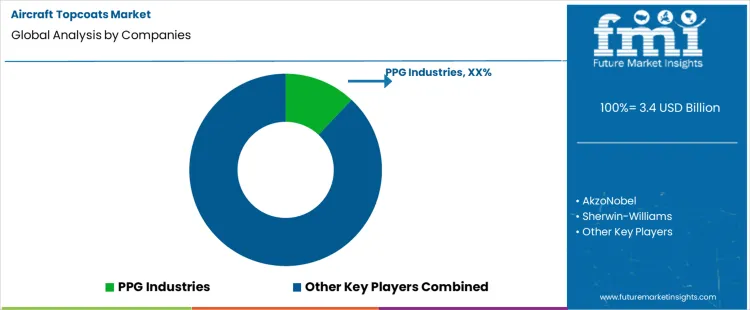
Competition in the aircraft topcoats market reflects variation in formulation performance, certification support, and alignment with airframe OEM standards. PPG Industries offers topcoat systems designed to provide durable color retention and resistance to environmental stress for commercial and military fleets, supported by engineering data for lifecycle maintenance. AkzoNobel supplies topcoats engineered for weatherability and gloss retention under high altitude UV exposure while aligning with specification criteria for large transport aircraft. Sherwin Williams develops aircraft finishes balancing appearance retention and surface protection with application flexibility on varied substrates. Mankiewicz provides specialist topcoat systems calibrated to specific airframe materials and structural details, integrating color consistency across production batches. Henkel focuses on coatings that facilitate adhesion and durability when combined with primers and sealants applied in factory and maintenance contexts.
Other participants emphasize reliability, application support, and supply continuity for operators and MRO facilities. 3M supplies topcoat products formulated to enhance resistance to abrasion and fluid exposure encountered during operations and ground handling. BASF contributes polymer science that supports performance under thermal cycling and operational stress. Hentzen Coatings offers niche aircraft finishes valued by regional and executive jet refinishing services. Deft (PPG) provides precision finishes that emphasize application consistency for maintenance touch ups. Axalta delivers engineered topcoats with documented resilience to weather and chemical exposure. Competitive position is influenced by certification experience, compatibility with airframe assembly processes, and documented service performance in fleet operations.
Key Players in the Aircraft Topcoats Market
- PPG Industries
- AkzoNobel
- Sherwin-Williams
- Mankiewicz
- Henkel
- 3M
- BASF
- Hentzen Coatings
- Deft (PPG)
- Axalta
Scope of the Report
| Items | Values |
|---|---|
| Quantitative Units (2026) | USD billion |
| Resin and Binder Type | Polyurethane, Epoxy, Fluoropolymer, Other |
| Coating Layer | Primer Systems, Basecoat, Topcoat, Clearcoat and Specialty |
| Aircraft Type | Commercial, Military, Business Jets, Other |
| Application Method | Conventional Spray, Electrostatic Spray, Robotic and Automated, Other |
| Region | Asia Pacific, Europe, North America, Latin America, Middle East & Africa |
| Key Countries Covered | China, Japan, South Korea, India, Australia & New Zealand, Germany, United Kingdom, France, Italy, Spain, Nordic, BENELUX, United States, Canada, Mexico, Brazil, Chile, Kingdom of Saudi Arabia, Other GCC Countries, Turkey, South Africa, Other African Union |
| Key Companies Profiled | PPG Industries, AkzoNobel, Sherwin-Williams, Mankiewicz, Henkel, 3M, BASF, Hentzen Coatings, Deft (PPG), Axalta |
| Additional Attributes | Dollar sales by resin/binder type, coating layer, aircraft type, and application method; regional CAGR and forecast value growth 2026 to 2036; operational performance, coating durability, corrosion and UV resistance, regulatory compliance, fleet maintenance integration |
Aircraft Topcoats Market Segmentation
Resin and Binder Type:
- Polyurethane
- Epoxy
- Fluoropolymer
- Other
Coating Layer:
- Primer Systems
- Basecoat
- Topcoat
- Clearcoat and Specialty
Aircraft Type:
- Commercial
- Military
- Business Jets
- Other
Application Method:
- Conventional Spray
- Electrostatic Spray
- Robotic and Automated
- Other
Region:
- Asia Pacific
- China
- Japan
- South Korea
- India
- Australia & New Zealand
- ASEAN
- Rest of Asia Pacific
- Europe
- Germany
- United Kingdom
- France
- Italy
- Spain
- Nordic
- BENELUX
- Rest of Europe
- North America
- United States
- Canada
- Mexico
- Latin America
- Brazil
- Chile
- Rest of Latin America
- Middle East & Africa
- Kingdom of Saudi Arabia
- Other GCC Countries
- Turkey
- South Africa
- Other African Union
- Rest of Middle East & Africa
Bibliography
- Federal Aviation Administration. (2024). FAA Advisory Circular 43-206 – Aircraft Paint Finishing and Coating Systems for Corrosion Control and Maintenance Safety. FAA Office of Aviation Safety.
- European Union Aviation Safety Agency. (2023). CS-25 and AMC 20-164 — Approval Guidance for Aerospace Paint Systems and Environmental Compliance. EASA Technical Publications.
- Society of Automotive Engineers International. (2023). SAE AMS 3095G — Paint Finishing Materials for Aircraft and Aerospace Applications. SAE Aerospace Materials Specification.
- National Aeronautics and Space Administration. (2023). Advanced Polyurethane and Fluoropolymer Coatings for High-Altitude Aircraft Surfaces: Performance and Durability Evaluation. NASA TM-2023-221048.
- International Council on Clean Transportation. (2024). VOC Reduction and Environmental Compliance in Aerospace Coating Systems. ICCT Working Paper No. 2024-07.
- Zhang, Q., Liu, X., & Chen, L. (2023). Next-Generation Polyurethane and Epoxy Topcoats for Aircraft Protection: Performance, Durability, and Environmental Aspects. Progress in Organic Coatings, 174, 107256. Elsevier.
Frequently Asked Questions
How big is the aircraft topcoats market in 2026?
The global aircraft topcoats market is estimated to be valued at USD 3.4 billion in 2026.
What will be the size of aircraft topcoats market in 2036?
The market size for the aircraft topcoats market is projected to reach USD 5.9 billion by 2036.
How much will be the aircraft topcoats market growth between 2026 and 2036?
The aircraft topcoats market is expected to grow at a 5.7% CAGR between 2026 and 2036.
What are the key product types in the aircraft topcoats market?
The key product types in aircraft topcoats market are polyurethane, epoxy, fluoropolymer and other.
Which coating layer segment to contribute significant share in the aircraft topcoats market in 2026?
In terms of coating layer, primer systems segment to command 28.0% share in the aircraft topcoats market in 2026.
Preview the report firsthand - request a free sample
Get SampleGet the brochure for pricing and purchase details.
Get PDFTable of Content
- Executive Summary
- Global Market Outlook
- Demand-side Trends
- Supply-side Trends
- Technology Roadmap Analysis
- Analysis and Recommendations
- Market Overview
- Market Coverage / Taxonomy
- Market Definition / Scope / Limitations
- Market Background
- Market Dynamics
- Drivers
- Restraints
- Opportunity
- Trends
- Scenario Forecast
- Demand in Optimistic Scenario
- Demand in Likely Scenario
- Demand in Conservative Scenario
- Opportunity Map Analysis
- Product Life Cycle Analysis
- Supply Chain Analysis
- Investment Feasibility Matrix
- Value Chain Analysis
- PESTLE and Porter’s Analysis
- Regulatory Landscape
- Regional Parent Market Outlook
- Production and Consumption Statistics
- Import and Export Statistics
- Market Dynamics
- Global Market Analysis 2021 to 2025 and Forecast, 2026 to 2036
- Historical Market Size Value (USD Million) Analysis, 2021 to 2025
- Current and Future Market Size Value (USD Million) Projections, 2026 to 2036
- Y-o-Y Growth Trend Analysis
- Absolute $ Opportunity Analysis
- Global Market Pricing Analysis 2021 to 2025 and Forecast 2026 to 2036
- Global Market Analysis 2021 to 2025 and Forecast 2026 to 2036, By Resin / Binder Type
- Introduction / Key Findings
- Historical Market Size Value (USD Million) Analysis By Resin / Binder Type , 2021 to 2025
- Current and Future Market Size Value (USD Million) Analysis and Forecast By Resin / Binder Type , 2026 to 2036
- Polyurethane
- Epoxy
- Fluoropolymer
- Other
- Polyurethane
- Y-o-Y Growth Trend Analysis By Resin / Binder Type , 2021 to 2025
- Absolute $ Opportunity Analysis By Resin / Binder Type , 2026 to 2036
- Global Market Analysis 2021 to 2025 and Forecast 2026 to 2036, By Coating Layer
- Introduction / Key Findings
- Historical Market Size Value (USD Million) Analysis By Coating Layer, 2021 to 2025
- Current and Future Market Size Value (USD Million) Analysis and Forecast By Coating Layer, 2026 to 2036
- Primer Systems
- Basecoat
- Topcoat
- Clearcoat/Specialty
- Primer Systems
- Y-o-Y Growth Trend Analysis By Coating Layer, 2021 to 2025
- Absolute $ Opportunity Analysis By Coating Layer, 2026 to 2036
- Global Market Analysis 2021 to 2025 and Forecast 2026 to 2036, By Aircraft Type
- Introduction / Key Findings
- Historical Market Size Value (USD Million) Analysis By Aircraft Type, 2021 to 2025
- Current and Future Market Size Value (USD Million) Analysis and Forecast By Aircraft Type, 2026 to 2036
- Commercial
- Military
- Business Jets
- Other
- Commercial
- Y-o-Y Growth Trend Analysis By Aircraft Type, 2021 to 2025
- Absolute $ Opportunity Analysis By Aircraft Type, 2026 to 2036
- Global Market Analysis 2021 to 2025 and Forecast 2026 to 2036, By Application Method
- Introduction / Key Findings
- Historical Market Size Value (USD Million) Analysis By Application Method, 2021 to 2025
- Current and Future Market Size Value (USD Million) Analysis and Forecast By Application Method, 2026 to 2036
- Conventional Spray
- Electrostatic Spray
- Robotic/Automated
- Other
- Conventional Spray
- Y-o-Y Growth Trend Analysis By Application Method, 2021 to 2025
- Absolute $ Opportunity Analysis By Application Method, 2026 to 2036
- Global Market Analysis 2021 to 2025 and Forecast 2026 to 2036, By Region
- Introduction
- Historical Market Size Value (USD Million) Analysis By Region, 2021 to 2025
- Current Market Size Value (USD Million) Analysis and Forecast By Region, 2026 to 2036
- North America
- Latin America
- Western Europe
- Eastern Europe
- East Asia
- South Asia and Pacific
- Middle East & Africa
- Market Attractiveness Analysis By Region
- North America Market Analysis 2021 to 2025 and Forecast 2026 to 2036, By Country
- Historical Market Size Value (USD Million) Trend Analysis By Market Taxonomy, 2021 to 2025
- Market Size Value (USD Million) Forecast By Market Taxonomy, 2026 to 2036
- By Country
- USA
- Canada
- Mexico
- By Resin / Binder Type
- By Coating Layer
- By Aircraft Type
- By Application Method
- By Country
- Market Attractiveness Analysis
- By Country
- By Resin / Binder Type
- By Coating Layer
- By Aircraft Type
- By Application Method
- Key Takeaways
- Latin America Market Analysis 2021 to 2025 and Forecast 2026 to 2036, By Country
- Historical Market Size Value (USD Million) Trend Analysis By Market Taxonomy, 2021 to 2025
- Market Size Value (USD Million) Forecast By Market Taxonomy, 2026 to 2036
- By Country
- Brazil
- Chile
- Rest of Latin America
- By Resin / Binder Type
- By Coating Layer
- By Aircraft Type
- By Application Method
- By Country
- Market Attractiveness Analysis
- By Country
- By Resin / Binder Type
- By Coating Layer
- By Aircraft Type
- By Application Method
- Key Takeaways
- Western Europe Market Analysis 2021 to 2025 and Forecast 2026 to 2036, By Country
- Historical Market Size Value (USD Million) Trend Analysis By Market Taxonomy, 2021 to 2025
- Market Size Value (USD Million) Forecast By Market Taxonomy, 2026 to 2036
- By Country
- Germany
- UK
- Italy
- Spain
- France
- Nordic
- BENELUX
- Rest of Western Europe
- By Resin / Binder Type
- By Coating Layer
- By Aircraft Type
- By Application Method
- By Country
- Market Attractiveness Analysis
- By Country
- By Resin / Binder Type
- By Coating Layer
- By Aircraft Type
- By Application Method
- Key Takeaways
- Eastern Europe Market Analysis 2021 to 2025 and Forecast 2026 to 2036, By Country
- Historical Market Size Value (USD Million) Trend Analysis By Market Taxonomy, 2021 to 2025
- Market Size Value (USD Million) Forecast By Market Taxonomy, 2026 to 2036
- By Country
- Russia
- Poland
- Hungary
- Balkan & Baltic
- Rest of Eastern Europe
- By Resin / Binder Type
- By Coating Layer
- By Aircraft Type
- By Application Method
- By Country
- Market Attractiveness Analysis
- By Country
- By Resin / Binder Type
- By Coating Layer
- By Aircraft Type
- By Application Method
- Key Takeaways
- East Asia Market Analysis 2021 to 2025 and Forecast 2026 to 2036, By Country
- Historical Market Size Value (USD Million) Trend Analysis By Market Taxonomy, 2021 to 2025
- Market Size Value (USD Million) Forecast By Market Taxonomy, 2026 to 2036
- By Country
- China
- Japan
- South Korea
- By Resin / Binder Type
- By Coating Layer
- By Aircraft Type
- By Application Method
- By Country
- Market Attractiveness Analysis
- By Country
- By Resin / Binder Type
- By Coating Layer
- By Aircraft Type
- By Application Method
- Key Takeaways
- South Asia and Pacific Market Analysis 2021 to 2025 and Forecast 2026 to 2036, By Country
- Historical Market Size Value (USD Million) Trend Analysis By Market Taxonomy, 2021 to 2025
- Market Size Value (USD Million) Forecast By Market Taxonomy, 2026 to 2036
- By Country
- India
- ASEAN
- Australia & New Zealand
- Rest of South Asia and Pacific
- By Resin / Binder Type
- By Coating Layer
- By Aircraft Type
- By Application Method
- By Country
- Market Attractiveness Analysis
- By Country
- By Resin / Binder Type
- By Coating Layer
- By Aircraft Type
- By Application Method
- Key Takeaways
- Middle East & Africa Market Analysis 2021 to 2025 and Forecast 2026 to 2036, By Country
- Historical Market Size Value (USD Million) Trend Analysis By Market Taxonomy, 2021 to 2025
- Market Size Value (USD Million) Forecast By Market Taxonomy, 2026 to 2036
- By Country
- Kingdom of Saudi Arabia
- Other GCC Countries
- Turkiye
- South Africa
- Other African Union
- Rest of Middle East & Africa
- By Resin / Binder Type
- By Coating Layer
- By Aircraft Type
- By Application Method
- By Country
- Market Attractiveness Analysis
- By Country
- By Resin / Binder Type
- By Coating Layer
- By Aircraft Type
- By Application Method
- Key Takeaways
- Key Countries Market Analysis
- USA
- Pricing Analysis
- Market Share Analysis, 2025
- By Resin / Binder Type
- By Coating Layer
- By Aircraft Type
- By Application Method
- Canada
- Pricing Analysis
- Market Share Analysis, 2025
- By Resin / Binder Type
- By Coating Layer
- By Aircraft Type
- By Application Method
- Mexico
- Pricing Analysis
- Market Share Analysis, 2025
- By Resin / Binder Type
- By Coating Layer
- By Aircraft Type
- By Application Method
- Brazil
- Pricing Analysis
- Market Share Analysis, 2025
- By Resin / Binder Type
- By Coating Layer
- By Aircraft Type
- By Application Method
- Chile
- Pricing Analysis
- Market Share Analysis, 2025
- By Resin / Binder Type
- By Coating Layer
- By Aircraft Type
- By Application Method
- Germany
- Pricing Analysis
- Market Share Analysis, 2025
- By Resin / Binder Type
- By Coating Layer
- By Aircraft Type
- By Application Method
- UK
- Pricing Analysis
- Market Share Analysis, 2025
- By Resin / Binder Type
- By Coating Layer
- By Aircraft Type
- By Application Method
- Italy
- Pricing Analysis
- Market Share Analysis, 2025
- By Resin / Binder Type
- By Coating Layer
- By Aircraft Type
- By Application Method
- Spain
- Pricing Analysis
- Market Share Analysis, 2025
- By Resin / Binder Type
- By Coating Layer
- By Aircraft Type
- By Application Method
- France
- Pricing Analysis
- Market Share Analysis, 2025
- By Resin / Binder Type
- By Coating Layer
- By Aircraft Type
- By Application Method
- India
- Pricing Analysis
- Market Share Analysis, 2025
- By Resin / Binder Type
- By Coating Layer
- By Aircraft Type
- By Application Method
- ASEAN
- Pricing Analysis
- Market Share Analysis, 2025
- By Resin / Binder Type
- By Coating Layer
- By Aircraft Type
- By Application Method
- Australia & New Zealand
- Pricing Analysis
- Market Share Analysis, 2025
- By Resin / Binder Type
- By Coating Layer
- By Aircraft Type
- By Application Method
- China
- Pricing Analysis
- Market Share Analysis, 2025
- By Resin / Binder Type
- By Coating Layer
- By Aircraft Type
- By Application Method
- Japan
- Pricing Analysis
- Market Share Analysis, 2025
- By Resin / Binder Type
- By Coating Layer
- By Aircraft Type
- By Application Method
- South Korea
- Pricing Analysis
- Market Share Analysis, 2025
- By Resin / Binder Type
- By Coating Layer
- By Aircraft Type
- By Application Method
- Russia
- Pricing Analysis
- Market Share Analysis, 2025
- By Resin / Binder Type
- By Coating Layer
- By Aircraft Type
- By Application Method
- Poland
- Pricing Analysis
- Market Share Analysis, 2025
- By Resin / Binder Type
- By Coating Layer
- By Aircraft Type
- By Application Method
- Hungary
- Pricing Analysis
- Market Share Analysis, 2025
- By Resin / Binder Type
- By Coating Layer
- By Aircraft Type
- By Application Method
- Kingdom of Saudi Arabia
- Pricing Analysis
- Market Share Analysis, 2025
- By Resin / Binder Type
- By Coating Layer
- By Aircraft Type
- By Application Method
- Turkiye
- Pricing Analysis
- Market Share Analysis, 2025
- By Resin / Binder Type
- By Coating Layer
- By Aircraft Type
- By Application Method
- South Africa
- Pricing Analysis
- Market Share Analysis, 2025
- By Resin / Binder Type
- By Coating Layer
- By Aircraft Type
- By Application Method
- USA
- Market Structure Analysis
- Competition Dashboard
- Competition Benchmarking
- Market Share Analysis of Top Players
- By Regional
- By Resin / Binder Type
- By Coating Layer
- By Aircraft Type
- By Application Method
- Competition Analysis
- Competition Deep Dive
- PPG Industries
- Overview
- Product Portfolio
- Profitability by Market Segments (Product/Age /Sales Channel/Region)
- Sales Footprint
- Strategy Overview
- Marketing Strategy
- Product Strategy
- Channel Strategy
- AkzoNobel
- Sherwin-Williams
- Mankiewicz
- Henkel
- 3M
- BASF
- Hentzen Coatings
- Deft (PPG)
- Axalta
- PPG Industries
- Competition Deep Dive
- Assumptions & Acronyms Used
- Research Methodology


