

- Industry Size (2026)
- USD 1.8 Bn
- Forecast (2036)
- USD 3.3 Bn
- CAGR (2026 to 2036)
- 6.4%
Solid Cleansing Oils Market Forecast and Outlook 2026 to 2036
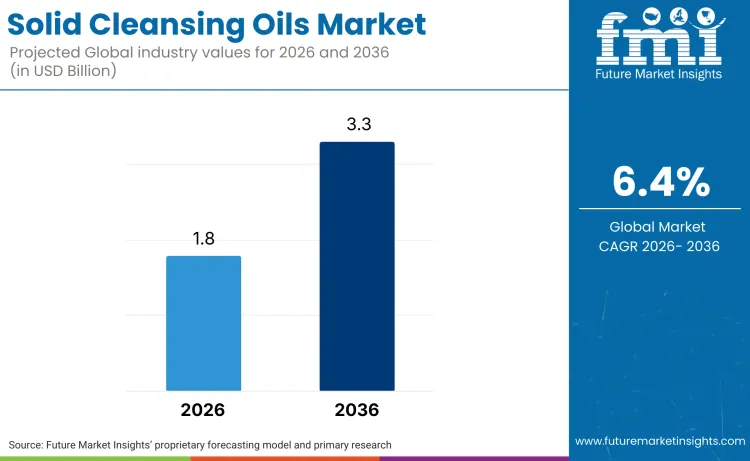
The solid cleansing oils market is valued at USD 1.8 billion in 2026 and is projected to reach USD 3.3 billion by 2036, expanding at a 6.4% CAGR. As per Future Market Insights, growth is shaped by evolving facial cleansing routines that favor balm-to-oil and solid oil formats offering makeup removal, cleansing, and skin conditioning within a single step. Solid cleansing oils address structural constraints associated with liquid oils, including leakage during travel, preservative dependence, and higher packaging intensity.
Product activity between 2024 and 2026 reflects stronger focus on waterless formulations, microbiome-friendly oils, and plant-derived or fermented lipids such as squalane and jojoba, supporting barrier care while maintaining sensorial performance. Established skincare brands are extending oil cleanser portfolios into solid formats to retain relevance, while emerging brands continue shaping awareness through refillable tins and streamlined ingredient profiles.
Broader consumer alignment with waterless personal care is shaping how the solid cleansing oils category is evolving. Balm and solid oil formats align with mobile lifestyles, simplified routines, and reduced packaging waste. Sustainability expectations are becoming more stringent across skincare purchasing decisions. As Vidhi Arya, Beauty Industry Analyst and Author, states, “Environmental consciousness is maturing into deep sustainability expectations. This includes biodegradable packaging, responsibly sourced bioactive ingredients, water-less formulas, and transparent supply chains.
In 2026, they will no longer be optional but expected.” Future Market Insights notes that e-commerce plays a central role in category expansion, as solid cleansing oils are lightweight, shelf-stable, and well suited for subscription replenishment. Growing acceptance of solid skincare formats, combined with emphasis on plastic reduction and multifunctional cleansing benefits, is expected to support repeat adoption, wider brand participation, and sustained value growth through 2036.
Summary of the Solid Cleansing Oils Market
What Is Growth Outlook for Solid Cleansing Oils Market as per Future Market Insights Projection?
Future Market Insights projects the solid cleansing oils market to grow at a CAGR of 6.4% from 2026 to 2036, expanding from USD 1.80 billion in 2026 to USD 3.34 billion by 2036.
How Do FMI Analysts Perceive Solid Cleansing Oils Market to Evolve?
FMI analysts perceive the market evolving from early-stage adoption toward routine daily facial cleansing use, supported by rising preference for gentle, oil-based formats that simplify skincare steps without compromising cleansing efficacy.
Which Country Holds Largest Share in the Global Solid Cleansing Oils Market?
China holds the largest share of the global solid cleansing oils market by value, supported by strong adoption of oil-based cleansing routines and rapid uptake of new skincare formats.
How Large Will the Solid Cleansing Oils Market Be by 2036?
The global solid cleansing oils market is projected to reach USD 3.34 billion by 2036.
What Is Definition of Solid Cleansing Oils Market?
The solid cleansing oils market comprises anhydrous, solid-format oil cleansers designed to dissolve makeup, sunscreen, and facial impurities, primarily for face, lip, and eye cleansing applications.
What Are Globally Unique Trends Shaping Solid Cleansing Oils Market?
Globally unique trends include rising preference for face-focused oil cleansing, growing relevance of traditional solid oil formats, and Asia-led adoption driven by China and India.
| Metric | Details |
|---|---|
| Industry Size (2026) | USD 1.8 Billion |
| Industry Value (2036) | USD 3.3 Billion |
| CAGR (2026 to 2036) | 6.4% |
Source: Future Market Insights (FMI) analysis, based on proprietary forecasting model and primary research.
Why Is the Demand for Solid Cleansing Oils Growing?
Usage expectations for facial cleansers are shifting as solid cleansing oils move from occasional travel products toward regular daily cleansing routines. As per Future Market Insights, consumers are placing greater emphasis on skin tolerance, residue-free rinsing, and compatibility with repeated use, especially within oil-based cleansing steps. Early solid formats were often treated as alternatives for sustainability-focused users, which limited repeat adoption for everyday skincare. That positioning is becoming less viable as solid cleansing oils enter mainstream facial cleansing assortments.
Brand portfolio decisions reflect this transition. Lush Cosmetics includes solid oil-based facial cleansers as part of its permanent skincare lineup, merchandised alongside liquid cleansers and soaps rather than as limited-format options. These products are formulated to soften on skin and emulsify with water, aligning with established cleansing behavior rather than introducing new usage steps. FMI notes that brands embedding solid cleansing oils into core cleansing ranges, with consistent formulation and routine-use intent, are better positioned to support repeat purchase as the category matures beyond niche adoption.
How is the Solid Cleansing Oils Market Segmented?
The solid cleansing oils market is segmented by type and application, reflecting routine skincare usage patterns. By type, the market includes traditional solid cleansing oils, disposable cleansing oil formats, and other variants developed for specific consumer preferences. Traditional solid cleansing oils account for a notable share due to consistent daily use. Disposable formats serve occasional or travel needs, while other types support niche positioning. By application, demand is categorized into face cleansing oil and lip and eye cleansing oil. Face cleansing oil dominates usage as a primary step in daily makeup and sunscreen removal, while lip and eye applications address targeted cleansing requirements.
Why Do Traditional Solid Cleansing Oils Hold a Dominant Share?
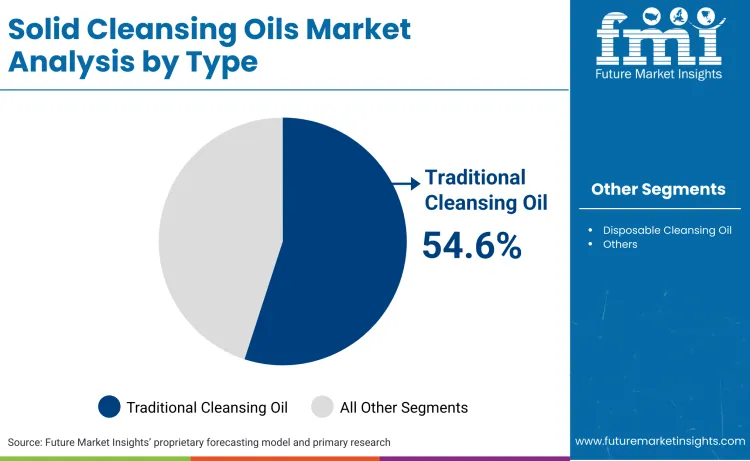
Traditional solid cleansing oils account for 54.6% of the solid cleansing oils market, supported by their close alignment with established oil-cleansing routines and consistent daily use. These formats are designed to melt on contact with skin, emulsify evenly with water, and rinse clean without leaving residue, which supports repeat morning and evening cleansing. Consumers associate traditional solid oils with longer usage cycles and stronger value perception compared with disposable formats. Their functional similarity to liquid cleansing oils reduces switching effort, especially within double-cleansing routines common in Asian skincare practices. FMI observes that traditional solid cleansing oils are positioned as core cleansing products rather than situational alternatives, allowing them to benefit from higher purchase frequency and routine integration. This positioning continues to anchor demand toward traditional formats as the category expands.
Why Does Face Cleansing Oil Lead by Application?
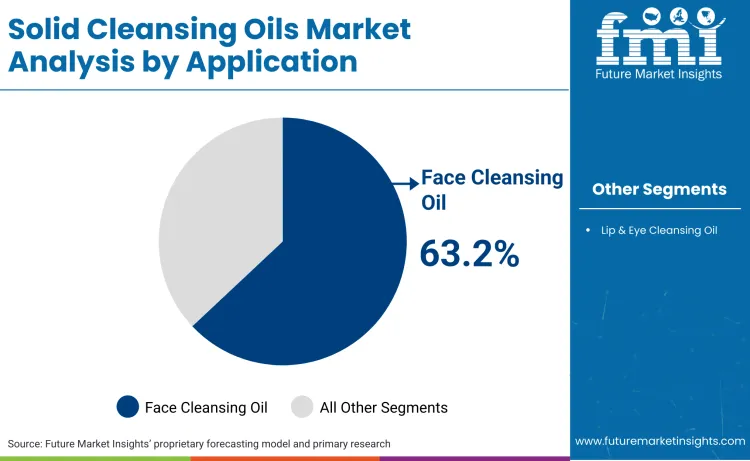
Face cleansing oil represents 63.2% of total application demand, reflecting its role as the primary cleansing step in daily skincare routines. Solid cleansing oils are predominantly formulated to dissolve facial makeup, sunscreen, and surface impurities while maintaining comfort during frequent use. Facial skin tolerance, emulsification performance, and rinse-off feel remain central formulation priorities, concentrating demand in face-focused applications. Lip and eye cleansing oils address more targeted needs and are used less frequently, limiting their volume contribution. FMI notes that face cleansing drives sustained consumption because it anchors both single-step and double-cleansing routines, resulting in higher repeat usage rates and broader consumer relevance across skincare users.
What Trends Are Shaping Industry Evolution Through Waterless Cleansing Formats?
Waterless cleansing formats are increasingly shaping the solid cleansing oils market as skincare brands reduce reliance on liquid formulations, heavy packaging, and preservative-dependent systems. Solid cleansing oils remove water entirely from formulations, improving product stability and minimizing the need for preservatives and complex emulsifier systems typically required in liquids. This structure lowers packaging volume and transport weight while preserving effective oil-based cleansing performance. As per Future Market Insights, brands are no longer positioning solid cleansing oils as travel-only or sustainability-led alternatives. Instead, they are being introduced as daily facial cleansers capable of handling makeup, sunscreen, and routine impurities. This shift reflects growing confidence in performance consistency and skin tolerance, gradually establishing solid cleansing oils as durable, routine-use products aligned with long-term skincare habits.
How Is Portfolio Integration Strengthening Solid Cleansing Oil Adoption?
Portfolio integration is supporting broader adoption of solid cleansing oils by embedding them within core facial cleansing assortments rather than treating them as isolated innovations. Brands are offering solid oil formats alongside liquid oils, balms, and gels, giving consumers format choice without changing established cleansing rituals. Herbivore Botanicals includes solid oil cleansing bars in its skincare lineup, marketed with other cleansing products across retail and digital channels. According to FMI, this integration allows companies to leverage existing formulation standards, distribution networks, and consumer familiarity to support newer formats. Embedding solid cleansing oils into mainstream portfolios reduces adoption barriers, encourages repeat usage, and helps these products scale across both mass and premium skincare markets.
Why Is Formulation Optimization Driving Product Differentiation?
Formulation optimization is a central driver of differentiation in the solid cleansing oils market because performance depends on precise control of oil composition fermented lipids, melting point, and emulsification behavior. Minor formulation inconsistencies can affect spreadability, rinse-off feel, residue levels, and skin comfort during repeated use. Manufacturers are refining oil blends to ensure reliable makeup and sunscreen removal while maintaining tolerance for daily cleansing across skin types. FMI notes that as competition increases, brands are prioritizing formulation discipline to deliver consistent results across climates and storage conditions. This focus on optimized, stable formulations supports scalability and repeat purchase. It also positions solid cleansing oils as dependable daily cleansers rather than experimental formats, reinforcing their role within routine skincare.
What Is the Country-wise Outlook for the Solid Cleansing Oils Market?
Growth patterns for solid cleansing oils differ across countries, shaped by local skincare habits, acceptance of oil cleansing, and openness to solid formats. China shows the fastest expansion at an 8.64% CAGR, supported by widespread double-cleansing practices and rapid adoption of new beauty formats. India follows with an 8.0% CAGR, reflecting rising urban skincare usage and increasing preference for compact, waterless products. Germany records 7.36% growth, influenced by strong sustainability awareness and steady uptake of solid beauty formats. Brazil advances at 6.72%, closely aligned with global trends as awareness of solid personal care increases. The United States posts 6.08%, indicating gradual penetration within a mature cleansing market. The United Kingdom reaches 5.44%, while Japan trails at 4.8%, shaped by slower format switching and continued preference for liquid cleansing oils.
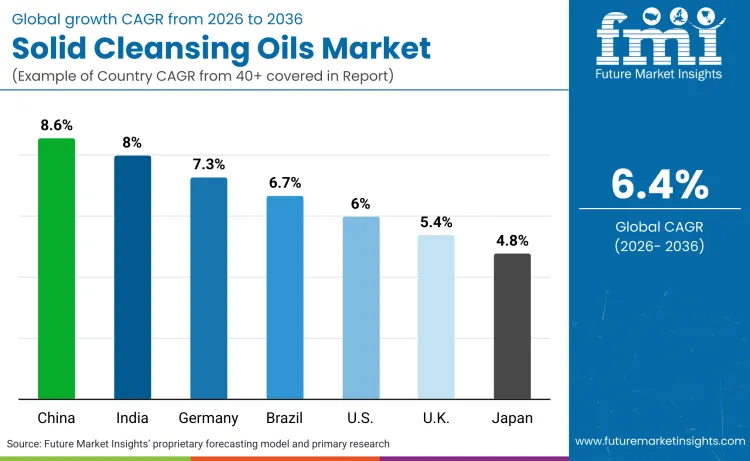
| Country | CAGR (2026 to 2036) |
|---|---|
| China | 8.64% |
| India | 8% |
| Germany | 7.36% |
| Brazil | 6.72% |
| United States | 6.08% |
| UK | 5.44% |
| Japan | 4.8% |
Source: FMI historical analysis and forecast data.
Why Is China Emerging as the Fastest-Growing Market for Solid Cleansing Oils?
China’s 8.64% CAGR reflects rapid normalization of oil-based cleansing and strong consumer openness toward new skincare formats. Urban consumers are already accustomed to double-cleansing routines, which lowers resistance to adopting solid cleansing oils as substitutes for liquid oils. Compact formats align well with dense urban living, frequent travel, and on-the-go lifestyles. E-commerce-first purchasing behavior further supports adoption, as lightweight solid products perform well in repeat orders and subscription models. Visibility across digital platforms increases trial frequency and accelerates switching from liquids to solids. Growth in China is driven less by new user addition and more by higher usage intensity and format substitution within existing skincare routines, reinforcing sustained demand momentum.
What Is Supporting Strong Growth in India?
India’s 8.0% CAGR is supported by expanding urban skincare awareness and increasing experimentation among younger consumers. Solid cleansing oils appeal due to their portability, reduced packaging, and compatibility with daily routines in warm and humid climates. Rising digital penetration has improved access to niche and emerging skincare formats beyond metropolitan centers, enabling trial purchases and repeat adoption. Solid formats are increasingly viewed as practical alternatives rather than premium novelties, helping adoption across multiple price tiers. Growth is reinforced by changing grooming habits, higher engagement with facial cleansing routines, and a gradual shift toward compact, low-waste personal care products suited for frequent travel and variable storage conditions.
Why Is Germany Showing Solid Growth in the Market?
Germany’s 7.36% CAGR is shaped by sustainability-conscious purchasing and disciplined skincare consumption patterns. Consumers show willingness to adopt solid cleansing oils when formats demonstrate clear reductions in plastic use while maintaining performance and quality consistency. Adoption tends to be deliberate, driven by informed decision-making rather than rapid trend uptake. Solid cleansing oils benefit from alignment with environmental priorities and interest in concentrated, long-lasting products. Growth is supported by steady integration into existing skincare routines rather than disruptive switching. This measured but consistent adoption keeps Germany above the global average, with demand anchored by consumers prioritizing formulation integrity, durability, and environmental considerations.
Why Is Brazil Showing Consistent Expansion?
Brazil’s 6.72% CAGR reflects steady growth supported by climate-driven skincare needs and rising middle-income consumption. Warm temperatures and high humidity increase the frequency of facial cleansing, favoring formats that are easy to store, transport, and use daily. Solid cleansing oils fit well into routines that emphasize freshness and convenience, particularly for work and travel. Improved availability through online platforms and specialty beauty retail is increasing awareness and repeat usage. Adoption is gradual but consistent, as consumers increasingly view solid cleansing oils as practical additions to daily skincare rather than occasional alternatives, supporting balanced growth across major urban regions.
Why Is Growth in the United States More Measured?
The United States records a 6.08% CAGR, indicating steady but selective adoption within a mature cleansing market. Solid cleansing oils are often used alongside liquid cleansers rather than fully replacing them, reflecting strong consumer loyalty to established formats. Growth is concentrated among convenience-focused users, frequent travelers, and sustainability-aware consumers seeking lower-waste options. Trial adoption is supported by digital channels and specialty retail, though widespread switching remains limited. As familiarity improves and performance confidence builds, solid formats continue to gain incremental traction without rapid displacement of liquid cleansing oils, resulting in moderate but stable market expansion.
How Is the Competition in the Solid Cleansing Oils Market?

The solid cleansing oils market is moderately concentrated, led by established skincare brands with strong equity in oil-based cleansing. Shu Uemura holds an estimated 17.8% share, reflecting its long-standing association with professional makeup removal and cleansing oil expertise. Japanese and Korean brands such as Biore, MISSHA, and ZA intensify competition by offering high-volume, routine-use cleansing products positioned for daily consumers. Their strength lies in familiarity with oil cleansing rituals and wide retail penetration across Asia. Competition in this segment is increasingly shaped by emulsification performance, rinse-off feel, and suitability for frequent use rather than format novelty or aggressive pricing strategies.
Dermatology-oriented brands such as Avène and Neutrogena contribute to competitive differentiation by extending gentle cleansing credentials into solid oil formats. These brands emphasize skin tolerance and routine compatibility, which resonates with consumers seeking daily-use products. Market competition is gradually shifting toward formulation consistency, sensory reliability, and brand trust. As the category matures, companies with established cleansing authority and disciplined portfolio integration are better positioned to defend share, while newer entrants face pressure to demonstrate comparable performance and repeat-use relevance.
Recent Developments:
- In September 2025, Shu Uemura expanded its cleansing portfolio with the introduction of a solid-format oil cleanser designed to complement its existing liquid cleansing oils. The launch reflects the brand’s focus on offering format flexibility while maintaining established oil-cleansing performance for daily makeup and sunscreen removal routines.
- In October 2025, Biore extended its facial cleansing range by introducing a compact solid oil cleanser positioned for routine household use. This development supports Biore’s strategy of translating high-volume liquid cleansing expertise into solid formats that emphasize ease of use, storage efficiency, and consistent rinse-off performance.
- In November 2025, Neutrogena advanced its gentle cleansing lineup by piloting solid oil cleansing formats within select skincare assortments. The initiative aligns with Neutrogena’s broader emphasis on skin tolerance and daily-use compatibility, allowing the brand to test solid cleansing oils as a complementary format alongside established liquid cleansers.
Key Players in Solid Cleansing Oils Market
- Shu Uemura
- MISSHA
- ZA
- Biore
- Avene
- Neutrogena
Market Definition
The solid cleansing oils market represents revenue generated from the sale of oil-based facial cleansing products formulated in solid or semi-solid formats that transform into oils upon application. The market, as operationally defined in the article, measures commercial sales of balm-to-oil cleansers, solid oil bars, and tablet or puck-style cleansing oils used for daily facial cleansing and makeup removal. Market sizing reflects the value of finished consumer products sold through retail and digital channels, analyzed by format, ingredient profile, and distribution channel, and expressed in USD billion.
The market includes balm cleansers, solid oil sticks, molded oil bars, and unit-dose or tabletized cleansing oil formats formulated with plant-derived, fermented, or synthetic-identical lipids such as squalane, jojoba, and esters. Applications covered include daily facial cleansing, makeup removal, sunscreen removal, and barrier-support cleansing routines. Revenue generated from waterless formulations, refillable packaging systems, and clean-label solid cleansing oils is included. The scope counts adoption across mass, premium, and dermatology-aligned skincare segments through supermarkets, specialty beauty retailers, pharmacies, brand-owned stores, and e-commerce platforms across North America, Europe, Asia Pacific, Latin America, and the Middle East & Africa.
The market excludes liquid cleansing oils, micellar waters, and foaming facial cleansers sold in bottled formats. Multi-step cleansing devices, cleansing tools, and reusable applicators are excluded. Standalone makeup removers not designed for full-face cleansing are not included. Professional-use cleansing products sold exclusively to spas or dermatology clinics without retail availability are excluded from market sizing. Private-label bulk formulations sold as raw materials are not counted within finished product revenues.
Scope of Report
| Items | Values |
|---|---|
| Quantitative Units (2026) | USD 1.8 Billion |
| Product Type | Traditional Solid Cleansing Oils; Disposable / Unit-Dose Solid Oils; Balm-to-Oil Cleansers; Others |
| Application | Face Cleansing Oil; Lip & Eye Cleansing Oil |
| Regions Covered | North America, Europe, Asia Pacific, Latin America, Middle East & Africa |
| Countries Covered | United States, Germany, United Kingdom, India, China, Brazil, and 40+ countries |
| Key Companies Profiled | Shu Uemura; MISSHA; ZA; Biore; Avène; Neutrogena |
| Additional Attributes | Dollar sales by product type and application; country-wise growth analysis; adoption trends for waterless and solid skincare formats; packaging sustainability and refill systems; ingredient positioning including plant-derived and fermented oils; competitive brand positioning across mass and premium channels |
Source: FMI historical analysis and forecast data.
Solid Cleansing Oils Market by Segments
By Product Type:
- Traditional Solid Cleansing Oil
- Disposable / Unit-Dose Solid Cleansing Oil
- Others
By Application:
- Face Cleansing Oil
- Lip & Eye Cleansing Oil
By Region:
- North America
- Europe
- Asia Pacific
- Latin America
- Middle East & Africa
Bibliography
- Avène Dermatological Laboratories. (2023). Dermatological cleansing systems and skin barrier tolerance. Pierre Fabre Research Publications, 1-42.
- Cosmetic Ingredient Review Expert Panel. (2024). Safety assessment of plant-derived and synthetic-identical lipids used in cosmetic cleansing formulations. Cosmetic Ingredient Review, 1-58.
- Personal Care Products Council. (2024). Anhydrous formulation design and preservative minimization in personal care products. PCPC Scientific Affairs Report, 1-40.
Frequently Asked Questions
What is the current global market size for Solid Cleansing Oils?
The global solid cleansing oils market is valued at USD 1.8 billion in 2026, supported by rising adoption of oil-based facial cleansing and growing interest in compact, waterless skincare formats.
What is the projected CAGR for the Solid Cleansing Oils market?
Market revenues are projected to grow at a 6.4% CAGR from 2026 to 2036, reaching USD 3.34 billion by the end of the forecast period.
Which segment currently dominates the industry?
Traditional solid cleansing oils dominate the market with a 54.6% share, driven by routine daily use and compatibility with established oil-cleansing practices.
What are the primary risks or barriers to adoption?
Key barriers include strong consumer loyalty to liquid cleansing oils, performance sensitivity related to melting and rinse-off behavior, and slower format switching in mature skincare markets.
Who are the leading players in the Solid Cleansing Oils space?
Leading brands include Shu Uemura, Biore, MISSHA, Avène, and Neutrogena, leveraging established cleansing credibility and broad retail reach.
Preview the report firsthand - request a free sample
Get SampleGet the brochure for pricing and purchase details.
Get PDFTable of Content
- Executive Summary
- Global Market Outlook
- Demand Side Trends
- Supply Side Trends
- Technology Roadmap Analysis
- Analysis and Recommendations
- Market Overview
- Market Coverage / Taxonomy
- Market Definition / Scope / Limitations
- Research Methodology
- Chapter Orientation
- Analytical Lens and Working Hypotheses
- Market Structure, Signals, and Trend Drivers
- Benchmarking and Cross-market Comparability
- Market Sizing, Forecasting, and Opportunity Mapping
- Research Design and Evidence Framework
- Desk Research Programme (Secondary Evidence)
- Expert Input and Fieldwork (Primary Evidence)
- Governance, Ethics, and Data Stewardship
- Tooling, Models, and Reference Databases
- Data Engineering and Model Build
- Data Acquisition and Ingestion
- Cleaning, Normalisation, and Verification
- Synthesis, Triangulation, and Analysis
- Quality Assurance and Audit Trail
- Market Background
- Market Dynamics
- Drivers
- Restraints
- Opportunity
- Trends
- Scenario Forecast
- Demand in Optimistic Scenario
- Demand in Likely Scenario
- Demand in Conservative Scenario
- Opportunity Map Analysis
- Product Life Cycle Analysis
- Supply Chain Analysis
- Investment Feasibility Matrix
- Value Chain Analysis
- PESTLE and Porter's Analysis
- Regulatory Landscape
- Regional Parent Market Outlook
- Production and Consumption Statistics
- Import and Export Statistics
- Market Dynamics
- Global Market Analysis 2021 to 2025 and Forecast, 2026 to 2036
- Historical Market Size Value (USD Billion) Analysis, 2021 to 2025
- Current and Future Market Size Value (USD Billion) Projections, 2026 to 2036
- Y-o-Y Growth Trend Analysis
- Absolute $ Opportunity Analysis
- Global Market Pricing Analysis 2021 to 2025 and Forecast 2026 to 2036
- Y-o-Y Growth Trend Analysis 2021 to 2025
- Absolute $ Opportunity Analysis 2026 to 2036
- Global Market Analysis 2021 to 2025 and Forecast 2026 to 2036, By Product Type
- Introduction / Key Findings
- Historical Market Size Value (USD Billion), 2021 to 2025
- Current and Future Market Size Value (USD Billion), 2026 to 2036
- Traditional Solid Cleansing Oils
- Disposable / Unit-Dose Solid Cleansing Oils
- Others
- Global Market Analysis 2021 to 2025 and Forecast 2026 to 2036, By Application
- Introduction / Key Findings
- Historical Market Size Value (USD Billion), 2021 to 2025
- Current and Future Market Size Value (USD Billion), 2026 to 2036
- Face Cleansing Oil
- Lip & Eye Cleansing Oil
- Global Market Analysis 2021 to 2025 and Forecast 2026 to 2036, By Region
- Introduction
- Historical Market Size Value (USD Billion), 2021 to 2025
- Current and Future Market Size Value (USD Billion), 2026 to 2036
- North America
- Latin America
- Europe
- Asia Pacific
- Middle East & Africa
- Market Attractiveness Analysis By Region
- Key Countries Market Analysis
- Market Structure Analysis
- Competition Dashboard
- Competition Benchmarking
- Market Share Analysis of Top Players
- Competition Analysis
- Competition Deep Dive
- Shu Uemura
- MISSHA
- ZA
- Biore
- Avène
- Neutrogena
- Competition Deep Dive
- Assumptions & Acronyms Used


