

- Industry Size (2026)
- USD 1.9 Bn
- Forecast (2036)
- USD 3.3 Bn
- CAGR (2026 to 2036)
- 5.5%
Bar-Format Makeup Removers Market Forecast and Outlook 2026 to 2036
The global bar-format makeup removers market is projected to reach USD 1.9 billion in 2026 and expand to USD 3.3 billion by 2036, registering a 5.5% CAGR over the forecast period. As per FMI opinion, this growth reflects a structural shift in skincare routines away from diluted liquid removers toward concentrated, waterless cleansing systems that deliver high efficacy with lower material intensity. Consumers increasingly adopt bar-format removers within simplified, performance-led routines that prioritize effective makeup breakdown, skin comfort, and reduced packaging waste. Product development centers on advanced cleansing architectures that include plant-derived oils, micellar inspired systems, and mild syndet technologies designed to match the sensorial profile and effectiveness of premium liquid removers while preserving the skin barrier.
“As we transform our company to better capture growth and drive profitability, we remain steadfast in our commitment to advancing environmental stewardship and social impact.”
-Stéphane De La Faverie, President and CEO, The Estée Lauder Companies
This alignment of performance and purpose supports market acceleration as bar-format makeup removers move from niche innovations into scaled mass-premium distribution. With increasing alignment between efficacy, sustainability, and regulatory ease, these formats are positioned to become a standard cleansing solution across multiple consumer segments over the next decade.
Quick Stats for Bar-format Makeup Removers Market
- Bar-format Makeup Removers Industry Value (2026): USD 1.9 Billion
- Bar-format Makeup Removers Industry Forecast Value (2036): USD 3.3 Billion
- Bar-format Makeup Removers Industry Forecast CAGR: 5.5%
- Bar-format Makeup Removers Industry Leading Product: Liquid Formulations (46.8%)
- Bar-format Makeup Removers Industry Key Growth Regions: United States, Germany, Japan, United Kingdom, France
- Bar-format Makeup Removers Industry Key Players: L'Oreal Groupe, Estée Lauder Inc, Unilever PLC, Procter & Gamble, Natura&Co
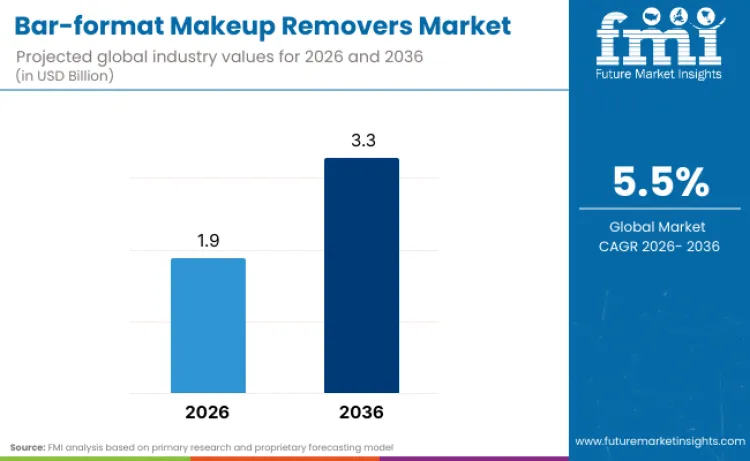
Bar-format Makeup Removers Market Key Takeaways
| Metric | Value |
|---|---|
| Market Value (2026) | USD 1.9 billion |
| Market Forecast Value (2036) | USD 3.3 billion |
| Forecast CAGR (2026 to 2036) | 5.5% |
Source: FMI’s proprietary forecasting model and primary research
Key Shift in the Bar-Format Makeup Removers Market During 2026 to 2036
Before 2026, bar-format makeup removers occupied a marginal position in skincare. Many products were criticized for weak cleansing performance, limited removal of waterproof makeup, and irritation on sensitive skin. Consumer trust remained low because performance claims often failed under real use conditions. Few offerings showed the formulation rigor associated with dermatologist supported cleansing routines, which restricted repeat purchase and routine integration.
By 2026, Advances in oil phase dispersion, precision emulsification, and pH balanced syndet platforms allow bar formats to compete with liquid removers on makeup dissolution, waterproof mascara removal, skin comfort, and post cleanse hydration. In some routines, these formats outperform liquids. These improvements close the long standing performance gap that previously limited adoption.
Product positioning also evolves. Makeup remover bars are increasingly presented as high concentration active cleansing blocks within dermatological skincare routines. Brands such as Neutrogena, supported by Johnson & Johnson micellar technology, and Dove introduce patented cleansing architectures in compact solids. Messaging shifts toward measurable efficacy and clinical credibility.
What are the Various Segments of the Bar-format Makeup Removers Market?
The bar-format makeup removers market is segmented by product type into liquid, lotion/cream, wipes, and others; by price into low, medium, high, and premium; by distribution channel into offline stores, online platforms, and others; by formulation into oil-based, micellar, gentle, and others; and by region into Asia Pacific (China, Japan, South Korea, India, Australia & New Zealand, ASEAN, rest of Asia Pacific), Europe (Germany, United Kingdom, France, Italy, Spain, Nordic, BENELUX, rest of Europe), North America (USA, Canada, Mexico), Latin America (Brazil, Chile, rest of Latin America), and Middle East & Africa (Kingdom of Saudi Arabia, other GCC countries, Turkey, South Africa, other African Union, rest of Middle East & Africa).
Which Product Type Holds the Largest Share in Bar-format Makeup Removers?
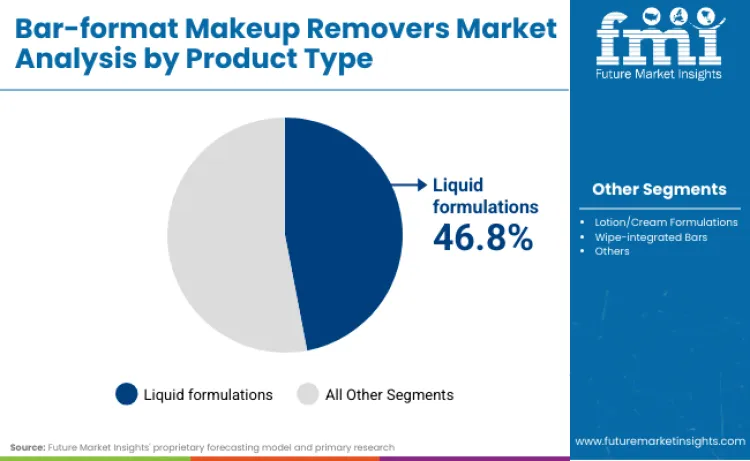
Liquid-based cleansing architectures dominate the bar-format makeup removers market with a 46.8% share, supported by their superior efficacy in dissolving long-wear, waterproof, and transfer-resistant makeup. These formats address the most common consumer pain point in cleansing: removing full-coverage foundation, mascara, and setting sprays without excessive rubbing or barrier disruption. Liquid-inspired bars deliver an immediate, visible payoff, faster makeup breakdown, smoother glide, and reduced residue, which drives repeat purchase and routine loyalty. Real market behavior confirms this concentration of demand. Unilever’s Dove Beauty Bars use syndet-liquid hybrid systems to combine gentleness with effective cleansing. Johnson & Johnson’s Neutrogena extends its micellar cleansing expertise into solid formats.
How Do Price Categories Influence Bar-format Makeup Remover Preferences?
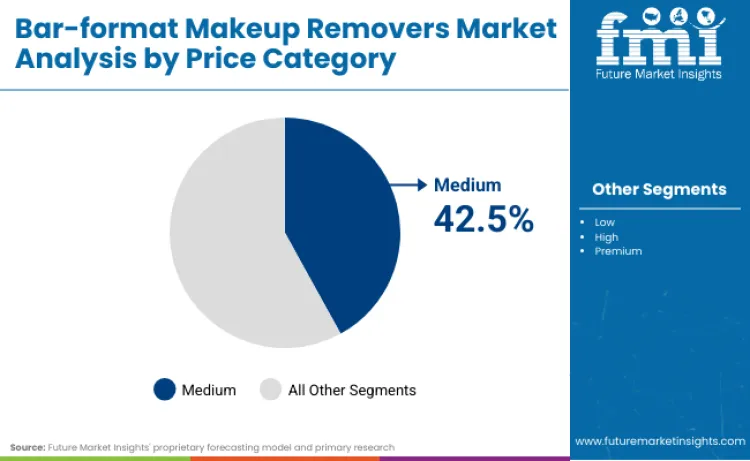
Medium-priced products account for 42.5% of the market, reflecting where value perception and performance confidence intersect. This segment attracts consumers who want efficacy comparable to premium liquid removers without the recurring cost burden. Price shapes preference because bar-format removers promise longer usage per unit, concentrated formulations, and reduced packaging, benefits that feel financially rational at mass retail. Brands succeeding here frame bars as smart substitutions, not compromises.
Neutrogena positions its cleansing bars as dermatologist-tested, effective solutions alongside its liquid removers, anchoring trust at accessible price points. Dove emphasizes affordability combined with skin comfort, making bar cleansers a routine purchase rather than an experiment. Garnier leverages its micellar heritage to justify mid-tier pricing with performance credibility. In contrast, premium brands such as Estée Lauder and Shiseido compete above this band by emphasizing sensorial refinement, ingredient purity, and skin benefits. However, volume growth remains concentrated in the medium-priced tier, where accessibility enables habitual use.
Why Are Bar-Format Makeup Removers Gaining Structural Share?
Bar-format makeup removers gain share when adoption shifts from novelty toward everyday practicality. A primary driver is mainstream retail normalization. Placement in retailers such as Target, CVS Pharmacy, and Sephora moves bars out of niche clean beauty sections and into standard skincare aisles. Shelf proximity to liquid removers reframes bars as credible substitutes rather than experimental formats. Cost per use efficiency is another driver during inflationary conditions. Concentrated bars last longer than liquids, increasing total cleansing uses per purchase and improving perceived value. Lifestyle compatibility also matters. Solid formats eliminate spill risk, meet air travel requirements, and simplify gym or commuter routines. These factors create functional demand independent of sustainability messaging. Retail access expands audience reach. Cost efficiency reshapes value comparison. Convenience supports routine integration. Adoption rises because bars solve practical problems linked to visibility, household economics, and daily mobility rather than abstract environmental claims.
What Factors Continue to Limit Adoption Despite Rising Interest?
Adoption slows when perceived usage risk outweighs expected benefit. The most significant barrier is the technique gap. Bar removers require correct lathering, controlled water contact, and proper drying. Early misuse often leads to uneven cleansing results, which discourages repeat purchase. Performance perception also limits uptake. Long wear foundations, waterproof mascaras, and high SPF filmsv still favor oil rich liquid or balm removers. Bars without sufficient oil phase stabilization struggle in these scenarios, creating disappointment. Hygiene perception remains another constraint. Consumers associate wet bars with residue buildup and reduced cleanliness, which conflicts with prestige skincare expectations. Storage concerns amplify this issue in shared bathrooms or humid climates. Routine inertia also plays a role. Established cleansing habits resist change even when alternatives perform well. Retail education gaps add friction. Without visible guidance or demonstrations, consumers hesitate to adjust technique. Adoption depends on confidence, clarity, and proof delivered at first use and at shelf level.
Why Has Market Momentum Accelerated in Recent Years?
Momentum has increased due to formulation and manufacturing maturity rather than sudden preference shifts. Advances in pH balanced syndet systems allow bar removers to match the gentleness and barrier protection of premium liquid cleansers. Improvements in oil dispersion and emulsification increase makeup dissolution reliability. Manufacturing scale also supports growth. Precision molding replaces manual pressing, improving consistency and throughput. Supply chain economics favor solids. Concentrated bars increase pallet density, lower freight exposure, and reduce leakage risk. Retail strategy reinforces adoption. Mass retailers position bars alongside liquids as equal options. Prestige brands integrate bars into minimalist routines focused on maintenance and skin health. Packaging design now emphasizes usability and storage solutions. Consumer education improves through clearer instructions and sampling. These elements align around performance, logistics, and accessibility. The result is structural acceleration. Bar-format makeup removers transition from niche alternatives into scalable mainstream cleansing systems supported by technical reliability and retail acceptance.
How Is the Bar-Format Makeup Removers Market Evolving Globally?
Global demand for bar-format makeup removers is increasing as the category moves from niche alternative to routine cleansing option. This shift is supported by formulation advances that allow concentrated, waterless bars to compete on makeup dissolution, skin comfort, cleansing completeness, and product longevity. Performance now drives adoption more than natural or eco positioning. Brands scale oil based cleansing systems, micellar technology integration, and pH optimized platforms to deliver reliable results across different skin types and makeup intensities.
Retail dynamics also shape this evolution. Makeup remover bars increasingly appear in mainstream beauty aisles and structured displays alongside liquid removers. This visibility reduces discovery friction and supports trial among everyday consumers. Consistent shelf placement reinforces format familiarity and improves repeat purchase rates. As a result, bar-format makeup removers transition from experimental products into standardized cleansing options supported by performance credibility, routine compatibility, and broader retail acceptance.
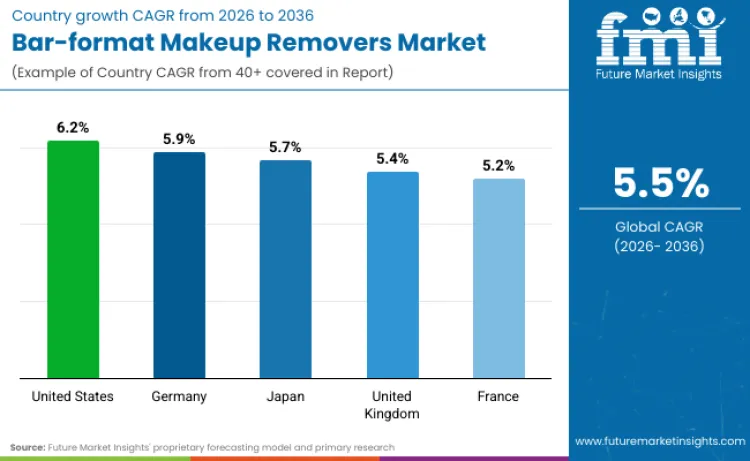
| Country | CAGR (2026 to 2036) |
|---|---|
| United States | 6.2% |
| Germany | 5.9% |
| Japan | 5.7% |
| United Kingdom | 5.4% |
| France | 5.2% |
Source: Future Market Insights' proprietary forecasting model and primary research
United States Bar-Format Makeup Removers Market Defined by Retail Access
The United States bar-format makeup removers market is projected to grow at a 6.2% CAGR from 2026 to 2036 as retail normalization removes adoption friction. Leading beauty retailers are increasingly moving bar-format removers into mainstream skincare aisles, shifting them away from niche 'clean beauty' sections to signal their broader appeal. This placement reframes bars as routine options rather than experimental formats. Consumers compare formats using performance outcomes and price logic during in-store evaluation.
Germany Bar-Format Makeup Removers Market Driven by Evidence
Germany’s bar-format makeup removers market is projected to grow at a 5.9% CAGR from 2026 to 2036, driven by data-backed performance claims and functional product positioning. The German consumer base tends to approach personal care with caution, valuing clinical validation, ingredient transparency, and measurable outcomes over novelty or trend-driven appeal. Solid-format makeup removers are gaining traction because they increasingly meet these standards, delivering reliable cleansing efficacy, skin comfort, and tolerability for sensitive skin without relying on high water content or heavy packaging.
Bar-format removers that highlight dermatologically tested results, minimalistic ingredient lists, and pH-balanced syndet systems are more likely to secure shelf space and long-term consumer trust. Retail formats also influence market growth: Germany’s drugstore culture favors clearly labeled, independently reviewed products with eco-certifications and user guidance, which helps lower the trial barrier. The shift is gradual but grounded, performance, regulatory alignment, and consumer familiarity with solid cleansing formats are aligning to support durable category expansion.
Japan Bar-Format Makeup Removers Market Supported by Routine Discipline
Japan’s bar-format makeup removers market is forecast to grow at a 5.7% CAGR from 2026 to 2036, supported by the country’s strong cultural emphasis on structured skincare routines, ingredient safety, and packaging efficiency. Japanese consumers prioritize consistency, texture elegance, and low-irritation cleansing-factors that align well with the evolving generation of syndet-based solid removers. The bar format fits into multi-step routines that already include oil cleansers, foams, and lotions, making it a compatible addition rather than a disruptive alternative.
Product success depends on refinement: Japanese users expect bar-format removers to offer quick emulsification, full makeup breakdown, and no residue. Compact, portable packaging also aligns with Japan’s urban lifestyle and preference for waste-minimizing formats. Regulatory compliance and detailed labeling are baseline expectations, further reinforcing consumer trust. As water conservation, travel efficiency, and minimalist formulations gain ground, Japan’s methodical, performance-led market environment creates fertile ground for long-term adoption of bar-format cleansing systems.
United Kingdom Bar-Format Makeup Removers Market Built on Trust
The United Kingdom bar-format makeup removers market is projected to grow at a 5.4% CAGR from 2026 to 2036, driven by a blend of value-conscious behavior, ingredient awareness, and retailer trust. UK consumers often rely on high-street retail environments, pharmacies, health chains, and department stores, as trusted sources for personal care products, particularly in categories linked to skin health. As bar-format makeup removers become more visible within these settings, they benefit from established shopper routines and growing interest in waterless, low-packaging formats.
UK buyers tend to favor products that balance affordability with performance, making bar formats appealing when they deliver long usage per unit, reduced waste, and minimal irritation. Ingredient disclosures, fragrance-free claims, and dermatologist-recommended positioning also resonate, particularly with sensitive skin consumers. While adoption is steady rather than rapid, bar-format removers gain traction when framed around credible efficacy, routine convenience, and alignment with environmental expectations in the mainstream retail space.
France Bar-Format Makeup Removers Market Anchored in Expertise
France’s bar-format makeup removers market is projected to expand at a 5.2% CAGR from 2026 to 2036, supported by strong beauty heritage and openness to innovation. French consumers expect cleansing products to balance efficacy, sensorial quality, and formulation sophistication. Well designed solid formats meet these expectations when performance credibility is clearly communicated. Retail education plays a central role in adoption. Sephora France provides trained advisors and in store storytelling that explain bar usage within modern cleansing routines. Pharmacies and parfumeries emphasize formulation science and correct technique during product selection.
Who Is Strengthening Competitive Positioning in Bar-Format Makeup Removers?
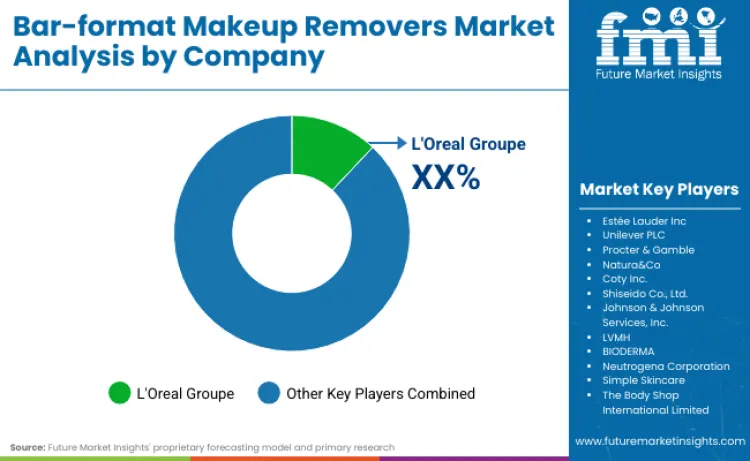
Brands gaining share in bar-format makeup removers are those that already hold consumer trust in facial cleansing and can extend usage habits without retraining behavior. Format legitimacy matters more than novelty. L’Oréal illustrates this approach by placing bar-format removers within established skincare systems. Consumers treat the bar as a format swap rather than a routine change. Familiar cleansing cues such as gentle efficacy, makeup breakdown, and skin comfort reduce misuse risk and support repeat purchase.
Japan anchors regional leadership because local players are format native. Shiseido and Kao engineer bar removers that fit multi step routines and travel heavy lifestyles. Advantages come from formulation precision, low residue cleansing, predictable skin feel, and packaging designed for humidity control.
One is the global scale integrator that legitimizes bar formats through distribution and education. The other is the regional formulation specialist that delivers superior routine fit. Share accrues to brands treating bar-format makeup removers as performance extensions of cleansing rather than sustainability experiments.
Recent Developments:
- In June 2025, Unilever agreed to acquire men’s personal care brand Dr. Squatch from Summit Partners. The deal strengthens Unilever’s premium portfolio, leveraging Dr. Squatch’s natural formulations, digital-first marketing, and strong North American consumer following.
- In December 2025, Kenvue highlighted milestones including a new state-of-the-art office, leading clinical research, and product innovations, reinforcing its purpose-driven approach to everyday care, personal health insights, and improved consumer wellbeing outcomes.
Key Players in the Bar-format Makeup Removers Market
- L'Oreal Groupe
- Estée Lauder Inc
- Unilever PLC
- Procter & Gamble
- Natura&Co
- Coty Inc.
- Shiseido Co., Ltd.
- Johnson & Johnson Services, Inc.
- LVMH
- BIODERMA
- Neutrogena Corporation
- Simple Skincare
- The Body Shop International Limited
- Olay (P&G)
- Clinique Laboratories LLC
Market Definition
The bar-format makeup removers market represents revenues generated from solid, concentrated cleansing products engineered specifically to remove cosmetic makeup from facial skin, including long-wear, waterproof, and transfer-resistant formulations. These products are manufactured in bar, puck, or pressed solid formats and function through oil-phase solubilization, micellar dispersion, or mild surfactant systems rather than water-diluted carriers. Market measurement captures ingredient concentration value, formulation complexity, and repeat-use economics, not packaging substitution alone, and is expressed in USD billion for the 2026 to 2036 period.
This market treats bar-format makeup removers as a distinct functional cleansing category, defined by primary makeup removal intent rather than general cleansing. Products must demonstrate effective cosmetic dissolution, residue management, and skin comfort comparable to or exceeding liquid removers. The analysis excludes soap logic and sustainability framing as defining criteria. Revenue attribution applies only to products positioned, merchandised, and repeatedly used as makeup removal steps within skincare routines, separating them from facial cleansing bars, treatment bars, and hybrid wash products.
Market Inclusion
Included in scope are commercially sold, ready-to-use solid makeup remover products distributed through mass retail, prestige beauty, pharmacy, professional salon channels, and direct-to-consumer platforms. Eligible products must be designed for routine makeup removal, not incidental cleansing, and must function independently without requiring a secondary remover step. This includes oil-based solid removers, micellar solid systems, low-pH syndet bars, and hybrid cleansing solids where makeup dissolution is the dominant performance claim.
The market includes bars formulated with concentrated oils, emulsified oil-water architectures, surfactant blends, micellar concentrates, and performance-driven botanical systems when their role is cosmetic removal. Revenues from remover bars sold within skincare kits, travel assortments, or subscription programs are included only when the remover component is distinctly identified, priced, or functionally marketed. Geographic coverage spans North America, Europe, Asia Pacific, Latin America, and the Middle East and Africa, with country-level analysis where retail normalization, routine adoption, and brand trust materially influence repeat purchase behavior.
Market Exclusion
Explicitly excluded are liquid, cream, gel, balm, oil, and micellar water removers, regardless of packaging format or sustainability positioning. Facial soap bars, exfoliating bars, cleansing treatment bars, and general face wash solids are excluded unless the product’s primary functional use is makeup removal, not incidental cosmetic cleansing. Hybrid cleanser-remover bars are excluded when makeup removal is secondary or unsupported by performance positioning.
Also excluded are single-use wipes, disposable pads, dissolvable sheets, cotton products, and cleansing accessories. DIY formulations, experimental prototypes, bulk salon treatments without retail sale, and non-standardized artisanal products fall outside scope. Revenues linked to accessories, storage cases, refill containers, or multi-step systems where makeup removal is not the core value proposition are excluded. Products focused on toning, treatment delivery, exfoliation, or skin therapy without explicit makeup removal intent are not counted within this market boundary.
Scope of the Report
| Items | Values |
|---|---|
| Quantitative Units | USD billion |
| Product Type | Liquid Formulations; Lotion/Cream Formulations; Wipe-integrated Bars; Others |
| Price Category | Low; Medium; High; Premium |
| Distribution Channel | Offline Stores (Drugstores & Department Stores); Online Platforms (DTC & Marketplaces); Specialty Beauty Retailers; Others |
| Formulation Type | Oil-based Cleansers; Micellar Technology; Gentle Surfactants; Botanical Extract Blends; Others |
| Regions Covered | North America, Europe, Asia Pacific, Latin America, Middle East & Africa |
| Countries Covered | United States, Germany, Japan, United Kingdom, France, Canada, and 40+ countries |
| Key Companies Profiled | L'Oreal Groupe; Estée Lauder Inc; Unilever PLC; Procter & Gamble; Natura&Co; Coty Inc.; Shiseido Co., Ltd.; Others |
Bar-format Makeup Removers Market by Segment
Product Type:
- Liquid Formulations
- Lotion/Cream Formulations
- Wipe-integrated Bars
- Others
Price Category:
- Low
- Medium
- High
- Premium
Distribution Channel:
- Offline Stores
- Online Platforms
- Specialty Beauty Retailers
- Others
Formulation Type:
- Oil-based Cleansers
- Micellar Technology
- Gentle Surfactants
- Others
Region:
- Asia Pacific
- China
- Japan
- South Korea
- India
- Australia & New Zealand
- ASEAN
- Rest of Asia Pacific
- Europe
- Germany
- United Kingdom
- France
- Italy
- Spain
- Nordic
- BENELUX
- Rest of Europe
- North America
- USA
- Canada
- Mexico
- Latin America
- Brazil
- Chile
- Rest of Latin America
- Middle East & Africa
- Kingdom of Saudi Arabia
- Other GCC Countries
- Turkey
- South Africa
- Other African Union
- Rest of Middle East & Africa
Bibliography
- European Commission. (2024). Regulation (EC) No 1223/2009 on cosmetic products and safety assessment guidelines. Official Journal of the European Union.
- International Cooperation on Cosmetics Regulation (ICCR). (2024). Global approaches to cosmetic product safety, ingredient evaluation, and regulatory harmonization. ICCR Framework.
- OECD. (2024). Test guidelines and safety assessment approaches for cosmetic and personal care formulations. Organisation for Economic Co‑operation and Development.
Frequently Asked Questions
How big is the global bar-format makeup removers market?
The global bar-format makeup removers market is valued at USD 1.9 billion in 2026 and is forecast to reach USD 3.3 billion by 2036.
What is the growth outlook for the bar-format makeup removers market over the next 10 years?
The category is projected to expand at a 5.5% CAGR from 2026 to 2036, reflecting steady conversion from liquid removers to concentrated solid formats.
Which product segments or formats drive demand in this market?
Liquid formulations lead demand with a 46.8% share, supported by familiar application methods and proven efficacy across various makeup types.
How does consumer behavior differ by region?
Adoption is strongest where bar formats are retail-normalized fastest, with United States (6.2% CAGR), Germany (5.9%), Japan (5.7%), United Kingdom (5.4%), and France (5.2%) outpacing the global baseline during 2026-2036.
What are the main risks and constraints affecting this market?
Growth is constrained where consumers experience application learning curves, efficacy gaps with waterproof makeup, or skin sensitivity concerns versus liquid alternatives, reducing repeat purchase.
Preview the report firsthand - request a free sample
Get SampleGet the brochure for pricing and purchase details.
Get PDFTable of Content
- Executive Summary
- Global Market Outlook
- Demand Side Trends
- Supply Side Trends
- Technology Roadmap Analysis
- Analysis and Recommendations
- Market Overview
- Market Coverage / Taxonomy
- Market Definition / Scope / Limitations
- Research Methodology
- Chapter Orientation
- Analytical Lens and Working Hypotheses
- Market Structure, Signals, and Trend Drivers
- Benchmarking and Cross-market Comparability
- Market Sizing, Forecasting, and Opportunity Mapping
- Research Design and Evidence Framework
- Desk Research Programme (Secondary Evidence)
- Company Annual and Sustainability Reports
- Peer-reviewed Journals and Academic Literature
- Corporate Websites, Product Literature, and Technical Notes
- Earnings Decks and Investor Briefings
- Statutory Filings and Regulatory Disclosures
- Technical White Papers and Standards Notes
- Trade Journals, Industry Magazines, and Analyst Briefs
- Conference Proceedings, Webinars, and Seminar Materials
- Government Statistics Portals and Public Data Releases
- Press Releases and Reputable Media Coverage
- Specialist Newsletters and Curated Briefings
- Sector Databases and Reference Repositories
- FMI Internal Knowledge Base and Historical Datasets
- Subscription Datasets and Paid Sources
- Social Channels, Communities, and Digital Listening Inputs
- Additional Desk Sources
- Expert Input and Fieldwork (Primary Evidence)
- Primary Modes
- Qualitative Interviews and Expert Elicitation
- Quantitative Surveys and Structured Data Capture
- Blended Approach
- Why Primary Evidence is Used
- Field Techniques
- Interviews
- Surveys
- Focus Groups
- Observational and In-context Research
- Social and Community Interactions
- Stakeholder Universe Engaged
- C-suite Leaders
- Board Members
- Presidents and Vice Presidents
- R&D and Innovation Heads
- Technical Specialists
- Domain Subject-matter Experts
- Scientists
- Physicians and Other Healthcare Professionals
- Governance, Ethics, and Data Stewardship
- Research Ethics
- Data Integrity and Handling
- Primary Modes
- Tooling, Models, and Reference Databases
- Desk Research Programme (Secondary Evidence)
- Data Engineering and Model Build
- Data Acquisition and Ingestion
- Cleaning, Normalisation, and Verification
- Synthesis, Triangulation, and Analysis
- Quality Assurance and Audit Trail
- Market Background
- Market Dynamics
- Drivers
- Restraints
- Opportunity
- Trends
- Scenario Forecast
- Demand in Optimistic Scenario
- Demand in Likely Scenario
- Demand in Conservative Scenario
- Opportunity Map Analysis
- Product Life Cycle Analysis
- Supply Chain Analysis
- Investment Feasibility Matrix
- Value Chain Analysis
- PESTLE and Porter's Analysis
- Regulatory Landscape
- Regional Parent Market Outlook
- Production and Consumption Statistics
- Import and Export Statistics
- Market Dynamics
- Global Market Analysis 2021 to 2025 and Forecast, 2026 to 2036
- Historical Market Size Value (USD Billion) Analysis, 2021 to 2025
- Current and Future Market Size Value (USD Billion) Projections, 2026 to 2036
- Y-o-Y Growth Trend Analysis
- Absolute $ Opportunity Analysis
- Global Market Pricing Analysis 2021 to 2025 and Forecast 2026 to 2036
- Y-o-Y Growth Trend Analysis 2021 to 2025
- Absolute $ Opportunity Analysis 2026 to 2036
- Global Market Analysis 2021 to 2025 and Forecast 2026 to 2036, By Product Type
- Introduction / Key Findings
- Historical Market Size Value (USD Billion) Analysis By Product Type, 2021 to 2025
- Current and Future Market Size Value (USD Billion) Analysis and Forecast By Product Type, 2026 to 2036
- Liquid Formulations
- Lotion/Cream Formulations
- Wipe-integrated Bars
- Others
- Y-o-Y Growth Trend Analysis By Product Type, 2021 to 2025
- Absolute $ Opportunity Analysis By Product Type, 2026 to 2036
- Global Market Analysis 2021 to 2025 and Forecast 2026 to 2036, By Price Category
- Introduction / Key Findings
- Historical Market Size Value (USD Billion) Analysis By Price Category, 2021 to 2025
- Current and Future Market Size Value (USD Billion) Analysis and Forecast By Price Category, 2026 to 2036
- Low
- Medium
- High
- Premium
- Y-o-Y Growth Trend Analysis By Price Category, 2021 to 2025
- Absolute $ Opportunity Analysis By Price Category, 2026 to 2036
- Global Market Analysis 2021 to 2025 and Forecast 2026 to 2036, By Distribution Channel
- Introduction / Key Findings
- Historical Market Size Value (USD Billion) Analysis By Distribution Channel, 2021 to 2025
- Current and Future Market Size Value (USD Billion) Analysis and Forecast By Distribution Channel, 2026 to 2036
- Offline Stores
- Online Platforms
- Specialty Beauty Retailers
- Others
- Y-o-Y Growth Trend Analysis By Distribution Channel, 2021 to 2025
- Absolute $ Opportunity Analysis By Distribution Channel, 2026 to 2036
- Global Market Analysis 2021 to 2025 and Forecast 2026 to 2036, By Formulation Type
- Introduction / Key Findings
- Historical Market Size Value (USD Billion) Analysis By Formulation Type, 2021 to 2025
- Current and Future Market Size Value (USD Billion) Analysis and Forecast By Formulation Type, 2026 to 2036
- Oil-based Cleansers
- Micellar Technology
- Gentle Surfactants
- Others
- Y-o-Y Growth Trend Analysis By Formulation Type, 2021 to 2025
- Absolute $ Opportunity Analysis By Formulation Type, 2026 to 2036
- Global Market Analysis 2021 to 2025 and Forecast 2026 to 2036, By Region
- Introduction
- Historical Market Size Value (USD Billion) Analysis By Region, 2021 to 2025
- Current Market Size Value (USD Billion) Analysis and Forecast By Region, 2026 to 2036
- North America
- Latin America
- Western Europe
- Eastern Europe
- East Asia
- South Asia and Pacific
- Middle East & Africa
- Market Attractiveness Analysis By Region
- North America Market Analysis 2021 to 2025 and Forecast 2026 to 2036, By Country
- Historical Market Size Value (USD Billion) Trend Analysis By Market Taxonomy, 2021 to 2025
- Market Size Value (USD Billion) Forecast By Market Taxonomy, 2026 to 2036
- By Country
- USA
- Canada
- Mexico
- By Product Type
- By Price Category
- By Distribution Channel
- By Formulation Type
- By Country
- Market Attractiveness Analysis
- By Country
- By Product Type
- By Price Category
- By Distribution Channel
- By Formulation Type
- Key Takeaways
- Latin America Market Analysis 2021 to 2025 and Forecast 2026 to 2036, By Country
- Historical Market Size Value (USD Billion) Trend Analysis By Market Taxonomy, 2021 to 2025
- Market Size Value (USD Billion) Forecast By Market Taxonomy, 2026 to 2036
- By Country
- Brazil
- Chile
- Rest of Latin America
- By Product Type
- By Price Category
- By Distribution Channel
- By Formulation Type
- By Country
- Market Attractiveness Analysis
- By Country
- By Product Type
- By Price Category
- By Distribution Channel
- By Formulation Type
- Key Takeaways
- Western Europe Market Analysis 2021 to 2025 and Forecast 2026 to 2036, By Country
- Historical Market Size Value (USD Billion) Trend Analysis By Market Taxonomy, 2021 to 2025
- Market Size Value (USD Billion) Forecast By Market Taxonomy, 2026 to 2036
- By Country
- Germany
- UK
- Italy
- Spain
- France
- Nordic
- BENELUX
- Rest of Western Europe
- By Product Type
- By Price Category
- By Distribution Channel
- By Formulation Type
- By Country
- Market Attractiveness Analysis
- By Country
- By Product Type
- By Price Category
- By Distribution Channel
- By Formulation Type
- Key Takeaways
- Eastern Europe Market Analysis 2021 to 2025 and Forecast 2026 to 2036, By Country
- Historical Market Size Value (USD Billion) Trend Analysis By Market Taxonomy, 2021 to 2025
- Market Size Value (USD Billion) Forecast By Market Taxonomy, 2026 to 2036
- By Country
- Russia
- Poland
- Hungary
- Balkan & Baltic
- Rest of Eastern Europe
- By Product Type
- By Price Category
- By Distribution Channel
- By Formulation Type
- By Country
- Market Attractiveness Analysis
- By Country
- By Product Type
- By Price Category
- By Distribution Channel
- By Formulation Type
- Key Takeaways
- East Asia Market Analysis 2021 to 2025 and Forecast 2026 to 2036, By Country
- Historical Market Size Value (USD Billion) Trend Analysis By Market Taxonomy, 2021 to 2025
- Market Size Value (USD Billion) Forecast By Market Taxonomy, 2026 to 2036
- By Country
- China
- Japan
- South Korea
- By Product Type
- By Price Category
- By Distribution Channel
- By Formulation Type
- By Country
- Market Attractiveness Analysis
- By Country
- By Product Type
- By Price Category
- By Distribution Channel
- By Formulation Type
- Key Takeaways
- South Asia and Pacific Market Analysis 2021 to 2025 and Forecast 2026 to 2036, By Country
- Historical Market Size Value (USD Billion) Trend Analysis By Market Taxonomy, 2021 to 2025
- Market Size Value (USD Billion) Forecast By Market Taxonomy, 2026 to 2036
- By Country
- India
- ASEAN
- Australia & New Zealand
- Rest of South Asia and Pacific
- By Product Type
- By Price Category
- By Distribution Channel
- By Formulation Type
- By Country
- Market Attractiveness Analysis
- By Country
- By Product Type
- By Price Category
- By Distribution Channel
- By Formulation Type
- Key Takeaways
- Middle East & Africa Market Analysis 2021 to 2025 and Forecast 2026 to 2036, By Country
- Historical Market Size Value (USD Billion) Trend Analysis By Market Taxonomy, 2021 to 2025
- Market Size Value (USD Billion) Forecast By Market Taxonomy, 2026 to 2036
- By Country
- Kingdom of Saudi Arabia
- Other GCC Countries
- Turkiye
- South Africa
- Other African Union
- Rest of Middle East & Africa
- By Product Type
- By Price Category
- By Distribution Channel
- By Formulation Type
- By Country
- Market Attractiveness Analysis
- By Country
- By Product Type
- By Price Category
- By Distribution Channel
- By Formulation Type
- Key Takeaways
- Key Countries Market Analysis
- USA
- Pricing Analysis
- Market Share Analysis, 2025
- By Product Type
- By Price Category
- By Distribution Channel
- By Formulation Type
- Canada
- Pricing Analysis
- Market Share Analysis, 2025
- By Product Type
- By Price Category
- By Distribution Channel
- By Formulation Type
- Mexico
- Pricing Analysis
- Market Share Analysis, 2025
- By Product Type
- By Price Category
- By Distribution Channel
- By Formulation Type
- Brazil
- Pricing Analysis
- Market Share Analysis, 2025
- By Product Type
- By Price Category
- By Distribution Channel
- By Formulation Type
- Chile
- Pricing Analysis
- Market Share Analysis, 2025
- By Product Type
- By Price Category
- By Distribution Channel
- By Formulation Type
- Germany
- Pricing Analysis
- Market Share Analysis, 2025
- By Product Type
- By Price Category
- By Distribution Channel
- By Formulation Type
- UK
- Pricing Analysis
- Market Share Analysis, 2025
- By Product Type
- By Price Category
- By Distribution Channel
- By Formulation Type
- Italy
- Pricing Analysis
- Market Share Analysis, 2025
- By Product Type
- By Price Category
- By Distribution Channel
- By Formulation Type
- Spain
- Pricing Analysis
- Market Share Analysis, 2025
- By Product Type
- By Price Category
- By Distribution Channel
- By Formulation Type
- France
- Pricing Analysis
- Market Share Analysis, 2025
- By Product Type
- By Price Category
- By Distribution Channel
- By Formulation Type
- India
- Pricing Analysis
- Market Share Analysis, 2025
- By Product Type
- By Price Category
- By Distribution Channel
- By Formulation Type
- ASEAN
- Pricing Analysis
- Market Share Analysis, 2025
- By Product Type
- By Price Category
- By Distribution Channel
- By Formulation Type
- Australia & New Zealand
- Pricing Analysis
- Market Share Analysis, 2025
- By Product Type
- By Price Category
- By Distribution Channel
- By Formulation Type
- China
- Pricing Analysis
- Market Share Analysis, 2025
- By Product Type
- By Price Category
- By Distribution Channel
- By Formulation Type
- Japan
- Pricing Analysis
- Market Share Analysis, 2025
- By Product Type
- By Price Category
- By Distribution Channel
- By Formulation Type
- South Korea
- Pricing Analysis
- Market Share Analysis, 2025
- By Product Type
- By Price Category
- By Distribution Channel
- By Formulation Type
- Russia
- Pricing Analysis
- Market Share Analysis, 2025
- By Product Type
- By Price Category
- By Distribution Channel
- By Formulation Type
- Poland
- Pricing Analysis
- Market Share Analysis, 2025
- By Product Type
- By Price Category
- By Distribution Channel
- By Formulation Type
- Hungary
- Pricing Analysis
- Market Share Analysis, 2025
- By Product Type
- By Price Category
- By Distribution Channel
- By Formulation Type
- Kingdom of Saudi Arabia
- Pricing Analysis
- Market Share Analysis, 2025
- By Product Type
- By Price Category
- By Distribution Channel
- By Formulation Type
- Turkiye
- Pricing Analysis
- Market Share Analysis, 2025
- By Product Type
- By Price Category
- By Distribution Channel
- By Formulation Type
- South Africa
- Pricing Analysis
- Market Share Analysis, 2025
- By Product Type
- By Price Category
- By Distribution Channel
- By Formulation Type
- USA
- Market Structure Analysis
- Competition Dashboard
- Competition Benchmarking
- Market Share Analysis of Top Players
- By Regional
- By Product Type
- By Price Category
- By Distribution Channel
- By Formulation Type
- Competition Analysis
- Competition Deep Dive
- L'Oreal Groupe
- Estée Lauder Inc
- Unilever PLC
- Procter & Gamble
- Natura&Co
- Coty Inc.
- Shiseido Co., Ltd.
- Johnson & Johnson Services, Inc.
- LVMH
- BIODERMA
- Competition Deep Dive
- Assumptions & Acronyms Used


