

- Industry Size (2026)
- USD 130.0 Mn
- Forecast (2036)
- USD 319.2 Mn
- CAGR (2026 to 2036)
- 9.4%
Reusable Makeup Remover Pad Market Size, Market Forecast, and Outlook By FMI
The reusable makeup remover pads market was estimated at USD 118.8 million in 2025. Industry is expected to reach USD 130.0 million in 2026 and are projected to advance at a CAGR of 9.4% from 2026 to 2036. Total market value is anticipated to reach USD 319.2 million by 2036 as restrictions on disposable personal-care formats and stronger consumer preference for washable alternatives continue to support category adoption.
Summary of Reusable Makeup Remover Pad Market
- The market is estimated at USD 118.8 million in 2025.
- The market is projected to reach USD 319.2 million by 2036.
- The market is expected to grow at a CAGR of 9.4% from 2026 to 2036.
- The forecast period represents an incremental opportunity of USD 189.2 million.
- Cotton leads the material segment with a 38.0% share.
- Round pads dominate the product type segment with a 46.0% share.
- Personal use leads the end-use segment with a 84.0% share.
- Online channels lead the distribution segment with a 52.0% share.
- Starter kits dominate the pack-format segment with a 61.0% share.
- India (11.5%), China (10.8%), and the United Kingdom (9.6%) are among the fastest-growing markets.
Reusable formats are gaining traction because they offer a clearer long-term value proposition than disposable cotton rounds and wipes. Delaying this transition leaves retailers with dead inventory when local legislation outlaws single-use plastics. Category expansion also benefits from growing acceptance of low-waste beauty products, especially where consumers are willing to trade lower replenishment frequency for higher product longevity. What unit-volume metrics miss is the secondary purchase behavior; early adopters often supplement pad purchases with a makeup remover pen for precision corrections rather than fully abandoning disposable convenience. Tracking the reusable makeup remover pad market growth consistently prioritizes margin expansion over pure unit volume.
Retail expansion is expected to strengthen as online-led discovery improves category visibility and broadens access to starter-kit formats. Wider assortment availability is likely to support first-time trial, while repeat demand remains tied to bundle design, replacement timing, and material performance. Cotton and microfiber formats continue to anchor category value because softness, familiarity, and cleansing efficiency remain central to purchase decisions. Long-term demand is expected to reflect a mix of sustainability, affordability over repeated use, and routine compatibility.
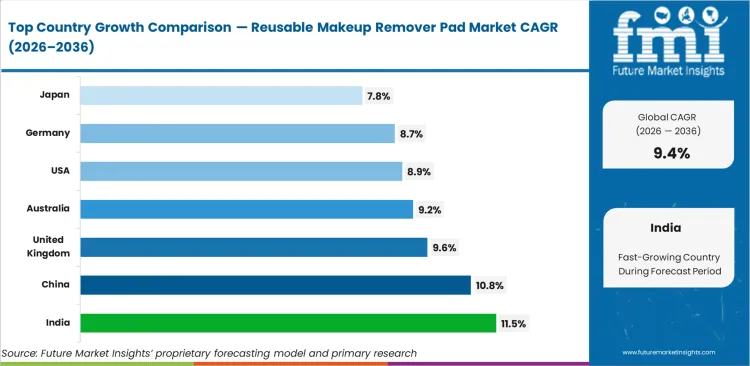
India is expected to record an 11.5% CAGR by 2036 as online channels deepen reach among younger urban consumers, moving directly toward durable formats. China is anticipated to register a 10.8% CAGR during the forecast period, supported by domestic textile manufacturing expansion. The United Kingdom is expected to post a 9.6% CAGR as legislation accelerates consumer switching. Australia is projected to witness a 9.2% CAGR, supported by waste-reduction initiatives. The United States is estimated to see an 8.9% CAGR on premium accessory demand in specialty retail. Germany is likely to reflect an 8.7% CAGR through established eco-retail networks. Japan is forecast to reach a 7.8% CAGR due to longer replacement cycles. Differences across these markets are expected to reflect whether adoption is driven by policy or by premiumization.
Segmental Analysis
Reusable Makeup Remover Pad Market Analysis by Material
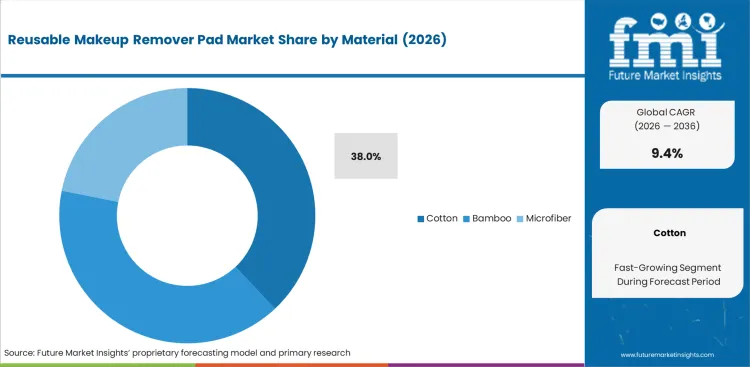
Material selection shapes category preference because consumers expect reusable pads to combine skin comfort, washability, and a disposal profile that fits low-waste beauty routines. Retail acceptance tends to be stronger for cotton-based formats because biodegradable material narratives are easier to communicate in eco-oriented assortments, even when certified and better-quality cotton raises input costs.
Cotton is expected to hold 38.0% share of the material segment in 2026, and this positioning continues to support the reusable makeup remover pad market share through stronger shelf compatibility and broader mainstream acceptance. Microfiber and blended constructions still retain importance where durability, structural stability, and pigment removal performance carry more weight, but cotton stays ahead because it fits the category’s core value proposition more naturally.
- Biodegradability compliance: Cotton-based formats fit more comfortably into low-waste positioning and cleaner disposal narratives. That improves acceptance in assortments where synthetic shedding remains a visible concern.
- Wash-cycle endurance: Microfiber performs better under repeated laundering and retains its structure for longer use cycles. Durability improves product life, though it weakens the natural-material appeal that many consumers still prefer.
- Formulation synergy: Blended materials help balance absorbency, softness, and cleansing compatibility. It gives manufacturers more room to match specific fiber ratios to specialized toner pad formulations without moving entirely away from consumer-friendly material positioning.
Reusable Makeup Remover Pad Market Analysis by Product Type
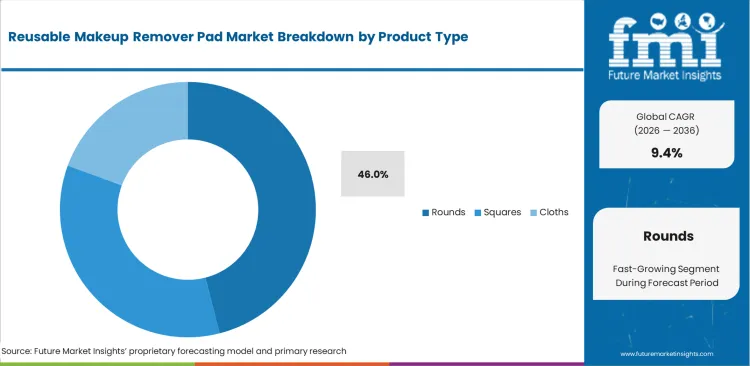
Format familiarity remains the clearest advantage in this segment because consumers are more willing to adopt a reusable product when it mirrors an established cleansing routine. Rounds are anticipated to capture 46.0% share of the product type segment in 2026, reflecting stronger routine compatibility and lower switching friction. Rounds stay ahead as they replicate the shape, handling comfort, and facial sweep pattern associated with disposable cotton pads, which reduces behavioral resistance at first purchase.
Compatibility with existing vanity storage also supports this preference, since consumers can integrate the format into daily use without changing how products are stored or used. Manufacturing efficiency is less favorable for circular formats because die-cutting produces more fabric waste than square alternatives, yet that drawback has not been enough to displace the format consumers recognize most easily.
- Dispenser integration: Round pads fit more naturally into existing bathroom organizers and storage trays. That supports easier household adoption by preserving routine continuity.
- Surface area maximization: Square formats use fabric more efficiently and provide broader cleansing coverage. Production economics improve, but consumer preference still leans toward the more familiar round profile.
- Routine alignment: Mitts offer better grip and more even pressure during heavier cleansing routines. Usage remains narrower because the format feels less interchangeable with applying complex skincare oil utilizing mitts.
Reusable Makeup Remover Pad Market Analysis by End Use
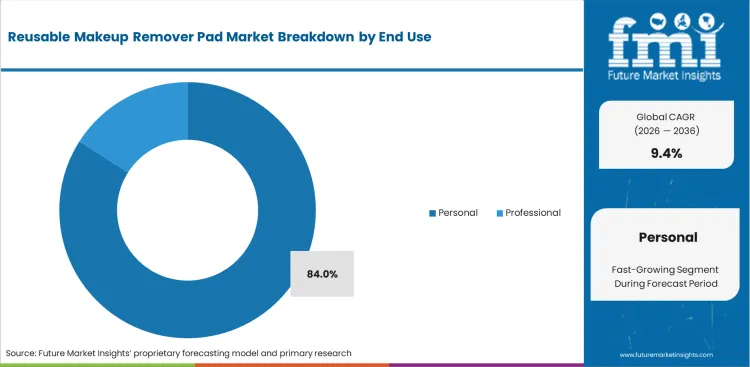
Personal use remains the commercial anchor of this market because reusable pads fit more easily into household cleansing routines than into regulated service environments. Consumers can wash and reuse pads through standard laundry cycles, which keeps maintenance practical and makes repeated use easier to sustain in daily skincare and makeup-removal habits. Personal use is expected to hold 84.0% share of the segment in 2026, reflecting stronger routine compatibility, lower maintenance friction, and broader household acceptance. Professional demand remains comparatively limited because reusable formats require more controlled cleaning conditions than many salons and aesthetic service environments are equipped to support, which keeps wholesale reusable makeup remover pads from scaling as quickly in commercial channels.
- Domestic laundry ease: Personal users can wash used pads within routine household laundry cycles. That lowers maintenance friction and supports regular repeat use without specialized care.
- Professional sanitation limits: Commercial settings often require tighter hygiene control for porous tools. Compliance pressure makes reusable pad adoption harder to scale in professional use environments.
- Travel routine adaptation: Personal users also value reusable pads in silicone makeup sponge in compact cleansing routines where dry, washable formats reduce dependence on liquid-heavy removers. Extends relevance beyond home use and reinforces travel-led demand.
Reusable Makeup Remover Pad Market Analysis by Distribution Channel
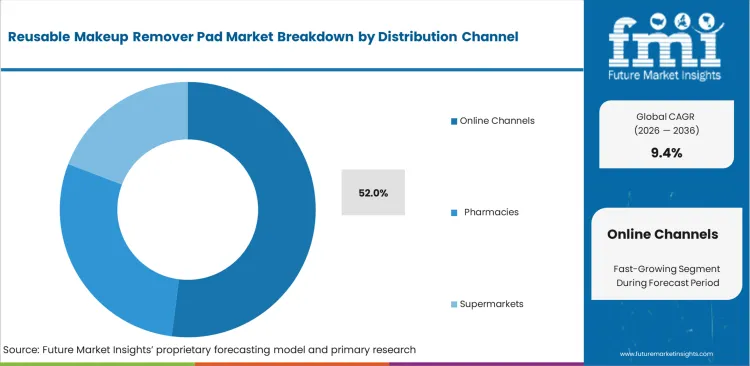
Online channels lead this market because reusable pads require demonstration, comparison, and repeated exposure before the first purchase. Category visibility also improves online because consumers can compare formats, read reviews, and assess product claims before committing to a higher upfront purchase. Online channels are projected to represent 52.0% share of the distribution channel segment in 2026, reflecting stronger discovery efficiency and smoother conversion in a product category that depends on explanation as much as trial. Physical retail is essential in supporting role by giving consumers direct tactile confirmation, but online remains ahead because performance-led content and bundle-led merchandising convert interest more effectively at scale.
- Digital demonstration: Video-led selling helps communicate pigment lift, softness, and washability more clearly than static packaging. That matters in a category where product performance is not immediately obvious.
- Tactile verification: Specialty retail allows consumers to assess pad density and fiber feel before purchase. Physical interaction builds trust, though it does not outweigh the scale advantage of digital discovery.
- Basket integration: Pharmacy and beauty retail can improve trial by placing reusable pads near cleansers and removers. Cross-merchandising supports entry, while overall volume remains more concentrated online.
Reusable Makeup Remover Pad Market Analysis by Pack Format
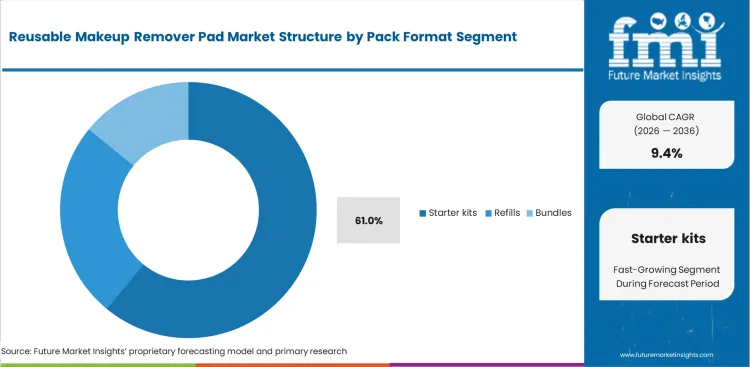
Initial trial friction shapes pack-format performance because first-time buyers need a complete and easy entry point rather than a loose replacement purchase. Starter kits are expected to hold 61.0% share of the pack format segment in 2026, as bundled sets with three to seven pads and a washing pouch reduce maintenance concerns and make the format easier to adopt at first use. Entry pricing also becomes easier to justify when the pack is presented as a ready-to-use solution with stronger shelf appeal and gifting value. Commercial strength in this segment comes from how effectively starter kits remove hesitation around storage, washing, and routine integration during the first purchase cycle.
- Objection elimination: Inclusion of a mesh laundry bag helps address a common maintenance concern from the start. Improves first-use confidence and reduces perceived inconvenience.
- Margin extraction: Refill bundles improve unit economics by reducing packaging cost per pad. Profitability strengthens once repeat users move beyond the introductory pack.
- Giftable positioning: Customized skincare carries stronger presentation value in premium and seasonal retail settings. Broadening appeal beyond functional bathroom use supports a higher initial ticket size.
Reusable Makeup Remover Pad Market Drivers, Restraints, and Opportunities
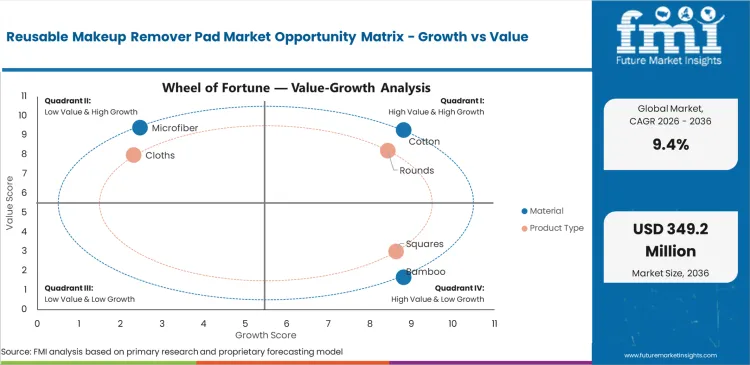
Regional plastic reduction mandates threaten retail buyers with massive dead-stock penalties. Pharmacy category managers cannot wait for consumer preference to shift organically. They must actively rebuild their beauty aisles today to comply with upcoming municipal deadlines. Delaying this inventory pivot means forfeiting shelf space to agile indie brands and losing critical revenue during the transition window. Retailers scrambling to secure compliant stock are actively delisting legacy suppliers who refuse to abandon plastic-stemmed cotton and non-biodegradable polyester sheets. Procurement teams replace these legacy items with dual-action textiles that pair well with a dual phase cleanser, accelerating overall adoption.
Clinic sanitation protocols create severe operational friction for professional buyers. Salon operators recognize the long-term cost savings of reusable textiles. They refuse to assume the liability of incomplete laundering. High-volume aesthetic centers require textiles capable of surviving chemical bleach or extreme thermal sterilization. These temperatures destroy standard retail microfiber blends in a single wash. Until textile engineers develop a cost-effective, autoclave-safe cosmetic fabric, the professional sector remains structurally locked into disposable hygienic barriers.
Opportunities in the Reusable Makeup Remover Pad Market
- Pigment-masking colorways: Textile engineers dye fabrics in dark charcoal or deep navy to hide permanent foundation stains. Brand managers extend the perceived lifespan of the pad to reduce consumer frustration over aesthetic degradation.
- Heavy-duty formulation pairing: Product developers engineer specific weave densities designed to cut through waterproof makeup setting spray. Brands capture a distinct niche of theatrical and professional consumers requiring aggressive pigment removal.
- Take-back recycling programs: Implementing mail-in systems for degraded cotton rounds to ensure closed-loop compliance. Brands lock in environmentally motivated consumers searching for sustainable alternatives to makeup wipes by handling the final disposal logistics.
Regional Analysis
Based on regional analysis, Reusable Makeup Remover Pad is segmented into North America, Latin America, Western Europe, Eastern Europe, Asia Pacific, and Middle East and Africa across 40 plus countries.
.webp "Top Country Growth Comparison Reusable Makeup Remover Pad Market Cagr (2026 2036)")
| Country | CAGR (2026 to 2036) |
|---|---|
| India | 11.5% |
| China | 10.8% |
| United Kingdom | 9.6% |
| Australia | 9.2% |
| United States | 8.9% |
| Germany | 8.7% |
| Japan | 7.8% |
Source: Future Market Insights (FMI) analysis, based on proprietary forecasting model and primary research
Asia Pacific Reusable Makeup Remover Pad Market Analysis
Manufacturing depth, digital beauty commerce, and faster routine migration keep Asia Pacific central to category expansion from 2026 to 2036. Urban demand across the region is shaped less by legacy store-based education and more by direct product discovery through social commerce, platform retail, and digital-first beauty channels. Such a structure allows new materials, pack formats, and cleansing-use propositions to reach consumers with less dependence on conventional shelf validation than in more mature Western retail markets. Regional relevance extends beyond demand, as textile processing capacity and shorter supply chains improve cost control, speed to market, and export readiness for reusable pad formats.
- India: Younger consumer demographic is moving toward reusable beauty accessories through digital discovery rather than through legacy cotton-pad habits. Online-led beauty purchasing also shortens the path from product education to conversion, supporting faster category adoption in daily skincare and makeup-removal routines. Demand for reusable makeup remover pads in India is expected to rise at a CAGR of 11.5% during 2026 to 2036. Stronger digital access, routine premiumization, and first-time adoption continue to reinforce the country’s position.
- China: From a stronger domestic textile base, which gives the market better control over input sourcing, scale economics, and product iteration speed. Sales of reusable makeup remover pads in China are projected to increase at a 10.8% CAGR from the forecast period. Lower production friction supports wider format availability across microfiber, blended, and value-tier reusable pads, while domestic beauty channels absorb that output efficiently. China remains important both as a consumption market and as a supply anchor within the regional value chain.
- Australia: Staying commercially relevant because waste-reduction priorities and premium personal care spending create a more receptive base for reusable cleansing accessories. Category acceptance is also prompted by a consumer environment that responds well to low-disposal, routine-friendly products with visible sustainability value. Reusable makeup remover pad adoption in Australia is likely to advance at a CAGR of 9.2% through 2036. Market scale remains narrower than in larger Asian economies, but category fit stays favorable.
- Japan: A more measured adoption curve is expected in Japan because established cleansing habits, high routine specificity, and stronger format expectations slow substitution into reusable textiles and limit faster replacement of dry and wet wipes in everyday cleansing routines. Product acceptance depends more heavily on material feel, pad construction, and compatibility with local cleansing routines than on sustainability messaging alone. Demand for reusable makeup remover pads in the country is anticipated to advance at a 7.8% CAGR from 2026 to 2036, keeping the market relevant where quality-sensitive consumers reward refinement, consistency, and routine fit over rapid category conversion.
FMI's report includes adjacent markets in Southeast Asia. Maturing logistics networks across these territories enable the rapid delivery of lightweight starter kits to expanding middle-class populations. Indonesia is also likely to add meaningful upside, as wider ASEAN e-commerce expansion continues to improve last-mile distribution for lightweight personal-care products.
Europe Reusable Makeup Remover Pad Market Analysis
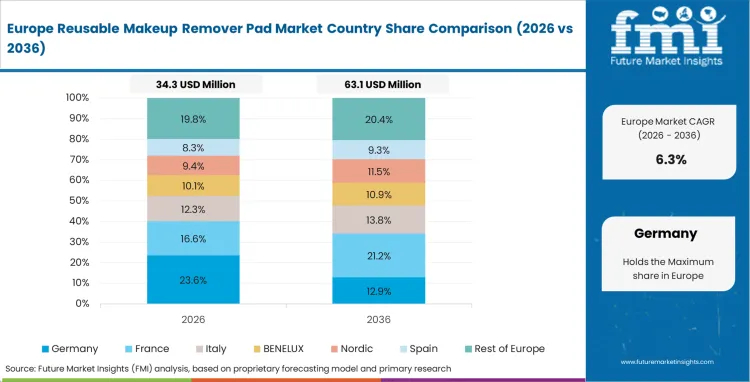
Regulatory tightening gives Europe a more policy-led adoption profile than most other regions, especially where restrictions on plastic-containing disposable formats are already influencing merchandising decisions in beauty and personal care. Reusable makeup remover pad industry analysis in the region remains closely tied to the alignment between environmental compliance, mature retail standards, and consumer willingness to adopt reusable alternatives in place of dry and wet wipes. Shelf access also tends to depend on clearer material disclosure, lower-plastic packaging, and stronger product credibility, which raises entry requirements but improves category quality. Regional demand develops through compliance-backed substitution as much as through sustainability-led consumer preference.
- United Kingdom: Regulatory pressure remains strongest in the United Kingdom, where restrictions on plastic wet wipes are expected to accelerate the shift toward reusable cosmetic textiles across mainstream retail channels. Faster product replacement in beauty and cleansing routines is also supported by a consumer base that is already familiar with low-waste personal care alternatives. Demand for reusable makeup remover pads in the United Kingdom is projected to rise at a 9.6% CAGR from 2026 to 2036, keeping the country at the front of regional adoption, where policy support and retail transition move in the same direction.
- Germany: Retail acceptance in Germany depends more heavily on product transparency, material credibility, and environmental consistency than on novelty-led positioning. Wider use is expected to remain tied to formats that align with established eco-retail expectations around fiber composition, disposal profile, and packaging restraint. Sales of reusable makeup remover pads in Germany are anticipated to increase at a CAGR of 8.7% from 2026 to 2036. Such a structure keeps Germany relevant as a steady-growth market where trust, certification readiness, and disciplined retail standards matter more than rapid format expansion.
FMI's report includes Nordic and Southern European countries. Stringent EU packaging directives continuously reshape how regional brands present their refill bundles to conscious consumers. Sweden is likely to remain relevant within the Nordic cluster because environmentally screened retail and established eco-label familiarity support stronger acceptance of lower-plastic, refill-oriented personal care formats.
North America Reusable Makeup Remover Pad Market Analysis
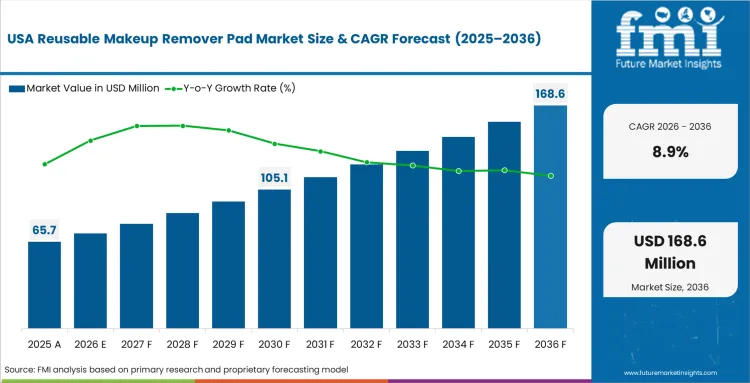
Premium positioning shapes category development across North America more than direct regulatory compulsion, as reusable cleansing accessories are more often marketed through beauty-value enhancement than through mandatory substitution. Category acceptance is supported by consumers willing to spend more on products that align with elevated skincare routines, vanity aesthetics, and lower-disposal personal care habits. Retail fit also depends on presentation, fabric feel, and pack design, since reusable formats are more likely to be evaluated as part of a premium beauty routine than as a basic replacement for dry and wet wipes. Regional demand remains tied to premiumization, shelf presentation, and brand credibility rather than to price-led volume expansion.
- United States: Higher-value beauty merchandising keeps the United States at the center of regional demand, especially where reusable formats are positioned as part of prestige-oriented skincare and makeup-removal routines. Starter kits and better-presented reusable accessories tend to perform more strongly because visual appeal and routine compatibility carry more weight than low entry pricing in this category. Reusable makeup remover pads industry in the United States is expected to rise at a 8.9% CAGR through 2036. Industry in the country is likely to maintain positive outlook where premium presentation, perceived quality, and routine integration reinforce repeat consumer acceptance.
FMI's report includes Canada and Mexico. Cross-border retail partnerships frequently dictate how effectively new brands can scale their North American footprint without incurring excessive logistics costs. Canada remains relevant where established pharmacy and beauty retail infrastructure can support steadier placement of reusable cleansing accessories within mainstream personal care assortments.
Competitive Aligners for Market Players
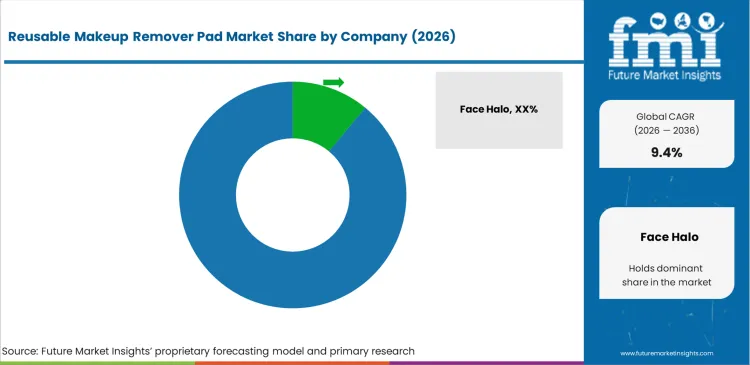
Supplier landscapes remain moderately fragmented, with a clear divide between established cosmetic tool manufacturers and digital-first sustainability brands. Shelf access in this category depends less on novelty alone and more on whether a brand can combine product credibility with dependable fulfillment across major retail channels. Reusable makeup remover pad market report positioning is therefore shaped by how consistently suppliers can deliver practical alternatives to disposable personal care wipes without creating inventory risk during peak seasonal demand. Distinct fabric construction still helps support brand identity, but national retail acceptance depends more heavily on continuity of supply, packaging readiness, and the ability to support recurring replenishment without disruption. It is critical to analyze the reusable makeup remover pad market report.
Established participants retain an advantage through longer-standing retail relationships and stronger visibility across pharmacy and beauty channels. Historical sell-through patterns, broader distribution experience, and better inventory forecasting give larger brands a clearer path to premium shelf placement than smaller entrants can usually secure. Competitive pressure for reusable makeup remove pad manufacturers centers on proving a genuine product difference, whether through fabric feel, softness retention, stain resistance, or other performance attributes that justify space on the shelf. Without a clear point of separation, pricing becomes the main lever, and that weakens margin quality before smaller brands can build enough scale to support beauty and personal care packaging, promotion, and wider distribution.
Retailers also tend to avoid overdependence on a single supplier, which keeps brand rotation active and preserves pricing flexibility across the category. Private-label capability adds weight in buyer evaluations because branded suppliers are often expected to support both flagship lines and retailer-owned assortments within the same beauty and personal care product structure. Category development is likely to remain competitive even as reusable makeup remover pad key players consolidate their position through wider retail coverage and better operational execution. The market is expected to favor participants that can combine dependable supply, differentiated product performance, and flexible manufacturing support across branded and private-label programs.
Key Players in Reusable Makeup Remover Pad Market
- Face Halo
- The Original MakeUp Eraser
- LastObject
- Bambaw
- GLOV
- EcoTools
- Tweezerman
Scope of the Report
| Metric | Value |
|---|---|
| Quantitative Units | USD 130.0 Million to USD 319.2 Million, at a CAGR of 9.4% |
| Market Definition | Physical cleansing accessories engineered for multi-use lifecycles through machine or manual washing. They rely on specialized textile weaves to lift cosmetics without chemical degradation. |
| Segmentation | Material, Product Type, End Use, Distribution Channel, Pack Format, Region |
| Regions Covered | North America, Latin America, Western Europe, Eastern Europe, Asia Pacific, Middle East and Africa |
| Countries Covered | United States, Canada, Brazil, Mexico, Germany, United Kingdom, France, Spain, Italy, Russia, China, Japan, South Korea, India, ASEAN, GCC, South Africa |
| Key Companies Profiled | Face Halo, The Original MakeUp Eraser, LastObject, Bambaw, GLOV, EcoTools, Tweezerman |
| Forecast Period | 2026 to 2036 |
| Approach | Top-down demand substitution models cross-referenced with bottom-up consumer replacement frequency and point-of-sale pricing tracking. |
Source: Future Market Insights (FMI) analysis, based on proprietary forecasting model and primary research
Reusable Makeup Remover Pad Market Analysis by Segments
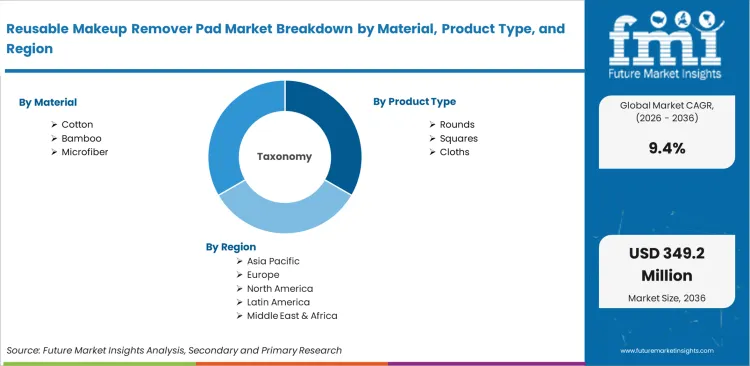
Material
- Cotton
- Bamboo
- Microfiber
- Blends
Product Type
- Rounds
- Squares
- Cloths
- Mitts
End Use
- Personal
- Professional
Distribution Channel
- Online
- Specialty retail
- Pharmacies
- Supermarkets
Pack Format
- Starter kits
- Refills
- Bundles
Region
- North America
- Latin America
- Western Europe
- Eastern Europe
- Asia Pacific
- Middle East and Africa
Bibliography
- Cotton Incorporated. (2025, October 7). New Global Lifestyle Monitor Survey Confirms Cotton Is the Fiber of Choice.
- Del Greco, A., Viglia, G., & Pera, R. (2024). Re-evaluating beauty: Attitudes and perceptions of eco-sustainable packaging in the cosmetics industry. Cleaner and Responsible Consumption, 15, 100323.
- Dini, I., Laneri, S., & Di Lorenzo, R. (2024). “Edible Beauty”: The Evolution of Environmentally Friendly Cosmetics and Packaging. Antioxidants, 13(6), 742.
- Goldie, K., et al. (2025). Sustainability in Aesthetic and Surgical Clinics. Journal of Cosmetic Dermatology.
- Government of the United Kingdom. (2025, December 17). Plastic wet wipes ban.
- Griffing, E., et al. (2025). Bicomponent Split Microfiber Reusable Textile Products to Improve Environmental Sustainability and Hygiene in Healthcare. Sustainability, 17(6), 2669.
- Islam, M. S., et al. (2025). Environmental challenges of disposable wipes. Sustainable Food Technology, 3.
- Varnaitė-Žuravliova, S., et al. (2024). Properties, Production, and Recycling of Regenerated Cellulose Fibers: A Review. Materials, 17.
This bibliography is provided for reader reference. The full FMI report contains the complete reference list with primary source documentation.
This Report Addresses
- Single-use plastic legislation impact on retail category plans
- Consumer replacement frequency versus textile degradation curves
- Form-factor mimicry in driving mass accessory adoption
- Margin extraction models across starter kits and refill bundles
- Cross-contamination liabilities limiting professional salon uptake
- Digital discovery pathways bypassing legacy pharmacy constraints
- Pigment-masking material innovations protecting product lifespans
- Private-label pivot timelines for national grocery multiples
Frequently Asked Questions
what is the reusable makeup remover pad market size?
The sector reaches USD 130.0 million in 2026. This baseline valuation reflects rapid retail transitions from disposable formats toward durable textile alternatives across global pharmacy chains.
how fast is the reusable makeup remover pad market growing?
Demand expands at a 9.4% reusable makeup remover pads CAGR through 2036. This sustained trajectory relies heavily on regional legislative bans forcing single-use plastics out of the commercial supply chain.
are reusable makeup remover pads better than wipes?
They offer superior long-term economics and environmental compliance. Consumers avoid recurring purchasing costs. Retailers bypass severe municipal fines tied to single-use plastic disposal.
reusable makeup remover pad vs makeup wipes?
Textile alternatives utilize specific micro-weaves to lift pigment mechanically without chemical assistance. Traditional wet wipes rely entirely on chemical solvents soaked into disposable polyester sheets.
reusable pads vs disposable cotton rounds?
Durable formats mimic the exact circular geometry of disposable rounds to eliminate routine switching friction. A single durable unit survives hundreds of laundry cycles to directly replace the volume of an entire disposable sleeve.
who are the top companies in reusable makeup remover pads?
Face Halo, The Original MakeUp Eraser, and LastObject secure critical retail placement. These incumbents maintain leverage by guaranteeing uninterrupted supply volume during peak holiday merchandising periods.
why are reusable makeup remover pads gaining demand?
Municipal legislation creates structural urgency for mass retailers. Procurement directors aggressively delist non-compliant disposable items to force consumer adoption of durable alternatives at the shelf level.
what is driving reusable makeup remover pad adoption in beauty?
The aesthetic premiumization of sustainability pushes brands to merchandise durable textiles alongside luxury cleansers. Consumers adopt them to elevate their routines rather than simply to reduce household waste.
sustainable alternatives to makeup wipes?
Consumers transition toward machine-washable cotton, bamboo, and microfiber cloths. These alternatives pair mechanically with liquid cleansers to eliminate the need for pre-soaked disposable chemical barriers.
what is the reusable makeup remover pads market size globally?
The overall category crosses USD 319.2 million by 2036. This value buildup relies on continuous user repurchases driven by aesthetic staining rather than actual fiber destruction.
how does material selection impact market positioning?
Organic cotton secures placement in strict eco-boutiques demanding compostability. Synthetic microfiber dominates budget channels by surviving intense machine laundering without fraying.
which product format captures the highest volume?
Circular cuts command immediate consumer trust through geometric familiarity. Packaging engineers design them to fit perfectly inside existing acrylic vanity organizers.
what prevents commercial adoption in salons?
Aesthetic clinics face strict bloodborne pathogen regulations. Standard microfiber blends cannot survive the high-temperature autoclaving required for legal porous-tool sterilization.
how do distribution channels shape brand survival?
Digital channels handle early customer acquisition and tactile education via video proof. Physical retail presence remains essential for long-term credibility and impulse cross-selling.
why do starter kits dominate early sales?
Introductory bundles eliminate trial friction by including dedicated mesh washing bags. This prevents pad loss in standard laundry machines and ensures a positive initial experience.
where is the actual profit margin located?
High-count refill bundles strip away expensive exterior packaging. Brands converting starter-kit buyers into recurring refill subscribers extract the highest lifetime value.
what is the fastest growing country market?
India advances at an 11.5% pace. Young urban populations bypass legacy retail entirely. They utilize social commerce to acquire premium soft-textile cleansing accessories directly.
how does UK policy alter regional adoption?
Direct government bans on plastic wet wipes force an immediate retail pivot. Pharmacy procurement teams restock shelves with reusable options simply to avoid massive non-compliance penalties.
what limits competitive challenger success?
Large pharmacy chains demand massive holiday fulfillment guarantees that indie brands struggle to meet. Innovation in textile weaves matters less to buyers than reliable inventory replenishment.
what is the primary consumer complaint?
Heavy cosmetic foundations permanently stain light-colored fibers. Users discard structurally perfect pads purely because aesthetic degradation makes them look unhygienic over time.
how can manufacturers extend product lifespans?
Product developers dye textiles in dark charcoal or navy colors. Masking permanent stains extends the perceived utility of the pad and lowers consumer churn rates.
will the category consolidate by 2036?
Established beauty conglomerates systematically acquire independent textile leaders. This strategy allows massive cosmetic parent companies to instantly capture validated eco-conscious consumer bases.
Preview the report firsthand - request a free sample
Get SampleGet the brochure for pricing and purchase details.
Get PDFTable of Content
- Executive Summary
- Global Market Outlook
- Demand-side Trends
- Supply-side Trends
- Technology Roadmap Analysis
- Analysis and Recommendations
- Market Overview
- Market Coverage / Taxonomy
- Market Definition / Scope / Limitations
- Research Methodology
- Chapter Orientation
- Analytical Lens and Working Hypotheses
- Market Structure, Signals, and Trend Drivers
- Benchmarking and Cross-market Comparability
- Market Sizing, Forecasting, and Opportunity Mapping
- Research Design and Evidence Framework
- Desk Research Programme (Secondary Evidence)
- Company Annual and Sustainability Reports
- Peer-reviewed Journals and Academic Literature
- Corporate Websites, Product Literature, and Technical Notes
- Earnings Decks and Investor Briefings
- Statutory Filings and Regulatory Disclosures
- Technical White Papers and Standards Notes
- Trade Journals, Industry Magazines, and Analyst Briefs
- Conference Proceedings, Webinars, and Seminar Materials
- Government Statistics Portals and Public Data Releases
- Press Releases and Reputable Media Coverage
- Specialist Newsletters and Curated Briefings
- Sector Databases and Reference Repositories
- FMI Internal Proprietary Databases and Historical Market Datasets
- Subscription Datasets and Paid Sources
- Social Channels, Communities, and Digital Listening Inputs
- Additional Desk Sources
- Expert Input and Fieldwork (Primary Evidence)
- Primary Modes
- Qualitative Interviews and Expert Elicitation
- Quantitative Surveys and Structured Data Capture
- Blended Approach
- Why Primary Evidence is Used
- Field Techniques
- Interviews
- Surveys
- Focus Groups
- Observational and In-context Research
- Social and Community Interactions
- Stakeholder Universe Engaged
- C-suite Leaders
- Board Members
- Presidents and Vice Presidents
- R&D and Innovation Heads
- Technical Specialists
- Domain Subject-matter Experts
- Scientists
- Physicians and Other Healthcare Professionals
- Governance, Ethics, and Data Stewardship
- Research Ethics
- Data Integrity and Handling
- Primary Modes
- Tooling, Models, and Reference Databases
- Desk Research Programme (Secondary Evidence)
- Data Engineering and Model Build
- Data Acquisition and Ingestion
- Cleaning, Normalisation, and Verification
- Synthesis, Triangulation, and Analysis
- Quality Assurance and Audit Trail
- Market Background
- Market Dynamics
- Drivers
- Restraints
- Opportunity
- Trends
- Scenario Forecast
- Demand in Optimistic Scenario
- Demand in Likely Scenario
- Demand in Conservative Scenario
- Opportunity Map Analysis
- Product Life Cycle Analysis
- Supply Chain Analysis
- Investment Feasibility Matrix
- Value Chain Analysis
- PESTLE and Porter’s Analysis
- Regulatory Landscape
- Regional Parent Market Outlook
- Production and Consumption Statistics
- Import and Export Statistics
- Market Dynamics
- Global Market Analysis 2021 to 2025 and Forecast, 2026 to 2036
- Historical Market Size Value (USD Million) Analysis, 2021 to 2025
- Current and Future Market Size Value (USD Million) Projections, 2026 to 2036
- Y-o-Y Growth Trend Analysis
- Absolute $ Opportunity Analysis
- Global Market Pricing Analysis 2021 to 2025 and Forecast 2026 to 2036
- Global Market Analysis 2021 to 2025 and Forecast 2026 to 2036, By Material
- Introduction / Key Findings
- Historical Market Size Value (USD Million) Analysis By Material , 2021 to 2025
- Current and Future Market Size Value (USD Million) Analysis and Forecast By Material , 2026 to 2036
- Cotton
- Bamboo
- Microfiber
- Cotton
- Y-o-Y Growth Trend Analysis By Material , 2021 to 2025
- Absolute $ Opportunity Analysis By Material , 2026 to 2036
- Global Market Analysis 2021 to 2025 and Forecast 2026 to 2036, By Product Type
- Introduction / Key Findings
- Historical Market Size Value (USD Million) Analysis By Product Type, 2021 to 2025
- Current and Future Market Size Value (USD Million) Analysis and Forecast By Product Type, 2026 to 2036
- Rounds
- Squares
- Cloths
- Rounds
- Y-o-Y Growth Trend Analysis By Product Type, 2021 to 2025
- Absolute $ Opportunity Analysis By Product Type, 2026 to 2036
- Global Market Analysis 2021 to 2025 and Forecast 2026 to 2036, By End Use
- Introduction / Key Findings
- Historical Market Size Value (USD Million) Analysis By End Use, 2021 to 2025
- Current and Future Market Size Value (USD Million) Analysis and Forecast By End Use, 2026 to 2036
- Personal
- Professional
- Personal
- Y-o-Y Growth Trend Analysis By End Use, 2021 to 2025
- Absolute $ Opportunity Analysis By End Use, 2026 to 2036
- Global Market Analysis 2021 to 2025 and Forecast 2026 to 2036, By Distribution Channel
- Introduction / Key Findings
- Historical Market Size Value (USD Million) Analysis By Distribution Channel, 2021 to 2025
- Current and Future Market Size Value (USD Million) Analysis and Forecast By Distribution Channel, 2026 to 2036
- Online Channels
- Pharmacies
- Supermarkets
- Online Channels
- Y-o-Y Growth Trend Analysis By Distribution Channel, 2021 to 2025
- Absolute $ Opportunity Analysis By Distribution Channel, 2026 to 2036
- Global Market Analysis 2021 to 2025 and Forecast 2026 to 2036, By Pack Format
- Introduction / Key Findings
- Historical Market Size Value (USD Million) Analysis By Pack Format, 2021 to 2025
- Current and Future Market Size Value (USD Million) Analysis and Forecast By Pack Format, 2026 to 2036
- Starter kits
- Refills
- Bundles
- Starter kits
- Y-o-Y Growth Trend Analysis By Pack Format, 2021 to 2025
- Absolute $ Opportunity Analysis By Pack Format, 2026 to 2036
- Global Market Analysis 2021 to 2025 and Forecast 2026 to 2036, By Region
- Introduction
- Historical Market Size Value (USD Million) Analysis By Region, 2021 to 2025
- Current Market Size Value (USD Million) Analysis and Forecast By Region, 2026 to 2036
- North America
- Latin America
- Western Europe
- Eastern Europe
- East Asia
- South Asia and Pacific
- Middle East & Africa
- Market Attractiveness Analysis By Region
- North America Market Analysis 2021 to 2025 and Forecast 2026 to 2036, By Country
- Historical Market Size Value (USD Million) Trend Analysis By Market Taxonomy, 2021 to 2025
- Market Size Value (USD Million) Forecast By Market Taxonomy, 2026 to 2036
- By Country
- USA
- Canada
- Mexico
- By Material
- By Product Type
- By End Use
- By Distribution Channel
- By Pack Format
- By Country
- Market Attractiveness Analysis
- By Country
- By Material
- By Product Type
- By End Use
- By Distribution Channel
- By Pack Format
- Key Takeaways
- Latin America Market Analysis 2021 to 2025 and Forecast 2026 to 2036, By Country
- Historical Market Size Value (USD Million) Trend Analysis By Market Taxonomy, 2021 to 2025
- Market Size Value (USD Million) Forecast By Market Taxonomy, 2026 to 2036
- By Country
- Brazil
- Chile
- Rest of Latin America
- By Material
- By Product Type
- By End Use
- By Distribution Channel
- By Pack Format
- By Country
- Market Attractiveness Analysis
- By Country
- By Material
- By Product Type
- By End Use
- By Distribution Channel
- By Pack Format
- Key Takeaways
- Western Europe Market Analysis 2021 to 2025 and Forecast 2026 to 2036, By Country
- Historical Market Size Value (USD Million) Trend Analysis By Market Taxonomy, 2021 to 2025
- Market Size Value (USD Million) Forecast By Market Taxonomy, 2026 to 2036
- By Country
- Germany
- UK
- Italy
- Spain
- France
- Nordic
- BENELUX
- Rest of Western Europe
- By Material
- By Product Type
- By End Use
- By Distribution Channel
- By Pack Format
- By Country
- Market Attractiveness Analysis
- By Country
- By Material
- By Product Type
- By End Use
- By Distribution Channel
- By Pack Format
- Key Takeaways
- Eastern Europe Market Analysis 2021 to 2025 and Forecast 2026 to 2036, By Country
- Historical Market Size Value (USD Million) Trend Analysis By Market Taxonomy, 2021 to 2025
- Market Size Value (USD Million) Forecast By Market Taxonomy, 2026 to 2036
- By Country
- Russia
- Poland
- Hungary
- Balkan & Baltic
- Rest of Eastern Europe
- By Material
- By Product Type
- By End Use
- By Distribution Channel
- By Pack Format
- By Country
- Market Attractiveness Analysis
- By Country
- By Material
- By Product Type
- By End Use
- By Distribution Channel
- By Pack Format
- Key Takeaways
- East Asia Market Analysis 2021 to 2025 and Forecast 2026 to 2036, By Country
- Historical Market Size Value (USD Million) Trend Analysis By Market Taxonomy, 2021 to 2025
- Market Size Value (USD Million) Forecast By Market Taxonomy, 2026 to 2036
- By Country
- China
- Japan
- South Korea
- By Material
- By Product Type
- By End Use
- By Distribution Channel
- By Pack Format
- By Country
- Market Attractiveness Analysis
- By Country
- By Material
- By Product Type
- By End Use
- By Distribution Channel
- By Pack Format
- Key Takeaways
- South Asia and Pacific Market Analysis 2021 to 2025 and Forecast 2026 to 2036, By Country
- Historical Market Size Value (USD Million) Trend Analysis By Market Taxonomy, 2021 to 2025
- Market Size Value (USD Million) Forecast By Market Taxonomy, 2026 to 2036
- By Country
- India
- ASEAN
- Australia & New Zealand
- Rest of South Asia and Pacific
- By Material
- By Product Type
- By End Use
- By Distribution Channel
- By Pack Format
- By Country
- Market Attractiveness Analysis
- By Country
- By Material
- By Product Type
- By End Use
- By Distribution Channel
- By Pack Format
- Key Takeaways
- Middle East & Africa Market Analysis 2021 to 2025 and Forecast 2026 to 2036, By Country
- Historical Market Size Value (USD Million) Trend Analysis By Market Taxonomy, 2021 to 2025
- Market Size Value (USD Million) Forecast By Market Taxonomy, 2026 to 2036
- By Country
- Kingdom of Saudi Arabia
- Other GCC Countries
- Turkiye
- South Africa
- Other African Union
- Rest of Middle East & Africa
- By Material
- By Product Type
- By End Use
- By Distribution Channel
- By Pack Format
- By Country
- Market Attractiveness Analysis
- By Country
- By Material
- By Product Type
- By End Use
- By Distribution Channel
- By Pack Format
- Key Takeaways
- Key Countries Market Analysis
- USA
- Pricing Analysis
- Market Share Analysis, 2025
- By Material
- By Product Type
- By End Use
- By Distribution Channel
- By Pack Format
- Canada
- Pricing Analysis
- Market Share Analysis, 2025
- By Material
- By Product Type
- By End Use
- By Distribution Channel
- By Pack Format
- Mexico
- Pricing Analysis
- Market Share Analysis, 2025
- By Material
- By Product Type
- By End Use
- By Distribution Channel
- By Pack Format
- Brazil
- Pricing Analysis
- Market Share Analysis, 2025
- By Material
- By Product Type
- By End Use
- By Distribution Channel
- By Pack Format
- Chile
- Pricing Analysis
- Market Share Analysis, 2025
- By Material
- By Product Type
- By End Use
- By Distribution Channel
- By Pack Format
- Germany
- Pricing Analysis
- Market Share Analysis, 2025
- By Material
- By Product Type
- By End Use
- By Distribution Channel
- By Pack Format
- UK
- Pricing Analysis
- Market Share Analysis, 2025
- By Material
- By Product Type
- By End Use
- By Distribution Channel
- By Pack Format
- Italy
- Pricing Analysis
- Market Share Analysis, 2025
- By Material
- By Product Type
- By End Use
- By Distribution Channel
- By Pack Format
- Spain
- Pricing Analysis
- Market Share Analysis, 2025
- By Material
- By Product Type
- By End Use
- By Distribution Channel
- By Pack Format
- France
- Pricing Analysis
- Market Share Analysis, 2025
- By Material
- By Product Type
- By End Use
- By Distribution Channel
- By Pack Format
- India
- Pricing Analysis
- Market Share Analysis, 2025
- By Material
- By Product Type
- By End Use
- By Distribution Channel
- By Pack Format
- ASEAN
- Pricing Analysis
- Market Share Analysis, 2025
- By Material
- By Product Type
- By End Use
- By Distribution Channel
- By Pack Format
- Australia & New Zealand
- Pricing Analysis
- Market Share Analysis, 2025
- By Material
- By Product Type
- By End Use
- By Distribution Channel
- By Pack Format
- China
- Pricing Analysis
- Market Share Analysis, 2025
- By Material
- By Product Type
- By End Use
- By Distribution Channel
- By Pack Format
- Japan
- Pricing Analysis
- Market Share Analysis, 2025
- By Material
- By Product Type
- By End Use
- By Distribution Channel
- By Pack Format
- South Korea
- Pricing Analysis
- Market Share Analysis, 2025
- By Material
- By Product Type
- By End Use
- By Distribution Channel
- By Pack Format
- Russia
- Pricing Analysis
- Market Share Analysis, 2025
- By Material
- By Product Type
- By End Use
- By Distribution Channel
- By Pack Format
- Poland
- Pricing Analysis
- Market Share Analysis, 2025
- By Material
- By Product Type
- By End Use
- By Distribution Channel
- By Pack Format
- Hungary
- Pricing Analysis
- Market Share Analysis, 2025
- By Material
- By Product Type
- By End Use
- By Distribution Channel
- By Pack Format
- Kingdom of Saudi Arabia
- Pricing Analysis
- Market Share Analysis, 2025
- By Material
- By Product Type
- By End Use
- By Distribution Channel
- By Pack Format
- Turkiye
- Pricing Analysis
- Market Share Analysis, 2025
- By Material
- By Product Type
- By End Use
- By Distribution Channel
- By Pack Format
- South Africa
- Pricing Analysis
- Market Share Analysis, 2025
- By Material
- By Product Type
- By End Use
- By Distribution Channel
- By Pack Format
- USA
- Market Structure Analysis
- Competition Dashboard
- Competition Benchmarking
- Market Share Analysis of Top Players
- By Region
- By Material
- By Product Type
- By End Use
- By Distribution Channel
- By Pack Format
- Competition Analysis
- Competition Deep Dive
- Face Halo
- Overview
- Product Portfolio
- Profitability by Market Segments (Product/Age /Sales Channel/Region)
- Sales Footprint
- Strategy Overview
- Marketing Strategy
- Product Strategy
- Channel Strategy
- The Original MakeUp Eraser
- LastObject
- Bambaw
- GLOV
- EcoTools
- Face Halo
- Competition Deep Dive
- Assumptions & Acronyms Used


