

- Industry Size (2026)
- USD 1.6 Bn
- Forecast (2036)
- USD 5.2 Bn
- CAGR (2026 to 2036)
- 12.51%
Reusable Apparel E-Commerce Mailers Market Size, Market Forecast and Outlook By FMI
The reusable apparel e-commerce mailers market was valued at USD 1.4 billion in 2025. The sector is set to reach USD 1.6 billion in 2026 at a CAGR of 12.51% during the forecast period. Revenue expansion lifts the total opportunity to USD 5.2 billion through 2036 as legally mandated reuse targets force fast fashion conglomerates to abandon virgin poly-mailers and deploy tracked, multi-trip circulation fleets.
Imminent extended producer responsibility frameworks expose high-volume apparel retailers to devastating per-unit waste penalties. Fast fashion conglomerates operating on razor-thin margins lose all profitability on single-item orders if they delay the transition to multi-trip shipping assets. While most supply chain directors focus heavily on raw material costs, the true bottleneck limiting circular e-commerce fulfillment is the reverse logistics friction created when consumers fail to return empty packages.
Summary of Reusable Apparel E-Commerce Mailers Market
- Reusable Apparel E-Commerce Mailers Market Definition
- Reusable apparel e-commerce mailers encompass durable, multi-trip shipping envelopes equipped with integrated tracking and reverse-logistics mechanisms, designed to replace single-use plastic in clothing fulfillment.
- Demand Drivers in the Market:
- EU Packaging and Packaging Waste Regulation (PPWR) (EU) 2024/2841 forces fast fashion conglomerates to adopt traceable, multi-trip shipping assets.
- Rising extended producer responsibility taxes compel premium apparel brands to abandon virgin poly-mailers.
- Saturated consumer tolerance for household plastic waste drives subscription clothing services to deploy deposit-based circular fleets.
- Key Segments Analyzed in the FMI Report:
- Recycled Plastics (rPET/rPE): 58.4% share in 2026, dominating because synthetic polymer durability guarantees the highest number of profitable transit cycles before material failure.
- Flexible Pouches: 44.2% share in 2026, leading as their ability to collapse flat minimizes return postage costs.
- QR Code/App-based Return: 38.6% share in 2026, expanding rapidly as it bypasses the need for printed secondary labels.
- Fast Fashion Brands: 41.5% share in 2026, commanding the segment due to sheer shipment volume and imminent regulatory pressure.
- Germany: 16.8% CAGR, driven by strict enforcement of the updated VerpackG legislation and strong deposit-return cultural conditioning.
- Analyst Opinion at FMI:
- Ismail Sutaria, Principal Consultant for Packaging, opines, "My analysis indicates that the real obstacle to achieving circular packaging isn’t the cost of the mailer itself, but the friction in reverse logistics. When consumers do not return the mailers, these high‑value reusable bags effectively become the most expensive single‑use waste. Apparel brands that fail to integrate effortless, everyday return options into the customer journey risk severe fleet losses and escalating capital costs.”
- Strategic Implications / Executive Takeaways:
- E-commerce fulfillment directors must integrate mailer recovery software with national postal carrier APIs to automate return postage before deploying large fleets.
- Reverse logistics operators should partner with physical retail chains to establish drop-off bins, reducing the friction of mailer returns.
- Packaging material suppliers must secure verifiable life-cycle assessment data proving their multi-trip mailers achieve a lower carbon footprint than single-use alternatives within three cycles, or face procurement disqualification.
- Methodology:
- Primary Research: FMI conducted detailed technical interviews with packaging engineers, e-commerce supply chain directors, and circular economy policy advisors across 40 countries to validate fleet recovery rates.
- Desk Research: Analysts aggregated public standards documentation from EPR registries, corporate sustainability reports from top fashion retailers, and life-cycle assessment databases.
- Market-Sizing and Forecasting: The model applies a bottom-up methodology starting with regional apparel shipping volumes and projecting the conversion rate to multi-trip formats.
- Data Validation and Update Cycle: Segment forecasts undergo cross-validation against quarterly financial disclosures from leading sustainable packaging startups and 3PL networks.
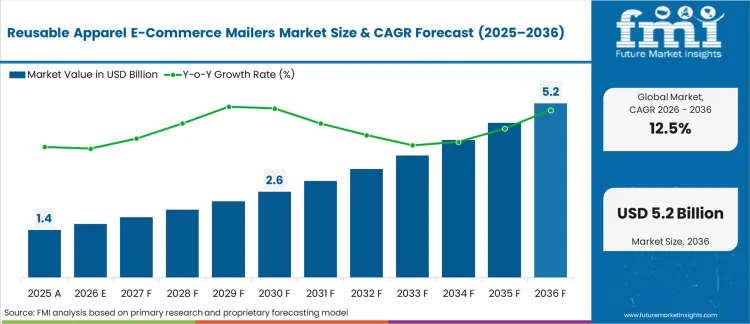
The economic viability of these closed-loop systems hinges entirely on national postal carriers standardizing processing rates for empty return mailers by 2028. Once major logistics operators eliminate the return postage premium, apparel brands can finally cross the breakeven threshold, making fleet circulation cheaper than single-use purchasing.
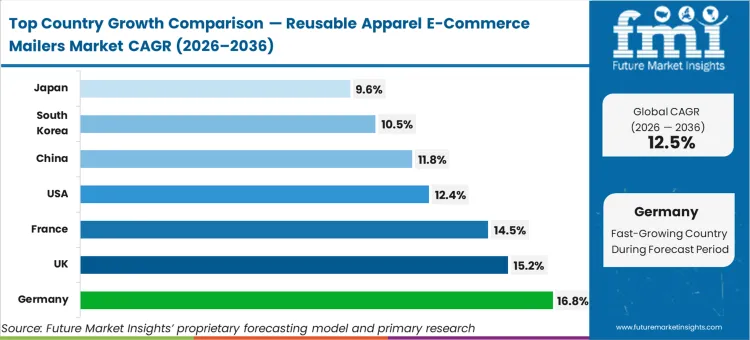
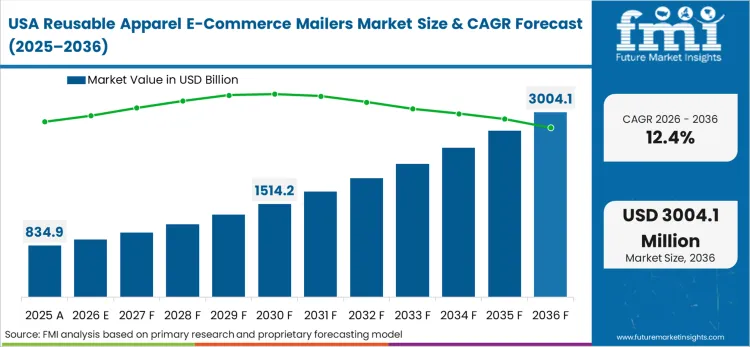
Germany advances at a 16.8% CAGR, driven by strict enforcement of the updated VerpackG legislation and high deposit-return cultural conditioning. The United Kingdom records a 15.2% rate as post-Brexit plastic packaging taxes escalate. France tracks at 14.5%, anchored by the Anti-Waste for a Circular Economy (AGEC) law. The United States posts a 12.4% expansion as subscription clothing services normalize the return behavior. China grows at 11.8%, followed by South Korea reaching 10.5% and Japan expanding at 9.6%. This distribution reflects distinct national variations in reverse logistics infrastructure and regulatory appetite for virgin plastic bans.
Reusable Apparel E‑Commerce Mailers Market Key Takeaways
| Metric | Details |
|---|---|
| Market Size (2026) | USD 1.6 billion |
| Market Value (2036) | USD 5.2 billion |
| CAGR (2026-2036) | 12.51% |
Source: Future Market Insights (FMI) analysis, based on proprietary forecasting model and primary research.
Reusable Apparel E-Commerce Mailers Market Definition
The reusable apparel e-commerce mailers market consists of durable, multi-trip shipping envelopes and bags specifically engineered for the two-way transit of clothing, footwear, and accessories. Unlike conventional single-use poly-mailers, these products are constructed from robust materials designed to withstand 20 to 50 transit cycles. They feature integrated return mechanisms such as secondary sealing strips, scannable return codes, and track-and-trace technology to facilitate closed-loop recovery.
Reusable Apparel E-Commerce Mailers Market Inclusions
The market scope includes heavy-duty flexible pouches, gusseted transit bags, and foldable box-style mailers constructed from rPET, bio-polymers, or upcycled textiles. Also included are returnable transit assets equipped with integrated RFID tags, QR codes, and proprietary return-shipping labels designed specifically for apparel fulfillment. Packaging-as-a-service subscription models covering the leasing and sanitization of these specific mailers are fully incorporated.
Reusable Apparel E-Commerce Mailers Market Exclusions
Standard single-use plastic mailers, single-trip corrugated boxes, and traditional kraft paper envelopes are explicitly excluded from this valuation. General-purpose reusable grocery totes, hard-sided industrial shipping crates, and purely internal warehouse transfer bins fall outside the defined parameters. Standalone reverse logistics software platforms sold without the accompanying physical mailer fleets are also omitted.
Reusable Apparel E-Commerce Mailers Market Research Methodology
- Primary Research: Analysts engaged with e-commerce fulfillment directors, packaging procurement leads at major fashion brands, and reverse logistics network operators to map fleet attrition rates.
- Desk Research: The data collection phase aggregated compliance roadmaps from the EU Packaging and Packaging Waste Regulation (PPWR), national postal carrier service updates, and major textile brand sustainability disclosures.
- Market-Sizing and Forecasting: The baseline value derives from a bottom-up aggregation of active multi-trip mailer fleets currently in circulation, applying region-specific regulatory timelines to project future adoption velocity.
- Data Validation and Update Cycle: Projections are rigorously tested against publicly reported capital expenditure guidance from leading third-party logistics (3PL) providers and packaging-as-a-service operators.
Segmental Analysis
Reusable Apparel E-Commerce Mailers Market Analysis by Material Type
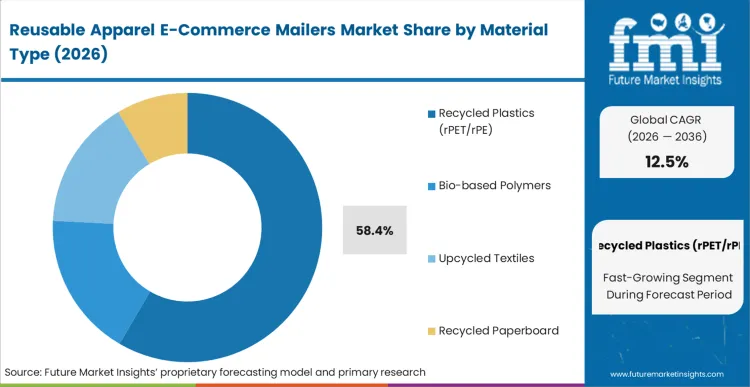
Recycled Plastics (rPET/rPE) holds a dominant 58.4% share in 2026 because synthetic polymer durability guarantees the highest number of profitable transit cycles before catastrophic material failure. Packaging procurement leads at major fashion brands face a critical cost-per-trip equation where any material failing before its tenth cycle destroys the financial viability of the entire program. According to FMI's estimates, selecting highly engineered synthetic wovens allows operators to maximize the lifespan of each asset, dramatically lowering the amortized cost per delivery. Advanced sustainable material formulations allow these plastics to be infinitely recycled once they are finally retired from the active fleet. Supply chain directors who experiment with unproven bio-materials often face massive mid-transit tearing, resulting in ruined apparel and alienated customers.
- Fleet Longevity: Synthetic polymer construction resists extreme abrasion during automated sorting, maximizing the number of trips per asset. Fulfillment directors utilizing rPET drastically lower their amortized cost per delivery.
- Moisture Impermeability: Recycled plastics completely block water ingress during unpredictable last-mile delivery conditions. Apparel retailers deploying these mailers eliminate costly product write-offs caused by weather damage.
- End-of-life Recyclability: Pure rPET mailers integrate seamlessly into existing municipal recycling streams once their transit lifespan concludes. Brand sustainability officers maintaining mono-material fleets easily meet their corporate zero-waste mandates.
Reusable Apparel E-Commerce Mailers Market Analysis by Mailer Type
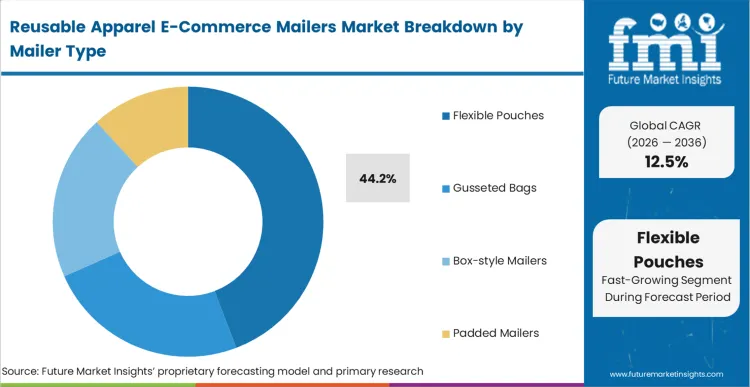
The displacement of rigid transit boxes by Flexible Pouches stems from the absolute necessity to minimize volumetric weight during the empty return journey. Reverse logistics network operators refuse to subsidize the cost of shipping air, making non-collapsible formats economically unviable for mass consumer recovery. Capturing 44.2% of the segment share in 2026, these flat-packing flexible shipping formats slide easily into standard postal drop-boxes without requiring a dedicated courier pickup. Based on FMI's assessment, the ability to fold a mailer to the size of a standard letter is the single largest determinant of successful consumer return rates. Operators who mandate the use of rigid, non-collapsible formats experience devastating fleet attrition as customers hoard the bulky containers rather than paying to return them.
- Volumetric Reduction: Pliable fabrics collapse entirely flat once the apparel is removed, eliminating empty space. Reverse logistics managers leveraging this flexibility drastically cut the postage rates required for the return trip.
- Postal Box Compatibility: Flat pouches easily slide into standard municipal mail slots without requiring counter service. Consumers interacting with these formats face zero friction, driving recovery rates above the critical profitability threshold.
- Dynamic Sizing: Soft-sided bags conform tightly to the specific volume of the enclosed garments, preventing internal shifting. Shipping leads utilizing these pouches bypass the dimensional weight penalties levied by major parcel carriers.
Reusable Apparel E-Commerce Mailers Market Analysis by Return Mechanism
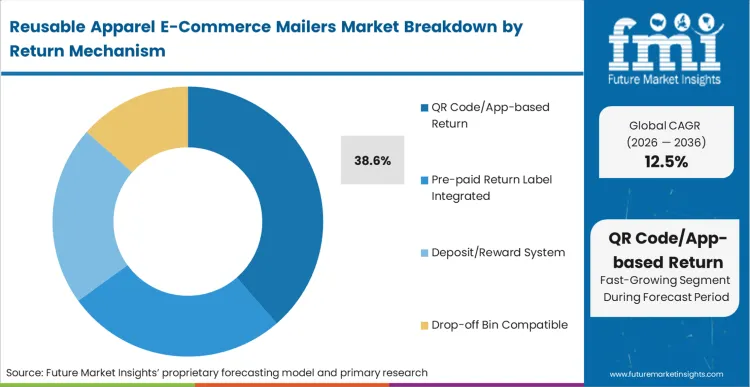
Every fulfillment director launching a circular program faces the strict operational reality that the physical bag is useless without an integrated digital recovery system. QR Code/App-based Return systems command a 38.6% share in 2026 by bypassing the inherent unreliability of printed secondary return labels. Rather than trusting consumers to preserve a paper sticker, brands embed permanent scannable matrixes directly onto the mailer's exterior. In FMI's view, these connected tracking ecosystems allow brands to instantly issue store credit the moment a courier scans the empty bag. Brands that rely on legacy paper-based return methods suffer severe asset loss when customers inevitably lose the required documentation.
- Digital Instantaneousness: Embedded QR codes trigger immediate consumer rewards the second the empty bag is scanned at a drop-off point. E-commerce platforms utilizing this immediate feedback loop guarantee a steady stream of returning inventory.
- Label Elimination: Printing permanent codes directly onto the fabric removes the need for easily damaged secondary paper stickers. Logistics coordinators deploying this technology eliminate the failure point of lost return credentials.
- Lifecycle Traceability: Unique digital identifiers allow central databases to track exactly how many trips a specific bag has completed. Fleet managers monitoring these metrics automatically retire degraded assets before they fail in transit.
Reusable Apparel E-Commerce Mailers Market Analysis by End User
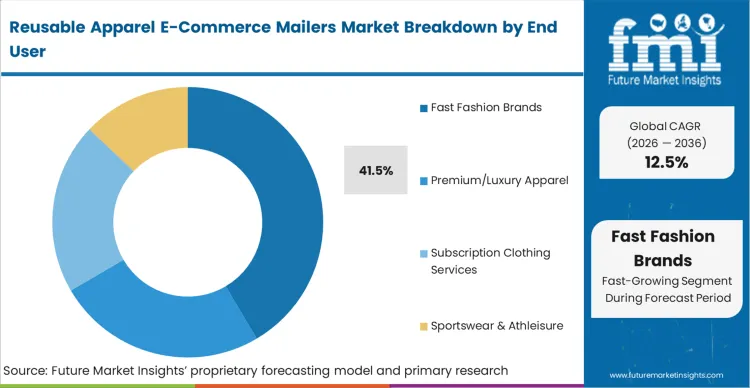
Saturated consumer tolerance for extreme packaging waste forces high-volume Fast Fashion Brands to overhaul their entire outbound logistics architecture. Representing 41.5% of the market in 2026, these conglomerates operate under imminent threats of punitive extended producer responsibility taxes in key European markets. Because they ship millions of low-margin items daily, they cannot absorb flat per-unit waste penalties without erasing their profitability entirely. FMI analysts opine that deploying tracked, multi-trip fleets shifts packaging from a consumable expense to an amortizable capital asset. Fast fashion executives who fail to adopt these biodegradable transit alternatives or multi-trip formats will see their margins destroyed by regulatory fines and consumer boycotts.
- Volume Distribution: Massive scale allows international apparel giants to negotiate bulk postal rates for empty bag returns. Procurement directors at these conglomerates achieve cost parity with single-use plastics faster than smaller competitors.
- Brand Perception: High-visibility adoption of circular shipping physically demonstrates corporate sustainability commitments to the end consumer. Marketing executives leveraging this transition successfully deflect growing criticism over fast fashion's environmental impact.
- EPR Mitigation: Deploying multi-trip assets exempts the brand from aggressive taxes levied on virgin plastic packaging. Financial controllers utilizing these fleets successfully protect the company's baseline profitability from legislative erosion.
Reusable Apparel E-Commerce Mailers Market Drivers, Restraints, and Opportunities
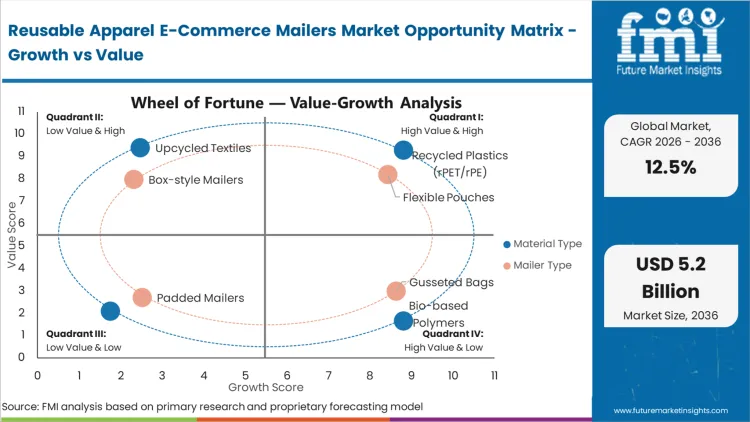
The EU Packaging and Packaging Waste Regulation (PPWR) (EU) 2024/2841 forces e-commerce supply chain directors to completely abandon single-use virgin plastics for apparel fulfillment. This structural mandate requires brands to demonstrate specific reuse targets for transport packaging by 2030, triggering a massive scramble to secure durable multi-trip fleets. Apparel retailers operating inside European jurisdictions face a strict binary choice: deploy verifiable circular mailer systems or incur devastating per-unit financial penalties that erase single-item profit margins. The transition to these tracked assets fundamentally shifts packaging from a disposable expense to an operational investment. Brands that ignore this regulatory cliff will simply lose the legal right to ship goods into highly regulated markets.
The intense friction of the reverse logistics journey severely limits the profitability of early circular fleet deployments. Without a standardized, frictionless method for consumers to return empty mailers, asset attrition rates remain unsustainably high, forcing brands to constantly purchase expensive replacement bags. While physical retail drop-off bins provide a localized workaround, they cannot service remote or purely digital consumers. This structural gap prevents the cost-per-trip from dropping below that of a single-use poly-mailer.
Opportunities in the Reusable Apparel E-Commerce Mailers Market
- Automated Hub Sanitization: Advanced automated cleaning and sorting facilities allow network operators to rapidly sanitize thousands of returned mailers per hour. Reverse logistics providers building these centralized hubs drastically reduce turnaround times, maximizing the availability of the active fleet.
- Incentivized Return Ecosystems: Integrating proprietary digital wallets with the mailer's RFID tag allows brands to automatically deposit store credit when the bag enters the postal network. Software developers building these seamless payment bridges solve the behavioral bottleneck, guaranteeing high recovery rates.
- Hybrid Rigid-Flexible Designs: Combining pliable fabrics with collapsible corrugated transit formats provides structural protection for delicate accessories without the volumetric penalty during the return trip. Packaging engineers developing these hybrid mailers unlock lucrative contracts with premium sunglass and jewelry brands.
Regional Analysis
Based on the regional analysis, the Reusable Apparel E-Commerce Mailers market is segmented into North America, Latin America, Europe, Asia-Pacific, South Asia, Oceania, and Middle East & Africa across 40 plus countries.
.webp "Top Country Growth Comparison Reusable Apparel E Commerce Mailers Market Cagr (2026 2036)")
| Country | CAGR (2026 to 2036) |
|---|---|
| Germany | 16.8% |
| United Kingdom | 15.2% |
| France | 14.5% |
| United States | 12.4% |
| China | 11.8% |
| South Korea | 10.5% |
| Japan | 9.6% |
Source: Future Market Insights (FMI) analysis, based on proprietary forecasting model and primary research
Europe Reusable Apparel E-Commerce Mailers Market Analysis
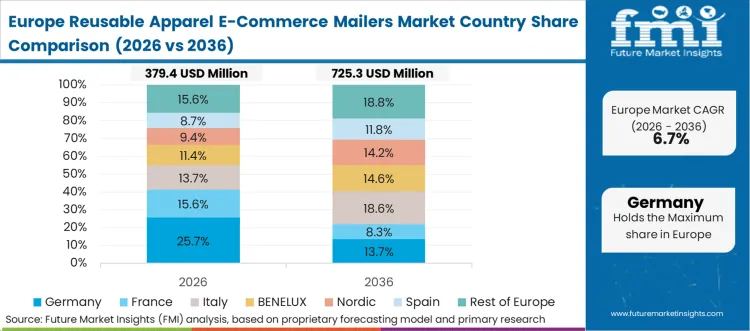
The widespread harmonization of cross-border postal regulations further supports the free flow of returning assets. As per FMI's projection, the existing cultural familiarity with deposit-return systems for beverage containers makes European consumers highly receptive to returning empty apparel bags. E-commerce fulfillment directors operating within this stringent regulatory environment face immediate, escalating taxes if they fail to implement verifiable circular transit models. This deeply ingrained behavioral baseline minimizes fleet attrition, allowing regional brands to rapidly scale their fiber-based protective layers and reusable synthetic mailers. The updated VerpackG legislation and the aggressive EU PPWR directive legally dictate the rapid elimination of single-use poly-mailers across the continent.
- Germany: Sustaining a 16.8% CAGR to 2036, the market leads the region. Widespread auditing by the Central Agency Packaging Register confirms this aggressive shift away from virgin plastics. Germany's strict enforcement of the updated VerpackG legislation imposes punitive extended producer responsibility taxes directly on non-reusable transit materials. Supply chain directors who ignore this material taxes face severe commercial disadvantages on high-volume fulfillment routes. This exact financial threat forces fast fashion logistics managers to adopt certified multi-trip mailers to maintain margin parity.
- United Kingdom: Procurement specification leads lacking compliant mailers suffer immediate tax liabilities at the point of fulfillment. This policy pressure enables fleet operators to rapidly displace legacy single-use suppliers. Advancing at 15.2% CAGR between 2026 and 2036, the country shows robust adoption. Logistics integrators actively mapping regional drop-off networks solidify high recovery rates. The post-Brexit plastic packaging tax in the United Kingdom requires pure-play online clothing retailers to utilize formats capable of repeated circulation.
- France: Facility owners delaying this upgrade face crippling non-compliance fines. Active government subsidies for circular infrastructure accelerate this transition. This legal framework forces brand owners to invest heavily in track-and-trace software to prove the multi-trip capability of their packaging. Major commercial apparel exporters in France operate under the Anti-Waste for a Circular Economy (AGEC) law, which explicitly mandates the phase-out of disposable shipping envelopes. The sector expands at a 14.5% CAGR through 2036.
FMI's report includes comprehensive evaluation of Italy, Spain, and the Nordics. The rapid expansion of centralized packaging-as-a-service providers across these nations standardizes the reverse logistics process, removing the capital burden of fleet ownership from individual clothing brands.
North America Reusable Apparel E-Commerce Mailers Market Analysis
Brands unable to secure highly discounted reverse-postage rates cannot successfully implement reusable models across continental distances. The integration of QR-code tracking directly into major domestic carrier networks serves as the foundational enabler for large-scale adoption. Logistics coordinators handling these inherently circular business models require durable shipping assets that can survive continuous two-way transit without failure. Specific cost structure pressures and the explosive growth of subscription-based wardrobe rental services drive the North American transition. In FMI's view, the vast geographic spread of the market forces network operators to negotiate complex, multi-zone postal rate agreements to keep the return journey economically viable.
- United States: The market is tracking 12.4% CAGR through to 2036. Leading postal carriers proactively optimizing their sorting equipment for empty flexible pouches drastically reduces turnaround times. This existing paradigm allows D2C fashion brands to introduce reusable mailers without having to educate the end user. Technology vendors failing to provide seamless carrier API integration lose access to the largest domestic apparel accounts. The massive expansion of subscription clothing services in the United States establishes a built-in behavioral loop where consumers naturally expect to return the package.
FMI's report includes coverage of Canada and Latin America. The proliferation of localized urban fulfillment hubs in these countries drastically shortens the return loop, making regionalized multi-trip fleets highly profitable for mid-tier retailers.
Asia-Pacific Reusable Apparel E-Commerce Mailers Market Analysis
State-sponsored initiatives targeting e-commerce waste provide the final catalyst for widespread commercial adoption. According to FMI's estimates, consumers in these markets demand instant digital gratification, forcing brands to link mailer returns directly to mobile payment platforms like WeChat or LINE. Dense urban infrastructure and highly automated logistics networks define the deployment parameters for circular packaging throughout the region. The sheer volume of single-day delivery events requires mailers that can be rapidly sanitized and immediately redeployed from micro-fulfillment centers. Reverse logistics network operators building out hyper-efficient, app-integrated drop-off lockers eliminate the friction of returning empty mailers in crowded metropolitan centers.
- China: Automated sorting hubs specifically designed to route empty mailers back to fulfillment centers prove the scale of this integration. Network operators who cannot guarantee sub-24-hour asset turnaround forfeit lucrative platform-level contracts. Projected at 11.8% CAGR over the forecast period, the country sets the volume baseline. This top-down marketplace rule creates an instant, immense demand for durable synthetic assets. China's aggressive domestic push toward green delivery standards forces massive online marketplaces to mandate the use of tracked, reusable pouches for apparel vendors.
- South Korea: This closed-loop infrastructure enables carriers to pick up empty bags during the exact same stop they drop off new orders. Widespread consumer adoption of eco-reward point systems further guarantees near-perfect return compliance. High-density urban living in South Korea requires e-commerce giants to integrate mailer collection directly into their proprietary overnight delivery loops. Capital project directors attempting to rely on third-party postal networks fail to match the efficiency of these closed-loop giants. The market is anchored to a 10.5% CAGR through the decade.
- Japan: Expanding at 9.6% CAGR between 2026 and 2036, the market rewards high-quality construction. Strategic partnerships between fashion houses and national convenience store chains establish a ubiquitous network of frictionless drop-off points. System integrators supplying cheap, easily degraded mailers are quickly rejected by quality-obsessed domestic buyers. This intense consumer preference forces premium apparel brands to adopt highly refined, aesthetically pleasing reusable transit bags. Stringent municipal waste sorting requirements in Japan drive eco-conscious consumers to demand packaging that does not burden their household disposal limits.
FMI's report includes detailed analysis of Taiwan and the broader ASEAN region. An emerging trend across these nations is the cross-border standardization of RFID tags, allowing regional logistics partners to seamlessly share and track the same pool of reusable mailers.
Competitive Aligners for Market Players
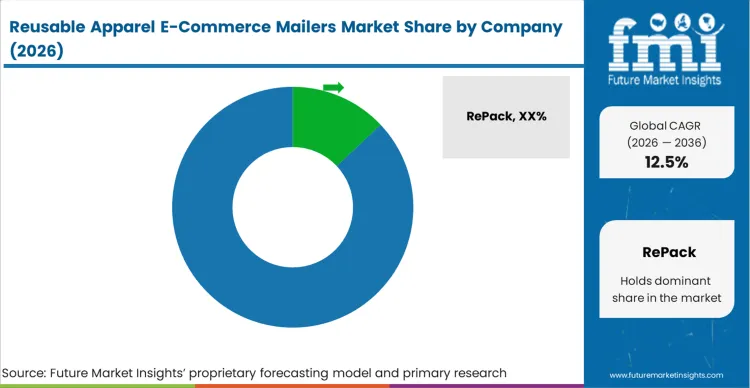
Procurement teams abandoning single-use poly-mailers now demand complete circular ecosystems rather than just durable bags, fundamentally shifting the competitive structure of the reusable apparel e-commerce mailers market. This strict requirement creates a moderately consolidated landscape where early-stage innovators and specialized packaging-as-a-service startups hold significant leverage. The immense upfront capital required to manufacture physical fleets, combined with the complex software engineering needed for track-and-trace architecture, acts as a severe barrier to entry. Companies like RePack, EcoEnclose, and Noissue have established dominant positions by offering these integrated solutions that seamlessly merge highly durable mailers with proprietary return-tracking algorithms. Procurement leads evaluating potential vendors now use reverse-logistics API integration as the absolute primary competitive variable, easily discarding suppliers who only manufacture physical pouches without providing the digital infrastructure to guarantee asset recovery.
Vendors possessing established integrations with national postal carriers and major third-party logistics networks command a massive structural advantage that is exceptionally difficult to disrupt. Firms such as Boox, Returnity, and LimeLoop have spent years negotiating standardized return-postage rates and optimizing their mailers for automated sorting compatibility, creating a moat built on regulatory and logistical alignment. To replicate this, a new challenger must spend millions subsidizing pilot programs and building complex data bridges with legacy carrier mainframes just to reach the starting line. Providers of traditional secure protective cushioning attempting to pivot into the circular economy often fail because they completely underestimate the software complexity required to prevent fleet attrition. Challengers entering this space must focus heavily on user experience, ensuring their return mechanism is entirely frictionless to survive the initial pilot phases.
Massive apparel conglomerates actively prevent vendor lock-in by throwing their weight behind open-source tracking standards that allow them to mix fleets from multiple suppliers on a single software dashboard. This structural tension puts heavy pressure on dominant vendors who prefer closed ecosystems, forcing agile players like The Better Packaging Co. and Hipli to compete aggressively on the per-trip durability of their physical mailers rather than trapping clients via proprietary software. The pricing power, as a result, remains heavily constrained across the industry, as brands will instantly shift volume to a competitor if a specific mailer's attrition rate spikes or per-trip costs escalate. Heading toward 2036, the market is becoming noticeably less concentrated as traditional corrugated giants acquire these nimble startups to rapidly build their own packaging-as-a-service portfolios, signaling a massive shift from niche sustainability efforts to mainstream logistical mandates.
Key Players in Reusable Apparel E-Commerce Mailers Market
- RePack
- EcoEnclose
- Boox
- Returnity
- Noissue
- LimeLoop
- The Better Packaging Co.
- Hipli
Scope of the Report
| Metric | Value |
|---|---|
| Quantitative Units | USD 1.6 billion to USD 5.2 billion, at a CAGR of 12.51% |
| Market Definition | Reusable apparel e-commerce mailers encompass durable, multi-trip shipping envelopes equipped with integrated tracking and reverse-logistics mechanisms, designed to replace single-use plastic in clothing fulfillment. |
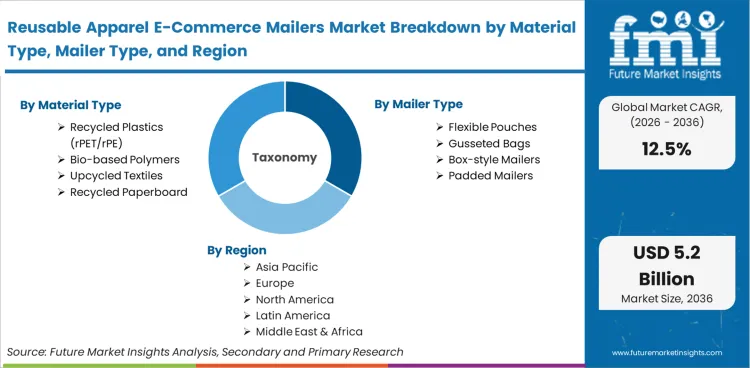
| Material Type Segmentation | Recycled Plastics (rPET/rPE), Bio-based Polymers, Upcycled Textiles, Recycled Paperboard |
| Mailer Type Segmentation | Flexible Pouches, Gusseted Bags, Box-style Mailers, Padded Mailers |
| Return Mechanism Segmentation | Pre-paid Return Label Integrated, QR Code/App-based Return, Deposit/Reward System, Drop-off Bin Compatible |
| End User Segmentation | Fast Fashion Brands, Premium/Luxury Apparel, Subscription Clothing Services, Sportswear & Athleisure |
| Regions Covered | North America, Latin America, Europe, East Asia, South Asia, Oceania, Middle East & Africa |
| Countries Covered | Germany, United Kingdom, France, United States, China, South Korea, Japan, and 40 plus countries |
| Key Companies Profiled | RePack, EcoEnclose, Boox, Returnity, Noissue, LimeLoop, The Better Packaging Co., Hipli |
| Forecast Period | 2026 to 2036 |
| Approach | The baseline value derives from a bottom-up aggregation of active multi-trip mailer fleets, projecting adoption velocity based on compliance timelines from the EU Packaging and Packaging Waste Regulation. |
Source: Future Market Insights (FMI) analysis, based on proprietary forecasting model and primary research
Segments
Material Type:
- Recycled Plastics (rPET/rPE)
- Bio-based Polymers
- Upcycled Textiles
- Recycled Paperboard
Mailer Type:
- Flexible Pouches
- Gusseted Bags
- Box-style Mailers
- Padded Mailers
Return Mechanism:
- Pre-paid Return Label Integrated
- QR Code/App-based Return
- Deposit/Reward System
- Drop-off Bin Compatible
End User:
- Fast Fashion Brands
- Premium/Luxury Apparel
- Subscription Clothing Services
- Sportswear & Athleisure
Regions:
- North America
- United States
- Canada
- Latin America
- Brazil
- Mexico
- Europe
- Germany
- United Kingdom
- France
- Italy
- Spain
- East Asia
- China
- Japan
- South Korea
- Rest of East Asia
- South Asia & Oceania
- India
- Australia
- Rest of South Asia & Oceania
- Middle East & Africa
- South Africa
- GCC Countries
Bibliography
- E-commerce Europe. (2024, October 30). Guidelines for transitioning to reusable transport packaging in online retail. E-commerce Europe Publications.
- DIN. (2024, August 22). DIN EN 13429:2024 Packaging - Reuse. German Institute for Standardization.
- US Environmental Protection Agency. (2024, December 14). Assessing the lifecycle impacts of reusable shipping assets. EPA Sustainable Materials Management.
- Boox. (2025, March 01). Tracking the future: API integration for circular packaging networks. Boox Technical Blog.
- Fashion for Good. (2024, July 15). The circular polybag pilot: Scaling reusable packaging in fashion fulfillment. Fashion for Good Reports.
This bibliography is provided for reader reference. The full FMI report contains the complete reference list with primary source documentation.
This Report Addresses
- Market intelligence to support strategic decision making across multi-trip shipping envelopes and RFID-tracked returnable pouches unique to this market
- Market size estimation and 10-year revenue forecasts from 2026 to 2036, supported by active multi-trip mailer fleet aggregation and postal carrier recovery rate metrics
- Growth opportunity mapping across Material Type and Return Mechanism categories with emphasis on national postal carriers standardizing processing rates for empty return mailers
- Segment and regional revenue forecasts covering Flexible Pouches and QR Code-based Returns across strict European EPR tax jurisdictions
- Competition strategy assessment including reverse-logistics API integration capabilities, automated sorting compatibility, and per-trip durability metrics
- Reusable packaging capability development tracking including EU PPWR reuse targets, automated hub sanitization, and incentivized return ecosystem integrations
- Market access analysis covering packaging-as-a-service subscription models and D2C apparel fulfillment pathways
- Market report delivery in PDF, Excel, PPT, and interactive dashboard formats for executive strategy, reverse logistics planning, and operational benchmarking use
Frequently Asked Questions
How large is the Reusable Apparel E-Commerce Mailers Market in 2026?
The market is valued at USD 1.6 billion in 2026 as legally mandated reuse targets force fast fashion conglomerates to abandon virgin poly-mailers.
What will it be valued at by 2036?
The valuation reaches USD 5.2 billion by 2036 as major national postal carriers standardize processing rates for empty returns, lowering the break-even threshold.
What CAGR is projected?
A 12.51% CAGR is projected, driven directly by escalating extended producer responsibility taxes penalizing single-use plastics.
Which Material Type segment leads?
Recycled Plastics (rPET/rPE) holds 58.4% share because synthetic polymer durability guarantees the highest number of profitable transit cycles before catastrophic material failure.
Which Mailer Type segment leads?
Flexible Pouches command 44.2% share by collapsing entirely flat, eliminating volumetric weight penalties during the empty return journey.
Which Return Mechanism segment leads?
QR Code/App-based Return secures 38.6% share as it bypasses the inherent unreliability of printed secondary return labels.
What drives rapid growth?
EU Packaging and Packaging Waste Regulation (PPWR) directives force high-volume apparel retailers to deploy verifiable circular transit models or face devastating per-unit fines.
What is the primary restraint?
The intense friction of the reverse logistics journey causes unsustainably high fleet attrition rates when consumers hoard or discard empty mailers.
Which country grows fastest?
Germany advances at a 16.8% CAGR, driven by strict enforcement of the updated VerpackG legislation and high deposit-return cultural conditioning.
How does the EU PPWR affect adoption?
It mandates specific reuse targets for transport packaging by 2030, legally requiring brands shipping into Europe to utilize multi-trip formats.
Why is reverse-logistics API integration critical?
Brands without integrated software cannot instantly issue return postage or track fleet attrition, turning expensive assets into single-use waste.
What competitive advantage do network operators hold?
Established firms have already negotiated standardized return-postage rates with national carriers, creating an immense capital barrier for new entrants.
How does Germany maintain high recovery rates?
Germany leverages a highly conditioned consumer base familiar with beverage deposit returns, transferring that behavior directly to apparel mailers.
What defines the United Kingdom's market position?
Post-Brexit plastic packaging taxes escalate the cost of virgin poly-mailers, enabling circular fleet operators to rapidly achieve price parity.
How is France accelerating the transition?
The Anti-Waste for a Circular Economy (AGEC) law explicitly bans disposable shipping envelopes for commercial exporters.
Why do US subscription clothing services lead adoption?
Their inherently circular business model normalizes the package return process, completely bypassing the consumer education hurdle.
What structural force drives China's expansion?
Top-down marketplace rules from domestic e-commerce giants force apparel vendors to adopt tracked, reusable pouches for all fast-fashion deliveries.
How does South Korea manage quick turnaround?
Carriers integrate mailer collection directly into proprietary overnight delivery loops, picking up empty bags during the exact same stop they drop off new orders.
What is the focus of Japanese consumers?
Stringent municipal waste limits drive consumers to prefer premium, reusable transit bags that do not consume household disposal quotas.
Are single-trip corrugated boxes included?
No, traditional kraft paper envelopes and single-trip corrugated boxes are explicitly excluded from this valuation.
Does the report cover purely internal warehouse bins?
General-purpose reusable grocery totes and internal warehouse transfer bins fall outside the defined parameters.
How is the baseline forecast validated?
Projections are rigorously tested against publicly reported capital expenditure guidance from leading third-party logistics networks and packaging-as-a-service operators.
Preview the report firsthand - request a free sample
Get SampleGet the brochure for pricing and purchase details.
Get PDFTable of Content
- Executive Summary
- Global Market Outlook
- Demand-side Trends
- Supply-side Trends
- Technology Roadmap Analysis
- Analysis and Recommendations
- Market Overview
- Market Coverage / Taxonomy
- Market Definition / Scope / Limitations
- Research Methodology
- Chapter Orientation
- Analytical Lens and Working Hypotheses
- Market Structure, Signals, and Trend Drivers
- Benchmarking and Cross-market Comparability
- Market Sizing, Forecasting, and Opportunity Mapping
- Research Design and Evidence Framework
- Desk Research Programme (Secondary Evidence)
- Company Annual and Sustainability Reports
- Peer-reviewed Journals and Academic Literature
- Corporate Websites, Product Literature, and Technical Notes
- Earnings Decks and Investor Briefings
- Statutory Filings and Regulatory Disclosures
- Technical White Papers and Standards Notes
- Trade Journals, Industry Magazines, and Analyst Briefs
- Conference Proceedings, Webinars, and Seminar Materials
- Government Statistics Portals and Public Data Releases
- Press Releases and Reputable Media Coverage
- Specialist Newsletters and Curated Briefings
- Sector Databases and Reference Repositories
- FMI Internal Proprietary Databases and Historical Market Datasets
- Subscription Datasets and Paid Sources
- Social Channels, Communities, and Digital Listening Inputs
- Additional Desk Sources
- Expert Input and Fieldwork (Primary Evidence)
- Primary Modes
- Qualitative Interviews and Expert Elicitation
- Quantitative Surveys and Structured Data Capture
- Blended Approach
- Why Primary Evidence is Used
- Field Techniques
- Interviews
- Surveys
- Focus Groups
- Observational and In-context Research
- Social and Community Interactions
- Stakeholder Universe Engaged
- C-suite Leaders
- Board Members
- Presidents and Vice Presidents
- R&D and Innovation Heads
- Technical Specialists
- Domain Subject-matter Experts
- Scientists
- Physicians and Other Healthcare Professionals
- Governance, Ethics, and Data Stewardship
- Research Ethics
- Data Integrity and Handling
- Primary Modes
- Tooling, Models, and Reference Databases
- Desk Research Programme (Secondary Evidence)
- Data Engineering and Model Build
- Data Acquisition and Ingestion
- Cleaning, Normalisation, and Verification
- Synthesis, Triangulation, and Analysis
- Quality Assurance and Audit Trail
- Market Background
- Market Dynamics
- Drivers
- Restraints
- Opportunity
- Trends
- Scenario Forecast
- Demand in Optimistic Scenario
- Demand in Likely Scenario
- Demand in Conservative Scenario
- Opportunity Map Analysis
- Product Life Cycle Analysis
- Supply Chain Analysis
- Investment Feasibility Matrix
- Value Chain Analysis
- PESTLE and Porter’s Analysis
- Regulatory Landscape
- Regional Parent Market Outlook
- Production and Consumption Statistics
- Import and Export Statistics
- Market Dynamics
- Global Market Analysis 2021 to 2025 and Forecast, 2026 to 2036
- Historical Market Size Value (USD Million) Analysis, 2021 to 2025
- Current and Future Market Size Value (USD Million) Projections, 2026 to 2036
- Y-o-Y Growth Trend Analysis
- Absolute $ Opportunity Analysis
- Global Market Pricing Analysis 2021 to 2025 and Forecast 2026 to 2036
- Global Market Analysis 2021 to 2025 and Forecast 2026 to 2036, By Material Type
- Introduction / Key Findings
- Historical Market Size Value (USD Million) Analysis By Material Type , 2021 to 2025
- Current and Future Market Size Value (USD Million) Analysis and Forecast By Material Type , 2026 to 2036
- Recycled Plastics (rPET/rPE)
- Bio-based Polymers
- Upcycled Textiles
- Recycled Paperboard
- Recycled Plastics (rPET/rPE)
- Y-o-Y Growth Trend Analysis By Material Type , 2021 to 2025
- Absolute $ Opportunity Analysis By Material Type , 2026 to 2036
- Global Market Analysis 2021 to 2025 and Forecast 2026 to 2036, By Mailer Type
- Introduction / Key Findings
- Historical Market Size Value (USD Million) Analysis By Mailer Type, 2021 to 2025
- Current and Future Market Size Value (USD Million) Analysis and Forecast By Mailer Type, 2026 to 2036
- Flexible Pouches
- Gusseted Bags
- Box-style Mailers
- Padded Mailers
- Flexible Pouches
- Y-o-Y Growth Trend Analysis By Mailer Type, 2021 to 2025
- Absolute $ Opportunity Analysis By Mailer Type, 2026 to 2036
- Global Market Analysis 2021 to 2025 and Forecast 2026 to 2036, By Return Mechanism
- Introduction / Key Findings
- Historical Market Size Value (USD Million) Analysis By Return Mechanism, 2021 to 2025
- Current and Future Market Size Value (USD Million) Analysis and Forecast By Return Mechanism, 2026 to 2036
- QR Code/App-based Return
- Pre-paid Return Label Integrated
- Deposit/Reward System
- Drop-off Bin Compatible
- QR Code/App-based Return
- Y-o-Y Growth Trend Analysis By Return Mechanism, 2021 to 2025
- Absolute $ Opportunity Analysis By Return Mechanism, 2026 to 2036
- Global Market Analysis 2021 to 2025 and Forecast 2026 to 2036, By End User
- Introduction / Key Findings
- Historical Market Size Value (USD Million) Analysis By End User, 2021 to 2025
- Current and Future Market Size Value (USD Million) Analysis and Forecast By End User, 2026 to 2036
- Fast Fashion Brands
- Premium/Luxury Apparel
- Subscription Clothing Services
- Sportswear & Athleisure
- Fast Fashion Brands
- Y-o-Y Growth Trend Analysis By End User, 2021 to 2025
- Absolute $ Opportunity Analysis By End User, 2026 to 2036
- Global Market Analysis 2021 to 2025 and Forecast 2026 to 2036, By Region
- Introduction
- Historical Market Size Value (USD Million) Analysis By Region, 2021 to 2025
- Current Market Size Value (USD Million) Analysis and Forecast By Region, 2026 to 2036
- North America
- Latin America
- Western Europe
- Eastern Europe
- East Asia
- South Asia and Pacific
- Middle East & Africa
- Market Attractiveness Analysis By Region
- North America Market Analysis 2021 to 2025 and Forecast 2026 to 2036, By Country
- Historical Market Size Value (USD Million) Trend Analysis By Market Taxonomy, 2021 to 2025
- Market Size Value (USD Million) Forecast By Market Taxonomy, 2026 to 2036
- By Country
- USA
- Canada
- Mexico
- By Material Type
- By Mailer Type
- By Return Mechanism
- By End User
- By Country
- Market Attractiveness Analysis
- By Country
- By Material Type
- By Mailer Type
- By Return Mechanism
- By End User
- Key Takeaways
- Latin America Market Analysis 2021 to 2025 and Forecast 2026 to 2036, By Country
- Historical Market Size Value (USD Million) Trend Analysis By Market Taxonomy, 2021 to 2025
- Market Size Value (USD Million) Forecast By Market Taxonomy, 2026 to 2036
- By Country
- Brazil
- Chile
- Rest of Latin America
- By Material Type
- By Mailer Type
- By Return Mechanism
- By End User
- By Country
- Market Attractiveness Analysis
- By Country
- By Material Type
- By Mailer Type
- By Return Mechanism
- By End User
- Key Takeaways
- Western Europe Market Analysis 2021 to 2025 and Forecast 2026 to 2036, By Country
- Historical Market Size Value (USD Million) Trend Analysis By Market Taxonomy, 2021 to 2025
- Market Size Value (USD Million) Forecast By Market Taxonomy, 2026 to 2036
- By Country
- Germany
- UK
- Italy
- Spain
- France
- Nordic
- BENELUX
- Rest of Western Europe
- By Material Type
- By Mailer Type
- By Return Mechanism
- By End User
- By Country
- Market Attractiveness Analysis
- By Country
- By Material Type
- By Mailer Type
- By Return Mechanism
- By End User
- Key Takeaways
- Eastern Europe Market Analysis 2021 to 2025 and Forecast 2026 to 2036, By Country
- Historical Market Size Value (USD Million) Trend Analysis By Market Taxonomy, 2021 to 2025
- Market Size Value (USD Million) Forecast By Market Taxonomy, 2026 to 2036
- By Country
- Russia
- Poland
- Hungary
- Balkan & Baltic
- Rest of Eastern Europe
- By Material Type
- By Mailer Type
- By Return Mechanism
- By End User
- By Country
- Market Attractiveness Analysis
- By Country
- By Material Type
- By Mailer Type
- By Return Mechanism
- By End User
- Key Takeaways
- East Asia Market Analysis 2021 to 2025 and Forecast 2026 to 2036, By Country
- Historical Market Size Value (USD Million) Trend Analysis By Market Taxonomy, 2021 to 2025
- Market Size Value (USD Million) Forecast By Market Taxonomy, 2026 to 2036
- By Country
- China
- Japan
- South Korea
- By Material Type
- By Mailer Type
- By Return Mechanism
- By End User
- By Country
- Market Attractiveness Analysis
- By Country
- By Material Type
- By Mailer Type
- By Return Mechanism
- By End User
- Key Takeaways
- South Asia and Pacific Market Analysis 2021 to 2025 and Forecast 2026 to 2036, By Country
- Historical Market Size Value (USD Million) Trend Analysis By Market Taxonomy, 2021 to 2025
- Market Size Value (USD Million) Forecast By Market Taxonomy, 2026 to 2036
- By Country
- India
- ASEAN
- Australia & New Zealand
- Rest of South Asia and Pacific
- By Material Type
- By Mailer Type
- By Return Mechanism
- By End User
- By Country
- Market Attractiveness Analysis
- By Country
- By Material Type
- By Mailer Type
- By Return Mechanism
- By End User
- Key Takeaways
- Middle East & Africa Market Analysis 2021 to 2025 and Forecast 2026 to 2036, By Country
- Historical Market Size Value (USD Million) Trend Analysis By Market Taxonomy, 2021 to 2025
- Market Size Value (USD Million) Forecast By Market Taxonomy, 2026 to 2036
- By Country
- Kingdom of Saudi Arabia
- Other GCC Countries
- Turkiye
- South Africa
- Other African Union
- Rest of Middle East & Africa
- By Material Type
- By Mailer Type
- By Return Mechanism
- By End User
- By Country
- Market Attractiveness Analysis
- By Country
- By Material Type
- By Mailer Type
- By Return Mechanism
- By End User
- Key Takeaways
- Key Countries Market Analysis
- USA
- Pricing Analysis
- Market Share Analysis, 2025
- By Material Type
- By Mailer Type
- By Return Mechanism
- By End User
- Canada
- Pricing Analysis
- Market Share Analysis, 2025
- By Material Type
- By Mailer Type
- By Return Mechanism
- By End User
- Mexico
- Pricing Analysis
- Market Share Analysis, 2025
- By Material Type
- By Mailer Type
- By Return Mechanism
- By End User
- Brazil
- Pricing Analysis
- Market Share Analysis, 2025
- By Material Type
- By Mailer Type
- By Return Mechanism
- By End User
- Chile
- Pricing Analysis
- Market Share Analysis, 2025
- By Material Type
- By Mailer Type
- By Return Mechanism
- By End User
- Germany
- Pricing Analysis
- Market Share Analysis, 2025
- By Material Type
- By Mailer Type
- By Return Mechanism
- By End User
- UK
- Pricing Analysis
- Market Share Analysis, 2025
- By Material Type
- By Mailer Type
- By Return Mechanism
- By End User
- Italy
- Pricing Analysis
- Market Share Analysis, 2025
- By Material Type
- By Mailer Type
- By Return Mechanism
- By End User
- Spain
- Pricing Analysis
- Market Share Analysis, 2025
- By Material Type
- By Mailer Type
- By Return Mechanism
- By End User
- France
- Pricing Analysis
- Market Share Analysis, 2025
- By Material Type
- By Mailer Type
- By Return Mechanism
- By End User
- India
- Pricing Analysis
- Market Share Analysis, 2025
- By Material Type
- By Mailer Type
- By Return Mechanism
- By End User
- ASEAN
- Pricing Analysis
- Market Share Analysis, 2025
- By Material Type
- By Mailer Type
- By Return Mechanism
- By End User
- Australia & New Zealand
- Pricing Analysis
- Market Share Analysis, 2025
- By Material Type
- By Mailer Type
- By Return Mechanism
- By End User
- China
- Pricing Analysis
- Market Share Analysis, 2025
- By Material Type
- By Mailer Type
- By Return Mechanism
- By End User
- Japan
- Pricing Analysis
- Market Share Analysis, 2025
- By Material Type
- By Mailer Type
- By Return Mechanism
- By End User
- South Korea
- Pricing Analysis
- Market Share Analysis, 2025
- By Material Type
- By Mailer Type
- By Return Mechanism
- By End User
- Russia
- Pricing Analysis
- Market Share Analysis, 2025
- By Material Type
- By Mailer Type
- By Return Mechanism
- By End User
- Poland
- Pricing Analysis
- Market Share Analysis, 2025
- By Material Type
- By Mailer Type
- By Return Mechanism
- By End User
- Hungary
- Pricing Analysis
- Market Share Analysis, 2025
- By Material Type
- By Mailer Type
- By Return Mechanism
- By End User
- Kingdom of Saudi Arabia
- Pricing Analysis
- Market Share Analysis, 2025
- By Material Type
- By Mailer Type
- By Return Mechanism
- By End User
- Turkiye
- Pricing Analysis
- Market Share Analysis, 2025
- By Material Type
- By Mailer Type
- By Return Mechanism
- By End User
- South Africa
- Pricing Analysis
- Market Share Analysis, 2025
- By Material Type
- By Mailer Type
- By Return Mechanism
- By End User
- USA
- Market Structure Analysis
- Competition Dashboard
- Competition Benchmarking
- Market Share Analysis of Top Players
- By Regional
- By Material Type
- By Mailer Type
- By Return Mechanism
- By End User
- Competition Analysis
- Competition Deep Dive
- RePack
- Overview
- Product Portfolio
- Profitability by Market Segments (Product/Age /Sales Channel/Region)
- Sales Footprint
- Strategy Overview
- Marketing Strategy
- Product Strategy
- Channel Strategy
- EcoEnclose
- Boox
- Returnity
- Noissue
- LimeLoop
- The Better Packaging Co.
- Hipli
- RePack
- Competition Deep Dive
- Assumptions & Acronyms Used


