

- Industry Size (2026)
- USD 5.9 Bn
- Forecast (2036)
- USD 12.6 Bn
- CAGR (2026 to 2036)
- 7.9%
Reusable Food Container Pooling Services Market Forecast and Outlook By FMI
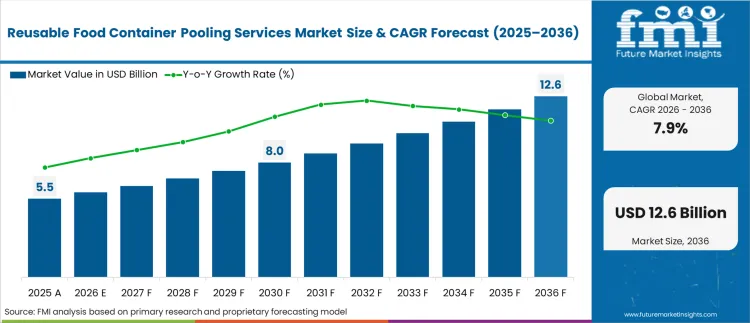
In 2025, the reusable food container pooling services market was valued at USD 5.4 billion. Based on Future Market Insights' analysis, demand for reusable food container pooling services is estimated to grow to USD 5.9 billion in 2026 and USD 12.6 billion by 2036. FMI projects a CAGR of 7.9% during the forecast period.
Absolute dollar growth of USD 7.2 billion over the decade represents sustained expansion driven by regulatory mandates eliminating single-use packaging and retailer sustainability commitments requiring circular supply chain models. Growth remains steady as established pooling networks expand geographic coverage and add container types, while regulatory pressure accelerates conversion from disposable corrugated and EPS foam packaging in fresh food distribution. Profitability depends on achieving density thresholds within regional freight lanes, with washing infrastructure proximity and customer concentration determining operational viability.
Summary of Reusable Food Container Pooling Services Market
- Reusable Food Container Pooling Services Market Definition
- The industry covers rental-based pooling systems providing standardized reusable containers through managed closed-loop networks with integrated washing and reverse logistics infrastructure.
- Demand Drivers in the Market
- European Union and regional packaging waste directives mandate transition to reusable formats for fresh food distribution by 2025 to 2030.
- Major retail chains commit to eliminating single-use packaging from produce and protein supply chains to meet corporate sustainability targets.
- Pooling operators achieve cost parity with disposable corrugated boxes through network density optimization and automation of washing facilities.
- Key Segments Analysed in the FMI Report
- Container Type: Reusable plastic crates (52%) dominate through standardization enabling automation and stackability advantages.
- Service Model: Open-loop pooling (61%) leads through multi-user network efficiencies versus dedicated closed-loop systems.
- End-use Industry: Retail fresh supply chains (66%) drive volume through produce, meat, and dairy distribution requirements.
- Analyst Opinion at FMI
- Ismail Sutaria, senior consultant at Future Market Insights, opines, "In the updated version of the Reusable Food Container Pooling Services Market Report for 2026 to 2036, supply chain executives will find critical insights into density threshold economics that determine pooling viability in emerging markets. My findings indicate that washing facility location optimisation and container recovery rate management present operational challenges that could restrict geographic expansion without localised infrastructure investment and retailer participation commitments."
- Strategic Implications / Executive Takeaways
- Prioritize network density buildout in regional freight lanes before geographic expansion to achieve profitability thresholds.
- Invest in automated washing and sorting infrastructure to reduce labor dependency and improve container turnaround times.
- Secure long-term retail anchor customers to guarantee minimum circulation volumes supporting washing facility fixed costs.
- Methodology
- Validated through direct engagement with pooling operators and retail fresh supply chain procurement teams across major markets.
- Zero reliance on commercial logistics research aggregators or unverified secondary sources.
- Based on verifiable operator circulation data, washing facility capacity, and retail policy commitments.
“We continued making significant progress in 2024 towards reducing our emissions across all three scopes. Highlights include procurement of green energy and PEFC certified wood approaching 100% of our needs, adopting lower-temperature washing processes, and advancing water reuse-with the potential to achieve up to 80% reuse. When implementing systems for efficient water use, we prioritise regions where water is scarce and costly.” Gerjo Scheringa, CEO
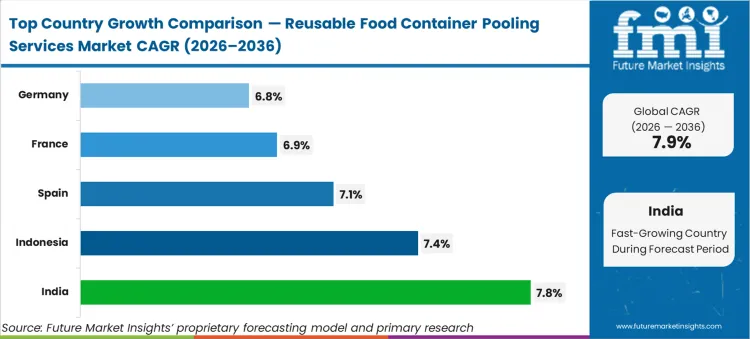
India (7.8% CAGR) and Indonesia (7.4% CAGR) drive growth through organised retail expansion, enabling MAP-compatible distribution infrastructure for fresh produce previously sold through ambient channels. Spain (7.1% CAGR), France (6.9% CAGR), and Germany (6.8% CAGR) generate replacement demand as established pooling systems transition to advanced foldable container designs, with growth constrained by market saturation in core retail fresh produce segments and operational cost pressures from washing facility energy consumption.
| Metric | Value |
|---|---|
| Market Size (2026) | USD 5.9 Billion |
| Forecast Value (2036) | USD 12.6 Billion |
| CAGR (2026-2036) | 7.9% |
Reusable Food Container Pooling Services Market Definition
The reusable food container pooling services market comprises rental-based systems where operators provide standardized containers to food supply chain participants through managed closed-loop or open-loop networks. Pooling service providers deliver clean containers to producers, manage reverse logistics from retail points, operate washing and inspection facilities, and maintain container inventory pools. The market serves fresh produce distributors, meat and dairy processors, foodservice operators, and retail chains requiring cost-effective alternatives to single-use corrugated boxes and foam packaging.
Reusable Food Container Pooling Services Market Inclusions
The report includes comprehensive analysis of market dynamics, featuring Global and Regional Market Sizes in both service revenue (USD billion) and container circulation volumes with a 10-year Forecast from 2026 to 2036. Coverage encompasses segmental breakdowns by container type (RPCs, totes, trays, foodservice containers), service model (closed-loop, open-loop, deposit-return, subscription), and end-use industry (retail fresh chains, foodservice, institutional catering, meal kits, food processing).
Reusable Food Container Pooling Services Market Exclusions
The scope excludes ownership-based reusable container programs where retailers or processors maintain dedicated fleets without third-party pooling operators. It omits pallet pooling services, bulk liquid intermediate bulk containers for non-food industries, and single-use container rental or leasing. Non-food applications and pilot programs without commercial-scale pooling networks with washing infrastructure are not covered.
Reusable Food Container Pooling Services Market Research Methodology
- Primary Research: Interviews were conducted with pooling service operators, fresh produce distributors, retail procurement teams, foodservice operators, and washing facility managers across North America, Europe, and Asia Pacific regions.
- Desk Research: Production data from fresh food industry associations, logistics reports on reverse supply chains, and regulatory filings from publicly traded pooling operators supported volume benchmarking and network coverage validation.
- Market-Sizing and Forecasting: A hybrid top-down and bottom-up model was developed. Demand was reconstructed from fresh produce distribution volumes, container rotation rates, rental pricing models, and network density metrics, then validated against operator-disclosed circulation figures and washing facility capacity data.
- Data Validation and Update Cycle: Outputs undergo anomaly screening, variance checks across operator financial disclosures and trade datasets, and structured peer review with industry stakeholders prior to release.
Segmental Analysis
Reusable Food Container Pooling Services Market Analysis by Container Type
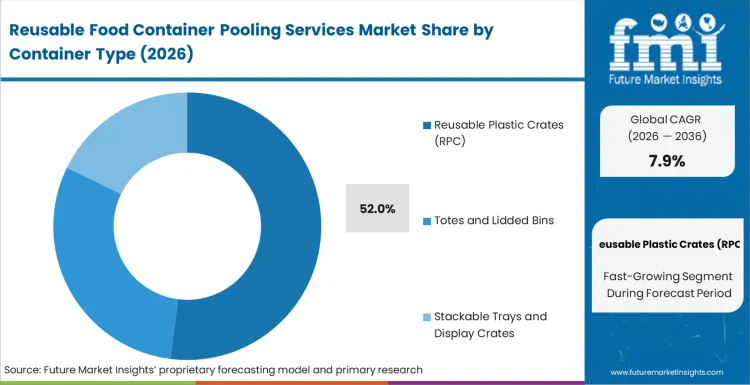
Based on FMI's reusable food container pooling services market report, consumption of reusable plastic crates is estimated to hold 52% share in 2026. Growth in demand for reusable plastic crates comes from standardized footprints enabling automation compatibility, superior stackability reducing transportation costs, and foldable designs achieving 86% volume reduction on return trips compared to rigid alternatives. RPCs maintain structural integrity through 30 to 120 rotation cycles before recycling, supporting pooling economics through extended service life.
- Life Cycle Performance Validation: IFCO Systems published comparative life cycle assessment results in November 2024, conducted by Fraunhofer IBP and critically reviewed by DEKRA, quantifying that reusable packaging crates reduce CO2 emissions by 62% compared to single-use packaging along with significant savings in water use, energy consumption, and waste across the fresh grocery supply chain. [1]
- Network Scale and Standardization: Euro Pool System operates over 215 service centers across 38 European countries managing 1.3 billion tray movements annually in 2024, with foldable green crates replacing rigid blue predecessors to reduce return transport requirements by 20,000 lorry journeys per year in Benelux markets through 86% space savings when folded. [2]
- Automation Infrastructure Integration: As per FMI analysis, reusable plastic crates with standardized dimensions and data matrix labeling enable compatibility with automated distribution center systems, reducing manual handling costs and supporting high-volume retail fresh supply chains requiring daily delivery cycles and point-of-sale display functionality.
Reusable Food Container Pooling Services Market Analysis by Service Model
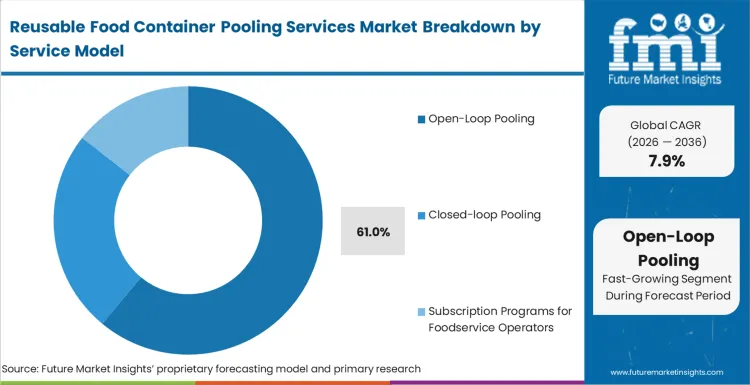
Open-loop pooling's 61% market share in 2026 stems from multi-user network efficiencies that distribute washing facility fixed costs across broader customer bases compared to dedicated closed-loop systems. The segment's reliance on standardization creates compatibility across competing retailers and distributors, enabling container circulation optimization through centralized logistics management and regional washing hub networks.
- Pooling Network Economics: IFCO Systems manages nearly 300 million reusable packaging containers in global pooling circulation, operating the SmartCycle closed-loop system covering container delivery, return, washing at specially designed facilities meeting food safety standards, quality inspection, and recirculation to maintain availability when and where customers need assets. [3]
- Reverse Logistics Optimization: Euro Pool System provides fully outsourced pooling services including tray rental, collection, washing, and repair processes, with digital track-and-trace systems monitoring container flows from depot to grower to retailer and back, enabling real-time visibility and reducing operational inefficiencies in reverse supply chains. [4]
- Multi-User Network Density: As per FMI analysis, open-loop pooling operators achieve profitability through regional concentration strategies, building sufficient customer density within freight lanes to optimize washing facility utilization rates and reduce empty container repositioning costs between surplus and deficit markets.
Reusable Food Container Pooling Services Market Drivers, Restraints, and Opportunities
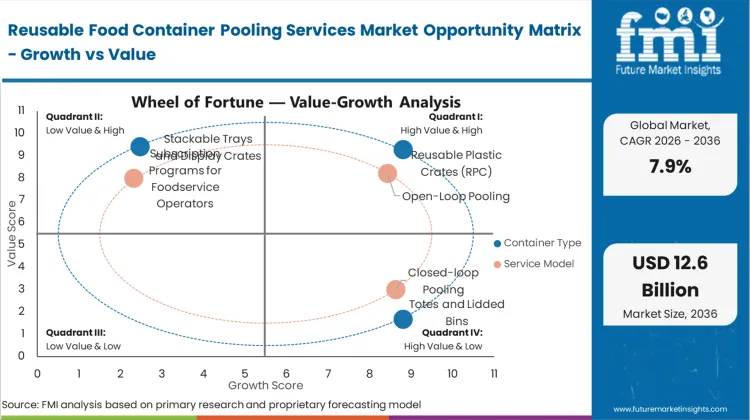
Future Market Insights analysis indicates that historical patterns point to a mature industry in established European markets entering geographic expansion phase in Asia Pacific and selective North American regions. The 2026 valuation represents consolidation of dominant players operating at scale with established washing networks, while growth derives from conversion of remaining disposable packaging in fresh food distribution and geographic expansion into markets developing organized retail infrastructure.
Growth trajectory reflects simultaneous volume expansion through retail fresh supply chain conversions in emerging markets and value growth through premium service models offering digital traceability and customized washing protocols. Standard pooling services compete directly with disposable corrugated boxes on total cost of ownership, while advanced offerings with RFID tracking, automated sorting, and guaranteed availability command premium pricing. This pricing structure stabilizes as washing infrastructure investment amortizes and operational efficiency improvements offset labor cost inflation.
- Regulatory Packaging Waste Mandates: European Union member states implement Extended Producer Responsibility schemes requiring reusable packaging adoption in fresh food distribution, with Germany, France, and Netherlands establishing deposit-return systems and packaging waste reduction targets driving conversion from single-use corrugated to pooled reusable container systems.
- Retail Sustainability Commitments: Major European grocery chains committed to eliminating single-use packaging from fresh produce and protein supply chains by 2025 to 2030, mandating supplier adoption of pooled reusable containers to maintain shelf access and meet corporate climate neutrality targets.
- Pooling Network Density Economics: Successful pooling operators achieve profitability through regional customer concentration strategies, with Euro Pool System operating 215 service centers managing 1.3 billion tray movements annually, demonstrating that washing facility proximity and multi-user network density determine operational viability and cost competitiveness versus disposable alternatives. [2]
Regional Analysis
Based on regional analysis, the reusable food container pooling services market is segmented into North America, Latin America, Europe, East Asia, South Asia, Oceania, and Middle East and Africa across 30+ countries. The full report offers market attractiveness analysis based on washing infrastructure development, regulatory mandates for reusable packaging, and organized retail penetration rates.
.webp "Top Country Growth Comparison Reusable Food Container Pooling Services Market Cagr (2026 2036)")
| Country | CAGR (2026 to 2036) |
|---|---|
| India | 7.8% |
| Indonesia | 7.4% |
| Spain | 7.1% |
| France | 6.9% |
| Germany | 6.8% |
Source: Future Market Insights (FMI) analysis, based on proprietary forecasting model and primary research
Europe Reusable Food Container Pooling Services Market Analysis
Europe functions as the global pooling industry epicenter, where established multi-decade networks achieve operational maturity and market saturation in core fresh produce segments. Key players in the European market include IFCO Systems operating the SmartCycle network across Europe and Americas, Euro Pool System managing 215 service centers across 38 countries, and La Palette Rouge (LPR) specializing in pallet pooling within Euro Pool Group's portfolio.
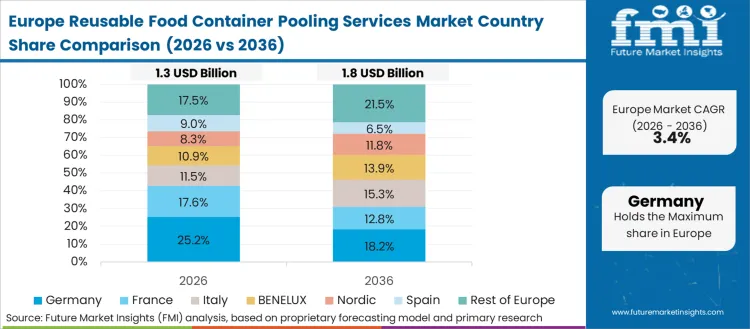
- Spain: Demand for reusable food container pooling services in Spain is rising at 7.1% CAGR through 2036, driven by Mediterranean fresh produce export sector requiring standardized packaging for European retail distribution networks. Euro Pool System operates multiple service centers throughout Spain managing over 1.3 billion tray movements annually across its European network of 215 facilities, with regional concentration in Valencia, Murcia, and Almería agricultural zones enabling efficient reverse logistics from retail destinations back to growing regions. [2] Horeca sector adoption remains limited compared to retail fresh chains, with foodservice takeaway container pooling concentrated in Barcelona and Madrid pilot programs testing deposit-return models requiring consumer participation in container return processes.
- France: Demand for reusable food container pooling services in France is projected to rise at 6.9% CAGR through 2036, supported by national anti-waste legislation promoting reusable packaging and established distribution infrastructure with high retail concentration. IFCO Systems operates its SmartCycle closed-loop system in France covering container delivery, return, washing at food safety-compliant facilities, quality inspection, and recirculation to maintain availability when and where customers need assets. [3] Euro Pool System provides fully outsourced pooling services including tray rental, collection, washing, and repair processes, with digital track-and-trace systems monitoring container flows from depot to grower to retailer and back, enabling real-time supply chain visibility. [4]
- Germany: Demand for reusable food container pooling services in Germany is rising at 6.8% CAGR through 2036, driven by mature pooling infrastructure serving discount retail sector and packaging waste regulations under German Packaging Act. Euro Pool System manages 215 service centres across 38 European countries with €15 million investment in digital services, including track-and-trace technology and real-time supply chain visibility platforms in 2024, supporting operational optimisation across German logistics networks. [6] Extended Producer Responsibility obligations under VerpackG establish financial incentives for reusable transport packaging adoption through reduced licensing fees compared to single-use alternatives. Foldable crate technology adoption accelerates in German logistics networks, addressing high diesel fuel costs and driver shortage constraints affecting road freight sector through 86% volume reduction when empty containers return to distribution points. [2]
FMI's analysis of the reusable food container pooling services market in Europe consists of country-wise assessment that includes Spain, France, Germany, United Kingdom, Italy, Netherlands, Belgium, and Rest of Europe. Readers can find detailed information about washing facility networks, regulatory compliance frameworks, and retail adoption trends impacting growth in the European region.
Asia Pacific Reusable Food Container Pooling Services Market Analysis
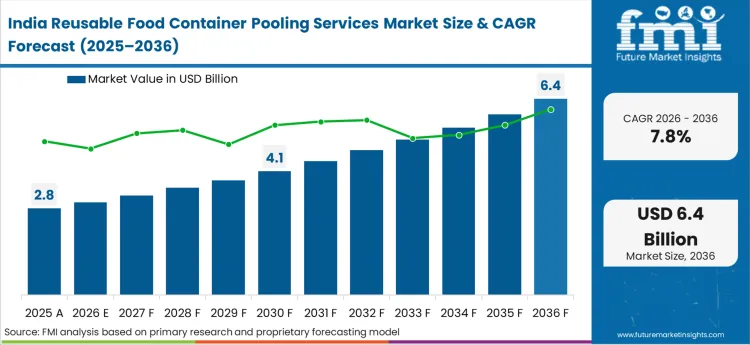
Asia Pacific represents the fastest-growing region globally, leveraging organized retail expansion and cold chain infrastructure development to enable pooling system adoption for fresh food distribution. Key regional players include IFCO Systems expanding washing center networks in China and Australia, Tosca operating in select Asia Pacific markets, and regional providers establishing localized pooling networks aligned with domestic retail chains.
- India: Domestic demand accelerates at 7.8% CAGR, supported by organised retail expansion, adding thousands of modern trade outlets annually and government food safety initiatives encouraging hygienic handling of fresh produce. IFCO Systems published life cycle assessment results in November 2024 confirming that reusable packaging crates reduce CO2 emissions by 62% compared to single-use packaging along with significant savings in water use, energy consumption, and waste across fresh grocery supply chains, validating environmental benefits driving Indian organized retail adoption. [1] Modern retail chains, including Reliance Fresh, D-Mart, and Big Basket, are expanding across tier-1 and tier-2 cities, establishing supply agreements requiring reusable packaging adoption from produce suppliers, creating network density in major metropolitan corridors, supporting washing facility investment economics.
- Indonesia: Projected growth of 7.4% CAGR through 2036 is driven by organized retail penetration in urban markets and export-oriented fresh produce processors adopting international packaging standards. IFCO Systems manages nearly 300 million reusable packaging containers in global pooling circulation through its SmartCycle network, with Asia Pacific expansion targeting markets where organized retail infrastructure supports container recovery systems. [3] As per FMI analysis, Indonesian pooling networks concentrate in Java corridor serving Jakarta, Surabaya, and Bandung metropolitan areas, with limited washing infrastructure requiring operators to prioritize anchor retail customers guaranteeing minimum circulation volumes before geographic expansion.
Competitive Aligners for Market Players
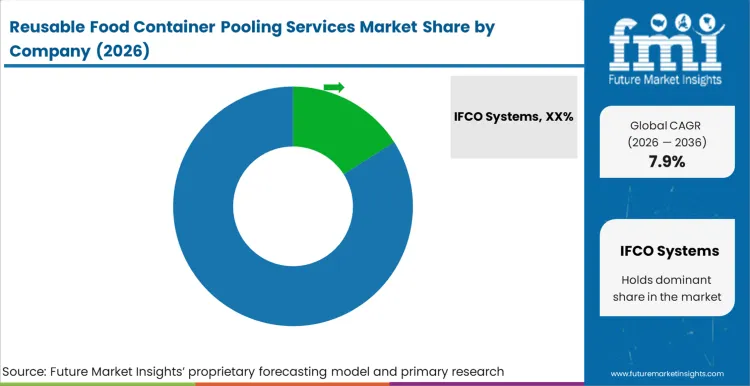
Market structure remains concentrated among established operators with multi-decade network development and washing infrastructure investment creating substantial entry barriers. Approximately 60% of global pooling capacity sits with IFCO Systems and Euro Pool System operating at continental scale with hundreds of washing facilities, while remaining capacity operates through regional specialists and emerging providers targeting specific categories or geographic markets. Primary competitive variable is network density within regional freight lanes rather than container pricing, as washing facility fixed costs require minimum circulation volumes for profitability.
Operators with established washing networks and anchor retail customers absorb demand variability more effectively than emerging providers lacking infrastructure scale. Integrated players maintain long-term contracts with major grocery chains and produce distributors, securing committed volumes that justify washing facility expansion and automated sorting technology investment. Non-integrated regional providers face margin pressure as they build network density, limiting geographic expansion capacity during market development phases.
Operational success requires achieving density thresholds where container rotation frequency supports washing facility utilization rates above break-even levels. Operators unable to maintain 30+ rotation cycles annually through concentrated customer bases face profitability challenges as washing costs and container depreciation exceed rental revenue. Customer concentration reinforces pooling economics, with major retail chains representing anchor volume commitments enabling service expansion to secondary customers within established logistics networks.
Recent Developments
- In October 2024, CHEP Europe (Pallecon) launched the FalConic™ Container, a stackable, reusable container designed for handling, storage, and transport of light dry cargo (pots, tubs, trays, lids), supporting pooling-based reuse models.
- Cologne-based VYTAL Global GmbH, a leading provider of smart reusable packaging solutions, has successfully raised €14.2 million in growth funding to accelerate its international growth. The new funding will enhance Vytal’s technology-driven solutions, making reusable packaging more seamless and cost-efficient for businesses and consumers.
Key Players in Reusable Food Container Pooling Services Market
- IFCO Systems
- Euro Pool System (Euro Pool Group)
- Tosca (Brambles)
- CHEP (Brambles)
- Loscam
- Logifruit
- CPR System
- reCup GmbH
- r.World
- Vytal Global
Scope of the Report
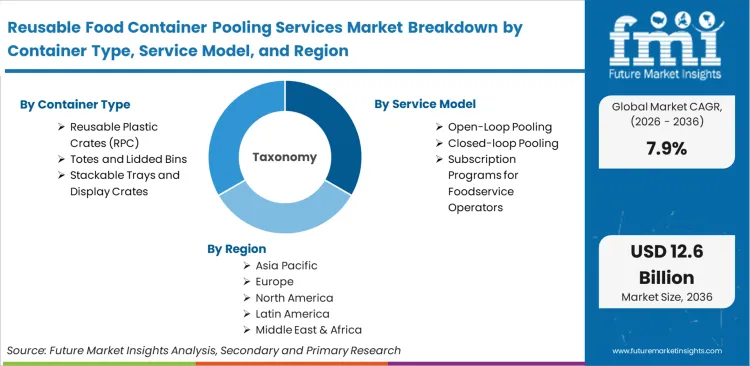
| Metric | Value |
|---|---|
| Quantitative Units | USD 5.9 billion (2026) to USD 12.6 billion (2036), at a CAGR of 7.9% |
| Market Definition | The reusable food container pooling services market comprises rental-based systems where operators provide standardized containers to food supply chain participants through managed closed-loop or open-loop networks with integrated washing and reverse logistics infrastructure. |
| Container Type Segmentation | Reusable Plastic Crates, Totes and Lidded Bins, Stackable Trays and Display Crates, Foodservice Takeaway Containers, Bulk Ingredient Containers |
| Service Model Segmentation | Closed-loop Pooling, Open-loop Pooling, Deposit-return/Return-incentive Pooling, Subscription Programs, Hybrid Pooling |
| End-use Industry Segmentation | Retail Fresh Supply Chains, Foodservice and QSR Takeaway/Delivery, Institutional Catering, Meal Kits Distribution, Food Processing Logistics |
| Regions Covered | North America, Latin America, Europe, East Asia, South Asia, Oceania, Middle East and Africa |
| Countries Covered | United States, Canada, Mexico, Brazil, Argentina, Germany, France, United Kingdom, Italy, Spain, Netherlands, Belgium, China, India, Japan, South Korea, Indonesia, Thailand, Vietnam, Philippines, Malaysia, Australia and 30 plus countries |
| Key Companies Profiled | IFCO Systems, Euro Pool System, Tosca, CHEP, Loscam, Logifruit, CPR System, reCup GmbH, r.World, Vytal Global |
| Forecast Period | 2026 to 2036 |
| Approach | Hybrid top-down and bottom-up market modeling validated through primary interviews with pooling operators, retail procurement teams, and washing facility operators, supported by operator circulation data and network coverage verification |
Reusable Food Container Pooling Services Market Analysis by Segments
Container Type
- Reusable Plastic Crates (RPC)
- Totes and Lidded Bins
- Stackable Trays and Display Crates
- Foodservice Takeaway Containers (cups, bowls, clamshells)
- Bulk Ingredient Containers for Food Plants
Service Model
- Closed-loop Pooling (dedicated retailer/QSR loop)
- Open-loop Pooling (multi-user network)
- Deposit-return/Return-incentive Pooling
- Subscription Programs for Foodservice Operators
- Hybrid Pooling with On-site and Hub Washing
End-use Industry
- Retail Fresh Supply Chains (produce, meat, dairy)
- Foodservice and QSR Takeaway/Delivery
- Institutional Catering (hospitals, universities, corporate dining)
- Meal Kits and Ready-to-eat Distribution
- Food Processing and Co-manufacturing Logistics
Region
- North America
- Latin America
- Europe
- East Asia
- South Asia
- Oceania
- Middle East and Africa
Bibliography
- [1] IFCO Systems. (2024). Life Cycle Assessment 2024 - IFCO Reusable Packaging Cuts CO2 Emissions by 62%. IFCO Systems Corporate Release, November 2024.
- [2] Pestel Analysis. (2025). How Does Euro Pool System International B.V. Company Work? Pestel Analysis Business Models, October 2025.
- [3] IFCO Systems. (2023). IFCO RPCs Recollection Easier Than Ever. IFCO Systems Pooling Operations, September 2023.
- [4] Euro Pool System. (2025). Pooling Services - Digital Track and Trace. Euro Pool System Services, November 2025.
- [5] Royal Society of Chemistry. (2024). Sustainable Biodegradable Coatings for Food Packaging: Challenges and Opportunities. Green Chemistry, 26(7), April 2024.
- [6] Canvas Business Model. (2025). How Does Euro Pool System International B.V. Company Work? Canvas Business Model Analysis, July 2025.
- [7] IFCO Systems. (2024). Pooling Reusable Packaging - SmartCycle Network. IFCO Systems Operations, August 2024.
- [8] Euro Pool System. (2024). About EPS - Leading Logistics Provider. Euro Pool System Company Overview, August 2024.
- [9] Packaging Revolution. (2025). IFCO Company Hub: RPCs, SmartCycle, Global Network. Reusable Packaging Hub, December 2025.
- [10] Euro Pool System. (2025). Sustainability - Creating Circular Progress. Euro Pool System Sustainability, November 2025.
- This bibliography is provided for the reader's reference and is not exhaustive. The full report contains the complete reference list and detailed citations.
This Report Addresses
- Market intelligence to enable structured strategic decision making across pooling network expansion and washing infrastructure investment planning
- Market size estimation and 10-year revenue forecasts from 2026 to 2036, supported by validated operator circulation data and network coverage benchmarks
- Growth opportunity mapping across RPCs, totes, foodservice containers, and specialized formats with emphasis on open-loop versus closed-loop economics
- Segment and regional revenue forecasts covering retail fresh chains, foodservice, and institutional catering across North America, Europe, and Asia Pacific markets
- Competition strategy assessment including network density positioning, washing facility optimization, and anchor customer relationship management
- Container technology development tracking including foldable designs, RFID integration, and automated handling compatibility
- Regulatory impact analysis covering Extended Producer Responsibility mandates, single-use packaging restrictions, and retailer sustainability commitments
- Market report delivery in PDF, Excel, PPT, and interactive dashboard formats for executive and operational use
Frequently Asked Questions
How large is the demand for Reusable Food Container Pooling Services in the global market in 2026?
Demand for reusable food container pooling services in the global market is estimated to be valued at USD 5.9 billion in 2026.
What will be the market size of Reusable Food Container Pooling Services in the global market by 2036?
Market size for reusable food container pooling services is projected to reach USD 12.6 billion by 2036.
What is the expected demand growth for Reusable Food Container Pooling Services in the global market between 2026 and 2036?
Demand for reusable food container pooling services in the global market is expected to grow at a CAGR of 7.9% between 2026 and 2036.
Which Container Type is poised to lead global sales by 2026?
Reusable plastic crates are expected to be the dominant container type, capturing approximately 52% of global market share in 2026 due to standardization enabling automation and foldable design reducing return transport costs.
How significant is the role of Retail Fresh Supply Chains in driving Reusable Pooling adoption in 2026?
Retail fresh supply chains represent the leading end-use industry segment, projected to hold approximately 66% share of the total market in 2026 as produce, meat, and dairy distribution drives pooling volume.
What is Driving Reusable Pooling Demand in Europe?
Regulatory packaging waste mandates under Extended Producer Responsibility schemes combined with retail sustainability commitments are driving conversion from single-use corrugated to pooled reusable container systems.
What Compliance Standards are Referenced for European Markets?
European Union Packaging and Packaging Waste directives and national EPR frameworks in Germany, France, and Netherlands requiring reusable packaging adoption are referenced as key compliance benchmarks.
What is the India Growth Outlook in this Report?
India is projected to grow at a CAGR of 7.8% during 2026 to 2036, driven by organized retail expansion and modern trade infrastructure development.
Why is Asia Pacific the Fastest Growing Region in this Report?
Growth is driven by organized retail penetration enabling standardized fresh food distribution and cold chain infrastructure development supporting temperature-controlled pooling operations.
What are Reusable Food Container Pooling Services and What are They Used For?
Reusable food container pooling services provide rental-based access to standardized containers through managed networks with integrated washing and reverse logistics for fresh food distribution.
What does Reusable Food Container Pooling Services Market Mean in this Report?
The market refers to rental revenue from pooling operators providing containers, washing, and logistics services through closed-loop or open-loop networks serving food supply chains.
What is Included in the Scope of this Reusable Food Container Pooling Services Market Report?
Scope covers container types (RPCs, totes, trays, foodservice containers), service models (closed-loop, open-loop, deposit-return), and end-use industries (retail fresh chains, foodservice, institutional catering).
What is Excluded from the Scope of this Report?
Ownership-based reusable programs without third-party pooling, pallet pooling, bulk liquid containers, and single-use container rental are excluded from coverage.
How does FMI Build and Validate the Reusable Food Container Pooling Services Market Forecast?
Forecast is developed using hybrid top-down and bottom-up modeling validated through pooling operator circulation data, washing facility capacity, retail policy commitments, and primary interviews with industry stakeholders.
Preview the report firsthand - request a free sample
Get SampleGet the brochure for pricing and purchase details.
Get PDFTable of Content
- Executive Summary
- Global Market Outlook
- Demand-side Trends
- Supply-side Trends
- Technology Roadmap Analysis
- Analysis and Recommendations
- Market Overview
- Market Coverage / Taxonomy
- Market Definition / Scope / Limitations
- Research Methodology
- Chapter Orientation
- Analytical Lens and Working Hypotheses
- Market Structure, Signals, and Trend Drivers
- Benchmarking and Cross-market Comparability
- Market Sizing, Forecasting, and Opportunity Mapping
- Research Design and Evidence Framework
- Desk Research Programme (Secondary Evidence)
- Company Annual and Sustainability Reports
- Peer-reviewed Journals and Academic Literature
- Corporate Websites, Product Literature, and Technical Notes
- Earnings Decks and Investor Briefings
- Statutory Filings and Regulatory Disclosures
- Technical White Papers and Standards Notes
- Trade Journals, Industry Magazines, and Analyst Briefs
- Conference Proceedings, Webinars, and Seminar Materials
- Government Statistics Portals and Public Data Releases
- Sector Databases and Reference Repositories
- FMI Internal Proprietary Databases and Historical Market Datasets
- Subscription Datasets and Paid Sources
- Social Channels, Communities, and Digital Listening Inputs
- Additional Desk Sources
- Expert Input and Fieldwork (Primary Evidence)
- Primary Modes
- Qualitative Interviews and Expert Elicitation
- Quantitative Surveys and Structured Data Capture
- Blended Approach
- Why Primary Evidence is Used
- Field Techniques
- Interviews
- Surveys
- Focus Groups
- Observational and In-context Research
- Social and Community Interactions
- Stakeholder Universe Engaged
- C-suite Leaders
- Board Members
- Presidents and Vice Presidents
- R&D and Innovation Heads
- Technical Specialists
- Domain Subject-matter Experts
- Scientists
- Physicians and Other Healthcare Professionals
- Governance, Ethics, and Data Stewardship
- Research Ethics
- Data Integrity and Handling
- Primary Modes
- Tooling, Models, and Reference Databases
- Desk Research Programme (Secondary Evidence)
- Data Engineering and Model Build
- Data Acquisition and Ingestion
- Cleaning, Normalisation, and Verification
- Synthesis, Triangulation, and Analysis
- Quality Assurance and Audit Trail
- Market Background
- Market Dynamics
- Drivers
- Restraints
- Opportunity
- Trends
- Scenario Forecast
- Demand in Optimistic Scenario
- Demand in Likely Scenario
- Demand in Conservative Scenario
- Opportunity Map Analysis
- Product Life Cycle Analysis
- Supply Chain Analysis
- Investment Feasibility Matrix
- Value Chain Analysis
- PESTLE and Porter’s Analysis
- Regulatory Landscape
- Regional Parent Market Outlook
- Production and Consumption Statistics
- Import and Export Statistics
- Market Dynamics
- Global Market Analysis 2021 to 2025 and Forecast, 2026 to 2036
- Historical Market Size Value (USD Million) Analysis, 2021 to 2025
- Current and Future Market Size Value (USD Million) Projections, 2026 to 2036
- Y-o-Y Growth Trend Analysis
- Absolute $ Opportunity Analysis
- Global Market Pricing Analysis 2021 to 2025 and Forecast 2026 to 2036
- Global Market Analysis 2021 to 2025 and Forecast 2026 to 2036, By Container Type
- Introduction / Key Findings
- Historical Market Size Value (USD Million) Analysis By Container Type , 2021 to 2025
- Current and Future Market Size Value (USD Million) Analysis and Forecast By Container Type , 2026 to 2036
- Reusable Plastic Crates (RPC)
- Totes and Lidded Bins
- Stackable Trays and Display Crates
- Reusable Plastic Crates (RPC)
- Y-o-Y Growth Trend Analysis By Container Type , 2021 to 2025
- Absolute $ Opportunity Analysis By Container Type , 2026 to 2036
- Global Market Analysis 2021 to 2025 and Forecast 2026 to 2036, By Service Model
- Introduction / Key Findings
- Historical Market Size Value (USD Million) Analysis By Service Model, 2021 to 2025
- Current and Future Market Size Value (USD Million) Analysis and Forecast By Service Model, 2026 to 2036
- Open-Loop Pooling
- Closed-loop Pooling
- Subscription Programs for Foodservice Operators
- Open-Loop Pooling
- Y-o-Y Growth Trend Analysis By Service Model, 2021 to 2025
- Absolute $ Opportunity Analysis By Service Model, 2026 to 2036
- Global Market Analysis 2021 to 2025 and Forecast 2026 to 2036, By End-use Industry
- Introduction / Key Findings
- Historical Market Size Value (USD Million) Analysis By End-use Industry, 2021 to 2025
- Current and Future Market Size Value (USD Million) Analysis and Forecast By End-use Industry, 2026 to 2036
- Retail Fresh Supply Chains
- Foodservice and QSR Takeaway/Delivery
- Institutional Catering
- Retail Fresh Supply Chains
- Y-o-Y Growth Trend Analysis By End-use Industry, 2021 to 2025
- Absolute $ Opportunity Analysis By End-use Industry, 2026 to 2036
- Global Market Analysis 2021 to 2025 and Forecast 2026 to 2036, By Region
- Introduction
- Historical Market Size Value (USD Million) Analysis By Region, 2021 to 2025
- Current Market Size Value (USD Million) Analysis and Forecast By Region, 2026 to 2036
- North America
- Latin America
- Western Europe
- Eastern Europe
- East Asia
- South Asia and Pacific
- Middle East & Africa
- Market Attractiveness Analysis By Region
- North America Market Analysis 2021 to 2025 and Forecast 2026 to 2036, By Country
- Historical Market Size Value (USD Million) Trend Analysis By Market Taxonomy, 2021 to 2025
- Market Size Value (USD Million) Forecast By Market Taxonomy, 2026 to 2036
- By Country
- USA
- Canada
- Mexico
- By Container Type
- By Service Model
- By End-use Industry
- By Country
- Market Attractiveness Analysis
- By Country
- By Container Type
- By Service Model
- By End-use Industry
- Key Takeaways
- Latin America Market Analysis 2021 to 2025 and Forecast 2026 to 2036, By Country
- Historical Market Size Value (USD Million) Trend Analysis By Market Taxonomy, 2021 to 2025
- Market Size Value (USD Million) Forecast By Market Taxonomy, 2026 to 2036
- By Country
- Brazil
- Chile
- Rest of Latin America
- By Container Type
- By Service Model
- By End-use Industry
- By Country
- Market Attractiveness Analysis
- By Country
- By Container Type
- By Service Model
- By End-use Industry
- Key Takeaways
- Western Europe Market Analysis 2021 to 2025 and Forecast 2026 to 2036, By Country
- Historical Market Size Value (USD Million) Trend Analysis By Market Taxonomy, 2021 to 2025
- Market Size Value (USD Million) Forecast By Market Taxonomy, 2026 to 2036
- By Country
- Germany
- UK
- Italy
- Spain
- France
- Nordic
- BENELUX
- Rest of Western Europe
- By Container Type
- By Service Model
- By End-use Industry
- By Country
- Market Attractiveness Analysis
- By Country
- By Container Type
- By Service Model
- By End-use Industry
- Key Takeaways
- Eastern Europe Market Analysis 2021 to 2025 and Forecast 2026 to 2036, By Country
- Historical Market Size Value (USD Million) Trend Analysis By Market Taxonomy, 2021 to 2025
- Market Size Value (USD Million) Forecast By Market Taxonomy, 2026 to 2036
- By Country
- Russia
- Poland
- Hungary
- Balkan & Baltic
- Rest of Eastern Europe
- By Container Type
- By Service Model
- By End-use Industry
- By Country
- Market Attractiveness Analysis
- By Country
- By Container Type
- By Service Model
- By End-use Industry
- Key Takeaways
- East Asia Market Analysis 2021 to 2025 and Forecast 2026 to 2036, By Country
- Historical Market Size Value (USD Million) Trend Analysis By Market Taxonomy, 2021 to 2025
- Market Size Value (USD Million) Forecast By Market Taxonomy, 2026 to 2036
- By Country
- China
- Japan
- South Korea
- By Container Type
- By Service Model
- By End-use Industry
- By Country
- Market Attractiveness Analysis
- By Country
- By Container Type
- By Service Model
- By End-use Industry
- Key Takeaways
- South Asia and Pacific Market Analysis 2021 to 2025 and Forecast 2026 to 2036, By Country
- Historical Market Size Value (USD Million) Trend Analysis By Market Taxonomy, 2021 to 2025
- Market Size Value (USD Million) Forecast By Market Taxonomy, 2026 to 2036
- By Country
- India
- ASEAN
- Australia & New Zealand
- Rest of South Asia and Pacific
- By Container Type
- By Service Model
- By End-use Industry
- By Country
- Market Attractiveness Analysis
- By Country
- By Container Type
- By Service Model
- By End-use Industry
- Key Takeaways
- Middle East & Africa Market Analysis 2021 to 2025 and Forecast 2026 to 2036, By Country
- Historical Market Size Value (USD Million) Trend Analysis By Market Taxonomy, 2021 to 2025
- Market Size Value (USD Million) Forecast By Market Taxonomy, 2026 to 2036
- By Country
- Kingdom of Saudi Arabia
- Other GCC Countries
- Turkiye
- South Africa
- Other African Union
- Rest of Middle East & Africa
- By Container Type
- By Service Model
- By End-use Industry
- By Country
- Market Attractiveness Analysis
- By Country
- By Container Type
- By Service Model
- By End-use Industry
- Key Takeaways
- Key Countries Market Analysis
- USA
- Pricing Analysis
- Market Share Analysis, 2025
- By Container Type
- By Service Model
- By End-use Industry
- Canada
- Pricing Analysis
- Market Share Analysis, 2025
- By Container Type
- By Service Model
- By End-use Industry
- Mexico
- Pricing Analysis
- Market Share Analysis, 2025
- By Container Type
- By Service Model
- By End-use Industry
- Brazil
- Pricing Analysis
- Market Share Analysis, 2025
- By Container Type
- By Service Model
- By End-use Industry
- Chile
- Pricing Analysis
- Market Share Analysis, 2025
- By Container Type
- By Service Model
- By End-use Industry
- Germany
- Pricing Analysis
- Market Share Analysis, 2025
- By Container Type
- By Service Model
- By End-use Industry
- UK
- Pricing Analysis
- Market Share Analysis, 2025
- By Container Type
- By Service Model
- By End-use Industry
- Italy
- Pricing Analysis
- Market Share Analysis, 2025
- By Container Type
- By Service Model
- By End-use Industry
- Spain
- Pricing Analysis
- Market Share Analysis, 2025
- By Container Type
- By Service Model
- By End-use Industry
- France
- Pricing Analysis
- Market Share Analysis, 2025
- By Container Type
- By Service Model
- By End-use Industry
- India
- Pricing Analysis
- Market Share Analysis, 2025
- By Container Type
- By Service Model
- By End-use Industry
- ASEAN
- Pricing Analysis
- Market Share Analysis, 2025
- By Container Type
- By Service Model
- By End-use Industry
- Australia & New Zealand
- Pricing Analysis
- Market Share Analysis, 2025
- By Container Type
- By Service Model
- By End-use Industry
- China
- Pricing Analysis
- Market Share Analysis, 2025
- By Container Type
- By Service Model
- By End-use Industry
- Japan
- Pricing Analysis
- Market Share Analysis, 2025
- By Container Type
- By Service Model
- By End-use Industry
- South Korea
- Pricing Analysis
- Market Share Analysis, 2025
- By Container Type
- By Service Model
- By End-use Industry
- Russia
- Pricing Analysis
- Market Share Analysis, 2025
- By Container Type
- By Service Model
- By End-use Industry
- Poland
- Pricing Analysis
- Market Share Analysis, 2025
- By Container Type
- By Service Model
- By End-use Industry
- Hungary
- Pricing Analysis
- Market Share Analysis, 2025
- By Container Type
- By Service Model
- By End-use Industry
- Kingdom of Saudi Arabia
- Pricing Analysis
- Market Share Analysis, 2025
- By Container Type
- By Service Model
- By End-use Industry
- Turkiye
- Pricing Analysis
- Market Share Analysis, 2025
- By Container Type
- By Service Model
- By End-use Industry
- South Africa
- Pricing Analysis
- Market Share Analysis, 2025
- By Container Type
- By Service Model
- By End-use Industry
- USA
- Market Structure Analysis
- Competition Dashboard
- Competition Benchmarking
- Market Share Analysis of Top Players
- By Regional
- By Container Type
- By Service Model
- By End-use Industry
- Competition Analysis
- Competition Deep Dive
- IFCO Systems
- Overview
- Product Portfolio
- Profitability by Market Segments (Product/Age /Sales Channel/Region)
- Sales Footprint
- Strategy Overview
- Marketing Strategy
- Product Strategy
- Channel Strategy
- Euro Pool System (Euro Pool Group)
- Tosca (Brambles)
- CHEP (Brambles)
- Loscam
- Logifruit
- CPR System
- IFCO Systems
- Competition Deep Dive
- Assumptions & Acronyms Used


