

- Industry Size (2026)
- USD 720 Mn
- Forecast (2036)
- USD 2465.8 Mn
- CAGR (2026 to 2036)
- 13.10%
Load Pooling and Co-Loading Marketplaces for LTL Shipments Market Forecast and Outlook 2026 to 2036
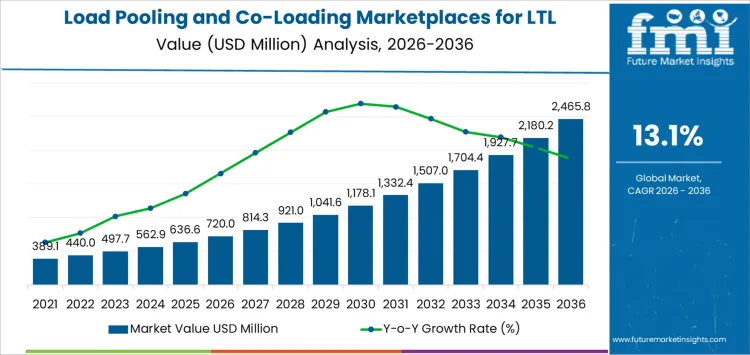
The load pooling and co-loading marketplaces for less-than-truckload (LTL) shipments market is expected to grow from USD 720 million in 2026 to USD 2,465.8 million by 2036, reflecting a compound annual growth rate (CAGR) of 13.1%. LTL shipments, which involve transporting smaller freight loads that do not require a full truck, have long been a significant part of the logistics industry. Load pooling and co-loading marketplaces, which allow multiple shippers to share truck space and optimize routes, help reduce costs and improve efficiency. The market is driven by growing demand for cost-effective and sustainable shipping solutions, particularly in e-commerce and retail industries that rely on fast, reliable deliveries.
The growth is also fueled by technological advancements that enable real-time tracking, enhanced route optimization, and better management of shared shipments. These platforms provide visibility, improve collaboration between different stakeholders, and enable better management of LTL operations, contributing to the continued growth of this market. Additionally, with increasing regulatory pressure to reduce emissions and improve efficiency, businesses are seeking solutions like load pooling and co-loading to minimize their environmental footprint and operating costs.
Quick Stats for Load Pooling and Co-Loading Marketplaces for LTL Shipments Market
- Load Pooling and Co-Loading Marketplaces for LTL Shipments Market Value (2026): USD 720 million
- Load Pooling and Co-Loading Marketplaces for LTL Shipments Market Forecast Value (2036): USD 2,465.8 million
- Load Pooling and Co-Loading Marketplaces for LTL Shipments Market Global Forecast CAGR (2026-2036): 13.10%
- Top Service Type by Share in Load Pooling and Co-Loading Marketplaces for LTL Shipments Market: Load Pooling Services (42%)
- Key Growth Regions in Load Pooling and Co-Loading Marketplaces for LTL Shipments Market: India, China, USA, Brazil, Germany
- Top Players in Load Pooling and Co-Loading Marketplaces for LTL Shipments Market: Convoy, Uber Freight, project44, Transfix, Loadsmart
What is the Growth Forecast for the Load Pooling and Co-Loading Marketplaces for LTL Shipments Market through 2036?
The breakpoint analysis for the load pooling and co-loading marketplaces for LTL shipments market shows steady and significant growth over the forecast period, with key periods of acceleration. Starting at USD 720 million in 2026, the market grows to USD 814.45 million in 2027 and USD 921.64 million in 2028, indicating consistent growth driven by the increasing adoption of shared load solutions and optimization technologies.
From 2028 to 2030, the market accelerates further, reaching USD 1,043.20 million in 2029 and USD 1,180.88 million in 2030. This acceleration is driven by more widespread adoption of LTL co-loading platforms, as companies seek to reduce transportation costs and improve supply chain efficiency. The period from 2030 to 2035 shows continued rapid growth, with the market reaching USD 1,512.73 million in 2031, USD 1,711.52 million in 2032, and USD 1,935.64 million in 2033.
By 2035, the market is projected to reach USD 2,188.97 million, and by 2036, USD 2,465.8 million. The breakpoint analysis reveals that the rate of growth significantly accelerates as these marketplaces gain more widespread adoption and as businesses increasingly recognize the benefits of load pooling and co-loading in terms of cost reduction, efficiency, and sustainability. The analysis suggests that while the market grows steadily in the early years, it will experience strong acceleration as the logistics industry continues to embrace these collaborative, optimized solutions for LTL shipments.
Load Pooling and Co-Loading Marketplaces for LTL Shipments Market Key Takeaways
| Metric | Value |
|---|---|
| Industry Sales Value (2026) | USD 720 million |
| Industry Forecast Value (2036) | USD 2,465.8 million |
| Industry Forecast CAGR (2026-2036) | 13.1% |
What Is Driving the Demand for Load Pooling and Co-Loading Marketplaces for LTL Shipments Globally?
The demand for load pooling and co loading marketplaces for less than truckload (LTL) shipments is driven by pressure on logistics costs, rising freight volumes, and the need for greater asset utilisation. Traditional LTL networks often result in partially filled trailers and inefficient routing because individual shippers book space independently. Load pooling and co loading platforms match multiple shippers’ freight to consolidate loads into fuller, more efficient truckloads, reducing empty miles and lowering cost per unit transported. Growth in e commerce and omni channel fulfilment has increased parcel and freight volumes that do not justify full truckload moves, making LTL more prominent in supply chains. Carriers, third party logistics providers, and freight marketplaces are adopting pooling solutions to improve capacity use, cut transportation expenses, and reduce delivery times. Platforms that use real time data and advanced matching algorithms enable dynamic consolidation across carriers and lanes, improving visibility and responsiveness. Sustainability goals and regulatory focus on emissions further reinforce the appeal of pooling, which can cut fuel usage and carbon output. As carriers and shippers seek better cost to service balance, pooling and co loading solutions have become a key strategy in markets such as North America, Europe, and Asia Pacific.
Future demand for load pooling and co loading marketplaces for LTL shipments is expected to grow as logistics networks become more digitally connected and data driven. Continued investment in cloud based platforms, real time tracking, and predictive analytics will support more accurate freight matching and optimisation, increasing adoption. The growth of regional distribution hubs and micro fulfilment centres is reinforcing shorter haul and LTL freight flows, creating more opportunities for shared capacity. Integration with transportation management systems and multimodal networks will enable broader participation by small and mid sized shippers that previously lacked the technology to engage in pooling. As service expectations for delivery speed rise, especially in e commerce, efficient LTL consolidation becomes more attractive for managing cost without sacrificing service levels. The pace of adoption will depend on demonstrable cost savings, ease of integration with existing carrier networks, and the ability of marketplaces to maintain high service reliability. As global freight volumes and cost pressures persist, demand for load pooling and co loading solutions is set to expand.
What Are the Key Segments in Load Pooling and Co-Loading Marketplaces for LTL Shipments Market?
The load pooling and co-loading marketplaces for LTL (less-than-truckload) shipments market is segmented by service type and end-use industry. Load pooling services lead the service type segment with 42% of the market share, optimizing the transportation of goods by consolidating shipments from multiple customers. Third-party logistics (3PL) providers dominate the end-use segment with 38%, as they seek cost-effective, flexible shipping solutions. The market is growing as businesses increasingly look for innovative ways to improve efficiency, reduce transportation costs, and streamline supply chains.
Which Service Type Drives Load Pooling and Co-Loading Marketplaces for LTL Shipments Market Demand Globally?
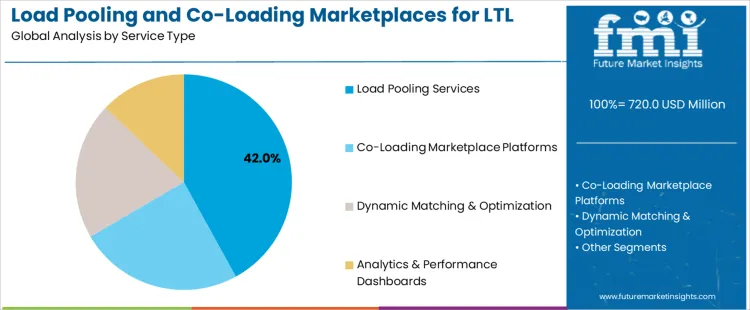
Load pooling services account for 42% of the market share. This service allows multiple shipments from different customers to be combined into a single truckload, maximizing vehicle capacity and reducing transportation costs. Load pooling offers a cost-effective solution for businesses that don’t have enough freight to fill a full truckload but still want the benefits of more efficient shipping. By consolidating goods from multiple customers, load pooling services reduce empty miles, minimize the carbon footprint, and lower overall shipping expenses. This service is particularly beneficial for industries that rely on LTL shipments, such as e-commerce, retail, and manufacturing, as it helps optimize logistics operations while offering flexible shipping options. The growing focus on supply chain efficiency and sustainability is driving the demand for load pooling services, especially as companies aim to reduce costs and improve delivery times.
Which End-Use Industry Drives Load Pooling and Co-Loading Marketplaces for LTL Shipments Market Demand Globally?
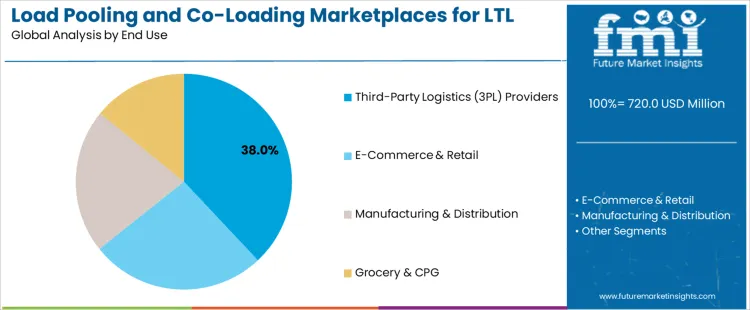
Third-party logistics (3PL) providers lead the end-use segment with 38% of the market share. 3PL providers are central players in managing the transportation and logistics needs of various industries. They seek flexible, cost-effective solutions to optimize their clients' LTL shipments. By using load pooling and co-loading services, 3PL providers can consolidate freight from multiple customers into a single shipment, improving efficiency and reducing costs for their clients. These services allow 3PL providers to offer more competitive shipping options and enhance the overall performance of their clients' supply chains. As demand for faster and more affordable delivery solutions continues to rise, the role of 3PL providers in driving the adoption of load pooling and co-loading services becomes increasingly important. While e-commerce & retail, manufacturing & distribution, and grocery & CPG also contribute to the market, 3PL providers remain the dominant segment due to their extensive involvement in managing and optimizing logistics for various industries.
What are the Key Dynamics of the Global Load Pooling and Co-Loading Marketplaces for LTL Shipments Market?
The global load pooling and co loading marketplaces for less than truckload (LTL) shipments market is growing as shippers and logistics providers seek greater capacity efficiency and lower transport cost. These digital marketplaces match compatible freight from different shippers into shared transport space, increasing asset utilisation and reducing empty miles. Growth in e commerce and demand for flexible delivery options has raised interest in collaborative transport solutions that support speed and reliability. Adoption of advanced matching algorithms, real time visibility tools and network optimisation makes pooling and co loading attractive for carriers and shippers in regional and long haul LTL operations.
What are the Key Drivers for the Global Load Pooling and Co Loading Marketplaces for LTL Shipments Market?
A key driver is pressure on logistics cost and capacity that encourages businesses to improve utilisation of transport assets. Pooling LTL shipments allows carriers to combine loads across customers and move freight more efficiently, reducing per shipment cost. Growth of e commerce generates high volumes of smaller shipments that benefit from co loading arrangements. Technology platforms that enable real time matching and tracking support dynamic decision making. Collaboration among shippers, carriers and logistics partners is increasing as stakeholders pursue cost savings, service improvements and scalable distribution strategies in competitive markets worldwide.
What are the Restraints for the Global Load Pooling and Co Loading Marketplaces for LTL Shipments Market?
One restraint is the complexity of coordinating shipments from multiple customers into shared loads while meeting delivery expectations and service agreements. Differences in shipment timing, size, destination and priority can complicate pooling decisions and require sophisticated planning systems. Some carriers may hesitate to share capacity with competitors or integrate systems because of data security and commercial sensitivity concerns. Variability in digital maturity across logistics partners affects ability to participate effectively in marketplace networks. Regulatory and documentation requirements for cross border LTL shipments add planning challenges that may slow adoption in international segments.
What is the Key Trends in the Global Load Pooling and Co Loading Marketplaces for LTL Shipments Market?
A key trend is integration of artificial intelligence and predictive analytics into marketplace platforms to improve matching accuracy, anticipate demand patterns and optimise co loading decisions. Platforms are offering enhanced visibility and tracking that support collaborative planning and performance measurement across supply chain partners. Shared transport networks are expanding through partnerships that link regional carriers and third party providers, broadening coverage and flexibility. Use of cloud native and mobile technologies supports seamless participation by shippers of all sizes. Focus on sustainability and reduction of empty miles encourages pooling and co loading solutions that contribute to lower fuel use and emission profiles in logistics operations.
What is the Country-Wise Outlook for Load Pooling and Co-Loading Marketplaces for LTL Shipments?
The Load Pooling and Co-Loading Marketplaces for LTL (Less Than Truckload) Shipments market is experiencing robust growth due to the increasing demand for cost-effective, flexible, and sustainable logistics solutions. Countries such as India, China, and the USA are leading this growth, driven by the expanding e-commerce sector, the need for optimizing transportation efficiency, and growing environmental concerns. Load pooling and co-loading enable businesses to share transportation space, reducing costs and improving supply chain efficiency. As the demand for LTL services rises, particularly with smaller, more frequent shipments, the market for load pooling and co-loading solutions is expected to grow significantly across these regions.
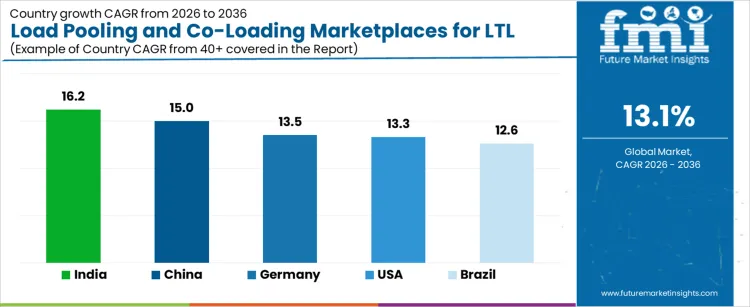
| Country | CAGR (2026–2036) |
|---|---|
| India | 16.2% |
| China | 15% |
| USA | 13.3% |
| Brazil | 12.6% |
| Germany | 13.5% |
What is Driving the Growth of Load Pooling and Co-Loading Marketplaces for LTL Shipments in India?
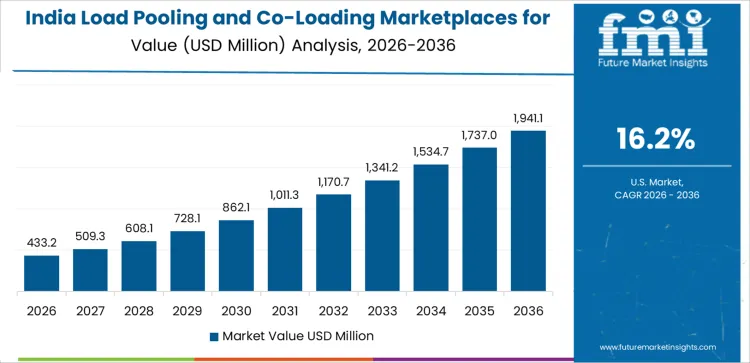
India’s Load Pooling and Co-Loading Marketplaces for LTL Shipments market is projected to grow at a CAGR of 16.2%. The growth is primarily driven by the increasing demand for efficient and cost-effective transportation solutions in India’s rapidly expanding logistics and e-commerce sectors. With businesses seeking to optimize transportation costs and improve supply chain efficiency, load pooling and co-loading platforms are becoming increasingly popular. These platforms allow multiple businesses to share truck space, lowering overall shipping costs and reducing environmental impact. As India’s infrastructure and logistics sector continue to modernize, the market for LTL shipment solutions is expected to grow steadily.
What is Contributing to the Growth of Load Pooling and Co-Loading Marketplaces for LTL Shipments in China?
China’s Load Pooling and Co-Loading Marketplaces for LTL Shipments market is expected to grow at a CAGR of 15%. As China’s logistics industry expands to meet the demands of a growing e-commerce sector, the need for more efficient shipping solutions becomes more pressing. Load pooling and co-loading offer an effective way to reduce transportation costs by allowing multiple shipments to share space in a single truck. The Chinese government’s ongoing efforts to improve transportation infrastructure and sustainability, combined with the growing demand for more flexible logistics solutions, are key factors driving the market’s growth. The increasing focus on cost-efficiency and environmental impact also contributes to the adoption of load pooling and co-loading solutions.
What is Driving the Load Pooling and Co-Loading Marketplaces for LTL Shipments Market Growth in the USA?
The USA’s Load Pooling and Co-Loading Marketplaces for LTL Shipments market is projected to grow at a CAGR of 13.3%. The growth is driven by the rising demand for more flexible, cost-effective shipping solutions, particularly in the e-commerce and retail sectors. As businesses seek to optimize transportation costs and reduce environmental impact, load pooling and co-loading platforms are gaining traction. These solutions allow companies to share truck space, making it more economical and efficient to transport smaller shipments. The increasing focus on sustainability and reducing transportation costs in the USA, along with advancements in digital logistics technologies, are expected to continue driving the market for load pooling and co-loading solutions.
What is Influencing the Growth of Load Pooling and Co-Loading Marketplaces for LTL Shipments in Brazil?
Brazil’s Load Pooling and Co-Loading Marketplaces for LTL Shipments market is projected to grow at a CAGR of 12.6%. As Brazil’s e-commerce and logistics industries continue to grow, there is a rising demand for efficient and cost-effective shipping solutions. Load pooling and co-loading offer an effective way to optimize space and reduce transportation costs by allowing multiple companies to share truck space for LTL shipments. Brazil’s focus on modernizing its logistics infrastructure and improving supply chain efficiency is driving the adoption of these solutions. Additionally, the country’s increasing interest in sustainable logistics practices is further supporting the growth of load pooling and co-loading platforms.
What is Contributing to the Growth of Load Pooling and Co-Loading Marketplaces for LTL Shipments in Germany?
Germany’s Load Pooling and Co-Loading Marketplaces for LTL Shipments market is expected to grow at a CAGR of 13.5%. Germany, as a major logistics hub in Europe, is increasingly focusing on sustainability and efficiency in its transportation sector. The growing demand for cost-effective and environmentally friendly shipping solutions is driving the adoption of load pooling and co-loading platforms. These solutions allow businesses to optimize truck space and reduce transportation costs by consolidating multiple shipments into a single truck. Germany’s strong e-commerce sector, along with its commitment to sustainability and reducing emissions, further contributes to the market’s growth, making these solutions integral to the country’s logistics landscape.
What is the Competitive Landscape for the Load Pooling and Co-Loading Marketplaces for LTL Shipments Market?
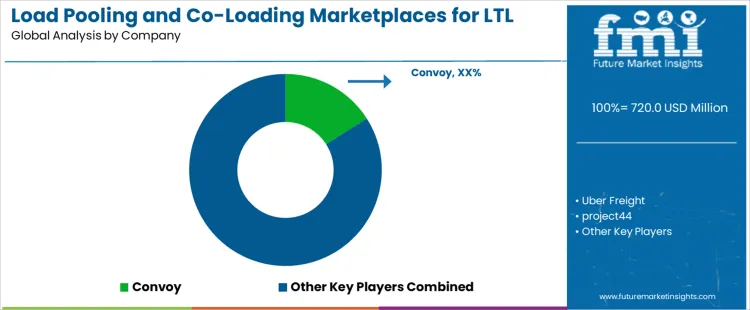
Global demand for load pooling and co loading marketplaces for less than truckload (LTL) shipments is increasing as shippers and carriers look to reduce transportation costs, improve asset utilisation and lower empty miles. Traditional LTL moves often incur higher per unit costs and longer transit times because freight is consolidated in fragmented waves. Load pooling and co loading platforms match compatible freight from multiple shippers to fill trailers more efficiently, reduce handling and shrink network emissions. Growth in e commerce, diversified order profiles and tighter delivery windows pressures logistics teams to leverage pooled capacity to maintain service levels without proportionately increasing fleet size. Rising fuel costs and sustainability goals further strengthen adoption of shared load models that spread utilisation across partners and reduce environmental impact per unit moved. Companies operating across North America, Europe and Asia Pacific increasingly integrate dynamic load pooling into transportation planning to balance demand peaks and optimise network performance.
On the supply side, a group of digital freight marketplaces and transport technology firms compete to lead this evolving segment. Convoy is recognised as a leading player with robust load matching algorithms, carrier network depth and visibility tools that support efficient co loading. Other competitors include Uber Freight, which leverages broad carrier access and platform scale; project44, known for real time visibility and integration with enterprise systems; Transfix, which focuses on AI driven freight matching and optimisation; and Loadsmart, offering automated pricing, capacity matching and digital booking tools. Competition among these providers centres on the accuracy of load matching, integration with shippers’ TMS and carriers’ systems, real time data access, scalability across regions and freight types, and ease of use. Providers that combine strong technology, extensive carrier networks and seamless integration with logistics workflows are best positioned to capture growth as the market for shared LTL capacity and load pooling expands globally.
Key Players of the Load Pooling and Co-Loading Marketplaces for LTL Shipments Market
- Convoy
- Uber Freight
- project44
- Transfix
- Loadsmart
Scope of the Report
| Items | Values |
|---|---|
| Quantitative Units (2026) | USD Million |
| Service Type | Load Pooling Services, Co-Loading Marketplace Platforms, Dynamic Matching & Optimization, Analytics & Performance Dashboards |
| End Use | Third-Party Logistics (3PL) Providers, E-Commerce & Retail, Manufacturing & Distribution, Grocery & CPG |
| Companies | Convoy, Uber Freight, project44, Transfix, Loadsmart |
| Regions Covered | North America, Latin America, Western Europe, Eastern Europe, South Asia and Pacific, East Asia, Middle East & Africa |
| Countries Covered | United States, Canada, Mexico, Brazil, Argentina, Germany, France, United Kingdom, Italy, Spain, Netherlands, China, India, Japan, South Korea, ANZ, GCC Countries, South Africa |
| Additional Attributes | Dollar by sales by service type, end-use, and region. Includes market trends in load pooling and co-loading for LTL shipments, performance in e-commerce, 3PL, and manufacturing logistics, demand for dynamic matching and optimization, cost-effectiveness, sustainability practices, regulatory compliance, market share and competitive positioning of key companies, and the role of load pooling and co-loading marketplaces in improving operational efficiency, reducing costs, and enhancing supply chain flexibility across industries. |
Key Segments in the Load Pooling and Co-Loading Marketplaces for LTL Shipments Market
Service Type
- Load Pooling Services
- Co Loading Marketplace Platforms
- Dynamic Matching & Optimization
- Analytics & Performance Dashboards
End Use
- Third Party Logistics (3PL) Providers
- E Commerce & Retail
- Manufacturing & Distribution
- Grocery & CPG
Region
- Asia Pacific
- China
- India
- Japan
- South Korea
- ASEAN
- Rest of Asia Pacific
- Europe
- Germany
- United Kingdom
- France
- Italy
- Spain
- Nordic
- BENELUX
- Rest of Europe
- North America
- United States
- Canada
- Mexico
- Latin America
- Brazil
- Chile
- Rest of Latin America
- Middle East & Africa
- Kingdom of Saudi Arabia
- Other GCC Countries
- Turkey
- South Africa
- Other African Union
- Rest of Middle East & Africa
Frequently Asked Questions
How big is the load pooling and co-loading marketplaces for ltl shipments market in 2026?
The global load pooling and co-loading marketplaces for ltl shipments market is estimated to be valued at USD 720.0 million in 2026.
What will be the size of load pooling and co-loading marketplaces for ltl shipments market in 2036?
The market size for the load pooling and co-loading marketplaces for ltl shipments market is projected to reach USD 2,465.8 million by 2036.
How much will be the load pooling and co-loading marketplaces for ltl shipments market growth between 2026 and 2036?
The load pooling and co-loading marketplaces for ltl shipments market is expected to grow at a 13.1% CAGR between 2026 and 2036.
What are the key product types in the load pooling and co-loading marketplaces for ltl shipments market?
The key product types in load pooling and co-loading marketplaces for ltl shipments market are load pooling services, co‑loading marketplace platforms, dynamic matching & optimization and analytics & performance dashboards.
Which end use segment to contribute significant share in the load pooling and co-loading marketplaces for ltl shipments market in 2026?
In terms of end use, third‑party logistics (3pl) providers segment to command 38.0% share in the load pooling and co-loading marketplaces for ltl shipments market in 2026.
Preview the report firsthand - request a free sample
Get SampleGet the brochure for pricing and purchase details.
Get PDFTable of Content
- Executive Summary
- Global Market Outlook
- Demand-side Trends
- Supply-side Trends
- Technology Roadmap Analysis
- Analysis and Recommendations
- Market Overview
- Market Coverage / Taxonomy
- Market Definition / Scope / Limitations
- Market Background
- Market Dynamics
- Drivers
- Restraints
- Opportunity
- Trends
- Scenario Forecast
- Demand in Optimistic Scenario
- Demand in Likely Scenario
- Demand in Conservative Scenario
- Opportunity Map Analysis
- Product Life Cycle Analysis
- Supply Chain Analysis
- Investment Feasibility Matrix
- Value Chain Analysis
- PESTLE and Porter’s Analysis
- Regulatory Landscape
- Regional Parent Market Outlook
- Production and Consumption Statistics
- Import and Export Statistics
- Market Dynamics
- Global Market Analysis 2021 to 2025 and Forecast, 2026 to 2036
- Historical Market Size Value (USD Million) Analysis, 2021 to 2025
- Current and Future Market Size Value (USD Million) Projections, 2026 to 2036
- Y-o-Y Growth Trend Analysis
- Absolute $ Opportunity Analysis
- Global Market Pricing Analysis 2021 to 2025 and Forecast 2026 to 2036
- Global Market Analysis 2021 to 2025 and Forecast 2026 to 2036, By Service Type
- Introduction / Key Findings
- Historical Market Size Value (USD Million) Analysis By Service Type , 2021 to 2025
- Current and Future Market Size Value (USD Million) Analysis and Forecast By Service Type , 2026 to 2036
- Load Pooling Services
- Co‑Loading Marketplace Platforms
- Dynamic Matching & Optimization
- Analytics & Performance Dashboards
- Y-o-Y Growth Trend Analysis By Service Type , 2021 to 2025
- Absolute $ Opportunity Analysis By Service Type , 2026 to 2036
- Global Market Analysis 2021 to 2025 and Forecast 2026 to 2036, By End Use
- Introduction / Key Findings
- Historical Market Size Value (USD Million) Analysis By End Use, 2021 to 2025
- Current and Future Market Size Value (USD Million) Analysis and Forecast By End Use, 2026 to 2036
- Third‑Party Logistics (3PL) Providers
- E‑Commerce & Retail
- Manufacturing & Distribution
- Grocery & CPG
- Y-o-Y Growth Trend Analysis By End Use, 2021 to 2025
- Absolute $ Opportunity Analysis By End Use, 2026 to 2036
- Global Market Analysis 2021 to 2025 and Forecast 2026 to 2036, By Region
- Introduction
- Historical Market Size Value (USD Million) Analysis By Region, 2021 to 2025
- Current Market Size Value (USD Million) Analysis and Forecast By Region, 2026 to 2036
- North America
- Latin America
- Western Europe
- Eastern Europe
- East Asia
- South Asia and Pacific
- Middle East & Africa
- Market Attractiveness Analysis By Region
- North America Market Analysis 2021 to 2025 and Forecast 2026 to 2036, By Country
- Historical Market Size Value (USD Million) Trend Analysis By Market Taxonomy, 2021 to 2025
- Market Size Value (USD Million) Forecast By Market Taxonomy, 2026 to 2036
- By Country
- USA
- Canada
- Mexico
- By Service Type
- By End Use
- By Country
- Market Attractiveness Analysis
- By Country
- By Service Type
- By End Use
- Key Takeaways
- Latin America Market Analysis 2021 to 2025 and Forecast 2026 to 2036, By Country
- Historical Market Size Value (USD Million) Trend Analysis By Market Taxonomy, 2021 to 2025
- Market Size Value (USD Million) Forecast By Market Taxonomy, 2026 to 2036
- By Country
- Brazil
- Chile
- Rest of Latin America
- By Service Type
- By End Use
- By Country
- Market Attractiveness Analysis
- By Country
- By Service Type
- By End Use
- Key Takeaways
- Western Europe Market Analysis 2021 to 2025 and Forecast 2026 to 2036, By Country
- Historical Market Size Value (USD Million) Trend Analysis By Market Taxonomy, 2021 to 2025
- Market Size Value (USD Million) Forecast By Market Taxonomy, 2026 to 2036
- By Country
- Germany
- UK
- Italy
- Spain
- France
- Nordic
- BENELUX
- Rest of Western Europe
- By Service Type
- By End Use
- By Country
- Market Attractiveness Analysis
- By Country
- By Service Type
- By End Use
- Key Takeaways
- Eastern Europe Market Analysis 2021 to 2025 and Forecast 2026 to 2036, By Country
- Historical Market Size Value (USD Million) Trend Analysis By Market Taxonomy, 2021 to 2025
- Market Size Value (USD Million) Forecast By Market Taxonomy, 2026 to 2036
- By Country
- Russia
- Poland
- Hungary
- Balkan & Baltic
- Rest of Eastern Europe
- By Service Type
- By End Use
- By Country
- Market Attractiveness Analysis
- By Country
- By Service Type
- By End Use
- Key Takeaways
- East Asia Market Analysis 2021 to 2025 and Forecast 2026 to 2036, By Country
- Historical Market Size Value (USD Million) Trend Analysis By Market Taxonomy, 2021 to 2025
- Market Size Value (USD Million) Forecast By Market Taxonomy, 2026 to 2036
- By Country
- China
- Japan
- South Korea
- By Service Type
- By End Use
- By Country
- Market Attractiveness Analysis
- By Country
- By Service Type
- By End Use
- Key Takeaways
- South Asia and Pacific Market Analysis 2021 to 2025 and Forecast 2026 to 2036, By Country
- Historical Market Size Value (USD Million) Trend Analysis By Market Taxonomy, 2021 to 2025
- Market Size Value (USD Million) Forecast By Market Taxonomy, 2026 to 2036
- By Country
- India
- ASEAN
- Australia & New Zealand
- Rest of South Asia and Pacific
- By Service Type
- By End Use
- By Country
- Market Attractiveness Analysis
- By Country
- By Service Type
- By End Use
- Key Takeaways
- Middle East & Africa Market Analysis 2021 to 2025 and Forecast 2026 to 2036, By Country
- Historical Market Size Value (USD Million) Trend Analysis By Market Taxonomy, 2021 to 2025
- Market Size Value (USD Million) Forecast By Market Taxonomy, 2026 to 2036
- By Country
- Kingdom of Saudi Arabia
- Other GCC Countries
- Turkiye
- South Africa
- Other African Union
- Rest of Middle East & Africa
- By Service Type
- By End Use
- By Country
- Market Attractiveness Analysis
- By Country
- By Service Type
- By End Use
- Key Takeaways
- Key Countries Market Analysis
- USA
- Pricing Analysis
- Market Share Analysis, 2025
- By Service Type
- By End Use
- Canada
- Pricing Analysis
- Market Share Analysis, 2025
- By Service Type
- By End Use
- Mexico
- Pricing Analysis
- Market Share Analysis, 2025
- By Service Type
- By End Use
- Brazil
- Pricing Analysis
- Market Share Analysis, 2025
- By Service Type
- By End Use
- Chile
- Pricing Analysis
- Market Share Analysis, 2025
- By Service Type
- By End Use
- Germany
- Pricing Analysis
- Market Share Analysis, 2025
- By Service Type
- By End Use
- UK
- Pricing Analysis
- Market Share Analysis, 2025
- By Service Type
- By End Use
- Italy
- Pricing Analysis
- Market Share Analysis, 2025
- By Service Type
- By End Use
- Spain
- Pricing Analysis
- Market Share Analysis, 2025
- By Service Type
- By End Use
- France
- Pricing Analysis
- Market Share Analysis, 2025
- By Service Type
- By End Use
- India
- Pricing Analysis
- Market Share Analysis, 2025
- By Service Type
- By End Use
- ASEAN
- Pricing Analysis
- Market Share Analysis, 2025
- By Service Type
- By End Use
- Australia & New Zealand
- Pricing Analysis
- Market Share Analysis, 2025
- By Service Type
- By End Use
- China
- Pricing Analysis
- Market Share Analysis, 2025
- By Service Type
- By End Use
- Japan
- Pricing Analysis
- Market Share Analysis, 2025
- By Service Type
- By End Use
- South Korea
- Pricing Analysis
- Market Share Analysis, 2025
- By Service Type
- By End Use
- Russia
- Pricing Analysis
- Market Share Analysis, 2025
- By Service Type
- By End Use
- Poland
- Pricing Analysis
- Market Share Analysis, 2025
- By Service Type
- By End Use
- Hungary
- Pricing Analysis
- Market Share Analysis, 2025
- By Service Type
- By End Use
- Kingdom of Saudi Arabia
- Pricing Analysis
- Market Share Analysis, 2025
- By Service Type
- By End Use
- Turkiye
- Pricing Analysis
- Market Share Analysis, 2025
- By Service Type
- By End Use
- South Africa
- Pricing Analysis
- Market Share Analysis, 2025
- By Service Type
- By End Use
- USA
- Market Structure Analysis
- Competition Dashboard
- Competition Benchmarking
- Market Share Analysis of Top Players
- By Regional
- By Service Type
- By End Use
- Competition Analysis
- Competition Deep Dive
- Convoy
- Overview
- Product Portfolio
- Profitability by Market Segments (Product/Age /Sales Channel/Region)
- Sales Footprint
- Strategy Overview
- Marketing Strategy
- Product Strategy
- Channel Strategy
- Uber Freight
- project44
- Transfix
- Loadsmart
- Convoy
- Competition Deep Dive
- Assumptions & Acronyms Used
- Research Methodology


