

- Industry Size (2026)
- USD 1650.0 Mn
- Forecast (2036)
- USD 3450.0 Mn
- CAGR (2026 to 2036)
- 7.7%
Drug-loaded Pellets Market Size, Market Forecast and Outlook By FMI
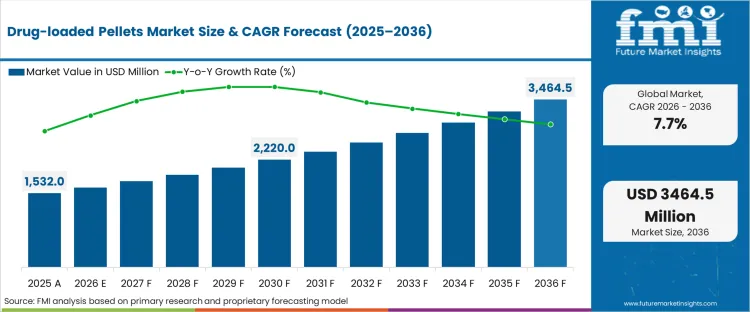
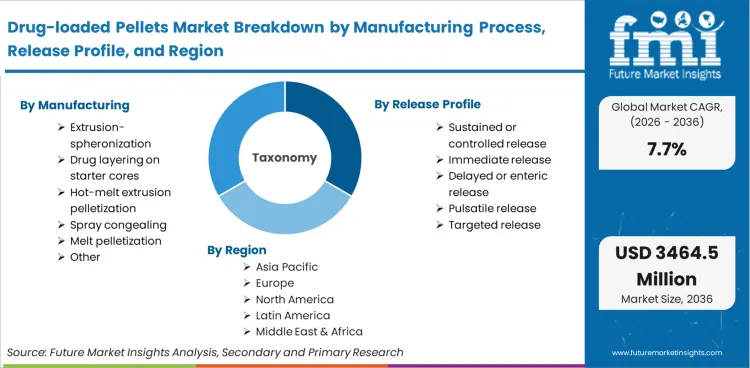
In 2026, the drug-loaded pellets market was valued at USD 1,650.0 million. Based on Future Market Insights analysis, demand for drug-loaded pellets is estimated to grow to USD 3,450.0 million by 2036. FMI projects a CAGR of 7.7% during the forecast period.
Absolute dollar growth of USD 1,800.0 million over the decade signals structural expansion rather than a packaging-led cycle. As per FMI, growth is expected to be supported by wider use of multiparticulate dosing to manage release control and reduce peak–trough variability, while scale-up validation, batch-to-batch uniformity requirements, and tech-transfer complexity are expected to pace adoption in regulated launches. “Aenova’s extended range of development services allows us to support pharmaceutical and biotech companies in accelerating their programs and optimizing their resources, Our Aenovation™ program is a reflection of our commitment to innovation and excellence in pharmaceutical development.” said Florent Bordet, Chief Scientific Officer at Aenova. [1]
Summary of Drug-loaded Pellets Market
- Drug-loaded Pellets Market Definition:
- The industry covers multi-particulate drug-loaded pellet systems used to build modified release and targeted release oral dosage forms, manufactured through standardized pelletization and coating processes for regulated pharmaceutical supply.
- Demand Drivers in the Market:
- Formulation teams are using pellet platforms to achieve sustained and delayed release profiles without increasing single-unit dose size.
- Generic manufacturers are adopting pellet-based MUPS and capsule fills to reduce bioequivalence risk through controlled release design.
- CDMO and CMO programs are scaling multi-particulate projects where process robustness and batch-to-batch uniformity drive supplier selection.
- Key Segments Analyzed in The FMI Report:
- By Manufacturing Process: Extrusion-spheronization leads at 34% share in 2026, followed by drug layering on starter cores at 28% share.
- By Release Profile: Sustained and Controlled Release leads at 42% share in 2026, followed by immediate release at 26% share.
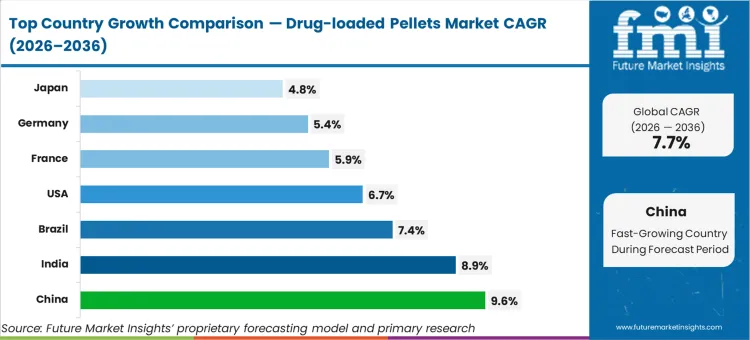
- Geography: China and India show the fastest growth at 9.6% and 8.9% CAGR, supported by expanding oral solid dose capacity and higher outsourcing activity.
- Analyst Opinion at FMI:
- Sabyasachi Ghosh, Principal Consultant at Future Market Insights, opines, ‘Supplier preference is being shaped by pellet size uniformity, coating reproducibility, and tech-transfer discipline, since minor variability can shift dissolution curves and trigger repeat development cycles.’
- Strategic Implications and Executive Takeaways:
- Concentrate capability builds on sustained-release pellet programs, with tight in-process controls that protect dissolution consistency.
- Strengthen tech-transfer playbooks for extrusion spheronization lines, since scale-up failures often start with moisture and torque variability.
- Align commercial offers to generic and CDMO demand where repeat projects depend on predictable timelines and validated documentation packs.
- Methodology:
- As per FMI, sizing and splits were triangulated using company primary disclosures, manufacturing capability mapping, and customer-type demand logic.
- Segment shares were validated by linking release-profile usage to common oral dosage form designs and repeat manufacturing workflows.
- Pricing sensitivity was stress tested across process types and coating intensity to confirm revenue movement under realistic mix shifts.
China (9.6% CAGR, supported by expanding oral solid dose capacity and higher adoption of controlled-release formats) and India (8.9% CAGR, driven by rising generic and CDMO output) are expected to lead growth. Brazil (7.4% CAGR) is expected to expand through broader use of modified-release products. The U.S. (6.7% CAGR) is expected to grow through innovator demand for differentiated release profiles. Mature markets including France (5.9%), Germany (5.4%), and Japan (4.8%) are expected to contribute more through replacement demand, constrained by validation timelines and conservative platform switching.
Drug-loaded Pellets Market Definition
The market includes multiparticulate drug-loaded pellets that are produced as intermediates or finished oral dosage forms designed for the purpose of controlled, delayed, or targeted drug release. The pellets are processed by methods such as extrusion/spheronization, drug coating on starter cores, melt or hot melt extrusion pelletization, and spray congealing and are packaged in capsules, MUPS tablets, sachets/sprinkles, oral suspensions, and other forms. The customers include innovator pharma, generic companies, CDMO/CMO service providers, research institutes, and veterinary pharma companies. The market is driven by the requirements of release profile, manufacturability, and quality specifications related to uniformity and particle size.
Drug-loaded Pellets Market Inclusions
The report includes global and regional market sizing and a 10-year forecast for 2026 to 2036. Segment-level sizing is provided by manufacturing process, release profile, therapeutic area, dosage form integration, customer type, and particle size range, with country-level CAGR comparisons across key markets. Competitive positioning is covered for major pellet technology and manufacturing providers, along with analysis of outsourcing patterns, tech-transfer considerations, and quality expectations affecting platform selection, as per FMI analysis.
Drug-loaded Pellets Market Exclusions
The scope excludes conventional single-unit oral solids that do not use pelletized multiparticulates, including standard immediate-release tablets and capsules filled with simple powders. It also omits APIs sold as bulk substances without pelletization, and excludes finished drug product revenue where pellets are only a minor internal component and not separately priced. Non-pharma industrial pellets are excluded. The focus remains on drug-loaded pellet intermediates and pellet-integrated dosage formats aligned to the listed segments and customer types.
Drug-loaded Pellets Market Research Methodology
- Primary Research: Interviews were conducted with formulation scientists, oral solid dose manufacturing leaders, CDMO program managers, QA stakeholders, and pellet technology suppliers to validate process preferences, scale-up constraints, and outsourcing drivers.
- Desk Research: Public information from regulators, standards bodies, peer-reviewed publications, trade associations, and company primary disclosures was reviewed to benchmark modified-release development and quality expectations.
- Market-Sizing and Forecasting: A hybrid model was applied using therapeutic area demand logic and dosage form mix, then reconciled using segment shares across manufacturing process, release profile, and customer type.
- Data Validation and Update Cycle: Outputs were checked through internal consistency screening across segment totals and country growth rates, with variance review applied before finalisation.
Segmental Analysis
Drug-loaded Pellets Market Analysis by Manufacturing Process
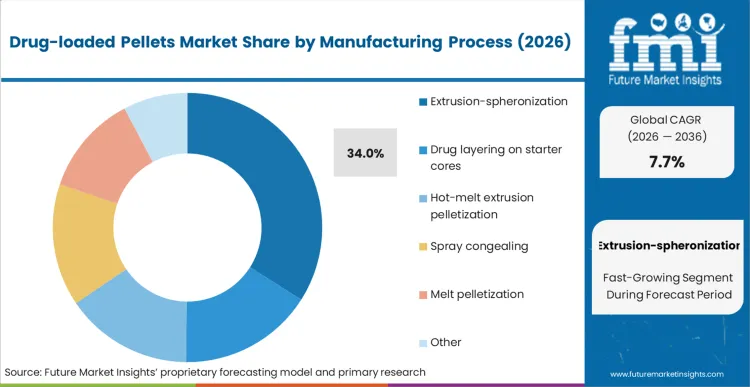
Extrusion-spheronization is projected to command a 34% share in 2026, followed by drug layering on starter cores with a 28% share. Extrusion-spheronization is the leader because it is suited for large-scale production of pellets with controlled size distribution, which is ideal for sustained release formulations that require uniform coating. Drug layering is the second market because it is suited for potent APIs, but cycle time and drug layering efficiency impact scale economies.
- Uniform pellets that coat predictably: Extrusion spheronisation is described as a well-established way to produce pellets with a spherical shape and narrow size distribution, and that regular sizing makes film coating easier and more consistent, which is critical for sustained-release multiparticulates.[2]
- Industrial equipment and workflow readiness: Commercial pellet platforms explicitly support pelletizing and pellet rounding of extrudates, indicating that extrusion/spheronization is engineered into standard pharma equipment stacks (pelletizing, layering, coating), which supports scale economics and routine GMP production.[3]
- Regulatory and tech-transfer comfort: Extrusion spheronization keeps leading because it is a long-used, well-characterised pelletisation route, so process validation, scale-up transfer, and post-approval change control tend to be more straightforward than newer or more equipment-sensitive alternatives.
Drug-loaded Pellets Market Analysis by Release Profile
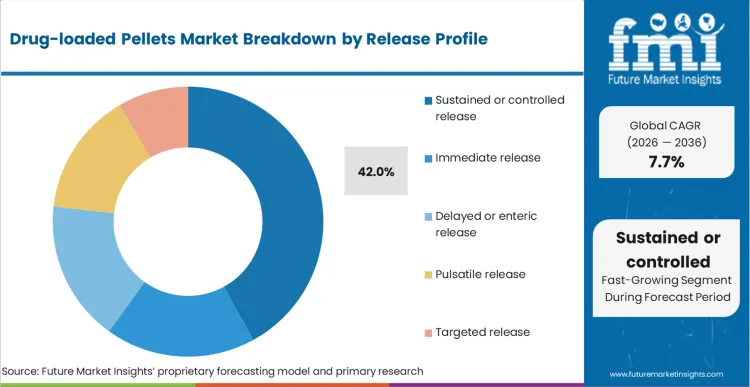
Controlled and sustained release holds the second-largest market share of 42% in 2026, followed by immediate release with a market share of 26%, according to a report by FMI. The dominance of sustained release products is a result of the growing need for a smoother pharmacokinetic profile and less frequent dosing, which is met by the use of coated pellet technology in capsules or MUPS tablets.
- Compliance boost due to fewer dosing frequencies: Meta-analyses of chronic infectious diseases have found that the more the dosing frequency is reduced, the better the compliance rates, which makes a case for the widespread use of sustained or controlled release formulations that provide more consistent drug levels and smaller peak-trough differences. [4]
- MUPS pellets improve exposure consistency: Reviews on multiple-unit pellet systems have found fewer chances of dose dumping, more consistent bioavailability, and smaller plasma fluctuations, which directly corresponds to the reason why sustained and controlled release formulations succeed in pellet-based oral delivery systems. [5]
- Dose control and product differentiation fit: Sustained and controlled release is chosen most often because coated pellet systems can reliably deliver drug over many hours, helping brands reduce side effects from peaks, support once or twice daily dosing, and create a clear “value add” versus simple immediate-release tablets.
Drug-loaded Pellets Market Drivers, Restraints, And Opportunities
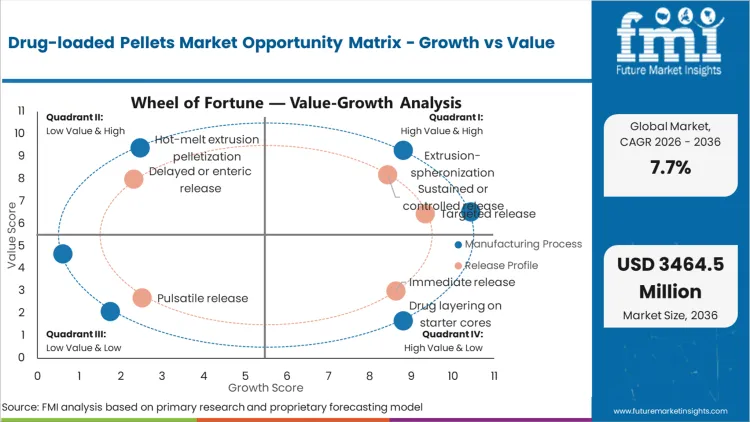
Future Market Insights analysis that historical patterns point at a formulation-led oral solids category where demand is anchored in controlled release design, dissolution curve management, and multi-particulate manufacturing discipline. Adoption is being driven by the need to balance dose loading, swallowability, and release performance within capsules and MUPS tablets, as per FMI.
While growth is being restrained by process complexity, longer development timelines, and tighter dissolution acceptance criteria that raise the cost of change-control, value expansion is being supported by sustained-release dominance and increasing outsourcing to specialized manufacturers. Based on FMI’s report, supplier selection is increasingly being filtered by reproducibility, documentation readiness, and predictable tech-transfer outcomes.
- Quality-Led Upgrading: Growth is shifting toward suppliers that can hold narrow pellet size distributions and stable coating outcomes across batches.
- Development-Cycle Restraint: Dissolution failures and scale-up variability can extend timelines, slowing conversion from pilot to commercial supply.
- Controlled-Release Pull Mechanism: Sustained-release programs are sustaining repeat demand as capsules and MUPS designs expand in chronic therapies.
Regional Analysis
Based on the regional analysis, drug-loaded pellets market is segmented into North America, Latin America, East Asia, South Asia & Pacific, Western Europe, Eastern Europe and Middle East & Africa across 40+ countries. Regional performance is interpreted through adoption of modified-release oral solids, scale-up activity in palletization lines, and outsourcing patterns among CMOs and CDMOs, as per FMI. The full report also offers market attractiveness analysis based on regional trends.
.webp "Top Country Growth Comparison Drug Loaded Pellets Market Cagr (2026 2036)")
| Country | CAGR |
|---|---|
| United States | 6.7% |
| India | 8.9% |
| Germany | 5.4% |
| China | 9.6% |
| Japan | 4.8% |
| France | 5.9% |
| Brazil | 7.4% |
Source: Future Market Insights (FMI) analysis, based on proprietary forecasting model and primary research
North America Drug-loaded Pellets Market Analysis
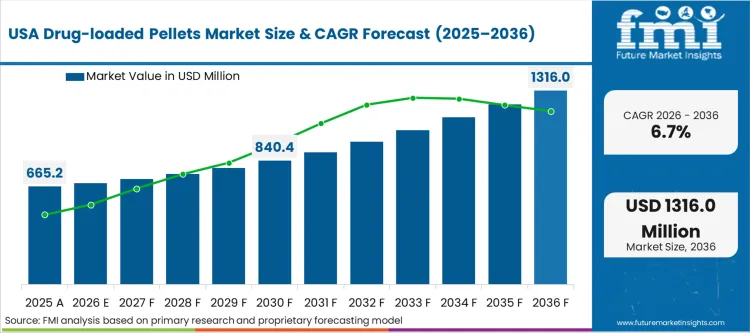
North America is shaped by formulation-led lifecycle management, where pellet-based systems are selected to achieve controlled release, taste masking, and multiparticulate flexibility across capsules and MUPS tablets. Catalent participates through development-to-commercial services that support pelletization and downstream oral solid manufacturing. Thermo Fisher Scientific supports CDMO-linked oral solid capacity that can absorb scale-up work for controlled release programs. Based on FMI’s report, innovation-led demand and generic competition both support continued use of multiparticulate approaches.
- United States.: In the United States, drug-loaded pellets are expected to expand at 6.7% CAGR through 2036, supported by higher use of sustained and controlled release profiles in chronic therapies and steady outsourcing of complex oral solids. Capsules remain the dominant integration route where multiparticulate dosing flexibility is required, while MUPS tablets are used where patient convenience and dose uniformity are prioritized.
FMI’s report includes a detailed analysis of the growth in the North American region, along with a country-wise assessment that includes the U.S., Canada and Mexico. Readers can also find regional trends, regulations, and market growth based on different segments and countries in the North America region.
Latin America Drug-loaded Pellets Market Analysis
Latin America remains import-reliant for many high-spec multiparticulate products, with selective local manufacturing for oral solids. Demand is paced by generic uptake, availability of appropriate excipient supply, and access to contracted pelletization capability. Based on FMI’s report, uptake remains concentrated where local manufacturers and regional CDMOs can support sustained release formats at acceptable cost.
- Brazil: Brazil is expected to record 7.4% CAGR through 2036, supported by growing generic manufacturing activity and rising use of controlled release oral solids in cardiovascular and CNS categories. Capsules remain common for multiparticulate formats, while MUPS adoption increases where local tableting capacity supports it. Constraint is created by limited domestic pelletization infrastructure for advanced processes, which pushes certain programs toward imports or contracted supply.
The report consists of a detailed analysis for the market in Brazil, Argentina and Rest of Latin America. Readers can find detailed information about several factors, such as the pricing analysis and regional trends, which are impacting growth in the Latin America region.
East Asia Drug-loaded Pellets Market Analysis
East Asia is driven by scale-up in complex generics and expanding CDMO capacity, where multiparticulate delivery is used to replicate reference release profiles and improve formulation performance. Evonik supports demand through polymer and formulation inputs aligned to controlled release needs. Lonza and other service providers participate where pelletization and downstream processing are integrated into broader oral solid programs. FMI analysts note that sustained and controlled release remains the lead release profile in many programs due to chronic therapy demand.
- China: China leads at 9.6% CAGR through 2036, driven by expanding generic manufacturing and increased focus on modified release formulations that compete on performance and compliance. Drug layering on starter cores and extrusion-spheronization remain common routes for scalable pellet output, while spray congealing is adopted more selectively.
- Japan: Japan is forecast at 4.8% CAGR through 2036, shaped by mature oral solid manufacturing and a measured shift toward multiparticulate approaches for lifecycle management. Adoption remains selective, with stronger pull in controlled release programs and in formulations that require tight release consistency.
The full report analyzes the drug-loaded pellets market across East and South Asia from 2021-2036, covering pricing, trends, and growth drivers in China, Japan, South Korea, India, Indonesia, Malaysia, and Thailand. The assessment highlights trends that dictate regional demand and procurement behaviour.
South Asia & Pacific Drug-loaded Pellets Market Analysis
South Asia & Pacific functions as a formulation and manufacturing scale-up region, where demand is supported by expanding CDMO and generic manufacturer activity and rising use of controlled release oral solids. Colorcon supports adoption through functional coating systems used in modified release pellets and MUPS. Catalent and other service providers influence demand where development support and tech transfer capability is required. FMI analysts note that capsule-based pellets remain dominant due to integration simplicity.
- India: India is expected to rise at 8.9% CAGR through 2036, supported by strong generic manufacturing and growing CDMO work in controlled release formats. Extrusion-spheronization and layering processes remain widely used due to scalability and familiarity. Constraint is created by validation workload and capacity scheduling at high-utilization plants, which can extend lead times for complex pellet programs.
FMI’s report includes a detailed analysis of the growth in the South Asia & Pacific region, along with a country-wise assessment that includes India, ASEAN Countries, Australia & New Zealand and Rest of South Asia. Readers can also find regional trends, regulations, and market growth based on different segments and countries in the South Asia & Pacific region.
Western Europe Drug-loaded Pellets Market Analysis
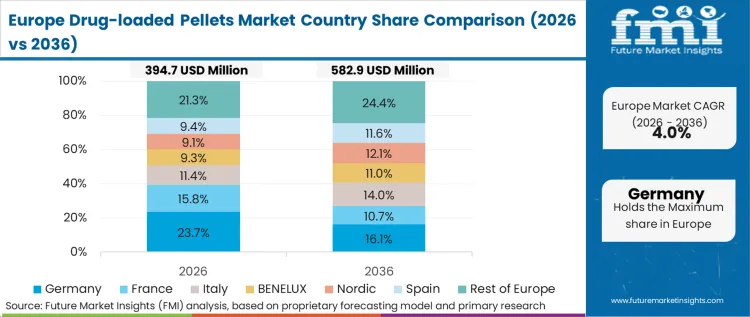
Western Europe is shaped by regulated manufacturing discipline and strong presence of specialty oral solid CMOs, where multiparticulate pellets are used for controlled release and for complex generics that require precise release matching. Evonik participates through excipient and polymer inputs supporting modified release designs. Siegfried and Recipharm maintain relevance through oral solid manufacturing services aligned to regulated markets. Based on FMI’s report, demand remains anchored in sustained and controlled release profiles.
- Germany: Germany posts 5.4% CAGR through 2036, supported by regulated manufacturing depth and steady pipeline activity in controlled release oral solids. Hot-melt extrusion pelletization remains selective, while extrusion-spheronization and layering approaches are used more broadly where release profile control is critical.
- France: France is projected at 5.9% CAGR through 2036, with growth supported by ongoing use of modified release dosage forms and demand for multiparticulate formats that improve tolerability and adherence. MUPS tablets and capsule integration both remain relevant, with selection dependent on patient segment and manufacturing economics.
FMI’s analysis of drug-loaded pellets market in Western Europe consists of country-wise assessment that includes Germany, U.K., France, Italy, Spain, BENELUX, Nordic Countries and Rest of Western Europe. Readers can know various regulations and latest trends in the regional market.
Competitive Aligners for Market Players
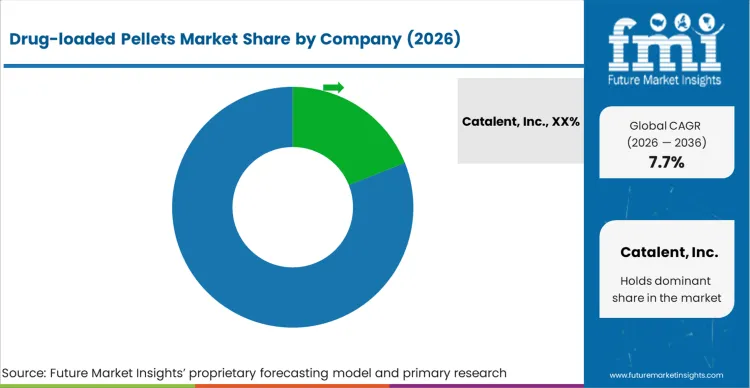
Market structure remains fragmented, yet practical competition is concentrated among a limited set of suppliers that can run validated pelletisation processes, maintain tight batch-to-batch control of drug loading and size distribution, and support regulated customers with documentation that stands up to audit and filing review. Competition is shaped by process reproducibility and scale-up success rather than short-cycle price movement, since switching suppliers can trigger revalidation work and comparability risk for modified release products. Capability across multiple manufacturing routes is a key differentiator because buyers often want a partner that can meet both development and commercial needs under one quality framework, as per FMI.
Companies with structural advantages tend to combine specialized pelletisation know-how with scalable equipment, analytical capability, and quality systems that manage variability in particle size and release performance. Suppliers that can handle sustained or controlled release profiles with consistent dissolution outcomes are better positioned because many programs require stable performance across batches and across sites. Depth in dosage form integration, including capsules and MUPS tablets, also supports account retention because it reduces downstream formulation risk for customers. Providers with broader CDMO footprints can offer redundancy, tech transfer support, and capacity planning that lowers supply risk during commercial ramps, based on FMI’s report.
Customer concentration reinforces buyer leverage. Innovator pharma and large generic manufacturers often qualify more than one supplier or internal route, maintain approved alternates, and use milestone-based contracts that tie volumes to performance and filing progress. CDMOs and CMOs compete on timelines, development support, and regulatory documentation response, which keeps pricing disciplined for standard pelletisation services. Pricing power is stronger where tighter particle size control and complex release profiles raise switching friction and increase the cost of revalidation. This procurement approach supports measured premiums mainly in programs where dissolution and size distribution are critical to bioequivalence or therapeutic performance, Future Market Insights analysis.
Recent Developments
The report includes full coverage of key trends from competitive benchmarking. Some of the recent developments covered in the reports:
- In February 2026, GEA highlighted rising adoption of drug-loaded pellets made via advanced extrusion spheronisation, citing better release control and scalable, reproducible production. It showcased its GMP-ready NICA platform to deliver consistent pellet size and content uniformity from development to commercial scale. [6]
- In February 2025, Ardena, a specialist pharmaceutical Contract Development and Manufacturing Organization (CDMO) announced that it has successfully completed the acquisition of Catalent’s state-of-the-art drug product manufacturing facility in Somerset, New Jersey. This acquisition marks strengthening of its capabilities in late-stage and small-scale commercial manufacturing of oral drug products and further integrating its comprehensive suite of drug development services. [7]
Key players in Drug-Loaded Pellets Market
- Catalent, Inc.
- Evonik Industries AG
- Colorcon, Inc.
- Thermo Fisher Scientific Inc.
- Lonza Group AG
- Aenova Group GmbH
- Recipharm AB
- Siegfried Holding AG
- CordenPharma International
- Glatt GmbH
Scope of the Report
| Metric | Value |
|---|---|
| Market Definition | The drug-loaded pellets market covers global production and trade of multiparticulate pellet-based drug delivery intermediates and finished-dose integrations used to achieve immediate, delayed, or controlled release profiles, where demand is shaped by oral solid dose lifecycle management, swallowability and sprinkle-use needs, and scale-up and quality control requirements across innovator, generic, and contract manufacturing settings. |
| Manufacturing Process Segmentation | Extrusion-spheronization, Drug layering on starter cores, Hot-melt extrusion pelletization, Spray congealing, Melt pelletization, Other |
| Release Profile Segmentation | Immediate release, Sustained or controlled release, Delayed or enteric release, Pulsatile release, Targeted release |
| Therapeutic Area Coverage | CNS, Cardiovascular, Gastrointestinal, Oncology, Pain or anti-inflammatory, Endocrine, Other |
| Dosage Form Integration Coverage | Capsules, Tablets (MUPS), Sachets or sprinkles, Oral suspensions, Other (implants etc.) |
| Customer Type Coverage | Innovator pharma, Generic manufacturers, CDMO or CMO, Research institutes, Veterinary pharma |
| Particle Size Range Coverage | <300 µm, 300-600 µm, 600-1000 µm, >1000 µm |
| Regions Covered | North America, Latin America, East Asia, South Asia & Pacific, Western Europe, Eastern Europe, and Middle East & Africa. |
| Countries Covered | United States, Canada, Mexico, Brazil, Argentina, Germany, France, United Kingdom, Italy, Spain, China, India, Japan, South Korea, Indonesia, Australia and 40+ countries |
| Key Companies Profiled | Catalent, Inc., Evonik Industries AG, Colorcon, Inc., Thermo Fisher Scientific Inc., Lonza Group AG, Aenova Group GmbH, Recipharm AB, Siegfried Holding AG, CordenPharma International, Glatt GmbH |
| Forecast Period | 2026 to 2036 |
| Approach | Hybrid top down and bottom up market modeling validated through primary interviews with formulation teams, pellet technology suppliers, and CDMO stakeholders, supported by capacity and technology mapping and product mix triangulation, as per FMI. |
| Quantitative Units | USD 1,650.0 Mn (2026) to USD 3,450.0 Mn (2036), at a CAGR of 7.7% |
Drug-Loaded Pellets Market Analysis by Segments
Manufacturing Process:
- Extrusion-spheronization
- Drug layering on starter cores
- Hot-melt extrusion pelletization
- Spray congealing
- Melt pelletization
- Other
Release Profile:
- Immediate release
- Sustained or controlled release
- Delayed or enteric release
- Pulsatile release
- Targeted release
Therapeutic Area:
- CNS
- Cardiovascular
- Gastrointestinal
- Oncology
- Pain or anti-inflammatory
- Endocrine
- Other
Dosage Form Integration:
- Capsules
- Tablets (MUPS)
- Sachets or sprinkles
- Oral suspensions
- Other (implants etc.)
Customer Type:
- Innovator pharma
- Generic manufacturers
- CDMO or CMO
- Research institutes
- Veterinary pharma
Particle size Range
- <300 µm
- 300-600 µm
- 600-1000 µm
- >1000 µm
Region:
- North America
- USA
- Canada
- Mexico
- Latin America
- Brazil
- Argentina
- Rest of Latin America
- East Asia
- China
- Japan
- South Korea
- South Asia & Pacific
- India
- ASEAN Countries
- Australia & New Zealand
- Rest of South Asia
- Western Europe
- Germany
- UK
- France
- Italy
- Spain
- BENELUX
- Nordic Countries
- Rest of Western Europe
- Eastern Europe
- Russia
- Hungary
- Poland
- Rest of Eastern Europe
- Middle East & Africa
- Saudi Arabia
- Türkiye
- South Africa
- Other African Union
- Rest of Middle East & Africa
Bibliography
- [1] Aenova Group (2025) Aenova launches Aenovation program to accelerate pharmaceutical development.
- [2] Heinrich-Heine-Universität Düsseldorf (2012). Spheronization Process - Particle Kinematics
- and Pellet Formation Mechanisms.
- [3] Glatt (2015). Laboratory Units for The Production of Solids in The Pharmaceutical Industry.
- [4] Journal of emerging technologies and innovative research (JETIR). (2024). Multiparticulate Drug Delivery Systems – A Brief Review On Pharmaceutical Pellets and Pelletization Techniques.
- [5] Bentham Science Publishers (2017). Multiple-Unit Pellet Systems (MUPS): Production and Applications as Advanced Drug Delivery Systems.
- [6] Manufacturing Chemist (2026). Drug-loaded pellets: unlocking flexible oral dosage design with modern pelletisation technologies.
- [7] Ardena (2025), Ardena Completes Acquisition of Advanced Drug Product Manufacturing Facility from Catalent and Expands Bioanalytical Services in North America.
This Report Addresses
- Market intelligence to support formulation strategy and capacity planning for multiparticulate oral delivery programs
- Market size estimation and 10-year revenue forecasts from 2026 to 2036 for drug-loaded pellet demand
- Growth opportunity mapping across processes, release profiles, therapeutic use, and dose integration pathways
- Segment and regional revenue forecasts aligned to the stated taxonomy and covered geographies
- Competition strategy assessment covering capability depth, scale fit, and customer mix positioning across key suppliers
- Product and compliance tracking focused on modified release controls, documentation discipline, and change control practices
- Regulatory impact analysis covering CMC expectations for release performance, quality attributes, and lifecycle management
- Market report delivery in PDF, Excel, PPT, and interactive dashboard formats for executive and operational use
Frequently Asked Questions
How large is the demand for Drug-Loaded Pellets in the global market in 2026?
Demand for Drug-loaded pellets in the global market is estimated to be valued at USD 1,650.0 Mn in 2026, as per FMI.
What will be the market size of Drug-Loaded Pellets in the global market by 2036?
Market size for Drug-loaded pellets is projected to reach USD 3,450.0 Mn by 2036.
What is the expected demand growth for Drug-Loaded Pellets in the global market between 2026 and 2036?
Demand for Drug-loaded pellets in the global market is expected to grow at a CAGR of 7.7% between 2026 and 2036.
Which manufacturing process is poised to lead global demand by 2026?
Extrusion-spheronization is expected to be the leading process, capturing 34% share in 2026.
Which release profile is expected to account for the largest share in 2026?
Sustained or controlled release is expected to hold the highest share at 42% in 2026.
Which dosage form integration is expected to dominate the 2026 mix?
Capsules are expected to lead dosage form integration with 46% share in 2026.
Preview the report firsthand - request a free sample
Get SampleGet the brochure for pricing and purchase details.
Get PDFTable of Content
- Executive Summary
- Global Market Outlook
- Demand-side Trends
- Supply-side Trends
- Technology Roadmap Analysis
- Analysis and Recommendations
- Market Overview
- Market Coverage / Taxonomy
- Market Definition / Scope / Limitations
- Research Methodology
- Chapter Orientation
- Analytical Lens and Working Hypotheses
- Market Structure, Signals, and Trend Drivers
- Benchmarking and Cross-market Comparability
- Market Sizing, Forecasting, and Opportunity Mapping
- Research Design and Evidence Framework
- Desk Research Programme (Secondary Evidence)
- Company Annual and Sustainability Reports
- Peer-reviewed Journals and Academic Literature
- Corporate Websites, Product Literature, and Technical Notes
- Earnings Decks and Investor Briefings
- Statutory Filings and Regulatory Disclosures
- Technical White Papers and Standards Notes
- Trade Journals, Industry Magazines, and Analyst Briefs
- Conference Proceedings, Webinars, and Seminar Materials
- Government Statistics Portals and Public Data Releases
- Press Releases and Reputable Media Coverage
- Specialist Newsletters and Curated Briefings
- Sector Databases and Reference Repositories
- FMI Internal Proprietary Databases and Historical Market Datasets
- Subscription Datasets and Paid Sources
- Social Channels, Communities, and Digital Listening Inputs
- Additional Desk Sources
- Expert Input and Fieldwork (Primary Evidence)
- Primary Modes
- Qualitative Interviews and Expert Elicitation
- Quantitative Surveys and Structured Data Capture
- Blended Approach
- Why Primary Evidence is Used
- Field Techniques
- Interviews
- Surveys
- Focus Groups
- Observational and In-context Research
- Social and Community Interactions
- Stakeholder Universe Engaged
- C-suite Leaders
- Board Members
- Presidents and Vice Presidents
- R&D and Innovation Heads
- Technical Specialists
- Domain Subject-matter Experts
- Scientists
- Physicians and Other Healthcare Professionals
- Governance, Ethics, and Data Stewardship
- Research Ethics
- Data Integrity and Handling
- Primary Modes
- Tooling, Models, and Reference Databases
- Desk Research Programme (Secondary Evidence)
- Data Engineering and Model Build
- Data Acquisition and Ingestion
- Cleaning, Normalisation, and Verification
- Synthesis, Triangulation, and Analysis
- Quality Assurance and Audit Trail
- Market Background
- Market Dynamics
- Drivers
- Restraints
- Opportunity
- Trends
- Scenario Forecast
- Demand in Optimistic Scenario
- Demand in Likely Scenario
- Demand in Conservative Scenario
- Opportunity Map Analysis
- Product Life Cycle Analysis
- Supply Chain Analysis
- Investment Feasibility Matrix
- Value Chain Analysis
- PESTLE and Porter’s Analysis
- Regulatory Landscape
- Regional Parent Market Outlook
- Production and Consumption Statistics
- Import and Export Statistics
- Market Dynamics
- Global Market Analysis 2021 to 2025 and Forecast, 2026 to 2036
- Historical Market Size Value (USD Million) Analysis, 2021 to 2025
- Current and Future Market Size Value (USD Million) Projections, 2026 to 2036
- Y-o-Y Growth Trend Analysis
- Absolute $ Opportunity Analysis
- Global Market Pricing Analysis 2021 to 2025 and Forecast 2026 to 2036
- Global Market Analysis 2021 to 2025 and Forecast 2026 to 2036, By Manufacturing Process
- Introduction / Key Findings
- Historical Market Size Value (USD Million) Analysis By Manufacturing Process , 2021 to 2025
- Current and Future Market Size Value (USD Million) Analysis and Forecast By Manufacturing Process , 2026 to 2036
- Extrusion-spheronization
- Drug layering on starter cores
- Hot-melt extrusion pelletization
- Spray congealing
- Melt pelletization
- Other
- Extrusion-spheronization
- Y-o-Y Growth Trend Analysis By Manufacturing Process , 2021 to 2025
- Absolute $ Opportunity Analysis By Manufacturing Process , 2026 to 2036
- Global Market Analysis 2021 to 2025 and Forecast 2026 to 2036, By Release Profile
- Introduction / Key Findings
- Historical Market Size Value (USD Million) Analysis By Release Profile, 2021 to 2025
- Current and Future Market Size Value (USD Million) Analysis and Forecast By Release Profile, 2026 to 2036
- Sustained or controlled release
- Immediate release
- Delayed or enteric release
- Pulsatile release
- Targeted release
- Sustained or controlled release
- Y-o-Y Growth Trend Analysis By Release Profile, 2021 to 2025
- Absolute $ Opportunity Analysis By Release Profile, 2026 to 2036
- Global Market Analysis 2021 to 2025 and Forecast 2026 to 2036, By Region
- Introduction
- Historical Market Size Value (USD Million) Analysis By Region, 2021 to 2025
- Current Market Size Value (USD Million) Analysis and Forecast By Region, 2026 to 2036
- North America
- Latin America
- Western Europe
- Eastern Europe
- East Asia
- South Asia and Pacific
- Middle East & Africa
- Market Attractiveness Analysis By Region
- North America Market Analysis 2021 to 2025 and Forecast 2026 to 2036, By Country
- Historical Market Size Value (USD Million) Trend Analysis By Market Taxonomy, 2021 to 2025
- Market Size Value (USD Million) Forecast By Market Taxonomy, 2026 to 2036
- By Country
- USA
- Canada
- Mexico
- By Manufacturing Process
- By Release Profile
- By Country
- Market Attractiveness Analysis
- By Country
- By Manufacturing Process
- By Release Profile
- Key Takeaways
- Latin America Market Analysis 2021 to 2025 and Forecast 2026 to 2036, By Country
- Historical Market Size Value (USD Million) Trend Analysis By Market Taxonomy, 2021 to 2025
- Market Size Value (USD Million) Forecast By Market Taxonomy, 2026 to 2036
- By Country
- Brazil
- Chile
- Rest of Latin America
- By Manufacturing Process
- By Release Profile
- By Country
- Market Attractiveness Analysis
- By Country
- By Manufacturing Process
- By Release Profile
- Key Takeaways
- Western Europe Market Analysis 2021 to 2025 and Forecast 2026 to 2036, By Country
- Historical Market Size Value (USD Million) Trend Analysis By Market Taxonomy, 2021 to 2025
- Market Size Value (USD Million) Forecast By Market Taxonomy, 2026 to 2036
- By Country
- Germany
- UK
- Italy
- Spain
- France
- Nordic
- BENELUX
- Rest of Western Europe
- By Manufacturing Process
- By Release Profile
- By Country
- Market Attractiveness Analysis
- By Country
- By Manufacturing Process
- By Release Profile
- Key Takeaways
- Eastern Europe Market Analysis 2021 to 2025 and Forecast 2026 to 2036, By Country
- Historical Market Size Value (USD Million) Trend Analysis By Market Taxonomy, 2021 to 2025
- Market Size Value (USD Million) Forecast By Market Taxonomy, 2026 to 2036
- By Country
- Russia
- Poland
- Hungary
- Balkan & Baltic
- Rest of Eastern Europe
- By Manufacturing Process
- By Release Profile
- By Country
- Market Attractiveness Analysis
- By Country
- By Manufacturing Process
- By Release Profile
- Key Takeaways
- East Asia Market Analysis 2021 to 2025 and Forecast 2026 to 2036, By Country
- Historical Market Size Value (USD Million) Trend Analysis By Market Taxonomy, 2021 to 2025
- Market Size Value (USD Million) Forecast By Market Taxonomy, 2026 to 2036
- By Country
- China
- Japan
- South Korea
- By Manufacturing Process
- By Release Profile
- By Country
- Market Attractiveness Analysis
- By Country
- By Manufacturing Process
- By Release Profile
- Key Takeaways
- South Asia and Pacific Market Analysis 2021 to 2025 and Forecast 2026 to 2036, By Country
- Historical Market Size Value (USD Million) Trend Analysis By Market Taxonomy, 2021 to 2025
- Market Size Value (USD Million) Forecast By Market Taxonomy, 2026 to 2036
- By Country
- India
- ASEAN
- Australia & New Zealand
- Rest of South Asia and Pacific
- By Manufacturing Process
- By Release Profile
- By Country
- Market Attractiveness Analysis
- By Country
- By Manufacturing Process
- By Release Profile
- Key Takeaways
- Middle East & Africa Market Analysis 2021 to 2025 and Forecast 2026 to 2036, By Country
- Historical Market Size Value (USD Million) Trend Analysis By Market Taxonomy, 2021 to 2025
- Market Size Value (USD Million) Forecast By Market Taxonomy, 2026 to 2036
- By Country
- Kingdom of Saudi Arabia
- Other GCC Countries
- Turkiye
- South Africa
- Other African Union
- Rest of Middle East & Africa
- By Manufacturing Process
- By Release Profile
- By Country
- Market Attractiveness Analysis
- By Country
- By Manufacturing Process
- By Release Profile
- Key Takeaways
- Key Countries Market Analysis
- USA
- Pricing Analysis
- Market Share Analysis, 2025
- By Manufacturing Process
- By Release Profile
- Canada
- Pricing Analysis
- Market Share Analysis, 2025
- By Manufacturing Process
- By Release Profile
- Mexico
- Pricing Analysis
- Market Share Analysis, 2025
- By Manufacturing Process
- By Release Profile
- Brazil
- Pricing Analysis
- Market Share Analysis, 2025
- By Manufacturing Process
- By Release Profile
- Chile
- Pricing Analysis
- Market Share Analysis, 2025
- By Manufacturing Process
- By Release Profile
- Germany
- Pricing Analysis
- Market Share Analysis, 2025
- By Manufacturing Process
- By Release Profile
- UK
- Pricing Analysis
- Market Share Analysis, 2025
- By Manufacturing Process
- By Release Profile
- Italy
- Pricing Analysis
- Market Share Analysis, 2025
- By Manufacturing Process
- By Release Profile
- Spain
- Pricing Analysis
- Market Share Analysis, 2025
- By Manufacturing Process
- By Release Profile
- France
- Pricing Analysis
- Market Share Analysis, 2025
- By Manufacturing Process
- By Release Profile
- India
- Pricing Analysis
- Market Share Analysis, 2025
- By Manufacturing Process
- By Release Profile
- ASEAN
- Pricing Analysis
- Market Share Analysis, 2025
- By Manufacturing Process
- By Release Profile
- Australia & New Zealand
- Pricing Analysis
- Market Share Analysis, 2025
- By Manufacturing Process
- By Release Profile
- China
- Pricing Analysis
- Market Share Analysis, 2025
- By Manufacturing Process
- By Release Profile
- Japan
- Pricing Analysis
- Market Share Analysis, 2025
- By Manufacturing Process
- By Release Profile
- South Korea
- Pricing Analysis
- Market Share Analysis, 2025
- By Manufacturing Process
- By Release Profile
- Russia
- Pricing Analysis
- Market Share Analysis, 2025
- By Manufacturing Process
- By Release Profile
- Poland
- Pricing Analysis
- Market Share Analysis, 2025
- By Manufacturing Process
- By Release Profile
- Hungary
- Pricing Analysis
- Market Share Analysis, 2025
- By Manufacturing Process
- By Release Profile
- Kingdom of Saudi Arabia
- Pricing Analysis
- Market Share Analysis, 2025
- By Manufacturing Process
- By Release Profile
- Turkiye
- Pricing Analysis
- Market Share Analysis, 2025
- By Manufacturing Process
- By Release Profile
- South Africa
- Pricing Analysis
- Market Share Analysis, 2025
- By Manufacturing Process
- By Release Profile
- USA
- Market Structure Analysis
- Competition Dashboard
- Competition Benchmarking
- Market Share Analysis of Top Players
- By Regional
- By Manufacturing Process
- By Release Profile
- Competition Analysis
- Competition Deep Dive
- Catalent, Inc.
- Overview
- Product Portfolio
- Profitability by Market Segments (Product/Age /Sales Channel/Region)
- Sales Footprint
- Strategy Overview
- Marketing Strategy
- Product Strategy
- Channel Strategy
- Evonik Industries AG
- Colorcon, Inc.
- Thermo Fisher Scientific Inc.
- Lonza Group AG
- Aenova Group GmbH
- Recipharm AB
- Siegfried Holding AG
- CordenPharma International
- Glatt GmbH
- Catalent, Inc.
- Competition Deep Dive
- Assumptions & Acronyms Used


