

- Industry Size (2026)
- USD 473.8 Mn
- Forecast (2036)
- USD 1255.0 Mn
- CAGR (2026 to 2036)
- 10.2%
Oral Microbiome Products Market size, Market Forecast and Outlook By FMI
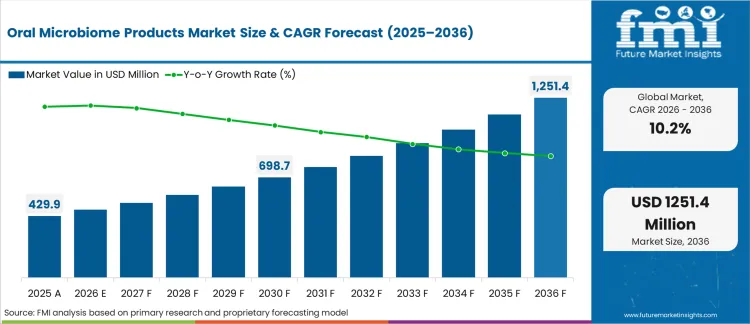
In 2026, the oral microbiome products market was valued at USD 473.8 million. Based on Future Market Insights analysis, demand for oral microbiome products is estimated to grow to USD 1,255.0 million by 2036. FMI projects a CAGR of 10.2% during the forecast period.
Absolute dollar growth of USD 781.2 million over the decade signals a scale-up phase rather than a routine OTC refresh cycle. As per FMI, growth is expected to be supported by higher consumer willingness to trial microbiome-positioned daily-use products, while claim substantiation standards, label-compliance checks, and conservative dental recommendations are expected to slow weakly evidenced launches.
“We decided to focus first on the clinical route to provide better therapeutics. In the dental space, and for gum disease specifically, a patient could have a surgery, take antibiotics, or both. So, we want to fill that space.” Brian Klein, Co-founder & CEO of BrickBuilt Therapeutics, highlighting the company’s development focus in advancing targeted oral microbiome therapeutics for gum disease. [1]
Summary of Oral Microbiome Products Market
- Oral Microbiome Products Market Definition
- The market includes consumer and professional oral care products that are positioned to maintain the oral microbiome balance.
- Demand Drivers in the Market
- Consumers are moving from products that support antiseptic properties to the products which support microbiome balance in caries prevention, gum care, and freshness of breath.
- Dental professionals are recommending additional products for plaque management, gum support and post-procedural items that are increasingly exceeding basic hygiene.
- Increased product visibility and search on retail and online platforms for probiotic-driven oral care products are driving trial and repeat purchase.
- Key Segments Analyzed in the FMI Report
- By Product: Oral probiotic leads at 63.3% share in 2026, followed by microbiome-friendly toothpaste at 20.8% share.
- By Application: Dental caries prevention leads at 27.1% share in 2026, followed by gum disease and periodontitis at 23.9% share.
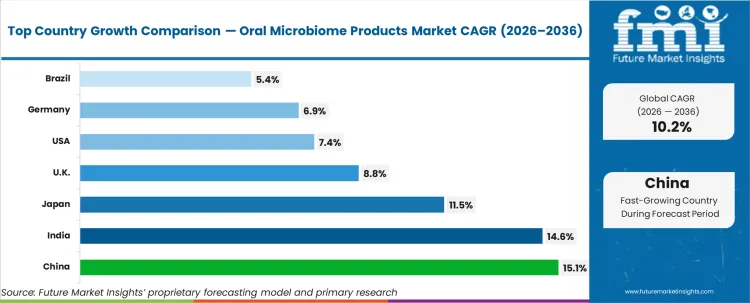
- Geography: China and India show the fastest growth at 15.08% and 14.63% CAGR, supported by higher preventive oral care adoption and faster modern trade reach.
- Analyst Opinion at FMI
- Anurag Sharma, Principal Consultant at Future Market Insights, opines, ‘Preference is being decided by clinically consistent strain selection, stability through shelf life, and clear usage positioning, since oral care buyers are treating microbiome claims as a daily routine decision rather than a one-time intervention.’
- Strategic Implications and Executive Takeaways
- Anchor portfolio strategy around oral probiotic formats, then ladder users into daily toothpaste and mouthwash routines for higher lifetime value.
- Design channel packs and pricing architecture for retail pharma velocity, while protecting e-commerce conversion through credible claim language and clear dosing instructions.
- Build dental-special and group dental penetration using professional education and post-treatment adjunct positioning tied to gum and breath applications.
- Methodology
- As per FMI, sizing and splits were reconciled using brand portfolio mapping, channel mix logic, and category-level price and volume triangulation.
- Share allocations were validated by matching product format economics to observed purchase behavior across retail, dental, and online channels.
- Forecast sensitivity was tested against channel shift pace and product mix changes to confirm revenue response under plausible adoption paths.
Based on FMI’s report, China (15.08% CAGR), supported by premium oral-care trading up and rapid online penetration) and India (14.63% CAGR), driven by expanding modern retail and preventive oral-care adoption) are expected to lead growth. Saudi Arabia (12.41% CAGR), linked to pharmacy channel expansion and higher spend on personal care) and Japan (11.53% CAGR), supported by ageing-linked sensitivity and mouth-dryness demand) are expected to follow. Russia (10.14% CAGR) and the U.K (8.75% CAGR) are expected to expand through repeat purchase formation. The U.S. (7.36%), Germany (6.90%), and Brazil (5.36%) are expected to contribute more through replacement demand, constrained by claim governance and slower switching in dentist-led recommendations.
Oral Microbiome Products Market Definition
The market covers oral-care products positioned to support or rebalance the oral microbiome through probiotic, prebiotic, postbiotic, synbiotic, and non-biotic supportive formulations. These products are purchased by consumers through pharmacies, e-commerce, supermarkets, and dental channels for daily-use prevention and symptom management use cases. The scope spans oral probiotic formats and microbiome-friendly toothpaste and mouthwash, along with targeted microbiome therapeutics aligned to oral-health needs. Demand is shaped by consumer trust in claims, dentist influence, and repeat-use adherence, with revenue generated through packaged product sales across retail and professional channels.
Oral Microbiome Products Market Inclusions
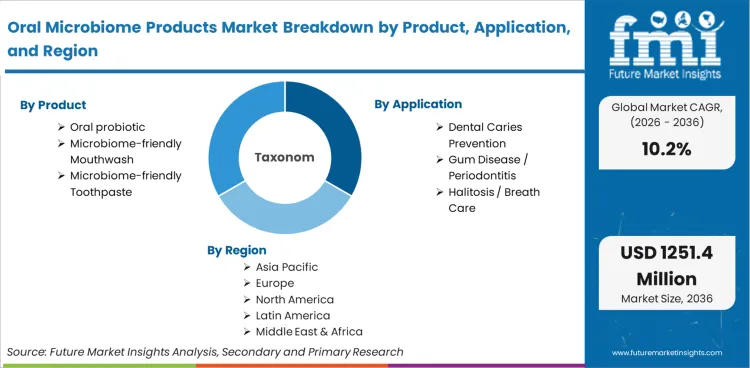
The report includes global and regional market sizes and a 10-year forecast for 2026 to 2036. It covers segmental breakdowns by product (oral probiotic, oral prebiotic & postbiotic products, microbiome-friendly toothpaste, microbiome-friendly mouthwash, targeted microbiome therapeutics), by formulation (probiotic-based formulations, prebiotic-based formulations, postbiotic-based formulations, synbiotic formulations, microbiome-supportive non-biotic formulations, targeted / precision microbiome therapeutic formulations), by application (dental caries prevention, gum disease / periodontitis, halitosis / breath care, dry mouth & xerostomia, children’s oral microbiome, post-dental treatment care, cosmetic / aesthetic oral care), by sales channel (hospital pharmacies, retail pharmacies, supermarkets, e-commerce, dental special, group dental). Coverage also includes competitive positioning of leading suppliers and assessment of channel dynamics across retail pharmacy, e-commerce, supermarket, and dental pathways, including how claims, labeling, and professional endorsement shape adoption.
Oral Microbiome Products Market Exclusions
The scope excludes conventional oral-care products that do not make microbiome-linked positioning, including standard fluoride toothpaste, whitening-only toothpaste, and cosmetic mouthwashes without microbiome support claims. It also omits prescription-only periodontal therapies, dental devices, and in-clinic procedures. Broad digestive microbiome supplements not positioned for oral-health use are excluded. The focus remains on oral microbiome products sold for the stated applications through the listed sales channels.
Oral Microbiome Products Market Research Methodology
- Primary Research: Interviews were carried out with dentists, retail pharmacist, e-commerce category managers, brand regulatory teams, and manufacturers to assess claim discipline, channel, and repeat purchase behavior.
- Desk Research: Public data from regulators, trade associations, primary company announcements, and published literature was analyzed to assess claim boundaries and formulation methods.
- Market-sizing and Forecasting: A hybrid top-down and bottom-up model was developed. Demand was reconstructed from Oral care patients, Treatment seeking rate, Prescription of Oral microbiome products, overall treatment cost, integrating segment share allocation by product, formulation, application, and sales channel with value build-up through pricing bands and sell-through patterns.
- Data validation and Update Cycle: Results were checked for consistency in segment totals and country growth rates, and then validated through structured checks before finalizing.
Segmental Analysis
Oral Microbiome Products Market Analysis by Product
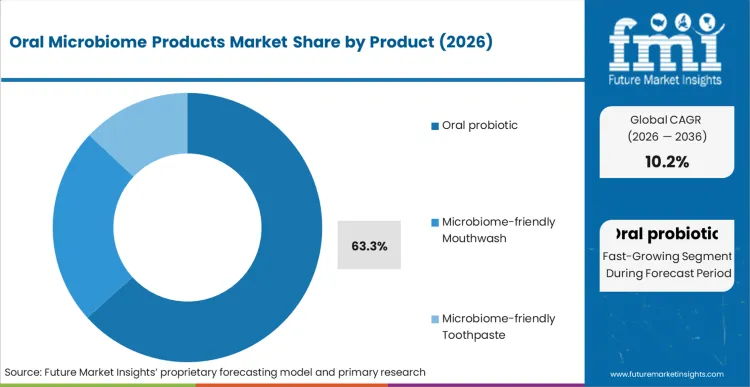
Based on FMI’s report, oral probiotic is estimated to hold 63.3% share in 2026. The lead position is supported by its direct fit with microbiome-led positioning, where a defined active component can be communicated as a daily regimen for caries, gum, and breath outcomes. Microbiome-friendly toothpaste holds 20.8% share as a routine format, though it competes with mainstream toothpaste switching inertia and price sensitivity in mass retail.
- Direct Microbiome Modulation: Oral probiotics rely on “competitive exclusion,” where Lactobacillus reuteri and Streptococcus salivarius BLIS M18 beneficial bacteria directly compete with pathogens for nutrients and attachment sites. This targeted action enables a “daily regimen that can be measured” with the outcome of reducing the caries-forming bacterial load and gum inflammation.[2]
- Superior Delivery Formats: To work effectively, oral probiotics must have direct access to the oral mucosa. The best products come in lozenge, chewable tablet, and dissolvable strip form. These delivery systems provide greater "bioavailability" and dwell time than toothpaste, which is simply washed away, making probiotics a superior delivery system for live cultures.
- Consumer Shift toward Preventative Healthcare: As high number of people are becoming aware of the "oral-systemic link" the relationship between oral health and overall health, there is a growing demand for natural, non-chemical alternatives to traditional antiseptics. Consumers are increasingly turning towards these "holistic" supplements that help the body's own natural defenses rather than traditional products that may contain artificial additives.
Oral Microbiome Products Market Analysis by Application
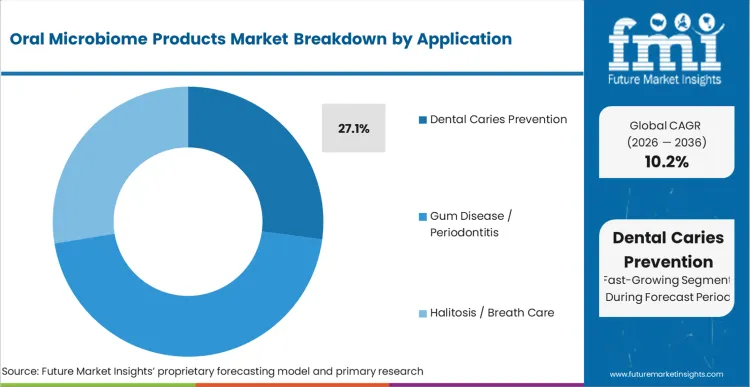
Dental caries prevention accounts for 27.1% share in 2026, based on FMI’s report, supported by broad consumer familiarity with prevention-led oral care and high frequency daily routines tied to brushing and adjunct products. Gum disease and periodontitis hold 23.9% share, driven by recurring gingival issues that push consumers toward longer regimen use and professional recommendations. Breath care at 16.5% and dry mouth and xerostomia at 12.1% reflect symptom-driven purchasing where repeat depends on perceived relief and regimen adherence.
- Global Prevalence and "Non-Communicable Disease" Reclassification: Caries is a permanent, cumulative disease where the microbiome's "dysbiosis" leads to structural destruction. Because the damage is irreversible once it reaches a certain stage, the clinical and financial priority is shifted entirely to pre-cavity microbiome management. This vast "at-risk" patient base creates a significantly larger market for preventive consumables than for specialized treatments like gum disease or breath control. [3]
- Precision Pediatric "Risk-Stratification" Guidelines: New clinical measures (such as those from the DQA) encourage clinicians to use microbiome monitoring to identify "high-risk" children before lesions appear. Because this is now linked to insurance reimbursement and "Quality Measures," there is a forced market expansion for preventive sealants, varnishes, and microbiome-targeted pastes. This "Precision Prevention" ensures that the caries application remains the primary revenue driver, as it is integrated into the essential care pathway for every child.
- Shift from "Kill-All" to "Ecosystem Neutralization" (Arginine & Peptides): In 2026, clinical protocols have moved toward "Restoring Symbiosis." Instead of broad-spectrum antibacterials (which treat general inflammation), new products use Arginine or self-assembling peptides to neutralize the specific pH drops that cause decay. This high-margin "therapeutic prevention" category is now a standard clinical line item, capturing revenue that previously went to surgical fillings.
Oral Microbiome Products Market Drivers, Restraints, and Opportunities
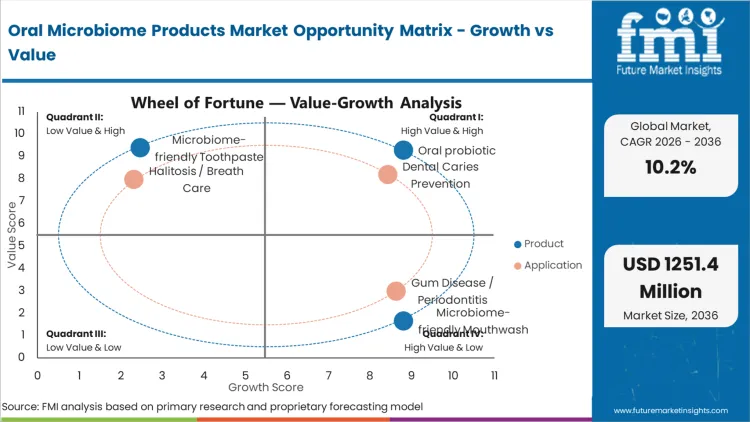
Future Market Insights analysis that historical patterns point at a fast-emerging oral care subcategory where demand is being anchored in preventive routines and consumer preference for microbiome-supportive positioning. Estimated valuation in 2026 is US$ 473.8 million, rising to US$ 1,255.0 million by 2036 at a 10.2% CAGR, based on FMI’s report, with growth shaped by higher regimen adoption in caries prevention and gum care use cases.
While growth is being paced by claim scrutiny, inconsistent consumer understanding of microbiome language, and slower switching from conventional toothpaste and mouthwash habits, higher value mix is lifting revenue as oral probiotic formats scale and prevention-led applications gain repeat purchasing. FMI analysts note that the forecast reflects a new normal where prevention-led claims expand household adoption, gum care increases regimen duration, and product layering lifts reorder rates across core use cases.
- Compliance-led Claim Discipline: Growth is shifting toward brands that can support prevention and gum-care positioning with clear regimen instructions and consistent product performance.
- Behavioral Switching Restraint: Habit-driven loyalty to conventional oral care slows conversion into microbiome products, keeping trial-to-repeat the core bottleneck.
- Application-led Expansion Mechanism: Caries prevention and gum disease positioning is expanding addressable demand by tying microbiome products to daily and recurring oral care needs.
Regional Analysis
.webp "Top Country Growth Comparison Oral Microbiome Products Market Cagr (2026 2036)")
Based on the regional analysis, oral microbiome products market is segmented into North America, Latin America, Western Europe, Eastern Europe, East Asia, South Asia and Middle East & Africa across 30+ countries. Regional performance is assessed using country-level demand signals linked to OTC adoption, dental channel influence, and probiotic regulatory and labelling expectations, as per FMI. The full report also offers market attractiveness analysis based on regional trends.
| Country | CAGR |
|---|---|
| USA | 7.4% |
| Brazil | 5.4% |
| China | 15.1% |
| India | 14.6% |
| Japan | 11.5% |
| Germany | 6.9% |
| UK | 8.8% |
| Russia | 10.1% |
| Saudi Arabia | 12.4% |
Source: Future Market Insights (FMI) analysis, based on proprietary forecasting model and primary research
North America Oral Microbiome Products Market Analysis
North America is shaped by premium OTC supplementation and dentist-influenced consumer switching, where product adoption is driven by retail pharmacy availability, DTC marketing compliance, and claims discipline for probiotics and oral care adjuncts. Regional demand is supported by strong consumer willingness to pay for preventive oral health products and by wider shelf access for functional gums, lozenges, and probiotic capsules positioned for breath and gum support. FMI is of the opinion that differentiation remains anchored in evidence-backed strains and claims that can withstand scrutiny from regulators and retailers.
- United States: Demand for oral microbiome products in the United States is forecast to increase at 7.36% CAGR through 2036. Growth is supported by consumer shift toward preventive oral health routines, and rising adoption of probiotics positioned on the gum health and breath management. Demand is also supported by high retail penetration, where pharmacy chains and online channels scale repeat purchasing through subscription and bundle models. Constraint is created by strict claims and labelling expectations for dietary supplements and functional oral care, which limits the pace of aggressive medical positioning and pushes brands toward conservative language and third-party testing.
FMI’s report includes a detailed analysis of the growth in the North American region, along with a country-wise assessment that includes the United States. Readers can also find regional trends, regulations, and market growth based on different segments and countries in the North America region.
Asia Pacific Oral Microbiome Products Market Analysis
The Asia Pacific continues to be the leading growth market, driven by the increasing middle-class consumption patterns, the fast growth of DTC, and the increased willingness to try new functional oral care formats beyond toothpaste. Demand is fueled by the strong e-commerce infrastructure and the growing awareness of preventive healthcare practices associated with dental hygiene education. Analysts at FMI analysts highlight that product claims and format preferences are very divergent, with relatively higher adoption of chewables, sachets, and lozenges in regions where convenience and taste are key drivers of repeat business.
- China: The Chinese market for Oral Microbiome Products is projected to see a 15.08% CAGR in demand from now until 2036. This is being driven by the pull of the rapidly growing e-commerce platform focused on health and the growing consumer interest in functional products that are positioned around gum care and breath control.
- India: The market for oral microbiome products in India is expected to grow at a CAGR of 14.63% until 2036. It is due to increasing adoption of OTC supplements and overall spending on preventive healthcare in urban India, with the availability of pharmacies and e-commerce platforms making it possible to try the products on a larger scale. This is also driven by the patterns of recommendations by dental clinics in upmarket cities where adjunct oral products are being used along with the traditional oral hygiene practices.
- Japan: The market for oral microbiome products in Japan is expected to grow at 11.53% CAGR until 2036. This is due to the mature market for functional foods and oral care products, with strong consumer willingness to buy products for gum and breath health. The market is driven by the availability of products in convenience stores and pharmacies and by consumer trust in quality.
The full report analyzes the oral microbiome products market across East and South Asia from 2021-2036, covering pricing, trends, and growth drivers in China, Japan, South Korea, India, Australia & New Zealand. The assessment highlights trends that dictate regional demand and procurement behavior.
Latin America Oral Microbiome Products Market Analysis
Latin America operates in a mixed model of modern retail and pharmacy distribution, where adoption is driven by the affordability of brands, import dependency, and geographic reach of distributors. Demand is fueled by the growing awareness of preventive healthcare and the subsequent increase in available probiotic dietary supplements and functional oral care products. According to FMI analysts, adoption is sensitive to pricing and import costs tied to currency.
- Brazil: The demand for oral microbiome products in Brazil is expected to grow at a 5.36% CAGR during the forecast period of 2036. This is driven by pharmacy-based distribution and the growing interest in functional supplements, with a gradual increase in the use of oral health adjuncts, excluding toothpaste.
The report consists of a detailed analysis for the market in Brazil, Chile, Argentina, Peru and Rest of Latin America. Readers can find detailed information about several factors, such as the pricing analysis and regional trends, which are impacting growth in the Latin America region.
Europe Oral Microbiome Products Market Analysis
Europe is shaped by claims scrutiny and pharmacy-led credibility, where adoption is influenced by regulatory expectations for probiotic and health claims and by strong consumer preference for clinically positioned oral care adjuncts. Demand is supported by established supplement consumption and higher use of dentist-recommended products. Future Market Insights analysis indicates that product success is linked to clear strain documentation, conservative claims, and pharmacy placement.
- Germany: Demand for oral microbiome products in Germany is projected to rise at 6.90% CAGR through 2036. Demand is anticipated to increase primarily due to the continuing popularity of supplements and the credibility of pharmacies to promote the use of probiotics designed for oral health purposes. The demand will also depend on the documented quality and authenticity associated with the products consumed.
- United Kingdom: Demand for oral microbiome products in the UK is projected to rise at 8.75% CAGR through 2036. This is driven by the high adoption of DTC and pharmacy sales, with the growing use of probiotics and functional oral products for breath and gum health. The limiting factor is the scrutiny of claims and retailer filters that limit the potential for high therapeutic claims. According to FMI, the growth will remain highest in the online and pharmacy segments, with dental recommendations driving high-end products.
FMI’s analysis of oral microbiome products market in Europe consists of country-wise assessment that includes the Germany, Italy, France, United Kingdom, Spain, Russia, Nordic, Benelux and Rest of Europe. Readers can know various regulations and latest trends in the regional market.
Competitive aligners for Market Players
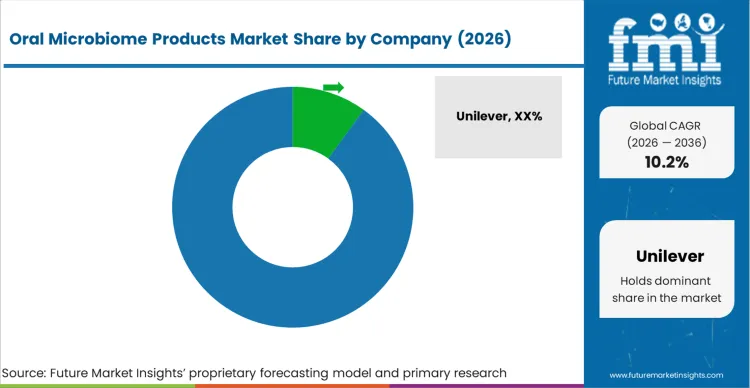
Market structure is moderately fragmented with tier 1 Players holding around 57.0% in 2025 but effective competition is driven by a shortlist of suppliers who can afford clinical proof, adhere to claims control, and distribute through mass retail and pharmacies. unstar Suisse S.A. dominates the market with a Company share of approximately 24%, while the rest of the market is divided among probiotic specialists, niche oral care brands, and smaller formulators. The primary competitive factor is brand development with authentic positioning, as product differentiation is primarily measured by strain specificity, dosage uniformity, and claim defensibility, rather than packaging innovation, as stated by FMI.
Companies with structural advantages are likely to leverage the consumer oral care base with the disciplined formulation and quality control of microbiome-targeted actives. Large FMCG companies can leverage shelf space, advertising reach, and existing dental and pharmacy networks to quickly convert trial into repeat business. Probiotic companies can leverage their proprietary strains, published studies, and better control over culture handling to support premium pricing when positioned around caries risk or halitosis management. Companies without brand scale or strain differentiation are likely to compete on price and influencer-driven demand creation, which drives churn as retailers simplify SKUs during category resets, as per FMI’s report.
Customer concentration sustains buyer leverage. Major retailers and pharmacy chains mitigate supplier dependence via private label comparisons, multi-sourcing of similar formats, and regular planogram changes that rapidly redirect volume to faster-moving products. Dental channel adoption is driven by professional acceptance, and as such, suppliers commonly support sampling, education, and compliance-ready content rather than solely on consumer-driven pull. This purchasing behavior limits pricing leverage for general wellness statements, but selective premiums are maintained if a product can support repeat purchase through a more compelling benefit story and consistent product experience, according to analysis by Future Market Insights.
Recent Developments
The report includes full coverage of key trends from competitive benchmarking. Some of the recent developments covered in the reports:
- In January 2026, Researchers at The Fraunhofer-Gesellschaft and IMWS, in collaboration with spin-off PerioTrap, have developed a breakthrough oral care range that selectively inhibits periodontitis-causing bacteria. Unlike traditional mouthwashes that wipe out the entire oral microbiome, this technology preserves beneficial bacteria to maintain a healthy natural balance.
- In Sept 2025, BioGaia has unveiled Prodentis® FRESH BREATH, an innovative probiotic designed to deliver immediate and long-lasting fresh breath while also promoting healthy gums and teeth. [4]
- In Sept 2025, Boka, the personal care brand transforming oral care through a blend of modern science and natural ingredients, is expanding its lineup with a new Probiotic Toothpaste. The formula is available in two refreshing flavors: Citrus Mint and Peppermint Blossom.
- In November 2024, BLIS signed a distribution partnership with a major Chinese omni-channel operator (Orange Daylily) to launch BLIS Probiotics on China’s largest e-commerce platforms including Alibaba Tmall, Taobao, and JD Health.[5]
Key Players in Oral Microbiome Products Market
- Unilever
- Sunstar Suisse S.A.
- BioGaia
- NatureWise
- BLIS Technologies
- Oral BioTech (Carifree)
- Vital Nutrients
- Revitin
- Others
Scope of the Report
| Metric | Value |
|---|---|
| Quantitative units | US$ 473.8 million (2026) to US$ 1,255.0 million (2036), at a CAGR of 10.2% |
| Market definition | The oral microbiome products market comprises the global production and trade of consumer oral care products and therapeutic-oriented offerings positioned to support microbial balance in the oral cavity, including probiotic, prebiotic, postbiotic, synbiotic, and microbiome-supportive formulations used for prevention and symptom-focused oral care needs across retail and dental channels. |
| Product segmentation | Oral Probiotic, Oral Prebiotic & Postbiotic Products, Microbiome-friendly Toothpaste, Microbiome-friendly Mouthwash, Targeted Microbiome Therapeutics |
| Formulation segmentation | Probiotic-Based Formulations, Prebiotic-Based Formulations, Postbiotic-Based Formulations, Synbiotic Formulations, Microbiome-Supportive Non-Biotic Formulations, Targeted or Precision Microbiome Therapeutic Formulations |
| Application coverage | Dental Caries Prevention, Gum Disease or Periodontitis, Halitosis or Breath Care, Dry Mouth or Xerostomia, Children’s Oral Microbiome, Post-Dental Treatment Care, Cosmetic or Aesthetic Oral Care |
| Sales channel coverage | Hospital Pharmacies, Retail Pharmacies, Supermarkets, E-commerce, Dental Specialty, Group Dental |
| Regions covered | North America, Latin America, East Asia, South Asia, Western Europe, Eastern Europe, Middle East and Africa |
| Countries covered | United States, Canada, Mexico, Brazil, Argentina, Germany, France, United Kingdom, Italy, Spain, China, India, Japan, South Korea, Indonesia, Australia and 40 plus countries |
| Key companies profiled | Unilever, Sunstar Suisse S.A., BioGaia, NatureWise, BLIS Technologies, Oral BioTech (Carifree), Vital Nutrients, Revitin and Others |
| Forecast period | 2026 to 2036 |
| Approach | Hybrid top down and bottom up market modeling validated through primary interviews with brand owners, dental channel stakeholders, and distribution partners, supported by category sales triangulation and formulation mapping, as per FMI. |
Oral Microbiome Products Market Analysis by Segments
Product
- Oral Probiotic
- Oral Prebiotic & Postbiotic Products
- Microbiome-friendly Toothpaste
- Microbiome-friendly Mouthwash
- Targeted Microbiome Therapeutics
Formulation
- Probiotic-Based Formulations
- Prebiotic-Based Formulations
- Postbiotic-Based Formulations
- Synbiotic Formulations
- Microbiome-Supportive Non-Biotic Formulations
- Targeted / Precision Microbiome Therapeutic Formulations
Application
- Dental Caries Prevention
- Gum Disease / Periodontitis
- Halitosis / Breath Care
- Dry Mouth & Xerostomia
- Children's Oral Microbiome
- Post-Dental Treatment Care
- Cosmetic / Aesthetic Oral Care
Sales Channel
- Hospital Pharmacies
- Retail Pharmacies
- Supermarkets & Hypermarkets
- E-Commerce
- Dental Speciality Clinics
- Group Dental Practices
Region
- Asia Pacific
- India
- China
- Japan
- South Korea
- Indonesia
- Australia & New Zealand
- ASEAN
- Rest of Asia Pacific
- Europe
- Germany
- Italy
- France
- United Kingdom
- Spain
- Benelux
- Nordics
- Central & Eastern Europe
- Rest of Europe
- North America
- United States
- Canada
- Mexico
- Latin America
- Brazil
- Argentina
- Chile
- Rest of Latin America
- Middle East & Africa
- Kingdom of Saudi Arabia
- United Arab Emirates
- South Africa
- Turkey
- Rest of Middle East & Africa
Bibliography
- [1] IndieBio. (n.d.). BrickBuilt Therapeutics - The First Oral Microbiome Therapeutics. Company Profile / Portfolio Overview.
- [2] Family Dental Center of Blair. (n.d.). What Are Oral Probiotics and How Do They Work? Educational Blog Article.
- [3] World Health Organization (WHO). (2025, July-August). Nutrition and Food Safety Newsletter. Newsletter Publication.
- [4] BioGaia. (n.d.). BioGaia Launches ProDentis Fresh Breath - A Probiotic Promoting Instant and Long-Lasting Fresh Breath While Supporting Healthy Gums and Teeth. Press Release.
- [5] BLIS Technologies. (2024, November 15). Partnership with Chinese Distributor for BLIS Probiotics. Corporate Announcement / Press Release.
This report addresses
- Market intelligence to enable structured strategic decision making across oral care innovation, portfolio planning, and channel prioritization
- Market size estimation and 10-year revenue forecasts from 2026 to 2036 for oral microbiome product demand
- Growth opportunity mapping across product, formulation, application, and sales channel demand pools
- Segment and regional revenue forecasts aligned to the stated taxonomy and covered geographies
- Competition strategy assessment including positioning by product type, formulation, application, and sales channel coverage benchmarking
- Product and compliance tracking focuses on quality expectations, labeling discipline, and formulation governance for microbiome positioned products
- Regulatory impact analysis covering how probiotics and biotherapeutic guidance can shape clinical positioning and market access planning
- Market report delivery in PDF, Excel, PPT, and interactive dashboard formats for executive and operational use
Frequently Asked Questions
How large is the demand for oral microbiome products in the global market in 2026?
Demand is estimated to be valued at USD 473.8 million in 2026, as per FMI.
What will be the market size of oral microbiome products in the global market by 2036?
Market size is projected to reach USD 1,255.0 million by 2036, based on FMI’s report.
What is the expected demand growth for oral microbiome products in the global market between 2026 and 2036?
Demand is expected to grow at a CAGR of 10.2% between 2026 and 2036.
Which product type is poised to lead global sales by 2026?
Oral Probiotic is expected to be the dominant product, capturing 63.3% share in 2026.
Which formulation is expected to account for the largest share in 2026?
Probiotic-Based Formulations are expected to hold the highest share at 38.2% in 2026.
How significant is Retail Pharmacies in the 2026 sales channel mix?
Retail Pharmacies are projected to account for 33.6% share in 2026.
Preview the report firsthand - request a free sample
Get SampleGet the brochure for pricing and purchase details.
Get PDFTable of Content
- Executive Summary
- Global Market Outlook
- Demand-side Trends
- Supply-side Trends
- Technology Roadmap Analysis
- Analysis and Recommendations
- Market Overview
- Market Coverage / Taxonomy
- Market Definition / Scope / Limitations
- Research Methodology
- Chapter Orientation
- Analytical Lens and Working Hypotheses
- Market Structure, Signals, and Trend Drivers
- Benchmarking and Cross-market Comparability
- Market Sizing, Forecasting, and Opportunity Mapping
- Research Design and Evidence Framework
- Desk Research Programme (Secondary Evidence)
- Company Annual and Sustainability Reports
- Peer-reviewed Journals and Academic Literature
- Corporate Websites, Product Literature, and Technical Notes
- Earnings Decks and Investor Briefings
- Statutory Filings and Regulatory Disclosures
- Technical White Papers and Standards Notes
- Trade Journals, Industry Magazines, and Analyst Briefs
- Conference Proceedings, Webinars, and Seminar Materials
- Government Statistics Portals and Public Data Releases
- Press Releases and Reputable Media Coverage
- Specialist Newsletters and Curated Briefings
- Sector Databases and Reference Repositories
- FMI Internal Proprietary Databases and Historical Market Datasets
- Subscription Datasets and Paid Sources
- Social Channels, Communities, and Digital Listening Inputs
- Additional Desk Sources
- Expert Input and Fieldwork (Primary Evidence)
- Primary Modes
- Qualitative Interviews and Expert Elicitation
- Quantitative Surveys and Structured Data Capture
- Blended Approach
- Why Primary Evidence is Used
- Field Techniques
- Interviews
- Surveys
- Focus Groups
- Observational and In-context Research
- Social and Community Interactions
- Stakeholder Universe Engaged
- C-suite Leaders
- Board Members
- Presidents and Vice Presidents
- R&D and Innovation Heads
- Technical Specialists
- Domain Subject-matter Experts
- Scientists
- Physicians and Other Healthcare Professionals
- Governance, Ethics, and Data Stewardship
- Research Ethics
- Data Integrity and Handling
- Primary Modes
- Tooling, Models, and Reference Databases
- Desk Research Programme (Secondary Evidence)
- Data Engineering and Model Build
- Data Acquisition and Ingestion
- Cleaning, Normalisation, and Verification
- Synthesis, Triangulation, and Analysis
- Quality Assurance and Audit Trail
- Market Background
- Market Dynamics
- Drivers
- Restraints
- Opportunity
- Trends
- Scenario Forecast
- Demand in Optimistic Scenario
- Demand in Likely Scenario
- Demand in Conservative Scenario
- Opportunity Map Analysis
- Product Life Cycle Analysis
- Supply Chain Analysis
- Investment Feasibility Matrix
- Value Chain Analysis
- PESTLE and Porter’s Analysis
- Regulatory Landscape
- Regional Parent Market Outlook
- Production and Consumption Statistics
- Import and Export Statistics
- Market Dynamics
- Global Market Analysis 2021 to 2025 and Forecast, 2026 to 2036
- Historical Market Size Value (USD Million) Analysis, 2021 to 2025
- Current and Future Market Size Value (USD Million) Projections, 2026 to 2036
- Y-o-Y Growth Trend Analysis
- Absolute $ Opportunity Analysis
- Global Market Pricing Analysis 2021 to 2025 and Forecast 2026 to 2036
- Global Market Analysis 2021 to 2025 and Forecast 2026 to 2036, By Product
- Introduction / Key Findings
- Historical Market Size Value (USD Million) Analysis By Product , 2021 to 2025
- Current and Future Market Size Value (USD Million) Analysis and Forecast By Product , 2026 to 2036
- Oral probiotic
- Microbiome-friendly Mouthwash
- Microbiome-friendly Toothpaste
- Oral probiotic
- Y-o-Y Growth Trend Analysis By Product , 2021 to 2025
- Absolute $ Opportunity Analysis By Product , 2026 to 2036
- Global Market Analysis 2021 to 2025 and Forecast 2026 to 2036, By Application
- Introduction / Key Findings
- Historical Market Size Value (USD Million) Analysis By Application, 2021 to 2025
- Current and Future Market Size Value (USD Million) Analysis and Forecast By Application, 2026 to 2036
- Dental Caries Prevention
- Gum Disease / Periodontitis
- Halitosis / Breath Care
- Dental Caries Prevention
- Y-o-Y Growth Trend Analysis By Application, 2021 to 2025
- Absolute $ Opportunity Analysis By Application, 2026 to 2036
- Global Market Analysis 2021 to 2025 and Forecast 2026 to 2036, By Region
- Introduction
- Historical Market Size Value (USD Million) Analysis By Region, 2021 to 2025
- Current Market Size Value (USD Million) Analysis and Forecast By Region, 2026 to 2036
- North America
- Latin America
- Western Europe
- Eastern Europe
- East Asia
- South Asia and Pacific
- Middle East & Africa
- Market Attractiveness Analysis By Region
- North America Market Analysis 2021 to 2025 and Forecast 2026 to 2036, By Country
- Historical Market Size Value (USD Million) Trend Analysis By Market Taxonomy, 2021 to 2025
- Market Size Value (USD Million) Forecast By Market Taxonomy, 2026 to 2036
- By Country
- USA
- Canada
- Mexico
- By Product
- By Application
- By Country
- Market Attractiveness Analysis
- By Country
- By Product
- By Application
- Key Takeaways
- Latin America Market Analysis 2021 to 2025 and Forecast 2026 to 2036, By Country
- Historical Market Size Value (USD Million) Trend Analysis By Market Taxonomy, 2021 to 2025
- Market Size Value (USD Million) Forecast By Market Taxonomy, 2026 to 2036
- By Country
- Brazil
- Chile
- Rest of Latin America
- By Product
- By Application
- By Country
- Market Attractiveness Analysis
- By Country
- By Product
- By Application
- Key Takeaways
- Western Europe Market Analysis 2021 to 2025 and Forecast 2026 to 2036, By Country
- Historical Market Size Value (USD Million) Trend Analysis By Market Taxonomy, 2021 to 2025
- Market Size Value (USD Million) Forecast By Market Taxonomy, 2026 to 2036
- By Country
- Germany
- UK
- Italy
- Spain
- France
- Nordic
- BENELUX
- Rest of Western Europe
- By Product
- By Application
- By Country
- Market Attractiveness Analysis
- By Country
- By Product
- By Application
- Key Takeaways
- Eastern Europe Market Analysis 2021 to 2025 and Forecast 2026 to 2036, By Country
- Historical Market Size Value (USD Million) Trend Analysis By Market Taxonomy, 2021 to 2025
- Market Size Value (USD Million) Forecast By Market Taxonomy, 2026 to 2036
- By Country
- Russia
- Poland
- Hungary
- Balkan & Baltic
- Rest of Eastern Europe
- By Product
- By Application
- By Country
- Market Attractiveness Analysis
- By Country
- By Product
- By Application
- Key Takeaways
- East Asia Market Analysis 2021 to 2025 and Forecast 2026 to 2036, By Country
- Historical Market Size Value (USD Million) Trend Analysis By Market Taxonomy, 2021 to 2025
- Market Size Value (USD Million) Forecast By Market Taxonomy, 2026 to 2036
- By Country
- China
- Japan
- South Korea
- By Product
- By Application
- By Country
- Market Attractiveness Analysis
- By Country
- By Product
- By Application
- Key Takeaways
- South Asia and Pacific Market Analysis 2021 to 2025 and Forecast 2026 to 2036, By Country
- Historical Market Size Value (USD Million) Trend Analysis By Market Taxonomy, 2021 to 2025
- Market Size Value (USD Million) Forecast By Market Taxonomy, 2026 to 2036
- By Country
- India
- ASEAN
- Australia & New Zealand
- Rest of South Asia and Pacific
- By Product
- By Application
- By Country
- Market Attractiveness Analysis
- By Country
- By Product
- By Application
- Key Takeaways
- Middle East & Africa Market Analysis 2021 to 2025 and Forecast 2026 to 2036, By Country
- Historical Market Size Value (USD Million) Trend Analysis By Market Taxonomy, 2021 to 2025
- Market Size Value (USD Million) Forecast By Market Taxonomy, 2026 to 2036
- By Country
- Kingdom of Saudi Arabia
- Other GCC Countries
- Turkiye
- South Africa
- Other African Union
- Rest of Middle East & Africa
- By Product
- By Application
- By Country
- Market Attractiveness Analysis
- By Country
- By Product
- By Application
- Key Takeaways
- Key Countries Market Analysis
- USA
- Pricing Analysis
- Market Share Analysis, 2025
- By Product
- By Application
- Canada
- Pricing Analysis
- Market Share Analysis, 2025
- By Product
- By Application
- Mexico
- Pricing Analysis
- Market Share Analysis, 2025
- By Product
- By Application
- Brazil
- Pricing Analysis
- Market Share Analysis, 2025
- By Product
- By Application
- Chile
- Pricing Analysis
- Market Share Analysis, 2025
- By Product
- By Application
- Germany
- Pricing Analysis
- Market Share Analysis, 2025
- By Product
- By Application
- UK
- Pricing Analysis
- Market Share Analysis, 2025
- By Product
- By Application
- Italy
- Pricing Analysis
- Market Share Analysis, 2025
- By Product
- By Application
- Spain
- Pricing Analysis
- Market Share Analysis, 2025
- By Product
- By Application
- France
- Pricing Analysis
- Market Share Analysis, 2025
- By Product
- By Application
- India
- Pricing Analysis
- Market Share Analysis, 2025
- By Product
- By Application
- ASEAN
- Pricing Analysis
- Market Share Analysis, 2025
- By Product
- By Application
- Australia & New Zealand
- Pricing Analysis
- Market Share Analysis, 2025
- By Product
- By Application
- China
- Pricing Analysis
- Market Share Analysis, 2025
- By Product
- By Application
- Japan
- Pricing Analysis
- Market Share Analysis, 2025
- By Product
- By Application
- South Korea
- Pricing Analysis
- Market Share Analysis, 2025
- By Product
- By Application
- Russia
- Pricing Analysis
- Market Share Analysis, 2025
- By Product
- By Application
- Poland
- Pricing Analysis
- Market Share Analysis, 2025
- By Product
- By Application
- Hungary
- Pricing Analysis
- Market Share Analysis, 2025
- By Product
- By Application
- Kingdom of Saudi Arabia
- Pricing Analysis
- Market Share Analysis, 2025
- By Product
- By Application
- Turkiye
- Pricing Analysis
- Market Share Analysis, 2025
- By Product
- By Application
- South Africa
- Pricing Analysis
- Market Share Analysis, 2025
- By Product
- By Application
- USA
- Market Structure Analysis
- Competition Dashboard
- Competition Benchmarking
- Market Share Analysis of Top Players
- By Regional
- By Product
- By Application
- Competition Analysis
- Competition Deep Dive
- Unilever
- Overview
- Product Portfolio
- Profitability by Market Segments (Product/Age /Sales Channel/Region)
- Sales Footprint
- Strategy Overview
- Marketing Strategy
- Product Strategy
- Channel Strategy
- Sunstar Suisse S.A.
- BioGaia
- NatureWise
- BLIS Technologies
- Oral BioTech (Carifree)
- Vital Nutrients
- Revitin
- Unilever
- Competition Deep Dive
- Assumptions & Acronyms Used


