

- Industry Size (2026)
- USD 116.8 Bn
- Forecast (2036)
- USD 621.8 Bn
- CAGR (2026 to 2036)
- 18.2%
Microbiome-Tuned Fertilizer Coating System Market Forecast and Outlook 2026 to 2036
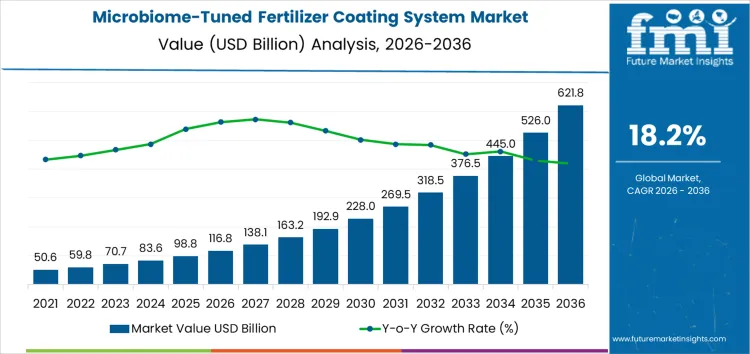
The microbiome-tuned fertilizer coating system market is valued at USD 116.8 billion in 2026 and is projected to reach USD 621.8 billion by 2036, reflecting a CAGR of 18.2%. Growth during this period is shaped by variability in soil microbial populations, coating release precision, and consistency of biological response across environments. Cost structures are influenced by coating formulation complexity, stability of biological interactions, and quality control during scale production. Products are assessed on their ability to regulate nutrient availability without disrupting native soil processes. Suppliers demonstrating repeatable performance across regions gain stronger acceptance. Purchasing decisions emphasize functional reliability rather than coating thickness or nutrient loading intensity.
Between 2026 and 2036, outcomes are driven by grower risk management and confidence in biological predictability. Adoption advances where coatings deliver measurable benefits without introducing management uncertainty. Once incorporated into fertility programs, switching remains limited due to recalibration effort and season-over-season benchmarking requirements. Sales channels providing technical validation and field interpretation reinforce continued use. Entry barriers persist through multi-season trials and biological consistency testing. Strategic trade offs arise between tailoring coatings to local microbiomes and maintaining scalable production. Competitive positioning favors suppliers aligned with long-term soil biology management rather than short-cycle performance claims.
Quick Stats for Microbiome-Tuned Fertilizer Coating System Market
- Microbiome-Tuned Fertilizer Coating System Market Value (2026): USD 116.8 billion
- Microbiome-Tuned Fertilizer Coating System Market Forecast Value (2036): USD 621.8 billion
- Microbiome-Tuned Fertilizer Coating System Market Forecast CAGR: 18.2%
- Leading Coating Type in Microbiome-Tuned Fertilizer Coating System Market: Polymer
- Leading Sales Channel in Microbiome-Tuned Fertilizer Coating System Market: Ag-Retailers
- Key Growth Regions in Microbiome-Tuned Fertilizer Coating System Market: Asia Pacific, North America, Europe
- Top Players in Microbiome-Tuned Fertilizer Coating System Market: BASF, ICL Group, Nutrien, Yara International, Syngenta, Novonesis
What Is the Growth Forecast for Microbiome Tuned Fertilizer Coating System Market through 2036?
Between 2026 and 2031, the microbiome tuned fertilizer coating system market expands from USD 116.8 billion in 2026 to USD 227.1 billion by 2031, generating an absolute increase of USD 110.3 billion. Year over year progression during this phase is rapid, with annual values rising from USD 44 billion in 2021 equivalent scaling to USD 116.8 billion in 2026. Early adoption is driven by demand for coatings that regulate nutrient release while supporting beneficial soil microbial activity around fertilizer granules. Growth in this period remains concentrated among progressive growers and specialty crop systems, supported by field validation programs and integration with coated nitrogen and phosphate products rather than full acreage conversion.
From 2031 to 2036, the market accelerates from USD 227.1 billion in 2031 to USD 621.8 billion by 2036, adding USD 394.9 billion and accounting for the majority of forecast expansion. Annual values increase from USD 268.1 billion in 2032 to USD 621.8 billion in 2036, indicating strong year over year momentum. This phase reflects transition from trial based use to standardized coating adoption across major crop nutrient programs. Broader agronomic confidence, repeat yield and soil performance outcomes, and scaling of biological additive supply chains support sustained expansion, positioning 2031–2036 as the dominant growth period for this market.
Microbiome Tuned Fertilizer Coating System Market Key Takeaways
| Metric | Value |
|---|---|
| Market Value (2026) | USD 116.8 billion |
| Forecast Value (2036) | USD 621.8 billion |
| Forecast CAGR (2026-2036) | 18.2% |
What Is Driving Demand in the Microbiome-Tuned Fertilizer Coating System Market?
Demand for microbiome-tuned fertilizer coating systems arises from observed limits in conventional nutrient release patterns rather than broad formulation trends. Standard fertilisers often release nutrients independently of soil biology, leaving applied nitrogen and phosphorus vulnerable to fixation, leaching, or slow uptake. Growers and soil scientists noted that root zone microbial communities play a central role in nutrient cycling and plant access. Microbiome-tuned coatings incorporate biologically active or signal-modulating components that encourage beneficial soil microbes to mobilise nutrients when roots are most active. Early adoption occurred where growers documented improved early growth and nutrient synchrony under microbial targeting compared with untreated fertiliser.
Future growth will be shaped by integration with digital soil biology assessments, documented nutrient use efficiency, and sustainability planning rather than additive sales alone. Advances in understanding how specific microbial consortia influence nutrient transformations are enabling coatings that support microbial functions linked to phosphorus solubilisation and nitrogen mineralisation. Soil testing tools that quantify microbial activity zones allow growers to tailor coated fertiliser choices to field conditions. As environmental reporting and nutrient loss regulations expand, systems that manage both chemical and biological aspects of fertility will gain preference. Adoption will align with measurable improvements in nutrient uptake, soil health indicators, and reduced environmental loss rather than nutrient content alone, embedding microbiome-tuned systems into structured fertility management programmes.
What Factors Are Affecting the Demand for Microbiome Tuned Fertilizer Coating System Market in Terms of Coating Type and Sales Channel?
The microbiome tuned fertilizer coating system market is driven by interest in improving nutrient efficiency through soil biological activity rather than higher application rates. Demand focuses on coatings that protect nutrients while supporting beneficial microbial processes near the root zone. Adoption depends on consistency of field response, compatibility with existing fertilizers, and availability through trusted channels. Market leadership reflects agronomic reliability and distribution reach rather than novelty of biological claims.
What Is Driving Leadership by Coating Type in the Microbiome Tuned Fertilizer Coating System Market?
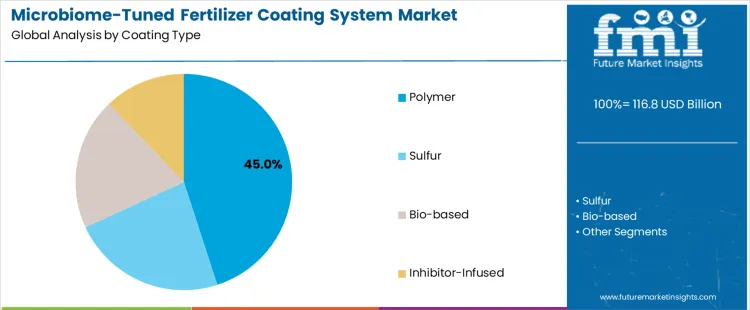
Polymer coatings account for about 45% of demand because they provide controlled nutrient release while creating a stable microenvironment for microbial activity. These coatings regulate moisture and nutrient diffusion, reducing salt stress around fertilizer granules and supporting microbial colonization. Fertilizer manufacturers favor polymer systems because coating thickness and release profiles can be adjusted without altering base fertilizer chemistry. This flexibility allows integration of microbiome friendly features into established products with minimal reformulation risk. Polymer coatings also perform consistently across soil textures and temperature ranges, supporting predictable outcomes at scale.
Sulfur, bio based, and inhibitor infused coatings play complementary roles but face limitations. Sulfur coatings can influence microbial activity but suffer from cracking and uneven release. Bio based coatings align with biological positioning but face variability in degradation rates. Inhibitor infused systems focus on chemical stabilization rather than microbiome support. These alternatives are adopted selectively based on soil conditions and crop systems. Coating type leadership therefore reflects release control, manufacturing scalability, and consistency of biological interaction rather than strength of biological signaling alone.
What Is Driving Leadership by Sales Channel in the Microbiome Tuned Fertilizer Coating System Market?
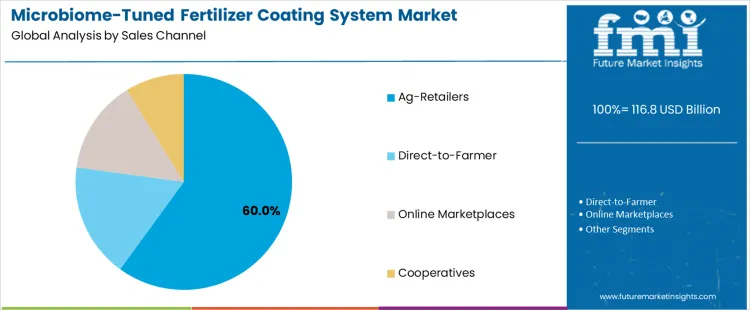
Ag retailers represent about 60% of demand because microbiome focused products require agronomic explanation and local validation. Growers often rely on retailer agronomists to assess soil conditions, crop history, and suitability of biological enhancement strategies. Retail channels support field trials, demonstrations, and side by side comparisons that build confidence in microbiome tuned coatings. Bundling these coatings with base fertilizers also simplifies purchasing and application decisions during tight seasonal windows.
Direct to farmer channels appeal to technically advanced growers but require higher education and support effort. Online marketplaces increase access but are used mainly for small scale trials. Cooperatives distribute inputs efficiently but vary in technical advisory depth. Sales channel leadership therefore reflects trust, advisory capacity, and logistical reliability rather than pricing efficiency or digital convenience.
How Are Microbiome-Tuned Fertilizer Coating Systems Being Applied Across Agriculture?
Use appears in row crops, vegetables, orchards, and high-value horticulture where optimizing soil microbial activity enhances nutrient uptake and plant growth. Farmers adopt microbiome-tuned fertilizer coatings to deliver nutrients alongside beneficial microorganisms or microbial stimulants, promoting root health, disease resistance, and nutrient-use efficiency. Application through seed coating, granular fertilizers, or fertigation integrates microbial support with standard fertilization. These applications reflect operational and agronomic priorities rather than purely cost objectives, with adoption driven by soil health improvement, crop performance, and sustainable nutrient management.
What Operational and Material Conditions Support Adoption of Microbiome-Tuned Fertilizer Coating Systems?
Selection aligns with fertilizers and microbial formulations compatible with coating technology, soil properties, and crop requirements. Coatings are optimized for nutrient release, microbial survival, and stability under storage and field conditions. Farmers monitor soil moisture, temperature, and microbial activity to ensure effective colonization and nutrient uptake. Quality control evaluates nutrient content, microbial viability, and crop response to comply with agronomic and environmental standards. These conditions emerge from operational reliability, microbial performance, and nutrient management priorities in structured fertilizer application workflows.
Which Practical Considerations Limit Wider Use of Microbiome-Tuned Fertilizer Coating Systems?
Higher material and process costs may restrict adoption in small-scale or low-margin farms. Effectiveness depends on soil type, climate, and crop species. Compatibility with other fertilizers, pesticides, or soil amendments must be verified. Storage, handling, and regulatory approvals for microbial products differ by region. These factors lead to selective deployment where microbial support, nutrient efficiency, and crop productivity justify incremental cost, monitoring, and careful operational management in microbiome-tuned fertilization programs.
What is the Demand for Microbiome Tuned Fertilizer Coating Systems by Country?
| Country | CAGR (%) |
|---|---|
| USA | 18.2% |
| China | 19.1% |
| Germany | 16.4% |
| India | 19.6% |
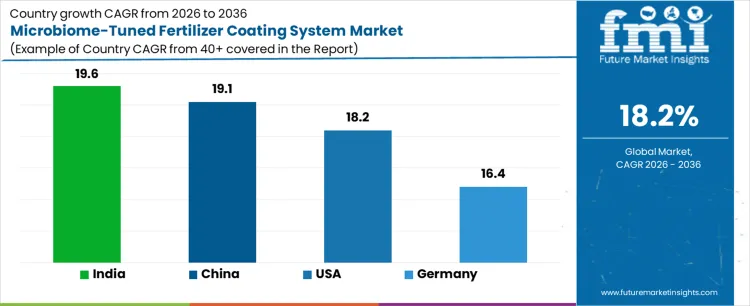
The demand for microbiome tuned fertilizer coating systems is expanding rapidly across major agricultural economies, driven by soil biology optimization, nutrient efficiency targets, and the shift toward biologically aligned crop nutrition. India leads with a 19.6% CAGR, supported by high cropping intensity, declining soil microbial diversity, and growing adoption of coated fertilizers that stabilize beneficial microbial activity at the root zone. China follows at 19.1%, shaped by large scale efforts to reduce chemical fertilizer overuse and improve soil health through biologically responsive inputs. The USA grows at 18.2%, reflecting strong uptake in precision agriculture systems and interest in yield stability through microbial performance enhancement. Germany records 16.4%, supported by strict nutrient regulations, advanced agronomy practices, and increasing integration of microbiome focused technologies into fertilizer programs.
How are microbiome-tuned fertilizer coating systems expanding adoption in the United States?
In the United States, the microbiome-tuned fertilizer coating system market is growing at a CAGR of 18.2% through 2036, driven by precision agriculture adoption, demand for enhanced soil microbial activity, and sustainable nutrient management practices. Farmers are applying microbiome-tuned coatings to improve nutrient uptake, enhance soil health, and boost crop resilience. Demand is concentrated in irrigated row crop regions, high-value horticultural zones, and industrial agricultural hubs. Compared to China, adoption emphasizes regulatory compliance and integration with existing fertilization technologies. Domestic suppliers provide high-performance, biologically active coatings suitable for recurring seasonal applications.
- Irrigated row crop regions, horticultural zones, and industrial hubs drive adoption
- Coatings enhance nutrient uptake, soil health, and crop resilience
- Domestic suppliers provide high-performance, biologically active solutions
- Recurring seasonal applications sustain adoption
How are industrial-scale agriculture and microbiome optimization driving growth in China?
In China, the market is expanding at a CAGR of 19.1% through 2036, fueled by high-intensity crop production, precision nutrient application, and government incentives for sustainable fertilization. Farmers are integrating microbiome-tuned coatings to stimulate beneficial soil microbes, improve nutrient-use efficiency, and increase crop yield and quality. Demand is concentrated in irrigated grain regions, industrial crop zones, and mechanized farming clusters. Compared to the USA, adoption emphasizes high-volume integration and mechanized application. Domestic suppliers provide cost-effective, high-performance biologically active coatings suitable for recurring seasonal fertilization.
- Irrigated grain regions, industrial crop zones, and mechanized clusters drive adoption
- Coatings stimulate beneficial microbes and improve nutrient efficiency
- Domestic suppliers provide cost-effective, high-performance solutions
- Recurring seasonal fertilization sustains adoption
How are soil microbiome enhancement and high-value crop cultivation driving adoption in Germany?
In Germany, revenue is growing at a CAGR of 16.4% through 2036, supported by EU environmental regulations, adoption of precision farming, and high-value horticultural production. Farmers are using microbiome-tuned coatings to enhance nutrient delivery, improve soil health, and increase resilience of crops against environmental stress. Demand is concentrated in irrigated horticultural zones, high-tech farming hubs, and industrial crop regions. Compared to India, adoption emphasizes regulatory compliance and precision nutrient application rather than rapid large-scale deployment. Domestic suppliers provide EU-certified, biologically active coatings suitable for recurring seasonal applications.
- Irrigated horticultural zones, high-tech farming hubs, and industrial regions drive adoption
- Coatings improve nutrient delivery, soil health, and crop resilience
- Domestic suppliers provide EU-certified, biologically active solutions
- Recurring seasonal applications sustain adoption
How are precision agriculture and high-value crop expansion driving growth in India?
In India, the market is growing at a CAGR of 19.6% through 2036, fueled by adoption of micro-irrigation systems, precision nutrient management, and increasing cultivation of high-value horticultural and cereal crops. Farmers are applying microbiome-tuned coatings to enhance soil microbial activity, improve nutrient uptake, and increase yield quality. Demand is concentrated in irrigated horticultural regions, industrial crop zones, and precision farming hubs. Compared to China, adoption emphasizes rapid large-scale deployment across multiple crop types. Domestic suppliers provide high-performance, safe biologically active coatings suitable for recurring seasonal applications.
- Irrigated horticultural regions, industrial crop zones, and precision farming hubs drive adoption
- Coatings enhance microbial activity, nutrient uptake, and yield quality
- Domestic suppliers provide high-performance, safe biologically active solutions
- Recurring seasonal applications sustain adoption
How Do Regional Soil Biology Profiles and Revenue Exposure Shape Competition in the Microbiome Tuned Fertilizer Coating System Market?
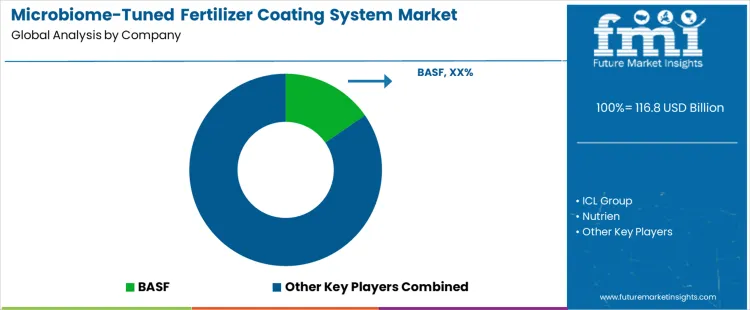
Competition in microbiome tuned fertilizer coating systems is defined by regional soil biology complexity and the ability to align coatings with dominant microbial pathways. BASF and Novonesis show stronger exposure in Europe and North America, where microbiome mapping, regulatory clarity, and field trial infrastructure allow coatings to be positioned as measurable efficiency enhancers. For these players, microbiome tuned coatings contribute a limited but growing share of biological and specialty nutrition revenues, typically linked to premium programs rather than bulk fertilizer volumes. ICL Group demonstrates higher concentration in intensive horticulture and fertigation driven regions, where repeat application cycles make microbiome alignment economically visible at the hectare level.
Program ownership and monetization models further separate competitors. Nutrien and Yara International embed microbiome tuned coatings within broader nutrient efficiency platforms, limiting direct revenue attribution but increasing adoption through advisory networks in North America and Australia. Syngenta integrates coating concepts into seed and crop performance systems, where microbiome effects support early vigor rather than standalone fertilizer differentiation. Across the market, competitive advantage is shaped by regional microbial variability, validation depth, and whether microbiome tuning is sold as a discrete coating technology or absorbed into integrated agronomic programs.
Key Players in the Microbiome-Tuned Fertilizer Coating System Market
- BASF
- ICL Group
- Nutrien
- Yara International
- Syngenta
- Novonesis
Scope of the Report
| Items | Values |
|---|---|
| Quantitative Units | USD Billion |
| Crop | Corn and maize, rice, wheat, sugarcane, other biologically responsive crops |
| Coating Type | Polymer, sulfur, bio-based, inhibitor-infused |
| Sales Channel | Ag-retailers, direct-to-farmer, online marketplaces, cooperatives |
| Application | Controlled nutrient release, microbiome-aligned nutrient delivery, soil biological activity support |
| End Users | Commercial crop growers, precision agriculture operators, high-value horticulture producers, intensive farming systems |
| Regions Covered | Asia Pacific, Europe, North America, Latin America, Middle East & Africa |
| Countries Covered | India, China, United States, Germany, and other major fertilizer-consuming economies |
| Key Companies Profiled | BASF, ICL Group, Nutrien, Yara International, Syngenta, Novonesis |
| Additional Attributes | Dollar by sales across coating types and crop categories, adoption trends linked to soil microbiome variability and nutrient use efficiency, competitive landscape shaped by biological consistency and multi-season field validation, integration with coated nitrogen and phosphate fertilizers, performance benchmarking based on microbial activity and nutrient synchrony, scalability constraints tied to coating formulation complexity |
Microbiome-Tuned Fertilizer Coating System Market Segmentation
Crop:
- Corn and Maize
- Rice
- Wheat
- Sugarcane
Coating Type:
- Polymer
- Sulfur
- Bio-based
- Inhibitor-Infused
Sales Channel:
- Ag-Retailers
- Direct-to-Farmer
- Online Marketplaces
- Cooperatives
Region:
- Asia Pacific
- China
- Japan
- South Korea
- India
- Australia & New Zealand
- ASEAN
- Rest of Asia Pacific
- Europe
- Germany
- United Kingdom
- France
- Italy
- Spain
- Nordic
- BENELUX
- Rest of Europe
- North America
- United States
- Canada
- Mexico
- Latin America
- Brazil
- Chile
- Rest of Latin America
- Middle East & Africa
- Kingdom of Saudi Arabia
- Other GCC Countries
- Turkey
- South Africa
- Other African Union
- Rest of Middle East & Africa
Frequently Asked Questions
How big is the microbiome-tuned fertilizer coating system market in 2026?
The global microbiome-tuned fertilizer coating system market is estimated to be valued at USD 116.8 billion in 2026.
What will be the size of microbiome-tuned fertilizer coating system market in 2036?
The market size for the microbiome-tuned fertilizer coating system market is projected to reach USD 621.8 billion by 2036.
How much will be the microbiome-tuned fertilizer coating system market growth between 2026 and 2036?
The microbiome-tuned fertilizer coating system market is expected to grow at a 18.2% CAGR between 2026 and 2036.
What are the key crop types in the microbiome-tuned fertilizer coating system market?
The key crop types in microbiome-tuned fertilizer coating system market are corn and maize, rice, wheat and sugarcane.
Which sales channel segment will contribute significant share in the microbiome-tuned fertilizer coating system market in 2026?
In terms of sales channel, Ag retailers segment to command 60.0% share in the microbiome-tuned fertilizer coating system market in 2026.
Preview the report firsthand - request a free sample
Get SampleGet the brochure for pricing and purchase details.
Get PDFTable of Content
- Executive Summary
- Global Market Outlook
- Demand-side Trends
- Supply-side Trends
- Technology Roadmap Analysis
- Analysis and Recommendations
- Market Overview
- Market Coverage / Taxonomy
- Market Definition / Scope / Limitations
- Market Background
- Market Dynamics
- Drivers
- Restraints
- Opportunity
- Trends
- Scenario Forecast
- Demand in Optimistic Scenario
- Demand in Likely Scenario
- Demand in Conservative Scenario
- Opportunity Map Analysis
- Product Life Cycle Analysis
- Supply Chain Analysis
- Investment Feasibility Matrix
- Value Chain Analysis
- PESTLE and Porter’s Analysis
- Regulatory Landscape
- Regional Parent Market Outlook
- Production and Consumption Statistics
- Import and Export Statistics
- Market Dynamics
- Global Market Analysis 2021 to 2025 and Forecast, 2026 to 2036
- Historical Market Size Value (USD Million) Analysis, 2021 to 2025
- Current and Future Market Size Value (USD Million) Projections, 2026 to 2036
- Y-o-Y Growth Trend Analysis
- Absolute $ Opportunity Analysis
- Global Market Pricing Analysis 2021 to 2025 and Forecast 2026 to 2036
- Global Market Analysis 2021 to 2025 and Forecast 2026 to 2036, By Crop
- Introduction / Key Findings
- Historical Market Size Value (USD Million) Analysis By Crop , 2021 to 2025
- Current and Future Market Size Value (USD Million) Analysis and Forecast By Crop , 2026 to 2036
- Corn and Maize
- Rice
- Wheat
- Sugarcane
- Corn and Maize
- Y-o-Y Growth Trend Analysis By Crop , 2021 to 2025
- Absolute $ Opportunity Analysis By Crop , 2026 to 2036
- Global Market Analysis 2021 to 2025 and Forecast 2026 to 2036, By Coating Type
- Introduction / Key Findings
- Historical Market Size Value (USD Million) Analysis By Coating Type, 2021 to 2025
- Current and Future Market Size Value (USD Million) Analysis and Forecast By Coating Type, 2026 to 2036
- Polymer
- Sulfur
- Bio-based
- Inhibitor-Infused
- Polymer
- Y-o-Y Growth Trend Analysis By Coating Type, 2021 to 2025
- Absolute $ Opportunity Analysis By Coating Type, 2026 to 2036
- Global Market Analysis 2021 to 2025 and Forecast 2026 to 2036, By Sales Channel
- Introduction / Key Findings
- Historical Market Size Value (USD Million) Analysis By Sales Channel, 2021 to 2025
- Current and Future Market Size Value (USD Million) Analysis and Forecast By Sales Channel, 2026 to 2036
- Ag-Retailers
- Direct-to-Farmer
- Online Marketplaces
- Cooperatives
- Ag-Retailers
- Y-o-Y Growth Trend Analysis By Sales Channel, 2021 to 2025
- Absolute $ Opportunity Analysis By Sales Channel, 2026 to 2036
- Global Market Analysis 2021 to 2025 and Forecast 2026 to 2036, By Region
- Introduction
- Historical Market Size Value (USD Million) Analysis By Region, 2021 to 2025
- Current Market Size Value (USD Million) Analysis and Forecast By Region, 2026 to 2036
- North America
- Latin America
- Western Europe
- Eastern Europe
- East Asia
- South Asia and Pacific
- Middle East & Africa
- Market Attractiveness Analysis By Region
- North America Market Analysis 2021 to 2025 and Forecast 2026 to 2036, By Country
- Historical Market Size Value (USD Million) Trend Analysis By Market Taxonomy, 2021 to 2025
- Market Size Value (USD Million) Forecast By Market Taxonomy, 2026 to 2036
- By Country
- USA
- Canada
- Mexico
- By Crop
- By Coating Type
- By Sales Channel
- By Country
- Market Attractiveness Analysis
- By Country
- By Crop
- By Coating Type
- By Sales Channel
- Key Takeaways
- Latin America Market Analysis 2021 to 2025 and Forecast 2026 to 2036, By Country
- Historical Market Size Value (USD Million) Trend Analysis By Market Taxonomy, 2021 to 2025
- Market Size Value (USD Million) Forecast By Market Taxonomy, 2026 to 2036
- By Country
- Brazil
- Chile
- Rest of Latin America
- By Crop
- By Coating Type
- By Sales Channel
- By Country
- Market Attractiveness Analysis
- By Country
- By Crop
- By Coating Type
- By Sales Channel
- Key Takeaways
- Western Europe Market Analysis 2021 to 2025 and Forecast 2026 to 2036, By Country
- Historical Market Size Value (USD Million) Trend Analysis By Market Taxonomy, 2021 to 2025
- Market Size Value (USD Million) Forecast By Market Taxonomy, 2026 to 2036
- By Country
- Germany
- UK
- Italy
- Spain
- France
- Nordic
- BENELUX
- Rest of Western Europe
- By Crop
- By Coating Type
- By Sales Channel
- By Country
- Market Attractiveness Analysis
- By Country
- By Crop
- By Coating Type
- By Sales Channel
- Key Takeaways
- Eastern Europe Market Analysis 2021 to 2025 and Forecast 2026 to 2036, By Country
- Historical Market Size Value (USD Million) Trend Analysis By Market Taxonomy, 2021 to 2025
- Market Size Value (USD Million) Forecast By Market Taxonomy, 2026 to 2036
- By Country
- Russia
- Poland
- Hungary
- Balkan & Baltic
- Rest of Eastern Europe
- By Crop
- By Coating Type
- By Sales Channel
- By Country
- Market Attractiveness Analysis
- By Country
- By Crop
- By Coating Type
- By Sales Channel
- Key Takeaways
- East Asia Market Analysis 2021 to 2025 and Forecast 2026 to 2036, By Country
- Historical Market Size Value (USD Million) Trend Analysis By Market Taxonomy, 2021 to 2025
- Market Size Value (USD Million) Forecast By Market Taxonomy, 2026 to 2036
- By Country
- China
- Japan
- South Korea
- By Crop
- By Coating Type
- By Sales Channel
- By Country
- Market Attractiveness Analysis
- By Country
- By Crop
- By Coating Type
- By Sales Channel
- Key Takeaways
- South Asia and Pacific Market Analysis 2021 to 2025 and Forecast 2026 to 2036, By Country
- Historical Market Size Value (USD Million) Trend Analysis By Market Taxonomy, 2021 to 2025
- Market Size Value (USD Million) Forecast By Market Taxonomy, 2026 to 2036
- By Country
- India
- ASEAN
- Australia & New Zealand
- Rest of South Asia and Pacific
- By Crop
- By Coating Type
- By Sales Channel
- By Country
- Market Attractiveness Analysis
- By Country
- By Crop
- By Coating Type
- By Sales Channel
- Key Takeaways
- Middle East & Africa Market Analysis 2021 to 2025 and Forecast 2026 to 2036, By Country
- Historical Market Size Value (USD Million) Trend Analysis By Market Taxonomy, 2021 to 2025
- Market Size Value (USD Million) Forecast By Market Taxonomy, 2026 to 2036
- By Country
- Kingdom of Saudi Arabia
- Other GCC Countries
- Turkiye
- South Africa
- Other African Union
- Rest of Middle East & Africa
- By Crop
- By Coating Type
- By Sales Channel
- By Country
- Market Attractiveness Analysis
- By Country
- By Crop
- By Coating Type
- By Sales Channel
- Key Takeaways
- Key Countries Market Analysis
- USA
- Pricing Analysis
- Market Share Analysis, 2025
- By Crop
- By Coating Type
- By Sales Channel
- Canada
- Pricing Analysis
- Market Share Analysis, 2025
- By Crop
- By Coating Type
- By Sales Channel
- Mexico
- Pricing Analysis
- Market Share Analysis, 2025
- By Crop
- By Coating Type
- By Sales Channel
- Brazil
- Pricing Analysis
- Market Share Analysis, 2025
- By Crop
- By Coating Type
- By Sales Channel
- Chile
- Pricing Analysis
- Market Share Analysis, 2025
- By Crop
- By Coating Type
- By Sales Channel
- Germany
- Pricing Analysis
- Market Share Analysis, 2025
- By Crop
- By Coating Type
- By Sales Channel
- UK
- Pricing Analysis
- Market Share Analysis, 2025
- By Crop
- By Coating Type
- By Sales Channel
- Italy
- Pricing Analysis
- Market Share Analysis, 2025
- By Crop
- By Coating Type
- By Sales Channel
- Spain
- Pricing Analysis
- Market Share Analysis, 2025
- By Crop
- By Coating Type
- By Sales Channel
- France
- Pricing Analysis
- Market Share Analysis, 2025
- By Crop
- By Coating Type
- By Sales Channel
- India
- Pricing Analysis
- Market Share Analysis, 2025
- By Crop
- By Coating Type
- By Sales Channel
- ASEAN
- Pricing Analysis
- Market Share Analysis, 2025
- By Crop
- By Coating Type
- By Sales Channel
- Australia & New Zealand
- Pricing Analysis
- Market Share Analysis, 2025
- By Crop
- By Coating Type
- By Sales Channel
- China
- Pricing Analysis
- Market Share Analysis, 2025
- By Crop
- By Coating Type
- By Sales Channel
- Japan
- Pricing Analysis
- Market Share Analysis, 2025
- By Crop
- By Coating Type
- By Sales Channel
- South Korea
- Pricing Analysis
- Market Share Analysis, 2025
- By Crop
- By Coating Type
- By Sales Channel
- Russia
- Pricing Analysis
- Market Share Analysis, 2025
- By Crop
- By Coating Type
- By Sales Channel
- Poland
- Pricing Analysis
- Market Share Analysis, 2025
- By Crop
- By Coating Type
- By Sales Channel
- Hungary
- Pricing Analysis
- Market Share Analysis, 2025
- By Crop
- By Coating Type
- By Sales Channel
- Kingdom of Saudi Arabia
- Pricing Analysis
- Market Share Analysis, 2025
- By Crop
- By Coating Type
- By Sales Channel
- Turkiye
- Pricing Analysis
- Market Share Analysis, 2025
- By Crop
- By Coating Type
- By Sales Channel
- South Africa
- Pricing Analysis
- Market Share Analysis, 2025
- By Crop
- By Coating Type
- By Sales Channel
- USA
- Market Structure Analysis
- Competition Dashboard
- Competition Benchmarking
- Market Share Analysis of Top Players
- By Regional
- By Crop
- By Coating Type
- By Sales Channel
- Competition Analysis
- Competition Deep Dive
- BASF
- Overview
- Product Portfolio
- Profitability by Market Segments (Product/Age /Sales Channel/Region)
- Sales Footprint
- Strategy Overview
- Marketing Strategy
- Product Strategy
- Channel Strategy
- ICL Group
- Nutrien
- Yara International
- Syngenta
- Novonesis
- BASF
- Competition Deep Dive
- Assumptions & Acronyms Used
- Research Methodology


