

- Industry Size (2026)
- USD 1.1 Bn
- Forecast (2036)
- USD 2.6 Bn
- CAGR (2026 to 2036)
- 9.0%
Reusable Beverage Bottles & Crates Market Forecast and Outlook 2026 to 2036
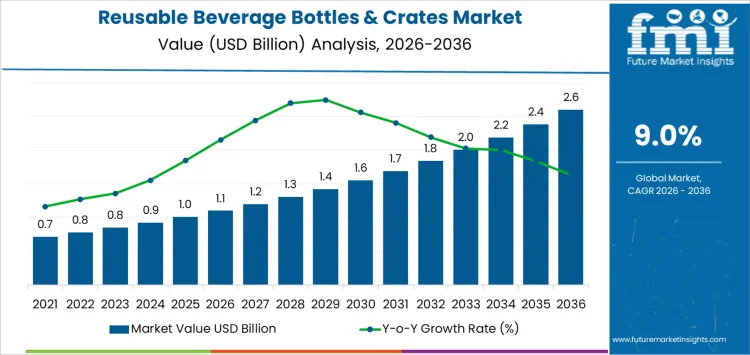
The reusable beverage bottles and crates market under PPWR targets is valued at USD 1.1 billion in 2026 and is projected to reach USD 2.6 billion by 2036, reflecting a CAGR of 9.0%. Early cumulative value, from USD 0.7 billion in 2020 to approximately USD 1.6 billion by 2031, is supported by adoption in retail refill and deposit systems, on-trade outlets, and beverage producers. Reusable glass and PET bottles, HDPE crates, and integrated reverse-logistics plus sanitisation systems drive structural value, enabling compliance with EU packaging and recycling targets.
From 2031 to 2036, cumulative market value grows from roughly USD 1.7 billion to USD 2.6 billion. Expansion is reinforced by broader adoption across local refill schemes, breweries, and automated crate-washing technologies. Repeat procurement, enhanced bottle durability, and optimized sanitisation systems contribute to long-term accumulation, while integration with deposit-return programs ensures consistent recycling cycles. The accumulation curve highlights compounding benefits, illustrating sustained growth driven by regulatory alignment, circular economy adoption, and scalable logistics infrastructure in beverage packaging and distribution over the forecast period.
Quick Stats of the Reusable Beverage Bottles & Crates Market under PPWR Targets:
- Reusable Beverage Bottles & Crates Market under PPWR Targets Value (2026): USD 1.1 billion
- Reusable Beverage Bottles & Crates Market under PPWR Targets Forecast Value (2036): USD 2.6 billion
- Reusable Beverage Bottles & Crates Market under PPWR Targets Forecast CAGR (2026 to 2036): 9.0%
- Leading Packaging Format in Reusable Beverage Bottles & Crates Market: Reusable Glass & PET Bottles (45%)
- Key Growth Regions in Reusable Beverage Bottles & Crates Market: India, China, Germany, Brazil, USA, Japan
- Top Players in Reusable Beverage Bottles & Crates Market: Vetropack, ALPLA, Schoeller Allibert, Orbis, Plastipak, Yantai Wanhua, UFlex, Klabin, Toyo Seikan
What is the Growth Forecast for the Reusable Beverage Bottles & Crates Market under PPWR Targets through 2036?
From 2026 to 2031, the reusable beverage bottles and crates market grows from USD 1.1 billion to approximately USD 1.6 billion, reflecting early-stage adoption driven by compliance with PPWR targets and regulatory mandates for circular packaging. Growth in this phase is concentrated among beverage producers and distributors implementing pilot programs, with uptake influenced by the need for standardized bottle and crate systems, deposit-return logistics, and operational validation. Annual value additions increase steadily as infrastructure expands, reverse logistics mature, and adoption scales across key beverage categories without full system saturation.
Between 2031 and 2036, the market expands from roughly USD 1.6 billion to USD 2.6 billion, indicating a stronger acceleration in value creation. This phase reflects broader normalization as reusable bottles and crates become embedded in mainstream beverage packaging programs. Growth is reinforced by higher per-unit reuse rates, portfolio-wide adoption, and repeat procurement across production sites. Earlier growth relied on selective pilot adoption, while later expansion is driven by scaled deployment, full integration into reverse logistics, and structural compliance with PPWR targets across mass-market beverage supply chains.
Reusable Beverage Bottles and Crates Market under PPWR Targets Key Takeaways
| Metric | Value |
|---|---|
| Market Value (2026) | USD 1.1 billion |
| Forecast Value (2036) | USD 2.6 billion |
| Forecast CAGR (2026 to 2036) | 9.0% |
What Is Shaping the Demand for Reusable Beverage Bottles and Crates Under PPWR Targets?
Demand for reusable beverage bottles and crates developed historically around operational economics and early circular packaging models in select regions. In many markets, glass and heavy duty plastic bottles were returned, cleaned, and refilled at scale for milk, beer, and soft drinks before single-use formats became dominant within the late twentieth century. Reuse systems delivered repeated material use cycles and reduced unit costs where logistics and cleaning infrastructure existed, particularly in local beverage circuits. Reusable crates supported secure transport and stacking of returnable glass and plastic containers. Historical uptake was constrained by labour costs, consumer convenience preferences for single-use, and limited deposit return incentives. Traditional reuse patterns declined as lightweight single-use bottles gained market share and reverse logistics capabilities lagged, shaping demand around convenience over circularity.
Future demand for reusable beverage bottles and crates is expected to be driven by regulatory frameworks such as the European Union Packaging and Packaging Waste Regulation (PPWR) that mandate reuse and recyclability criteria rather than cost advantages alone. The PPWR sets binding targets for reusable beverage containers and deposit return systems to raise reuse rates and minimise packaging waste by 2030, including requirements for reusable container shares and collection mechanisms. Compliance obligations will prompt beverage producers and retailers to invest in returnable bottle networks, standardised crate systems, and reverse logistics infrastructure across supply chains. Reusable formats will be integrated with digital tracking and asset pooling to improve throughput and reduce losses. Growth will be anchored in compliance with lifecycle based policy targets and circular economy measures, shifting demand from isolated reuse pilots toward systemic reuse adoption across beverage categories. The regulatory impetus reflects a structural shift in packaging strategy rather than incremental preference changes seen historically.
What Factors Are Affecting the Demand for Reusable Beverage Bottles and Crates Market under PPWR Targets in Terms of End Use Application and Packaging Format and Type?
Demand for reusable beverage bottles and crates under PPWR targets is segmented by end use application and packaging format and type across beverage distribution systems. Retail refill and deposit systems account for about 40% of total demand, making this the leading end use segment. On trade channels, beverage producers, local refill schemes, and breweries represent additional applications without disclosed share splits. These segments differ in circulation intensity, return logistics, and cleaning requirements. PPWR targets influence reuse rates, container durability, and tracking systems. Packaging format and type determine lifecycle performance and compliance feasibility. Reusable bottles, refillable PET formats, and crate systems address different distribution models. Together, these segments explain demand formation shaped by regulatory obligations, operational reuse loops, and logistics infrastructure rather than single use replacement alone.
What Drives Demand by End Use Application in the Reusable Beverage Bottles and Crates Market under PPWR Targets?
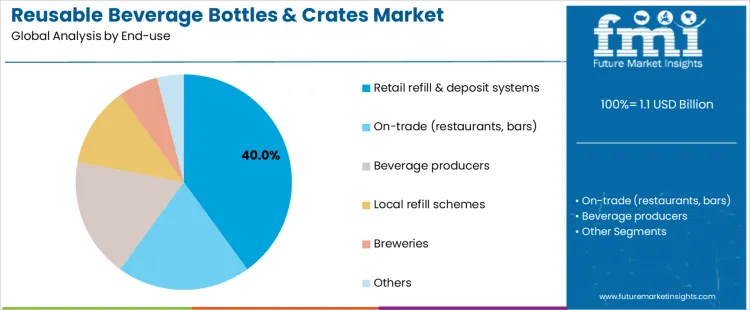
Retail refill and deposit systems lead demand with a 40% share due to established return infrastructure and high consumer participation rates. These systems support repeated circulation of standardized bottles across retail networks. On trade environments adopt reusable packaging to manage controlled consumption and centralized collection. Beverage producers implement reusable formats to meet mandated reuse targets and stabilize packaging supply. Local refill schemes rely on short loop distribution and community based return systems. Breweries apply reusable bottles where regional distribution limits transport distances. Adoption intensity aligns with return efficiency and washing capacity. End use demand therefore reflects feasibility of closed loop logistics rather than beverage category preferences.
Application driven demand remains stable because reuse systems depend on consistent circulation volumes. Retail operators integrate deposit systems into long term packaging strategies. On trade channels benefit from predictable consumption and collection points. Producers prioritize standard bottle pools to reduce complexity. Local refill schemes expand gradually within defined catchment areas. Breweries maintain reuse where infrastructure already exists. These patterns limit short term volatility. End use segmentation highlights dependence on logistics control and recovery rates. Demand therefore aligns with operational readiness and regulatory timelines rather than rapid shifts in consumer packaging behavior.
How Does Packaging Format and Type Shape Demand for Reusable Beverage Bottles and Crates Market under PPWR Targets?
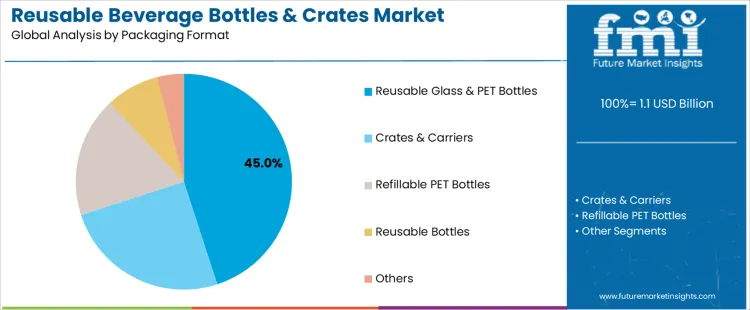
Reusable glass and PET bottles account for about 45% of total demand, making them the leading packaging format. Their dominance reflects suitability for repeated filling cycles and compatibility with washing systems. Crates and carriers support transport, handling, and reverse logistics efficiency. Refillable PET bottles are used where weight reduction and break resistance are required. Other reusable bottle formats address localized or niche distribution models. Packaging format selection depends on durability, standardization, and compatibility with sorting and cleaning infrastructure. Demand follows proven reuse performance rather than material novelty across regulated beverage systems.
Reusable bottles maintain leadership due to established pooling and refill processes. Crates remain essential for protecting containers during transport and stacking. Refillable PET formats gain adoption where logistics distance and handling frequency increase. Producers favor standardized formats to simplify circulation management. Major format changes are avoided due to washing line and sorting constraints. This limits rapid diversification of packaging types. Packaging format and type therefore stabilize demand by reinforcing interoperable systems. These constraints explain why widely adopted reusable bottle formats dominate under PPWR driven reuse requirements.
How Are Reusable Beverage Bottles and Crates Being Applied Under PPWR Targets?
Use appears in beverage and distribution systems where compliance with the EU Packaging and Packaging Waste Regulation (PPWR) encourages multiple-use formats. Beverage producers implement reusable bottles for soft drinks, water, and dairy products to meet minimum reuse and refill targets. Crates are adopted across logistics networks to transport bottles efficiently while maintaining hygiene and structural integrity. Retailers and cafes integrate reusable systems for in-store refill programs. These applications reflect operational and regulatory priorities rather than marketing objectives, with adoption driven by mandated reuse rates, traceability, and operational efficiency.
What Operational and Regulatory Conditions Support Adoption of Reusable Bottles and Crates Under PPWR?
Selection aligns with production and distribution workflows that accommodate collection, washing, and return loops. Filling plants require bottle and crate durability compatible with automated washing and sterilization processes. Logistics teams benefit from stackable, standardized crate designs to optimize transport and storage. Brands adopt reusable formats to comply with PPWR reuse targets while maintaining beverage quality. Retailers manage inventory and deposit systems to support consumer returns. These conditions emerge from operational efficiency, regulatory compliance, and sustainability targets within structured beverage supply chains.
Which Practical Considerations Limit Wider Adoption of Reusable Beverage Bottles and Crates?
Initial investment in bottles, crates, and washing infrastructure is significant. Tracking and deposit systems require robust consumer and retailer coordination. Return logistics add handling complexity and labor costs. Hygiene standards demand precise cleaning and sterilization cycles. Compatibility with existing filling lines and crate handling equipment may require retrofitting. These factors lead to selective adoption where regulatory compliance, environmental impact, and operational feasibility outweigh upfront capital and logistical complexity.
What is the Demand for Reusable Beverage Bottles and Crates under PPWR Targets by Country?
| Country | CAGR (%) |
|---|---|
| Germany | 9.0% |
| USA | 7.2% |
| China | 10.5% |
| India | 12.0% |
| Brazil | 8.0% |
| Japan | 5.0% |
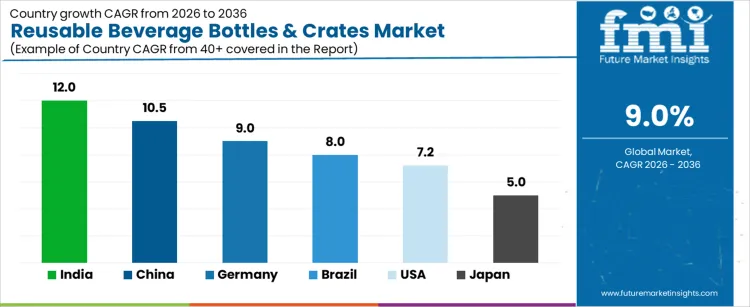
The demand for reusable beverage bottles and crates under PPWR targets varies across countries, driven by regulatory compliance, sustainable packaging adoption, and beverage industry growth. India leads with a 12.0% CAGR, supported by expanding beverage production, growing retail distribution, and adoption of reusable packaging solutions. China follows at 10.5%, driven by large scale manufacturing and focus on circular economy initiatives. Germany grows at 9.0%, reflecting regulatory support for reuse systems and strong beverage sector adoption. The USA records 7.2%, shaped by retail and consumer demand for reusable packaging. Brazil posts 8.0%, supported by organized beverage distribution, while Japan grows at 5.0%, reflecting mature markets and steady adoption of reusable formats.
How Is Reusable Beverage Packaging Driving Growth in Germany?
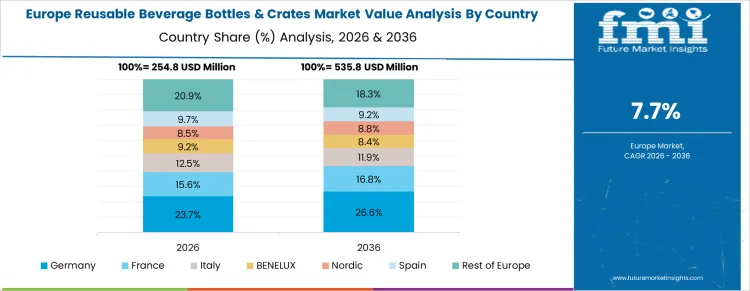
In Germany, revenue from the Reusable Beverage Bottles & Crates Market under PPWR Targets is expanding at a CAGR of 9.00% through 2036, driven by adoption of reusable bottles and crates to meet EU Packaging and Packaging Waste Regulation (PPWR) sustainability targets. Beverage producers are integrating durable plastic, glass, and hybrid material crates to improve returnability, reduce single-use packaging, and enhance operational efficiency. Demand is concentrated in retail, foodservice, and distribution channels. Domestic suppliers are providing standardized, robust reusable bottles and crate systems compatible with automated filling and washing lines. Regulatory compliance, structured reverse logistics, and recurring reuse cycles are sustaining predictable procurement nationwide.
- Beverage producers adopt reusable bottles and crates to comply with PPWR sustainability targets
- Durable plastic, glass, and hybrid crates improve returnability and reduce single-use packaging
- Domestic suppliers provide standardized reusable bottles and crate systems
- Recurring reuse cycles sustain predictable procurement volumes
How Is Consumer and Retail Demand Supporting Growth in the United States?
The United States is experiencing growth in the Reusable Beverage Bottles & Crates Market at a CAGR of 7.20% through 2036, supported by increasing consumer awareness and sustainability initiatives. Beverage brands are using reusable bottles and crates for soft drinks, juices, and alcoholic beverages to reduce single-use packaging and encourage repeat use. Demand is concentrated in retail, vending, and distribution channels. Domestic suppliers provide robust bottle and crate systems designed for high cycle life and compatibility with automated cleaning and sorting lines. Structured reverse logistics and recurring refill programs sustain predictable procurement nationwide.
- Soft drink, juice, and alcoholic beverage producers adopt reusable bottles and crates
- Reusable systems reduce single-use packaging and promote sustainability
- Domestic suppliers provide durable bottles and crate systems compatible with automated cleaning lines
- Recurring refill programs sustain predictable procurement
How Is E-Commerce and Industrial Expansion Accelerating Adoption in China?
In China, revenue from the Reusable Beverage Bottles & Crates Market is growing at a CAGR of 10.50% through 2036, driven by expansion of beverage production, e-commerce distribution, and sustainability initiatives. Manufacturers are adopting reusable crates and bottles for soft drinks, juices, and bottled water to reduce packaging waste and improve logistics efficiency. Demand is strong across retail, modern trade, and industrial beverage production. Domestic suppliers are scaling production of reusable bottles and crates designed for repeated handling and automated processing. High production volumes and structured reverse logistics are sustaining rapid adoption nationwide.
- Beverage production and e-commerce growth drive adoption of reusable bottles and crates
- Soft drinks, juices, and bottled water anchor demand
- Domestic suppliers scale production for high durability and automated handling
- Structured reverse logistics sustain consistent adoption
How Is Organized Beverage Manufacturing Supporting Growth in India?
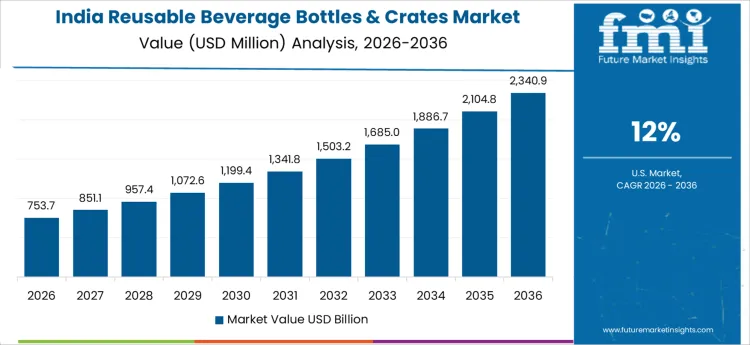
India is witnessing strong expansion in the Reusable Beverage Bottles & Crates Market at a CAGR of 12.00% through 2036, supported by growth in organized beverage manufacturing and sustainability initiatives. Manufacturers are integrating reusable crates and bottles for soft drinks, bottled water, and juices to reduce environmental impact and improve operational efficiency. Demand is rising across retail, distribution, and institutional beverage supply chains. Domestic suppliers are providing cost-aligned, durable bottles and crates suitable for high-volume reuse. Expanding retail networks, refill programs, and organized beverage manufacturing are sustaining robust procurement nationwide.
- Organized beverage manufacturing increases demand for reusable bottles and crates
- Soft drinks, bottled water, and juices drive high-volume adoption
- Domestic suppliers provide cost-aligned, durable reusable systems
- Retail expansion and refill program adoption sustain procurement growth
How Are Beverage Distribution Needs Supporting Adoption in Brazil?
Brazil is seeing steady growth in the Reusable Beverage Bottles & Crates Market at a CAGR of 8.00% through 2036, supported by increasing distribution of soft drinks, juices, and bottled water. Beverage producers are using reusable bottles and crates to reduce packaging waste, improve logistics efficiency, and comply with sustainability initiatives. Demand is concentrated in retail, beverage production, and regional distribution hubs. Domestic suppliers are expanding reusable bottle and crate production and providing robust handling systems. Growth in beverage distribution and retail networks is sustaining recurring procurement across packaging operations nationwide.
- Soft drinks, juices, and bottled water drive reusable bottle and crate adoption
- Reusable systems improve logistics efficiency and reduce packaging waste
- Domestic suppliers expand production and provide robust handling systems
- Retail and distribution growth sustain recurring procurement
How Does Mature Beverage Packaging Demand Influence Stability in Japan?
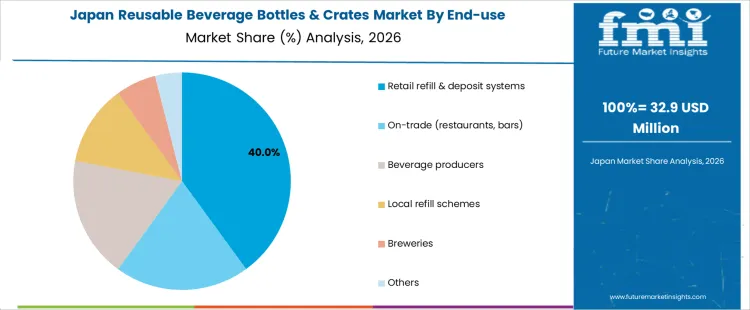
Japan is maintaining measured growth in the Reusable Beverage Bottles & Crates Market at a CAGR of 5.00% through 2036, supported by mature beverage markets and selective adoption of reusable systems. Beverage producers apply reusable bottles and crates for soft drinks, bottled water, and juices. Demand remains focused on material durability, returnability, and compatibility with automated washing and sorting equipment. Domestic suppliers emphasize precise manufacturing and consistent product quality. Stable consumption patterns and recurring refill cycles are sustaining predictable procurement across established beverage packaging operations nationwide.
- Mature beverage markets favor selective adoption of reusable bottles and crates
- Soft drinks, bottled water, and juices anchor baseline demand
- Domestic suppliers ensure durable materials and automated system compatibility
- Recurring refill cycles sustain procurement continuity
Which Companies Are Shaping Competition in The Reusable Beverage Bottles and Crates Market Under PPWR Targets Across Regional Supply Chains?
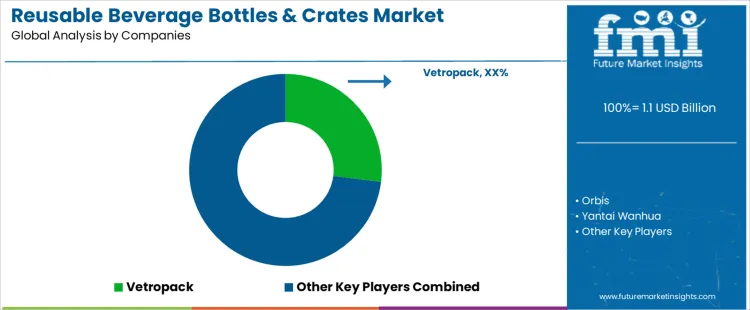
Competition in the Reusable Beverage Bottles and Crates Market under PPWR targets is led by packaging producers with experience in returnable systems and closed loop logistics. Vetropack holds a strong position in reusable glass bottles across European beverage markets, supported by standardized formats and established refill networks. ALPLA contributes through returnable plastic bottles and crate systems designed for repeated handling and wash cycles. Schoeller Allibert and Orbis influence the crate segment through durable returnable transport packaging used in beverage distribution and pooling systems. Plastipak participates through plastic container expertise adapted for reuse focused beverage applications. Competitive positioning centers on durability, washability, and system compatibility with existing bottling and distribution infrastructure.
Regional and material focused players add competitive depth. Toyo Seikan supports reusable beverage packaging in Japan through precision container manufacturing aligned with deposit and return systems. Yantai Wanhua participates from the materials side, supplying resins used in durable bottle and crate production rather than finished packaging. UFlex engages through selective returnable packaging initiatives and partnerships in emerging markets. Klabin contributes indirectly through fibre based crate alternatives and transport packaging solutions in Latin America. Local system operators and beverage cooperatives shape adoption by defining standard formats and circulation models. Competitive dynamics are influenced by logistics integration, asset management capability, and regulatory alignment rather than packaging aesthetics or short term cost advantages.
Key Players in the Reusable Beverage Bottles & Crates Market
- Vetropack
- ALPLA
- Schoeller Allibert
- Orbis
- Plastipak
- Yantai Wanhua
- UFlex
- Klabin
- Toyo Seikan
Scope of the Report
| Items | Values |
|---|---|
| Quantitative Units (2026) | USD billion |
| End-use / Application | Retail refill & deposit systems; On-trade (restaurants, bars); Beverage producers; Local refill schemes; Breweries; Others |
| Packaging Format / Type | Reusable Glass & PET Bottles; Crates & Carriers; Refillable PET Bottles; Reusable Bottles; Others |
| Material | Glass / rPET; HDPE Crates; PET blends; HDPE / PP; Others |
| Technology | Reverse-logistics + sanitisation; Automated crate washing; Bottle life-extension design; Low-cost sanitisation; Others |
| Region | Asia Pacific; Europe; North America; Latin America; Middle East & Africa |
| Countries Covered | China; Japan; South Korea; India; Australia & New Zealand; ASEAN; Germany; United Kingdom; France; Italy; Spain; Nordic; BENELUX; United States; Canada; Mexico; Brazil; Chile; Kingdom of Saudi Arabia; Other GCC Countries; Turkey; South Africa; Other African Union; Rest of Asia Pacific; Rest of Europe; Rest of Latin America; Rest of Middle East & Africa |
| Key Companies Profiled | Vetropack; ALPLA; Schoeller Allibert; Orbis; Plastipak; Yantai Wanhua; UFlex; Klabin; Toyo Seikan |
| Additional Attributes | Dollar by sales across end-use applications, packaging formats, materials, and technologies; Reusable glass and PET bottles lead adoption due to durability and repeated fill cycles; Crates and carriers support transport, stacking, and reverse logistics efficiency; Refillable PET bottles gain traction for lightweight and break-resistance requirements; PPWR compliance drives standardized bottle and crate systems, deposit-return integration, and logistics optimization; Growth is supported by regulatory alignment, circular economy adoption, and scalable reuse infrastructure; Operational considerations include automated washing compatibility, material life extension, and hygiene standards; Regional adoption influenced by beverage production scale, retail distribution, and deposit-return programs; Repeat procurement and multi-site adoption reinforce structural demand in beverage supply chains. |
Reusable Beverage Bottles & Crates Market Segmentation
End-use / Application:
- Retail refill & deposit systems
- On-trade (restaurants, bars)
- Beverage producers
- Local refill schemes
- Breweries
- Others
Packaging Format / Type:
- Reusable Glass & PET Bottles
- Crates & Carriers
- Refillable PET Bottles
- Reusable Bottles
- Others
Material:
- Glass / rPET
- HDPE Crates
- PET blends
- HDPE / PP
- Others
Technology:
- Reverse-logistics + sanitisation
- Automated crate washing
- Bottle life-extension design
- Low-cost sanitisation
- Others
Region
- Asia Pacific
- China
- Japan
- South Korea
- India
- Australia & New Zealand
- ASEAN
- Rest of Asia Pacific
- Europe
- Germany
- United Kingdom
- France
- Italy
- Spain
- Nordic
- BENELUX
- Rest of Europe
- North America
- United States
- Canada
- Mexico
- Latin America
- Brazil
- Chile
- Rest of Latin America
- Middle East & Africa
- Kingdom of Saudi Arabia
- Other GCC Countries
- Turkey
- South Africa
- Other African Union
- Rest of Middle East & Africa
Frequently Asked Questions
How big is the reusable beverage bottles & crates market in 2026?
The global reusable beverage bottles & crates market is estimated to be valued at USD 1.1 billion in 2026.
What will be the size of reusable beverage bottles & crates market in 2036?
The market size for the reusable beverage bottles & crates market is projected to reach USD 2.6 billion by 2036.
How much will be the reusable beverage bottles & crates market growth between 2026 and 2036?
The reusable beverage bottles & crates market is expected to grow at a 9.0% CAGR between 2026 and 2036.
What are the key product types in the reusable beverage bottles & crates market?
The key product types in reusable beverage bottles & crates market are retail refill & deposit systems, on-trade (restaurants, bars), beverage producers, local refill schemes, breweries and others.
Which packaging format segment to contribute significant share in the reusable beverage bottles & crates market in 2026?
In terms of packaging format, reusable glass & pet bottles segment to command 45.0% share in the reusable beverage bottles & crates market in 2026.
Preview the report firsthand - request a free sample
Get SampleGet the brochure for pricing and purchase details.
Get PDFTable of Content
- Executive Summary
- Global Market Outlook
- Demand-side Trends
- Supply-side Trends
- Technology Roadmap Analysis
- Analysis and Recommendations
- Market Overview
- Market Coverage / Taxonomy
- Market Definition / Scope / Limitations
- Market Background
- Market Dynamics
- Drivers
- Restraints
- Opportunity
- Trends
- Scenario Forecast
- Demand in Optimistic Scenario
- Demand in Likely Scenario
- Demand in Conservative Scenario
- Opportunity Map Analysis
- Product Life Cycle Analysis
- Supply Chain Analysis
- Investment Feasibility Matrix
- Value Chain Analysis
- PESTLE and Porter’s Analysis
- Regulatory Landscape
- Regional Parent Market Outlook
- Production and Consumption Statistics
- Import and Export Statistics
- Market Dynamics
- Global Market Analysis 2021 to 2025 and Forecast, 2026 to 2036
- Historical Market Size Value (USD Million) Analysis, 2021 to 2025
- Current and Future Market Size Value (USD Million) Projections, 2026 to 2036
- Y-o-Y Growth Trend Analysis
- Absolute $ Opportunity Analysis
- Global Market Pricing Analysis 2021 to 2025 and Forecast 2026 to 2036
- Global Market Analysis 2021 to 2025 and Forecast 2026 to 2036, By End-use
- Introduction / Key Findings
- Historical Market Size Value (USD Million) Analysis By End-use , 2021 to 2025
- Current and Future Market Size Value (USD Million) Analysis and Forecast By End-use , 2026 to 2036
- Retail refill & deposit systems
- On-trade (restaurants, bars)
- Beverage producers
- Local refill schemes
- Breweries
- Others
- Y-o-Y Growth Trend Analysis By End-use , 2021 to 2025
- Absolute $ Opportunity Analysis By End-use , 2026 to 2036
- Global Market Analysis 2021 to 2025 and Forecast 2026 to 2036, By Packaging Format
- Introduction / Key Findings
- Historical Market Size Value (USD Million) Analysis By Packaging Format, 2021 to 2025
- Current and Future Market Size Value (USD Million) Analysis and Forecast By Packaging Format, 2026 to 2036
- Reusable Glass & PET Bottles
- Crates & Carriers
- Refillable PET Bottles
- Reusable Bottles
- Others
- Y-o-Y Growth Trend Analysis By Packaging Format, 2021 to 2025
- Absolute $ Opportunity Analysis By Packaging Format, 2026 to 2036
- Global Market Analysis 2021 to 2025 and Forecast 2026 to 2036, By Material
- Introduction / Key Findings
- Historical Market Size Value (USD Million) Analysis By Material, 2021 to 2025
- Current and Future Market Size Value (USD Million) Analysis and Forecast By Material, 2026 to 2036
- Glass / rPET
- HDPE Crates
- PET blends
- HDPE / PP
- Others
- Y-o-Y Growth Trend Analysis By Material, 2021 to 2025
- Absolute $ Opportunity Analysis By Material, 2026 to 2036
- Global Market Analysis 2021 to 2025 and Forecast 2026 to 2036, By Technology
- Introduction / Key Findings
- Historical Market Size Value (USD Million) Analysis By Technology, 2021 to 2025
- Current and Future Market Size Value (USD Million) Analysis and Forecast By Technology, 2026 to 2036
- Reverse-logistics + sanitisation
- Automated crate washing
- Bottle life-extension design
- Low-cost sanitisation
- Others
- Y-o-Y Growth Trend Analysis By Technology, 2021 to 2025
- Absolute $ Opportunity Analysis By Technology, 2026 to 2036
- Global Market Analysis 2021 to 2025 and Forecast 2026 to 2036, By Region
- Introduction
- Historical Market Size Value (USD Million) Analysis By Region, 2021 to 2025
- Current Market Size Value (USD Million) Analysis and Forecast By Region, 2026 to 2036
- North America
- Latin America
- Western Europe
- Eastern Europe
- East Asia
- South Asia and Pacific
- Middle East & Africa
- Market Attractiveness Analysis By Region
- North America Market Analysis 2021 to 2025 and Forecast 2026 to 2036, By Country
- Historical Market Size Value (USD Million) Trend Analysis By Market Taxonomy, 2021 to 2025
- Market Size Value (USD Million) Forecast By Market Taxonomy, 2026 to 2036
- By Country
- USA
- Canada
- Mexico
- By End-use
- By Packaging Format
- By Material
- By Technology
- By Country
- Market Attractiveness Analysis
- By Country
- By End-use
- By Packaging Format
- By Material
- By Technology
- Key Takeaways
- Latin America Market Analysis 2021 to 2025 and Forecast 2026 to 2036, By Country
- Historical Market Size Value (USD Million) Trend Analysis By Market Taxonomy, 2021 to 2025
- Market Size Value (USD Million) Forecast By Market Taxonomy, 2026 to 2036
- By Country
- Brazil
- Chile
- Rest of Latin America
- By End-use
- By Packaging Format
- By Material
- By Technology
- By Country
- Market Attractiveness Analysis
- By Country
- By End-use
- By Packaging Format
- By Material
- By Technology
- Key Takeaways
- Western Europe Market Analysis 2021 to 2025 and Forecast 2026 to 2036, By Country
- Historical Market Size Value (USD Million) Trend Analysis By Market Taxonomy, 2021 to 2025
- Market Size Value (USD Million) Forecast By Market Taxonomy, 2026 to 2036
- By Country
- Germany
- UK
- Italy
- Spain
- France
- Nordic
- BENELUX
- Rest of Western Europe
- By End-use
- By Packaging Format
- By Material
- By Technology
- By Country
- Market Attractiveness Analysis
- By Country
- By End-use
- By Packaging Format
- By Material
- By Technology
- Key Takeaways
- Eastern Europe Market Analysis 2021 to 2025 and Forecast 2026 to 2036, By Country
- Historical Market Size Value (USD Million) Trend Analysis By Market Taxonomy, 2021 to 2025
- Market Size Value (USD Million) Forecast By Market Taxonomy, 2026 to 2036
- By Country
- Russia
- Poland
- Hungary
- Balkan & Baltic
- Rest of Eastern Europe
- By End-use
- By Packaging Format
- By Material
- By Technology
- By Country
- Market Attractiveness Analysis
- By Country
- By End-use
- By Packaging Format
- By Material
- By Technology
- Key Takeaways
- East Asia Market Analysis 2021 to 2025 and Forecast 2026 to 2036, By Country
- Historical Market Size Value (USD Million) Trend Analysis By Market Taxonomy, 2021 to 2025
- Market Size Value (USD Million) Forecast By Market Taxonomy, 2026 to 2036
- By Country
- China
- Japan
- South Korea
- By End-use
- By Packaging Format
- By Material
- By Technology
- By Country
- Market Attractiveness Analysis
- By Country
- By End-use
- By Packaging Format
- By Material
- By Technology
- Key Takeaways
- South Asia and Pacific Market Analysis 2021 to 2025 and Forecast 2026 to 2036, By Country
- Historical Market Size Value (USD Million) Trend Analysis By Market Taxonomy, 2021 to 2025
- Market Size Value (USD Million) Forecast By Market Taxonomy, 2026 to 2036
- By Country
- India
- ASEAN
- Australia & New Zealand
- Rest of South Asia and Pacific
- By End-use
- By Packaging Format
- By Material
- By Technology
- By Country
- Market Attractiveness Analysis
- By Country
- By End-use
- By Packaging Format
- By Material
- By Technology
- Key Takeaways
- Middle East & Africa Market Analysis 2021 to 2025 and Forecast 2026 to 2036, By Country
- Historical Market Size Value (USD Million) Trend Analysis By Market Taxonomy, 2021 to 2025
- Market Size Value (USD Million) Forecast By Market Taxonomy, 2026 to 2036
- By Country
- Kingdom of Saudi Arabia
- Other GCC Countries
- Turkiye
- South Africa
- Other African Union
- Rest of Middle East & Africa
- By End-use
- By Packaging Format
- By Material
- By Technology
- By Country
- Market Attractiveness Analysis
- By Country
- By End-use
- By Packaging Format
- By Material
- By Technology
- Key Takeaways
- Key Countries Market Analysis
- USA
- Pricing Analysis
- Market Share Analysis, 2025
- By End-use
- By Packaging Format
- By Material
- By Technology
- Canada
- Pricing Analysis
- Market Share Analysis, 2025
- By End-use
- By Packaging Format
- By Material
- By Technology
- Mexico
- Pricing Analysis
- Market Share Analysis, 2025
- By End-use
- By Packaging Format
- By Material
- By Technology
- Brazil
- Pricing Analysis
- Market Share Analysis, 2025
- By End-use
- By Packaging Format
- By Material
- By Technology
- Chile
- Pricing Analysis
- Market Share Analysis, 2025
- By End-use
- By Packaging Format
- By Material
- By Technology
- Germany
- Pricing Analysis
- Market Share Analysis, 2025
- By End-use
- By Packaging Format
- By Material
- By Technology
- UK
- Pricing Analysis
- Market Share Analysis, 2025
- By End-use
- By Packaging Format
- By Material
- By Technology
- Italy
- Pricing Analysis
- Market Share Analysis, 2025
- By End-use
- By Packaging Format
- By Material
- By Technology
- Spain
- Pricing Analysis
- Market Share Analysis, 2025
- By End-use
- By Packaging Format
- By Material
- By Technology
- France
- Pricing Analysis
- Market Share Analysis, 2025
- By End-use
- By Packaging Format
- By Material
- By Technology
- India
- Pricing Analysis
- Market Share Analysis, 2025
- By End-use
- By Packaging Format
- By Material
- By Technology
- ASEAN
- Pricing Analysis
- Market Share Analysis, 2025
- By End-use
- By Packaging Format
- By Material
- By Technology
- Australia & New Zealand
- Pricing Analysis
- Market Share Analysis, 2025
- By End-use
- By Packaging Format
- By Material
- By Technology
- China
- Pricing Analysis
- Market Share Analysis, 2025
- By End-use
- By Packaging Format
- By Material
- By Technology
- Japan
- Pricing Analysis
- Market Share Analysis, 2025
- By End-use
- By Packaging Format
- By Material
- By Technology
- South Korea
- Pricing Analysis
- Market Share Analysis, 2025
- By End-use
- By Packaging Format
- By Material
- By Technology
- Russia
- Pricing Analysis
- Market Share Analysis, 2025
- By End-use
- By Packaging Format
- By Material
- By Technology
- Poland
- Pricing Analysis
- Market Share Analysis, 2025
- By End-use
- By Packaging Format
- By Material
- By Technology
- Hungary
- Pricing Analysis
- Market Share Analysis, 2025
- By End-use
- By Packaging Format
- By Material
- By Technology
- Kingdom of Saudi Arabia
- Pricing Analysis
- Market Share Analysis, 2025
- By End-use
- By Packaging Format
- By Material
- By Technology
- Turkiye
- Pricing Analysis
- Market Share Analysis, 2025
- By End-use
- By Packaging Format
- By Material
- By Technology
- South Africa
- Pricing Analysis
- Market Share Analysis, 2025
- By End-use
- By Packaging Format
- By Material
- By Technology
- USA
- Market Structure Analysis
- Competition Dashboard
- Competition Benchmarking
- Market Share Analysis of Top Players
- By Regional
- By End-use
- By Packaging Format
- By Material
- By Technology
- Competition Analysis
- Competition Deep Dive
- Vetropack
- Overview
- Product Portfolio
- Profitability by Market Segments (Product/Age /Sales Channel/Region)
- Sales Footprint
- Strategy Overview
- Marketing Strategy
- Product Strategy
- Channel Strategy
- Orbis
- Yantai Wanhua
- UFlex
- Klabin
- Toyo Seikan
- ALPLA
- Schoeller Allibert
- Vetropack
- Competition Deep Dive
- Assumptions & Acronyms Used
- Research Methodology


