

- Industry Size (2026)
- USD 1650.6 Mn
- Forecast (2036)
- USD 2325.8 Mn
- CAGR (2026 to 2036)
- 3.5%
Beverage Coaster Market Size, Market Forecast and Outlook By FMI
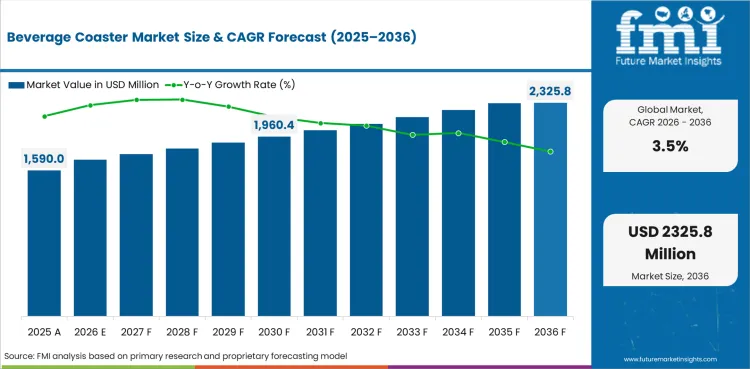
In 2025, the global beverage coaster market was valued at approximately USD 1,590 million. Based on Future Market Insights’ analysis, demand is estimated to reach USD 1,650.6 million in 2026 and is projected to expand to USD 2,325.8 million by 2036, reflecting a compound annual growth rate of 3.5% during the forecast period.
Quick Stats for Beverage Coaster Market
- Market Snapshot
- The beverage coaster market was valued at USD 1,590 million in 2025 and is projected to reach USD 2,325.8 million by 2036.
- The market is expected to grow at a CAGR of 3.5% from 2026 to 2036, creating an incremental opportunity of approximately USD 675 million.
- The industry is transitioning from a low-cost consumable category to a branding and presentation-driven tabletop accessory market.
- Demand and Growth Drivers
- Demand is driven by expansion of hospitality infrastructure, increasing promotional merchandising by beverage brands, and growing emphasis on tabletop aesthetics and customer experience.
- Rising adoption of reusable and premium coasters in residential and hospitality settings is further supporting growth.
- Customization through digital printing and short-run production is accelerating usage in event-based marketing and promotional campaigns.
- Product and Segment View
- The market includes formats such as paperboard, silicone, cork-backed composites, ceramic, stone, glass, and metal coasters.
- Paperboard beer mats dominate due to cost efficiency and absorbency in high-volume environments.
- Premium materials such as silicone, ceramic, and stone are gaining traction in retail and upscale hospitality segments.
- Scope includes all beverage coasters used for surface protection and branding, while excluding non-coaster tabletop accessories like placemats, trays, and napkins.
- Geography and Competitive Outlook
- North America leads in market size due to strong promotional usage and hospitality density, while East Asia and South Asia are the fastest-growing regions.
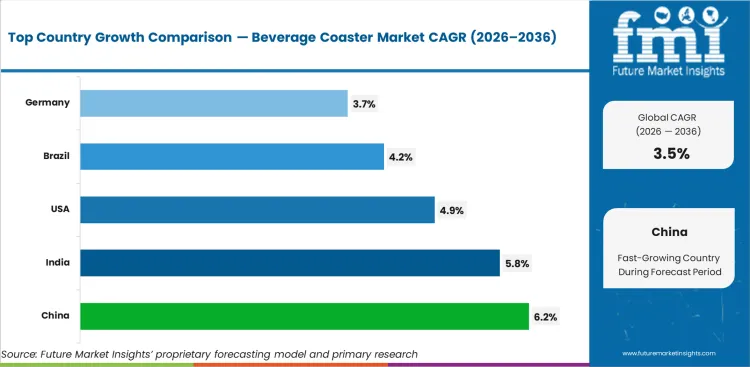
- Among key countries, China (6.2%) and India (5.8%) show the highest growth rates, followed by USA (4.9%), Brazil (4.2%), and Germany (3.7%).
- Competition is defined by material innovation, customization capability, and sustainability alignment, with players focusing on premium and eco-friendly product portfolios.
- Analyst Opinion at FMI
- Ismail Sutaria, Principal Consultant, opines: “The strategic role of beverage coasters is shifting from disposable service items to integrated branding tools. Suppliers that align with sustainability requirements and deliver high-quality customization at speed will gain stronger positioning within hospitality and promotional supply chains.”
- Strategic Implications / Executive Takeaways
- Manufacturers should invest in recyclable fiberboard and sustainable materials to align with hospitality procurement trends.
- Expanding digital printing and short-run customization capabilities is critical for capturing promotional demand.
- Companies should develop premium reusable coaster portfolios targeting retail, gifting, and lifestyle décor segments.
The market is expected to generate an absolute dollar opportunity exceeding USD 675 million between 2026 and 2036, supported primarily by expansion of hospitality infrastructure, increased promotional merchandising expenditure by beverage brands, and rising adoption of reusable tabletop accessories across residential and premium dining environments. Growth across the forecast period is being shaped less by beverage consumption volumes alone and more by increasing importance of tabletop presentation quality and brand visibility within competitive hospitality environments.
Paperboard beer mats continue to represent the dominant coaster format across high-throughput beverage service environments due to their absorbency and cost efficiency. At the same time, silicone, cork-backed composites, ceramic, stone, and laminated paperboard formats are gaining adoption across premium hospitality venues and consumer retail segments where durability and aesthetic appeal influence purchasing behavior.
“Coasters have a direct line to your emotions,” Thomas Reuter Stiegl Head of Purchasing confidently says. “People use them to play and to write messages on them - sometimes they even take them home as a souvenir. In other words, they create a connection between our brand and memories of a great night spent somewhere.” Reuter is convinced that there are few things that will bring you closer to consumers than coasters and glassware. Not to mention, of course, that beverage coasters are also super valuable for hosts thanks to their practical uses. There is a reason why Stiegl provides these advertising tools for free and beer truck drivers always have them along for the ride. “People don’t have to order coasters from us. We simply give them out for free to our customers so that the hospitality industry doesn’t run out.”
Recent developments reflect this branding and quality-driven shift, with manufacturers expanding offerings across premium printed coasters, reusable coaster sets, and custom promotional formats for hospitality, events, and direct-to-consumer retail. Investments in advanced printing technologies, specialty coatings, and mixed-material constructions are reinforcing the role of beverage coasters as both functional protectors and visual brand assets.
FMI expects these experience-driven, branding-focused, and sustainability-aligned trends to structurally elevate the perceived value and functional relevance of beverage coasters over the coming decade. As hospitality and beverage brands increasingly compete on presentation and consumer experience, beverage coasters are expected to transition from disposable service items to integral components of tabletop branding, surface protection, and premium beverage presentation within global foodservice and consumer markets.
Customization capability supported by digital printing and short-run decoration technologies continues to strengthen the role of beverage coasters as promotional media assets used for event-based marketing campaigns, seasonal product launches, and limited-edition beverage branding programs across bars, cafés, breweries, and corporate hospitality environments
Beverage Coaster Market Definition
The beverage coaster market refers to the global ecosystem of tabletop surface-protection accessories designed to prevent moisture damage, condensation staining, and heat-related surface wear caused by beverage containers across hospitality, commercial foodservice, promotional branding, and residential environments. Beverage coasters are widely used across bars, restaurants, cafés, hotels, breweries, corporate offices, and household settings where they support both functional surface protection and visual brand communication.
Modern beverage coaster formats increasingly incorporate material diversification, specialty coatings, premium thickness profiles, and advanced printing technologies designed to enhance durability, slip resistance, stain protection, and branding effectiveness across high-traffic beverage service environments. As hospitality operators increasingly prioritize presentation quality and customer experience differentiation, beverage coasters are evolving into integrated tabletop branding elements rather than disposable service accessories.
Beverage Coaster Market Inclusions
The report provides global and regional market size estimates for 2025 and 2026 with forecasts through 2036 and includes segmentation across shape and geometry, material composition, coating performance characteristics, thickness profiles, decoration technologies, distribution-channel structure, and end-use application demand patterns. The study evaluates coaster performance characteristics including absorbency behavior, moisture-resistance capability, anti-slip functionality, surface durability, and compatibility with offset, digital, and specialty decoration techniques across hospitality and promotional branding environments.
The analysis further incorporates procurement dynamics across beverage brand owners, hospitality operators, promotional merchandise agencies, and consumer retail channels where coaster selection increasingly reflects branding strategy alignment rather than purely functional tabletop protection requirements.
Beverage Coaster Market Exclusions
The scope excludes tabletop accessories that do not function primarily as beverage container surface protectors, including placemats, trays, napkins, table linens, drinkware accessories, and decorative tabletop items not intended for condensation management or beverage-container support applications. Packaging substrates used exclusively for food-contact wrapping or disposable serviceware applications are also excluded unless directly associated with beverage coaster production formats.
Beverage Coaster Market Research Methodology
Primary research for the beverage coaster market included structured interviews with paperboard converters, specialty tabletop accessory manufacturers, promotional merchandise suppliers, hospitality procurement managers, and beverage brand marketing teams responsible for point-of-sale branding execution across bars, cafés, breweries, and event environments. These interviews validated adoption trends across pulpboard beer mats, laminated paperboard coasters, cork-backed composite formats, and reusable coaster materials including silicone, ceramic, stone, and metal variants.
Desk research incorporated hospitality outlet density benchmarking, promotional merchandise procurement cycles across beverage-brand marketing programs, tabletop accessory consumption patterns across bars and cafés, and material-transition trends influencing adoption of recyclable fiberboard substrates and reusable coaster alternatives across commercial and residential environments. Additional inputs were derived from printing technology adoption trends, decoration-method evolution across offset and digital platforms, and e-commerce-based custom-print coaster production capacity supporting short-run personalization demand across promotional branding applications.
Market sizing and forecasting were conducted using a hybrid top-down and bottom-up methodology in which coaster consumption intensity per hospitality outlet and per promotional campaign was modeled against beverage-service volumes and event-driven marketing activity across major consuming regions. Estimates were validated through converter production-capacity mapping, hospitality procurement benchmarking, and expert-panel review prior to final release.
Analyst Opinion at FMI
Ismail Sutaria, Principal Consultant for Packaging Industry at Future Market Insights, opines, ‘CXOs will find in this report strategic clarity on how hospitality branding requirements, recyclable fiberboard adoption, and growth of premium tabletop accessory retail channels are redefining the strategic role of beverage coasters beyond traditional disposable service formats.’
Strategic Implications / Executive Takeaways
- Invest in recyclable pulpboard and responsibly sourced fiber substrates aligned with sustainability procurement practices across hospitality operators.
- Expand short-run digital printing capabilities to support event-driven promotional coaster campaigns for beverage brands.
- Develop premium reusable coaster portfolios positioned for coordinated tabletop décor and gifting retail channels.
Summary of Beverage Coaster Market
Demand for beverage coasters continues to expand steadily as hospitality operators and beverage brand owners increasingly prioritize tabletop presentation quality and brand visibility across high-footfall beverage service environments. Coasters remain one of the most cost-effective physical branding touchpoints available within on-premise beverage consumption environments, supporting brand recall and customer engagement during consumption moments.
At the same time, consumer demand for coordinated home décor accessories and premium tabletop presentation formats is strengthening adoption of reusable coaster materials across residential retail channels. Improvements in digital printing capability and customization turnaround times are enabling beverage brands and promotional merchandise suppliers to deploy short-run coaster campaigns supporting seasonal marketing programs and experiential brand engagement initiatives across global hospitality markets.
Regional Analysis
Region Introduction
The global beverage coaster market is segmented across North America, Europe, East Asia, South Asia, Latin America, and the Middle East & Africa. Regional demand patterns are influenced primarily by hospitality outlet density, beverage consumption intensity across on-trade environments, promotional merchandising activity by beverage brand owners, and adoption of reusable tabletop accessories across consumer retail channels. Market maturity varies across regions depending on café culture expansion, branded beverage-service penetration, and availability of cost-efficient coaster manufacturing capacity across paperboard and specialty-material segments.
Future Market Insights observes that North America currently represents the largest regional market by value supported by strong promotional merchandise adoption and widespread use of customized paperboard coasters across breweries, bars, and corporate hospitality environments. East Asia and South Asia are emerging as high-growth regions driven by expanding café infrastructure and
.webp "Top Country Growth Comparison Beverage Coaster Market Cagr (2026 2036)")
| Country | CAGR (2026-2036) |
|---|---|
| China | 6.2% |
| India | 5.8% |
| United States | 4.9% |
| Brazil | 4.2% |
| Germany | 3.7% |
East Asia - Fastest-Growing Hospitality Branding Support Market
East Asia represents one of the fastest-growing regional markets for beverage coasters supported by expansion of branded café chains, premium casual dining concepts, and beverage-service standardization practices across metropolitan hospitality environments. Growth across the region is reinforced by rising disposable incomes, increasing consumer participation in social dining experiences, and strengthening adoption of branded tabletop accessories across beverage service environments where presentation quality influences customer perception.
Regional manufacturers benefit from integrated paperboard conversion capacity and availability of diverse coaster materials including laminated fiberboard, cork-backed formats, and reusable polymer-based coaster solutions supporting both commercial and retail distribution channels.
- China: China represents the fastest-growing beverage coaster market globally and is projected to expand at a CAGR of 6.2% through 2036 supported by rapid expansion of café culture, premium dining environments, and branded beverage-service concepts across urban hospitality infrastructure. Increasing investment by international beverage brands in localized experiential marketing programs continues to strengthen adoption of customized coaster formats designed to support brand recall and tabletop presentation consistency across bars, restaurants, and event venues.
Growth across the Chinese market is further reinforced by strong domestic manufacturing capacity across paperboard and composite-material coaster production as well as increasing use of coasters as promotional merchandise across corporate events, festivals, and beverage brand campaigns targeting younger urban consumer segments.
South Asia - Expanding Café Culture and Promotional Branding Market
South Asia represents an emerging high-growth market for beverage coasters supported by expansion of organized café chains, quick-service restaurant networks, and premium hospitality formats across urbanizing consumer markets. Adoption across the region is increasingly influenced by the need to improve tabletop presentation quality and strengthen brand identity across competitive beverage-service environments.
Rising availability of recycled fiberboard and cost-efficient paperboard coaster formats continues to support adoption across both domestic hospitality operators and international beverage brands expanding presence across the region.
- India: India’s beverage coaster market is projected to expand at a CAGR of 5.8% through 2036 supported by rapid expansion of café culture, growth of specialty beverage chains, and increasing adoption of branded tabletop accessories across premium hospitality venues in tier-1 and tier-2 cities. Beverage brands operating across urban markets are increasingly deploying customized paperboard coaster formats as low-cost promotional tools capable of supporting localized marketing campaigns and product launches across cafés, restaurants, and event-driven beverage-service environments.
Expansion of domestic printing capability and availability of recyclable fiberboard substrates continue to support cost-efficient customization across short-run promotional coaster campaigns aligned with regional brand-engagement strategies.
North America - Largest Promotional Coaster Consumption Market
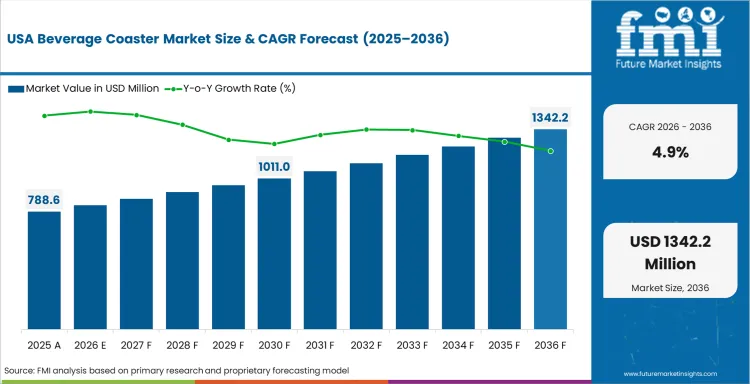
North America represents the largest beverage coaster market globally supported by strong promotional merchandise adoption across breweries, bars, restaurants, and corporate hospitality environments where coasters function as cost-effective brand-visibility tools. Growth across the region is supported by high beverage consumption intensity across on-premise service environments and widespread deployment of customized coaster formats supporting product launches, seasonal promotions, and event-driven marketing initiatives.
Expansion of premium home-entertainment culture is also strengthening demand for reusable coaster formats across consumer retail channels including silicone, stone, ceramic, and laminated composite coaster sets aligned with lifestyle décor purchasing trends.
- United States: The United States beverage coaster market is projected to expand at a CAGR of 4.9% through 2036 supported by strong adoption across craft breweries, bars, restaurants, and event-based promotional environments where branded coasters function as integral components of beverage-service presentation strategies. Beverage brand owners continue to utilize customized coaster formats as point-of-sale communication tools capable of reinforcing brand identity while supporting moisture management across high-footfall service environments.
Growth across the consumer retail segment is also supported by increasing demand for premium reusable coaster formats aligned with home-entertainment trends and coordinated tabletop décor purchasing behavior across lifestyle-focused retail channels.
Latin America - Social Dining and Outdoor Hospitality Expansion Market
Latin America represents a steadily expanding beverage coaster market supported by growth of casual dining environments, outdoor beverage-service venues, and branded hospitality concepts across metropolitan consumer markets. Expansion of event-driven beverage consumption and promotional branding campaigns across festivals and entertainment venues continues to reinforce demand for customized coaster formats across the region.
Manufacturers serving Latin American hospitality markets benefit from increasing adoption of laminated fiberboard and coated paperboard coaster formats capable of supporting moisture resistance across humid outdoor service environments.
- Brazil: Brazil’s beverage coaster market is projected to expand at a CAGR of 4.2% through 2036 supported by strong social dining culture and expansion of bars, cafés, and outdoor entertainment venues where coasters function as both protective accessories and promotional branding surfaces. Beverage brands operating across the Brazilian market increasingly deploy customized coaster formats as part of experiential marketing campaigns supporting product launches and event sponsorship activities.
Growth across the Brazilian market is further supported by rising demand for visually distinctive coaster formats across premium hospitality environments seeking to enhance tabletop aesthetics while maintaining cost-efficient service operations.
Europe - Sustainability-Driven Paperboard Coaster Market
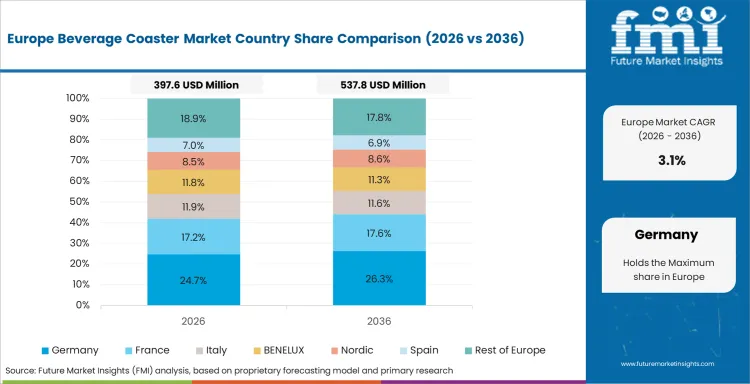
Europe represents a mature beverage coaster market shaped primarily by sustainability-focused procurement strategies across hospitality operators and beverage brand owners seeking alignment with recyclable fiberboard substrate adoption and responsible sourcing practices across tabletop accessory supply chains. Paperboard beer mats continue to dominate high-volume hospitality consumption across the region supported by their absorbency performance and compatibility with offset printing technologies used across promotional branding campaigns.
Increasing availability of cork-backed composite coaster formats and reusable silicone alternatives continues to strengthen adoption across premium hospitality venues and consumer retail distribution channels aligned with environmental positioning strategies across European tabletop accessory markets.
- Germany: Germany’s beverage coaster market is projected to expand at a CAGR of 3.7% through 2036 supported by strong adoption of recyclable paperboard coaster substrates across breweries, cafés, and restaurants where sustainability compliance increasingly influences tabletop accessory procurement decisions. Beverage-service operators across Germany continue to prioritize responsibly sourced fiberboard coaster formats aligned with environmental certification frameworks while maintaining high absorbency performance across high-throughput beverage service environments.
Germany’s established beer culture and dense hospitality infrastructure further support stable long-term demand for customized paperboard beer mats deployed across both independent venues and multinational beverage brand marketing programs.
Competitive Aligners for Market Players
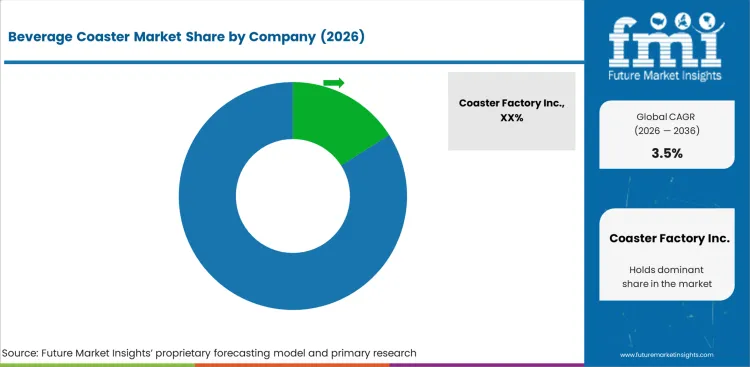
Competition within the beverage coaster market is increasingly defined by material selection capability, decoration quality, customization turnaround time, and sustainability alignment rather than commodity paperboard conversion capacity alone. Manufacturers supplying pulpboard beer mats continue to maintain leadership across high-volume hospitality environments, while suppliers operating across premium reusable coaster segments are strengthening positioning through expansion of silicone, cork-backed composite, ceramic, and stone coaster portfolios aligned with consumer retail décor applications.
Customization capability supported by short-run digital printing technologies is emerging as a critical competitive differentiator across promotional merchandise supply chains where beverage brand owners increasingly require rapid deployment of event-specific coaster campaigns supporting experiential marketing strategies across bars, festivals, and corporate hospitality environments.
Portfolio diversification across decorative tabletop accessory collections is further strengthening competitive positioning among suppliers serving coordinated retail décor channels where beverage coasters are increasingly sold as part of bundled tabletop presentation sets rather than standalone disposable accessories.
Key Developments
- In March 2025, Portmeirion Group launched a multi-year transformation plan aimed at sustainable growth. Key pillars include “Return to Growth” in its core markets (USA, UK, South Korea), strengthening its balance sheet via debt reduction, and increasing the proportion of products manufactured in Stoke-on-Trent (“Made in Stoke-on-Trent” onshoring)
Scope of the Report

| Items | Values |
|---|---|
| Quantitative Units | USD million |
| By Shape & Format | Round; Square; Hexagonal; Custom Die-Cut Shapes; Folded & Tent-Style Coasters; Coaster Sleeves & Wrap Formats |
| By Material Type | Paper & Board-Based (Pulpboard / Beer Mat Board; Coated Paperboard; Recycled Fiber Board; Laminated Paperboard); Wood-Based; Plastic-Based (PVC; Polypropylene (PP); ABS & Other Rigid Plastics; Recycled Plastics); Rubber & Silicone-Based (Silicone Rubber; Neoprene; Natural Rubber); Stone, Ceramic & Glass (Natural Stone; Ceramic & Porcelain; Tempered Glass); Metal-Based (Stainless Steel; Aluminum; Tinplate) |
| End Use | Hospitality (Bars & Pubs; Restaurants; Cafés & Coffee Shops; Hotels & Banquets; Breweries & Taprooms); Foodservice & Events (Catering Services; Weddings & Corporate Events; Festivals & Beverage Promotions); Consumer Retail (Home Décor Sets; Gift Sets; Lifestyle & Premium Coasters; Subscription Boxes); Promotional & Branding (Promotional Coasters; Beverage Brand POS Displays; Event & Concert Merchandise); Corporate & Office Applications |
| Regions Covered | North America, Europe, East Asia, South Asia, Latin America, Middle East & Africa |
| Countries Covered | United States, Germany, United Kingdom, China, India, Japan, and 40+ countries |
| Key Companies Profiled | Coaster Factory Inc.; Koehler Group; Portmeirion Group Plc; Caspari, Inc.; Zazzle Inc.; Others |
| Additional Attributes | Revenue analysis by shape & format, material type, coating, thickness, printing & decoration method, and distribution channel; evaluation of absorbency, durability, heat resistance, anti-slip performance, and aesthetic appeal; assessment of customization demand, branding effectiveness, and premiumization trends in hospitality and promotional markets; analysis of sustainability initiatives including recycled materials, biodegradable substrates, and eco-friendly coatings; procurement dynamics driven by brand visibility, cost efficiency, customization turnaround time, and long-term supplier relationships across hospitality, retail, and promotional merchandise ecosystems. |
Segmentation of Beverage Coaster Market
By Shape & Format
- Round
- Square
- Hexagonal
- Custom Die-Cut Shapes
- Folded & Tent-Style Coasters
- Coaster Sleeves & Wrap Formats
By Material Type
- Paper & Board-Based
- Pulpboard / Beer Mat Board
- Coated Paperboard
- Recycled Fiber Board
- Laminated Paperboard
- Wood-Based
- Plastic-Based
- PVC
- Polypropylene (PP)
- ABS & Other Rigid Plastics
- Recycled Plastics
- Rubber & Silicone-Based
- Silicone Rubber
- Neoprene
- Natural Rubber
- Stone, Ceramic & Glass
- Natural Stone
- Ceramic & Porcelain
- Tempered Glass
- Metal-Based
- Stainless Steel
- Aluminum
- Tinplate
By Coating
- Uncoated Absorbent
- Varnished
- UV Coated
- Waterproof Laminate
- Heat-Resistant Coating
- Anti-slip Backing
- Stain-Resistant Coating
- Cork or Rubber Backing
By Thickness
- Thin (1-2 mm)
- Medium (2-4 mm)
- Heavy (4-8 mm)
- Premium Thick (>8 mm)
By Printing & Decoration
- Offset Printing
- Digital Printing
- Screen Printing
- Laser Engraving / Etching
- Embossing & Debossing
- Foil Stamping & Metallic Foils
- Dye Sublimation
- Full-Color Photo Printing
By Distribution
- B2B
- Beverage Brand Procurement
- Promotional Merchandise Agencies
- Retail
- E-Commerce
- Custom Print Online Platforms
By End Use
- Hospitality
- Bars & Pubs
- Restaurants
- Cafés & Coffee Shops
- Hotels & Banquets
- Breweries & Taprooms
- Foodservice & Events
- Catering Services
- Weddings & Corporate Events
- Festivals & Beverage Promotions
- Consumer Retail
- Home Décor Sets
- Gift Sets
- Lifestyle & Premium Coasters
- Subscription Boxes
- Promotional & Branding
- Promotional Coasters for Marketing
- Alcohol/Beverage Brand POS Displays
- Event/Concert Merchandise
- Corporate / Office
- Corporate Branded Office Coasters
- Device Protection Coasters
Bibliography
- European Carton Makers Association (ECMA). (2024). Paperboard and Pulp-Based Materials for Foodservice Accessories: Performance, Absorbency, and Sustainability Considerations. ECMA.
- Company Annual Report, 10K, Investor Presentations, Press Release, Factiva, Comtrade, Volza, Bllomberg
- Cepi - Confederation of European Paper Industries. (2024). Paper and Board Applications in Food and Beverage Service: Material Properties and End-Use Performance. Cepi.
- Flexible Packaging Europe (FPE). (2024). Surface Protection and Branding Materials in Food and Beverage Service Environments. Flexible Packaging Europe.
- Forest Stewardship Council (FSC). (2024). FSC-Certified Paper Products in Foodservice Applications: Chain of Custody and Environmental Performance. FSC International.
- ASTM International. (2024). Standard Test Methods for Water Absorption, Surface Wear, and Dimensional Stability of Cellulosic and Composite Materials (ASTM D570 and related methods). ASTM Committee D20 on Plastics.
- International Organization for Standardization (ISO). (2024). Food Contact Materials - General Safety and Material Performance Requirements (ISO 22000 and related guidance). ISO.
- European Commission. (2011). Framework Regulation (EC) No 1935/2004 on Materials and Articles Intended to Come into Contact with Food. Official Journal of the European Union.
- Sustainable Packaging Coalition (SPC). (2024). Sustainability and Recyclability Considerations for Paper-Based and Composite Foodservice Accessories. SPC.
This Report Addresses
- Strategic market intelligence supporting tabletop accessory portfolio planning across hospitality and promotional merchandising ecosystems.
- Global market size estimation validated through hospitality outlet density benchmarking and beverage-service consumption modeling.
- Material transition analysis covering pulpboard beer mats, laminated paperboard substrates, reusable silicone formats, and decorative ceramic coaster solutions supporting retail décor applications.
- End-use demand mapping across bars, cafés, breweries, event environments, corporate branding programs, and residential tabletop accessory markets.
- Regional outlook assessment covering North America, East Asia, South Asia, Latin America, and Europe supported by country-level adoption benchmarking.
- Competitive benchmarking across coaster manufacturers based on material capability, decoration technology adoption, customization responsiveness, and sustainability alignment across hospitality and promotional merchandise supply chains.
Frequently Asked Questions
How large is the beverage coaster market in 2026?
The beverage coaster market is estimated to reach USD 1,650.6 million in 2026 supported by sustained demand across hospitality venues and promotional branding environments.
What will the market size be by 2036?
The market is projected to expand to USD 2,325.8 million by 2036 supported by continued adoption across cafés, breweries, restaurants, and consumer retail décor applications.
What is the expected growth rate during the forecast period?
The market is expected to expand at a compound annual growth rate of 3.5% between 2026 and 2036.
Which material dominates adoption?
Paperboard and pulpboard beer mat substrates remain the dominant material category supported by high absorbency performance and compatibility with large-scale promotional printing applications.
Which region leads global demand?
North America represents the largest regional market supported by strong hospitality infrastructure and widespread deployment of branded promotional coaster formats.
Preview the report firsthand - request a free sample
Get SampleGet the brochure for pricing and purchase details.
Get PDFTable of Content
- Executive Summary
- Global Market Outlook
- Demand-side Trends
- Supply-side Trends
- Technology Roadmap Analysis
- Analysis and Recommendations
- Market Overview
- Market Coverage / Taxonomy
- Market Definition / Scope / Limitations
- Research Methodology
- Chapter Orientation
- Analytical Lens and Working Hypotheses
- Market Structure, Signals, and Trend Drivers
- Benchmarking and Cross-market Comparability
- Market Sizing, Forecasting, and Opportunity Mapping
- Research Design and Evidence Framework
- Desk Research Programme (Secondary Evidence)
- Company Annual and Sustainability Reports
- Peer-reviewed Journals and Academic Literature
- Corporate Websites, Product Literature, and Technical Notes
- Earnings Decks and Investor Briefings
- Statutory Filings and Regulatory Disclosures
- Technical White Papers and Standards Notes
- Trade Journals, Industry Magazines, and Analyst Briefs
- Conference Proceedings, Webinars, and Seminar Materials
- Government Statistics Portals and Public Data Releases
- Press Releases and Reputable Media Coverage
- Specialist Newsletters and Curated Briefings
- Additional Desk Sources
- Expert Input and Fieldwork (Primary Evidence)
- Primary Modes
- Qualitative Interviews and Expert Elicitation
- Quantitative Surveys and Structured Data Capture
- Blended Approach
- Why Primary Evidence is Used
- Field Techniques
- Interviews
- Surveys
- Focus Groups
- Observational and In-context Research
- Social and Community Interactions
- Stakeholder Universe Engaged
- C-suite Leaders
- Board Members
- Presidents and Vice Presidents
- R&D and Innovation Heads
- Technical Specialists
- Domain Subject-matter Experts
- Scientists
- Physicians and Other Healthcare Professionals
- Governance, Ethics, and Data Stewardship
- Research Ethics
- Data Integrity and Handling
- Primary Modes
- Tooling, Models, and Reference Databases
- Desk Research Programme (Secondary Evidence)
- Data Engineering and Model Build
- Data Acquisition and Ingestion
- Cleaning, Normalisation, and Verification
- Synthesis, Triangulation, and Analysis
- Quality Assurance and Audit Trail
- Market Background
- Market Dynamics
- Drivers
- Restraints
- Opportunity
- Trends
- Scenario Forecast
- Demand in Optimistic Scenario
- Demand in Likely Scenario
- Demand in Conservative Scenario
- Opportunity Map Analysis
- Product Life Cycle Analysis
- Supply Chain Analysis
- Investment Feasibility Matrix
- Value Chain Analysis
- PESTLE and Porter’s Analysis
- Regulatory Landscape
- Regional Parent Market Outlook
- Production and Consumption Statistics
- Import and Export Statistics
- Market Dynamics
- Global Market Analysis 2021 to 2025 and Forecast, 2026 to 2036
- Historical Market Size Value (USD Million) Analysis, 2021 to 2025
- Current and Future Market Size Value (USD Million) Projections, 2026 to 2036
- Y-o-Y Growth Trend Analysis
- Absolute $ Opportunity Analysis
- Global Market Pricing Analysis 2021 to 2025 and Forecast 2026 to 2036
- Global Market Analysis 2021 to 2025 and Forecast 2026 to 2036, By Shape & Format
- Introduction / Key Findings
- Historical Market Size Value (USD Million) Analysis By Shape & Format , 2021 to 2025
- Current and Future Market Size Value (USD Million) Analysis and Forecast By Shape & Format , 2026 to 2036
- Round
- Square
- Hexagonal
- Custom Die-Cut Shapes
- Folded & Tent-Style Coasters
- Coaster Sleeves & Wrap Formats
- Round
- Y-o-Y Growth Trend Analysis By Shape & Format , 2021 to 2025
- Absolute $ Opportunity Analysis By Shape & Format , 2026 to 2036
- Global Market Analysis 2021 to 2025 and Forecast 2026 to 2036, By Material Type
- Introduction / Key Findings
- Historical Market Size Value (USD Million) Analysis By Material Type, 2021 to 2025
- Current and Future Market Size Value (USD Million) Analysis and Forecast By Material Type, 2026 to 2036
- Paper & Board-Based
- Wood-Based
- Plastic-Based
- Rubber & Silicone-Based
- Stone, Ceramic & Glass
- Metal-Based
- Paper & Board-Based
- Y-o-Y Growth Trend Analysis By Material Type, 2021 to 2025
- Absolute $ Opportunity Analysis By Material Type, 2026 to 2036
- Global Market Analysis 2021 to 2025 and Forecast 2026 to 2036, By Coating
- Introduction / Key Findings
- Historical Market Size Value (USD Million) Analysis By Coating, 2021 to 2025
- Current and Future Market Size Value (USD Million) Analysis and Forecast By Coating, 2026 to 2036
- Uncoated Absorbent
- Varnished
- UV Coated
- Waterproof Laminate
- Heat-Resistant Coating
- Anti-slip Backing
- Stain-Resistant Coating
- Cork or Rubber Backing
- Uncoated Absorbent
- Y-o-Y Growth Trend Analysis By Coating, 2021 to 2025
- Absolute $ Opportunity Analysis By Coating, 2026 to 2036
- Global Market Analysis 2021 to 2025 and Forecast 2026 to 2036, By Region
- Introduction
- Historical Market Size Value (USD Million) Analysis By Region, 2021 to 2025
- Current Market Size Value (USD Million) Analysis and Forecast By Region, 2026 to 2036
- North America
- Latin America
- Western Europe
- Eastern Europe
- East Asia
- South Asia and Pacific
- Middle East & Africa
- Market Attractiveness Analysis By Region
- North America Market Analysis 2021 to 2025 and Forecast 2026 to 2036, By Country
- Historical Market Size Value (USD Million) Trend Analysis By Market Taxonomy, 2021 to 2025
- Market Size Value (USD Million) Forecast By Market Taxonomy, 2026 to 2036
- By Country
- USA
- Canada
- Mexico
- By Shape & Format
- By Material Type
- By Coating
- By Country
- Market Attractiveness Analysis
- By Country
- By Shape & Format
- By Material Type
- By Coating
- Key Takeaways
- Latin America Market Analysis 2021 to 2025 and Forecast 2026 to 2036, By Country
- Historical Market Size Value (USD Million) Trend Analysis By Market Taxonomy, 2021 to 2025
- Market Size Value (USD Million) Forecast By Market Taxonomy, 2026 to 2036
- By Country
- Brazil
- Chile
- Rest of Latin America
- By Shape & Format
- By Material Type
- By Coating
- By Country
- Market Attractiveness Analysis
- By Country
- By Shape & Format
- By Material Type
- By Coating
- Key Takeaways
- Western Europe Market Analysis 2021 to 2025 and Forecast 2026 to 2036, By Country
- Historical Market Size Value (USD Million) Trend Analysis By Market Taxonomy, 2021 to 2025
- Market Size Value (USD Million) Forecast By Market Taxonomy, 2026 to 2036
- By Country
- Germany
- UK
- Italy
- Spain
- France
- Nordic
- BENELUX
- Rest of Western Europe
- By Shape & Format
- By Material Type
- By Coating
- By Country
- Market Attractiveness Analysis
- By Country
- By Shape & Format
- By Material Type
- By Coating
- Key Takeaways
- Eastern Europe Market Analysis 2021 to 2025 and Forecast 2026 to 2036, By Country
- Historical Market Size Value (USD Million) Trend Analysis By Market Taxonomy, 2021 to 2025
- Market Size Value (USD Million) Forecast By Market Taxonomy, 2026 to 2036
- By Country
- Russia
- Poland
- Hungary
- Balkan & Baltic
- Rest of Eastern Europe
- By Shape & Format
- By Material Type
- By Coating
- By Country
- Market Attractiveness Analysis
- By Country
- By Shape & Format
- By Material Type
- By Coating
- Key Takeaways
- East Asia Market Analysis 2021 to 2025 and Forecast 2026 to 2036, By Country
- Historical Market Size Value (USD Million) Trend Analysis By Market Taxonomy, 2021 to 2025
- Market Size Value (USD Million) Forecast By Market Taxonomy, 2026 to 2036
- By Country
- China
- Japan
- South Korea
- By Shape & Format
- By Material Type
- By Coating
- By Country
- Market Attractiveness Analysis
- By Country
- By Shape & Format
- By Material Type
- By Coating
- Key Takeaways
- South Asia and Pacific Market Analysis 2021 to 2025 and Forecast 2026 to 2036, By Country
- Historical Market Size Value (USD Million) Trend Analysis By Market Taxonomy, 2021 to 2025
- Market Size Value (USD Million) Forecast By Market Taxonomy, 2026 to 2036
- By Country
- India
- ASEAN
- Australia & New Zealand
- Rest of South Asia and Pacific
- By Shape & Format
- By Material Type
- By Coating
- By Country
- Market Attractiveness Analysis
- By Country
- By Shape & Format
- By Material Type
- By Coating
- Key Takeaways
- Middle East & Africa Market Analysis 2021 to 2025 and Forecast 2026 to 2036, By Country
- Historical Market Size Value (USD Million) Trend Analysis By Market Taxonomy, 2021 to 2025
- Market Size Value (USD Million) Forecast By Market Taxonomy, 2026 to 2036
- By Country
- Kingdom of Saudi Arabia
- Other GCC Countries
- Turkiye
- South Africa
- Other African Union
- Rest of Middle East & Africa
- By Shape & Format
- By Material Type
- By Coating
- By Country
- Market Attractiveness Analysis
- By Country
- By Shape & Format
- By Material Type
- By Coating
- Key Takeaways
- Key Countries Market Analysis
- USA
- Pricing Analysis
- Market Share Analysis, 2025
- By Shape & Format
- By Material Type
- By Coating
- Canada
- Pricing Analysis
- Market Share Analysis, 2025
- By Shape & Format
- By Material Type
- By Coating
- Mexico
- Pricing Analysis
- Market Share Analysis, 2025
- By Shape & Format
- By Material Type
- By Coating
- Brazil
- Pricing Analysis
- Market Share Analysis, 2025
- By Shape & Format
- By Material Type
- By Coating
- Chile
- Pricing Analysis
- Market Share Analysis, 2025
- By Shape & Format
- By Material Type
- By Coating
- Germany
- Pricing Analysis
- Market Share Analysis, 2025
- By Shape & Format
- By Material Type
- By Coating
- UK
- Pricing Analysis
- Market Share Analysis, 2025
- By Shape & Format
- By Material Type
- By Coating
- Italy
- Pricing Analysis
- Market Share Analysis, 2025
- By Shape & Format
- By Material Type
- By Coating
- Spain
- Pricing Analysis
- Market Share Analysis, 2025
- By Shape & Format
- By Material Type
- By Coating
- France
- Pricing Analysis
- Market Share Analysis, 2025
- By Shape & Format
- By Material Type
- By Coating
- India
- Pricing Analysis
- Market Share Analysis, 2025
- By Shape & Format
- By Material Type
- By Coating
- ASEAN
- Pricing Analysis
- Market Share Analysis, 2025
- By Shape & Format
- By Material Type
- By Coating
- Australia & New Zealand
- Pricing Analysis
- Market Share Analysis, 2025
- By Shape & Format
- By Material Type
- By Coating
- China
- Pricing Analysis
- Market Share Analysis, 2025
- By Shape & Format
- By Material Type
- By Coating
- Japan
- Pricing Analysis
- Market Share Analysis, 2025
- By Shape & Format
- By Material Type
- By Coating
- South Korea
- Pricing Analysis
- Market Share Analysis, 2025
- By Shape & Format
- By Material Type
- By Coating
- Russia
- Pricing Analysis
- Market Share Analysis, 2025
- By Shape & Format
- By Material Type
- By Coating
- Poland
- Pricing Analysis
- Market Share Analysis, 2025
- By Shape & Format
- By Material Type
- By Coating
- Hungary
- Pricing Analysis
- Market Share Analysis, 2025
- By Shape & Format
- By Material Type
- By Coating
- Kingdom of Saudi Arabia
- Pricing Analysis
- Market Share Analysis, 2025
- By Shape & Format
- By Material Type
- By Coating
- Turkiye
- Pricing Analysis
- Market Share Analysis, 2025
- By Shape & Format
- By Material Type
- By Coating
- South Africa
- Pricing Analysis
- Market Share Analysis, 2025
- By Shape & Format
- By Material Type
- By Coating
- USA
- Market Structure Analysis
- Competition Dashboard
- Competition Benchmarking
- Market Share Analysis of Top Players
- By Regional
- By Shape & Format
- By Material Type
- By Coating
- Competition Analysis
- Competition Deep Dive
- Coaster Factory Inc.
- Overview
- Product Portfolio
- Profitability by Market Segments (Product/Age /Sales Channel/Region)
- Sales Footprint
- Strategy Overview
- Marketing Strategy
- Product Strategy
- Channel Strategy
- CoasterStone
- Beverage Coasters
- Conimar
- Koehler Group
- Coaster Factory Inc.
- Competition Deep Dive
- Assumptions & Acronyms Used


