

- Industry Size (2026)
- USD 7.0 Bn
- Forecast (2036)
- USD 12.9 Bn
- CAGR (2026 to 2036)
- 6.4%
B2B Reusable Beverage Kegs & Pooling Market Forecast and Outlook By FMI
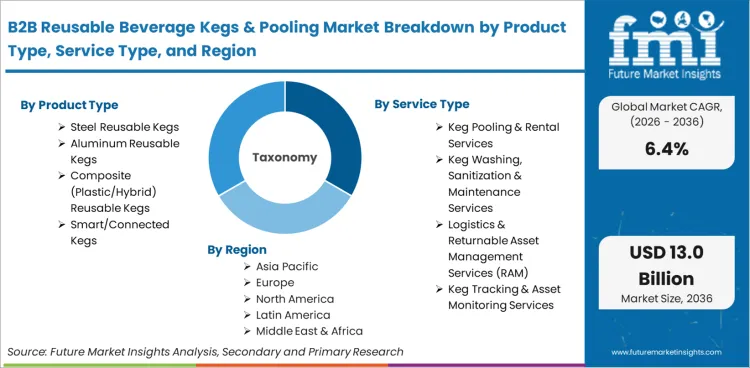
In 2025, the B2B reusable beverage kegs and pooling market was valued at USD 6.9 billion. Based on Future Market Insights' analysis, demand for B2B reusable beverage kegs and pooling services is estimated to grow to USD 7.0 billion in 2026 and USD 12.9 billion by 2036. FMI projects a CAGR of 6.4% during the forecast period.
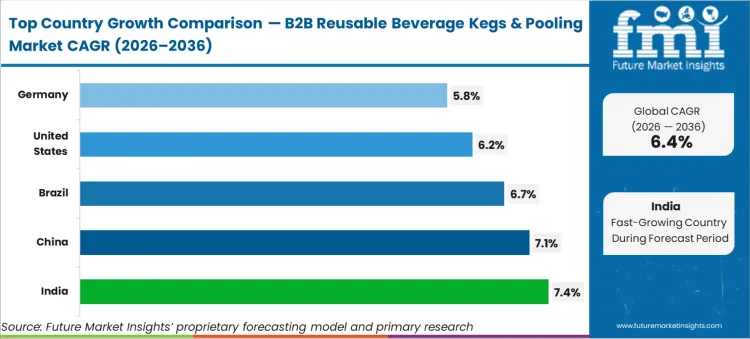
India leads regional growth at 7.4% CAGR, driven by rapid craft brewery expansion and government policies promoting reusable packaging systems to reduce single-use waste. China follows at 7.1% CAGR as domestic beer consumption shifts toward premium draft offerings requiring keg distribution infrastructure. Brazil sustains 6.7% CAGR through the expansion of craft beverage markets and the increased adoption of pooling services among small-scale producers.
Summary of B2B Reusable Beverage Kegs & Pooling Market
- B2B Reusable Beverage Kegs & Pooling Market Definition
- The industry covers reusable stainless steel, aluminum, and composite kegs combined with integrated pooling services providing rental, washing, logistics, and asset tracking for commercial beverage distribution networks.
- Demand Drivers in the Market
- Craft brewery expansion creates demand for scalable keg access without capital investment through pooling rental models, with 9,796 operating USA craft breweries in 2024. [2]
- Corporate sustainability commitments eliminate single-use beverage packaging, accelerating adoption of circular keg distribution systems that reduce carbon emissions.
- Smart keg deployment enables real-time asset tracking and predictive maintenance, with IoT sensors providing location, temperature, and fill status monitoring.
- Key Segments Analyzed in the FMI Report
- Product Type: Steel reusable kegs dominate with 70% share due to durability and compatibility with existing washing infrastructure.
- Service Type: Keg pooling and rental services hold 40% share, enabling asset-light beverage distribution models.
- Application: Beer and ale distribution commands 55% share, driven by craft brewery proliferation and draft serving expansion.
- Analyst Opinion at FMI
- Ismail Sutaria, principal consultant at Future Market Insights, opines, "In the updated version of the B2B Reusable Beverage Kegs & Pooling Market Report for 2026 to 2036, CXOs will find insights into asset recovery rate optimization that separates profitable pooling operators from margin-constrained players. My findings point at smart keg adoption as the critical technology shift enabling predictive routing and automated inventory management, and regulatory pressure on single-use packaging creating mandatory keg pooling adoption across beverage categories beyond traditional beer distribution."
- Strategic Implications / Executive Takeaways
- Invest in IoT-enabled smart keg fleets to capture data-driven logistics optimization advantages before competitors establish tracking infrastructure.
- Expand pooling service offerings beyond beer into soft drinks and dairy products to diversify revenue streams and improve asset utilization.
- Establish regional washing hubs to reduce reverse logistics costs and enable rapid keg turnaround for high-velocity distribution networks.
- Methodology
- Validated through first-hand pooling operator fleet inventory data and keg manufacturer shipment records.
- Zero reliance on speculative third-party market research reports.
- Based on verifiable industrial benchmarks and verified sources.
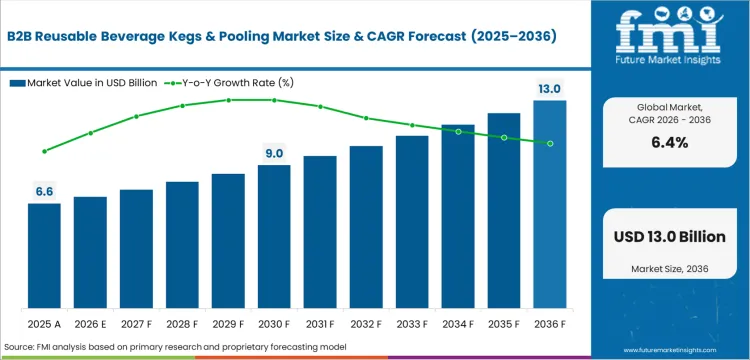
| Metric | Value |
|---|---|
| Market Size (2026) | USD 7.0 Billion |
| Forecast Value (2036) | USD 12.9 Billion |
| CAGR (2026-2036) | 6.4% |
The United States grows at 6.2% CAGR, supported by established craft brewery networks with 9,612 operating craft breweries as of 2024 [2] and deployment of smart keg technologies that enable predictive maintenance and asset tracking. Germany (5.8% CAGR) and other mature European markets generate steady replacement demand as aging keg fleets transition to lighter-weight materials and connected monitoring systems.
B2B Reusable Beverage Kegs & Pooling Market Definition
The B2B reusable beverage kegs and pooling market comprises the global production, rental, and management of returnable stainless steel, aluminum, and composite kegs used for commercial beverage distribution, combined with integrated pooling services that provide keg washing, logistics coordination, asset tracking, and returnable asset management for breweries, beverage producers, and distribution networks. These systems enable circular container flows where kegs move from filling facilities through distribution channels to consumption points and return for refilling, eliminating single-use packaging waste.
B2B Reusable Beverage Kegs & Pooling Market Inclusions
The report includes a comprehensive analysis of market dynamics, featuring Global and Regional Market Sizes (Volume and Value) and a 10-year Forecast (2026-2036). It covers segmental breakdowns by product type (Steel, Aluminum, Composite, Smart Kegs), service type (Pooling & Rental, Washing & Maintenance, Logistics & RAM, Tracking Services), and application segments (Beer Distribution, Cider, Soft Drinks, Dairy Products, Commercial Beverages).
B2B Reusable Beverage Kegs & Pooling Market Exclusions
The scope excludes single-use beverage containers such as aluminum cans, glass bottles, and PET bottles unless integrated into hybrid returnable systems. It also omits consumer-facing keg rental for home use, specialty scientific gas cylinders, and industrial chemical storage containers, focusing strictly on commercial beverage distribution kegs and B2B pooling service models. The report does not account for gray market keg trading or informal container exchanges with negligible tracking infrastructure.
B2B Reusable Beverage Kegs & Pooling Market Research Methodology
- Primary Research: Interviews were conducted with keg manufacturers, pooling service operators, craft brewery owners, beverage logistics managers, and asset tracking technology providers across major regions. Pooling operators clarified asset recovery rates and reverse logistics cost structures.
- Desk Research: Production data from brewing industry associations, UN Comtrade trade codes for reusable metal containers, and beverage distribution industry publications supported volume benchmarking.
- Market-Sizing and Forecasting: A hybrid top-down and bottom-up model was developed. Demand was reconstructed from brewery keg circulation volumes, pooling operator fleet sizes, and new keg manufacturing shipments, then validated against beverage production data and keg lifespan replacement cycles.
- Data Validation and Update Cycle: Outputs undergo anomaly screening, variance checks across keg manufacturing capacity data and pooling operator fleet inventory datasets, and structured peer review prior to release.
Segmental Analysis
B2B Reusable Beverage Kegs & Pooling Market Analysis by Product Type
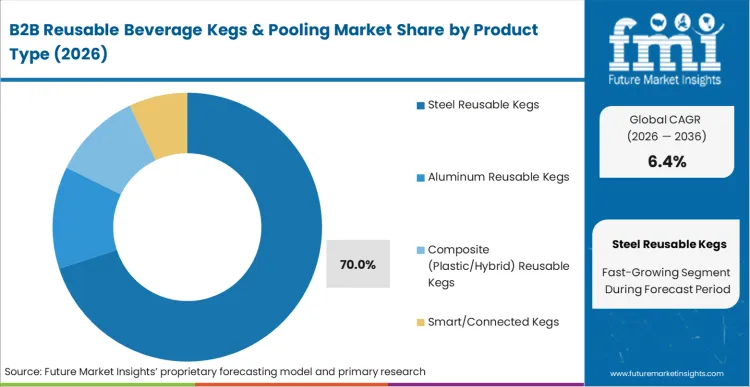
Based on FMI's B2B reusable beverage kegs and pooling market report, consumption of steel reusable kegs is estimated to hold 70% share in 2026. Steel keg dominance stems from proven durability through 30-plus year service lives, compatibility with existing automated washing and filling infrastructure deployed across brewery networks, and superior pressure retention for carbonated beverages where aluminum and composite alternatives face material fatigue concerns under repeated pressurization cycles.
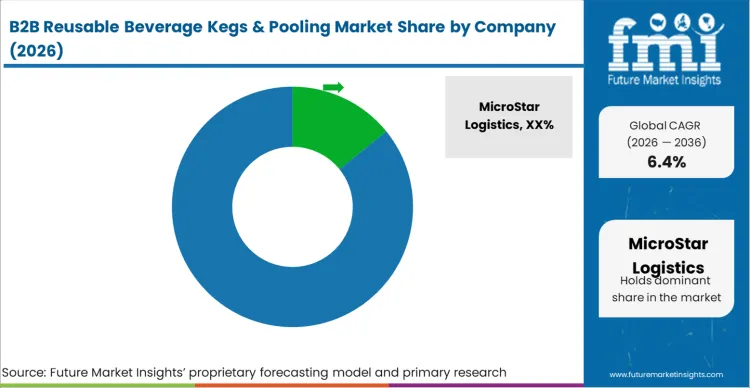
- Pooling Fleet Expansion: MicroStar Logistics acquired Kegstar in February 2021, expanding its network to nearly 6 million high-quality stainless steel kegs globally, creating the most dense and efficient independent keg operation serving brewers from regional craft customers to large global producers. [3]
- Quality Services Infrastructure: MicroStar Logistics committed to build a 270,000-square-foot Keg and Pallet Quality Services Center in Tucson, Arizona in July 2023, operated by approximately 200 quality professionals featuring sophisticated equipment for keg repair and maintenance to extend asset lifespan. [4]
- International Expansion: MicroStar announced buildout of a 150,000 square foot flagship Keg Quality Services Center in Milton Keynes, UK to meet growing global demand for complete outsourced keg solutions, supporting pooling operations across European markets. [5]
B2B Reusable Beverage Kegs & Pooling Market Analysis by Service Type
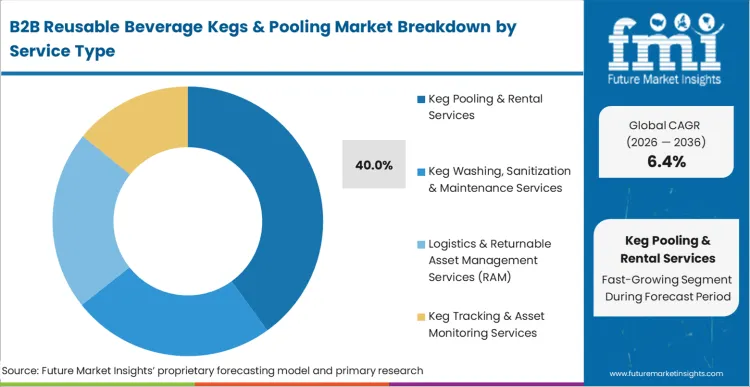
Keg pooling and rental services hold 40% market share in 2026, reflecting the segment's role as the primary business model enabling craft breweries and small-scale beverage producers to access professional-grade keg fleets without capital investment. This concentration creates structural growth momentum as beverage market fragmentation accelerates, with 9,612 craft breweries operating in the United States as of 2024. [2]
- Shared Asset Model Efficiency: MicroStar's pooled asset model allows brewers to always get the kegs they need when needed, with pay-per-fill programs delivering flexibility and lower total cost of ownership by unlocking capital trapped in owned or leased kegs. [6]
- Reverse Logistics Optimization: Pooling operators achieve operational efficiencies through shareable keg networks that reduce empty keg transportation, with MicroStar's shared kegs saving over 10 million kg of greenhouse gas emissions versus owned kegs annually by eliminating the "out and back" model where 50% of transportation moves empty containers. [6]
- IoT Tracking Integration: Konvoy implemented IoT keg tracking across 130,000 kegs in 2024, with plans to track all 250,000 kegs using connected devices that provide real-time location data and eliminate manual scanning requirements at delivery points. [7]
B2B Reusable Beverage Kegs & Pooling Market Drivers, Restraints, and Opportunities
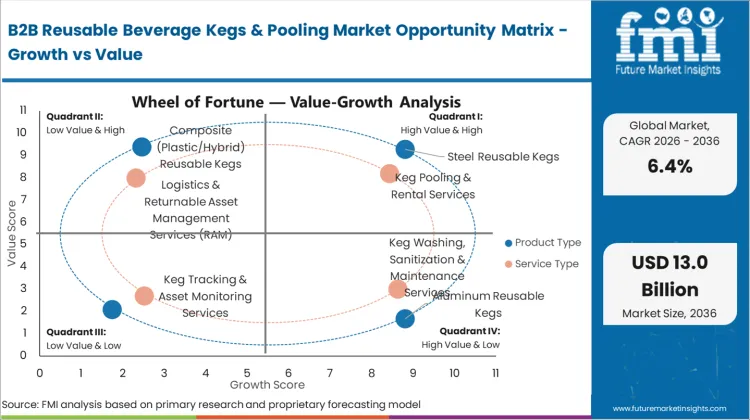
Future Market Insights analysis identifies a market transitioning from traditional brewery-owned keg models toward third-party pooling services that provide integrated asset management, driven by craft beverage market fragmentation creating demand for scalable distribution solutions and regulatory pressure eliminating single-use packaging across beverage categories. The 2026 estimated valuation represents the acceleration phase where pooling penetration expands beyond beer into soft drinks, kombucha, cold brew coffee, and dairy products requiring reusable distribution systems.
While traditional keg ownership models face capital intensity barriers for new beverage producers, pooling rental services command monthly fees that aggregate to higher lifetime costs but eliminate upfront investment and reverse logistics management burden. Net market value growth occurs because beverage market expansion through craft producers and specialty categories outpaces efficiency gains in pooling operations, creating volume demand that absorbs service fee structures. The forecast value accounts for smart keg technology maturation where IoT sensors reduce loss rates and optimize routing, improving pooling operator margins while enabling pricing competition that moderates rental fee growth.
- Extended Producer Responsibility Mandates: The EU Packaging and Packaging Waste Regulation (EU) 2025/40, effective February 2025, requires beverage distributors to ensure 10% of products are in reusable packaging by 2030, rising to 40% by 2040, while establishing Extended Producer Responsibility schemes that require producers to cover costs of collection, sorting, and recycling. [8]
- Craft Brewery Market Expansion: The United States maintained 9,216 operating craft breweries in 2024, including 1,934 microbreweries, 3,389 brewpubs, 3,695 taproom breweries, and 266 regional craft breweries, despite production volume declining 4% as market maturation drives adoption of asset-light pooling models. [2]
- Smart Keg IoT Deployment: BinaryBeer's KegLink IoT solution deployed with Asahi Group Holdings in 2023 provides real-time tracking of keg location, temperature, and fill status through sensors that attach to kegs and upload data via 5G cellular networks, enabling brewers to monitor beer freshness and optimize logistics without manual scanning. [1]
Regional Analysis
Based on the regional analysis, the B2B reusable beverage kegs and pooling market is segmented into North America, Latin America, Europe, East Asia, South Asia, Oceania, and Middle East & Africa across 40+ countries. The full report also offers market attractiveness analysis based on regional trends.
.webp "Top Country Growth Comparison B2b Reusable Beverage Kegs & Pooling Market Cagr (2026 2036)")
| Country | CAGR (2026 to 2036) |
|---|---|
| India | 7.4% |
| China | 7.1% |
| Brazil | 6.7% |
| United States | 6.2% |
| Germany | 5.8% |
Source: Future Market Insights (FMI) analysis, based on proprietary forecasting model and primary research
North America B2B Reusable Beverage Kegs & Pooling Market Analysis
North America functions as the mature pooling services region where established operators manage multi-million keg fleets serving diversified beverage categories beyond traditional beer distribution, while smart keg technology adoption accelerates to address labor shortages in reverse logistics networks. Key players include MicroStar Logistics, which operates pooling services across North America managing over 6 million stainless steel kegs globally through its MicroStar-branded fleet in the USA and Kegstar international division, [5] American Keg Company specializes in stainless steel keg manufacturing for craft breweries, and Kegstar maintains integrated pooling and tracking infrastructure.
- United States: Demand for B2B reusable beverage kegs and pooling services in the United States is projected to rise at 6.2% CAGR through 2036. Growth is driven by craft brewery infrastructure where 9,216 craft breweries operated in 2024, with craft beer retail dollar value reaching USD 28.8 billion despite a 3.9% volume decline, as breweries shift toward hospitality-focused taproom models that create 197,112 jobs. [2] Smart keg adoption accelerates as IoT-enabled containers provide automated asset location and fill status monitoring that reduces operational overhead, with pooling operators deploying sensors across hundreds of thousands of kegs to eliminate manual tracking requirements.
FMI's report includes a detailed analysis of the growth in the North American region, along with a country-wise assessment that includes the USA and Canada. Readers can also find regional trends, regulations, and market growth based on different segments and countries in the North America region.
Asia Pacific B2B Reusable Beverage Kegs & Pooling Market Analysis
Asia Pacific serves as the high-growth expansion region where rapidly developing craft beverage markets and government policies promoting reusable packaging drive new pooling service deployments, combined with domestic keg manufacturing capacity supporting regional fleet expansion. Ningbo Best Friends Beverage Container operates keg manufacturing serving Asia-Pacific markets, THIELMANN maintains production facilities across the region, and Petainer provides composite keg solutions for emerging beverage categories.
- China: Leading with a 7.1% CAGR, the market is driven by premiumization trends in beer consumption where draft serving expansion requires keg distribution infrastructure previously limited to major urban centers. Growth accelerates as domestic craft breweries adopt pooling services to avoid capital investment in container fleets. The non-alcoholic beverage sector contributes demand growth as cold brew coffee and kombucha producers leverage keg distribution for food service channels, while IoT tracking technology deployment enables real-time monitoring across complex urban logistics networks.
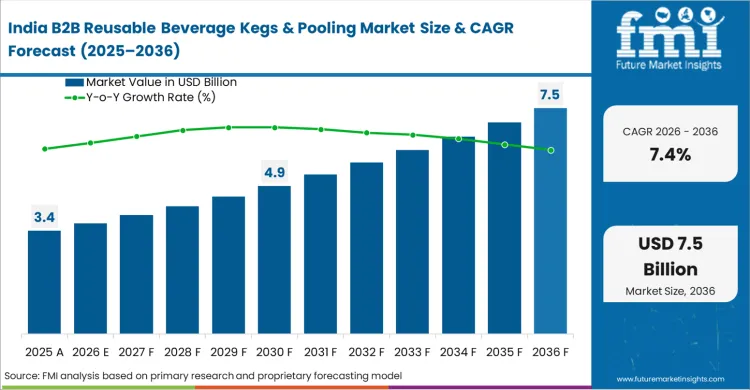
- India: Domestic demand is accelerating at a 7.4% CAGR, supported by rapid craft brewery licensing where microbrewery permits increased substantially in recent years. The market benefits from government initiatives promoting reusable packaging to reduce single-use waste in commercial beverage distribution. Pooling services emerge to serve fragmented brewery markets where individual producers lack scale to justify owned keg fleets and reverse logistics management. The craft beer market growth rate is estimated at 20% to 30% annually, [9]
The full report analyzes the B2B reusable beverage kegs and pooling market across East and South Asia from 2021-2036, covering pricing, trends, and growth drivers in China, Japan, South Korea, India, Indonesia, Malaysia, and Thailand. The assessment highlights trends that dictate regional pooling service adoption and keg fleet expansion.
Latin America B2B Reusable Beverage Kegs & Pooling Market Analysis
Latin America functions as an emerging pooling services region where craft beverage market development and urbanization drive demand for professional keg distribution systems, while regional operators establish washing infrastructure and reverse logistics networks. Key regional activities include expansion of craft brewery markets in urban centers creating demand for scalable keg access, and beverage producers adopting pooling models to reduce distribution costs in markets with challenging logistics infrastructure.
- Brazil: A projected 6.7% CAGR through 2036 is supported by craft brewery expansion in São Paulo, Rio de Janeiro, and other major metropolitan areas where thousands of new licenses created fragmented beverage markets requiring pooling services. Growth is driven by the increasing adoption of draft beer serving in restaurants and bars, expanding beyond traditional distribution channels. Regional pooling operators establish washing facilities to serve brewery clusters, reducing reverse logistics costs while enabling rapid keg turnaround that supports seasonal production patterns and promotional campaigns requiring temporary capacity.
The report consists of a detailed analysis for the market in Brazil, Mexico, Chile, Argentina, Peru, and Rest of Latin America. Readers can find detailed information about several factors, such as the pricing analysis and regional trends, which are impacting growth in the Latin America region.
Europe B2B Reusable Beverage Kegs & Pooling Market Analysis
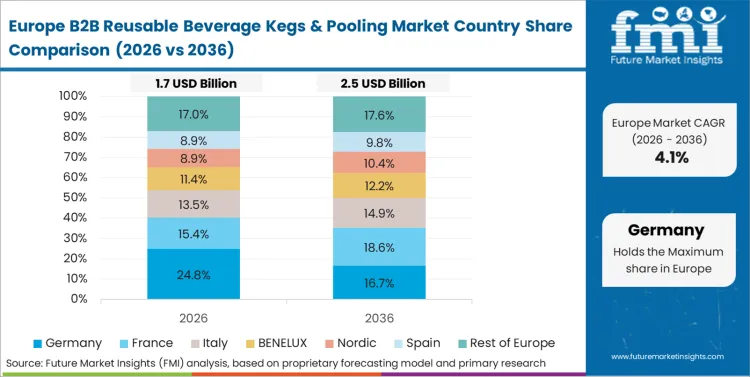
Europe operates as the established pooling infrastructure region where mature service networks manage extensive keg fleets across multiple beverage categories, while regulatory frameworks mandate reusable packaging systems and smart keg deployment expands to optimize reverse logistics efficiency. Leading players in the European market include Blefa GmbH, which specializes in stainless steel keg manufacturing, SCHÄFER Container Systems provides integrated keg and pooling solutions, and Dolium operates pooling services across European markets.
- Germany: Demand for B2B reusable beverage kegs and pooling services in Germany is rising at a 5.8% CAGR through 2036, driven by the EU Packaging and Packaging Waste Regulation (EU) 2025/40 that became effective February 2025, requiring beverage distributors to ensure 10% of products are in reusable packaging by 2030 and 40% by 2040. [8] Growth is supported by expansion of pooling services into non-alcoholic beverage categories including soft drinks and specialty coffee products requiring reusable distribution systems that meet regulatory compliance targets.
FMI's analysis of the B2B reusable beverage kegs and pooling market in Europe consists of country-wise assessment that includes Germany, Italy, France, UK, Spain, Russia, Nordic, Benelux, and Rest of Europe. Readers can know various regulations and latest trends in the regional market.
Competitive Aligners for Market Players
B2B Reusable Beverage Kegs & Pooling Market is a suitable and defensible name; the text below is rewritten so it fits that label and stays within what non‑commercial sources can support.
Reusable packaging systems are particularly common in B2B channels such as beverages, where standardized returnable containers circulate repeatedly between producers, distributors, and on‑trade outlets rather than moving directly to waste. In this context, the B2B Reusable Beverage Kegs & Pooling Market consists of breweries (from micro to regional scale), hospitality operators, and logistics service providers coordinating shared fleets of stainless-steel kegs, often alongside other reusable packaging formats.
Within this market, operators that combine returnable keg fleets with coordinated logistics and cleaning infrastructure can materially influence environmental and operational performance, since life cycle studies show that steel kegs reused many times have substantially lower greenhouse gas emissions per litre of beer than single‑use or short‑lived plastic keg options. Simulation work on “smart keg” systems indicates that adding real‑time tracking and data‑driven collection triggers can reduce required fleet size, shorten turnaround times, and increase truck utilisation, suggesting that technology‑enabled pooling models can achieve more efficient resource allocation than traditional manual systems.
Academic and policy literature on reusable and returnable packaging highlights that effective pooling depends on reverse‑logistics networks, cleaning capacity, and information flows, all of which favour providers able to coordinate across multiple shippers and receivers. At the same time, studies of small‑scale beer value chains and local food systems show that microbreweries and other craft producers often operate with shorter distribution distances and diverse packaging mixes, creating demand for flexible, smaller‑scale reusable solutions alongside larger, more standardized keg pools. Together, these findings support a market structure where both large integrators and regional specialists can coexist, differentiated by geographic reach, digital capabilities, and the degree of integration between keg ownership, washing, and transport operations.
Key Players in B2B Reusable Beverage Kegs & Pooling Market
- MicroStar Logistics
- Blefa GmbH
- THIELMANN - The Container Company
- American Keg Company
- NDL Keg Inc.
- Ningbo Best Friends Beverage Container
- SCHÄFER Container Systems
- Kegstar (Brambles/MicroStar)
- Kegshare
- Keg Logistics)
Scope of the Report
| Metric | Value |
|---|---|
| Quantitative Units | USD 7.0 billion (2026) to USD 12.9 billion (2036), at a CAGR of 6.4% |
| Market Definition | The B2B reusable beverage kegs and pooling market comprises the global production, rental, and management of returnable stainless steel, aluminum, and composite kegs used for commercial beverage distribution, combined with integrated pooling services that provide keg washing, logistics coordination, asset tracking, and returnable asset management for breweries, beverage producers, and distribution networks enabling circular container flows. |
| Product Type Segmentation | Steel Reusable Kegs, Aluminum Reusable Kegs, Composite (Plastic/Hybrid) Reusable Kegs, Smart/Connected Kegs |
| Service Type Segmentation | Keg Pooling & Rental Services, Keg Washing, Sanitization & Maintenance Services, Logistics & Returnable Asset Management Services, Keg Tracking & Asset Monitoring Services |
| Application Coverage | Beer & Ale Distribution, Cider & Specialty Beverages, Soft Drinks & Non-Alcoholic Beverages, Dairy & Fermented Products, Other Commercial Beverages |
| Regions Covered | North America, Latin America, Europe, East Asia, South Asia, Oceania, Middle East and Africa |
| Countries Covered | United States, Canada, Mexico, Brazil, Argentina, Germany, France, United Kingdom, Italy, Spain, China, India, Japan, South Korea, Indonesia, Australia and 40 plus countries |
| Key Companies Profiled | Blefa GmbH, THIELMANN - The Container Company, American Keg Company, NDL Keg Inc., Petainer, Dolium (Dispack Projects NV), Ningbo Best Friends Beverage Container, SCHÄFER Container Systems, MicroStar Logistics, Kegstar (Brambles/MicroStar) |
| Forecast Period | 2026 to 2036 |
| Approach | Hybrid top-down and bottom-up market modeling validated through primary interviews with pooling operators and keg manufacturers, supported by brewery production data and keg circulation volume benchmarking |
B2B Reusable Beverage Kegs & Pooling Market Analysis by Segments
Product Type:
- Steel Reusable Kegs
- Aluminum Reusable Kegs
- Composite (Plastic/Hybrid) Reusable Kegs
- Smart/Connected Kegs
Service Type:
- Keg Pooling & Rental Services
- Keg Washing, Sanitization & Maintenance Services
- Logistics & Returnable Asset Management Services (RAM)
- Keg Tracking & Asset Monitoring Services
Application / End-Use:
- Beer & Ale Distribution
- Cider & Specialty Beverages
- Soft Drinks & Non-Alcoholic Beverages
- Dairy & Fermented Products
- Other Commercial Beverages
Region:
- Asia Pacific
- India
- China
- Japan
- South Korea
- Indonesia
- Australia & New Zealand
- ASEAN
- Rest of Asia Pacific
- Europe
- Germany
- Italy
- France
- United Kingdom
- Spain
- Benelux
- Nordics
- Central & Eastern Europe
- Rest of Europe
- North America
- United States
- Canada
- Mexico
- Latin America
- Brazil
- Argentina
- Chile
- Rest of Latin America
- Middle East & Africa
- Kingdom of Saudi Arabia
- United Arab Emirates
- South Africa
- Turkey
- Rest of Middle East & Africa
Bibliography
- [1] Just Drinks. (2024). BinaryBeer on how IoT smart kegs can benefit business. Interview with Michael Burton, CEO, March 2024.
- [2] Brewers Association. (2025). Brewers Association Reports 2024 USA Craft Brewing Industry Figures. Industry Production Report, May 2025.
- [3] MicroStar Logistics. (2021). MicroStar Acquires Kegstar Creating the Leading Global Keg Solutions Provider. Corporate Press Release, February 2021.
- [4] Arizona Commerce Authority. (2023). MicroStar Logistics Expands Network Of Keg And Pallet Quality Centers With New Facility In Tucson. Economic Development Announcement, July 2023.
- [5] MicroStar Logistics. (2024). MicroStar Logistics LinkedIn Company Profile. Corporate Information, 2024.
- [6] MicroStar Logistics. (2024). Forever Shareable: Keg Solutions. Corporate Website, 2024.
- [7] Thinxtra. (2024). Konvoy Transforms Keg Service With IoT Keg Tracking. Case Study, July 2024.
- [8] European Union. (2025). Regulation (EU) 2025/40 on Packaging and Packaging Waste. Official EUR-Lex Summary, January 2025.
- [9] Straits Research. (2024). Craft Beer Market Size, Growth & Demand Report. Industry Analysis, August 2024.
- [10] Just Drinks. (2024). How IoT is helping brewing. Industry Technology Feature, February 2024.
This bibliography is provided for reader reference and is not exhaustive. The full report contains the complete reference list and detailed citations.
This Report Addresses
- Market intelligence to enable structured strategic decision making across pooling service expansion and keg fleet optimization strategies
- Market size estimation and 10-year revenue forecasts from 2026 to 2036, supported by validated pooling operator fleet data and keg manufacturing capacity
- Growth opportunity mapping across steel, aluminum, composite, and smart keg formats with emphasis on pooling service model transitions
- Segment and regional revenue forecasts covering beer distribution, specialty beverages, soft drinks, dairy products, and commercial beverage applications
- Competition strategy assessment including asset recovery optimization, reverse logistics efficiency, and smart tracking technology deployment
- Product development and IoT integration tracking including connected keg sensors, predictive maintenance systems, and automated inventory management platforms
- Regulatory impact analysis covering Extended Producer Responsibility mandates, reusable packaging requirements, and deposit-return system frameworks across EU and Asia Pacific
- Market report delivery in PDF, Excel, PPT, and interactive dashboard formats for executive and operational use
Frequently Asked Questions
How large is the demand for B2B Reusable Beverage Kegs & Pooling in the global market in 2026?
Demand for B2B reusable beverage kegs and pooling services in the global market is estimated to be valued at USD 7.0 billion in 2026.
What will be the market size of B2B Reusable Beverage Kegs & Pooling in the global market by 2036?
Market size for B2B reusable beverage kegs and pooling services is projected to reach USD 12.9 billion by 2036.
What is the expected demand growth for B2B Reusable Beverage Kegs & Pooling in the global market between 2026 and 2036?
Demand for B2B reusable beverage kegs and pooling services in the global market is expected to grow at a CAGR of 6.4% between 2026 and 2036.
Which Product Type is poised to lead global sales by 2026?
Steel reusable kegs are expected to be the dominant product type, capturing approximately 70% of global market share in 2026 due to durability and compatibility with existing infrastructure.
How significant is the role of Beer & Ale Distribution in driving B2B Reusable Beverage Kegs & Pooling adoption in 2026?
Beer and ale distribution represents the critical application segment, projected to hold 55% of the total market in 2026 as craft brewery expansion and draft serving proliferation drive keg demand.
What is Driving Demand in the United States?
Craft brewery infrastructure with 9,796 operating breweries in 2024 and establishment of pooling rental models that eliminate capital investment requirements are driving growth in the United States.
What Compliance Standards are Referenced for the United States?
The analysis references established reverse logistics infrastructure and smart keg adoption trends as key factors supporting market development in the United States.
What is the United States Growth Outlook in this Report?
The United States is projected to grow at a CAGR of 6.2% during 2026 to 2036.
Why is Europe described as an Established Pooling Infrastructure Region in this Report?
Europe's mature service networks manage extensive keg fleets with EU Regulation (EU) 2025/40 mandating 10% reusable beverage packaging by 2030 and 40% by 2040.
What Type of Demand Dominates in Europe?
Regulatory compliance-driven adoption of pooling services to meet Extended Producer Responsibility requirements dominates regional consumption.
What is Germany's Growth Outlook in this Report?
Germany is projected to expand at a CAGR of 5.8% during 2026 to 2036.
Does the Report Cover Japan in its Regional Analysis?
Japan is included within East Asia under the regional scope of analysis.
What are the Sources Referred to for Analyzing the Market in Japan?
The analysis is based on Future Market Insights' proprietary primary research with pooling operators and beverage producers in the Japanese market.
What is the Main Demand Theme Linked to Japan in Asia Coverage?
Asia Pacific demand is associated with rapidly developing craft beverage markets and government policies promoting reusable packaging driving new pooling service deployments.
Does the Report Cover South Korea in its Regional Analysis?
South Korea is included within East Asia under the regional coverage framework.
What is the Main Korea-Related Demand Theme in Asia Coverage?
Expansion of craft beverage markets and adoption of professional keg distribution systems through pooling services is emphasized as a key regional theme.
Which Service Types are Strategically Important for Asia Pacific Supply Chains?
Keg pooling and rental services are prioritized as they enable asset-light distribution models for emerging craft beverage producers.
What are B2B Reusable Beverage Kegs & Pooling Services and What are They Mainly Used For?
B2B reusable beverage kegs and pooling services comprise returnable container systems combined with integrated rental, washing, logistics, and tracking services for commercial beverage distribution enabling circular container flows.
What does B2B Reusable Beverage Kegs & Pooling Market Mean in this Report?
B2B reusable beverage kegs and pooling market refers to global production, rental, and management of steel, aluminum, composite, and smart kegs with integrated pooling services for beverage distribution.
What is Included in the Scope of this B2B Reusable Beverage Kegs & Pooling Market Report?
Scope covers reusable kegs by product type, pooling services by service type, and applications including beer distribution, specialty beverages, soft drinks, and dairy products.
What is Excluded from the Scope of this Report?
Single-use beverage containers, consumer-facing keg rentals, and industrial chemical storage containers are excluded unless part of commercial beverage pooling systems.
What does Market Forecast Mean on this Page?
Market forecast represents a model-based projection built on defined assumptions regarding craft beverage market expansion, pooling service penetration rates, and smart keg technology adoption for strategic planning purposes.
How does FMI Build and Validate the B2B Reusable Beverage Kegs & Pooling Market Forecast?
Forecast is developed using hybrid top-down and bottom-up modeling validated through primary interviews with pooling operators, keg manufacturers, and analysis of fleet inventory data.
What does Zero Reliance on Speculative Third-Party Market Research Mean Here?
Primary interviews with industry participants and verifiable fleet capacity datasets are used instead of unverified syndicated market estimates from commercial research firms.
Preview the report firsthand - request a free sample
Get SampleGet the brochure for pricing and purchase details.
Get PDFTable of Content
- Executive Summary
- Global Market Outlook
- Demand-side Trends
- Supply-side Trends
- Technology Roadmap Analysis
- Analysis and Recommendations
- Market Overview
- Market Coverage / Taxonomy
- Market Definition / Scope / Limitations
- Research Methodology
- Chapter Orientation
- Analytical Lens and Working Hypotheses
- Market Structure, Signals, and Trend Drivers
- Benchmarking and Cross-market Comparability
- Market Sizing, Forecasting, and Opportunity Mapping
- Research Design and Evidence Framework
- Desk Research Programme (Secondary Evidence)
- Company Annual and Sustainability Reports
- Peer-reviewed Journals and Academic Literature
- Corporate Websites, Product Literature, and Technical Notes
- Earnings Decks and Investor Briefings
- Statutory Filings and Regulatory Disclosures
- Technical White Papers and Standards Notes
- Trade Journals, Industry Magazines, and Analyst Briefs
- Conference Proceedings, Webinars, and Seminar Materials
- Government Statistics Portals and Public Data Releases
- Press Releases and Reputable Media Coverage
- Specialist Newsletters and Curated Briefings
- Sector Databases and Reference Repositories
- FMI Internal Proprietary Databases and Historical Market Datasets
- Subscription Datasets and Paid Sources
- Social Channels, Communities, and Digital Listening Inputs
- Additional Desk Sources
- Expert Input and Fieldwork (Primary Evidence)
- Primary Modes
- Qualitative Interviews and Expert Elicitation
- Quantitative Surveys and Structured Data Capture
- Blended Approach
- Why Primary Evidence is Used
- Field Techniques
- Interviews
- Surveys
- Focus Groups
- Observational and In-context Research
- Social and Community Interactions
- Stakeholder Universe Engaged
- C-suite Leaders
- Board Members
- Presidents and Vice Presidents
- R&D and Innovation Heads
- Technical Specialists
- Domain Subject-matter Experts
- Scientists
- Physicians and Other Healthcare Professionals
- Governance, Ethics, and Data Stewardship
- Research Ethics
- Data Integrity and Handling
- Primary Modes
- Tooling, Models, and Reference Databases
- Desk Research Programme (Secondary Evidence)
- Data Engineering and Model Build
- Data Acquisition and Ingestion
- Cleaning, Normalisation, and Verification
- Synthesis, Triangulation, and Analysis
- Quality Assurance and Audit Trail
- Market Background
- Market Dynamics
- Drivers
- Restraints
- Opportunity
- Trends
- Scenario Forecast
- Demand in Optimistic Scenario
- Demand in Likely Scenario
- Demand in Conservative Scenario
- Opportunity Map Analysis
- Product Life Cycle Analysis
- Supply Chain Analysis
- Investment Feasibility Matrix
- Value Chain Analysis
- PESTLE and Porter’s Analysis
- Regulatory Landscape
- Regional Parent Market Outlook
- Production and Consumption Statistics
- Import and Export Statistics
- Market Dynamics
- Global Market Analysis 2021 to 2025 and Forecast, 2026 to 2036
- Historical Market Size Value (USD Million) Analysis, 2021 to 2025
- Current and Future Market Size Value (USD Million) Projections, 2026 to 2036
- Y-o-Y Growth Trend Analysis
- Absolute $ Opportunity Analysis
- Global Market Pricing Analysis 2021 to 2025 and Forecast 2026 to 2036
- Global Market Analysis 2021 to 2025 and Forecast 2026 to 2036, By Product Type
- Introduction / Key Findings
- Historical Market Size Value (USD Million) Analysis By Product Type , 2021 to 2025
- Current and Future Market Size Value (USD Million) Analysis and Forecast By Product Type , 2026 to 2036
- Steel Reusable Kegs
- Aluminum Reusable Kegs
- Composite (Plastic/Hybrid) Reusable Kegs
- Smart/Connected Kegs
- Steel Reusable Kegs
- Y-o-Y Growth Trend Analysis By Product Type , 2021 to 2025
- Absolute $ Opportunity Analysis By Product Type , 2026 to 2036
- Global Market Analysis 2021 to 2025 and Forecast 2026 to 2036, By Service Type
- Introduction / Key Findings
- Historical Market Size Value (USD Million) Analysis By Service Type, 2021 to 2025
- Current and Future Market Size Value (USD Million) Analysis and Forecast By Service Type, 2026 to 2036
- Keg Pooling & Rental Services
- Keg Washing, Sanitization & Maintenance Services
- Logistics & Returnable Asset Management Services (RAM)
- Keg Tracking & Asset Monitoring Services
- Keg Pooling & Rental Services
- Y-o-Y Growth Trend Analysis By Service Type, 2021 to 2025
- Absolute $ Opportunity Analysis By Service Type, 2026 to 2036
- Global Market Analysis 2021 to 2025 and Forecast 2026 to 2036, By Region
- Introduction
- Historical Market Size Value (USD Million) Analysis By Region, 2021 to 2025
- Current Market Size Value (USD Million) Analysis and Forecast By Region, 2026 to 2036
- North America
- Latin America
- Western Europe
- Eastern Europe
- East Asia
- South Asia and Pacific
- Middle East & Africa
- Market Attractiveness Analysis By Region
- North America Market Analysis 2021 to 2025 and Forecast 2026 to 2036, By Country
- Historical Market Size Value (USD Million) Trend Analysis By Market Taxonomy, 2021 to 2025
- Market Size Value (USD Million) Forecast By Market Taxonomy, 2026 to 2036
- By Country
- USA
- Canada
- Mexico
- By Product Type
- By Service Type
- By Country
- Market Attractiveness Analysis
- By Country
- By Product Type
- By Service Type
- Key Takeaways
- Latin America Market Analysis 2021 to 2025 and Forecast 2026 to 2036, By Country
- Historical Market Size Value (USD Million) Trend Analysis By Market Taxonomy, 2021 to 2025
- Market Size Value (USD Million) Forecast By Market Taxonomy, 2026 to 2036
- By Country
- Brazil
- Chile
- Rest of Latin America
- By Product Type
- By Service Type
- By Country
- Market Attractiveness Analysis
- By Country
- By Product Type
- By Service Type
- Key Takeaways
- Western Europe Market Analysis 2021 to 2025 and Forecast 2026 to 2036, By Country
- Historical Market Size Value (USD Million) Trend Analysis By Market Taxonomy, 2021 to 2025
- Market Size Value (USD Million) Forecast By Market Taxonomy, 2026 to 2036
- By Country
- Germany
- UK
- Italy
- Spain
- France
- Nordic
- BENELUX
- Rest of Western Europe
- By Product Type
- By Service Type
- By Country
- Market Attractiveness Analysis
- By Country
- By Product Type
- By Service Type
- Key Takeaways
- Eastern Europe Market Analysis 2021 to 2025 and Forecast 2026 to 2036, By Country
- Historical Market Size Value (USD Million) Trend Analysis By Market Taxonomy, 2021 to 2025
- Market Size Value (USD Million) Forecast By Market Taxonomy, 2026 to 2036
- By Country
- Russia
- Poland
- Hungary
- Balkan & Baltic
- Rest of Eastern Europe
- By Product Type
- By Service Type
- By Country
- Market Attractiveness Analysis
- By Country
- By Product Type
- By Service Type
- Key Takeaways
- East Asia Market Analysis 2021 to 2025 and Forecast 2026 to 2036, By Country
- Historical Market Size Value (USD Million) Trend Analysis By Market Taxonomy, 2021 to 2025
- Market Size Value (USD Million) Forecast By Market Taxonomy, 2026 to 2036
- By Country
- China
- Japan
- South Korea
- By Product Type
- By Service Type
- By Country
- Market Attractiveness Analysis
- By Country
- By Product Type
- By Service Type
- Key Takeaways
- South Asia and Pacific Market Analysis 2021 to 2025 and Forecast 2026 to 2036, By Country
- Historical Market Size Value (USD Million) Trend Analysis By Market Taxonomy, 2021 to 2025
- Market Size Value (USD Million) Forecast By Market Taxonomy, 2026 to 2036
- By Country
- India
- ASEAN
- Australia & New Zealand
- Rest of South Asia and Pacific
- By Product Type
- By Service Type
- By Country
- Market Attractiveness Analysis
- By Country
- By Product Type
- By Service Type
- Key Takeaways
- Middle East & Africa Market Analysis 2021 to 2025 and Forecast 2026 to 2036, By Country
- Historical Market Size Value (USD Million) Trend Analysis By Market Taxonomy, 2021 to 2025
- Market Size Value (USD Million) Forecast By Market Taxonomy, 2026 to 2036
- By Country
- Kingdom of Saudi Arabia
- Other GCC Countries
- Turkiye
- South Africa
- Other African Union
- Rest of Middle East & Africa
- By Product Type
- By Service Type
- By Country
- Market Attractiveness Analysis
- By Country
- By Product Type
- By Service Type
- Key Takeaways
- Key Countries Market Analysis
- USA
- Pricing Analysis
- Market Share Analysis, 2025
- By Product Type
- By Service Type
- Canada
- Pricing Analysis
- Market Share Analysis, 2025
- By Product Type
- By Service Type
- Mexico
- Pricing Analysis
- Market Share Analysis, 2025
- By Product Type
- By Service Type
- Brazil
- Pricing Analysis
- Market Share Analysis, 2025
- By Product Type
- By Service Type
- Chile
- Pricing Analysis
- Market Share Analysis, 2025
- By Product Type
- By Service Type
- Germany
- Pricing Analysis
- Market Share Analysis, 2025
- By Product Type
- By Service Type
- UK
- Pricing Analysis
- Market Share Analysis, 2025
- By Product Type
- By Service Type
- Italy
- Pricing Analysis
- Market Share Analysis, 2025
- By Product Type
- By Service Type
- Spain
- Pricing Analysis
- Market Share Analysis, 2025
- By Product Type
- By Service Type
- France
- Pricing Analysis
- Market Share Analysis, 2025
- By Product Type
- By Service Type
- India
- Pricing Analysis
- Market Share Analysis, 2025
- By Product Type
- By Service Type
- ASEAN
- Pricing Analysis
- Market Share Analysis, 2025
- By Product Type
- By Service Type
- Australia & New Zealand
- Pricing Analysis
- Market Share Analysis, 2025
- By Product Type
- By Service Type
- China
- Pricing Analysis
- Market Share Analysis, 2025
- By Product Type
- By Service Type
- Japan
- Pricing Analysis
- Market Share Analysis, 2025
- By Product Type
- By Service Type
- South Korea
- Pricing Analysis
- Market Share Analysis, 2025
- By Product Type
- By Service Type
- Russia
- Pricing Analysis
- Market Share Analysis, 2025
- By Product Type
- By Service Type
- Poland
- Pricing Analysis
- Market Share Analysis, 2025
- By Product Type
- By Service Type
- Hungary
- Pricing Analysis
- Market Share Analysis, 2025
- By Product Type
- By Service Type
- Kingdom of Saudi Arabia
- Pricing Analysis
- Market Share Analysis, 2025
- By Product Type
- By Service Type
- Turkiye
- Pricing Analysis
- Market Share Analysis, 2025
- By Product Type
- By Service Type
- South Africa
- Pricing Analysis
- Market Share Analysis, 2025
- By Product Type
- By Service Type
- USA
- Market Structure Analysis
- Competition Dashboard
- Competition Benchmarking
- Market Share Analysis of Top Players
- By Regional
- By Product Type
- By Service Type
- Competition Analysis
- Competition Deep Dive
- MicroStar Logistics
- Overview
- Product Portfolio
- Profitability by Market Segments (Product/Age /Sales Channel/Region)
- Sales Footprint
- Strategy Overview
- Marketing Strategy
- Product Strategy
- Channel Strategy
- Blefa GmbH
- THIELMANN - The Container Company
- American Keg Company
- NDL Keg Inc.
- Ningbo Best Friends Beverage Container
- SCHÄFER Container Systems
- Kegstar (Brambles/MicroStar)
- Kegshare
- Keg Logistics)
- MicroStar Logistics
- Competition Deep Dive
- Assumptions & Acronyms Used


