

- Industry Size (2026)
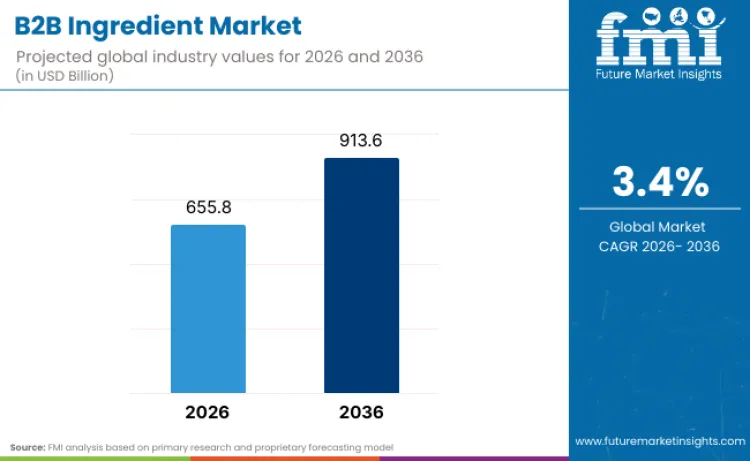
- USD 655.8 Bn
- Forecast (2036)
- USD 913.6 Bn
- CAGR (2026 to 2036)
- 3.4%
B2B Ingredient Market Forecast and Outlook 2026 to 2036
The global B2B ingredient market is projected to reach USD 655.8 billion in 2026 and expand to USD 913.6 billion by 2036, registering a CAGR of 3.4% over the forecast period. This growth reflects a structural shift away from commodity-grade inputs toward specialized, performance-driven ingredient systems that improve formulation efficiency, stability, and end-product differentiation. Manufacturers are increasingly prioritizing multifunctional actives, bio-based alternatives, and advanced delivery platforms that can replace multiple legacy components while delivering more consistent functional outcomes. Innovation is therefore concentrating on encapsulation and controlled-release architectures that maintain performance under real-world processing, storage, and distribution conditions.
“Logistics management and supply chain management are just different ways of saying capital allocation.”- Hendrith Vanlon Smith Jr., CEO, Mayflower-Plymouth
Quick Stats for B2B Ingredient Market
- B2B Ingredient Market Industry Value (2026): USD 655.8 Billion
- B2B Ingredient Market Industry Forecast Value (2036): USD 913.6 Billion
- B2B Ingredient Market Industry Forecast CAGR: 3.4%
- B2B Ingredient Market Industry Leading Type: Natural Ingredients (35.7%)
- B2B Ingredient Market Industry Key Growth Regions: China, United States, Germany, India, United Kingdom
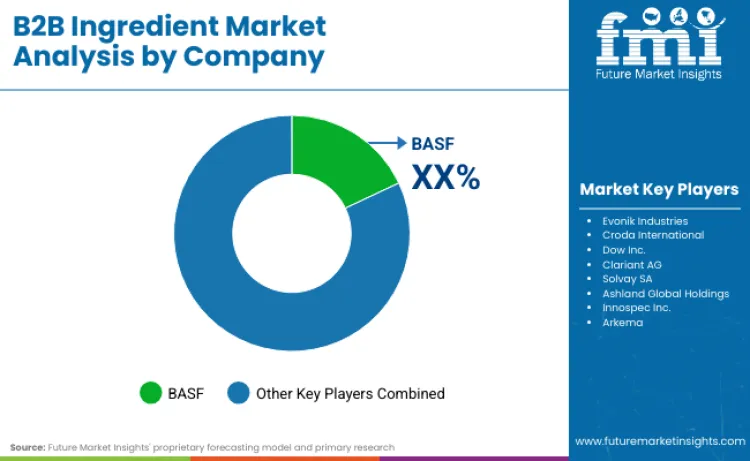
- B2B Ingredient Market Industry Key Players: BASF SE, Evonik Industries, Croda International, Dow Inc., Clariant AG
This capital-allocation perspective is reinforced by the European Union’s 2026 bio-based investment agenda under the Circular Bio-based Europe Joint Undertaking (CBE JU). Its €170.7 million funding program targets biorefinery scale-up, Safe and Sustainable by Design (SSbD) solutions for home and personal care, biotechnology pathways for biomass valorization, and circular-by-design materials. Rather than driving short-term sales, this policy framework de-risks system-level ingredient performance across safety, sustainability, and manufacturability.
As a result, large formulators are accelerating adoption of integrated ingredient systems. Suppliers gain advantage by reducing reformulation risk, providing robust technical documentation, and supporting faster scale-up across multiple end-use categories. The market’s value proposition is increasingly defined by ingredients treated as operational infrastructure rather than interchangeable procurement inputs.
B2B Ingredient Market Key Takeaways
| Metric | Value |
|---|---|
| Market Value (2026) | USD 655.8 billion |
| Market Forecast Value (2036) | USD 913.6 billion |
| Forecast CAGR (2026-2036) | 3.4% |
Source: Future Market Insights (FMI) analysis, based on proprietary forecasting model and primary research
How Is the B2B Ingredient Market Structurally Transforming Between 2026 and 2036?
Before 2026, the B2B ingredient landscape was shaped by commodity chemical sourcing where unit price dominated decision making. Manufacturers relied on multiple single purpose inputs to achieve target performance. This approach increased formulation complexity, introduced batch to batch variability, and reduced consistency across regions and production lines. Quality control became harder to standardize and indirect costs increased through reformulation, waste, and scale up risk. By 2026, the segment enters what FMI defines as the Integrated Performance Phase.
Advances in multifunctional chemistry, engineered bio based inputs, and processing compatible ingredient systems allow specialized solutions to compete with commodity inputs on formulation efficiency, manufacturing simplicity, end product consistency, and cost per function optimization. Performance outcomes improve while formulation architectures become simpler and more repeatable. Ingredient positioning also changes. B2B inputs are increasingly treated as performance enablers within advanced manufacturing systems rather than interchangeable raw materials. Croda International and Evonik Industries introduce validated ingredient architectures that replace multiple traditional components and support value led formulation design. Sourcing models shift in parallel. Price driven trading gives way to technical partnerships and co development. BASF expands technical service capacity to support formulation optimization and scale up reliability. Dow focuses on integrated material systems that simplify manufacturing workflows and improve performance across multiple end use industries.
What are the Various Segments of the B2B Ingredient Market?
The B2B ingredient market is segmented by ingredient type into natural ingredients, synthetic ingredients, biodegradable ingredients, and functional additives; by application into personal care products, cosmetic formulations, pharmaceuticals, household formulations, and industrial formulations; by functionality into emulsifiers, surfactants, thickeners & rheology modifiers, active ingredients, preservatives & stabilizers, and conditioning agents; and by region into Asia Pacific (China, Japan, South Korea, India, Australia & New Zealand, ASEAN, rest of Asia Pacific), Europe (Germany, United Kingdom, France, Italy, Spain, Nordic, BENELUX, rest of Europe), North America (USA, Canada, Mexico), Latin America (Brazil, Chile, rest of Latin America), and Middle East & Africa (Kingdom of Saudi Arabia, other GCC countries, Turkey, South Africa, other African Union, rest of Middle East & Africa).
Which Ingredient Type Holds the Largest Share in B2B Ingredients?
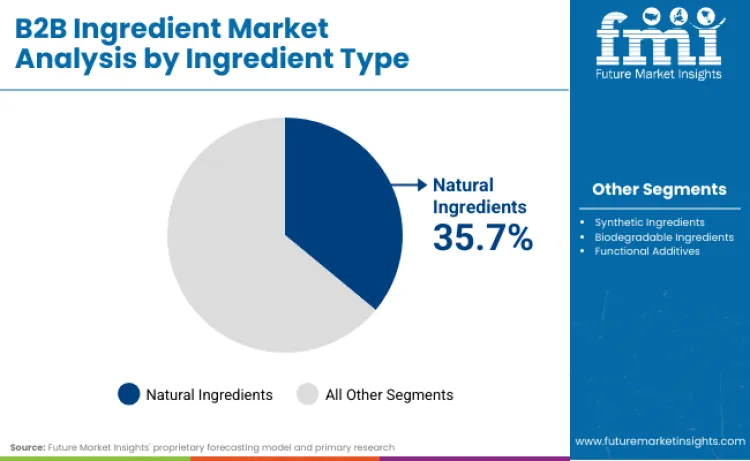
Natural ingredients lead the B2B ingredient market with a 35.7% share. This leadership is driven by clean label expectations, regulatory pressure for bio based inputs, and brand risk management across consumer facing industries. Natural systems address a core manufacturer requirement by aligning formulation performance with consumer perception and compliance needs at scale. These ingredients allow brands to support sustainability and safety positioning while maintaining functional performance in personal care, home care, and pharmaceutical applications. Market behavior supports this concentration. BASF has expanded plant derived surfactants and bio based emulsifiers across global FMCG customers. Croda International centers its portfolio on naturally derived specialty lipids and emulsifiers. Evonik Industries positions bio based actives as performance equivalent to synthetic options. Clariant advances renewable ingredient platforms for consumer goods. DSM-Firmenich combines bio based functional ingredients with strong regulatory documentation.
How Do End Use Applications Influence B2B Ingredient Preferences?
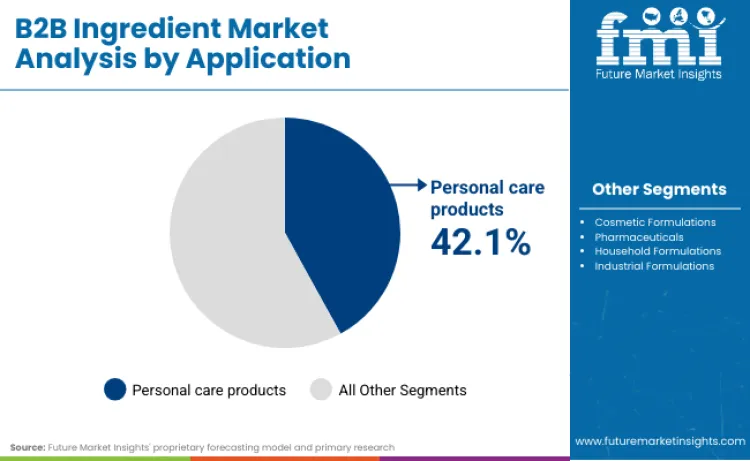
Personal care represents 42.1% of demand because ingredient choice directly shapes brand equity, regulatory exposure, and margin potential. In this segment, brands pay premiums for specialized ingredients that enable safety claims, sensory differentiation, and premium positioning. Beiersdorf prioritizes safety validated actives for sensitive skin products. Estée Lauder Companies invests in high performance natural and biotech ingredients to support prestige positioning. Pharmaceutical buyers emphasize documentation and consistency, favoring suppliers such as Lonza and BASF. Household and industrial users remain cost sensitive and adopt specialized ingredients only when performance gains justify higher input costs.
Which Functionality Is Most Demanded in B2B Ingredients?
Emulsifiers lead functional demand because modern formulations require stable multiphase systems that improve consistency and shelf life while reducing formulation complexity. Emulsifiers deliver phase stability, texture control, processing robustness, and lower ingredient counts. This multifunctional role supports cost per function optimization and explains their dominance over single purpose additives. Supplier strategies reinforce this pattern. BASF invests in advanced emulsifier platforms supported by global application laboratories. Evonik Industries develops high performance emulsifiers designed for formulation efficiency. Croda International focuses on naturally derived emulsifiers for premium and sensitive applications. Clariant supplies emulsifiers tailored for regulatory constrained markets. DSM-Firmenich integrates emulsifier technology with sensory and stability performance. Across these suppliers, emulsifiers function as formulation anchors that simplify manufacturing and protect end product quality.
Why Are Performance-Driven B2B Ingredients Gaining Structural Share?
B2B ingredients gain share when adoption decisions move away from unit cost focus toward system level performance logic. The most powerful driver is regulatory compliance becoming a license to operate rather than a differentiator. Environmental, safety, and traceability frameworks such as EU materials restrictions, Digital Product Passports, and the US FSMA Rule 204 increasingly disadvantage legacy commodity chemicals. Specialized performance driven ingredient systems are easier to document, certify, and defend during audits, which makes them structurally preferred inputs. Premiumization pressure from downstream brands reinforces this shift. Clean label positioning, sustainable sourcing, and multifunctionality now function as core value requirements that support margin expansion. Manufacturing efficiency also plays a central role. Multifunctional ingredient systems reduce SKU counts, formulation steps, and operational variability, which reframes ingredient selection as a capital allocation decision rather than a procurement substitution. These drivers translate into direct business outcomes. Regulatory compliance determines market access. Premium demand supports price realization. Manufacturing efficiency improves cost to serve and supply resilience. Adoption is therefore driven by compliance certainty, performance consolidation, and operational risk reduction rather than ingredient novelty.
What Factors Continue to Slow Adoption Despite Clear Value?
Adoption slows when switching costs and technical complexity elevate short term risk. Formulation revalidation remains the primary constraint. Even a single ingredient change can require six to twelve months of stability testing, regulatory review, and quality assurance. Supply chain concentration presents another barrier since specialized ingredient systems often rely on fewer qualified suppliers, which raises dependency concerns. Technical capability gaps also limit uptake. Advanced multifunctional or controlled release ingredients require application laboratories, process expertise, and formulation knowledge that many mid sized manufacturers do not maintain internally. Regulatory scope can further delay adoption. New ingredient classes require extensive toxicological documentation, which extends time to market compared with established chemistries. Cost benefit timing also matters. Higher upfront ingredient costs are incurred immediately while operational benefits accumulate over longer production cycles. Customer education demands remain significant since performance driven systems require deeper technical engagement than price led raw material replacement.
Why Has Adoption Momentum Accelerated in Recent Years?
Recent momentum reflects structural change rather than cyclical demand. Regulatory escalation has converted sustainability and safety from voluntary initiatives into enforceable standards, which favors bio based, multifunctional, and well documented ingredient systems. Supply chain volatility linked to climate events and geopolitical risk has exposed weaknesses in commodity sourcing and accelerated adoption of fermentation based, biotech, and locally scalable inputs that offer more consistent supply. Infrastructure shifts reinforce this trend. Digital procurement platforms increasingly integrate technical data, traceability, and compliance documentation directly into purchasing workflows, which lowers adoption friction. Industry 4.0 manufacturing and automation also favor ingredients that simplify processing and reduce variability. As a result, B2B ingredient selection is increasingly governed by compliance certainty, operational resilience, and performance consolidation rather than lowest price sourcing.
What Is Driving the Global Transformation of the B2B Ingredient Market?
Global demand for B2B ingredients is rising as manufacturing sectors transition from commodity chemical sourcing to performance driven ingredient selection. Advances in formulation science and process compatibility enable specialized ingredients to compete on functional efficiency, regulatory compliance, cost per function, and supply reliability. Growth is increasingly based on value optimization rather than price minimization. Suppliers are expanding application specific solutions, technical service capabilities, and integrated ingredient systems that deliver measurable gains in manufacturing efficiency, consistency, and end product performance. This shift is reinforced by regulatory standardization and deeper technical collaboration between ingredient suppliers and manufacturers. Ingredient selection now emphasizes compliance readiness, documentation strength, and formulation robustness across regions. Partnership based sourcing models are replacing transactional purchasing, positioning ingredient suppliers as strategic contributors to manufacturing performance rather than interchangeable raw material vendors.
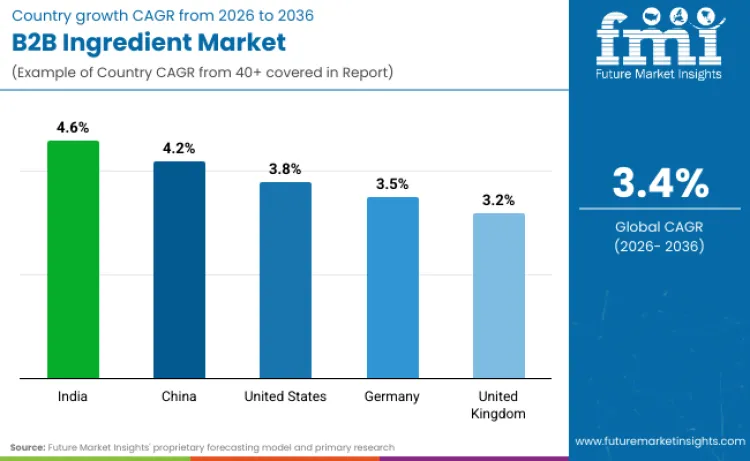
| Country | CAGR (2026-2036) |
|---|---|
| China | 4.2% |
| United States | 3.8% |
| Germany | 3.5% |
| India | 4.6% |
| United Kingdom | 3.2% |
Source: Future Market Insights' proprietary forecasting model and primary research
How Is Manufacturing Scale Reshaping the China B2B Ingredient Market?
China is projected to grow at a 4.2% CAGR from 2026 to 2036 as manufacturing scale makes ingredient optimization a core productivity driver. Vertically integrated industries across electronics, automotive, construction materials, textiles, and consumer goods rely on specialized ingredients to improve yield, consistency, and defect control at high volumes. Domestic chemical leaders such as Sinopec, Wanhua Chemical, Bluestar, and Zhejiang Longsheng embed functional additives, advanced resins, and performance intermediates into standard production recipes. Manufacturing clusters in Guangdong and Jiangsu operate with co located ingredient suppliers, pilot plants, and application engineers. This structure shortens optimization cycles and lowers logistics friction. Multinational suppliers such as BASF and Evonik Industries have expanded local technical centers to support factory level formulation tuning and scale up validation. Specialized ingredients are normalized as operational inputs that protect throughput, quality, and export competitiveness.
How Is Innovation Culture Shaping the United States B2B Ingredient Market?
The United States B2B ingredient market is expected to expand at a 3.8% CAGR from 2026 to 2036, driven by research intensity, patent protection, and technology led differentiation. Manufacturers integrate ingredient innovation early in product design to secure performance advantages, regulatory readiness, and margin resilience. Suppliers such as Dow, DuPont, Ashland, Eastman, and ADM operate extensive application laboratories and pilot facilities that support co development, rapid prototyping, and data backed validation. Procurement behavior prioritizes total value over unit price. Advanced ingredients are selected for formulation simplification, variability reduction, and faster time to market across personal care, food systems, coatings, and advanced materials. Corporate innovation programs and university partnerships sustain a pipeline of proprietary chemistries. B2B ingredients function as technology platforms with competition centered on application expertise, documentation strength, and lifecycle performance.
Why Do Precision and Documentation Define the German B2B Ingredient Market?
Germany is projected to grow at a 3.5% CAGR from 2026 to 2036, reflecting an engineering focused manufacturing culture and deep chemical heritage. Buyers prioritize predictability, documentation quality, and repeatability across long production runs. Ingredient systems are chosen for stable performance rather than trial substitution. Chemical leaders such as BASF, Evonik Industries, Lanxess, and Clariant anchor the market through integrated technical service models that combine formulation support, process optimization, and quality assurance. Ingredients undergo engineering analysis and lifecycle testing prior to adoption. This approach reduces downtime and operational risk. Alignment with European regulatory frameworks favors suppliers that provide comprehensive data packages and audit ready documentation. Specialized chemistry is treated as a predictable productivity improvement that supports compliance, efficiency, and long term manufacturing stability in cost conscious industrial environments.
What Is Driving Rapid Adoption in the India B2B Ingredient Market?
India represents the fastest growing market with a 4.6% CAGR from 2026 to 2036, supported by industrial expansion and strong cost discipline. Manufacturers across pharmaceuticals, textiles, food processing, and personal care adopt specialized ingredients when measurable gains appear in yield, consistency, or compliance. Domestic leaders such as Tata Chemicals, Aarti Industries, Pidilite Industries, and SRF Limited expand ingredient capabilities through technology transfer, joint ventures, and local scale up. Government programs supporting chemical manufacturing and exports strengthen adoption. Advanced ingredients are treated as productivity tools that reduce rework, simplify formulations, and enable access to regulated markets. Local production and regional cost structures mitigate price sensitivity. Performance per rupee guides purchasing decisions as technical capability deepens across manufacturing clusters.
How Does Specialty Expertise Sustain the United Kingdom B2B Ingredient Market?
The United Kingdom is forecast to grow at a 3.2% CAGR from 2026 to 2036, supported by strength in specialty chemicals and high value manufacturing. Manufacturers compete on formulation sophistication and regulatory credibility rather than scale. Ingredient selection favors systems that enable differentiation in pharmaceuticals, catalysts, personal care, and advanced materials. Companies such as Croda International, Johnson Matthey, Synthomer, and Victrex supply high specification ingredients supported by deep application expertise and compliance documentation. Academic and industry collaboration accelerates commercialization through research institutions and innovation hubs. Procurement decisions emphasize lifecycle value, risk reduction, and export readiness. Specialized ingredients function as strategic assets that protect margins and market access, sustaining the United Kingdom as a global center for premium performance driven B2B ingredient applications.
Which Brands Are Gaining Share in the Solid Conditioner Bars Market?
The global solid conditioner bars market is led by brands that already own repeat purchase haircare relationships and can educate consumers at the shelf without relying on niche sustainability messaging. Solid conditioner bars represent a formulation and usage shift, not a packaging change. Leading players manage trial, prove performance on hair texture and manageability, and keep consumers within a simple routine that pairs shampoo bars with matching conditioner bars. Lush is one of the largest solid conditioner bar players globally.
Its leadership is built on vertical control of product creation and a global owned retail network that positions bar based routines as everyday haircare. Lush treats shampoo bars as a core innovation and sells solid conditioners as the essential second step. This routine framing reduces adoption friction and supports repeat purchase behavior. The competitive landscape splits into two positions. One is the system owner that controls education and routine adoption, represented by Lush. The other is the mass scale follower that expands bar formats once familiarity exists. Until mass brands treat solid conditioner bars as a performance category with repeat purchase economics, leadership remains with specialists that already own the bar habit.
Recent Developments:
In November 2025, Biochem agreed to acquire BASF’s global glycinate business, expanding its organic trace minerals portfolio and distribution reach. BASF’s divestiture supports portfolio focus, while ensuring continuity for customers and advancing sustainable, science-backed animal nutrition solutions worldwide. Biochem and BASF Announce Agreement for Biochem’s Acquisition of BASF's Global Glycinate Business In September 2025, Evonik and AMSilk extended their partnership, commissioning a dedicated Slovakian production line for sustainable silk proteins.
The scale-up supports premium apparel and automotive uses, expanding Evonik’s precision biosolutions portfolio with biodegradable, biotech-derived biomaterials. Evonik and AMSilk extend partnership for sustainable biotech silk materials In May 2025, Dow expanded its personal care portfolio, debuting low-carbon silicone elastomer blends under Decarbia™ and new conditioning, styling, and film-forming ingredients. The launch included prototypes and the ProtecTress 2.0 program for advanced hair heat protection. Dow Personal Care at New York SCC Suppliers' Day 2025
Key Players in the B2B Ingredient Market
- BASF SE
- Evonik Industries
- Croda International
- Dow Inc.
- Clariant AG
- Solvay SA
- Ashland Global Holdings
- Innospec Inc.
- Arkema
- Wacker Chemie AG
- Huntsman Corporation
- Stepan Company
- Lonza Group
- DSM-Firmenich
- Eastman Chemical Company
- Momentive Performance Materials
- Shin-Etsu Chemical
- Akzo Nobel
- Covestro AG
- Lanxess AG
Market Definition
The B2B ingredient market refers to revenues generated from specialized chemical compounds, formulations, and functional additives sold to manufacturers for incorporation into end products across personal care, pharmaceutical, household, and industrial applications. These ingredients provide defined functionality such as emulsification, preservation, thickening, active delivery, conditioning, and performance enhancement that supports product development and manufacturing efficiency. Market size is measured in USD billions and evaluated over the 2026 to 2036 period. The market includes ingredients positioned strictly for manufacturer use rather than direct consumer purchase. Products are classified based on chemical functionality and industrial application instead of end use category. The scope covers natural, synthetic, biodegradable, and specialty additive systems that deliver measurable performance benefits during manufacturing. The analysis treats B2B ingredients as a distinct industrial category, separate from commodity chemicals, finished consumer goods, and upstream feedstocks.
Market Inclusion
Included in the B2B ingredient market are finished, application ready ingredient products sold through direct sales, distributors, and technical service channels to manufacturing customers. The scope covers emulsifiers, surfactants, active ingredients, preservatives, conditioning agents, and functional additives designed for integration into customer formulations across multiple industries. The market includes ingredients developed using natural and synthetic chemistry, bio based alternatives, specialty polymers, and performance enhancing additives that provide specific functional outcomes in manufacturing processes. Revenues from ingredients supplied through technical service programs, custom blends, or integrated supply agreements are included when the ingredient component is distinctly identifiable or separately priced. Geographic coverage includes North America, Europe, Asia Pacific, Latin America, and the Middle East and Africa, with country level analysis where manufacturing scale, regulatory frameworks, or technical capability materially influence ingredient adoption.
Market Exclusion
Excluded from the B2B ingredient market are commodity chemicals, raw material feedstocks, and basic chemical intermediates that lack defined functional formulation for end use applications. Finished consumer products, packaged goods, and direct to consumer chemical products are excluded regardless of performance claims or specialty positioning. The scope also excludes equipment, processing machinery, and manufacturing systems without chemical ingredient supply. Contract manufacturing services, technical consulting, and formulation services are excluded unless they involve direct sales of ingredient products. Revenues from ingredient packaging, transportation, logistics, regulatory support, and standalone technical services are not counted when chemical supply is not the primary value driver. Laboratory chemicals, analytical standards, and research grade materials with limited commercial manufacturing use fall outside the defined market boundary.
Scope of the Report
| Items | Values |
|---|---|
| Quantitative Units | USD billion |
| Ingredient Type | Natural Ingredients; Synthetic Ingredients; Biodegradable Ingredients; Functional Additives |
| Application | Personal Care Products; Cosmetic Formulations; Pharmaceuticals; Household Formulations; Industrial Formulations |
| Functionality | Emulsifiers; Surfactants; Thickeners & Rheology Modifiers; Active Ingredients; Preservatives & Stabilizers; Conditioning Agents |
| Regions Covered | North America, Europe, Asia Pacific, Latin America, Middle East & Africa |
| Countries Covered | China, United States, Germany, India, United Kingdom, Japan, South Korea, and 40+ countries |
| Key Companies Profiled | BASF SE; Evonik Industries; Croda International; Dow Inc.; Clariant AG; Solvay SA; Ashland Global Holdings; Others |
B2B Ingredient Market by Segment
Ingredient Type:
- Natural Ingredients
- Synthetic Ingredients
- Biodegradable Ingredients
- Functional Additives
Application:
- Personal Care Products
- Cosmetic Formulations
- Pharmaceuticals
- Household Formulations
- Industrial Formulations
Functionality:
- Emulsifiers
- Surfactants
- Thickeners & Rheology Modifiers
- Active Ingredients
- Preservatives & Stabilizers
- Conditioning Agents
Region:
- Asia Pacific
- China
- Japan
- South Korea
- India
- Australia & New Zealand
- ASEAN
- Rest of Asia Pacific
- Europe
- Germany
- United Kingdom
- France
- Italy
- Spain
- Nordic
- BENELUX
- Rest of Europe
- North America
- USA
- Canada
- Mexico
- Latin America
- Brazil
- Chile
- Rest of Latin America
- Middle East & Africa
- Kingdom of Saudi Arabia
- Other GCC Countries
- Turkey
- South Africa
- Other African Union
- Rest of Middle East & Africa
Bibliography
- USA Environmental Protection Agency (EPA). (2024). TSCA compliance and reporting requirements for industrial chemical ingredients. United States Government.
- American Chemistry Council (ACC). (2024). Specialty chemical industry outlook, regulatory trends, and supply chain developments. ACC Industry Report.
- Organisation for Economic Co‑operation and Development (OECD). (2024). Sustainable chemistry and bio‑based materials guidance for industrial applications. OECD Policy Papers.
Frequently Asked Questions
How big is the global B2B ingredient market?
The global B2B ingredient market is valued at USD 655.8 billion in 2026 and is forecast to reach USD 913.6 billion by 2036.
What is the growth outlook for the B2B ingredient market over the next 10 years?
The category is projected to expand at a 3.4% CAGR from 2026 to 2036, reflecting steady demand for specialized ingredients across manufacturing sectors driven by performance optimization and regulatory compliance requirements.
Which ingredient segments drive demand in this market?
Natural ingredients lead demand with a 35.7% share, supported by increasing consumer demand for clean-label products and regulatory pressure for bio-based alternatives across multiple industries.
How does market behavior differ by region?
Growth is strongest where manufacturing activity and technical capability support ingredient innovation, with China (4.2% CAGR), India (4.6%), United States (3.8%), Germany (3.5%), and United Kingdom (3.2%) showing varied growth patterns during 2026-2036.
What are the main constraints affecting this market?
Growth is constrained where formulation revalidation requirements, supply chain risk concerns, or technical expertise limitations increase switching costs from established commodity chemical approaches, reducing adoption of specialized ingredients.
Preview the report firsthand - request a free sample
Get SampleGet the brochure for pricing and purchase details.
Get PDFTable of Content
- Executive Summary
- Global Market Outlook
- Demand Side Trends
- Supply Side Trends
- Technology Roadmap Analysis
- Analysis and Recommendations
- Market Overview
- Market Coverage / Taxonomy
- Market Definition / Scope / Limitations
- Research Methodology
- Chapter Orientation
- Analytical Lens and Working Hypotheses
- Market Structure, Signals, and Trend Drivers
- Benchmarking and Cross-market Comparability
- Market Sizing, Forecasting, and Opportunity Mapping
- Research Design and Evidence Framework
- Desk Research Programme (Secondary Evidence)
- Company Annual and Sustainability Reports
- Peer-reviewed Journals and Academic Literature
- Corporate Websites, Product Literature, and Technical Notes
- Earnings Decks and Investor Briefings
- Statutory Filings and Regulatory Disclosures
- Technical White Papers and Standards Notes
- Trade Journals, Industry Magazines, and Analyst Briefs
- Conference Proceedings, Webinars, and Seminar Materials
- Government Statistics Portals and Public Data Releases
- Press Releases and Reputable Media Coverage
- Specialist Newsletters and Curated Briefings
- Sector Databases and Reference Repositories
- FMI Internal Knowledge Base and Historical Datasets
- Subscription Datasets and Paid Sources
- Social Channels, Communities, and Digital Listening Inputs
- Additional Desk Sources
- Expert Input and Fieldwork (Primary Evidence)
- Primary Modes
- Qualitative Interviews and Expert Elicitation
- Quantitative Surveys and Structured Data Capture
- Blended Approach
- Why Primary Evidence is Used
- Field Techniques
- Interviews
- Surveys
- Focus Groups
- Observational and In-context Research
- Social and Community Interactions
- Stakeholder Universe Engaged
- C-suite Leaders
- Board Members
- Presidents and Vice Presidents
- R&D and Innovation Heads
- Technical Specialists
- Domain Subject-matter Experts
- Scientists
- Physicians and Other Healthcare Professionals
- Governance, Ethics, and Data Stewardship
- Research Ethics
- Data Integrity and Handling
- Primary Modes
- Tooling, Models, and Reference Databases
- Desk Research Programme (Secondary Evidence)
- Data Engineering and Model Build
- Data Acquisition and Ingestion
- Cleaning, Normalisation, and Verification
- Synthesis, Triangulation, and Analysis
- Quality Assurance and Audit Trail
- Market Background
- Market Dynamics
- Drivers
- Restraints
- Opportunity
- Trends
- Scenario Forecast
- Demand in Optimistic Scenario
- Demand in Likely Scenario
- Demand in Conservative Scenario
- Opportunity Map Analysis
- Product Life Cycle Analysis
- Supply Chain Analysis
- Investment Feasibility Matrix
- Value Chain Analysis
- PESTLE and Porter's Analysis
- Regulatory Landscape
- Regional Parent Market Outlook
- Production and Consumption Statistics
- Import and Export Statistics
- Market Dynamics
- Global Market Analysis 2021 to 2025 and Forecast, 2026 to 2036
- Historical Market Size Value (USD Billion) Analysis, 2021 to 2025
- Current and Future Market Size Value (USD Billion) Projections, 2026 to 2036
- Y-o-Y Growth Trend Analysis
- Absolute $ Opportunity Analysis
- Global Market Pricing Analysis 2021 to 2025 and Forecast 2026 to 2036
- Y-o-Y Growth Trend Analysis 2021 to 2025
- Absolute $ Opportunity Analysis 2026 to 2036
- Global Market Analysis 2021 to 2025 and Forecast 2026 to 2036, By Ingredient Type
- Introduction / Key Findings
- Historical Market Size Value (USD Billion) Analysis By Ingredient Type, 2021 to 2025
- Current and Future Market Size Value (USD Billion) Analysis and Forecast By Ingredient Type, 2026 to 2036
- Natural Ingredients
- Synthetic Ingredients
- Biodegradable Ingredients
- Functional Additives
- Y-o-Y Growth Trend Analysis By Ingredient Type, 2021 to 2025
- Absolute $ Opportunity Analysis By Ingredient Type, 2026 to 2036
- Global Market Analysis 2021 to 2025 and Forecast 2026 to 2036, By Application
- Introduction / Key Findings
- Historical Market Size Value (USD Billion) Analysis By Application, 2021 to 2025
- Current and Future Market Size Value (USD Billion) Analysis and Forecast By Application, 2026 to 2036
- Personal Care Products
- Cosmetic Formulations
- Pharmaceuticals
- Household Formulations
- Industrial Formulations
- Y-o-Y Growth Trend Analysis By Application, 2021 to 2025
- Absolute $ Opportunity Analysis By Application, 2026 to 2036
- Global Market Analysis 2021 to 2025 and Forecast 2026 to 2036, By Functionality
- Introduction / Key Findings
- Historical Market Size Value (USD Billion) Analysis By Functionality, 2021 to 2025
- Current and Future Market Size Value (USD Billion) Analysis and Forecast By Functionality, 2026 to 2036
- Emulsifiers
- Surfactants
- Thickeners & Rheology Modifiers
- Active Ingredients
- Preservatives & Stabilizers
- Conditioning Agents
- Y-o-Y Growth Trend Analysis By Functionality, 2021 to 2025
- Absolute $ Opportunity Analysis By Functionality, 2026 to 2036
- Global Market Analysis 2021 to 2025 and Forecast 2026 to 2036, By Region
- Introduction
- Historical Market Size Value (USD Billion) Analysis By Region, 2021 to 2025
- Current Market Size Value (USD Billion) Analysis and Forecast By Region, 2026 to 2036
- North America
- Latin America
- Western Europe
- Eastern Europe
- East Asia
- South Asia and Pacific
- Middle East & Africa
- Market Attractiveness Analysis By Region
- North America Market Analysis 2021 to 2025 and Forecast 2026 to 2036, By Country
- Historical Market Size Value (USD Billion) Trend Analysis By Market Taxonomy, 2021 to 2025
- Market Size Value (USD Billion) Forecast By Market Taxonomy, 2026 to 2036
- By Country
- USA
- Canada
- Mexico
- By Ingredient Type
- By Application
- By Functionality
- By Country
- Market Attractiveness Analysis
- By Country
- By Ingredient Type
- By Application
- By Functionality
- Key Takeaways
- Latin America Market Analysis 2021 to 2025 and Forecast 2026 to 2036, By Country
- Historical Market Size Value (USD Billion) Trend Analysis By Market Taxonomy, 2021 to 2025
- Market Size Value (USD Billion) Forecast By Market Taxonomy, 2026 to 2036
- By Country
- Brazil
- Chile
- Rest of Latin America
- By Ingredient Type
- By Application
- By Functionality
- By Country
- Market Attractiveness Analysis
- By Country
- By Ingredient Type
- By Application
- By Functionality
- Key Takeaways
- Western Europe Market Analysis 2021 to 2025 and Forecast 2026 to 2036, By Country
- Historical Market Size Value (USD Billion) Trend Analysis By Market Taxonomy, 2021 to 2025
- Market Size Value (USD Billion) Forecast By Market Taxonomy, 2026 to 2036
- By Country
- Germany
- UK
- Italy
- Spain
- France
- Nordic
- BENELUX
- Rest of Western Europe
- By Ingredient Type
- By Application
- By Functionality
- By Country
- Market Attractiveness Analysis
- By Country
- By Ingredient Type
- By Application
- By Functionality
- Key Takeaways
- Eastern Europe Market Analysis 2021 to 2025 and Forecast 2026 to 2036, By Country
- Historical Market Size Value (USD Billion) Trend Analysis By Market Taxonomy, 2021 to 2025
- Market Size Value (USD Billion) Forecast By Market Taxonomy, 2026 to 2036
- By Country
- Russia
- Poland
- Hungary
- Balkan & Baltic
- Rest of Eastern Europe
- By Ingredient Type
- By Application
- By Functionality
- By Country
- Market Attractiveness Analysis
- By Country
- By Ingredient Type
- By Application
- By Functionality
- Key Takeaways
- East Asia Market Analysis 2021 to 2025 and Forecast 2026 to 2036, By Country
- Historical Market Size Value (USD Billion) Trend Analysis By Market Taxonomy, 2021 to 2025
- Market Size Value (USD Billion) Forecast By Market Taxonomy, 2026 to 2036
- By Country
- China
- Japan
- South Korea
- By Ingredient Type
- By Application
- By Functionality
- By Country
- Market Attractiveness Analysis
- By Country
- By Ingredient Type
- By Application
- By Functionality
- Key Takeaways
- South Asia and Pacific Market Analysis 2021 to 2025 and Forecast 2026 to 2036, By Country
- Historical Market Size Value (USD Billion) Trend Analysis By Market Taxonomy, 2021 to 2025
- Market Size Value (USD Billion) Forecast By Market Taxonomy, 2026 to 2036
- By Country
- India
- ASEAN
- Australia & New Zealand
- Rest of South Asia and Pacific
- By Ingredient Type
- By Application
- By Functionality
- By Country
- Market Attractiveness Analysis
- By Country
- By Ingredient Type
- By Application
- By Functionality
- Key Takeaways
- Middle East & Africa Market Analysis 2021 to 2025 and Forecast 2026 to 2036, By Country
- Historical Market Size Value (USD Billion) Trend Analysis By Market Taxonomy, 2021 to 2025
- Market Size Value (USD Billion) Forecast By Market Taxonomy, 2026 to 2036
- By Country
- Kingdom of Saudi Arabia
- Other GCC Countries
- Turkiye
- South Africa
- Other African Union
- Rest of Middle East & Africa
- By Ingredient Type
- By Application
- By Functionality
- By Country
- Market Attractiveness Analysis
- By Country
- By Ingredient Type
- By Application
- By Functionality
- Key Takeaways
- Key Countries Market Analysis
- USA
- Pricing Analysis
- Market Share Analysis, 2025
- By Ingredient Type
- By Application
- By Functionality
- Canada
- Pricing Analysis
- Market Share Analysis, 2025
- By Ingredient Type
- By Application
- By Functionality
- Mexico
- Pricing Analysis
- Market Share Analysis, 2025
- By Ingredient Type
- By Application
- By Functionality
- Brazil
- Pricing Analysis
- Market Share Analysis, 2025
- By Ingredient Type
- By Application
- By Functionality
- Chile
- Pricing Analysis
- Market Share Analysis, 2025
- By Ingredient Type
- By Application
- By Functionality
- Germany
- Pricing Analysis
- Market Share Analysis, 2025
- By Ingredient Type
- By Application
- By Functionality
- UK
- Pricing Analysis
- Market Share Analysis, 2025
- By Ingredient Type
- By Application
- By Functionality
- Italy
- Pricing Analysis
- Market Share Analysis, 2025
- By Ingredient Type
- By Application
- By Functionality
- Spain
- Pricing Analysis
- Market Share Analysis, 2025
- By Ingredient Type
- By Application
- By Functionality
- France
- Pricing Analysis
- Market Share Analysis, 2025
- By Ingredient Type
- By Application
- By Functionality
- India
- Pricing Analysis
- Market Share Analysis, 2025
- By Ingredient Type
- By Application
- By Functionality
- ASEAN
- Pricing Analysis
- Market Share Analysis, 2025
- By Ingredient Type
- By Application
- By Functionality
- Australia & New Zealand
- Pricing Analysis
- Market Share Analysis, 2025
- By Ingredient Type
- By Application
- By Functionality
- China
- Pricing Analysis
- Market Share Analysis, 2025
- By Ingredient Type
- By Application
- By Functionality
- Japan
- Pricing Analysis
- Market Share Analysis, 2025
- By Ingredient Type
- By Application
- By Functionality
- South Korea
- Pricing Analysis
- Market Share Analysis, 2025
- By Ingredient Type
- By Application
- By Functionality
- Russia
- Pricing Analysis
- Market Share Analysis, 2025
- By Ingredient Type
- By Application
- By Functionality
- Poland
- Pricing Analysis
- Market Share Analysis, 2025
- By Ingredient Type
- By Application
- By Functionality
- Hungary
- Pricing Analysis
- Market Share Analysis, 2025
- By Ingredient Type
- By Application
- By Functionality
- Kingdom of Saudi Arabia
- Pricing Analysis
- Market Share Analysis, 2025
- By Ingredient Type
- By Application
- By Functionality
- Turkiye
- Pricing Analysis
- Market Share Analysis, 2025
- By Ingredient Type
- By Application
- By Functionality
- South Africa
- Pricing Analysis
- Market Share Analysis, 2025
- By Ingredient Type
- By Application
- By Functionality
- USA
- Market Structure Analysis
- Competition Dashboard
- Competition Benchmarking
- Market Share Analysis of Top Players
- By Regional
- By Ingredient Type
- By Application
- By Functionality
- Competition Analysis
- Competition Deep Dive
- BASF SE
- Evonik Industries
- Croda International
- Dow Inc.
- Clariant AG
- Solvay SA
- Ashland Global Holdings
- Innospec Inc.
- Arkema
- Wacker Chemie AG
- Competition Deep Dive
- Assumptions & Acronyms Used


